





Introduction: The plateau of the Holocene
No Homo sapiens alive 11,700 years ago would have had knowledge that the oscillating climatic conditions that had previously dominated human existence in the Pleistocene would soon end and usher in a new age, wonderfully suited for human development and civilisation due to a largely stable and predictable long term climate (15°C average, plus or minus 1°C, Schönwiese, Reference Schönwiese and Hante2005). Looking back, one might call this a golden age for hominins such as us, as the stable temperature (Figure 1) and predictably mild climactic conditions (15°C average), provided the foundations for the growths in human society, agriculture, technology and the production of human language and meaning. Nature was largely seen as a resource, or something to be tamed and controlled to the benefit of humans; of course, animist shamanism and cultures working together in and part of nature still existed (Greenwood, Reference Greenwood2020, pp. 39–58), but they were progressively exiled to the outside of the sedentary mainstream, whose focus was on the maximisation of conditions to the benefit of humans, for example, by constructing cities, hierarchies, planned harvests and water supplies and laws to live and work by that ignored the diversities in and of ecologies and the chaos of nature. One may designate this sedentary hominin mainstream as the ultimate human product of the Holocene (Figure 1), and the flattened surface onto which human desire and striving has been corralled and reproduced; importantly involving education as a mechanism for steering and maintaining the status quo, keeping humanity focused on their own growth and building and cultivating knowledge that preserves human domination of the natural world (Brennan, Reference Brennan2007).
The evolution of temperature during the Holocene era and the key mechanisms responsible for the increase in temperature over the last 12,000 years. Credit: Samantha Bova (Rutgers university, 2021). Educational graphic open (cc) licence.

Even though every human civilisation that has arisen and fallen over the last 11,700 years has its own distinct qualities and characteristics such as languages, customs and different sets of beliefs, technologies and modes of governance and power, it is the contention of this paper that the unequalled climatic stability of the Holocene (15°C ± 1°C), has seen a generalised homogenisation of these cultures over time into the contemporary global, one world, capitalist society of today (cf., Hornborg, Reference Hornborg2023). For example, religion has largely merged into monotheism, scientific rationality now (most frequently) underpins the practice of medicine, global economic governance determines the social order through finance and the mechanics of globalisation has (re)aligned specific traditions and cultures, into one world commercial activities that now dominate the Earth through anthropogenic effects (Stearns, Reference Stearns2023, pp. 91–135). In effect, the Holocene plateau now consists of a planetary human civilisation, into which reciprocating mechanisms such as education, commerce, technology and power have normalised the ongoing status quo and that are constantly being programmed to (re)make and (re)mould the world in the image of the Holocene human, Homo economicus (Thaler, Reference Thaler2010). It is this image of thought and such a machine of human/non-human becoming (i.e., the “technosphere,” Haff, Reference Haff2014) that must be questioned and resolved if progress towards a better future in the Anthropocene is to be made; and it is to this end that this paper deploys the tipping points as devices to unhinge the claims to exceptionalism that the Holocene plateau has bestowed on Homo sapiens.
What is a tipping point?
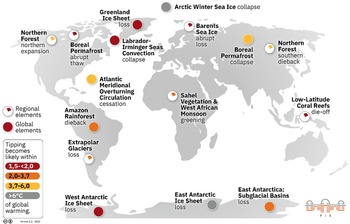
Tipping points are planetary changes in the Earth’s composition and form that are being instigated as global warming ramps up (Figure 2). As Figure 2 demonstrates, there are (at least) sixteen global and local tipping points, that are being triggered and will escalate as temperatures rise (Ritchie et al., Reference Ritchie, Clarke, Cox and Huntingford2021). As we move away from the stability of the Holocene average 15°C ± 1° ranges for the last 11,700 years, the tipping points will trigger others, until the tipping points cascade, and induce positive feedback effects, such the melting of the polar ice caps, which leads to less sunlight being reflected into space, and hence further warming of the planet. Even though the tipping points are depicted as sixteen separate “events” through this diagram, they are, of course, entirely interlinked and constitute part of the systematic changes that are occurring in the Anthropocene due to human action. The focus of the tipping points is to understand their moving ecologies, the physical dynamics and its interrelatedness, in a complex and interdependent manner. In this way, it might be possible to grasp the planetary scale and state of change that we are enabling through our global activities and hence try to reverse these processes or at least slow them down (Wunderling et al., Reference Wunderling, von der Heydt, Aksenov, Barker, Bastiaansen, Brovkin and Willeit2024).
The geographical distribution of global and regional tipping elements, colour-coded according to the best estimate for their temperature thresholds, beyond which the element would be “tipped.” Figure designed at PIK (2023) (under cc-by licence), based on Armstrong McKay et al. (Reference Armstrong McKay, Staal, Abrams, Winkelmann, Sakschewski, Loriani and Lenton2022).

Firstly, the tipping points, once reached are irreversible (Buhr et al., Reference Buhr, Lenzi, Pols, Brunner, Fischer, Staal and Bovenkerk2025) (at least on a human timescale). In effect, this means we (as humans) are always at the point of chasing the next tipping point and trying to stop it from happening, if we are to stave off its long-term effects. Furthermore, we should be doing everything in our powers to avert tipping points that are not going to happen in our lifetimes, such as the complete dissolution of the polar ice caps, which according to Figure two, will occur after global warming exceeds 6°C (e.g., Sanderson et al., Reference Sanderson, Hemming and Betts2011), because they will detrimentally impact future generations (and other/all life on Earth). As such, the tipping points create an immanent picture of potential catastrophic changes in the Earth environment, that will unhinge the Holocene away from its beneficial plateau and onto an unstable set of peaks and troughs that will test the adaptability and resilience of every human community and individual on planet Earth (Juhola et al., Reference Juhola, Filatova, Hochrainer-Stigler, Mechler, Scheffran and Schweizer2022), perhaps even more than the Pleistocene (e.g., Jones et al., Reference Jones, Marín-Arroyo, Straus and Richards2020). Such immanence defines a moment of revelation/awareness that is internal to us and our actions, yet is simultaneously future-driven and considers our ethical responsibility for the planet, and what will come next in terms of human society and its potential prosperity/survival/regeneration as well as all life on Earth. I would suggest that such complexity, and, as such, the physical dynamics of the tipping points, and their complex inter-relatedness (and interdependence) as a moving change mechanism for human and planetary existence, can only be understood through what Deleuze/Guattari (1987) term as “the rhizome,” and the resultant practice of “rhizomatics” (e.g., Irwin et al. Reference Irwin, Beer, Springgay, Grauer, Xiong and Bickel2006). Any model that does not have the internal and essential complexity of the rhizome (i.e., subterranean/non-representative/unconscious/laterally branching), will fall back into dualism and ultimately be a cause for inaction and hinder the plunging and marking of the tipping points on human motivation, by creating impasses between thought and physical activityFootnote 1 . These impasses are created by models that function as modes of governance for the Anthropocene rather than acting as internal and external motivation to change. To avoid the creation of such a mental and physical ravine, I propose that we firstly explore the time dimension from the perspective of the rhizome before we expand it into an educational practice suitable for the tipping points.
Time in the AnthropoceneFootnote 2
The phrase “tipping point” denotes a change in time, a point after which time changes. In the terms of this essay, the tipping points are happening in the Anthropocene, a time wherein human existence on planet Earth has become “telluric”; as such, we are now collectively a force of nature, that is changing the very dynamics of the Earth’s planetary systems (e.g., Crutzen, Reference Crutzen, Crutzen, Eds. and Crutzen2016). This time in the Anthropocene has also been termed as “accelerated,” because human activity has gone beyond nature and has created a milieu that reciprocates itself, that can be seen, for example, in the pan-connected digital sphere of the internet, or in the new regimes of 24/7 modes of work dependent on the fluctuations of global markets that never sleep and have nothing to do with natural forces (e.g., Crary, Reference Crary2013). Hence, these developments, which have their roots in the Industrial Revolution and the ways in which time, labour and capital have become interdependent and self-augmenting (Allen, Reference Allen2009), introduces us to the “time of the Anthropocene.” Marx theorised the metabolic rift due to this time (Foster, Reference Foster1999) based on his analysis of industrial relations and how natural resources were being increasingly exploited for profit, a process that he termed as a material exchange with nature, or metabolism. The process of the creation of the metabolic rift has more recently been amplified and expanded to express the ecological damage that humans are enacting on and in the world through industrial activities (Moore, Reference Moore2011), as well as the continued separation of humans from nature and its rhythms. Thus, the accelerated time milieu of the Anthropocene is shot through with capitalism and technology and represents a time when humans have become disassociated with the time of nature.
The question that concerns this essay is whether we can still access the pre-Anthropocene, pre-metabolic rift time rhythms, to be closer and/or part of nature? Of course, remnants of pre-modern, pre-industrial human societies exist, for example, in the hunter gathers of the Amazon rainforest, or in the nomads of the mountainous plains of Kyrgyzstan (e.g., Otunchieva et al., Reference Otunchieva, Borbodoev and Ploeger2021). However, these human societies are isolated and continually under threat from absorption into one world capitalism. Rather, focused, and concentrated methodologies are required to inculcate a time other than the accelerated, universal time of contemporary capitalism and its proliferation of consumptive signs. The secret here is not to think of this time as retrogressive, primitive/pre-modern, nostalgic, romantic, or an idealistic fantasy built from a hippie dream, or a “nowhere” (Cole, Reference Cole2019) in contrast to “today/now/here.” Rather, the achievement, understanding and practice of this time is complex, and requires resources such as Bergson’s (Reference Bergson2004) internal and creative notion of durée, and the fixation on long-term time that is resistant to perturbation and the continual breakup of contemporary consumptive/commercial/capitalist time. Elsewhere, I have theorised this time in terms of the devolution of global capitalist community into smaller units and had incorporated a change of consciousness model into these projected necessary social changes in the Anthropocene for survival and adaptation (Cole, Reference Cole2021, pp. 121–137). Along with a degrowth model of economics (Kallis et al., Reference Kallis, Kerschner and Martinez-Alier2012) and a critical, political and planetary model of immanent change, the change of consciousness model for the strengthening of projected small scale, adaptive and resilient societies is based on the practice of Buddhism. In the next section, I will take this tripartite model forward, along with the rhizomatics above and combine them into a workable toolbox for survival in the Anthropocene through education.
Toolbox for survival in the Anthropocene
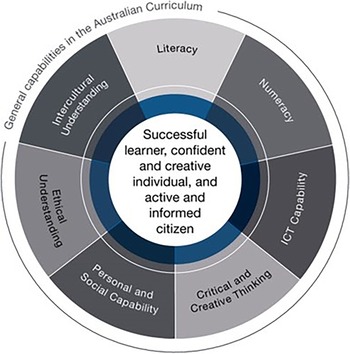
This article reconciles the rippling and dappled force of the dispersive power of the rhizome with doing something about the eventuality of the tipping points though education (cf., Gregoriou, Reference Gregoriou2004). Such a framework for education maps tipping points not as isolated events, but as part of a sprawling, decentralised, non-hierarchical web of ecological influences, where connections, feedback loops and emergent properties drive transformation in the system and individually as agency (Colocci, Reference Colocci2024, pp. 31–49). In sum, this essay emphasises fluidity, multiplicity and the unpredictable interplay of factors rather than linear causality and in contrast to normative models of educational work, such as the ACARA (2008) model of a “successful leaner” (Figure 3). The rhizomatics of this article works against the certainty implied by the ACARA (2008) model, and, by extension, against the ways in which Environmental Education (EE) and Education for Sustainable Development (ESD) create stable knowledge fields, and thus give the impression to the agent that simply by following their rules, problems such as the tipping points of the Anthropocene will be solved (Kopnina, Reference Kopnina2014; Wallin, Reference Wallin2022). In contrast, rhizomatics works against the general capabilities of the Australian Curriculum (Figure 3), in that the connection between knowledge and capability fields, e.g., literacy, is not stable and fixed in that “becoming literate” necessarily implies success. Rather, “becoming literate” is part of a journey in spacetime, wherein complex multiplicities cohere and disassociate, and in terms of the tipping points, build knowledge and expression around theses points, and thus developing, in the case of this article, “tipping point literacy” (cf., Masny & Cole, Reference Masny and Cole2009). This mode of literacy can feed into EE and ESD, but not as a straightforward constructivism if this implies building a stable, arborescent process. Tipping point literacies line up alongside every other in the fields of EE and ESD to contest the grounds upon which the knowledge is based, and, as such, the rhizomatics of the tipping points questions how and why one acts according to EE and ESD. Thus, the rhizomatic approach to literacy is not simply to set it into place alongside other capabilities, EE and ESD and the active citizen (Figure 3), but bundles it with other material forces that pass through the mind due to a specific spacetime, and thus creating a moving picture, or dynamic cartography, appropriate for understanding and working alongside whatever concept is under investigation, in this case, the tipping points (cf., Cole & Mirzaei Rafe, Reference Cole and Mirzaei Rafe2017). In the next section, I will expand the educational theory of a rhizomatics of tipping points to explore their foundations, i.e.: i) affect; ii) creativity.
The Australian curriculum includes seven general capabilities (ACARA, 2008). Open access (cc-licence) educational figure.

Social–emotional states in the Anthropocene
The social–emotional states produced by teaching and learning about the tipping points will oscillate between dread, anxiety and indifference. For example, it has been calculated that the melting of the West Antarctic glaciers that feed into its ice sheet would cause a global sea level rise of approximately three to four metres (Pan et al., Reference Pan, Powell, Latychev, Mitrovica, Creveling, Gomez and Clark2021)Footnote 3 . If this were to happen, it would be dreadful for coastal and low-lying areas, and the inevitable inundation that this sea level rise would create there, and students and teachers might quite rightly feel anxious about this. Contrastingly, the fact that this tipping point, even though it has been identified as red in (Figure 2) and in the 1.5°C–2°C temperature rise band, where we currently sit, is still not of immediate danger to us, and, as such, populations might simultaneously be indifferent to its existence and impact on their lives (cf., Sims & Finnoff, Reference Sims and Finnoff2016). Hence, the teacher in these situations is a modulator in terms of mitigating against the misery and fear that the reality of the tipping points could create, so their communication does not create hysteria, panic and confusion in the student body, yet, at the same time, warding against complacency and the sense that action to stave off the tipping points is futile and not worthwhile (e.g., Kolenatý et al., Reference Kolenatý, Kroufek and Činčera2022). Furthermore, rather than describing the situation in emotional terms, the modulation of the class in the context of teaching and learning about tipping points can be better understood in terms of affect (Cole, Reference Cole, Semetsky and Masny2013). Affect theory has a long and varied history in philosophy and psychology, starting with the philosophy of Baruch Spinoza in 1677, and, more recently, being appropriated by the humanities and social sciences in the “affective turn” to understand the concept of embodiment (e.g., Kim & Bianco, Reference Kim and Bianco2007).
The power of the tipping points for affect theory and for educative purposes, is that they function as plunge points, or singularities in the maelstrom of everyday educational practice (Cole et al., Reference Cole, Rafe, Yang-Heim, Cole, Rafe and Yang-Heim2024, pp. 1–16). The tipping points are starting now but fixed as happening in the future, and predefined as instances wherein changes to the Earth’s physical makeup, geography and atmospheric chemistry, will create new and hostile conditions for humans to exist and survive, as we move away from the stable Holocene. The importance of the tipping point as affect is that it is presently out of sight, and therefore not possible to render as a straightforward scientific observation or measurement, but only as a prediction or extrapolation from what we currently know and can observe (cf., Schneider et al., Reference Schneider, Turner and Garriga1998). Thus, the tipping points involve and induce the use of the imagination as a crucial part of the “affect” that can be felt and related to in the teaching and learning environment (or ignored), wherein the tipping point is scrutinised. In terms of the rhizomatic methodology of this article, it is worth comparing the outcomes of the application of the rhizome to this imaginative “affect” of teaching and learning about the tipping points, and how social–emotional states can be understood in an educational context designed for the future, and as this corresponds to the tipping points (e.g., Figure 4).
Portrait of a Future Ready Student (Future design school, 2022, 19). Educational use permitted under cc-licence.

The social–emotional states of the “future ready” student according to this schema for “future design school” (Figure 4, in red) are: (i) Responsible Decision Making; (ii) Emotional Intelligence; (iii) Self + Social Awareness; (iv) Self-Regulation and (v) Healthy Relationships (Future Design School, 2022, 22). Firstly, “responsible decision making” is made more circuitous and indirect through application of the rhizome and affect. Such an interjection allows for and encourages questioning of this specific decision making, for example, why are we making decisions? What is meant by “responsible”? In the context of the tipping points, “responsible decision making” involves paring back from using fossil fuels, switching to renewable energy sources wherever possible, and using circular economies for recycling (e.g., Murray et al., Reference Murray, Skene and Haynes2017). However, such decisions are not always viable, and hence the affective rhizomatic approach redefines them as distributive potential, as the desire to improve our chances of not exceeding the tipping points, and as this desire transferring to action wherever possible. Emotional intelligence is refigured with respect to the rhizome and affect in terms of sensitivity to and comprehension of atmospheres, and having the wisdom and patience to wait for the right opportunity to make change happen (to avoid the tipping points), rather than applying emotional intelligence as a universal and measurable attribute of the thinking subject, that will result in a ranking of this intelligence, e.g., as part of an interview process (O’Connor et al., Reference O’Connor, Hill, Kaya and Martin2019). Self + social awareness is important in terms of affect and the rhizome, yet transformed into being less about the self, and more about encounters with the world, and how they play out, for example, what are the environmental consequences of the future school and its design, how can they be made sustainable? Hence, the human self is diminished in terms of the “affect” and rhizomatic approach to education, and it is distributed amongst planetary processes such as the formation of the tipping points, and how to circumvent their inevitability (cf., Brailas, Reference Brailas and Khine2023). Similarly, self-regulation is less about the self in terms of affect and the rhizome, and involves analysis of human desires and appetites, and how they are using planetary resources such as food and water, and how they can be modified in the contemporary situation. Such analysis inevitably leads to the root causes of these appetites and desires, and the systems that they depend on, that are often consumer capitalist in nature, augmented and replicated through social media (cf., Gilroy-Ware, Reference Gilroy-Ware2017, pp. 19–58). Lastly, in terms of the future design school figure (Figure 4), the notion of healthy relationships is equally important in terms of the rhizomatic and affect theory approach to social–emotional states in education. However, in line with the previous four aspects of socio-emotional states as sieved through the rhizome and affect, healthy relationships are scrutinised further, and questioned for being homogeneous, or relying on a normative understanding of what is healthy that might not be universal (e.g., Fedoryka, Reference Fedoryka1997). Rather, healthy relationships in terms of this article should lead to the lowering of consumption, humans living within the resources and means of their specific biome, and, in addition, having the consequence of returning to smaller scale societies, that are specifically adaptive and resilient in terms of what will come, as we approach and enter the tipping points (Cole, Reference Cole2021, pp. 121–137).
Pedagogic creativity in the Anthropocene
Teachers acting alone will not solve the climate crisis, or the other interrelated crises that we are approaching in the Anthropocene, such as those represented by the tipping points (Beach, Reference Beach2023). Rather, teachers can only: (1) Understand what is known about how we have arrived in the Anthropocene and have created the tipping points; (2) Devise curricula, assessment and teaching and learning experiences based on the best ways forward given the historical precedents and tendencies that are currently ongoing in the Anthropocene; (3) Find new ways to insert these experiences into their living, interconnected and future practice(s), given local and national constraints, such as the organisation and regulation of education and teaching at different levels by bureaucratic power-based structures (Cole & Gannon, Reference Cole and Gannon2017). Taken together as a whole, I would like to name these interconnected educational processes as “pedagogic creativity in the Anthropocene,” and suggest that this conjunction signifies a movement from science (understanding the facts of the Anthropocene), to philosophy (being able to create new concepts and speculate theoretically about the Anthropocene), to art (being able to practice a new transformative pedagogy fit for the Anthropocene) (cf., Deleuze & Guattari, Reference Deleuze and Guattari1994). This section expounds upon and explains this movement (from science to art) with respect to the rhizomatic and affect theory basis of this essay and relates it directly back to what teachers can do today to help act with respect to the global tipping points (Figure 5).
Pedagogic creativity in the anthropocene: [Science > Philosophy > Art].

Firstly, the science of the Anthropocene for teachers does not stop at the level of accessing and disseminating peer reviewed articles that have described what is known in the field. The science for teachers in the Anthropocene, and as the starting point for the schema for creativity (Figure 5), must investigate the local effects of the move into the Anthropocene, as well as the global effects, such as the tipping points of this article. The rhizomatic, affect based approach of this paper, means that science for the Anthropocene can be practised in unexpected and new ways (Gough, Reference Gough2006). For example, changes in climate, the water cycles and human population and its consumption (e.g., food and electricity production and usage) can be observed, measured and mapped, in processes of local cartography, which will enable rich and nuanced perspectives on the Anthropocene. This research-based education should be interactively undertaken in the local environment of the lessons and school/college/university, and produce new concepts, as the next part of this process for pedagogic creativity will describe as philosophy (Deleuze & Guattari, Reference Deleuze and Guattari1994) (Figure 5).
Parallel to the initiation of the process for pedagogic creativity in the Anthropocene through a new science for the Anthropocene (Cole, Reference Cole and Murris2020), teachers do not have to be trained philosophers to do the new philosophy for the Anthropocene (Clark, Reference Clark2013). Rather, once the groundwork of the science of the Anthropocene has been completed using qualitative and quantitative methods, the teachers should speculate philosophically about the concepts that may arise given the evidence that the initial stage of pedagogic creativity shall produce. For example, if water shortages are apparent in the local area, and changes are happening due to climate change that will extenuate drought and food shortages, the concepts produced through the new Anthropocene curriculum might be prefixed with hydro, e.g., hydro-shortage; hydro-distribution; hydro-clear (for polluted water); hydro-fresh (for desalination); hydro-search; hydro-collection; hydro-storage; hydro-investigation; hydro-imagination; hydro-transformation, hydro-environment … (Cole, Reference Cole2025). In other words, the philosophical aspect of the pedagogic creativity for the Anthropocene will create a constellation of interrelated ideas (or patchworks), that conceptually map the empirical facts that have been discovered during the first phase of the creative pedagogy for the Anthropocene. Furthermore, it is important at this stage to note that the philosophical creation of concepts does not emanate and relate to human only concerns, which would amount to a (re)anthropomorphising of the available data based on human ego. Rather, in the example of water shortages given above, the entire environment requires water to sustain itself and survive, a fact recognised and incorporated into ritual, myth and worship by the Aboriginal Australians for millennia (Somerville, Reference Somerville2013).
Lastly, the aspect of art finishes the cycle of teacher creativity that begins with science and philosophy. Art is important due to the imperative to create action, and to inspire teachers and students to do something about the tipping points, and not to leave it to others to deal with these problems. The chosen method of rhizomatics and affect for pedagogic creativity means that art must surprise, question, challenge and even exacerbate problems, rather than produce systemic solutions to the tipping points (Irwin et al., Reference Irwin, Beer, Springgay, Grauer, Xiong and Bickel2006). Art should impinge upon the unconscious and the drives that have created the Anthropocene, that I have elsewhere figured as; Tool-enhancement; the Carbon trails; the Phallocene and Atomic time (Cole, Reference Cole2021, pp. 21–102). This means, for example, when going back to the water usage, e.g., showing how water is being used for data centres in the local area, or sources of water pollution and their effects, enlarging the images of water borne pathogens in the area, or, making creative soundscapes of the noise that water creates as it interacts with the immediate environment. In sum, the art of creative pedagogies should be an unbounded activity and open the imagination to the effects of the Anthropocene, for example, on water (Somerville, Reference Somerville2013). Simple moral messages, such as to avoid water wastage and the overusage of water will have less impact than being able to unleash the full potential of the imaginations of the cohort, and to inspire others to think about water and its life in the environment. The art of creative pedagogy would loop back to the science of the cycle, as seen in (Figure 5), as creativity is recursive and self-augmenting, given the three parts of its production. Teachers and students would be able to pick up and experiment with this cycle and process as their needs, abilities, time and capacities allow and encourage, noting that momentum, drive and the creation of inter-relationships are crucial to its overall success and implementation (Cole & Mirzaei Rafe, Reference Cole and Mirzaei Rafe2017).
Conclusion: Beyond the tipping point hypothesis
The documentary, Breaking Boundaries: The science of our planet depends on its viewers changing their perspective and position from being consumers of climate documentaries to doing something about the tipping points through their everyday actions. Education is a mediating activity that can take on this role of “surge director” between viewing and understanding the scientific facts and human drivers that are leading to the tipping points and organising activities that help to mitigate their effects (e.g., Lehtonen et al., Reference Lehtonen, Salonen, Cantell and Cook2018). One way to understand this “surge direction” is through the “pedagogy of cinema” (Figure 6). A pedagogy of cinema was inspired by Deleuze’s (Reference Deleuze1992, Reference Deleuze2005) cinema books and is a means to translate the philosophical thinking that happens in and through the images in film into action. As can be seen in Figure six, the images of films are not left as flat depictions on a screen, but set up cybernetic feedback processes with the audience, to enhance the thinking that transpires in cinema. In the example of Breaking Boundaries, the pedagogy of cinema helps to render the realisation that we must act on mass to avert the tipping points and not dismiss this example of cinema as another (mere) alarmist climate wake-up call or wait for “magical thinking” to encompass the human world.
A pedagogy of cinema (Cole & Bradley, Reference Cole and Bradley2016, 4) © Karin Mackay.

In the end, will the methodology of this article to help mitigate the effects of the tipping points? The processes outlined in this paper, going from science to art via philosophy and incorporating rhizomatics and affect are designed to augment and diversify the ways in which the tipping points can be taught and learnt about, and, as such, the transformation of education along the lines of this paper are essential to make this schema real (so that rhizomatics, affect and the journey from science>philosophy>art can become part of mainstream educational practice). Currently, education is tied up by processes that are designed to allow governments to know what is happening in education and, subsequently, in society (e.g., Rose, Reference Rose2000). As a backdrop to the knowledge of education and society by power, regulatory bodies have themselves become part of the global capitalist web of financial influence, and thus this sphere of influence directly enters the everyday lives of teachers and students through educational practice. In corollary, if the schema of this paper is to work, education needs to be taken away from governmental, corporate and financial directives and returned to small scale communities truly concerned with environmental renewal, and where the local action to avoid the tipping points can be organised and achieved as: rhizomatics + affect and science > philosophy > art.
Acknowledgements
The author would like to acknowledge the Centre for Regenerating Futures at Deakin University, and Dr Peta White for the invitation to present this paper in October 2025.
Financial support
This research received no specific grant from any funding agency, commercial, or not-for-profit sectors.
Ethical statement
This paper does not need ethics permission as no empirical data was collected for its construction.
Author Biography
David R. Cole is employed by Western Sydney University as an Associate Professor in the philosophy of education and cultural analysis. He runs a research programme called “Education in the Anthropocene” at Western Sydney and is a coordinator of the “Education in the Anthropocene” network of the World Education Research Association. Cole has been collaborating on funded projects since 1996 and has contributed 18 books and 130+ other significant publications to the field. His latest book is called: Educational Research and the Question(s) of Time, and he is currently working on a collection that enables creative philosophy to function in the Anthropocene.



 Open access

