

Hostname: page-component-77f85d65b8-hzqq2 Total loading time: 0 Render date: 2026-03-27T09:16:06.682Z Has data issue: false hasContentIssue false

Splash on a liquid pool: coupled cavity–sheet unsteady dynamics

Published online by Cambridge University Press:  27 December 2024

R. Dandekar
Affiliation:
The Fluid Dynamics of Disease Transmission Laboratory, Fluids and Health Network, Massachusetts Institute of Technology, Cambridge, MA 02139, USA
N. Shen
Affiliation:
The Fluid Dynamics of Disease Transmission Laboratory, Fluids and Health Network, Massachusetts Institute of Technology, Cambridge, MA 02139, USA
B. Naar
Affiliation:
The Fluid Dynamics of Disease Transmission Laboratory, Fluids and Health Network, Massachusetts Institute of Technology, Cambridge, MA 02139, USA
L. Bourouiba*
Affiliation:
The Fluid Dynamics of Disease Transmission Laboratory, Fluids and Health Network, Massachusetts Institute of Technology, Cambridge, MA 02139, USA
*
Email address for correspondence: lbouro@mit.edu

Abstract

Splashes from impacts of drops on liquid pools are ubiquitous and generate secondary droplets important for a range of applications in healthcare, agriculture and industry. The physics of splash continues to comprise central unresolved questions. Combining experiments and theory, here we study the sequence of topological changes from drop impact on a deep, inviscid liquid pool, with a focus on the regime of crown splash with developing air cavity below the interface and crown sheet above it. We develop coupled evolution equations for the cavity–crown system, leveraging asymptotic theory for the cavity and conservation laws for the crown. Using the key coupling of sheet and cavity, we derive similarity solutions for the sheet velocity and thickness profiles, and asymptotic prediction of the crown height evolution. Unlike the cavity whose expansion is opposed by gravitational effects, the axial crown rise is mostly opposed by surface tension effects. Moreover, both the maximum crown height and the time of its occurrence scale as ${\textit {We}}^{5/7}$. We find our analytical results to be in good agreement with our experimental measurements. The cavity–crown coupling achieved enables us to obtain explicit estimates of the crown splash spatio-temporal unsteady dynamics, paving the way to deciphering ultimate splash fragmentation.

Information

Type
JFM Papers
Copyright
© The Author(s), 2024. Published by Cambridge University Press

Access options

Get access to the full version of this content by using one of the access options below. (Log in options will check for institutional or personal access. Content may require purchase if you do not have access.)

Article purchase

Temporarily unavailable

Supplementary material: File

Dandekar et al. supplementary movie 1

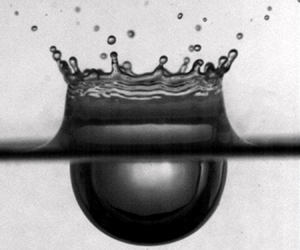
Time evolution of an approximately cylindrical splash crown that forms after a drop-pool impact, as given in Figure 2b. Here the initial drop has a diameter of 4.56 mm and an impact velocity of 3.95 m/s. The Weber number is 990. This video was recorded with 12500 frames per second.
Download Dandekar et al. supplementary movie 1(File)
File 19.8 MB
Supplementary material: File

Dandekar et al. supplementary movie 2

Particle tracking for the sheet velocity measurement, as given in Figure 4d. Polyethylene microspheres are used as seeded particles. They are approximately 50 μm in diameters, with error on position of their center, no larger than 3 pixels, that is smaller than the displacement over the sampling time. In this case, the crown sheet develops from a drop of 4.3 mm diameter and 3.8 m/s impacting velocity. The Weber number is 900. This video was recorded with 12500 frames per second.
Download Dandekar et al. supplementary movie 2(File)
File 18.4 MB