





1. Introduction
Fluctuations in the flow field at relatively low frequencies compared with the most dominant frequency have been reported in various flow configurations (Berger, Scholz & Schumm Reference Berger, Scholz and Schumm1990; Zelman & Maslennikova Reference Zelman and Maslennikova1993; Chang & Malik Reference Chang and Malik1994; Yokota, Nagata & Nonomura Reference Yokota, Nagata and Nonomura2025). These low-frequency components typically exhibit large-scale spatial structures and influence a broad spectrum of frequencies throughout the flow. Identifying their presence and understanding their impact on other frequency components is therefore important for a comprehensive interpretation of flow dynamics. In flows around an object, such low-frequency fluctuations have been identified from time-series data of velocity fields, as well as drag and lift coefficients (Berger et al. Reference Berger, Scholz and Schumm1990; Najjar & Balachandar Reference Najjar and Balachandar1998; Jiang, Cheng & An Reference Jiang, Cheng and An2017; Jiang & Cheng Reference Jiang and Cheng2017). These fluctuations are frequently observed in complex flow regimes, particularly at high Reynolds numbers ( $\textit{Re}$
). Recent advances in data-driven science have made it increasingly feasible to detect and analyse these low-frequency components (Ohmichi, Kobayashi & Kanazaki Reference Ohmichi, Kobayashi and Kanazaki2019; Okano et al. Reference Okano, Sato, Nagai and Ohnishi2024; Yokota & Nonomura Reference Yokota and Nonomura2024; Yokota et al. Reference Yokota, Nagata and Nonomura2025). Nevertheless, the precise conditions that give rise to such components and their influence on the overall flow dynamics remain incompletely understood.
$\textit{Re}$
). Recent advances in data-driven science have made it increasingly feasible to detect and analyse these low-frequency components (Ohmichi, Kobayashi & Kanazaki Reference Ohmichi, Kobayashi and Kanazaki2019; Okano et al. Reference Okano, Sato, Nagai and Ohnishi2024; Yokota & Nonomura Reference Yokota and Nonomura2024; Yokota et al. Reference Yokota, Nagata and Nonomura2025). Nevertheless, the precise conditions that give rise to such components and their influence on the overall flow dynamics remain incompletely understood.
Roshko (Reference Roshko1954) identified low-frequency fluctuations, which are approximately one-tenth or less of the primary shedding frequency, in the time history of velocity fluctuations in the wake of a spanwise-uniform circular cylinder across an $\textit{Re}$
range of
$\textit{Re}$
range of $40$
to
$40$
to $10\,000$
. Beyond circular cylinders, Berger et al. (Reference Berger, Scholz and Schumm1990) observed similar low-frequency fluctuations in flows around axisymmetric bodies such as spheres and disks, where the free stream is aligned with the object’s axis. They showed that variations in the vortex-shedding phase with respect to the circumferential direction modulate the length of the wake recirculation bubble. The recursive elongation and shortening of this bubble are associated with low-frequency fluctuations, which they termed pumping or recirculation bubble pumping. Recirculation bubble pumping has also been confirmed experimentally in the wake of an Ahmed body (Lehmkuhl et al. Reference Lehmkuhl, Rodríguez, Borrell and Oliva2013; Volpe, Devinant & Kourta Reference Volpe, Devinant and Kourta2015) and axisymmetric bodies with angles of attack (Yokota & Nonomura Reference Yokota and Nonomura2024; Yokota et al. Reference Yokota, Nagata and Nonomura2025).
$10\,000$
. Beyond circular cylinders, Berger et al. (Reference Berger, Scholz and Schumm1990) observed similar low-frequency fluctuations in flows around axisymmetric bodies such as spheres and disks, where the free stream is aligned with the object’s axis. They showed that variations in the vortex-shedding phase with respect to the circumferential direction modulate the length of the wake recirculation bubble. The recursive elongation and shortening of this bubble are associated with low-frequency fluctuations, which they termed pumping or recirculation bubble pumping. Recirculation bubble pumping has also been confirmed experimentally in the wake of an Ahmed body (Lehmkuhl et al. Reference Lehmkuhl, Rodríguez, Borrell and Oliva2013; Volpe, Devinant & Kourta Reference Volpe, Devinant and Kourta2015) and axisymmetric bodies with angles of attack (Yokota & Nonomura Reference Yokota and Nonomura2024; Yokota et al. Reference Yokota, Nagata and Nonomura2025).
The low-frequency fluctuations in flow are also confirmed in numerical simulation. Najjar & Balachandar (Reference Najjar and Balachandar1998) identified low-frequency fluctuations in the lift and drag force acting on a normal flat plate. They demonstrated that such low-frequency fluctuations are prominent in three-dimensional simulations and are accompanied by a streamwise shift in the vortex location. Similarly, Ohmichi et al. (Reference Ohmichi, Kobayashi and Kanazaki2019) showed that, in the wake of an axisymmetric re-entry capsule, low-frequency components are associated with circumferential motion of the recirculation bubble. Yang et al. (Reference Yang, Liu, Wu, Zhong and Zhang2014) further demonstrated that recirculation bubble pumping in the wake of an axisymmetric disk arises from axial variations in the vortex-shedding location. These studies indicate collectively that low-frequency components, with frequencies typically less than one-tenth of the primary shedding frequency, are universally observed in the wakes of various objects, regardless of their geometry. However, its underlying mechanisms have been investigated primarily in the context of axisymmetric bodies rather than spanwise-uniform cylinders.
From a theoretical perspective, low-frequency components with large-scale spatial structures are known to interact nonlinearly with other frequency components. More generally, when multiple frequencies are present in the flow field, their components are expected to interact through the nonlinear terms in the Navier–Stokes equations (Phillips Reference Phillips1960; Yeung, Chu & Schmidt Reference Yeung, Chu and Schmidt2024; Freeman, Martinuzzi & Hemmati Reference Freeman, Martinuzzi and Hemmati2024). Focusing on the nonlinear term composed of the $f_{\!p}$
- and
$f_{\!p}$
- and $f_q$
-frequency components, these frequencies influence another component at frequency
$f_q$
-frequency components, these frequencies influence another component at frequency $f_r$
, which satisfies the relation
$f_r$
, which satisfies the relation $f_r \pm f_{\!p} \pm f_q=0$
. When
$f_r \pm f_{\!p} \pm f_q=0$
. When $f_{\!p}$
and
$f_{\!p}$
and $f_q$
are close in value, their difference interaction gives rise to a low-frequency component at
$f_q$
are close in value, their difference interaction gives rise to a low-frequency component at $f_{\!p} - f_q$
. In fact, several studies (Lehmkuhl et al. Reference Lehmkuhl, Rodríguez, Borrell and Oliva2013; Volpe et al. Reference Volpe, Devinant and Kourta2015) on the wake of an Ahmed body suggest that the interaction between multiple vortex-shedding modes may lead to the emergence of low-frequency recirculation bubble pumping. Spectral analysis of experimentally measured velocity time-series data has revealed the presence of such modal interactions (Volpe et al. Reference Volpe, Devinant and Kourta2015). These findings underscore a significant correlation between low-frequency components and vortex-shedding dynamics.
$f_{\!p} - f_q$
. In fact, several studies (Lehmkuhl et al. Reference Lehmkuhl, Rodríguez, Borrell and Oliva2013; Volpe et al. Reference Volpe, Devinant and Kourta2015) on the wake of an Ahmed body suggest that the interaction between multiple vortex-shedding modes may lead to the emergence of low-frequency recirculation bubble pumping. Spectral analysis of experimentally measured velocity time-series data has revealed the presence of such modal interactions (Volpe et al. Reference Volpe, Devinant and Kourta2015). These findings underscore a significant correlation between low-frequency components and vortex-shedding dynamics.
For the canonical flow around a spanwise-uniform circular cylinder, low-frequency components have been investigated in various studies. In the seminal work by Roshko (Reference Roshko1954), it was reported that beyond $\textit{Re} = 150$
, the flow transitions to a three-dimensional state, in which the Kármán vortex street becomes non-uniform in the spanwise direction. With this transition, irregular low-frequency bursts were observed in the temporal fluctuations of the velocity. These bursts became increasingly frequent with higher
$\textit{Re} = 150$
, the flow transitions to a three-dimensional state, in which the Kármán vortex street becomes non-uniform in the spanwise direction. With this transition, irregular low-frequency bursts were observed in the temporal fluctuations of the velocity. These bursts became increasingly frequent with higher $\textit{Re}$
and persisted up to
$\textit{Re}$
and persisted up to $\textit{Re} = 300$
. When
$\textit{Re} = 300$
. When $\textit{Re}$
exceeds 300, the velocity fluctuations become fully irregular, and the flow transitions to turbulence. Based on these observations, the range
$\textit{Re}$
exceeds 300, the velocity fluctuations become fully irregular, and the flow transitions to turbulence. Based on these observations, the range $150 \leqslant \textit{Re} \leqslant 300$
is considered a transitional regime, and the emergence of low-frequency components can be regarded as an early indicator of the onset of turbulence.
$150 \leqslant \textit{Re} \leqslant 300$
is considered a transitional regime, and the emergence of low-frequency components can be regarded as an early indicator of the onset of turbulence.
From an experimental perspective, Williamson (Reference Williamson1989) demonstrated that the critical $\textit{Re}$
for the transition to three-dimensional flow depends on whether the wake vortex shedding is parallel or oblique to the cylinder axis. In the case of parallel vortex shedding, the transition region can be divided into two distinct stages, with the flow that emerges around
$\textit{Re}$
for the transition to three-dimensional flow depends on whether the wake vortex shedding is parallel or oblique to the cylinder axis. In the case of parallel vortex shedding, the transition region can be divided into two distinct stages, with the flow that emerges around $\textit{Re} \approx 190$
identified as Mode A (Williamson Reference Williamson1988). In contrast, the experiment by Roshko (Reference Roshko1954) was classified as a case of oblique vortex shedding, attributed to the influence of the spanwise ends of the cylinder model in the wind tunnel. It was further suggested that the low-frequency components observed in Roshko’s experiment may have originated from these end effects. This phenomenon occurs because oblique vortex shedding alters the spanwise wavelength of vortices in the wake, leading to Kármán vortex shedding with slightly different frequencies. This behaviour was referred to as vortex dislocation in the wake.
$\textit{Re} \approx 190$
identified as Mode A (Williamson Reference Williamson1988). In contrast, the experiment by Roshko (Reference Roshko1954) was classified as a case of oblique vortex shedding, attributed to the influence of the spanwise ends of the cylinder model in the wind tunnel. It was further suggested that the low-frequency components observed in Roshko’s experiment may have originated from these end effects. This phenomenon occurs because oblique vortex shedding alters the spanwise wavelength of vortices in the wake, leading to Kármán vortex shedding with slightly different frequencies. This behaviour was referred to as vortex dislocation in the wake.
In a further experimental study, Williamson (Reference Williamson1992) suggested that vortex dislocations observed in earlier experiments may not originate solely from spanwise end effects, but may also arise naturally from the flow. Vortex dislocation was investigated by attaching a ring at a specific spanwise location on the cylinder, thereby slightly increasing the local cylinder diameter and forcing a change in the vortex-shedding frequency at that location. As a result, vortex dislocations were observed near the ring, accompanied by the emergence of low-frequency components. The frequency of these low-frequency components was shown to match the difference between the shedding frequencies at the ring position and other spanwise positions. Moreover, the mechanism responsible for the forced dislocations induced by the ring was also found to occur naturally.
From a theoretical perspective, the transition of two-dimensional periodic vortex shedding to a three-dimensional flow field is widely recognised as a secondary instability. This type of bifurcation occurs on the periodic limit cycle of the two-dimensional base flow. It involves the emergence of complex-conjugate eigenvalues whose absolute values cross the unit circle. In other words, an oscillatory mode with a non-zero frequency begins to grow transversely to the limit cycle. From the viewpoint of dynamical systems, this corresponds to a Neimark–Sacker bifurcation, resulting in a quasi-periodic solution that evolves along a toroidal trajectory. Using numerical stability analysis, Noack, König & Eckelmann (Reference Noack, König and Eckelmann1993) provided theoretical evidence that the fully developed Mode A manifests as such a quasi-periodic flow. The evidence of quasi-periodic flow is also confirmed by Zhang et al. (Reference Zhang, Fey, Noack, König and Eckelmann1995), Blackburn & Lopez (Reference Blackburn and Lopez2003). This stability analysis approach, known as Floquet analysis, is based on the classical theory developed by Floquet (Reference Floquet1883). Building on this framework, numerous studies (Barkley & Henderson Reference Barkley and Henderson1996; Rolandi et al. Reference Rolandi, Fontane, Jardin, Gressier and Joly2023; Aleksyuk & Heil Reference Aleksyuk and Heil2023) investigated the spanwise wave stability of the Kármán vortex street and, through Floquet analysis, identified the spanwise wavelengths for which the two-dimensional Kármán vortex becomes unstable.
From the numerical aspects, numerous studies have computed the flow field in the transition region with its low-frequency behaviour. Karniadakis & Triantafyllou (Reference Karniadakis and Triantafyllou1990) and Karniadakis & Triantafyllou (Reference Karniadakis and Triantafyllou1992) investigated the onset of three-dimensionality through direct numerical simulations (DNS) and showed that a secondary instability leads to the formation of three-dimensional flow in the $\textit{Re}$
range of
$\textit{Re}$
range of $180$
to
$180$
to $200$
. Subsequently, Henderson (Reference Henderson1997) conducted DNS with a sufficiently large spanwise domain and observed low-frequency fluctuation (beating) at
$200$
. Subsequently, Henderson (Reference Henderson1997) conducted DNS with a sufficiently large spanwise domain and observed low-frequency fluctuation (beating) at $\textit{Re} = 265$
. It should be noted, however, that
$\textit{Re} = 265$
. It should be noted, however, that $\textit{Re} = 265$
lies within the regime where Mode B, which has a shorter spanwise wavelength than Mode A, can also coexist. Therefore, the observed fluctuation cannot be regarded as arising purely from Mode A. In contrast, Posdziech & Grundmann (Reference Posdziech and Grundmann2001) performed DNS at
$\textit{Re} = 265$
lies within the regime where Mode B, which has a shorter spanwise wavelength than Mode A, can also coexist. Therefore, the observed fluctuation cannot be regarded as arising purely from Mode A. In contrast, Posdziech & Grundmann (Reference Posdziech and Grundmann2001) performed DNS at $\textit{Re} = 210$
, corresponding to a regime where only Mode A is expected to be present, and examined the temporal variation of the vortex-shedding frequency. The observed frequency was not constant but exhibited a certain range of frequencies. Nevertheless, the presence of a distinct low-frequency component was not explicitly discussed in their study.
$\textit{Re} = 210$
, corresponding to a regime where only Mode A is expected to be present, and examined the temporal variation of the vortex-shedding frequency. The observed frequency was not constant but exhibited a certain range of frequencies. Nevertheless, the presence of a distinct low-frequency component was not explicitly discussed in their study.
In numerical simulation, the constraint due to the small spanwise computational domain size $L_z$
is not negligible, as Mode A has a relatively long spanwise wavelength compared with the cylinder diameter. For example, in the numerical simulation by Posdziech & Grundmann (Reference Posdziech and Grundmann2001),
$L_z$
is not negligible, as Mode A has a relatively long spanwise wavelength compared with the cylinder diameter. For example, in the numerical simulation by Posdziech & Grundmann (Reference Posdziech and Grundmann2001), $L_z$
was set to match the most unstable wavelength of Mode A identified by Floquet analysis, which implies that only a single spanwise wavelength of Mode A could exist in the computational domain. Jiang et al. (Reference Jiang, Cheng and An2017) quantitatively examined the influence of
$L_z$
was set to match the most unstable wavelength of Mode A identified by Floquet analysis, which implies that only a single spanwise wavelength of Mode A could exist in the computational domain. Jiang et al. (Reference Jiang, Cheng and An2017) quantitatively examined the influence of $L_z$
and the boundary conditions on the flow characteristics of Mode A in DNS at
$L_z$
and the boundary conditions on the flow characteristics of Mode A in DNS at $\textit{Re} = 200$
. Their results showed that the temporal behaviour of Mode A is significantly influenced by the spanwise domain size
$\textit{Re} = 200$
. Their results showed that the temporal behaviour of Mode A is significantly influenced by the spanwise domain size $L_z$
. For example, low-frequency fluctuations are absent when the spanwise domain is small. In the absence of such low-frequency fluctuations, the flow remains three-dimensional but becomes fully periodic in time. Interestingly, as
$L_z$
. For example, low-frequency fluctuations are absent when the spanwise domain is small. In the absence of such low-frequency fluctuations, the flow remains three-dimensional but becomes fully periodic in time. Interestingly, as $L_z$
is gradually increased, low-frequency fluctuations in the time histories of the drag and lift coefficients become more pronounced. It was also demonstrated that when
$L_z$
is gradually increased, low-frequency fluctuations in the time histories of the drag and lift coefficients become more pronounced. It was also demonstrated that when $L_z$
exceeds approximately three times the most unstable wavelength of Mode A, the influence of
$L_z$
exceeds approximately three times the most unstable wavelength of Mode A, the influence of $L_z$
becomes negligible.
$L_z$
becomes negligible.
Jiang et al. (Reference Jiang, Cheng and An2017) investigated the qualitative differences between the periodic vortices that form in small $L_z$
and those observed in large
$L_z$
and those observed in large $L_z$
, where low-frequency fluctuations become prominent. They concluded that the low-frequency fluctuations are associated with temporal variations in the spanwise wavelength, thus vortex dislocation, which in turn varies the shedding frequency. Such spanwise-wavelength variations are constrained in small domains, where the spanwise extent limits the admissible wavelength values, resulting in the absence of low-frequency fluctuations associated with vortex dislocation. In their subsequent works (Jiang & Cheng Reference Jiang and Cheng2017, Reference Jiang and Cheng2019), they performed high-fidelity simulations of flow past a circular cylinder. Jiang & Cheng (Reference Jiang and Cheng2017) discussed the relationship between the Reynolds number and the Strouhal number. It is well known that the formation of Mode A in the cylinder wake is associated with a decrease in the Strouhal number (Henderson Reference Henderson1997). Jiang & Cheng (Reference Jiang and Cheng2017) investigated this relationship by varying the spanwise domain size
$L_z$
, where low-frequency fluctuations become prominent. They concluded that the low-frequency fluctuations are associated with temporal variations in the spanwise wavelength, thus vortex dislocation, which in turn varies the shedding frequency. Such spanwise-wavelength variations are constrained in small domains, where the spanwise extent limits the admissible wavelength values, resulting in the absence of low-frequency fluctuations associated with vortex dislocation. In their subsequent works (Jiang & Cheng Reference Jiang and Cheng2017, Reference Jiang and Cheng2019), they performed high-fidelity simulations of flow past a circular cylinder. Jiang & Cheng (Reference Jiang and Cheng2017) discussed the relationship between the Reynolds number and the Strouhal number. It is well known that the formation of Mode A in the cylinder wake is associated with a decrease in the Strouhal number (Henderson Reference Henderson1997). Jiang & Cheng (Reference Jiang and Cheng2017) investigated this relationship by varying the spanwise domain size $L_z$
and computing Mode A structures both with and without vortex dislocations. Through this comparison, they examined how the drop in the Strouhal number is related to the presence of vortex dislocations and the formation of Mode A. However, the existence of low-frequency components themselves and their potential role in nonlinear interactions were not addressed in these studies.
$L_z$
and computing Mode A structures both with and without vortex dislocations. Through this comparison, they examined how the drop in the Strouhal number is related to the presence of vortex dislocations and the formation of Mode A. However, the existence of low-frequency components themselves and their potential role in nonlinear interactions were not addressed in these studies.
This study aims to elucidate the presence of low-frequency components embedded in Mode A of the circular cylinder wake and to clarify their relationship with the shedding-frequency components. Based on a comprehensive understanding of previous studies, the low-frequency fluctuations observed in Mode A are believed to be associated with vortex dislocations, which arise from interactions between vortex-shedding modes of different frequencies. While low-frequency components such as recirculation bubble pumping have been reported for other body geometries, their existence within Mode A remains unconfirmed. In this context, the works of Jiang et al. (Reference Jiang, Cheng and An2017), Jiang & Cheng (Reference Jiang and Cheng2017) provide valuable insights: the magnitude of low-frequency fluctuations can be suppressed by adjusting $L_z$
. As is widely recognised, periodic flows, which are observed in the cases of very small
$L_z$
. As is widely recognised, periodic flows, which are observed in the cases of very small $L_z$
, offer clearer spectral characteristics than aperiodic flows. Therefore, by appropriately selecting the
$L_z$
, offer clearer spectral characteristics than aperiodic flows. Therefore, by appropriately selecting the $L_z$
value, one can obtain a flow field that retains a periodic nature while still exhibiting weak low-frequency fluctuations. This facilitates both the identification of low-frequency components and the investigation of their nonlinear interactions with dominant modes.
$L_z$
value, one can obtain a flow field that retains a periodic nature while still exhibiting weak low-frequency fluctuations. This facilitates both the identification of low-frequency components and the investigation of their nonlinear interactions with dominant modes.
For analysing numerical flow data, data-driven methods have become powerful tools (Lumley Reference Lumley1967; Taira et al. Reference Taira, Brunton, Dawson, Rowley, Colonius, McKeon, Schmidt, Gordeyev, Theofilis and Ukeiley2017; Glazkov & Schmid Reference Glazkov and Schmid2024; Yeung et al. Reference Yeung, Chu and Schmidt2024). Dynamic mode decomposition (DMD) (Schmid Reference Schmid2010; Tu Reference Tu2013) is a practical technique for extracting coherent structures associated with specific frequencies, including low-frequency components, from flow fields. In the context of nonlinear interactions, Schmidt (Reference Schmidt2020) introduced bispectral mode decomposition (BMD), which leverages the bispectrum to detect nonlinear interaction pathways within flow data. Both DMD and BMD provide effective frameworks for identifying coherent structures related to low-frequency fluctuations and for revealing nonlinear interaction mechanisms between the primary shedding frequency and nearby spectral components for the dataset constrained by $L_z$
.
$L_z$
.
The structure of this paper is as follows. Section 2 describes the methodology of numerical simulation and modal analysis of DMD and BMD. Section 3 presents simulation, DMD and BMD results. Section 4 provides a comprehensive discussion based on the DMD and the BMD results. The main results and findings are summarised in § 5, and the future directions are described.
2. Numerical model and modal analysis method
This section outlines the numerical simulation procedure for Mode A, along with the modal analysis methodology applied to the resulting data.
2.1. Numerical simulation method and computational grids
The flow around a circular cylinder at $\textit{Re} = 200$
was computed using a numerical simulation of the incompressible Navier–Stokes equations. The governing equations are as follow:
$\textit{Re} = 200$
was computed using a numerical simulation of the incompressible Navier–Stokes equations. The governing equations are as follow:
 \begin{equation} \boldsymbol{\nabla }\boldsymbol{\cdot }\boldsymbol{u}=0, \end{equation}
 \begin{equation} \frac {\partial {\boldsymbol{u}}}{\partial {t}}=-(\boldsymbol{u}\boldsymbol{\cdot }\boldsymbol{\nabla })\boldsymbol{u}-\frac {1}{\rho }\boldsymbol{\nabla }\!{p}+\frac {1}{\textit{Re}}{{\nabla} ^2}\boldsymbol{u}, \end{equation}
where $\boldsymbol{u}$
denotes the velocity vector (with bold symbols indicating vector quantities),
$\boldsymbol{u}$
denotes the velocity vector (with bold symbols indicating vector quantities), $p$
is the pressure, and
$p$
is the pressure, and $\rho$
is the fluid density. The Reynolds number
$\rho$
is the fluid density. The Reynolds number $\textit{Re}$
is defined as
$\textit{Re}$
is defined as
 \begin{equation} \textit{Re}=\frac {U_{\infty }D}{\nu }, \end{equation}
where $U_{\infty }$
is the free-stream velocity,
$U_{\infty }$
is the free-stream velocity, $\nu$
is the kinematic viscosity, and
$\nu$
is the kinematic viscosity, and $D$
is the diameter of the cylinder.
$D$
is the diameter of the cylinder.
The governing equations were discretised using the fractional step method proposed by Le & Moin (Reference Le and Moin1991). Time advancement was performed with a third-order, three-stage Runge–Kutta scheme for the advection term and a second-order implicit Crank–Nicholson scheme for the viscous term. The time step was chosen such that the maximum Courant–Friedrichs–Lewy (CFL) number (Zang, Street & Koseff Reference Zang, Street and Koseff1994) across all grid cells remained below $0.5$
. Validation of the time-step size is provided in Appendix A.1. Spatial derivatives were computed using a second-order central difference scheme (Kajishima & Taira Reference Kajishima and Taira2017) and the quadratic upwinding interpolation for convective kinematics method (Leonard Reference Leonard1979). The pressure Poisson equation was solved using the bi-conjugate gradient stabilised method (van der Vorst Reference van der Vorst1992). Further details of the numerical implementation can be found in previous studies (Nakamura et al. Reference Nakamura, Sato and Ohnishi2024a
,
Reference Nakamura, Sato and Ohnishib
).
$0.5$
. Validation of the time-step size is provided in Appendix A.1. Spatial derivatives were computed using a second-order central difference scheme (Kajishima & Taira Reference Kajishima and Taira2017) and the quadratic upwinding interpolation for convective kinematics method (Leonard Reference Leonard1979). The pressure Poisson equation was solved using the bi-conjugate gradient stabilised method (van der Vorst Reference van der Vorst1992). Further details of the numerical implementation can be found in previous studies (Nakamura et al. Reference Nakamura, Sato and Ohnishi2024a
,
Reference Nakamura, Sato and Ohnishib
).
The three-dimensional computational mesh is shown in figure 1. The far-field boundary of the domain was extended to a distance of $60D$
, where
$60D$
, where $D$
is the diameter of the circular cylinder. The mesh consisted of
$D$
is the diameter of the circular cylinder. The mesh consisted of $240$
cells in the wall-normal direction and
$240$
cells in the wall-normal direction and $440$
cells in the wall-parallel direction. The height of the first layer adjacent to the cylinder surface was
$440$
cells in the wall-parallel direction. The height of the first layer adjacent to the cylinder surface was $1.0 \times 10^{-3}$
. A periodic boundary condition was imposed in the spanwise direction. As noted by Jiang et al. (Reference Jiang, Cheng and An2017), the characteristics of Mode A are influenced by the spanwise boundary conditions. While symmetry conditions are suitable for predicting the critical Reynolds number associated with the transition from two-dimensional to three-dimensional flow (including Mode A), periodic conditions are more appropriate for examining the three-dimensional structure of a fully developed wake. The spanwise domain length
$1.0 \times 10^{-3}$
. A periodic boundary condition was imposed in the spanwise direction. As noted by Jiang et al. (Reference Jiang, Cheng and An2017), the characteristics of Mode A are influenced by the spanwise boundary conditions. While symmetry conditions are suitable for predicting the critical Reynolds number associated with the transition from two-dimensional to three-dimensional flow (including Mode A), periodic conditions are more appropriate for examining the three-dimensional structure of a fully developed wake. The spanwise domain length $L_z$
was varied by changing the number of grid points, while maintaining a constant spanwise grid spacing of
$L_z$
was varied by changing the number of grid points, while maintaining a constant spanwise grid spacing of ${\rm d}z = 0.1D$
. These grid settings and boundary conditions follow previous DNS by Jiang et al. (Reference Jiang, Cheng, Draper, An and Tong2016a
,
Reference Jiang, Cheng, Tong, Draper and Anb
), and Jiang & Cheng (Reference Jiang and Cheng2017).
${\rm d}z = 0.1D$
. These grid settings and boundary conditions follow previous DNS by Jiang et al. (Reference Jiang, Cheng, Draper, An and Tong2016a
,
Reference Jiang, Cheng, Tong, Draper and Anb
), and Jiang & Cheng (Reference Jiang and Cheng2017).
Computational grid around a circular cylinder: (a) overall grids (b) close-up view of near the cylinder.

2.2. The DMD algorithm
The DMD provides a means of decomposing a flow field into a sequence of spatial modes, each associated with a characteristic frequency and growth rate. While various extensions of the DMD algorithm have been proposed (Schmid Reference Schmid2022), we introduce the standard DMD formulation, which is suitable for large-scale time-series data obtained from numerical simulations (Hemati, Williams & Rowley Reference Hemati, Williams and Rowley2014; Ohmichi, Ishida & Hashimoto Reference Ohmichi, Ishida and Hashimoto2017).
Let $\boldsymbol{u}(\boldsymbol{x},t_{\!j})$
denote the velocity field at time
$\boldsymbol{u}(\boldsymbol{x},t_{\!j})$
denote the velocity field at time $t_{\!j}$
(
$t_{\!j}$
( $j = 1, 2, \ldots , M$
), expressed as a vector containing the three velocity components (
$j = 1, 2, \ldots , M$
), expressed as a vector containing the three velocity components ( $u$
,
$u$
, $v$
,
$v$
, $w$
) at all grid points, with
$w$
) at all grid points, with $N$
total elements. In DMD, we construct two data matrices
$N$
total elements. In DMD, we construct two data matrices $X$
and
$X$
and $X'$
from the following snapshots:
$X'$
from the following snapshots:
 \begin{align} \begin{split} X=[\boldsymbol{u}(\boldsymbol{x},t_1), \boldsymbol{u}(\boldsymbol{x},t_2), {\cdots}\,, \boldsymbol{u}(\boldsymbol{x},t_{M-1})] \in \mathbb{R}^{N \times M-1},\\ X'=[\boldsymbol{u}(\boldsymbol{x},t_2), \boldsymbol{u}(\boldsymbol{x},t_3), {\cdots}\,, \boldsymbol{u}(\boldsymbol{x},t_{M})] \,\,\,\,\,\, \in \mathbb{R}^{N \times M-1}. \end{split} \end{align}
These matrices are related by a linear operator $A \in \mathbb{R}^{N \times N}$
that approximates the time evolution of the system, such that
$A \in \mathbb{R}^{N \times N}$
that approximates the time evolution of the system, such that
 \begin{align} \begin{split} X' = AX. \end{split} \end{align}
The goal of DMD is to compute the eigenvalues and eigenvectors of $A$
. However, for numerically simulated flows, the size of
$A$
. However, for numerically simulated flows, the size of $A$
is typically quite large, making direct computation impractical. To address this, singular value decomposition (SVD), also known as proper orthogonal decomposition (POD) (Lumley Reference Lumley1967), is applied to reduce the dimensionality of the problem:
$A$
is typically quite large, making direct computation impractical. To address this, singular value decomposition (SVD), also known as proper orthogonal decomposition (POD) (Lumley Reference Lumley1967), is applied to reduce the dimensionality of the problem:
 \begin{equation} X \approx U_rS_rV_r^{\rm T}, \end{equation}
where $U_r \in \mathbb{R}^{N \times r}$
and
$U_r \in \mathbb{R}^{N \times r}$
and $V_r \in \mathbb{R}^{r \times (M-1)}$
contain the leading
$V_r \in \mathbb{R}^{r \times (M-1)}$
contain the leading $r$
left and right singular vectors, respectively, and
$r$
left and right singular vectors, respectively, and $S_r \in \mathbb{R}^{r \times r}$
is a diagonal matrix of non-negative singular values. Here,
$S_r \in \mathbb{R}^{r \times r}$
is a diagonal matrix of non-negative singular values. Here, $U_r$
corresponds to the POD modes, computed without subtracting the mean flow
$U_r$
corresponds to the POD modes, computed without subtracting the mean flow $\boldsymbol{\bar {u}}$
defined as
$\boldsymbol{\bar {u}}$
defined as
 \begin{align} \begin{split} \boldsymbol{\bar {u}}(\boldsymbol{x}) = \sum ^{M-1}_{l = 1} \frac {1}{M-1}\boldsymbol{u}(\boldsymbol{x},t_l). \end{split} \end{align}
In the context of DMD, the implications of subtracting or retaining the mean field have been discussed by (Tu et al. Reference Tu, Rowley, Luchtenburg, Brunton and Kutz2013). In this study, we apply DMD without subtracting the temporal mean from the dataset; however, the rank is determined based on the energy of the fluctuations. Specifically, the rank is chosen using the cumulative contribution ratio $R_{\textit{CCR}}$
, defined as the fraction of the total fluctuation energy captured by the retained left singular vectors. Under this criterion, the contribution of the mean-flow energy, embedded in the leading singular values, must be excluded, and the rank
$R_{\textit{CCR}}$
, defined as the fraction of the total fluctuation energy captured by the retained left singular vectors. Under this criterion, the contribution of the mean-flow energy, embedded in the leading singular values, must be excluded, and the rank $r$
is determined such that
$r$
is determined such that
 \begin{align} \begin{split} \frac {\sum _{k=1}^{r} s^2_k}{\sum _{k=1}^{M} s^2_k} \geqslant \frac {\rho +R_{\textit{CCR}}}{\rho +1}, \end{split} \end{align}
where $s_k$
is
$s_k$
is $k$
th singular value. Here,
$k$
th singular value. Here, $\rho$
represents the energy ratio between the mean field and the fluctuations:
$\rho$
represents the energy ratio between the mean field and the fluctuations:
 \begin{align} \begin{split} \rho &= \frac {(M-1)\|\boldsymbol{\bar {u}}(\boldsymbol{x})\|^2}{\sum _{l=1}^{M-1}\|\boldsymbol{u}(\boldsymbol{x},t_l) - \boldsymbol{\bar {u}}(\boldsymbol{x})\|^2}, \end{split} \end{align}
where $\| \boldsymbol{\cdot }\|$
is vector norm. Details of this criterion are provided in Nakamura et al. (Reference Nakamura, Sato and Ohnishi2024c
). To efficiently handle large datasets, we employ the incremental POD method (Ross et al. Reference Ross, Lim, Lin and Yang2008; Ohmichi Reference Ohmichi2017; Ohmichi et al. Reference Ohmichi, Ishida and Hashimoto2017) to construct
$\| \boldsymbol{\cdot }\|$
is vector norm. Details of this criterion are provided in Nakamura et al. (Reference Nakamura, Sato and Ohnishi2024c
). To efficiently handle large datasets, we employ the incremental POD method (Ross et al. Reference Ross, Lim, Lin and Yang2008; Ohmichi Reference Ohmichi2017; Ohmichi et al. Reference Ohmichi, Ishida and Hashimoto2017) to construct $U_r$
. Furthermore, the POD is parallelised using the method of Asada & Kawai (Reference Asada and Kawai2025).
$U_r$
. Furthermore, the POD is parallelised using the method of Asada & Kawai (Reference Asada and Kawai2025).
Using the reduced basis $U_r$
, we define the low-rank matrix
$U_r$
, we define the low-rank matrix $\tilde {X}$
as
$\tilde {X}$
as
 \begin{equation} \tilde {X}={U_r}^{\rm T}X. \end{equation}
The reduced-order approximation $\tilde {A}$
of the operator
$\tilde {A}$
of the operator $A$
is then computed by
$A$
is then computed by
 \begin{equation} \tilde {A}={U_r}^{\rm T}X'\tilde {X}^{{\rm T}}(\tilde {X}\tilde {X}^{\rm T})^{\dagger }, \end{equation}
where the superscript $\dagger$
denotes the Moore–Penrose pseudoinverse. This expression is equivalent to
$\dagger$
denotes the Moore–Penrose pseudoinverse. This expression is equivalent to $U_r^{\rm T} X' V_r S_r^{-1}$
, as shown in Hemati et al. (Reference Hemati, Williams and Rowley2014). Given the
$U_r^{\rm T} X' V_r S_r^{-1}$
, as shown in Hemati et al. (Reference Hemati, Williams and Rowley2014). Given the $k$
th eigenvector
$k$
th eigenvector $\boldsymbol{\tilde {\varphi }}^{\textit{DMD}}_k$
of
$\boldsymbol{\tilde {\varphi }}^{\textit{DMD}}_k$
of $\tilde {A}$
, the corresponding DMD mode in the full space is obtained as
$\tilde {A}$
, the corresponding DMD mode in the full space is obtained as
 \begin{equation} \boldsymbol{\varphi }^{\textit{DMD}}_k = U_r\boldsymbol{\tilde {\varphi }}^{\textit{DMD}}_k. \end{equation}
The non-dimensional frequency $f^{\textit{DMD}}_k$
and growth rate
$f^{\textit{DMD}}_k$
and growth rate $\sigma ^{\textit{DMD}}_k$
of this mode are computed from the associated eigenvalue
$\sigma ^{\textit{DMD}}_k$
of this mode are computed from the associated eigenvalue $\tilde {\lambda }^{\textit{DMD}}_k$
as
$\tilde {\lambda }^{\textit{DMD}}_k$
as
 \begin{equation} f^{\textit{DMD}}_k = \frac {\text{Im}\{\log ({\tilde {\lambda }^{\textit{DMD}}_k})\}}{2\pi \Delta t}, \end{equation}
 \begin{equation} \sigma ^{\textit{DMD}}_k = \frac {\textrm{Re}\{\log ({\tilde {\lambda }^{\textit{DMD}}_k})\}}{\Delta t}, \end{equation}
where $\textrm{Re}(\boldsymbol{\cdot })$
and
$\textrm{Re}(\boldsymbol{\cdot })$
and $\text{Im}(\boldsymbol{\cdot })$
denote the real and imaginary parts, respectively, and
$\text{Im}(\boldsymbol{\cdot })$
denote the real and imaginary parts, respectively, and $\Delta t$
is the non-dimensional time interval. The function
$\Delta t$
is the non-dimensional time interval. The function $\log (\boldsymbol{\cdot })$
denotes the complex logarithm, with the argument (phase angle) defined in
$\log (\boldsymbol{\cdot })$
denotes the complex logarithm, with the argument (phase angle) defined in $-\pi$
to
$-\pi$
to $\pi$
. To enhance the spectral resolution and robustness of the DMD, we employ Hankel matrices for
$\pi$
. To enhance the spectral resolution and robustness of the DMD, we employ Hankel matrices for $X$
and
$X$
and $X'$
, following the approaches in Brunton et al. (Reference Brunton, Brunton, Proctor, Kaiser and Kutz2017) and Asada & Kawai (Reference Asada and Kawai2025).
$X'$
, following the approaches in Brunton et al. (Reference Brunton, Brunton, Proctor, Kaiser and Kutz2017) and Asada & Kawai (Reference Asada and Kawai2025).
2.3. The BMD algorithm
The BMD (Schmidt Reference Schmidt2020) identifies spatial structures associated with triadic interactions in statistically stationary flow fields. In such interactions, the frequencies $\{f_{\!p}, f_q, f_r\}$
satisfy a resonance condition of the form
$\{f_{\!p}, f_q, f_r\}$
satisfy a resonance condition of the form
 \begin{align} \begin{split} f_r \pm f_{\!p} \pm f_q=0. \end{split} \end{align}
Within the BMD framework, both the interaction relationships, which are characterised via the bispectrum, and their corresponding spatial structures are extracted based on the quadratic nonlinearity in the Navier–Stokes equations.
Let $\boldsymbol{u}(\boldsymbol{x},t_m)$
(
$\boldsymbol{u}(\boldsymbol{x},t_m)$
( $m = 1, 2, \ldots , M$
) denote the time series of the velocity field. To estimate an asymptotically consistent power spectrum and bispectrum, Welch’s method is employed. The time series is divided into
$m = 1, 2, \ldots , M$
) denote the time series of the velocity field. To estimate an asymptotically consistent power spectrum and bispectrum, Welch’s method is employed. The time series is divided into $N_{\textit{blk}}$
segments, each containing
$N_{\textit{blk}}$
segments, each containing $N_{\textit{FFT}}$
snapshots, with an overlap of
$N_{\textit{FFT}}$
snapshots, with an overlap of $N_{{ovlp}}$
snapshots between consecutive segments.
$N_{{ovlp}}$
snapshots between consecutive segments.
The discrete Fourier transform of the $l$
th segment, computed numerically via the fast Fourier transform (FFT), is given by
$l$
th segment, computed numerically via the fast Fourier transform (FFT), is given by
 \begin{align} \begin{split} \hat {\boldsymbol{u}}^{l}(\boldsymbol{x},f_{\!p}) = \sum ^{N_{\textit{FFT}}-1}_{m=0}\boldsymbol{u}(\boldsymbol{x},t_m)e^{-\frac {2\pi {\rm i}pm}{N_{\textit{FFT}}}}\,\,\,\,\,\,\,(p=0,1,{\cdots} N_{\textit{FFT}}-1). \end{split} \end{align}
The sampling frequency of $\hat {\boldsymbol{u}}$
is given by
$\hat {\boldsymbol{u}}$
is given by $1/\Delta t$
. The bispectrum at frequencies
$1/\Delta t$
. The bispectrum at frequencies $f_{\!p}$
and
$f_{\!p}$
and $f_q$
is defined as
$f_q$
is defined as
 \begin{align} \begin{split} \mathcal{B}(f_{\!p},f_q) = E[\langle \hat {\boldsymbol{u}}^*(\boldsymbol{x},f_{\!p}) \circ \hat {\boldsymbol{u}}^*(\boldsymbol{x},f_q) , \hat {\boldsymbol{u}}(\boldsymbol{x},f_{\!p}+f_q)\rangle ], \end{split} \end{align}
where $\circ$
denotes the element-wise (Hadamard) product,
$\circ$
denotes the element-wise (Hadamard) product, $E[\boldsymbol{\cdot }]$
is the expectation operator, and the superscript
$E[\boldsymbol{\cdot }]$
is the expectation operator, and the superscript $*$
indicates complex conjugation. In the context of discrete frequency analysis, the index
$*$
indicates complex conjugation. In the context of discrete frequency analysis, the index $r$
corresponds to
$r$
corresponds to $p+q$
when the frequency triad satisfies the condition in (2.15). From the perspective of the Navier–Stokes equations, the component
$p+q$
when the frequency triad satisfies the condition in (2.15). From the perspective of the Navier–Stokes equations, the component $\hat {\boldsymbol{u}}(\boldsymbol{x},f_{\!p}+f_q)$
arises from the quadratic nonlinear interaction between
$\hat {\boldsymbol{u}}(\boldsymbol{x},f_{\!p}+f_q)$
arises from the quadratic nonlinear interaction between $\hat {\boldsymbol{u}}(\boldsymbol{x},f_{\!p})$
and
$\hat {\boldsymbol{u}}(\boldsymbol{x},f_{\!p})$
and $\hat {\boldsymbol{u}}(\boldsymbol{x},f_q)$
(Schmidt Reference Schmidt2020; Freeman et al. Reference Freeman, Martinuzzi and Hemmati2024). Thus, the bispectrum characterises the interaction relationship between the product
$\hat {\boldsymbol{u}}(\boldsymbol{x},f_q)$
(Schmidt Reference Schmidt2020; Freeman et al. Reference Freeman, Martinuzzi and Hemmati2024). Thus, the bispectrum characterises the interaction relationship between the product $\hat {\boldsymbol{u}}(\boldsymbol{x},f_{\!p}) \circ \hat {\boldsymbol{u}}(\boldsymbol{x},f_q)$
(cause) and the resulting response
$\hat {\boldsymbol{u}}(\boldsymbol{x},f_{\!p}) \circ \hat {\boldsymbol{u}}(\boldsymbol{x},f_q)$
(cause) and the resulting response $\hat {\boldsymbol{u}}(\boldsymbol{x},f_{\!p}+f_q)$
(effect).
$\hat {\boldsymbol{u}}(\boldsymbol{x},f_{\!p}+f_q)$
(effect).
The bispectrum is computed from the spectra of all $N_{\textit{blk}}$
segments. Specifically, the cause and effect within each segment are related through the coefficient
$N_{\textit{blk}}$
segments. Specifically, the cause and effect within each segment are related through the coefficient $a_k(f_{\!p}, f_q)$
for
$a_k(f_{\!p}, f_q)$
for $k = 1, 2, \ldots , N_{\textit{blk}}$
, as follows:
$k = 1, 2, \ldots , N_{\textit{blk}}$
, as follows:
 \begin{align} \begin{split} \boldsymbol{\phi }_{f_{\!p} \circ f_q}({\boldsymbol{x},f_{\!p},f_q})&=\sum _{k=1}^{N_{\textit{blk}}}a_k(f_{\!p},f_q)\{\hat {\boldsymbol{u}}^{k}(\boldsymbol{x},f_{\!p}) \circ \hat {\boldsymbol{u}}^{k}(\boldsymbol{x},f_q)\},\\ \boldsymbol{\phi }_{f_{\!p} + f_q}({\boldsymbol{x},f_{\!p}+f_q})&=\sum _{k=1}^{N_{\textit{blk}}}a_k(f_{\!p},f_q)\{\hat {\boldsymbol{u}}(\boldsymbol{x},f_{\!p} + f_q)\}, \end{split} \end{align}
where $ \boldsymbol{\phi }_{f_{\!p} \circ f_q}({\boldsymbol{x},f_{\!p},f_q})$
and
$ \boldsymbol{\phi }_{f_{\!p} \circ f_q}({\boldsymbol{x},f_{\!p},f_q})$
and $\boldsymbol{\phi }_{f_{\!p} + f_q}({\boldsymbol{x},f_{\!p}+f_q})$
represent the cause and effect, respectively, in terms of bispectrum summarised on all segments. The core objective of BMD is to identify the coupling coefficients
$\boldsymbol{\phi }_{f_{\!p} + f_q}({\boldsymbol{x},f_{\!p}+f_q})$
represent the cause and effect, respectively, in terms of bispectrum summarised on all segments. The core objective of BMD is to identify the coupling coefficients $a_k$
that maximise the bispectral interaction. Accordingly,
$a_k$
that maximise the bispectral interaction. Accordingly, $a_k$
is determined by solving the following maximisation problem:
$a_k$
is determined by solving the following maximisation problem:
 \begin{align} \begin{split} \boldsymbol{a} = \underset {\|{\boldsymbol{a}}\|=1} {\operatorname {argmax}} \big | E \big [\langle \boldsymbol{\phi }_{f_{\!p} \circ f_q} , \boldsymbol{\phi }_{f_{\!p} + f_q}\rangle \big ] \big |. \end{split} \end{align}
This maximisation problem is solved by computing the eigenvector corresponding to the largest eigenvalue of the matrix $B_{p,q}$
, defined as follows:
$B_{p,q}$
, defined as follows:
 \begin{align} \begin{split} B_{p,q}&=U_{p \circ q}^{H}\textit{WU}_{p + q} \in \mathbb{R}^{N_{\textit{blk}} \times N_{\textit{blk}}},\\ U_{p \circ q}&=[\hat {\boldsymbol{u}}^1_{p \circ q}, \hat {\boldsymbol{u}}^2_{p \circ q}, {\cdots}\, \hat {\boldsymbol{u}}^{N_{\textit{blk}}}_{p \circ q}] \in \mathbb{R}^{N \times N_{\textit{blk}}},\\ U_{p + q}&=[\hat {\boldsymbol{u}}^1_{p + q}, \hat {\boldsymbol{u}}^2_{p + q}, {\cdots}\, \hat {\boldsymbol{u}}^{N_{\textit{blk}}}_{p + q}] \in \mathbb{R}^{N \times N_{\textit{blk}}}, \end{split} \end{align}
where superscript $H$
denotes the Hermitian transpose. Here,
$H$
denotes the Hermitian transpose. Here, $\hat {\boldsymbol{u}}^k_{p \circ q}$
and
$\hat {\boldsymbol{u}}^k_{p \circ q}$
and $\hat {\boldsymbol{u}}^k_{p+q}$
are presented as follows:
$\hat {\boldsymbol{u}}^k_{p+q}$
are presented as follows:
 \begin{align} \begin{split} \hat {\boldsymbol{u}}^k_{p \circ q} &= \hat {\boldsymbol{u}}^{k}(\boldsymbol{x},f_{\!p}) \circ \hat {\boldsymbol{u}}^{k}(\boldsymbol{x},f_q),\\ \hat {\boldsymbol{u}}^k_{p+q}&=\hat {\boldsymbol{u}}(\boldsymbol{x},f_{\!p}+f_q). \end{split} \end{align}
The largest eigenvalue, denoted by $\lambda ^{\textit{BMD}}_{f_{\!p},f_q}$
, represents the maximised bispectrum associated with the frequency pair
$\lambda ^{\textit{BMD}}_{f_{\!p},f_q}$
, represents the maximised bispectrum associated with the frequency pair $(f_{\!p}, f_q)$
. The eigenvalue and its corresponding eigenvector of
$(f_{\!p}, f_q)$
. The eigenvalue and its corresponding eigenvector of $B{p,q}$
are computed using the ZGEEV routine from the LAPACK library.
$B{p,q}$
are computed using the ZGEEV routine from the LAPACK library.
The bispectrum can be evaluated at arbitrary pairs of frequencies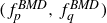 $(f^{\textit{BMD}}_{\!p}, f^{\textit{BMD}}_q)$
. However, due to the constraint imposed by the Nyquist frequency
$(f^{\textit{BMD}}_{\!p}, f^{\textit{BMD}}_q)$
. However, due to the constraint imposed by the Nyquist frequency $f_c$
, valid computations are restricted to the region defined by
$f_c$
, valid computations are restricted to the region defined by $-f_c\leqslant f^{\textit{BMD}}_{\!p} \leqslant f_c$
,
$-f_c\leqslant f^{\textit{BMD}}_{\!p} \leqslant f_c$
, $-f_c\leqslant f^{\textit{BMD}}_q \leqslant f_c$
and
$-f_c\leqslant f^{\textit{BMD}}_q \leqslant f_c$
and $-f_c\leqslant f^{\textit{BMD}}_{\!p} + f^{\textit{BMD}}_q \leqslant f_c$
. Moreover, the bispectral magnitude
$-f_c\leqslant f^{\textit{BMD}}_{\!p} + f^{\textit{BMD}}_q \leqslant f_c$
. Moreover, the bispectral magnitude $\lambda ^{\textit{BMD}}_{f_{\!p},f_q}$
remains invariant under the exchange of
$\lambda ^{\textit{BMD}}_{f_{\!p},f_q}$
remains invariant under the exchange of $f^{\textit{BMD}}_{\!p}$
and
$f^{\textit{BMD}}_{\!p}$
and $f^{\textit{BMD}}_q$
, as well as under complex conjugation of the bispectrum. As a result, it suffices to compute
$f^{\textit{BMD}}_q$
, as well as under complex conjugation of the bispectrum. As a result, it suffices to compute $\lambda ^{\textit{BMD}}_{f_{\!p},f_q}$
within the principal region indicated in grey in figure 2.
$\lambda ^{\textit{BMD}}_{f_{\!p},f_q}$
within the principal region indicated in grey in figure 2.
Symmetry of the bispectrum. Owing to the Nyquist frequency limit, conjugate symmetry and the symmetry between $f^{\textit{BMD}}_{\!p}$
and
$f^{\textit{BMD}}_{\!p}$
and $f^{\textit{BMD}}_q$
, the bispectrum is evaluated only within the shaded region.
$f^{\textit{BMD}}_q$
, the bispectrum is evaluated only within the shaded region.

In the context of BMD, the cause distribution $\boldsymbol{\phi }_{f_{\!p} \circ f_q}$
and its corresponding effect
$\boldsymbol{\phi }_{f_{\!p} \circ f_q}$
and its corresponding effect $\boldsymbol{\phi }_{f_{\!p} + f_q}$
are referred to as the cross-frequency field and the bispectral mode, respectively. The interaction between these two fields is characterised by the following spatial mode:
$\boldsymbol{\phi }_{f_{\!p} + f_q}$
are referred to as the cross-frequency field and the bispectral mode, respectively. The interaction between these two fields is characterised by the following spatial mode:
 \begin{equation} \boldsymbol{\tau }_{f_{\!p} \circ f_q}(\boldsymbol{x}) = \big |\boldsymbol{\phi }_{f_{\!p} \circ f_q}(\boldsymbol{x}) \circ \boldsymbol{\phi }_{f_{\!p} + f_q}(\boldsymbol{x})\big |, \end{equation}
where $\left | \boldsymbol{\cdot }\right |$
denotes the magnitude of a complex quantity. The field
$\left | \boldsymbol{\cdot }\right |$
denotes the magnitude of a complex quantity. The field $\boldsymbol{\tau }_{f_{\!p} \circ f_q}(\boldsymbol{x})$
represents the spatial distribution of interaction strength, as its integral over space equals
$\boldsymbol{\tau }_{f_{\!p} \circ f_q}(\boldsymbol{x})$
represents the spatial distribution of interaction strength, as its integral over space equals $ |\lambda ^{\textit{BMD}}_{f_{\!p},f_q}|$
. Accordingly,
$ |\lambda ^{\textit{BMD}}_{f_{\!p},f_q}|$
. Accordingly, $\boldsymbol{\tau }_{f_{\!p} \circ f_q}$
is referred to as the interaction map.
$\boldsymbol{\tau }_{f_{\!p} \circ f_q}$
is referred to as the interaction map.
3. Simulation results and modal analysis
3.1. Numerical simulation results
Numerical simulations were conducted with a spanwise domain size of $L_z = 12D$
. According to Jiang et al. (Reference Jiang, Cheng and An2017), for
$L_z = 12D$
. According to Jiang et al. (Reference Jiang, Cheng and An2017), for $L_z \geqslant 12D$
, the time-averaged drag coefficient, the root-mean-square of the lift coefficient, and the Strouhal number (
$L_z \geqslant 12D$
, the time-averaged drag coefficient, the root-mean-square of the lift coefficient, and the Strouhal number ( $St$
) associated with Kármán vortex shedding become independent of
$St$
) associated with Kármán vortex shedding become independent of $L_z$
. Therefore, the simulation at
$L_z$
. Therefore, the simulation at $L_z = 12D$
can be considered effectively free from spanwise domain-size effects. Figure 3 shows an isosurface of the Q-value, coloured by the streamwise velocity component, from the simulation at
$L_z = 12D$
can be considered effectively free from spanwise domain-size effects. Figure 3 shows an isosurface of the Q-value, coloured by the streamwise velocity component, from the simulation at $L_z = 12D$
. The wake behind the cylinder exhibits a periodic vortex structure in the spanwise direction. The observed spanwise wavelength
$L_z = 12D$
. The wake behind the cylinder exhibits a periodic vortex structure in the spanwise direction. The observed spanwise wavelength $\lambda$
was approximately
$\lambda$
was approximately $4D$
, as three periodic structures were present across the domain. This wavelength is consistent with previous findings reported by Jiang et al. (Reference Jiang, Cheng and An2017, Reference Jiang, Cheng, Tong, Draper and An2016b).
$4D$
, as three periodic structures were present across the domain. This wavelength is consistent with previous findings reported by Jiang et al. (Reference Jiang, Cheng and An2017, Reference Jiang, Cheng, Tong, Draper and An2016b).
Isosurfaces of the $Q$
-value at
$Q$
-value at $0.1$
, coloured by the streamwise (
$0.1$
, coloured by the streamwise ( $x$
-direction) velocity, obtained in the computational domain with
$x$
-direction) velocity, obtained in the computational domain with $L_z = 12D$
: (a) overall view of the flow field and (b) view in the
$L_z = 12D$
: (a) overall view of the flow field and (b) view in the $y$
-normal direction. The flow exhibits a three-dimensional vortex structure with a spanwise wavelength of approximately
$y$
-normal direction. The flow exhibits a three-dimensional vortex structure with a spanwise wavelength of approximately $4D$
.
$4D$
.

As reported by Jiang et al. (Reference Jiang, Cheng and An2017), both the spanwise wavelength $\lambda$
and the temporal behaviour of the force coefficients vary with the spanwise domain length
$\lambda$
and the temporal behaviour of the force coefficients vary with the spanwise domain length $L_z$
. To examine how temporal behaviour depends on
$L_z$
. To examine how temporal behaviour depends on $L_z$
, numerical simulations were performed for several values of
$L_z$
, numerical simulations were performed for several values of $L_z$
. Following previous studies (Jiang et al. Reference Jiang, Cheng and An2017; Jiang & Cheng Reference Jiang and Cheng2017; Rolandi et al. Reference Rolandi, Fontane, Jardin, Gressier and Joly2023; Nakamura, Sato & Ohnishi Reference Nakamura, Sato and Ohnishi2025), the time variation of the drag and lift coefficients acting on the cylinder is used as a key indicator of the flow’s temporal characteristics. The drag coefficient
$L_z$
. Following previous studies (Jiang et al. Reference Jiang, Cheng and An2017; Jiang & Cheng Reference Jiang and Cheng2017; Rolandi et al. Reference Rolandi, Fontane, Jardin, Gressier and Joly2023; Nakamura, Sato & Ohnishi Reference Nakamura, Sato and Ohnishi2025), the time variation of the drag and lift coefficients acting on the cylinder is used as a key indicator of the flow’s temporal characteristics. The drag coefficient $C_D$
and lift coefficient
$C_D$
and lift coefficient $C_L$
were computed from the simulation results using the following expression (Akhtar Reference Akhtar2008):
$C_L$
were computed from the simulation results using the following expression (Akhtar Reference Akhtar2008):
 \begin{align} C_D = \frac {1}{\frac {1}{2}\rho {U}_{\infty }^2DL_z}\int \int _\varOmega \left(p\cos \theta -\frac {1}{\textit{Re}}{\omega }_z\sin \theta \right)\,{\rm d}\theta {\rm d}z, \end{align}
 \begin{align} C_L = \frac {1}{\frac {1}{2}\rho {U}_{\infty }^2DL_z}\int \int _\varOmega \left(\!-p\sin \theta -\frac {1}{\textit{Re}}{\omega }_z\cos \theta \right)\,{\rm d}\theta {\rm d}z, \end{align}
where $\varOmega$
denotes the surface of the cylinder,
$\varOmega$
denotes the surface of the cylinder, $\theta$
is the angle measured from the stagnation point, and
$\theta$
is the angle measured from the stagnation point, and $\omega _z$
is the spanwise vorticity component, defined as
$\omega _z$
is the spanwise vorticity component, defined as
 \begin{equation} \omega _z = \frac {\partial v}{\partial x} - \frac {\partial u}{\partial y}. \end{equation}
The derivation of the fluid force expressions is provided in Appendix B.
Figure 4 presents the time histories of the drag coefficient for spanwise domain sizes of $L_z = 3.4D$
,
$L_z = 3.4D$
, $3.7D$
,
$3.7D$
, $3.9D$
and
$3.9D$
and $12D$
, highlighting characteristic differences in temporal behaviour. At
$12D$
, highlighting characteristic differences in temporal behaviour. At $L_z = 3.4D$
, the drag coefficient exhibited a constant amplitude, resembling the well-known two-dimensional periodic flow around a circular cylinder (Nakamura et al. Reference Nakamura, Sato and Ohnishi2024b
), and differing markedly from the more complex dynamics observed at
$L_z = 3.4D$
, the drag coefficient exhibited a constant amplitude, resembling the well-known two-dimensional periodic flow around a circular cylinder (Nakamura et al. Reference Nakamura, Sato and Ohnishi2024b
), and differing markedly from the more complex dynamics observed at $L_z = 12D$
. At
$L_z = 12D$
. At $L_z = 3.7D$
, small-amplitude, low-frequency fluctuations appeared in the drag signal, although their magnitude remained smaller than those observed at
$L_z = 3.7D$
, small-amplitude, low-frequency fluctuations appeared in the drag signal, although their magnitude remained smaller than those observed at $L_z = 12D$
. At
$L_z = 12D$
. At $L_z = 3.9D$
, more pronounced low-frequency fluctuations were evident, comparable to those at
$L_z = 3.9D$
, more pronounced low-frequency fluctuations were evident, comparable to those at $L_z = 12D$
. As noted by Henderson (Reference Henderson1997), the presence of multiple frequency components contributes to the emergence of low-frequency fluctuations. The observed fluctuations in the present results suggest that multiple frequencies were present in the drag coefficient signals.
$L_z = 12D$
. As noted by Henderson (Reference Henderson1997), the presence of multiple frequency components contributes to the emergence of low-frequency fluctuations. The observed fluctuations in the present results suggest that multiple frequencies were present in the drag coefficient signals.
Time variation of the drag coefficient for different spanwise domain sizes: (a) $L_z = 3.4D$
, (b)
$L_z = 3.4D$
, (b) $L_z = 3.7D$
, (c)
$L_z = 3.7D$
, (c) $L_z = 3.9D$
and (d)
$L_z = 3.9D$
and (d) $L_z = 12D$
. As
$L_z = 12D$
. As $L_z$
increases, low-frequency fluctuations become more pronounced.
$L_z$
increases, low-frequency fluctuations become more pronounced.

The time series of the drag and lift coefficients was analysed using the FFT to compute their power spectral densities. Figure 5 shows the power spectral densities for $L_z = 3.4D$
,
$L_z = 3.4D$
, $3.7D$
,
$3.7D$
, $3.9D$
and
$3.9D$
and $12D$
. The FFT was performed over a length of time window
$12D$
. The FFT was performed over a length of time window $T = 0.1 \times 4096$
, yielding a frequency resolution of
$T = 0.1 \times 4096$
, yielding a frequency resolution of $\Delta f = 1/T = 1/409.6 \approx 2.44 \times 10^{-3}$
. A Hamming window was applied to mitigate spectral leakage. For
$\Delta f = 1/T = 1/409.6 \approx 2.44 \times 10^{-3}$
. A Hamming window was applied to mitigate spectral leakage. For $L_z = 3.4D$
, the dominant non-zero frequency peak occurs at
$L_z = 3.4D$
, the dominant non-zero frequency peak occurs at $f/\Delta f = 77$
, whereas for
$f/\Delta f = 77$
, whereas for $L_z = 3.7D$
,
$L_z = 3.7D$
, $3.9D$
and
$3.9D$
and $12D$
, the peak appears consistently at
$12D$
, the peak appears consistently at $f/\Delta f = 75$
.
$f/\Delta f = 75$
.
Power spectral density of drag and lift coefficients: (a) $L_z = 3.4D$
, (b)
$L_z = 3.4D$
, (b) $L_z = 3.7D$
, (c)
$L_z = 3.7D$
, (c) $L_z = 3.9D$
and (d)
$L_z = 3.9D$
and (d) $L_z = 12D$
. As
$L_z = 12D$
. As $L_z$
increases, additional low-frequency components become apparent. Subharmonic peaks appear at
$L_z$
increases, additional low-frequency components become apparent. Subharmonic peaks appear at $f_t$
and
$f_t$
and $f_s$
, and a low-frequency component
$f_s$
, and a low-frequency component $f_b$
emerges for
$f_b$
emerges for $L_z = 3.9D$
, indicating the presence of triadic interactions.
$L_z = 3.9D$
, indicating the presence of triadic interactions.

It is well established that the oscillation frequency of the lift coefficient corresponds to the vortex-shedding frequency in the wake. The non-dimensional vortex-shedding frequency, known as the Strouhal number $St$
, is defined as
$St$
, is defined as
 \begin{equation} St = \frac {\check {f}_K D}{U_{\infty }}, \end{equation}
where $\check {f}_K$
denotes the dimensional frequency of wake vortex shedding. Although the shedding frequency can fluctuate in unsteady flows, such as those exhibiting Mode A, many previous studies (Henderson Reference Henderson1997; Posdziech & Grundmann Reference Posdziech and Grundmann2001) have estimated it using the time-averaged oscillation frequency of the lift coefficient or transverse velocity at a single point. Jiang & Cheng (Reference Jiang and Cheng2017) showed that the peak frequency obtained from the FFT of the lift-coefficient time series closely matches this time-averaged value. Based on their report, we regard the peak frequency in the FFT spectrum of the lift coefficient as the representative value of
$\check {f}_K$
denotes the dimensional frequency of wake vortex shedding. Although the shedding frequency can fluctuate in unsteady flows, such as those exhibiting Mode A, many previous studies (Henderson Reference Henderson1997; Posdziech & Grundmann Reference Posdziech and Grundmann2001) have estimated it using the time-averaged oscillation frequency of the lift coefficient or transverse velocity at a single point. Jiang & Cheng (Reference Jiang and Cheng2017) showed that the peak frequency obtained from the FFT of the lift-coefficient time series closely matches this time-averaged value. Based on their report, we regard the peak frequency in the FFT spectrum of the lift coefficient as the representative value of $St$
. In the present study, the observed peak frequencies,
$St$
. In the present study, the observed peak frequencies, $f = 77 \Delta f \approx 0.188$
for
$f = 77 \Delta f \approx 0.188$
for $L_z = 3.4D$
and
$L_z = 3.4D$
and $f = 75 \Delta f \approx 0.183$
for
$f = 75 \Delta f \approx 0.183$
for $L_z = 3.7D$
,
$L_z = 3.7D$
, $3.9D$
and
$3.9D$
and $12D$
, are in good agreement with the vortex-shedding frequencies reported by Jiang et al. (Reference Jiang, Cheng and An2017). Hereafter, for each
$12D$
, are in good agreement with the vortex-shedding frequencies reported by Jiang et al. (Reference Jiang, Cheng and An2017). Hereafter, for each $L_z$
, the peak non-dimensional frequency of the lift-coefficient spectrum is denoted as
$L_z$
, the peak non-dimensional frequency of the lift-coefficient spectrum is denoted as $f_K$
. As discussed in a later section, this frequency corresponds to the most energetic flow structure in the entire field.
$f_K$
. As discussed in a later section, this frequency corresponds to the most energetic flow structure in the entire field.
For the case of $L_z = 3.4D$
, a distinct peak in the drag coefficient spectrum is observed at approximately twice the frequency of
$L_z = 3.4D$
, a distinct peak in the drag coefficient spectrum is observed at approximately twice the frequency of $f = f_K$
. This behaviour is characteristic of periodic flows, such as the two-dimensional flow past a circular cylinder, where the spectrum contains the fundamental frequency and its harmonics. Within the frequency range shown in the figure, only the peaks at
$f = f_K$
. This behaviour is characteristic of periodic flows, such as the two-dimensional flow past a circular cylinder, where the spectrum contains the fundamental frequency and its harmonics. Within the frequency range shown in the figure, only the peaks at $f_K$
and
$f_K$
and $2f_K$
are clearly visible; however, additional harmonics at
$2f_K$
are clearly visible; however, additional harmonics at $3f_K$
,
$3f_K$
, $4f_K$
and higher were also identified in the higher-frequency range.
$4f_K$
and higher were also identified in the higher-frequency range.
For the case of $L_z = 3.7D$
, several additional spectral peaks are observed besides the peaks at
$L_z = 3.7D$
, several additional spectral peaks are observed besides the peaks at $f/\Delta f = 75$
and
$f/\Delta f = 75$
and $f/\Delta f = 150$
, which correspond to
$f/\Delta f = 150$
, which correspond to $f_K$
and its harmonic
$f_K$
and its harmonic $2f_K$
. Notably, peaks also appear at
$2f_K$
. Notably, peaks also appear at $f/\Delta f = 25$
and
$f/\Delta f = 25$
and $f/\Delta f = 50$
. These frequencies correspond to one-third and two-thirds of the shedding frequency, respectively, indicating the presence of subharmonic components in the flow.
$f/\Delta f = 50$
. These frequencies correspond to one-third and two-thirds of the shedding frequency, respectively, indicating the presence of subharmonic components in the flow.
For the case of $L_z = 3.9D$
, a large number of additional peaks appear, although the spectral peaks at
$L_z = 3.9D$
, a large number of additional peaks appear, although the spectral peaks at $f/\Delta f = 25$
,
$f/\Delta f = 25$
, $50$
and
$50$
and $75$
are also observed. The lowest-frequency peak is identified at
$75$
are also observed. The lowest-frequency peak is identified at $f/\Delta f = 6$
in the drag coefficient spectrum. Notably, neighbouring peaks in the lift-coefficient spectrum at
$f/\Delta f = 6$
in the drag coefficient spectrum. Notably, neighbouring peaks in the lift-coefficient spectrum at $f/\Delta f = 69$
and
$f/\Delta f = 69$
and $81$
satisfy
$81$
satisfy $75 - 69 = 81 - 75 = 6$
, suggesting a triadic interaction involving
$75 - 69 = 81 - 75 = 6$
, suggesting a triadic interaction involving $f/\Delta f = 6$
and the vortex-shedding frequency
$f/\Delta f = 6$
and the vortex-shedding frequency $f_K$
. Similar relationships are observed for other lift-coefficient peaks:
$f_K$
. Similar relationships are observed for other lift-coefficient peaks: $f/\Delta f = 19$
and
$f/\Delta f = 19$
and $31$
satisfy
$31$
satisfy $25 - 19 = 31 - 25 = 6$
, and
$25 - 19 = 31 - 25 = 6$
, and $f/\Delta f = 44$
and
$f/\Delta f = 44$
and $56$
satisfy
$56$
satisfy $50 - 44 = 56 - 50 = 6$
, further supporting the presence of triadic interactions. Additionally, a peak at
$50 - 44 = 56 - 50 = 6$
, further supporting the presence of triadic interactions. Additionally, a peak at $f/\Delta f = 12$
is observed in the drag coefficient spectrum, which likely corresponds to the second harmonic of
$f/\Delta f = 12$
is observed in the drag coefficient spectrum, which likely corresponds to the second harmonic of $f/\Delta f = 6$
. A peak at
$f/\Delta f = 6$
. A peak at $f/\Delta f = 18$
is also found in the drag coefficient spectrum and may be related to
$f/\Delta f = 18$
is also found in the drag coefficient spectrum and may be related to $f/\Delta f = 6$
as well. However, based on the current spectral data, it remains inconclusive whether this component is synchronised with the lift-coefficient peak at
$f/\Delta f = 6$
as well. However, based on the current spectral data, it remains inconclusive whether this component is synchronised with the lift-coefficient peak at $f/\Delta f = 19$
.
$f/\Delta f = 19$
.
In the following discussion, the frequency $25\Delta f$
observed for
$25\Delta f$
observed for $L_z = 3.7D$
and
$L_z = 3.7D$
and $3.9D$
is referred to as
$3.9D$
is referred to as $f_t$
, and the frequency
$f_t$
, and the frequency $50\Delta f$
as
$50\Delta f$
as $f_s$
. Additionally, the lowest frequency observed for the
$f_s$
. Additionally, the lowest frequency observed for the $L_z = 3.9D$
case, corresponding to
$L_z = 3.9D$
case, corresponding to $f = 6\Delta f \approx 0.0146$
, is denoted as
$f = 6\Delta f \approx 0.0146$
, is denoted as $f_b$
. As discussed in a later section, frequencies, including the vortex-shedding frequency
$f_b$
. As discussed in a later section, frequencies, including the vortex-shedding frequency $f_K$
, may vary depending on the spanwise domain size. Therefore, the frequency labels defined here correspond specifically to the values observed for
$f_K$
, may vary depending on the spanwise domain size. Therefore, the frequency labels defined here correspond specifically to the values observed for $L_z = 3.7D$
and
$L_z = 3.7D$
and $3.9D$
. However, similar spatial structures may appear at different frequencies in cases with other spanwise extents.
$3.9D$
. However, similar spatial structures may appear at different frequencies in cases with other spanwise extents.
For the case of $L_z = 12D$
, clear spectral peaks are observed at
$L_z = 12D$
, clear spectral peaks are observed at $f/\Delta f = 75$
and
$f/\Delta f = 75$
and $f/\Delta f = 150$
, corresponding to
$f/\Delta f = 150$
, corresponding to $f_K$
and its harmonic. In contrast to the case of
$f_K$
and its harmonic. In contrast to the case of $L_z = 3.9D$
, no distinct peaks appear at
$L_z = 3.9D$
, no distinct peaks appear at $f \lt = f_K$
. In particular, the low-frequency fluctuation evident in the time history of the drag coefficient (figure 4
d) does not manifest as a pronounced peak in the spectrum. The influence of spanwise domain size on low-frequency fluctuations is evident in the temporal variation of the drag coefficient.
$f \lt = f_K$
. In particular, the low-frequency fluctuation evident in the time history of the drag coefficient (figure 4
d) does not manifest as a pronounced peak in the spectrum. The influence of spanwise domain size on low-frequency fluctuations is evident in the temporal variation of the drag coefficient.
Furthermore, the power spectrum density of the drag and lift coefficient at $L_z=3.7D$
and
$L_z=3.7D$
and $3.9D$
captures primary peaks in
$3.9D$
captures primary peaks in $f\lt f_K$
. However, the low-frequency fluctuations of
$f\lt f_K$
. However, the low-frequency fluctuations of $L_z = 12D$
, as shown by the temporal variation of the drag coefficient, do not appear as evident peak frequencies in the power spectral density. For small values of
$L_z = 12D$
, as shown by the temporal variation of the drag coefficient, do not appear as evident peak frequencies in the power spectral density. For small values of $L_z$
, the flow is constrained in the spanwise direction, which limits the allowable wavelengths and, in turn, alters the temporal characteristics of the cylinder wake. A more detailed analysis is needed to quantify the frequencies associated with each
$L_z$
, the flow is constrained in the spanwise direction, which limits the allowable wavelengths and, in turn, alters the temporal characteristics of the cylinder wake. A more detailed analysis is needed to quantify the frequencies associated with each $L_z$
and to clarify the relationships among the different spectral components.
$L_z$
and to clarify the relationships among the different spectral components.
3.2. The DMD-based analysis
For the case of $L_z = 12D$
, the FFT analysis does not reveal any distinct peaks in the low-frequency range (
$L_z = 12D$
, the FFT analysis does not reveal any distinct peaks in the low-frequency range ( $f \lt f_K$
) of the power spectral density. However, low-frequency fluctuations are clearly visible in the time history of the drag coefficient. In this section, we employ DMD to investigate the existence of low-frequency components. One of the core features of DMD is that it can extract structures associated with the top-
$f \lt f_K$
) of the power spectral density. However, low-frequency fluctuations are clearly visible in the time history of the drag coefficient. In this section, we employ DMD to investigate the existence of low-frequency components. One of the core features of DMD is that it can extract structures associated with the top- $r$
left singular vectors, that is, energetic modes that oscillate at representative growth rates and frequencies. Consequently, even when many closely spaced frequency components exist, such that FFT does not exhibit a clear peak, DMD can still identify the corresponding frequency elements, which appear explicitly as eigenvalues. This enables confirmation of their presence even when spectral leakage obscures the peaks.
$r$
left singular vectors, that is, energetic modes that oscillate at representative growth rates and frequencies. Consequently, even when many closely spaced frequency components exist, such that FFT does not exhibit a clear peak, DMD can still identify the corresponding frequency elements, which appear explicitly as eigenvalues. This enables confirmation of their presence even when spectral leakage obscures the peaks.
To confirm the presence of the low-frequency components in cases where no clear spectral peak exists, DMD was performed for the time-series data of the flow fields in the $L_z=12D$
case. In this case, the number of snapshots was
$L_z=12D$
case. In this case, the number of snapshots was $3000$
, and the number of modes
$3000$
, and the number of modes $r$
in the low-rank approximation of SVD was
$r$
in the low-rank approximation of SVD was $194$
, determined based on the cumulative contribution ratio exceeding
$194$
, determined based on the cumulative contribution ratio exceeding $99.5 \,\%$
. Figure 6 shows the eigenvalue distribution of the DMD mode. Here, the
$99.5 \,\%$
. Figure 6 shows the eigenvalue distribution of the DMD mode. Here, the $f_K$
value indicated in figure 6 corresponds to the eigenvalue of the DMD mode whose frequency is closest to the
$f_K$
value indicated in figure 6 corresponds to the eigenvalue of the DMD mode whose frequency is closest to the $f_K$
obtained from the power spectral density of the lift coefficient. Some of the DMD eigenvalues lie inside the unit circle, indicating that the associated frequencies are decaying over time. These decaying modes are found at frequencies higher than
$f_K$
obtained from the power spectral density of the lift coefficient. Some of the DMD eigenvalues lie inside the unit circle, indicating that the associated frequencies are decaying over time. These decaying modes are found at frequencies higher than $f_K$
, whereas the low-frequency modes lie on the unit circle, indicating neutrally stable oscillations. These low-frequency components correspond to the low-frequency fluctuations in the drag coefficient shown in figure 4. The absence of distinct peaks in the power spectral density shown in figure 5(d) is therefore likely due to the presence of multiple low-frequency components with comparable energy levels, which may spread the spectral content.
$f_K$
, whereas the low-frequency modes lie on the unit circle, indicating neutrally stable oscillations. These low-frequency components correspond to the low-frequency fluctuations in the drag coefficient shown in figure 4. The absence of distinct peaks in the power spectral density shown in figure 5(d) is therefore likely due to the presence of multiple low-frequency components with comparable energy levels, which may spread the spectral content.
The time variations of the drag coefficient, shown in figure 4, indicate that computations in a smaller domain suppress the emergence of low-frequency fluctuations. This suppression is also expected to simplify the flow dynamics due to the constraints imposed by the small spanwise size. Applying DMD to the $L_z = 3.4D$
,
$L_z = 3.4D$
, $3.7D$
and
$3.7D$
and $3.9D$
cases may help clarify this effect. In the DMD-mode computation, the rank
$3.9D$
cases may help clarify this effect. In the DMD-mode computation, the rank $r$
in the SVD approximation is truncated based on a cumulative contribution ratio exceeding
$r$
in the SVD approximation is truncated based on a cumulative contribution ratio exceeding $99.8\,\%$
. The truncated ranks for the
$99.8\,\%$
. The truncated ranks for the $L_z = 3.4D$
,
$L_z = 3.4D$
, $3.7D$
and
$3.7D$
and $3.9D$
cases corresponding to figure 4 are summarised in table 1. The rank
$3.9D$
cases corresponding to figure 4 are summarised in table 1. The rank $r$
increases with increasing
$r$
increases with increasing $L_z$
, indicating that high-order modes (associated with smaller singular values) contribute non-negligibly to the flow representation. Consequently, a broader range of frequency components is captured by DMD in the larger-
$L_z$
, indicating that high-order modes (associated with smaller singular values) contribute non-negligibly to the flow representation. Consequently, a broader range of frequency components is captured by DMD in the larger- $ L_z$
cases. This result also implies that, as
$ L_z$
cases. This result also implies that, as $L_z$
increases, the flow contains a greater number of distinct frequency components, making it more difficult to identify clear peaks in the power spectral densities of lift and drag coefficients shown in figure 5.
$L_z$
increases, the flow contains a greater number of distinct frequency components, making it more difficult to identify clear peaks in the power spectral densities of lift and drag coefficients shown in figure 5.
The SVD rank used in the DMD computation, determined based on the cumulative contribution ratio exceeding 99.8 $\,\%$
.
$\,\%$
.

Eigenvalues of DMD modes obtained from the flow field at $L_z = 12D$
. The SVD rank
$L_z = 12D$
. The SVD rank $r = 194$
was determined based on the cumulative contribution ratio of the singular values associated with the fluctuating component.
$r = 194$
was determined based on the cumulative contribution ratio of the singular values associated with the fluctuating component.

Figure 7 shows the eigenvalue distribution of the DMD modes for the same $L_z$
cases presented in table 1 and figure 4. For the
$L_z$
cases presented in table 1 and figure 4. For the $L_z = 3.4D$
case, no frequency component below
$L_z = 3.4D$
case, no frequency component below $f^{\textit{DMD}}_k =f_K$
is observed, and the identified frequencies are uniformly spaced. This indicates that only harmonics of
$f^{\textit{DMD}}_k =f_K$
is observed, and the identified frequencies are uniformly spaced. This indicates that only harmonics of $f^{\textit{DMD}}_k =f_K$
are captured, which is consistent with the FFT results for both drag and lift coefficients shown in figure 5(a). In the
$f^{\textit{DMD}}_k =f_K$
are captured, which is consistent with the FFT results for both drag and lift coefficients shown in figure 5(a). In the $L_z = 3.7D$
and
$L_z = 3.7D$
and $3.9D$
cases, harmonics of
$3.9D$
cases, harmonics of $f_K$
are also identified. However, frequency components lower than
$f_K$
are also identified. However, frequency components lower than $f^{\textit{DMD}}_k =f_K$
become significant. At
$f^{\textit{DMD}}_k =f_K$
become significant. At $L_z = 3.7D$
, the frequencies remain uniformly spaced, similar to the
$L_z = 3.7D$
, the frequencies remain uniformly spaced, similar to the $3.4D$
case. This suggests that only harmonics of the lowest frequency are present in the
$3.4D$
case. This suggests that only harmonics of the lowest frequency are present in the $L_z = 3.7D$
case. In this case, the lowest frequency is
$L_z = 3.7D$
case. In this case, the lowest frequency is $f_t$
.
$f_t$
.
Eigenvalues of DMD modes obtained from flow fields at (a) $L_z = 3.4D$
, (b)
$L_z = 3.4D$
, (b) $L_z = 3.7D$
and (c)
$L_z = 3.7D$
and (c) $L_z = 3.9D$
. The SVD rank used in each case is listed in table 1. At
$L_z = 3.9D$
. The SVD rank used in each case is listed in table 1. At $L_z = 3.4D$
, only harmonics of the shedding frequency
$L_z = 3.4D$
, only harmonics of the shedding frequency $f_K$
are observed, whereas for
$f_K$
are observed, whereas for $L_z = 3.7D$
and
$L_z = 3.7D$
and $3.9D$
, additional eigenvalues corresponding to frequencies other than the harmonics of
$3.9D$
, additional eigenvalues corresponding to frequencies other than the harmonics of $f_K$
appear.
$f_K$
appear.

For the case of $L_z = 3.9D$
, the emergence of frequency components significantly lower than
$L_z = 3.9D$
, the emergence of frequency components significantly lower than $f_t$
(whose frequency is
$f_t$
(whose frequency is $f_K/3$
at
$f_K/3$
at $L_z=3.9D$
), as revealed in the power spectral density of the lift and drag coefficients, is further supported by the distribution of DMD eigenvalues. The lowest frequency identified by the DMD analysis is
$L_z=3.9D$
), as revealed in the power spectral density of the lift and drag coefficients, is further supported by the distribution of DMD eigenvalues. The lowest frequency identified by the DMD analysis is $f^{\textit{DMD}}_k = 0.0149$
, which closely corresponds to the lowest peak observed in the drag coefficient spectrum. Based on this agreement, we refer to
$f^{\textit{DMD}}_k = 0.0149$
, which closely corresponds to the lowest peak observed in the drag coefficient spectrum. Based on this agreement, we refer to $f^{\textit{DMD}}_k = 0.0149$
as
$f^{\textit{DMD}}_k = 0.0149$
as $f_b$
for the
$f_b$
for the $L_z = 3.9D$
case.
$L_z = 3.9D$
case.
Based on the eigenvalue distribution obtained from the DMD analysis, we selected the DMD mode corresponding to the shedding frequency $f_K$
for the
$f_K$
for the $L_z = 3.4D$
case, and DMD modes with frequencies lower than
$L_z = 3.4D$
case, and DMD modes with frequencies lower than $f_K$
for the
$f_K$
for the $L_z = 3.7D$
and
$L_z = 3.7D$
and $3.9D$
cases. Specifically, we focus on two DMD modes,
$3.9D$
cases. Specifically, we focus on two DMD modes, $f^{\textit{DMD}}_k = f_t$
and
$f^{\textit{DMD}}_k = f_t$
and $f_s$
, for the
$f_s$
, for the $L_z = 3.7D$
case, and the DMD mode,
$L_z = 3.7D$
case, and the DMD mode, $f^{\textit{DMD}}_k = f_b$
, for the
$f^{\textit{DMD}}_k = f_b$
, for the $L_z = 3.9D$
case. Figure 8 presents the spatial distributions of the DMD modes associated with these four selected frequencies. The DMD mode at
$L_z = 3.9D$
case. Figure 8 presents the spatial distributions of the DMD modes associated with these four selected frequencies. The DMD mode at $f^{\textit{DMD}}_k = f_K$
corresponds to the classical Kármán vortex fluctuations in the wake of the cylinder. This structure is consistently observed across all
$f^{\textit{DMD}}_k = f_K$
corresponds to the classical Kármán vortex fluctuations in the wake of the cylinder. This structure is consistently observed across all $L_z$
cases, though it is omitted from the figure for brevity.
$L_z$
cases, though it is omitted from the figure for brevity.
Real part of the streamwise ( $x$
-direction) velocity component of selected DMD modes: (a)
$x$
-direction) velocity component of selected DMD modes: (a) $f^{\textit{DMD}}_k = f_K$
for the
$f^{\textit{DMD}}_k = f_K$
for the $L_z = 3.4D$
case; (b)
$L_z = 3.4D$
case; (b) $f^{\textit{DMD}}_k = f_s$
and (c)
$f^{\textit{DMD}}_k = f_s$
and (c) $f^{\textit{DMD}}_k = f_t$
for the
$f^{\textit{DMD}}_k = f_t$
for the $L_z = 3.7D$
case; and (d)
$L_z = 3.7D$
case; and (d) $f^{\textit{DMD}}_k = f_b$
for the
$f^{\textit{DMD}}_k = f_b$
for the $L_z = 3.9D$
case. The modes in (b) and (c) are chosen for their lower frequencies relative to
$L_z = 3.9D$
case. The modes in (b) and (c) are chosen for their lower frequencies relative to $f_K$
at
$f_K$
at $L_z = 3.7D$
, while the mode in (d) represents the lowest-frequency DMD mode identified for
$L_z = 3.7D$
, while the mode in (d) represents the lowest-frequency DMD mode identified for $L_z = 3.9D$
.
$L_z = 3.9D$
.

The DMD mode at frequency $f^{\textit{DMD}}_k = f_t$
exhibits an asymmetric structure concerning
$f^{\textit{DMD}}_k = f_t$
exhibits an asymmetric structure concerning $y=0$
in the cylinder wake, in contrast to the symmetric structure observed at
$y=0$
in the cylinder wake, in contrast to the symmetric structure observed at $f^{\textit{DMD}}_k = f_s$
. Such asymmetry relative to
$f^{\textit{DMD}}_k = f_s$
. Such asymmetry relative to $y=0$
is considered to contribute to lift fluctuations. This interpretation is supported by the power spectral density shown in figure 5(b), where the asymmetric mode at
$y=0$
is considered to contribute to lift fluctuations. This interpretation is supported by the power spectral density shown in figure 5(b), where the asymmetric mode at $f^{\textit{DMD}}_k = f_t$
aligns with a spectral peak in the lift coefficient. In contrast, the symmetric mode at
$f^{\textit{DMD}}_k = f_t$
aligns with a spectral peak in the lift coefficient. In contrast, the symmetric mode at $f^{\textit{DMD}}_k = f_s$
corresponds to a peak in the drag coefficient. This tendency, where modes asymmetric concerning
$f^{\textit{DMD}}_k = f_s$
corresponds to a peak in the drag coefficient. This tendency, where modes asymmetric concerning $y=0$
are associated with lift fluctuations, and symmetric modes with drag fluctuations, is also observed for the DMD modes at
$y=0$
are associated with lift fluctuations, and symmetric modes with drag fluctuations, is also observed for the DMD modes at $f^{\textit{DMD}}_k = f_K$
and
$f^{\textit{DMD}}_k = f_K$
and $f^{\textit{DMD}}_k = f_b$
shown in figure 5.
$f^{\textit{DMD}}_k = f_b$
shown in figure 5.
The low-frequency components (DMD modes) shown in figure 7, extracted via DMD for $L_z = 3.4D$
,
$L_z = 3.4D$
, $3.7D$
and
$3.7D$
and $3.9D$
, may be influenced by the limited spanwise domain size. Before further analysing these low-frequency components, we first verify whether similar frequency components appear in flow fields computed within a sufficiently large domain. From the distribution of DMD eigenvalues for the
$3.9D$
, may be influenced by the limited spanwise domain size. Before further analysing these low-frequency components, we first verify whether similar frequency components appear in flow fields computed within a sufficiently large domain. From the distribution of DMD eigenvalues for the $L_z = 12D$
case shown in figure 6, DMD eigenvalues corresponding to
$L_z = 12D$
case shown in figure 6, DMD eigenvalues corresponding to $f^{\textit{DMD}}_k \approx f_K$
,
$f^{\textit{DMD}}_k \approx f_K$
, $f_s$
,
$f_s$
, $f_t$
and
$f_t$
and $f_b$
were identified. Figure 9 presents the spatial distributions of the corresponding DMD modes. These four modes exhibit the same symmetries concerning
$f_b$
were identified. Figure 9 presents the spatial distributions of the corresponding DMD modes. These four modes exhibit the same symmetries concerning $y=0$
as their counterparts observed in the
$y=0$
as their counterparts observed in the $L_z = 3.4D$
,
$L_z = 3.4D$
, $3.7D$
and
$3.7D$
and $3.9D$
cases. This comparison suggests that the presence of these low-frequency components is not a numerical artefact resulting from the limited spanwise extent, but rather a distinct feature of the flow dynamics.
$3.9D$
cases. This comparison suggests that the presence of these low-frequency components is not a numerical artefact resulting from the limited spanwise extent, but rather a distinct feature of the flow dynamics.
The DMD modes corresponding to the same frequencies as in figure 8, but for the $L_z = 12D$
case. These distinct frequency components appear in the fully developed Mode A regime and occur at frequencies lower than
$L_z = 12D$
case. These distinct frequency components appear in the fully developed Mode A regime and occur at frequencies lower than $f_K$
.
$f_K$
.

To investigate the temporal evolution of the flow in detail, numerical simulations were performed using finely adjusted spanwise domain sizes: $L_z = 3.2D$
,
$L_z = 3.2D$
, $3.5D$
,
$3.5D$
, $3.6D$
,
$3.6D$
, $3.8D$
,
$3.8D$
, $4.0D$
,
$4.0D$
, $4.2D$
,
$4.2D$
, $4.7D$
and
$4.7D$
and $5.0D$
. For
$5.0D$
. For $L_z = 3.2D$
and
$L_z = 3.2D$
and $5.0D$
, the flow remained two-dimensional, as indicated by the negative growth rate of the spanwise-velocity component. The onset of three-dimensional flow occurred at values of
$5.0D$
, the flow remained two-dimensional, as indicated by the negative growth rate of the spanwise-velocity component. The onset of three-dimensional flow occurred at values of $L_z$
consistent with the stable spanwise-wavelength range of Mode A, as predicted by Floquet analysis (Barkley & Henderson Reference Barkley and Henderson1996; Rolandi et al. Reference Rolandi, Fontane, Jardin, Gressier and Joly2023). This range corresponds to a regime in which spanwise perturbations remain sufficiently small that nonlinear effects in the spanwise velocity can be neglected. This suppression arises because, under the constraint of a limited spanwise extent, only wavelengths with negative growth rates are permitted during the linear development from the two-dimensional flow. As a result, the onset of three-dimensionality is inhibited, and low-frequency components do not emerge. This relationship between spanwise domain size and the onset of three-dimensionality in numerical simulations has also been reported by Jiang et al. (Reference Jiang, Cheng and An2017).
$L_z$
consistent with the stable spanwise-wavelength range of Mode A, as predicted by Floquet analysis (Barkley & Henderson Reference Barkley and Henderson1996; Rolandi et al. Reference Rolandi, Fontane, Jardin, Gressier and Joly2023). This range corresponds to a regime in which spanwise perturbations remain sufficiently small that nonlinear effects in the spanwise velocity can be neglected. This suppression arises because, under the constraint of a limited spanwise extent, only wavelengths with negative growth rates are permitted during the linear development from the two-dimensional flow. As a result, the onset of three-dimensionality is inhibited, and low-frequency components do not emerge. This relationship between spanwise domain size and the onset of three-dimensionality in numerical simulations has also been reported by Jiang et al. (Reference Jiang, Cheng and An2017).
The DMD was applied to the time-series flow field data for spanwise domain sizes of $L_z = 3.4D$
,
$L_z = 3.4D$
, $3.5D$
,
$3.5D$
, $3.6D$
,
$3.6D$
, $3.7D$
,
$3.7D$
, $3.8D$
,
$3.8D$
, $4.0D$
,
$4.0D$
, $4.2D$
,
$4.2D$
, $4.3D$
and
$4.3D$
and $4.7D$
. The cases with
$4.7D$
. The cases with $L_z = 3.7D$
and
$L_z = 3.7D$
and $3.8D$
represent transitional regimes, where the periodic characteristics of the flow begin to weaken, and low-frequency DMD modes gradually emerge, making relatively small contributions. To capture these weak components in the
$3.8D$
represent transitional regimes, where the periodic characteristics of the flow begin to weaken, and low-frequency DMD modes gradually emerge, making relatively small contributions. To capture these weak components in the $L_z = 3.7D$
and
$L_z = 3.7D$
and $3.8D$
cases, we adopted a fixed number of DMD modes,
$3.8D$
cases, we adopted a fixed number of DMD modes, $r = 194$
, based on the rank determined for the
$r = 194$
, based on the rank determined for the $L_z = 12D$
case. For the other cases, the rank was selected such that the cumulative energy contribution exceeded 99.8 %. From the resulting DMD eigenvalue distributions, we extracted neutrally stable modes (i.e. zero growth rate) within the frequency range
$L_z = 12D$
case. For the other cases, the rank was selected such that the cumulative energy contribution exceeded 99.8 %. From the resulting DMD eigenvalue distributions, we extracted neutrally stable modes (i.e. zero growth rate) within the frequency range $0 \lt f^{\textit{DMD}}_k \leqslant 0.2$
to isolate the low-frequency dynamics. Figure 10 presents the DMD-mode frequencies
$0 \lt f^{\textit{DMD}}_k \leqslant 0.2$
to isolate the low-frequency dynamics. Figure 10 presents the DMD-mode frequencies $f^{\textit{DMD}}_k$
obtained for each spanwise domain size. Frequencies marked with red triangles indicate the
$f^{\textit{DMD}}_k$
obtained for each spanwise domain size. Frequencies marked with red triangles indicate the $f_K$
associated with vortex-shedding frequency, which closely match the values reported by Jiang et al. (Reference Jiang, Cheng and An2017), shown as blue triangles.
$f_K$
associated with vortex-shedding frequency, which closely match the values reported by Jiang et al. (Reference Jiang, Cheng and An2017), shown as blue triangles.
The DMD-mode frequencies $f^{\textit{DMD}}_k$
in the range of
$f^{\textit{DMD}}_k$
in the range of $0$
to
$0$
to $0.2$
for various spanwise domain sizes: (a)
$0.2$
for various spanwise domain sizes: (a) $3.2D \leqslant L_z \leqslant 5.0D$
; (b)
$3.2D \leqslant L_z \leqslant 5.0D$
; (b) $L_z = 12D$
. Two notable transitions are observed, the second of which marks the onset of multiple low-frequency DMD modes.
$L_z = 12D$
. Two notable transitions are observed, the second of which marks the onset of multiple low-frequency DMD modes.

The first notable change in the emergence of low-frequency DMD modes occurs between $L_z = 3.5D$
and
$L_z = 3.5D$
and $3.6D$
, marked by the appearance of frequencies at
$3.6D$
, marked by the appearance of frequencies at $f^{\textit{DMD}}_k = f_t$
and
$f^{\textit{DMD}}_k = f_t$
and $f_s$
. Between this transition and the next, which occurs between
$f_s$
. Between this transition and the next, which occurs between $L_z = 3.7D$
and
$L_z = 3.7D$
and $3.8D$
, only three dominant frequency components,
$3.8D$
, only three dominant frequency components, $f^{\textit{DMD}}_k = f_t$
,
$f^{\textit{DMD}}_k = f_t$
, $f_s$
and
$f_s$
and $f_K$
, are observed. Following the transition at
$f_K$
, are observed. Following the transition at $L_z = 3.8D$
, frequency components lower than
$L_z = 3.8D$
, frequency components lower than $f_t$
begin to appear, for example, in the case of
$f_t$
begin to appear, for example, in the case of $L_z = 3.9D$
, this corresponds to
$L_z = 3.9D$
, this corresponds to $f^{\textit{DMD}}_k = f_b$
, along with multiple components clustered around
$f^{\textit{DMD}}_k = f_b$
, along with multiple components clustered around $f^{\textit{DMD}}_k = f_K$
,
$f^{\textit{DMD}}_k = f_K$
, $f_t$
and
$f_t$
and $f_s$
. As
$f_s$
. As $L_z$
increases further, the number of distinct frequencies near
$L_z$
increases further, the number of distinct frequencies near $f^{\textit{DMD}}_k = f_K$
,
$f^{\textit{DMD}}_k = f_K$
, $f_s$
and
$f_s$
and $f_t$
gradually increases. These observations suggest that the emergence of DMD modes with
$f_t$
gradually increases. These observations suggest that the emergence of DMD modes with $f^{\textit{DMD}}_k \lt f_t$
marks the onset of multi-frequency behaviour in the flow field.
$f^{\textit{DMD}}_k \lt f_t$
marks the onset of multi-frequency behaviour in the flow field.
Figure 11 presents the frequencies identified in figure 10, normalised by the vortex-shedding frequency $f_K$
corresponding to each value of
$f_K$
corresponding to each value of $L_z$
. As discussed, for
$L_z$
. As discussed, for $3.6D \leqslant L_z \leqslant 3.7D$
, DMD modes corresponding to
$3.6D \leqslant L_z \leqslant 3.7D$
, DMD modes corresponding to $f^{\textit{DMD}}_k = f_t$
are clearly observed. In the range
$f^{\textit{DMD}}_k = f_t$
are clearly observed. In the range $3.8D \leqslant L_z \leqslant 4.0D$
, components with
$3.8D \leqslant L_z \leqslant 4.0D$
, components with $f^{\textit{DMD}}_k/f_K \lt 1/3$
appear alongside those at
$f^{\textit{DMD}}_k/f_K \lt 1/3$
appear alongside those at $f^{\textit{DMD}}_k = f_t$
. However, as
$f^{\textit{DMD}}_k = f_t$
. However, as $L_z$
increases further, the frequencies increasingly deviate from the
$L_z$
increases further, the frequencies increasingly deviate from the $f^{\textit{DMD}}_k = f_t$
line. This is attributed to the emergence of additional low-frequency components in the flow, which interact with dominant frequencies such as
$f^{\textit{DMD}}_k = f_t$
line. This is attributed to the emergence of additional low-frequency components in the flow, which interact with dominant frequencies such as $f^{\textit{DMD}}_k = f_t$
,
$f^{\textit{DMD}}_k = f_t$
, $f_s$
and
$f_s$
and $f_K$
, leading to frequency deviation. Despite this deviation, the DMD modes with frequencies near
$f_K$
, leading to frequency deviation. Despite this deviation, the DMD modes with frequencies near $f_t$
and
$f_t$
and $f_s$
(shown in figures 9
b and 9
c) retain symmetry concerning
$f_s$
(shown in figures 9
b and 9
c) retain symmetry concerning $y=0$
, similar to that observed in the
$y=0$
, similar to that observed in the $L_z = 3.9D$
case. This similarity suggests that the
$L_z = 3.9D$
case. This similarity suggests that the $L_z = 3.7D$
and
$L_z = 3.7D$
and $3.9D$
cases provide representative examples for analysing the behaviour of these frequency components, offering insight into the underlying dynamics even when the spanwise domain is sufficiently large.
$3.9D$
cases provide representative examples for analysing the behaviour of these frequency components, offering insight into the underlying dynamics even when the spanwise domain is sufficiently large.
The DMD-mode frequencies $f^{\textit{DMD}}_k$
, normalised by the shedding frequency
$f^{\textit{DMD}}_k$
, normalised by the shedding frequency $f_K$
, in the range
$f_K$
, in the range $0$
to
$0$
to $0.2$
for various spanwise domain sizes: (a)
$0.2$
for various spanwise domain sizes: (a) $3.2D \leqslant L_z \leqslant 5.0D$
; (b)
$3.2D \leqslant L_z \leqslant 5.0D$
; (b) $L_z = 12D$
.
$L_z = 12D$
.

3.3. The BMD-based analysis
Previous studies have suggested that the low-frequency fluctuations in Mode A arise from the presence of multiple frequencies that are close to, but distinct from, the shedding frequency. In the case of $L_z = 3.9D$
, the sum and difference of
$L_z = 3.9D$
, the sum and difference of $f_K$
and
$f_K$
and $f_b$
yield frequencies near
$f_b$
yield frequencies near $f_K$
but offset from it. Furthermore, the peak frequencies observed in the power spectral densities of the lift and drag coefficients at
$f_K$
but offset from it. Furthermore, the peak frequencies observed in the power spectral densities of the lift and drag coefficients at $L_z = 3.9D$
indicate the presence of components at
$L_z = 3.9D$
indicate the presence of components at $f = f_K \pm f_b$
,
$f = f_K \pm f_b$
, $f_t \pm f_b$
and
$f_t \pm f_b$
and $f_s \pm f_b$
(see figure 5). These observations suggest that combinations of frequency components coincide with other frequencies, implying the presence of nonlinear interactions (Phillips Reference Phillips1960). To explore these interaction mechanisms in Mode A, we apply BMD to the flow fields for the
$f_s \pm f_b$
(see figure 5). These observations suggest that combinations of frequency components coincide with other frequencies, implying the presence of nonlinear interactions (Phillips Reference Phillips1960). To explore these interaction mechanisms in Mode A, we apply BMD to the flow fields for the $L_z = 3.7D$
and
$L_z = 3.7D$
and $3.9D$
cases.
$3.9D$
cases.
The BMD was applied to the time-series data for the $L_z = 3.7D$
case. Details regarding the validation of FFT parameters used in the BMD algorithm are provided in Appendix C. Figure 12 shows the mode bispectrum obtained from the BMD analysis. Spectral peaks appear at intervals of
$L_z = 3.7D$
case. Details regarding the validation of FFT parameters used in the BMD algorithm are provided in Appendix C. Figure 12 shows the mode bispectrum obtained from the BMD analysis. Spectral peaks appear at intervals of $f_t$
, consistent with the frequency patterns identified in the power spectral densities (figure 5) and DMD results (figure 10). The appearance of a bispectral peak confirms triadic interactions among the three frequency components
$f_t$
, consistent with the frequency patterns identified in the power spectral densities (figure 5) and DMD results (figure 10). The appearance of a bispectral peak confirms triadic interactions among the three frequency components $f = f_K$
,
$f = f_K$
, $f_s$
and
$f_s$
and $f_t$
. The presence of only integer multiples of
$f_t$
. The presence of only integer multiples of $f_t$
across the entire spectrum indicates that the harmonics of the lowest-frequency component coincide with the shedding frequency
$f_t$
across the entire spectrum indicates that the harmonics of the lowest-frequency component coincide with the shedding frequency $f_K$
. In other words, in the case of
$f_K$
. In other words, in the case of $L_z=3.7D$
, the lowest-frequency component is the third subharmonic, exactly equal to
$L_z=3.7D$
, the lowest-frequency component is the third subharmonic, exactly equal to $f_t$
. The frequency pattern shown in figure 10 suggests that the number `3’ is a characteristic feature of the system within the range
$f_t$
. The frequency pattern shown in figure 10 suggests that the number `3’ is a characteristic feature of the system within the range $3.5D \lt L_z \lt 3.8D$
. The appearance of only doublet waves based on the third subharmonic indicates that the flow field at
$3.5D \lt L_z \lt 3.8D$
. The appearance of only doublet waves based on the third subharmonic indicates that the flow field at $L_z = 3.7D$
exhibits overall periodic behaviour. This is further supported by the time variation of the drag coefficient in figure 4(b), which displays a repeating pattern with three distinct peaks.
$L_z = 3.7D$
exhibits overall periodic behaviour. This is further supported by the time variation of the drag coefficient in figure 4(b), which displays a repeating pattern with three distinct peaks.
Mode bispectrum corresponding to the two frequencies $f^{\textit{BMD}}_{\!p}$
and
$f^{\textit{BMD}}_{\!p}$
and $f^{\textit{BMD}}_q$
, obtained via BMD for the case
$f^{\textit{BMD}}_q$
, obtained via BMD for the case $L_z = 3.7D$
: (a) wide frequency range; (b) close-up of the range
$L_z = 3.7D$
: (a) wide frequency range; (b) close-up of the range $0$
to
$0$
to $f_K$
. The absolute values of the bispectrum are displayed using a logarithmic colour scale. Nonlinear interactions are observed only at harmonics of
$f_K$
. The absolute values of the bispectrum are displayed using a logarithmic colour scale. Nonlinear interactions are observed only at harmonics of $f_t$
. The spatial structures of modes (A) and (B) are shown in figure 13.
$f_t$
. The spatial structures of modes (A) and (B) are shown in figure 13.

High peaks are observed along the $0$
-frequency line
$0$
-frequency line $f^{\textit{BMD}}_q = 0$
, as well as at points associated with the
$f^{\textit{BMD}}_q = 0$
, as well as at points associated with the $f_K$
-frequency component, such as (
$f_K$
-frequency component, such as ( $f^{\textit{BMD}}_{\!p}$
,
$f^{\textit{BMD}}_{\!p}$
, $f^{\textit{BMD}}_q$
) = (
$f^{\textit{BMD}}_q$
) = ( $f_K$
,
$f_K$
, $f_K$
), (
$f_K$
), ( $2f_K$
,
$2f_K$
, $f_K$
), (
$f_K$
), ( $f_K$
,
$f_K$
, $-f_K$
) and (
$-f_K$
) and ( $2f_K$
,
$2f_K$
, $-f_K$
). These features indicate an energy cascade into harmonics of the
$-f_K$
). These features indicate an energy cascade into harmonics of the $f_K$
-frequency component. Along the
$f_K$
-frequency component. Along the $f^{\textit{BMD}}_{\!p} = f_K$
line, the interactions between
$f^{\textit{BMD}}_{\!p} = f_K$
line, the interactions between $f_K$
- and
$f_K$
- and $f_t$
-frequency components are more pronounced than those between
$f_t$
-frequency components are more pronounced than those between $f_K$
- and
$f_K$
- and $f_s$
-frequency components, suggesting a stronger nonlinear interaction between the Kármán vortex fluctuation and the
$f_s$
-frequency components, suggesting a stronger nonlinear interaction between the Kármán vortex fluctuation and the $f_t$
-frequency component. This implies a possible relationship between the Kármán vortex fluctuation and the emergence of the
$f_t$
-frequency component. This implies a possible relationship between the Kármán vortex fluctuation and the emergence of the $f_t$
-frequency component.
$f_t$
-frequency component.
Figure 13 presents the spatial distributions and interaction relationships of the $(f^{\textit{BMD}}_{\!p}, f^{\textit{BMD}}_q) = (f_s, f_t)$
and
$(f^{\textit{BMD}}_{\!p}, f^{\textit{BMD}}_q) = (f_s, f_t)$
and $(f_K, -f_t)$
modes, which exhibit strong triadic interactions among the frequencies
$(f_K, -f_t)$
modes, which exhibit strong triadic interactions among the frequencies $f_t$
,
$f_t$
, $f_s$
and
$f_s$
and $f_K$
. In the figure, each arrow points in the direction of the resulting frequency component, given by
$f_K$
. In the figure, each arrow points in the direction of the resulting frequency component, given by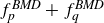 $f^{\textit{BMD}}_{\!p} + f^{\textit{BMD}}_q$
. In the
$f^{\textit{BMD}}_{\!p} + f^{\textit{BMD}}_q$
. In the $(f_s, f_t)$
interaction, the bispectral mode
$(f_s, f_t)$
interaction, the bispectral mode $\phi _{f_s + f_t}$
corresponds to a Kármán vortex fluctuation with a sum of frequency
$\phi _{f_s + f_t}$
corresponds to a Kármán vortex fluctuation with a sum of frequency $f^{\textit{BMD}}_{p+q} = f_K$
. For the
$f^{\textit{BMD}}_{p+q} = f_K$
. For the $(f_K, -f_t)$
interaction, the bispectral mode
$(f_K, -f_t)$
interaction, the bispectral mode $\phi _{f_K - f_t}$
closely matches the spatial structure of the DMD mode shown in figure 8(b). Because bispectral modes of periodic flows coincide with Fourier modes, and because DMD and Fourier modes at the same frequency exhibit similar spatial structures (Tu Reference Tu2013), the bispectral and DMD modes are expected to share the same spatial distribution. Accordingly, the interactions captured by BMD are consistent with those identified by DMD. The interaction map shows a coherent spatial structure across the three frequency components, particularly in the downstream region of the cylinder, where aligned features in the streamwise (
$\phi _{f_K - f_t}$
closely matches the spatial structure of the DMD mode shown in figure 8(b). Because bispectral modes of periodic flows coincide with Fourier modes, and because DMD and Fourier modes at the same frequency exhibit similar spatial structures (Tu Reference Tu2013), the bispectral and DMD modes are expected to share the same spatial distribution. Accordingly, the interactions captured by BMD are consistent with those identified by DMD. The interaction map shows a coherent spatial structure across the three frequency components, particularly in the downstream region of the cylinder, where aligned features in the streamwise ( $x$
) direction emphasise the strength of their triadic interaction.
$x$
) direction emphasise the strength of their triadic interaction.
Isosurfaces of bispectral mode and interaction map obtained for the $L_z = 3.7D$
case. All isosurfaces represent the streamwise (
$L_z = 3.7D$
case. All isosurfaces represent the streamwise ( $x$
-direction) velocity component. The BMD results indicate a triadic interaction among the three frequency components
$x$
-direction) velocity component. The BMD results indicate a triadic interaction among the three frequency components $f = f_t$
,
$f = f_t$
, $f_s$
and
$f_s$
and $f_K$
. The central mode in the figure corresponds symbolically to the DMD mode at frequency
$f_K$
. The central mode in the figure corresponds symbolically to the DMD mode at frequency $f_t$
shown in figure 8(c).
$f_t$
shown in figure 8(c).

The three frequency components at which bispectral peaks were identified using BMD are, from a fluid dynamics perspective, energetically coupled through the nonlinear terms of the governing equations. According to the formulation by Freeman et al. (Reference Freeman, Martinuzzi and Hemmati2024), the magnitude and direction of energy transfer resulting from nonlinear interactions identified by BMD are given by
 \begin{equation} E_{f_{\textit{dn}} \stackrel {f_{\textit{ct}}}{ \rightarrow } f_{\textit{rc}}} = -\textrm{Re}\!\left [ \int \boldsymbol{\hat {u}}^H(\boldsymbol{x},f_{\textit{rc}})\left \{\boldsymbol{\hat {u}}(\boldsymbol{x},f_{\textit{ct}})\boldsymbol{\cdot }\boldsymbol{\nabla }\right \}\boldsymbol{\hat {u}}(\boldsymbol{x},f_{\textit{dn}}) {\rm d}\boldsymbol x\right ]\!, \end{equation}
where the frequencies $f_{\textit{rc}}$
,
$f_{\textit{rc}}$
, $f_{\textit{ct}}$
and
$f_{\textit{ct}}$
and $f_{\textit{dn}}$
satisfy the triadic relation
$f_{\textit{dn}}$
satisfy the triadic relation $f_{\textit{rc}} = f_{\textit{ct}} + f_{\textit{dn}}$
. The term
$f_{\textit{rc}} = f_{\textit{ct}} + f_{\textit{dn}}$
. The term $E_{f_{\textit{dn}} \stackrel {f_{\textit{ct}}}{ \rightarrow } f_{\textit{rc}}}$
quantifies the energy transferred from the donor frequency
$E_{f_{\textit{dn}} \stackrel {f_{\textit{ct}}}{ \rightarrow } f_{\textit{rc}}}$
quantifies the energy transferred from the donor frequency $f_{\textit{dn}}$
to the recipient frequency
$f_{\textit{dn}}$
to the recipient frequency $f_{\textit{rc}}$
via the catalyst frequency
$f_{\textit{rc}}$
via the catalyst frequency $f_{\textit{ct}}$
. This formulation, known as the recipient–donor framework, implies that the donor frequency
$f_{\textit{ct}}$
. This formulation, known as the recipient–donor framework, implies that the donor frequency $f_{\textit{dn}}$
transfers energy to the recipient frequency
$f_{\textit{dn}}$
transfers energy to the recipient frequency $f_{\textit{rc}}$
through the catalyst frequency
$f_{\textit{rc}}$
through the catalyst frequency $f_{\textit{ct}}$
, which facilitates the nonlinear interaction without directly receiving or donating energy itself.
$f_{\textit{ct}}$
, which facilitates the nonlinear interaction without directly receiving or donating energy itself.
For the frequencies at which bispectral peaks were observed, and triadic interactions were inferred, the energy transfer terms defined in (3.5) were computed. Figure 14 presents the energy transfer terms for selected recipient frequencies, $f_{\textit{rc}} = f_K$
,
$f_{\textit{rc}} = f_K$
, $2f_K$
,
$2f_K$
, $f_t$
and
$f_t$
and $f_s$
, corresponding to prominent bispectral peaks. The horizontal axis indicates the donor frequency
$f_s$
, corresponding to prominent bispectral peaks. The horizontal axis indicates the donor frequency $f_{\textit{dn}}$
, while the catalyst frequency is determined as
$f_{\textit{dn}}$
, while the catalyst frequency is determined as $f_{\textit{ct}} = f_{\textit{rc}} - f_{\textit{dn}}$
. The component at the vortex-shedding frequency
$f_{\textit{ct}} = f_{\textit{rc}} - f_{\textit{dn}}$
. The component at the vortex-shedding frequency $f_K$
gains energy from the
$f_K$
gains energy from the $0$
-frequency mode via nonlinear transfer. In contrast, it loses energy to the second harmonic (
$0$
-frequency mode via nonlinear transfer. In contrast, it loses energy to the second harmonic ( $2f_K$
), suggesting a transfer of energy from
$2f_K$
), suggesting a transfer of energy from $f_K$
to
$f_K$
to $2f_K$
. This interpretation is supported by figure 14(b), where the
$2f_K$
. This interpretation is supported by figure 14(b), where the $f_{\textit{rc}} = 2f_K$
component shows a positive energy gain from
$f_{\textit{rc}} = 2f_K$
component shows a positive energy gain from $f_K$
. Additionally, as shown in figure 14(a), the
$f_K$
. Additionally, as shown in figure 14(a), the $f_K$
component exhibits negative energy transfer to itself. This corresponds to the case where
$f_K$
component exhibits negative energy transfer to itself. This corresponds to the case where $f_{\textit{ct}} = f_K - f_K = 0$
, representing convection by the
$f_{\textit{ct}} = f_K - f_K = 0$
, representing convection by the $0$
-frequency component. This result implies that energy at
$0$
-frequency component. This result implies that energy at $f_K$
is being convected out of the computational domain by the
$f_K$
is being convected out of the computational domain by the $0$
-frequency component. Similar negative self-convection has also been reported by Yeung et al. (Reference Yeung, Chu and Schmidt2024).
$0$
-frequency component. Similar negative self-convection has also been reported by Yeung et al. (Reference Yeung, Chu and Schmidt2024).
Focusing on frequencies lower than the vortex-shedding frequency $f_K$
, the
$f_K$
, the $f_t$
-frequency component is found to receive the most significant amount of energy from the
$f_t$
-frequency component is found to receive the most significant amount of energy from the $f_K$
-frequency component. It also gains energy through a difference interaction between the
$f_K$
-frequency component. It also gains energy through a difference interaction between the $0$
- and
$0$
- and $f_K$
-frequency components. Additionally,
$f_K$
-frequency components. Additionally, $f_t$
-frequency component transfers energy to the
$f_t$
-frequency component transfers energy to the $-f_s$
-frequency component, with the
$-f_s$
-frequency component, with the $f_K$
-frequency component serving as a catalyst for this transfer term. The
$f_K$
-frequency component serving as a catalyst for this transfer term. The $f_s$
-frequency component receives most of its energy from the
$f_s$
-frequency component receives most of its energy from the $0$
-frequency component, followed by the
$0$
-frequency component, followed by the $-f_t$
-frequency component. In the latter case, the energy transfer is again facilitated by the
$-f_t$
-frequency component. In the latter case, the energy transfer is again facilitated by the $f_K$
-frequency component. This suggests that the
$f_K$
-frequency component. This suggests that the $f_s$
-frequency component does not arise from a self-interaction of the
$f_s$
-frequency component does not arise from a self-interaction of the $f_t$
-frequency component (i.e.
$f_t$
-frequency component (i.e. $2 \times f_t$
), but rather from a difference interaction of the form
$2 \times f_t$
), but rather from a difference interaction of the form $f_K - f_t$
. In other words, unless the
$f_K - f_t$
. In other words, unless the $f_t$
-frequency component is an exact third subharmonic of the
$f_t$
-frequency component is an exact third subharmonic of the $f_K$
-frequency component, the
$f_K$
-frequency component, the $f_s$
-frequency component cannot be regarded as the second harmonic of the
$f_s$
-frequency component cannot be regarded as the second harmonic of the $f_t$
-frequency component. For instance, if the interacting frequency is
$f_t$
-frequency component. For instance, if the interacting frequency is $f_K/4$
, the difference
$f_K/4$
, the difference $f_K - (f_K/4) = 3f_K/4$
does not correspond to a second harmonic of
$f_K - (f_K/4) = 3f_K/4$
does not correspond to a second harmonic of $f_K/4$
. This interpretation is further supported by the weak bispectral peak at
$f_K/4$
. This interpretation is further supported by the weak bispectral peak at $(f^{\textit{BMD}}_{\!p}, f^{\textit{BMD}}_q) = (f_t, f_t)$
, indicating that the self-interaction of the
$(f^{\textit{BMD}}_{\!p}, f^{\textit{BMD}}_q) = (f_t, f_t)$
, indicating that the self-interaction of the $f_t$
-frequency component is weak. Furthermore, in the
$f_t$
-frequency component is weak. Furthermore, in the $L_z = 4.0D$
case shown in figure 11, a DMD-derived frequency slightly below
$L_z = 4.0D$
case shown in figure 11, a DMD-derived frequency slightly below $f_K/3$
and another slightly above
$f_K/3$
and another slightly above $2f_K/3$
are observed. This can be interpreted as the result of a difference interaction between
$2f_K/3$
are observed. This can be interpreted as the result of a difference interaction between $f_K$
and a component slightly lower than
$f_K$
and a component slightly lower than $f_K/3$
, denoted as
$f_K/3$
, denoted as $f_K/3 - \delta$
. The resulting frequency,
$f_K/3 - \delta$
. The resulting frequency, $f_K - (f_K/3 - \delta ) = 2f_K/3 + \delta$
, lies slightly above
$f_K - (f_K/3 - \delta ) = 2f_K/3 + \delta$
, lies slightly above $2f_K/3$
, consistent with the DMD eigenvalue distribution.
$2f_K/3$
, consistent with the DMD eigenvalue distribution.
Energy transfer terms associated with various $f_{\textit{dn}}$
at
$f_{\textit{dn}}$
at $L_z = 3.7D$
: (a)
$L_z = 3.7D$
: (a) $f_{\textit{rc}} = f_K$
; (b)
$f_{\textit{rc}} = f_K$
; (b) $f_{\textit{rc}} = 2f_K$
; (c)
$f_{\textit{rc}} = 2f_K$
; (c) $f_{\textit{rc}} = f_t$
; (d)
$f_{\textit{rc}} = f_t$
; (d) $f_{\textit{rc}} = f_s$
.
$f_{\textit{rc}} = f_s$
.

We performed BMD for the $L_z = 3.9D$
case to investigate interactions associated with the
$L_z = 3.9D$
case to investigate interactions associated with the $f_b$
-frequency component. Figure 15 shows the distribution of the mode bispectrum obtained from the BMD analysis. Compared with the
$f_b$
-frequency component. Figure 15 shows the distribution of the mode bispectrum obtained from the BMD analysis. Compared with the $L_z = 3.7D$
case, where no lowest-frequency component other than
$L_z = 3.7D$
case, where no lowest-frequency component other than $f_t$
was identified, a greater number of bispectral peaks were observed. Primary peaks appear at
$f_t$
was identified, a greater number of bispectral peaks were observed. Primary peaks appear at $f_t$
,
$f_t$
, $f_s$
and
$f_s$
and $f_K$
, similar to the
$f_K$
, similar to the $L_z = 3.7D$
case. However, for
$L_z = 3.7D$
case. However, for $L_z = 3.9D$
, additional satellite peaks are observed around these primary frequencies, a feature not present in the earlier case. Along the line
$L_z = 3.9D$
, additional satellite peaks are observed around these primary frequencies, a feature not present in the earlier case. Along the line $f^{\textit{BMD}}_q = f_b$
, distinct peaks appear at
$f^{\textit{BMD}}_q = f_b$
, distinct peaks appear at $(f^{\textit{BMD}}_{\!p}, f^{\textit{BMD}}_q) = (f_b, f_t)$
,
$(f^{\textit{BMD}}_{\!p}, f^{\textit{BMD}}_q) = (f_b, f_t)$
, $(f_b, f_s)$
and
$(f_b, f_s)$
and $(f_b, f_K)$
, as highlighted by the white circles in figure 15(b). These correspond to interactions between the
$(f_b, f_K)$
, as highlighted by the white circles in figure 15(b). These correspond to interactions between the $f_b$
-frequency component and the
$f_b$
-frequency component and the $f_t$
-,
$f_t$
-, $f_s$
-, and
$f_s$
-, and $f_K$
-frequency components. These satellite peaks thus indicate nonlinear interactions between the
$f_K$
-frequency components. These satellite peaks thus indicate nonlinear interactions between the $f_b$
-frequency component and the other primary frequency components
$f_b$
-frequency component and the other primary frequency components $f^{\textit{BMD}}_{\!p} = f_t$
,
$f^{\textit{BMD}}_{\!p} = f_t$
, $f_s$
and
$f_s$
and $f_K$
.
$f_K$
.
Mode bispectrum corresponding to the two frequencies $f^{\textit{BMD}}_{\!p}$
and
$f^{\textit{BMD}}_{\!p}$
and $f^{\textit{BMD}}_q$
, obtained via BMD for the
$f^{\textit{BMD}}_q$
, obtained via BMD for the $L_z = 3.9D$
case: (a) wide frequency range; (b) close-up of the range
$L_z = 3.9D$
case: (a) wide frequency range; (b) close-up of the range $0$
to
$0$
to $f_K$
. The absolute values of the mode bispectrum are presented using a logarithmic colour scale. With the emergence of the
$f_K$
. The absolute values of the mode bispectrum are presented using a logarithmic colour scale. With the emergence of the $f_b$
-frequency component, a satellite peak appears near the
$f_b$
-frequency component, a satellite peak appears near the $f_K$
-,
$f_K$
-, $f_t$
- and
$f_t$
- and $f_s$
-frequency peaks. The interaction points labelled (C), (D), (E) and (F), representing interactions between the
$f_s$
-frequency peaks. The interaction points labelled (C), (D), (E) and (F), representing interactions between the $f_K$
component and the
$f_K$
component and the $f_b$
-frequency component, are shown in figures 16 and 17.
$f_b$
-frequency component, are shown in figures 16 and 17.

In the $L_z = 3.9D$
case, the spectral magnitudes of satellite peaks such as
$L_z = 3.9D$
case, the spectral magnitudes of satellite peaks such as ${f_{\!p}^{\textit{BMD}}} = f_t + 2f_b$
,
${f_{\!p}^{\textit{BMD}}} = f_t + 2f_b$
, $f_t - 2f_b$
and
$f_t - 2f_b$
and $f_K - 2f_b$
, which result from interactions with the
$f_K - 2f_b$
, which result from interactions with the $2f_b$
-frequency component, were smaller than those of peaks at
$2f_b$
-frequency component, were smaller than those of peaks at $f_t + f_b$
,
$f_t + f_b$
, $f_t - f_b$
and
$f_t - f_b$
and $f_K - f_b$
, which arise from interactions with the
$f_K - f_b$
, which arise from interactions with the $f_b$
-frequency component. This suggests that the nonlinear interaction involving the
$f_b$
-frequency component. This suggests that the nonlinear interaction involving the $2f_b$
-frequency component is weaker than that involving the
$2f_b$
-frequency component is weaker than that involving the $f_b$
-frequency component. However, as shown in figure 10, the number of frequency components identified by the DMD increases with the spanwise domain size
$f_b$
-frequency component. However, as shown in figure 10, the number of frequency components identified by the DMD increases with the spanwise domain size $L_z$
. This indicates that frequency components initially associated with weak peaks become detectable by the DMD. Therefore, in a flow field with a sufficiently large spanwise extent, nonlinear interactions involving the lowest-frequency components enhance the emergence of additional frequency components throughout the flow.
$L_z$
. This indicates that frequency components initially associated with weak peaks become detectable by the DMD. Therefore, in a flow field with a sufficiently large spanwise extent, nonlinear interactions involving the lowest-frequency components enhance the emergence of additional frequency components throughout the flow.
Isosurfaces of bispectral modes and interaction maps at $(f^{\textit{BMD}}_{\!p}, f^{\textit{BMD}}_q) = (f_K, f_b)$
and
$(f^{\textit{BMD}}_{\!p}, f^{\textit{BMD}}_q) = (f_K, f_b)$
and $(f_K^+, -f_b)$
, obtained for the
$(f_K^+, -f_b)$
, obtained for the $L_z = 3.9D$
case. All isosurfaces represent the streamwise (
$L_z = 3.9D$
case. All isosurfaces represent the streamwise ( $x$
-direction) velocity component. The central mode in the figure corresponds symbolically to the DMD mode at frequency
$x$
-direction) velocity component. The central mode in the figure corresponds symbolically to the DMD mode at frequency $f_b$
shown in figure 8(d).
$f_b$
shown in figure 8(d).

We examined the mode distributions at the interaction points where large peaks were observed in figure 15. For simplicity, the frequencies $f_K + f_b$
and
$f_K + f_b$
and $f_K - f_b$
are hereafter denoted as
$f_K - f_b$
are hereafter denoted as $f_K^+$
and
$f_K^+$
and $f_K^-$
, respectively. Figure 16 presents the interaction relationships and spatial distributions of the modes obtained from BMD at
$f_K^-$
, respectively. Figure 16 presents the interaction relationships and spatial distributions of the modes obtained from BMD at $(f^{\textit{BMD}}_{\!p}, f^{\textit{BMD}}_q) = (f_K, f_b)$
and
$(f^{\textit{BMD}}_{\!p}, f^{\textit{BMD}}_q) = (f_K, f_b)$
and $(f_K^+, -f_b)$
. These correspond to interactions mediated by the
$(f_K^+, -f_b)$
. These correspond to interactions mediated by the $f_b$
-frequency component between the primary peak and its satellite peaks. The bispectral modes
$f_b$
-frequency component between the primary peak and its satellite peaks. The bispectral modes $\phi _{f_K^+ - f_b}$
and
$\phi _{f_K^+ - f_b}$
and $\phi _{f_K+f_b}$
both represent Kármán vortex fluctuations in the wake at different frequencies. Hence, the presence of several shedding frequencies is associated with low-frequency fluctuations, which supports the assertions of Henderson (Reference Henderson1997) and Jiang et al. (Reference Jiang, Cheng and An2017). The interaction map indicates a strong interaction near the centreline of the wake (
$\phi _{f_K+f_b}$
both represent Kármán vortex fluctuations in the wake at different frequencies. Hence, the presence of several shedding frequencies is associated with low-frequency fluctuations, which supports the assertions of Henderson (Reference Henderson1997) and Jiang et al. (Reference Jiang, Cheng and An2017). The interaction map indicates a strong interaction near the centreline of the wake ( $y = 0$
), particularly close to the cylinder. This localised interaction implies that the Kármán vortex-shedding frequency in the wake is determined primarily by the shedding position or timing at the cylinder.
$y = 0$
), particularly close to the cylinder. This localised interaction implies that the Kármán vortex-shedding frequency in the wake is determined primarily by the shedding position or timing at the cylinder.
Isosurfaces of cross-frequency fields, bispectral modes and interaction maps at $(f^{\textit{BMD}}_{\!p}, f^{\textit{BMD}}_q) = (f_b, -f_b)$
and
$(f^{\textit{BMD}}_{\!p}, f^{\textit{BMD}}_q) = (f_b, -f_b)$
and $(0, f_b)$
, obtained for the
$(0, f_b)$
, obtained for the $L_z = 3.9D$
case. All isosurfaces represent the streamwise (
$L_z = 3.9D$
case. All isosurfaces represent the streamwise ( $x$
-direction) velocity component.
$x$
-direction) velocity component.

Figure 17 shows the spatial distributions of the modes obtained from BMD at $(f^{\textit{BMD}}_{\!p}, f^{\textit{BMD}}_q) = (f_b, 0)$
and
$(f^{\textit{BMD}}_{\!p}, f^{\textit{BMD}}_q) = (f_b, 0)$
and $(f_b, -f_b)$
, along with their interaction relationships. The interactions involving the
$(f_b, -f_b)$
, along with their interaction relationships. The interactions involving the $0$
-frequency (mean flow) and
$0$
-frequency (mean flow) and $f_b$
-frequency component, namely
$f_b$
-frequency component, namely $(f^{\textit{BMD}}_{\!p}, f^{\textit{BMD}}_q) = (f_b, 0)$
and
$(f^{\textit{BMD}}_{\!p}, f^{\textit{BMD}}_q) = (f_b, 0)$
and $(f_b, -f_b)$
, exhibit a symmetric structure about
$(f_b, -f_b)$
, exhibit a symmetric structure about $y = 0$
. The cross-frequency fields
$y = 0$
. The cross-frequency fields $\phi _{f_b \circ 0}$
and
$\phi _{f_b \circ 0}$
and $\phi _{f_b \circ (-f_b)}$
are localised near the wake recirculation region associated with the
$\phi _{f_b \circ (-f_b)}$
are localised near the wake recirculation region associated with the $0$
-frequency component, represented by the bispectral mode
$0$
-frequency component, represented by the bispectral mode $\phi _{f_b - f_b}$
. The interaction map also indicates strong coupling near the recirculation region. These distributions suggest a correlation between the vortical structures formed near the recirculation region and the
$\phi _{f_b - f_b}$
. The interaction map also indicates strong coupling near the recirculation region. These distributions suggest a correlation between the vortical structures formed near the recirculation region and the $f_b$
-frequency component.
$f_b$
-frequency component.
Figure 18 presents the energy transfer terms computed for various recipient frequencies at $L_z = 3.9D$
. The recipient frequency labels
$L_z = 3.9D$
. The recipient frequency labels $f_{\textit{rc}}$
shown in the figure are based on the frequencies identified from the FFT results. In figure 18(a), the energy transfer characteristics at
$f_{\textit{rc}}$
shown in the figure are based on the frequencies identified from the FFT results. In figure 18(a), the energy transfer characteristics at $f_{\textit{rc}} = f_t$
display similar directions and magnitudes to those observed at the same frequency in the
$f_{\textit{rc}} = f_t$
display similar directions and magnitudes to those observed at the same frequency in the $L_z = 3.7D$
case. This indicates that the energy transfer relationships among the
$L_z = 3.7D$
case. This indicates that the energy transfer relationships among the $f_t$
-,
$f_t$
-, $f_s$
- and
$f_s$
- and $f_K$
-frequency components identified for
$f_K$
-frequency components identified for $L_z = 3.7D$
also hold for
$L_z = 3.7D$
also hold for $L_z = 3.9D$
.
$L_z = 3.9D$
.
From the energy transfer terms of $f_{\textit{rc}} = f_b$
shown in figure 18(b), it is evident that the
$f_{\textit{rc}} = f_b$
shown in figure 18(b), it is evident that the $f_b$
-frequency component receives the largest amount of energy from
$f_b$
-frequency component receives the largest amount of energy from $f_K^+$
, a frequency slightly offset from the vortex-shedding frequency
$f_K^+$
, a frequency slightly offset from the vortex-shedding frequency $f_K$
. As shown in figure 18(c), the energy transfer terms of
$f_K$
. As shown in figure 18(c), the energy transfer terms of $f_{\textit{rc}} = f_K^+$
indicate that the
$f_{\textit{rc}} = f_K^+$
indicate that the $f_K^+$
-frequency component, in turn, receives most of its energy from the
$f_K^+$
-frequency component, in turn, receives most of its energy from the $f_K$
-frequency component. This suggests that a slight shift in the dominant vortex-shedding frequency facilitates energy transfer to the lowest-frequency component of
$f_K$
-frequency component. This suggests that a slight shift in the dominant vortex-shedding frequency facilitates energy transfer to the lowest-frequency component of $f_b$
. Similarly, figure 18(d) shows that the
$f_b$
. Similarly, figure 18(d) shows that the $f_K^-$
-frequency component also receives its largest energy input from the
$f_K^-$
-frequency component also receives its largest energy input from the $f_K$
-frequency component. However, in this case, there is minimal energy transfer toward the low-frequency range.
$f_K$
-frequency component. However, in this case, there is minimal energy transfer toward the low-frequency range.
We now focus on frequency components that are considered to result from nonlinear interactions involving the lowest-frequency component $f_b$
. As shown in figure 18(e), the energy transfer terms of the
$f_b$
. As shown in figure 18(e), the energy transfer terms of the $f_{\textit{rc}} = 2f_b$
-frequency component indicate that this component receives energy from the
$f_{\textit{rc}} = 2f_b$
-frequency component indicate that this component receives energy from the $f_b$
-frequency component indicated by the blue square in the figure, supporting the interpretation that the
$f_b$
-frequency component indicated by the blue square in the figure, supporting the interpretation that the $2f_b$
-frequency component is a harmonic of the
$2f_b$
-frequency component is a harmonic of the $f_b$
-frequency component. However, the largest amount of energy is transferred from the frequency component of
$f_b$
-frequency component. However, the largest amount of energy is transferred from the frequency component of $f_K + 2f_b = f_K^{+} + f_b$
, which is highlighted with a red circle in the figure and denoted as
$f_K + 2f_b = f_K^{+} + f_b$
, which is highlighted with a red circle in the figure and denoted as $f_K^{++} = f_K^{+} + f_b$
. The energy transfer terms of
$f_K^{++} = f_K^{+} + f_b$
. The energy transfer terms of $f_{\textit{rc}} = f_K^{++}$
, shown in figure 18(f), reveals that the
$f_{\textit{rc}} = f_K^{++}$
, shown in figure 18(f), reveals that the $f_K^{++}$
-frequency component receives energy from both the
$f_K^{++}$
-frequency component receives energy from both the $f_K$
- and
$f_K$
- and $f_K^+$
-frequency components. This suggests that the
$f_K^+$
-frequency components. This suggests that the $f_K^{++}$
-frequency component emerges as a result of a slight shift in the vortex-shedding frequency.
$f_K^{++}$
-frequency component emerges as a result of a slight shift in the vortex-shedding frequency.
Energy transfer terms associated with various $f_{\textit{dn}}$
at
$f_{\textit{dn}}$
at $L_z = 3.9D$
: (a)
$L_z = 3.9D$
: (a) $f_{\textit{rc}} = f_t$
; (b)
$f_{\textit{rc}} = f_t$
; (b) $f_{\textit{rc}} = f_b$
; (c)
$f_{\textit{rc}} = f_b$
; (c) $f_{\textit{rc}} = f_K^+$
; (d)
$f_{\textit{rc}} = f_K^+$
; (d) $f_{\textit{rc}} = f_K^-$
; (e)
$f_{\textit{rc}} = f_K^-$
; (e) $f_{\textit{rc}} = 2f_b$
; (f)
$f_{\textit{rc}} = 2f_b$
; (f) $f_{\textit{rc}} = f_K^{++}$
.
$f_{\textit{rc}} = f_K^{++}$
.

Finally, we confirm that the interaction relationship between the low-frequency components and the vortex-shedding frequency component is preserved even in a sufficiently large spanwise domain. Figure 19(a) shows the energy transfer terms for various $f_{\textit{dn}}$
when the recipient frequency is set to
$f_{\textit{dn}}$
when the recipient frequency is set to $f_{\textit{rc}} = 51\Delta f$
. To improve the convergence of the transfer term, the energy transfer was computed after performing a spanwise average every
$f_{\textit{rc}} = 51\Delta f$
. To improve the convergence of the transfer term, the energy transfer was computed after performing a spanwise average every $4D$
. The results indicate that the
$4D$
. The results indicate that the $f_s$
-frequency component receives energy from the
$f_s$
-frequency component receives energy from the $f_K$
-frequency component and that it also receives energy from the
$f_K$
-frequency component and that it also receives energy from the $f_t$
-frequency component through the difference interaction involving
$f_t$
-frequency component through the difference interaction involving $f_t$
and
$f_t$
and $f_K$
. These interaction patterns are consistent with those observed for the
$f_K$
. These interaction patterns are consistent with those observed for the $L_z = 3.7D$
domain.
$L_z = 3.7D$
domain.
Figure 19(b) shows the magnitude of the energy transfer for various $f_{\textit{dn}}$
when the recipient frequency is set to
$f_{\textit{dn}}$
when the recipient frequency is set to $f_{\textit{rc}} = 6\Delta f \approx f_b$
. The results indicate that the
$f_{\textit{rc}} = 6\Delta f \approx f_b$
. The results indicate that the $f_b$
-frequency component receives the largest amount of energy from the
$f_b$
-frequency component receives the largest amount of energy from the $f_K^{+}$
-frequency component. Moreover, for frequencies near
$f_K^{+}$
-frequency component. Moreover, for frequencies near $f_K$
and
$f_K$
and $-f_K$
, even slight variations in
$-f_K$
, even slight variations in $f_{\textit{dn}}$
cause frequent sign changes in the transfer direction, implying that
$f_{\textit{dn}}$
cause frequent sign changes in the transfer direction, implying that $f_b$
and the frequency components around the vortex-shedding frequency exchange energy with one another. This behaviour is consistent with the trend observed for the
$f_b$
and the frequency components around the vortex-shedding frequency exchange energy with one another. This behaviour is consistent with the trend observed for the $L_z = 3.9D$
case, shown in figure 18(b).
$L_z = 3.9D$
case, shown in figure 18(b).
Based on this discussion, the low-frequency components can be classified into two groups from the perspective of energy transfer. The first group comprises components such as the $f_t$
- and
$f_t$
- and $f_s$
-frequency components, which receive energy directly from the dominant vortex-shedding mode at frequency
$f_s$
-frequency components, which receive energy directly from the dominant vortex-shedding mode at frequency $f_K$
. The second group includes components such as the
$f_K$
. The second group includes components such as the $f_b$
-frequency component, which gain energy from frequency components slightly offset from
$f_b$
-frequency component, which gain energy from frequency components slightly offset from $f_K$
, such as
$f_K$
, such as $f_K^{++}$
and
$f_K^{++}$
and $f_K^+$
. Notably, components in the second group tend to lie at lower frequencies than those in the first group, contributing to the emergence of additional frequency components through harmonic generation and nonlinear interactions with other low-frequency components.
$f_K^+$
. Notably, components in the second group tend to lie at lower frequencies than those in the first group, contributing to the emergence of additional frequency components through harmonic generation and nonlinear interactions with other low-frequency components.
Harmonic structure for various $L_z$
values, characterised by the ratios
$L_z$
values, characterised by the ratios $f_K/g$
and
$f_K/g$
and $f_K/s$
, where
$f_K/s$
, where $s$
denotes the frequency near one-third of
$s$
denotes the frequency near one-third of $f_K$
, and
$f_K$
, and $g$
is the lowest frequency.
$g$
is the lowest frequency.

Energy transfer terms associated with various $f_{\textit{dn}}$
at
$f_{\textit{dn}}$
at $L_z = 12D$
: (a)
$L_z = 12D$
: (a) $f_{\textit{rc}} = f_s$
; (b)
$f_{\textit{rc}} = f_s$
; (b) $f_{\textit{rc}} = f_b$
.
$f_{\textit{rc}} = f_b$
.

4. Emergence of low-frequency components and their effect on flow fields
The appearance of the low-frequency components, such as the $f_t$
- and
$f_t$
- and $f_b$
-frequency components, can be considered the beginning of the complexity of the flow field. Therefore, it is important to investigate further low-frequency components.
$f_b$
-frequency components, can be considered the beginning of the complexity of the flow field. Therefore, it is important to investigate further low-frequency components.
4.1. Harmonic nature between the lowest-frequency mode and Kármán vortex
The BMD results suggest that the $f_t$
-frequency component acts as the third subharmonic of the vortex-shedding frequency for
$f_t$
-frequency component acts as the third subharmonic of the vortex-shedding frequency for $L_z = 3.7D$
and
$L_z = 3.7D$
and $3.9D$
. However, further analysis is required to determine whether the
$3.9D$
. However, further analysis is required to determine whether the $f_b$
-frequency component can be regarded as a subharmonic of
$f_b$
-frequency component can be regarded as a subharmonic of $f_K$
, particularly for other spanwise domain sizes. Table 2 presents the dominant Kármán vortex-shedding frequency
$f_K$
, particularly for other spanwise domain sizes. Table 2 presents the dominant Kármán vortex-shedding frequency $f_K$
, the lowest frequency
$f_K$
, the lowest frequency $g$
obtained from the DMD analysis, and the corresponding ratio
$g$
obtained from the DMD analysis, and the corresponding ratio $f_K/g$
. It also lists the frequency
$f_K/g$
. It also lists the frequency $f'_t(L_z)$
closest to one-third of
$f'_t(L_z)$
closest to one-third of $f_K$
for each spanwise domain width
$f_K$
for each spanwise domain width $L_z$
. As
$L_z$
. As $L_z$
increases, the value of
$L_z$
increases, the value of $f_K/f'_t$
gradually deviates from an exact subharmonic relation. Notably, the appearance of a lowest frequency that is not a subharmonic of
$f_K/f'_t$
gradually deviates from an exact subharmonic relation. Notably, the appearance of a lowest frequency that is not a subharmonic of $f_K$
occurs only when
$f_K$
occurs only when $L_z \geqslant 3.8D$
. For
$L_z \geqslant 3.8D$
. For $L_z = 3.8D$
and
$L_z = 3.8D$
and $3.9D$
, the value of
$3.9D$
, the value of $f_K/f'_t$
remains close to
$f_K/f'_t$
remains close to $3$
, with deviations at the decimal level being negligibly small. In contrast, for
$3$
, with deviations at the decimal level being negligibly small. In contrast, for $L_z = 3.6D$
and
$L_z = 3.6D$
and $3.7D$
, the decimal part of
$3.7D$
, the decimal part of $f_K/g$
is one order of magnitude smaller than in the cases where the lowest-frequency other than frequency
$f_K/g$
is one order of magnitude smaller than in the cases where the lowest-frequency other than frequency $f'_t$
is present. This indicates that
$f'_t$
is present. This indicates that $f_K/g$
cannot be regarded as an integer, especially at larger
$f_K/g$
cannot be regarded as an integer, especially at larger $L_z$
, suggesting that the
$L_z$
, suggesting that the $f_K$
-frequency component is not harmonically related to the lowest-frequency component.
$f_K$
-frequency component is not harmonically related to the lowest-frequency component.
Previous studies have shown that fully developed Mode A gives rise to a quasi-periodic flow field. This behaviour is grounded in the bifurcation theory of dynamical systems, where quasi-periodicity arises from the presence of multiple oscillators with incommensurate (i.e. irrationally related) periods. Focusing again on the energy transfer into the low-frequency component $f_b$
, which contributes to the breakdown of periodicity, we observe the appearance of frequencies slightly offset from the dominant vortex-shedding frequency, such as
$f_b$
, which contributes to the breakdown of periodicity, we observe the appearance of frequencies slightly offset from the dominant vortex-shedding frequency, such as $f_K^+$
. The nonlinear interaction between these components, specifically
$f_K^+$
. The nonlinear interaction between these components, specifically $f_K^+ - f_K$
, supplies energy to the
$f_K^+ - f_K$
, supplies energy to the $f_b$
-frequency component. In this sense, the emergence of the
$f_b$
-frequency component. In this sense, the emergence of the $f_b$
-frequency component suggests the presence of multiple vortex-shedding oscillators.
$f_b$
-frequency component suggests the presence of multiple vortex-shedding oscillators.
These oscillators are expected to have incommensurate periods, at least when the spanwise domain is sufficiently wide. Consequently, the $f_b$
-frequency component, maintained through their difference interaction, can be interpreted as an irrational multiple of the vortex-shedding frequency. While any frequency computed numerically must be rational due to finite resolution and truncation, the fact that the values of
$f_b$
-frequency component, maintained through their difference interaction, can be interpreted as an irrational multiple of the vortex-shedding frequency. While any frequency computed numerically must be rational due to finite resolution and truncation, the fact that the values of $f_K/g$
reported in table 2 for
$f_K/g$
reported in table 2 for $L_z \geqslant 3.8D$
are non-integer supports the plausibility of quasi-periodicity in the system.
$L_z \geqslant 3.8D$
are non-integer supports the plausibility of quasi-periodicity in the system.
4.2. Relationship between the $0$
-frequency component and the
$f_b$
-frequency component
$0$
-frequency component and the
$f_b$
-frequency component


Based on the BMD and energy transfer analysis, the $f_b$
-frequency component observed at
$f_b$
-frequency component observed at $L_z = 3.9D$
differs from other components, such as
$L_z = 3.9D$
differs from other components, such as $f_t$
- and
$f_t$
- and $f_s$
-frequency components, in that it does not receive energy directly from the
$f_s$
-frequency components, in that it does not receive energy directly from the $f_K$
-frequency component. This characteristic highlights
$f_K$
-frequency component. This characteristic highlights $f_b$
as a particularly distinct feature within the low-frequency spectral composition.
$f_b$
as a particularly distinct feature within the low-frequency spectral composition.
Returning to the self-interaction map of the $f_b$
-frequency component shown in figure 17, we observe that the interaction region is localised around the wake recirculation region associated with the
$f_b$
-frequency component shown in figure 17, we observe that the interaction region is localised around the wake recirculation region associated with the $0$
-frequency component. This spatial overlap suggests a potential relationship between the
$0$
-frequency component. This spatial overlap suggests a potential relationship between the $f_b$
-frequency component and the dynamics of the wake recirculation. Figure 20 presents a cross-section at
$f_b$
-frequency component and the dynamics of the wake recirculation. Figure 20 presents a cross-section at $z = 0$
for the DMD mode with
$z = 0$
for the DMD mode with $f_k^{\textit{DMD}} = 0$
and an isosurface of the DMD mode with
$f_k^{\textit{DMD}} = 0$
and an isosurface of the DMD mode with $f_k^{\textit{DMD}} = f_b$
, obtained from the
$f_k^{\textit{DMD}} = f_b$
, obtained from the $L_z = 3.9D$
case. The symmetric structure of the DMD mode with
$L_z = 3.9D$
case. The symmetric structure of the DMD mode with $f_k^{\textit{DMD}} = f_b$
, concerning
$f_k^{\textit{DMD}} = f_b$
, concerning $y = 0$
is similar to that of the
$y = 0$
is similar to that of the $0$
-frequency DMD mode. Furthermore, the
$0$
-frequency DMD mode. Furthermore, the $f_b$
-frequency DMD mode is distributed along the wake recirculation region of the
$f_b$
-frequency DMD mode is distributed along the wake recirculation region of the $0$
-frequency DMD mode. The interaction maps and spatial distribution of the cross-frequency fields from the BMD, as shown in figure 17, further support these spatial correlations. These findings indicate that the
$0$
-frequency DMD mode. The interaction maps and spatial distribution of the cross-frequency fields from the BMD, as shown in figure 17, further support these spatial correlations. These findings indicate that the $f_b$
-frequency DMD mode (
$f_b$
-frequency DMD mode ( $f_b$
-frequency component) is closely linked to the distribution of the recirculation region formed behind the cylinder.
$f_b$
-frequency component) is closely linked to the distribution of the recirculation region formed behind the cylinder.
Overlay plot at $z = 0$
showing the real part of the streamwise (
$z = 0$
showing the real part of the streamwise ( $x$
-direction) velocity component of the DMD mode with
$x$
-direction) velocity component of the DMD mode with $f_k^{\textit{DMD}} = 0$
, along with the isosurface of the DMD mode at
$f_k^{\textit{DMD}} = 0$
, along with the isosurface of the DMD mode at $f_k^{\textit{DMD}} = f_b$
, obtained for the
$f_k^{\textit{DMD}} = f_b$
, obtained for the $L_z = 3.9D$
case.
$L_z = 3.9D$
case.

Numerous studies on the recirculation region in cylinder wakes (Fornberg Reference Fornberg1980; Nakamura et al. Reference Nakamura, Sato and Ohnishi2025) have identified the distance between the cylinder surface and the zero-crossing point of the streamwise velocity component at $y = 0$
as a key parameter characterising the extent of the recirculation region. Figure 21 presents a conceptual diagram of the recirculation region formed behind the cylinder. In this study, the recirculation length,
$y = 0$
as a key parameter characterising the extent of the recirculation region. Figure 21 presents a conceptual diagram of the recirculation region formed behind the cylinder. In this study, the recirculation length, $L_{\textit{recirc}}$
, is defined as the
$L_{\textit{recirc}}$
, is defined as the $x$
-coordinate at which the spanwise-averaged streamwise velocity becomes zero, excluding the no-slip region on the cylinder surface.
$x$
-coordinate at which the spanwise-averaged streamwise velocity becomes zero, excluding the no-slip region on the cylinder surface.
Definition of $L_{\textit{recirc}}$
.
$L_{\textit{recirc}}$
.

Figure 22 presents the recirculation length $L_{\textit{recirc}}$
as a function of spanwise length
$L_{\textit{recirc}}$
as a function of spanwise length $L_z$
, along with its gradient concerning
$L_z$
, along with its gradient concerning $L_z$
. The gradient was calculated using central differencing between two reference points,
$L_z$
. The gradient was calculated using central differencing between two reference points, $L_z = L_1$
and
$L_z = L_1$
and $L_2$
, and evaluated at the midpoint
$L_2$
, and evaluated at the midpoint $L_z = (L_1 + L_2)/2$
as follows:
$L_z = (L_1 + L_2)/2$
as follows:
 \begin{equation} \frac {{\rm d}L_{\textit{recirc}}}{{\rm d}L_z}\bigg |_{L_z = \frac {L_1 + L_2}{2}} = \frac {L_{\textit{recirc}}(L_1) - L_{\textit{recirc}}(L_2)}{L_1 - L_2}. \end{equation}
The grey lines in figure 22 highlight that the $f_b$
-frequency component appears for
$f_b$
-frequency component appears for $L_z \geqslant 3.8D$
, consistent with the frequency distribution obtained from the DMD results shown in figure 10.
$L_z \geqslant 3.8D$
, consistent with the frequency distribution obtained from the DMD results shown in figure 10.
For $L_z \lt 3.8D$
, the recirculation length
$L_z \lt 3.8D$
, the recirculation length $L_{\textit{recirc}}$
increased with spanwise length, indicating that the recirculation region expanded as
$L_{\textit{recirc}}$
increased with spanwise length, indicating that the recirculation region expanded as $L_z$
grew. This trend ceased at
$L_z$
grew. This trend ceased at $L_z = 3.8D$
, as clearly evidenced by the vanishing gradient of
$L_z = 3.8D$
, as clearly evidenced by the vanishing gradient of $L_{\textit{recirc}}$
concerning
$L_{\textit{recirc}}$
concerning $L_z$
. Beyond this point, the recirculation length remained nearly constant, coinciding with the onset of the
$L_z$
. Beyond this point, the recirculation length remained nearly constant, coinciding with the onset of the $f_b$
-frequency component observed at
$f_b$
-frequency component observed at $L_z = 3.8D$
.
$L_z = 3.8D$
.
Length of the recirculation region, $L_{\textit{recirc}}$
, and its gradient with respect to
$L_{\textit{recirc}}$
, and its gradient with respect to $L_z$
. The increase in
$L_z$
. The increase in $L_{\textit{recirc}}$
saturates with the emergence of the
$L_{\textit{recirc}}$
saturates with the emergence of the $f_b$
-frequency component in the range
$f_b$
-frequency component in the range $3.7D \lt L_z \lt 3.8D$
.
$3.7D \lt L_z \lt 3.8D$
.

Since the DMD mode at $f_k^{\textit{DMD}} = f_b$
is concentrated around the recirculation region, reconstructing the flow field using only this mode and the
$f_k^{\textit{DMD}} = f_b$
is concentrated around the recirculation region, reconstructing the flow field using only this mode and the $0$
-frequency DMD mode may be more contentious. The reconstructed velocity field using selected DMD modes is given by
$0$
-frequency DMD mode may be more contentious. The reconstructed velocity field using selected DMD modes is given by
 \begin{align} \begin{split} [b_{k_1}(t_{\!j}), b_{k_2}(t_{\!j}), {\cdots}\, b_{k_s}(t_{\!j})]=\big[\boldsymbol{\varphi }^{\textit{DMD}}_{k_1}(\boldsymbol{x}),\boldsymbol{\varphi }^{\textit{DMD}}_{k_2}(\boldsymbol{x}), {\cdots}\, \boldsymbol{\varphi }^{\textit{DMD}}_{k_s}(\boldsymbol{x})\big]^{\dagger }\boldsymbol{u}(\boldsymbol{x},t_{\!j}),\\ \end{split} \end{align}
where $k_{\!j}$
denotes the indices of the selected DMD modes, and
$k_{\!j}$
denotes the indices of the selected DMD modes, and $b_{k_s}(t_{\!j})$
is the coupling coefficient corresponding to mode
$b_{k_s}(t_{\!j})$
is the coupling coefficient corresponding to mode $\boldsymbol{\varphi }^{\textit{DMD}}_{k_s}$
at time
$\boldsymbol{\varphi }^{\textit{DMD}}_{k_s}$
at time $t = t_{\!j}$
. These coefficients are computed directly from the flow snapshot using
$t = t_{\!j}$
. These coefficients are computed directly from the flow snapshot using
 \begin{align} \begin{split} [b_{k_1}(t_{\!j}), b_{k_2}(t_{\!j}), {\cdots}\, b_{k_s}(t_{\!j})]=[\boldsymbol{\varphi }^{\textit{DMD}}_{k_1}(\boldsymbol{x}),\boldsymbol{\varphi }^{\textit{DMD}}_{k_2}(\boldsymbol{x}), {\cdots}\, \boldsymbol{\varphi }^{\textit{DMD}}_{k_s}(\boldsymbol{x})]^{\dagger }\boldsymbol{u}(\boldsymbol{x},t_{\!j}).\\ \end{split} \end{align}
The Moore–Penrose pseudoinverse is computed using a QR decomposition for preconditioning. QR refers to the decomposition of a matrix into an orthogonal matrix Q and an upper triangular matrix R.
For the $L_z = 3.9D$
case, the coupling coefficients
$L_z = 3.9D$
case, the coupling coefficients $b_k(t_{\!j})$
corresponding to the DMD modes with
$b_k(t_{\!j})$
corresponding to the DMD modes with $f_k^{\textit{DMD}} = \pm f_b$
and
$f_k^{\textit{DMD}} = \pm f_b$
and $0$
were computed. The flow fields were then reconstructed using the DMD modes with
$0$
were computed. The flow fields were then reconstructed using the DMD modes with $f_k^{\textit{DMD}} = \pm f_b$
and
$f_k^{\textit{DMD}} = \pm f_b$
and $0$
. The reconstructed flow fields were averaged in the spanwise direction. From these spanwise-averaged fields, the temporal variation of the recirculation length
$0$
. The reconstructed flow fields were averaged in the spanwise direction. From these spanwise-averaged fields, the temporal variation of the recirculation length $L_{\textit{recirc}}$
was extracted. Figure 23 shows instantaneous spanwise-averaged fields corresponding to the maximum and minimum values of
$L_{\textit{recirc}}$
was extracted. Figure 23 shows instantaneous spanwise-averaged fields corresponding to the maximum and minimum values of $L_{\textit{recirc}}$
. The difference in
$L_{\textit{recirc}}$
. The difference in $L_{\textit{recirc}}$
between these two states was approximately
$L_{\textit{recirc}}$
between these two states was approximately $0.1D$
. Since the
$0.1D$
. Since the $0$
-frequency DMD mode contains no temporal fluctuations, the time-varying component of the reconstructed field originates solely from the DMD modes with
$0$
-frequency DMD mode contains no temporal fluctuations, the time-varying component of the reconstructed field originates solely from the DMD modes with $f_k^{\textit{DMD}} = \pm f_b$
. This indicates that the
$f_k^{\textit{DMD}} = \pm f_b$
. This indicates that the $f_b$
-frequency fluctuation is responsible for the expansion and compression of the recirculation region.
$f_b$
-frequency fluctuation is responsible for the expansion and compression of the recirculation region.
Spatial distribution of the spanwise-averaged reconstructed streamwise velocity $u'$
using the DMD modes at
$u'$
using the DMD modes at $f^{\textit{DMD}}_k = 0$
and
$f^{\textit{DMD}}_k = 0$
and $f_b$
, shown at the time of maximum (top) and minimum (bottom) recirculation region length. The bubble pumping phenomenon is characterised by the periodic expansion and contraction of the recirculation region.
$f_b$
, shown at the time of maximum (top) and minimum (bottom) recirculation region length. The bubble pumping phenomenon is characterised by the periodic expansion and contraction of the recirculation region.

The expansion and compression of the recirculation region at frequencies significantly lower than the vortex-shedding frequency have been reported in various body wakes (Berger et al. Reference Berger, Scholz and Schumm1990; Najjar & Balachandar Reference Najjar and Balachandar1998; Ohmichi et al. Reference Ohmichi, Kobayashi and Kanazaki2019; Yokota & Nonomura Reference Yokota and Nonomura2024; Yokota et al. Reference Yokota, Nagata and Nonomura2025), and this phenomenon is referred to as recirculation bubble pumping. Therefore, temporal variations in the recirculation length $L_{\textit{recirc}}$
can be interpreted as manifestations of recirculation bubble pumping.
$L_{\textit{recirc}}$
can be interpreted as manifestations of recirculation bubble pumping.
It is also known that the low-frequency fluctuations originating from this mechanism appear in the spectrum of the drag coefficient (Najjar & Balachandar Reference Najjar and Balachandar1998), and the power spectral density results shown in figure 5 support this interpretation. However, in some complex flows (Ohmichi et al. Reference Ohmichi, Kobayashi and Kanazaki2019; Yokota & Nonomura Reference Yokota and Nonomura2024; Yokota et al. Reference Yokota, Nagata and Nonomura2025), recirculation bubble pumping has been shown to exist even when no distinct and sharp spectral peaks are observed in the low-frequency range. A similar situation arises in the present study at $L_z = 12D$
, where the drag coefficient spectrum exhibits no clear peak in the low-frequency range. Nevertheless, a weak local maximum is observed in the drag coefficient spectrum shown in figure 5(d), and the DMD mode shown in figure 9(d) reveals a structure that is symmetric about
$L_z = 12D$
, where the drag coefficient spectrum exhibits no clear peak in the low-frequency range. Nevertheless, a weak local maximum is observed in the drag coefficient spectrum shown in figure 5(d), and the DMD mode shown in figure 9(d) reveals a structure that is symmetric about $y = 0$
, indicating that it influences the drag force. These observations suggest the presence of recirculation bubble pumping at
$y = 0$
, indicating that it influences the drag force. These observations suggest the presence of recirculation bubble pumping at $L_z=12D$
. Thus, constraining the spanwise domain size has enabled the clear identification of this low-frequency mechanism.
$L_z=12D$
. Thus, constraining the spanwise domain size has enabled the clear identification of this low-frequency mechanism.
Returning to the relationship between $L_z$
and
$L_z$
and $L_{\textit{recirc}}$
shown in figure 22, the time-averaged length of the recirculation length
$L_{\textit{recirc}}$
shown in figure 22, the time-averaged length of the recirculation length $L_{\textit{recirc}}$
tends to saturate beyond
$L_{\textit{recirc}}$
tends to saturate beyond $3.8D$
. This trend suggests that recirculation bubble pumping occurs around the
$3.8D$
. This trend suggests that recirculation bubble pumping occurs around the $L_{\textit{recirc}}$
value at
$L_{\textit{recirc}}$
value at $L_z=3.9D$
. Since the most stable spanwise wavelength for Mode A is reported to be around
$L_z=3.9D$
. Since the most stable spanwise wavelength for Mode A is reported to be around $3.8D \lt L_z \lt 3.9D$
(Henderson Reference Henderson1997; Jiang & Cheng Reference Jiang and Cheng2017; Jiang et al. Reference Jiang, Cheng and An2017), the saturation of
$3.8D \lt L_z \lt 3.9D$
(Henderson Reference Henderson1997; Jiang & Cheng Reference Jiang and Cheng2017; Jiang et al. Reference Jiang, Cheng and An2017), the saturation of $L_{\textit{recirc}}$
observed for
$L_{\textit{recirc}}$
observed for $L_z \gt 3.8D$
is likely governed by the intrinsic stability of the flow. From this perspective, the stabilisation of the spanwise wavelength leads to a corresponding stabilisation in the size of the recirculation region, around which the wake recirculation bubble pumping develops. Thus, increasing
$L_z \gt 3.8D$
is likely governed by the intrinsic stability of the flow. From this perspective, the stabilisation of the spanwise wavelength leads to a corresponding stabilisation in the size of the recirculation region, around which the wake recirculation bubble pumping develops. Thus, increasing $L_z$
beyond the stability threshold enables the recirculation region to develop fully, providing the necessary conditions for the onset of recirculation bubble pumping.
$L_z$
beyond the stability threshold enables the recirculation region to develop fully, providing the necessary conditions for the onset of recirculation bubble pumping.
4.3. Interaction between Kármán vortex-shedding mode and recirculation bubble pumping
We reconstructed the vortex structures at the frequencies $f_K$
,
$f_K$
, $f_K^+$
and
$f_K^+$
and $f_K^-$
using DMD modes corresponding to the
$f_K^-$
using DMD modes corresponding to the $0$
-frequency component and the respective frequencies for the
$0$
-frequency component and the respective frequencies for the $L_z = 3.9D$
case. The vortices associated with
$L_z = 3.9D$
case. The vortices associated with $f^{\textit{DMD}}_k = f_K^+$
and
$f^{\textit{DMD}}_k = f_K^+$
and $f_K^-$
are considered to arise from interactions between the DMD modes at frequencies
$f_K^-$
are considered to arise from interactions between the DMD modes at frequencies $f_b$
and
$f_b$
and $f_K$
. In the presence of a fully developed Mode A, a distinct periodic structure emerges in the spanwise direction. Accordingly, the isosurfaces of streamwise vorticity
$f_K$
. In the presence of a fully developed Mode A, a distinct periodic structure emerges in the spanwise direction. Accordingly, the isosurfaces of streamwise vorticity $\omega _x$
characterise the wake vortex pattern, consistent with observations reported by Jiang & Cheng (Reference Jiang and Cheng2017), Jiang et al. (Reference Jiang, Cheng and An2017) and Jiang et al. (Reference Jiang, Cheng, Tong, Draper and An2016b
). The streamwise vorticity
$\omega _x$
characterise the wake vortex pattern, consistent with observations reported by Jiang & Cheng (Reference Jiang and Cheng2017), Jiang et al. (Reference Jiang, Cheng and An2017) and Jiang et al. (Reference Jiang, Cheng, Tong, Draper and An2016b
). The streamwise vorticity $\omega _x$
was computed from the reconstructed flow field as
$\omega _x$
was computed from the reconstructed flow field as
 \begin{equation} \omega _x = \frac {D}{U_\infty }\! \left ( \frac {\partial w'}{\partial y} - \frac {\partial v'}{\partial z} \right )\!, \end{equation}
where $w'$
and
$w'$
and $v'$
denote the reconstructed spanwise and transverse velocity components, respectively. Figure 24 presents instantaneous isosurfaces of
$v'$
denote the reconstructed spanwise and transverse velocity components, respectively. Figure 24 presents instantaneous isosurfaces of $\omega _x$
for the three frequencies
$\omega _x$
for the three frequencies $f^{\textit{DMD}}_k = f_K$
,
$f^{\textit{DMD}}_k = f_K$
, $f_K^+$
and
$f_K^+$
and $f_K^-$
. The vortices at these frequencies are spatially co-located, indicating that they are not independent structures but instead constitute a single vortex street formed through mutual interaction. Since the
$f_K^-$
. The vortices at these frequencies are spatially co-located, indicating that they are not independent structures but instead constitute a single vortex street formed through mutual interaction. Since the $f_K$
component corresponds to the most energetic component, the primary vortex structure is captured by the DMD mode at
$f_K$
component corresponds to the most energetic component, the primary vortex structure is captured by the DMD mode at $f^{\textit{DMD}}_k = f_K$
.
$f^{\textit{DMD}}_k = f_K$
.
Figure 24(d) presents overlay plots of isosurfaces corresponding to the three frequency components: $f_K$
,
$f_K$
, $f_K^+$
and
$f_K^+$
and $f_K^-$
. The vortices associated with
$f_K^-$
. The vortices associated with $f_K^+$
and
$f_K^+$
and $f_K^-$
are distributed around the primary vortex at frequency
$f_K^-$
are distributed around the primary vortex at frequency $f_K$
, suggesting that spatial fluctuations of the dominant Kármán vortex give rise to vortices at slightly different frequencies. According to Jiang et al. (Reference Jiang, Cheng and An2017), increasing
$f_K$
, suggesting that spatial fluctuations of the dominant Kármán vortex give rise to vortices at slightly different frequencies. According to Jiang et al. (Reference Jiang, Cheng and An2017), increasing $L_z$
permits variations in the spanwise wavelength of Mode A, leading to vortex dislocations. Here, the term vortex dislocation, mainly investigated by Williamson (Reference Williamson1996), refers to the phenomenon in the cylinder wake where the spanwise wavelength undergoes a large variation. These vortex structures with different spanwise wavelengths exhibit slightly different shedding frequencies due to their distinct spatial distributions. Through nonlinear interactions among these frequency components, energy is transferred to the
$L_z$
permits variations in the spanwise wavelength of Mode A, leading to vortex dislocations. Here, the term vortex dislocation, mainly investigated by Williamson (Reference Williamson1996), refers to the phenomenon in the cylinder wake where the spanwise wavelength undergoes a large variation. These vortex structures with different spanwise wavelengths exhibit slightly different shedding frequencies due to their distinct spatial distributions. Through nonlinear interactions among these frequency components, energy is transferred to the $f_b$
-frequency component, which appears as recirculation bubble pumping. Furthermore, the BMD interaction map shown in figure 17 indicates that these interactions occur near the recirculation region. Specifically, modes with different vortex-shedding frequencies interact in close proximity to the body, serving as an energy source for pumping within the recirculation region. Since the primary frequency components, such as
$f_b$
-frequency component, which appears as recirculation bubble pumping. Furthermore, the BMD interaction map shown in figure 17 indicates that these interactions occur near the recirculation region. Specifically, modes with different vortex-shedding frequencies interact in close proximity to the body, serving as an energy source for pumping within the recirculation region. Since the primary frequency components, such as $f_K$
,
$f_K$
, $f_t$
and
$f_t$
and $f_s$
, interact with the
$f_s$
, interact with the $f_b$
-frequency component, it is suggested that the recirculation bubble pumping, represented by the
$f_b$
-frequency component, it is suggested that the recirculation bubble pumping, represented by the $f_b$
frequency, contributes to the maintenance of additional frequency components throughout the flow field. Thus, the emergence of recirculation bubble pumping induces spatial fluctuations in the dominant coherent structure, thereby promoting the appearance of multiple frequency components.
$f_b$
frequency, contributes to the maintenance of additional frequency components throughout the flow field. Thus, the emergence of recirculation bubble pumping induces spatial fluctuations in the dominant coherent structure, thereby promoting the appearance of multiple frequency components.
Isosurfaces of streamwise vorticity $\omega _x$
computed from flow fields reconstructed using DMD modes: (a)
$\omega _x$
computed from flow fields reconstructed using DMD modes: (a) $f^{\textit{DMD}}_k = 0$
and
$f^{\textit{DMD}}_k = 0$
and $f_K$
; (b)
$f_K$
; (b) $f^{\textit{DMD}}_k = 0$
and
$f^{\textit{DMD}}_k = 0$
and $f_K + f_b$
; (c)
$f_K + f_b$
; (c) $f^{\textit{DMD}}_k = 0$
and
$f^{\textit{DMD}}_k = 0$
and $f_K - f_b$
; and (d) overlay of all three vorticity isosurfaces. Vortices associated with
$f_K - f_b$
; and (d) overlay of all three vorticity isosurfaces. Vortices associated with $f^{\textit{DMD}}_k = f_K \pm f_b$
are distributed around the vortex corresponding to
$f^{\textit{DMD}}_k = f_K \pm f_b$
are distributed around the vortex corresponding to $f^{\textit{DMD}}_k = f_K$
. Due to interaction with the recirculation bubble pumping mechanism, fluctuations appear in the vortex structure at
$f^{\textit{DMD}}_k = f_K$
. Due to interaction with the recirculation bubble pumping mechanism, fluctuations appear in the vortex structure at $f^{\textit{DMD}}_k = f_K$
.
$f^{\textit{DMD}}_k = f_K$
.

5. Conclusions
This study investigates the emergence of low-frequency fluctuations in Mode A and their influence on the flow field. At $\textit{Re} = 200$
, the presence of a low-frequency component in Mode A is confirmed through numerical simulations with varying spanwise domain sizes
$\textit{Re} = 200$
, the presence of a low-frequency component in Mode A is confirmed through numerical simulations with varying spanwise domain sizes $L_z$
. These components are observed when a pair of Mode A structures exists within the computational domain (
$L_z$
. These components are observed when a pair of Mode A structures exists within the computational domain ( $3.2D \lt L_z \lt 5.0D$
). The DMD applied to simulations across different
$3.2D \lt L_z \lt 5.0D$
). The DMD applied to simulations across different $L_z$
values reveals the associated frequencies and spatial structures involved in the temporal evolution leading to the emergence of low-frequency components. Notable transitions occur between
$L_z$
values reveals the associated frequencies and spatial structures involved in the temporal evolution leading to the emergence of low-frequency components. Notable transitions occur between $L_z = 3.5D$
and
$L_z = 3.5D$
and $3.6D$
, and between
$3.6D$
, and between $L_z = 3.7D$
and
$L_z = 3.7D$
and $3.8D$
. In the former case, oscillations at one-third of wake vortex-shedding frequency
$3.8D$
. In the former case, oscillations at one-third of wake vortex-shedding frequency $f_t$
and two-thirds of wake vortex shedding
$f_t$
and two-thirds of wake vortex shedding $f_s$
appear, while in the latter, a low-
$f_s$
appear, while in the latter, a low- $f_b$
-frequency component other than
$f_b$
-frequency component other than $f_t$
- and
$f_t$
- and $f_s$
-frequency components emerges. The lowest-frequency value is approximately
$f_s$
-frequency components emerges. The lowest-frequency value is approximately $0.01$
.
$0.01$
.
With the aid of BMD analysis for the case of $L_z = 3.7D$
, interactions were identified among the
$L_z = 3.7D$
, interactions were identified among the $f = f_t$
,
$f = f_t$
, $f_s$
and
$f_s$
and $f_K$
-frequency components. The flow field was composed primarily of harmonics of
$f_K$
-frequency components. The flow field was composed primarily of harmonics of $f_t$
, and the presence of only harmonic components preserved the periodic nature of the flow. However, energy transfer analysis revealed that the
$f_t$
, and the presence of only harmonic components preserved the periodic nature of the flow. However, energy transfer analysis revealed that the $f_s$
-frequency component receives energy through a difference interaction between the vortex-shedding frequency (
$f_s$
-frequency component receives energy through a difference interaction between the vortex-shedding frequency ( $f_K$
) and the
$f_K$
) and the $f_t$
-frequency component. This indicates that
$f_t$
-frequency component. This indicates that $f_s$
is not a harmonic of
$f_s$
is not a harmonic of $f_t$
, but rather a difference frequency defined by
$f_t$
, but rather a difference frequency defined by $f_s = f_K - f_t$
. Since
$f_s = f_K - f_t$
. Since $f_t$
is one-third of the vortex-shedding frequency, this finding suggests that the entire flow field consists of frequency components that are integer multiples of
$f_t$
is one-third of the vortex-shedding frequency, this finding suggests that the entire flow field consists of frequency components that are integer multiples of $f_t$
in the
$f_t$
in the $L_z=3.7D$
case.
$L_z=3.7D$
case.
In contrast, when $L_z = 3.9D$
, the
$L_z = 3.9D$
, the $f_b$
-frequency component interacted with other frequency components such as
$f_b$
-frequency component interacted with other frequency components such as $f = f_t$
,
$f = f_t$
, $f_s$
and
$f_s$
and $f_K$
. This interaction is marked by the emergence of additional frequency components, such as
$f_K$
. This interaction is marked by the emergence of additional frequency components, such as $f_K^+ = f_K + f_b$
and
$f_K^+ = f_K + f_b$
and $f_K^- = f_K - f_b$
. According to the energy transfer analysis, the
$f_K^- = f_K - f_b$
. According to the energy transfer analysis, the $f_b$
-frequency component receives energy from the
$f_b$
-frequency component receives energy from the $f_K^+$
-frequency component. Thus, the onset of the
$f_K^+$
-frequency component. Thus, the onset of the $f_b$
-frequency component is associated with the emergence of vortex shedding at frequencies other than
$f_b$
-frequency component is associated with the emergence of vortex shedding at frequencies other than $f_K^+$
.
$f_K^+$
.
Since fully developed Mode A exhibited quasi-periodic behaviour, the vortex-shedding frequency components $f_K$
and
$f_K$
and $f_K^+$
, which differed slightly in frequency, were not rational multiples of each other. The
$f_K^+$
, which differed slightly in frequency, were not rational multiples of each other. The $f_t$
-frequency component corresponded to a subharmonic of the dominant shedding frequency
$f_t$
-frequency component corresponded to a subharmonic of the dominant shedding frequency $f_K$
at both
$f_K$
at both $L_z = 3.7D$
and
$L_z = 3.7D$
and $3.9D$
. In contrast, no clear evidence was found that the
$3.9D$
. In contrast, no clear evidence was found that the $f_b$
-frequency component corresponded to a rational subharmonic of the
$f_b$
-frequency component corresponded to a rational subharmonic of the $f_K$
-frequency component. Given the quasi-periodicity of the flow and the incommensurability of
$f_K$
-frequency component. Given the quasi-periodicity of the flow and the incommensurability of $f_K$
and
$f_K$
and $f_K^+$
, it was therefore reasonable to conclude that
$f_K^+$
, it was therefore reasonable to conclude that $f_b$
was also not a rational multiple of the
$f_b$
was also not a rational multiple of the $f_K$
-frequency component.
$f_K$
-frequency component.
Reconstruction using the $f_b$
-frequency DMD mode revealed that it was associated with fluctuations in the size of the recirculation bubble in the wake. This behaviour resembled the recirculation bubble pumping reported in previous studies. Reconstruction of the streamwise vorticity using the DMD modes corresponding to the
$f_b$
-frequency DMD mode revealed that it was associated with fluctuations in the size of the recirculation bubble in the wake. This behaviour resembled the recirculation bubble pumping reported in previous studies. Reconstruction of the streamwise vorticity using the DMD modes corresponding to the $f_K$
-,
$f_K$
-, $f_K^+$
- and
$f_K^+$
- and $f_K^-$
-frequency components showed that the
$f_K^-$
-frequency components showed that the $f_K^+$
- and
$f_K^+$
- and $f_K^-$
-frequency components reflected spatial fluctuations in the
$f_K^-$
-frequency components reflected spatial fluctuations in the $f_K$
-frequency DMD mode, resulting from slight shifts in the vortex-shedding position. The appearance of multiple vortex-shedding frequencies, each with distinct frequencies and shedding locations, led to the emergence of the
$f_K$
-frequency DMD mode, resulting from slight shifts in the vortex-shedding position. The appearance of multiple vortex-shedding frequencies, each with distinct frequencies and shedding locations, led to the emergence of the $f_b$
-frequency component associated with recirculation bubble pumping. This mechanism was consistent with those observed for axisymmetric and other objects. These findings therefore suggest the existence of a universal physical mechanism underlying recirculation bubble pumping.
$f_b$
-frequency component associated with recirculation bubble pumping. This mechanism was consistent with those observed for axisymmetric and other objects. These findings therefore suggest the existence of a universal physical mechanism underlying recirculation bubble pumping.
Constraints imposed by the spanwise domain size revealed several significant frequency components embedded within the complex structure of Mode A. However, the mechanism underlying the emergence of the $f_t$
- and
$f_t$
- and $f_s$
-frequency components remains to be clarified. In particular, the appearance of the third subharmonic of the Kármán vortex-shedding frequency requires a more detailed explanation. Further investigations of Modes A and Mode B, as well as their coupling effect at different Reynolds numbers, are also expected to uncover additional physical mechanisms. Furthermore, the proposed approach is expected to contribute to elucidating three-dimensional effects in the wakes of non-circular bodies such as aerofoils, elliptical cylinders and square cylinders.
$f_s$
-frequency components remains to be clarified. In particular, the appearance of the third subharmonic of the Kármán vortex-shedding frequency requires a more detailed explanation. Further investigations of Modes A and Mode B, as well as their coupling effect at different Reynolds numbers, are also expected to uncover additional physical mechanisms. Furthermore, the proposed approach is expected to contribute to elucidating three-dimensional effects in the wakes of non-circular bodies such as aerofoils, elliptical cylinders and square cylinders.
Acknowledgements
Y. N. thanks Professor T. Nonomura for pointing out the homogeneous nature of the spanwise direction. Y. N. gratefully acknowledges Dr Y. Ohmichi and Y. Okano for providing valuable knowledge about bubble pumpings, and H. Sakamoto for advice on oblique instability. Y. N. thanks Y. Iwatani for the valuable discussions on nonlinear interactions and BMD.
Funding
The numerical simulations were performed on the supercomputer systems ‘AFI-NITY’ and ‘AFI-NITY II’ at the Advanced Fluid Information Research Center, Institute of Fluid Science, Tohoku University, and JAXA Supercomputer System Generation 3 (JSS3). This study was partially supported by a Sasakawa Scientific Research Grant from the Japan Science Society. This study was partially supported by JST SPRING, grant number JPMJSP2114, Japan.
Declaration of interests
The authors report no conflict of interest.
Appendix A. Validation of numerical simulation
A.1. Grid and time dependence
The computational mesh and CFL numbers were selected based on a convergence study. A convergence test was performed by comparing the results obtained on the regular grid and CFL number with those obtained on a finer grid and a smaller CFL number. The number of cells for the fine grid was $320$
in the wall-normal direction and
$320$
in the wall-normal direction and $660$
in the wall-parallel direction. The cell widths of the regular and fine grids in the cylinder wake are shown in figure 25. To assess the influence of the spanwise grid resolution, we additionally constructed a spanwise-fine grid in which only the spanwise spacing of the regular grid was reduced by half. The CFL number for the small-CFL-number cases was set to
$660$
in the wall-parallel direction. The cell widths of the regular and fine grids in the cylinder wake are shown in figure 25. To assess the influence of the spanwise grid resolution, we additionally constructed a spanwise-fine grid in which only the spanwise spacing of the regular grid was reduced by half. The CFL number for the small-CFL-number cases was set to $0.3$
or less. This dependence was tested in a flow field of
$0.3$
or less. This dependence was tested in a flow field of $\textit{Re}=300$
to ensure that the dissipation effects derived from the time-step size and grid width were not dominant at
$\textit{Re}=300$
to ensure that the dissipation effects derived from the time-step size and grid width were not dominant at $\textit{Re}=200$
. Figure 26 shows a comparison of the
$\textit{Re}=200$
. Figure 26 shows a comparison of the $x$
-directional velocities averaged over time and spanwise directions for
$x$
-directional velocities averaged over time and spanwise directions for $x/D=1$
,
$x/D=1$
, $x/D=3$
and
$x/D=3$
and $x/D=5$
. The numerical dissipation, which depends on the grid width, was not dominant because the average results for a fine grid were not different from those for a regular grid. When the CFL number was halved, the average time remained constant. Therefore, the computational result of CFL number
$x/D=5$
. The numerical dissipation, which depends on the grid width, was not dominant because the average results for a fine grid were not different from those for a regular grid. When the CFL number was halved, the average time remained constant. Therefore, the computational result of CFL number ${\lt } 0.6$
for the regular grids was reasonable, and all
${\lt } 0.6$
for the regular grids was reasonable, and all $L_z$
cases were computed under CFL number
$L_z$
cases were computed under CFL number ${\lt } 0.6$
and had the same grid width as the regular grids. For the spanwise-fine grid, a slight discrepancy is observed at
${\lt } 0.6$
and had the same grid width as the regular grids. For the spanwise-fine grid, a slight discrepancy is observed at $y=0$
compared with the other results. Nevertheless, when these profiles are further compared with the reference DNS data of Jiang et al. (Reference Jiang, Cheng, Draper, An and Tong2016a
) shown in the figure, the regular grid exhibits agreement of comparable accuracy. This suggests that the resolution provided by the regular grid is adequate for the present analysis.
$y=0$
compared with the other results. Nevertheless, when these profiles are further compared with the reference DNS data of Jiang et al. (Reference Jiang, Cheng, Draper, An and Tong2016a
) shown in the figure, the regular grid exhibits agreement of comparable accuracy. This suggests that the resolution provided by the regular grid is adequate for the present analysis.
Cell width for regular and fine grid.

Comparison with spanwise- and time-averaged fields of streamwise velocity at $\textit{Re}=300$
. The values reported by Jiang et al. (Reference Jiang, Cheng, Draper, An and Tong2016a
) are plotted only at several representative locations.
$\textit{Re}=300$
. The values reported by Jiang et al. (Reference Jiang, Cheng, Draper, An and Tong2016a
) are plotted only at several representative locations.

A.2. Spanwise boundary and domain-size effect
At $\textit{Re} = 200$
, the effect of the spanwise boundary condition and domain size on the flow field is assessed. Two types of spanwise boundary conditions are considered: symmetric (no-slip) and periodic. Numerical simulations are performed for both boundary conditions with a spanwise extent of
$\textit{Re} = 200$
, the effect of the spanwise boundary condition and domain size on the flow field is assessed. Two types of spanwise boundary conditions are considered: symmetric (no-slip) and periodic. Numerical simulations are performed for both boundary conditions with a spanwise extent of $L_z = 3.9D$
. Figure 27 presents the spanwise distributions of the time-averaged streamwise and spanwise velocities. Under the symmetric boundary condition, the gradient of the streamwise velocity and the spanwise velocity are forced to be zero at the boundaries
$L_z = 3.9D$
. Figure 27 presents the spanwise distributions of the time-averaged streamwise and spanwise velocities. Under the symmetric boundary condition, the gradient of the streamwise velocity and the spanwise velocity are forced to be zero at the boundaries $z/L_z=0$
and
$z/L_z=0$
and $1$
. In contrast, the periodic boundary condition imposes no such constraints, and only continuity at
$1$
. In contrast, the periodic boundary condition imposes no such constraints, and only continuity at $z/L_z = 0$
and
$z/L_z = 0$
and $1$
is maintained. Although the phase of the spanwise wave pattern differs between the two boundary conditions, their overall shapes remain similar.
$1$
is maintained. Although the phase of the spanwise wave pattern differs between the two boundary conditions, their overall shapes remain similar.
Comparison with periodic and symmetric boundary conditions based on time-averaged-streamwise- and spanwise-velocity fields at $(x/D, y/D)=(1,0)$
at
$(x/D, y/D)=(1,0)$
at $\textit{Re}=200$
.
$\textit{Re}=200$
.

From the flow fields obtained under the symmetric boundary condition, the drag and lift coefficients were computed, and the power spectral densities were evaluated using FFT. Figure 28 shows the power spectral densities for $L_z = 3.7D$
and
$L_z = 3.7D$
and $3.9D$
. Peaks appear at the same frequencies as those observed under the periodic boundary condition in figure 5, indicating that the primary frequency components are identical for the symmetric and periodic cases. Note that the symmetric boundary condition imposes a weaker explicit constraint on the spanwise wavelength than the periodic condition. As a result, spanwise wavelengths longer than the domain size may emerge under the symmetric boundary condition.
$3.9D$
. Peaks appear at the same frequencies as those observed under the periodic boundary condition in figure 5, indicating that the primary frequency components are identical for the symmetric and periodic cases. Note that the symmetric boundary condition imposes a weaker explicit constraint on the spanwise wavelength than the periodic condition. As a result, spanwise wavelengths longer than the domain size may emerge under the symmetric boundary condition.
Power spectral density of drag and lift coefficients with symmetric boundary condition: (a) $L_z = 3.7D$
and (b)
$L_z = 3.7D$
and (b) $L_z = 3.9D$
. As
$L_z = 3.9D$
. As $L_z$
increases, additional low-frequency components become apparent. Subharmonic peaks appear at
$L_z$
increases, additional low-frequency components become apparent. Subharmonic peaks appear at $f_t$
and
$f_t$
and $f_s$
, and a low-frequency component
$f_s$
, and a low-frequency component $f_b$
emerges for
$f_b$
emerges for $L_z = 3.9D$
, indicating the presence of triadic interactions.
$L_z = 3.9D$
, indicating the presence of triadic interactions.

To assess the influence of the domain size, spanwise- and time-averaged fields were computed for several spanwise extents. Figure 29 compares the average fields for periodic boundary conditions with $L_z = 3.4D$
,
$L_z = 3.4D$
, $3.7D$
,
$3.7D$
, $3.9D$
and
$3.9D$
and $12D$
, as well as the average field for the symmetric boundary condition at
$12D$
, as well as the average field for the symmetric boundary condition at $L_z = 3.9D$
. Except for
$L_z = 3.9D$
. Except for $L_z = 3.4D$
and
$L_z = 3.4D$
and $3.7D$
, the average fields show overall agreement. The deviation at
$3.7D$
, the average fields show overall agreement. The deviation at $L_z = 3.4D$
is attributed to the strong constraint imposed by the small spanwise domain size, which also suppresses the emergence of low-frequency components. At
$L_z = 3.4D$
is attributed to the strong constraint imposed by the small spanwise domain size, which also suppresses the emergence of low-frequency components. At $x/D = 3$
and
$x/D = 3$
and $5$
, the average field for
$5$
, the average field for $L_z = 3.7D$
also exhibits noticeable differences from the others. This is likely because the recirculation bubble pumping, which refers to the low-frequency back-and-forth motion of the recirculation region, does not occur at
$L_z = 3.7D$
also exhibits noticeable differences from the others. This is likely because the recirculation bubble pumping, which refers to the low-frequency back-and-forth motion of the recirculation region, does not occur at $L_z = 3.7D$
. As a result, downstream locations such as
$L_z = 3.7D$
. As a result, downstream locations such as $x/D = 3$
and
$x/D = 3$
and $5$
, which are influenced by this motion when present, show a distribution distinct from the wider cases. Nevertheless, for spanwise domain sizes that permit the recirculation bubble pumping, the spanwise- and time-averaged fields agree well under both symmetric and periodic boundary conditions.
$5$
, which are influenced by this motion when present, show a distribution distinct from the wider cases. Nevertheless, for spanwise domain sizes that permit the recirculation bubble pumping, the spanwise- and time-averaged fields agree well under both symmetric and periodic boundary conditions.
Comparison with spanwise- and time-averaged fields of streamwise velocity at $\textit{Re}=200$
.
$\textit{Re}=200$
.

Appendix B. Derivation of fluid force
Equations (3.1) and (3.2) are used for computing the fluid force acting on a spanwise-uniform cylinder. In summary, the first term represents the pressure force, and the second term corresponds to the viscous force. The pressure force involves integration of the pressure over the body surface and is not an unusual formulation. The viscous term for drag force, denoted by $\tau _D$
, can be transformed as follows:
$\tau _D$
, can be transformed as follows:
 \begin{align} \tau _D&=-\frac {1}{\textit{Re}}\int \int _\varOmega {\omega }_z\sin \theta \,{\rm d}\theta {\rm d}z \end{align}
 \begin{align} &=-\frac {1}{\textit{Re}}\int \int _\varOmega \left(\frac {\partial v}{\partial x} - \frac {\partial u}{\partial y}\right)\sin \theta \,{\rm d}\theta {\rm d}z. \end{align}
Using the coordinate transformation $x = -r \cos \theta$
and
$x = -r \cos \theta$
and $y = r \sin \theta$
, the derivatives are transformed as
$y = r \sin \theta$
, the derivatives are transformed as
 \begin{align} \frac {\partial v}{\partial x} &= \frac {\partial v}{\partial r}\frac {\partial r}{\partial x} + \frac {\partial v}{\partial \theta }\frac {\partial \theta }{\partial x} \\[-12pt]\nonumber\end{align}
 \begin{align} &=-\cos \theta \frac {\partial v}{\partial r} + \frac {1}{r}\sin \theta \frac {\partial v}{\partial \theta }, \\[-12pt]\nonumber\end{align}
 \begin{align} \frac {\partial u}{\partial y} &= \frac {\partial u}{\partial r}\frac {\partial r}{\partial y} + \frac {\partial u}{\partial \theta }\frac {\partial \theta }{\partial y} \\[-12pt]\nonumber\end{align}
 \begin{align} &=\sin \theta \frac {\partial u}{\partial r} + \frac {1}{r}\cos \theta \frac {\partial u}{\partial \theta }. \end{align}
Substituting these into the expression for $\tau _D$
gives
$\tau _D$
gives
 \begin{align} \tau _D&=-\frac {1}{\textit{Re}}\int \int _\varOmega \left(-\cos \theta \frac {\partial v}{\partial r} + \frac {1}{r}\sin \theta \frac {\partial v}{\partial \theta } - \sin \theta \frac {\partial v}{\partial r} - \frac {1}{r}\cos \theta \frac {\partial v}{\partial \theta }\right)\sin \theta \,{\rm d}\theta {\rm d}z \\[-12pt]\nonumber\end{align}
 \begin{align} &=\frac {1}{\textit{Re}}\int \int _\varOmega \left(\cos \theta \frac {\partial v}{\partial r} - \frac {1}{r}\sin \theta \frac {\partial v}{\partial \theta } + \sin \theta \frac {\partial v}{\partial r} + \frac {1}{r}\cos \theta \frac {\partial v}{\partial \theta }\right)\sin \theta \,{\rm d}\theta {\rm d}z \\[-12pt]\nonumber\end{align}
 \begin{align} &=\frac {1}{\textit{Re}}\int \int _\varOmega \left \{\frac {\partial }{\partial r}(v\cos \theta +u\sin \theta ) + \frac {1}{r}\frac {\partial }{\partial \theta } (v\cos \theta + u\sin \theta )\right \}\sin \theta \,{\rm d}\theta {\rm d}z. \end{align}
Recognising that $v \cos \theta + u \sin \theta$
corresponds to the azimuthal velocity
$v \cos \theta + u \sin \theta$
corresponds to the azimuthal velocity $u_\theta$
, the expression simplifies to
$u_\theta$
, the expression simplifies to
 \begin{align} \tau _D=\frac {1}{\textit{Re}}\int \int _\varOmega \left \{\frac {\partial u_\theta }{\partial r} + \frac {1}{r}\frac {\partial u_\theta }{\partial \theta }\right \}\sin \theta \,{\rm d}\theta {\rm d}z. \end{align}
Since the integration is performed along a closed surface, the term involving the azimuthal derivative vanishes by Cauchy’s first theorem or residue theorem:
 \begin{align} \int \int _\varOmega \left \{\frac {1}{r}\frac {\partial u_\theta }{\partial \theta }\right \}\sin \theta \,{\rm d}\theta {\rm d}z = 0. \end{align}
Hence, the viscous term reduces to
 \begin{align} \tau _D=\frac {1}{\textit{Re}}\int \int _\varOmega \left \{\frac {\partial u_\theta }{\partial r}\right \}\sin \theta \,{\rm d}\theta {\rm d}z, \end{align}
which represents the $x$
-component of the shear stress derived from the velocity gradient at the surface of the object.
$x$
-component of the shear stress derived from the velocity gradient at the surface of the object.
Appendix C. Convergence study for BMD
We addressed the selection of parameters for the FFT dataset within the BMD algorithm. Table 3 lists the estimation parameters of the spectrum for $L_z=3.7D$
and
$L_z=3.7D$
and $3.9D$
. The time-step size of the datasets was
$3.9D$
. The time-step size of the datasets was $0.1$
, and the Nyquist frequency was
$0.1$
, and the Nyquist frequency was $5$
in all cases. Here,
$5$
in all cases. Here, $N_{\textit{FFT}}$
was determined based on the sampling frequency requirement of the spectrum. A higher frequency resolution was required for
$N_{\textit{FFT}}$
was determined based on the sampling frequency requirement of the spectrum. A higher frequency resolution was required for $L_z=3.9D$
than for
$L_z=3.9D$
than for $L_z=3.7D$
to capture the lowest-frequency structures belonging to bubble pumping.
$L_z=3.7D$
to capture the lowest-frequency structures belonging to bubble pumping.
Spectrum estimation parameters in the FFT for each case.

The number of blocks $N_{\textit{blk}}$
was verified to ensure that the spectrum converged. The convergence was evaluated by integrating the power spectral density over the entire domain:
$N_{\textit{blk}}$
was verified to ensure that the spectrum converged. The convergence was evaluated by integrating the power spectral density over the entire domain:
 \begin{align} \begin{split} \lambda ^{\textit{FFT}}(f)=\sum ^{N_{\textit{blk}}}_{k=1}\sum ^{N}_{j=1} \{ \hat {\boldsymbol{u}}^{k*}(\boldsymbol{x}_{\!j},f) \circ \hat {\boldsymbol{u}}^k(\boldsymbol{x}_{\!j},f) \}. \end{split} \end{align}
Figure 30 shows the value of $\lambda ^{\textit{FFT}}(\textit {f})$
as the number of blocks increased. The Hanning window was used for spectral estimation. For
$\lambda ^{\textit{FFT}}(\textit {f})$
as the number of blocks increased. The Hanning window was used for spectral estimation. For $L_z=3.7D$
,
$L_z=3.7D$
, $\lambda ^{\textit{FFT}}(\textit {f})$
with
$\lambda ^{\textit{FFT}}(\textit {f})$
with $N_{\textit{blk}}=5$
and
$N_{\textit{blk}}=5$
and $7$
blocks is consistent. A similar trend is observed for
$7$
blocks is consistent. A similar trend is observed for $L_z=3.9D$
, where
$L_z=3.9D$
, where $N_{\textit{blk}}=7$
and
$N_{\textit{blk}}=7$
and $9$
.
$9$
.
Frequency spectrum for increasing the number of blocks in the FFT; (a) $L_z=3.7D$
, (b)
$L_z=3.7D$
, (b) $L_z=3.9D$
, (c)
$L_z=3.9D$
, (c) $L_z=12D$
. In this paper, we adopted
$L_z=12D$
. In this paper, we adopted $N_{\textit{blk}}=7$
for
$N_{\textit{blk}}=7$
for $L_z=3.7D$
and
$L_z=3.7D$
and $N_{\textit{blk}}=9$
for
$N_{\textit{blk}}=9$
for $L_z=3.9D$
.
$L_z=3.9D$
.

To assess convergence in greater detail, an FFT was applied in the spanwise direction to compute the frequency spectra for each wavenumber. Figure 31 shows the frequency spectra for spanwise wavenumbers $m = 0, 1, 2$
at
$m = 0, 1, 2$
at $L_z = 3.7D$
and
$L_z = 3.7D$
and $3.9D$
. For all wavenumber components, the spectra are found to be converged at
$3.9D$
. For all wavenumber components, the spectra are found to be converged at $N_{\textit{blk}} = 7$
and
$N_{\textit{blk}} = 7$
and $9$
for
$9$
for $L_z = 3.7D$
and
$L_z = 3.7D$
and $3.9D$
, respectively. Therefore, the choice of block numbers
$3.9D$
, respectively. Therefore, the choice of block numbers $N_{\textit{blk}}=7$
and
$N_{\textit{blk}}=7$
and $9$
for each FFT at
$9$
for each FFT at $L_z=3.7D$
and
$L_z=3.7D$
and $3.9D$
, respectively, is reasonable.
$3.9D$
, respectively, is reasonable.
Frequency spectrum of $m$
th wavenumber for increasing the number of blocks in the FFT; (a)
$m$
th wavenumber for increasing the number of blocks in the FFT; (a) $L_z=3.7D, m = 0$
, (b)
$L_z=3.7D, m = 0$
, (b) $L_z=3.9D, m=0$
, (c)
$L_z=3.9D, m=0$
, (c) $L_z=3.7D, m = 1$
, (d)
$L_z=3.7D, m = 1$
, (d) $L_z=3.9D, m=1$
, (e)
$L_z=3.9D, m=1$
, (e) $L_z=3.7D, m = 2$
, (f)
$L_z=3.7D, m = 2$
, (f) $L_z=3.9D, m=2$
.
$L_z=3.9D, m=2$
.





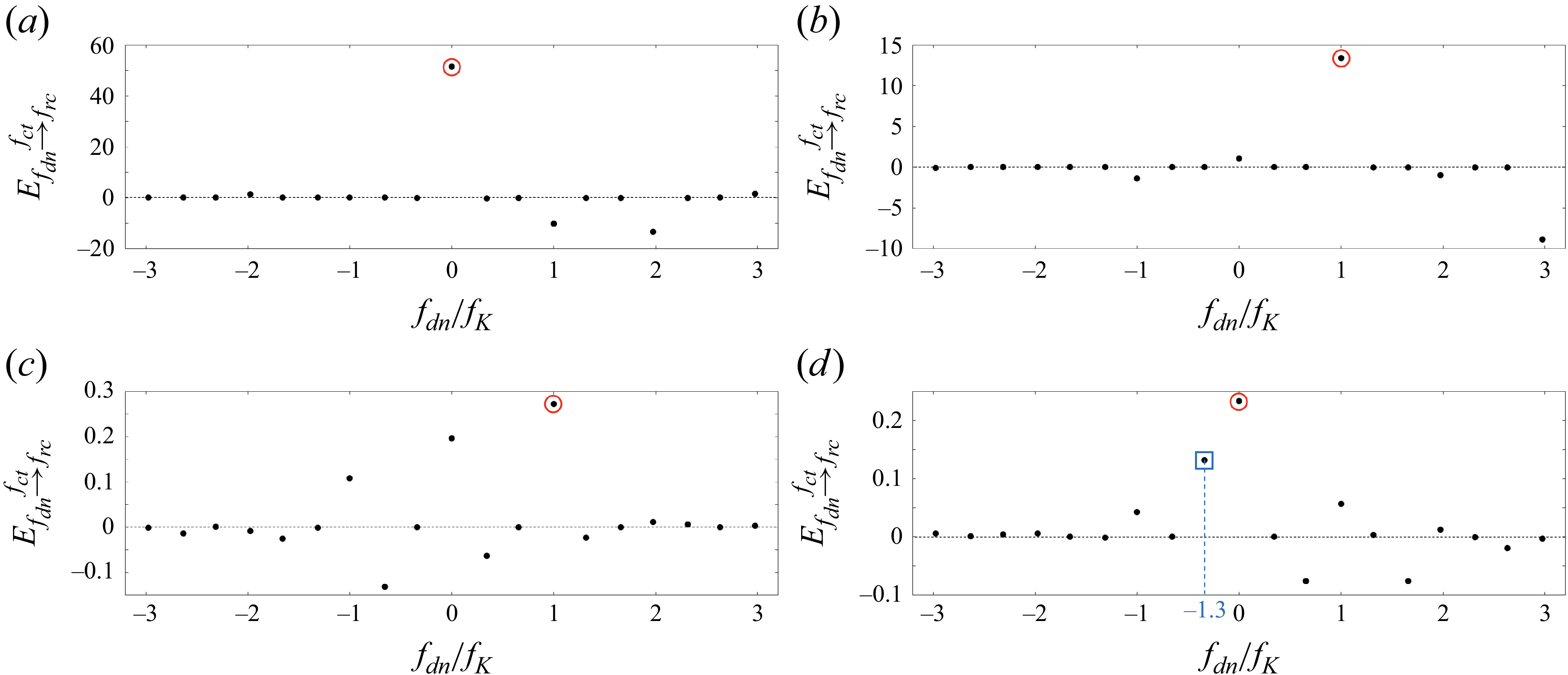


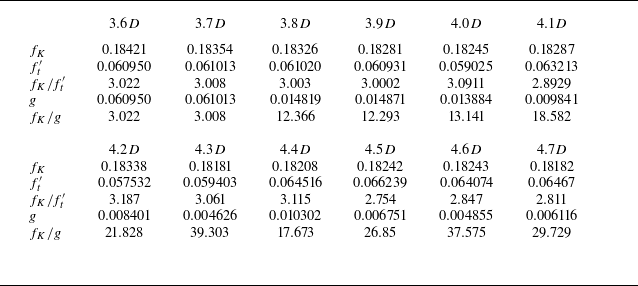


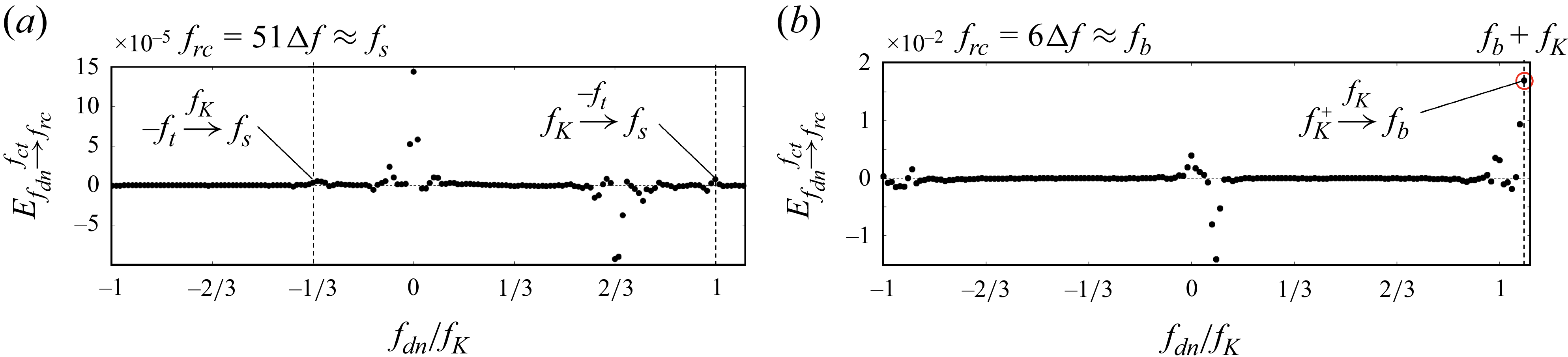


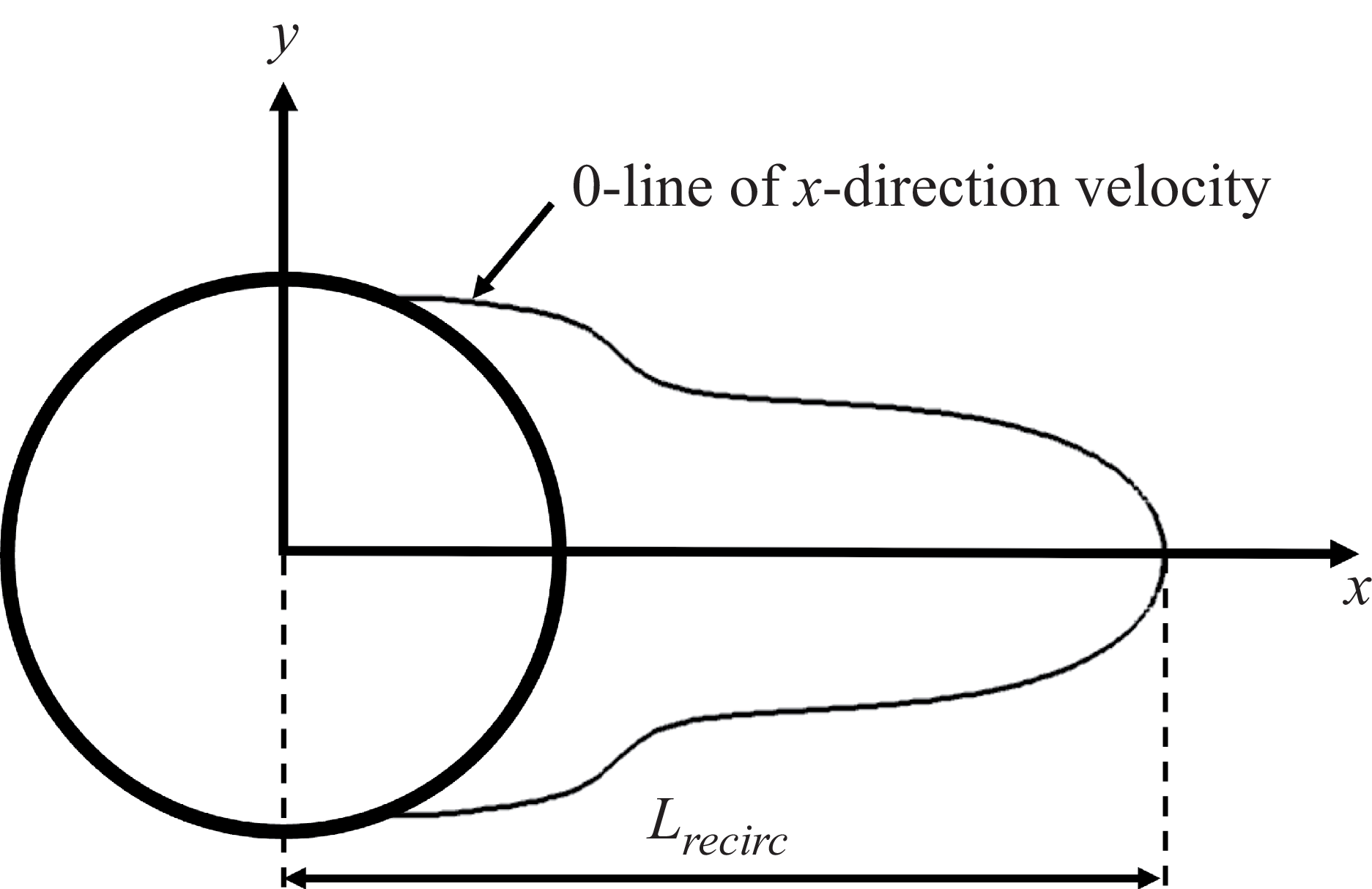


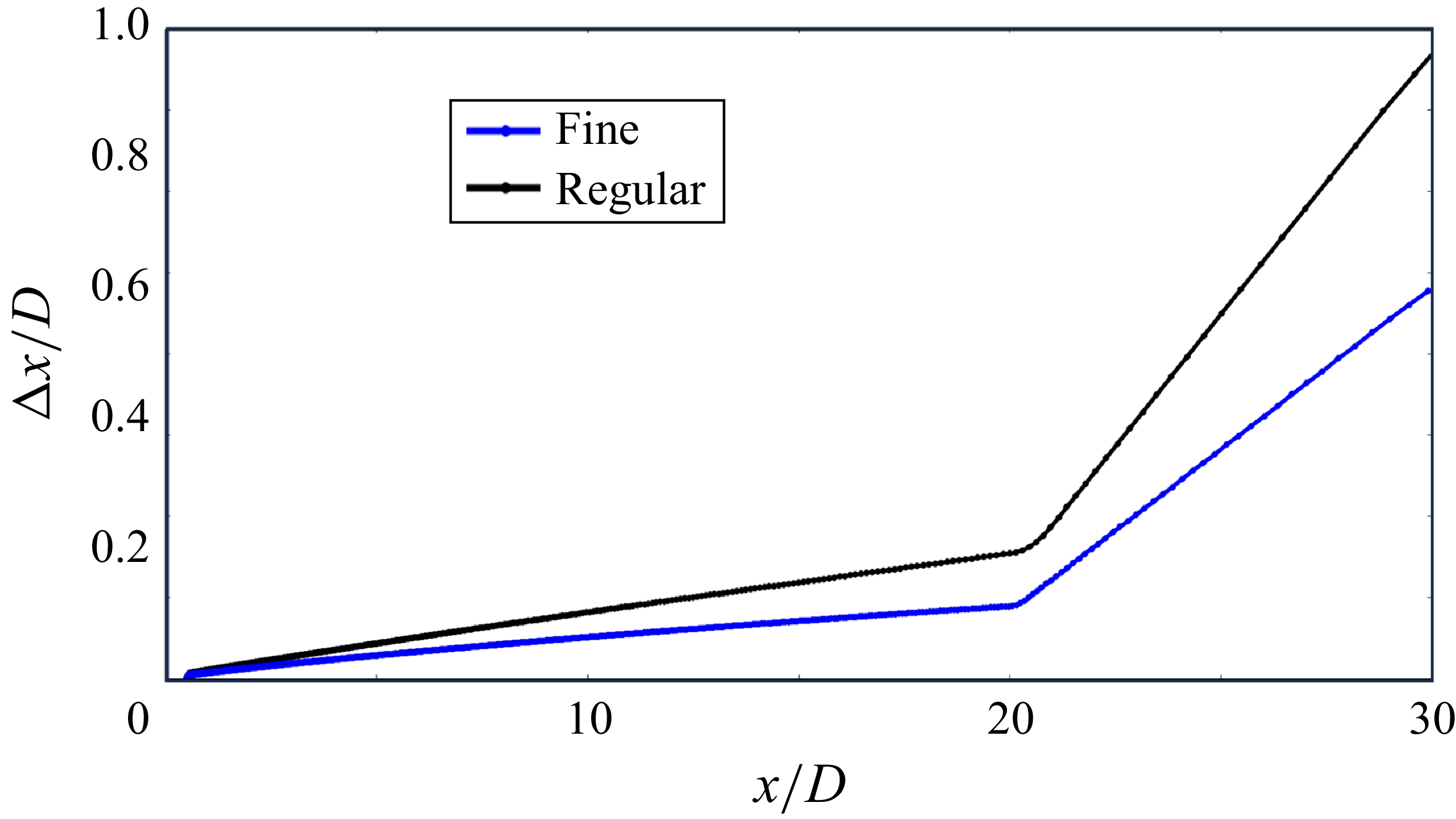





 Open access

