




Attaining accurate L2 phonetic perception is fundamental to successful communication, and explicit training has been shown to improve learners’ phonetic competence. However, most existing studies have relied on massed practice schedules, where training sessions are delivered in quick succession with minimal intervals. Recent work in cognitive psychology and L2 vocabulary learning has highlighted the benefits of distributed practice, where learning sessions are spaced over time. Despite its potential importance, this issue has rarely been investigated in L2 phonetic training. Addressing this gap, the present study examines how different training schedules—massed, equal spacing, and expanding spacing—affect Mandarin learners’ acquisition of the English /ɛ/–/æ/ contrast.
L2 phonetic training research
Over the past 50 years, much attention has been given to the effects of training in L2 phonetic learning. A range of empirical studies has demonstrated that provision of explicit phonetic training promotes L2 phonetic perception on both segmental (e.g., Bradlow, Reference Bradlow, Hansen and Zampini2008 for Japanese speakers’ English [r] and [l] acquisition) and suprasegmental levels (e.g., Wang et al., Reference Wang, Sereno, Jongman and Hirsch2003 for Americans’ acquisition of Mandarin lexical tones). Such training effectiveness can be amplified through the use of multiple talkers (e.g., High Variability Phonetic Training; Uchihara et al., Reference Uchihara, Karas and Thomson2025), and key features are acoustically enhanced (e.g., F3 enhancement in English [r] and [l] contrast; Iverson et al., Reference Iverson, Hazan and Bannister2005).
Recent meta-analyses offer further support for these findings, revealing that phonetic training has a medium to large positive effect on L2 phonetic competence (e.g., Saito & Plonsky, Reference Saito and Plonsky2019; Sakai & Moorman, Reference Sakai and Moorman2018; Yao et al., Reference Yao, He, Chen and Zhu2025). In a recent comprehensive meta-analysis, Yao et al. (Reference Yao, He, Chen and Zhu2025) synthesized findings from 65 studies involving 2,793 learners and reported a large average effect size of d = 0.762 for phonetic training. More specifically, analyzing 25 years of research, Sakai and Moorman’s (Reference Sakai and Moorman2018) meta-analysis found that perceptual training led to medium-sized improvements in perception (d = 0.92) and small but significant improvements in production (d = 0.54). This suggests that perceptual training can indeed have a positive effect on production abilities in L2 phonetic learning (Flege & Bohn, Reference Flege, Bohn and Wayland2021). Finally, Saito and Plonsky (Reference Saito and Plonsky2019) conducted a meta-analysis of 77 studies and found that L2 pronunciation instruction is generally effective with a moderate overall effect size (d = 0.61). Greater improvements were observed when targeting specific features and using objective, controlled assessments rather than global, subjective evaluations.
In a typical phonetic training study, participants take a pre-test, complete a series of short training sessions (typically 10–30 minutes), and then undergo immediate and delayed post-tests. When it comes to the perception domain aspects of L2 phonetic training (i.e., the main focus of the study), recent review articles demonstrated that a few hours of training typically result in approximately 5–10% of gains (e.g., Saito et al., Reference Saito, Hanzawa, Petrova, Kachlicka, Suzukida and Tierney2022). One methodological issue that has become standard practice—without substantial scholarly scrutiny—is the distribution schedule of these training sessions. Most existing studies have employed massed or evenly spaced training input (e.g., using a one-day inter-session interval). More broadly, L2 phonetic learning research has long emphasized the importance of input. There is ample evidence that both the quantity of input (e.g., length of immersion; Trofimovich & Baker, Reference Trofimovich and Baker2006) and the quality of input (e.g., the frequency and intensity of L2 interaction; Derwing & Munro, Reference Derwing and Munro2013) shape the rate and ultimate success of speech development. However, the question of how best to schedule such input—particularly in short-term instructional contexts—remains largely underexplored.
Massed practice is a learning strategy in which study or skill rehearsal is concentrated into a single, continuous, and intensive period with little to no rest between repetitions. Often referred to as “cramming,” it contrasts with distributed practice, which spaces learning sessions over time (for a meta-analysis of verbal recall in cognitive psychology, see Cepeda et al., Reference Cepeda, Pashler, Vul, Wixted and Rohrer2006). In research in L2 learning outside phonetics, it has been shown that training outcomes can vary—and sometimes improve—depending on the distribution schedule (e.g., massed vs. equal vs. expanding spacing; Suzuki, Nakata, & DeKeyser, Reference Suzuki, Nakata and Dekeyser2019). Despite its potential importance, this issue has received little attention in L2 phonetics, with Alfotais et al. (Reference Alfotais, Mahdi and Alkhammash2025) being a rare exception (see below).
In the case of L2 phonetic training, previous studies have employed a wide range of schedules, varying in duration, number of sessions, and overall intensity. As shown in Uchihara et al.’s (Reference Uchihara, Karas and Thomson2025) a methodological synthesis, programs have ranged from highly condensed formats delivered within a few days to more extended schedules lasting several weeks, with total training time varying from as little as 60 minutes (i.e., massed learning) to more than 20 hours (i.e., spaced learning; see Table 2 on p. 810). However, these spacing decisions were typically made on pragmatic rather than theoretical grounds, and no consistent pattern has been established linking timing/spacing parameters to learning outcomes. While perception gains tend to increase with overall training time up to a certain threshold (approximately six hours), neither the number of sessions nor their temporal distribution systematically predicted outcomes. Thus, although extant L2 phonetic training research provides abundant evidence for the efficacy of L2 phonetic training, the specific role of training distribution has not yet been directly addressed. The current study was designed to correspond to these concerns.
Distributed practice in L2 vocabulary research
Turning to L2 vocabulary literature, researchers have begun to investigate how the distribution of input—not just its amount or quality—affects learning outcomes (Suzuki et al., Reference Suzuki, Nakata and Dekeyser2019). This line of inquiry draws from the well-established spacing effect in cognitive psychology, which posits that learning is more robust when practice is spaced out over time rather than massed into a single session (Baddeley, Reference Baddeley1997; Cepeda et al., Reference Cepeda, Pashler, Vul, Wixted and Rohrer2006). One influential origin of this research is Ebbinghaus’s (1913) discovery that forgetting follows a predictable curve, but can be mitigated by repeated retrieval spaced over time.
In language learning, spaced practice has consistently been shown to yield better retention outcomes than massed practice (e.g., Bloom & Shuell, Reference Bloom and Shuell1981; Hamouda, Reference Hamouda2021; Namaziandost et al., Reference Namaziandost, Anwar and Neisi2020). Studies show that spaced learning (either equal or expanding) can lead to 20–40% higher retention compared to massed practice, and this effect is especially clearly observed in long-term retention (e.g., after a week or more).
Within the broader category of spaced practice, scholars have further distinguished between absolute spacing (i.e., total time between repetitions) and relative spacing (i.e., the pattern of intervals between repetitions), both of which have been shown to influence learning. Relative spacing has received particular attention in L2 vocabulary acquisition. It includes equal spacing—where intervals between study sessions are fixed—and expanding spacing—where intervals gradually increase across repetitions. Expanding spacing is often argued to be more effective because it increases retrieval difficulty over time, which can promote stronger memory consolidation (Karpicke & Bauernschmidt, Reference Karpicke and Bauernschmidt2011; Landauer & Bjork, Reference Landauer, Bjork, Gruneberg, Morris and Sykes1978; Pyc & Rawson, Reference Pyc and Rawson2009).
However, empirical evidence comparing equal and expanding spacing has yielded mixed results. Nakata (Reference Nakata2015), in a carefully controlled study of 128 Japanese learners, reported that expanding spacing resulted in significantly higher receptive vocabulary scores than equal spacing, across short, medium, and long absolute spacing schedules. Similarly, Schuetze (Reference Schuetze2015) found advantages for expanding spacing in short-term retention, though equal spacing outperformed in the long-term. Karpicke and Roediger (Reference Karpicke and Roediger2007) reported comparable findings, suggesting that the benefits of expanding spacing may be more pronounced in the early stages of learning.
Conversely, other studies have failed to find consistent advantages. Kang et al. (Reference Kang, Lindsey, Mozer and Pashler2014), for example, compared expanding and equal spacing schedules in a four-week vocabulary learning study and found no significant differences between the two groups on delayed post-tests. This echoes earlier work by Pyc and Rawson (Reference Pyc and Rawson2007), who also found no long-term advantage of expanding over equal spacing in their study of Swahili-English word pair retention. Overall, while the spacing effect is well established, the specific efficacy of expanding vs. equal spacing remains unsettled.
It is important to note that much of the existing research has focused on vocabulary learning. Moreover, outcomes may depend on moderating factors such as the total number of exposures, the timing of retrieval, the nature of the linguistic targets, and whether feedback is provided during practice. As stressed earlier, surprisingly little is known about the optimal timing of input in the context of L2 phonetic learning and training.
The mechanisms underlying L2 vocabulary and phonetic learning may differ substantially. On the one hand, vocabulary learning (as tested in the existing literature) involves the conscious cognitive operation of higher-order information, such as facts, conceptual knowledge, vocabulary, and morphosyntactic rules. In this case, learning typically refers to the explicit acquisition of form-meaning mappings using declarative memory. In such contexts, introducing different types of input variability through distributed practice (massed vs. spaced; equal vs. expanding spacing) can strengthen memory traces and retrieval (Landauer & Bjork, Reference Landauer, Bjork, Gruneberg, Morris and Sykes1978). On the other hand, phonetic learning takes place on relatively lower-order and perceptual levels. Such learning processes entail the readjustment of abstract, acoustic, and articulatory details of new sounds relative to L1 phonetic categories. Here, learning relies on procedural rather than declarative memory, and the process tends to be implicit, subconscious, and gradual (Best & Tyler, Reference Best, Tyler, Bohn and Munro2007).
Given these fundamentally different learning mechanisms, researchers in L2 acquisition and teaching have increasingly shown interest in testing the generalizability (or specificity) of findings across different domains of L2 learning (e.g., extending task-based language teaching from vocabulary and grammar to phonology; Mora-Plaza et al., Reference Mora-Plaza, Mora, Ortega and Aliaga-Garcia2024; Xu et al., Reference Xu, Saito and Mora-Plaza2024). Following this line of thought, we argue that it is important to explore whether, to what degree, and how insights on distributed practice (derived mainly from L2 vocabulary and grammar research) can be generalized to L2 phonetic learning. At the very least, it is possible that the effects of distributed practice differ across vocabulary/grammar learning and phonetic training, and such discrepancies should be examined to further our understanding of the role of distributed practice in language learning more broadly.
Motivation for current study
To our knowledge, Alfotais et al.’s (Reference Alfotais, Mahdi and Alkhammash2025) recent empirical study represents the very first systematic attempt to compare the effects of massed and spaced repetition schedules. In their quasi-experimental investigation, 49 Saudi EFL learners were trained on the acquisition of the English /b/–/p/ contrast. Using a within-subjects design, the study assessed L2 phonetic development both immediately after training and following a four-week delay. The results revealed that spaced repetition consistently outperformed massed repetition for both short- and long-term retention, enhancing effectiveness by approximately 55–80% compared with massed repetition—a pattern strikingly similar to the figures reported in L2 vocabulary research (Nakata, Reference Nakata2015).
While Alfotais et al. (Reference Alfotais, Mahdi and Alkhammash2025) represent an important first step in applying distributed practice frameworks to L2 phonetic learning, their work raises two important questions that merit further investigation. First, can the benefits of spaced over massed repetition be replicated in a different L2 phonetic learning context? Second, might the effects of spaced repetition be further enhanced by considering types of spacing—specifically, by distinguishing between equal and expanding spacing formats, two theoretically significant subtypes of distributed practice?
The present study built on this foundation by not only replicating the massed vs. spaced comparison but also extending it to examine the relative efficacy of equal vs. expanding spacing schedules. Given that most existing phonetic training studies have employed massed practice, our ultimate aim was to provide principled methodological guidance on the extent to which the effectiveness of the same phonetic training can change or increase when researchers adopt different timing regimes—massed, equal, or expanding. These findings will ultimately inform key theoretical questions concerning the temporal distribution of phonetic input in L2 speech training and how differently distributed input may affect L2 phonetic learning.
In the context of Mandarin learners’ acquisition of the English vowels /ɛ/ and /æ/, the current study was designed to address the following three research questions, each accompanied by a corresponding prediction:
-
1. Does a spaced practice schedule facilitate L2 phonetic learning more effectively than a massed practice schedule? If so, how much?
-
2. How do different types of spaced practice schedules (equal vs. expanding) influence L2 phonetic learning? If so, how much?
-
3. Do the relative benefits of input distribution (massed, equal, expanding) vary as a function of learners’ perceptual–cognitive abilities?
Prediction 1: Massed vs. spaced practice schedules
Following previous research in L2 vocabulary learning (e.g., Nakata, Reference Nakata2015), we first aimed to test the generalizability of the spacing effect—specifically, whether the relative advantage of spaced over massed practice would extend to L2 phonetic learning. Drawing on prior phonetic training studies (e.g., Alfotais et al., Reference Alfotais, Mahdi and Alkhammash2025), we predicted that spaced practice would lead to greater learning gains than massed practice. This effect was expected to be substantial, as Alfotais et al. reported significantly larger effect sizes for spaced conditions (d > 2) than for massed conditions (d = 1–2) at both immediate and delayed post-tests. Such findings suggest that spaced practice can result in nearly twice the retention gains of massed practice (Alfotais et al., Reference Alfotais, Mahdi and Alkhammash2025; Nakata, Reference Nakata2015).
Prediction 2: Equal vs. expanding spacing
Although spaced repetition is a well-established method for enhancing memory, debate remains as to whether expanding spacing—gradually increasing the intervals between reviews—yields greater learning gains than equal spacing, where intervals remain constant. Proponents of expanding spacing argue that increasing retrieval difficulty strengthens memory by engaging effortful retrieval and reconsolidation processes (Karpicke & Bauernschmidt, Reference Karpicke and Bauernschmidt2011; Landauer & Bjork, Reference Landauer, Bjork, Gruneberg, Morris and Sykes1978; Pyc & Rawson, Reference Pyc and Rawson2009). In contrast, equal spacing provides a simpler and more consistent schedule, which may be more effective when the initial learning task is particularly demanding (e.g., Kang et al., Reference Kang, Lindsey, Mozer and Pashler2014). In the present study, given the moderate difficulty Mandarin learners experience in acquiring the English /ɛ/–/æ/ contrast, we predicted that expanding spacing would lead to greater improvement than equal spacing. Previous research suggests that the gains from expanding spacing may yield moderately higher retention—approximately 10–20% more—than equal spacing (Nakata, Reference Nakata2015).
Prediction 3: Aptitude–treatment interaction
Recent research has shown that individual differences in perceptual-cognitive abilities can strongly influence the outcomes of L2 speech instruction. While well-structured, explicit training tends to benefit learners broadly, those with lower aptitude profiles may struggle more under less scaffolded (e.g., Suzukida & Saito, Reference Suzukida and Saito2023 for the null aptitude effects in classroom L2 speech learning), more naturalistic conditions—such as study abroad settings (Saito & Tierney, Reference Saito and Tierney2025), incidental rather than intentional phonetic training (Correia et al., Reference Correia, Rato, Ge, Fernandes, Kachlicka, Saito and Rebuschat2025; Saito et al., Reference Saito, Hanzawa, Petrova, Kachlicka, Suzukida and Tierney2022), or meaning-oriented over form-focused instruction (Ruan & Saito, Reference Ruan and Saito2023; Xu et al., Reference Xu, Saito and Mora-Plaza2024). In the current study, we hypothesized that learners with lower aptitude would make limited gains in the more demanding massed condition, where cognitive load is concentrated and consolidation opportunities are minimal. In contrast, spaced practice—particularly expanding spacing—was expected to mitigate these individual differences, leading to robust gains across aptitude levels.
Methodological implications
In response to R1-R3, the paper aims to provide critical methodological implications regarding whether, to what degree, and how introducing different practice schedules (equal and expanding spacing) can influence and enhance the effectiveness of the same phonetic training compared to traditional massed practice. Given that many existing studies traditionally rely on massed practice schedules, the findings may allow us to reinterpret their potential effectiveness if the distribution of training sessions is adjusted.
Method
This study employed a quasi-experimental design with a pre-test, an immediate post-test, and a delayed post-test. A total of 60 participants took part and were randomly assigned to either one of two experimental groups (n = 39) or a control group (n = 20). All participants completed the pre-test before undergoing six training sessions. Each experimental group received the same phonetic training—focusing on the identification and discrimination of the English vowels /e/ and /æ/ with feedback—delivered under different temporal schedules (see Figure 1 for a visual summary).
Overview of the experimental procedure across three conditions: Equal spacing (three-day fixed intervals), Expanding spacing (intervals increasing from 0 to 8 days), and Massed practice (six sessions completed in one day). All participants completed a pre-test, and the two experimental groups received immediate post-tests after session 6, followed by a seven-day retention interval and delayed post-tests. Auditory processing aptitude tests were conducted after the delayed post-tests.

Figure 1. Long description
The flowchart is divided into three columns.
Left Column: Experimental Group Equal with n = 20. A vertical bracket indicates that sessions 1 to 6 span 16 days. The sequence starts with pre-test session 1, followed by a 3-day interval, session 2, a 3-day interval, session 3, a 3-day interval, session 4, a 3-day interval, session 5, a 3-day interval, and session 6 with an immediate posttest. This is followed by a 7-day retention interval and a final box for delayed posttest and auditory processing tests.
Middle Column: Experimental Group Expanding with n = 19. The sequence starts with pre-test session 1. There is no interval between s 1 and s 2. It continues with session 2, a 1-day interval, session 3, a 2-day interval, session 4, a 4-day interval, session 5, an 8-day interval, and session 6 with an immediate posttest. It concludes with a 7-day retention interval and a box for delayed posttest and auditory processing tests.
Right Column: Control Group Massed with n = 20. The sequence starts with a single box containing pre-test, session 1 to session 6, and immediate posttest. This is followed by a 7-day retention interval and a final box for delayed posttest and auditory processing tests.
Following the well-established HVPT paradigm, first introduced by Logan, Lively, and Pisoni (Reference Logan, Lively and Pisoni1991), the training stimuli consisted of naturally produced tokens of real English words, recorded by multiple native speakers. This methodological framework has been extensively validated in more than 50 empirical studies over the past three decades and was recently synthesized in a comprehensive meta-analysis (Uchihara et al., Reference Uchihara, Karas and Thomson2025), which confirmed its robustness in promoting durable gains in L2 speech perception and production.
Upon completion of the six sessions, participants took an immediate post-test, a delayed post-test, and a battery of auditory processing tests to assess aptitude. The design incorporated two of the two methodological criteria proposed by Nakata (Reference Nakata2015) for evaluating the effects of spacing: (1) provision of trial-by-trial feedback during training and (2) inclusion of multiple retention intervals via both immediate and delayed post-tests. These conditions were deemed particularly important for contrasting the effects of equal and expanding spacing schedules.
The three-day spacing interval in the Equal Spacing group was selected to align with principles of optimal distributed practice, where intersession intervals are proportional to the desired retention interval (Cepeda et al., Reference Cepeda, Pashler, Vul, Wixted and Rohrer2006). Given the seven-day delay before the final post-test, a three-day interval was expected to strike an appropriate balance between retrieval difficulty and memory consolidation for the moderately difficult /ɛ/–/æ/ contrast. This spacing schedule also allowed for consistent learner engagement and operational feasibility across the 16-day training window.
In the Expanding Spacing group, the intersession intervals gradually increased from 1 to 8 days (1–2–3–4–5–8). This schedule was grounded in the expanding retrieval hypothesis, which posits that learning is enhanced when retrieval becomes increasingly effortful but remains successful over time (Karpicke & Bauernschmidt, Reference Karpicke and Bauernschmidt2011; Landauer & Bjork, Reference Landauer, Bjork, Gruneberg, Morris and Sykes1978). The initial short intervals supported early encoding of the novel phonetic contrast (/ɛ/–/æ/), while later, more widely spaced sessions fostered durable consolidation in anticipation of the seven-day delayed post-test. This structure was intended to optimize both short- and long-term gains by balancing encoding support and memory challenge across the training timeline.
Participants
The participants were 60 adult Chinese ESL learners recruited through social media platforms in a specific region of China. Participation was incentivized by advertising the project as a free English phonetic training program, thereby attracting only individuals genuinely interested in the project. This approach was intended to avoid recruiting participants who might otherwise participate solely for monetary incentives and thus complete the training without sufficient concentration. All were over 18 years old, self-reported no hearing impairments, and had received at least 7 years of formal English education as part of China’s compulsory schooling system. According to national curriculum guidelines, this educational background corresponds to CEFR A2–B1 proficiency levels. None of the participants reported extensive study abroad experience. Interested individuals contacted the researcher to enroll. Prior to participation, they received an information sheet and signed a consent form. One participant withdrew before completing the study due to personal reasons, leaving a final sample of 59 participants. The average age was 29.6 (Range = 20–54). On average, they began learning English at age 7.6 (Range = 1–13 years). Participants were randomly assigned to one of three groups: Expanding spacing (n = 19), Equal spacing (n = 20), or Control (Massed practice) (n = 20).
Power analysis of sample size
Importantly, for robust statistics, participants with extremely high scores (>90% accuracy) were excluded at the outset of the project to avoid ceiling effects. This resulted in a final sample of 53 participants for analysis. To estimate the required sample size, a power analysis was conducted using G*Power (Faul, Erdfelder, Lang, & Buchner, Reference Faul, Erdfelder, Lang and Buchner2007). Although Alfotais et al. (Reference Alfotais, Mahdi and Alkhammash2025) reported relatively large effects (d = 2) in their precursor research, we adopted a more conservative approach and set the predicted effect size to “medium,” in line with Yao et al.’s (Reference Yao, He, Chen and Zhu2025) meta-analysis, which suggested that L2 phonetic training typically yields medium effects (d = 0.762). For three groups (massed, equal spacing, and expanding spacing) assessed across three testing points (pre, immediate post, and delayed post), achieving medium effects (f = 0.25) with sufficient power (0.95) required a sample size of 54. Thus, our final sample size (n = 53) was considered adequate. Notably, this was comparable to existing research (n = 49; Alfotais et al., Reference Alfotais, Mahdi and Alkhammash2025).
Setup
The experiment was conducted online via the Gorilla platform (Anwyl-Irvine et al., Reference Anwyl-Irvine, Massonnié, Flitton, Kirkham and Evershed2020), with participants completing all tests and training individually on their own computers and headsets under the guidance of a researcher (a native Mandarin speaker). Several precautionary measures were implemented to ensure that participants fully understood and engaged with the tasks, remained focused, and completed the procedures without distraction. Any participants who showed evidence of deviation were excluded to maintain data quality. First, we explicitly advertised the project as an opportunity to learn English pronunciation for free, ensuring that participants were genuinely motivated by the project’s objective (i.e., improving their L2 English speech proficiency). Second, the investigator arranged an individual videoconferencing meeting with each participant, explained the project’s purpose and procedures in their L1 (Mandarin), and confirmed comprehension. During this meeting, participants also completed an online survey about their EFL experience on Gorilla as a test run and checked the sound level of their headsets. Third, the investigator monitored participants’ progress in each training session via Gorilla. Pilot data collection confirmed that each training session lasted about 10 minutes. A threshold of 15 minutes per session was set for potential elimination; however, no participants exceeded this limit. In sum, we are confident that all participants included in the final analyses (n = 53) completed the tasks with adequate levels of understanding, engagement, and concentration.
Speech stimuli
Target of training
The focus of this study was on the perception of the English vowels /ɛ/ and /æ/, a high-functional-load contrast in English that is particularly difficult for Mandarin speakers. Prior research (e.g., Xiao & Chen, Reference Xiao and Chen2021) has shown that Mandarin speakers often assimilate both /ɛ/ and /æ/ to their native /a/ (or /e/) category, resulting in poor perceptual discrimination and inaccurate production.
Flege’s Speech Learning Model (SLM; Flege & Bohn, Reference Flege, Bohn and Wayland2021) attributes this perceptual difficulty to category assimilation. The likelihood of establishing a new L2 phonetic category depends on the perceived dissimilarity between the L2 sound and its closest L1 counterpart. Since Mandarin lacks the /æ/ vowel, learners typically assimilate it to /a/ or /e/, resulting in persistent misperception. The SLM also emphasizes the reciprocal relationship between perception and production, whereby inaccurate perception reinforces inaccurate production and vice versa. Best and Tyler’s (Reference Best, Tyler, Bohn and Munro2007) Perceptual Assimilation Model offers a similar account: both English vowels are assimilated to a single Mandarin category (/a/ or /e/). This Single-Category assimilation prevents learners from forming distinct representations of /ɛ/ and /æ/, leading to consistently poor discrimination performance in empirical studies.
Indeed, research has repeatedly shown that this contrast is among the most problematic for Mandarin learners, often proving more difficult to acquire than other challenging pairs (e.g., /i/-/ɪ/, /u/-/ʊ/; Thomson, Nearey, & Derwing, Reference Thomson, Nearey and Derwing2009). This perceptual difficulty is further compounded by Mandarin speakers’ reliance on acoustic cues that differ from those used by native English speakers. While native English speakers employ both spectral (vowel height, F1) and durational cues to distinguish /ɛ/ and /æ/, Mandarin learners often struggle to use these cues in a native-like manner, which hinders the establishment of distinct phonological categories for the two vowels (Kachlicka, Symons, Saito, Dick, & Tierney, Reference Kachlicka, Symons, Saito, Dick and Tierney2024).
Lexical items
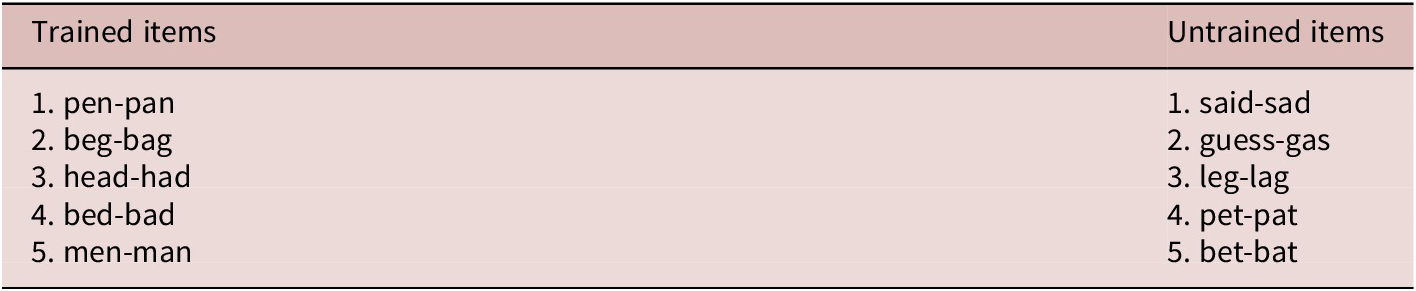
L2 phonetic training in the current study employed words that contrasted /ɛ/ and /æ/ in a consonant-vowel-consonant structure. A total of 20 lexical items were selected—10 trained items, which appeared in the training and both tests, and 10 untrained items, which appeared only in the tests. This allowed for an assessment of both trained learning and generalization to novel items. The majority of items (19 out of 20) belonged to the first 2,000 word families in the British National Corpus (BNC), based on frequency profiles available via Tom Cobb’s Vocabulary Profiler. Thirteen items were classified as K-1, and six as K-2. The remaining word (lag) was from the K-5 level but followed regular phonological patterns and was therefore deemed appropriate. According to Milton (Reference Milton2009), a vocabulary size of 1,500–2,500 words corresponds to CEFR A2 level, suggesting that the selected items were appropriate for the study’s target participants, all of whom had a minimum estimated proficiency of CEFR A2. A list of the target items was displayed in Table 1.
Target Word pairs used during training and testing (trained items) vs. testing only (untrained items)

Table 1. Long description
The table is divided into two main columns.
The first column, titled Trained items, contains five numbered word pairs:
1. pen-pan
2. beg-bag
3. head-had
4. bed-bad
5. men-man
The second column, titled Untrained items, contains five numbered word pairs:
1. said-sad
2. guess-gas
3. leg-lag
4. pet-pat
5. bet-bat
Talkers
Two talkers (one male, one female) were recruited to produce the auditory stimuli. Both were native speakers of British English who spoke with Received Pronunciation and had experience as professional voice actors. Prior to recording, the talkers were informed of the nature of the study and instructed to clearly distinguish between the English vowels /ɛ/ and /æ/ in their pronunciations. In total, they produced 40 stimuli (20 per speaker). All recordings were completed in their own home studios using professional-grade equipment to ensure high audio quality.
It is important to acknowledge that the training involved only two talkers. According to Uchihara et al.’s (Reference Uchihara, Karas and Thomson2025) methodological synthesis, this number falls at the lower end of HVPT research, which typically ranges between 2 and 30 talkers. While their meta-analysis suggested that the number of talkers may influence outcomes for highly proficient L2 learners, our participants were relatively lower proficiency (CEFR A2–B1). We therefore assumed that two talkers would be sufficient to trigger learning in this context. Supporting this assumption, Nagle, Bruun, and Zarate-Sandez (Reference Nagle, Bruun and Zarate-Sandez2025) found no advantage of using six over two talkers when training English speakers on relatively simple Spanish stop consonants.
Pre/post-test measures
To assess the effects of training on learners’ perception of the English vowels /ɛ/ and /æ/, a forced-choice identification test was administered at pre-test, immediate post-test, and delayed post-test. To accommodate participants’ availability and geographical distribution, the tests were delivered online using the Gorilla Experiment Builder platform. During the test, participants completed a two-alternative forced-choice identification task. Using their own devices in a quiet environment, they listened to pairs of minimally contrasting words (e.g., pen vs. pan) that differed only in the target vowel sound. The stimuli included both trained and untrained items (see Table 1), and each item was recorded by 3 native speakers, resulting in 60 audio tokens in total. For each trial, participants heard a single word and were asked to identify what they heard by selecting one of two written options displayed on the screen (see Figure 2).
Sample screenshot of the two-alternative forced-choice identification task interface used in the perception test. On each trial, participants listened to a spoken word and selected the corresponding written form from two options (e.g., said vs. sad). Instructions were presented bilingually in English and Chinese (“Click the word you heard.” / 点击您所听到的单词) to ensure clarity for all participants. Responses were submitted by clicking one of the two options, after which the task automatically advanced to the next item.

Phonetic training
Training setup
Following the pre-test, participants completed six sessions of perceptual training using a high-variability paradigm with trial-by-trial feedback. Each session lasted approximately 10 minutes, amounting to about 1 hour of training in total. In each session, participants identified 20 audio tokens of the 10 trained words (see Table 1), spoken by both a male and a female talker. After each response, participants received immediate visual feedback, followed by a replay of the correct word accompanied by a bilingual message (see Figure 3). This feedback format was informed by Nakata (Reference Nakata2015), who emphasize the importance of corrective feedback and repeated exposure for consolidating difficult phonetic contrasts. To minimize reliance on rote memorization, the order of word presentation was randomized in each session. The six-session structure was based on research suggesting that 2–20 exposures are typically required to establish lexical knowledge (Saragi et al., Reference Saragi1978; Uchihara et al., Reference Uchihara, Webb, Saito and Trofimovich2022; Webb, Reference Webb2007). In the present design, each word was presented at least 12 times across sessions (6 sessions × 2 talkers), providing sufficient repetition to support perceptual learning.
Example screenshots from the phonetic training session. After selecting one of the two word options, participants received immediate visual feedback indicating whether their response was correct (green tick; 3A) or incorrect (red cross; 3B). This was followed by a feedback screen presenting the correct word along with its pronunciation and a bilingual prompt (“The correct word is” / 正确的单词是; 3C). The two-step feedback procedure was designed to enhance phonetic category learning by encouraging accurate form-meaning mapping and reinforcing correct auditory representations.

Figure 3. Long description
The figure consists of three vertically stacked computer monitors labeled A, B, and C.
* Panel A at the top shows a screen with the bilingual question ‘Which word did you hear?’ and its Chinese translation. Below the text is a green check mark. At the center are two gray buttons labeled ‘bet’ on the left and ‘bat’ on the right.
* Panel B in the middle displays the same bilingual question. Below the text is a red X mark. The ‘bet’ button on the left remains gray, while the ‘bat’ button on the right is highlighted in a darker shade.
* Panel C at the bottom shows a feedback screen. The top text reads ‘The Correct Word Is’ followed by the Chinese translation. The word ‘bet’ is displayed in the center of the screen. At the bottom center is a red button labeled ‘Next’.
Group conditions
Upon enrolment, participants were randomly assigned to one of three groups: the Massed Practice group (control), the Equal Spacing group (experimental), and the Expanding Spacing group (experimental).
All participants followed the same overall sequence: a pre-test, six training sessions, an immediate post-test administered directly after the final training session (Retention Interval = 0 days), and a delayed post-test administered seven days later. Auditory processing aptitude tests were completed within two days after the delayed post-test. Notably, the first training session began immediately after the pre-test.
Each group differed in how their training sessions were spaced. Drawing from Landauer et al. (Reference Landauer, Bjork, Gruneberg, Morris and Sykes1978), which originally employed three repetitions following initial exposure (e.g., 5–5–5), the current study implemented five intersession intervals, allowing each target item to be reviewed six times across the six sessions. The intersession interval was measured in time (hours/days), and each group followed a distinct schedule:
-
• Massed Group (0–0–0–0–0): All six sessions were completed consecutively without delay between them (e.g., session 2 followed immediately after session 1).
-
• Expanding Group (0–1–2–4–8): ISIs increased across sessions—session 2 followed immediately after session 1, session 3 was held one day later, session 4 after two days, session 5 after four days, and session 6 after eight days.
-
• Equal Group (3–3–3–3–3): All sessions were spaced evenly, with three days (72 hours) between each.
To control for absolute spacing, which may influence the effectiveness of relative spacing (Dobson, Reference Dobson2012; Maddox, Balota, Coane, & Duchek, Reference Maddox, Balota, Coane and Duchek2011; Nakata, Reference Nakata2015), both the expanding and equal groups were matched on total time span (15 days) across the 5 intersession intervals (Expanding: 0 + 1 + 2 + 4 + 8 = 15 days; Equal: 3 × 5 = 15 days). This controlled design ensured that any observed differences could be attributed to relative rather than absolute spacing.
Although intersession intervals were planned in days, the implementation was based on exact hours. For example, if a participant in the Equal group completed session 1 at 9:00 a.m. on Day 1, session 2 would become available at 9:00 a.m. on Day 4. Given the practical constraints of participant schedules, some flexibility was introduced: each training session could be completed within a six-hour window after the scheduled start time (e.g., between 9:00 a.m. and 3:00 p.m.).
Auditory processing measures
To assess participants’ individual differences in auditory processing abilities, two types of tests were administered: (a) auditory acuity tasks targeting spectral and temporal discrimination, and (b) auditory–motor integration tasks assessing rhythm and melody reproduction. All tasks were delivered via the Gorilla platform. Written instructions were provided in both English and Mandarin, and participants completed a brief practice trial before each task to ensure comprehension. All test materials are available through SLA Speech Tools (Mora-Plaza, Saito, Suzukida, Dewaele, & Tierney, Reference Mora-Plaza, Saito, Suzukida, Dewaele and Tierney2022), with full methodological details and validation reported in Saito and Tierney (Reference Saito and Tierney2025).
Auditory acuity test
Three adaptive three-alternative forced-choice discrimination tests were used to assess participants’ ability to detect subtle differences in duration, formant, and pitch. Each trial presented three non-verbal sounds (with a fixed 0.5s inter-stimulus interval); participants were asked to identify which of the first or third sound differed from the standard second sound by clicking “1” or “3” on the screen. The stimuli were 500-ms four-harmonic complex tones with a fundamental frequency of 330 Hz. The specific test parameters were as follows. In the duration discrimination task, the standard stimulus was set at 250 ms, and target durations varied from 252.5 to 500 ms in 2.5 ms increments. In the pitch discrimination task, the standard tone was 330 Hz, while the target frequencies ranged from 330.3 Hz to 360 Hz in 0.3 Hz steps. For the formant discrimination task, the stimuli were complex tones with a fundamental frequency of 100 Hz, F1 at 500 Hz, and F3 at 2,500 Hz. The second formant was set at 1,500 Hz in the standard stimulus and varied from 1,502 to 1,700 Hz in 2 Hz increments in the target stimuli.
Following Levitt’s (Reference Levitt1971) adaptive threshold procedure, task difficulty increased after three consecutive correct responses and decreased after each incorrect response. The task ended after either 8 reversals or 70 trials. Final scores ranged from 0 to 100, with lower scores indicating finer discrimination ability.
Audio-motor integration test
To evaluate participants’ ability to reproduce temporal and spectral auditory information, two reproduction tasks were administered: rhythm reproduction and melody reproduction. In the rhythm reproduction task, participants listened to rhythmic patterns that were 3.2 seconds in length and composed of drum hits, adapted from Povel and Essens (Reference Povel and Essens1985). Each pattern was presented three times per trial, after which participants were instructed to reproduce the rhythm by tapping the spacebar on their keyboard. In the melody reproduction task, participants heard short melodies consisting of seven notes, with each note lasting 300 milliseconds. The melodies were constructed using six-harmonic complex tones with fundamental frequencies of 220, 246.9, 277.2, 311.1, and 329.6 Hz. After listening to each melody three times, participants reproduced it by pressing number keys from 1 to 5, where “1” represented the lowest pitch and “5” the highest. Prior to the actual test, participants were given a brief familiarization period to ensure they understood the correspondence between the number keys and the pitch scale.
In contrast to the acuity tasks, higher scores in the reproduction tasks indicated better performance. All tasks have been validated and used extensively in recent studies examining auditory processing in adult L2 acquisition (Kachlicka, Saito, & Tierney, Reference Kachlicka, Saito and Tierney2019; Saito et al., Reference Saito, Hanzawa, Petrova, Kachlicka, Suzukida and Tierney2022; Shao et al., Reference Shao, Saito and Tierney2023).
Results
The data and R script are publicly available on OSF: https://osf.io/9x48y. As observed in existing phonetic training studies of this kind, participants’ test scores were negatively skewed. Following established procedures, six participants who scored above 90% accuracy at the onset of the project were removed from the dataset, as these participants had little room for improvement (n = 3 from Expanding Spacing, n = 3 from Equal Spacing; see Iverson, Pinet, & Evans, Reference Iverson, Pinet and Evans2012, for a similar decision). According to Kolmogorov–Smirnov tests, the final dataset (n = 53) did not show significant deviations from normality for the Control, Expanding, and Equal groups (D = .129, .089, and .122, respectively; p > .05). Descriptive statistics for participants’ vowel perception scores by group (Control, Expanding, Equal) and lexis condition (trained, untrained) across the three test points (pre-, immediate post-, and delayed post-test) are summarized in Table 2 and visually presented in Figure 4. Participants’ average accuracy ranged between 70% and 80%, which is comparable to other studies that have targeted and reported significant improvements in the context of challenging L2 speech acquisition cases (see Saito et al.’s Reference Saito, Hanzawa, Petrova, Kachlicka, Suzukida and Tierney2022 synthesis of L2 phonetic training studies). This suggests that the Mandarin participants in the present study did experience difficulty with the target contrasts (English /ɛ/ and /æ/), leaving substantial room for improvement.
Descriptive statistics of participants’ vowel perception scores at different time points as per group conditions
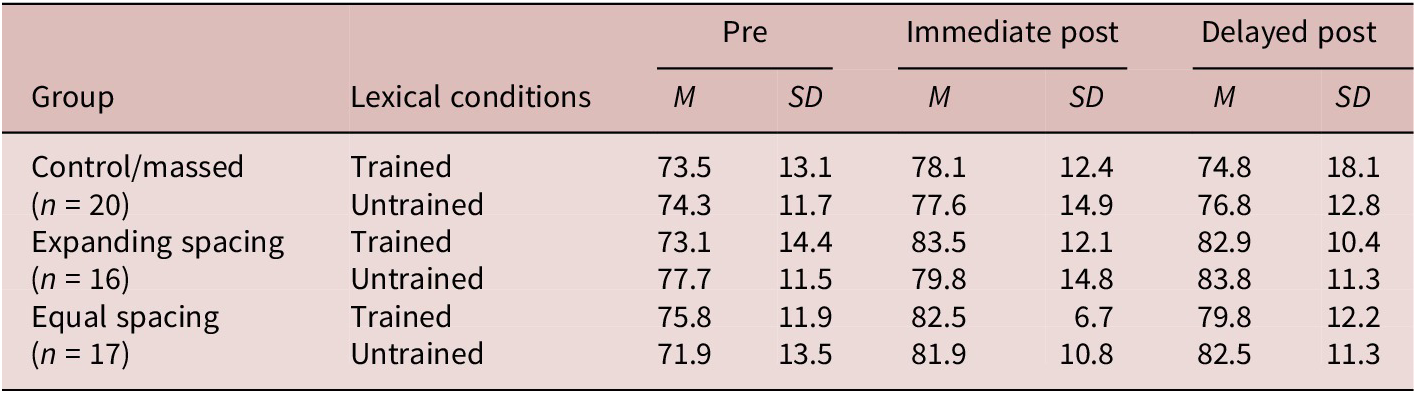
Table 2. Long description
Fallback
Vowel perception performance across groups and time. A visual summary of the three groups’ (Control, Expanding, Equal) vowel perception performance (%) at three different time points (Pre, Immediate, Delayed) overall (4A) and across two lexical conditions (4B). While the control/massed group showed improvement at the immediate post-tests, their performance declined at the delayed post-tests. Both expanding and equal groups maintained their performance up to the delayed post-tests.

Figure 4. Long description
Panel 4 A, titled Overall Performance, features a line graph with Time Point on the x-axis (Pre, Immediate, Delayed) and Mean D V Score on the y-axis ranging from 70 to 85.
* The Control (Massed) group, shown in red, starts at approximately 74, rises to 78 at Immediate, and drops to 76 at Delayed.
* The Expanding Spacing group, shown in green, starts at 73, rises sharply to 81 at Immediate, and continues to rise to 82 at Delayed.
* The Equal Spacing group, shown in blue, starts at 74, rises to 82 at Immediate, and slightly declines to 81 at Delayed.
Panel 4 B, titled Two Lexical Conditions (Trained versus Untrained), contains two side-by-side line graphs.
* In the Lex: Trained graph, all groups show a peak at the Immediate time point. The Expanding (green) and Equal (blue) groups reach approximately 83, while the Control (red) group peaks lower at 78. At the Delayed point, the Control group drops to 75, while the other two remain near 80-82.
* In the Lex: Untrained graph, the Expanding group (green) shows a continuous linear increase from 75 at Pre to 82 at Delayed. The Equal group (blue) rises from 72 to 82 at Immediate and plateaus. The Control group (red) rises from 74 to 78 at Immediate and slightly declines to 77 at Delayed.
All data points include vertical error bars representing variance.
A linear mixed-effects regression analysis was performed using the lme4 package (Bates, Mächler, Bolker, & Walker, Reference Bates, Mächler, Bolker and Walker2015) in the R statistical environment (R Core Team, 2025). The following model (DV ~ Group * Time * Lex + (1 | ID)) was constructed to examine the extent to which participants in three different groups (Group: Controlled, Expanding, Equal) improved their L2 vowel perception scores (%) over time (Time: Pre, Immediate Post, Delayed Post) and whether these improvements extended to untrained lexical contexts (Lex: Trained, Untrained).
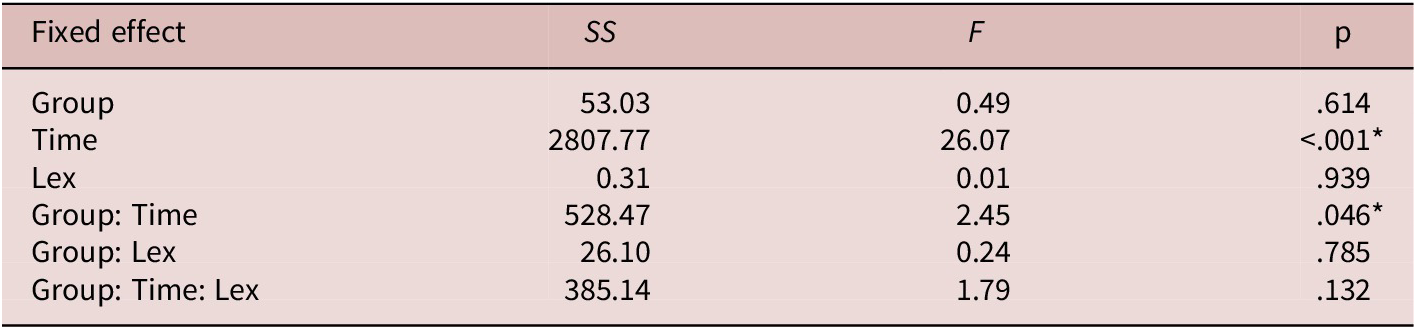
As shown in Table 3 (and visually plotted in Figure 4A), the analysis revealed significant main effects of Time, as well as significant Group × Time interaction effects, indicating that the trajectory of improvement differed across the three groups. However, the Group × Time × Lex interaction was not statistically significant (p = .132), suggesting that the pattern of improvement was consistent across both trained and untrained lexical conditions. This implies that the observed learning gains were generalizable beyond the specific lexical items used during training.
Results of mixed-effects model analysis for L2 vowel perception

Table 3. Long description
The table consists of four columns: Fixed effect, S S, F, and p.
• Group: S S 53.03, F 0.49, p .614.
• Time: S S 2807.77, F 26.07, p less than .001 (marked with an asterisk indicating significance).
• Lex: S S 0.31, F 0.01, p .939.
• Group by Time interaction: S S 528.47, F 2.45, p .046 (marked with an asterisk indicating significance).
• Group by Lex interaction: S S 26.10, F 0.24, p .785.
• Group by Time by Lex interaction: S S 385.14, F 1.79, p .132.
A footer note specifies that an asterisk indicates p is less than .05.
Note: * indicates p < .05
To unpack the significant interaction effects of Group and Time, we performed a set of post-hoc multiple comparisons. These comparisons were analyzed using the emmeans package (Lenth & Piaskowski, Reference Lenth and Piaskowski2025) in R and are summarized in Table 4. The results indicated that the Control/Massed group showed rapid improvement from pre-test to immediate post-test, with a medium effect size (p = .040, d = 0.55, 95% CI [0.10, 0.99]). However, these gains were not statistically significant at the delayed post-test (p = .474). In contrast, both the Expanding and Equal groups demonstrated significant improvements at both the immediate and delayed post-tests (p < .001 for all comparisons with pre-test scores). Effect sizes varied slightly between these two groups. The Expanding group exhibited large effects at both the immediate (d = 1.02) and delayed (d = 1.21) post-tests. Similarly, the Equal group showed a large effect at the immediate post-test (d = 1.14), which remained substantial at the delayed post-test (d = 0.99). When comparing improvements from pre-test to immediate post-test, the Expanding (d = 1.02) and Equal (d = 1.14) groups demonstrated effect sizes nearly twice as large as that of the Control group (d = 0.55). Furthermore, at the delayed post-test, the Control group’s gains were not statistically significant and reflected only a small effect size (d = 0.26), whereas the Expanding (d = 1.21) and Equal (d = 0.99) groups maintained large effect sizes, clearly outperforming the Control group in terms of sustained improvement.
Results of multiple comparison analyses

Table 4. Long description
The table consists of seven columns. The first column identifies the Group. The next three columns are grouped under the heading Pre to immediate post, and the final three columns are grouped under Pre to delayed post. Both time intervals report values for t, p, and d [95% C I].
* Control group: Pre to immediate post shows t = 2.413, p = .040, d = 0.545 [0.096, 0.994]. Pre to delayed post shows t = 1.168, p = .474, d = 0.261 [0.185, 0.708].
* Expanding group: Pre to immediate post shows t = 4.088, p < .001, d = 1.022 [0.516, 1.528]. Pre to delayed post shows t = 4.826, p < .001, d = 1.207 [0.697, 1.715].
* Equal group: Pre to immediate post shows t = 4.682, p < .001, d = 1.136 [0.642, 1.629]. Pre to delayed post shows t = 4.076, p < .001, d = 0.989 [0.497, 1.480].
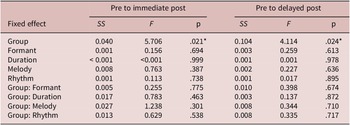
The objective of the final statistical analyses was to examine the extent to which participants’ improvement over time was linked to their individual differences in auditory processing abilities. To this end, participants’ relative gain scores were calculated for two different contexts (pre to immediate post, pre to delayed post) using the following formula: (pre-test minus post-test scores)/pre-test scores. Using their gain scores as dependent variables (one for pre-to-immediate, the other for pre-to-delayed), the following linear regression models were constructed—i.e., DV ~ Group * formant + Group * duration + Group * melody + Group * rhythm. As summarized in Table 5, not surprisingly, the main effects of Group reached statistical significance as both Expanding and Equal outperformed Control/Massed at both immediate and delayed post-tests (p < .05). However, none of the main and interaction effects of auditory processing variables reached statistical significance (p > .05). This suggests that the participants’ improvement patterns were unrelated to their perceptual-cognitive individual differences.
Results of multiple regression analyses

Table 5. Long description
The table displays S S, F, and p values for nine fixed effects across two categories: Pre to immediate post and Pre to delayed post.
* Group: Pre to immediate post S S 0.040, F 5.706, p .021 asterisk; Pre to delayed post S S 0.104, F 4.114, p .024 asterisk.
* Formant: Pre to immediate post S S 0.001, F 0.156, p .694; Pre to delayed post S S 0.003, F 0.259, p .613.
* Duration: Pre to immediate post S S less than 0.001, F less than 0.001, p .999; Pre to delayed post S S 0.001, F 0.001, p .978.
* Melody: Pre to immediate post S S 0.008, F 0.763, p .387; Pre to delayed post S S 0.002, F 0.227, p .636.
* Rhythm: Pre to immediate post S S 0.001, F 0.113, p .738; Pre to delayed post S S 0.001, F 0.017, p .895.
* Group: Formant: Pre to immediate post S S 0.005, F 0.255, p .775; Pre to delayed post S S 0.010, F 0.398, p .674.
* Group: Duration: Pre to immediate post S S 0.017, F 0.783, p .463; Pre to delayed post S S 0.003, F 0.137, p .872.
* Group: Melody: Pre to immediate post S S 0.027, F 1.238, p .301; Pre to delayed post S S 0.008, F 0.344, p .710.
* Group: Rhythm: Pre to immediate post S S 0.013, F 0.629, p .538; Pre to delayed post S S 0.008, F 0.335, p .717.
Note: asterisk indicates p less than .05.
Note: * indicates p < .05
Discussion
Over the past 30 years, a substantial body of research has investigated various phenomena underlying instructed L2 phonetic learning. As shown in recent meta-analyses, a few hours of targeted phonetic training typically yield medium-sized learning gains (e.g., d = 0.762 as reported in Yao et al., Reference Yao, He, Chen and Zhu2025). According to Saito et al. (Reference Saito, Hanzawa, Petrova, Kachlicka, Suzukida and Tierney2022), such improvements generally fall within the range of 5–10%. However, most existing studies have exclusively employed massed training conditions, where sessions are delivered in close succession with minimal intervals. In contrast, psycholinguistic research increasingly suggests that the distribution of practice—how learning sessions are spaced over time—can significantly enhance L2 learning outcomes in domains such as vocabulary and grammar (e.g., Suzuki et al., Reference Suzuki, Nakata and Dekeyser2019). The primary aim of the present study was to explore how alternative practice schedules (massed, equal spacing, and expanding spacing) affect the efficacy of L2 phonetic training. In doing so, we aim to offer methodological insights into how the findings of past studies might be reinterpreted through the lens of practice distribution.
After just one hour of training, participants in the Control/Massed group showed approximately a 5% improvement, with a medium effect size at the immediate post-test (d = 0.545). Since neither the main nor interaction effects of Lex (trained vs. untrained lexical contexts) were observed for the Control/Massed group (or any other spacing group), the training gains were not influenced by whether performance was tested on trained or untrained lexical contexts. This suggests that the training gains generalized from trained to untrained lexical contexts. When it comes to the durability of such training effects, however, they were unable to retain these gains, with nearly half of the improvement lost by the delayed post-test (d = 0.261). The magnitude of the initial gain is comparable to previous findings (e.g., Yao et al., Reference Yao, He, Chen and Zhu2025, d = 0.762), and the developmental pattern—rapid improvement followed by decay—is consistent with trends observed in explicit L2 training research (e.g., Li, Reference Li2010). Crucially, when training sessions were distributed either with expanding intervals (0–1–2–4–8) or equal intervals (3–3–3–3–3), learning gains increased by approximately 10%. The effect sizes at the immediate post-test were large (d = 1.002 for Expanding and d = 1.136 for Equal), roughly double that of the Massed group (5% gain; d = 0.545). Most importantly, both spacing groups retained their gains at the delayed post-test, with effect sizes remaining large (d = 1.207 for Expanding and d = 0.989 for Equal). Here, we did not observe clear group differences between the Expanding and Equal groups.
Building on Alfotais et al. (Reference Alfotais, Mahdi and Alkhammash2025), the current study provided another empirical support that introducing spaced practice schedule may not only double the effectiveness of traditional phonetic training paradigm with massed practice schedule at immediate post-tests but also boost the durability of such large gains over time. The findings here could be comparable to other dimensions of L2 learning (e.g., Nakata, Reference Nakata2015 for vocabulary; Suzuki, Reference Suzuki2018 for grammar). Given that most of the existing L2 phonetic training studies have exclusively relied on massed conditions or short inter-session intervals (one day), the methodological implications of the study and Alfotais et al. (Reference Alfotais, Mahdi and Alkhammash2025) could be substantial. Whereas they typically note medium effects (e.g., Yao et al., Reference Yao, He, Chen and Zhu2025, d = 0.762), it is logically possible that replicating these studies with spaced practice sessions could help amplify the size and durability of their initial effectiveness. Whereas scholars have paid much attention to a range of methodological factors such as variability in input (e.g., Sakai & Moorman, Reference Sakai and Moorman2018) and nature of training (e.g., task-based language; Mora-Plaza et al., Reference Mora-Plaza, Mora, Ortega and Aliaga-Garcia2024) as a way to enhance the existing L2 phonetic methods, the current study proposes a crucial methodological and pedagogical message that manipulating practice schedule could be another way with a view of acquisitionally rich instructed L2 phonetic learning.
An unpredicted finding of the current study was that the introduction of two different spacing schedules—Expanding (0–1–2–4–8) and Equal (3–3–3–3–3)—did not result in clear differences in training effectiveness or retention. The null finding itself has important pedagogical implications. For classroom practice, it suggests that what matters most is implementing some form of distributed practice rather than massing sessions together. Teachers therefore need not be concerned with optimizing the exact spacing formula (e.g., equal vs. expanding intervals); instead, ensuring that practice is spaced out—even moderately—appears sufficient to yield robust improvements in phonetic learning.
From theoretical perspectives, this outcome contrasts with findings in L2 vocabulary research, where expanding spacing has often shown superior benefits (e.g., Nakata, Reference Nakata2015). The current results suggest that, in the context of instructed L2 phonetic learning, what may matter most is that input is distributed over time, allowing learners sufficient opportunity to encode, proceduralize, and restructure their phonetic systems. However, this raises the question: Why might the specific type of spacing (equal vs. expanding) not significantly affect outcomes in L2 phonetic training?
One possible reason is the potentially different learning mechanisms underlying L2 vocabulary and phonetic learning. Much of the empirical support for expanding spacing comes from research on vocabulary, which involves form-meaning mapping using declarative memory. In such contexts, expanding intervals are thought to introduce “desirable difficulties” that strengthen memory traces through effortful yet successful retrieval and encoding variability (Landauer & Bjork, Reference Landauer, Bjork, Gruneberg, Morris and Sykes1978). In contrast, L2 phonetic learning—particularly the acquisition of speech perception and production skills—primarily involves procedural memory. This domain relies on the implicit formation of perceptual and motor routines, such as tuning the auditory system to distinguish unfamiliar phonetic contrasts or developing accurate articulatory patterns.
Procedural learning may respond differently to practice schedules. For instance, motor learning literature suggests that consistent and relatively immediate repetitions early in training can help stabilize new sensorimotor mappings, minimize the risk of fossilizing errors, and promote fluent automaticity (Best & Tyler, Reference Best, Tyler, Bohn and Munro2007). From this perspective, equal spacing may offer a more reliable and sustainable rhythm of practice, especially during the early stages of phonetic training.
Moreover, acquiring L2 phonetic categories involves detecting and re-weighting fine-grained acoustic cues—an inherently difficult and subtle process that differs from the more explicit mappings involved in vocabulary or grammar learning (see Kachlicka et al., Reference Kachlicka, Symons, Saito, Dick and Tierney2024, for a cue-weighting account of L2 speech learning). If expanding intervals increase too quickly, learners may face retrieval failure rather than productive difficulty, particularly when forming new phonetic categories that require high precision. This risk may diminish the potential advantages of expanding spacing in this specific domain.
Finally, it is notable that the relative efficacy of distributed practice was not influenced by participants’ perceptual–cognitive individual differences. The null aptitude effects observed here may seem surprising, given our initial predictions. In this study, although the type of input distribution varied (massed vs. spaced), the training itself was explicit: participants were fully aware of what they were learning and consciously focused on improving in each session. Under such conditions, the role of aptitude may be less fundamental. Indeed, previous research has shown that aptitude effects in L2 speech learning are more clearly observed when training conditions are more demanding—communicatively authentic, meaning-oriented, incidental, and/or implicit—thus posing greater challenges for individuals with lower perceptual-cognitive abilities (Correia et al., Reference Correia, Rato, Ge, Fernandes, Kachlicka, Saito and Rebuschat2025; Xu et al., Reference Xu, Saito and Mora-Plaza2024). Taken together, our findings provide tentative suggestion that spaced practice is a broadly effective instructional strategy, likely to benefit the majority of L2 learners regardless of their perceptual–cognitive profiles.
Conclusion
In the domains of L2 vocabulary and grammar learning, there is growing empirical support for the benefits of distributed practice, with studies showing that spacing practice sessions can substantially enhance the effectiveness and durability of instruction (e.g., Suzuki et al., Reference Suzuki, Nakata and Dekeyser2019). Although prior research on L2 phonetic training has reported moderate learning gains (e.g., Yao et al., Reference Yao, He, Chen and Zhu2025), these studies have almost exclusively relied on massed training schedules. Some have explicitly called for investigations into alternative distribution methods (cf. Alfotais et al., Reference Alfotais, Mahdi and Alkhammash2025). Addressing this gap, the present study examined the effects of two types of spaced training—expanding and equal—relative to a traditional massed training condition, focusing on Chinese learners’ acquisition of the English /ɛ/–/æ/ contrast.
Results showed that both spaced conditions led to significantly larger improvements—approximately double the gains of the massed condition at the immediate post-test—and these gains were successfully retained over time. From a methodological standpoint, the findings suggest that previous studies using massed practice may underestimate the full potential of L2 phonetic training. Had spaced practice been implemented, the reported effects could have been considerably larger and more durable. Notably, the present study indicated that effect sizes can be approximately twice as large for spaced conditions relative to massed conditions.
While distributed practice clearly outperformed massed practice—echoing patterns found in other areas of instructed L2 learning (e.g., Suzuki et al., Reference Suzuki, Nakata and Dekeyser2019)—no significant differences were observed between the expanding and equal spacing conditions. Although these two approaches may differ in their effectiveness for declarative learning (e.g., vocabulary or grammar), their impact on procedural learning, such as L2 phonetic acquisition, may be more limited. In this context, subtle distinctions between spacing types might yield only marginal gains, which are difficult to detect given the inherent variability in L2 learning outcomes.
These results highlight the potential for distributed practice—regardless of spacing type—to serve as a robust method for enhancing both the magnitude and durability of L2 phonetic learning. This underscores the need to revisit past findings based on massed training paradigms and to consider whether adopting alternative timing schedules could unlock greater learning potential—for instance, by doubling the size and durability of training effects through the use of spaced conditions.
Data availability statement
The experiment in this article earned Open Data and Open Materials badges for transparent practices. The materials and data are available at: https://osf.io/9x48y.
Acknowledgments
This project originated from Siying Chen’s Master’s dissertation submitted to University College London. We thank Tatsuya Nakata for his valuable feedback on the experimental design and acknowledge anonymous reviewers and Editor Luke Plonsky for their insightful comments on an earlier version of the manuscript. This research was supported by a Leverhulme Trust Grant (RPG-2024-391) and a UK-ISPF Grant (1185702223).






 Open access

