


Impact Statement
Meteotsunamis are hazardous ocean waves triggered by atmospheric disturbances, yet they remain under-monitored due to sparse offshore observations. This study presents a data-driven framework that combines dynamic mode decomposition, numerical modeling, and data assimilation to optimize the detection of meteotsunamis in data-scarce regions. Using the 2022 Ireland meteotsunami as a case study, we demonstrate that a minimal, strategically positioned sensor network can effectively capture essential wave dynamics. Our methodology supports cost-effective offshore monitoring and is adaptable to other hazard-prone coastal regions. The approach is scalable, cost-efficient, and applicable to other vulnerable coastal areas. By enhancing early detection and forecasting capabilities, this work provides policymakers with valuable insights, ultimately improving coastal resilience to rapidly evolving oceanic hazards in a changing climate.
1. Introduction
Meteotsunamis are tsunami-like waves generated by atmospheric disturbances. Despite their seemingly rare nature, meteotsunamis pose significant risks to coastal communities, yet remain inadequately monitored. Their sudden onset, coupled with limited observational infrastructure and forecasting tools, makes them particularly challenging to detect and predict. In this study, we present a rigorous approach that combines high-resolution numerical modeling, dynamic mode decomposition (DMD), and data assimilation (DA) techniques to better characterize meteotsunami dynamics and optimize offshore monitoring strategies. Using the 2022 Ireland meteotsunami as a case study, we demonstrate how data-driven insights can inform the strategic placement of observational stations, enhancing early warning systems and improving coastal resilience. Our framework not only advances the scientific understanding of meteotsunamis but also offers a scalable methodology for hazard-prone regions worldwide.
Meteotsunamis are wave oscillations caused by atmospheric disturbances that share characteristics similar to those of seismically generated tsunamis (Monserrat et al., Reference Monserrat, Vilibić and Rabinovich2006). The generation of meteotsunamis on open coasts is typically a multi-resonant process initiated by a sudden atmospheric pressure jump, usually only a few hPa, or by wind disturbances associated with moving weather systems such as storms, squalls, or frontal passages. This initial water level perturbation, primarily driven by the inverse barometer effect, is amplified as it propagates with the triggering disturbance through external resonance processes and nearshore wave transformations, such as shoaling, refraction, and wave reflection.
Proudman resonance (Proudman, Reference Proudman1929) plays a crucial role. It is typically the main phenomenon in the initial generation of meteotsunamis, where the maximum energy transfer occurs when the speed of the atmospheric pressure disturbance is close to the celerity of shallow water waves. Additionally, resonances such as the Greenspan resonance (Greenspan, Reference Greenspan1956), whereby the atmospheric perturbation travels at a speed close to that of edge wave modes along the coast, combined with local bathymetry and harbor seiche matching (Denamiel et al., Reference Denamiel, Šepić and Vilibić2018), can significantly amplify wave heights, sometimes reaching destructive levels of several meters. In certain cases, the Greenspan resonance may play a more dominant role than the Proudman resonance (e.g., Kim et al., Reference Kim, Choi and Omira2022).
Meteotsunamis have been reported in regions such as the Mediterranean, the US East Coast, and the Great Lakes, where well-documented events have enabled deeper scientific understanding. In contrast, the Celtic Sea remains largely understudied, with meteotsunamis in this region often perceived as rare and relatively benign. This geographic gap presents a valuable opportunity to advance knowledge in a poorly characterized yet potentially vulnerable coastal setting. Lewis et al. (Reference Lewis, Smyth, Williams, Neumann and Cloke2023) reported that meteotsunamis occur more frequently in the vicinity of the Celtic Sea than previously believed. With relatively flat bathymetry (~100 m), the region is susceptible to Proudman resonance when atmospheric disturbances travel at 20–50 m/s—yet events here remain under-detected and under-studied. One key reason is the limited offshore monitoring infrastructure: only two buoys (M3 and M5) are positioned near the study area, both with coarse, one-hour sampling intervals (Figure 1). Such low temporal resolution may miss meteotsunami signals with periods of just a few hours.
Bathymetry and topography data with ~15 arcsec resolution. Blue inverted triangles and red diamonds indicate the location of tide gauges and AWSs, respectively. Black circles denote the location of the existing offshore buoys. The contour lines represent the shallow water wave celerity $ c=\sqrt{gd} $
in terms of water depth
$ c=\sqrt{gd} $
in terms of water depth $ d $
.
$ d $
.

Unlike earthquake-prone regions—where dense offshore networks like Japan’s DONET (Baba et al., Reference Baba, Takahashi and Kaneda2014; Kaneda et al., Reference Kaneda, Kawaguchi, Araki, Matsumoto, Nakamura, Kamiya, Ariyoshi, Hori, Baba and Takahashi2015) and S-Net (Yamamoto et al., Reference Yamamoto, Hirata, Aoi, Suzuki, Nakamura and Kunugi2016) or the U.S. DART system (Titov et al., Reference Titov, Gonzalez, Bernard, Eble, Mofjeld, Newman and Venturato2005) reduce uncertainty in tsunami source modeling—meteotsunami-prone areas lack comparable systems. Yet meteotsunami forecasting faces similarly high uncertainty, particularly in estimating the origin, shape, and propagation of atmospheric pressure disturbances. Most weather stations are land-based, offering little insight into oceanic forcing. Expanding offshore weather observations is therefore essential to resolving atmospheric inputs and enabling accurate transformation into coastal sea level responses via numerical modeling. This study addresses these challenges by proposing a data-driven methodology to optimize offshore sensor placement, using meteotsunami simulations and spatiotemporal decomposition to overcome observational sparsity and improve predictive capacity.
In summary, this work introduces a data-driven framework for meteotsunami monitoring that unifies numerical forward simulations, DMD, and DA. The main findings and contributions are as follows:
-
• An integrated numerical simulation—DMD–DA framework combines nonlinear shallow-water modelling, mode decomposition, and data assimilation to extract dominant meteotsunami dynamics from sparse observations.
-
• The approach represents one of the first applications of both DMD and DA to meteotsunamis, enabling the identification of coherent spatiotemporal patterns and supporting the optimization of offshore observational networks.
-
• Application to the 18 June 2022 Ireland meteotsunami shows that a minimal array of five strategically positioned sensors can reproduce the essential wave dynamics with accuracy comparable to a dense network.
-
• The framework provides a scalable and cost-efficient methodology that can be generalized to improve meteotsunami detection and forecasting in other data-sparse coastal regions.
The remainder of this paper is organized as follows. Section 2 presents the related works and background concepts that support the proposed framework. Section 3 describes the numerical model setup and atmospheric forcing representation. Section 4 explains the implementation of DMD and DA. Section 5 presents and discusses the results, while Section 6 provides the concluding remarks.
2. Background and related work
2.1. Related works
Previous studies have investigated meteotsunamis in different regions of the world, revealing both their common generation mechanisms and their distinct local features. Early works identified the principal resonant mechanisms responsible for amplification—Proudman resonance (Proudman, Reference Proudman1929), Greenspan resonance (Greenspan, Reference Greenspan1956), and harbor resonance (Denamiel et al., Reference Denamiel, Šepić and Vilibić2018). Numerical and observational analyses, such as those by Hibiya and Kajiura (Reference Hibiya and Kajiura1982) in Nagasaki Bay and Vilibić et al. (Reference Vilibić, Monserrat, Rabinovich and Mihanović2008) in the Adriatic, it showed how bathymetry and atmospheric forcing jointly shape meteotsunami behavior. More recent studies have explored meteotsunami dynamics in various basins, including the Adriatic Sea (Denamiel et al., Reference Denamiel, Šepić, Huan, Bolzer and Vilibić2019a, Reference Denamiel, Šepić, Ivanković and Vilibić2019b), the Yellow Sea (Kim et al., Reference Kim, Choi and Omira2022), the coast of Portugal (Kim and Omira, Reference Kim and Omira2021), and the United Kingdom (Thompson et al., Reference Thompson, Renzi, Sibley and Tappin2020; Lewis et al., Reference Lewis, Smyth, Williams, Neumann and Cloke2023). Together, these works demonstrate that meteotsunamis are more frequent and globally distributed than once believed (Gusiakov, Reference Gusiakov2021).
Numerical models based on the nonlinear shallow-water equations (NLSWE) remain the standard tool for simulating tsunami and meteotsunami propagation. Recent developments have also highlighted the potential of combining physical models with data-driven techniques to improve computational efficiency and interpretability (Fauzi and Mizutani, Reference Fauzi and Mizutani2020a; Andraud, Reference Andraud2025).
From the observational perspective, dense offshore networks such as DONET and S-Net in Japan (Baba et al., Reference Baba, Takahashi and Kaneda2014; Kaneda et al., Reference Kaneda, Kawaguchi, Araki, Matsumoto, Nakamura, Kamiya, Ariyoshi, Hori, Baba and Takahashi2015; Kubota et al., Reference Kubota, Saito, Chikasada and Sandanbata2021) and the DART system (Titov et al., Reference Titov, Gonzalez, Bernard, Eble, Mofjeld, Newman and Venturato2005) have significantly improved tsunami detection and early warning. However, their high cost and maintenance demands (Bernard and Titov, Reference Bernard and Titov2015) limit their feasibility for meteotsunami monitoring. This limitation motivates research into optimal sensor placement methods that can maximize information from a minimal number of stations.
In recent years, data-driven techniques have increasingly been applied to tsunami science. DA has been used to integrate model predictions with observations in real time (Kalnay, Reference Kalnay2002; Maeda et al., Reference Maeda, Obara, Shinohara, Kanazawa and Uehira2015; Byrne et al., Reference Byrne, Horsburgh and Williams2023). Similar hybrid approaches combining DA with machine-learning frameworks have also been explored for rapid tsunami wavefield reconstruction (Fauzi and Mizutani, Reference Fauzi and Mizutani2020b). For optimizing sensor networks, most tsunami studies have relied on Empirical Orthogonal Function (EOF) analysis to identify spatial patterns that capture the largest variance (Mulia et al., Reference Mulia, Gusman and Satake2017, Reference Mulia, Gusman, Williamson and Satake2019; Ren et al., Reference Ren, Wang, Wang, Zhao, Hu and Li2022). However, EOF assumes stationary linear modes, which may not fully describe the non-stationary and time-dependent characteristics of meteotsunamis forced by evolving atmospheric disturbances. To address this, DMD has emerged as a promising approach. DMD captures time-dependent structures and dominant frequencies within complex flow fields (H. Tu et al., Reference Tu, Rowley, Luchtenburg, Brunton and Nathan Kutz2014) and has recently been applied to atmospheric and oceanic datasets (Gugole and Franzke, Reference Gugole and Franzke2020; Li et al., Reference Li, Mémin, Tissot, Chapron, Crisan, Holm, Mémin and Radomska2023). Building upon these developments, the present study integrates DMD and DA to identify dynamically significant regions for offshore monitoring and to reconstruct meteotsunami wavefields from sparse observations.
2.2. Background concept
The numerical modelling of meteotsunamis is commonly based on the NLSWE with atmospheric pressure as an external forcing term. These equations describe the depth-averaged conservation of mass and momentum, allowing simulation of long-wave propagation in coastal and shelf regions. The sea-surface displacement is governed by hydrostatic balance, responding to spatial and temporal variations in air pressure through the inverse-barometer effect. When the propagation speed of the atmospheric disturbance approaches the wave celerity $ c=\sqrt{gd} $
, where
$ c=\sqrt{gd} $
, where $ d $
is the local ocean depth, Proudman resonance occurs, producing resonant energy transfer from air to sea. Additional amplification mechanisms, such as Greenspan and harbor resonances, depend on coastal geometry and bathymetry (Denamiel et al., Reference Denamiel, Šepić and Vilibić2018).
$ d $
is the local ocean depth, Proudman resonance occurs, producing resonant energy transfer from air to sea. Additional amplification mechanisms, such as Greenspan and harbor resonances, depend on coastal geometry and bathymetry (Denamiel et al., Reference Denamiel, Šepić and Vilibić2018).
Atmospheric pressure forcing is typically represented using idealized Gaussian-shaped perturbations (Anarde et al., Reference Anarde, Cheng, Tissier, Figlus and Horrillo2021) or by interpolating observational data (Kim and Omira, Reference Kim and Omira2021; Kim et al., Reference Kim, Choi and Omira2022). These formulations enable the reconstruction of realistic atmospheric inputs for numerical simulations and are widely used for assessing meteotsunami generation and propagation.
To extract dominant spatiotemporal patterns from the simulated fields, DMD is employed as the primary decomposition method within the framework. Coupling DMD with sequential DA (Kalnay, Reference Kalnay2002; Maeda et al., Reference Maeda, Obara, Shinohara, Kanazawa and Uehira2015) allows model states to be updated using sparse observations, enhancing both reconstruction accuracy and monitoring efficiency.
These physical and methodological concepts form the foundation of the present framework, which combines NLSWE-based simulation, DMD analysis, and DA to improve meteotsunami detection and forecasting in data-sparse coastal regions. In the following, we describe the 2022 Ireland meteotsunami and associated modelling choices.
3. The 2022 Ireland meteotsunami
On June 18, 2022, a sudden change in sea surface elevation was reported by locals along the southern coast of Ireland. A preliminary study by Renzi et al. (Reference Renzi, Bergin, Kokina, Pelaez-Zapata, Giles and Dias2023) identified the presence of a high-intensity jet stream in the region on the day of the event. Additionally, high relative humidity was observed along the jet stream’s border—conditions that closely resemble those of previously studied meteotsunami events. To better understand the characteristics and underlying causes of this event, this study analyzes key observational datasets. The two primary datasets used are tidal observations and air pressure measurements.
Tidal data were obtained from the Marine Institute of Ireland (www.marine.ie) and recorded at four tide gauges along the southern coast: Castletownbere, Ballycotton, Union Hall, and Wexford, each with a sampling interval of 5 minutes (Figure 1). Although the M3 and M5 buoys also provided air pressure data, they were excluded from the analysis due to their low sampling interval (1 h), which is insufficient for capturing the shorter-period atmospheric disturbances. The previous study applied a single high-pass filter with a 4-h cutoff period (~0.000069 Hz), which removes long-period tidal components but may still retain higher-frequency variability. In contrast, our study used a band-pass Butterworth filter with a high-pass cutoff of 0.00008 Hz (~3.47 h) and a low-pass cutoff of 0.003 Hz (~0.93 h) to better isolate the meteotsunami band. The additional low-pass cutoff suppresses short-period noise, resulting in a smoother signal focused on the 15–60 min frequency range typical of meteotsunamis. Since determining the optimal cutoff frequency is sensitive to both tide-gauge and pressure data, we performed iterative forward simulations to identify the range that best reproduced the observed waveforms. Additionally, wavelet spectrum analysis was applied to confirm that the recorded waves exhibited long-period characteristics, which are a defining feature of meteotsunamis. We use the Morlet continuous wavelet spectrum (Torrence and Compo, Reference Torrence and Compo1998), which has also been used in many previous studies (Kim and Omira, Reference Kim and Omira2021; Kim et al., Reference Kim, Choi and Omira2022; Renzi et al., Reference Renzi, Bergin, Kokina, Pelaez-Zapata, Giles and Dias2023). The original, filtered, and wavelet spectrum analyses are shown in Figure 2.
Waveforms recorded at four tide gauges on 18 June 2022. (a) The original waveforms. (b) the filtered waveforms. (c) Morlet wavelet spectra.
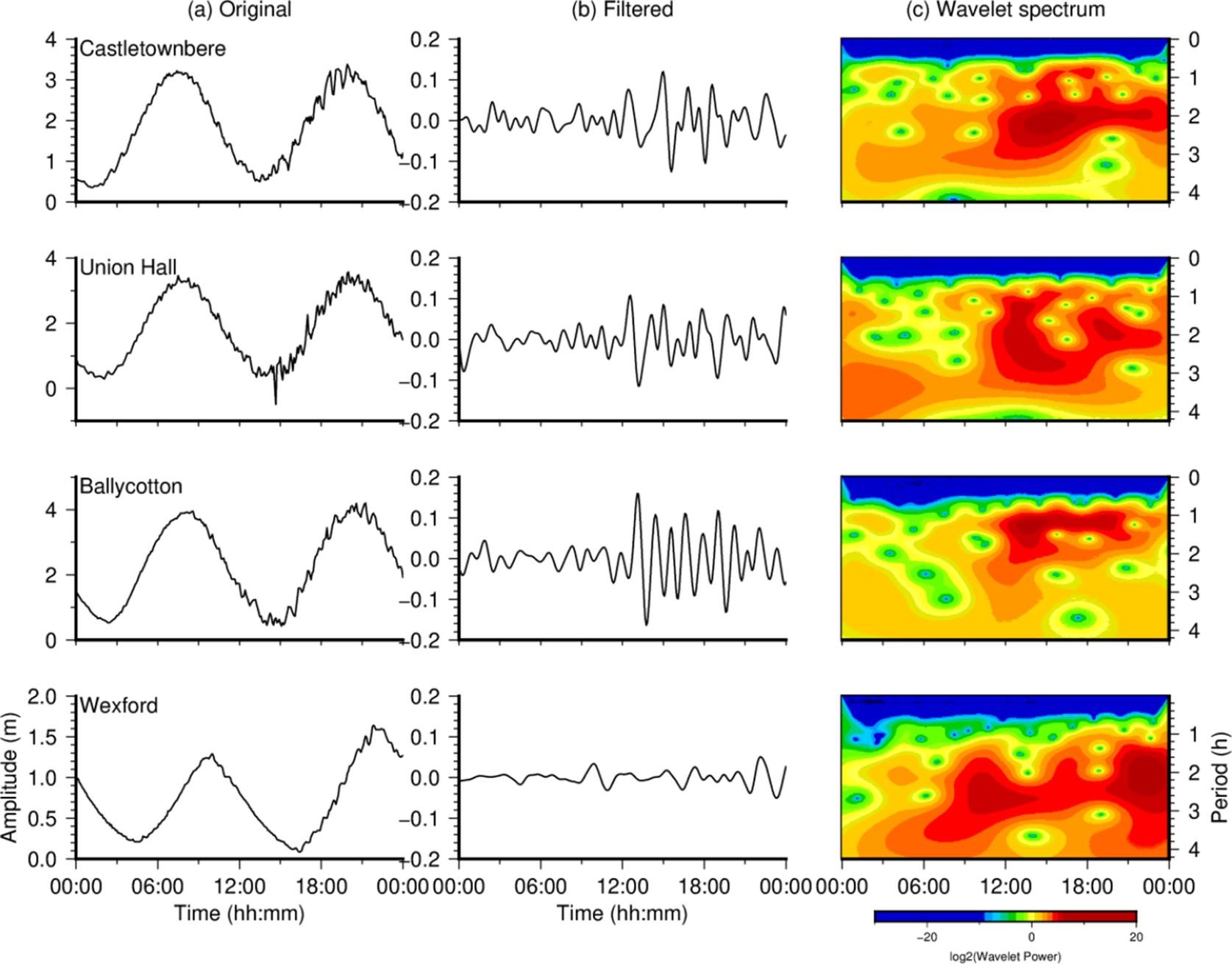
From the filtered waveforms, the first small wave was recorded at Castletownbere around 12:25 UTC, followed by a larger wave at 15:00 UTC, reaching a maximum crest-to-trough wave height of 0.25 m. Similar wave patterns were subsequently observed at other stations, with maximum crest-to-trough wave heights of 0.22 m at 12:35 UTC in Union Hall, 0.32 m at 13:05 UTC in Ballycotton, and 0.10 m at 22:10 UTC in Wexford. Tsunami waves typically exhibit wave periods between a few minutes and nearly 3 h (Rabinovich, Reference Rabinovich2020). The wavelet spectrum analysis in Figure 2c provides clear evidence that the recorded waves of the 2022 Ireland event are within the tsunami frequency range, where the wave periods at Castletownbere, Union Hall, and Wexford range between 1–3 h, while 1–2 h at Ballycotton.
We also gathered high-resolution 1-min sampling frequency atmospheric pressure data from the Irish Meteorological Service (www.met.ie) at four AWSs, including Sherkin Island, Roches Point, Moore Park, and Johnstown Castle. These AWSs are situated between 21 and 62 m above mean sea level and located across the south and eastern regions of Ireland (see Figure 1). To localize the sudden pressure changes during the event, we applied a high-pass filter to eliminate the low-frequency components of the pressure. Using a fifth-order Butterworth high-pass filter, we carefully choose a cutoff period of 0.001 Hz (~0.278 h). Recorded air pressure variations provide strong evidence for the presence and propagation of pressure jumps during the event. The comparison of the original, filtered, and their associated wavelet spectra is shown in Figure 3.
Air pressure disturbances recorded at four AWSs on 18 June 2022. (a) The original air pressure. (b) the filtered air pressure. (c) Morlet wavelet spectra.
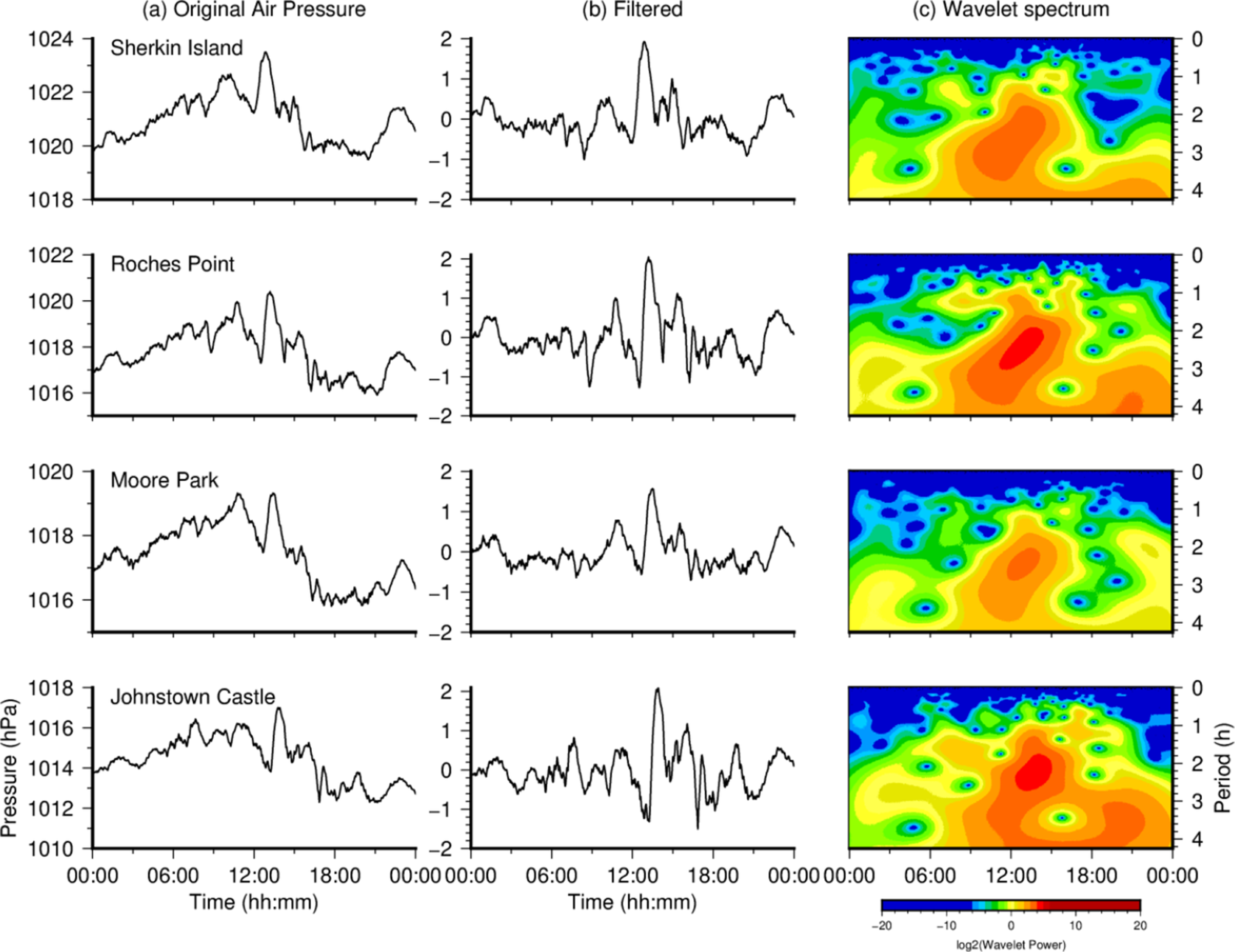
Analysis of the filtered pressure data reveals a significant pressure change first observed at Sherkin Island AWS between approximately 12:00 and 13:00 UTC. The pressure dropped from −0.59 hPa at 11:59 UTC and suddenly increased to 1.92 hPa at 12:52 UTC, resulting in a maximum pressure jump of 2.52 hPa within an hour. A similar pattern was subsequently recorded at Roches Point, Moore Park, and Johnstown Castle AWS. At Roches Point, the maximum pressure jump was 3.33 hPa, increasing from −1.28 hPa at 12:30 UTC to 2.05 hPa at 13:11 UTC. At Moore Park, pressure rose from −0.56 hPa at 12:39 UTC to 1.57 hPa at 13:29 UTC, yielding a maximum jump of 2.13 hPa. Meanwhile, at Johnstown Castle, the pressure increased from −1.32 hPa at 13:14 UTC to 2.09 hPa at 13:55 UTC, marking the highest observed jump of 3.40 hPa. Further wavelet spectrum analysis confirms the long-wave characteristics, with wavelet power indicating wave periods between 1 and 4 h.
The arrival time of the first wave crest at Castletownbere and Union Hall falls within the time range of the pressure jump recorded at Sherkin Island AWS, the closest location. This temporal coincidence strongly suggests that air pressure fluctuations played a key role in driving the sea surface changes. A similar pattern was observed at Ballycotton, which correlated well with pressure variations at Roches Point AWS. However, Wexford displayed a different response, showing a distinct correlation with Johnstown Castle AWS. These findings indicate that atmospheric pressure disturbances were likely a primary forcing mechanism behind the 18 June event, with regional variations in pressure gradients influencing the water level at different tide gauge stations.
3.1. Numerical model description: governing equations
We use a numerical model based on a non-linear shallow water equation (NLSWE) with atmospheric pressure as the source model. NLSWE-based models have been widely used in meteotsunami studies. For example, Vilibić et al. (Reference Vilibić, Monserrat, Rabinovich and Mihanović2008), Šepić et al. (Reference Šepić, Rabinovich and Sytov2018a), and Kim and Omira (Reference Kim and Omira2021) employed depth-averaged NLSWE models with idealized atmospheric pressure forcing to simulate meteotsunami dynamics, validating their results against field observations. We consider a spherical coordinate system ( $ R $
,
$ R $
, $ \theta $
,
$ \theta $
, $ \lambda $
) with the origin at the Earth’s center. The Earth is assumed to be a sphere, hence the radius
$ \lambda $
) with the origin at the Earth’s center. The Earth is assumed to be a sphere, hence the radius $ R $
is constant and equal to the Earth’s radius, whereas
$ R $
is constant and equal to the Earth’s radius, whereas $ \theta $
is latitude (measured southwards) and
$ \theta $
is latitude (measured southwards) and $ \lambda $
is longitude (measured eastwards). The governing equations of NLSWE are given by the following expressions:
$ \lambda $
is longitude (measured eastwards). The governing equations of NLSWE are given by the following expressions:
 $$ \frac{\partial D}{\partial t}+\frac{1}{R\sin \theta}\frac{\partial (uD)}{\partial \lambda }+\frac{1}{R}\frac{\partial (vD)}{\partial \theta }=0, $$
 $$ \frac{\partial u}{\partial t}+\frac{u}{R\sin \theta}\frac{\partial u}{\partial \lambda }+\frac{v}{R}\frac{\partial u}{\partial \theta }+\frac{g}{R\sin \theta}\frac{\partial h}{\partial \lambda }+{C}_f\frac{u\sqrt{u^2+{v}^2}}{D}+\frac{1}{\rho R\sin \theta}\frac{\partial P}{\partial \lambda }=0, $$
 $$ \frac{\partial v}{\partial t}+\frac{u}{R\sin \theta}\frac{\partial v}{\partial \lambda }+\frac{v}{R}\frac{\partial v}{\partial \theta }+\frac{g}{R}\frac{\partial h}{\partial \theta }+{C}_f\frac{v\sqrt{u^2+{v}^2}}{D}+\frac{1}{\rho R}\frac{\partial P}{\partial \theta }=0, $$
 $$ {C}_f=\frac{g{n}^2}{D^{\frac{1}{3}}}. $$
Manning’s roughness coefficient $ n $
is used to calculate the non-dimensional frictional coefficient
$ n $
is used to calculate the non-dimensional frictional coefficient $ {C}_f $
. A constant value of
$ {C}_f $
. A constant value of $ n=0.025 $
m1/3s−1 is applied homogeneously in the whole computational domain. This value is widely used in ocean wave propagation modeling (Imamura et al., Reference Imamura, Yalçiner and Ozyurt2006). In equations (1)–(4),
$ n=0.025 $
m1/3s−1 is applied homogeneously in the whole computational domain. This value is widely used in ocean wave propagation modeling (Imamura et al., Reference Imamura, Yalçiner and Ozyurt2006). In equations (1)–(4), $ u $
and
$ u $
and $ v $
are depth-averaged horizontal velocity fluxes along the latitude and longitude axes, respectively,
$ v $
are depth-averaged horizontal velocity fluxes along the latitude and longitude axes, respectively, $ P $
is air pressure,
$ P $
is air pressure, $ t $
is time,
$ t $
is time, $ g $
is the gravitational constant, and
$ g $
is the gravitational constant, and $ D $
is the total water depth, which is a summation of water depth
$ D $
is the total water depth, which is a summation of water depth $ d $
and sea surface amplitude
$ d $
and sea surface amplitude $ h $
. We assume that seawater density
$ h $
. We assume that seawater density $ \rho $
~ 1025 kg/m3. The edge of the computational domain is used as an open boundary and the Coriolis effect is neglected in this study. The computational time step should satisfy the Courant–Friedrichs–Lewy (CFL) condition, whereby the time step
$ \rho $
~ 1025 kg/m3. The edge of the computational domain is used as an open boundary and the Coriolis effect is neglected in this study. The computational time step should satisfy the Courant–Friedrichs–Lewy (CFL) condition, whereby the time step $ \Delta t $
must be equal to or smaller than the time required by a wave to travel on the spatial grid size.
$ \Delta t $
must be equal to or smaller than the time required by a wave to travel on the spatial grid size.
3.2. Air pressure forcing
Air pressure modeling is a critical variable in meteotsunami simulations and represents a key distinction from seismic tsunami modeling. In seismically generated tsunamis, once the hypocenter coordinates are known, the source model is typically estimated using waveform inversion of either oceanic or seismic waves (Satake, Reference Satake1989; Gusman and Tanioka, Reference Gusman and Tanioka2013). This is possible not only due to the availability of observing sensors but also because seismic waves travel through the Earth’s layers and can be detected globally (Obara, Reference Obara2007; Gee and Leith, Reference Gee and Leith2011; Di Giacomo et al., Reference Di Giacomo, Storchak, Safronova, Ozgo, Harris, Verney and Bondar2014). However, estimating a tsunamigenic atmospheric perturbation, such as an air pressure jump, is challenging due to the limited spatial coverage of observational stations. As a consequence, there is significant uncertainty regarding the shape, propagation direction, and speed of the pressure perturbation. Gaussian shapes are commonly used to represent the shape of the pressure jump (Anarde et al., Reference Anarde, Cheng, Tissier, Figlus and Horrillo2021). A more realistic source model can be constructed by interpolating between observed pressure values (Kim and Omira, Reference Kim and Omira2021; Kim et al., Reference Kim, Choi and Omira2022).
Due to the limited information on the spatial distribution of air pressure, this study employs a Gaussian-shaped profile to estimate the characteristics of air–pressure disturbances.
 $$ {P}_{i,j,t}=\sum \limits_{k=1}^N{P}_k\mathit{\exp}\left[{\left(-\frac{x_{i,j} sin\phi +{y}_{i,j} cos\phi -{V}_ot}{\frac{\sigma_k}{2}}\right)}^2\right], $$
where $ P $
is air pressure on a two-dimensional grid,
$ P $
is air pressure on a two-dimensional grid, $ {P}_k $
is the initial amplitude of the
$ {P}_k $
is the initial amplitude of the $ k $
th pressure component (with a total of
$ k $
th pressure component (with a total of $ N $
components),
$ N $
components), $ x $
and
$ x $
and $ y $
are longitude and latitude coordinates,
$ y $
are longitude and latitude coordinates, $ \phi $
is the propagation direction of the pressure disturbance measured counterclockwise from the
$ \phi $
is the propagation direction of the pressure disturbance measured counterclockwise from the $ x $
-axis,
$ x $
-axis, $ {V}_o $
is the propagation speed,
$ {V}_o $
is the propagation speed, $ t $
is the numerical time step, and
$ t $
is the numerical time step, and $ \sigma $
is the spread of the kth component, which controls the width of the Gaussian distribution. Similar to Anarde et al. (Reference Anarde, Cheng, Tissier, Figlus and Horrillo2021), we create a synthesized representation of the physical pressure perturbation by combining individual components into a smooth, continuous two-dimensional distribution. A total of four crests and troughs, each with distinct
$ \sigma $
is the spread of the kth component, which controls the width of the Gaussian distribution. Similar to Anarde et al. (Reference Anarde, Cheng, Tissier, Figlus and Horrillo2021), we create a synthesized representation of the physical pressure perturbation by combining individual components into a smooth, continuous two-dimensional distribution. A total of four crests and troughs, each with distinct $ {P}_0 $
and
$ {P}_0 $
and $ \sigma $
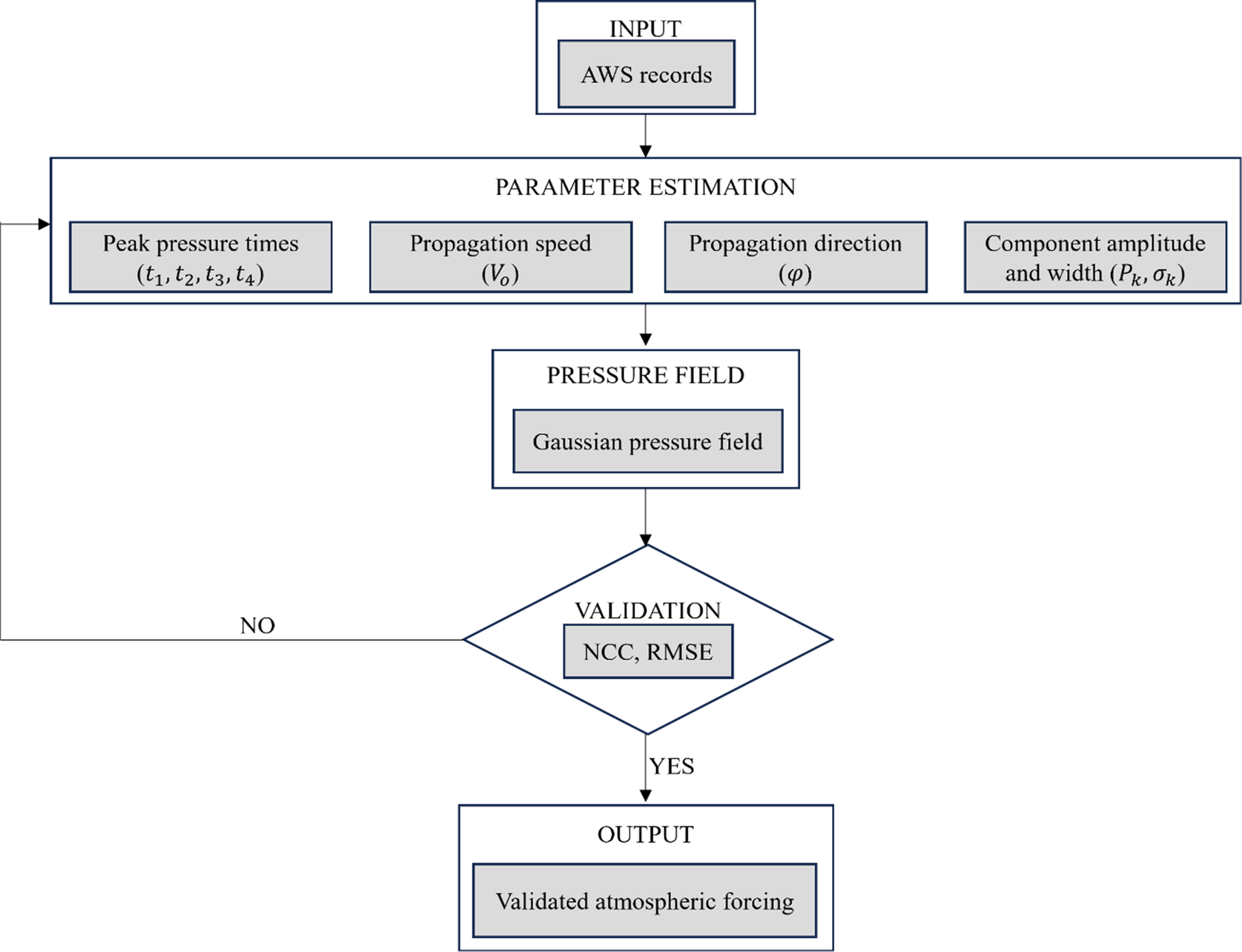
values, are identified from the pressure records. The spatial distribution of the AWSs allows for a quantitative estimation of the direction and propagation speed of the air-pressure disturbance. Based on the locations of the AWSs (Figure 1) and the clear sequential pattern of maximum pressure jumps over time (Figure 3), we conclude that the pressure disturbances propagated in a northeastward direction, in agreement with Renzi et al. (Reference Renzi, Bergin, Kokina, Pelaez-Zapata, Giles and Dias2023). We assume that the pressure disturbance propagates at a constant speed and angle. This assumption is widely used in the previous study (Šepić et al., Reference Šepić, Vilibić, Rabinovich and Tinti2018b; Anarde et al., Reference Anarde, Cheng, Tissier, Figlus and Horrillo2021; Kim and Omira, Reference Kim and Omira2021).To determine the propagation speed and direction, the process typically begins with hypothetical values, followed by multiple trial-and-error iterations to best fit the observations. In this study, we first identified the time of maximum air-pressure perturbation recorded at each AWS along the track of the synoptic disturbance. The average propagation speed was then calculated as the mean distance between Sherkin Island and the other AWSs divided by the corresponding time lag between their peak-pressure records, yielding an average speed of 55.4 m/s. The propagation direction (44° from the west) was estimated from the linear alignment of these stations and the spatiotemporal sequence of the pressure peaks. The parameter estimation workflow is summarized in Figure 4, illustrating the stepwise process from AWS observations to the synthesized pressure field.
$ \sigma $
values, are identified from the pressure records. The spatial distribution of the AWSs allows for a quantitative estimation of the direction and propagation speed of the air-pressure disturbance. Based on the locations of the AWSs (Figure 1) and the clear sequential pattern of maximum pressure jumps over time (Figure 3), we conclude that the pressure disturbances propagated in a northeastward direction, in agreement with Renzi et al. (Reference Renzi, Bergin, Kokina, Pelaez-Zapata, Giles and Dias2023). We assume that the pressure disturbance propagates at a constant speed and angle. This assumption is widely used in the previous study (Šepić et al., Reference Šepić, Vilibić, Rabinovich and Tinti2018b; Anarde et al., Reference Anarde, Cheng, Tissier, Figlus and Horrillo2021; Kim and Omira, Reference Kim and Omira2021).To determine the propagation speed and direction, the process typically begins with hypothetical values, followed by multiple trial-and-error iterations to best fit the observations. In this study, we first identified the time of maximum air-pressure perturbation recorded at each AWS along the track of the synoptic disturbance. The average propagation speed was then calculated as the mean distance between Sherkin Island and the other AWSs divided by the corresponding time lag between their peak-pressure records, yielding an average speed of 55.4 m/s. The propagation direction (44° from the west) was estimated from the linear alignment of these stations and the spatiotemporal sequence of the pressure peaks. The parameter estimation workflow is summarized in Figure 4, illustrating the stepwise process from AWS observations to the synthesized pressure field.
Atmospheric pressure parameter estimation workflow.
To illustrate the resonance condition, Figure 1 includes contours of the local long-wave phase speed $ c=\sqrt{gd} $
. The region where the atmospheric disturbance speed matches the oceanic wave celerity indicates where Proudman resonance is expected to occur—along the 50–60 m/s contour southwest of Ireland. Figure 5 presents the comparison between simulated and observed air pressure at the four AWS locations. To quantify the agreement between observed and simulated air pressure, we use the normalized cross-correlation coefficient (NCC), where values closer to 1 indicate a strong correlation. Additionally, we evaluate the root mean square error (RMSE). Overall, the simulated air pressure demonstrates good agreement with observations, yielding an NCC value of 0.83 and an RMSE of 0.38 hPa across all AWS locations.
$ c=\sqrt{gd} $
. The region where the atmospheric disturbance speed matches the oceanic wave celerity indicates where Proudman resonance is expected to occur—along the 50–60 m/s contour southwest of Ireland. Figure 5 presents the comparison between simulated and observed air pressure at the four AWS locations. To quantify the agreement between observed and simulated air pressure, we use the normalized cross-correlation coefficient (NCC), where values closer to 1 indicate a strong correlation. Additionally, we evaluate the root mean square error (RMSE). Overall, the simulated air pressure demonstrates good agreement with observations, yielding an NCC value of 0.83 and an RMSE of 0.38 hPa across all AWS locations.
Comparisons between simulated and observed air pressure at four AWSs.

3.3. Meteotsunami generation and propagation
At the beginning of the numerical simulation (at $ t=0 $
), the air pressure disturbance is transformed into a two-dimensional grid to create an initial sea surface using hydrostatic approximation,
$ t=0 $
), the air pressure disturbance is transformed into a two-dimensional grid to create an initial sea surface using hydrostatic approximation,
 $$ h=-\frac{\Delta P}{\rho g}. $$
The topography and bathymetry dataset are obtained from the GEBCO 2024 grid with a resolution of 15 arcsec (~450 m), see Figure 1. To satisfy the CFL condition, the numerical time step $ \Delta t $
is set to 1 s. We run the 12 h simulation time using simulated air pressure from 18 June 2022, 09:00 to 21:00 UTC to observe the dynamics of meteotsunami during the generation and propagation phases.
$ \Delta t $
is set to 1 s. We run the 12 h simulation time using simulated air pressure from 18 June 2022, 09:00 to 21:00 UTC to observe the dynamics of meteotsunami during the generation and propagation phases.
The snapshots of pressure and wave propagation over the computational domain are shown in Figure 6, whereas the comparison between observed and simulated waves at four coastal gauges is presented in Figure 7. Figure 6 shows that meteotsunami propagation is directly guided by pressure forcing along its propagation path. Our numerical model also captures wave amplification due to local bathymetry. Initially, the model generates only a few centimeters of sea surface displacement in the offshore region, which then propagates toward the coast, increasing in magnitude as a result of nearshore amplification processes. As shown in Figure 7, the simulated waveforms exhibit good agreement with observations at Castletownbere, although the model slightly overestimates both the maximum and minimum wave amplitudes. The simulated maximum amplitude is 0.17 m, overestimating observations only by 0.05 m, and the overall waveform pattern closely aligns with the observed data. Similarly, comparisons at Union Hall and Ballycotton show a strong correlation, despite a minor temporal shift in the timing of the maximum wave amplitude. The maximum wave amplitudes are 0.12 m at Union Hall and 0.15 m at Ballycotton, with overestimations of 0.015 m and underestimations of 0.01 m, respectively. At Wexford, however, the model overestimates the observed wave heights, suggesting potential discrepancies in model accuracy at this location, which will be discussed in Section 4. The maximum simulated amplitude at Wexford is 0.1 m, compared to 0.03 m in observations, indicating an overestimation of 0.07 m.
Snapshots of simulated air pressure and the influenced sea surface over computational domain.

Comparisons between simulated and observed waveforms at four tide gauges.

3.4. Computational setup
The numerical simulations were performed using Fortran for the nonlinear shallow-water solver and Python for the post-processing analyses, including DMD, K-means clustering, and DA. The Fortran code was compiled and executed on the Linux-based HPC cluster at Northumbria University. Each run used a single compute node (Intel Xeon 2.2 GHz CPU), and a 12-hour simulation of the 18 June 2022 event required about three hours of wall-clock time.
The computational complexity of the numerical solver scales linearly with the number of spatial grid points $ N $
expressed as
$ N $
expressed as $ O(N) $
, while the DMD analysis scales with both the number of spatial points and temporal snapshots
$ O(N) $
, while the DMD analysis scales with both the number of spatial points and temporal snapshots $ M $
, approximately
$ M $
, approximately $ O\left(N\times M\right) $
. Data assimilation using Optimal Interpolation operates at
$ O\left(N\times M\right) $
. Data assimilation using Optimal Interpolation operates at $ O(N) $
per assimilation cycle. The numerical solver structure is summarized in Figure 8, and all simulation parameters are provided in Table 1 to ensure reproducibility. Detailed computational specifications—including hardware configuration, compiler version, and optimization flags, and software environment—are also reported in Table 1.
$ O(N) $
per assimilation cycle. The numerical solver structure is summarized in Figure 8, and all simulation parameters are provided in Table 1 to ensure reproducibility. Detailed computational specifications—including hardware configuration, compiler version, and optimization flags, and software environment—are also reported in Table 1.
Nonlinear shallow-water equation solver structure.

Numerical simulation parameters used in the meteotsunami modeling

4. Optimization of offshore monitoring stations
Lewis et al. (Reference Lewis, Smyth, Williams, Neumann and Cloke2023) investigated the occurrence of meteotsunamis in the UK and identified key hotspots, including the southwest region, where most historical events have been recorded. These meteotsunamis exhibit distinct seasonal patterns, with winter events clustering around the southwest UK, particularly along the Celtic Sea boundary. This seasonal pattern aligns with the passage of mid-latitude depressions, in which convective elements are embedded within cold fronts and low-pressure troughs. However, the detection and analysis of these events are often complicated by storm-driven water level fluctuations, which can obscure the meteotsunami signals (Thompson et al., Reference Thompson, Renzi, Sibley and Tappin2020). Because of their rapid onset and limited predictability, individual meteotsunamis can cause abrupt changes in water levels and flow velocities, threatening human safety, coastal infrastructure, and marine activities. However, the limited availability of offshore observational stations remains a critical challenge for early warning (Denamiel et al., Reference Denamiel, Šepić, Huan, Bolzer and Vilibić2019a, Reference Denamiel, Šepić, Ivanković and Vilibić2019b), as most existing monitoring networks are primarily designed for earthquake-generated tsunamis. As a result, meteotsunamis have often been considered rare events. However, recent studies (e.g., Lewis et al., Reference Lewis, Smyth, Williams, Neumann and Cloke2023) have shown that meteotsunamis occur more frequently than previously believed, challenging this long-held perception. Building on this issue, we evaluate the potential deployment of offshore observational stations along the southeastern coast of Ireland, using the 2022 Ireland meteotsunami as a case study. We show that expanding offshore observational networks with higher-frequency pressure sensors enhances detection capabilities, improves early warning systems, and refines predictive models.
4.1. Dynamic mode decomposition and sensitivity analysis
We use dynamic mode decomposition (DMD) for analyzing spatiotemporal patterns, and here we apply it to the 2022 Ireland meteotsunami case, where high-quality data offer a valuable opportunity to demonstrate its strengths. Currently, on the Irish side of the Celtic Sea, only two offshore buoys (M3 and M5) are located near the study area, with a 1-h sampling interval and positioned relatively far apart. This spatial and temporal sparsity is insufficient to capture meteotsunami dynamics. To improve detection and monitoring, observational stations should be strategically located in regions where the most energetic dynamics occur.
Previous studies have utilized empirical orthogonal function (EOF) analysis to determine the most energetic locations for seismically generated tsunamis (Mulia et al., Reference Mulia, Gusman and Satake2017, Reference Mulia, Gusman, Williamson and Satake2019; Ren et al., Reference Ren, Wang, Wang, Zhao, Hu and Li2022). EOF, essentially a principal component analysis, identifies static spatial patterns that explain the highest variance in the dataset. However, it assumes linear modes, which may not always adequately represent the evolution of wave propagation. In seismically generated tsunamis, wave propagation is primarily driven by water height gradients, which influence velocity changes. However, in meteotsunamis, waves propagate due to both water height gradients and atmospheric pressure forcing (Eqs. [2] and [3]). As a result, meteotsunamis exhibit distinct spatiotemporal variations compared to seismically generated tsunamis, which require a different approach.
To address this limitation, we employ DMD, which captures time-dependent patterns and frequencies within the dataset (Tu et al., Reference Tu, Rowley, Luchtenburg, Brunton and Nathan Kutz2014). Unlike EOF, DMD extracts modes that evolve dynamically over time, offering a more accurate representation of wave evolution. Here, we derive the DMD modes of meteotsunami amplitudes resulting from numerical simulations. For the DMD computation, tsunami amplitudes within the model domain are stored at 5-minute intervals. We use the first 4 h of the meteotsunami simulation, yielding a total $ m=48 $
snapshots. The DMD algorithm decomposes the spatiotemporal meteotsunami data into dynamic modes, each associated with specific frequencies and growth rates. Similar mode decomposition approaches have been used to isolate physically significant instabilities in nonlinear wave simulations, such as the dipole-shaped superharmonic unstable modes linked to wave breaking (Mansar et al., Reference Mansar, Turner, Bridges and Dias2025).
$ m=48 $
snapshots. The DMD algorithm decomposes the spatiotemporal meteotsunami data into dynamic modes, each associated with specific frequencies and growth rates. Similar mode decomposition approaches have been used to isolate physically significant instabilities in nonlinear wave simulations, such as the dipole-shaped superharmonic unstable modes linked to wave breaking (Mansar et al., Reference Mansar, Turner, Bridges and Dias2025).
First, the simulated sea surface dataset $ \left\{{h}_1,\dots, {h}_m\right\} $
is arranged into two sequential matrices,
$ \left\{{h}_1,\dots, {h}_m\right\} $
is arranged into two sequential matrices,
 $$ {X}_1=\left[{h}_1,\dots, {h}_{m-1}\right], $$
 $$ {X}_2=\left[{h}_1,\dots, {h}_m\right], $$
where each ith column represents a sea surface elevation at a given time interval. The goal of DMD is to find a best-fit linear operator $ A $
such that,
$ A $
such that,
 $$ {X}_2\approx A{X}_1. $$
Since $ A $
is typically high-dimensional, a singular value decomposition is applied to
$ A $
is typically high-dimensional, a singular value decomposition is applied to $ X $
, yielding a reduced-order representation. The matrix
$ X $
, yielding a reduced-order representation. The matrix $ X $
is factorized as
$ X $
is factorized as
 $$ X=U\Sigma {V}^T, $$
where $ U $
and
$ U $
and $ V $
are orthonormal matrices, and
$ V $
are orthonormal matrices, and $ \Sigma $
is a diagonal matrix containing singular values. To obtain a low-rank approximation of
$ \Sigma $
is a diagonal matrix containing singular values. To obtain a low-rank approximation of $ A $
, we compute
$ A $
, we compute
 $$ \overset{\sim }{A}={U}^T{X}_2V{\varSigma}^{-1}, $$
where $ \overset{\sim }{A} $
is a reduced-order representation that captures the dominant system dynamics while mitigating computational complexity. Next, we solve the eigenvalue problem,
$ \overset{\sim }{A} $
is a reduced-order representation that captures the dominant system dynamics while mitigating computational complexity. Next, we solve the eigenvalue problem,
 $$ \overset{\sim }{A}W=W\Lambda, $$
where $ \Lambda $
contains the DMD eigenvalues, which define the oscillation frequencies and growth rates, and
$ \Lambda $
contains the DMD eigenvalues, which define the oscillation frequencies and growth rates, and $ W $
contains the corresponding eigenvectors, representing temporal evolution. Finally, the true DMD modes, which describe the spatial structures of wave dynamics, are reconstructed using
$ W $
contains the corresponding eigenvectors, representing temporal evolution. Finally, the true DMD modes, which describe the spatial structures of wave dynamics, are reconstructed using
 $$ \varphi ={X}_2V{\Sigma}^{-1}W. $$
These DMD modes reveal the dominant spatiotemporal patterns of meteotsunami evolution, providing a more dynamic characterization than traditional EOF analysis. By employing DMD, we capture the complex interactions between pressure forcing and ocean response over time, offering a more comprehensive approach for identifying key regions where offshore observational stations should be deployed.
Furthermore, since the DMD results consist of multiple spatial points, many of which may be redundant, we apply K-means clustering (Lloyd, Reference Lloyd1982) as an optimization step to group similar modes and remove redundancies. K-means clustering optimizes the selection of dominant modes by minimizing the intra-cluster variance, which is given by the objective function:
 $$ J=\sum \limits_{i=1}^k\sum \limits_{x\in {C}_i}{\left\Vert x-{\mu}_i\right\Vert}^2, $$
where $ k $
is the number of clusters,
$ k $
is the number of clusters, $ {C}_i $
represents the set of data points in cluster
$ {C}_i $
represents the set of data points in cluster $ i $
,
$ i $
, $ {\mu}_i $
is the centroid of cluster
$ {\mu}_i $
is the centroid of cluster $ i $
, and
$ i $
, and $ {\left\Vert x-{\mu}_i\right\Vert}^2 $
denotes the squared Euclidean distance between a data point
$ {\left\Vert x-{\mu}_i\right\Vert}^2 $
denotes the squared Euclidean distance between a data point $ x $
and its cluster centroid. By iteratively updating centroids and reassigning points, K-means partitions the DMD modes into a set of representative clusters, reducing noise and redundancy in the final analysis. This process ensures that only the most significant and distinct spatiotemporal patterns are retained, improving the interpretability and efficiency of meteotsunami dynamic analysis.
$ x $
and its cluster centroid. By iteratively updating centroids and reassigning points, K-means partitions the DMD modes into a set of representative clusters, reducing noise and redundancy in the final analysis. This process ensures that only the most significant and distinct spatiotemporal patterns are retained, improving the interpretability and efficiency of meteotsunami dynamic analysis.
The results of the first two spatial modes and their corresponding extrema are presented in Figure 9a,b. We focus on these two leading modes, as they capture the majority of the variance and represent the most energetic meteotsunami dynamics in the study area, primarily associated with meteotsunami propagation. While the first mode likely represents the largest-scale, slowest-changing features in the dataset, the second mode captures secondary variations, such as reflected waves, smaller oscillations, and bathymetric influences. The energy variance for these modes is similar, with the first mode representing 25.04% and the second mode for 22.68% of the total variance. Although subsequent modes also contribute to the overall variance (e.g., 15.96% for the third mode and 13.58% for the fourth mode), their contributions are significantly smaller, and higher modes primarily represent less energetic processes. For comparison, Figure 9d,e display the spatial modes and extrema derived from the traditional EOF analysis.
Spatial distributions and station selections based on DMD and EOF analysis. (a) First DMD mode and (b) second DMD mode, with extrema indicated by black circles. (c) Selected extrema from DMD modes identified as potential observational stations (black circles). (d) First EOF mode and (e) second EOF mode, with extrema indicated by black circles. (f) Selected extrema from EOF modes used as potential observational stations (black circles). (g) Predefined station locations resembling the S-Net array configuration, with approximately 50 km spacing. (h) Evolution of the greedy optimization process for DMD- and EOF-based station selection. Numbers above and below the markers indicate the stations removed at each iteration.

To identify optimal observation locations, we evaluated the extrema of modes 1 and 2 through an iterative, greedy optimization based on DA sensitivity testing. In each iteration, one candidate extremum was removed, and the DA performance was recalculated. The extrema whose exclusion caused the largest decrease in the overall assimilation score (i.e., the most dynamically significant locations) were retained, while those whose removal had minimal impact on the score were discarded. The performance metric was quantified using a scalar skill score that combines improvements in both amplitude accuracy and waveform coherence:
 $$ Score=w\left(1-\frac{RMSE}{RMSE_f}\right)+\left(1-w\right)\left(\frac{NCC-{NCC}_f}{1-{NCC}_{\mathrm{f}}}\right), $$
where $ {RMSE}_f $
and
$ {RMSE}_f $
and $ {NCC}_f $
denote the forward modeling baselines, and
$ {NCC}_f $
denote the forward modeling baselines, and $ w=0.5 $
assigns equal weight to amplitude and phase coherence. Higher values of the score indicate better assimilation performance.
$ w=0.5 $
assigns equal weight to amplitude and phase coherence. Higher values of the score indicate better assimilation performance.
The evolution of this optimization process for both DMD and EOF extrema is shown in Figure 9h, where the score changes with the successive removal of candidate stations. This greedy elimination continued until all non-significant extrema were removed. In addition, extrema located less than 30 km from the coastline (D1, E1, and E13) were excluded. The remaining candidate stations should have a space of approximately 85–100 km apart, ensuring a balanced spatial distribution that enhances meteotsunami monitoring and forecasting (Heidarzadeh et al., Reference Heidarzadeh, Wang, Satake and Mulia2019; Ren et al., Reference Ren, Wang, Wang, Zhao, Hu and Li2022).
The final DMD-based configuration initially identified the last seven candidate stations (D2, D3, D11, D12, D15, D16, and D20), where the assimilation score generally decreased as stations were removed. However, stations D11 and D12 were manually excluded to maintain adequate spacing between observation points. The resulting five optimized stations—D2, D3, D15, D16, and D20—correspond to the final five iterations in Figure 9h (see Figure 9c for their spatial locations).
Similarly, the EOF-based configuration retains three key stations—E2, E5, and E23—as shown in Figure 9f. Although the score shows a minor increase when E2 was excluded (Figure 9h), this likely reflects the sensitivity of the greedy procedure rather than a physically meaningful improvement. Station E2 is spatially well separated from the other EOF extrema and extends the observational coverage toward the eastern shelf, ensuring that the optimized network samples a broader portion of the meteotsunami propagation path. Therefore, E2 was retained to maintain spatial balance and avoid excessive clustering of observation points in the southern region.
4.2. Meteotsunami data assimilation
To model the meteotsunami monitoring system, we apply data assimilation using optimized station locations derived from DMD and K-means clustering to assess their performance. Sequential data assimilation (DA) techniques have been widely used in weather simulation (Kalnay, Reference Kalnay2002). Maeda et al. (Reference Maeda, Obara, Shinohara, Kanazawa and Uehira2015) introduced a DA approach for real-time tsunami wavefield simulation using the optimal interpolation method. Byrne et al. (Reference Byrne, Horsburgh and Williams2023) applied a similar technique to transform tide gauge records into a regional storm surge model. Optimal interpolation is computationally less demanding than more advanced methods, such as the ensemble Kalman filter (Yang et al., Reference Yang, Dunham, Barnier and Almquist2019), provided that the system remains linear. Despite its simplicity, this DA approach has demonstrated excellent agreement with both observed tsunami data and synthetic cases. To the best of our knowledge, this is the first study to implement data assimilation for meteotsunamis, with the goal of identifying potential offshore observational station locations.
In the numerical simulation, the meteotsunami wavefield at the nth time step is represented as $ {\boldsymbol{x}}_{\boldsymbol{n}}\left(\eta \left(n\Delta t,x,y\right),M\left(n\Delta t,x,y\right),N\left(n\Delta t,x,y\right)\right) $
, where
$ {\boldsymbol{x}}_{\boldsymbol{n}}\left(\eta \left(n\Delta t,x,y\right),M\left(n\Delta t,x,y\right),N\left(n\Delta t,x,y\right)\right) $
, where $ \eta $
is the meteotsunami height,
$ \eta $
is the meteotsunami height, $ M $
and
$ M $
and $ N $
are the depth-integrated meteotsunami fluxes in the
$ N $
are the depth-integrated meteotsunami fluxes in the $ x $
and
$ x $
and $ y $
directions and
$ y $
directions and $ \Delta t $
is the time step. The DA method can be expressed as
$ \Delta t $
is the time step. The DA method can be expressed as
 $$ {\boldsymbol{x}}_n^f=\boldsymbol{F}{\boldsymbol{x}}_{n-1}^a, $$
 $$ {\boldsymbol{x}}_n^a={\boldsymbol{x}}_n^f+\boldsymbol{W}\left({\boldsymbol{y}}_n-\boldsymbol{H}{\boldsymbol{x}}_n^b\right). $$
At each time step, the forecasted meteotsunami wavefield, $ {\boldsymbol{x}}_n^f $
, is obtained by solving the non-linear long wave equation using the assimilated wavefield from the previous time step,
$ {\boldsymbol{x}}_n^f $
, is obtained by solving the non-linear long wave equation using the assimilated wavefield from the previous time step, $ {\boldsymbol{x}}_{n-1}^a $
. Here,
$ {\boldsymbol{x}}_{n-1}^a $
. Here, $ \boldsymbol{F} $
is the propagation matrix corresponding to the two-dimensional NLSWE model. The residual—defined as the difference between the observed meteotsunami amplitude at the observational stations (
$ \boldsymbol{F} $
is the propagation matrix corresponding to the two-dimensional NLSWE model. The residual—defined as the difference between the observed meteotsunami amplitude at the observational stations ( $ {\boldsymbol{y}}_n $
) and the simulation output (
$ {\boldsymbol{y}}_n $
) and the simulation output ( $ \boldsymbol{H}{\boldsymbol{x}}_n^b $
)—is calculated, where
$ \boldsymbol{H}{\boldsymbol{x}}_n^b $
)—is calculated, where $ \boldsymbol{H} $
is a vector with entries of 1 at the observational stations and 0 elsewhere, used to extract the forecasted meteotsunami height. These residuals are then multiplied by a smoothing matrix,
$ \boldsymbol{H} $
is a vector with entries of 1 at the observational stations and 0 elsewhere, used to extract the forecasted meteotsunami height. These residuals are then multiplied by a smoothing matrix, $ \boldsymbol{W} $
, which is crucial for bringing the assimilated wavefield closer to the observed meteotsunami field. The smoothing matrix is determined by solving the following equation:
$ \boldsymbol{W} $
, which is crucial for bringing the assimilated wavefield closer to the observed meteotsunami field. The smoothing matrix is determined by solving the following equation:
 $$ \boldsymbol{W}=\boldsymbol{P}{\boldsymbol{H}}^{\boldsymbol{T}}+{\left(\boldsymbol{HP}{\boldsymbol{H}}^{\boldsymbol{T}}+\boldsymbol{R}\right)}^{-\mathbf{1}}, $$
where $ \boldsymbol{P}=\left\langle {\varepsilon}^f{\varepsilon}^{fT}\right\rangle $
and
$ \boldsymbol{P}=\left\langle {\varepsilon}^f{\varepsilon}^{fT}\right\rangle $
and $ \boldsymbol{R}=\left\langle {\varepsilon}^O{\varepsilon}^{OT}\right\rangle $
are the error covariance matrices of the forward simulation and the observations, respectively.
$ \boldsymbol{R}=\left\langle {\varepsilon}^O{\varepsilon}^{OT}\right\rangle $
are the error covariance matrices of the forward simulation and the observations, respectively. $ {\varepsilon}^f $
and
$ {\varepsilon}^f $
and $ {\varepsilon}^O $
are the errors of the forward simulation and observations, while
$ {\varepsilon}^O $
are the errors of the forward simulation and observations, while $ {\varepsilon}^{fT} $
and
$ {\varepsilon}^{fT} $
and $ {\varepsilon}^{OT} $
are the corresponding transpose matrices. In practice,
$ {\varepsilon}^{OT} $
are the corresponding transpose matrices. In practice, $ \boldsymbol{P} $
is modelled using an isotropic Gaussian correlation
$ \boldsymbol{P} $
is modelled using an isotropic Gaussian correlation $ {P}_{ij}={\sigma}_p^2\mathit{\exp}\left[-\frac{d_{ij}^2}{L^2}\right] $
, where
$ {P}_{ij}={\sigma}_p^2\mathit{\exp}\left[-\frac{d_{ij}^2}{L^2}\right] $
, where $ {d}_{ij}^2 $
is the distance between grid points
$ {d}_{ij}^2 $
is the distance between grid points $ i $
and
$ i $
and $ j $
,
$ j $
, $ {\sigma}_p^2 $
is the background-error variance, and
$ {\sigma}_p^2 $
is the background-error variance, and $ L $
is the characteristic distance controlling the spatial influence of each observation. Observation errors are assumed to be uncorrelated, so
$ L $
is the characteristic distance controlling the spatial influence of each observation. Observation errors are assumed to be uncorrelated, so $ R={\sigma}_r^2I $
. Following Maeda et al. (Reference Maeda, Obara, Shinohara, Kanazawa and Uehira2015), the relative error ratio is expressed by the nondimensional parameter
$ R={\sigma}_r^2I $
. Following Maeda et al. (Reference Maeda, Obara, Shinohara, Kanazawa and Uehira2015), the relative error ratio is expressed by the nondimensional parameter $ \rho $
, defined as the root-mean-square observation error normalized by the forecast error (
$ \rho $
, defined as the root-mean-square observation error normalized by the forecast error ( $ \frac{R}{P}={\rho}_d^2 $
). Similarly, we adopted
$ \frac{R}{P}={\rho}_d^2 $
). Similarly, we adopted $ {\rho}_d=1 $
implying equal confidence in model and observations. Both covariance matrices assume Gaussian-distributed errors with a characteristic distance of 20 km (Maeda et al., Reference Maeda, Obara, Shinohara, Kanazawa and Uehira2015; Wang et al., Reference Wang, Satake, Maeda and Gusman2018). The assimilation cadence was identical to the numerical time step (
$ {\rho}_d=1 $
implying equal confidence in model and observations. Both covariance matrices assume Gaussian-distributed errors with a characteristic distance of 20 km (Maeda et al., Reference Maeda, Obara, Shinohara, Kanazawa and Uehira2015; Wang et al., Reference Wang, Satake, Maeda and Gusman2018). The assimilation cadence was identical to the numerical time step ( $ \Delta t $
) used in the forward model. By iteratively applying Eqs. (16) and (17), the tsunami wavefield is effectively assimilated, enabling the generation of forecasted meteotsunami waveforms at any location within the model domain during and after the assimilation process. The assimilation was performed sequentially at each model time step corresponding to the available observation interval, with an assimilation cadence of 1 min. The complete data assimilation procedure, including the optimal interpolation scheme based on Maeda et al. (Reference Maeda, Obara, Shinohara, Kanazawa and Uehira2015), is visualized in Figure 10. This sequential algorithm updates the wavefield at each time step using observations from the optimized station network.
$ \Delta t $
) used in the forward model. By iteratively applying Eqs. (16) and (17), the tsunami wavefield is effectively assimilated, enabling the generation of forecasted meteotsunami waveforms at any location within the model domain during and after the assimilation process. The assimilation was performed sequentially at each model time step corresponding to the available observation interval, with an assimilation cadence of 1 min. The complete data assimilation procedure, including the optimal interpolation scheme based on Maeda et al. (Reference Maeda, Obara, Shinohara, Kanazawa and Uehira2015), is visualized in Figure 10. This sequential algorithm updates the wavefield at each time step using observations from the optimized station network.
Flowchart of the sequential data assimilation procedure using optimal interpolation.

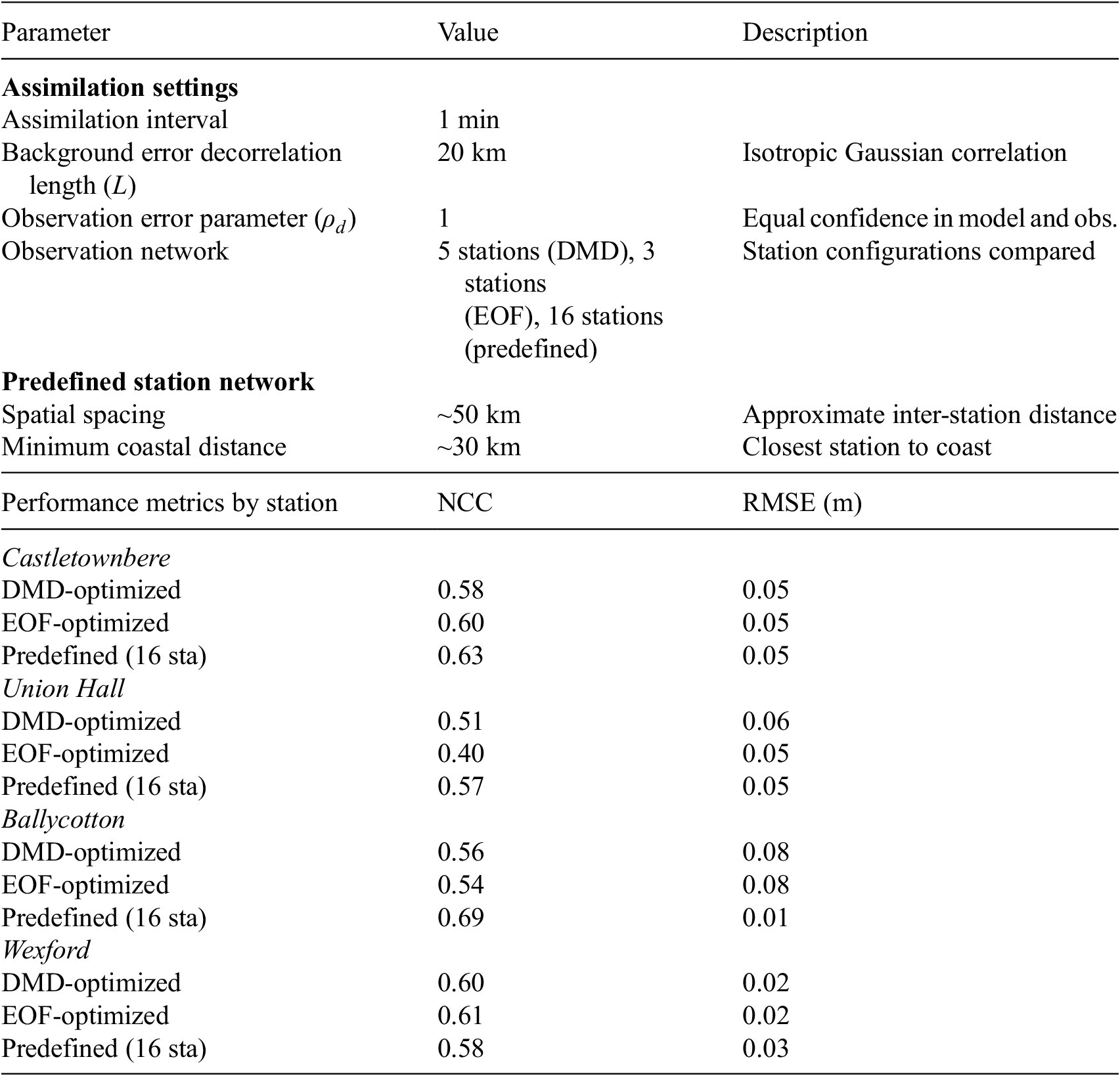
For a clear performance comparison, we run DA simulations using three sets of observational station configurations: DMD-generated, EOF-generated, and predefined stations. The predefined stations, shown in Figure 9g, represent a dense network of observational stations with a spatial interval of approximately 50 km as well as for the approximate closest distance to the coast, resembling the dense S-Net network. We then compare the resulting waveforms at tide gauges and the maximum meteotsunami amplitudes to evaluate the performance of each approach. As shown in Figure 11, the assimilated waveforms from the DMD-generated, EOF-generated, and predefined stations exhibit good agreement with forward modeling results and observations. Even though EOF-generated stations exhibit similar statistical performance to DMD-generated, EOF tends to underestimate wave amplitudes. For instance, at Castletownbere, the maximum wave amplitudes are better captured by DMD-generated stations. The NCC values at this gauge are 0.58, 0.6, and 0.63 for the DMD, EOF-optimized, and predefined station scenarios, respectively, with a similar RMSE of 0.05 m. Similarly, the assimilated waveforms from DMD-generated stations at Union Hall, Ballycotton, and Wexford demonstrate good agreement with observations, with NCC values of 0.51, 0.56, and 0.60 and RMSE values of 0.06 m, 0.08 m, and 0.02 m, respectively. Detailed information including DA configurations are summarized in Table 2.
Comparisons between simulated, observed, and assimilated waveforms at four tide gauges.

Data assimilation parameters and performance metrics for all station configurations
We also compared the assimilated maximum wave amplitudes to those from the meteotsunami forward simulation, since survey data for maximum wave height along the southern coast of Ireland is not available. The predefined station network shows good agreement with the simulated results, likely due to its wide spatial coverage, which enables better capture of meteotsunami dynamics. Comparison between assimilation and simulation near the coastline (Figure 12) further confirms that the predefined scenario closely aligns with the forward modeling. Similarly, the DMD-generated stations also show comparable maximum wave amplitudes, although some underestimation is observed in the longitude range between −7.5°W and − 6.5°W, which is likely due to a lower density of observation points in that area. Nevertheless, this underestimation is minimal and does not significantly impact the overall accuracy of the assimilation results. In contrast, the EOF-based stations exhibit more pronounced underestimation in both the −7.5°W to −6.5°W and the southwestern region between 51°N to 52°N and − 11°W to −9°W, which is attributed to the absence of EOF-generated stations in these areas.
Comparison of maximum meteotsunami amplitudes along the southern coast of Ireland from (a) the forward modeling simulation, (b) data assimilation (DA) using five DMD-optimized observational stations, (c) DA using three EOF-optimized observational stations, and (d) DA using 16 predefined observational stations. Insets above and to the right of (b), (c), and (d) show maximum wave amplitudes at coastal locations, highlighting differences in spatial accuracy.

5. Discussion
A comprehensive analysis of observational datasets, incorporating sea level and atmospheric pressure measurements, identifies meteorological forcing as the primary mechanism behind the tsunami-like waves observed along the southern coast of Ireland on 18 June 2022. The high-resolution air pressure records enable a more realistic representation of atmospheric forcing in meteotsunami genesis. Our numerical model plays a crucial role in reconstructing the hydrodynamics of the meteotsunami, from its generation to propagation.
Overall, the comparison between simulated and observed waveforms at tide gauges demonstrates good agreement in terms of wave amplitude and arrival times, and represents an improvement over previous studies that employed a sine-based source model for atmospheric pressure forcing (Renzi et al., Reference Renzi, Bergin, Kokina, Pelaez-Zapata, Giles and Dias2023). However, at the northernmost tide gauge in Wexford, the simulation overestimates wave heights, indicating a discrepancy between model predictions and observations. Several factors may contribute to this overestimation, including uncertainties in atmospheric forcing, limitations in bathymetric resolution, and complex wave interaction processes.
In this case, the uncertainties in atmospheric forcing appear to be the primary cause. Supporting this hypothesis, an analysis of filtered waveforms data and air pressure (Figures 2 and 3) reveals a positive correlation between Castletownbere and Ballycotton with Sherkin Island AWS, the nearest weather station. A similar pattern is observed at Union Hall, which correlates well with the air pressure recorded at Roches Point AWS. In contrast, Wexford does not exhibit a similar response to air pressure variations recorded at Johnstown Castle AWS, despite their proximity of just 6 km. This mismatch is also reported by Renzi et al. (Reference Renzi, Bergin, Kokina, Pelaez-Zapata, Giles and Dias2023), suggesting that localized atmospheric conditions or small-scale meteorological processes not fully captured in the dataset may have influenced the observed wave dynamics.
One possible explanation for this discrepancy is that the idealized Gaussian pressure field used in the numerical model may overestimate the actual spatial structure of the atmospheric pressure disturbance. Another potential explanation relates to the local geography of the Wexford tide gauge, which is situated within a harbor enclosed by a breakwater and further protected by a bay partially sheltered by a sandy barrier spit. The overestimation of wave amplitude may be due to unresolved local dissipation and complex wave transformations occurring within these nested, sheltered environments—processes that are not captured in the regional-scale numerical model. This is supported by the Wexford and Burrow Modelling Study (RPS, 2021), which underscores the need for high-resolution modeling to account for localized features like breakwaters and barrier spits. Similar conclusions by Costa et al. (Reference Costa, Bryan, Stephens and Coco2023) highlight how small-scale coastal morphology can affect water level responses.
The EOF-based optimization curve (Figure 9h) exhibits a non-monotonic trend, with an initial decline, a brief recovery, and a final sharp drop in skill score. This behavior arises because many EOF extrema are spatially clustered—particularly in the central shelf region (e.g., E16–E18 and E10–E12)—resulting in redundant and highly correlated observations. The inclusion of these closely spaced extrema renders the gain matrix $ {\left(\boldsymbol{HP}{\boldsymbol{H}}^{\boldsymbol{T}}+\boldsymbol{R}\right)}^{-\mathbf{1}} $
increasingly ill-conditioned, amplifying small numerical errors and leading to unstable assimilation performance. Once the redundant stations are removed, the matrix conditioning improves, and the skill score temporarily recovers; however, the subsequent elimination of dynamically significant offshore stations produces the final sharp decline. Similar effects of correlated observation errors on matrix conditioning and analysis stability have been reported by Goux et al. (Reference Goux, Gürol, Weaver, Diouane and Guillet2024).
$ {\left(\boldsymbol{HP}{\boldsymbol{H}}^{\boldsymbol{T}}+\boldsymbol{R}\right)}^{-\mathbf{1}} $
increasingly ill-conditioned, amplifying small numerical errors and leading to unstable assimilation performance. Once the redundant stations are removed, the matrix conditioning improves, and the skill score temporarily recovers; however, the subsequent elimination of dynamically significant offshore stations produces the final sharp decline. Similar effects of correlated observation errors on matrix conditioning and analysis stability have been reported by Goux et al. (Reference Goux, Gürol, Weaver, Diouane and Guillet2024).
In contrast, the DMD-derived extrema are more spatially sparse and dynamically independent, providing better spatial coverage and numerical stability within the data-assimilation framework. By combining DMD with K-means clustering, we optimized station placement to achieve accuracy comparable to that of a dense observational network while substantially reducing the number of required sensors. The potential locations for offshore stations are represented by the two leading DMD modes, which also capture energy variations influenced by bathymetric effects, as evidenced by the optimized points aligning near the −300 m depth contour (Figure 9c).
Despite the significant reduction in station number, the optimized network reproduces the performance of a dense predefined array, offering a cost-effective strategy for future meteotsunami monitoring. The DMD extrema also capture key wave dynamics in the southern region of Ireland (Figure 9b,c), yielding two additional candidate stations in an area underrepresented by EOF. This agrees with previous findings that DMD outperforms EOF by resolving non-stationary, time-evolving flow structures and providing a more faithful representation of large-scale kinetic-energy variability (e.g., Gugole and Franzke, Reference Gugole and Franzke2020; Li et al., Reference Li, Mémin, Tissot, Chapron, Crisan, Holm, Mémin and Radomska2023). Using a straightforward selection strategy, we identified three optimal extrema from the EOF modes, whereas the DMD approach produced five, demonstrating a broader and more flexible range of candidate locations. Overall, DMD offers richer spatial information and greater numerical robustness for optimizing offshore observational networks.
The high costs associated with offshore observational systems require careful station placement to maximize efficiency while minimizing expenses. The financial burden of offshore tsunami detection systems is substantial. For example, a DART station costs approximately $0.5 M per unit, with additional high emergency maintenance costs due to ship-based interventions. Cabled observatories, while supporting high-density monitoring, require an upfront investment of hundreds of millions of dollars, as demonstrated by Japan’s $500 M cabled network covering 1000 km with 164 pressure sensors. Similarly, differential GPS buoys cost around $3 M per unit, with additional limitations in deployment flexibility (Bernard and Titov, Reference Bernard and Titov2015). Given these expenses, reducing the number of required stations without compromising accuracy is critical. It should be clarified that the proposed offshore monitoring stations are not intended to perform high-performance computations. They function as lightweight data acquisition platforms that collect sea-level or pressure observations and transmit them in near real time. All computationally intensive processes—including numerical simulations, DMD analysis, and data assimilation—are performed centrally at an onshore high-performance computing facility. The present study, therefore, focuses on sensor placement optimization rather than distributed offshore computation.
In determining the optimal placement of observational stations, previous studies have often relied on EOF analysis using multiple hypothetical scenarios based on recorded events and enhanced using a stochastic model (Mulia et al., Reference Mulia, Gusman, Williamson and Satake2019; Ren et al., Reference Ren, Wang, Wang, Zhao, Hu and Li2022). However, in the case of meteotsunamis in Ireland, historical records are scarce or poorly documented, limiting the ability to use past events as a basis for station placement. Consequently, the characteristics of meteotsunamis in this region, as well as their potential future occurrence, remain largely unidentified. This contrasts with the Balearic Islands, where the probability of meteotsunami occurrence has been extensively studied (Šepić et al., Reference Šepić, Vilibić and Monserrat2016).
As a result, this study relies solely on a synthetic scenario of the 2022 Ireland event to determine the optimal station locations for meteotsunami detection. While this approach provides a reasonable first-order approximation, future studies could benefit from the development of stochastic scenarios to incorporate a wider range of potential meteotsunami conditions, thereby improving the robustness of station placement strategies. This represents an intriguing direction for future research. Additionally, higher-resolution nested modeling of the Wexford harbor area would help resolve the local dissipation processes that our regional model currently underestimates, potentially improving forecast accuracy in complex coastal environments.
6. Conclusions
This study introduces a data-driven framework for extracting dominant meteotsunami dynamics from sparse observational data, combining dynamic mode decomposition, numerical simulation, and data assimilation. Using the 2022 Ireland meteotsunami as a demonstration case, we show that a minimal, optimally placed network of offshore sensors can effectively capture key wavefield characteristics, even in under-monitored regions. While developed in the context of a specific event, the methodology is broadly applicable and scalable to other meteotsunami-prone coastal areas. We anticipate that the methodology introduced here will encourage the installation of additional offshore stations, ultimately enhancing the detection, forecasting, and understanding of meteotsunamis.
Abbreviations
- AWS
-
automatic weather station
- DA
-
data assimilation
- DART
-
deep-ocean assessment and reporting tsunamis
- DMD
-
dynamic mode decomposition
- DONET
-
dense oceanfloor network system for earthquakes and tsunamis
- EOF
-
empirical orthogonal function
- NCC
-
normalized cross correlation coefficient
- NLSWE
-
non-linear shallow water equation
- RMSE
-
root mean square error
- S-Net
-
seafloor observation network for earthquakes and tsunami along the Japan trench
Open peer review
To view the open peer review materials for this article, please visit http://doi.org/10.1017/eds.2026.10036.
Acknowledgments
Figures in this paper were made using GMT software (Wessel and Luis, Reference Wessel and Luis2017), which can be downloaded at http://gmt.soest.hawaii.edu/.
Author contribution
AF initiated the research idea, conducted simulations, prepared the manuscript, and produced the figures. ER contributed to the research idea, provided critical comments on the results, and assisted in structuring the manuscript. FD provided critical feedback on the results and contributed to the manuscript’s structure. DPZ and TK supplied raw data and contributed to the manuscript’s structure. All authors read and approved the final manuscript.
Competing interests
The authors declare that they have no competing interests.
Data availability statement
The raw data underlying this study is not publicly available because it constitutes a key research asset that is still being explored in ongoing work and may form the basis of future publications. Raw data may be shared upon reasonable request, subject to a collaboration agreement. For additional reference, air pressure and tidal datasets used in this study were obtained from the Marine Institute of Ireland (www.marine.ie) and Met Éireann, the Irish Meteorological Service (www.met.ie). The 15-arcsec resolution global bathymetry dataset is publicly available and can be downloaded from GEBCO at https://www.gebco.net/data-products/gridded-bathymetry-data. The source code for the forward modelling, data assimilation, and dynamic mode decomposition to reproduce our experiments can be accessed at https://github.com/ardifauzi/metDA.git.
Ethics statement
The research meets all ethical guidelines, including adherence to the legal requirements of the study country.
Funding statement
This research was not supported by any external grants/funding.


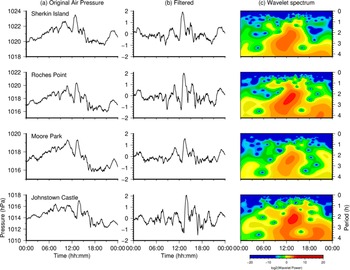
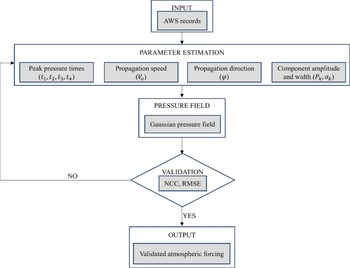

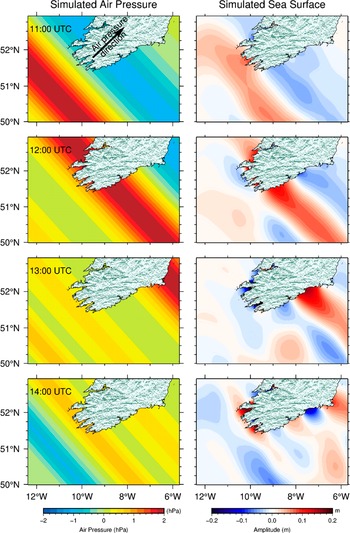
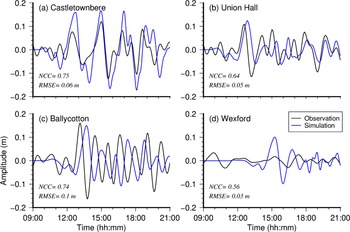


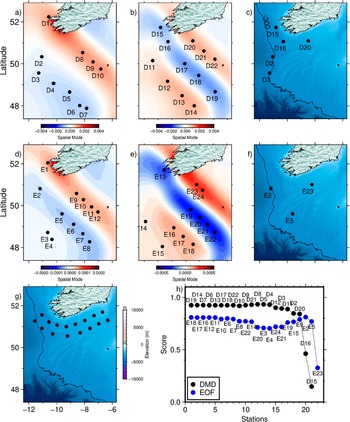


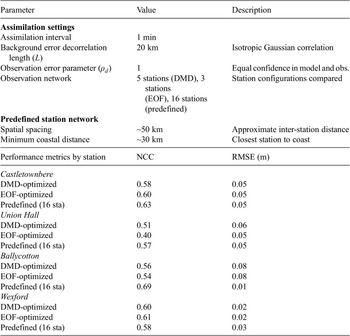


 Open access

