


1 Introduction
Product–service systems (PSSs) have drawn significant attention as a driver for business innovation and manufacturing servitization. A PSS is a system of products, services, supporting networks and infrastructure that is designed to satisfy customer needs and to generate values (Goedkoop et al. Reference Goedkoop, van Halen, te Riele and Rommens1999; McAloone et al. Reference McAloone, Mougaard, Neugebauer, Nielsen and Bey2011; Kim et al. Reference Kim, Lee, Kim, Jeong and Kim2012, Reference Kim, Lee, Jeong, Kim, Kim, Noh and Won2013a; Dewit & De Roeck Reference Dewit and De Roeck2014; Haber & Fargnoli Reference Haber and Fargnoli2017). A PSS is designed reflecting the strengths of the product of a manufacturing company to provide added values to the customers of the product. Designing a PSS is the key in manufacturing servitization (Fischer, Gebauer & Fleisch Reference Fischer, Gebauer and Fleisch2012; Baines & Lightfoot Reference Baines and Lightfoot2013) to pursue business innovation of the manufacturing company. Manufacturing companies can accomplish business innovation by devising new service elements and providing PSSs starting from their products.
With analysis of the company’s business contexts, diverse strategies could be set for servitization. The servitization process may start with the current state of the company. This may include what their products are and who their customers are. It is important to assess what kinds of values the customers would like to achieve through using the product and how much these are now supported. Then the key challenge in servitization would be devising new services to provide those values that the customers desire but not yet well supported. The servitization should also address what changes would be needed in the business model strategies to provide those values through new PSSs. Also good interactions between customers and service providers need to be offered. Thus, a servitization process would take current business context of the company with the product and generate a new integrated PSS with modified business model and customer relations.
In some cases, services could be developed so that their product functions can be supported. Repair and maintenance services would fit this classification of services supporting products (Mathieu Reference Mathieu2001). On the other hand, new services could be devised to drive active emotional values of their customers in a broadly related manner with their products. Education services to enhance capabilities of the customers, for example, belong to this classification of service supporting clients (Mathieu Reference Mathieu2001). Many different servitization strategies could be employed (Fischer et al. Reference Fischer, Gebauer and Fleisch2012). Thus, it would be desirable to devise a method to represent the servitization cases with the characteristics of the products and customers as well as newly devised services so that many different servitization cases and PSSs can be compared.
1.1 Previous research in literature
In previous research in literature, several efforts have been made for representing PSSs. But most addressed detailed descriptions of product and service elements rather than high-level descriptions of characteristics of PSSs to compare many different PSSs. Previous methods of PSS representations addressed how detailed product and service elements as well as stakeholder relations are represented as they are designed (Morelli Reference Morelli2006; Maussang, Brissaud & Zwolinski Reference Maussang, Brissaud, Zwolinski, Tichkiewitch, Tollenaere and Ray2007; Kim, Lee & Koh Reference Kim, Lee and Koh2011). Typically, multiple representations are used in a combined manner to represent PSSs in their design process. Interactions between stakeholders are represented in an Actor Map (Morelli Reference Morelli2006) or a Customer Value Chain (Donaldson, Ishii & Sheppard Reference Donaldson, Ishii and Sheppard2006) in various forms of general attributed directed graphs. Functions of a PSS are represented as black boxes with inputs and outputs in a hierarchical manner, e.g., IDEF0, and specific activities of stakeholders with their interaction nature are represented by service blueprints (Shostack Reference Shostack1982). A functional block diagram (FBD) was proposed (Maussang et al. Reference Maussang, Brissaud, Zwolinski, Tichkiewitch, Tollenaere and Ray2007) to represent the overall set of product and services in relations with stakeholders in a functional analysis approach, where stakeholders and services are connected through both physical and service touchpoints. FBD is to be used together with the agent-based model (Sakao et al. Reference Sakao, Shimomura, Lindahl, Sundin, Brissaud, Tichkiewitch and Zwolinski2006) with value flow and function description. A representation of PSS in a specific manner of associating the activities of service receivers and providers in the service blueprint together with the functions of service elements as well as relevant affordances and affordance features leading to product elements has been devised (Kim et al. Reference Kim, Lee and Koh2011). Affordance features are structural elements that provide affordances for a certain activity (Kim Reference Kim2015) and these can play a critical role in designing relevant product elements for a service element which is composed of activities of stakeholders in designing PSS with an activity centered approach. All these PSS representation efforts addressed detailed PSS description on how it works rather than characterizing and comparing many PSS cases at higher level perspectives.
To compare and classify different PSSs, the kinds of offerings of PSSs have been used as a key factor in classification (Tukker Reference Tukker2004; Ulaga & Reinartz Reference Ulaga and Reinartz2011; Gaiardelli et al. Reference Gaiardelli, Resta, Martinez, Pinto and Albores2014). Ulaga & Reinartz (Reference Ulaga and Reinartz2011) classified industrial servitization cases into four classes of Product Life-Cycle Services, Asset Efficiency Services, Process Support Services and Process Delegation Services by considering the service offerings based on two aspects of whether the value propositions are input-based or output-based and whether services support manufacturer’s goods or customer’s processes. Various PSS cases have been classified in Gaiardelli et al. (Reference Gaiardelli, Resta, Martinez, Pinto and Albores2014) based on three axes regarding the interaction between customers and PSS providers and the focus of PSS offerings in addition to the ownership and user issues of product-, use- and result-oriented aspects (Tukker Reference Tukker2004). The interaction axis shows how much it is transaction-oriented or relationship-oriented. The PSS offering focus tells whether product or process is focused in the offerings.
In addition to those classification methods mentioned above dealing with offerings (Tukker Reference Tukker2004; Ulaga & Reinartz Reference Ulaga and Reinartz2011; Gaiardelli et al. Reference Gaiardelli, Resta, Martinez, Pinto and Albores2014), the strategy topic matrix has been developed to enable evaluation of PSS strategies as an overview tool (Neugebauer et al. Reference Neugebauer, Mougaard, Andersen, McAloone and Meier2013). It is composed of six categories of stakeholders, physical assets, capabilities, influencers, network and offering. While the stakeholder category has nine topics, the others have one or two topics. The matrix only marks whether these topics are considered as important issues or not without making any further information specified or degrees on how much these topics have been reflected. Thus, this could serve as a very high-level guide. But it cannot allow more specific comparisons or evaluations of different PSS cases. Also the strategy topic matrix addresses PSS strategies only and cannot compare or evaluate other issues necessary in devising PSSs.
1.2 Research goals of the representation framework
While these kinds of classifications mentioned above are useful to compare the results of PSSs, they do not provide enough support in representing various characteristics of PSSs and in guiding and comparing servitization processes. It would be desirable to have a representation framework within which diverse PSSs could be represented so that various characteristics of PSSs can be described in a detailed enough manner. Many different perspectives on PSSs should be included in such a framework. Information on the product and the business context needs to be represented. Characteristics of the customers and their desired values are also important. Identification of stakeholders and their relations as well as the business and interaction context should be understood to compare PSSs and their influences. The properties of newly designed service concepts should also be characterized in representing PSSs. Thus, a richer representation framework is desired for the comparison and the classification of PSSs.
Moreover, it is desirable if servitization processes and PSS design processes can be supported by the representation of PSSs. Previous design results on such perspectives as well as other critical viewpoints should be stored and retrieved to be referred to in designing a new PSS. Servitization process information is critical in supporting and guiding a new servitization so that diverse viewpoints of PSSs could be used. In other words, the tasks to be performed in PSS design could be guided by identifying the necessary viewpoints of PSS design.
The research question of the paper is, therefore, whether a representation of PSSs can be devised so that many different PSS and servitization cases can be compared at a high level with diverse viewpoints and the PSS design process can be supported with such a representation. In this paper, a framework to represent PSSs is described using various issue spaces such as product space, customer space, value space, actor space, service space, business model space, interaction context space and time space. The detailed explanation and intent of the representation are provided in this paper for each of these eight spaces, while brief descriptions have been sketched in a few conference papers (Kim, Kim & Roh Reference Kim, Kim and Roh2015a; Kim Reference Kim2016; Kim & Choe Reference Kim and Choe2017). A preliminary sketch on the representation spaces has been briefly presented with some simple PSS cases developed at graduate students course work in Kim et al. (Reference Kim, Kim and Roh2015a). Simple explanations on the representation spaces have been given with one example per each space in Kim (Reference Kim2016). Similarity comparison for 15 industry cases has been provided in Kim & Choe (Reference Kim and Choe2017). Classification of PSSs using this representation would help in determining strategies and methods for new servitization efforts.
The framework has been developed into a PSS representation and repository system, which is a software system that represents and stores PSS cases using these eight spaces as a core part of the Manufacturing Servitization Support Framework (MSSF) project sponsored by the Koran Ministry of Trade, Industry and Energy. The objective of the MSSF project is to develop methods and tools to support manufacturing servitization and to apply these to industry cases. In the next section, the representation spaces are presented with explanation on their role and intent in the framework as well as examples. In Section 3, how the representation framework can guide a PSS design process is described. Then 15 PSS cases developed with industry partners at the MSSF project are introduced and their service space descriptions are compared. In Section 5, 15 PSS cases are compared using the PSS representation framework and similarity assessment results for a few spaces are explained to illustrate the representation method and its utility. The algorithms for similarity computation have been described in another paper (Ahn et al. Reference Ahn, Lee, Kim, Kim and Lee2018). The utilities of the framework in designing PSSs and in analyzing and guiding manufacturing servitization are discussed, and contributions and advantages of the proposed representation framework over previous research efforts on classification and comparison of PSS cases are detailed in Section 7. The paper is concluded with a summary and discussions on future work.
2 PSS representation framework
For designing PSSs, various combinations of product and service elements should be considered. Previous design results on such combinations as well as other critical viewpoints should be saved and retrieved to design a brand new PSS. Experienced consultants may maintain good repositories of successful cases with effective searching mechanism to draw potential hints and insights from the cases to guide the new tasks. To support classification, comparison and design of PSSs, a rich representation framework of PSSs with eight spaces is proposed. In this section, the spaces of the representation framework are described.
2.1 Product space
In manufacturing servitization, a PSS is to be devised starting from the product of the company. The product space is an essential aspect in characterizing PSSs. We use two sub-spaces. Product classification based on United Nations Standard Products and Services Code (UNSPSC) is used (UN Development Program 1988) as a sub-space. UNSPSC classifies a product in a hierarchical structure composed of five levels. The first level is to classify as Raw Materials, Industrial Equipment, Components and Supplies, End Use Products and Services. The classification refines on the following levels. For example, the product classification of women shoes as in the case of Shoes Purchase of the 15 industry cases is End Use Product >Apparel and Luggage and Personal Care Products >Footwear >Shoes >Women Shoes from the first level to the lowest fifth level as shown in Figure 1. The figure was image-captured from the screen of the PSS Representation and Repository software system developed at the MSSF project. UNSPSC has a very detailed hierarchical structure with specifically relevant lower-level classifications.
Product space of the Shoes Purchase PSS case.

The other sub-space is the life-cycle step of the product (Matzen Reference Matzen2009). The life cycle of a product is first categorized as Pre, During and Post phases. The Pre phase is composed of Design, Production, Sales and Delivery steps. The During phase, e.g., Use phase, is composed of Installation, Use, Supplement, Maintenance & Repair, Upgrade and Storage steps. The Post phase is composed of Recycle and Disposal steps. After servitization, this sub-space shows at which life-cycle steps of the product the new PSS concept is addressed. For example, the life-cycle steps of the Shoes Purchase case for which the new PSS addresses are Sales and Delivery steps as shown in Figure 1. Out of 12 life-cycle steps, these 2 steps are highlighted with the remaining 10 steps shown in light. The Shoes Purchase case addressed customer experience improvements in their purchase experiences at offline shops as well as online provision of status of ordered shoes. While the selection of relevant life-cycle steps is to be done by PSS designers, it would not be much subjective as detailed service concepts have been already designed when such a selection is made after the servitization process is finished. When servitization is being done, the life-cycle steps could be used in guiding. For example, PSS designers may question what kinds of service concepts could be devised to address a specific life-cycle step during the servitization process.
PSSs can be compared using the product space. For example, the women shoes of the Shoes Purchase case and the car seat of the Car Seat case can be compared to identify the two products only at the first level of End Use Products as shown in Figure 2 where two PSS cases are compared side by side on the product space. The car seat of the Car Seat case and the furniture of the Furniture DIY case are very similar as they have the same classification until the third level as shown in Figure 3. The car seat is classified as the Baby and Toddler Furniture and Accessories at the fourth level differently from the Furniture in the case of Furniture DIY as can be seen in the selection of classification pop-up menu in the figure.
Comparison of product spaces of the Shoes Purchase case and the Car Seat case.

Comparison of product spaces of the Car Seat case and the furniture DIY case.

2.2 Customer space
Services are made by interacting with customers who receive services. One sub-space of the customer space is the customer segmentation. Whether they are B2B customers or B2C customers could be the highest segmentation issue with many lower segmentation issues. For example, gender, age, job and region could be the next level segmentations. While the customer segmentation sub-space specifies rather general characteristics of the customers, more detailed characteristics of customers should be properly addressed as user model properties for customization of services.
The other sub-space of the customer space deals with the classification of the activities of the customers in which the product and, therefore, the new PSS are involved for the customers. Note that most countries have an activity coding lexicon of major activity categories (USA Bureau of Labor Statistics 2014). Major human activities are classified at the highest level into Necessary, Contracted, Committed and Leisure Activities (Statistics Korea 2010). The Necessary Activities are Personal Caring. Contracted Activities are Work and Education. Committed Activities are Movement, Household Activities and Caring of Household Members. Leisure Activities are Participation and Volunteering, Socializing and Leisure and Others. The activity categories are as shown in Figure 4.
Human activity categories in Statistics Korea.

In the example of the Shoes Purchase case, the customer segmentation sub-space represents the characteristics of B2C customers with Female Gender. The activity sub-space shows the Necessary Activity of Personal Caring with Personal Care, etc. classification and the Leisure Activity of Socializing and Leisure with Purchasing Leisure-Related Items as shown in Figure 5. In the example of the Car Seat case, the customers are Middle Aged people in his or her activities of Committed Activity of Movement and Committed Activity of Care of Household Members with Caring for Pre-School Children also as shown in Figure 5. The Car Seat case deals with a new service concept of enhancing experiences of both driving Mom or Dad and a small child or a baby while the two are traveling in a car without any other adult. By not specifying the third level of activity classification under Movement, all sub-class activities of Movement would become relevant so that any movement and even waiting associated with movement are relevant activities while Caring for Pre-School Children is relevant as specified. In many cases, more than one activities are selected relevant.
The customer space of a PSS tells what kinds of activities of what kinds of customers are supported by the PSS case. Two PSS cases dealing with the same product would have different characteristics depending on what activities the product is involved with. For example, one PSS case would deal with a chair as used for Taking Class activity for Education as a Contracted Activity, while the other PSS case would involve a chair with Leisure Activities of Socializing and Leisure as a Leisure Activity. Desired experience values of a chair for these two cases would have some different characteristics, while some basic functional values of a chair would be common for the two cases. Thus, the activity sub-space of the customer space is very important. Note that the value space would be related with the customer space as a PSS would provide those values in the value space to the customers in their activities in the customer space.
Customer spaces of the Shoes Purchase case and the Car Seat case.

2.3 Value space
PSSs should address diverse values of both service receivers and service providers. The value space can be regarded that it represents the objectives of PSSs. It should encompass value aspects presented by rapidly increasing environmental and social demand, intensified globalization, new technology, and new way of consuming and life style.
2.3.1 E3 values
Addressing recent trends, the E3 Value concept of Economic, Ecological and Experience values has been proposed in 2010 by Kim and his research group (Cho, Kim & Lee Reference Cho, Kim and Lee2010). In addition to the E2 value concept (Goedkoop et al. Reference Goedkoop, van Halen, te Riele and Rommens1999), a new value category of experience values has become the most critical one especially because of human centeredness and personalization trends. Pine & Gilmore (Reference Pine and Gilmore1998) argued that experiences represent a critical step in the evolution of economy, and experiences are believed critical in the competitive advantages of businesses in these days. Customer experiences are subjectively made as customers sense, feel, think, act and relate a company and its products and services (Schmitt Reference Schmitt1999). Customer experiences involve cognitive, affective, emotional, social and physical responses and encompass multiple touchpoints and channels (Verhoef et al. Reference Verhoef, Lemon, Parasuraman, Roggeveen, Tsiros and Schlesinger2009). Experiences are evolutionary and dynamic (Lemon & Verhoef Reference Lemon and Verhoef2016). Experience values are those values created by customers and other stakeholders through their experiences. Experience values are divided into functional, social, emotional and epistemic values, taking four from five types of values (Sheth, Newman & Gross Reference Sheth, Newman and Gross1991) excluding conditional value, and they are critical in both B2C and B2B cases.
Holbrook introduced three dimensions of consumer value: extrinsic versus intrinsic, self-oriented versus other-oriented and active versus reactive (Holbrook Reference Holbrook and Holbrook1999). The E3 Value concept took two from Holbrook’s dimensions. Extrinsic value is such a value that is appreciated as serving as a means to accomplishing some further a goal, while intrinsic value is such that it is appreciated as an end in itself (Holbrook Reference Holbrook and Holbrook1999). While extrinsic values are rather objective and many can share common implications, intrinsic values are more subjective and only the consumer who experiences the value knows its real meaning. Active value is such a value that is construed as a consumer actively manipulates physically or mentally some tangible or intangible object with control, while reactive value is such that it is experienced by a consumer passively due to some object (Holbrook Reference Holbrook and Holbrook1999). That is, value is active when it entails manipulation done by the human subject and value is reactive when it results from apprehending, appreciating or, otherwise, responding to some object (Holbrook Reference Holbrook and Holbrook1999). In active value, the consumer controls the experience by trying to meet some need. In reactive value, the experience controls the consumer (Wagner Reference Wagner and Holbrook1999).
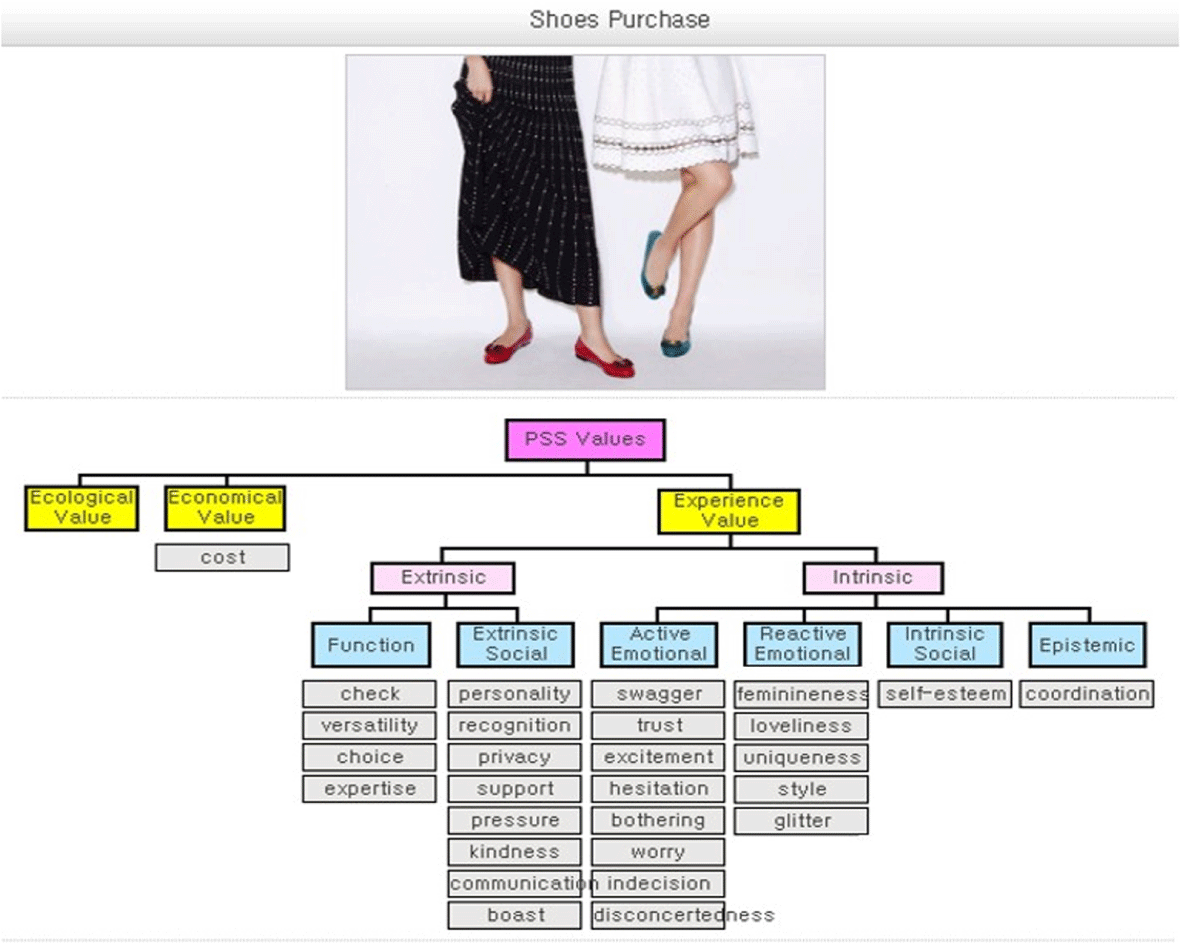
Some experience values are extrinsic, while others are intrinsic. Functional values are objective and extrinsic. Some social values like connectedness are extrinsic. But some social values like respect are intrinsic. Emotional values and epistemic values are intrinsic. Among emotional values, some values come quickly and go away quickly with primary contribution by the external world. These reactive emotional values are called by Scherer as esthetic values (Scherer Reference Scherer2005). If one says it touches good, looks good, smells good, sounds good and tastes good, she talks about reactive emotions. What is more important are active emotional values like love, happiness, anger, fun and control. Summarizing this taxonomy of E3 values, the value hierarchy, as shown in Figure 6, is used in enlisting specific value themes for a PSS under the corresponding categories. Note that those who see new value themes would be in a position to design new service activities that drive those values first.
Value space of the Shoes Purchase case.

2.3.2 Value themes
Values are to be identified through various research and probing methods and the E3 value tree is constructed with value themes obtained from specific attributes as customers sense, feel and think their experiences with various touchpoints of the journey (Kim et al. Reference Kim, Hong, Kim and Kim2011b). In the value space, specific value themes are represented based on the structure of the E3 values. Some PSSs address a lot of functional experience values and others involve many emotional experience values. Epistemic values such as information and knowledge are key issues in some service concepts. The example of the Shoes Purchase case has the value space representation as shown in Figure 6. Reflecting interaction issues between purchasing customer and sales person, a lot of extrinsic social value themes such as pressure, kindness and communication are identified. Social value of boast is also relevant among purchasing customers and her peers and friends. Also purchase decision-making is a critical touchpoint where functional values like choice and many active emotional value themes, such as trust, worry and indecision, are relevant. The customer would like for the sales person to have proper expertise to help her purchase decision-making. The Shoes Purchase case deals with reactive emotional value themes such as feminineness, loveliness and style. Explanations for all the value themes of the Shoes Purchase case are given in the caption of Figure 6.
Specifically, the value space representation of the Shoes Purchase case has eight value themes in extrinsic social branch, eight in active emotional branch and five in reactive emotional branch. The structure of the E3 value tree representing how many value themes are under each branch represents syntactic characteristics of the value space and reflects which E3 value branches are important in the PSS. From the perspective of the value space, a PSS case with many functional values but not many other values would be regarded different from a PSS case with many active emotional values but little functional values.
Also specific value theme keywords represent semantic characteristics of the values of a PSS. When comparing value spaces of different PSS cases, both the syntactic and the semantic aspects are used. Semantic similarities between specific value themes are determined using the distances of those value theme words using WordNet (Pedersen et al. Reference Pedersen, Patwardhan, Michelizzi and Banerjee2004). Specific choice of value theme words is based on some attributes from customer experiences in a bottom-up manner, and it could be subjective. However, when these words are compared for semantic comparison of value spaces of different PSS cases, their similarities are computed considering their meaning distances in WordNet. In this way, issues in subjective selection of value theme words can be mitigated.
Through experience evaluations of stakeholders including customers, those value themes that are important, but not yet well supported currently, can be identified. These values become the target values to improve, and activities to enhance these values are to be designed in a new PSS. When service concepts are designed to drive those target values, prototyping of those service concepts is to be conducted with potential customers and other stakeholders where experiences are evaluated for those corresponding specific value themes. These designs and prototyping are to be iterated in the PSS design. Thus, the value space is very important to characterize a PSS.
2.4 Actor space
In the life-cycle step analysis of the product, various stakeholders including the customers are identified (Matzen Reference Matzen2009; Kim Reference Kim2018). Also, in a narrow sense, actors are key elements of activities as defined in the Context-based Activity Modeling (Kim & Lee Reference Kim and Lee2011). While each stakeholder could be represented in detail in the form of user modeling with static and dynamic information, the actor space represents the actors and their relations as a graph with stakeholder nodes and relation edges at an abstract level. A node can be a receiver, a provider or a virtual stakeholder. Among the receivers, a primary receiver can be designated, and often the customer is designated as a primary receiver. To enhance the representation of the relations, the actor space also uses at a detailed level the Customer Value Chain Analysis (CVCA) method where the edges are attributed with value exchange information and directed with value provision direction (Donaldson et al. Reference Donaldson, Ishii and Sheppard2006). Note that the actor space is basically the same as the widely used Actor Map.
Note that graphs have been widely used to represent and model concepts and relations of complex networks in many areas and algorithms to compare graphs have been developed (Bunke Reference Bunke1997; Cao, Ying & Yin Reference Cao, Ying and Yin2013). Designation of a primary receiver node of an actor space graph is critical in comparing actor spaces of PSS cases. Primary receiver nodes can be treated as root nodes, and assessing similarities of actor space graphs can reflect relations of stakeholders better.
Actor space of the Bike Cleanser case (as-is version before servitization).

The actor space of the Bicycle Cleanser case is shown in Figure 7. The Bicycle Cleanser case is a PSS case for a new cleanser of bicycles addressing behavior changes of bicycle users regarding cleaning and caring of bicycles. The abstract actor space is shown on the left where a user is designated as the primary receiver shown in red color. Note that this actor space in Figure 7 represents the stakeholder relations before a new PSS is designed. The CVCA actor space is shown on the right. A User, bicycle rider, is riding with Riding Partners and gets information on various riding issues including cleaning and care. A User is talking about his riding and related experiences to his Family/Friends. A User may also join Bike Riding Clubs. A User gets a bicycle and related products from Bicycle Sales Shops, repair from Repair Shops and gets his bike cleaned by Expert Cleaning Shops as well as various kinds of information from them. Bike Riding Clubs and Riding Partners get information from Information Providers. The Cleanser Maker can provide its cleanser products to users through Expert Cleaning Shops and Repair Shops. Expert Cleaning Shops and Repair Shops purchase cleaning tools from Cleaning Tools Makers and Bicycle Sales Shops get bicycles from Bicycle Makers. A user node is connected to six other nodes and it has the most neighboring nodes among all the nodes. But, at present, it is not connected to the node representing the Cleanser Maker. In the new PSS, direct interactions between the cleanser manufacturing company and users have been created with new service concepts.
Actor space of the Shoes Purchase case.

For the Shoes Purchase case, the CVCA actor space before servitization is shown in Figure 8(a), where the relation edges are broken once or twice so that the attributed values are easily visible. When a Customer purchases her shoes in a store, she interacts with a sales person, denoted as the Clerk node in the actor space. She gets help and advice from a Clerk and buys her shoes from a Clerk or makes order to a Clerk if her size is not available for example. On the other hand, the Shoes Company gives a commission fee to a Clerk in return for his sales, and the Shoes Factory makes shoes with an order from the Shoes Company. As represented in the actor space, the shoes company does not have proper understanding about the customer’s experiences in purchasing its products. The actor space of the Shoes Purchase case after new services directly relating customers to the shoes company have been devised is shown in Figure 8(b). New stakeholders of IT company and Delivery company are added in the actor space as new services are devised.
2.5 Service space
Services supporting products in PSSs are provided to ensure proper functioning and availability of the manufacturing company’s product, while services supporting customers or clients are provided to help the customers achieve activities, processes and goals associated with the product (Mathieu Reference Mathieu2001; Gaiardelli et al. Reference Gaiardelli, Resta, Martinez, Pinto and Albores2014). We developed the service space composed of five grades from service supporting products to service supporting customers.
2.5.1 5 classes of the service space
If the service supports only product functions, it is regarded as Service Supporting Product (SSPP). If the service addresses customer values not directly related with the product but critical to customers of the product, it is classified as Service Supporting Customer (SSCC). For example, simple parts replacement, product protection and sales services are classified as SSPP. Nike Plus Fuel Band service allows its wearers to track their physical activity, steps taken daily and amount of energy burned. This service can be contrasted to SSPP services as it does not add functions of Nike’s products of sporting wear or shoes, but it changes behavior of their customers leading to more sales of their products. This kind of services is classified as SSCC. If there is a little aspect for customer value support while mostly the product is supported, it is Service Supporting mainly Products and partially customers (SSPc). Here upper case letter P and lower case c is used. If a service mainly supports customer values with a little product supports, it is Service Supporting mainly Customers and partially products (SSCp). Here C comes first and p later. Service Supporting Products and Customers about half and half (SSPC) (or equivalently SSCP) represents the case where the levels of product supporting and customer supporting are about the same.
Most PSS cases are composed of several service concepts. Thus, the service space of a PSS is represented by classifying those service concepts into the five classes of SSPP, SSPc, SSPC, SSCp and SSCC. Evaluations in the service space can be made considering the issues like product dependency, customer ability enhancement, customization levels, customer service interaction levels and involvement of various industry sectors as shown in Figure 9.
Service space classifications.

Service concepts for ensuring and slight improvement of product functions as well as simple service on access support of sales would be classified as SSPP. These are very dependent on the specific product. Services of providing protection and control of the product in hardware dominant manners would also be SSPP. Product supporting services like delivery and reservation involves a little bit more customer supporting aspect and would be classified as SSPc. Providing spaces for product use and simple rental-like access support would also be SSPc. As service focus is shifted toward processes from products, service space classification moves toward more customer-oriented and less product-dependent. Regarding availability or access related services, sales involves lower level of interactions than rental, which again involves less interaction compared with sharing. While a typical sales service is SSPP, most rental services are SSPc and general sharing services would be SSPC. Regarding dependency on product, sales involves a specific instance of a product, while rental is arranged for a specific kind of a product. Sharing would have even less specificity of products as can be seen on the row of product dependency in Figure 9.
In the perspective of customer ability enhancement, a typical product use guide or a product help desk support would be SSPc. Product use education service and product selection recommendation would be SSPC. Process education services that enhance customer abilities related with products but beyond simple product usage would be SSCp. For example, fashion coordination support for the Shoes Purchase case would involve enhancement of customer ability on fashion so that she can apply such abilities in fashion coordination of different shoes as well. This is less dependent on the specific pair of shoes. This kind of service would be classified as SSCp. Services that induce customer behavioral changes would be SSCC as can be found on the row of customer ability. Note that the product dependency aspect and the customer ability perspective are rather on reverse relation.
Customization and relationship issues have been regarded as typical characteristics of service support products and service supporting customers (Mathieu Reference Mathieu2001; Gaiardelli et al. Reference Gaiardelli, Resta, Martinez, Pinto and Albores2014). Customization services at the level of personalization would be classified as SSCC, while customizations based on product variations only would be SSPP. Services based on the interactions that customers initiate and lead would be classified as SSCC.
For SSPP services, the organization unit responsible for services would still be relevant product division of the manufacturing company (Fischer et al. Reference Fischer, Gebauer and Fleisch2012) and the inter-industry involvement level is very low. As services move toward more customer-oriented direction, more inter-department and inter-industry collaborations would be needed. When services supporting customers are enhanced through integration and involvement of multiple industry sectors, they would be SSCp or SSCC. That is, PSS ecosystems would get more complicated and expanded as services become more customer supporting. These kinds of concerns are the relevant issues on the row of convergence with various industries in Figure 9.
2.5.2 Service concept labels
In addition to the classification of the five classes, each service concept in a PSS case is labeled with keyword descriptions of the key service activities of the corresponding service concept design. For the Shoes Purchase case, six service concepts ‘Shoes Looks’, ‘Shoes Now’, ‘Shoes Album’, ‘Shoes Coordination’, ‘Shoes Plan’ and ‘Private Fitting’ have been designed, and their service space classifications are shown in Figure 10. Currently, service concept labels are made of two-word descriptions with one primary keyword designated in blue color for semantic comparisons. For example, ‘Looks’ is the primary keyword for ‘Shoes Looks’ label. A labeled service concept is at the level of a service unit. A service unit is composed of service elements. A service element is again composed of detailed activities of involved stakeholders as described in a service blueprint. Thus, the service concepts represented in the PSS representation framework are associated with detailed activities and context information (Kim & Lee Reference Kim and Lee2011) as described in a software-based service blueprint system.
Service space of the Shoes Purchase case.

2.5.3 Classification of the service concepts in the shoes purchase case
Critical touchpoints in the experience journey map of a shoes purchasing customer are when she conducts decision-makings regarding which shoes to buy or whether she should buy any or not and when she searches for the shoes that she would be interested in trying on. To enhance customer experiences in shoes purchasing, the ‘Shoes Looks’ service concept was devised. She would want to look at her with those shoes on from the front, from the rear and a close-up view in a natural manner while she can look at her entire body. This experience is enhanced with taking photographs of her trying on with three different cameras and showing the three different looks on a screen near the mirror. She can even store her shoes looks and compare multiple trials side by side by retrieving previous looks. For example, it helps when she needs to look at her photos with red shoes and blue shoes simultaneously to choose one color. She can also make her evaluations on different shoes looks to help her decision-making. With photos made with the ‘Shoes Looks’ service unit, other service units are enabled. The system of these service concepts has been registered as a patent (Kim et al. Reference Kim, Moon and Yoon2018). This enhances customer’s ability of purchase decision-making of the shoes products at this purchase occasion at hand, and, thus, some dependency on products exists. Thus, ‘Shoes Looks’ service concept is classified as SSPC.
The ‘Shoes Coordination’ service concept is concerned with the coordination service and means that fashion coordination information is provided for the shoes that the customer is interested in and trying on. This would be the enhancement of customer ability in using the shoes as well as shoes fashion coordination in general beyond the specific shoes. Thus, ‘Coordination’ is the selected keyword description and is classified as SSCp because this service highly enhances her ability and has low level of product dependency.
The ‘Shoes Plan’ service concept means the service which informs the customer of the marketing plan of new shoes similar to the shoes that the customer purchased or showed interests. This is classified as SSCp because it provides a customized service reflecting the preferences of the customer revealed through accumulated interactions like purchase or trial. This service also addresses multiple touchpoints in the customer journey even involving life cycles of more than one pair of shoes with multiple purchases and trials. This indicates that relation-based interactions have been cultivated.
The ‘Shoes Album’ service is to maintain the record of the customer purchases and trials including the photos the customer selected from the data of ‘Shoes Looks’ service and to allow retrieval of the records. This service concept is classified as SSCp as it enhances customer ability in shoes purchase and it cultivates relation-based interactions with customers. It also provides some customization aspects at multiple touchpoints including at purchasing, trial and even flexible browsing at her daily life schedules including at leisure time.
The ‘Private Fitting’ service concept is to provide a private space for shoes trial in a simple manner using low-fenced walls so that female customers who are shy enough to show her bare foots in front of sales persons and other guests who could include male persons. This service is to provide things to be used in the touchpoint of trial service resulting in a customization of the trial. It is classified as SSPC.
The ‘Shoes Now’ is the provision of delivery information telling at which step the shoes ordering is at the time so that the customer can trace whereabouts of the order from the purchase and ordering state to shoes making state and to specific delivery state. The ‘Shoes Now’ is dependent on the specific pair of shoes and classified as SSPc.
2.6 Business model space
New PSS concepts and their business models are designed together (Won et al. Reference Won, Kim, Lee and Hong2014). In the business model canvas (Osterwalder & Pigneur Reference Osterwalder and Pigneur2010), nine aspects of Customer Segments, Customer Relationships, Channels, Revenue Streams, Cost Structures, Key Resources, Key Partners and Key Activities are used in representing a business model. For each aspect, except the value proposition aspect which is the PSS offering itself, business model strategies have been determined by deriving from real business cases (Lee et al. Reference Lee, Shin, Hong and Kim2011). The business model strategies are as follows (Kim Reference Kim2018):
Customer Segments: Two-Sided Targeting, Environmental Targeting, Geographical Expansion, Long Tail Targeting, Low-Price Targeting, Niche Targeting, Premium Targeting, Segment Expansion, Public Interest Targeting.
Customer Relationships: Blockbuster Marketing, Community, Customer Participation, Customization, Education, Life-Cycle Care, Membership, Network Effect, Reward, Social Network, Upgrade.
Channels: Bundling/Channel Sharing, Delivery, Disintermediation, Experience Shop, Franchise, Intermediation, Internet, Road Shop, Sales Person, Shop in Shop, Traditional, Home shopping/Catalog.
Revenue Streams: Ad-based, Commission, Donation, Freemium, Loyalty, Pay as You Want, Pay per Unit, Pay per Use, Razor Blade, Subscription, Subsidiary.
Cost Structure: Cost Effectiveness, Cost Efficiency, No Frill, Structural Innovation.
Key Resources: Adding New Resources, Alliance, Brand Leverage, Crowdsourcing, Merge & Acquisition, Open Innovation, Outsourcing, Adding New Resources, Platform Utilization, Recycle.
Key Partners: Cross Promotion, Cross Servicing, Design Collaboration, Joint Distribution, R&D Contract, Shared Investment, Subcontractor Network/Solution Network, Internal Network.
Key Activities: Added Service, Economics of Scale, Economics of Scope, Lean Manufacturing, No Frill, Peer to Peer (P2P), Responsiveness, Self Service, Service Productization, Standardization, Vertical Integration.
Business model space of the Smart Lighting case.

Specific business model space is represented using those strategies in red as well as specific additional comments in blue as shown in Figure 11 where the business model space of the Smart Lighting case is represented. In the Smart Lighting case, lighting customization is provided for users in coffee shops based on accumulated experience evaluations as they perform certain activities under LED lighting. Similarities in business model can be obtained by comparing those strategies used in different PSSs. The customer segment strategies are Niche Targeting for niche customers who would like to have good lighting conditions specific to their tasks and Premium Targeting for premium customers who would be willing to give their experience evaluations to co-create the values of customization. The customer relationship strategies are Customer Participation and Customization as their involvements are key to the customization. Also the Membership Strategy is used as the customers become members of the service so that their evaluation data are accumulated and customization is done using those data. The relevant channel strategy is the Shop in Shop as the lighting control is given at My Spots located in coffee shops of partnering franchises rather than a new separate coffee shop franchise being started. Thus, the partnership strategy is the Joint Distribution. The resources strategy is the Brand Leverage that the resources of the lighting company is utilized primarily. The revenue strategies are Subscription and Pay per Use as users pay specific fees to use the service in addition to the payment of the coffee shop.
For our running example of the Shoes Purchase case, the business model space is shown in Figure 12. As the service addresses not only the purchase life-cycle step but also the delivery as well as the next purchase, the Life-Cycle Care strategy is relevant. But since there is no additional revenue from the service other than those from the sales of shoes, the Pay per Unit revenue strategy of a typical shoes sales is still maintained. Regarding the resources aspect, the Outsourcing strategy has been taken to have an IT company develop and operate services as well as manufacturing and logistics outsourcing. The Subcontract Network strategy has been selected to collaborate with IT companies, delivery companies and shoes factories. The key activities aspect strategy is the Added Service strategy in offering those six service units explained in the previous section. Note that similarities of the business model spaces can be found by comparing which aspects of the business model are emphasized and by counting how many strategies are common in the two cases.
Business model space of the Shoes Purchase case.

2.7 Interaction context space
Services involve interactions among actors. Also some of the service interactions involve physical touchpoints. Interaction context space is representing these interactions. Unlike actor space, specific human-to-human interactions and human-to-physical touchpoint interactions are represented. To represent interaction contexts in a PSS, we attempt to describe three different entities of service providers, service receivers and touchpoints. These are represented as nodes. We use a circle node for a service receiver, a triangle node for a service provider and a square node for a touchpoint. The directed edge shows interaction between service providers, receivers and touchpoints. We describe the interaction among these nodes as a directed edge. Thus, the interaction context is shown as a form of a directed graph. Furthermore, the touchpoints are distinguished into two kinds, a physical touchpoint like a typical product which is represented by a big square and a service system touchpoint which is represented by a small square. Note that a service system touchpoint may include both product elements and service elements. In this way, the interaction context is represented systematically. As in the actor space, a key service receiver can be designated as the primary service receiver node.
In Figure 13, which shows the interaction context space of the new PSS of the Shoes Purchase case, the shoes purchasing Customer is represented as the primary service receiver with a yellow circle node, and six service providers of Clerk, Shoes Company, IT Company, Delivery Company, Factory 1 and Factory 2 are shown with pink triangle nodes. The Customer is interacting with the Clerk service provider and with shoes products and the shop touchpoints. The new service concepts are delivered through the interactions of the Customer with service systems like MyShoes Looks, MyShoes Coordi and Private Fitting Zone as they purchase in the shop. The Customer gets the whereabouts information of her shoes order through MyShoes Now service touchpoint once the order is made. The customer is also interacting with the service systems of MyShoes Plan and MyShoes Album in a continued manner once she becomes a membership customer. Please note that the Shoes Company and the IT Company are interacting through the customer membership DB touchpoint. The Shoes Company is interacting with Clerk, Delivery Company and Factories. Information in MyShoes Coordi, MyShoes Plan and MyShoes Now are updated and managed by the Shoes Company in a continued manner based on the customer information on the membership DB.
The interaction context space of the Shoes Purchase case.

2.8 Time space
Diverse values are realized in PSS by interactions between service providers and receivers. The time space addresses when those value creating encountering interactions happen along the time line. Some services provide values only at transactions in discrete manners. Values are continuously delivered in some services as the other extreme situation (Lovelock Reference Lovelock1983). In between these two are the case where values are provided at certain times and the case where values are provided when requested or needed (Tan & McAloone Reference Tan and McAloone2006).
Time spaces of some PSS cases.

Examples of the time spaces of a few PSSs are shown in Figure 14. For the Shoes Purchase case, Shoes Looks and Shoes Now would be available when a purchase transaction is made. Shoes Coordi, Shoes Album and Shoes Plan services can be given when needed. The Child Care Robot case provides child care support using a small robot with a camera so that the robot is following a small child and keep sending photos or video to Mom or Dad when both Mom and Dad are busy at home. This Showing Child service could be done in a continuous manner like a surveillance unit depending on how the user sets. In the Smart Lighting case, Customization service is available when a user goes to a coffee shop with proper lighting service system, that is, when needed. In the case of the Bicycle Cleanser, Cleaning Camp service is offered so that education on bicycle cleaning can be provided, and Cleaning Place service is provided for users who need proper spaces to clean bicycles. These services would be available at certain times with proper intervals though these services are not offered every day. The Diary service of helping users build up new cleaning behaviors is available when needed.
3 Servitization process guide using PSS representations
The PSS representation framework with eight spaces as explained in the previous section represents the characteristics of PSSs. Comparison of different PSSs can be done for one specific space or for a combination of the spaces. Moreover, these spaces can guide manufacturing servitization processes as depicted in a generic way in Figure 15.
PSS representations and process relations.
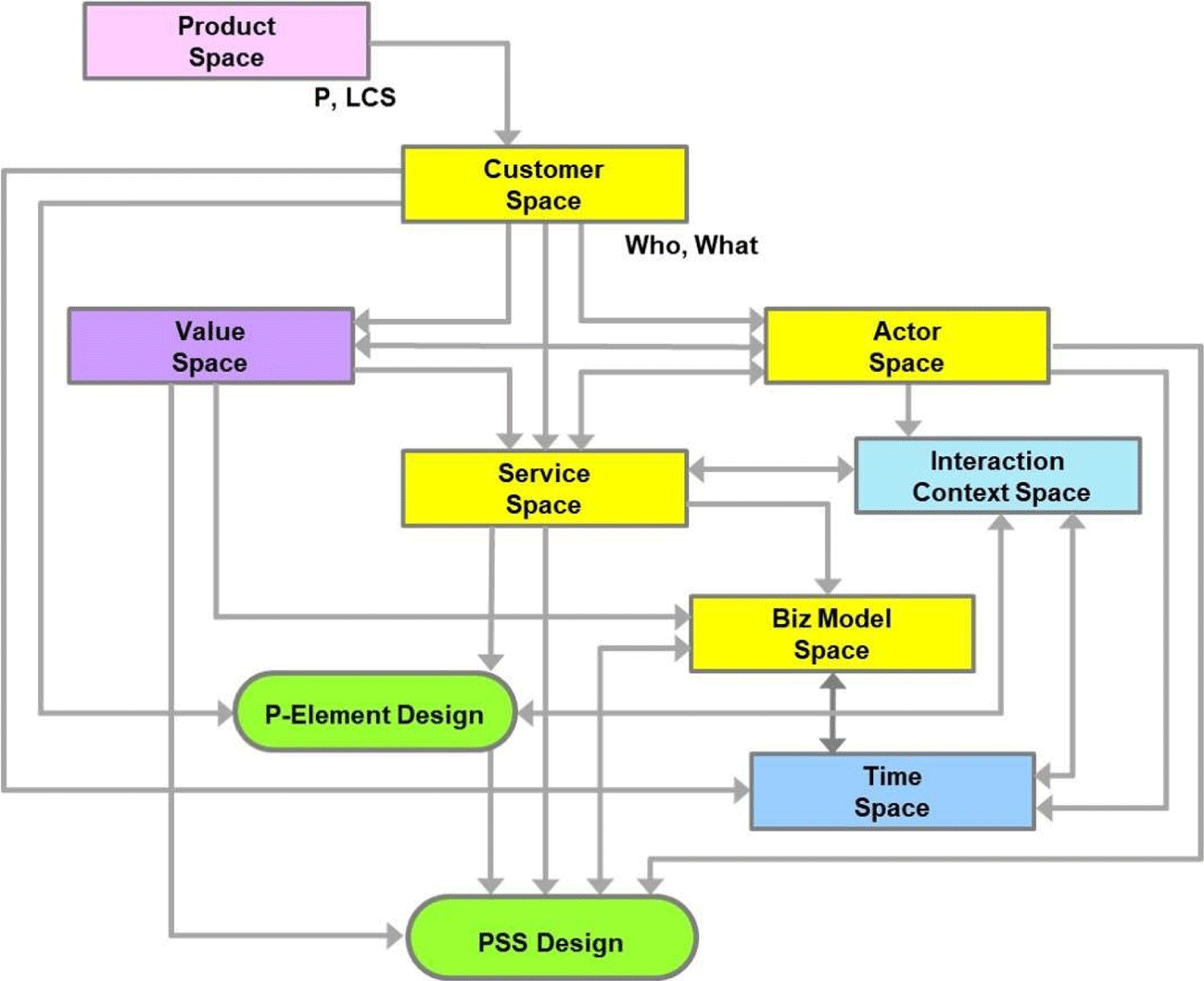
First, the product space is addressed to understand what kind of a product the servitization is to be conducted for. Then the customers as well as the activities of the customers in dealing with the corresponding product in the customer space are studied. Among the activities in the customer space, some activities and the values associated with these activities are identified so that a new PSS can be devised to provide these values. Key values of the customers regarding the product and associated activities are identified and represented in the value space. Stakeholders and their relations are then determined and represented in the actor space. To drive those values, activities of actors including service receivers and providers are newly designed to propose service concepts to be represented in the service space. Specific business model strategies are determined for the service concepts or service units gradually so that desired values are driven to design the business model as represented in the business model space. Also the interactions among the stakeholders are designed for the service activities and represented in the interaction context space as well as the interactions between stakeholders and touchpoints. Further details on the encountering of the customers with the services are determined regarding how often the services are delivered for each service concept as represented in the time space. In this way, the servitization processes are conducted with new service activities, business models, interactions and relations.
While the servitization process has been started with a product, new service activities would require physical touchpoints to support the activities. These are referred to as product elements (p-elements). For example, the Private Fitting service of the Shoes Purchase case would require small fences to form a small private spaces for shoes trial. The fences constitute the product element for the Private Fitting service. Once service activities are designed, corresponding product-element design is to be done in a later stage to naturally induce the new service activities using their context-based activity modeling and affordance issues.
Through these processes guided by the representation spaces, a PSS is to be designed (Kim et al. Reference Kim, Lee, Kim, Jeong and Kim2012; Kim Reference Kim2016) as generically depicted in Figure 15. The above description of the servitization process is generic as any real PSS design process would require many iterations and back tracking. But the representation spaces play the role of basic guiding so that key characteristics of a PSS are properly addressed along the servitization process.
4 Fifteen industry cases of product–service systems
The framework of PSS representation with eight spaces has been developed at the MSSF project. Using comprehensive and systematic PSS design methods and tools, the consortium performed the servitization processes for 15 companies ranging from a small venture companies to big global companies. Products of these companies vary a lot from chemical cleaning products to fashion shoes to personal posture assistive devices. These companies and their products are briefly introduced in the following. Descriptive images of these companies are shown in Figure 16:
Fifteen industry cases of product–service systems.

(a) Furniture DIY: a personalized DIY service has been developed for a small furniture manufacturing company (Kim et al. Reference Kim, Lee, Lee and Hong2015b).
(b) Smart Lighting: a smart lighting customization service for coffee shops has been conducted for a medium-sized LED manufacturing company.
(c) Child Care Robot: a child care service for working couples was developed for a venture service robot company.
(d) Posture Assistive Devices: a PSS was designed for a venture company which manufactures posture assistive devices for children.
(e) Air Purifier: a big living care company’s IoT-based air quality sensor case has been servitized with focus on the service interaction between customers and service providers.
(f) Health Information: a PSS was developed for a health information management system which measures physical capabilities of users for a venture company.
(g) Van Customization: a diverse channel enhancement service was developed for a medium-sized van customization company.
(h) Glasses Purchase: customer purchase experience service design was developed for a glasses sales company with more than 200 franchise stores.
(i) Shoes Purchase: experiences for purchasing shoes were addressed for a female shoes company with about the fifth ranking in the national market.
(j) Heating Tent: a PSS has been developed for a heating tent company.
(k) Kindergarten Album: a small venture company that produced customized photo albums for kindergartens received enhanced service design support.
(l) Animation Bluetooth Service: an IoT-based interaction service was developed for a bluetooth-based entertainment technology company.
(m) Bicycle Cleanser: a company producing cleaning chemicals wanted to develop a new business opportunity with the bicycle market so that a comprehensive PSS to enter this new business had been devised.
(n) Car Seat: a new business division of a global car manufacturer is developing children car seats, for which a brand new car-life experience service design has been conducted.
(o) Shower Devices: a small company that makes shower equipments wanted to innovate its business with servitization so that a new service platform had been developed.
The service spaces of these 15 cases are shown in Figure 17. A typical PSS case is composed with several service concepts, and each service concept is specifically classified into one of five classes of SSPP, SSPc, SSPC, SSCp and SSCC as explained in Section 2.5. Each service concept is characterized with the perspectives of product dependency, customer ability enhancement, customization, service interaction and convergence aspect. While service concept level comparison can be done based on the classification on the five classes, PSS level comparison of the service space can be done combining the service concepts. The characteristics of a PSS case in the service space is represented syntactically by how many service concepts belong to each of the five classes. When a majority of the service concepts belongs to SSCC, the overall service characteristic of the case is customer-supporting-oriented roughly. Between the Car Seat case and the Kindergarten Album case shown in the upper part of the right column in Figure 17, the Car Seat case can be regarded as more customer supporting than the case of Kindergarten Album. The Glasses Purchase case shown at the bottom of the left column is less customer supporting than the Car Seat case, but it is more customer supporting than the case of Animation Bluetooth Service shown at the top of the left column.
Also a center of mass characteristic can be considered. In the case of Animation Bluetooth Service, the center of mass is at SSPC with one concept at each of SSPP, SSPC and SSPc. This case can be regarded as the most product supporting among the 15 cases. On the other hand, the center of the Car Seat case would be somewhere between SSCp and SSCC, and the center of the Kindergarten Album, at SSCp. The PSS cases in Figure 17 are positioned with the order starting from the most product supporting services of the Animation Bluetooth Service case shown at the top of the left column to the most customer supporting services of the Car Seat case at the top of the right column. Note that the syntactic characteristics of the cases of Shoes Purchase and Glasses Purchase are the same with three service concepts at SSCp, two at SSPC and one at SSPc as shown in the lower part of the left column. As explained in Section 2.5, the semantic aspect is characterized with service concept labels, that is, key words description of each service concept. In the next section, similarity comparisons of the 15 cases are explained for a few spaces.
Service spaces of 15 industry cases of PSS design.

5 Comparison of product–service system cases
In Sections 2 and 3, the PSS representation spaces have been described as a PSS design can be done addressing the relevant spaces in some order while there have to be iterations in any designing processes. Comparison of PSS cases in their overall aspects could be quite difficult. On the other hand, PSS cases can be compared more specifically using a particular space. PSS designers can conduct more intuitive comparisons. Also more objective comparisons can be made using similarity assessment algorithms. When PSS cases are represented in a specific space of the representation or in a combination of a few spaces, similarities among PSS cases could be compared in more objective ways.
The purpose of comparison is to understand how various PSS cases are similar or different in the respective space so that characteristics of PSS cases can be identified in a comparative manner and similar and/or different cases could be utilized in designing new PSS cases. This is to use case-based reasoning approaches where a designer finds a previous situation similar to the current one and uses that to solve the new problem by adapting old solutions to meet new demands (Kolodner Reference Kolodner1992).
Using product space comparison, designers of a new PSS could check whether there are PSS cases dealing with products similar to the current product for which a new PSS is to be designed with case-based reasoning approaches. As the product space includes the sub-space of the life-cycle steps where the company is involved, designers could get some insights by learning about the service concepts designed in other PSS cases addressing specific life-cycle steps. Alternatively, if the company is not dealing with a specific life-cycle step yet, addressing this life-cycle step with new services could open up new potential opportunities.
5.1 Product space comparison
Similarity comparison of PSS cases in the product space can be done through the hierarchical classification of the products using the UNSPSC sub-space of the product space. UNSPSC is composed of five hierarchical levels. Thus, two PSS cases would have the same product space classification if their classifications up to the fifth level are the same. The product space similarities of 15 cases are shown in Figure 18. Note that the similarity score of the Car Seat case and the Furniture DIY case is the highest (0.83) in this comparison. They are the same up to the third level; they are both accommodation furniture as shown in Figure 19. The similarity assessment method utilizes the hierarchical structure of UNSPSC (Ahn et al. Reference Ahn, Lee, Kim, Kim and Lee2018) and was addressed as a part of similarity measurement of PSS designing activities (Wu et al. 2017).
Product space comparison.

Product space similarity (Furniture DIY versus Car Seat: 0.83).

5.2 Value space comparison
E3 values of a PSS case are represented in a tree structure as shown in Figure 6 and in Figure 20. Specific value themes are listed in the corresponding branch as identified through various research and survey methods from stakeholders including customers. Among experience values, functional values and some social values are extrinsic. Both active and reactive emotional values are typical intrinsic values as well as epistemic and some social values among oneself. In similarity assessment, the syntactical aspects of the value trees like which value classes are more populated than others are considered. In other words, the number of terminal nodes in each branch is compared for the syntactic similarities. Also the semantic aspect of value themes is considered in similarity assessment using the WordNet where distances of two words are computed as described in Section 2.3.
Value spaces of Glasses Purchase and Shoes Purchase cases.


Value space descriptions of the Shoes Purchase case and the Glasses Purchase case are shown in Figure 20. While the product space similarity of the two cases is very low (0.38), as shown in Figure 18, these two cases have similar value tree structures as shown in Figure 20. The numbers of terminal nodes of ecological, economical, active emotion, reactive emotion and intrinsic social branches are the same between the two cases. Also the branches of functional, extrinsic social, active emotion and reactive emotion have relatively large number of terminal nodes, while the active emotion branch in both cases has the most nodes. In this way, the value tree structures are syntactically similar in these two cases. Moreover, both address cost issue in the economical value branch. Value themes expertise and choice are common in the functional value branch. Value themes kindness, boast, pressure and communication are appearing in both cases in the extrinsic social aspect. Also themes worry, indecision and disconcertedness are common in the active emotion aspect. The style theme appears in both cases in the reactive emotion part. Also similar though not identical value themes of loveliness and prettiness appear in reactive emotion category. Thus, the similarity of these two cases is about 0.75 (75%), which is very high. The comparison of 15 cases in their value space is shown in Figure 21.
Value space comparison.

5.3 Service space comparison
Service concepts proposed in a PSS are classified into five categories of the service space as discussed in Section 2.5. PSS cases are compared in the service space concerning which classes of services are of primary foci in the corresponding cases regarding the nature of service concepts in their product supporting or customer supporting roles. Like in the case of the value space, the syntactical aspect in the five classes is considered. Also keyword descriptions of service concepts are compared using WordNet.
In Figure 17, the service space descriptions of the 15 cases are ordered from the most product supporting services to the most customer supporting services. The case of Car Seat has three service concepts of SSCC and one concept in each of SSCp and SSPC. The case of Kindergarten Album has three service concepts; one each for SSCC, SSCp and SSPC. On the other hand, the case of Animation Bluetooth Service has services in SSPP, SSPc and SSPC, and this case is the most product supporting among the 15 cases.
Service space comparison.

Service space comparison of Shoes Purchase and Glasses Purchase (0.88).

Pairwise similarities of these 15 cases in the service space are shown in Figure 22. Note that the similarity of 0.88 is computed for the Shoes Purchase case and the Glasses Purchase case. As shown in Figure 23, their syntactic aspects are the same in the service space. Also some semantic aspects are very similar as they both include Looks and Coordi. Note that the value space similarity of these two cases is very high. The two cases were conducted at about the same time. But if one were done before, service concepts of the previous case could have been used as hints in designing the latter case. That is, the strategy of PSS design that finds similar cases of the new PSS case and makes some kind of analogical reasoning of the service concepts of similar cases could be used. On the other hand, the similarity of Van Customization and Health Information cases in the service space is very low (0.26) as shown in Figure 22. No service concepts are on the same class in these two cases as shown in Figure 24. The measures of the similarity also include the overall service space score comparing the distances in their weight center locations (Ahn et al. Reference Ahn, Lee, Kim, Kim and Lee2018), and this is why their similarity is not zero. The similarity between the Car Seat case and the Animation Bluetooth Service is 0.27 as both have one service concept at SSPC, while the similarity between the Car Seat case and the Heating Tent case, with one service concept each at SSCp, is 0.28, a little bit higher, as their centers are just a little bit closer than those of the pair of the Car Seat and the Animation Bluetooth cases.
Service space comparison of Van Customization and Health Information cases (0.26).

6 Discussion
A representation framework of PSSs with eight spaces of product, customer, value, actor, service, business model, interaction context and time spaces has been proposed in this paper. This representation framework will allow classification and comparison of diverse PSS cases. This will help to understand in what aspects various PSS cases are different.
6.1 Benefits in classification and comparisons
When a manufacturing company seeks servitization strategies, they can analyze and compare previous PSS cases of the company. Especially if the company has diverse product portfolio and many PSS cases, it is strategically critical to determine the next PSS design directions based on its previous PSS design cases and surrounding business contexts and trends. The proposed representation framework would enable comprehensive and systematic comparisons. Such companies could maintain their own repositories of PSS cases using the representation framework for continued servitization strategic planning and PSS designing. Comprehensive and systematic representation and comparison framework could also be critically important for those government agencies which can plan and promote manufacturing servitization policies. Characteristics of various PSS cases can be used in identifying the trends and establishing plans for servitization support strategies.
Manufacturing servitization experts and consulting companies also would like to have their servitization and PSS design cases represented in this framework so that effective comparison can be possible to support their new servitization and PSS design tasks. For example, they can represent the product space, customer space and value space of the new PSS task first. Using product space comparison, designers of a new PSS could check whether there are other PSS cases dealing with similar products. Then they can identify other similar cases in the product space and extract potential insights from those cases. As the product space includes the sub-space of the life-cycle steps where the company is involved, designers could get some insights by learning about the service concepts designed in other PSS cases addressing the corresponding life-cycle steps. Alternatively, if the company is not dealing with a certain life-cycle step yet, addressing this life-cycle step with new services could open up potential new opportunities. Alternatively, they can learn from other cases similar in their value space as service activities to drive similar values can be retrieved from such other cases. Please note that the Shoes Purchase case and the Glasses Purchase case have very similar value space representations and their service spaces are also very similar as discussed in Section 5. While these two cases were conducted at about the same time in the MSSF project and thus their value space similarity had not been exploited, it could have happened that one case could learn from the other case. For all eight spaces, similarities between different cases can be obtained. Similarities can also be computed for a combination of multiple spaces as well. The similarity comparison could be utilized in searching for similar cases from which a new PSS concept can be obtained through analogical reasoning efforts. If other PSS cases with similar interaction context spaces are identified, some hints for the development of service interaction touchpoints for a new PSS could be obtained from the detailed information of service interaction touchpoints of those similar cases.
6.2 Benefits in supporting PSS design
As discussed in Section 3, this representation framework can guide PSS design processes. The task of PSS design can be conducted, addressing the PSS representation spaces with their interrelations. Key service concept design can also be done utilizing similar cases. Associations of these spaces can also guide necessary design tasks. The product space can support expanding the life-cycle steps where service activities can be designed to expand service-based revenues. Based on the information in the customer segment sub-space of the customer space, servitization strategies such as segment expansion and penetration could be pursued as well as customization addressing the characteristics of the specific customer segments. The key activities sub-space of the customer space can help in characterizing the overarching context on which the customers would place emphases dealing with the given product and newly devised services. The value space represents the key servitization targets for which the service activities are to be designed. New service concepts and activities can be designed through analogical reasoning approaches with those service concepts and activities of other PSS cases as sources or hints that drive similar value themes to the value themes of the new PSS case.
Particularly, the service space could guide what kind of service concepts could be conceived to advance servitization qualities considering the current state. For example, if a manufacturing company currently offers services supporting products, then the next service concepts could be aimed at services with a little bit of customer supporting aspects. New services can be targeted to those services which improve customization and interaction aspects as represented in the service space. Then previous service concepts in other PSS cases with those characteristics could be identified from the repository. For example, a company may set its strategy to enhance customer service interaction aspect to SSCp level from the current SSPC level. Then from the repository, other PSS cases with service concepts at SSCp level can be retrieved so that specific service activities of these cases can be referred to in devising new service interaction. For interaction details, the interaction context spaces of these retrieved cases can be studied. The service space represents the key service characteristics of the new PSS and positions the PSS on the service advancement and emphasis scale.
The business model space associates business strategies for a relevant business model aspect. The associations between service concepts and business model strategies would play critical roles in evaluating service concepts in the PSS design so that many iterations in service designing can be conducted in the evolutionary process of servitization. The actor space would suggest how to expand potential collaboration partners in the new PSS ecosystem. Information on how relations among the actors are specifically constructed and maintained through what kinds of touchpoints and encountering to drive certain values can be obtained and represented through the interaction context space and the time space. In this manner, the PSS representation and repository could support PSS designing.
6.3 Advantages over other previous work
Comparisons of services supporting products and services supporting customers/clients (Mathieu Reference Mathieu2001) addressed four dimensions of the direct recipient of the service, the intensity of the relationship, the customization of the service and the critical elements of the service marketing mix. In Mathieu (Reference Mathieu2001), the distinctions on these dimensions are distinguished with two alternatives; just low or high in the relations and the customization dimensions and just product or person in the recipient dimension. The marketing mix elements are either physical evidences and process or people. The PSS classification model in Gaiardelli et al. (Reference Gaiardelli, Resta, Martinez, Pinto and Albores2014) used three major dimensions of product–service offering focus, interaction and ownership issues. As in Mathieu (Reference Mathieu2001), offering focus addressed the characteristics of relationship intensity and customization level as high versus low. The interaction dimension regarding transaction-based or relationship-based addressed the characteristics of risk takers and pricing strategy. Product-oriented services categorized four product specific services, nine advice/training/consulting for product/process/business issues as well as internal function or business unit management support. Use-oriented services have five classes including lease, short-term rent, long-term rent, sharing and pooling. Result-oriented services are pay per use, outsourcing and pay per result. Combining these, a product–service offering classification model of 30 classes has been developed. While the classification model simply identifies a PSS case into one of these classes or a combination of a few of these and characterizes the cases with the three dimensions, these characteristics are not at all comprehensive as the model deals with offerings only. However, the representation framework proposed in this paper addresses comprehensive perspectives including those aspects of given conditions of the servitization such as product, customer, actor and value spaces and those viewpoints of PSS design results such as service, business model, interaction context and time spaces.
In the strategy topic matrix method (Neugebauer et al. Reference Neugebauer, Mougaard, Andersen, McAloone and Meier2013) using six categories of stakeholders, physical assets, capabilities, influencers, network and offering, 13 PSS cases have been compared to see whether certain topics have been checked, but no specific semantic information is described. On the other hand, the business model space of the representation framework proposed in this paper specifies business model strategies for each aspect of business model canvas. This aspect may be similar to the strategy topic matrix in that certain topics in each of the six categories are checked as important. However, our business model space further specifies semantic information on the nature of how a certain strategy has been applied using keywords. In this way, both syntactic (whether a certain strategy is relevant or not) and semantic (how a certain strategy is applied) information can be specified so that more specific and contextually meaningful comparisons can be made on different PSS cases.
The proposed representation framework is not just a classification model, but it is a comprehensive description of detailed characteristics of PSS cases on diverse issues. Detailed characteristics in eight representation spaces are represented in a software-based representation framework, and other PSS design support tools like service blueprint system can be associated. The characteristics on each space can be described and reviewed as seen in Figures 1, 6, 7, 8, 10, 11, and 13.
The representation allows both rough comparison and detailed comparison. Two PSS cases can be compared on each of the eight spaces so that a user can intuitively understand respective characteristics represented as in Figures 2, 3 and 5. In the service space, a user can compare different cases based on the classifications of service concepts in each respective cases. Roughly, a user can understand how many service concepts are classified into each of the five classes. Within a case, relative focus on customer or product supporting can be assessed. The proposed representation not only describes the characteristics, but it could be used to identify the directions for gradual improvements including, for example, customization and relation-based interaction directions.
The proposed representation framework involves various classifications by selecting a specific class among the class options. For example, a user would pick a specific classification of a product using the hierarchical classes of UNSPSC and choose one or more relevant life-cycle steps among the 12 steps given by the system. All these involve subjective decisions by users. The representation is not made by automatic feature extraction. But the virtue of the proposed representation is that most spaces provide hierarchical structures and involve both syntactic and semantic aspects. For example, UNSPSC has a hierarchy with depth 5. While selection is to be done by a user, the issue of wrong or less proper classification is mitigated by the hierarchy. For instance, a user’s choice at the fourth level may be different from another user’s choice. But their classifications up to the third level would be the same. This is the advantage of the hierarchical structure. Similarity computation algorithms address this even though a detailed discussion of the algorithms is out of the scope of this paper. The value space involves both syntactic and semantic aspects. The E3 value tree structure is syntactic and the value theme description is semantic. The value theme keywords selection is subjective. But when they are compared, the similarity distance notion of the WordNet is used. That is, when two words are not the same, how similar they are is determined by the WordNet distance. It is not whether they are the same or not. It is not a Boolean decision of 0 or 1, but the distance between 0 and 1.
In comparison with other classification methods in the literature, most of them distinguished either product supporting or customer supporting, but the proposed service space uses five classes from SSPP, SSPc, SSPC, SSCp and SSCC. Also the service space classifies each service concept of a PSS case, which typically includes several service concepts. Thus, when the service spaces of two PSS cases are compared, the similarity is not whether they are the same or not, but the similarity between 0 and 1 is determined. Even further, the service concept label reflects semantic aspect using the WordNet distance. In this way, the proposed classification and comparison method of the representation framework overcomes the limitations of qualitative subjective decisions. This is one of the advantages of the proposed representation framework over other methods.
This representation enables quantitative comparisons of PSS cases based on objective similarity comparison algorithms. Thus, similarities and differences of PSS cases are computed so that hundreds of PSS cases could be compared. If needed, more specific quantitative similarity scores can be computed so that a detailed comparison can be enabled. Pairwise similarity comparisons for multiple cases are possible as seen in Figures 18, 21 and 22. Note that if a user selects the similarity score of specific two cases of the pairwise comparison table, the corresponding space information of the two cases are shown as in Figures 19, 20, 23 and 24. More complicated queries can also be processed as the framework represents the PSS cases in eight spaces and similarity algorithms have been devised.
7 Conclusion
Many manufacturing companies develop PSSs based on their product strengths by devising service elements to achieve business innovation. Such servitization processes and resulting PSSs are all different reflecting the corresponding company’s business context and customer needs. In this paper, a representation framework for PSSs with eight spaces of product, customer, value, actor, service, business model, interaction context and time space has been proposed to enable comparisons of different PSSs and to support PSS design process. A PSS repository using the representation framework has been developed, and the comparison of 15 industry cases has been illustrated where the similarities of the cases using the product, value and service spaces have been used.
The proposed representation framework provides high-level characteristics as well as specific details associated. The representation is comprehensive to address the products and business contexts of manufacturing companies with information on their customers and other stakeholders as well as key values of them. The representation also describes the characteristics of resulting PSS design including service concepts, business model strategies and interaction information. It allows both rough comparison and detailed comparison of PSS cases. This representation enables quantitative comparisons of PSS cases based on objective similarity comparison algorithms.
It is intended that the utility of the representation framework can be assessed through comparisons of industry cases. It is desired that more PSS cases from possibly various industry cases could be represented and stored in the repository so that more diverse utilities of such representation framework can be validated including designing new PSS cases using analogical reasoning approaches exploiting similar PSS cases. Designing new PSS cases utilizing the representation framework and the repository of other PSS cases is a future task. The proposed representation framework has been implemented as a proof-of-concept software system. After refinement and testing, an improved software system would become available for PSS designers.
Acknowledgments
This research has been supported by the Manufacturing Servitization Support Framework (MSSF) project sponsored by the Korean Ministry of Trade, Industry and Energy. The MSSF consortium has been composed of the Creative Design Institute of Sungkyunkwan University, the Product-Service Engineering Laboratory of Seoul National University, the Graduate School of Culture Technology at KAIST as well as the Korea Consulting Service Association and the Service Design Council. The help by the graduate students, including H. J. Lee, K. Suzuki, E. K. Ahn, Y. J. Choi, S. M. Cho, E. R. Rho, M. J. Lim, C. J. Lee, Y. K. Kim, J. H. Kim, S. E. Kim, H. Oh, S. Y. Jung, S. C. Yoon, J. Moon, J. W. Lee, Y. J. Kim, G. S. Kim, S. G. Kim, J. E. Choi, S. Lee and Y. H. Choe, and by research staff including S. H. Cho, J. Lee, S. H. Park and E. M. Choi, in conducting PSS design cases is greatly appreciated. Also collaborations by other partners of the MSSF project in PSS design and in developing the repository system are also appreciated.


 Open access

