


Lisu (ISO 639-2 lis) is spoken by just over a million members of the group of this name in south-western China, north-eastern Burma, northern Thailand and north-eastern India. It formerly also had other names used by outsiders, including Yeren (Chinese yeren ‘wild people’), and Yawyin in Burma and Yobin in India (both derived from the Chinese term). Other names included Lisaw from the Shan and Thai name for the group, also seen in the former Burmese name Lishaw. About two-thirds of the speakers live in China, especially in north-western Yunnan Province, but also scattered elsewhere in Yunnan and Sichuan. About a quarter live in the Kachin State and the northern Shan State in Burma, with a substantial number in Chiangmai, Chiangrai and other provinces of Thailand, and a few thousand in Arunachal Pradesh in India. It is also spoken as a second language by many speakers of Nusu, Anung, Rawang and others in north-western Yunnan and northern Burma. Lisu has almost completely replaced Anung in China and is replacing Lemei in China. The Lisu are one of the 55 national minorities recognised in China, one of 135 ethnic groups recognised in Burma, a scheduled (officially listed and recognised) tribe in India, and one of the recognised hill tribe groups of Thailand. Figure 1 shows a map of the area where Lisu is spoken.
Map of Lisu language area.

Lisu has four main dialects: Northern, as described in Bradley (Reference Bradley1994), and spoken in northwestern Yunnan in China, far northern Burma and India; Central, as described in Fraser (Reference Fraser1922), Bradley (Reference Bradley, Sybesma, Behr, Gu, Handel, Huang and Myers2016, Reference Bradley, Thurgood and LaPolla2017) and Yu (Reference Yu2007), and spoken in west central Yunnan in China and in north-eastern Burma; Southern, as described in Hope (Reference Hope1974) and Bradley et al. (Reference Bradley, Hope, Fish and Bradley2006), and spoken in Thailand and nearby in eastern Burma; and Eastern, as spoken in south-western Sichuan in China and nearby in Yunnan, and described in Yu (Reference Yu2007). The standard literary variety is based on the Central dialect, with some elements of the Northern dialect (Bradley Reference Bradley1997, Bradley & Bradley Reference Bradley and Bradley1999). The data here is from the literary dialect as spoken by author DY, whose own dialect is a subdialect of Central Lisu. Many words, such as ‘sun’ and ‘knee’ in the data provided below, have alternative traditional and innovative forms used in literary Lisu.
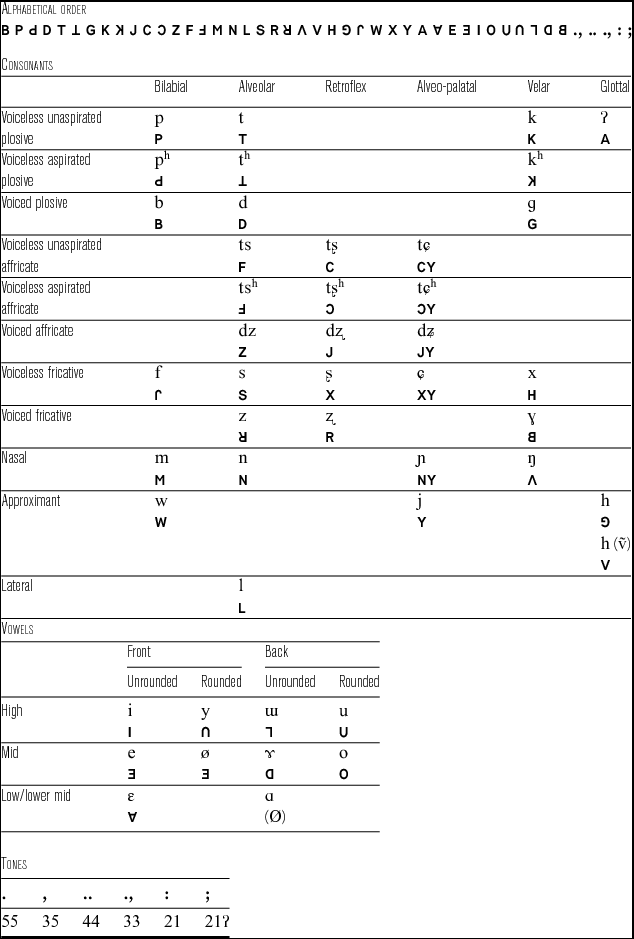
Lisu has three main orthographies: one devised in 1914 by a group of Christian missionaries led by James O. Fraser (the author of Fraser Reference Fraser1922) and now universally used by all Lisu Christians in China, Burma, Thailand and India (i.e. over half of the total Lisu population); one devised in the 1920s in China by an indigenous Lisu leader, Huang Renbo, but no longer in use; and one devised between 1956 and 1958 based on the principles of Chinese pinyin (‘phonetic writing’) and used in China since then, especially by non-Christians (Bradley Reference Bradley1994, Reference Bradley1997, Reference Bradley, Saxena and Borin2006). In 1983 the so-called Fraser script was made the standard for government use in the two Lisu autonomous areas in China, but the pinyin script also continues in limited use there. The Fraser script has a Unicode standard, and is used in this presentation. This is a Romanisation which uses 25 upper case letters upright and 15 inverted to represent segments, and uses punctuation to indicate tones (see Table 1). The use of punctuation to indicate tones is derived and expanded from the traditional Burmese writing system, as is the use of the hyphen for comma and an equals sign for full stop. In Lisu, the comma indicates a rising tone and the full stop indicates a high level tone; other punctuation is used for the other four contrasting tones. Note that there are no syllable-final consonants in the native Lisu vocabulary, although /n/ and /ŋ/ occur syllable-finally in a few loanwords.
Fraser orthography for Lisu. Note that the vowel /ɑ/ is ‘inherent’ in any consonant, e.g. b is /bɑ/, z is /dzɑ/, etc. Note also that there are two graphemes for /h/ – one for the relatively common /h/ which may be pronounced [ɦ], and which induces nasalization on the following vowel; and one for the marginal /h/, which is written in one imperative particle and which may be pronounced as [h] or as [x].
The speaker in this Illustration is the author DY, a female born in Shibacha village in Yingjiang county of Yunnan in 1964. She spoke Central Lisu and Yunnan Mandarin with her parents, and was schooled in standard Mandarin.Footnote 1 She completed a Ph.D. on the Lisu language at La Trobe University, under the supervision of author DB (Yu Reference Yu2007), and is currently an associate professor of Lisu language at Yunnan Minzu University. The recordings for this Illustration took place in March 2014 using a Zoom H4 solid state recorder.Footnote 2 Some follow-up recordings of examples were made in July 2016.
Consonants
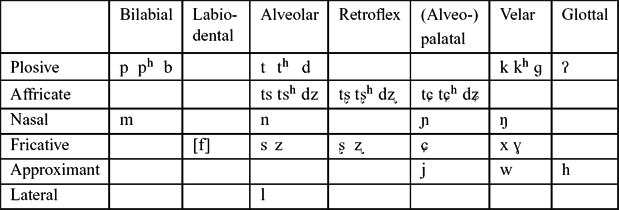
As can be seen in the table above, Central Lisu has three places of articulation in the plosives (bilabial, alveolar and velar), with a three-way voicing contrast at each place (voiceless unaspirated, voiceless aspirated, and voiced). In most cases, we give examples in both initial and in medial position. Note that all transcriptions are phonemic, unless explicitly noted otherwise.

Table 2 shows mean Voice Onset Time (VOT) values for the voiceless plosive bursts. It can be seen that VOT ranges between about 10 ms and 25 ms for the voiceless un-aspirated plosives, depending on place. By contrast, for the voiceless aspirated plosives, VOT ranges between about 55 ms and 90 ms, depending on place.
Voice Onset Time (in milliseconds) for Lisu voiceless plosives based on 214 tokens. Note that tokens without a visible stop burst on the spectrogram are not included in this count – this mainly concerns velar plosives which were realized as fricatives.

An examination of voicing probability values sampled at 35 ms prior to the offset of the plosive confirmed that the probability of voicing was much higher at this time-point for voiced plosives than for voiceless plosives, with mean values tending around 90% for the voiced plosives (range: 88–92%) and around 20–30% for the voiceless plosives (range: 11–44%).Footnote 3
There are also four nasal consonants, three of which correspond to the plosive places of articulation (bilabial, alveolar, velar), with the other nasal consonant being palatal.

Lisu is particularly rich in fricative and affricate places of articulation. There are four phonemic voiceless fricatives /s ʂ ɕ x/, respectively alveolar, retroflex, alveo-palatal and velar, plus [f] which can be treated as an allophone of the glottal stop before /u/. There are also two phonemic voiced fricatives: retroflex /ʐ/ and velar /ɣ/. However, retroflex /ʐ/ is often produced without friction, rendering it much more similar to the rhotic [ɻ], as can be heard in the example word /ʐo21/ ‘we (inclusive)’ – the first two repetitions here have some friction, whereas the last repetition does not (on another recording we have of the speaker saying the same word, the first repetition has friction, and the second and third don't). We class the sound as a fricative phonologically in Lisu because languages in the Ngwi sub-group of Tibeto-Burman (to which Lisu belongs) do not have a rhotic phoneme: cognate words instead have a clear fricative phoneme. (Note that in the Lisu orthography, the grapheme for this sound is like the Latin capital ‘R’.) Note also that the voiced velar fricative /ɣ/ can likewise be very lenited, as in the example word /ɣɯ21/ ‘far’ below.

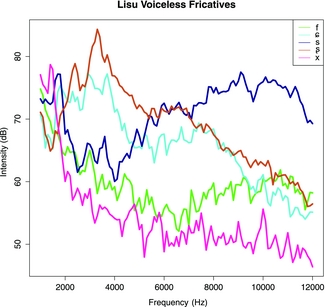
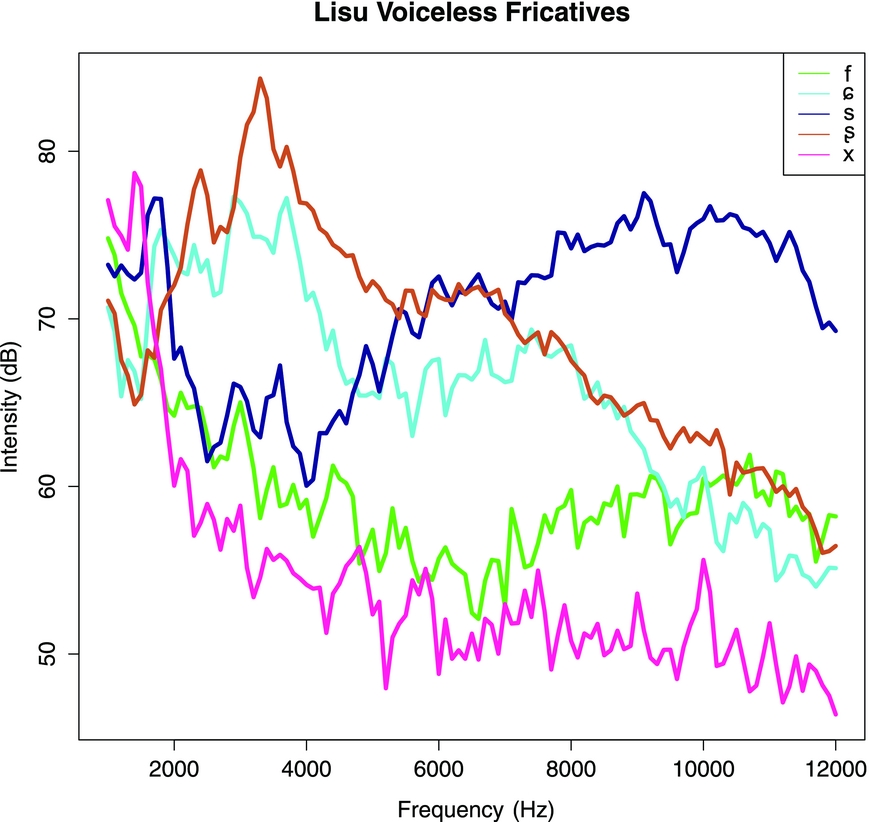
Figure 2 gives spectra for the six voiceless fricatives of Lisu. It can be seen that /s/ has more spectral energy above 6 kHz than any other fricative, as is typical for this sibilant sound. The grave fricatives [f] and /x/ have the least energy of all the fricatives, though in this dataset [f] has more energy than /x/ in the frequency range above 6 kHz. The retroflex and the alveo-palatal have the most energy of all the fricatives in the 2–5 kHz range, with the retroflex having more energy than the alveo-palatal in this range. The retroflex also seems to have more energy in the frequency range above 8 kHz than does the alveo-palatal. Note that it is not clear whether the retroflex of Central Lisu is typically produced with an apical or a sub-apical articulation, or at the post-alveolar or pre-palatal place of articulation (this also applies to the affricates below). We leave this question open for further instrumental investigation.
Plot of averaged Fast Fourier Transformed spectra for the five voiceless fricatives of Lisu as produced by speaker DY. Data are sampled at the temporal midpoint of the fricative using a 10 ms Hamming window. Only the spectral range between 1 kHz and 12 kHz is shown. The plot is based on 183 tokens: 16 /f/, 21 /ɕ/, 53 /ʂ/, 63 /s/ and 15 /x/. Note that all [f] are necessarily followed by /u/. Note also that in the dataset presented here, all /x/ tokens are followed by either /ɯ/ or the approximant /w/; /ɕ/ is only followed by /ø/; and /ʂ/ is followed by the fricative vowel. /s/ is followed by a variety of vowel contexts in this dataset, including the fricative vowel.
Lisu also has nine phonemic affricates – the alveolar, retroflex and alveo-palatal affricates can all be voiceless unaspirated, voiceless aspirated, or voiced. Example words are given below. Note that the alveo-palatal affricates occur only before front vowels (rounded or unrounded), and before the vowel /ɑ/, in which case the vowel is produced more forward in the vowel space, towards [a]. A little more information on vowel contexts for the fricatives and affricates is provided further below.

Note that the voiced alveo-palatal often sounds like a sequence /dj/, as can perhaps be heard in the word for ‘water’ /ji3 dʑɑ44/ above or ‘cold’ /dʑɑ44/.
Figure 3 gives spectra for the three voiceless aspirated affricates of Lisu (the voicing category for which we had the largest number of tokens). The similarities with the fricative phonemes are clear – alveolar /tsh/ has more spectral energy above 8 kHz than the other affricates, while the retroflex /tʂh/ and the alveo-palatal /tɕh/ have more energy in the 2–6 kHz range, with the retroflex having more energy than the alveo-palatal in the 2–5 kHz range (although the alveo-palatal seems to have more energy than the retroflex in the 5–8 kHz range, something that we did not observe in the fricative spectra).Footnote 5
Plot of averaged Fast Fourier Transformed spectra for the three voiceless aspirated affricates of Lisu as produced by speaker DY. Data are sampled at the onset of the burst following the closure, using a 10 ms Hamming window. Only the spectral range between 1 kHz and 12 kHz is shown. The plot is based on 109 tokens: 48 /tsh/, 18 /tʂh/ and 43 /tɕh/. Note that the alveo-palatal is only followed by front vowels, the retroflex is only followed by its fricative vowel in this dataset, and the alveolar is followed by a variety of vowel contexts, including its fricative vowel.
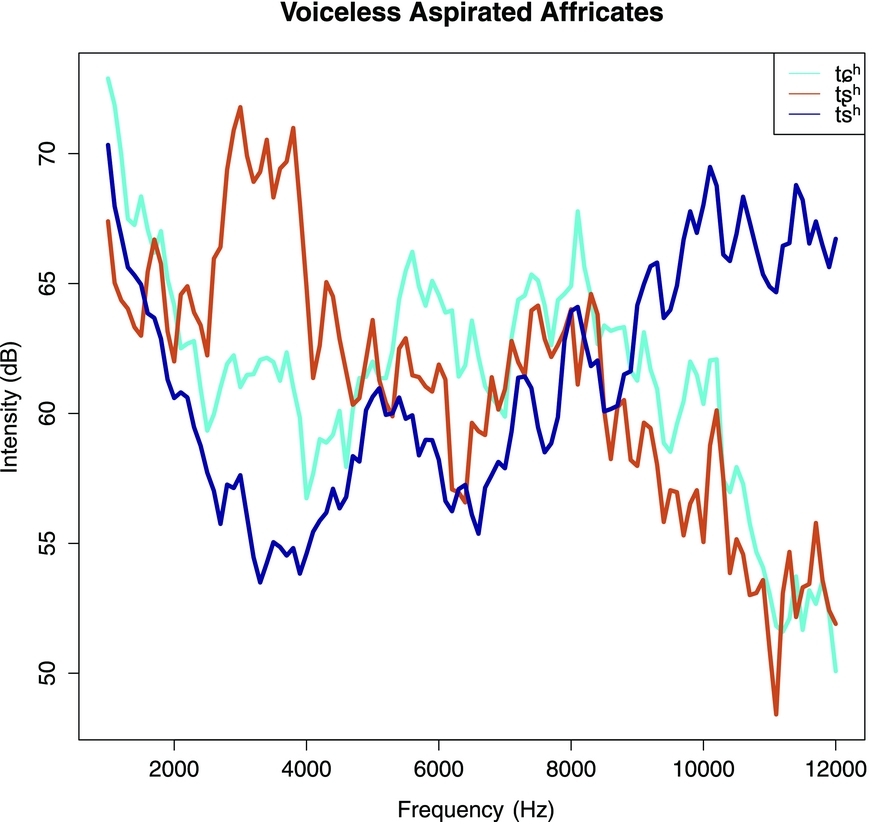
Table 3 shows mean Voice Onset Time values for the voiceless affricates. It can be seen that VOT ranges between about 40 ms and 75 ms for the voiceless un-aspirated affricates, depending on place. For the voiceless aspirated affricates, VOT ranges between about 110 ms and 135 ms, depending on place. In both cases, the alveo-palatal has the lowest VOT values, and the retroflex has slightly higher VOT values than the alveolar.
Voice Onset Time (in milliseconds) for Lisu voiceless affricates based on 133 tokens.

In terms of vowel context distributions, the alveolar fricatives and affricates /s z tsʰ ts dz/ can occur in all vowel contexts except /y/ and /ɤ/. They can also occur before the fricative vowel [z̩], which the orthography treats as an allophone of the vowel /i/ following precisely these sounds. The alveo-palatal fricative and affricates /ɕ tɕ tɕʰ dʑ/ occur before front vowels /i e ø/ and occasionally before /ɛ/. The alveo-palatal fricative and affricates also occur before /ɑ/, in which case, as already mentioned, the vowel is realized as [a]. The retroflex fricatives and affricates /ʂ ʐ tʂ tʂʰ dʐ/ occur before the back vowels /u o ɑ ɤ/. They also occur before the sequence /wɑ/, and before the fricative vowel [ʐ̩], which the orthography treats as an allophone of the high front rounded vowel /y/. However, although it is possible to analyse [z̩] as an allophone of /i/ following alveolar fricatives and affricates, and [ʐ̩] as an allophone of /y/ following retroflex fricatives and affricates (based on the orthography, and also given that these particular vowel contexts do not occur for these respective sounds), linguistic tradition for this language instead treats the fricative vowels as allophones of a phoneme /ɨ/ (the vowels are treated further below). Finally, it should be noted that the velar fricative /x/ occurs before /ɑ o ɯ w/ in native words, although other vowel contexts are possible in Chinese loan words.
Note that we have posited two series for the fricatives and affricates, alveo-palatal and retroflex, in addition to the alveolars. However, it is possible to suggest that the alveo-palatals and retroflexes are in complementary distribution. The alveo-palatals occur before front vowels, and the retroflexes occur before back vowels. However, in this case, we would need to posit an extra vowel phoneme /a/, which occurs only after alveo-palatals, with a separate vowel /ɑ/ occurring after all other consonants, including retroflexes. We choose to adopt the analysis where alveo-palatals and retroflexes are not in complementary distribution, and therefore we only have one low vowel phoneme, with an allophone [a] following alveo-palatals.
In addition to the above-mentioned consonants, Lisu has a palatal approximant, a labio-velar approximant, a lateral (alveolar), a glottal approximant, and a glottal stop. The palatal approximant is often realized as the alveo-palatal [ʑ], as in the word /ji33/ ‘to flow’ below. This is the reason why we have put the sounds traditionally labelled ‘palatal’ (namely /j/ and /ɲ/) in the same column as the sounds traditionally labelled ‘alveo-palatal’ (namely the alveo-palatal fricative and affricates). Note however that while the alveo-palatal fricative and affricates occur only before front vowels and /ɑ/, the palatal nasal may additionally occur before /o/, but does not occur before /y/. The palatal approximant has the same distribution as the palatal nasal, with the addition of /u/ as a possible context. Further articulatory study may elucidate more precisely the exact place-of-articulation of these various consonant sounds. Note that there is no phonemic alveo-palatal /ʑ/ in this dialect, representing a gap in the system of fricatives as seen in the table above. In some other dialects there is a phonemic contrast between /j/ and /ʑ/ before /i/, but not in this dialect. Note also the [a] variant of /ɑ/ following /j/.

The glottal approximant /h/ causes the following vowel to be nasalized, as in the following examples. The glottal consonant itself may be rather breathy, and is perhaps more accurately transcribed as [ɦ]. The tendency for syllables with glottal consonants to be nasalized has been termed rhinoglottophilia (Matisoff Reference Matisoff, Ferguson, Hyman and Ohala1975), and the question of exactly how nasalization and glottal properties such as breathiness interact and spread across the syllable requires further instrumental examination. Note that a non-nasalized [h] has a marginal phonemic status in Lisu, occurring only in one of the imperative markers (not given here).

The glottal stop /ʔ/ serves as the syllable onset where no other consonant is available. When followed by any vowel other than /ɑ/, the glottal stop causes the following vowel to be nasalized, in the same way as the glottal approximant /h/ causes its following vowel to be nasalized (see example word /ʔo44/ ‘to swell’ below). Note however that in the context of a following /u/ vowel, the default consonant is [f] rather than /ʔ/, and there is no nasalization of the /u/ vowel (see below for the fricatives).

The palatal and labio-velar approximants can be used to form clusters with the plosive and nasal consonants at the onset of a syllable. The palatal approximant forms clusters with bilabials and alveolars (plosives, nasals and lateral), and the labio-velar approximant forms clusters with velars and with alveolar affricates. Some examples are given below.

Vowels

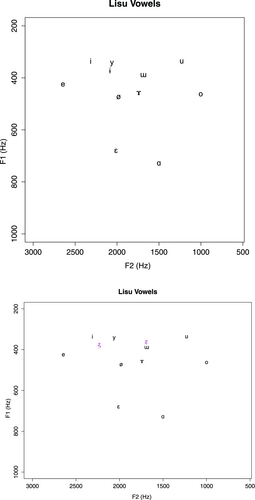
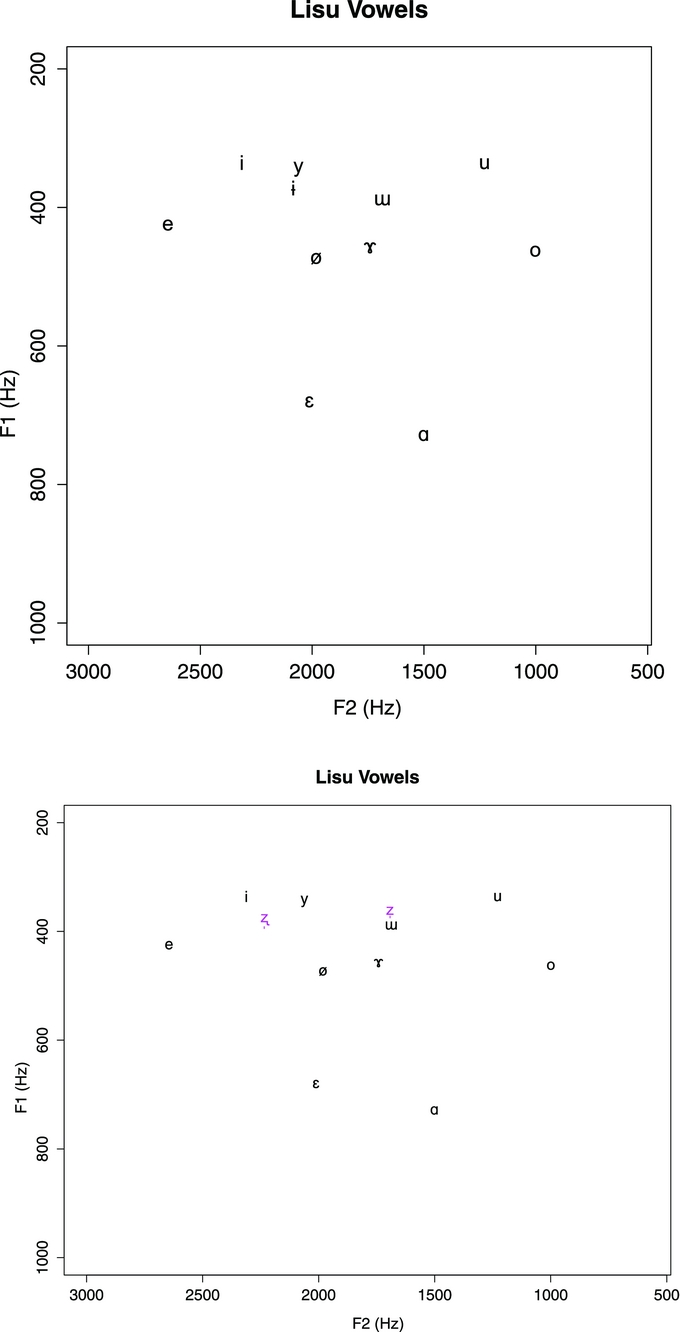
Central Lisu has 11 phonemic vowels: three front unrounded vowels, two front rounded vowels, two back rounded vowels, three back unrounded vowels, and two ‘fricative vowels’ [z̩] and [ʐ̩], which may be collapsed into the single phoneme /ɨ/ as has been done for the above chart. This chart is based on the acoustic measurement of vowel formants for this speaker, which are presented further below.
The example words given here for vowels are mostly monosyllables beginning with /b/, but where such a word did not exist in our recordings for a particular vowel, we chose another consonant context, and then tried to give a similar word for another vowel in order to facilitate comparison.

The vowel /i/ is quite high in the vowel space, and /e/ is produced by this speaker with a noticeable palatal onglide. The vowel /ɛ/ is quite low, and could perhaps even be represented with the /æ/ symbol. The /ɑ/ vowel is a little further back than central, hence our choice of this symbol. /u/ is quite high and back, while the quality of /o/ varies between high-mid and slightly lower, as can be heard on these two example recordings. These are all frequently occurring vowels.
The front rounded vowel /y/ is fairly common, as is /ø/. The back unrounded vowel /ɯ/ is also very common, particularly following a velar fricative, as shown here. We also give this vowel following /s/ in order to provide a minimal pair with the much less common vowel /ɤ/.
Finally, we use the symbol [z̩] to represent the weakly fricative high central vowel which follows the alveolar affricates and fricatives, and we use [ʐ̩] to represent the slightly stronger fricative high central vowel which follows the retroflex affricates and fricatives. Note, however, that Chinese linguistic tradition represents these sounds with the symbols [ɿ] for the fricative vowel which follows alveolar consonants, and [ʅ] for the fricative vowel which follows retroflex consonants (Handel Reference Handel and Sybesma2016). The fricative vowels are represented in the orthography – the [z̩] is written with ‘I’ and the [ʐ̩] is written with inverted ‘U’. Thus, as already mentioned above, the orthography is suggesting that [z̩]~[ɿ] is an allophone of /i/ and [ʐ̩]~[ʅ] is an allophone of /y/; however, some dialects have alveolar affricates /ts tsh dz/ and fricatives /s z/ before [i] /i/, contrasting with [z̩] /ɨ/ after these same initials.
As can be seen in Figure 4, it is quite possible to track the formants in these fricative vowels. As seen in Figure 4 (top panel), their common phoneme /ɨ/ is then located in the high central region of the vowel space, quite close to /y/. It is possible that the phoneme /ɨ/ is at least partly distinguished from the phoneme /y/ by the presence of the extra noise in the vowel spectrum that follows the various affricates and fricatives, though this is clearly a question for further empirical study. It should be noted that although we have collapsed the fricative vowels for plotting purposes in the top panel of Figure 4 given the analysis that they function as a single phoneme, the two fricative vowels in fact show quite different F2 values (Figure 4, bottom panel). [ʐ̩] (which occurs after retroflexes) has a mean F2 value of 2232 Hz (S.D. = 150 Hz, N = 83), patterning closer to /i/ than /y/; while [z̩] (which occurs after alveolars) has a mean F2 value of 1676 Hz (S.D. = 237, N = 30), patterning closer to /ɯ/ (F1 and F3 values are very similar). There is therefore some evidence in the formant data for [ʐ̩] patterning with /i/, and [z̩] patterning with /y/, in line with the orthography. If these two fricative vowels were part of the same phoneme /ɨ/, it is not clear why the retroflex would induce a higher F2 in the following vowel than would the alveolar.
Plot of mean Lisu vowels formants for speaker DY based on 1428 tokens. Top panel: Vowel plot with the fricative vowels combined into a phoneme /ɨ/. Bottom panel: Vowel plot with the fricative vowels plotted separately. Individual vowel token numbers are as follows: /i/ 278, /e/ 70, /ɛ/ 89, /ɑ/ 418, /o/ 127, /u/ 104, /y/ 15, /ø/ 93, /ɤ/ 6, /ɯ/ 115, /ɨ/ 113 (83 [ʐ̩] and 30 [ʐ̩]). Note that /u/ and /o/ means exclude tokens where F2 was tracked as greater than 2000 Hz, and /ɑ/ means exclude tokens where F1 was tracked as less than 250 Hz. Note also that the /ɑ/ means do not include any preceding alveo-palatal consonants. Formants were tracked using the ESPS formant tracker in EMU (default settings, with the exception of frame rate set to 5 ms and window set to Hamming).
Finally, the reader is referred to Bradley et al. (Reference Bradley, Hope, Fish and Bradley2006) for tables of co-occurrence restrictions between the various vowels and consonants. For instance, /y/ occurs primarily after bilabial and alveolar stops and nasals, and after the lateral /l/. By contrast, /ø/ occurs after all places of articulation, except the velar.
Tones
Lisu has six phonemic tones, as exemplified by the minimal set given below, based on the sequence /lo/. There is one high tone /55/; one rising tone /35/; two mid tones, /44/ and /33/; and two falling tones, /21/ and /21ʔ/. As can be seen, one of the falling tones is represented as being ‘checked’ by a glottal stop. However, in practice this is realized as some form of laryngealization on the affected syllable, whether this involves a point of complete glottal closure or not. Note the use of punctuation to represent the tones in the orthography.

An averaged and time-normalized plot of f0 for these tones is presented in Figure 5. It can be seen that /55/ is indeed a high tone, at a little over 200 Hz in this speaker's range. The /35/ tone rises until about the mid-point of the vowel before falling again – further acoustic study is needed in order to determine the precise timing of this tone peak.
Plot of averaged and time-normalized Lisu f0 trajectories for the six tones of Lisu as produced by speaker DY. The plot is based on 1381 tokens, as sampled across the vowel portion of the tone. Individual tone token numbers are as follows: /21/ 308, /21ʔ/ 101, /33/ 242, /35/ 93, /44/ 399, /55/ 238. Note that tokens where f0 was less than 80 Hz at the midpoint of the vowel were excluded from this plot. f0 was tracked using the ESPS pitch and formant tool in EMU (default settings).
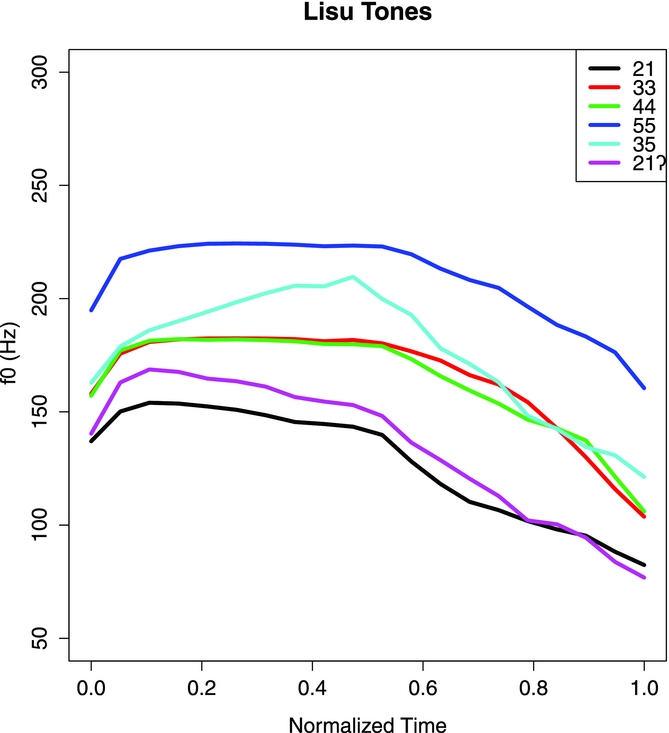
The /44/ and /33/ tones are difficult to differentiate for non-native speakers, and indeed it can be seen on the plot that their f0 values largely overlap. Native speakers who are asked to describe the difference between these tones say the /44/ has a constriction in the throat, while the /33/ is more relaxed. The difference could be described as ‘tense’ vs. ‘non-tense’ – author DB often hears a slightly tight phonation for /44/, as compared to a very slightly breathy phonation for /33/. However, for this particular speaker, an examination of H1*-H2* (the difference between the first harmonic and the second harmonic, corrected for formant) and of CPP (Cepstral Peak Prominence, a measure of the harmonic energy relative to noise energy) suggested no differences between the /33/ and /44/ tones. Further study may elucidate any differences between these tones across the various dialects of Lisu.
Note that for some other dialects of Lisu (such as Southern Lisu – see Bradley et al. Reference Bradley, Hope, Fish and Bradley2006), the /44/ is slightly higher in pitch, which is why it has been transcribed as /44/. In yet other dialects (such as Northern Lisu – see Bradley Reference Bradley1994), the contrast varies and is in the process of being lost, with both tones neutralised to /33/ with modal phonation. Historically these tones derive from different sources, the /44/ from syllables with a final stop, or from a tone category which has creaky phonation in some related languages such as Burmese; and the /33/ derives from syllables with another tone category, no final stop and no creaky phonation (see Bradley Reference Bradley1979).
Finally, the falling tones can be seen to end very low, falling from 150 Hz to below 100 Hz for this female speaker. It can be seen that the ‘checked’ tone /21ʔ/ has a slightly higher onset than the non-checked /21/. In the standard Chinese tradition (see Chao Reference Chao1930) this checked tone is described as [42ʔ] – based on this plot, the tone might be described as [31ʔ]. It is possible that the non-checked /21/ tone is in general produced with a slightly more breathy phonation, for greater contrast with the checked tone /21ʔ/ (consider /lo21/ above, and /ŋwɑ21/ in the sentence below). Indeed, for this particular speaker, there were clear differences between the /21/ tone and the /21ʔ/ tone as measured by H2*-H1*. H2*-H1* values tended around 2–3 dB for /21ʔ/, and around 8–9 dB for /21/ (as sampled at the temporal midpoint of the vowel using the VoiceSauce software). By contrast, H2*-H1* values tended around 6–7 dB for both the /33/ tone and the /44/ tone. It could therefore be said that for this particular speaker, the /21ʔ/ tone is more creaky than the /33/ and /44/ mid tones, and the /21/ tone is more breathy than the two mid tones. In addition, CPP values for this speaker tended around 22–23 dB for the mid tones /33/ and /44/, and around 17–18 dB for the low tones /21/ and /21ʔ/, with the checked tone /21ʔ/ having slightly lower CPP values than the non-checked tone /21/. This provides confirmation that the mid tones have a more regular (i.e. modal) phonation than either of the low tones.
Duration (in milliseconds) for Lisu tones based on 1514 tokens.

Table 4 gives the average duration values for the six tones of Lisu. It can be seen that the ‘checked’ tone /21ʔ/ is considerably shorter than the non-checked /21/ (about 140 ms vs. 200 ms in this speaker's data). The mid tones as well as the rising tone tend around 220–230 ms, while the high tone is much shorter, at around 160 ms.
Most of the tones of Lisu can also be illustrated using the following fun sentence based on the syllables /mɑ/ and /ŋwɑ/:

There is little productive tone sandhi, but there is some variation between the /21/ and /21ʔ/ tones in two-syllable words which have a sequence of two low falling tones. Thus, /21ʔ/ + /21/ can come out as [21] + [21], and /21/ + /21ʔ/ can come out as [21ʔ] + [21ʔ] with the first tone in the word assimilating to the second. There are also some dialectal differences in the lexical distribution of the /33/ and /44/ tones. One diachronic sandhi process, no longer absolutely productive, is that the nominal prefix /ʔɑ/ has a tone which mirrors (i.e. inverts) the following main syllable: /55/ before /21/ and /21ʔ/ tones; /21/ before /55/, /35/ and /33/; and /44/ before /44/. However, this pattern does not apply to adverbs, kin terms and loans.
Another sandhi pattern involves three very frequently-occurring clitics which are attached to verbs: declarative /ɑ44/, perfective /o44/ and interrogative /ɑ21ʔ/, which consist of a single vowel with a tone (in some dialects the interrogative instead has the form /lɑ21/). Unlike non-clitic syllables with an initial vowel, these never have an initial glottal stop, and are always tightly fused to the preceding verb syllable. In songs and poetry, these do not count as an additional syllable for the purpose of metre. An example was given in footnote 3 for the word ‘to live’ with the perfective /o44/. For the clitic /ɑ44/, there is a fairly frequent but not categorical process in which the /ɑ/ vowel of the clitic disappears and the tone of the verb and the tone of the clitic fuse. When the verb has the /33/, /35/, /55/ or /44/ tone, the resulting fused tone is /55/; when the verb has the /21/ or /21ʔ/ tones, the resulting fused tone is /35/. This fusion is particularly frequent in song and poetic style, but also occurs in normal speech.
Transcription of recorded passage

‘The Sun and the North Wind’

‘One day, the Sun and the North Wind met a traveller who came along wrapped in an overcoat. They discussed which one of them was stronger.’

‘They agreed that the one who could make the traveller take his coat off would be considered stronger than the other one.’

‘Then the North Wind blew as hard as he could. The harder he blew, the tighter the traveller wrapped his coat around himself, and at last the North Wind gave up trying.’

‘Then the Sun began to shine warmly, and right away the traveller took off his coat, and so the North Wind had to admit that the Sun was stronger than he was.’
Acknowledgements
We would like to thank Marc Garellek for assistance with the analyses of voice quality; Monique Matthieson and Sally Bowman for research assistance; and editor Amalia Arvaniti and two anonymous reviewers for their comments on an earlier version of this Illustration. This research was supported by the Australian Research Council via a Future Fellowship to Marija Tabain.