


Introduction
The spatial distribution and time variations of mass balance are needed over the whole Greenland ice sheet as inputs to ice-dynamics models. As such models must describe the dynamics of the ice sheet under past, present and (likely) Future climates, the mass balance must be modelled in terms of climate variables, which are themselves accessible to direct measurement and to modelling.
For the purposes of the present paper, the specific balance b is given by
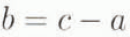
where c is the accumulation and a is the ablation, Ablation is defined here as positive, because this is more convenient than the negative ablation recommended by Anonymous (1969). The present-day distribution of accumulation is reasonably well-known (Ohmura and Reeh, 1991) and the present paper reviews progress and problems with calculating the ablation component of the surface balance. Ablation a is given by

where m is the melt and r is the refreezing of meltwater, Melt ran be calculated from temperature data by the degree-day model and from more extensive climate data by the energy-balance model-All quantities in Equations (1) and (2) are annual specific balances in kg m−2 a−1 (mm a−1), and must depend explicitly on climate (and accumulation if that is prescribed). The sites of recent ablation climate studies in Greenland are shown in Figure 1.
Locations of glaciological studies in Greenland referred to in the text.

Degree-Day Model
The degree-day model was first suggested by Finsterwalder and Schunk (1887) for an Alpine glacier and has been field-tested in Greenland by Braithwaite and Olesen (1985, 1989) and Braithwaite (1995b). Aside from being used to plan hydropower stations in Greenland (Kern-Hansen, 1988; Braithwaite and Thomsen, 1989), the degree-day model is used to drive ice-dynamics models of Northern Hemisphere ice sheets (Payne and Sugden, 1990; Huybrechts and others, 1991; Letréguilly and others, 1991; Huybrechts, 1994; Fabre and others, 1995; Greve and Hutter, 1995; Huybrechts and T’siobbel, 1995) and to calculate the effects of climate change on water resources in Scandinavia (Jøhaunesson and others, 1993; Laumann and Reeh, 1993; Jøhannesson and others, 1995).
The melt m at a certain point during a certain period is given by
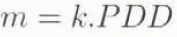
where PDD is the sum of positive temperatures at the same point for the same period and the parameter k is the degree-day factor. Strictly speaking. PDD should be calculated as the positive sum of temperature series, e.g. data collected several limes in each day, but can be estimated from monthly i Braithwaite, 1980, 1985) or annual temperatures (Reeh, 1991).
If the total melt m is made up of snow melt m s and ice melt m i, separate degree-day factors should be applied to the two phases:

and
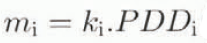
where k s and k i are degree-day factors for snow and ice, respectively, and PDD s and PDD i are degree-day sums for the periods of snow and ice melt.
The most recent compilation of field data from the sites in Figure 1 (Braithwaite, 1995b) does not support a single and universal degree-day factor for ice ablation, although the value of 8 mm d−1deg−1, assumed for recent ice-dynamics modelling (Huybrechts and others, 1991; Letréguilly and others, 1991; Huybrechts, 1994), is a reasonable first approximation.
The degree-day factor for snow in Greenland is only about 40% of the factor for ice (table 1) while Scandinavian glaciers show a higher value of about 70%. As energy-balance modelling shows that degree-day factors are strongly controlled by albedo (Braithwaite, 1995b, Fig. 6), the differences in snow and ice degree-day factors may reflect a smaller albedo contrast on the Scandinavian glaciers than on the two Greenland glaciers.
Positive degree-day factors for ice and snow ablation calculated by mass-balance (MR) and energy-balance (EB) modelling. Units are mm d −1 deg −1.

Energy-Balance Model
The melt m is calculated from the available energy at the glacier surface and

where L is the latent heal of fusion, gh is the ground beat flux, sw is the net shortwave radiation, lw is the net longwave radiation, sh is the sensible-heat flux and lh is the latent-heat flux.
Despite the apparent simplicity of Equation (6), the energy balance represents a complex of physical processes (Paterson, 1994, chapter 4). The essence of energy-balance modelling is to estimate each term in the balance from a few simple climate elements, e.g. global radiation, cloud amount, air temperature, wind speed and humidity (Braithwaite and Olesen, 1990). However, even these simple data are not available over most of the Greenland ice sheet and their past and future variations are hardly known. One must therefore distinguish between a model for a well-instrumented site (Braithwaite and Olesen, 1990; Wal and Russell, 1994) and a model for the whole ice sheet (Oerlemans, 1991; Wal and Oerlemans, 1994), which requires further simplification to avoid using data that are not available.
The above point can be illustrated by a relatively simple method to calculate sensible-heat flux based on Ambach (1986) as modified by Paterson (1994, p. 65) and is

where A is a dimensionless transfer coefficient, P is atmospheric pressure and u and T are wind speed and temperature a couple of metres above the glacier surface. T s is the surface temperature of the glacier, which is 0°C for melting ice, and the numerical factor lumps together some constants; see Paterson (1994, p.65) for details.
For neutral turbulence, the transfer coefficient is given by

where k is von Karmen’s constant (0.41), z is the instrument height, Z OU is the surface roughness for wind speed and Z OT is the surface rung]mess for temperature. The approach can also be extended to stable turbulence by using log-linear profiles instead of logarithmic profiles (Munro, 1989; Braithwaite, 1995a). A is of the order of 0.002 for ice and 0.001 for snow using the surface roughness given by Ambach (1986).
The validity of the above approach is still open to debate, especially on the assumed wind and temperature profiles (Grainger and Lister, 1966) and choice of parameters (Forrer and Rotach, 1994; Henneken, 1994; Ohmura and others, 1994), but it does offer a rational way to calculate sensible-heat fluxes from temperature and wind-speed data. This is useful if these data are available but the wind-speed distribution over the ice sheet is almost unknown in contrast to the temperature distribution (Ohmura, 1987). One solution is to follow Kuhn (1979) and calculate sensible-heat flux from temperature alone so that

where α is a bulk heat-transfer coefficient.
This bulk approach has been used in Greenland with α values of 10–15 W m−2 K−1 (Oerlemans, 1991; Oerlemans and others, 1993; Wal and Oerlemans, 1994) without any discussion of the different values used, and presumably the α values are found by model tuning. Comparison of Equations (7) and (9) suggest that the α parameter depends on mean wind conditions and, as mean wind speeds in Greenland lie in the general range 3–8 m s−1 (Broeke and others, 1994; Konzelmann and Braithwaite, 1995), α may vary by more than a factor of 2, depending upon locality and period. The bulk approach is probably valid but better documentation and critical testing are needed to be convincing.
There is not enough space here for a critical discussion of the oilier energy-balance terms but there seems to be a similar pattern: simplified methods are needed to calculate the energy balance for the whole ice sheet but these methods should be critically tested and better documented. This must be especially the case for the shortwave radiation and albedo, where some highly sophisticated formulations are used, although one knows that there are very little data, e.g. Konzelmann (1994) listed radiation data from only nine short-term stations in Greenland.
Meltwater Refreezing
Refreezing r is generally small for a well-drained melting ice surface, where water can run off before it has time to refreeze. However, melt water from a melting snow surface, e.g. as in the accumulation area of the ice sheet, infiltrates the underlying snow layer and re freezes if or when it encounters cold snow. The temperature of the lower snow layer is raised by the latent heat released by the refreezing and may reach 0°C, after which refreezing ceases at that level. Infiltrating meltwater thereafter reaches increasingly deeper layers until it is all refrozen, or until it meets an impermeable surface at the melting point, after which it may flow laterally along this surface.
The concept of different zones in the accumulation area, developed by P. A. Shumskii, C. S. Benson and F. Müller (Paterson, 1994, p. 9–12), is important for modelling refreezing, and ice-sheet models must take account of the shifts of these zones in response to climate changes. The flow of meltwater within cold snow involves a complex interplay of hydraulics and heat transfer (Colbeck, 1976; Illangasekare and others, 1990), but more conceptual approaches can be taken (Pfeffer and others, 1991; Braithwaite and others, 1994). The latter is summarized below.
A surface layer of firn is wetted by meltwater during the summer down to a certain depth, below which the firn remains dry although it has been wetted in earlier years. The density at the bottom of this wetted layer ρ 2 is a function of melt m and accumulation c and

where ρ 0 is the density of surface snow before melting starts. Alternatively, the melting m required to achieve the density ρ 2 is:

There is a run-off limit within the lower accumulation area of the Greenland ice sheet, above which all meltwater is refrozen so there is no run-off At this run-off limit the whole surface layer of firn is completely wetted by the end of the summer and the underlying material is impermeable to meltwater. i.e. the density ρ 2 refers to ice. The run-off limit defined in this way is above the firn limit as there is some run-off from within the firn area (LaChapelle, 1955), but the wet firn layer must be fairly shallow for run-off to occur, i.e. not thicker than the few metres of annual meltwater penetration (Trabant and Mayo, 1985).
Using the snow and ice densities of 375 and 890 kg m−3 (Braithwaite and others, 1994) the ratio m/c is about 0.6 at the run-off limit. Values reported in the literature are 0.7 (Pfeffer and others, 1991), 0.6 without explanation (Huybrechts and others, 1991) and 0.4 (Shumskii, 1964), where differences mainly reflect different choices of density. The ablation is given by

Meltwater refreezing must be included in ice-sheet models to calculate the correct altitude of the equilibrium line (ELA), where a = c. This occurs at m = c without refreezing and at m= 1.6c with refreezing. The effect of refreezing in mass-balance models is to lower the ELA in West Greenland by 100–200 m a.s.l.
Considering the remaining uncertainties in modelling the melt m. Equation (6) is probably good enough to describe the rapid densification in the near-surface firn layer due to refreezing, and presumably further densification at greater depths can be described by dry-snow models like that of Herron and Langway (1980). However, this approach assumes that deeper firn layers are far below the melting point while a truly dynamic model, describing the evolution of the Greenland ice sheet under a variety of different climates, should calculate firn temperatures. For example, could the deeper firn layers he slowly warmed up to the melting point under a warmer climate, with a consequent increased run-off to the sea? This can only be answered by a detailed physical model of refreezing in the near-surface firn layers, but such a model will be hard to verify due to the practical difficulty of working in the wet snow zone (Braithwaite and Laternser, 1993).
Discussion
Both degree-day and energy-balance models can give distributed inputs to ice-dynamics models but have only been tested extensively in West Greenland, The energy-balance model seems more realistic than the degree-day model but needs input data that are not generally available over the whole ice sheet, while the parameters in the degree-day model can vary from one situation to another.
The models are not exclusive alternatives but available tools for ice-sheet modellers, for example, the simulation of degree-day factors by energy-balance modelling (Braithwaite, 1995b) shows flow the models can be used together. More fundamentally, boil models will be improved by data collection in the remoter parts of Greenland, where conditions are less well known than in West Greenland. For example, reconnaissance energy-balance studies in north Greenland show that sublimation from the glacier surface and heat conduction into the ice are both much larger than in West Greenland (table 2), greatly reducing the energy that would otherwise be available for melting.
Calculated energy balance (W m−2) at four sites in Greenland: Nordbogletscher (NBG), Qamanârssûp sermia (QAM), Kronprins Christian Land (KPCL) and Hans Tausen Ice Cap (HTIC)

In addition to further data from north Greenland (cold-dry), similar studies should also be made in southeast Greenland (warm-wet) to sample ablation conditions in a humid environment. The increased income of longwave radiation and heal supply from condensation probably causes increased ablation there.
Extra data collections from both north and south-east Greenland are probably a minimum requirement for models to describe fully the diverse conditions found over the present Greenland ice sheet, and which must have prevailed at different periods in the past. In view of tire expense and logistic difficulties of working in remote areas, long-term programmes of mass-balance measurements (with little or no parallel collection of meteorological data) as in the Alps and in Scandinavia are not recommended. A greater return on investments will lie achieved by relatively short periods of detailed measurements of ablation and climate, cither on a reconnaissance basis (Konzelmann and Braithwaite, 1995) or in the form of full glacier–meteorology experiments (Oerlemans and Vugts, 1993; Ohmura and others, 1994).
The calculation of melt within high resolution GCMs (global climate models) will soon be realistic (Ohmura and others, 1994) but, here again, it will be necessary to test the results with data from different parts of Greenland. Remote sensing can also be expected to play a part, e.g. for mapping large-scale albedo variations (Haefliger and others, 1993).
Acknowledgements
The author’s recent research has been supported by the European Union through contracts to the Geological Survey of Greenland (GGU): EPOC-CT90–0015 for 1991–93 and EV5V-CT91–0051 for 1992–94. Attendance at the 1995 EISMINT symposium in Chamonix was supported by the Arts Faculty, The University of Manchester (Account No. 6/VBF/RA/002).



