





1 Introduction
Aspinwall proposed the exoflop as a tool for finding categorical resolutions of singular varieties via their corresponding gauged Landau-Ginzburg models [Reference AspinwallAsp15]. In this work, he computed categorical resolutions of certain singular K3 surfaces in toric varieties to demonstrate their power in this context. In the present paper, we formalize and generalize this usage of exoflops, yielding a dynamic web of related derived categories.
Let $\operatorname {\mathbb {C}}$
be an algebraically closed field of characteristic zero. Let X be a smooth variety over
$\operatorname {\mathbb {C}}$
be an algebraically closed field of characteristic zero. Let X be a smooth variety over $\operatorname {\mathbb {C}}$
and G an affine algebraic group that acts on X. Take W to be a G-invariant section of an invertible G-equivariant sheaf
$\operatorname {\mathbb {C}}$
and G an affine algebraic group that acts on X. Take W to be a G-invariant section of an invertible G-equivariant sheaf $\mathcal {L}$
, that is,
$\mathcal {L}$
, that is, $W \in \Gamma (X, \mathcal {L})^G$
. We call the data
$W \in \Gamma (X, \mathcal {L})^G$
. We call the data $(X, G, W)$
a gauged Landau-Ginzburg (LG) model. There is a derived category called the (matrix) factorization category
$(X, G, W)$
a gauged Landau-Ginzburg (LG) model. There is a derived category called the (matrix) factorization category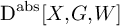 $\operatorname {D}^{\operatorname {abs}}[X,G,W]$
associated to the gauged Landau-Ginzburg model. To any complete intersection, there is a corresponding gauged Landau-Ginzburg model associated to it [Reference OrlovOrl06, Reference Umut IsikIsi13, Reference ShipmanShi12, Reference HiranoHir17]. Relating complete intersections to their corresponding gauged Landau-Ginzburg models has had applications for both derived categories and enumerative geometry.
$\operatorname {D}^{\operatorname {abs}}[X,G,W]$
associated to the gauged Landau-Ginzburg model. To any complete intersection, there is a corresponding gauged Landau-Ginzburg model associated to it [Reference OrlovOrl06, Reference Umut IsikIsi13, Reference ShipmanShi12, Reference HiranoHir17]. Relating complete intersections to their corresponding gauged Landau-Ginzburg models has had applications for both derived categories and enumerative geometry.
Geometrically, an exoflop can be viewed as having two steps:
-
exo: partially compactifying the space X in a gauged LG model while extending the group action G and global function W, and
-
flop: a birational transformation of the partial compactification of X determined by varying the stability parameter of a prescribed geometric invariant theory quotient.
Exoflops are not a new concept. Over three decades ago, Aspinwall, Greene, and Morrison examined the multiple mirror phenomenon using toric variations of geometric invariant theory [Reference Aspinwall, Greene and MorrisonAGM94]. Here, they studied the secondary fan of $\operatorname {tot} K_{\operatorname {\mathbb {P}}^4 / \operatorname {\mathbb {Z}}_5^3}$
, which is related to the gauged LG model corresponding to the mirror quintic. There, they discovered chambers of the secondary fan that are partial compactifications of line bundles over distinct toric varieties. This testifies to the need of formal results in the context of modern mirror symmetry statements, such as Kontsevich’s Homological Mirror Symmetry [Reference KontsevichKon95].
$\operatorname {tot} K_{\operatorname {\mathbb {P}}^4 / \operatorname {\mathbb {Z}}_5^3}$
, which is related to the gauged LG model corresponding to the mirror quintic. There, they discovered chambers of the secondary fan that are partial compactifications of line bundles over distinct toric varieties. This testifies to the need of formal results in the context of modern mirror symmetry statements, such as Kontsevich’s Homological Mirror Symmetry [Reference KontsevichKon95].
Exoflops were used to show derived equivalences between Calabi-Yau varieties that were BHK mirror to two Calabi-Yau hypersurfaces in the same toric variety [Reference Favero and KellyFK19]. Such results were then expanded to understanding Calabi-Yau hypersurfaces in toric varieties [Reference Doran, Favero and KellyDFK18]. Their usage to understand categorical resolutions of Kuznetsov components has been shown in examples in (unpublished) work of Aspinwall, Addington, and Segal that has been outlined in [Reference AddingtonAdd16], as well as in [Reference Favero and KellyFK18].
Lastly, they have been studied for toric complete intersections [Reference AspinwallAsp15, Reference MalterMal24]; however, results were only established in examples. These results for complete intersections required involved computations for each example, which motivated finding a new approach. Using the framework of categorical resolutions avoids these calculations for complete intersections. We thus obtain a more general result for complete intersections in toric Fano varieties. Theorem 1.2 below proves sufficient criteria for when a Calabi-Yau complete intersection is derived equivalent to a Calabi-Yau variety with a Batyrev-Borisov mirror. Skip to §1.2 for precise statements. However, this paper also offers results to readers wanting to relate derived categories of complete intersections in toric varieties, so we first give an intuition for the results found along the way.
1.1 How the exoflop works
Here is a rough overview of how this operation changes the factorization category. Start with a complete intersection $\mathcal {Z}$
(inside a projective (Fano) toric variety Y), and take its corresponding gauged LG model
$\mathcal {Z}$
(inside a projective (Fano) toric variety Y), and take its corresponding gauged LG model $(X,G,W)$
. The gauged LG model is found by taking the vector bundle
$(X,G,W)$
. The gauged LG model is found by taking the vector bundle $\mathcal {E}$
, where
$\mathcal {E}$
, where $\mathcal {Z} = Z(s)$
for some
$\mathcal {Z} = Z(s)$
for some $s \in \Gamma (Y,\mathcal {E})$
, writing
$s \in \Gamma (Y,\mathcal {E})$
, writing $[X/G] = \operatorname {tot}\mathcal {E}^\vee $
and W is found by pairing with the section s. Partially compactify by finding an open immersion
$[X/G] = \operatorname {tot}\mathcal {E}^\vee $
and W is found by pairing with the section s. Partially compactify by finding an open immersion $[X/G] \hookrightarrow [\bar X/\bar G]$
where W can be extended to a
$[X/G] \hookrightarrow [\bar X/\bar G]$
where W can be extended to a $\bar G$
-invariant global function
$\bar G$
-invariant global function $\bar W:\bar X\to \mathbb {A}^1$
. When the original complete intersection is not smooth, one can see that the critical locus is not proper. Choosing a good partial compactification can remedy this and yield a crepant categorical resolution ([Reference Favero and KellyFK18, Theorem 3.7], restated as Theorem 3.7 here). This is made explicit in Aspinwall’s example, which we treat in §6.1.
$\bar W:\bar X\to \mathbb {A}^1$
. When the original complete intersection is not smooth, one can see that the critical locus is not proper. Choosing a good partial compactification can remedy this and yield a crepant categorical resolution ([Reference Favero and KellyFK18, Theorem 3.7], restated as Theorem 3.7 here). This is made explicit in Aspinwall’s example, which we treat in §6.1.
Next, we observe that if one starts with a smooth complete intersection $\mathcal {Z}$
, then we have a fully faithful functor
$\mathcal {Z}$
, then we have a fully faithful functor $F: \operatorname {D}^{\operatorname {b}}(\operatorname {coh }\mathcal {Z}) \to \operatorname {D}^{\operatorname {abs}}[\bar X, \bar G, \bar W]$
(Corollary 3.9). As a direct corollary, if
$F: \operatorname {D}^{\operatorname {b}}(\operatorname {coh }\mathcal {Z}) \to \operatorname {D}^{\operatorname {abs}}[\bar X, \bar G, \bar W]$
(Corollary 3.9). As a direct corollary, if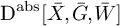 $\operatorname {D}^{\operatorname {abs}}[\bar X, \bar G, \bar W]$
is Calabi-Yau, then F is an equivalence (Corollary 3.10). These corollaries are key observations introduced in this paper. Previously, Orlov proved that if one partially compactifies X while not extending the critical locus of W, then the corresponding factorization category is equivalent to the original one [Reference OrlovOrl04, Proposition 1.14]. This hypothesis manifests as a computationally heavy problem in proving certain containment of ideals to obtain an equivalence (see e.g., [Reference Favero and KellyFK19, Lemma 5.13], [Reference MalterMal24, Lemma 4.5]). This became a source of technical difficulty for general results, but our methods sidestep this issue through using crepant categorical resolutions and extend techniques from the hypersurface case in [Reference Doran, Favero and KellyDFK18, Reference Favero and KellyFK19] to complete intersections.
$\operatorname {D}^{\operatorname {abs}}[\bar X, \bar G, \bar W]$
is Calabi-Yau, then F is an equivalence (Corollary 3.10). These corollaries are key observations introduced in this paper. Previously, Orlov proved that if one partially compactifies X while not extending the critical locus of W, then the corresponding factorization category is equivalent to the original one [Reference OrlovOrl04, Proposition 1.14]. This hypothesis manifests as a computationally heavy problem in proving certain containment of ideals to obtain an equivalence (see e.g., [Reference Favero and KellyFK19, Lemma 5.13], [Reference MalterMal24, Lemma 4.5]). This became a source of technical difficulty for general results, but our methods sidestep this issue through using crepant categorical resolutions and extend techniques from the hypersurface case in [Reference Doran, Favero and KellyDFK18, Reference Favero and KellyFK19] to complete intersections.
Next, one uses variations of geometric invariant theory on the gauged LG model $(\bar X, \bar G, \bar W)$
. From the above viewpoint, this can be optional to find partial compactifications or equivalences; however, after a birational modification one may find a new gauged LG model
$(\bar X, \bar G, \bar W)$
. From the above viewpoint, this can be optional to find partial compactifications or equivalences; however, after a birational modification one may find a new gauged LG model $(X', G', W')$
that is a more natural LG model (e.g., a toric vector bundle) and proving certain properties about the category can be more straightforward. Varying geometric invariant theory quotients (VGIT) and its ramifications on the factorization category for a gauged Landau-Ginzburg model has been established by Ballard-Favero-Katzarkov and Halpern-Leistner [Reference Ballard, Favero and KatzarkovBFK19, Reference Halpern-LeistnerHL15]. By first partially compactifying, one obtains more relations to other factorization categories of gauged Landau-Ginzburg models and more geometric invariant theory problems. A key part to using this technique is finding the right context and partial compactification. We provide a result in convex geometry that in turn allows us to identify ways to ensure our partial compactification is a GIT quotient and allows us to use techniques from VGIT (Lemma 4.5 / Corollary 4.6).
$(X', G', W')$
that is a more natural LG model (e.g., a toric vector bundle) and proving certain properties about the category can be more straightforward. Varying geometric invariant theory quotients (VGIT) and its ramifications on the factorization category for a gauged Landau-Ginzburg model has been established by Ballard-Favero-Katzarkov and Halpern-Leistner [Reference Ballard, Favero and KatzarkovBFK19, Reference Halpern-LeistnerHL15]. By first partially compactifying, one obtains more relations to other factorization categories of gauged Landau-Ginzburg models and more geometric invariant theory problems. A key part to using this technique is finding the right context and partial compactification. We provide a result in convex geometry that in turn allows us to identify ways to ensure our partial compactification is a GIT quotient and allows us to use techniques from VGIT (Lemma 4.5 / Corollary 4.6).
Lastly, we note when one does this carefully, one can sometimes find that the new gauged Landau-Ginzburg model corresponds to a different complete intersection $\mathcal {Z}'$
, and one can establish relations between
$\mathcal {Z}'$
, and one can establish relations between $\mathcal {Z}$
and
$\mathcal {Z}$
and $\mathcal {Z}'$
. Roughly, the sequence of relations is the following:
$\mathcal {Z}'$
. Roughly, the sequence of relations is the following:

Aspinwall’s original paper aimed to establish the use of exoflops for K3 surfaces in toric varieties. The results in Sections 3 and 4 work more generally. We summarize the most general versions of results §4.3; however, there is no uniform theorem outside the CICY case. The cleanest results hold for Calabi-Yau complete intersections whose defining polynomials are generic with respect to special linear systems corresponding to completely split reflexive Gorenstein cones.
1.2 Precise results
Let M and N be dual lattices. Suppose $X_{\Sigma }$
is a toric projective
$X_{\Sigma }$
is a toric projective $\operatorname {\mathbb {Q}}$
-Fano variety with fan
$\operatorname {\mathbb {Q}}$
-Fano variety with fan $\Sigma $
in
$\Sigma $
in $N_{\operatorname {\mathbb {R}}}$
and assume the fan
$N_{\operatorname {\mathbb {R}}}$
and assume the fan $\Sigma $
is simplicial. We recall that each ray
$\Sigma $
is simplicial. We recall that each ray $\rho \in \Sigma (1)$
corresponds to a torus-invariant Weil divisor
$\rho \in \Sigma (1)$
corresponds to a torus-invariant Weil divisor $D_\rho $
and
$D_\rho $
and $\sum _{\rho \in \Sigma (1)} D_\rho = -K_{X_{\Sigma }}$
. We can make a Calabi-Yau complete intersection in
$\sum _{\rho \in \Sigma (1)} D_\rho = -K_{X_{\Sigma }}$
. We can make a Calabi-Yau complete intersection in $X_{\Sigma }$
as follows. Take
$X_{\Sigma }$
as follows. Take $D_1, \dots , D_r$
to be torus-invariant Weil divisors that partition
$D_1, \dots , D_r$
to be torus-invariant Weil divisors that partition $-K_{X_{\Sigma }}$
. That is, let
$-K_{X_{\Sigma }}$
. That is, let $R_1 \sqcup \dots \sqcup R_r = \Sigma (1)$
and take
$R_1 \sqcup \dots \sqcup R_r = \Sigma (1)$
and take
 $$ \begin{align*}D_i = \sum_{\rho \in R_i} D_\rho. \end{align*} $$
Note that there are polytopes $P_{D_i}$
whose lattice points correspond to a basis of the vector space of global sections
$P_{D_i}$
whose lattice points correspond to a basis of the vector space of global sections $\Gamma (X_{\Sigma }, \mathcal {O}_{X_{\Sigma }}(D_i))$
. Take global sections
$\Gamma (X_{\Sigma }, \mathcal {O}_{X_{\Sigma }}(D_i))$
. Take global sections $f_i\in \Gamma (X_{\Sigma }, \mathcal {O}_{X_{\Sigma }}(D_i))$
and write it as
$f_i\in \Gamma (X_{\Sigma }, \mathcal {O}_{X_{\Sigma }}(D_i))$
and write it as $f_i = \sum _{m \in P_{D_i}} c_m x^m$
. Then consider the complete intersection
$f_i = \sum _{m \in P_{D_i}} c_m x^m$
. Then consider the complete intersection $\mathcal {Z} = Z(f_1, \dots , f_r) \subseteq \mathcal {X}_{\Sigma }$
where
$\mathcal {Z} = Z(f_1, \dots , f_r) \subseteq \mathcal {X}_{\Sigma }$
where $\mathcal {X}_{\Sigma }$
is the toric stack associated to the fan
$\mathcal {X}_{\Sigma }$
is the toric stack associated to the fan $\Sigma $
.
$\Sigma $
.
Consider the toric fan $\Sigma _{-D_1, \dots , -D_r}$
where
$\Sigma _{-D_1, \dots , -D_r}$
where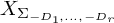 $X_{\Sigma _{-D_1, \dots , -D_r}}$
is the total space
$X_{\Sigma _{-D_1, \dots , -D_r}}$
is the total space $\operatorname {tot}(\oplus _{i=1}^r \mathcal {O}_{X_{\Sigma }} (-D_i))$
(for an explicit construction, see §3.2). The cone
$\operatorname {tot}(\oplus _{i=1}^r \mathcal {O}_{X_{\Sigma }} (-D_i))$
(for an explicit construction, see §3.2). The cone $\sigma = |\Sigma _{-D_1, \dots , -D_r}|$
that supports the fan
$\sigma = |\Sigma _{-D_1, \dots , -D_r}|$
that supports the fan $\Sigma _{-D_1, \dots , -D_r}$
is strictly convex. Its dual cone can be written as
$\Sigma _{-D_1, \dots , -D_r}$
is strictly convex. Its dual cone can be written as
 $$ \begin{align*}\sigma^\vee = \operatorname{Cone}(P_{D_1} * \cdots *P_{D_r}) \subseteq N_{\operatorname{\mathbb{R}}} \times \operatorname{\mathbb{R}}^r, \end{align*} $$
where $P_{D_1} * \cdots *P_{D_r}$
is a Cayley polytope given by taking the convex hull of
$P_{D_1} * \cdots *P_{D_r}$
is a Cayley polytope given by taking the convex hull of $P_{D_i} + e_i$
, where
$P_{D_i} + e_i$
, where $e_i$
are the standard elementary basis vectors for
$e_i$
are the standard elementary basis vectors for $\operatorname {\mathbb {R}}^r$
. We can make a subpolytope by taking
$\operatorname {\mathbb {R}}^r$
. We can make a subpolytope by taking
 $$ \begin{align*}\Xi_i := \{ m \in P_{D_i} \ | \ \text{ the coefficient } c_m \text{ for the monomial } x^m \text{ in } f_i \text{ is nonzero}\}.\end{align*} $$
Take the convex hull $P_i = \operatorname {Conv}(\Xi _i)$
. Note
$P_i = \operatorname {Conv}(\Xi _i)$
. Note $P_i \subseteq P_{D_i}+e_i$
, and to get a proper partial compactification in the exoflop we need this containment to be strict. This means we will be considering a special linear system of
$P_i \subseteq P_{D_i}+e_i$
, and to get a proper partial compactification in the exoflop we need this containment to be strict. This means we will be considering a special linear system of $D_i$
. Construct the cone
$D_i$
. Construct the cone $\sigma _W := \operatorname {Cone}( P_1* \cdots *P_{r})$
and consider its dual cone,
$\sigma _W := \operatorname {Cone}( P_1* \cdots *P_{r})$
and consider its dual cone, $\sigma _W^\vee $
. The choice of global sections
$\sigma _W^\vee $
. The choice of global sections $f_i$
completely determines this cone, and under appropriate circumstances the choice we make allows us to write
$f_i$
completely determines this cone, and under appropriate circumstances the choice we make allows us to write $\sigma _W^\vee $
as support of a toric variety that is itself a rank r vector bundle
$\sigma _W^\vee $
as support of a toric variety that is itself a rank r vector bundle $\bigoplus _{i=1}^r\operatorname {\mathcal {O}}_{X_{\Sigma ^{\prime }}}(D_i)$
over another complete toric stack
$\bigoplus _{i=1}^r\operatorname {\mathcal {O}}_{X_{\Sigma ^{\prime }}}(D_i)$
over another complete toric stack $\mathcal {X}_{\Sigma ^{\prime }}$
. In this case, we can construct a new Calabi-Yau complete intersection
$\mathcal {X}_{\Sigma ^{\prime }}$
. In this case, we can construct a new Calabi-Yau complete intersection $\mathcal {Z}'\subset \mathcal {X}_{\Sigma ^{\prime }}$
. In fact, one notes that the construction of the complete intersection remains valid for any cone
$\mathcal {Z}'\subset \mathcal {X}_{\Sigma ^{\prime }}$
. In fact, one notes that the construction of the complete intersection remains valid for any cone $\Sigma ^{\prime }$
lying between
$\Sigma ^{\prime }$
lying between $\sigma _W$
and
$\sigma _W$
and $\sigma ^\vee $
whose dual corresponds to the support of an appropriate rank r vector bundle, which is the content of the key Assumption 5.1. We also assume that the Calabi-Yau orbifolds
$\sigma ^\vee $
whose dual corresponds to the support of an appropriate rank r vector bundle, which is the content of the key Assumption 5.1. We also assume that the Calabi-Yau orbifolds $ \mathcal Z, \mathcal Z'$
are positive dimensional.
$ \mathcal Z, \mathcal Z'$
are positive dimensional.
Theorem 1.1 (Corollary 5.2).
Suppose Assumption 5.1 holds and take $\mathcal Z, \mathcal Z'$
defined above.
$\mathcal Z, \mathcal Z'$
defined above.
-
(i) If $\mathcal Z'$
is smooth, then we have a crepant categorical resolution
$$ \begin{align*} F&:\operatorname{D}^{\operatorname{b}}(\operatorname{coh }\mathcal Z') \to \operatorname{D}^{\operatorname{b}}(\operatorname{coh }\mathcal Z), \\ G&:\operatorname{Perf} \mathcal Z \to \operatorname{D}^{\operatorname{b}}(\operatorname{coh }\mathcal Z'). \end{align*} $$
$\mathcal Z'$
is smooth, then we have a crepant categorical resolution
$$ \begin{align*} F&:\operatorname{D}^{\operatorname{b}}(\operatorname{coh }\mathcal Z') \to \operatorname{D}^{\operatorname{b}}(\operatorname{coh }\mathcal Z), \\ G&:\operatorname{Perf} \mathcal Z \to \operatorname{D}^{\operatorname{b}}(\operatorname{coh }\mathcal Z'). \end{align*} $$
-
(ii) If both
$\mathcal Z$
and
$\mathcal Z'$
are smooth, then they are derived equivalent.


We then prove the following result that gives combinatorial sufficient criteria for obtaining a (geometrically realizable) crepant categorical resolution for the complete intersection $\mathcal Z$
.
$\mathcal Z$
.
Theorem 1.2 (Corollary 5.7).
If the cone $\sigma _W$
and its dual are completely split reflexive Gorenstein cones, and the coefficients
$\sigma _W$
and its dual are completely split reflexive Gorenstein cones, and the coefficients $c_m$
are generic, then there is an explicitly constructed Calabi-Yau complete intersection
$c_m$
are generic, then there is an explicitly constructed Calabi-Yau complete intersection $\mathcal {Z}'$
in a toric Fano variety and a crepant categorical resolution of
$\mathcal {Z}'$
in a toric Fano variety and a crepant categorical resolution of $\mathcal {Z}$
given by two functors
$\mathcal {Z}$
given by two functors
 $$ \begin{align*} F&:\operatorname{D}^{\operatorname{b}}(\operatorname{coh }\mathcal Z') \to \operatorname{D}^{\operatorname{b}}(\operatorname{coh }\mathcal Z), \\ G&:\operatorname{Perf} \mathcal Z \to \operatorname{D}^{\operatorname{b}}(\operatorname{coh }\mathcal Z'). \end{align*} $$
Moreover, if $\mathcal {Z}$
is smooth, then it is a derived equivalence.
$\mathcal {Z}$
is smooth, then it is a derived equivalence.
The Calabi-Yau complete intersections $\mathcal {Z'}$
used in the above theorem have a special place in mirror symmetry. They are precisely those that have mirrors that can be constructed using the Batyrev-Borisov mirror construction [Reference Batyrev and BorisovBB96a, Reference Batyrev and BorisovBB96b]. This provides a way to take a smooth Calabi-Yau complete intersection
$\mathcal {Z'}$
used in the above theorem have a special place in mirror symmetry. They are precisely those that have mirrors that can be constructed using the Batyrev-Borisov mirror construction [Reference Batyrev and BorisovBB96a, Reference Batyrev and BorisovBB96b]. This provides a way to take a smooth Calabi-Yau complete intersection $\mathcal Z$
that fits into this criterion and find its mirror A-model, as its mirror A-model should be the same as that of
$\mathcal Z$
that fits into this criterion and find its mirror A-model, as its mirror A-model should be the same as that of $\mathcal Z$
by Theorem 1.2, in light of Kontsevich’s Homological Mirror Symmetry Conjecture [Reference KontsevichKon95]. We end the paper with several examples—some relating to this mirror symmetry viewpoint—with a look to generalizing mirror constructions involving special linear systems defining Calabi-Yau complete intersections in toric varieties.
$\mathcal Z$
by Theorem 1.2, in light of Kontsevich’s Homological Mirror Symmetry Conjecture [Reference KontsevichKon95]. We end the paper with several examples—some relating to this mirror symmetry viewpoint—with a look to generalizing mirror constructions involving special linear systems defining Calabi-Yau complete intersections in toric varieties.
2 Background on factorization categories
In this section we outline relevant details for the derived category associated to a gauged Landau-Ginzburg model, the factorization category. We aim to suppress technicalities that may otherwise distract from the main narrative of the paper, but provide references.
2.1 Gauged Landau-Ginzburg models and their factorizations
Let $\operatorname {\mathbb {C}}$
be an algebraically closed field of characteristic zero. Let X be a smooth variety over
$\operatorname {\mathbb {C}}$
be an algebraically closed field of characteristic zero. Let X be a smooth variety over $\operatorname {\mathbb {C}}$
and G an affine algebraic group that acts on X. Take W to be a G-invariant section of an invertible G-equivariant sheaf
$\operatorname {\mathbb {C}}$
and G an affine algebraic group that acts on X. Take W to be a G-invariant section of an invertible G-equivariant sheaf $\mathcal {L}$
, that is,
$\mathcal {L}$
, that is, $W \in \Gamma (X, \mathcal {L})^G$
. We call the data
$W \in \Gamma (X, \mathcal {L})^G$
. We call the data $(X, G, W)$
a gauged Landau-Ginzburg (LG) model. To a gauged LG model, there is the absolute derived category
$(X, G, W)$
a gauged Landau-Ginzburg (LG) model. To a gauged LG model, there is the absolute derived category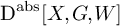 $\operatorname {D}^{\operatorname {abs}}[X,G,W]$
associated to it, which is the analogue of a variety’s bounded derived category of coherent sheaves.
$\operatorname {D}^{\operatorname {abs}}[X,G,W]$
associated to it, which is the analogue of a variety’s bounded derived category of coherent sheaves.
We roughly outline its definition as follows. Good resources include [Reference Ballard, Favero and KatzarkovBFK14, Reference HiranoHir17].
Definition 2.1. A factorization is the data $\operatorname {\mathcal {E}} = (\operatorname {\mathcal {E}}_{0}, \operatorname {\mathcal {E}}_1, \phi ^{\operatorname {\mathcal {E}}}_0, \phi _1^{\operatorname {\mathcal {E}}})$
where
$\operatorname {\mathcal {E}} = (\operatorname {\mathcal {E}}_{0}, \operatorname {\mathcal {E}}_1, \phi ^{\operatorname {\mathcal {E}}}_0, \phi _1^{\operatorname {\mathcal {E}}})$
where $\operatorname {\mathcal {E}}_0$
and
$\operatorname {\mathcal {E}}_0$
and $\operatorname {\mathcal {E}}_1$
are G-equivariant quasi-coherent sheaves and
$\operatorname {\mathcal {E}}_1$
are G-equivariant quasi-coherent sheaves and
 $$ \begin{align*}\operatorname{\mathcal{E}}_0 \stackrel{\phi_0^{\operatorname{\mathcal{E}}}}{\longrightarrow} \operatorname{\mathcal{E}}_1 \stackrel{\phi_1^{\operatorname{\mathcal{E}}}}{\longrightarrow} \operatorname{\mathcal{E}}_0 \otimes_{\operatorname{\mathcal{O}}_X} \mathcal{L} \end{align*} $$
are morphisms such that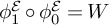 $\phi ^{\operatorname {\mathcal {E}}}_1 \circ \phi ^{\operatorname {\mathcal {E}}}_0 = W$
and
$\phi ^{\operatorname {\mathcal {E}}}_1 \circ \phi ^{\operatorname {\mathcal {E}}}_0 = W$
and $(\phi _0^{\operatorname {\mathcal {E}}} \otimes \mathcal {L}) \circ \phi _{1}^{\operatorname {\mathcal {E}}} = W$
.
$(\phi _0^{\operatorname {\mathcal {E}}} \otimes \mathcal {L}) \circ \phi _{1}^{\operatorname {\mathcal {E}}} = W$
.
For two factorizations $\operatorname {\mathcal {E}}$
and
$\operatorname {\mathcal {E}}$
and $\mathcal {F}$
, there is a complex
$\mathcal {F}$
, there is a complex $\operatorname {\mathrm {Hom}}(\operatorname {\mathcal {E}}, \mathcal {F})$
of morphisms from
$\operatorname {\mathrm {Hom}}(\operatorname {\mathcal {E}}, \mathcal {F})$
of morphisms from $\operatorname {\mathcal {E}}$
to
$\operatorname {\mathcal {E}}$
to $\mathcal {F}$
defined as follows. We have the graded vector space
$\mathcal {F}$
defined as follows. We have the graded vector space
 $$ \begin{align*}\operatorname{\mathrm{Hom}}(\operatorname{\mathcal{E}}, \mathcal{F})^\bullet := \bigoplus_{n\in \operatorname{\mathbb{Z}}} \operatorname{\mathrm{Hom}}(\operatorname{\mathcal{E}}, \mathcal{F})^n \end{align*} $$
with differential $d^i: \operatorname {\mathrm {Hom}}(\operatorname {\mathcal {E}}, \mathcal {F})^i \to \operatorname {\mathrm {Hom}}(\operatorname {\mathcal {E}}, \mathcal {F})^{i+1}$
given by
$d^i: \operatorname {\mathrm {Hom}}(\operatorname {\mathcal {E}}, \mathcal {F})^i \to \operatorname {\mathrm {Hom}}(\operatorname {\mathcal {E}}, \mathcal {F})^{i+1}$
given by $d^i(f) = \phi ^{\mathcal {F}}_{\star + i} \circ f - (-1)^i f \circ \phi ^{\operatorname {\mathcal {E}}}_{\star }$
where
$d^i(f) = \phi ^{\mathcal {F}}_{\star + i} \circ f - (-1)^i f \circ \phi ^{\operatorname {\mathcal {E}}}_{\star }$
where
 $$ \begin{align*}\begin{aligned} \operatorname{\mathrm{Hom}}(\operatorname{\mathcal{E}}, \mathcal{F})^{2m} &:= \operatorname{\mathrm{Hom}}(\operatorname{\mathcal{E}}_1, \mathcal{F}_1\otimes \mathcal{L}^{\otimes m}) \oplus \operatorname{\mathrm{Hom}}(\operatorname{\mathcal{E}}_0, \mathcal{F}_0\otimes \mathcal{L}^{\otimes m}) \\ \operatorname{\mathrm{Hom}}(\operatorname{\mathcal{E}}, \mathcal{F})^{2m+1} &:= \operatorname{\mathrm{Hom}}(\operatorname{\mathcal{E}}_1, \mathcal{F}_0\otimes \mathcal{L}^{\otimes m}) \oplus \operatorname{\mathrm{Hom}}(\operatorname{\mathcal{E}}_0, \mathcal{F}_1\otimes \mathcal{L}^{\otimes m+1}) \\ \end{aligned}\end{align*} $$
This yields a dg category $\operatorname {Fact }(X,G,W)$
. Denote by
$\operatorname {Fact }(X,G,W)$
. Denote by $\operatorname {fact }(X,G,W)$
the full dg-subcategory of this dg category whose components are coherent.
$\operatorname {fact }(X,G,W)$
the full dg-subcategory of this dg category whose components are coherent.
This category has a subcategory of acyclic complexes. Given $\operatorname {Fact }(X,G,W)$
, consider the subcategory
$\operatorname {Fact }(X,G,W)$
, consider the subcategory $Z^0\operatorname {Fact }(X,G,W)$
with the same objects but only degree zero morphisms. Given a complex of objects in
$Z^0\operatorname {Fact }(X,G,W)$
with the same objects but only degree zero morphisms. Given a complex of objects in $Z^0\operatorname {Fact }(X,G,W)$
, one can construct a new object
$Z^0\operatorname {Fact }(X,G,W)$
, one can construct a new object ${\mathcal {T} \in \operatorname {Fact }(X,G,W)}$
in a natural way by taking direct sums and arranging the morphisms in a natural way (see (2.1) of [Reference Favero and KellyFK18] for details). Take
${\mathcal {T} \in \operatorname {Fact }(X,G,W)}$
in a natural way by taking direct sums and arranging the morphisms in a natural way (see (2.1) of [Reference Favero and KellyFK18] for details). Take $\operatorname {Acyc}(X,G,W)$
to be the full subcategory of
$\operatorname {Acyc}(X,G,W)$
to be the full subcategory of $\operatorname {Fact }(X,G,W)$
consisting of all totalizations of bounded exact complexes in
$\operatorname {Fact }(X,G,W)$
consisting of all totalizations of bounded exact complexes in $Z^0\operatorname {Fact }(X, G, W)$
and let
$Z^0\operatorname {Fact }(X, G, W)$
and let $\operatorname {acyc}(X,G,W) = \operatorname {Acyc}(X,G,W) \cap \operatorname {fact }(X,G,W)$
.
$\operatorname {acyc}(X,G,W) = \operatorname {Acyc}(X,G,W) \cap \operatorname {fact }(X,G,W)$
.
Definition 2.2. The absolute derived category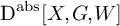 $\operatorname {D}^{\operatorname {abs}}[X,G,W]$
is the idempotent completion of the Verdier quotient of
$\operatorname {D}^{\operatorname {abs}}[X,G,W]$
is the idempotent completion of the Verdier quotient of $\operatorname {fact }(X,G,W)$
by
$\operatorname {fact }(X,G,W)$
by $\operatorname {acyc}(X,G,W)$
.
$\operatorname {acyc}(X,G,W)$
.
The absolute derived category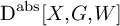 $\operatorname {D}^{\operatorname {abs}}[X,G,W]$
can be thought of as the derived category of the gauged LG model
$\operatorname {D}^{\operatorname {abs}}[X,G,W]$
can be thought of as the derived category of the gauged LG model $(X,G,W)$
. To justify this claim, we must introduce some context and notation.
$(X,G,W)$
. To justify this claim, we must introduce some context and notation.
Notation 2.3. Let Y be a smooth quasi-projective variety with a G-action. Suppose that s is a regular section of a G-equivariant vector bundle $\operatorname {\mathcal {E}}$
on Y with vanishing locus
$\operatorname {\mathcal {E}}$
on Y with vanishing locus $Z := Z(s)$
. Let
$Z := Z(s)$
. Let $\operatorname {\mathbb {G}_m}$
act on the total space
$\operatorname {\mathbb {G}_m}$
act on the total space $\operatorname {tot} \operatorname {\mathcal {E}}^\vee $
of the dual bundle to
$\operatorname {tot} \operatorname {\mathcal {E}}^\vee $
of the dual bundle to $\operatorname {\mathcal {E}}$
by fiberwise dilation (the so-called
R-charge) and consider the pairing
$\operatorname {\mathcal {E}}$
by fiberwise dilation (the so-called
R-charge) and consider the pairing $W=\langle -,s\rangle $
as a section of
$W=\langle -,s\rangle $
as a section of $\operatorname {\mathcal {O}}_{\operatorname {tot} \operatorname {\mathcal {E}}^\vee }(\chi )$
where
$\operatorname {\mathcal {O}}_{\operatorname {tot} \operatorname {\mathcal {E}}^\vee }(\chi )$
where $\chi $
is the projection character.
$\chi $
is the projection character.
We have the following theorem, which has appeared in various forms due to Orlov [Reference OrlovOrl06], Isik [Reference Umut IsikIsi13], Shipman [Reference ShipmanShi12], and, in its most general form, Hirano [Reference HiranoHir17].
Theorem 2.4 (Proposition 4.8 of [Reference HiranoHir17]).
There exists an equivalence of categories
 $$ \begin{align*}\Omega: \operatorname{D}^{\operatorname{b}}(\operatorname{coh }[Z/G]) \stackrel{\sim}{\longrightarrow} \operatorname{D}^{\operatorname{abs}}[\operatorname{tot} \operatorname{\mathcal{E}}^\vee, G \times \operatorname{\mathbb{G}_m}, W]. \end{align*} $$
Remark 2.5. This theorem is also often viewed as (a variant of) Knörrer periodicity or Orlov’s theorem. In fact, one needs to use variations of geometric invariant theory from this theorem to recover Orlov’s theorem.
2.2 Partial compactifications yielding categorical resolutions
In effect, this subsection gives a mathematical introduction to the ‘exo’ part of the exoflop, following [Reference Favero and KellyFK18]. We first recall a categorical resolution of singularities, and provide sufficient criteria for their existence using gauged LG models. We use the definition stated in loc. cit., but the one given by Kuznetsov [Reference KuznetsovKuz08, Definition 3.2] could be used throughout if the reader prefers. Let Z be a variety with a G-action and $\mathcal {D}$
an admissible subcategory of
$\mathcal {D}$
an admissible subcategory of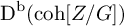 $\operatorname {D}^{\operatorname {b}}(\operatorname {coh }[Z/G])$
. We denote by
$\operatorname {D}^{\operatorname {b}}(\operatorname {coh }[Z/G])$
. We denote by $\mathcal {D}^{\operatorname {perf}}$
the full subcategory of
$\mathcal {D}^{\operatorname {perf}}$
the full subcategory of $\mathcal {D}$
consisting of G-equivariant perfect complexes on Z.
$\mathcal {D}$
consisting of G-equivariant perfect complexes on Z.
Definition 2.6 (Definition 3.1 of [Reference Favero and KellyFK18]).
Let $\tilde {\mathcal {D}}$
be the homotopy category of a homologically smooth and proper pretriangulated dg category. A pair of exact functors
$\tilde {\mathcal {D}}$
be the homotopy category of a homologically smooth and proper pretriangulated dg category. A pair of exact functors
 $$ \begin{align*} F&:\tilde{\mathcal{D}} \to \mathcal{D}\\ G&:\mathcal{D}^{\operatorname{perf}} \to \tilde{\mathcal{D}} \end{align*} $$
is a categorical resolution of singularities if G is left adjoint to F and the natural morphism of functors $\operatorname {Id}_{\mathcal {D}^{\operatorname {perf}}} \to FG$
is an isomorphism. We say the categorical resolution is crepant if G is right adjoint to F.
$\operatorname {Id}_{\mathcal {D}^{\operatorname {perf}}} \to FG$
is an isomorphism. We say the categorical resolution is crepant if G is right adjoint to F.
We first discuss step (exo) and its interactions with the absolute derived category. A good resource for this can be found in [Reference Favero and KellyFK18, Section 3]. Consider a variety U equipped with an action by a linearly reductive group G, a character $\chi $
of G and a section W of
$\chi $
of G and a section W of $\operatorname {\mathcal {O}}_U(\chi )$
. Let
$\operatorname {\mathcal {O}}_U(\chi )$
. Let
 $$ \begin{align*}i: V \longrightarrow U \end{align*} $$
be a G-equivariant open immersion.
Definition 2.7 (Definition 3.3 of [Reference Favero and KellyFK18]).
Let $\operatorname {D}^{\operatorname {abs}}[V,G,W]_{\operatorname {rel} U}$
denote the full subcategory of
$\operatorname {D}^{\operatorname {abs}}[V,G,W]_{\operatorname {rel} U}$
denote the full subcategory of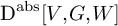 $\operatorname {D}^{\operatorname {abs}}[V, G, W]$
consisting of factorizations
$\operatorname {D}^{\operatorname {abs}}[V, G, W]$
consisting of factorizations $\operatorname {\mathcal {E}}$
where the closure of the support of
$\operatorname {\mathcal {E}}$
where the closure of the support of $\operatorname {\mathcal {E}}$
in U does not intersect
$\operatorname {\mathcal {E}}$
in U does not intersect $U\setminus V$
.
$U\setminus V$
.
We then have the following functors
 $$ \begin{align}\begin{aligned} i_*: \operatorname{D}^{\operatorname{abs}}[V,G,W]_{\operatorname{rel} U} &\longrightarrow \operatorname{D}^{\operatorname{abs}}[U,G,W]; \\ i^*: \operatorname{D}^{\operatorname{abs}}[U,G,W] &\longrightarrow\operatorname{D}^{\operatorname{abs}}[V,G,W]; \end{aligned}\end{align} $$
where $i_*$
is both left and right adjoint to
$i_*$
is both left and right adjoint to $i^*$
. We can use this to build crepant categorical resolutions, after giving a geometric context to the categories
$i^*$
. We can use this to build crepant categorical resolutions, after giving a geometric context to the categories $\operatorname {D}^{\operatorname {abs}}[V,G,W]_{\operatorname {rel} U}$
and
$\operatorname {D}^{\operatorname {abs}}[V,G,W]_{\operatorname {rel} U}$
and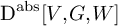 $\operatorname {D}^{\operatorname {abs}}[V,G,W]$
. We do this via the following variant of Theorem 2.4. Recall Notation 2.3.
$\operatorname {D}^{\operatorname {abs}}[V,G,W]$
. We do this via the following variant of Theorem 2.4. Recall Notation 2.3.
Lemma 2.8 (Lemma 3.6 of [Reference Favero and KellyFK18]).
Assume Y admits a G-ample line bundle. The equivalence of categories
 $$ \begin{align*}\Omega: \operatorname{D}^{\operatorname{b}}(\operatorname{coh }[Z/G]) \to \operatorname{D}^{\operatorname{abs}}[\operatorname{tot} \operatorname{\mathcal{E}}^\vee, G \times \operatorname{\mathbb{G}_m}, W] \end{align*} $$
restricts to an equivalence between the full subcategory of perfect objects $\operatorname {Perf} [Z/G]$
and the full subcategory of
$\operatorname {Perf} [Z/G]$
and the full subcategory of $\operatorname {D}^{\operatorname {abs}}[\operatorname {tot} \operatorname {\mathcal {E}}^\vee , G \times \operatorname {\mathbb {G}_m}, W]$
with objects supported on the zero section of
$\operatorname {D}^{\operatorname {abs}}[\operatorname {tot} \operatorname {\mathcal {E}}^\vee , G \times \operatorname {\mathbb {G}_m}, W]$
with objects supported on the zero section of $\operatorname {\mathcal {E}}^\vee $
.
$\operatorname {\mathcal {E}}^\vee $
.
Note that if the zero section is already proper, then the image of the subcategory of perfect objects will not intersect with the partial compactification. Thus, to find a crepant categorical resolution, we find an appropriate partial compactification of $\operatorname {tot} \operatorname {\mathcal {E}}^\vee $
.
$\operatorname {tot} \operatorname {\mathcal {E}}^\vee $
.
3 Partial compactifications for toric gauged LG models
In this section, we contextualize the ideas in §2.2 to a toric setting. Fix a lattice M of rank d with dual lattice N, equipped with the pairing
 $$\begin{align*}\langle -,-\rangle: M\times N\rightarrow \operatorname{\mathbb{Z}}. \end{align*}$$
Extend this pairing $\operatorname {\mathbb {R}}$
-linearly to
$\operatorname {\mathbb {R}}$
-linearly to $M_{\operatorname {\mathbb {R}}} := M \otimes _{\operatorname {\mathbb {Z}}}\operatorname {\mathbb {R}}$
and
$M_{\operatorname {\mathbb {R}}} := M \otimes _{\operatorname {\mathbb {Z}}}\operatorname {\mathbb {R}}$
and $N_{\operatorname {\mathbb {R}}} := N \otimes _{\operatorname {\mathbb {Z}}}\operatorname {\mathbb {R}}$
. Often we will consider the spaces
$N_{\operatorname {\mathbb {R}}} := N \otimes _{\operatorname {\mathbb {Z}}}\operatorname {\mathbb {R}}$
. Often we will consider the spaces $M_{\operatorname {\mathbb {R}}}\times \operatorname {\mathbb {R}}^r$
and
$M_{\operatorname {\mathbb {R}}}\times \operatorname {\mathbb {R}}^r$
and $N_{\operatorname {\mathbb {R}}}\times \operatorname {\mathbb {R}}^r$
for some
$N_{\operatorname {\mathbb {R}}}\times \operatorname {\mathbb {R}}^r$
for some $r\in \operatorname {\mathbb {Z}}$
and extend the inner product using the Euclidean inner product.
$r\in \operatorname {\mathbb {Z}}$
and extend the inner product using the Euclidean inner product.
3.1 Cox stacks
Let $\Sigma $
be a fan in
$\Sigma $
be a fan in $N_{\operatorname {\mathbb {R}}}$
. We define a quotient stack
$N_{\operatorname {\mathbb {R}}}$
. We define a quotient stack $\mathcal {X}_{\Sigma }$
associated to the fan
$\mathcal {X}_{\Sigma }$
associated to the fan $\Sigma $
following the Cox construction as follows (see, e.g., [Reference Cox, Little and SchenckCLS11, Section 5.1] for the standard construction). Let
$\Sigma $
following the Cox construction as follows (see, e.g., [Reference Cox, Little and SchenckCLS11, Section 5.1] for the standard construction). Let $\nu = \{u_{\rho } \ | \ \rho \in \Sigma (1)\} \subseteq N$
, where
$\nu = \{u_{\rho } \ | \ \rho \in \Sigma (1)\} \subseteq N$
, where $u_\rho $
is the primitive lattice generator of the ray
$u_\rho $
is the primitive lattice generator of the ray $\rho \in \Sigma (1)$
. Consider the vector space
$\rho \in \Sigma (1)$
. Consider the vector space $\operatorname {\mathbb {R}}^{\Sigma (1)}$
with elementary
$\operatorname {\mathbb {R}}^{\Sigma (1)}$
with elementary $\operatorname {\mathbb {Z}}$
-basis vectors
$\operatorname {\mathbb {Z}}$
-basis vectors $e_\rho $
for each
$e_\rho $
for each $\rho \in \Sigma (1)$
. We construct a new fan
$\rho \in \Sigma (1)$
. We construct a new fan
 $$ \begin{align} \operatorname{Cox}(\Sigma) := \{ \operatorname{Cone}(e_\rho \ | \ \rho \in \sigma) \ | \ \sigma \in \Sigma\} \end{align} $$
This fan is a subfan of the standard fan for $\mathbb {A}^{| \Sigma (1)|}$
, hence its associated toric variety is an open subset of affine space.
$\mathbb {A}^{| \Sigma (1)|}$
, hence its associated toric variety is an open subset of affine space.
Definition 3.1. We call $U_\Sigma := X_{\operatorname {Cox}(\Sigma )}$
the Cox open set associated to
$U_\Sigma := X_{\operatorname {Cox}(\Sigma )}$
the Cox open set associated to $\Sigma $
.
$\Sigma $
.
There is a canonical group acting on $U_\Sigma $
. Consider the right exact sequence
$U_\Sigma $
. Consider the right exact sequence
 $$ \begin{align} M \stackrel{f_{\nu}}{\longrightarrow} \operatorname{\mathbb{Z}}^{\nu} \stackrel{\pi}{\longrightarrow} \operatorname{coker}(f_\nu) \longrightarrow 0 \end{align} $$
where $f_{\nu }(m) := \sum _{\rho \in \Sigma (1)} \langle u_\rho , m\rangle e_\rho $
. Applying the functor
$f_{\nu }(m) := \sum _{\rho \in \Sigma (1)} \langle u_\rho , m\rangle e_\rho $
. Applying the functor $\operatorname {\mathrm {Hom}}(-,\mathbb {G}_m)$
to this sequence yields the left exact sequence
$\operatorname {\mathrm {Hom}}(-,\mathbb {G}_m)$
to this sequence yields the left exact sequence
 $$\begin{align*}1\rightarrow \operatorname{\mathrm{Hom}}(\operatorname{coker}(f_\nu),\mathbb{G}_m)\xrightarrow{\widehat{\pi}}\mathbb{G}_m^{\nu} \xrightarrow{\widehat{f_\nu}}\mathbb{G}_m^d. \end{align*}$$
Define
 $$\begin{align*}S_{\Sigma}:=\operatorname{\mathrm{Hom}}(\operatorname{coker}(f_\nu),\mathbb{G}_m). \end{align*}$$
We note that $S_{\Sigma }$
acts on the open set
$S_{\Sigma }$
acts on the open set $U_\Sigma $
constructed above.
$U_\Sigma $
constructed above.
Definition 3.2. Define the Cox stack associated to $\Sigma $
to be
$\Sigma $
to be
 $$\begin{align*}\mathcal{X}_\Sigma:=[U_\Sigma/S_{\Sigma}]. \end{align*}$$
3.2 Toric vector bundles
Let $\Sigma $
be a fan in
$\Sigma $
be a fan in $N_{\operatorname {\mathbb {R}}}$
. For each ray
$N_{\operatorname {\mathbb {R}}}$
. For each ray $\rho \in \Sigma (1)$
with primitive generator
$\rho \in \Sigma (1)$
with primitive generator $u_\rho $
, denote by
$u_\rho $
, denote by $D_\rho $
the torus-invariant divisor associated to it. Recall that any torus-invariant Weil divisor D on
$D_\rho $
the torus-invariant divisor associated to it. Recall that any torus-invariant Weil divisor D on $X_\Sigma $
can be written as a linear combination
$X_\Sigma $
can be written as a linear combination
 $$\begin{align*}D=\sum_{\rho\in \Sigma(1)}a_\rho D_\rho, \end{align*}$$
for some $a_\rho \in \operatorname {\mathbb {Z}}$
. Consider now a collection of r such divisors,
$a_\rho \in \operatorname {\mathbb {Z}}$
. Consider now a collection of r such divisors, $D_i=\sum _{\rho \in \Sigma (1)}a_{i\rho }D_\rho $
, with
$D_i=\sum _{\rho \in \Sigma (1)}a_{i\rho }D_\rho $
, with $a_{i\rho }\in \operatorname {\mathbb {Z}}$
.
$a_{i\rho }\in \operatorname {\mathbb {Z}}$
.
Write $e_1, \dots , e_r$
for the elementary
$e_1, \dots , e_r$
for the elementary $\operatorname {\mathbb {Z}}$
-basis for
$\operatorname {\mathbb {Z}}$
-basis for $\operatorname {\mathbb {R}}^r$
, and we denote by
$\operatorname {\mathbb {R}}^r$
, and we denote by $e_1^*, \dots , e_r^*$
its dual basis.
$e_1^*, \dots , e_r^*$
its dual basis.
For any cone $\sigma \in \Sigma $
, define the cone
$\sigma \in \Sigma $
, define the cone
 $$\begin{align*}\sigma_{D_1,\dots,D_r}:=\operatorname{Cone}(\{u_\rho-a_{1\rho}e_1-\dots-a_{r\rho}e_r\vert \rho\in\sigma(1)\}\cup\{e_i\mid i\in\{1,\dots,r\})\subseteq N_{\operatorname{\mathbb{R}}}\times \operatorname{\mathbb{R}}^r. \end{align*}$$
By considering the collection $\{\sigma _{D_1,\dots ,D_r}\mid \sigma \in \Sigma \}$
of these cones, together with their proper faces, we form the fan
$\{\sigma _{D_1,\dots ,D_r}\mid \sigma \in \Sigma \}$
of these cones, together with their proper faces, we form the fan $\Sigma _{D_1,\dots ,D_r}\subseteq N_{\operatorname {\mathbb {R}}}\times \operatorname {\mathbb {R}}^r$
. Note that the rays of
$\Sigma _{D_1,\dots ,D_r}\subseteq N_{\operatorname {\mathbb {R}}}\times \operatorname {\mathbb {R}}^r$
. Note that the rays of $\Sigma _{D_1,\dots ,D_r}$
are given by
$\Sigma _{D_1,\dots ,D_r}$
are given by
 $$ \begin{align*} \bar\rho := \operatorname{Cone}( u_\rho-a_{1\rho}e_1-\dots-a_{r\rho}e_r) \text{ for all } \rho \in \Sigma(1) \end{align*} $$
and $\epsilon _i := \operatorname {Cone}(e_i)$
for
$\epsilon _i := \operatorname {Cone}(e_i)$
for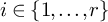 $i \in \{1, \dots , r\}$
. The toric variety associated to the fan
$i \in \{1, \dots , r\}$
. The toric variety associated to the fan $\Sigma _{D_1,\dots ,D_r}$
is the total space of the vector bundle
$\Sigma _{D_1,\dots ,D_r}$
is the total space of the vector bundle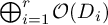 $\bigoplus _{i=1}^r \operatorname {\mathcal {O}}(D_i)$
over
$\bigoplus _{i=1}^r \operatorname {\mathcal {O}}(D_i)$
over $X_\Sigma $
(see, e.g., Proposition 7.3.1 of [Reference Cox, Little and SchenckCLS11]). The analogous proposition for toric stacks is the following.
$X_\Sigma $
(see, e.g., Proposition 7.3.1 of [Reference Cox, Little and SchenckCLS11]). The analogous proposition for toric stacks is the following.
Proposition 3.3 (Proposition 5.16 in [Reference Favero and KellyFK17]).
Let $D_1,\dots ,D_r$
be torus-invariant Weil divisors on
$D_1,\dots ,D_r$
be torus-invariant Weil divisors on $X_\Sigma $
defined as above. There is an isomorphism of stacks
$X_\Sigma $
defined as above. There is an isomorphism of stacks
 $$\begin{align*}\mathcal{X}_{\Sigma_{D_1,\dots,D_r}}\simeq \operatorname{tot}\left(\bigoplus_{i=1}^r\operatorname{\mathcal{O}}_{\mathcal{X}_\Sigma}(D_i)\right). \end{align*}$$
Recall that the set of global functions on a toric variety $\Sigma $
in
$\Sigma $
in $N_{\operatorname {\mathbb {R}}}$
can be computed as follows. Take the support
$N_{\operatorname {\mathbb {R}}}$
can be computed as follows. Take the support $\sigma = |\Sigma |$
and compute the dual cone
$\sigma = |\Sigma |$
and compute the dual cone $\sigma ^\vee \subseteq M_{\operatorname {\mathbb {R}}}$
. Then for any
$\sigma ^\vee \subseteq M_{\operatorname {\mathbb {R}}}$
. Then for any $m \in \sigma ^\vee \cap M$
, we obtain a monomial
$m \in \sigma ^\vee \cap M$
, we obtain a monomial
 $$ \begin{align} x^m := \prod_{\rho \in \Sigma(1)} x_\rho^{\langle m, u_\rho\rangle} \end{align} $$
that is a global function on $X_\Sigma $
. Any algebraic map
$X_\Sigma $
. Any algebraic map $X_\Sigma \to \operatorname {\mathbb {C}}$
can be written as a linear combination of
$X_\Sigma \to \operatorname {\mathbb {C}}$
can be written as a linear combination of $x^m$
for some
$x^m$
for some $m \in \sigma ^\vee \cap M$
. While we will often consider
$m \in \sigma ^\vee \cap M$
. While we will often consider $\Sigma $
to be complete, hence only have constant global functions, the supports of the fans
$\Sigma $
to be complete, hence only have constant global functions, the supports of the fans $\Sigma _{D_1,\dots ,D_r}$
will be strictly convex cones, which will have have maximal dimension dual cones.
$\Sigma _{D_1,\dots ,D_r}$
will be strictly convex cones, which will have have maximal dimension dual cones.
We now restrict to $\Sigma $
being a complete fan in
$\Sigma $
being a complete fan in $N_{\operatorname {\mathbb {R}}}$
. The polytope associated to the torus-invariant Weil divisor
$N_{\operatorname {\mathbb {R}}}$
. The polytope associated to the torus-invariant Weil divisor $D_i= \sum _{\rho \in \Sigma (1)} a_{\rho i} D_\rho $
is given by
$D_i= \sum _{\rho \in \Sigma (1)} a_{\rho i} D_\rho $
is given by
 $$ \begin{align*} P_{D_i} = \{ m \in M_{\operatorname{\mathbb{R}}} \ | \ \langle m, u_\rho\rangle \ge -a_{\rho i} \text{ for all } \rho \in \Sigma(1)\}. \end{align*} $$
Note that $m \in P_{D_i}$
if and only if
$m \in P_{D_i}$
if and only if $\langle m + e_i^*, u_\rho + a_{\rho i}e_i\rangle \ge 0$
for all
$\langle m + e_i^*, u_\rho + a_{\rho i}e_i\rangle \ge 0$
for all $\rho \in \Sigma (1)$
. Thus
$\rho \in \Sigma (1)$
. Thus $m \in P_{D_i}$
if and only if
$m \in P_{D_i}$
if and only if $m + e_i^* \in |\Sigma _{-D_1,\dots ,-D_r}|^\vee $
. Consider the (codimension r) hyperplane
$m + e_i^* \in |\Sigma _{-D_1,\dots ,-D_r}|^\vee $
. Consider the (codimension r) hyperplane ${H_i := \{ (m, \delta _{1i}, \dots , \delta _{ri}) \ | \ m \in M_{\operatorname {\mathbb {R}}}\}}$
.Footnote
1
Thus we get that the global sections of each divisor
${H_i := \{ (m, \delta _{1i}, \dots , \delta _{ri}) \ | \ m \in M_{\operatorname {\mathbb {R}}}\}}$
.Footnote
1
Thus we get that the global sections of each divisor
 $$ \begin{align*}f_i = \sum_{m \in P_{D_i} \cap M} c_m \prod_{\rho \in \Sigma(1)} x_\rho^{\langle m, u_\rho\rangle+a_{\rho i}} \in \Gamma(X_{\Sigma}, \operatorname{\mathcal{O}}(D_i))\end{align*} $$
correspond to the global functions on $\operatorname {tot} \bigoplus _{i=1}^r \operatorname {\mathcal {O}}(-D_i)$
 $$ \begin{align}\begin{aligned} s_i &= \sum_{(m, b_1, \dots, b_r) \in H_i \cap (M\times \operatorname{\mathbb{Z}}^r)} c_m \prod_{ \bar\rho \in \Sigma_{-D_1,\dots,-D_r}(1)} x_{\bar\rho}^{\langle m+ \sum_{i=1}^r b_i e_i, u_{\bar\rho}\rangle} \\ &= u_i \sum_{(m, b_1, \dots, b_r) \in H_i\cap (M \times \operatorname{\mathbb{Z}}^r)} c_m \prod_{ \rho \in \Sigma(1)} x_{\bar\rho}^{\langle m, u_\rho\rangle+a_{\rho i}} , \end{aligned}\end{align} $$
where we denote the coordinate associated to the ray $\epsilon _i$
by
$\epsilon _i$
by $u_i$
and that corresponding to
$u_i$
and that corresponding to $\bar{\rho} $
by
$\bar{\rho} $
by $x_{\bar{\rho}} $
. By abuse of notation, we will write
$x_{\bar{\rho}} $
. By abuse of notation, we will write $s_i = u_if_i$
, as it is equivalent if one conflates
$s_i = u_if_i$
, as it is equivalent if one conflates $x_\rho $
with
$x_\rho $
with $x_{\bar \rho }$
. Write
$x_{\bar \rho }$
. Write
 $$ \begin{align*}[\mathcal{Z}/G] = [Z(f_1, \dots, f_r) / S_{\Sigma}] \subseteq [U_\Sigma / S_{\Sigma}]\end{align*} $$
and $W = \sum _{i=1}^r u_if_i$
. We recall the R-charge action of
$W = \sum _{i=1}^r u_if_i$
. We recall the R-charge action of $\operatorname {\mathbb {G}_m}$
acting on a vector bundle by fiberwise dilation (see Notation 2.3) and consider the projection character
$\operatorname {\mathbb {G}_m}$
acting on a vector bundle by fiberwise dilation (see Notation 2.3) and consider the projection character
 $$ \begin{align*}\chi: S_{\Sigma} \times \operatorname{\mathbb{G}_m} \to \operatorname{\mathbb{G}_m}. \end{align*} $$
Note that
 $$ \begin{align*}W \in \Gamma(U_{\Sigma_{-D_1,\dots,-D_r}}, \operatorname{\mathcal{O}}_{U_{\Sigma_{-D_1,\dots,-D_r}}}(\chi))^{S_{\Sigma_{-D_1,\dots,-D_r}} \times \operatorname{\mathbb{G}_m}}. \end{align*} $$
We remark this is equivalent to W being semi-invariant with respect to the character $\chi $
[Reference Favero and KellyFK19, Definition 4.3].
$\chi $
[Reference Favero and KellyFK19, Definition 4.3].
Corollary 3.4. There exists an equivalence of categories
 $$ \begin{align*}\Omega: \operatorname{D}^{\operatorname{b}}(\operatorname{coh }[\mathcal{Z}/G]) \stackrel{\sim} \longrightarrow \operatorname{D}^{\operatorname{abs}}[ U_{\Sigma_{-D_1,\dots,-D_r}}, S_{\Sigma_{-D_1,\dots,-D_r}(1)} \times \operatorname{\mathbb{G}_m}, W], \end{align*} $$
where the $\operatorname {\mathbb {G}_m}$
acts with weights 0 on the coordinates
$\operatorname {\mathbb {G}_m}$
acts with weights 0 on the coordinates $x_\rho $
and 1 on the
$x_\rho $
and 1 on the $u_i$
.
$u_i$
.
Proof. Follows directly from Theorem 2.4.
In light of the above corollary, the gauged Landau-Ginzburg model associated to the complete intersection $[\mathcal {Z}/G]$
is
$[\mathcal {Z}/G]$
is
 $$\begin{align*}(U_{\Sigma_{-D_1,\dots,-D_r}}, S_{\Sigma_{-D_1,\dots,-D_r}(1)} \times \operatorname{\mathbb{G}_m}, W). \end{align*}$$
Remark 3.5. One can equip any simplicial fan $\tilde {\Sigma }$
with
$\tilde {\Sigma }$
with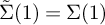 $\tilde {\Sigma }(1)=\Sigma (1)$
with the same superpotential. This fact becomes important when comparing factorization categories associated to different toric gauged LG models related by exoflops.
$\tilde {\Sigma }(1)=\Sigma (1)$
with the same superpotential. This fact becomes important when comparing factorization categories associated to different toric gauged LG models related by exoflops.
3.3 Partial compactifications and crepant categorical resolutions
We continue with the setup of § 3.2 and keep the notations $\Sigma , D_i, W, H_i, f_i, s_i$
as above. In light of Remark 3.5, we assume
$\Sigma , D_i, W, H_i, f_i, s_i$
as above. In light of Remark 3.5, we assume $\Sigma $
is simplicial and thus so is
$\Sigma $
is simplicial and thus so is $\Sigma _{-D_1,\dots ,-D_r}$
. Given the global function
$\Sigma _{-D_1,\dots ,-D_r}$
. Given the global function $W: \operatorname {tot} \bigoplus _{i=1}^r \operatorname {\mathcal {O}}(-D_i) \to \mathbb {A}^1$
, we can define
$W: \operatorname {tot} \bigoplus _{i=1}^r \operatorname {\mathcal {O}}(-D_i) \to \mathbb {A}^1$
, we can define
 $$ \begin{align*}\Xi_{i, W} := \{ \bar m = (m, \delta_{1i}, \dots, \delta_{ri}) \in H_i \ | \ c_m \ne 0\}. \end{align*} $$
Note $\Xi _{i,W} \subseteq P_{D_i}+e_i^*$
. Take
$\Xi _{i,W} \subseteq P_{D_i}+e_i^*$
. Take $\Xi _W = \bigcup _{i=1} \Xi _{i,W}$
. Note that
$\Xi _W = \bigcup _{i=1} \Xi _{i,W}$
. Note that $\sigma _W := \operatorname {Cone}(\Xi _W) \subseteq |\Sigma _{-D_1,\dots ,-D_r}|^\vee $
, hence
$\sigma _W := \operatorname {Cone}(\Xi _W) \subseteq |\Sigma _{-D_1,\dots ,-D_r}|^\vee $
, hence $\sigma _W^\vee \supseteq |\Sigma _{-D_1,\dots ,-D_r}|$
.
$\sigma _W^\vee \supseteq |\Sigma _{-D_1,\dots ,-D_r}|$
.
Take a (strictly convex) rational polyhedral cone $\Sigma ^{\prime }$
so that
$\Sigma ^{\prime }$
so that $ |\Sigma _{-D_1,\dots ,-D_r}| \subseteq \Sigma ^{\prime } \subseteq \sigma _{W}^\vee $
. We have the following result.
$ |\Sigma _{-D_1,\dots ,-D_r}| \subseteq \Sigma ^{\prime } \subseteq \sigma _{W}^\vee $
. We have the following result.
Lemma 3.6. There exists a simplicial fan $\Psi $
with support
$\Psi $
with support $\Sigma ^{\prime }$
so that
$\Sigma ^{\prime }$
so that $\Sigma _{-D_1, \dots , -D_r}$
is a subfan of
$\Sigma _{-D_1, \dots , -D_r}$
is a subfan of $\Psi $
.
$\Psi $
.
This lemma is a corollary of Lemma 4.5 proven in Subsection 4.1 using convex geometry, so we postpone its proof.
Using Corollary 4.23 of [Reference Favero and KellyFK18], we have a stack isomorphism
 $$ \begin{align*}\varphi: [U_{\Sigma_{-D_1, \dots, -D_r}} \times \operatorname{\mathbb{G}_m}^{\Psi(1) \setminus \Sigma_{-D_1, \dots, -D_r}(1)} / S_{\Psi}] \stackrel{\sim}{\longrightarrow} [U_{\Sigma_{-D_1, \dots, -D_r}} / S_{\Sigma_{-D_1, \dots, -D_r}}],\end{align*} $$
which induces an equivalence of categories on the associated absolute derived categories. We then consider the $S_\Psi $
-equivariant open immersion
$S_\Psi $
-equivariant open immersion
 $$ \begin{align} i: U_{\Sigma_{-D_1, \dots, -D_r}} \times \operatorname{\mathbb{G}_m}^{\Psi(1) \setminus \Sigma_{-D_1, \dots, -D_r}(1)} \hookrightarrow U_{\Psi}. \end{align} $$
As shorthand, we write $U_{\Sigma , D_i}' := U_{\Sigma _{-D_1, \dots , -D_r}} \times \operatorname {\mathbb {G}_m}^{\Psi (1) \setminus \Sigma _{-D_1, \dots , -D_r}(1)}$
. Note that the function
$U_{\Sigma , D_i}' := U_{\Sigma _{-D_1, \dots , -D_r}} \times \operatorname {\mathbb {G}_m}^{\Psi (1) \setminus \Sigma _{-D_1, \dots , -D_r}(1)}$
. Note that the function $W: \operatorname {tot} \bigoplus _{i=1}^r \operatorname {\mathcal {O}}(-D_i)\to \mathbb {A}^1$
can be viewed as an
$W: \operatorname {tot} \bigoplus _{i=1}^r \operatorname {\mathcal {O}}(-D_i)\to \mathbb {A}^1$
can be viewed as an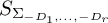 $S_{\Sigma _{-D_1, \dots , -D_r}}$
-invariant function
$S_{\Sigma _{-D_1, \dots , -D_r}}$
-invariant function $W: U_{\Sigma _{-D_1, \dots , -D_r}} \to \mathbb {A}^1$
. Extend the R-charge trivially to the new variables. Since W is a linear combination of toric monomials in the dual cone to
$W: U_{\Sigma _{-D_1, \dots , -D_r}} \to \mathbb {A}^1$
. Extend the R-charge trivially to the new variables. Since W is a linear combination of toric monomials in the dual cone to $|\Psi |$
, the function is then extended to
$|\Psi |$
, the function is then extended to
 $$ \begin{align} \bar W \in \Gamma( U_{\Psi}, \operatorname{\mathcal{O}}_{U_\Psi}(\chi))^{S_{\Psi} \times \operatorname{\mathbb{G}_m}} \end{align} $$
where $\chi :S_{\Psi } \times \operatorname {\mathbb {G}_m} \to \operatorname {\mathbb {G}_m}$
is again the projection. Indeed, the extension
$\chi :S_{\Psi } \times \operatorname {\mathbb {G}_m} \to \operatorname {\mathbb {G}_m}$
is again the projection. Indeed, the extension $\bar W$
is a section of
$\bar W$
is a section of $\operatorname {\mathcal {O}}_{U_\Psi }(\chi )$
because each toric monomial
$\operatorname {\mathcal {O}}_{U_\Psi }(\chi )$
because each toric monomial $x^{\bar m}$
, once written in coordinates, is of the form
$x^{\bar m}$
, once written in coordinates, is of the form $u_i \cdot \prod _{\bar \rho \in \Psi (1) \setminus \{\epsilon _i\} } x_{\bar \rho }^{\langle \bar m, u_{\bar \rho }\rangle }$
for some i, where the
$u_i \cdot \prod _{\bar \rho \in \Psi (1) \setminus \{\epsilon _i\} } x_{\bar \rho }^{\langle \bar m, u_{\bar \rho }\rangle }$
for some i, where the $u_i$
are the bundle coordinates as in § 3.2. The following is essentially an alternative stating of Theorem 3.7 of [Reference Favero and KellyFK18] in the toric setting.
$u_i$
are the bundle coordinates as in § 3.2. The following is essentially an alternative stating of Theorem 3.7 of [Reference Favero and KellyFK18] in the toric setting.
Theorem 3.7. Suppose $\operatorname {D}^{\operatorname {abs}}[U_{\Psi }, G_{\Psi } \times \operatorname {\mathbb {G}_m}, \bar W]$
is homologically smooth and proper. Then we have the following crepant categorical resolution
$\operatorname {D}^{\operatorname {abs}}[U_{\Psi }, G_{\Psi } \times \operatorname {\mathbb {G}_m}, \bar W]$
is homologically smooth and proper. Then we have the following crepant categorical resolution

Proof. First, we note that using Lemma 2.8, the image under $\varphi _* \circ \Omega $
of
$\varphi _* \circ \Omega $
of $\operatorname {Perf} [\mathcal Z/G] $
is supported on the hyperplane
$\operatorname {Perf} [\mathcal Z/G] $
is supported on the hyperplane $Z(u_1, \dots , u_r)\subseteq U_{\Sigma , D_i}' $
. Note that the partial compactification given by the open immersion i given in (3.5) does not intersect the hyperplane, thus the image under
$Z(u_1, \dots , u_r)\subseteq U_{\Sigma , D_i}' $
. Note that the partial compactification given by the open immersion i given in (3.5) does not intersect the hyperplane, thus the image under $i_*$
will be in the subcategory
$i_*$
will be in the subcategory $\operatorname {D}^{\operatorname {abs}}[U_{\Psi }, G_{\Psi } \times \operatorname {\mathbb {G}_m}, \bar W]_{\operatorname {rel} U_{\Sigma , D_i}' }$
.
$\operatorname {D}^{\operatorname {abs}}[U_{\Psi }, G_{\Psi } \times \operatorname {\mathbb {G}_m}, \bar W]_{\operatorname {rel} U_{\Sigma , D_i}' }$
.
The claim then follows from the fact that
 $$ \begin{align}\begin{aligned} \Omega^{-1} \circ \varphi_*& \circ i^* \circ i_*\circ\varphi^* \circ\Omega \\&= \Omega^{-1} \circ\varphi_* \circ \operatorname{Id}_{\operatorname{D}^{\operatorname{abs}}[ U_{\Sigma_{-D_1,\dots,-D_r}} \times \operatorname{\mathbb{G}_m}^{\Psi(1) \setminus \Sigma_{-D_1, \dots, -D_r}(1)} , S_{\Sigma_{\Psi}} \times \operatorname{\mathbb{G}_m}, W]|_{\operatorname{rel } U_\Psi}} \circ \varphi^* \circ \Omega \\ &= \operatorname{Id}_{\operatorname{Perf} [\mathcal Z/G]}. \end{aligned}\end{align} $$
and Definition 2.6.
Remark 3.8. Equation (3.8) implies that (3.7) is a crepant categorical resolution in the sense of Kuznetsov’s definition [Reference KuznetsovKuz08, Definition 3.2] as well.
We then obtain the following corollary when $[\mathcal {Z}/G]$
is smooth.
$[\mathcal {Z}/G]$
is smooth.
Corollary 3.9. Consider the situation of Theorem 3.7 above. Assume further that $[\mathcal {Z}/G]$
is a smooth Deligne-Mumford stack. Then
$[\mathcal {Z}/G]$
is a smooth Deligne-Mumford stack. Then $i_* \circ \varphi ^* \circ \Omega $
is a fully faithful functor.
$i_* \circ \varphi ^* \circ \Omega $
is a fully faithful functor.
Furthermore, we have the following corollary we use later.
Corollary 3.10. Suppose we are in the situation of Corollary 3.9. Assume further that $\operatorname {D}^{\operatorname {abs}}[U_{\Psi }, G_{\Psi } \times \operatorname {\mathbb {G}_m}, \bar W]$
is Calabi-Yau and connected. Then
$\operatorname {D}^{\operatorname {abs}}[U_{\Psi }, G_{\Psi } \times \operatorname {\mathbb {G}_m}, \bar W]$
is Calabi-Yau and connected. Then $i_* \circ \varphi ^* \circ \Omega $
is an equivalence.
$i_* \circ \varphi ^* \circ \Omega $
is an equivalence.
Proof. This follows directly from the fact that a Calabi-Yau category is indecomposable (see, e.g., Proposition 5.1 of [Reference KuznetsovKuz19]).
4 Variation of GIT and the Exoflop
In the last section, we established a candidate for a crepant categorical resolution for the derived category of a toric complete intersection: the factorization category of a partial compactification of a toric vector bundle equipped with a superpotential extended onto the partial compactification. In the notation above, this is the category
 $$ \begin{align*}\operatorname{D}^{\operatorname{abs}}[U_{\Psi}, G_{\Psi} \times \operatorname{\mathbb{G}_m}, \bar W]. \end{align*} $$
This category is associated to the Cox construction associated to a fan $\Psi $
where
$\Psi $
where $\Psi $
contains the toric vector bundle as a subfan.
$\Psi $
contains the toric vector bundle as a subfan.
An exoflop involves performing some flops after partially compactifying. Examples can be calculated using toric geometry when one uses toric geometric invariant theory and varies the stability parameter. To do so, we need $\mathcal {X}_{\Psi }$
to be a GIT quotient. In the first subsection, we give sufficient criteria for this.
$\mathcal {X}_{\Psi }$
to be a GIT quotient. In the first subsection, we give sufficient criteria for this.
In the toric case, the choices of GIT quotients are parameterized by the secondary fan, which parameterizes the choice of linearization for the GIT quotient. For each elementary wall crossing between maximal chambers in the secondary fan, there are two open sets $U, U' \subseteq \mathbb {A}^{\Psi (1)}$
so that
$U, U' \subseteq \mathbb {A}^{\Psi (1)}$
so that $[U/G_{\Psi }]$
and
$[U/G_{\Psi }]$
and $[U'/G_{\Psi }]$
are semiprojective. Moreover, there is an established relation between the categories
$[U'/G_{\Psi }]$
are semiprojective. Moreover, there is an established relation between the categories $\operatorname {D}^{\operatorname {abs}}[U, G_{\Psi } \times \operatorname {\mathbb {G}_m}, \bar W]$
and
$\operatorname {D}^{\operatorname {abs}}[U, G_{\Psi } \times \operatorname {\mathbb {G}_m}, \bar W]$
and $\operatorname {D}^{\operatorname {abs}}[U', G_{\Psi } \times \operatorname {\mathbb {G}_m}, \bar W]$
, proven by Ballard-Favero-Katzarkov [Reference Ballard, Favero and KatzarkovBFK19, Theorem 3.5.2] and Halpern-Leistner [Reference Halpern-LeistnerHL15, Proposition 4.2]. In certain scenarios, these results are made concrete for the entire secondary fan in [Reference Favero and KellyFK18, Sections 4 and 5]. The results in loc. cit. make it possible to black box the geometric invariant theory, and we do so here. Since we black box this machinery, the flops may not be as transparent to the reader as they can be.
$\operatorname {D}^{\operatorname {abs}}[U', G_{\Psi } \times \operatorname {\mathbb {G}_m}, \bar W]$
, proven by Ballard-Favero-Katzarkov [Reference Ballard, Favero and KatzarkovBFK19, Theorem 3.5.2] and Halpern-Leistner [Reference Halpern-LeistnerHL15, Proposition 4.2]. In certain scenarios, these results are made concrete for the entire secondary fan in [Reference Favero and KellyFK18, Sections 4 and 5]. The results in loc. cit. make it possible to black box the geometric invariant theory, and we do so here. Since we black box this machinery, the flops may not be as transparent to the reader as they can be.
4.1 Semiprojectivity of partial compactifications
In this subsection, we discuss the existence of semiprojective partial compactifications by using regular triangulations and convex geometry. This subsection may at first seem like a digression, but it proves we have a partial compactification that is a GIT quotient. However, since the results of the subsection are true outside of the above context, we rename $N \times \operatorname {\mathbb {Z}}^r$
to N temporarily until Corollary 4.6. Said corollary is a strengthening of Lemma 3.6 and the main result for our purposes in this subsection.
$N \times \operatorname {\mathbb {Z}}^r$
to N temporarily until Corollary 4.6. Said corollary is a strengthening of Lemma 3.6 and the main result for our purposes in this subsection.
There are two standard notions of regular triangulation in the literature. We start by reviewing them. Take a finite subset of distinct elements $\nu = \{v_1, \dots , v_r\} \in N_{\mathbb {Q}}$
lying on an integral affine hyperplane
$\nu = \{v_1, \dots , v_r\} \in N_{\mathbb {Q}}$
lying on an integral affine hyperplane $H\subseteq N_{\operatorname {\mathbb {R}}}$
with
$H\subseteq N_{\operatorname {\mathbb {R}}}$
with $0 \notin H$
. This gives the lattice polytope
$0 \notin H$
. This gives the lattice polytope $Q_\nu = \operatorname {Conv}(v_1, \dots , v_r)\subseteq H$
. We will assume that
$Q_\nu = \operatorname {Conv}(v_1, \dots , v_r)\subseteq H$
. We will assume that $Q_\nu $
has full dimension in H and that the cone
$Q_\nu $
has full dimension in H and that the cone $C_\nu = \operatorname {Cone}(\nu )$
has full dimension in
$C_\nu = \operatorname {Cone}(\nu )$
has full dimension in $N_{\operatorname {\mathbb {R}}}$
and is strongly convex. The below is a minor variant on the definition of triangulation from that in [Reference Cox, Little and SchenckCLS11, §15.2], which we follow.
$N_{\operatorname {\mathbb {R}}}$
and is strongly convex. The below is a minor variant on the definition of triangulation from that in [Reference Cox, Little and SchenckCLS11, §15.2], which we follow.
Definition 4.1. A triangulation $\mathcal {T}$
of
$\mathcal {T}$
of $\nu $
is a collection of simplices satisfying:
$\nu $
is a collection of simplices satisfying:
-
• each simplex in
$\mathcal {T}$
has codimension 1 in
$N_{\operatorname {\mathbb {R}}}$
with vertices in
$\nu $
; -
• the intersection of any two simplices in
$\mathcal {T}$
is a face of each; -
• the union of the simplices in
$\mathcal {T}$
is
$Q_\nu $
.


One can define a special class of triangulations, regular triangulations, as follows. Given nonnegative weights $\omega = (w_1, \dots , w_r) \in \mathbb {Q}^{r}_{\ge 0}$
(or, equivalently a weight function
$\omega = (w_1, \dots , w_r) \in \mathbb {Q}^{r}_{\ge 0}$
(or, equivalently a weight function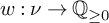 ${w: \nu \to \operatorname {\mathbb {Q}}_{\ge 0}}$
) to obtain a cone
${w: \nu \to \operatorname {\mathbb {Q}}_{\ge 0}}$
) to obtain a cone
 $$ \begin{align*}C_{\nu, \omega} := \operatorname{Cone}( (v_1, w_1) \dots, (v_r, w_r)) \subseteq N_{\operatorname{\mathbb{R}}} \times \operatorname{\mathbb{R}}. \end{align*} $$
The lower hull of $C_{\nu , \omega }$
consists of all facets of the cone
$C_{\nu , \omega }$
consists of all facets of the cone $C_{\nu , \omega }$
whose inner normal has a positive last coordinate. Projecting the facets in the lower hull and their faces gives a fan
$C_{\nu , \omega }$
whose inner normal has a positive last coordinate. Projecting the facets in the lower hull and their faces gives a fan $\Sigma _{\omega }$
in
$\Sigma _{\omega }$
in $N_{\operatorname {\mathbb {R}}}$
such that
$N_{\operatorname {\mathbb {R}}}$
such that $|\Sigma _\omega | = C_{\nu }$
and
$|\Sigma _\omega | = C_{\nu }$
and $\Sigma _{\omega } \subseteq \{\operatorname {Cone}(v_i) \ | \ 1 \le i \le r\}$
. The fan
$\Sigma _{\omega } \subseteq \{\operatorname {Cone}(v_i) \ | \ 1 \le i \le r\}$
. The fan $\Sigma _\omega $
naturally provides a polyhedral subdivision of the convex hull
$\Sigma _\omega $
naturally provides a polyhedral subdivision of the convex hull $Q_\nu $
. The following is a variant of Definition 15.2.8 of [Reference Cox, Little and SchenckCLS11] (requiring rational weights
$Q_\nu $
. The following is a variant of Definition 15.2.8 of [Reference Cox, Little and SchenckCLS11] (requiring rational weights $\omega \subseteq \mathbb {Q}^{r}_{\ge 0}$
rather than
$\omega \subseteq \mathbb {Q}^{r}_{\ge 0}$
rather than $\operatorname {\mathbb {R}}^r_{\ge 0}$
) for when this polyhedral subdivision is a triangulation.
$\operatorname {\mathbb {R}}^r_{\ge 0}$
) for when this polyhedral subdivision is a triangulation.
Definition 4.2. A triangulation $\mathcal {T}$
of
$\mathcal {T}$
of $\nu $
is regular if there are weights
$\nu $
is regular if there are weights $\omega $
so that
$\omega $
so that $\Sigma _{\omega }$
is simplicial and
$\Sigma _{\omega }$
is simplicial and $\mathcal {T} = \Sigma _{\omega } \cap Q_{\nu }$
.
$\mathcal {T} = \Sigma _{\omega } \cap Q_{\nu }$
.
There is an alternate definition of regular triangulation by Hausel and Sturmfels for cones [Reference Hausel and SturmfelsHS02]. We modify their definitions by adding the word ‘conical’ to avoid confusion with the above.
Definition 4.3. A conical triangulation of $\nu $
is a simplicial fan
$\nu $
is a simplicial fan $\Sigma $
whose rays have generators in
$\Sigma $
whose rays have generators in $\nu \subseteq N$
. A
T-Cartier divisor on
$\nu \subseteq N$
. A
T-Cartier divisor on $\Sigma $
is a continuous function
$\Sigma $
is a continuous function
 $$ \begin{align*}\Phi: C_{\nu} \to \operatorname{\mathbb{R}}\end{align*} $$
which is linear on each cone of $\Sigma $
and takes integer values on
$\Sigma $
and takes integer values on $N\cap C_{\nu }$
. The conical triangulation
$N\cap C_{\nu }$
. The conical triangulation $\Sigma $
is called regular if there exists a T-Cartier divisor
$\Sigma $
is called regular if there exists a T-Cartier divisor $\Phi $
which is ample, i.e., the function
$\Phi $
which is ample, i.e., the function $\Phi $
is convex and restricts to a different linear function on each maximal cone of
$\Phi $
is convex and restricts to a different linear function on each maximal cone of $\Sigma $
.
$\Sigma $
.
Proposition 4.4. Suppose one has a regular triangulation of the point configuration ${\nu = (v_1, \dots , v_r)}$
with weights
${\nu = (v_1, \dots , v_r)}$
with weights $\omega =(w_1, \dots , w_r) \in \mathbb {Q}_{\ge 0}^r$
. Then
$\omega =(w_1, \dots , w_r) \in \mathbb {Q}_{\ge 0}^r$
. Then $\Sigma _\omega $
is a regular conical triangulation of
$\Sigma _\omega $
is a regular conical triangulation of $C_\nu $
.
$C_\nu $
.
Proof. For any $q \in Q_{\nu }$
, there is a unique
$q \in Q_{\nu }$
, there is a unique $w_q \in \mathbb {R}_{>0}$
such that
$w_q \in \mathbb {R}_{>0}$
such that $(q,w_q)$
is in the lower hull of
$(q,w_q)$
is in the lower hull of $C_{\nu , \omega }$
. Note that if
$C_{\nu , \omega }$
. Note that if $q \in Q_{\nu } \cap N$
then
$q \in Q_{\nu } \cap N$
then $w_q \in \mathbb {Q}_{>0}$
as it is a rational linear combination of
$w_q \in \mathbb {Q}_{>0}$
as it is a rational linear combination of $w_1, \dots , w_r$
. Write
$w_1, \dots , w_r$
. Write $C_{\nu } = \{ a q \ | \ q \in Q_{\nu }, a \in \mathbb {R}_{\ge 0}\}$
. Then define a map
$C_{\nu } = \{ a q \ | \ q \in Q_{\nu }, a \in \mathbb {R}_{\ge 0}\}$
. Then define a map $\Psi : C_{\nu } \to \mathbb {R}$
 $$ \begin{align*}\Phi: C_{\nu} \to \mathbb{R}_{\ge 0}, \qquad \Psi(aq) = aw_q. \end{align*} $$
Using the fact that the weights $w_q$
are built from the lower hull of
$w_q$
are built from the lower hull of $C_{\nu ,\omega }$
, one can check this is continuous, convex, linear on each cone of
$C_{\nu ,\omega }$
, one can check this is continuous, convex, linear on each cone of $\Sigma _w$
, and restricts to a different linear function on each maximal cone of
$\Sigma _w$
, and restricts to a different linear function on each maximal cone of $\Sigma _w$
. One can then use Gordan’s lemma on each maximal cone of
$\Sigma _w$
. One can then use Gordan’s lemma on each maximal cone of $\Sigma _w$
to find a constant D so that the function
$\Sigma _w$
to find a constant D so that the function
 $$ \begin{align*}\Phi_D: C_{\nu} \to \mathbb{R}_{\ge 0}, \qquad \Psi(aq) =D aw_q. \end{align*} $$
satisfies the properties above and also takes integer values on $N\cap C_\nu $
.
$N\cap C_\nu $
.
Lemma 4.5. Consider two finite sets of lattice points $L_0,L_1\subseteq N_{\operatorname {\mathbb {R}}}$
and their union
$L_0,L_1\subseteq N_{\operatorname {\mathbb {R}}}$
and their union ${L:=L_0\cup L_1}$
such that
${L:=L_0\cup L_1}$
such that $\dim \operatorname {Conv}(L_0)=\dim \operatorname {Conv}(L)$
. Let
$\dim \operatorname {Conv}(L_0)=\dim \operatorname {Conv}(L)$
. Let $\mathcal {T}_0$
be a regular triangulation of
$\mathcal {T}_0$
be a regular triangulation of $L_0$
. Then there is a regular triangulation
$L_0$
. Then there is a regular triangulation $\mathcal {T}$
of L that contains
$\mathcal {T}$
of L that contains $\mathcal {T}_0$
in the sense that every simplex
$\mathcal {T}_0$
in the sense that every simplex $T\in \mathcal {T}_0$
is also contained in
$T\in \mathcal {T}_0$
is also contained in $\mathcal {T}$
, i.e.
$\mathcal {T}$
, i.e. $\mathcal {T}_0\subseteq \mathcal {T}$
.
$\mathcal {T}_0\subseteq \mathcal {T}$
.
Proof. We first prove the existence of a regular polyhedral subdivision $\mathcal {S}$
of L containing
$\mathcal {S}$
of L containing $\mathcal {T}_0$
in the sense of the lemma, and then we prove that this regular subdivision can be refined into a regular triangulation containing
$\mathcal {T}_0$
in the sense of the lemma, and then we prove that this regular subdivision can be refined into a regular triangulation containing $\mathcal {T}_0$
, thus proving the Lemma.
$\mathcal {T}_0$
, thus proving the Lemma.
If $L_1 \subset L_0$
, the lemma is trivial. We proceed by induction. Suppose
$L_1 \subset L_0$
, the lemma is trivial. We proceed by induction. Suppose $L_1\setminus L_0 =\{v\}$
. Denote the standard basis of
$L_1\setminus L_0 =\{v\}$
. Denote the standard basis of $M_{\operatorname {\mathbb {R}}}\times \operatorname {\mathbb {R}}$
by
$M_{\operatorname {\mathbb {R}}}\times \operatorname {\mathbb {R}}$
by $e_1, e_2,\dots , e_{d+1}$
. By definition, the regular triangulation
$e_1, e_2,\dots , e_{d+1}$
. By definition, the regular triangulation $\mathcal {T}_0$
of
$\mathcal {T}_0$
of $L_0$
is obtained by projecting the lower facets of a polyhedron
$L_0$
is obtained by projecting the lower facets of a polyhedron $\mathcal {Q}_0=\operatorname {Conv}(\{x+w_0(x) e_{d+1}\vert x\in L_0\})\subseteq M_{\operatorname {\mathbb {R}}}\times \operatorname {\mathbb {R}}$
for some weight function
$\mathcal {Q}_0=\operatorname {Conv}(\{x+w_0(x) e_{d+1}\vert x\in L_0\})\subseteq M_{\operatorname {\mathbb {R}}}\times \operatorname {\mathbb {R}}$
for some weight function $w_0:L_0\rightarrow \operatorname {\mathbb {Q}}_{\ge 0}$
. To obtain the regular subdivision
$w_0:L_0\rightarrow \operatorname {\mathbb {Q}}_{\ge 0}$
. To obtain the regular subdivision $\mathcal {S}$
of
$\mathcal {S}$
of $L=L_0\cup \{v\}$
which contains
$L=L_0\cup \{v\}$
which contains $\mathcal {T}_0$
, we extend
$\mathcal {T}_0$
, we extend $w_0$
to a weight function
$w_0$
to a weight function $w_1:L\rightarrow \operatorname {\mathbb {R}}^+$
and project the lower facets of the polyhedron
$w_1:L\rightarrow \operatorname {\mathbb {R}}^+$
and project the lower facets of the polyhedron $\mathcal {Q}_1=\operatorname {Conv}(\{x+w_1(x)e_{d+1}\vert x\in L\})\subseteq M_{\operatorname {\mathbb {R}}}\times \operatorname {\mathbb {R}}$
, noting that
$\mathcal {Q}_1=\operatorname {Conv}(\{x+w_1(x)e_{d+1}\vert x\in L\})\subseteq M_{\operatorname {\mathbb {R}}}\times \operatorname {\mathbb {R}}$
, noting that $\mathcal {Q}_0\subseteq \mathcal {Q}_1$
. We distinguish two cases:
$\mathcal {Q}_0\subseteq \mathcal {Q}_1$
. We distinguish two cases: $v\in \operatorname {Conv}(L_0)$
and
$v\in \operatorname {Conv}(L_0)$
and $v\not \in \operatorname {Conv}(L_0)$
.
$v\not \in \operatorname {Conv}(L_0)$
.
Case 1: v ∈ Conv(L
0). Define the weight function $w_1:L\rightarrow \operatorname {\mathbb {Q}}_{\ge 0}$
by setting
$w_1:L\rightarrow \operatorname {\mathbb {Q}}_{\ge 0}$
by setting $w_1(v)=1+\max _{x\in L_0}(w_0(x))$
and
$w_1(v)=1+\max _{x\in L_0}(w_0(x))$
and $w_1(x)=w_0(x)$
otherwise. Since
$w_1(x)=w_0(x)$
otherwise. Since $v \in \operatorname {Conv}(L_0)$
, there exists weights
$v \in \operatorname {Conv}(L_0)$
, there exists weights $\lambda _x \in [0,1]$
for all
$\lambda _x \in [0,1]$
for all $x \in L_0$
such that
$x \in L_0$
such that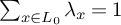 $\sum _{x \in L_0} \lambda _x = 1$
and
$\sum _{x \in L_0} \lambda _x = 1$
and $\sum _{x \in L_0} \lambda _x x = v$
. Thus, for any such collection of weights,
$\sum _{x \in L_0} \lambda _x x = v$
. Thus, for any such collection of weights,
 $$ \begin{align*}w_1(v)> \max_{x\in L_0}(w_0(x)) \ge \sum_{x\in L_0} \lambda_x w_0(x) \end{align*} $$
hence $(v,w_1(v))$
is not in any lower facet of the polyhedron
$(v,w_1(v))$
is not in any lower facet of the polyhedron $\mathcal {Q}_1$
. Thus
$\mathcal {Q}_1$
. Thus $\mathcal {S} = \mathcal {T}_0$
is a regular triangulation.
$\mathcal {S} = \mathcal {T}_0$
is a regular triangulation.
Case 2: v∉Conv(L
0). First we construct a weight function $w_1$
. Fix a lower facet F of
$w_1$
. Fix a lower facet F of $\mathcal {Q}_0$
with inner pointing normal
$\mathcal {Q}_0$
with inner pointing normal $u_F$
. Write
$u_F$
. Write $F=\mathcal {Q}_0\cap A_F$
where
$F=\mathcal {Q}_0\cap A_F$
where $A_F$
is the boundary of the supporting halfspace
$A_F$
is the boundary of the supporting halfspace $H_F=\{x\in N_{\operatorname {\mathbb {R}}}\times \operatorname {\mathbb {R}}\vert \langle u_F, x\rangle \geq c_F\}$
at the facet F, so
$H_F=\{x\in N_{\operatorname {\mathbb {R}}}\times \operatorname {\mathbb {R}}\vert \langle u_F, x\rangle \geq c_F\}$
at the facet F, so $A_F = \{x\in N_{\operatorname {\mathbb {R}}}\times \operatorname {\mathbb {R}}\vert \langle u_F, x \rangle =c_F\}$
. Write
$A_F = \{x\in N_{\operatorname {\mathbb {R}}}\times \operatorname {\mathbb {R}}\vert \langle u_F, x \rangle =c_F\}$
. Write $\mu _F=\langle u_F, e_{d+1}\rangle>0$
and
$\mu _F=\langle u_F, e_{d+1}\rangle>0$
and $\overline {u}_F=u_F-\mu _F e_{d+1}^*$
, where
$\overline {u}_F=u_F-\mu _F e_{d+1}^*$
, where $e_{d+1}^*$
is the dual basis vector to
$e_{d+1}^*$
is the dual basis vector to $e_{d+1}$
and
$e_{d+1}$
and $\overline {u}_F$
(respectively
$\overline {u}_F$
(respectively $\mu _Fe_{d+1}^*$
) is the projection of
$\mu _Fe_{d+1}^*$
) is the projection of $u_F$
onto the first d coordinates (last coordinate). Define
$u_F$
onto the first d coordinates (last coordinate). Define $w_1: L_1 \cup L_0 \to \operatorname {\mathbb {Q}}_{\ge 0}$
to be
$w_1: L_1 \cup L_0 \to \operatorname {\mathbb {Q}}_{\ge 0}$
to be
 $$\begin{align*}w_1(x) = \begin{cases} w_0(x) & \text{ if } x \in L_0; \\ 1+\max_{x\in L_0}\frac{c_F-\langle \overline{u}_F, v\rangle}{\mu_F} & \text{ if } x = v. \end{cases} \end{align*}$$
Consider the polyhedron $\mathcal {Q}_1=\operatorname {Conv}(\{x+w_1(x)e_{d+1}\vert x\in L\})$
. Note
$\mathcal {Q}_1=\operatorname {Conv}(\{x+w_1(x)e_{d+1}\vert x\in L\})$
. Note
 $$\begin{align*}\bigcup_{T \text{ a lower facet of }\mathcal{Q}_0} T\subseteq \mathcal{Q}_0\subseteq \mathcal{Q}_1. \end{align*}$$
Fix a lower facet $F=\mathcal {Q}_0\cap A_F$
of
$F=\mathcal {Q}_0\cap A_F$
of $\mathcal {Q}_0$
. We claim that F is a lower facet of
$\mathcal {Q}_0$
. We claim that F is a lower facet of $\mathcal {Q}_1$
, i.e.
$\mathcal {Q}_1$
, i.e. $\mathcal {Q}_1\cap A_F=F$
and
$\mathcal {Q}_1\cap A_F=F$
and $\mathcal {Q}_1\subseteq H_F$
.
$\mathcal {Q}_1\subseteq H_F$
.
Suppose that $\mathcal {Q}_1\not \subseteq H_F$
, i.e. there is a point
$\mathcal {Q}_1\not \subseteq H_F$
, i.e. there is a point $q\in \mathcal {Q}_1$
such that
$q\in \mathcal {Q}_1$
such that $q\not \in H_F$
. Then
$q\not \in H_F$
. Then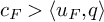 $c_F> \langle u_F, q\rangle $
and there are non-negative real numbers
$c_F> \langle u_F, q\rangle $
and there are non-negative real numbers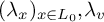 $(\lambda _x)_{x\in L_0},\lambda _v$
where
$(\lambda _x)_{x\in L_0},\lambda _v$
where $1=\lambda _v+\sum _{x\in L_0}\lambda _x$
such that
$1=\lambda _v+\sum _{x\in L_0}\lambda _x$
such that
 $$\begin{align*}q=\lambda_v(v+w_1(v) e_{d+1})+\sum_{x\in L_0}\lambda_x(x+w_1(x)e_{d+1}). \end{align*}$$
We obtain
 $$ \begin{align}\begin{aligned} c_F&>\left\langle u_F, \lambda_v(v+w_1(v)e_{d+1})+\sum_{x\in L_0}\lambda_x(x+w_1(x)e_{d+1})\right\rangle\\ & =\lambda_v(\langle \overline{u}_F,v\rangle +w_1(v)\mu_F)+\left\langle u_F, \sum_{x\in L_0}\lambda_x(x+w_1(x)e_{d+1})\right\rangle\\ & > \lambda_v\left( \langle \overline{u}_F,v\rangle+\frac{c_F-\langle \overline{u}_F,v\rangle}{\mu_F}\mu_F\right)+\sum_{x\in L_0}\lambda_xc_F\\ & =c_F. \end{aligned} \end{align} $$
This is a contradiction, and so $\mathcal {Q}_1\subseteq H_F$
.
$\mathcal {Q}_1\subseteq H_F$
.
Suppose, for the point of contradiction, there is a point $q\in (\mathcal {Q}_1\setminus \mathcal {Q}_0)\cap A_F$
. Then there is a collection of non-negative real numbers
$q\in (\mathcal {Q}_1\setminus \mathcal {Q}_0)\cap A_F$
. Then there is a collection of non-negative real numbers $\{\lambda _x\vert x\in L_0\}\cup \{\lambda _v\}$
such that
$\{\lambda _x\vert x\in L_0\}\cup \{\lambda _v\}$
such that $\lambda _v+\sum _{x\in L_0}\lambda _x=1$
with
$\lambda _v+\sum _{x\in L_0}\lambda _x=1$
with $\lambda _v>0$
and
$\lambda _v>0$
and $\lambda _v(v+w_1(v)e_{d+1})+\sum _{x\in L_0}\lambda _x(x+w_1(x)e_{d+1})=q$
and
$\lambda _v(v+w_1(v)e_{d+1})+\sum _{x\in L_0}\lambda _x(x+w_1(x)e_{d+1})=q$
and
 $$ \begin{align*} c_F&=\langle u_F, q\rangle \\ & =\langle u_F, \lambda_v(v+w_1(v)e_{d+1})\rangle +\langle u_F, \sum_{x\in L_0}\lambda_x(x+w_1(x)e_{d+1})\rangle. \end{align*} $$
For each $x\in L_0$
, we have
$x\in L_0$
, we have $(x+w_1(x)e_{d+1})\in \mathcal {Q}_0$
so
$(x+w_1(x)e_{d+1})\in \mathcal {Q}_0$
so $\langle u_F, x+w_1(x)e_{d+1} \rangle \geq c_F$
. Thus we obtain
$\langle u_F, x+w_1(x)e_{d+1} \rangle \geq c_F$
. Thus we obtain
 $$ \begin{align*} c_F& \geq \langle u_F, \lambda_v(v+w_1(v)e_{d+1})\rangle +c_F\sum_{x\in L_0}\lambda_x\\ &= \lambda_v\langle u_F, v+w_1(v)e_{d+1}\rangle+(1-\lambda_v)c_F;\\ \lambda_vc_F & \geq \lambda_v\langle \overline{u}_F + \mu_F e_{d+1}^*, v+w_1(v)e_{d+1}\rangle;\\ c_F-\langle \overline{u}_F, v\rangle &\geq \langle \mu_F e_{d+1}^*, w_1(v)e_{d+1}\rangle> \frac{c_F-\langle \overline{u}_F, v\rangle}{\mu_F}\mu_F=c_F-\langle \overline{u}_F, v\rangle; \end{align*} $$
a contradiction. Hence, $(\mathcal {Q}_1\setminus \mathcal {Q}_0)\cap A_F=\emptyset $
. Consequently, as
$(\mathcal {Q}_1\setminus \mathcal {Q}_0)\cap A_F=\emptyset $
. Consequently, as $\mathcal {Q}_0\subseteq \mathcal {Q}_1$
, we have
$\mathcal {Q}_0\subseteq \mathcal {Q}_1$
, we have $\mathcal {Q}_1\cap A_F=\mathcal {Q}_0\cap A_F$
as required.
$\mathcal {Q}_1\cap A_F=\mathcal {Q}_0\cap A_F$
as required.
In summary, we have shown that all lower facets of $\mathcal {Q}_0$
are also lower facets of
$\mathcal {Q}_0$
are also lower facets of $\mathcal {Q}_1$
. Thus,
$\mathcal {Q}_1$
. Thus,
 $$\begin{align*}\mathcal{T}_0\subseteq \mathcal{S}. \end{align*}$$
Suppose $\mathcal {S}$
is not a triangulation. Then there exist a lower facet
$\mathcal {S}$
is not a triangulation. Then there exist a lower facet $F = \mathcal {Q}_1 \cap A_F$
of
$F = \mathcal {Q}_1 \cap A_F$
of $\mathcal {Q}_1$
that is not a simplex. Recall that
$\mathcal {Q}_1$
that is not a simplex. Recall that $\mathcal {T}_0$
is a triangulation, so
$\mathcal {T}_0$
is a triangulation, so $F \notin \mathcal {Q}_0$
and
$F \notin \mathcal {Q}_0$
and $v \in F$
. Write
$v \in F$
. Write
 $$ \begin{align*}F = \operatorname{Conv}(v+ w_1(v)e_{d+1}, (x_j + w_1(x_j) e_{d+1})_{j \in J}) \end{align*} $$
for some $J \subseteq L_0$
. Assume J is maximal in the sense that if
$J \subseteq L_0$
. Assume J is maximal in the sense that if $x + w_1(x) e_{d+1} \in F$
for some
$x + w_1(x) e_{d+1} \in F$
for some $x \in L_0$
then
$x \in L_0$
then $x \in J$
. Note that
$x \in J$
. Note that $\dim \operatorname {Conv}(L_0) = \dim F \le |J| -1$
, as F is not a simplex. This would require there to be a facet
$\dim \operatorname {Conv}(L_0) = \dim F \le |J| -1$
, as F is not a simplex. This would require there to be a facet $F' \subseteq \mathcal {Q}_0$
given by
$F' \subseteq \mathcal {Q}_0$
given by $F' = \operatorname {Conv} (x_j + w_1(x_j) e_{d+1})_{j \in J}$
such that
$F' = \operatorname {Conv} (x_j + w_1(x_j) e_{d+1})_{j \in J}$
such that $ F' = \mathcal {Q}_0 \cap A_F$
and
$ F' = \mathcal {Q}_0 \cap A_F$
and $\dim F = \dim F'$
. Since
$\dim F = \dim F'$
. Since $\mathcal {T}_0$
is a triangulation,
$\mathcal {T}_0$
is a triangulation, $|J|-1 =\dim F' = \dim F= \dim \operatorname {Conv}(L_0)$
. This implies that the minimal affine linear subspace containing
$|J|-1 =\dim F' = \dim F= \dim \operatorname {Conv}(L_0)$
. This implies that the minimal affine linear subspace containing $ (x_j + w_1(x_j) e_{d+1})_{j \in J}$
must contain
$ (x_j + w_1(x_j) e_{d+1})_{j \in J}$
must contain $v+ w_1(v)e_{d+1}$
, which contradicts the fact that
$v+ w_1(v)e_{d+1}$
, which contradicts the fact that $\mathcal {Q}_0 \subset \mathcal {Q}_1$
(e.g., Equation (4.1)).
$\mathcal {Q}_0 \subset \mathcal {Q}_1$
(e.g., Equation (4.1)).
The induction step now follows easily by iterating the above for each element of $L_1$
.
$L_1$
.
The following is a strengthened version of Lemma 3.6. Recall the (strictly convex) rational polyhedral cone $\Sigma ^{\prime }$
so that
$\Sigma ^{\prime }$
so that $ |\Sigma _{-D_1,\dots ,-D_r}| \subseteq \Sigma ^{\prime } \subseteq \sigma _{W}^\vee $
.
$ |\Sigma _{-D_1,\dots ,-D_r}| \subseteq \Sigma ^{\prime } \subseteq \sigma _{W}^\vee $
.
Corollary 4.6. There exists a simplicial fan $\Psi $
with support
$\Psi $
with support $\Sigma ^{\prime }$
so that
$\Sigma ^{\prime }$
so that $\Sigma _{-D_1, \dots , -D_r}$
is a subfan of
$\Sigma _{-D_1, \dots , -D_r}$
is a subfan of $\Psi $
and
$\Psi $
and $X_{\Psi }$
is semiprojective.
$X_{\Psi }$
is semiprojective.
Proof. Since $\sigma $
is a polyhedral strictly convex cone in
$\sigma $
is a polyhedral strictly convex cone in $N_{\operatorname {\mathbb {R}}} \times \operatorname {\mathbb {R}}^r$
, there exists an element
$N_{\operatorname {\mathbb {R}}} \times \operatorname {\mathbb {R}}^r$
, there exists an element $\bar m \in M_{\operatorname {\mathbb {Q}}} \times \operatorname {\mathbb {Q}}^r$
so that
$\bar m \in M_{\operatorname {\mathbb {Q}}} \times \operatorname {\mathbb {Q}}^r$
so that $\sigma \setminus \{0\}$
is contained in the halfspace
$\sigma \setminus \{0\}$
is contained in the halfspace $H:= \{ \bar n \in N_{\operatorname {\mathbb {R}}} \times \operatorname {\mathbb {R}}^r \ | \ \langle \bar m, \bar n \rangle>0\}$
. Consider the set
$H:= \{ \bar n \in N_{\operatorname {\mathbb {R}}} \times \operatorname {\mathbb {R}}^r \ | \ \langle \bar m, \bar n \rangle>0\}$
. Consider the set $L_0 = \{ v \in H_{\bar m}(1) \ | \ v \in \rho , \text { for some } \rho \in \Sigma _{-D_1, \dots , -D_r}(1)\}$
and take
$L_0 = \{ v \in H_{\bar m}(1) \ | \ v \in \rho , \text { for some } \rho \in \Sigma _{-D_1, \dots , -D_r}(1)\}$
and take $L_1$
to be the generators of the cone
$L_1$
to be the generators of the cone $\sigma $
that are contained in the halfspace H. Note
$\sigma $
that are contained in the halfspace H. Note $L=L_0 \cup L_1 \in N_{\operatorname {\mathbb {Q}}} \times \operatorname {\mathbb {Q}}^r$
. Then by Lemma 4.5 we have a regular triangulation of L, for some weights
$L=L_0 \cup L_1 \in N_{\operatorname {\mathbb {Q}}} \times \operatorname {\mathbb {Q}}^r$
. Then by Lemma 4.5 we have a regular triangulation of L, for some weights $\omega $
, yielding a simplicial fan
$\omega $
, yielding a simplicial fan $\Psi = \Sigma _{\omega }$
. Thus by Proposition 4.4, the fan
$\Psi = \Sigma _{\omega }$
. Thus by Proposition 4.4, the fan $\Psi $
is a regular conical triangulation. By Corollary 2.7 of [Reference Hausel and SturmfelsHS02], we obtain that
$\Psi $
is a regular conical triangulation. By Corollary 2.7 of [Reference Hausel and SturmfelsHS02], we obtain that $X_{\Psi }$
is semiprojective.
$X_{\Psi }$
is semiprojective.
4.2 Variation of GIT Quotients and Gorenstein Cones
Corollary 4.6 shows there exists a simplicial fan $\Psi $
with support
$\Psi $
with support $\Sigma ^{\prime }$
so that
$\Sigma ^{\prime }$
so that $X_{\Psi }$
is semiprojective and
$X_{\Psi }$
is semiprojective and $\Psi $
contains
$\Psi $
contains $\Sigma _{-D_1, \dots , -D_r}$
as a subfan. Recall that we have the global
$\Sigma _{-D_1, \dots , -D_r}$
as a subfan. Recall that we have the global $G_{\Psi (1)}$
-invariant function
$G_{\Psi (1)}$
-invariant function $\bar W$
, defined as in (3.6), yielding the gauged LG model
$\bar W$
, defined as in (3.6), yielding the gauged LG model
 $$ \begin{align*}(U_\Psi, G_{\Psi(1)} \times \operatorname{\mathbb{G}_m}, \bar W) \end{align*} $$
Since $X_{\Psi }$
is semiprojective,
$X_{\Psi }$
is semiprojective, $\Psi $
corresponds to a chamber of a secondary fan corresponding to the point collection given by intersecting a hyperplane with the rays in
$\Psi $
corresponds to a chamber of a secondary fan corresponding to the point collection given by intersecting a hyperplane with the rays in $\Psi (1)$
(see, e.g., Exercise 15.1.8 of [Reference Cox, Little and SchenckCLS11]). Thus the quotient stack
$\Psi (1)$
(see, e.g., Exercise 15.1.8 of [Reference Cox, Little and SchenckCLS11]). Thus the quotient stack $[U_{\Psi } / G_{\Psi }]$
is a GIT quotient and we can vary the choice of linearization to find other GIT quotients, and provide relationships between their corresponding factorization categories using the technology developed in [Reference Ballard, Favero and KatzarkovBFK19, Reference Halpern-LeistnerHL15]. Such a change will give a birational transformation, yielding the ‘flop’ portion of the exoflop. One can use this technology directly and the above in order to generate results on relations in various cases.
$[U_{\Psi } / G_{\Psi }]$
is a GIT quotient and we can vary the choice of linearization to find other GIT quotients, and provide relationships between their corresponding factorization categories using the technology developed in [Reference Ballard, Favero and KatzarkovBFK19, Reference Halpern-LeistnerHL15]. Such a change will give a birational transformation, yielding the ‘flop’ portion of the exoflop. One can use this technology directly and the above in order to generate results on relations in various cases.
The story simplifies when one restricts to Calabi-Yau complete intersections. In this case, the relationships between the factorization categories of different GIT quotients were streamlined in [Reference Favero and KellyFK18] using Gorenstein cones. The following definitions for various variants of Gorenstein cones will be necessary for some of the following statements.
Definition 4.7. Consider a cone $\sigma $
in
$\sigma $
in $N_{\operatorname {\mathbb {R}}}$
. We say
$N_{\operatorname {\mathbb {R}}}$
. We say $\sigma $
is
$\sigma $
is
-
(1) Gorenstein with respect to 𝔪 σ if there exists an element
$\mathfrak m_\sigma \in M$
so that the cone
$\sigma $
is generated over
$\operatorname {\mathbb {Q}}$
by finitely many lattice points in
$\{n \in N \ | \ \langle \mathfrak m_\sigma , n \rangle =1 \}$
. -
(2) ℚ-Gorenstein with respect to 𝔪 σ if there exists an element
$\mathfrak m_{\sigma } \in M_{\operatorname {\mathbb {Q}}}$
so that the cone
$\sigma $
is generated over
$\operatorname {\mathbb {Q}}$
by finitely many lattice points in
$\{n \in N \ | \ \langle \mathfrak m_\sigma , n \rangle =1 \}$
.






If $\sigma $
has primitive lattice generators
$\sigma $
has primitive lattice generators $v_1, \dots , v_k \in N$
, the support
$v_1, \dots , v_k \in N$
, the support $\Delta _\sigma $
of
$\Delta _\sigma $
of $\sigma $
is the polytope
$\sigma $
is the polytope $\operatorname {Conv}(\{v_1, \dots , v_k\})$
in the hyperplane
$\operatorname {Conv}(\{v_1, \dots , v_k\})$
in the hyperplane
 $$ \begin{align*}H_{\mathfrak m_\sigma}(1) := \{ x \in N_{\operatorname{\mathbb{R}}} \ | \ \langle \mathfrak m_{\sigma}, x\rangle=1\}.\end{align*} $$
We say a Gorenstein cone $\sigma $
is reflexive Gorenstein of index r
if its dual cone
$\sigma $
is reflexive Gorenstein of index r
if its dual cone $\sigma ^\vee $
is Gorenstein with respect to an element
$\sigma ^\vee $
is Gorenstein with respect to an element $\mathfrak n_{\sigma ^\vee } \in N$
and
$\mathfrak n_{\sigma ^\vee } \in N$
and $\langle \mathfrak m_{\sigma }, \mathfrak n_{\sigma ^\vee }\rangle = r$
.
$\langle \mathfrak m_{\sigma }, \mathfrak n_{\sigma ^\vee }\rangle = r$
.
Remark 4.8. Here it is important to note that we do not require that $\sigma $
is generated over
$\sigma $
is generated over $\operatorname {\mathbb {Z}}$
but over
$\operatorname {\mathbb {Z}}$
but over $\operatorname {\mathbb {Q}}$
. This is sometimes called almost Gorenstein and is a weaker assumption.
$\operatorname {\mathbb {Q}}$
. This is sometimes called almost Gorenstein and is a weaker assumption.
Definition 4.9. Given r lattice polytopes $\Delta _1, \dots , \Delta _r \subseteq M_{\operatorname {\mathbb {R}}}$
, we define a Cayley polytope of length r associated to Δ1, …, Δ
r
to be the convex hull
$\Delta _1, \dots , \Delta _r \subseteq M_{\operatorname {\mathbb {R}}}$
, we define a Cayley polytope of length r associated to Δ1, …, Δ
r
to be the convex hull $\operatorname {Conv}(\Delta _1+e_1, \dots , \Delta _r + e_r) \subseteq M_{\operatorname {\mathbb {R}}} \times \operatorname {\mathbb {R}}^r$
, where
$\operatorname {Conv}(\Delta _1+e_1, \dots , \Delta _r + e_r) \subseteq M_{\operatorname {\mathbb {R}}} \times \operatorname {\mathbb {R}}^r$
, where $e_i$
is the ith standard basis vector of
$e_i$
is the ith standard basis vector of $\operatorname {\mathbb {R}}^r$
. We say a cone is a Cayley cone (of length r) if it is the cone over a Cayley polytope of length r. We say a cone is completely split if it is a reflexive Gorenstein cone of index r that is also a Cayley cone of length r.
$\operatorname {\mathbb {R}}^r$
. We say a cone is a Cayley cone (of length r) if it is the cone over a Cayley polytope of length r. We say a cone is completely split if it is a reflexive Gorenstein cone of index r that is also a Cayley cone of length r.
Note that if $\sigma $
is
$\sigma $
is $\operatorname {\mathbb {Q}}$
-Gorenstein and dimension
$\operatorname {\mathbb {Q}}$
-Gorenstein and dimension $\dim N_{\operatorname {\mathbb {R}}} = d$
, then
$\dim N_{\operatorname {\mathbb {R}}} = d$
, then $m_{\sigma }$
is unique.
$m_{\sigma }$
is unique.
Example 4.10. Let $\Sigma $
be a complete fan in
$\Sigma $
be a complete fan in $N_{\operatorname {\mathbb {R}}}$
. Take the fan
$N_{\operatorname {\mathbb {R}}}$
. Take the fan $\Sigma _{-D_1, \dots , -D_r}$
where
$\Sigma _{-D_1, \dots , -D_r}$
where ${D_i = \sum _{\rho \in \Sigma (1)} a_{\rho i} D_\rho }$
and, for each i,
${D_i = \sum _{\rho \in \Sigma (1)} a_{\rho i} D_\rho }$
and, for each i, $a_{\rho i} = \delta _{ij}$
for some j (that is,
$a_{\rho i} = \delta _{ij}$
for some j (that is, $\sum _i D_i = -K_{X_{\Sigma }}$
and the
$\sum _i D_i = -K_{X_{\Sigma }}$
and the $D_i$
partition the anticanonical divisor). Then the support
$D_i$
partition the anticanonical divisor). Then the support $|\Sigma _{-D_1, \dots , -D_r}|$
is an almost Gorenstein cone in
$|\Sigma _{-D_1, \dots , -D_r}|$
is an almost Gorenstein cone in $N_{\operatorname {\mathbb {R}}} \times \operatorname {\mathbb {R}}^r$
with respect to
$N_{\operatorname {\mathbb {R}}} \times \operatorname {\mathbb {R}}^r$
with respect to $m= e_1 +\dots + e_r$
.
$m= e_1 +\dots + e_r$
.
Let $\sigma \subseteq N_{\operatorname {\mathbb {R}}}$
be a
$\sigma \subseteq N_{\operatorname {\mathbb {R}}}$
be a $\operatorname {\mathbb {Q}}$
-Gorenstein cone and
$\operatorname {\mathbb {Q}}$
-Gorenstein cone and $\nu \subseteq \sigma \cap N$
be a finite, geometric collection of lattice points which contains the (primitive) ray generators of
$\nu \subseteq \sigma \cap N$
be a finite, geometric collection of lattice points which contains the (primitive) ray generators of $\sigma $
. Partition the set
$\sigma $
. Partition the set $\nu $
into two subsets
$\nu $
into two subsets
 $$ \begin{align}\begin{aligned} \nu_{=1} = \{v \in \nu \ | \ \langle m_{\sigma}, v\rangle = 1\} \text{ and }\\ \nu_{\ne 1} = \{ v \in \nu \ | \ \langle m_{\sigma}, v \rangle \ne 1\}. \end{aligned}\end{align} $$
Note that since $\sigma $
is
$\sigma $
is $\operatorname {\mathbb {Q}}$
-Gorenstein, the ray generators of
$\operatorname {\mathbb {Q}}$
-Gorenstein, the ray generators of $\sigma $
are contained in
$\sigma $
are contained in $\nu _{=1}$
.
$\nu _{=1}$
.
We consider the fan $\Psi $
above. Suppose the cone
$\Psi $
above. Suppose the cone $|\Psi |$
is
$|\Psi |$
is $\operatorname {\mathbb {Q}}$
-Gorenstein. Then we have the following result.
$\operatorname {\mathbb {Q}}$
-Gorenstein. Then we have the following result.
Theorem 4.11 (Theorem 5.8 of [Reference Favero and KellyFK18]).
Let $\Psi $
be any simplicial fan such that
$\Psi $
be any simplicial fan such that ${\Psi (1) = \{ \operatorname {Cone}(v) \ | \ v \in \nu \}}$
and
${\Psi (1) = \{ \operatorname {Cone}(v) \ | \ v \in \nu \}}$
and $X_{\Psi }$
is semiprojective. Similarly, let
$X_{\Psi }$
is semiprojective. Similarly, let $\tilde \Sigma $
be any simplicial fan such that
$\tilde \Sigma $
be any simplicial fan such that $\tilde \Sigma (1) \subseteq \nu _{=1}$
,
$\tilde \Sigma (1) \subseteq \nu _{=1}$
, $X_{\tilde \Sigma }$
is semiprojective and
$X_{\tilde \Sigma }$
is semiprojective and $\operatorname {Cone}(\tilde {\Sigma }(1)) = |\Psi |$
. We have the following:
$\operatorname {Cone}(\tilde {\Sigma }(1)) = |\Psi |$
. We have the following:
-
(a) If
$\langle m_{\sigma }, a\rangle> 1$
for all
$a \in \nu _{\ne 1}$
, then there is a fully-faithful functor
$$ \begin{align*}\operatorname{D}^{\operatorname{abs}}[U_{\tilde \Sigma} \times \operatorname{\mathbb{G}_m}^{\nu \setminus \tilde\Sigma(1)}, G_{\Psi} \times \operatorname{\mathbb{G}_m}, \bar W] \to \operatorname{D}^{\operatorname{abs}}[U_{\Psi}, G_{\Psi} \times \operatorname{\mathbb{G}_m}, \bar W]. \end{align*} $$
-
(b) If
$\langle m_{\sigma }, a\rangle < 1$
for all
$a \in \nu _{\ne 1}$
, then there is a fully-faithful functor
$$ \begin{align*}\operatorname{D}^{\operatorname{abs}}[U_{\Psi}, G_{\Psi} \times \operatorname{\mathbb{G}_m}, \bar W] \to \operatorname{D}^{\operatorname{abs}}[U_{\tilde \Sigma} \times \operatorname{\mathbb{G}_m}^{\nu \setminus \tilde\Sigma(1)}, G_{\Psi} \times \operatorname{\mathbb{G}_m}, \bar W]. \end{align*} $$
-
(c) If
$\nu _{\ne 1} = \varnothing $
, then there is an equivalence
$$ \begin{align*}\operatorname{D}^{\operatorname{abs}}[U_{\tilde \Sigma} \times \operatorname{\mathbb{G}_m}^{\nu \setminus \tilde\Sigma(1)}, G_{\Psi} \times \operatorname{\mathbb{G}_m}, \bar W] \cong \operatorname{D}^{\operatorname{abs}}[U_{\Psi}, G_{\Psi} \times \operatorname{\mathbb{G}_m}, \bar W]. \end{align*} $$


Using Theorem 4.11, we are left to study the category
 $$ \begin{align*}\operatorname{D}^{\operatorname{abs}}[U_{\tilde \Sigma} \times \operatorname{\mathbb{G}_m}^{\nu \setminus \tilde\Sigma(1)}, G_{\Psi} \times \operatorname{\mathbb{G}_m}, \bar W]. \end{align*} $$
With some additional assumptions, we can prove that it is geometric. The following is half of [Reference Favero and KellyFK18, Corollary 5.15].
Proposition 4.12. Take a fan $\tilde \Sigma $
as in Theorem 4.11. Suppose there exist rays
$\tilde \Sigma $
as in Theorem 4.11. Suppose there exist rays ${\rho ^{\prime }_1, \dots , \rho ^{\prime }_r \in \tilde \Sigma (1)}$
with primitive generators
${\rho ^{\prime }_1, \dots , \rho ^{\prime }_r \in \tilde \Sigma (1)}$
with primitive generators $e_{\rho ^{\prime }_1}, \dots , e_{\rho ^{\prime }_r} \in N \times \operatorname {\mathbb {Z}}^r$
so that
$e_{\rho ^{\prime }_1}, \dots , e_{\rho ^{\prime }_r} \in N \times \operatorname {\mathbb {Z}}^r$
so that
-
(1) the induced projection
induces the toric morphism
$$ \begin{align*}\pi: N\times \operatorname{\mathbb{Z}}^r \to (N\times \operatorname{\mathbb{Z}}^r) / (\oplus_{i=1}^t \operatorname{\mathbb{Z}} \cdot e_{\rho^{\prime}_i}) \end{align*} $$
$\pi : X_{\Sigma ^{\prime }_{-D_1', \dots , -D_r'}} \to X_{\Sigma ^{\prime }}$
and this toric morphism is a rank r vector bundle whose sheaf of sections is
$\oplus _{i=1}^r \mathcal {O}_{X_{\Sigma ^{\prime }}}(-D_i')$
, and
-
(2)
$e_{\rho ^{\prime }_1}+ \dots + e_{\rho ^{\prime }_r}= e_1 + \dots + e_r \in \operatorname {\mathbb {N}} \times \operatorname {\mathbb {Z}}^r$
.




Write the function $\bar W$
as
$\bar W$
as
 $$ \begin{align*}\bar W = \sum_{\bar m \in \Xi_{i,W}} c_m \prod_{\rho \in \tilde\Sigma(1)} x_\rho^{\langle \bar m, u_{\rho}\rangle}. \end{align*} $$
Then, there exists a partition $\Xi _{i,W} = H_1' \cup \dots \cup H_r'$
so that we can write
$\Xi _{i,W} = H_1' \cup \dots \cup H_r'$
so that we can write
 $$ \begin{align*}\bar W = u_1'g_1 + \dots + u_r' g_r, \text{ where } g_i = \sum_{\bar m \in H_i'} \prod_{\rho \in \tilde\Sigma(1)\setminus\{\rho^{\prime}_1, \dots, \rho_r'\}} x_\rho^{\langle \bar m, u_\rho\rangle} \end{align*} $$
where $g_i \in \Gamma (X_{\Sigma ^{\prime }}, \mathcal {O}_{X_{\Sigma ^{\prime }}}(D_i'))$
. Then we have the quotient stack
$g_i \in \Gamma (X_{\Sigma ^{\prime }}, \mathcal {O}_{X_{\Sigma ^{\prime }}}(D_i'))$
. Then we have the quotient stack
 $$ \begin{align} [\mathcal Z'/G']:= [Z(g_1, \dots, g_r) / S_{\tilde\Sigma(1)}] \subseteq [U_{\tilde \Sigma}/S_{\Sigma}] \end{align} $$
where
 $$ \begin{align*}\operatorname{D}^{\operatorname{abs}}[U_{\tilde \Sigma} \times \operatorname{\mathbb{G}_m}^{\nu \setminus \tilde\Sigma(1)}, G_{\Psi} \times \operatorname{\mathbb{G}_m}, \bar W] \cong \operatorname{D}^{\operatorname{b}}(\operatorname{coh }[\mathcal Z'/G']). \end{align*} $$
Note that if $[\mathcal Z'/G']$
is smooth, then
$[\mathcal Z'/G']$
is smooth, then $\operatorname {D}^{\operatorname {b}}(\operatorname {coh }[\mathcal Z'/G'])$
is homologically smooth and proper. Also, if
$\operatorname {D}^{\operatorname {b}}(\operatorname {coh }[\mathcal Z'/G'])$
is homologically smooth and proper. Also, if $[\mathcal Z'/G']$
is a Calabi-Yau orbifold,
$[\mathcal Z'/G']$
is a Calabi-Yau orbifold, $\operatorname {D}^{\operatorname {b}}(\operatorname {coh }[\mathcal Z'/G'])$
is Calabi-Yau. These observations are useful for satisfying the hypotheses of Theorem 3.7 and Corollary 3.10, respectively.
$\operatorname {D}^{\operatorname {b}}(\operatorname {coh }[\mathcal Z'/G'])$
is Calabi-Yau. These observations are useful for satisfying the hypotheses of Theorem 3.7 and Corollary 3.10, respectively.
4.3 Categorical ramifications of the exoflop
In Section 3, we established the following diagram for when one partially compactifies the gauged Landau-Ginzburg model corresponding to a complete intersection in a toric variety:

Here, $\Omega $
is the equivalence in Corollary 3.4 and
$\Omega $
is the equivalence in Corollary 3.4 and $i_* \circ \varphi ^*$
-
(i) with
$\varphi _*\circ i^*$
forms a crepant categorical resolution if
$\operatorname {D}^{\operatorname {abs}}[U_{\Psi }, G_{\Psi } \times \operatorname {\mathbb {G}_m}, \bar W]$
is homologically smooth and proper (Theorem 3.7); -
(ii) is a fully faithful functor if
$\operatorname {D}^{\operatorname {abs}}[U_{\Psi }, G_{\Psi } \times \operatorname {\mathbb {G}_m}, \bar W]$
is homologically smooth and proper and
$\operatorname {D}^{\operatorname {b}}(\operatorname {coh }[\mathcal {Z}/G]) $
is a smooth Deligne-Mumford stack (Corollary 3.9); and -
(iii) is an equivalence if
$\operatorname {D}^{\operatorname {abs}}[U_{\Psi }, G_{\Psi } \times \operatorname {\mathbb {G}_m}, \bar W]$
is homologically smooth, proper, connected, and Calabi-Yau, and
$\operatorname {D}^{\operatorname {b}}(\operatorname {coh }[\mathcal {Z}/G]) $
is a smooth Deligne-Mumford stack (Corollary 3.10).



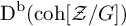

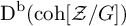
In this section, we established a chain of relations:

Putting together, we have the following corollary that summarizes the exoflop’s power:
Corollary 4.13.
-
(a) If the conditions of Proposition 4.12 hold, we are in either cases (a) or (c) of Theorem 4.11, and
$[\mathcal Z'/G']$
is smooth, then we have that
$\operatorname {D}^{\operatorname {abs}}[U_{\Psi }, G_{\Psi } \times \operatorname {\mathbb {G}_m}, \bar W]$
is homologically smooth and proper, hence
$i_* \circ \varphi ^*\circ \Omega $
and
$\Omega ^{-1}\circ \varphi _*\circ i^*$
form a categorical resolution for
$\operatorname {D}^{\operatorname {b}}(\operatorname {coh }[\mathcal {Z}/G])$
. -
(b) If the conditions of Proposition 4.12 hold, we are in either cases (b) or (c) of Theorem 4.11, and
$[\mathcal Z/G]$
and
$[\mathcal Z'/G']$
are smooth, then we have a fully faithful functor
$$ \begin{align*}\operatorname{D}^{\operatorname{b}}(\operatorname{coh }[\mathcal Z/G]) \rightarrow \operatorname{D}^{\operatorname{b}}(\operatorname{coh }[\mathcal Z'/G']). \end{align*} $$
-
(c) If the conditions of Proposition 4.12 hold, we are in case (c) of Theorem 4.11,
$[\mathcal Z/G]$
is smooth, and
$[\mathcal Z'/G']$
is a smooth, connected Calabi-Yau orbifold, then we have an equivalence
$$ \begin{align*}\operatorname{D}^{\operatorname{b}}(\operatorname{coh }[\mathcal Z/G]) \stackrel{\sim}{\rightarrow} \operatorname{D}^{\operatorname{b}}(\operatorname{coh }[\mathcal Z'/G']). \end{align*} $$



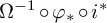
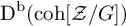


There are many conditions at play in Corollary 4.13. However, to illustrate its power, we describe in the next section combinatorial sufficient conditions using reflexive completely split Gorenstein cones.
5 Exoflops for CICYs
In the previous sections, we aimed to provide general results. In this section, we specialize to the case of Calabi-Yau complete intersections (CICYs) in toric Fano varieties. We provide combinatorial context for when one can use Corollary 4.13(a) and (c). We recall notation from above, but will make additional assumptions in our set-up.
Let $X_{\Sigma }$
be a toric projective Fano variety and let
$X_{\Sigma }$
be a toric projective Fano variety and let $D_1, \dots , D_r$
be torus-invariant Weil divisors so that we can write
$D_1, \dots , D_r$
be torus-invariant Weil divisors so that we can write
 $$ \begin{align*}D_{i} = \sum_{\rho \in \Sigma(1)} a_{\rho i } D_\rho \end{align*} $$
where $a_{\rho i} = \delta _{ij}$
for some
$a_{\rho i} = \delta _{ij}$
for some $j \in \{1, \dots , r\}$
. Note
$j \in \{1, \dots , r\}$
. Note $\sum _{i=1}^r D_i = -K_{X_{\Sigma }}$
. Consider the toric fan
$\sum _{i=1}^r D_i = -K_{X_{\Sigma }}$
. Consider the toric fan $\Sigma _{-D_1, \dots , -D_r}$
as above. Note
$\Sigma _{-D_1, \dots , -D_r}$
as above. Note $|\Sigma _{-D_1, \dots , -D_r}|$
is almost Gorenstein with respect to
$|\Sigma _{-D_1, \dots , -D_r}|$
is almost Gorenstein with respect to
 $$ \begin{align} \mathfrak{m} := e_1^* + \dots + e_r^* \in M \times \operatorname{\mathbb{Z}}^r. \end{align} $$
Write $\mathfrak {n} = e_1 + \dots + e_r$
.
$\mathfrak {n} = e_1 + \dots + e_r$
.
Let $f_i \in \Gamma (X_{\Sigma }, \mathcal {O}_{X_\Sigma }(D_i))$
be a non-zero global section of
$f_i \in \Gamma (X_{\Sigma }, \mathcal {O}_{X_\Sigma }(D_i))$
be a non-zero global section of $D_i$
. We can write
$D_i$
. We can write
 $$ \begin{align} W = u_1f_1 + \dots + u_r f_r = \sum_{\bar m \in H_{\mathfrak{n}}(1)\cap (M\times\operatorname{\mathbb{Z}}^r)\cap |\Sigma_{-D_1, \dots, -D_r}|^\vee} c_{\bar m} \prod_{\rho \in \Sigma_{-D_1, \dots, -D_r}(1)} x_\rho^{\langle \bar m, u_\rho\rangle} \end{align} $$
for some $c_{\bar m} \in \operatorname {\mathbb {C}}$
. Define the set and cone
$c_{\bar m} \in \operatorname {\mathbb {C}}$
. Define the set and cone
 $$ \begin{align} \Xi_W := \{ \bar m \in H_{\mathfrak{n}}(1)\cap (M\times\operatorname{\mathbb{Z}}^r)\cap |\Sigma_{-D_1, \dots, -D_r}|^\vee \ | \ c_{\bar m} \ne 0\}; \qquad \sigma_W := \operatorname{Cone}(\Xi_W). \end{align} $$
As above, take a cone $\Sigma ^{\prime }$
so that
$\Sigma ^{\prime }$
so that $\sigma _W^\vee \supseteq \Sigma ^{\prime } \supseteq |\Sigma _{-D_1, \dots , -D_r}|$
.
$\sigma _W^\vee \supseteq \Sigma ^{\prime } \supseteq |\Sigma _{-D_1, \dots , -D_r}|$
.
Assumption 5.1. We assume the following:
-
(i) The cone
$\Sigma ^{\prime }$
is almost Gorenstein with respect to
$\mathfrak {m}$
. -
(ii) There exists a fan
$\Sigma ^{\prime }_{-D_1', \dots , -D_r'}$
with support
$|\Sigma ^{\prime }_{-D_1', \dots , -D_r'}| = \Sigma ^{\prime }$
so that:-
• for any primitive generator
$u_{\rho '}$
of a ray
$\rho ' \in \Sigma ^{\prime }_{-D_1', \dots , -D_r'}(1)$
we have
$\langle \mathfrak {m}, u_{\rho '}\rangle =1$
; -
• there exists rays
$\rho _1', \dots , \rho ^{\prime }_r \in \Sigma ^{\prime }_{-D_1', \dots , -D_r'}(1)$
so that-
–
$u_{\rho ^{\prime }_1} + \dots + u_{\rho ^{\prime }_r} = \mathfrak {n}$
, i.e.,
$\Sigma ^{\prime }$
is a Cayley cone associated to r lattice polytopes and -
– the projection
$\pi : N\times \operatorname {\mathbb {Z}}^r \to N\times \operatorname {\mathbb {Z}}^r / (\oplus _{i=1}^r \operatorname {\mathbb {Z}} \cdot u_{\rho ^{\prime }_i})$
induces a toric morphism
$\pi : X_{\Sigma ^{\prime }_{-D_1', \dots , -D_r'}} \to X_{\Sigma ^{\prime }}$
for some fan
$\Sigma ^{\prime }$
in
$N_{\operatorname {\mathbb {R}}}\times \operatorname {\mathbb {R}}^r / (\oplus _{i=1}^r \operatorname {\mathbb {R}} \cdot u_{\rho ^{\prime }_i})$
corresponding to a toric Fano variety
$X_{\Sigma ^{\prime }}$
and this toric morphism is a rank r vector bundle whose sheaf of sections is
$\oplus _{i=1}^r \mathcal {O}_{X_{\Sigma ^{\prime }}}(-D_i')$
.
-
-


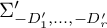













We denote by $v_1, \dots , v_r$
the variables corresponding to the rays
$v_1, \dots , v_r$
the variables corresponding to the rays $\rho _1', \dots , \rho ^{\prime }_r$
. Since each monomial of
$\rho _1', \dots , \rho ^{\prime }_r$
. Since each monomial of $\bar W$
is of the form
$\bar W$
is of the form $x^{\bar m}$
,
$x^{\bar m}$
, $\langle \bar m, \mathfrak {n}\rangle =1$
, and
$\langle \bar m, \mathfrak {n}\rangle =1$
, and $\langle \bar m, u_{\rho ^{\prime }_i}\rangle \in \operatorname {\mathbb {Z}}_{\ge 0}$
, we can write the extended global function as
$\langle \bar m, u_{\rho ^{\prime }_i}\rangle \in \operatorname {\mathbb {Z}}_{\ge 0}$
, we can write the extended global function as
 $$ \begin{align*}\bar W = \sum_{\bar m \in \Xi_W} c_{\bar m} \prod_{\rho' \in \Sigma^{\prime}_{-D_1', \dots, -D_r'}(1)} x_\rho^{\langle \bar m, u_{\rho'}\rangle} = v_1 g_1 + \dots + v_r g_r, \end{align*} $$
where $g_i \in \Gamma (X_{\Sigma ^{\prime }}, \mathcal {O}_{X_{\Sigma ^{\prime }}}(D_i'))$
. We then have
$g_i \in \Gamma (X_{\Sigma ^{\prime }}, \mathcal {O}_{X_{\Sigma ^{\prime }}}(D_i'))$
. We then have $ [\mathcal Z'/G']:= [Z(g_1, \dots , g_r) / S_{\tilde \Sigma (1)}] $
as in (4.3).
$ [\mathcal Z'/G']:= [Z(g_1, \dots , g_r) / S_{\tilde \Sigma (1)}] $
as in (4.3).
Corollary 5.2. Suppose Assumption 5.1 holds and take $[\mathcal Z/G], [\mathcal Z'/G']$
defined above. Then
$[\mathcal Z/G], [\mathcal Z'/G']$
defined above. Then
-
(i) If
$[\mathcal Z'/G']$
is smooth, then we have a crepant categorical resolution
$$ \begin{align*} F&:\operatorname{D}^{\operatorname{b}}(\operatorname{coh }[\mathcal Z'/G']) \to \operatorname{D}^{\operatorname{b}}(\operatorname{coh }[\mathcal Z/G]), \\ G&:\operatorname{Perf} [\mathcal Z/G] \to \operatorname{D}^{\operatorname{b}}(\operatorname{coh }[\mathcal Z'/G']). \end{align*} $$
-
(ii) If both
$[\mathcal Z/G]$
and
$[\mathcal Z'/G']$
are smooth and connected, then they are derived equivalent.


Proof. This is an application of Corollary 4.13. If Assumption 5.1 holds, then the conditions of Proposition 4.12 hold and we are in case (c) of Theorem 4.11. Since the fan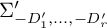 $\Sigma ^{\prime }_{-D_1', \dots , -D_r'}$
has only rays that pair to
$\Sigma ^{\prime }_{-D_1', \dots , -D_r'}$
has only rays that pair to $1$
with
$1$
with $\mathfrak {m}$
, we have that
$\mathfrak {m}$
, we have that $\operatorname {D}^{\operatorname {b}}(\operatorname {coh }[\mathcal Z'/G']) $
is Calabi-Yau by [Reference Favero and KellyFK18, Corollary 5.15].
$\operatorname {D}^{\operatorname {b}}(\operatorname {coh }[\mathcal Z'/G']) $
is Calabi-Yau by [Reference Favero and KellyFK18, Corollary 5.15].
The choice of $\Sigma ^{\prime }$
is key for the possibility that Assumption 5.1 can hold. For this reason, we now provide combinatorial criteria from convex geometry.
$\Sigma ^{\prime }$
is key for the possibility that Assumption 5.1 can hold. For this reason, we now provide combinatorial criteria from convex geometry.
5.1 Gorenstein Cones and CICYs
The following is a general result about almost Gorenstein cones.
Proposition 5.3. Let $\sigma \subseteq N_{\operatorname {\mathbb {R}}}\times \operatorname {\mathbb {R}}^r$
be an almost Gorenstein cone with respect to
$\sigma \subseteq N_{\operatorname {\mathbb {R}}}\times \operatorname {\mathbb {R}}^r$
be an almost Gorenstein cone with respect to $\mathfrak {m}$
above. If both
$\mathfrak {m}$
above. If both $\sigma $
and
$\sigma $
and $\sigma ^\vee $
are completely split reflexive Gorenstein of index r, then
$\sigma ^\vee $
are completely split reflexive Gorenstein of index r, then $\sigma $
fulfills Assumption 5.1.
$\sigma $
fulfills Assumption 5.1.
Proof. Being reflexive Gorenstein with respect to $\mathfrak {m}$
implies that
$\mathfrak {m}$
implies that $\sigma $
is almost Gorenstein with respect to
$\sigma $
is almost Gorenstein with respect to $\mathfrak {m}$
. Firstly, we note that
$\mathfrak {m}$
. Firstly, we note that $\sigma $
and
$\sigma $
and $\sigma ^\vee $
both being completely split reflexive Gorenstein is equivalent to
$\sigma ^\vee $
both being completely split reflexive Gorenstein is equivalent to $\sigma $
being associated to a nef-partition by Corollary 3.7 of [Reference Batyrev and NillBN08]. That is, there exists some
$\sigma $
being associated to a nef-partition by Corollary 3.7 of [Reference Batyrev and NillBN08]. That is, there exists some $e_1', \dots , e_r' \in N \times \operatorname {\mathbb {Z}}^r$
that form part of a
$e_1', \dots , e_r' \in N \times \operatorname {\mathbb {Z}}^r$
that form part of a $\operatorname {\mathbb {Z}}$
-basis for
$\operatorname {\mathbb {Z}}$
-basis for $N\times \operatorname {\mathbb {Z}}^r$
so that there exists a nef partition
$N\times \operatorname {\mathbb {Z}}^r$
so that there exists a nef partition $\Delta _1+\dots +\Delta _r=\Delta $
with unique interior point
$\Delta _1+\dots +\Delta _r=\Delta $
with unique interior point $0$
in
$0$
in $N' := N\times \operatorname {\mathbb {Z}}^r / (\oplus _{i=1}^r \operatorname {\mathbb {Z}} e_i')$
and
$N' := N\times \operatorname {\mathbb {Z}}^r / (\oplus _{i=1}^r \operatorname {\mathbb {Z}} e_i')$
and $\sigma =\operatorname {Cone}(\Delta _1+ e_1', \dots , \Delta _r + e_r')$
.
$\sigma =\operatorname {Cone}(\Delta _1+ e_1', \dots , \Delta _r + e_r')$
.
Denote by $V_i$
the vertex set of
$V_i$
the vertex set of $\Delta _i + e_i'$
. Note
$\Delta _i + e_i'$
. Note $V_i\cap V_j=\emptyset $
. Let
$V_i\cap V_j=\emptyset $
. Let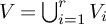 $V=\bigcup _{i=1}^r V_i$
. We note
$V=\bigcup _{i=1}^r V_i$
. We note $\sigma =\operatorname {Cone}(V)$
, and by associating to each
$\sigma =\operatorname {Cone}(V)$
, and by associating to each $p\in V$
the ray
$p\in V$
the ray $\rho _p$
with primitive generator p, we have
$\rho _p$
with primitive generator p, we have $\sigma (1)=\{\rho _p\ \vert \ p\in V\}$
. We want to show that
$\sigma (1)=\{\rho _p\ \vert \ p\in V\}$
. We want to show that $\sigma =|\Sigma ^{\prime }_{-D_1',\dots ,-D_r'}|$
for some vector bundle over a simplicial
$\sigma =|\Sigma ^{\prime }_{-D_1',\dots ,-D_r'}|$
for some vector bundle over a simplicial $\Sigma ^{\prime }$
. We prove this by direct construction.
$\Sigma ^{\prime }$
. We prove this by direct construction.
Write $\pi : N_{\operatorname {\mathbb {R}}} \times \operatorname {\mathbb {R}}^r \to N_{\operatorname {\mathbb {R}}}'$
for the projection and
$\pi : N_{\operatorname {\mathbb {R}}} \times \operatorname {\mathbb {R}}^r \to N_{\operatorname {\mathbb {R}}}'$
for the projection and $\overline {\rho }_p := \pi (\rho _p)$
. We have that the cone over
$\overline {\rho }_p := \pi (\rho _p)$
. We have that the cone over $\pi (V) \setminus \{0\}$
has support
$\pi (V) \setminus \{0\}$
has support $N_{\operatorname {\mathbb {R}}}'$
as
$N_{\operatorname {\mathbb {R}}}'$
as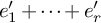 $e_1'+\dots +e_r'$
is in the relative interior of
$e_1'+\dots +e_r'$
is in the relative interior of $\sigma $
. Thus, there exists a complete fan in
$\sigma $
. Thus, there exists a complete fan in $N_{\operatorname {\mathbb {R}}}'$
with rays
$N_{\operatorname {\mathbb {R}}}'$
with rays $ \{\overline {\rho }_p \ | \ p \in V, p \ne e_i' \text { for all } i\}$
. One can then simplicially subdivide to obtain a fan
$ \{\overline {\rho }_p \ | \ p \in V, p \ne e_i' \text { for all } i\}$
. One can then simplicially subdivide to obtain a fan $\Sigma ^{\prime }$
. Let
$\Sigma ^{\prime }$
. Let
 $$ \begin{align*} D^{\prime}_i:=\sum_{\substack{ p\in V_i\\ p \ne e_i'\text{ for all } i}}D_{\overline{\rho}_p}. \end{align*} $$
Note that, by Corollary 3.17 of [Reference Batyrev and NillBN08], the images of $V_i$
and
$V_i$
and $V_j$
in
$V_j$
in $N'$
intersect only at the origin, thus each
$N'$
intersect only at the origin, thus each $D_{\rho _p}$
appears as a nontrivial summand in a unique divisor
$D_{\rho _p}$
appears as a nontrivial summand in a unique divisor $D_i'$
. Following the standard toric vector bundle construction [Reference Cox, Little and SchenckCLS11, §7.3], we find that the vector bundle
$D_i'$
. Following the standard toric vector bundle construction [Reference Cox, Little and SchenckCLS11, §7.3], we find that the vector bundle $\bigoplus \operatorname {\mathcal {O}}_{X_{\Sigma ^{\prime }}}(-D^{\prime }_i)$
has a fan
$\bigoplus \operatorname {\mathcal {O}}_{X_{\Sigma ^{\prime }}}(-D^{\prime }_i)$
has a fan $\Sigma ^{\prime }_{-D^{\prime }_1,\dots ,D^{\prime }_r}$
with rays
$\Sigma ^{\prime }_{-D^{\prime }_1,\dots ,D^{\prime }_r}$
with rays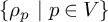 $\{\rho _p\ \vert \ p\in V\}$
, i.e.
$\{\rho _p\ \vert \ p\in V\}$
, i.e. $\Sigma ^{\prime }_{-D^{\prime }_1,\dots ,D^{\prime }_r}(1)=\sigma (1)$
, implying that
$\Sigma ^{\prime }_{-D^{\prime }_1,\dots ,D^{\prime }_r}(1)=\sigma (1)$
, implying that $\sigma =|\Sigma ^{\prime }_{-D^{\prime }_1,\dots ,-D^{\prime }_r}|$
. As desired, we therefore have constructed directly a fan
$\sigma =|\Sigma ^{\prime }_{-D^{\prime }_1,\dots ,-D^{\prime }_r}|$
. As desired, we therefore have constructed directly a fan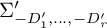 $\Sigma ^{\prime }_{-D^{\prime }_1,\dots ,-D_r'}$
that fulfills the conditions of Assumption 5.1.
$\Sigma ^{\prime }_{-D^{\prime }_1,\dots ,-D_r'}$
that fulfills the conditions of Assumption 5.1.
We look to apply Corollary 5.2 while using the above Proposition. To do so, it is sufficient to check if the dual cone $\sigma _W^\vee $
to
$\sigma _W^\vee $
to $\sigma _W$
defined in (5.3) is completely split reflexive Gorenstein, and that the LG model corresponds to a smooth complete intersection. In the rest of the section, we find combinatorial criteria and genericity hypotheses where both are satisfied.
$\sigma _W$
defined in (5.3) is completely split reflexive Gorenstein, and that the LG model corresponds to a smooth complete intersection. In the rest of the section, we find combinatorial criteria and genericity hypotheses where both are satisfied.
Lemma 5.4. Let $\sigma _W$
be as in (5.3). If its dual
$\sigma _W$
be as in (5.3). If its dual $\sigma _W^\vee $
is completely split Gorenstein of index r, then
$\sigma _W^\vee $
is completely split Gorenstein of index r, then $\sigma _W^\vee $
fulfills Assumption 5.1.
$\sigma _W^\vee $
fulfills Assumption 5.1.
Proof. The cone $\sigma _W^\vee $
is reflexive Gorenstein of index r, hence so is
$\sigma _W^\vee $
is reflexive Gorenstein of index r, hence so is $\sigma _W$
. The containment
$\sigma _W$
. The containment $|\Sigma _{-D_1,\dots ,-D_r}|^\vee \supseteq \sigma _W$
implies that
$|\Sigma _{-D_1,\dots ,-D_r}|^\vee \supseteq \sigma _W$
implies that $\mathfrak {n}_{\sigma _W}$
is the Gorenstein element
$\mathfrak {n}_{\sigma _W}$
is the Gorenstein element $\mathfrak {n}$
of
$\mathfrak {n}$
of $|\Sigma _{-D_1,\dots ,-D_r}|^\vee $
.
$|\Sigma _{-D_1,\dots ,-D_r}|^\vee $
.
Furthermore, since $|\Sigma _{-D_1,\dots ,-D_r}|$
is completely split and
$|\Sigma _{-D_1,\dots ,-D_r}|$
is completely split and $|\Sigma _{-D_1,\dots ,-D_r}|\subseteq \sigma _W^\vee $
, there are elements
$|\Sigma _{-D_1,\dots ,-D_r}|\subseteq \sigma _W^\vee $
, there are elements $e_1^*, \dots , e_r^* \in |\Sigma _{-D_1,\dots ,-D_r}|\subseteq \sigma _W^\vee $
so that
$e_1^*, \dots , e_r^* \in |\Sigma _{-D_1,\dots ,-D_r}|\subseteq \sigma _W^\vee $
so that $e_1^* + \dots +e_r^*= \mathfrak n_{|\Sigma _{-D_1,\dots ,-D_r}|}=\mathfrak {n}_{\sigma _W}$
. Proposition 2.3 in [Reference Batyrev and NillBN08] then implies that
$e_1^* + \dots +e_r^*= \mathfrak n_{|\Sigma _{-D_1,\dots ,-D_r}|}=\mathfrak {n}_{\sigma _W}$
. Proposition 2.3 in [Reference Batyrev and NillBN08] then implies that $\sigma _W$
is a Cayley cone and thus a completely split reflexive Gorenstein cone of index r. Since
$\sigma _W$
is a Cayley cone and thus a completely split reflexive Gorenstein cone of index r. Since $\sigma _W$
and
$\sigma _W$
and $\sigma _W^\vee $
are both completely split reflexive Gorenstein cones of index r, Proposition 5.3 implies that
$\sigma _W^\vee $
are both completely split reflexive Gorenstein cones of index r, Proposition 5.3 implies that $\sigma _W^\vee $
fulfills the Assumption 5.1.
$\sigma _W^\vee $
fulfills the Assumption 5.1.
The next result uses Lemma 5.4 and Bertini’s theorem to allow us to apply Corollary 5.2, hence providing a crepant categorical resolution as desired. First, let us set up some notation.
Definition 5.5. We say $\Xi $
is saturated if
$\Xi $
is saturated if $\Xi = \operatorname {Conv}(\Xi ) \cap (M\times \operatorname {\mathbb {Z}}^r)$
.
$\Xi = \operatorname {Conv}(\Xi ) \cap (M\times \operatorname {\mathbb {Z}}^r)$
.
Notation 5.6. Let $\Xi $
be saturated and
$\Xi $
be saturated and $\Psi $
a fan so that
$\Psi $
a fan so that $\Xi \subseteq |\Psi |^\vee $
. We write
$\Xi \subseteq |\Psi |^\vee $
. We write $\mathcal {F}_{\Xi }$
for the family of polynomials
$\mathcal {F}_{\Xi }$
for the family of polynomials $W: U_{\Psi } \to \mathbb {A}^1$
of the form
$W: U_{\Psi } \to \mathbb {A}^1$
of the form
 $$ \begin{align*}W = \sum_{m \in \Xi} c_m \prod_{\rho\in \Psi(1)} x^{\langle m, u_\rho\rangle }. \end{align*} $$
Corollary 5.7. Let $\Xi _W$
and
$\Xi _W$
and $\sigma _W$
be as defined in (5.3) and suppose
$\sigma _W$
be as defined in (5.3) and suppose $[\mathcal Z / G]$
is positive dimensional. Suppose
$[\mathcal Z / G]$
is positive dimensional. Suppose $\Xi _W$
is saturated,
$\Xi _W$
is saturated, $\sigma _W^\vee $
is completely split reflexive Gorenstein of index r and that
$\sigma _W^\vee $
is completely split reflexive Gorenstein of index r and that $W\in \mathcal F_\Xi $
is sufficiently generic. Then there is a crepant categorical resolution of
$W\in \mathcal F_\Xi $
is sufficiently generic. Then there is a crepant categorical resolution of $[\mathcal Z/G]$
 $$ \begin{align*} F&:\operatorname{D}^{\operatorname{b}}(\operatorname{coh }[\mathcal Z'/G']) \to \operatorname{D}^{\operatorname{b}}(\operatorname{coh }[\mathcal Z/G]), \\ G&:\operatorname{Perf} [\mathcal Z/G] \to \operatorname{D}^{\operatorname{b}}(\operatorname{coh }[\mathcal Z'/G']) \end{align*} $$
by $[\mathcal Z'/G']$
as in (4.3). Moreover, if
$[\mathcal Z'/G']$
as in (4.3). Moreover, if $[\mathcal {Z} / G]$
is smooth and
$[\mathcal {Z} / G]$
is smooth and $\dim [\mathcal {Z} / G]>0$
, then there is a derived equivalence between
$\dim [\mathcal {Z} / G]>0$
, then there is a derived equivalence between $[\mathcal {Z}/G]$
and
$[\mathcal {Z}/G]$
and $[\mathcal {Z}'/G']$
.
$[\mathcal {Z}'/G']$
.
Proof. By Lemma 5.4, the cone $\sigma _W^\vee $
fulfills Assumption 5.1. To apply Corollary 5.2 and obtain the desired categorical resolution, it remains to show that the complete intersection
$\sigma _W^\vee $
fulfills Assumption 5.1. To apply Corollary 5.2 and obtain the desired categorical resolution, it remains to show that the complete intersection $[\mathcal Z'/G']$
in
$[\mathcal Z'/G']$
in $\mathcal X_{\Sigma ^{\prime }}$
is indeed smooth. In the proof of Proposition 5.3, we have shown that the lattice polytopes giving
$\mathcal X_{\Sigma ^{\prime }}$
is indeed smooth. In the proof of Proposition 5.3, we have shown that the lattice polytopes giving $\sigma _W^\vee $
its Cayley structure in fact give a nef-partition of
$\sigma _W^\vee $
its Cayley structure in fact give a nef-partition of $\Delta _{-K_{\Sigma ^{\prime }}}$
. Hence, the divisors
$\Delta _{-K_{\Sigma ^{\prime }}}$
. Hence, the divisors $D^{\prime }_i$
corresponding to the nef-partition and giving the vector bundle
$D^{\prime }_i$
corresponding to the nef-partition and giving the vector bundle $\bigoplus _{i=1}^r \operatorname {\mathcal {O}}_{X_{\Sigma ^{\prime }}}(-D^{\prime }_i)$
are nef. In particular, by Proposition 6.3.12 in [Reference Cox, Little and SchenckCLS11] these divisors are basepoint free. Recall that any section
$\bigoplus _{i=1}^r \operatorname {\mathcal {O}}_{X_{\Sigma ^{\prime }}}(-D^{\prime }_i)$
are nef. In particular, by Proposition 6.3.12 in [Reference Cox, Little and SchenckCLS11] these divisors are basepoint free. Recall that any section $g\in \Gamma (\bigoplus \operatorname {\mathcal {O}}_{X_{\Sigma ^{\prime }}}(-D_i'))$
can be expressed via a sum of monomials
$g\in \Gamma (\bigoplus \operatorname {\mathcal {O}}_{X_{\Sigma ^{\prime }}}(-D_i'))$
can be expressed via a sum of monomials
 $$\begin{align*}\sum_{m\in H_{\mathfrak{n}}(1)\cap (M\times\operatorname{\mathbb{Z}}^r)\cap |\Psi|^\vee\cap M}c_mx^m\end{align*}$$
for some coefficients $c_m$
. By Bertini’s Theorem, a generic section
$c_m$
. By Bertini’s Theorem, a generic section $(g_1,\dots ,g_r)$
of the vector bundle will give a smooth complete intersection
$(g_1,\dots ,g_r)$
of the vector bundle will give a smooth complete intersection $[\mathcal Z'/G']:=Z(g_i)\subseteq \mathcal {X}_{\Sigma ^{\prime }}$
. The set of such generic sections is open and dense in the linear system spanned by the divisors
$[\mathcal Z'/G']:=Z(g_i)\subseteq \mathcal {X}_{\Sigma ^{\prime }}$
. The set of such generic sections is open and dense in the linear system spanned by the divisors $D_i'$
. As
$D_i'$
. As $\Xi _W$
is saturated, the open and dense set of generic sections must thus intersect the family corresponding to sections of the form
$\Xi _W$
is saturated, the open and dense set of generic sections must thus intersect the family corresponding to sections of the form $\sum _{m\in \Xi _W}c_mx^m$
, i.e. there is an element W in
$\sum _{m\in \Xi _W}c_mx^m$
, i.e. there is an element W in $\mathcal F_W$
such that the corresponding complete intersection
$\mathcal F_W$
such that the corresponding complete intersection $[\mathcal Z'/G']\subseteq \mathcal {X}_{\Sigma ^{\prime }}$
is smooth. Corollary 5.2 then gives the crepant categorical resolution as desired. We remark that these categories are connected when the Calabi-Yau orbifolds are positive dimensional and thus the equivalence holds if the additional hypotheses are satisfied.
$[\mathcal Z'/G']\subseteq \mathcal {X}_{\Sigma ^{\prime }}$
is smooth. Corollary 5.2 then gives the crepant categorical resolution as desired. We remark that these categories are connected when the Calabi-Yau orbifolds are positive dimensional and thus the equivalence holds if the additional hypotheses are satisfied.
The Corollary 5.7 gives us combinatorial conditions we can check to generate categorical resolutions as in Corollary 5.2. Since this is useful, we give below another formulation of it that may be more user-friendly for applications.
Definition 5.8. A lattice polytope $\Delta \subseteq N_{\operatorname {\mathbb {R}}}$
is called integrally closed, if any lattice point in the Gorenstein cone
$\Delta \subseteq N_{\operatorname {\mathbb {R}}}$
is called integrally closed, if any lattice point in the Gorenstein cone $\sigma $
over
$\sigma $
over $\Delta $
is a sum of lattice points from the support
$\Delta $
is a sum of lattice points from the support $\sigma (1)\simeq \Delta $
.
$\sigma (1)\simeq \Delta $
.
One can rewrite Corollary 5.7 in terms of the support polytopes in the following way.
Corollary 5.9. Suppose $\Xi $
is saturated and that
$\Xi $
is saturated and that $\tilde {\Delta }=\operatorname {Conv}(\Xi _W)$
and its dual
$\tilde {\Delta }=\operatorname {Conv}(\Xi _W)$
and its dual $\tilde {\Delta }^\vee $
are both integrally closed Gorenstein polytopes (of index r). Then, for a generic polynomial W in the family
$\tilde {\Delta }^\vee $
are both integrally closed Gorenstein polytopes (of index r). Then, for a generic polynomial W in the family $\mathcal F_\Xi $
, there is a crepant categorical resolution of
$\mathcal F_\Xi $
, there is a crepant categorical resolution of $[\mathcal Z/G]$
 $$ \begin{align*} F&:\operatorname{D}^{\operatorname{b}}(\operatorname{coh }[\mathcal Z'/G']) \to \operatorname{D}^{\operatorname{b}}(\operatorname{coh }[\mathcal Z/G]), \\ G&:\operatorname{Perf} [\mathcal Z/G] \to \operatorname{D}^{\operatorname{b}}(\operatorname{coh }[\mathcal Z'/G']) \end{align*} $$
by $[\mathcal Z'/G']$
as in (4.3).
$[\mathcal Z'/G']$
as in (4.3).
Proof. By Corollary 5.7 it is sufficient to show that $\sigma _W$
is completely split reflexive Gorenstein. Since
$\sigma _W$
is completely split reflexive Gorenstein. Since $\tilde {\Delta }$
is a Gorenstein polytope, by Proposition 2.11 in [Reference Batyrev and BorisovBB97] the cone
$\tilde {\Delta }$
is a Gorenstein polytope, by Proposition 2.11 in [Reference Batyrev and BorisovBB97] the cone $\sigma _W$
is reflexive Gorenstein. Since both
$\sigma _W$
is reflexive Gorenstein. Since both $\tilde {\Delta }$
and
$\tilde {\Delta }$
and $\tilde {\Delta }^\vee $
are integrally closed, by Corollary 3.9 of [Reference Batyrev and NillBN08] we obtain that
$\tilde {\Delta }^\vee $
are integrally closed, by Corollary 3.9 of [Reference Batyrev and NillBN08] we obtain that $\sigma _W$
is completely split and associated to a nef-partition. As
$\sigma _W$
is completely split and associated to a nef-partition. As $\Xi $
is saturated, there is a sufficiently generic polynomial in the family
$\Xi $
is saturated, there is a sufficiently generic polynomial in the family $\mathcal F_\Xi $
and the statement of the Corollary is not empty.
$\mathcal F_\Xi $
and the statement of the Corollary is not empty.
6 Examples and applications
The following highlights use-cases and examples to build intuition on exoflops.
6.1 Aspinwall’s example
We first explain an explicit example. We choose to repeat Aspinwall’s primary example in his paper [Reference AspinwallAsp15, §2.3, 3.1-5]. In some sense this is a simple case in comparison to the general case of what can happen above as the partial compactification in the exoflop is as simple as possible, but it provides intuition on why an exoflop can give rise to a categorical resolution.
Consider a quartic
 $$ \begin{align*}f = f_4(x_1, x_2, x_3) + x_0 f_3(x_1,x_2,x_3)+ x_0^2 f_2(x_1,x_2,x_3) \end{align*} $$
where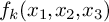 $f_k(x_1, x_2, x_3)$
are homogeneous equations of degree k. We assume that the
$f_k(x_1, x_2, x_3)$
are homogeneous equations of degree k. We assume that the $f_k$
are generic enough to avoid additional singularities. We have that
$f_k$
are generic enough to avoid additional singularities. We have that $f \in \Gamma (\operatorname {\mathbb {P}}^3, \mathcal {O}_{\operatorname {\mathbb {P}}^3}(4))$
, and
$f \in \Gamma (\operatorname {\mathbb {P}}^3, \mathcal {O}_{\operatorname {\mathbb {P}}^3}(4))$
, and $Z(f)\subseteq \operatorname {\mathbb {P}}^3$
is a singular quartic surface. Indeed, its singular locus is the point
$Z(f)\subseteq \operatorname {\mathbb {P}}^3$
is a singular quartic surface. Indeed, its singular locus is the point $(1:0:0:0)$
.
$(1:0:0:0)$
.
The vector bundle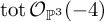 $\operatorname {tot} \operatorname {\mathcal {O}}_{\operatorname {\mathbb {P}}^3}(-4)$
can be written as a quotient stack
$\operatorname {tot} \operatorname {\mathcal {O}}_{\operatorname {\mathbb {P}}^3}(-4)$
can be written as a quotient stack $[(\operatorname {\mathbb {A}}^4 \setminus \{0\}) \times \operatorname {\mathbb {A}}^1 / \operatorname {\mathbb {G}_m}]$
, where
$[(\operatorname {\mathbb {A}}^4 \setminus \{0\}) \times \operatorname {\mathbb {A}}^1 / \operatorname {\mathbb {G}_m}]$
, where $\operatorname {\mathbb {G}_m}$
acts with weights
$\operatorname {\mathbb {G}_m}$
acts with weights $(1,1,1,1,-4)$
. Write u for the variable corresponding to the last coordinate. There is a
$(1,1,1,1,-4)$
. Write u for the variable corresponding to the last coordinate. There is a $\operatorname {\mathbb {G}_m}$
-invariant global function
$\operatorname {\mathbb {G}_m}$
-invariant global function
 $$ \begin{align*}W=uf: (\operatorname{\mathbb{A}}^4 \setminus\{0\}) \times \operatorname{\mathbb{A}}^1 \to \operatorname{\mathbb{A}}^1. \end{align*} $$
One computes that the critical locus has two irreducible components, when $u=f=0$
and
$u=f=0$
and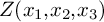 $Z(x_1,x_2, x_3)$
. The former component, when viewed in the stack
$Z(x_1,x_2, x_3)$
. The former component, when viewed in the stack $[(\operatorname {\mathbb {A}}^4 \setminus \{0\}) \times \operatorname {\mathbb {A}}^1 / \operatorname {\mathbb {G}_m}]$
is proper and isomorphic to
$[(\operatorname {\mathbb {A}}^4 \setminus \{0\}) \times \operatorname {\mathbb {A}}^1 / \operatorname {\mathbb {G}_m}]$
is proper and isomorphic to $Z(f)$
in the zero section
$Z(f)$
in the zero section $u=0$
. The latter is the
$u=0$
. The latter is the $\operatorname {\mathbb {A}}^1$
corresponding to the fiber over the point
$\operatorname {\mathbb {A}}^1$
corresponding to the fiber over the point $(1:0:0:0)$
.
$(1:0:0:0)$
.
We construct a partial compactification of the quotient stack $[(\operatorname {\mathbb {A}}^4 \setminus \{0\}) \times \operatorname {\mathbb {A}}^1 / \operatorname {\mathbb {G}_m}]$
and extend W. To do so, there is a stack isomorphism
$[(\operatorname {\mathbb {A}}^4 \setminus \{0\}) \times \operatorname {\mathbb {A}}^1 / \operatorname {\mathbb {G}_m}]$
and extend W. To do so, there is a stack isomorphism
 $$ \begin{align*}\varphi: [(\operatorname{\mathbb{A}}^4 \setminus\{0\}) \times \operatorname{\mathbb{A}}^1 / \operatorname{\mathbb{G}_m}] \to [(\operatorname{\mathbb{A}}^4 \setminus\{0\}) \times \operatorname{\mathbb{A}}^1 \times \operatorname{\mathbb{G}_m} / (\operatorname{\mathbb{G}_m})^2] \end{align*} $$
where the two $\operatorname {\mathbb {G}_m}$
act by weights
$\operatorname {\mathbb {G}_m}$
act by weights $(1,1,1,1,-4,0)$
and
$(1,1,1,1,-4,0)$
and $(1,0,0,0,-2,1)$
. We will use the variable y for this new coordinate. Consider the
$(1,0,0,0,-2,1)$
. We will use the variable y for this new coordinate. Consider the $(\operatorname {\mathbb {G}_m})^2$
-equivariant open immersion
$(\operatorname {\mathbb {G}_m})^2$
-equivariant open immersion
 $$ \begin{align*}i: (\operatorname{\mathbb{A}}^4 \setminus\{0\}) \times \operatorname{\mathbb{A}}^1 \times \operatorname{\mathbb{G}_m} \hookrightarrow \operatorname{\mathbb{A}}^6 \setminus Z(yx_0, yx_1, yx_2, yx_3, ux_0). \end{align*} $$
Here, we can extend W by taking the $(\operatorname {\mathbb {G}_m})^2$
-invariant function
$(\operatorname {\mathbb {G}_m})^2$
-invariant function
 $$ \begin{align*}\bar W= u(\bar f), \text{ where } \bar f = y^2f_4(x_1, x_2, x_3) + yx_0 f_3(x_1,x_2,x_3)+ x_0^2 f_2(x_1,x_2,x_3) \end{align*} $$
Since the additional strata added by the open immersion are away from the zero section of the line bundle, the first component of the critical locus of $\bar W$
is the same as W. However, the second is compactified to be a weighted projective line.
$\bar W$
is the same as W. However, the second is compactified to be a weighted projective line.
Remark 6.1. The above construction is simple in toric geometry. Take the standard fan for $\operatorname {\mathbb {P}}^3$
. The vector bundle is the toric variety associated to the fan obtained by the star subdivision at the ray generated by the lattice point
$\operatorname {\mathbb {P}}^3$
. The vector bundle is the toric variety associated to the fan obtained by the star subdivision at the ray generated by the lattice point $(0,0,0,1)$
of the cone
$(0,0,0,1)$
of the cone
 $$ \begin{align*}\operatorname{Cone}((1,0,0,1),(0,1,0,1),(0,0,1,1), (-1,-1,-1,1)).\end{align*} $$
The partial compactification is found by adding the cone
 $$ \begin{align*}\operatorname{Cone}((-1,0,0,1),(0,1,0,1),(0,0,1,1), (-1,-1,-1,1))\end{align*} $$
to the fan. The maximal special linear system allowed to take this partial compactification corresponds to
 $$ \begin{align*} \Xi = (M \times \operatorname{\mathbb{Z}}) \cap \operatorname{Conv}(&(-1,-1,-1,1), (-1,3,-1,1), (-1,-1,3,1), \\ &(1,-1,-1,1), (1,1,-1,1),(1,-1,1,1)) \end{align*} $$
Taking a generic enough potential using $\Xi $
is equivalent to choosing
$\Xi $
is equivalent to choosing $f_4, f_3$
, and
$f_4, f_3$
, and $f_2$
above generic enough to avoid singularities.
$f_2$
above generic enough to avoid singularities.
There is a toric flop (given by GIT) corresponding to the following birational map
 $$ \begin{align*}\psi: \operatorname{\mathbb{A}}^6 \setminus Z(yx_0, yx_1, yx_2, yx_3, ux_0) \dashrightarrow \operatorname{\mathbb{A}}^6 \setminus Z(x_0x_1, x_0x_2, x_0x_3, yx_1, yx_2, yx_3) \end{align*} $$
One can check that $[\operatorname {\mathbb {A}}^6 \setminus Z(x_0x_1, x_0x_2, x_0x_3, yx_1, yx_2, yx_3) / (\operatorname {\mathbb {G}_m})^2]$
is the total space of the anticanonical bundle of the blow up
$[\operatorname {\mathbb {A}}^6 \setminus Z(x_0x_1, x_0x_2, x_0x_3, yx_1, yx_2, yx_3) / (\operatorname {\mathbb {G}_m})^2]$
is the total space of the anticanonical bundle of the blow up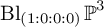 $\operatorname {Bl}_{(1:0:0:0)}\operatorname {\mathbb {P}}^3$
of
$\operatorname {Bl}_{(1:0:0:0)}\operatorname {\mathbb {P}}^3$
of $\operatorname {\mathbb {P}}^3$
at
$\operatorname {\mathbb {P}}^3$
at $(1:0:0:0)$
, and that
$(1:0:0:0)$
, and that ${\bar f \in \Gamma (\operatorname {Bl}_{(1:0:0:0)}\operatorname {\mathbb {P}}^3, -K_{\operatorname {Bl}_{(1:0:0:0)}\operatorname {\mathbb {P}}^3})}$
. Since f was chosen sufficiently generically,
${\bar f \in \Gamma (\operatorname {Bl}_{(1:0:0:0)}\operatorname {\mathbb {P}}^3, -K_{\operatorname {Bl}_{(1:0:0:0)}\operatorname {\mathbb {P}}^3})}$
. Since f was chosen sufficiently generically, $Z(\bar f)$
is smooth. One then obtains that
$Z(\bar f)$
is smooth. One then obtains that $Z(\bar f)\subseteq \operatorname {Bl}_{(1:0:0:0)}\operatorname {\mathbb {P}}^3 $
is a categorical resolution of
$Z(\bar f)\subseteq \operatorname {Bl}_{(1:0:0:0)}\operatorname {\mathbb {P}}^3 $
is a categorical resolution of $Z(f)\subseteq \operatorname {\mathbb {P}}^3$
(as an example of Corollary 5.2).
$Z(f)\subseteq \operatorname {\mathbb {P}}^3$
(as an example of Corollary 5.2).
6.2 Derived equivalences with varying bundle structures
As seen above, a standard (toric) resolution of singularities can appear from an exoflop, but there are some derived equivalences that are found where a birational equivalence is not obvious. In this section we exhibit the convex geometry that leads to such a derived equivalence. This involves when the toric vector bundle structures differ (that is, there are different sets of minimal generators that sum to $\mathfrak {n}$
, as seen in Assumption 5.1). We will consider three different Calabi-Yau complete intersections (we have chosen a small dimensional case to attempt to not cloud the example with too much unnecessary toric geometry).
$\mathfrak {n}$
, as seen in Assumption 5.1). We will consider three different Calabi-Yau complete intersections (we have chosen a small dimensional case to attempt to not cloud the example with too much unnecessary toric geometry).
For this example, we work in $N= \operatorname {\mathbb {Z}}^5$
and take the rays
$N= \operatorname {\mathbb {Z}}^5$
and take the rays $\rho _1, \dots , \rho _{12}$
with minimal generators
$\rho _1, \dots , \rho _{12}$
with minimal generators
 $$ \begin{align*} &u_{\rho_1}= (2,0,-1,0,1), \hspace{0.45em} &u_{\rho_2} = (0,2,-1,0,1), \hspace{0.45em} &u_{\rho_3}=(-1,-1,2,1,0), \hspace{0.45em} &u_{\rho_4} = (-1,-1,0,1,0), \\ &u_{\rho_5} = (1,-1,0,1,0), \hspace{0.45em} &u_{\rho_6} = (-1,1,0,1,0), \hspace{0.45em} &u_{\rho_7}=(0,0,1,0,1), \hspace{0.45em} &u_{\rho_8} = (0,0,-1,0,1), \\ &u_{\rho_9} = (0,-1,0,1,0), \hspace{0.45em} &u_{\rho_{10}} = (0,1,0,0,1), \hspace{0.45em} &u_{\rho_{11}} = (0,0,0,1,0), \hspace{0.45em} &u_{\rho_{12}}=(0,0,0,0,1). \end{align*} $$
Consider the following three cones:
 $$ \begin{align*} & \sigma = \operatorname{Cone}(\rho_1,\dots,\rho_8),\\ & \sigma_1=\operatorname{Cone}(\rho_1,\rho_2,\rho_3,\rho_4,\rho_{11},\rho_{12}),\\ & \sigma_2=\operatorname{Cone}(\rho_1,\rho_2,\rho_3,\rho_4, \rho_9, \rho_{10}). \end{align*} $$
We refer the reader to Figure 1 to get some geometric intuition in the convex geometry. Note that $\rho _9, \rho _{10}, \rho _{11}, \rho _{12} \in \sigma $
, hence
$\rho _9, \rho _{10}, \rho _{11}, \rho _{12} \in \sigma $
, hence $\sigma _1,\sigma _2\subseteq \sigma $
. Moreover, all 3 cones are completely split Gorenstein cones of index 2 with respect to
$\sigma _1,\sigma _2\subseteq \sigma $
. Moreover, all 3 cones are completely split Gorenstein cones of index 2 with respect to $\mathfrak {m} = (0,0,0,1,1)$
.
$\mathfrak {m} = (0,0,0,1,1)$
.
A depiction of the minimal generators $u_i := u_{\rho _i}$
of the cone
$u_i := u_{\rho _i}$
of the cone $\sigma \subseteq \operatorname {\mathbb {R}}^5$
when projected to the first three coordinates. Here, the minimal generators in black have their fourth coordinate
$\sigma \subseteq \operatorname {\mathbb {R}}^5$
when projected to the first three coordinates. Here, the minimal generators in black have their fourth coordinate $1$
and those in magenta have fifth coordinate
$1$
and those in magenta have fifth coordinate $1$
. The purple vertex is
$1$
. The purple vertex is $(0,0,0)$
and the only point where the tetra intersect after projecting down to the first three coordinates. The cone
$(0,0,0)$
and the only point where the tetra intersect after projecting down to the first three coordinates. The cone $\sigma $
is a cone over the Cayley product of these two tetrahedra.
$\sigma $
is a cone over the Cayley product of these two tetrahedra.

Figure 1 Long description
At the center is a purple vertex labeled u sub 7, marking the intersection of two tetrahedra. The black tetrahedron, positioned lower left, has vertices labeled u sub 3, u sub 4, u sub 5, and u sub 6, with additional black points u sub 9 on edge u sub 5 to u sub 7. The magenta tetrahedron, positioned upper right, has vertices labeled u sub 1, u sub 2, u sub 7, and u sub 8, with additional magenta points u sub 10 on edge u sub 2 to u sub 7 and u sub 8 on edge u sub 1 to u sub 7. All edges are drawn between corresponding vertices, forming two overlapping tetrahedra. The black tetrahedron's vertices have fourth coordinate one, while the magenta tetrahedron's vertices have fifth coordinate one. The intersection at u sub 7 is the only shared point after projection to the first three coordinates.
Note that the cone $\sigma ^\vee $
is a completely split Gorenstein cone of index 2 with respect to
$\sigma ^\vee $
is a completely split Gorenstein cone of index 2 with respect to $\mathfrak {n} = (0,0,0,1,1)$
. We take
$\mathfrak {n} = (0,0,0,1,1)$
. We take $\Xi _W = H_{\mathfrak {n}}(1)\cap M \cap \sigma ^\vee $
, which one can compute to be
$\Xi _W = H_{\mathfrak {n}}(1)\cap M \cap \sigma ^\vee $
, which one can compute to be
 $$ \begin{align*}\Xi_W = \{(1,0,0,1,0), (0,1,0,1,0), (0,0,1,0,1), (-1,-1,-1,0,1), (0,0,0,1,0), (0,0,0,0,1)\}. \end{align*} $$
We name each of these above lattice points $m_1, \dots , m_6 \in \Xi _W$
(in the above order), and can write the following global function on any fan
$m_1, \dots , m_6 \in \Xi _W$
(in the above order), and can write the following global function on any fan $\Sigma $
with
$\Sigma $
with $\Sigma (1) = \{ \rho _1, \dots , \rho _{12}\}$
.
$\Sigma (1) = \{ \rho _1, \dots , \rho _{12}\}$
.
 $$ \begin{align*} W = \sum_{i=1}^6 c_i \prod_{\rho\in \sigma(1)} x^{\langle m_i, u_{\rho_i}\rangle } &= c_1 x_1^2 x_5^2x_9x_{11} + c_2 x_2^2 x_6^2 x_{10}x_{11} + c_3 x_3^2 x_7^2 x_{10} x_{12} \\ &\qquad +c_4 x_4^2 x_8^2 x_9x_{12} + c_5 x_3x_4x_5x_6x_9 x_{11} + c_6 x_1x_2x_7x_8x_{10}x_{12}. \end{align*} $$
We can use W to define complete intersections in different toric varieties. Since $\sigma , \sigma _1, \sigma _2$
all are completely split Gorenstein cones of index 2, there exist fans
$\sigma , \sigma _1, \sigma _2$
all are completely split Gorenstein cones of index 2, there exist fans $\Sigma , \Sigma _1,$
and
$\Sigma , \Sigma _1,$
and $\Sigma _2$
that are total spaces of rank two vector bundles over dimension 3 toric varieties.
$\Sigma _2$
that are total spaces of rank two vector bundles over dimension 3 toric varieties.
For $\Sigma _1$
, we star subdivide with respect to
$\Sigma _1$
, we star subdivide with respect to $\rho _{11}$
and
$\rho _{11}$
and $\rho _{12}$
as
$\rho _{12}$
as $u_{\rho _{11}}+u_{\rho _{12}}= \mathfrak {n}$
. In this case, we can reduce the potential to
$u_{\rho _{11}}+u_{\rho _{12}}= \mathfrak {n}$
. In this case, we can reduce the potential to
 $$ \begin{align*}W' = (c_1 x_1^2 + c_2 x_2^2 + c_5x_3x_4)x_{11} + (c_3 x_3^2 + c_4 x_4^2 + c_6 x_1x_2)x_{12}. \end{align*} $$
and one can compute that this corresponds to a complete intersection
 $$ \begin{align*}\mathcal{Z}' := Z(c_1 x_1^2 + c_2 x_2^2 + c_5x_3x_4, c_3 x_3^2 + c_4 x_4^2 + c_6 x_1x_2) \subseteq [\mathbb{P}^3 / (\operatorname{\mathbb{Z}}/4\operatorname{\mathbb{Z}})], \end{align*} $$
where a generator g of the $\operatorname {\mathbb {Z}}/4\operatorname {\mathbb {Z}}$
acts on
$\operatorname {\mathbb {Z}}/4\operatorname {\mathbb {Z}}$
acts on $\operatorname {\mathbb {P}}^3$
by
$\operatorname {\mathbb {P}}^3$
by $g\cdot (x_1:x_2:x_3:x_4) = (x_1:-x_2:ix_3:-ix_4)$
.
$g\cdot (x_1:x_2:x_3:x_4) = (x_1:-x_2:ix_3:-ix_4)$
.
On the other hand, for $\Sigma _2$
, we star subdivide with respect to
$\Sigma _2$
, we star subdivide with respect to $\rho _9$
and
$\rho _9$
and $\rho _{10}$
as
$\rho _{10}$
as $u_{\rho _{9}}+u_{\rho _{10}}= \mathfrak {n}$
. The potential reduces to
$u_{\rho _{9}}+u_{\rho _{10}}= \mathfrak {n}$
. The potential reduces to
 $$ \begin{align*}W"= (c_1 x_1^2 +c_4 x_4^2+ c_5 x_3x_4)x_9 + (c_2 x_2^2 + c_3 x_3^2 + c_6 x_1x_2)x_{10} \end{align*} $$
and this corresponds to the complete intersection
 $$ \begin{align*}\mathcal{Z}" = Z(c_1 x_1^2 +c_4 x_4^2+ c_5 x_3x_4, c_2 x_2^2 + c_3 x_3^2 + c_6 x_1x_2) \subseteq [\mathbb{P}^3 / (\operatorname{\mathbb{Z}}/2\operatorname{\mathbb{Z}})], \end{align*} $$
where the generator g of $\operatorname {\mathbb {Z}}/2\operatorname {\mathbb {Z}}$
acts on
$\operatorname {\mathbb {Z}}/2\operatorname {\mathbb {Z}}$
acts on $\operatorname {\mathbb {P}}^3$
by
$\operatorname {\mathbb {P}}^3$
by $g\cdot (x_1:x_2:x_3:x_4) = (-x_1:-x_2:x_3:x_4)$
.
$g\cdot (x_1:x_2:x_3:x_4) = (-x_1:-x_2:x_3:x_4)$
.
If the $c_i$
are generic, one can check that both
$c_i$
are generic, one can check that both $\mathcal {Z}'$
and
$\mathcal {Z}'$
and $\mathcal {Z}''$
are smooth Calabi-Yau orbifolds. Lastly, there is a
$\mathcal {Z}''$
are smooth Calabi-Yau orbifolds. Lastly, there is a $\Sigma $
with support
$\Sigma $
with support $\sigma $
that is a rank 2 vector bundle and one can use W to define a Calabi-Yau complete intersection
$\sigma $
that is a rank 2 vector bundle and one can use W to define a Calabi-Yau complete intersection $[\mathcal {Z}/G]$
in it. By Corollary 5.7, there is a derived equivalence between
$[\mathcal {Z}/G]$
in it. By Corollary 5.7, there is a derived equivalence between $[\mathcal {Z}/G]$
and both
$[\mathcal {Z}/G]$
and both $\mathcal {Z}'$
and
$\mathcal {Z}'$
and $\mathcal {Z}''$
, hence
$\mathcal {Z}''$
, hence $\operatorname {D}^{\operatorname {b}}(\operatorname {coh }\mathcal {Z}') \cong \operatorname {D}^{\operatorname {b}}(\operatorname {coh }\mathcal {Z}'')$
.
$\operatorname {D}^{\operatorname {b}}(\operatorname {coh }\mathcal {Z}') \cong \operatorname {D}^{\operatorname {b}}(\operatorname {coh }\mathcal {Z}'')$
.
Note the ‘shuffling’ of monomials that happens between the two potentials $W'$
and
$W'$
and $W''$
, which happens when different rays are used as the rays corresponding to the bundle coordinates. This can be used to make interesting equivalences between CICYs. In this example, it can be shown that
$W''$
, which happens when different rays are used as the rays corresponding to the bundle coordinates. This can be used to make interesting equivalences between CICYs. In this example, it can be shown that $\mathcal Z'$
and
$\mathcal Z'$
and $\mathcal Z''$
are birational, but it is not clear if the derived equivalent Calabi-Yau complete intersections are always birational for higher-dimensional examples.
$\mathcal Z''$
are birational, but it is not clear if the derived equivalent Calabi-Yau complete intersections are always birational for higher-dimensional examples.
6.3 A higher-dimensional generalization of the Libgober-Teitelbaum family
In [Reference Libgober and TeitelbaumLT93], Libgober and Teitelbaum proposed a mirror to a highly symmetric Calabi-Yau complete intersection given by two cubics in $\operatorname {\mathbb {P}}^5$
. In [Reference MalterMal24], it was proven to be derived equivalent to the Batyrev-Borisov mirror to two cubics in
$\operatorname {\mathbb {P}}^5$
. In [Reference MalterMal24], it was proven to be derived equivalent to the Batyrev-Borisov mirror to two cubics in $\operatorname {\mathbb {P}}^5$
. In this subsection, we look at the most natural generalization to the Libgober-Teitelbaum family, and show it has a crepant categorical resolution using the Batyrev-Borisov mirror to the complete intersection of two degree n polynomials in
$\operatorname {\mathbb {P}}^5$
. In this subsection, we look at the most natural generalization to the Libgober-Teitelbaum family, and show it has a crepant categorical resolution using the Batyrev-Borisov mirror to the complete intersection of two degree n polynomials in $\operatorname {\mathbb {P}}^{2n-1}$
. We fix
$\operatorname {\mathbb {P}}^{2n-1}$
. We fix $n\in \operatorname {\mathbb {Z}}$
,
$n\in \operatorname {\mathbb {Z}}$
, $n\ge 2$
, throughout what follows.
$n\ge 2$
, throughout what follows.
Define two polynomials
 $$ \begin{align*} Q_{1,\lambda}&=x_1^n+x_2^n+\dots+x_n^n-\lambda x_{n+1}\dots x_{2n}, \\ Q_{2,\lambda}&=x_{n+1}^n+x_{n+2}^n+\dots+x_{2n}^n-\lambda x_1\dots x_n. \end{align*} $$
Their complete intersection $Z_{\lambda }:=Z(Q_{1,\lambda }, Q_{2,\lambda })\subseteq \operatorname {\mathbb {P}}^{2n-1}$
is a smooth Calabi-Yau complete intersection in
$Z_{\lambda }:=Z(Q_{1,\lambda }, Q_{2,\lambda })\subseteq \operatorname {\mathbb {P}}^{2n-1}$
is a smooth Calabi-Yau complete intersection in $n=3$
for
$n=3$
for $\lambda $
such that
$\lambda $
such that $\lambda ^6\ne 0,3^6$
and it is a singular complete intersection otherwise. It is also highly symmetric.
$\lambda ^6\ne 0,3^6$
and it is a singular complete intersection otherwise. It is also highly symmetric.
Denote by $\zeta _n$
a primitive n-th root of unity. Consider
$\zeta _n$
a primitive n-th root of unity. Consider $\alpha _i,\beta _i\in \operatorname {\mathbb {Z}}\pmod {n}$
(
$\alpha _i,\beta _i\in \operatorname {\mathbb {Z}}\pmod {n}$
( $1\le i\le n-1$
) and
$1\le i\le n-1$
) and $\delta \in \operatorname {\mathbb {Z}}\pmod {n^2}$
such that
$\delta \in \operatorname {\mathbb {Z}}\pmod {n^2}$
such that
 $$\begin{align*}\zeta_{n^2}^\delta=\zeta_n^{\beta_1+\dots+\beta_{n-1}}=\zeta_n^{\alpha_1+\dots+\alpha_{n-1}}. \end{align*}$$
Consider the following subgroup $G_n$
of
$G_n$
of $PGL(2n-1,\operatorname {\mathbb {C}})$
, given by automorphisms of the form
$PGL(2n-1,\operatorname {\mathbb {C}})$
, given by automorphisms of the form

One can check that the action of $G_n$
on
$G_n$
on $\operatorname {\mathbb {P}}^{2n-1}$
acts invariantly on the variety
$\operatorname {\mathbb {P}}^{2n-1}$
acts invariantly on the variety $Z_{\lambda }$
, hence we can define the orbifold
$Z_{\lambda }$
, hence we can define the orbifold $[\mathcal {Z}_n/G_n]:=Z(Q_{1,n,\lambda },Q_{2,n,\lambda })\subseteq [\operatorname {\mathbb {P}}^{2n-1}/G_n]$
. For
$[\mathcal {Z}_n/G_n]:=Z(Q_{1,n,\lambda },Q_{2,n,\lambda })\subseteq [\operatorname {\mathbb {P}}^{2n-1}/G_n]$
. For $n=3$
, this is the Libgober-Teitelbaum mirror to the complete intersection of two cubics in
$n=3$
, this is the Libgober-Teitelbaum mirror to the complete intersection of two cubics in $\operatorname {\mathbb {P}}^5$
, which is proven to be derived equivalent to members of the Batyrev-Borisov mirror family in [Reference MalterMal24]. However, for
$\operatorname {\mathbb {P}}^5$
, which is proven to be derived equivalent to members of the Batyrev-Borisov mirror family in [Reference MalterMal24]. However, for $n\geq 4$
, the techniques for proving derived equivalence to the corresponding Batyrev-Borisov construction used in loc. cit. do not work any further, as
$n\geq 4$
, the techniques for proving derived equivalence to the corresponding Batyrev-Borisov construction used in loc. cit. do not work any further, as $[\mathcal {Z}_n/G_n]$
is singular. Using the results of § 5, we will demonstrate instead that the natural result of applying the Batyrev-Borisov construction yields categorical resolutions to the family
$[\mathcal {Z}_n/G_n]$
is singular. Using the results of § 5, we will demonstrate instead that the natural result of applying the Batyrev-Borisov construction yields categorical resolutions to the family $[\mathcal {Z}_n/G_n]$
.
$[\mathcal {Z}_n/G_n]$
.
We start by noting that since $[\mathcal {Z}_n/G_n]$
is a complete intersection of the two
$[\mathcal {Z}_n/G_n]$
is a complete intersection of the two $Q_{i,\lambda }$
in
$Q_{i,\lambda }$
in $\mathcal {X}_n=[\operatorname {\mathbb {P}}^{2n-1}/G_n]$
, there is a corresponding gauged LG model with superpotential
$\mathcal {X}_n=[\operatorname {\mathbb {P}}^{2n-1}/G_n]$
, there is a corresponding gauged LG model with superpotential
 $$\begin{align*}W=u_1Q_{1,\lambda}+u_2Q_{2,\lambda}, \end{align*}$$
This will be a global function for the total space $\operatorname {tot}(\operatorname {\mathcal {O}}_{\mathcal {X}_n}(-D_1)\oplus \operatorname {\mathcal {O}}_{\mathcal {X}_n}(-D_2))$
of a rank two vector bundle where
$\operatorname {tot}(\operatorname {\mathcal {O}}_{\mathcal {X}_n}(-D_1)\oplus \operatorname {\mathcal {O}}_{\mathcal {X}_n}(-D_2))$
of a rank two vector bundle where $Q_{i,\lambda } \in \Gamma (\mathcal {X}_n, \operatorname {\mathcal {O}}_{\mathcal {X}_n} (D_i))$
. One can construct the toric variety for this vector bundle, which will be
$Q_{i,\lambda } \in \Gamma (\mathcal {X}_n, \operatorname {\mathcal {O}}_{\mathcal {X}_n} (D_i))$
. One can construct the toric variety for this vector bundle, which will be $N_{\operatorname {\mathbb {R}}}$
where
$N_{\operatorname {\mathbb {R}}}$
where $N=\operatorname {\mathbb {Z}}^{2n+1}$
. Give this lattice the standard
$N=\operatorname {\mathbb {Z}}^{2n+1}$
. Give this lattice the standard $\operatorname {\mathbb {Z}}$
-basis
$\operatorname {\mathbb {Z}}$
-basis $e_1, \dots , e_{2n+1}$
. We now will define the rays
$e_1, \dots , e_{2n+1}$
. We now will define the rays $\rho _1, \dots , \rho _{2n}, \tau _1, \tau _2$
of the fan
$\rho _1, \dots , \rho _{2n}, \tau _1, \tau _2$
of the fan $\Sigma _{\mathcal {X}_n}$
by giving its primitive generators. To do so, we first write
$\Sigma _{\mathcal {X}_n}$
by giving its primitive generators. To do so, we first write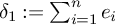 $\delta _1 := \sum _{i=1}^n e_i$
and
$\delta _1 := \sum _{i=1}^n e_i$
and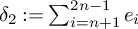 $\delta _2 := \sum _{i=n+1}^{2n-1} e_i$
. Then the primitive generators for the rays are
$\delta _2 := \sum _{i=n+1}^{2n-1} e_i$
. Then the primitive generators for the rays are
 $$ \begin{align}\begin{aligned} u_{\rho_i} &= ne_i - \delta_2 + e_{2n+1}, \text{ for } 1 \le i \le n;\\ u_{\rho_i} &= -\delta_1 + n e_i + e_{2n}, \text{ for } n+1 \le i \le 2n-1;\\ u_{\rho_{2n}} &= -\delta_1 + e_{2n};\\ u_{\tau_1} &= e_{2n}; \\ u_{\tau_2} &= e_{2n+1}. \end{aligned}\end{align} $$
We associate the coordinates $x_1, \dots , x_{2n}$
to
$x_1, \dots , x_{2n}$
to $\rho _1, \dots , \rho _{2n}$
and
$\rho _1, \dots , \rho _{2n}$
and $u_1, u_2$
to
$u_1, u_2$
to $\tau _1, \tau _2$
. One can see that
$\tau _1, \tau _2$
. One can see that $\operatorname {tot}(\operatorname {\mathcal {O}}_{\mathcal {X}_n}(-D_1)\oplus \operatorname {\mathcal {O}}_{\mathcal {X}_n}(-D_2))$
is the toric variety corresponding to the fan obtained by star subdividing the cone
$\operatorname {tot}(\operatorname {\mathcal {O}}_{\mathcal {X}_n}(-D_1)\oplus \operatorname {\mathcal {O}}_{\mathcal {X}_n}(-D_2))$
is the toric variety corresponding to the fan obtained by star subdividing the cone $\operatorname {Cone}(\rho _1, \dots , \rho _{2n}, \tau _1, \tau _2)$
along
$\operatorname {Cone}(\rho _1, \dots , \rho _{2n}, \tau _1, \tau _2)$
along $\tau _1$
and
$\tau _1$
and $\tau _2$
.
$\tau _2$
.
We now move to the potential W. Write $e_i^*\in M$
for the dual basis vector to
$e_i^*\in M$
for the dual basis vector to $e_i$
. Define
$e_i$
. Define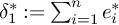 $\delta _1^* := \sum _{i=1}^n e_i^*$
and
$\delta _1^* := \sum _{i=1}^n e_i^*$
and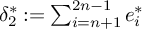 $\delta _2^* := \sum _{i=n+1}^{2n-1} e_i^*$
. Next, one can compute that
$\delta _2^* := \sum _{i=n+1}^{2n-1} e_i^*$
. Next, one can compute that $W = \sum _{i=1}^{2n} x^{m_i} - \lambda x^{m_{2n+1}} - \lambda x^{m_{2n+2}}$
, where
$W = \sum _{i=1}^{2n} x^{m_i} - \lambda x^{m_{2n+1}} - \lambda x^{m_{2n+2}}$
, where
 $$ \begin{align}\begin{aligned} m_i &= e_i^* + e_{2n}^*, \text{ for } 1 \le i \le n, \\ m_i &= e_i^* + e_{2n+1}^*, \text{ for } n+1 \le i \le 2n-1, \\ m_{2n} &= (- \textstyle\sum_{i=1}^{2n-1} e_i^*) + e_{2n+1}^*, \\ m_{2n+1} &= e_{2n}^*, \\ m_{2n+2} &= e_{2n+1}^*. \end{aligned}\end{align} $$
Hence $\Xi _W = \{m_1, \dots , m_{2n+2}\}$
and
$\Xi _W = \{m_1, \dots , m_{2n+2}\}$
and $\sigma _W = \operatorname {Cone}(\Xi _W)$
. The dual cone
$\sigma _W = \operatorname {Cone}(\Xi _W)$
. The dual cone $\sigma _W^\vee $
is then the cone over the
$\sigma _W^\vee $
is then the cone over the $4n+2$
points
$4n+2$
points $u_{\rho _1}, \dots , u_{\rho _{4n}}, u_{\tau _1}, u_{\tau _2}$
, where
$u_{\rho _1}, \dots , u_{\rho _{4n}}, u_{\tau _1}, u_{\tau _2}$
, where $u_{\rho _1}, \dots , u_{\rho _{2n}}, u_{\tau _1}, u_{\tau _2}$
are as in (6.1) and
$u_{\rho _1}, \dots , u_{\rho _{2n}}, u_{\tau _1}, u_{\tau _2}$
are as in (6.1) and
 $$ \begin{align}\begin{aligned} u_{\rho_{2n+i}} &= - \delta_1 + ne_i + e_{2n}, \text{ for } 1 \le i \le n, \\ u_{\rho_{3n+i}} &= - \delta_2 + ne_{n+i} + e_{2n+1}, \text{ for } 1 \le i \le n-1, \\ u_{\rho_{4n}} &= -\delta_2 + e_{2n+1}. \end{aligned}\end{align} $$
The cone $\sigma _W^\vee $
is completely split reflexive Gorenstein of index 2. Thus, Lemma 5.4 implies that
$\sigma _W^\vee $
is completely split reflexive Gorenstein of index 2. Thus, Lemma 5.4 implies that $\sigma _W^\vee $
fulfills Assumption 5.1.
$\sigma _W^\vee $
fulfills Assumption 5.1.
Denote by $\Sigma ^{\prime }_{-D_1',-D_2'}$
the fan whose support is
$\Sigma ^{\prime }_{-D_1',-D_2'}$
the fan whose support is $\sigma _W^\vee $
in Assumption 5.1. Write
$\sigma _W^\vee $
in Assumption 5.1. Write $x_i$
for the variables associated to the new rays
$x_i$
for the variables associated to the new rays $\rho _i$
. The extended superpotential
$\rho _i$
. The extended superpotential $\bar W$
on the partial compactification takes the form
$\bar W$
on the partial compactification takes the form
 $$ \begin{align*} \bar W &=u_1(x_1^nx_{2n+1}^n+\dots+x_n^{n}x_{3n}^n-\lambda x_{n+1}\cdots x_{3n}) \ + \\ &\qquad u_2(x_{n+1}^nx_{3n+1}^n+\dots+x_{2n}^nx_{4n}^n-\lambda x_1\cdots x_n\cdot x_{3n+1}\cdots x_{4n}). \end{align*} $$
Then one obtains a complete intersection $[\mathcal {Z}^{\prime }_n / G_n'] \subseteq [U_{\Sigma ^{\prime }} / G_{\Sigma ^{\prime }}]$
.
$[\mathcal {Z}^{\prime }_n / G_n'] \subseteq [U_{\Sigma ^{\prime }} / G_{\Sigma ^{\prime }}]$
.
Lastly, one can verify that the complete intersection $[\mathcal {Z}^{\prime }_n/G_n']$
as in (4.3) is smooth when
$[\mathcal {Z}^{\prime }_n/G_n']$
as in (4.3) is smooth when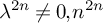 $\lambda ^{2n} \ne 0,n^{2n}$
, hence Corollary 5.2 implies that we have a categorical resolution of
$\lambda ^{2n} \ne 0,n^{2n}$
, hence Corollary 5.2 implies that we have a categorical resolution of $[\mathcal {Z}_n/G_n]$
via
$[\mathcal {Z}_n/G_n]$
via $[\mathcal {Z}^{\prime }_n/G_n']$
.
$[\mathcal {Z}^{\prime }_n/G_n']$
.
Remark 6.2. For $n=2$
, the complete intersection
$n=2$
, the complete intersection $[\mathcal {Z}_2/G_2]\subseteq [\operatorname {\mathbb {P}}^{3}/G_2]$
is smooth and Corollary 5.2 yields a derived equivalence between
$[\mathcal {Z}_2/G_2]\subseteq [\operatorname {\mathbb {P}}^{3}/G_2]$
is smooth and Corollary 5.2 yields a derived equivalence between $[\mathcal {Z}_2/G_2]$
and
$[\mathcal {Z}_2/G_2]$
and $[\mathcal {Z}^{\prime }_2/G_2']$
. Furthermore, the
$[\mathcal {Z}^{\prime }_2/G_2']$
. Furthermore, the $n=2$
complete intersection
$n=2$
complete intersection $[\mathcal {Z}_2/G_2]\subseteq [\operatorname {\mathbb {P}}^3/G_2]$
features in §6.2.
$[\mathcal {Z}_2/G_2]\subseteq [\operatorname {\mathbb {P}}^3/G_2]$
features in §6.2.
6.4 Mirror Constructions
Take a $\operatorname {\mathbb {Q}}$
-Fano toric variety corresponding to a polytope
$\operatorname {\mathbb {Q}}$
-Fano toric variety corresponding to a polytope $\Delta $
. In [Reference Artebani, Comparin and GuilbotACG16], Artebani, Comparin and Guilbot prove that general hypersurfaces associated to a special linear system corresponding to canonical subpolytopes
$\Delta $
. In [Reference Artebani, Comparin and GuilbotACG16], Artebani, Comparin and Guilbot prove that general hypersurfaces associated to a special linear system corresponding to canonical subpolytopes $\Delta '$
of the anticanonical polytope
$\Delta '$
of the anticanonical polytope $\Delta $
are Calabi-Yau. In particular, given a
$\Delta $
are Calabi-Yau. In particular, given a $\operatorname {\mathbb {Q}}$
-Fano toric variety with anticanonical polytope
$\operatorname {\mathbb {Q}}$
-Fano toric variety with anticanonical polytope $\Delta _2$
, one can take a special linear system corresponding to a canonical polytope
$\Delta _2$
, one can take a special linear system corresponding to a canonical polytope $\Delta _1$
and consider its corresponding family of Calabi-Yau varieties. Here
$\Delta _1$
and consider its corresponding family of Calabi-Yau varieties. Here $(\Delta _1, \Delta _2)$
form a good pair if both
$(\Delta _1, \Delta _2)$
form a good pair if both $\Delta _1$
and
$\Delta _1$
and $\Delta _2^*$
are canonical. Consequently,
$\Delta _2^*$
are canonical. Consequently, $(\Delta ^*_2, \Delta ^*_1)$
also form a good pair, forming a duality. This generalizes both mirror constructions of Batyrev-Borisov and Berglund-Hübsch-Krawitz. In the former case, when
$(\Delta ^*_2, \Delta ^*_1)$
also form a good pair, forming a duality. This generalizes both mirror constructions of Batyrev-Borisov and Berglund-Hübsch-Krawitz. In the former case, when $\Delta $
is reflexive, then
$\Delta $
is reflexive, then $(\Delta , \Delta )$
is a good pair and one recovers Batyrev duality. There has been recent work by Rossi that generalizes this work and suggests an iterative process of doing this, by introducing what is known as f-duality [Reference RossiRos22, Reference RossiRos23]. In this case, however, the type of singularities that can arise is unclear.
$(\Delta , \Delta )$
is a good pair and one recovers Batyrev duality. There has been recent work by Rossi that generalizes this work and suggests an iterative process of doing this, by introducing what is known as f-duality [Reference RossiRos22, Reference RossiRos23]. In this case, however, the type of singularities that can arise is unclear.
In [Reference Doran, Favero and KellyDFK18, Theorem 1.2], the authors proved that given good pairs $(\Delta _1, \Delta _2)$
and
$(\Delta _1, \Delta _2)$
and $(\Delta _1', \Delta _2)$
members of their dual families were derived equivalent. This is expected, as when one has multiple constructions for the mirror of two symplectomorphic manifolds, these ‘multiple’ mirrors must be derived equivalent according to the Homological Mirror Symmetry Conjecture. As
$(\Delta _1', \Delta _2)$
members of their dual families were derived equivalent. This is expected, as when one has multiple constructions for the mirror of two symplectomorphic manifolds, these ‘multiple’ mirrors must be derived equivalent according to the Homological Mirror Symmetry Conjecture. As $\Delta _1$
and
$\Delta _1$
and $\Delta _1'$
define two different families of hypersurfaces in the same toric variety, a generalization of Moser’s theorem would imply a symplectomorphism.
$\Delta _1'$
define two different families of hypersurfaces in the same toric variety, a generalization of Moser’s theorem would imply a symplectomorphism.
One expects a similar situation in the complete intersection case. To our knowledge, there is no sufficient criterion for polytopes defining complete intersections that are Calabi-Yau that is weaker than using the standard nef partition of reflexive polytopes for codimension higher than one. Consider nef partitions of reflexive polytopes ${\Delta _1 = \Delta _{1,1} + \dots + \Delta _{1,r}}$
, and
${\Delta _1 = \Delta _{1,1} + \dots + \Delta _{1,r}}$
, and $\Delta _2 = \Delta _{2,1} + \dots + \Delta _{2,r}$
in
$\Delta _2 = \Delta _{2,1} + \dots + \Delta _{2,r}$
in $M_{\operatorname {\mathbb {R}}}$
where one has the inclusion of Cayley polytopes
$M_{\operatorname {\mathbb {R}}}$
where one has the inclusion of Cayley polytopes
 $$ \begin{align*} \Delta_{1,1} * \cdots * \Delta_{1,r} \subseteq \Delta_{2,1} * \dots * \Delta_{2,r}. \end{align*} $$
Since $\{\Delta _{i,j}\kern-1pt\}_{j=1}^r$
is a nef partition, it corresponds to vector bundles
$\{\Delta _{i,j}\kern-1pt\}_{j=1}^r$
is a nef partition, it corresponds to vector bundles $\mathcal {V} \kern1.3pt{=}\kern1.3pt \bigoplus _{j=1}^r\kern-1pt \operatorname {\mathcal {O}}_{X_{\Sigma _{\Delta _i}}}\kern-1pt(-D_{i,j}\kern-1pt)$
over the toric varieties
$\mathcal {V} \kern1.3pt{=}\kern1.3pt \bigoplus _{j=1}^r\kern-1pt \operatorname {\mathcal {O}}_{X_{\Sigma _{\Delta _i}}}\kern-1pt(-D_{i,j}\kern-1pt)$
over the toric varieties $X_{\Sigma _{\Delta _i}}$
, where
$X_{\Sigma _{\Delta _i}}$
, where $\Sigma _{\Delta _i}$
is the normal fan to
$\Sigma _{\Delta _i}$
is the normal fan to $\Delta _i$
and
$\Delta _i$
and $D_{i,j}$
is the divisor associated to the polytope
$D_{i,j}$
is the divisor associated to the polytope $\Delta _{i,j}$
. The lattice points in
$\Delta _{i,j}$
. The lattice points in $\Delta _{1,1} * \cdots * \Delta _{1,r}$
correspond to global functions of the vector bundle. Each global function corresponds to a (stacky) complete intersection
$\Delta _{1,1} * \cdots * \Delta _{1,r}$
correspond to global functions of the vector bundle. Each global function corresponds to a (stacky) complete intersection $\mathcal {Z}_i$
. We then have by Corollary 5.7 a derived equivalence between
$\mathcal {Z}_i$
. We then have by Corollary 5.7 a derived equivalence between $\mathcal {Z}_1$
and
$\mathcal {Z}_1$
and $\mathcal {Z}_2$
.
$\mathcal {Z}_2$
.
Question 6.3. Is there a combinatorial condition for Cayley products of length $r>1$
that generalizes canonical in
$r>1$
that generalizes canonical in $r=1$
where one obtains Calabi-Yau orbifolds? Does some higher codimension version of the mirror construction of Artebani, Comparin and Guilbot hold?
$r=1$
where one obtains Calabi-Yau orbifolds? Does some higher codimension version of the mirror construction of Artebani, Comparin and Guilbot hold?
If so, then, when one can use such a new mirror construction or Batyrev-Borisov, then we expect there to be a derived equivalence between these new Calabi-Yau mirrors and those constructed by Batyrev-Borisov that can be proven using exoflops.
Acknowledgments.
We thank David Favero heartily for discussions and previous work on related topics. We also thank Nick Addington, Alessandro Chiodo, Cyril Closset, Luigi Martinelli, and Ed Segal for discussions relating to this project. We also thank the referee for their comments that improved the paper. The first author acknowledges support from EPSRC Grant EP/S03062X/1 and a UK Research and Innovation Future Leaders Fellowship MR/T01783X/1,2. They also thank the Fondation Sciences Mathématiques de Paris for support and the Institut de Mathématiques de Jussieu for their hospitality where portions of this paper were written. The second author was supported by the EPSRC grants EP/L016516/1, Postdoctoral Fellowships for Research in Japan (Short-term (PE), Fellowship ID: PE23724), the Beijing Natural Science Foundation International Scientist Program IS25013 and the Beijing Postdoctoral Research Foundation.
Competing interests
The authors have no competing interest.
Data Availability Statement
No data was generated.



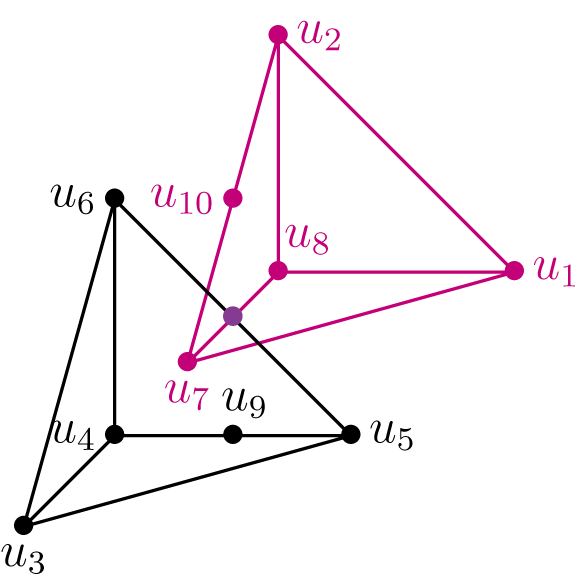


 Open access

