

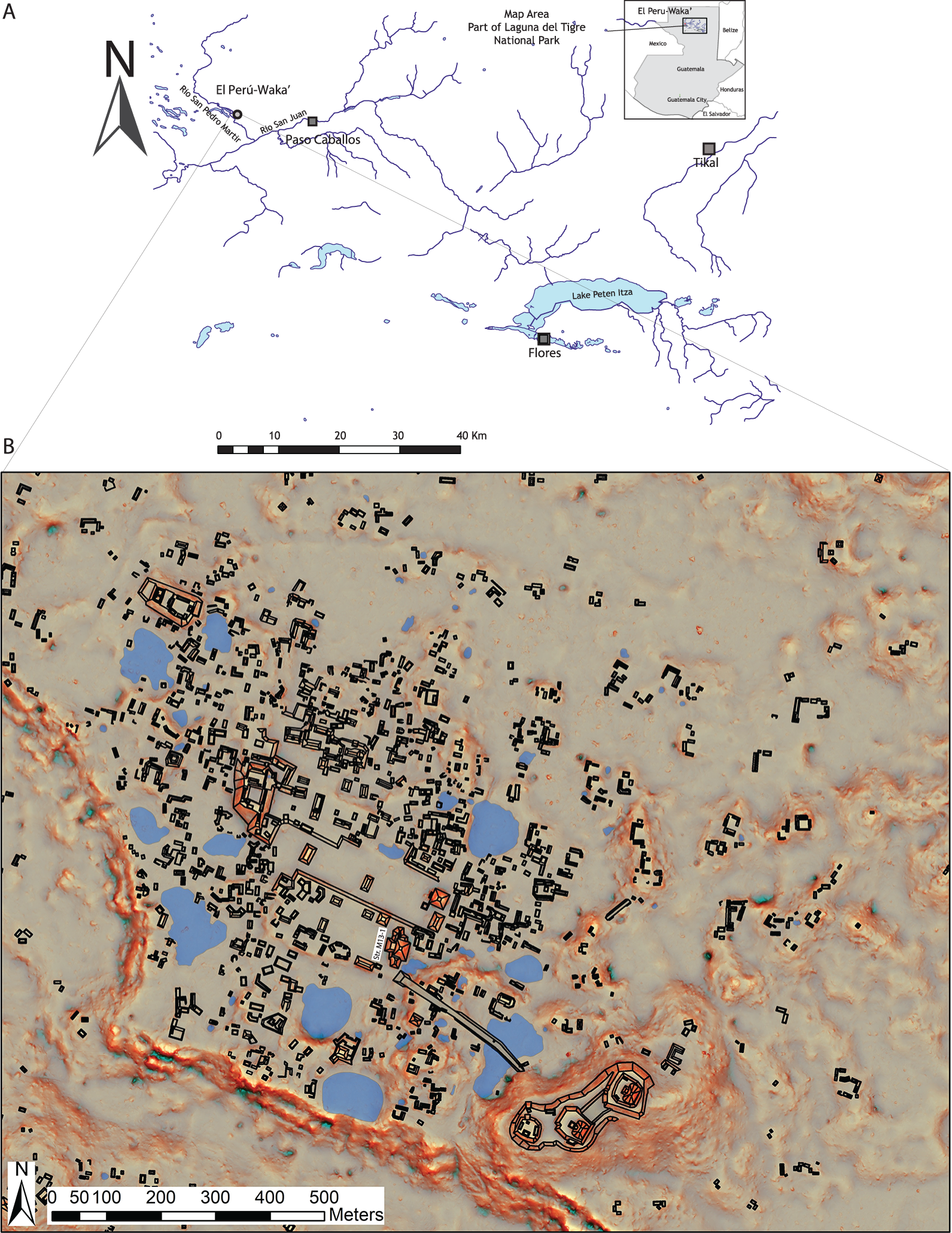
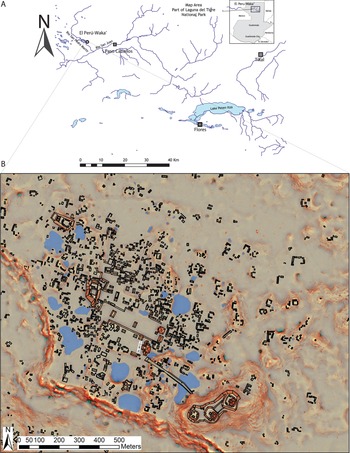
During the late ninth through the eleventh centuries CE, numerous urban centers in the southern Maya Lowlands experienced dips in population (Arnauld et al. Reference Arnauld, Eva, Dominique, Melanie, Arnauld, Beekman and Pereira2021). This generally occurred alongside a noted decline in the royal commissioning of historical texts outlining the accomplishments of divine rulers (Demarest et al. Reference Demarest, Rice and Rice2004). This same pattern is true of ancient Waka’ wherein we see evidence for a decline of royal authority while also noting fleeting attempts at collective governance that would not endure (Eppich and Van Oss Reference Eppich, Van Oss and Pérez2017). Waka’ held a strategic juncture atop an 80 m high escarpment, east of the San Juan River and north of the San Pedro Mártir River in northwestern Petén, Guatemala (Figure 1A). The urban core (see Figure 1B) is about 1.35 km2 (Marken and Pérez Dueñas Reference Marken, Pérez Dueñas, Pérez, Pérez and Freidel2017) with a compact settlement and varied topography (Marken Reference Marken2011, Reference Marken, Marken and Fitzsimmons2015). The city’s occupational history spanned the Late Preclassic (approximately 400 BCE–250 CE) to the Terminal Classic (830–1100 CE; see Figure 2). In the following article we consider how this living landscape was perceived by its inhabitants during this period of gradual population decline at Waka’.
(A) Map of northwestern Petén; image by Evangelia Tsesmeli; (B) map of Waka’ with Structure M13-1 labeled; image by Damien Marken. Images courtesy of the Ministry of Culture and Sports of Guatemala and the Proyecto Arqueológico Waka’. (Color online)
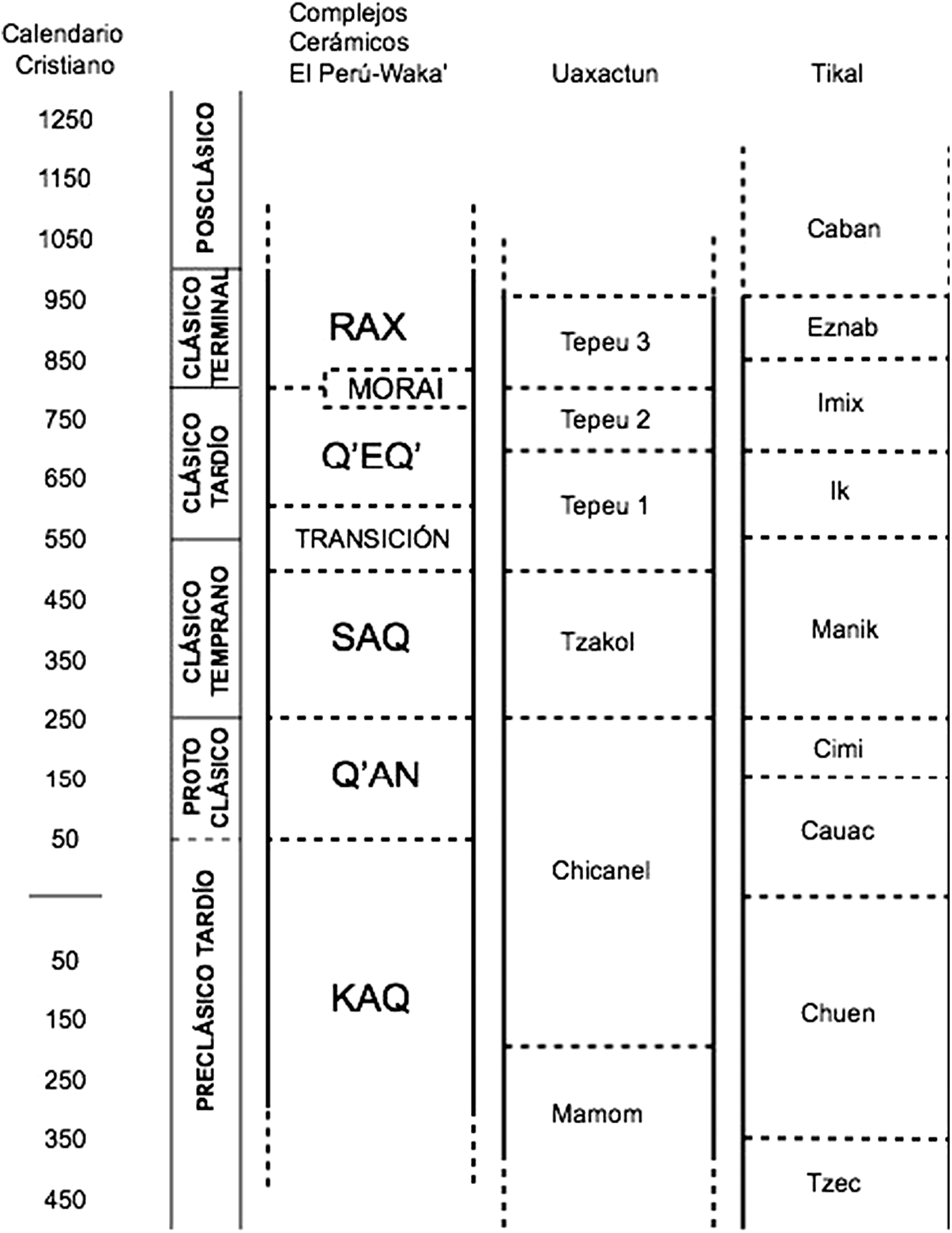
El Perú-Waka’ Ceramic Chronology (after Eppich Reference Eppich, Van Oss and Pérez2017:Figure 12.1).
The politically charged sociopolitical context of the ninth through the eleventh centuries in the southern Lowlands was no doubt rife with tension and uncertainty as people were likely to be constantly on the move (Arnauld et al. Reference Arnauld, Eva, Dominique, Melanie, Arnauld, Beekman and Pereira2021). We acknowledge this critical backdrop in our consideration of how gradual abandonment of ancient Waka’ was broadly perceived. We also embrace threads of critical ontology (Alberti Reference Alberti2016) in recognition that Waka’ was in the past, as it is in the present, a living landscape. More specifically, we find that the traditional Western scientific traditions of empiricism and skepticism in which we have all trained are insufficient to accurately interpret how people of Waka’ engaged with this politically and ritually charged animate landscape. Because “Western” is a broadly generalizing term, we refer here to the tendency toward assumed binaries such as animate versus inert or ritual versus utilitarian that are representative of one way of understanding the world/universe and are not meaningful within Indigenous ontologies (e.g., Astor-Aguilera Reference Astor-Aguilera2008, Reference Astor-Aguilera, Astor-Aguilera and Harvey2018; Baker Reference Baker2020; Deloria Reference Deloria1997; Viveiros de Castro Reference Viveiros de Castro2004; Watts Reference Watts2013). We find the best way forward is a relational ontological perspective that takes seriously the contributions of Indigenous ontology for understanding how the world works (see Montejo Reference Montejo2021; Montgomery Reference Montgomery, Crellin, Cipolla, Montgomery, Harris and Moore2021; Todd Reference Todd2016). We see the built environment of Waka’ (both past and present) as one possessing animate qualities (for analogous perspectives, see Brown and Emory Reference Brown and Emery2008; Woodfill and Henderson Reference Woodfill Brent and Henderson2024). We follow recent scholarship focused on Mesoamerica (e.g., Brown Reference Brown and Aveni2015; Harrison-Buck Reference Harrison-Buck, Hutson and Ardren2020; Horowitz et al. Reference Horowitz, Brown, Yaeger and Cap2024; Pacheco Reference Pacheco2021; Palka et al. Reference Palka, Lozada Toledo, Folch González and Lopez2023) that emphasizes the mutually constituent nature of humans and other-than human entities that would be characterized by Western logic as inert or inanimate.
Additionally, the matter of what “engagement” with a living landscape may have entailed during its gradual abandonment could have involved a wide range of actions, including those in association with small or large-scale buildings or pathways. They may have constituted anthropogenic modifications, large and small-scale agricultural activities, and/or the deployment of ritual technologies (after Walker Reference Walker, Skibo, Walker and Nielson1995, Reference Walker and Schiffer2001; Walker and Berryman Reference Walker and Berryman2023). Such activities could also have occurred in domestic or public spheres and at both large and small scales. Given this variability, we limit the present discussion to public engagement with Waka’s primary civic-ceremonial shrine, situated in the heart of the city, spanning the eastern edge of a grand plaza. It was the focus of sustained publicly conveyed political engagement for centuries at Waka’. Indeed, investigations of its Early Classic architecture reveal this space was the locus of an important royal tomb with Teotihuacan-style offerings (Eppich Reference Eppich2025; Navarro-Farr et al. Reference Navarro-Farr, Kelly and Freidel2024) that served as an accession platform, a point to which we briefly return below.
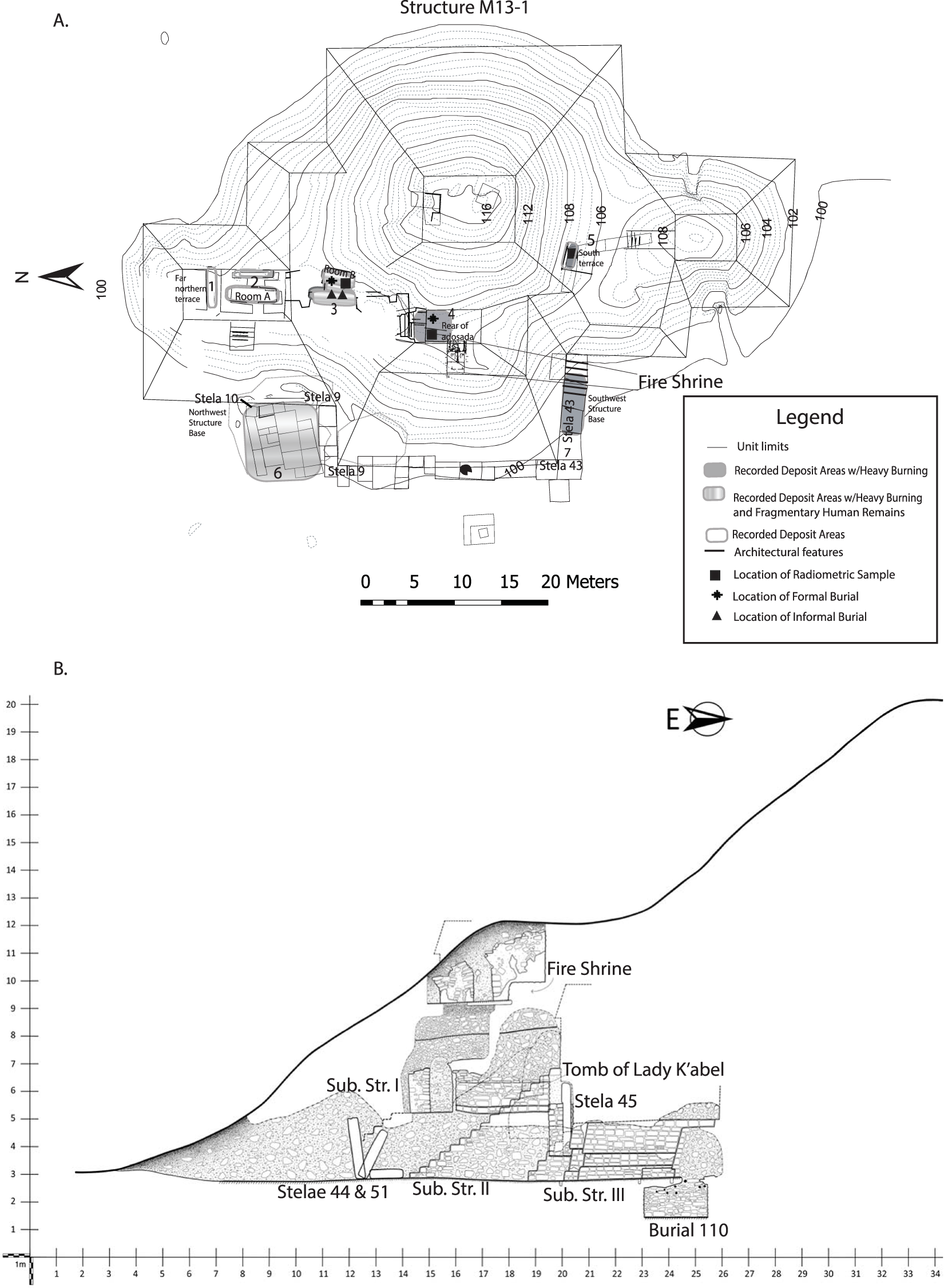
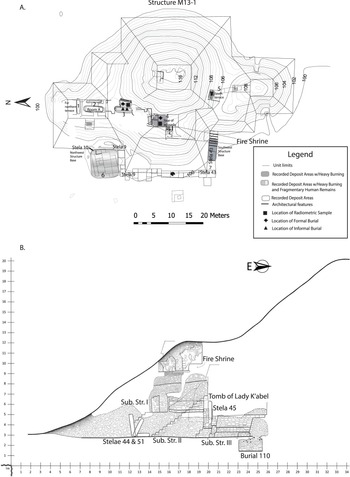
The public’s continued engagement with this building (Navarro-Farr Reference Navarro-Farr2009, Reference Navarro-Farr, Iannone, Houk and Schwake2016) during and after the decline of the city’s royal court was identified through painstakingly point-plotted layers of in situ deposits blanketing the building’s varied final occupational surfaces. These acts, which feature diverse patterns (for details, see Navarro-Farr Reference Navarro-Farr, Iannone, Houk and Schwake2016), were carried out largely by non-elite practitioners throughout Waka’s gradual abandonment, precisely during the ninth through the eleventh centuries. As stated above, we frame our interpretations by embracing a relational ontology approach grounded in Indigenous ontologies whereby these acts were informed in the understanding of Waka’ and this building as not only the dwelling places of living ancestors and vitality but as themselves animate entities capable of meaningful relational interactions with humans and other-than-humans (see Harrison-Buck Reference Harrison-Buck2012a; Kosiba Reference Kosiba, Kosiba, Janusek and Cummins2020; Woodfill and Henderson Reference Woodfill Brent and Henderson2024). The building, identified as Structure M13-1, possessed a monumental hearth atop its final phase fronting platform, or adosada. We thus refer to it henceforth as the Fire Shrine (see Figure 3).
(A) Plan view of Structure M13-1 featuring deposit locations (numbered 1–7) with descriptions, burial locations, radiometric sample locations, and architectural features. Figure by Evangelia Tsesmeli, Olivia Navarro-Farr, and Ana Lucía Arroyave Prera; image courtesy of the Dirección General del Patrimonio Cultural y Natural del Ministerio de Cultura y Deportes of Guatemala. (B) Profile Illustration of Structure M13-1 adosada featuring locations of Sub-Structures (numbered I-III), Stelae, Burial of Lady K’abel, Burial 110, and the Fire Shrine. Figure by René Ozaeta and Olivia Navarro-Farr; image courtesy of the Dirección General del Patrimonio Cultural y Natural del Ministerio de Cultura y Deportes of Guatemala.
Research at the Fire Shrine
Long-term research at the Fire Shrine reveals a richly layered architectural history. The building is situated between the westerly palace complex and the spatially restricted eastern hilltop Mirador Group. West-facing, with the Terminal phase aligned along true north, this building dominates the eastern edge of the vast Plaza 2 (see Figure 1B). Viewshed analyses (Tsesmeli Reference Tsesmeli, Navarro-Farr and Rich2014) and the building’s command of Waka’s largest plaza underscore its role in public performance (Inomata Reference Inomata, Inomata and Coben2006a, Reference Inomata2006b; Inomata and Coben Reference Inomata and Coben2006). The main pyramid is flanked by asymmetrical constructions expanding north and south with a high-rising central summit temple. The imposing central pyramid features an adosada like those at Teotihuacan (Fash et al. Reference Fash, Tokovinine, Fash, Fash and López Luján2009) with an unroofed masonry superstructure that housed a massive hearth.
As with earlier periods, the final chapters of Waka’s political history, spanning the late eighth to the late ninth centuries, are vividly legible within the final architectural phases of this building. They demonstrate continued engagement, even amid the clearly declining influence of Waka’s royal court. The architecture dating from the end of the Late Classic period, from about 750 CE, into the ceramically identifiable Late-Terminal Classic period transition of the Morai ceramic complex from 770 to 820 CE (see Figure 2), included the adosada platform topped with the Fire Shrine. Constructions postdating use of the Fire Shrine both atop and at the base of the structure were far less grand and more akin to refurbishments or modifications, demonstrating diminishing investment in the form of crudely fashioned alterations, wall additions, rudimentary stucco replastering, and stone alignments built with reutilized cut stones. These alterations demonstrate that the ancient inhabitants continued to engage with the structure through and even well beyond the tumult of the city’s declining royal court, which based on epigraphic evidence, likely fully declined by the early ninth century (see Guenter Reference Guenter, Navarro-Farr and Rich2014).
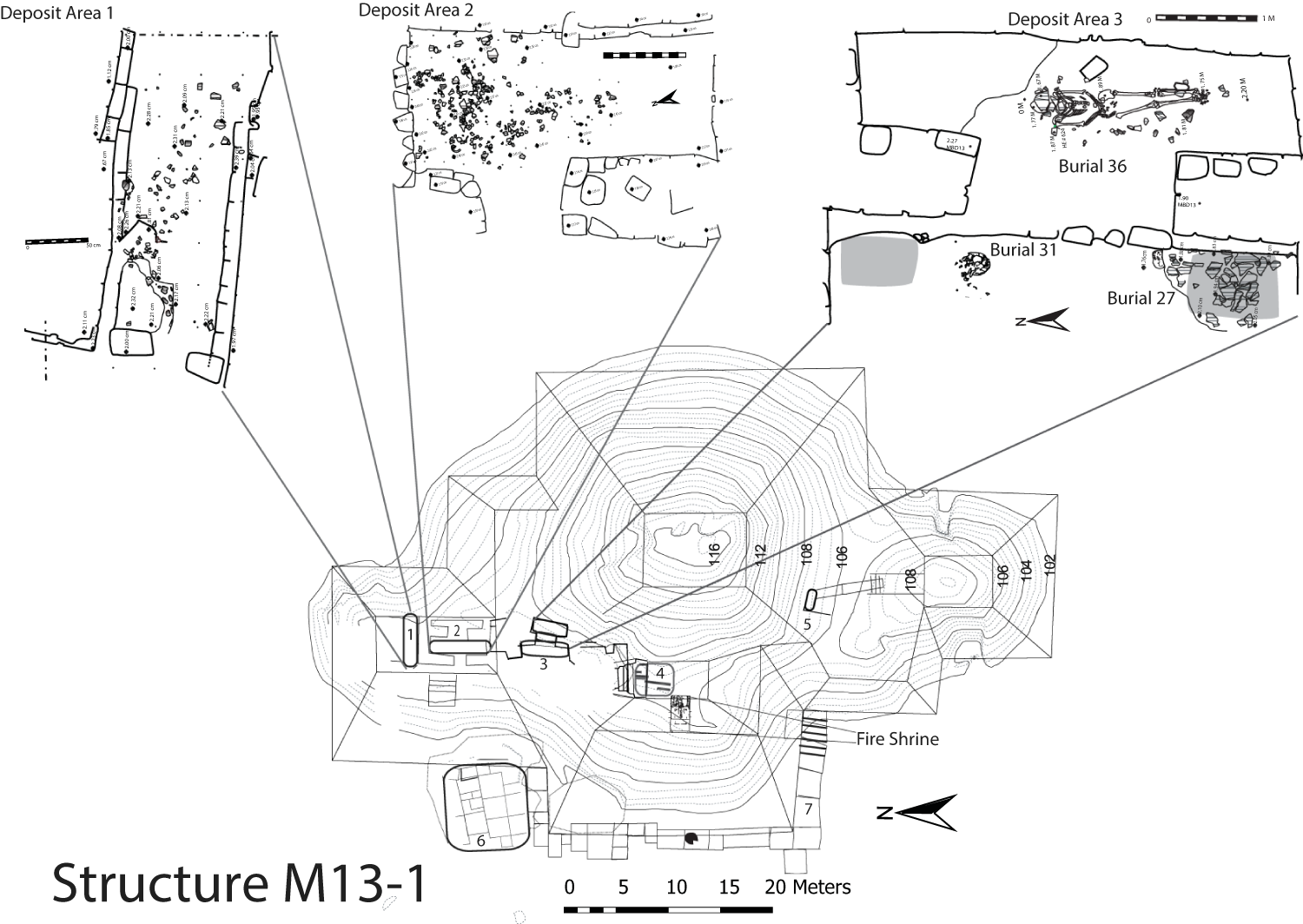
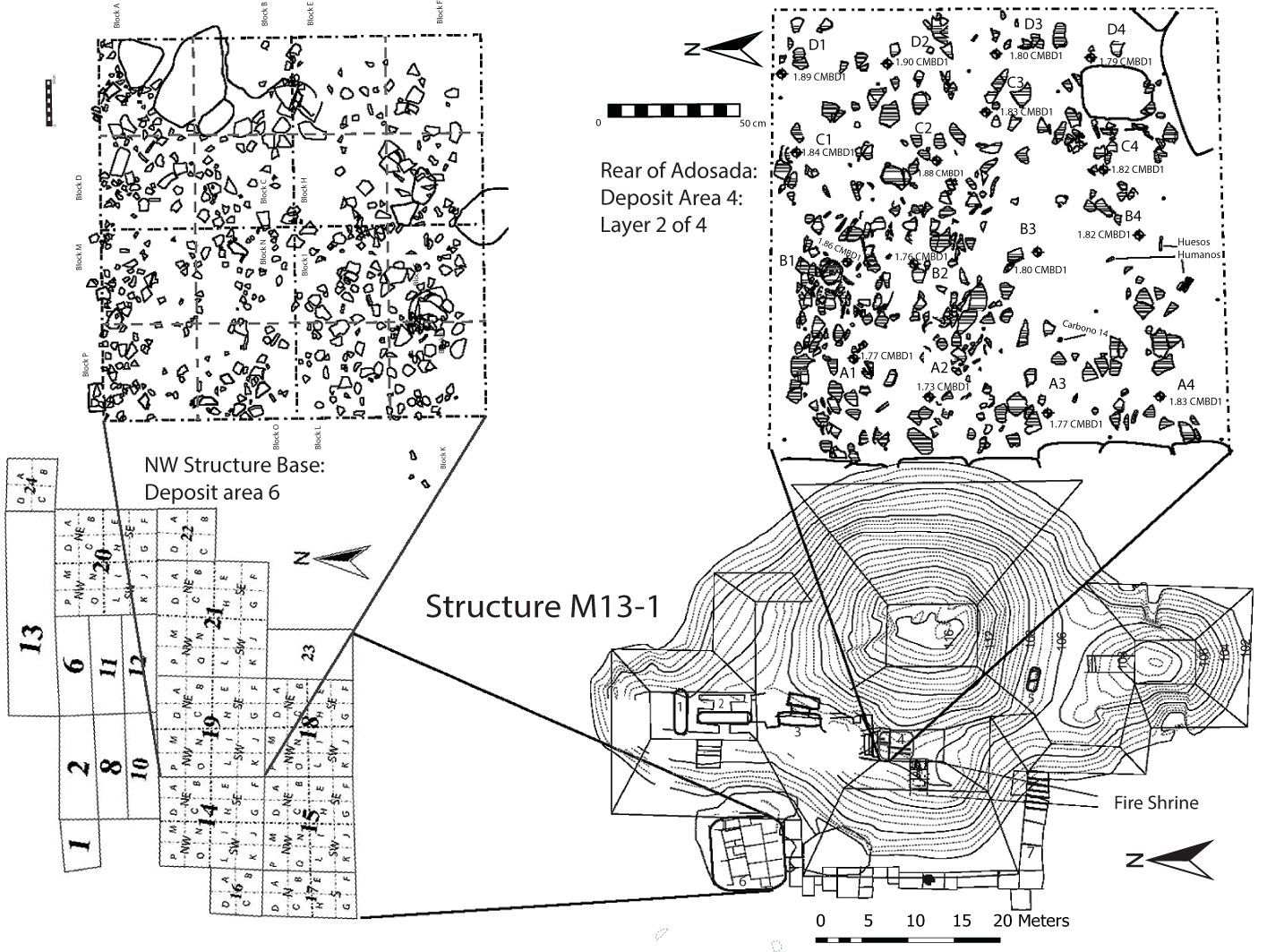
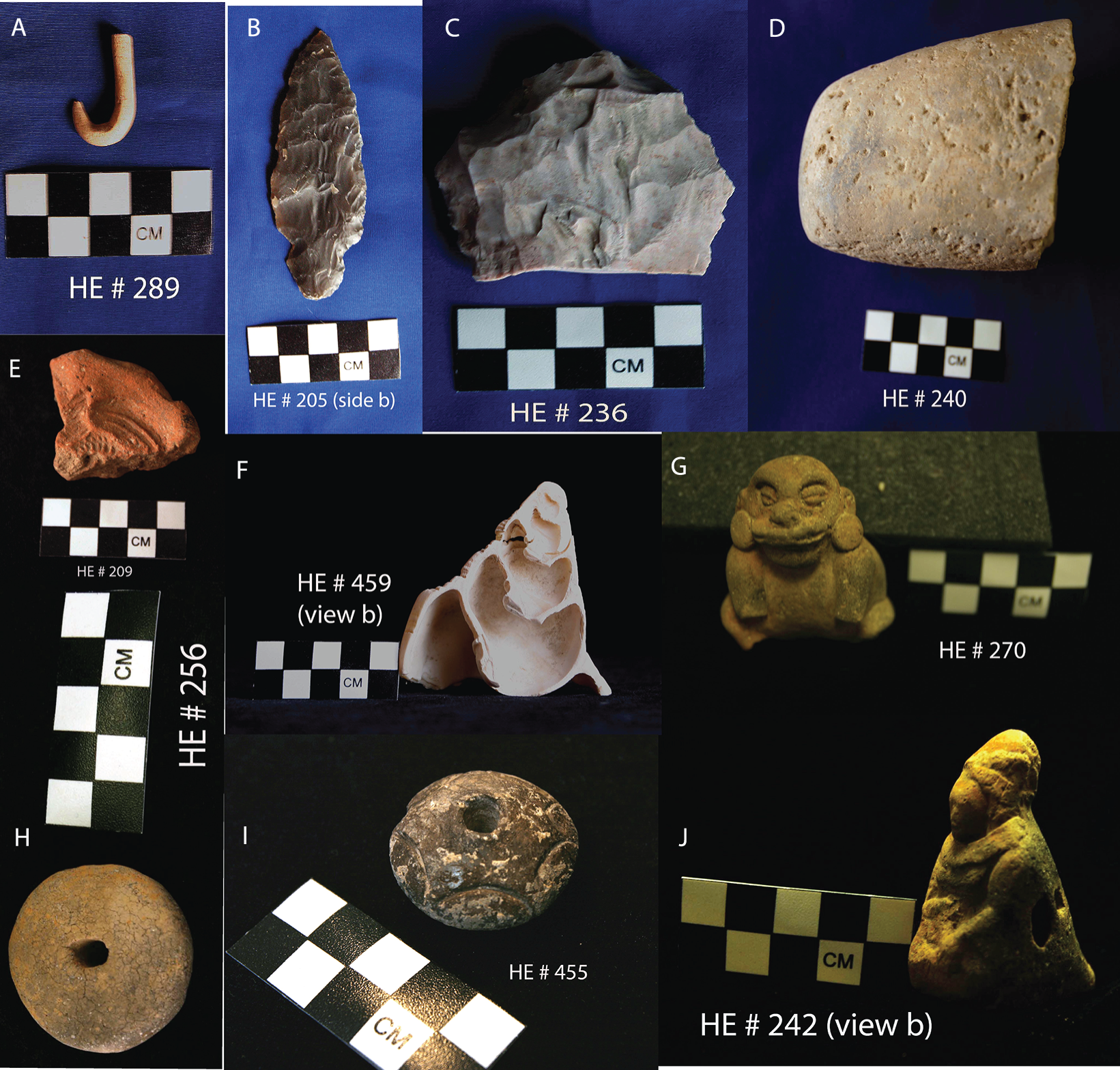
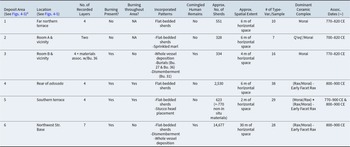
Initial investigations at the Fire Shrine focused on the recovery and meticulous documentation of dense surface deposits accumulated in sheets north of the fronting stair side at plaza level (Navarro-Farr Reference Navarro-Farr2009). Further investigations of the northern superstructure revealed similarly constituted deposits throughout all sectors (see Figures 4–5 for point-plotted deposits in five of seven locales). These deposits, in addition to mortuary remains and fragmented ceramics, included varying quantities of broken chert tools, figurine heads, worked and unworked shell, hematite, jade, broken grinding stones, stelae fragments, and other miscellanea (see Table 1 for examples and locations). Many artifacts demonstrate a range of specialized tasks including but not limited to fishing (bone hook), hunting (projectile points), farming (bifacial chert hoes), plant processing (mano fragments), ceramic production (a ceramic figurine mold fragment), scribal artistry (a halved conch paint pot), music (ocarinas), and spinning thread for weaving (spindle whorls) (see Figure 6). Additionally, considerable human labor was required to reaggregate Early and Late Classic stelae fragments within and around the Terminal architecture and associated deposits. These activities occurred as layered events.
Plan of Structure M13-1 including locations of Deposit area 1 (far northern terrace); Deposit area 2 (Room A); and Deposit area 3 (Room B). Drawings by Olivia Navarro-Farr, Ana Lucía Arroyave Prera and Evangelia Tsesmeli; images courtesy of the Dirección General del Patrimonio Cultural y Natural del Ministerio de Cultura y Deportes of Guatemala.
Plan of Structure M13-1 including locations of Deposit area 6 (NW Structure base: Unit 19 deposit layer 5 of 7) and Deposit area 4 (Rear of adosada: Deposit layer 2 of 4). Drawings by Olivia Navarro-Farr, Ana Lucía Arroyave Prera and Evangelia Tsesmeli; image tracing by Alina Karapandzic and Alexander Hume; images courtesy of the Dirección General del Patrimonio Cultural y Natural del Ministerio de Cultura y Deportes of Guatemala.
A sample of small finds from various deposit locales exhibiting an array of specialized tasks. From top row starting from left: (A) bone fishing hook; (B) stemmed chert biface; (C) halved chert biface; (D) halved grinding stone (mano); middle row from left: (E) fragment of ceramic figurine mold; (F) halved conch shell ink pot; (G) zoomorphic ceramic ocarina; bottom row from left: (H) plain spindle whorl; (I) carved spindle whorl; (J) anthropomorphic ceramic ocarina. Photos by Olivia Navarro-Farr; images courtesy of the Dirección General del Patrimonio Cultural y Natural del Ministerio de Cultura y Deportes of Guatemala. (Color online)
Small Finds and Their Location at the Fire Shrine.
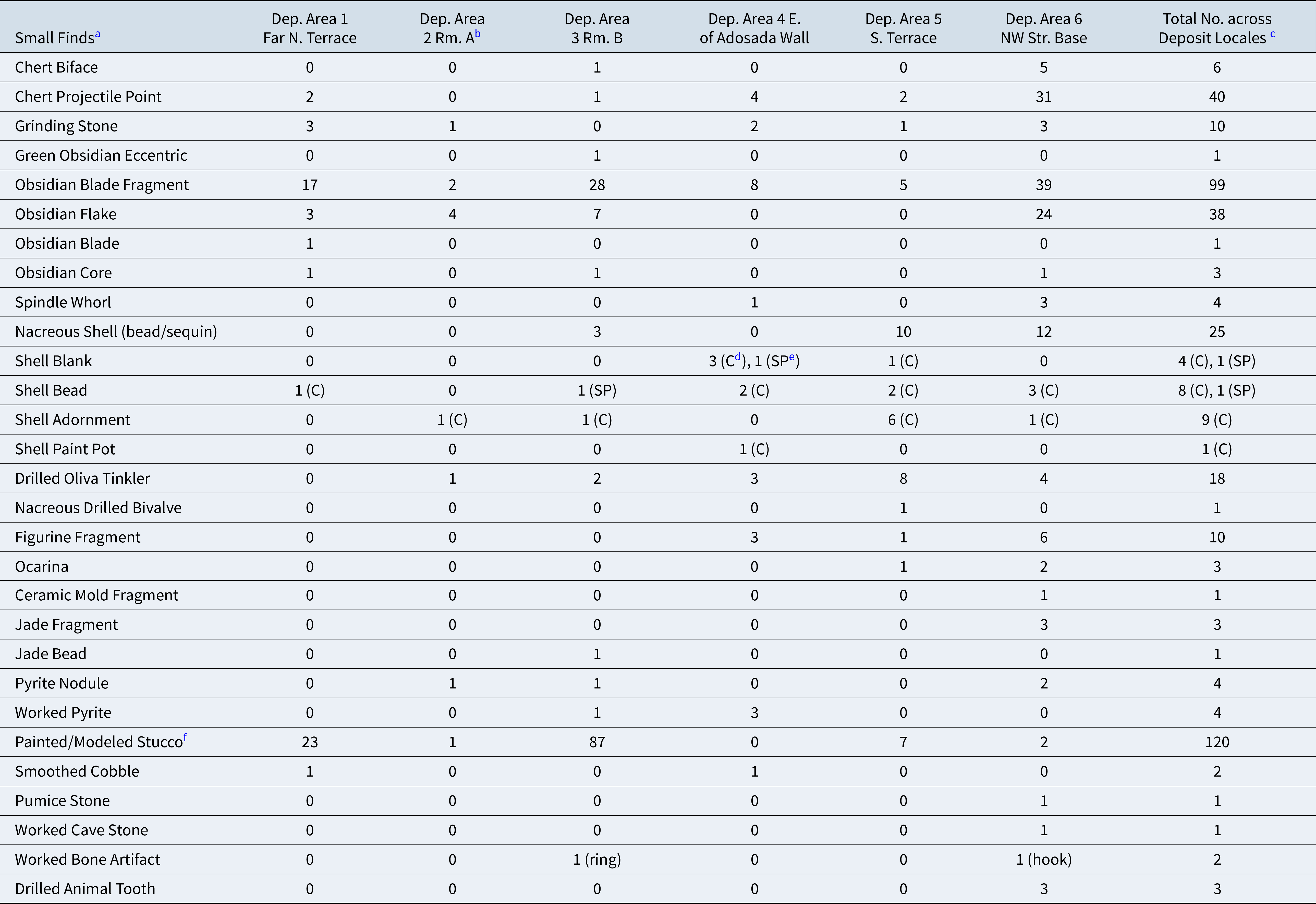
a The term “Small Finds” is a Proyecto Arqueológico Waka designation deriving from Hallazgo Especial, or HE; it refers to any objects not categorized as sherds or vessel fragments and can include modified or repurposed sherds.
b Rooms A and B also include immediate vicinities.
c While there are seven recorded deposit locales, only six are included in this table.
d “C” stands for conch shell (Strombus gigas).
e “SP” stands for spondylus shell (Spondylus princeps).
f Due to the fragile nature of these stucco pieces, these numbers (taken from field counts) are approximate.
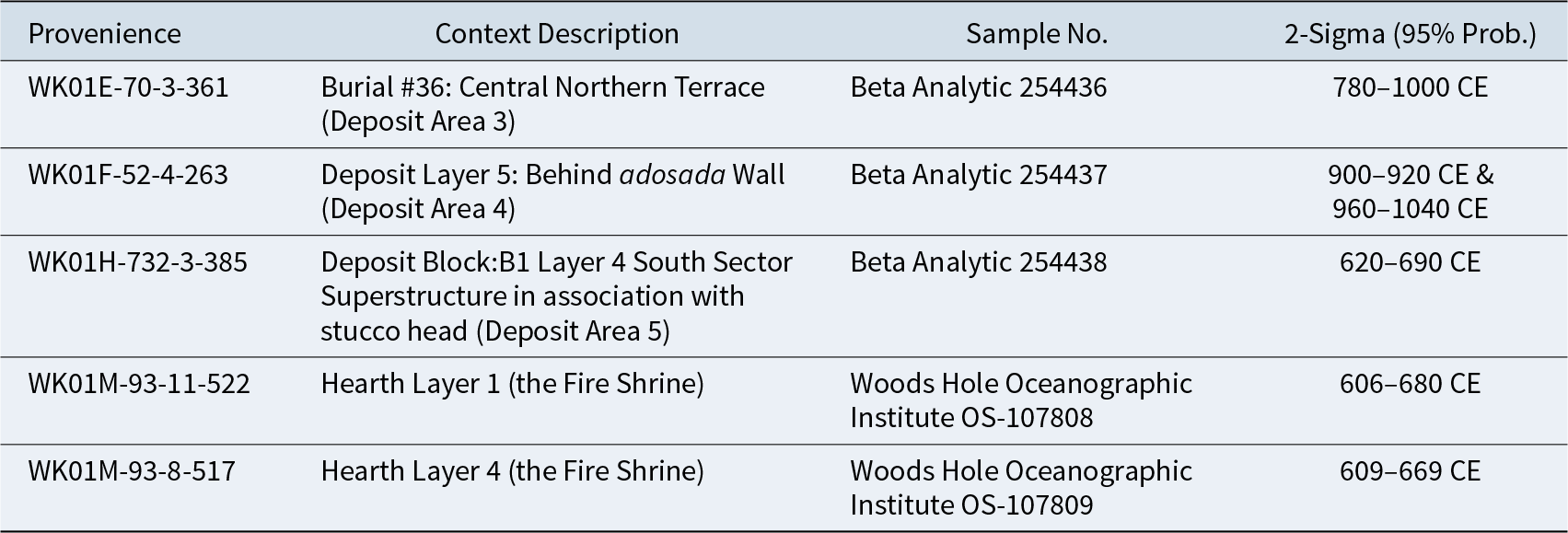
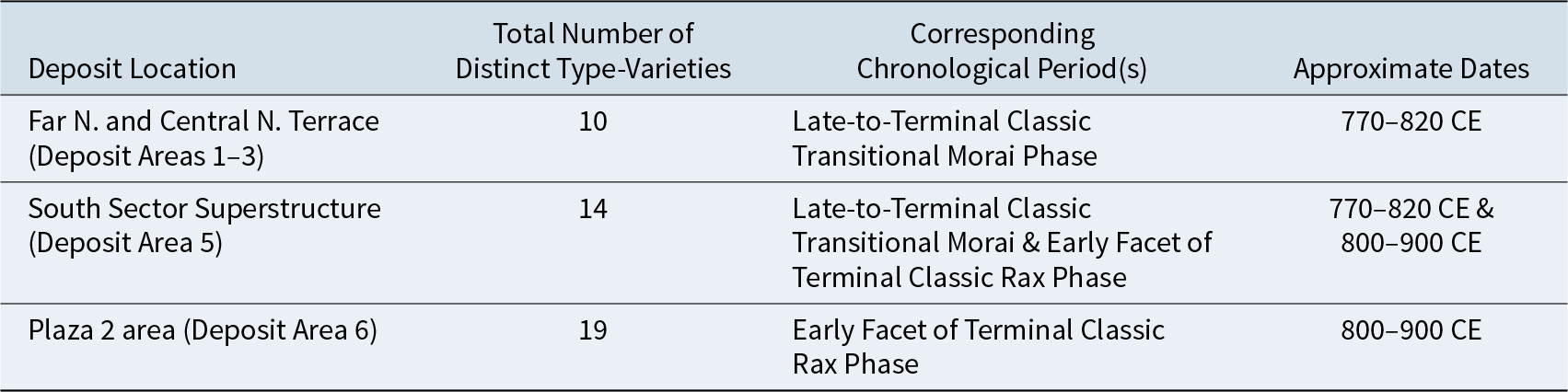
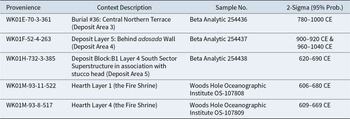
In terms of dates, although some of the radiocarbon samples both from the south sector and the Fire Shrine yielded earlier than expected seventh-century dates, these have been attributed to the old wood effect (see Cagnato Reference Cagnato2016; Navarro-Farr and Arroyave Prera Reference Navarro-Farr, Lucía Arroyave Prera, Navarro-Farr and Rich2014; see also Table 2). Ultimately, stratigraphic data, radiometric samples, and ceramic chronologies indicate the deposit activities were carried out over a span of time coeval with the gradual decline and departure of the city’s royal court and the consequent decrease in sponsorship of the public maintenance of these buildings by these departing royals (see Tables 2 and 3 for absolute and relative dates, respectively). Despite or perhaps because of the sociopolitical dynamics of departing royalty, we see this dynamism of ritualized community engagement by non-elites interacting with the city’s primary shrine as deeply indicative of the perceived animate nature of this building as a focal point of ritual engagement. In other words, despite having borne the appearance (from a Western point-of-view) of a building in a mid-to-late stage of abandonment by central authorities (the royal court), the Fire Shrine continued to be alive for those who remained at Waka’. It was fed and cared for after Waka’s royal court decline by “ordinary” folk of the city and beyond. To further contextualize these behaviors, a brief review of the Late-Terminal Classic epigraphic and settlement data at Waka’ is warranted.
Waka’s Late-to-Terminal Classic Political and Residential Picture in Brief
Epigraphic information for the Terminal Classic at Waka’ is murky. Royal power was waning throughout the southern Maya Lowlands during the early ninth century (Demarest et al. Reference Demarest, Rice and Rice2004; Iannone et al. Reference Iannone, Houk and Schwake2016). This is particularly clear from the diminishing power of the major centers of Calakmul and Tikal that had figured prominently throughout Waka’s Late Classic political history (Freidel et al. Reference Freidel, Escobedo, Guenter, Sabloff and Fash2007; Martin and Grube Reference Martin and Grube2008). The Snake dynasty (Kannul), seated at Calakmul in the Late Classic, had patronized the Waka’ dynasty from at least the sixth century. Kaanul’s ultimate defeat by its rival Tikal certainly damaged the resiliency of Waka’s royal court, likely contributing to the defeat of Waka’s Late Classic ruler Bahlam Tz’am II by Yihk’in Chan K’awiil in 743 (Kelly et al. Reference Kelly, Freidel, Navarro-Farr, Eppich, Marken and Freidel2024; Martin and Grube Reference Martin and Grube2008). Guenter (Reference Guenter, Escobedo and Freidel2005) sees some evidence for a royal resurgence based on Stela 32, dating to 790. This monument features a royal pair where the female is named as Ix Pakal. The inclusion of an eroded “Bat” Ajaw title prompts speculation about Waka’s affiliation with this dynasty. Others have discussed the Bat Kingdom’s resurgent status in a post-Kaanul world (Martin Reference Martin2020:141) though whether Waka’ took part in that is unclear since textual details are too eroded to be certain. Additionally, the incomplete Stela 37 dates stylistically to the Terminal Classic (Guenter Reference Guenter, Navarro-Farr and Rich2014) and features another royal couple. Stela 38 and Altar 1 are most likely both dedicated in 801 and Stela 39 is another late eighth-century monument. The recently discovered Stela 46 fragments tentatively date it to the late ninth century (Freidel et al. Reference Freidel, Guenter, Kelly and Zender2022) but beyond that, information is limited, and Waka’s epigraphic picture goes silent from the early ninth century, suggesting declining royal authority.
Important settlement shifts during the transitional Late-Terminal Classic Morai phase, reported by Eppich, Marken, and Menéndez (Reference Eppich, Marken, Menéndez, Marken and Arnauld2023), demonstrate there was continued settlement density in the core while certain peripheral settlements, including the Late Classic satellite of Chakah to the southeast, experienced almost total and immediate abandonment. They note that, simultaneously, neighborhoods just north of the core saw increased activity. However, it is unknown whether this shift represented a reinvigoration of existing settlement in that locale or complete resettlement of the old Early Classic neighborhoods to that locale. The apparent contraction of the settlement and migration to the urban core that began in the late eighth century apparently accelerated in the ninth century. Excavations demonstrate virtually every residence was inhabited, every space was used, and every new structure had been built in previously unoccupied areas while there was simultaneous diminution of activity in hinterland settlements, though underlying causes are difficult to interpret (Eppich, Marken, and Menéndez Reference Eppich, Marken, Menéndez, Marken and Arnauld2023). There is scattered evidence of sporadic return to abandoned peripheral residences in the form of votive offerings though not in the form of resumed occupation. Excavations of a proposed council house (Eppich and Van Oss Reference Eppich, Van Oss and Pérez2017; McMahon Reference McMahon2024), an indicator of shared governance that was likely commissioned during the reign of Waka’ ruler, Aj Yax Chow Pat in the early ninth century, demonstrate the building was never completed. Meanwhile, the royal palace registered little activity during the early ninth century, apparently falling into disuse (Pérez Robles and Pérez Reference Pérez Robles and Pérez2017, Reference Pérez Robles, Pérez, Pérez, Pérez and Marken2019). Nevertheless, occupation continued at Waka’ at least until the mid-eleventh century, as seen from the appearance of thin-slate and Plumbate ceramics in elite residential compounds. Amid these seemingly turbulent times, the ritual accumulations at the Fire Shrine may offer insights into how communities responded to these shifting political and demographic landscapes seen at Waka’ during the Late-to-Terminal Classic transition.
A Community’s Response to Political Change: Offerings at the Fire Shrine
Material deposits blanketing monumental structures like those documented throughout the Fire Shrine’s final phase have been reported from sites throughout the southern Maya Lowlands (Ambrosino Reference Ambrosino2007; Chase and Chase Reference Chase, Chase, Demarest, Rice and Rice2004; Coe Reference Coe1990; Garber Reference Garber1986; Garber et al. Reference Garber, Driver, Sullivan, Glassman and Shirley Boteler-Mock1998; Harrison-Buck et al. Reference Harrison-Buck, McAnany, Storey, Tiesler and Cucina2007; Inomata Reference Inomata, Inomata and Webb2003; Mock Reference Mock and Boteler-Mock1998; Pagliaro et al. Reference Pagliaro, Garber, Stanton, Brown and Stanton2003; Suhler Reference Suhler1996; Trik Reference Trik1939; Walker Reference Walker and Boteler-Mock1998). The diverse array of materials and settings in which these appear have been the subject of keen attention and varied interpretation (Clayton et al Reference Clayton, Driver and Kosakowsky2005; Harrison-Buck Reference Harrison-Buck and Harrison-Buck2012b; Lamoureux-St-Hilaire et al. Reference Lamoureux-St-Hilaire, Macrae, McCane, Parker and Iannone2015; McAnany and Hodder Reference McAnany and Hodder2009; Newman Reference Newman2015; Oates et al. Reference Oates, Molleson and Soltysiak2008; Schiffer Reference Schiffer and Schiffer1995; Walker Reference Walker, Skibo, Walker and Nielson1995, Reference Walker2002). Researchers have long grappled with how to most appropriately term such seemingly anomalous suites of material items and attendant behavior(s). Initial interpretations posited that the deposits seen at the Fire Shrine resulted from a single-event ritual termination (Navarro-Farr et al. Reference Navarro-Farr, Freidel, Lucía Arroyave Prera, Stanton and Magnoni2008). However, upon closer review of the data, the patterns were more suggestive of cumulative and episodic depositions from the end of the Late through the Terminal Classic period (see Navarro-Farr and Arroyave Prera Reference Navarro-Farr, Lucía Arroyave Prera, Navarro-Farr and Rich2014). It should be noted that across the recorded deposit areas and amidst the recorded locales, many of which feature numerous layers, there were no indications of thin soil layers between these layers, which would have suggested periods of temporary abandonment between deposits. Most strikingly, the activities involved diverse actors and behaviors (see Navarro-Farr Reference Navarro-Farr2009, Reference Navarro-Farr, Iannone, Houk and Schwake2016; Navarro-Farr and Arroyave Prera Reference Navarro-Farr, Lucía Arroyave Prera, Navarro-Farr and Rich2014; see also Table 4). Recent evaluation of lithic, paleoethnobotanical, and ceramic offerings supports these initial interpretations, revealing suites of material typically associated with household activities.
Deposit Areas and Associated Features.
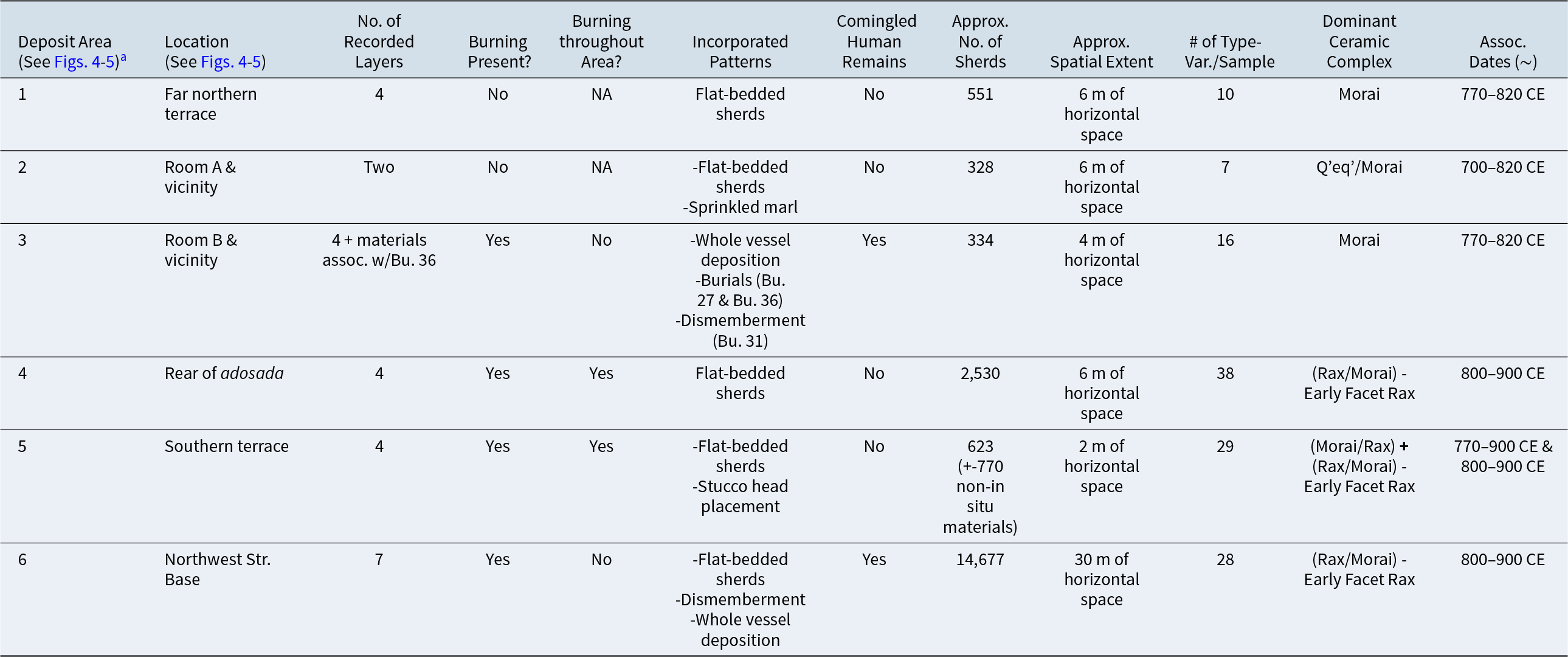
a Although there are seven recorded deposit areas, only six are included here.
The lithic assemblage in the deposits, especially those at the building’s base, included predominately bifaces (n = 124), many of which were General Utility Bifaces (GUB), stemmed, or lanceolate bifaces; these are also typically found in household assemblages. The majority (88.7%) were broken, possibly intentionally, due to the relatively even proportion of basal, medial, and proximal biface segments (22.7%, 43.6%, and 33.6%, respectively). It makes sense that the medial components form the largest group as there can be more than one of these when bifaces break. Most breakages were from impact (n = 71; 57%); when identified in use contexts, impact fractures most often show higher proportions of the proximal ends of projectiles, while the hafted bases were taken away and found elsewhere. Intentional breakage of lithics and other materials is related to the ritual termination, or “killing” of the objects, as ontologically all lithic material is considered animate and to possess a soul by the ancestral and modern Maya (Horowitz et al. Reference Horowitz, Brown, Yaeger and Cap2024). Intentional breakage could have occurred in this context, although there was only one refit noted (note: systematic refitting was not performed; the refit was a serendipitous observation). In addition to breakage, some (n = 11; 8.9%) of the bifaces had evidence of burning, another manner of ritual destruction. The bifaces were produced mostly on what are presumed to be locally available chert, with limited nonlocal, higher quality cherts (n = 48; 38.7%) and a single obsidian point, reinforcing the typical household nature of the assemblage. Locally available cherts were identified based on the presence of cortex and early-stage production debris from those raw materials, while nonlocal materials are found almost exclusively as finished tools, with more limited debitage and cores within the site’s lithic assemblage. While no lithic production areas have thus far been identified at Waka’, we assume that lithic production occurred within the site, and those materials would have been considered “local” to the site’s inhabitants.
That lithic assemblages from these deposits closely resemble those from household contexts is intriguing when coupled with the frequency of fragmentary human skeletal material consisting primarily of long bone and cranial fragments (Piehl Reference Piehl, Escobedo and Freidel2004). While acknowledging these elements tend to have a higher taphonomic longevity in archaeological contexts, it is also important to note these remains are typical of ancestral funerary bundling (McAnany Reference McAnany1995, Reference McAnany and Houston1998). This suggests their deposition may constitute the fragmentary curated remains of honored ancestors. Such materials represent among the most precious items that a non-elite person might offer. That these activities were carried out coeval with gradual political transition and likely presaged broader site-wide occupational decline sheds light on the gradual nature of these processes at Waka’.
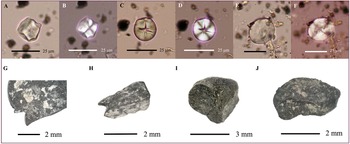
Another important parallel pertains to the instances of grinding stones amidst the deposits surrounding the building’s base. These had clearly been used to process plants, an otherwise clear indication of domestic activity. Specifically, starch grain analyses revealed the presence of maize (Zea mays; n = 16), manioc (Manihot esculenta; n = 2), chili pepper (Capsicum sp.; n = 3), and arrowroot (Maranta sp.; n = 1) (Figure 7A–F), in addition to unidentified/damaged grains.
Starch grains and carbonized macrobotanical remains recovered from deposits around Str. M13-1. This figure features transmitted and cross-polarized photos of starch grains of maize (A–B), manioc (C–D), and chili pepper (E–F). It also includes images of the seed remains of Pouteria (G), Manilkara (H), Sabal (I), and a maize cupule (J). Photos by Clarissa Cagnato; images courtesy of the Dirección General del Patrimonio Cultural y Natural del Ministerio de Cultura y Deportes of Guatemala. (Color online)

Additional paleoethnobotanical evidence, all recovered in carbonized form through flotation, from around the fronting deposits at the building’s northwest base demonstrate a prevalence of the remains of economically important fruit-bearing trees. These include Pouteria (zapote; three seed fragments), Cordia (siricote; nine seed fragments), Manilkara (sapodilla; two seed fragments), Attalea (cohune; three seed fragments), and one Sabal (guano) seed (Figure 7G–I). Maize kernel fragments (n = 1) and cupules (one whole, five fragmented) (Figure 7J) were also recovered from these deposits, suggesting the presence of whole maize cobs. This is not a random pattern and reflects a deliberate choice made by the people residing at Waka’. They fed this metaphorical mountain of the Fire Shrine, contributing to a cumulative offering of their memories and narratives (after Mills and Walker Reference Mills and Walker2008). These narratives, as discussed, included numerous votive offerings of chert, grinding stones, ancestral remains, maize, and a variety of fruit-bearing plants (all of which are imbued with deep ontological significance; see Morehart and Morell-Hart Reference Morehart and Morell-Hart2015). Of all the material evidence, the most abundant forms of votive interaction come from the ceramic offerings.
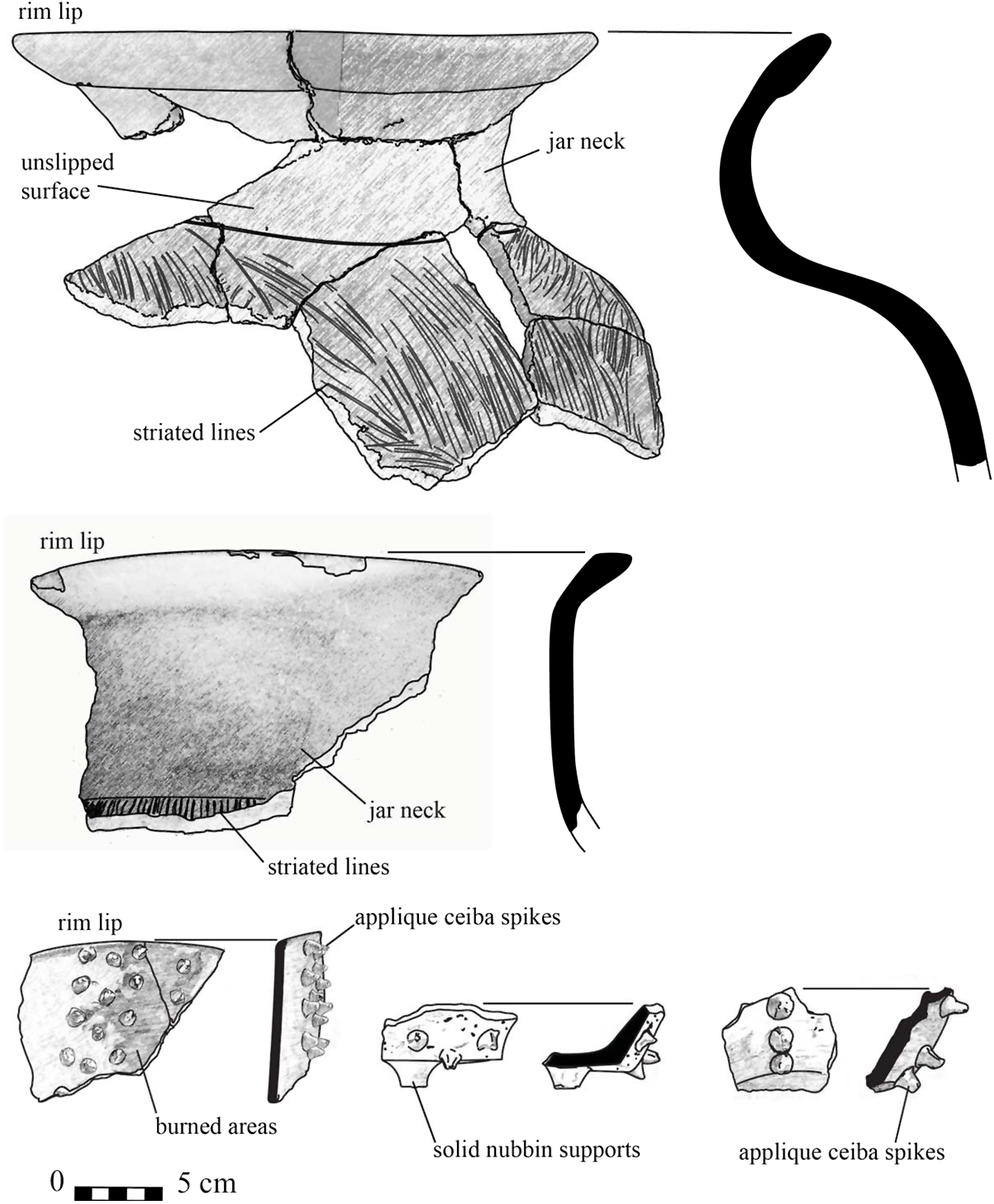
The ceramics recovered from the deposits across the Fire Shrine generally possess a strong similarity to assemblages documented in small domestic patio groups across Waka’ (see Eppich Reference Eppich2024; Eppich, Bertin et al. Reference Eppich, Bertin, de los Ángeles Cuyan, Massanelli, Menéndez, Montgomery, Orzolek, Ramos, Simons, Navarro-Farr, Marken and Pérez2023; Eppich et al. Reference Eppich, Berenson, Bertin, Knutson, McCary, McMahon, Novelo, Riddel, Smith, Marken, Navarro-Farr and Cid2025). One such vessel form that commonly occurred in eighth- and ninth-century domestic contexts is a thick-based bowl with out-curving walls. Intriguingly, at least 12 such bowls appeared as part of the votive rituals conducted in association with the Fire Shrine, the largest number recorded at Waka’ (Figure 8), and all possess some degree of use-wear. Specifically, there is notable wear on both interior and exterior surfaces of each of these vessels. Those conducting these rituals had therefore clearly pulled quotidian vessels from their homes to place them here. There is also a relatively high frequency of wide-bodied and narrow-necked water jars (Figure 9), comprising 20% of the assemblage. Numerous charring spots indicate the use of fire on these jars. The ritual juxtaposition of fire and water is consistent with pan-Mesoamerican paired opposites that have frequent material (Freidel et al. Reference Freidel, Schele and Parker1993) and linguistic (Knowlton Reference Knowlton2002) manifestations. There is also a notable presence of fragmented unslipped incense burners with blunt spike appliques (Smith and Gifford Reference Smith and Gifford1966:159; see also Figure 9). Termed Misería Applicado, this type appears at roughly 1% of the identifiable ceramics in these deposits though it rarely appears elsewhere at the site.
Utilitarian thick-based bowls with outcurving rims recovered from the votive deposits of the Fire Shrine. Illustrations by Keith Eppich; images courtesy of the Dirección General del Patrimonio Cultural y Natural del Ministerio de Cultura y Deportes of Guatemala.
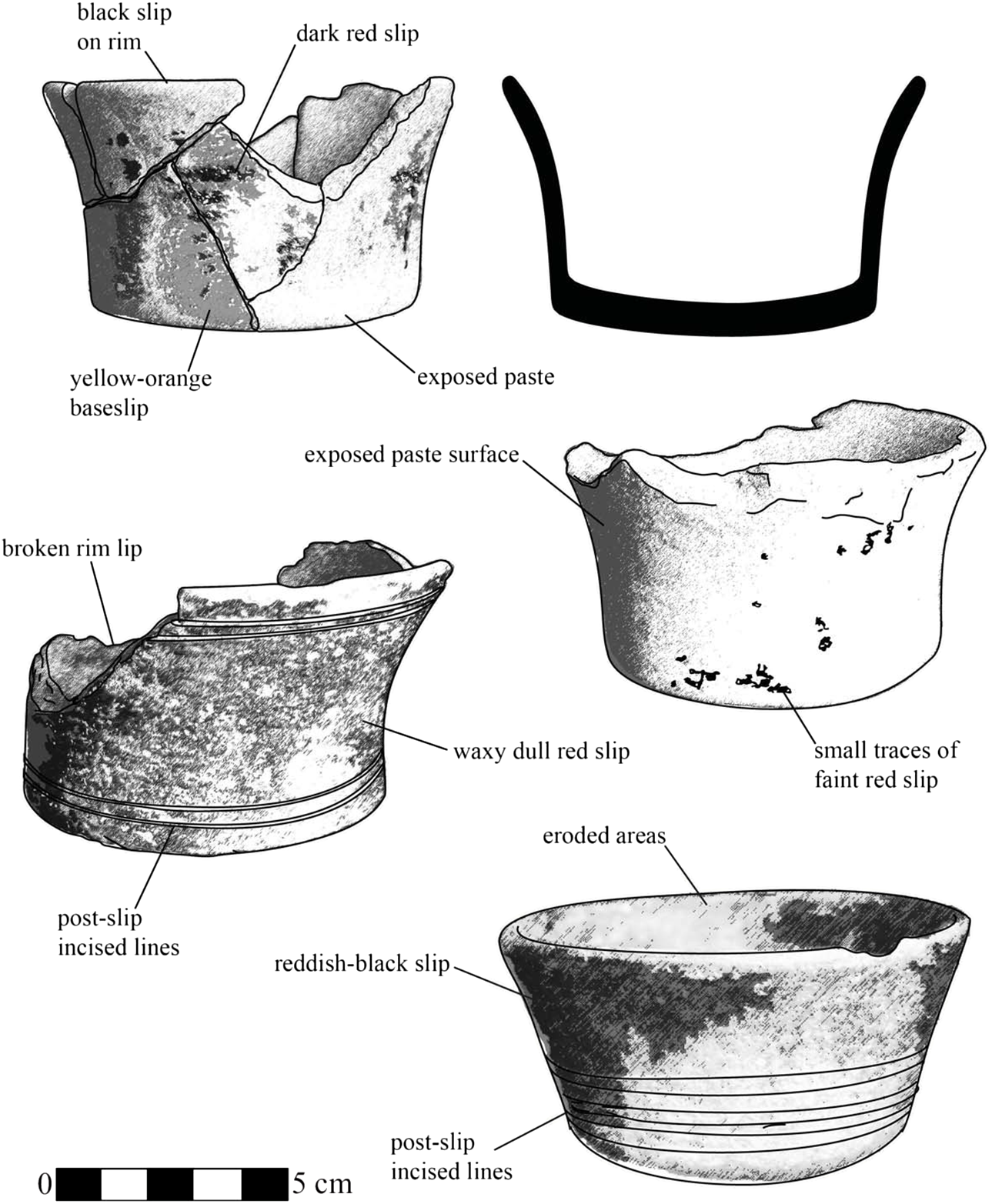
Striated water jars and Misería Applicado censers. Illustrations by Keith Eppich; images courtesy of the Dirección General del Patrimonio Cultural y Natural del Ministerio de Cultura y Deportes of Guatemala.
Importantly, this assemblage also possesses several ceramics from well outside Waka’s potting tradition (Figure 10). From one of the deposit areas atop the building, investigators identified Terminal Classic period Chablekal Gris and Chicxulub Inciso. These small, fine, gray bowls hailed from the Gulf Coast region of Tabasco and Campeche, arriving in the Petén toward the end of the eighth century (Foias and Bishop Reference Foias, Bishop, Varela and Foias2005; Schroder et al. Reference Schroder, del Pilar Jiménez Álvarez, Córdova, Naomi Avilés Arjona, Bolaños, Yerath Ramiro Talavera and González2024). They appear in these deposits with an eighth-century polychrome termed Moro Naranja whose highly refined polychrome surface décor likely came from workshops surrounding Piedras Negras. Additionally, we see late eighth- to ninth- century thin-slate wares including the well-documented Ticul slate ware (Ball Reference Ball1977, Reference Ball2014; Smith Reference Smith1971; see also Smyth et al. Reference Smyth, Dore, Neff and Glascock1995) originating from the central and northwestern Yucatan. Another ware, Ojo Impreso, is a large earthenware jar that has not been documented in any quantity outside of these deposits. Because Ojo Impreso resembles jars documented in the north-central Yucatan (see Jiménez et al. Reference Jiménez, Magnoni, Eugenia, Tara, Scott and Hutson2017), it likely also originates in that region. Altogether these ceramics, which are decidedly outside the local potting conventions, hint at a broad set of connections from Piedras Negras to the Gulf Coast of Tabasco to central and northwestern Yucatan during the eighth and ninth centuries. This, in turn, suggests votive activities by both people who resided at Waka’ and others who traveled there from greater distances, demonstrating Waka’s Fire Shrine held considerable importance.
Nonlocal ceramics at the Fire Shrine, Chablekal Gris, Ojo Impreso, Moro Naranja Polychrome, Ticul Thin-slate. Illustrations by Keith Eppich; images courtesy of the Dirección General del Patrimonio Cultural y Natural del Ministerio de Cultura y Deportes of Guatemala.

One additional ceramic type warrants mention because of its conspicuous absence. Across Terminal Classic (ninth–tenth century) Waka’, the most prestigious ceramic was a molded-carved fine orange ceramic termed Pabellon Modeled-Carved. It occurs in low frequencies throughout the city, primarily in Terminal Classic elite residences (Eppich Reference Eppich, Van Oss and Pérez2017). However, not a single sherd of Pabellon Molded-Carved has been recovered from the Fire Shrine. Therefore, if these ceramics are broadly indicative of Terminal Classic elite consumption, then by the Terminal Classic, elite activities at the Fire Shrine seem to have largely ceased, leaving the shrine for veneration by the everyday citizens of the city. This trend underscores the ritual appropriation of the Fire Shrine by non-elite people from Waka’ and beyond.
Discussion
The comprehensive study of these surface contexts combined with the emphasis on precise recording of spatial patterning and context permit addressing how populations interacted with ceremonially significant features of the city’s-built landscape. A study like this also permits consideration of deeper questions. For example, if depositional acts like those recorded here were carried out in post-royal contexts, we can ask whether they were authorized or overseen by some transitional governing body such as that represented by the council house. We can address, from analysis of the assemblages, some aspect of the identities of those responsible for carrying out the attendant activities. Finally, we can consider what such offerings indicated about the populations who continued to ritually engage with a landscape undergoing gradual abandonment. Thinking through the evidence from a relational approach informed by Mesoamerican ontologies, we see the pattern of engagement as one in which the building was (and still is) understood to be a living being who was fed and tended to and who bore witness to the likely turbulent political events of the period during Waka’s gradual abandonment. Moreover, we now have a far more comprehensive knowledge of this building’s deeper structural history. We can therefore view these rich and complex depositional findings and the associated ritual engagement from these later periods in line with a continuous pattern of civic engagement documented from the fourth through to the tenth century CE. For example, the Late phase’s dominant Fire Shrine is a major architectural feature built to revive the legacy and legitimacy of New Fire ceremonialism (see Fash et al. Reference Fash, Tokovinine, Fash, Fash and López Luján2009), which itself hearkened to Waka’s Early Classic linkages to the political incursion of Teotihuacanos into the Maya Lowlands known as the “Entrada” (see Navarro-Farr et al. Reference Navarro-Farr, Marken, Kelly, Eppich, Pérez Robles, Carlos Pérez Calderón and Braswell2022; see also Stuart Reference Stuart, Carrasco, Jones and Sessions2000, Reference Stuart2024). Importantly, this Fire Shrine was terminated with an immense deposit of modeled stucco infilling the entire shrine; this stucco deposit, which sealed access to the Fire Shrine, was likely undertaken in tandem with the deposits carried out atop and at the base of the building.
Ongoing research on Late and Early Classic contexts buried inside the Fire Shrine provides ample contextualization for the role of memory (Mills and Walker Reference Mills and Walker2008) seen in these Late-era rituals, highlighting the Fire Shrine’s long-term political importance as a commemoration of earlier events. In the Early Classic, an earlier version of this building was the locus for a publicly accessible mortuary chamber (Burial 110) surrounded by a scaffolded accession platform analogous to one rendered on the West Wall of the Pinturas building at San Bartolo (see Taube et al. Reference Taube, Saturno, Stuart and Hurst2010). This building was inhabited by a revered Early Classic ancestor whose interment included ceramics styled after highland Mexican pottery (Eppich Reference Eppich2025). This tomb, which dates to the Entrada era, continued to be accessible throughout the reign of the Late Classic Kaanul-affiliated Lady K’abel. It was ultimately subsumed by the same construction phase that housed the commemorative Fire Shrine atop the final adosada. That phase was built when Lady K’abel died. The prominent and public exposure of a sacred Early Classic ancestor whose tomb incorporated Teotihuacan-style pottery for the better part of three centuries is a relevant feature. For one, it provides greater contextual understanding for the motivations behind Lady K’abel’s political decision to be buried here. More broadly, it also speaks to the importance of memory afforded to this place throughout that period and long after. It deepens understanding of the complex and diverse depositional activities we discuss here that spanned the Late–Terminal Classic transition, dating from 770 to 820 CE, and the ensuing Terminal Classic, dating from 800 to 1050 CE. This evidence, when paired with the simultaneous settlement density increases in the core and the settlement decline along the site’s periphery, suggests a dynamic population on the move and engaged in their community.
Our data also support early hypotheses that non-royal people actively engaged with an enduring and animate ritual landscape amid intense political and social change in this city. Deeper understanding of this building’s political history provides context for that engagement. We can more clearly understand the need and the drive to feed this building in particular during this otherwise turbulent period of dramatic political change. From the vantage of this building, that engagement took the form of enshrinement by non-elite folk during a period following the royal court’s absolute hold on governance. These people offered what they could, incorporating fire ceremonies in various instances. The carefully chosen offerings included everything from fragments of possibly once bundled human remains (Piehl Reference Piehl, Escobedo and Freidel2004) to commemorative tokens of varied livelihoods. Notably, the presence of varied tree fruits might relate to the idea that the Maya had regarding their ancestors. Fruit-bearing trees, according to McAnany (Reference McAnany1995) were linked to ancestors. Martin (Reference Martin and McNeil2006:178) reiterates the Maya ontological view that trees “evidently constitute a bridge between death and rebirth.” This notion is visually depicted on the Early Classic tripod vessel (K6547) and on Pakal’s sarcophagus, where “ten fruit-laden saplings emerging from cracks in the ground can be identified from the shape of their progeny as cacao, guayaba, avocado, zapote, and nance” (Martin Reference Martin and McNeil2006:161). Chert is also considered to hold protective qualities, and deposition of chert materials can be interpreted as protecting important spaces (Bassie-Sweet Reference Bassie-Sweet1996; see also Horowitz et al. Reference Horowitz, Brown, Yaeger and Cap2024). The ceramic data also underscore the domestic qualities of the offerings. These data illustrate that people, both from Waka’, and as certain ceramics suggest, far from this place, came to engage and leave offerings behind. Clearly this place was well known but, more than that, it was (and continues to be) alive!
Conclusions
These deposits convey simultaneous attachment and detachment; they embody the false dichotomy of sacred versus mundane, and they reflect the inalienability of memory (Mills and Walker Reference Mills and Walker2008). Rather than a rapidly abandoned city, people living at Waka’ stayed on for a considerable period continuing to tend the city’s patron deities and ancestors and the landscape as a living breathing place. This community also continued to function in the absence of a singular royal authority, a phenomenon that speaks to transitional governance and social organization that continued through the dynamic period we problematically refer to as the Terminal Classic. Today, this building’s fronting plaza continues to be a locus for various pre-excavation ceremonies conducted to seek permissions and interactions with sacred ancestors we as archaeologists see as (still) inhabiting this sacred landscape (see Figure 11). Ultimately, there remains much to learn from these oft unsung episodes of post-royal life at living spaces otherwise relegated to “decline” or “collapse.” What we have learned from this investigation is how dynamic populations continuously moved across their living landscape, even amid political transition and well into the periods of site occupation that extend beyond their domination by ruling elite. These signs of continuity, adaptation, and resiliency are worthy of continued investigation as they speak to the animate nature of these living places.
Pre-excavation ceremonial fire (2012) Photo by Diana Fridberg. (Color online)

Acknowledgments
We thank the Instituto de Antropología e Historia de Guatemala (IDAEH), the Ministerio de Cultura y Deportes de Guatemala (MCDG), and the Departamento de Monumento Prehispánicos (DEMOPRE) for their support and permission to conduct research. We thank Jerry Glick, Kristin Hettich, Dave and Ken Hitz, Cynthia Perera, the University of New Mexico’s (UNM) Division for Equity and Inclusion, the College of Wooster. We thank the Proyecto Arqueológico Waka’ (PAW) archaeologists, field and camp personnel and staff, the organizers of this special section, Roberto Rosado-Ramírez and Arthur Joyce, and three anonymous reviewers for their comments. Photographs and drawings of artifacts appear courtesy of the MCDG.
Funding Statement
Funding for Navarro-Farr’s research was provided by the Jerome E. Glick Foundation, the Alphawood Foundation, the Hitz Foundation, the US Department of the Interior - International Technical Assistance Program (DOI-ITAP), the Fundación Patrimonio Cultural y Natural (PACUNAM), the College of Wooster Faculty Development Fund, a Henry Luce III Fund for Distinguished Scholarship, a Kendall-Rives Grant for Research in Latin America, and a James and Jean McClung Research Grant. Research contributed by Clarissa Cagnato was supported with a National Science Foundation Doctoral Dissertation Improvement Grant # 1212559.
Data Availability Statement
All archaeological materials discussed here are stored in the PAW laboratory in San Lucas, Sacatepéquez, Guatemala. For access, contact the PAW Laboratory and PAW Project Director, David Ricardo Del Cid, daric18@gmail.com; DEMOPRE-IDAEH, demoprearqueologia@gmail.com.
Competing Interests
The authors declare no competing interests.






 Open access

