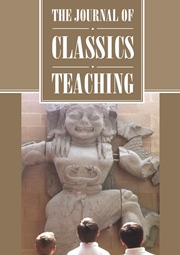


What does it mean to make Classics matter now? The contributions in this issue offer a wealth of answers. Taken together, they show a subject alive with ingenuity, sustained by the commitment of teachers and researchers seeking fresh ways to connect the ancient past with the lives of their students. At the same time, they point to a less comfortable truth: that this work is often carried out under pressure.
Several articles return, in different ways, to questions about how texts are read and understood. Ioannis-Evangelos Chasapogiannis’ exploration of Plutarch’s pedagogical thinking invites renewed reflection on the purposes of reading, while Natale Musso’s statistical analysis of the Iliad and the Odyssey offers a thought-provoking perspective on long-standing debates. Questions of what is taught, and why, are taken up in three articles that foreground curriculum and classroom content. Anna Accettola discusses the use of Aristophanic comedy as a vehicle for introducing students to the study of Antiquity. Priscilla Gontijo Leite shows how the Projeto Vocabulário Político da Antiguidade (Political Vocabulary of Antiquity Project) teaches Antiquity to students aged 11 to 17 in Brazil. J. L. Watson sets out how the Queering the Past(s) initiative is enabling secondary students to explore LGBTQ+ topics in the UK.
A strong thread running through the issue is a concern with how learning happens, and how it might happen differently. Giulio Celotto considers the potential of board games to transform students’ learning experiences in the Latin classroom. Ignacio Aragües y Oroz proposes Minimal Latin, a novel approach to Latin instruction. Melissa Cooper argues that free composition, alongside traditional prose composition, can transform Latin learning in the Year 7 classroom. Giles Thomas Penman highlights the value of the Online Coins of the Roman Empire (OCRE) database as a practical classroom tool, showing how it can re-engage previously disengaged Year 12 students. All of these contributions, in different ways, rethink familiar practices. What emerges is a clear move away from seeing students as passive recipients of knowledge towards viewing them as active participants, making meaning for themselves.
This emphasis on active participation is developed further in articles that explore technology and collaboration. Daniela Canfarotta and Manuela Pipitone’s case study of a student-created video game offers a vivid example of what can happen when classical material is reworked through digital creativity. Panagiotis Seranis and Eleni Liousa’s account of interschool collaboration in Greece demonstrates how technology can bring students together across different contexts. The question of why such work matters is addressed in Mary O’Reilly’s discussion of emotional literacy in the Scottish curriculum, where Classical literature is shown to play an important role in supporting students’ emotional awareness and wellbeing.
The book reviews and reports included in this issue extend these conversations. The reviews span a wide range of topics: from ancient consolation, literature, and societies to video games, colour, and the place of Classics in contemporary culture, highlighting the breadth of current scholarship and its relevance to teaching. Alongside these, Sarah Merali-Smith’s report on the East London Classics Summer School and Steven Hunt’s report on the Cambridge CI (Comprehensible Input) conference on ancient language teaching offer vivid examples of a subject being actively shaped through collaboration, professional exchange, and shared practice.
Alongside these published contributions, a number of additional pieces are available as First View articles on the journal’s website, with further work to follow as it is completed and released ahead of the next issue. This ongoing stream reflects the continued vitality of the field and the steady expansion of conversations taking place within it.
Set against this energy and creativity, however, is a more uncertain backdrop. Across the issue are glimpses of familiar pressures: limited time, uneven access to resources, and the ongoing challenge of securing space for Classics within crowded curricula. These pressures come into sharp and moving focus in Catherine Perkins’ reflective essay on redundancy. Her account, framed through creative practice and the metaphor of Ovidian exile, speaks not only to an individual experience but to a wider sense of precarity within the field.
There is, then, no simple story to be told. The articles, reports, and reviews collected here speak both to what is possible and to what is at risk. They show Classics teaching at its most inventive and thoughtful, while underlining how much depends on the conditions in which that teaching takes place. If Classics is to continue to matter, the energy and ingenuity evident in this issue will need not only to be recognised, but supported. That urgency is impossible to ignore.

 Open access

