





Introduction
From 2020 to 2022, Oklahoma was ranked second or third in the nation for winter wheat production; winter wheat was the number-one cash crop produced on 991,000 ha harvested in Oklahoma during 2022 (USDA-NASS 2022). Oklahoma winter wheat is unique because producers use it for both forage and grain purposes, thereby increasing the diversity of their products and their income for the year. When using the land for forage and grain, producers will place cattle out to graze wheat through mid-fall and winter, remove the cattle before wheat jointing, and harvest the grain in summer. This is known as a dual-purpose system. Because of the flexibility winter wheat systems provide, Oklahoma producers can either sow wheat for dual purposes from August to mid-October or as seed for a grain-only purpose from mid-October to November (Lollato Reference Lollato, Patrignani, Ochsner, Rocateli and Edwards2017). Due to the diverse benefits dual-purpose winter wheat provides, many producers grow wheat season-to-season within the same field in a monoculture.
Additionally, in these continuous winter annual grass crop systems, winter annual grass weeds, such as downy brome (Bromus tectorum L.), form monospecific stands that adapt and thrive (Menalled et al. Reference Menalled, Mangold and Davis2008). Persistence of winter annual grass weeds becomes common as continuous monoculture systems fail to break up pest cycles through lack of herbicide availability, cultural efforts, and use of crop rotation to hinder weed growth cycles.
Considering the unique and economically important resource of Oklahoma winter wheat in the state and region, the consistency of infestations with weeds from the Bromus species contributes to significant direct and indirect losses. Ratliff and Peeper (Reference Ratliff and Peeper1987) observed dockage in harvested grain exceeding 40% in cheat-infested (B. secalinus L.) wheat fields. Other economically critical Bromus species found in Oklahoma winter wheat include not only cheat but also Japanese brome (B. japonicus Thunb.), rescuegrass (B. catharticus Vahl.), and occasionally, downy brome. At one time, cheat infested approximately 1.4 million ha of harvested winter wheat in Oklahoma (Ratliff and Pepper Reference Ratliff and Peeper1987) and reduced grain yield by up to 19% at a density of 89 plants m−2 (Fast et al. Reference Fast, Medlin and Murray2009). Downy brome densities can exceed 400 plants m−2, and may cause crop failure (Reddy et al. Reference Reddy, Stahlman and Geier2013).
Despite many regionally adapted wheat cultivars available to producers in Oklahoma and the region, cheat can still compete with wheat, causing grain and forage yield loss, delayed harvest operations, additional seed cleaning, and grain quality discounts for dockage, foreign material, or both. Immediate control and removal of Bromus species, like cheat, can be correlated to reduced competition and higher crop yield response (Ratliff Reference Ratliff1985) and quality. Cheat and downy brome have unique qualities that contribute to their weediness and persistence, such as an ability to germinate over a wide range of environmental conditions (Haferkamp et al. Reference Haferkemp, Karl and Macneil1994). Downy brome grows rapidly in the spring, which reduces resources for wheat during heading, and thereby reducing yields by up to 20% (Menalled et al. Reference Menalled, Mangold and Davis2008; Stahlman and Miller Reference Stahlman and Miller1990).
Many Bromus species have evolved resistance to herbicides. As early as 2009, Oklahoma documented cheat that was cross-resistant to all herbicides that inhibit acetolactate synthase (ALS; categorized as Group 2 herbicides by the Weed Science Society of America), including imazamox, propoxycarbazone-sodium, pyroxsulam, and sulfosulfuron (Heap 2021). Quizalofop-resistant (CoAXium®) and imazamox-resistant (Clearfield®) winter wheat systems provide control of many winter annual grass species, including Bromus species, but they are not a tool for sustainable management of species that are resistant to WSSA Group 1 and Group 2 herbicides, such as cheat and downy brome (Heap 2024). Although reports of downy brome resistance are correlated with the Pacific Northwest, there is concern that Clearfield and CoAXium technologies may cause resistance in Oklahoma.
With recent documentation of ALS cross-resistant cheat in Oklahoma, imazamox is now ineffective in many regions, leaving wheat growers with only one option: to spray quizalofop onto quizalofop-resistant wheat. However, without proper stewardship (crop and herbicide rotations) of the technology, continued development of grass weed biotypes that are resistant to WSSA Group 1 herbicides will occur. Some wheat fields where our study was located still have susceptible cheat populations, which allows for the continued reliance on certain herbicides. Herbicide-only management practices that fail to integrate other practices will result in the further selection of herbicide-resistant species, likely not being detected until their populations reach 30% of total weed populations (Mahmood et al. Reference Mahmood, Bilal and Jan2014). Nevertheless it is still critically necessary that winter wheat systems use integrated weed management rather than relying on herbicides alone.
The lack of consistent, effective management strategies for cheat and downy brome is a serious production problem facing many winter wheat producers in the southern Great Plains. To improve management of cheat and downy brome in the region, a study was conducted in Lahoma, Oklahoma, over two growing seasons, to evaluate the effects of wheat cultivar selection, planting date, and herbicide treatment on ALS-susceptible cheat and downy brome populations.
Materials and Methods
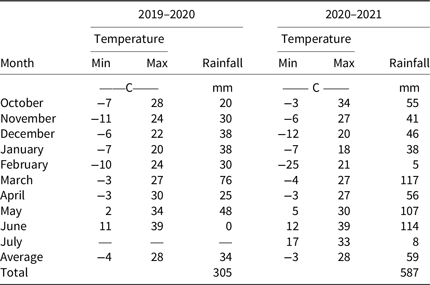
Field experiments were located near Lahoma, OK (36.23086°N, 98.06464°W; elevation 380 m), during the 2019–2020 and 2020–2021 winter wheat growing seasons. The soil was primarily a Grant silt loam (fine-silty, mixed, superactive, thermic Udic Argiustolls) with an average pH of 5.9 and organic matter content of 1.5%. Field trial growing seasons are referred to as the year grain harvest occurred. Winter wheat was sown from early October to mid-November (Table 1). In-season rainfall and average monthly temperature are listed in Table 2.
Key agronomic study dates during the 2019–2020 and 2020–2021 winter wheat growing seasons

a The optimal planting date represents the optimal window for sowing grain-only wheat to maximize grain yield and quality. The delayed timing occurred 2 to 3 wk after the optimal date, whereas the late planting date occurred 2 to 3 wk after the delayed date.
b Application timing of pyroxsulam sprayed at a rate of 18.4 g ai ha−1 and sulfosulfuron at 35.2 g ai ha−1 at the 2- to 3-leaf stage of winter wheat and cheat for each planting date. All herbicide treatments were applied using water as the carrier and included a nonionic surfactant at 0.25% vol/vol and a urea-ammonium nitrate solution at 30% vol/vol.
c Biomass collection of wheat and cheat at heading.
d Harvest date of wheat grain when kernel moisture was between 9% and 12%.
The experimental design was a three-way factorial treatment structure (three planting dates × two cultivars × three herbicides), arranged as a split-plot design with 18 treatments with four replications. Main plots consisted of three planting dates, subplots represented one of two wheat cultivars, and sub-subplots included two herbicide treatments plus a nontreated control. Individual sub-subplots were 2.2 m wide by 10 m in length. N-P-K fertilizer was applied as indicated by soil test results. Fungicide was applied at wheat flag leaf emergence. Soil samples were collected from 1 acre (0.405 ha) of each field location prior to planting each year by obtaining 20 to 30 soil cores from 0 to 15 cm in depth. Samples were thoroughly mixed and analyzed at the Oklahoma State University Soil, Water and Forage Analytical Laboratory (SWFAL) in Stillwater for pH, organic matter, and N-P-K analysis. Based on SWAFL results, N-P-K was applied either prior to planting or split into two applications: prior to planting and prior to green-up in the late winter/early spring.
Three planting dates were used to represent optimal, delayed, and late plantings (Table 1) for grain-only winter wheat production in Oklahoma. The optimal planting date occurred from October to mid-November (Lollato et al. Reference Lollato, Patrignani, Ochsner, Rocateli and Edwards2017), representing the optimal time to sow grain-only wheat for north central Oklahoma. The delayed planting date was approximately 2 to 3 wk after the optimal date, and the late planting date was approximately 5 to 6 wk after the optimal planting. Two high-yielding winter wheat cultivars were selected: ‘Showdown’, which has early canopy coverage and low forage-yielding characteristics during spring; and ‘Green Hammer’, which has low-competitive early canopy coverage and high forage-yielding characteristics during spring (Anonymous 2021). Fields were prepped with a disk and field cultivator, undercutting 10 cm below the soil surface and churning the topsoil with multiple shanks and teeth to smooth out the field. Wheat was seeded at a soil depth of 1.9 cm and a rate of 67 kg ha−1 using a grain drill with 19-cm row spacing. Immediately after each sowing for each planting date, a burndown application of glyphosate at 0.86 kg ae ha−1 with ammonium sulfate at 2.85 kg ha−1 was sprayed to ensure a weed-free field before wheat emergence.
Herbicide treatments included two common ALS-inhibiting herbicides and a nontreated control (Table 2). Each herbicide treatment included a nonionic surfactant at 0.25% vol/vol plus liquid urea-ammonium nitrate at 30% vol/vol. Treatments consisted of pyroxsulam (18.4 g ai ha-1, PowerFlex® HL; Corteva Agriscience, Wilmington, DE) or sulfosulfuron (35.2 g ai ha−1, Outrider®; Valent U.S.A., San Ramon, CA) applied at the 2- to 3-leaf stage of cheat and downy brome at each site and planting date. Herbicides were sprayed at the recommended labeled rate using water as the carrier with a CO2-pressurized backpack sprayer calibrated to deliver 140 L ha−1 at 1.6 kph, using Turbo TeeJet® 11002 nozzles (Spraying Systems Co., Glendale Heights, IL). As previously mentioned, ALS cross-resistant cheat has been confirmed in Oklahoma, however, a susceptible biotype was present at this site for both cheat and downy brome. Downy brome has recorded ALS resistance in Oregon and Montana, but not Oklahoma.
Visual control estimates of cheat and downy brome (Table 3) were evaluated approximately 8 to 9 wk after treatment using a scale of 0% to 100%, where 0% = no weed control and 100% = complete control. At the heading of wheat stage, downy brome, cheat, and wheat biomass was collected from a single square-meter quadrat between the second and third row of the crop from the west side of each plot. Biomass samples were separated by species in the field. Samples were dried in an oven at 60 C for 5 d, weighed, and recorded. Wheat was harvested in June or July of each year (Table 2) with a small-plot combine (Model Classic Plus; Wintersteiger, Salt Lake City, UT).
Visual control of cheat and downy brome 8 to 9 wk after herbicide treatment during the 2019–2020 and 2020–2021 winter wheat growing seasons

a Visual rating of cheat control was based on a scale of 0% to 100% as compared to nontreated plots, where 0% represents no control, and 100% represents complete control.
b The optimal planting date represents the optimal window for sowing grain-only wheat to maximize grain yield and quality. The delayed timing occurred 2 to 3 wk after the optimal date, and the late planting date occurred 2 to 3 wk after the delayed date.
c Means within a column for each site year followed by a common letter were similar according to Fisher’s protected LSD at P < 0.05.
d Pyroxsulam was sprayed at a rate of 18.4 g ai ha−1 and sulfosulfuron at 35.2 g ai ha−1. All herbicide treatments were applied using water as the carrier and included a nonionic surfactant at 0.25% vol/vol and a urea-ammonium nitrate solution at 30% vol/vol.
Due to significant site year-by-treatment interactions, all site years were analyzed independently. Fixed effects included planting date, winter wheat cultivar, and herbicide treatment, with replication considered a random effect. Observations of fixed-effect interactions were also included. A univariate analysis was performed on all responses to test for stable variance with SAS software (version 9.4; SAS Institute Inc., Cary, NC). No data sets were transformed because transformation did not increase stabilization. Data sets were analyzed using the GLIMMIX procedure, and treatments were separated by Fisher’s protected LSD at an α level of 0.05.
Results and Discussions
There were no significant effects of wheat cultivar on visual control of cheat or downy brome; the biomass of cheat, downy brome, and wheat; or wheat grain yield. There were also no significant interactions between wheat cultivar and planting date; wheat cultivar and herbicide; or wheat cultivar, planting date, and herbicide. Consequently, data were averaged across cultivars within planting dates and herbicide treatments. Data for cultivar selection will not be discussed in the following results. It is critical to note that only two cultivars were assessed.
Cheat and Downy Brome
Visual Control
Weed species data are presented by year to account for differences observed across total species and population variations. In 2020, planting date affected cheat and downy brome visual control 8 to 9 wk after treatment (Table 3). A delay in planting allowed for a longer window to apply glyphosate as a burndown treatment to control emerged Bromus species before sowing wheat, ultimately reducing the amount of cheat and downy brome vegetation observed. Visual cheat and downy brome control increased by 9% at the delayed planting compared with the optimal, and it increased by 13% at the late planting compared with the delayed planting. In 2021, similar visual control (∼99%) was recorded for delayed and late plantings and was 23% greater than visual control following the optimal planting.
The effects of planting date on cheat and downy brome were similar to those reported by Koscelny et al. (Reference Koscelny, Peeper, Solie and Solomon1991). Wheat plots planted in September, October, and November at the Lahoma location averaged 84, 71, and 11 plants m−2, respectively. Massee (Reference Massee1976) observed similar trends in Idaho when downy brome was purposely planted with winter wheat on three planting dates (September 20, October 3, and October 19), with downy brome germination declining as planting date was delayed. Delaying planting not only reduces weeds that are present, but it creates fewer instances of weed-crop competition due to a reduced ability of weeds to compete with a later-planted crop (Melander Reference Melander1995).
Biomass
In both years, cheat and downy brome biomass collected at the wheat heading stage averaged 2.6% and 2.75% of total biomass, respectively. Cheat and downy brome biomass during the 2020 growing season was unaffected by any management strategy (Table 4). This may result from inadequate rainfall before the optimal planting date, which delayed overall cheat and downy brome emergence (Table 1). Additionally, weed biomass was highly variable from plot to plot in 2020, with some plots having no biomass (data not shown). In 2021, planting date also did not create significant differences in cheat biomass, but it did for downy brome. Delayed and late planting dates reduced downy brome biomass by 87% and 91%, respectively, compared with the optimal planting (Table 4). Sufficient rainfall around the optimal planting encouraged downy brome emergence and control with preplant burndown glyphosate prior to the delayed and late planting dates (Table 1). Koscelny et al. (Reference Koscelny, Peeper, Solie and Solomon1991) conducted an experiment in the Lahoma area and documented similar cheat biomass values as well as a similar trend of cheat biomass peaking that averaged 390, 499, and 54 kg ha−1 at wheat planting dates of September 21, October 11, and November 2, respectively.
Wheat, downy brome, and cheat biomass collected at heading during the 2019–2020 and 2020–2021 winter wheat growing seasons. a

a Means within a column for each site year followed by a common letter were similar according to Fisher’s protected LSD at P < 0.05.
b The optimal planting date represents the optimal window for sowing grain-only wheat to maximize yield and quality. The delayed timing occurred 2 to 3 wk after the optimal date, and the late planting date occurred 2 to 3 wk after the delayed date.
c Pyroxsulam was sprayed at a rate of 18.4 g ai ha−1, sulfosulfuron at 35.2 g ai ha−1. All herbicide treatments were applied using water as the carrier and included a nonionic surfactant at 0.25% vol/vol and a urea-ammonium nitrate solution at 30% vol/vol.
In 2021, there was an herbicide effect for both cheat and downy brome biomass, in which pyroxsulam or sulfosulfuron use resulted in biomass reduction of 98% and 97%, respectively, compared with nontreated controls (Table 4). Cheat and downy brome biomass in 2020 were not affected by herbicide application. Herbicide efficacy may be limited by cheat and downy brome’s delayed asynchronous emergence, allowing late-emerging individuals to escape the timing of herbicide applications. Although herbicide application successfully controlled susceptible cheat and downy brome populations at the research location in 2021, populations of Bromus species can still create problems of herbicide control with a cheat that is cross-resistant to the ALS herbicides imazamox, propoxycarbazone-sodium, pyroxsulam, and sulfosulfuron (Heap 2021).
Winter Wheat
Biomass
Wheat biomass is presented by year to account for differences observed across temperature and environmental variations. A delay in planting did affect wheat biomass in 2020 and 2021 (Table 4). Optimal-time planting in 2020 resulted in up to 26% greater wheat biomass compared with delayed and late plantings. Biomass for optimal and delayed plantings were similar, with 33% greater biomass than late-planted wheat in 2021. Similar findings by Wajid et al. (Reference Wajid, Hussain, Ahmad, Goheer, Ibrahim and Mussaddique2004) revealed that wheat biomass following a recommended sowing timing significantly increased the final biomass of wheat compared with that of a late planting date. Planting within a recommended planting window allows producers to sow wheat during optimal soil temperatures of 12 to 25 C (Edwards Reference Edwards2008). As planting date is delayed, soil temperatures fall below the optimal range, resulting in less wheat emergence.
Grain Yield
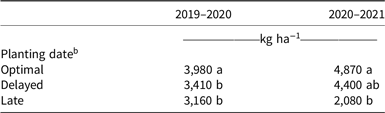
Even though optimal planting dates improved wheat biomass in both years, end-of-season grain yield was variable. In 2020, grain yield was reduced from optimal planting to delayed or late planting, evidenced as a decrease in grain yield by up to 21% (Table 5). In 2021, increased wheat biomass was observed for optimal and delayed plantings compared with late-planted wheat; only the optimal timing yielded more grain than the late timing, with 57% more grain harvested from the optimal planting. It is important to note that during the 2021 growing season, a severe freeze occurred in early February, which prolonged crop stress. A severe freeze during the winter, multiple freezes in the spring, or both, can result in severe wheat injury depending on the wheat growth stage at time of the event or events (Barret Reference Barrett1978; Miller Reference Miller1992). Additionally, significant stripe rust (Puccinia striiformis f. sp. tritici) followed by leaf rust [P. triticina (P. recondite Roberge ex Desmaz. f. sp. tritici)] infection during wheat recovery from the freeze-reduced growth for late-planted wheat.
Grain yield obtained from the 2019–2020 and 2020–2021 winter wheat growing seasons. a
a Means within a column for each site year followed by a common letter were similar according to Fisher’s protected LSD at α < 0.05.
b The optimal planting date represents the optimal window for sowing grain-only wheat to maximize grain yield and quality. The delayed timing occurred 2 to 3 wk after the optimal planting date, and the late planting date occurred 2 to 3 wk after the delayed date.
The use of ALS-inhibiting herbicides pyroxsulam and sulfosulfuron can provide effective control of cheat and downy brome but they may affect crop growth. Environmental conditions such as air temperature (Olson et al. Reference Olson, Al-Khatib, Stahlman and Isakson2000), soil organic matter, pH (Moyer and Hamman Reference Moyer and Hamman2001), and precipitation (Shinn et al. Reference Shinn, Thill, Price and Ball1998) can alter the efficacy of sulfonylurea herbicides (e.g., sulfosulfuron). A wide range of weather conditions occurred throughout the 2 site-years evaluated in our study. This likely explains the varying herbicide effects.
Winter wheat cultivar selection, herbicide treatment, and wheat planting time can be important strategies for cheat and downy brome management in winter wheat crops. Producers in Oklahoma and the southern Great Plains have the option of integrating these tools with their existing weed management plans, either individually, together, or in a sequential manner. Treatments with pyroxsulam and sulfosulfuron can control or suppress cheat and downy brome growth when proper stewardship and favorable conditions occur. In our studies, herbicides did not negatively affect wheat biomass or yield, but weed control was inconsistent. Producers who use ALS-inhibiting herbicides to control cheat or downy brome also need to be aware that continued use of this chemistry without incorporating other management strategies will continue to increase selection pressure for ALS-resistant cheat and downy brome biotypes. Finally, delaying planting by 2 to 6 wk after the optimal planting time provided control of cheat and downy brome, but it also decreased wheat biomass and grain yield. If choosing to incorporate a delay in planting as a cheat and downy brome management strategy, producers will need to evaluate their weed infestations and decide whether they can afford possible short-term yield decreases to make a long-term investment in Bromus species seed bank management.
Practical Implications
Weed management is critically necessary for winter wheat producers in the southern Great Plains. Timing of wheat planting is a key technique for managing downy brome and cheat. Downy brome and cheat are early emerging winter annual grasses that primarily germinate from mid-September to mid-October. This coincides with the optimal sowing window of dual-purpose and grain-only production in Oklahoma. This overlap creates management problems for wheat producers, because delaying wheat planting allows the producer to control early emerging downy brome and cheat, resulting in yield loss. We recommend a planting date of early to mid-November, 2 to 6 wk after the beginning of the optimal sowing window used by grain-only producers with high infestations of cheat and downy brome in Oklahoma. Weather conditions may further allow producers to delay the sowing of winter wheat while mitigating the yield loss from downy brome. In addition to planting date, producers can use common ALS-inhibiting herbicides such as pyroxsulam or sulfosulfuron to suppress downy brome and cheat.
Acknowledgments
We thank David Victor at the Oklahoma Agricultural Experiment Station. No conflicts of interest have been declared.
Financial Support
We thank the Oklahoma Wheat Research Foundation for providing wheat seed, the Oklahoma Wheat Commission, and CARE grant 13081905 awarded by the U.S. Department of Agriculture–National Institute of Food and Agriculture for providing funding for this research.


 Open access

