


1. Introduction
Are renters truly more politically left-wing than homeowners? A central argument in the literature on economic voting is that asset ownership makes individuals more right-wing, which is reflected in their political behaviour. A particularly salient asset appears to be the home, with homeownership being associated with both more right-wing views (Cabral and Hoxby, Reference Cabral and Hoxby2012; Lewis-Beck and Nadeau, Reference Lewis-Beck and Nadeau2011) and support for right-leaning parties (Verberg, Reference Verberg2000; Fischel, Reference Fischel2005). While the political preferences of homeowners command significant attention, renters typically enter the picture merely as a foil. This is an important oversight in light of recent work suggesting that this central argument is flawed and not borne out in the data. Rather, both homeowners and renters hold complex, sometimes counterintuitive, views on housing markets and policy (Elmendorf et al., Reference Elmendorf, Nall and Oklobdzija2024; Reference Elmendorf, Nall and Oklobdzija2025). Fleshing out the views of renters, across developed markets, therefore can help us better understand whether the conventional asset-ownership theory of political behaviour holds or whether housing tenure effects are more nuanced than previously assumed.
Omitting renters is a surprising gap in the political economy of developed countries for two reasons. First, rental markets are increasingly important across industrialized economies and the site of intense politics. In Canada, for example, about a third of Canadian families rent rather than own (Statistics Canada, 2022), and the rise of rental prices in big cities has been one of the major economic (and therefore political stories) of the past decade, squeezing a sizable share of the population. Second, homeownership does not fall from the sky. For most renters, it entails significant, sustained financial effort and planning. A full accounting of the effects of homeownership on political behaviour must consider how the path towards ownership might challenge the conceptual distinction between homeowners and renters. We examine this issue in Canada.
Our main argument is that renters are heterogeneous in their political behaviour. We differentiate between renters who, at any given moment, would like to own, a group we call “prospective homeowners,” and those who would prefer to rent, or “satisfied renters.” The standard patrimonial (economic) voting story is that homeowners are more right-wing than renters by virtue of being tied geographically and financially to their home—typically one of their largest financial assets. We think of prospective homeowners similarly. Prospective homeowners must save a significant amount of wealth and dedicate a substantial amount of time to realize their purchase. While they may not own a home just yet, their intention to buy and related saving behaviour make them holders of significant assets. As they prepare for a purchase, other social and behavioural factors kick in, pushing the ideological preferences of prospective homeowners away from those of satisfied renters and closer to those of actual homeowners. For example, prospective homeowners should demonstrate an aversion to increases in property tax rates because they anticipate these issues will affect them in short order. Along the same vein, the substantial financial and emotional effort of saving might make them less supportive of taxing the wealthy—viewing homeowners as more deserving. While we do not expect alignment on all issues between prospective homeowners and actual homeowners, our hypothesis is that prospective homeowners should tend to be more right-wing with regard to government intervention than satisfied renters.
Our goal is mainly theory building, not causal hypothesis testing. Though framed as a causal story about subtle shifts in political thinking, we rely on observational survey data to establish the empirical plausibility of our theories and hope that future work can fill in the gaps. To begin, we show that there are persistent differences in the political behaviour of homeowners and renters using the Canadian Election Survey’s 2019 wave. In line with the extant literature, homeowners are more right-wing than renters. Next, we deploy a first-of-its-kind survey of Canadian renters to probe into ideological heterogeneity among renters. Using simple statistical modelling techniques, we show that prospective homeowners are more right-wing than satisfied renters. However, these preferences do not translate into increased support for right-wing parties.
This study adds to the theoretical debates about the effects of homeownership on social and political beliefs. We join a limited body of work in political science theorizing about the political preferences of renters. Rather than consider how local market conditions change renters’ political behaviour (Hankinson, Reference Hankinson2018), our focus is on how the home buying process generates differences in political behaviour among renters. Drawing on insights from patrimonial economic voting and political psychology (Case and Shiller, Reference Case and Shiller1988; Reid, Reference Reid, Eric, Christopher, Jennifer and Institute2014; Salzman and Zwinkels, Reference Salzman and Zwinkels2017), we make the case that the relationship between homeownership and right-wing ideology and vote-choice predates, to some extent, the actual purchase of a home.
2. Homeowners as Politically Active Right-Wing Citizens
Classical work in political economy going all the way back to Engels (Reference Engels1935) has long argued that property ownership shapes political behaviour and preferences in predictable ways. In more contemporary work, the logic is simple. Buying a home entails making a significant financial commitment that is anchored to a relatively illiquid asset. As such, most single homeowners are “stuck” financially (to their home) and geographically (to their neighborhood, city, state, and so forth). These factors sharpen the trade-offs related to political participation. Because homeowners cannot (easily) vote with their feet, they must directly engage in the political process should they want to pursue change. A main prediction, therefore, is that homeowners are more politically active than renters.
Existing work from housing scholars has mostly confirmed this. Footnote 1 Earlier work demonstrates that homeowners are more likely than renters to participate in local associations and political groups (Cox, Reference Cox1982; DiPasquale and Glaeser, Reference DiPasquale and Glaeser1999). Homeowners are also more likely to be engaged in local politics and vote in national elections (Kingston et al., Reference Kingston, Thompson and Eichar1984; Rossi and Weber, Reference Rossi and Weber1996; Herbert and Belsky, Reference Herbert and Belsky2008; McCabe, Reference McCabe2016). Various studies from political scientists reach similar conclusions: Homeownership leads to higher levels of political participation (Fischel, Reference Fischel2005; Wolfinger and Rosenstone, Reference Wolfinger and Rosenstone1980; Verba et al., Reference Verba, Schlozman, Brady and Nie1993). Recent studies using quasi-experimental designs in the US context provide evidence of a causal relationship between homeownership and participation in local elections, especially when questions about zoning laws are on the ballot (Hall and Yoder, Reference Hall and Yoder2021; Yoder, Reference Yoder2020).
Aside from limiting mobility, buying a house can shape political behaviour through its impacts on wealth. In the USA, buying a house remains one of the most important ways through which parents save money, invest it and pass it on to their children (McCabe, Reference McCabe2016; Di, Reference Di2005; Turner and Luea, Reference Turner and Luea2009). Viewed as a wealth building endeavor, homeownership generates new predictions. The literature on patrimonial voting, for example, reasons that homeowners should be more right-wing than those who rent because more left-leaning policies, such as expanding housing supply, can lower housing prices. Similarly, homeowners should be averse to policies that raise the costs of managing their investment, such as raising property taxes.
Generally, these differences in political and policy preferences when it comes to renters and homeowners are well-documented in the empirical evidence. Scholars have shown that homeowners generally oppose increases in property taxes (Cabral and Hoxby, Reference Cabral and Hoxby2012), which has indirect effects on voting through ideology and party identification (Lewis-Beck and Nadeau, Reference Lewis-Beck and Nadeau2011). In contrast, Brunner et al. (Reference Brunner, Ross and Simonsen2015), for instance, show that renters are approximately 10–18 percentage points more likely than homeowners to favour a property tax increase over a sales tax increase to fund public services. As a result, local jurisdictions with higher shares of renters appear to spend more on local services, a phenomenon called the “renter effect” (Oates, Reference Oates2005). Scholars of public policy and urban studies have also confirmed that homeowners and renters express different attitudes on a variety of related issues (Oliver, Reference Oliver2001), with renters significantly more pro-redistribution than homeowners (André and Dewilde, Reference André and Dewilde2016). Work on Canada supports this view. McGregor and Spicer (Reference McGregor and Spicer2016) argue that renters are less likely to vote in municipal elections and that they diverge sharply with homeowners on policies related to property. This may explain why homeowners are sometimes more likely than renters to support right-leaning political parties (Studlar et al., Reference Studlar, McAllister and Ascui1990; Verberg, Reference Verberg2000; Fischel, Reference Fischel2005), though this is not true across all contexts and might depend on the relative policy position of parties on housing policy (Hellwig and McAllister, Reference Hellwig and McAllister2019).
At the same time, recent work challenges the notion that voters fully understand housing markets or policy. Elmendorf et al. (Reference Elmendorf, Nall and Oklobdzija2025) find that large swaths of both renters and homeowners believe that a significant increase in housing supply would either not affect or would increase local housing prices. This suggests that the political motivations of homeowners are more complex than the traditional “homevoter hypothesis” would allow. Furthermore, voters of all types show a strong preference for non-market interventions when presented with policy options to improve housing market affordability. Elmendorf et al. (Reference Elmendorf, Nall and Oklobdzija2024) find broad public support for policies such as rent control, demand-side subsidies and restrictions on corporate investors, while policies to increase the supply of market-rate housing are seen as less effective. Taken together, this new body of work suggests that the traditional homeowner–renter divide is blurry and that voters’ policy preferences may be shaped more by heuristics and blame attribution than by sophisticated economic reasoning. This suggests a potential wedge between an individual’s general ideological self-placement and their partisan choice, as specific policy beliefs may not align neatly with party platforms. This is consistent with cross-national work which suggests that, as the “supply” or range of party’s policy positions becomes more diverse or polarized, homeownership is more strongly associated with right-wing party support (Hellwig and McAllister, Reference Hellwig and McAllister2019).
Market conditions, including changes in home value, can further complicate the relationship between homeownership and policy or political preferences. Looking at Sweden, Persson and Martinsson (Reference Persson and Martinsson2018) show that what matters is not homeownership per se but the changing value of the home. These findings are in line with scholarship in political psychology, which has noted that large changes in economic circumstance can alter preferences for redistribution (Peterson, Reference Peterson2016; Doherty et al., Reference Doherty, Gerber and Green2006). Rising housing prices tend to improve homeowner’s satisfaction with incumbents (Han and Jeong Shin, Reference Han and Jeong Shin2021; Larsen et al., Reference Larsen, Hjorth, Dinesen and Mannemar Sønderskov2019) and increase homeowner’s opposition to redistributive measures (Ansell, Reference Ansell2014). Similarly, risky housing markets and significant drops in home prices seem to generate substantial backlash against the political system among homeowners. Studying this issue in Quebec, Foucault (Reference Foucault, Bastien, Bélanger and Gélineau2018) demonstrates that high-risk homeownership increases the probability of voting for a right-wing party. In contrast to earlier findings, André et al. (Reference André, Dewilde, Luijkx and Spierings2018) show that, in The Netherlands, homeowners become more pro-welfare when their house value declines. This is nonetheless consistent with the notion that homeowners view their home as insurance against economic shocks. Finally, an emerging literature links falling housing prices to the rise of far-right parties. Adler and Ansell (Reference Adler and Ansell2020) have argued that low housing prices increase likelihood of supporting populist causes or parties. In sum, while scholars continue to conclude that homeownership makes individuals more likely to participate in politics, new work points to the fact that their politics seem more contextual than initially thought.
While much of the literature on homeownership politics focuses on the local level, our focus on federal partisanship and ideology is particularly relevant in the Canadian context. Housing policy in Canada is a multilevel affair. While provincial and local governments hold significant regulatory and planning authority (Farhan, Reference Farhan2024; Ontario Housing Affordability Task Force, 2022), the federal government plays a crucial role through tax incentives, mortgage insurance underwriting and direct spending (Hulchanski, Reference Hulchanski, Young and Leuprecht2006). The issue’s national salience has grown substantially. In 2017, the federal government launched a 10-year, $40 billion National Housing Strategy, and housing affordability has since become a top-tier priority for all major federal parties. In the most recent federal election, all major parties had detailed housing policy plans.Footnote 2
3. The Preferences of Satisfied Renters and Prospective Homeowners
While the differences in political behaviour and preferences between renters and homeowners are well-documented, we know much less about variation in the political behaviour and preferences of renters. While the literature may not explicitly assume renters are homogeneous, it has largely overlooked potential sources of heterogeneity within this group. If homeowners differ along some key dimensions on the degree of their political ideology and vote choice, it stands to reason that renters should too. In particular, the possibility that renters differ systematically in their ideology and partisanship remains underexplored.
Our contention is that renters differ with regard to their preference over homeownership. While prospective homeowners would like to own a home in the future, satisfied renters are perfectly content renting. As we show in the next section, not only are these individuals a non-negligible share of renters, but also sorting into satisfied “rentership” cannot be explained solely by socio-economic characteristics or market conditions. Thus, this distinction is rooted not in the ability to enter the real estate market, but in true preferences over the possible returns (or burdens) of owning a home versus renting at any given moment. We are not distinguishing between people who will never want to own a home and those who always do, but rather conceptualize preferences over homeownership as fluid. In other words, we believe that many individuals who would prefer to rent right now will eventually become prospective homeowners. It is this potential transformation that is of theoretical interest to us—does wanting to enter the housing market flip a switch that partly shapes how individuals think about politics? Our tentative answer is “yes.” Becoming a prospective homeowner has social, behavioural and financial implications that affect an individual’s political preferences and behaviour. We consider these in turn. (Of course, we recognize that the relationship between housing preference and ideology may be endogenous, as pre-existing political views could also influence the desire to own a home. We return to this challenge in our research design, but our primary goal here is to establish the theoretical grounds for distinguishing among renters.)
Studies across the developed world find that homeownership is associated with life satisfaction. In the USA, for example, homeownership is tightly linked to social aspirations and the American dream (Rohe and Stegman, Reference Rohe and Stegman1994). Likewise, it increases owners’ sense of security (Zavisca and Gerber, Reference Zavisca and Gerber2016). In settings where renter protections are limited—such as Canada—renters may find long-term stability and security in buying a home. But these benefits accrue only to homeowners. Prospective homeowners, in contrast, are more likely to feel less satisfied and secure with regard to their renting situation. In contexts where home buying initiatives are robust, this might yield more sociotropic individuals. But in places where home prices are high and government support is limited, the opposite is likely to be true: Individuals may find themselves more concerned with their own well-being, less likely to trust the government to provide support to buy a home and generally more right-wing than satisfied renters.
On a cognitive level, becoming a prospective homeowner might shape political behaviour through two mechanisms. First, once renters commit to becoming homeowners, they may find it difficult to back out. The path to homeownership begins with shifting consumer behaviour as renters increase their savings to make a down payment. As their savings increase, however, the stakes get higher as commitment bias kicks in. The more they save, the less likely they will deviate from actually buying a house, regardless of whether or not the current costs outweigh the benefits. Footnote 3 This mechanism might operate through social channels as well. The more you advertise to friends and family that you are on the market for a house, the more likely you are to remain committed to buying a house. We would expect that in such cases prospective homeowners will share deep preferences with actual homeowners on issues such as property taxes.
Second, prospective homeownership requires exercising a large amount of self-restraint in terms of saving because most people tend to value immediate returns to delayed ones, that is, present bias (O’Donoghue and Rabin, Reference O’Donoghue and Rabin1999; Goda et al., Reference Goda, Levy, Manchester, Sojourner and Tasoff2020). In high-cost housing markets, this bias may be particularly acute since the opportunity cost of saving is higher than in lower-cost markets. People engaging in something difficult may value the efforts of those who came before them more highly. As such, they may be more likely to support policies that benefit the wealthy, thinking of them as more deserving. Together these biases tend to suggest that prospective homeowners, as they start down the path of saving for a down payment, will be more likely to identify with homeowners, shifting their views towards more right-wing positions.
As to the financial implications of prospective homeownership, we borrow from the literature on patrimonial voting. At its core, the patrimonial voting story is one of wealth accumulation. Property ownership shapes ideology and voting behaviour because homeowners have a significant amount of wealth invested into houses. As holders of significant wealth, homeowners may find themselves less reliant on social services, less supportive of property tax and redistribution more specifically and more likely to engage in activities that raise housing or sustain housing prices (“Not in My Back Yard” (NIMBY) activities, for instance). A similar process should be at work with regard to prospective homeowners. To be able to buy a house, these prospective homeowners must engage in the same type of wealth accumulation that we presume makes homeowners more politically active and right-wing. Specifically, to buy a house, homeowners must save (or otherwise acquire) a substantial amount of capital.Footnote 4
This is surely the case in Canada. According to the National Bank of Canada (2021), the average home price across Canada is roughly $650,000. Assuming, a minimum down payment of 10 per cent, the average prospective homeowner will have to save about $65,000 to be eligible to buy a house—a considerable amount to hold in cash. From a political psychology perspective, this substantial wealth accumulation should lead to distinguishable political effects; namely, as wealth increases, we should note changes in ideological self-placement and partisanship (Peterson, Reference Peterson2016; Doherty et al., Reference Doherty, Gerber and Green2006). It follows that these prospective homeowners should be concerned with protecting their growing investment with implications for their support for taxation and redistribution.
Of course, prospective homeowners are not homeowners. This potentially closes off some pathways to changes in political preferences. To give one example, whereas homeowners are physically grounded by their investment, prospective homeowners are not and could potentially pick up and leave one housing market (and political unit) for the next with relative ease. We believe, however, that a nontrivial share of prospective homeowners may have strong attachment to their communities owing to work or family commitments. These strong social attachments should increase their political activism to ensure, for instance, that their future property values do not plummet. In short, social and political investments may limit how mobile prospective homeowners truly are. Other differences will remain, of course. Our point is that, to the degree to which wealth considerations shape political participation and political attitudes, they should push in the same direction for homeowners and prospective homeowners, and that this distinguishes the latter from satisfied renters.
We also note that this process is compatible with the “folk economics” framework (Elmendorf et al., Reference Elmendorf, Nall and Oklobdzija2025). While the financial discipline and future-oriented mindset required to save for a home may shift an individual’s general ideological disposition on matters of wealth and redistribution, their specific beliefs about housing policy may still be shaped by the same intuitive heuristics that affect the general public. An individual can begin to see themselves as a future asset-holder deserving of tax breaks while still believing that rent control is the most effective way to ensure affordability, or that developers are to blame for high prices. This suggests that a shift in ideology may not neatly map onto a shift in partisan allegiance.
Furthermore, the link between a changing ideology and federal vote choice is not straightforward. On the one hand, comparative research suggests that asset ownership is more strongly associated with right-wing party support when the range of party policy positions are more polarized (Hellwig and McAllister, Reference Hellwig and McAllister2019). In Canada, research suggests that voters’ partisanship has become more strongly associated with redistributive policy positions in recent decades (Kevins and Soroka, Reference Kevins and Soroka2018) and that parties have also become increasingly polarized in their policy positions during the same period (Johnston, Reference Johnston2023). Together, this would suggest that, as Canadian prospective homeowners become more ideologically right-wing, they would be more likely to support right-wing parties. On the other hand, a voter’s final ballot choice is the result of a complex calculation weighing a host of policy issues, candidate evaluations, long-standing partisan loyalties and even strategic voting (Gidengil, Reference Gidengil2022; Rivard and Lockhart, Reference Rivard and Lockhart2022); housing is but one factor among many.Footnote 5 In a federal system such as Canada’s, this link is weakened further, as voters may not attribute responsibility for housing policy solely to the federal government (see, for example, Cutler, Reference Cutler2008; Mosannef et al., Reference Mosannef, Alcantara, Stephenson and Sayers2025). Blame or credit can be assigned to provincial or municipal actors, complicating the connection between an individual’s housing concerns and their federal partisan choice.
We derive two hypotheses from this argument. First, because we think of prospective homeowners and homeowners as analytically equivalent with respect to wealth accumulation:
H1: Renters who express a preference for homeownership should be more right-wing than those who express a preference for renting.
While some suggest that the effect of homeownership extends to party preferences (André et al., Reference André, Dewilde, Luijkx and Spierings2018), we note that renters and homeowners are different in their preferences over housing prices. As prices increase, prospective homeowners will be increasingly priced out of the market. Thus, while renters who are prospective homeowners may be more right-wing on average along some dimensions, they are not necessarily fully right-wing and might be supportive of certain policies that are more in line with redistribution. For example, as they still need to enter the market, they may be more likely to support policies such as rent control or housing subsidy programs that are broadly popular among the public (Elmendorf et al., Reference Elmendorf, Nall and Oklobdzija2024).
While a shift towards a more right-wing ideology seems plausible (H1), we do not expect this to translate directly into increased support for right-wing parties. The link between a general ideological shift and a specific vote choice is attenuated by several factors. As noted, voters’ final ballot decisions are multi-determined and influenced by a range of issues beyond housing, and in a federal system, voters may not attribute housing policy responsibility to the national government. Moreover, the “folk economic” beliefs individuals hold about housing (Elmendorf et al., Reference Elmendorf, Nall and Oklobdzija2025; Reference Elmendorf, Nall and Oklobdzija2024) may lead a prospective homeowner to adopt a more right-wing worldview on wealth and taxation while simultaneously supporting non-market housing interventions not typically associated with right-wing parties. Therefore:
H2: Renters who express a preference for homeownership should not be more likely to vote for right-wing parties.
4. Context: Renters in Canada
Before turning to our empirical analysis, we provide context on the political behaviour and attitudes of Canadian renters using data from the 2019 Canadian Election Study (CES) (Stephenson et al., Reference Stephenson, Harell, Rubenson and Loewen2020). Our task is to show that Canadian homeowners and renters conform broadly to the existing literature’s expectations.
We begin by examining whether renters are more left-wing than homeowners using the 2019 CES data. We identified respondents who said they (or a member of their household) own a residence and code them as homeowners. After excluding nonresponses, we coded the remaining respondents as renters. We then identified political views. To do so we used self-reported data from CES documenting respondent’s placement on a left-to-right scale, ranging from 0 to 10, where higher values indicated closer alignment with right-wing views. Figure 1 presents the distribution of responses for renters and homeowners (n = 14,067). We noted the mean of each distribution with a vertical line. The mean showed that renters (mean = 4.8) are more left-wing than homeowners (mean = 5.2), and that such a difference is statistically significant at conventional levels (p ≤ 0.05). Moreover, the distributions themselves are statistically distinguishable from each other (p ≤ 0.05). At the same time, Figure 1 presents that there is substantial heterogeneity across groups. A great deal of homeowners and renters identified as having fairly right-wing views. In other words, while homeowners may be, on average, more right-wing than renters, quite a few renters are more right-wing than some homeowners.
Ideological placement of renters and homeowners in Canada, 2019.

Next, we examined differences in political behaviour between homeowners and renters. About 22.31 per cent (1,681) of homeowners reported attending at least one political meeting within the last 12 months, compared with 20.13 per cent (490) of renters. Footnote 6 We also explored differences in voting by identifying respondents who said they had voted (in an advance poll) or were certain to vote in the pre-election survey, who we coded as certain voters. After removing those who said they were ineligible to vote or preferred not to respond to the question, all remaining responses were coded uncertain voters. Canadian renters and homeowners behaved in accordance with what the literature has described in other settings: Homeowners were more likely to be certain voters, or 83.76 per cent (20,058) compared with certain voters among renters at 70.98 per cent (7,467).Footnote 7
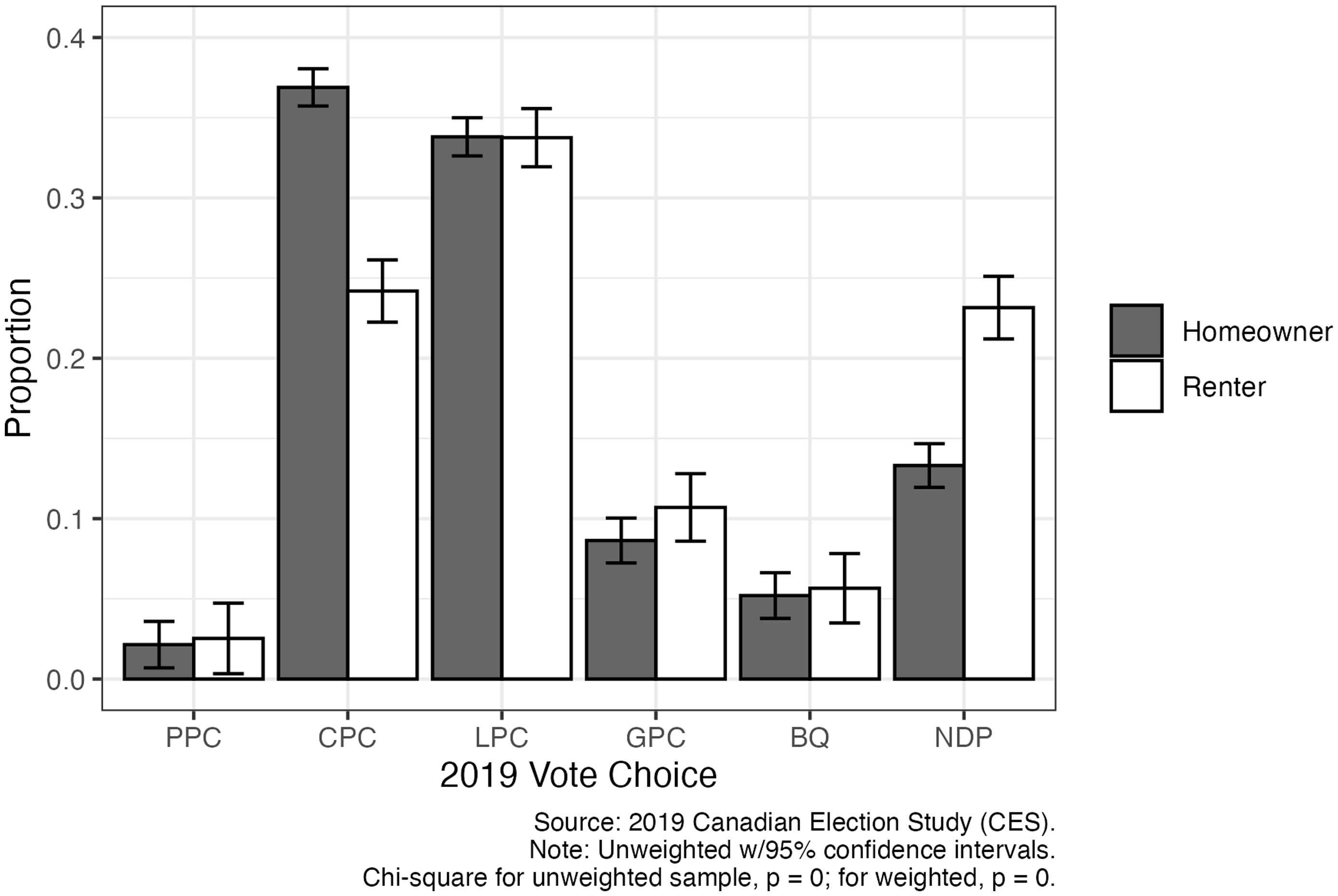
Finally, we assessed whether renters were more likely to vote for more right-wing parties. Figure 2 presents vote choice among six national Canadian parties for the entire electorate grouped by homeownership. Substantial differences were apparent. Homeowners were more likely to vote for the Conservative Party of Canada (CPC) than renters, while renters were more likely to vote for the New Democratic Party (NDP) (and to some extent the Green Party of Canada (GPC)). Note that the share of renters voting for the CPC is not trivial; 24.2 per cent of renters voted for the CPC. Upon adding voters for the People’s Party of Canada (PPC), 26.7 per cent of renters voted for right-wing parties.
Vote choice of homeowners and renters in Canada, 2019.

To summarize, in line with the existing literature, Canadian renters appear to be on average more left-wing than homeowners and less politically engaged. They were also less likely to vote for the CPC than homeowners. But these averages obscured quite a bit of variation in political views and engagement among renters. Many renters had right-wing views, were fairly active across political activities and voted for right-wing parties. Our argument about prospective homeowners can explain this heterogeneity.
5. Research Design
To assess the relationship between prospective homeownership and political beliefs and behaviour, we collected a national survey of Canadian renters. Our focus was on establishing the plausibility of our argument. Studying prospective homeownership is difficult because people are not sorted randomly into preferences for homeownership. Rather, these preferences are built on contextual circumstances, including resources available to individuals as well as their pre-existing levels of political behaviour (Manturuk et al., Reference Manturuk, Lindblad and Quercia2017). Prospective homeownership may very well be endogenous to ideology and vote choice. Thus, we can make no causal claims. Still existing work provides some guidance on how to proceed. We know, for example, that ownership itself is determined in part by resource accumulation, which is in turn dictated by income. Similarly, age and family composition are key determinants of the choice to buy a home. Our strategy, therefore, revolved around modeling this relationship by adjusting for a host of plausible confounders. We leave to future work the task of untangling the causal relationship.
5.1. Data
Our sample consisted of 1,845 self-identified renters who responded to our housing survey administered by Vox Pop Labs during the last week of January and first week of February 2020 (before the coronavirus disease 2019 (COVID-19) pandemic impacted Canada). Participants were aged 19 years or older and Canadian residents. All participants were drawn from the Vox Pop Labs online respondent panel, which contained approximately 650,000 panelists in Canada.Footnote 8 The dataset used for the analysis consisted of two components that were linked, (1) 37 questions about experiences and preferences regarding housing collected in January 2020, and (2) socio-demographic questions and political preferences from the respondents’ initial participation in the Vox Pop Labs election survey conducted previously. We also used the respondent’s forward sorting area (FSA) to code respondents who lived in one of the four largest cities (Ottawa, Montreal, Toronto and Vancouver) or elsewhere. Table 1 includes descriptive statistics for our sample. Footnote 9 The sample allowed us to generalize about Canadian renters willing to speak on their political opinions and behaviours.
2020 renter survey descriptive statistics

Note: L, left; R, right; SD, standard deviation
Source: Renter survey (2020), unweighted.
5.2. Dependent Variables
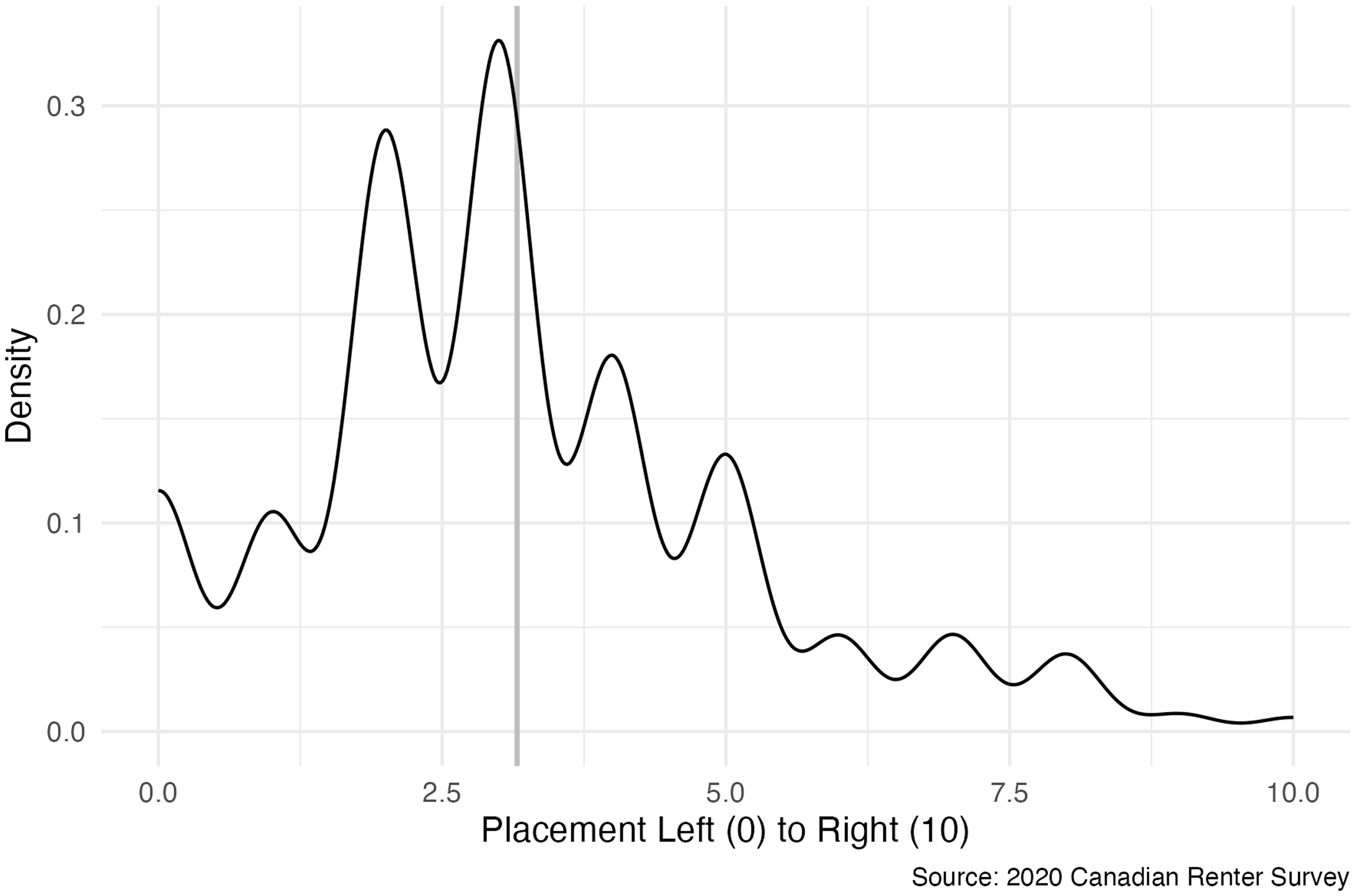
We had two dependent variables. The first was ideological orientation. We measured this concept by asking respondents to place themselves on an 11-point left (0) to right (10) scale. The resulting measure had a mean of 3.16 and a standard deviation of 1.99. This implies that most of the sample was fairly left-wing in orientation. The distribution of answers among respondents can be seen in Figure 3.
Distribution of ideological self-placement of renters in Canada.

Second, we measured right-wing vote choice. To do so, we asked respondents whether they voted and excluded those who did not or those who had spoiled their ballot. We coded those who voted for the CPC or PPC as right-wing voters, given that these parties are generally considered to align with traditional, right-wing values. All other respondents casting valid ballots were the reference category. Roughly 7.63 per cent of our sample were right-wing voters.Footnote 10 The unweighted percentage of renters in our renter survey who reported voting for either the CPC or PPC was much lower than what renters reported in the 2019 CES. For this reason, in the statistical analyses that follow, we present weighted results in the main text.
5.3. Independent Variable
Our primary independent variable of interest is prospective homeownership. We conceptualized prospective homeowners as renters who were oriented towards future ownership, in contrast to those content with renting. We operationalized this concept by asking respondents:
“Right now, would you prefer to own your home rather than rent?”
Respondents who said they would prefer to own were coded as prospective homeowners, whereas those who preferred to rent were coded as satisfied renters.
We acknowledge that this question measures a preference or aspiration for ownership, rather than a concrete, active plan to purchase a home. However, we argue this is a valid and conceptually appropriate measure for our argument, which posits that the political effects of homeownership begin with the psychological and social reorientation that precedes active financial planning. Footnote 11 Our goal is to capture the crucial segment of renters whose outlooks are shaped by the aspiration of future ownership, even if they are currently constrained by material circumstances.
5.4. Estimation Strategy
We estimated a series of simple statistical models on our observational data to assess the plausibility of our arguments. First, we estimated the relationship between prospective homeownership (PH) and ideological self-placement. The estimating equation was:
 $${{\rm{y}}_i} = \gamma {\rm{PH}} + {{\rm{X}}_{\rm{i}}}\beta + {{\rm{u}}_{\rm{i}}}$$
where y i is ideological self-placement, PH is an indicator for whether the respondent would prefer to own a home rather than to rent, X i is a vector of adjustment variables and u i is an error term. We estimate this as a linear equation with raking weights Footnote 12 and with fixed effects for province or region.Footnote 13
Next, we estimated the relationship between prospective homeownership (PH) and vote choice in the last election (2019). The estimating equation is:
 $${{\rm{y}}_{\rm{i}}} = \gamma {\rm{PH}} + {{\rm{X}}_{\rm{i}}}\beta + {{\rm{u}}_{\rm{i}}}$$
where y i is voting for either the CPC or PPC in fall 2019 for respondent i, PH is an indicator for whether the respondent would prefer to own a home rather than to rent, X i is a vector of adjustment variables and u i is an error term. Because the dependent variable is binary, we estimated this equation using logit with fixed effects for province or region.
6. Results
6.1. Ideological Self-Placement
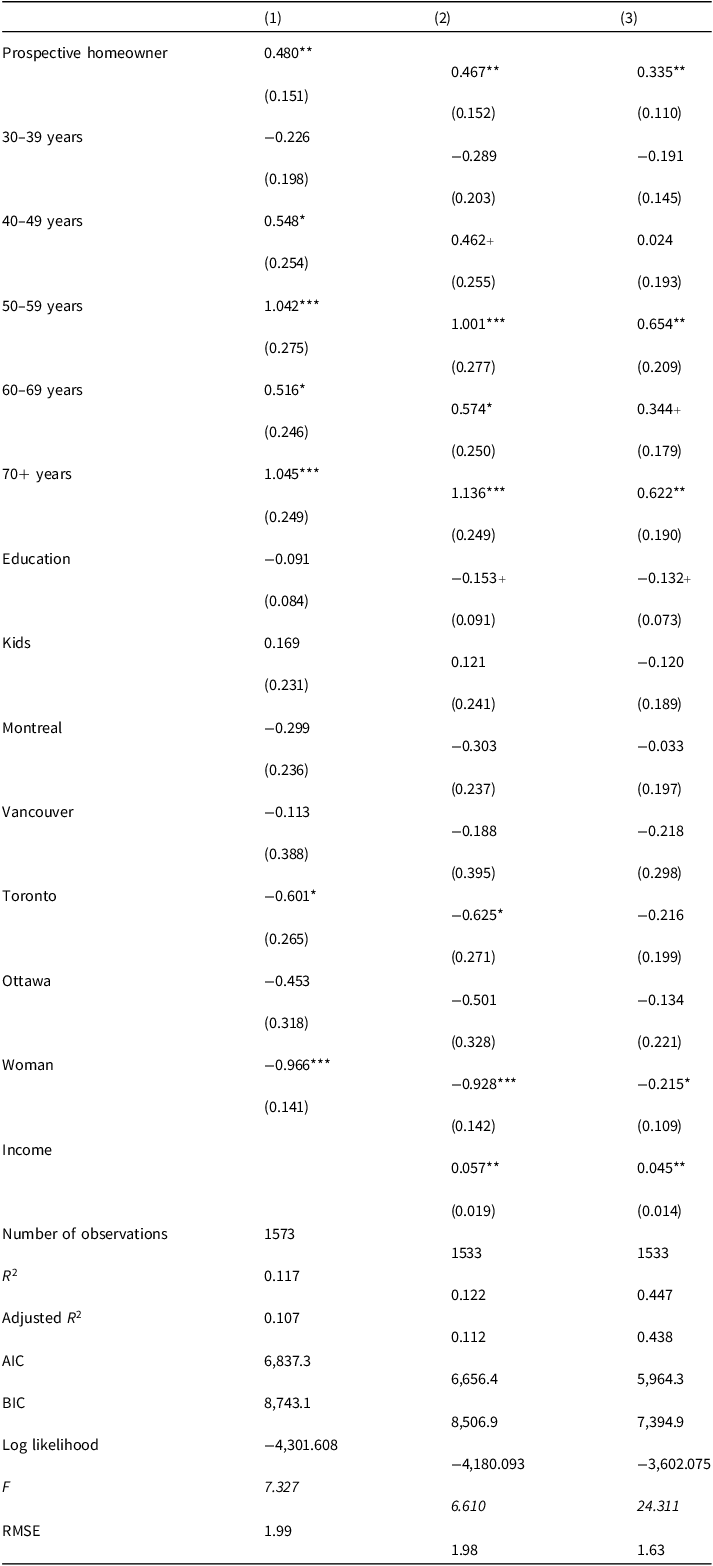
Our analysis found support for H 1. Table 2 examines the association between self-placement on an ideological scale and prospective homeownership across three models. Model 1 adjusted for age, education, gender and region, whereas Model 2 further adjusted for income. Model 3 included vote choice in the 2019 election. We think this variable might introduce post-treatment bias since becoming a prospective homeowner makes individuals both more right-wing and possibly more likely to vote for a right-wing party (in our hypothesized causal ordering). If true, the inclusion of vote choice would absorb some of the effect of prospective homeownership on ideology, attenuating the coefficient’s magnitude. For these reasons, we de-emphasize Model 3.Footnote 14
Regressing ideological placement on prospective homeownership and covariates

Note: The dependent variable is ideological self-placement, with higher values indicating more right-wing ideology. Models include survey weights, fixed effects for province/region, and robust standard errors. The model in column 3 includes vote choice in the 2019 election. AIC, Akaike information criterion; BIC, Bayesian information criterion; RMSE, root mean square error. +p < 0.1, *p < 0.05, **p < 0.01, ***p < 0.001
Across all models, the relationship between ideology and prospective homeownership was positive and statistically significant at the p < 0.01 level. Since higher values on the self-placement scale indicated more right-wing views, the models suggest that prospective homeowners are more right-wing than satisfied renters. This relationship was fairly consistent across model specifications though, as expected, the magnitude of the effect was diminished in the model adjusting for vote choice.Footnote 15
How large are these effects in substantive terms? Figure 4 plots the predicted effects of prospective homeownership on ideology for both satisfied renters and prospective homeowners. Predictions were adjusted for age, education, province, income and sex.Footnote 16 While both groups were fairly left-wing, with scores well under mid-point of 5 on the 0–10 scale, we expect that prospective homeowners will be notably more right-wing than satisfied renters. We estimated the typical satisfied renter would take on a value of approximate 3.41 on the ideological scale, versus 3.88 for prospective homeowners, nearly half a point on the ideology scale, a non-negligible increase.
Predicted ideological self-placement among renters.

6.2. Vote Choice
Table 3 examines the association between voting for right-wing parties (the PPC and CPC) and prospective homeownership across three models. Footnote 17 Model 1 adjusted for age, education, sex, region and location, whereas Model 2 further adjusted for income. Model 3 included left-to-right self-placement. Across all models, the relationship between voting for right-wing parties and prospective homeownership was positive but not statistically significant at conventional levels. This finding is consistent with our theoretical expectation that a general shift in ideology does not necessarily translate into a change in vote choice. Our argument there was that this would be attributed to the multiple determinants of voting, of which housing policy is but one possibly small component. Footnote 18 Figure 5 presents these results in terms of predicted probabilities adjusting again for age, education, region, city size, income and sex. Whereas we would expect satisfied renters to vote for right-wing parties with a 0.23 probability, we expect prospective homeowners to do so with a 0.27–0.28 probability. The magnitude of the difference was not statistically significant, likely owing to significant variation within both groups. While prospective homeowners might be more right-wing, this does not directly translate into support for right-wing parties.
Regressing vote for PPC or CPC on prospective homeownership and covariates

Note: The DV is a dummy for voting for the PPC or CPC. Linear probability models include survey weights, fixed effects for province/region, and robust standard errors. Model 3 includes left-right ideology (0–10). AIC, Akaike information criterion; BIC, Bayesian information criterion; RMSE, root mean square error. + p < 0.1, *p < 0.05, **p < 0.01, ***p < 0.001
Predicted probability of voting for a right-wing party.

Together, the preceding results provide evidence consistent with both of our hypotheses. Prospective homeownership was associated with a more right-wing ideological self-placement among renters, but this did not translate into a significantly higher probability of voting for right-wing parties. The direction and significance of the control variables were broadly consistent with what is known about political ideology and vote choice in Canada.
6.3. Additional Robustness Checks
In addition to the alternative measures and estimation methods noted above, we assessed the possibility that specific housing markets are driving the results. We collected data on average income by FSA and merged it to our data. First, our results did not change when adjusting for these characteristics. Footnote 19 Second, we also interacted average FSA income with prospective homeownership and found no heterogeneous effects by FSA income levels. Footnote 20 Third, we assessed whether respondents in certain high-priced cities were responsible for the overall effects. To do so, we relied on PadMapper’s Canadian Rent Report, which identifies the top 10 most expensive cities in Canada to rent a one-bedroom apartment using their own data. We used these data to operationalize high rent markets in different ways (Top 2, 3, 4, 5 and 10 most expensive cities) and interact such a term with PH. Footnote 21 We found no evidence that the effect of PH on ideological self-placement or vote choice depends on high rent markets, and that our results remain the same when adjusting for these terms.
7. Implications
The political science literature on housing has largely ignored potential heterogeneity in the political preferences and behaviour of renters. This article addresses this gap by considering how the path to becoming a homeowner—what we call prospective homeownership—shapes the politics of renters. Our main argument is that renters are heterogeneous in their political preferences and behaviour. First, we made an analytic distinction between prospective homeowners and satisfied renters. We argued that prospective homeowners share political preferences, and therefore ideological self-placement, with actual homeowners and that their preferences distinguish them from satisfied renters. Using a unique survey of Canadian renters, our evidence supported this argument.
Our findings have important implications for the literature on housing. Our argument is built around the notion that homeownership, and specifically the path to homeownership, is a continuous process shaping social and political identity, not a binary treatment that cleanly distinguishes those with a house and those without. More specifically, we demonstrated that the literature overstates political differences between prospective and current homeowners. Our key finding that the path to homeownership is associated with a more right-wing ideology but not with right-wing vote choice highlights that political identity is not monolithic. This aligns with a context where recent research reveals that the political beliefs of both groups are far more complex and internally contradictory than previously assumed (Elmendorf et al., Reference Elmendorf, Nall and Oklobdzija2025; Reference Elmendorf, Nall and Oklobdzija2024) and vote choice may be shaped by party policy positions on housing or other assets (Hellwig and McAllister, Reference Hellwig and McAllister2019).
This article also makes an important empirical contribution. Much of the literature on housing in North America focuses on the USA. While some authors do explore these issues in Canada, they do not typically rely on national survey data to support their claims. Footnote 22 We hope our data and findings can help inform current and future debates about these issues in Canada and, through them, influence the larger comparative literature on housing. Other scholars can use our approach to test the degree to which our claims travel to other countries.
Our findings also raise a compelling puzzle when viewed through the lens of recent American scholarship. The “folk economics” literature suggests that US voters are highly skeptical that building more homes will improve affordability (Elmendorf et al., Reference Elmendorf, Nall and Oklobdzija2025). Yet, in the contemporary Canadian political landscape, federal parties across the ideological spectrum have converged on a message emphasizing the need to “build more homes.” We suggest that the political appeal of increased construction may resonate with parties because they believe it signals to voters that they are serious about government action to make housing available. In a political environment where voters tend to blame actors such as developers for high prices (Elmendorf et al., Reference Elmendorf, Nall and Oklobdzija2025), a pledge to build might resonate with voters regardless of their specific beliefs about market effects. This would explain why parties emphasize the tangible act of building without making the politically risky and potentially less credible promise of explicitly lowering prices.
We leave various questions unsettled. Does the effect of homeownership on political behaviour wane over time? Does it peak as families grow older and become more likely to retire, or when they become more numerous and outgrow the home? What do we make of homeowners refinancing their homes, or on the market to sell or buy a house? Our work pushes the comparative housing literature forward by suggesting that answers to these questions are likely to depend on what analytical groups are considered. When it comes to housing, our article shows that heterogeneous effects do exist, that they deserve theorizing and that future work should continue to untangle this relationship further.
Supplementary material
To view supplementary material for this article, please visit https://doi.org/10.1017/S0008423926101036
Acknowledgements
We thank James R. Dunn, whose grant from the Canada Mortgage and Housing Corporation (CMHC)/Social Sciences and Humanities Research Council (SSHRC) funded data collection, and Robbie Brydon, who contributed to survey design. All views and errors are our own.
Competing interests
The authors declare none.




 Open access

