


Dietary fibre intake has been reported to be associated with a lower glycosylated Hb (HbA1c) level and an improved glycaemic control status in patients with type 2 diabetes( Reference Post, Mainous and King 1 – Reference Chandalia, Garg and Lutjohann 4 ). However, this association has been suggested to vary by race( Reference Brownley, Heymen and Hinderliter 5 ) and severity of glucose impairment( Reference Livesey, Taylor and Hulshof 6 ). In a systematic review, Livesey et al. ( Reference Livesey, Taylor and Hulshof 6 ) reported that higher amounts of unavailable carbohydrate in diets, e.g. dietary fibre, reduce the levels of glycated proteins, particularly in patients with a poorer glycaemic control status. Mechanisms underlying this effect are not very clear. It is plausible that dietary fibre may retard food digestion and nutrient absorption( Reference Riccardi and Rivellese 7 , Reference Brennan 8 ), improve insulin sensitivity( Reference Jenkins, Axelsen and Kendall 9 – Reference Robertson, Bickerton and Dennis 11 ) and thus play an important role in carbohydrate metabolism.
In our previous study, we observed an association of insoluble dietary fibre intake with subsequent HbA1c levels among Chinese adults with type 2 diabetes( Reference Yang, Shu and Jiang 12 ). However, little is known whether and how the associations would vary in patients with different glycaemic control status. In the present study, we aimed to determine the possible difference in associations of insoluble dietary fibre intake with HbA1c levels across the quantile levels of HbA1c using a quantile regression (QR) approach. The QR model allows us to determine how the covariates influence the location, scale and shape of the entire response distribution rather than just its conditional mean( Reference Cade and Noon 13 – Reference Burgette, Reiter and Miranda 15 ). If insoluble dietary fibre intake had a minimal impact on the mean level of HbA1c and could greatly reduce HbA1c levels in the upper percentiles, the differential associations might be overlooked when using typical mean regression models such as ordinary least-squares regression, but could be captured using a QR model.
Materials and methods
Subjects and data collection
As described in our previous study( Reference Yang, Shu and Jiang 12 ), 979 prevalent patients with type 2 diabetes were recruited from the communities of Pudong New Area of Shanghai, China, and were interviewed from October to December 2006. They were followed up from May to July 2011 using a similar protocol. Structured questionnaires were used during baseline and follow-up surveys to collect information on age, sex, time from being diagnosed with type 2 diabetes, regular exercise (at least three times per week and at least half an hour per time), oral hypoglycaemic drug use, insulin use and family history of diabetes. The standing height and body weight of the patients were measured to calculate BMI, which was defined as weight divided by height squared (kg/m2).
Dietary intake was assessed using an interview-administered FFQ modified based on a validated FFQ in which the correlation coefficient for validation was 0·53 for insoluble dietary fibre( Reference Shu, Yang and Jin 16 ). The modified FFQ specified 103 food items, covering 90 % of the food items commonly consumed by the residents of Shanghai. The participants were asked to report the frequency (daily, weekly, monthly, annually or never) and duration (months per year) of consumption of each food item, as well as the estimated amount that they ate each time in the unit of liang (1 liang = 50 g). The amount of intake was reported in millilitres for liquid foods such as milk, juice and beverages and was further converted into grams in the data analysis. The daily intakes of oil, salt and sugar were calculated as the average amount consumed by each member of the participant's family.
The Chinese food composition tables were used to estimate the intake of nutrients from all food items and obtain glycaemic index (GI) values for most of the food items( Reference Yang, Wang and Pan 17 ), leaving the others, the values for which were obtained by referring to the report of Foster-Powell et al. ( Reference Foster-Powell, Holt and Brand-Miller 18 ). The daily intake of each nutrient was calculated by summing up the intakes of the nutrient from each food item consumed. For calculating dietary fibre intake, the intake of only insoluble fibre was considered. Glycaemic load was calculated by multiplying a food's GI by the carbohydrate content of the food and the average amount of the food consumed per d. Average GI for each individual was obtained by dividing the total dietary glycaemic load, which was obtained by summing up the glycaemic loads from each food item consumed, by the total amount of carbohydrate consumed.
In both surveys, an overnight fasting blood sample was collected from each participant to measure fasting glucose and HbA1c levels. The quality control of the assays was assessed internally and externally( Reference Jiang, Qiu and Zhao 2 ). After excluding eight subjects with extreme values of total energy intake ( < 3347 or >16 736 kJ/d for men; < 2092 or >14 644 kJ/d for women), a total of 497 patients who took part in both surveys and provided a blood sample were included in the present study. The patients were categorised into those with an uncontrolled glycaemic status (HbA1c level ≥ 7·0 %) and those with a controlled glycaemic status (HbA1c level < 7·0 %) using the HbA1c value recorded during the second survey according to the recommendation of the American Diabetes Association( 19 ).
The study was approved by the Institutional Review Board of Fudan University (IRB00002408, FWA00002399). Written informed consent was obtained from each participant before data collection.
Statistical analyses
We applied a QR analytical approach to evaluate the associations of insoluble dietary fibre intake with HbA1c levels at a set of quantile levels ranging from 0·05 to 0·95. The QR approach, which was introduced by Koenker & Bassett( Reference Koenker and Bassett 20 ), has been used in various fields( Reference Koenker and Hallock 21 ) because it assumes no parametric form of the error distribution and the QR estimates are more robust against outliers( Reference Koenker and Bassett 20 ) and more accurate in the tails( Reference Cade and Noon 13 , Reference Chernozhukov 22 ). The distinguishing feature of the QR model is that the regression coefficients of insoluble dietary fibre intake may differ across the quantile levels of HbA1c ( Reference Han and Powell 23 , Reference Yang, Adolph and Puyau 24 ), which is practically meaningful in that it can distinguish the association of insoluble dietary fibre intake with HbA1c levels between the upper/lower tails and the central trends.
Statistical analyses were conducted using R for Windows version 3.0.1 (R Foundation for Statistical Computing). The characteristics of patients with uncontrolled and controlled glycaemic status were compared at the 0·05 α-level of significance for two sides, using the χ2 test for categorical variables and the Wilcoxon test for continuous variables. A QR analysis was carried out using R package ‘quantreg’ (R Foundation for Statistical Computing). Ordinary least-squares estimations were also performed using R function ‘lm’ (R Foundation for Statistical Computing) as a reference.
Results
The descriptive statistics of important covariates according to the glycaemic control status of patients are summarised in Table 1. Patients with a controlled glycaemic status were older (P= 0·0304), had lower BMI (P= 0·0156), lower baseline HbA1c levels (P< 0·0001), higher insoluble fibre intake (P= 0·0046) and lower GI value (P= 0·0066), on average, and were less likely to use hypoglycaemic drugs (P= 0·0007) compared with those with an uncontrolled glycaemic status. Patients with a controlled glycaemic status tended to have diabetes for a shorter duration and were more likely to be female, to have a family history of diabetes, to exercise, to use insulin, and to have lower energy and carbohydrate intake; however, the differences did not reach statistical significance.
Comparison of selected covariates at the baseline survey between patients with uncontrolled glycaemic status and those with controlled glycaemic status during the second survey (Medians and 25th–75th percentiles for continuous variables; number of patients and percentages for categorical variables)

HbA1c, glycosylated Hb.
* χ2 test (for categorical variables) or Wilcoxon test (for continuous variables).
The coefficient estimates and 95 % CI for the associations of HbA1c levels with insoluble dietary fibre intake across the quantile levels of HbA1c are given in Table 2. According to the ordinary least-squares estimations, a significant inverse association was observed between insoluble dietary fibre intake at baseline and HbA1c levels during the follow-up survey (β = − 0·258; 95 % CI − 0·450, − 0·065). In the QR analysis, however, the association was found to be not significant until after the quantile level of 0·52 (i.e. the HbA1c level of 6·8 %). The estimates were − 0·174 (95 % CI − 0·433, − 0·025) at the quantile of 0·60, − 0·200 (95 % CI − 0·306, − 0·008) at 0·70, − 0·221 (95 % CI − 0·426, − 0·117) at 0·80, and − 0·389 (95 % CI − 0·516, − 0·018) at 0·90. Further adjustment for other dietary factors such as protein and fat intake did not alter the results substantially.
Marginal associations of glycosylated Hb (HbA1c) levels with insoluble dietary fibre intake at the mean and selected quantile levels of HbA1c (Coefficients and 95 % confidence intervals)
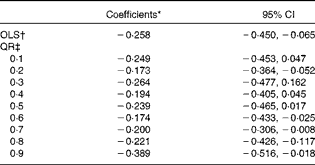
OLS, ordinary least squares; QR, quantile regression.
* Refers to the change in HbA1c levels (%) with one unit (g/1000 kJ per d) intake of insoluble fibre; all estimations were adjusted for age (continuous variable), sex (male/female), BMI (continuous variable), time from being diagnosed with diabetes (continuous variable), regular exercise (ever/never), hypoglycaemic drug use (ever/never), insulin use (ever/never), family history of diabetes (ever/never), carbohydrate intake per 1000 kJ/d (continuous variable), energy intake (continuous variable) and HbA1c level during the baseline survey (continuous variable).
† The mean value of HbA1c was 7·0 %.
‡ The corresponding values of HbA1c at the quantile levels ranging from 0·1 to 0·9 were 5·1, 5·6, 6·0, 6·4, 6·7, 7·2, 7·7, 8·4 and 9·3 %, respectively.
The plot in Fig. 1(a), with the quantile levels of HbA1c ranging from 0·05 to 0·95 on the x-axis and regression coefficients for the associations of HbA1c levels with insoluble dietary fibre intake (β) derived from QR models on the y-axis, shows the changes in HbA1c levels with one unit (g/1000 kJ per d) intake of insoluble dietary fibre across the quantile levels of HbA1c. The association of insoluble dietary fibre intake with subsequent HbA1c levels was found to be significant at and after the quantile of 0·52 (HbA1c level = 6·8 %). Considering the significant influence of drug use on HbA1c levels, we conducted a sensitivity analysis by including hypoglycaemic drug use and insulin use during the follow-up survey into the QR models. As shown in Fig. 1(b), the inverse associations of insoluble dietary fibre intake with HbA1c levels were more pronounced after the quantile of 0·56, where the HbA1c level was 7·0 %.
Coefficients (β) for the associations of glycosylated Hb (HbA1c) levels with insoluble dietary fibre intake across the quantile levels of HbA1c. The coefficients indicate the change in HbA1c levels (%) with one unit (g/1000 kJ per d) increase in insoluble fibre. The black solid horizontal line represents β = 0, black dots represent the estimated coefficients and the grey area represents 95 % CI of the corresponding parameters. The mean values of insoluble dietary fibre intake at the quantile levels of HbA1c ranging from 0·1 to 0·9 were 1·5, 1·4, 1·4, 1·5, 1·7, 1·6, 1·4, 1·5 and 1·0, respectively. All coefficients and 95 % CI were adjusted for age (continuous variable), sex (male/female), BMI (continuous variable), time from being diagnosed with diabetes (continuous variable), regular exercise (ever/never), family history of diabetes (ever/never), carbohydrate intake per 1000 kJ/d (continuous variable), energy intake (continuous variable) and HbA1c level at baseline (continuous variable) in both (a) and (b) and additionally baseline hypoglycaemic drug use (ever/never) and insulin use (ever/never) in (a) and additionally hypoglycaemic drug use (ever/never) and insulin use (ever/never) during the follow-up survey in (b).

Fig. 2(a) shows the associations between dietary GI value and HbA1c levels, which reached statistical significance when the quantile level was 0·52 (HbA1c level = 6·8 %) or higher and became stronger afterwards. Similarly, in the sensitivity analysis, the associations of GI value with HbA1c levels were more evident after the quantile of 0·56 (HbA1c level = 7·0 %; Fig. 2(b)).
Coefficients (β) for the associations of glycosylated Hb (HbA1c) levels with dietary glycaemic index (GI) value across the quantile levels of HbA1c. The coefficients indicate the change in HbA1c levels (%) with one unit increase in dietary GI. The black solid horizontal line represents β = 0, black dots represent the estimated coefficients and the grey area represents 95 % CI of the corresponding parameters. The mean values of dietary GI at the quantile levels of HbA1c ranging from 0·1 to 0·9 were 61·9, 58·9, 60·8, 57·0, 60·4, 58·5, 62·3, 61·7 and 68·2, respectively. All coefficients and 95 % CI were adjusted for age (continuous variable), sex (male/female), BMI (continuous variable), time from being diagnosed with diabetes (continuous variable), regular exercise (ever/never), family history of diabetes (ever/never), carbohydrate intake per 1000 kJ/d (continuous variable), energy intake (continuous variable) and HbA1c level at baseline (continuous variable) in both (a) and (b) and additionally baseline hypoglycaemic drug use (ever/never) and insulin use (ever/never) in (a) and additionally hypoglycaemic drug use (ever/never) and insulin use (ever/never) during the follow-up survey in (b).

Discussion
In the present study, using QR models, we were able to evaluate whether and how the associations of insoluble dietary fibre intake with HbA1c levels changed across the selected quantile levels of HbA1c among Chinese adults with type 2 diabetes. We found that both insoluble dietary fibre intake and GI value were significantly associated with subsequent HbA1c levels among diabetic patients, especially among those with high HbA1c levels. Our findings indicate the importance of insoluble dietary fibre intake in Chinese diabetic patients with uncontrolled glycaemia. So far, no other study has been carried out to evaluate the associations of dietary factors with HbA1c levels by applying a QR model.
The role of dietary fibre intake in glycaemic control has long been controversial, and its close correlation with dietary GI value may be one of the reasons. Fibre-rich foods usually have a low GI value( Reference Bjorck and Elmstahl 10 , Reference Riccardi, Rivellese and Giacco 25 ), making it difficult to distinguish their independent effects. In recent years, attempts have been made to determine the individual and joint effects of dietary fibre intake and GI value on glucose control. In a randomised trial, patients consuming low-GI diets were found to have lower HbA1c levels than those consuming high-cereal fibre diets during a 6-month treatment period( Reference Jenkins, Kendall and McKeown-Eyssen 26 ). In a meta-analysis, unavailable carbohydrate (e.g. dietary fibre) was found to have at least as much effect on health outcome as GI itself, which was independent of GI value( Reference Livesey, Taylor and Hulshof 6 ). In our prior analysis of observational data, we observed a significant association of glycaemic control status with insoluble dietary fibre intake, but not with GI value( Reference Yang, Shu and Jiang 12 ), which, however, was probably because it was not taken into account whether the absolute size of the association was conditional on the level of glycaemic control, but which was taken into account in the QR analysis carried out in the present study.
In the present study using the QR method, we observed significant associations of both insoluble dietary fibre intake and GI value with HbA1c levels, especially among patients who did not have their blood glucose under control. Unlike the parametric logistic regression method used in our previous study( Reference Yang, Shu and Jiang 12 ) in which an average association was estimated among all participants without considering whether the size of the association was dependent on the level of blood glucose control, the non-parametric QR approach adopted in the present study allowed us to identify differing regression coefficients across the conditional distribution of HbA1c and provided a more complete picture of how the dietary factors and HbA1c levels are associated( Reference Marrie, Dawson and Garland 14 ).
The results of the present study are somewhat consistent with those reported by Livesey et al. ( Reference Livesey, Taylor and Hulshof 6 ), who demonstrated that both dietary GI value and fibre intake have significant effects, and the strength of their effects on absolute changes was dependent on the severity of diabetes. Such results indicate that the dietary fibre may act independently of its effect on the rate of digestion. However, the mechanism for the conditionality remains to be investigated. Nevertheless, the results of the present study implicate some clinical and public health significance. In our diabetic patient setting, one unit increase in insoluble fibre intake (i.e. 1·0 g/1000 kJ per d) was found to be associated with a 0·174 % decrease in HbA1c content at a HbA1c level of 7·2 % and with a 0·221 % decrease at a HbA1c level of 8·4 %.
The present study has several limitations. First, the sample size was relatively small and the follow-up rate was not very high. Possible selection biases could not be overlooked. Second, insoluble dietary fibre intake in the study population was much lower than that reported previously( Reference Yin, Zheng and Huang 27 , Reference Villegas, Yang and Gao 28 ), and so extreme caution should be exercised when generalising these results to a broad range of populations. The 5-year time frame was also a potential problem. The patients could have made many changes to their physical activities or diets during the study period and these could affect HbA1c levels within a few months. The possible differentiated changes in patients with low or high HbA1c levels could bias the results of the study in both directions. In the present study population, the κ coefficient for regular exercise between the two surveys was 0·22 (P< 0·001) for patients with low HbA1c levels, but was 0·01 (P>0·05) for patients with high HbA1c levels, indicating more evident changes in regular exercise among patients with high HbA1c levels. Unfortunately, physical activity was poorly measured in the present study, which limited our ability to assess the confounding effect of this important factor.
In conclusion, our findings indicate that insoluble dietary fibre intake and GI value are significantly associated with HbA1c levels in Chinese diabetic patients, particularly among those with a poor glycaemic control status. Further studies are required to confirm our findings.
Acknowledgements
The authors thank all the participants and research staff at community health centres in Pudong New Area of Shanghai, China.
The present study was funded by the Shanghai Municipal Health Bureau (grant no. 12GWZX1010, GWDTR201204) and partially supported by the National Nature and Science Foundation of China (grant no. 11371100), the Scientific Research Foundation for the Returned Overseas Chinese Scholars, and the National 985 Project of Fudan University and Shanghai Leading Academic Discipline Project (project no. B118). The funders had no role in the design and analysis of the study or in the writing of this article.
The authors' contributions are as follows: W. H. X., X. R. and G. Q. designed the study; Z. T. conducted the data analysis and wrote the manuscript; J. J., Y. Z. and H. Q. collected the data; G. Q. provided statistical support; W. H. X. and Y. C. revised the article. All the authors read and approved the final manuscript.
None of the authors has any conflicts of interest to declare.



