




Introduction
Music education is challenged by technological developments, which have radically changed the methods of operating in the musical field, affecting all levels from production to fruition (Ruokonen et al., Reference RUOKONEN, ENBUSKA, HIETANEN, TUISKU, RIMPPI and RUISMÄKI2017). It is important to connect school activities with real-life experiences and define effective learning strategies for using the latest technologies in music education. Currently, devices such as computers, tablets and mobiles phones are widely accessible and have become easy tools for music making (Tobias, Reference TOBIAS, Ruthmann and Mantie2017), allowing all people – including those without a specific musical background – to generate music (Partti & Westerlund, Reference PARTTI and WESTERLUND2013). Technological devices are flexible and satisfy both novice and expert needs, enabling music making not only through musical notes but also through complex direct manipulations of the sound events. The multifaceted uses of technological devices make them a flexible resource for teachers when designing music education activities.
Technology offers benefits to music education, such as its support for elaborating and sharing musical ideas. Collaborative music tasks may take advantage of the use of technological and multimedia tools: technology has been innovative in the music composition world and led to new ways of thinking about music, amplifying musical creativity. Technological tools have also affected the social dimension of composition, simplifying collaborative compositional tasks. In music education, collaborative music composition activities may enhance the expression of divergent thinking skills through collective effort (McCarthy et al., Reference MCCARTHY, BLIGH, JENNINGS and TANGNEY2005).
In addition to the support of technology, there is a concurrent progress in communication systems (Burland & Davidson, Reference BURLAND and DAVIDSON2001; Burnard & Yunker, Reference BURNARD and YOUNKER2008; Rusinek, Reference RUSINEK2007), which should be considered in music education. Several virtual environments and applications for music making are available in Web 2.0, and many programs are freely accessible (Gibson & Dovey, Reference GIBSON and DOVEY2006; McCarthy et al., Reference FAUTLEY2005). Online tools make it possible to interact and to produce music collaboratively, which is relevant for music education. Platforms such as ejamming.com, mikseri.net and noteflight.com were conceived for virtual music collaborations and offer stimuli for expanding divergent thinking abilities and creativity. Working in a virtual environment implies skills such as collaborating with other people, sharing processes for music creation and establishing new interactions. Online activities occur at an informal level of learning, both for musical and collaborative strategies. However, the extent to which these tools are used during music education activities remains unclear. One of the most current issues in educational research is the pedagogical potential of online music tools, which is underestimated by music educators. The formal and informal dimensions of learning can be connected to innovate traditional teaching methods (Green, Reference GREEN2009). Informal activities can provide ideas for renewing traditional educational practices by introducing more interactive teaching methods based on collaboration (Biasutti, Reference BIASUTTI2017) and stimulating new approaches for curricular actions in music education.
The current pilot study collects data about online composition processes, investigating the learning activities of eight electroacoustic composers engaged in collaboratively composing new electroacoustic pieces. The aim is to collect data that could be applied in designing music education activities. The following research questions are considered as:
-
1. How do electroacoustic composers plan and manage collaborative compositional activity?
-
2. What approaches and strategies do electroacoustic composers adopt when engaging in collaborative compositional activity?
Literature review
Collaborative composition in educational settings
Historically, composition has been a process that takes place individually, and it is only recently that its research horizons have been broadened by considering group processes (Fautley, Reference FAUTLEY2005). The compositional process is characterised by its multidimensional nature, where musical, aesthetic and psychological aspects are joined in an artistic action. The complexity of the compositional process requires the composer to make a specific plan but to remain flexible while applying and revising the plan (Sloboda, Reference SLOBODA1985). In group composition, the scenario is even more complex, as composers have to manage both working and social dimensions during collaborative activities (Burland & Davidson, Reference BURLAND and DAVIDSON2001; Burnard & Younker, Reference BURNARD and YOUNKER2008).
Collaborative compositional tasks have been examined in educational contexts, with particular attention given to their social and communicative dimensions (Burland & Davidson, Reference BURLAND and DAVIDSON2001; McCarthy et al., Reference MCCARTHY, BLIGH, JENNINGS and TANGNEY2005; Hewitt, Reference HEWITT2008). In music education, compositional activities are useful for enhancing group creativity, encouraging the expression of children’s musicality and supporting social skills and cooperation within the class. Collaborative tasks, such as songcrafting, stimulate students to define group objectives and negotiate individual ideas in a shared musical product (Muhonen, Reference MUHONEN2016). Discussing and collectively assessing musical proposals are core abilities that could be acquired through collaborative tasks: children may learn that group work leads to a refined and elaborated musical product, strengthening the cohesiveness and cooperation among participants (McCarthy et al., Reference MCCARTHY, BLIGH, JENNINGS and TANGNEY2005). The development of the social dimension is important for promoting students’ ‘transversal’ skills and for creating positive and effective interpersonal relationships with peers (Burland & Davidson, Reference BURLAND and DAVIDSON2001).
Students’ interactions are focused on reaching specific compositional goals and planning, conducting and assessing group activities. Group composition supports in-depth critical reflection of actions and decisions through the evaluation of proposals and feedback by other group members (Biasutti, Reference BIASUTTI2018); here, flexibility is an essential requirement, as the social dimension implies the constant negotiation of actions and outcomes within the group. Although constant negotiation in compositional activity requires great effort from group members, it allows the creation of a more refined product than individual work (McCarthy et al., Reference MCCARTHY, BLIGH, JENNINGS and TANGNEY2005).
Several aspects of the management of social interactions have been studied in educational contexts, such as interpersonal relationships and the distribution of leadership (Burland & Davidson, Reference BURLAND and DAVIDSON2001; Burnard & Younker, Reference BURNARD and YOUNKER2008). Social interactions during collaborative educational compositional activities are focused on the achievement of common goals and may include the use of tools, the rules of the group and the division of work (Burnard & Younker, Reference BURNARD and YOUNKER2008). The division of work is connected to the relationship model of the group: vertically linked relationships are usually organised hierarchically, with leaders and followers, while horizontally linked relationships are characterised by an equal distribution of leadership. The management of interpersonal exchanges depends on the personal and professional features of the group participants, which result in multifaceted interactional patterns (Hewitt, Reference HEWITT2008).
The development of students’ musical and social skills is one of the main benefits of collaborative compositional activities, and it would be interesting to understand how the teacher can facilitate the learning process, encouraging both musical creation and social exchange (Muhonen, Reference MUHONEN2016). Technology and online tools can support music educators in structuring group activities for creating music (Thorgersen, Reference THORGERSEN2012) and motivating students to be engaged in collaborative creative tasks.
Online collaborative music making and music education
Online collaborative music making is an emerging research topic that has attracted scholarly attention in music education. Research has provided evidence that online settings can successfully support the management of collaborative activities in music composition (Biasutti, Reference BIASUTTI2018). From a global perspective, multimedia tools allow people to communicate and collaborate despite physical distance, and websites and software for online collaborative musical activity are becoming accessible and intuitive (Gibson & Dovey, Reference GIBSON and DOVEY2006; McCarthy et al., Reference MCCARTHY, BLIGH, JENNINGS and TANGNEY2005), enabling people from several countries – and with different levels of musical expertise – to work collaboratively. A high level of creativity is involved, as people expand on current ideas to give rise to a product that did not exist before (Webster, Reference WEBSTER2002). In addition, virtual spaces allow musicians to co-create in musical communities, to share their expertise and to exchange ideas and best practices (Partti & Westerlund, Reference PARTTI and WESTERLUND2013; Salavuo, Reference SALAVUO2006; Waldron, Reference WALDRON, Bartlett and Higgins2017). Online communities are focused on specific musical tasks (Partti & Westerlund, Reference PARTTI and WESTERLUND2013), which implies a high level of motivation on the part of the participants that are engaged in musical activities (Salavuo, Reference SALAVUO2006).
Collaborative composition has also had an impact in music education research (Biasutti, Reference BIASUTTI2015, Reference BIASUTTI2018; Partti & Westerlund, Reference PARTTI and WESTERLUND2013) because collaborative online music making can link formal and informal music education settings (Green, Reference GREEN2009). In virtual learning contexts, collaborative compositional activities are mainly directed by communicative exchanges of two different codes: verbal and musical. While language is used for managing social interactions and organising compositional activities, the musical code is essential for sharing ideas and feedback about the current musical progress (Biasutti, Reference BIASUTTI2015; Partti & Westerlund, Reference PARTTI and WESTERLUND2013).
It is also relevant to examine the processes and phases in which collaborative compositional tasks are structured. The learning activities of adult musicians during the composition of a rock piece through online collaboration were analysed in a pilot study (Biasutti, Reference BIASUTTI2018), which found that the participants interacted using synchronous and asynchronous tools to develop the composition project. The following five learning activities were identified as: experimenting, listening/evaluating, constructing, playing and technical issues.
Summary of the theoretical background
An analysis of previous studies highlighted the importance of the social dimension of collaborative composition in music education, revealing that the management of interpersonal relationships plays a central role in defining strategies, objectives and stages. The interactions are focused on the organisation, the management of the task (Biasutti, Reference BIASUTTI2018), the discussion of the compositional process and the products. Social variables affecting collaborative composition include the characteristics of the group (Hewitt, Reference HEWITT2008), the leadership model (Burnard & Younker, Reference BURNARD and YOUNKER2008) and the level of interpersonal relationships (Burland & Davidson, Reference BURLAND and DAVIDSON2001). Two main styles of communication have been highlighted as follows (Biasutti, Reference BIASUTTI2015; Partti & Westerlund, Reference PARTTI and WESTERLUND2013): one based on verbal interactions and the other on the musical manipulation of the compositional product. While interventions in the musical piece are based on the direct application of compositional strategies (and the consequent feedback from the other members), verbal interactions are focused on sharing and negotiating the different stages of the musical task (Biasutti, Reference BIASUTTI2018). There is a need to investigate how a lack of personal acquaintance may affect the management of a collaborative compositional task in a virtual environment, where communication may occur only through multimedia devices. The current study examines the organisation of compositional activities and the learning strategies adopted during a collaborative online task.
Method
The current research project employed a multiple case study methodology and can be defined as an embedded case study (Scholz & Tietje, Reference SCHOLZ and TIETJE2002). Different units of analysis of a specific situation are examined with a mixed-method technique. The project followed a replication approach (Yin, Reference YIN2014), where each case was analysed individually and cross-case comparisons based on specific indicators were made to identify possible similarities or contrasting results to draw final conclusions.
The ECCOL project
Electroacoustic Collaborative Composition OnLine (ECCOL) is a research project developed by a European university to examine collaborative compositional processes in virtual environments involving composers of electroacoustic music from different countries around the world. Composers have been working in groups of two or three participants with the aim of creating an electroacoustic musical piece lasting about 5–8 min. No music constraints related to style, genre, framework or technique were imposed on the participants who were free to decide how to proceed in the compositional process and how to develop the music piece. However, the researchers established a set of rules about communicative exchanges to ensure that the work was conducted entirely online. Material was collected, and all steps in the activities were documented. The following instructions were communicated and agreed to by the participants:
-
1. Participants were asked to undertake the work only online. They were invited to use the team work forum and the chat function in the platform to discuss compositional activities with the other composers. If they wanted to use other communicative channels outside the Modular Object-Oriented Dynamic Learning Environment (Moodle) platform, such as Skype or e-mail, they had to inform the research team.
-
2. While participants had to use the platform for all contacts, they also had the opportunity to meet and discuss synchronously using other tools, such as Skype. In the case of Skype meetings, they had to inform the research team in advance of their meetings to allow researchers to collect data about the synchronous working session (as stated in the Introduction section). When the participants discussed the compositional activity thorough e-mails, they were asked to report the dialogues in the activity diary section to document all events.
-
3. Participants had to keep a detailed diary of all the activity sessions (individual and collective) undertaken for composing the music piece. They were asked to report the intentions and the actions performed during the online work step by step in the diary. All the participants had the ability to contribute their observations to the diary. The diary was set in the Moodle platform using a Wiki tool so that all participants had the ability to modify or integrate the text. The diary was important for updating the other participants about work progress, and participants were asked to update it on at least a weekly basis.
-
4. Participants were asked to inform the other participants of their individual work through the platform. The team work forum and other tools were available for exchanging information among group members. It was also possible to upload audio and multimedia files to the platform.
-
5. Participants were invited to immediately inform the tutors of any difficulties or technical problems.
An online tutor was available on the platform to facilitate the process and to solve possible issues. The tutor was also responsible for creating a friendly environment and welcoming the participants. For example, an ice-breaking activity was proposed at the beginning in which the composers had to introduce themselves to the other participants. During the project, participants were encouraged to collaborate and to constantly communicate to reach a shared result. The tutor had the role of facilitator in this exchange, helping the group members, when necessary, to keep the communication active.
The project activities took place from February to September 2016. Participants were free to manage their own time, but they were asked to complete the collaborative tasks in around eight months. At the end of the project activity, a written interview was sent to all the participants, which included questions intended to investigate features of the composers’ experiences within the ECCOL project. The interview was focused on the management of the compositional activity, the strategies used for sound manipulation, the organisation of the work and the management of interpersonal relationships within the project team. The complete list of questions in the interview is given in Appendix 1.
The virtual environment
A virtual space was made available to the participants on the university’s Moodle platform for the ECCOL project. Moodle is an online platform that is mainly used by academic institutions for managing online learning activities.
The ECCOL project space was divided into the following four main sections:
-
The general section (see Figure 1), which included all the information about the project (about the project, with the main aims, guidelines, information about data use and informed consent for participants), a forum with the researcher’s team news (project news), a forum for support for technical issues (technical issues forum) and a folder with additional materials about the project (documents and additional materials folder).
-
The section called team work (see Figure 2) was conceived for performing the collaborative compositional task, which included a forum for asynchronous communications, a chat application for synchronous communications, a Wiki for reporting group activity (the activity diary) and a database.
-
The electroacoustic composer community section offered virtual space for all the participants to communicate, share and exchange ideas, links and materials connected with the artistic and professional activities of the composers.
-
The online space for collaborative composition was designed with the free compositional software programme OhmStudio (see Figure 3). Each group of composers accessed a specific section and worked on the sound track synchronously or asynchronously.
The general section of the ECCOL project space in the Moodle platform.

The team work section of the ECCOL project space in the Moodle platform.

The OhmStudio software for collaborative composition in the virtual space.

Participants
A recruitment phase was implemented to find participants with a specific professional background. Criteria for inclusion were as follows: at least five years’ experience in electroacoustic music composition and professional expertise in different multimedia compositional strategies and tools. To promote the project among electroacoustic composers, a call for participants was sent to the main international associations of electroacoustic music composers, such as the Society for Electro-Acoustic Music in the United States (SEAMUS), the Canadian Electroacoustic Community (CEC) and the Australian Computer Music Association (ACMA). Sixteen advanced compositional students and professional composers from different countries (5 women and 12 men) responded to the call and sent their professional and academic curriculum vitae. After the applicants’ requests were examined and approved, they were all admitted to the project and asked to confirm their willingness to participate. Eight applicants (one woman and seven men) confirmed their interest in participating. Six of them were university or conservatory of music advanced students (Master or PhD) while two were professional composers, and all were skilled in different compositional techniques (e.g., algorithmic composition techniques, fixed media and live digital signal processing), and they chose to join the research study voluntarily. Participants did not know each other before the project and had not been involved in a collaborative compositional project before. Informed consent was obtained from each composer, in accordance with the Declaration of Helsinki (World Medical Association, 2013) and American Psychological Association (APA) ethical principles of psychology and the code of conduct (APA, 2003). Participants were informed about the purpose and procedure of the study, and they were assured that the data collected during the project would remain anonymous and be used for research purposes only.
The participants were divided into three groups as follows: group 1 (two male composers), group 2 (three composers, one female and two males) and group 3 (three male composers). Each composer could only see and access their virtual space group; however, at the end of the project, the researchers made all the online spaces accessible to everyone for sharing the final products. Demographic information about the three groups (gender, age, nationality and location) is reported in Table 1.
Demographic Information for Each Group

Data analysis
Data were collected from different sources to examine the compositional process and the organisational strategies used by each group during the compositional task. A content analysis was used for examining the written material: in this qualitative method, a triangulation of the data from different sources was applied to provide a detailed description of the processes that occurred during the activities. A final model summarising the actions performed by all groups was provided. Group activities were also contrasted in the last section, considering the following six indicators that emerged from the literature review, using a top-down process:
-
1. Working approach (Biasutti, Reference BIASUTTI2015, Reference BIASUTTI2018);
-
2. Communicative style (Hewitt, Reference HEWITT2008; McCarthy et al., Reference MCCARTHY, BLIGH, JENNINGS and TANGNEY2005);
-
3. Relational model (Burnard & Younker, Reference BURNARD and YOUNKER2008);
-
4. Leadership (Burland & Davidson, Reference BURLAND and DAVIDSON2001; Burnard & Younker, Reference BURNARD and YOUNKER2008);
-
5. Organisation (Biasutti, Reference BIASUTTI2018) and
-
6. Compositional process (Biasutti, Reference BIASUTTI2018).
The experience of each project group has been described and examined with these features to understand the internal processes of the collaborative activity.
Results: analysis of cases
Group 1
Group 1 comprised of two male composers, with a similar level of expertise in electroacoustic music composition: they were both college students, with academic curricula based on musical composition. They showed many similarities, related not only to some of their demographic characteristics (gender and age) but also to their academic and professional backgrounds. The two composers actively participated in several international electroacoustic music artistic events. The group managed the compositional process in a mixed way, alternating synchronous meetings – Moodle chat and Skype meetings – with asynchronous activity – Moodle Forums and OhmStudio software. With the OhmStudio platform, they often worked and communicated asynchronously, as reported in the final interview: ‘Most of the time was asynchronous (…)’, although they also held some synchronous sessions. They worked with continuity except for occasional interruptions mainly due to academic and job commitments. They made a regular plan of their activity, as they explained in the interview ‘This regularly scheduled time allowed us to work consistently and in a collaborative way’. They successfully completed their task in a six-month period.
Both composers shared equal roles in planning and making decisions in a collaborative process. Neither of them was definitely the leader, as they stated in the final interview ‘We moved between leading and following. Sometimes we would be working on the same section, other times on different sections. I would say there was no concretely defined roles’ and ‘There was no hierarchy to the project or defined roles’. Their communication model was based on a horizontal relationship (Burnard & Younker, Reference BURNARD and YOUNKER2008), and their relationship was based on democratic cooperation.
Their compositional objectives were defined by ‘brainstorming’ ideas, where they decided the main topic of their work. The current socio-political national (USA) and international events were considered, and a satirical approach was adopted. Focusing on these ideas, the composers exchanged some source material, manipulated it and defined the structure of their project, as they reported as follows: ‘We then began experimenting with some material we brought and quickly decided to use sound samples….’. They collaboratively decided on their objectives, the digital sound techniques and the upcoming individual tasks for developing the compositional project. They then worked independently on the sound tracks, as they reported in the activity diary when describing a session at an intermediate stage of the project: ‘We both worked independently’. The composers started from recorded materials, using techniques such as granulation and sound distortion to obtain a noisy effect. They also merged sounds from different sources, looking for a chaotic sound space. The musical idea that guided their work was the progression from recognisable sound events to noise and vice versa. At the end of each individual work, they collaboratively monitored the progress, reviewed the output when needed and decided which further actions should be taken, as stated in the following passage: ‘We now have a better idea of how the piece might work and will continue individual work until next Thursday’. Each step of the compositional activity was determined in advance, and they coordinated their individual work (‘Today we focused on making long noise files’). They showed effective organisation of the work, sharing and maintaining regular communicative exchanges with each other. They also managed to create a good interpersonal relationship and a positive climate, as they often used humour and warm-up chatting (‘What happens if we put a group of electroacoustic composers in rooms with only ok internet access … they stop being polite and start getting real’). Their interpersonal interactions were not limited to the compositional task; they also chatted, told jokes and talked about current events (‘Aside from this, we discussed current movement towards right wing support in European countries such as Belgium and Austria’).
Group 2
Group 2 included three experienced composers (two male and one female) with different artistic backgrounds: two were conservatory students specialising in musical composition, and the third was a professional musician who was also an active electroacoustic composer. During the project, the composers worked mainly asynchronously, using the Moodle forum and updating each other about the latest steps of their activity through e-mail messages. They worked with continuity and completed their task successfully in approximately four months.
The compositional work started with the proposal of a few acoustical ideas, which were developed freely by each group member. The explorative strategy was proposed by one member as follows: ‘I’d rather develop lots of materials and see how you guys sequence, process – or don’t – them’. Group members followed this proposal, as one reported in the final interview: ‘At the beginning of the project, B. brought the idea that we all put one sound on the dropbox … and create variations on the other sounds’. The compositional objectives were not defined in advance but rather emerged intuitively after the first sessions of individual work through a bottom-up process. Starting from an initial musical idea, they generated several variations, mixing them up in the sound track. They worked at their subtasks and uploaded their new tracks directly into the compositional project, offering written explanations of the work done. The whole group then listened and evaluated the musical products, deciding democratically whether to accept or revise them. Their work was realised with fixed media and was based on a collaborative transformation of sound events. The piece was created as variations on one main theme, as stated by one participant in the final interview: ‘I started thinking of the idea of variations’.
During the project activity, each member took on a specific role within the group, in a communicative model based on vertical relations (Burnard & Younker, Reference BURNARD and YOUNKER2008). One of the three participants was positively recognised as the leader by the other participants, as noted in the following messages: ‘Thanks for taking the lead on this project’ and, in the final interview, ‘B. took the reins and began sequencing material. Inspired by her work I then uploaded more materials, which were then used to complete the work’. After the first phase of compositional experimentation, the leader made a structured proposal for organising the whole compositional work. She also monitored the activity, asked for feedback from her colleagues, maintained contact with the researchers for project information (activities, deadlines and material) and reported the progress of the group in the activity diary. One of her colleagues had a more creative role, while the second seemed to be a follower. All the three managed to include a personal touch in their compositional work in which their different artistic experiences emerged. The ‘group leader’ showed a particular interpersonal sensitivity while also maintaining a positive climate within the group when discussing contrasting ideas, as indicated in the following message: ‘I’m sorry you don’t like the title, R.’ This quote highlights that she showed empathy for a colleague who did not totally agree with a group decision. She also often mediated between her two teammates who sometimes argued due to contrasting ideas.
Group 3
Group 3 included three male composers, with similar artistic backgrounds. They were all students, and they practiced many different compositional strategies in electroacoustic composition, such as algorithmic composition, granulation, micro-montage and soundscape recordings. They worked asynchronously, using the Moodle forum as their main tool for communicating ideas and discussing the activity. They alternated periods of intensive work with breaks lasting a few weeks, and they completed the project work in seven months.
The compositional work started with a planning phase in which members did some preliminary research to find ideas for their compositional task, as they reported in the following passage: ‘We do some combined research to plan a work in three movements’. Then, the composers defined the objectives of their activity and the characteristics of the piece they wanted to create, as reported by one member in the final interview: ‘The first step was to establish what we wanted to do as a group and what the final composition would be like’. They planned a structured task to reach the compositional goals. As one member said in the final interview, they focused on ‘Deciding a theme, planning and delegating’, which highlights a top-down compositional process. Composers started recording sounds, manipulated them with granular synthesis and created ascending and descending pitch patterns sonifying specific sounds.
The participants of group 3 took on similar roles, sharing and distributing the leadership in a horizontal model (Burnard & Younker, Reference BURNARD and YOUNKER2008). They paid attention to strategic aspects: they started planning the working strategies and defining the compositional objectives, as indicated in the following quote: ‘That way we would end up with a three section work with each of us working in three separate ways’. Although they were well organised in terms of activity management, they sometimes demonstrated difficulties in keeping in touch with each other (this was one of the main causes of their breaks). These difficulties may have occurred because they planned each individual task in detail but did not define a specific time schedule. As one participant reported, ‘We simply decided to take a movement each, so not much organising had to be done, other than planning for ourselves to create each movement’. In general, the working environment was perceived as positive, and their communicative exchanges were characterised by a good climate.
Final composition model
Considering the activities performed by the three groups, the following model could be proposed as:
-
1. context definition;
-
2. planning/organising;
-
3. experimenting/generating;
-
4. constructing and
-
5. evaluating.
In the context definition phase, the participants discussed the context in which the piece could be developed, explicating the surrounding ideas. In the planning/organising phase, the aims of the activities were defined or emerged, and a general framework of how to develop the piece was discussed. The design of the activities was implemented, defining the objectives, the way of working and the general organisation. The discussion involved a constant negotiation of goals, roles and responsibilities, with a great involvement of individuals’ social competence. This recursive phase occurred several times for redefining the aims and organisation of the activities (e.g., when something was not working). The experimenting/generating phase was characterised by the creation of musical events, through the elaboration of sound material and/or recorder tracks in an attempt to discover musical ideas to use in the piece. When constructing, the events were assembled and mounted in a coherent way. At this stage, a compositional grammar was generated. Finally, in the evaluating phase, the sound material was listened to and discussed. This was a recursive phase that occurred several times to assess specific sections or the whole piece and ensure constant monitoring of the task progresses.
The five phases could be seen in the working process of all the groups. However, the model assumed a personalised structure for each project team: while group 1 mainly followed the general model structure, group 2 started with an experimenting phase, leaving the definition of the context until after the conclusion of the musical ideas generation. Group 3 repeatedly alternated between the constructing and evaluation phases until the end of the project, which was characterised by an overall evaluation of the musical product.
Differences and similarities among groups
The main features of the collaborative compositional activity of each group were examined and compared using the following previously described indicators: working approach, relational model, members’ roles, leadership, organisation and compositional process. Indicators and examples of quotations are reported in Table 2.
The Main Indicators and Examples from Participant Quotations
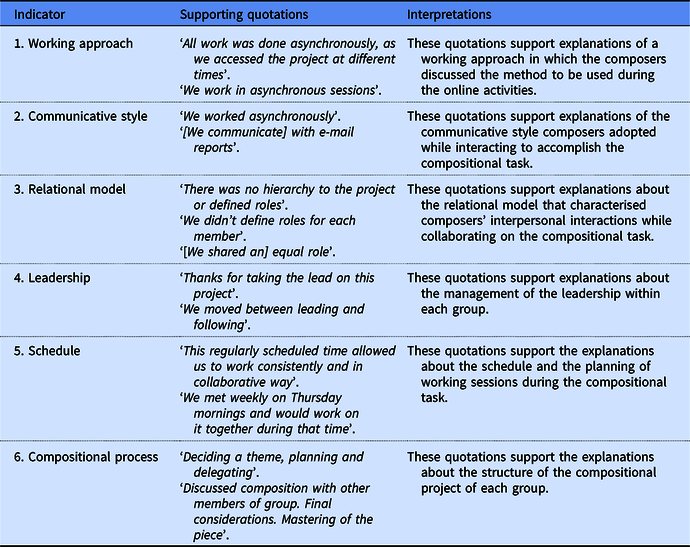
Participants interacted exclusively in a virtual environment to manage all phases of the compositional task. Verbal interactions were linked to the compositional activity that took place in the OhmStudio working space. Each group showed a communicative style connected with a specific working modality, according to their personal characteristics and organisation possibilities. Group 1 often adopted synchronous communicative exchanges (Skype meetings and chat) to create a close interpersonal relationship, sharing the leadership of the project equally. Conversely, groups 2 and 3 preferred asynchronous communication, probably due to time zone differences and personal commitments.
A main difference between groups involved the definition of specific roles and the management of leadership. Groups 1 and 3 shared a relational structure similar to the ‘horizontal relationship model’ (Burnard & Younker, Reference BURNARD and YOUNKER2008). Conversely, the relationships in group 2 were based on a hierarchical structure, where one member demonstrated a leading role during the online activity. Group 2 was the most heterogeneous of the three, not only in terms of professional expertise but also demographic characteristics (gender and age). This was the only group with a female composer, and one member was significantly older than the other two.
There were some differences in the organisation and the compositional process regarding the strategies used for starting and planning the activities. The composers in group 1 defined the project goals in a preliminary stage – before starting the compositional task – choosing their musical objectives after discussing and negotiating several ideas through a sort of virtual brainstorming. Members of group 3 also dedicated time to searching for themes and topics that could be used as musical cues for composing their piece. Group 2 adopted a more inductive process for defining the objectives; however, a different bottom-up strategy emerged as follows: participants started experimenting with variations and sound manipulations of a musical event with the aim of having musical objectives emerge gradually. The main features of the indicators for each group are reported in Table 3.
Main Indicators of the Collaborative Compositional Process for Each Project Team

Discussion and limitations
The current study analysed the management of the collaborative compositional activities in three groups of electroacoustic composers. The results indicate that the composers successfully completed the pieces in the online platform. Regarding the first research question (‘How do electroacoustic composers plan and manage collaborative compositional activity’?), the analysis showed that the management of the tasks of each project team was connected to group characteristics, such as leadership style, work approach and communicative modality – synchronous vs. asynchronous (Burnard & Younker, Reference BURNARD and YOUNKER2008). Communication depended on the characteristics of the group members (Hewitt, Reference HEWITT2008), such as age, professional expertise and cultural background. Composers used two communicative channels to manage the collaborative tasks: a verbal channel, characterised by forum interactions, chat, e-mails and Skype meetings, and a musical one, which consisted of the application of compositional strategies and techniques for electronic sound manipulation. These features are consistent with the findings of previous research, which highlighted the dual communicative systems (verbal and musical) that composers used while working collaboratively (Partti & Westerlund, Reference PARTTI and WESTERLUND2013). They are also in agreement with previous results showing that verbal interactions were complementary to the musical activity: participants co-constructed the musical piece, supporting and motivating their actions with verbal instructions, indications and feedback (Biasutti, Reference BIASUTTI2018). This aspect confirms the findings of previous studies focused on students (McCarthy et al., Reference MCCARTHY, BLIGH, JENNINGS and TANGNEY2005), highlighting the need to focus on social competence and communicative skills when proposing collaborative activity in music education settings.
With regard to the second research question (‘What approaches and strategies do electroacoustic composers adopt when engaging in collaborative compositional activity’?), the analysis of the activities of each group showed different approaches to collaborative music composition. Groups 1 and 3 adopted a top-down process for managing the compositional strategies, defining objectives and planning sub-tasks and roles. Considering the musical objectives, participants co-created the musical piece, finding source material, selecting strategies and techniques and refining the acoustical and rhythmic patterns that characterised the musical idea of the composition. Group 2 followed a different procedure, as the members used a bottom-up and inductive approach. First, they generated a musical idea that was elaborated by each member. Then, they collected, listened to and evaluated the first results, deciding how to proceed. This inductive approach is similar to something Biasutti (Reference BIASUTTI2018) identified for collaborative music composition in a virtual environment, where group members started the activity by improvising and developing new ideas.
The findings from the working phases are coherent with previous research on online learning (Biasutti, Reference BIASUTTI2018). The phase two planning/organising was different than in previous studies, highlighting a more structured approach than those used by pop/rock musicians. A personalisation of the structure of the model can be observed in each group, according to the working modality and processes that the participants selected for their compositional activity.
The current study has limitations, mainly related to the generalisation of the findings, which are limited to the three cases presented. One main limitation is the gender imbalance among the participants. In the current project, although there were five female applicants selected, only one confirmed her interest in participating in the activities. Thus, there is a need to further investigate the possible impact that gender may have on group collaboration, encouraging the participation of female composers. Another issue is related to the role of the researchers who tried to establish ecological conditions. They did not interfere with the activity of the groups, limiting their actions to supervision and help when it was explicitly requested; however, it was sometimes necessary to stimulate the groups to continue with their work. This was particularly true for group 3 in the last phase of its activity, when the members seemed to have lost contact with each other. Another limitation involves the assessment of the final pieces, which were not performed since the focus of the current study was on the processes rather the products. A detailed music evaluation of the music pieces could provide additional inputs for understanding the creative behaviours of the participants in the virtual environment.
Educational implications and further developments
The current study provides ideas for understanding the cognitive and artistic processes that occur in collaborative composition. The way in which the participants interacted has possible implications for music education. It has been demonstrated that it is possible to compose electroacoustic music online in a collaborative way, and several scholars have reported the advantages of such compositional activities. For example, compositional activities allow students to think musically and demonstrate their own expressive dimension with sounds (Fautley, Reference FAUTLEY2005). Computer-based feedback with automatic performance allows students to handle multiple representations and to analyse the different parts of the piece, making the intuitive decision criteria explicit. With a computer, students can work directly on the sound, expressing processes that are qualitatively different from those of traditional compositional techniques.
Divergent activities play a leading role in the music education curriculum, as they promote high thinking skills, such as the generation of a compositional grammar. Innovative contexts are needed to promote divergent skills by stimulating interactive communication and positive socialisation. Motivation and the extended and transversal learning methods have to be stimulated with didactics on the process rather than on the products. Students must be responsible for their own learning, with an awareness of their strengths and what they can improve. Compositional activities have great educational potential and should be considered the foundation of basic music education, balancing creative, performance and listening tasks.
There are several educational implications of the findings of the current study. First, it provided rich data on the compositional processes activated during online learning that could be applied in designing collaborative composition activities in educational contexts. Second, the final proposed model could be a guide for working with students in collaborative compositional activities in music education. The different phases may help group members in organising the work and managing the subtasks, structuring positive interpersonal exchanges under the guidance of the teacher. This might be useful especially with young students who need to improve not only their compositional skills but also their social abilities.
The current study offers indications for further research, such as the involvement of intrinsic motivation, which is necessary in online collaborative music composition groups. It would be useful to examine the motivational elements and personal goals that composers set when engaged in compositional activities in virtual environments. Further research is also needed to examine aspects related to interpersonal exchanges and the individual roles within the groups. Specific information about personal experiences as a group member could be collected in individual interviews to provide insights for understanding the collaborative creative behaviours of composers.
Acknowledgements
We would like to take this opportunity to thank all the composers that participated to the ECCOL project, the international associations that helped us in promoting the project and Matteo Padovan (FISPPA) for the technical support. Author Contributions. MB was the idea originator and Director of the project, contributed with research method, literature review, results interpretation; EC implemented all the online activities and contributed with data collection and analysis and results interpretation.
Appendix 1: ECCOL project final written interview
-
1. Please describe the main steps during the realisation of the music piece.
-
2. How did you generate and/or elaborate the sound events?
-
3. What were the strategies for assembling the sound material?
-
4. How did you organise the online group work?
-
5. What roles did the members play during the online activities?
-
6. How did you evaluate the music piece?


 Open access

