


Introduction
Hunting and the associated trade in wildlife have been widely acknowledged as a major driver of biodiversity loss and as a threat to mammals worldwide, particularly in tropical countries (Kumara & Singh, Reference Kumara and Singh2004; Velho et al., Reference Velho, Karanth and Laurance2012; Benítez-López et al., Reference Benítez-López, Alkemade, Schipper, Ingram, Verweij, Eikelboom and Huijbregts2017). Hunting and illegal wildlife trade have severely affected all eight species of pangolins, particularly the four Asian species. Pangolins are believed to be the most trafficked animals globally (Wu et al., Reference Wu, Liu, Zhang and Ma2004; Baillie et al., Reference Baillie, Challender, Kaspal, Khatiwada, Mohapatra and Nash2014; Zhou et al., Reference Zhou, Zhou, Newman and Macdonald2014; Challender, Reference Challender2015; Challender et al., Reference Challender, Harrop and MacMillan2015). The seizure of illegally trafficked pangolins and their body parts continues unabated, with > 1 million pangolins trafficked globally during 2000–2013 (Challender et al., Reference Challender, Waterman and Baillie2014).
The Indian pangolin Manis crassicaudata, categorized as Endangered on the IUCN Red List (Baillie et al., Reference Baillie, Challender, Kaspal, Khatiwada, Mohapatra and Nash2014), is one of two pangolin species occurring in India (the other is the Critically Endangered Chinese pangolin Manis pentadactyla). The Indian pangolin is included under Schedule 1 Part 1 of the Indian Wild Life (Protection) Act, 1972, which legally protects the species and prohibits its hunting in India, and is on Appendix I of CITES, which prohibits all commercial international trade (CITES, 2017) and places it under a zero export quota (Challender et al., Reference Challender, Harrop and MacMillan2015; Hua et al., Reference Hua, Gong, Wang, Li, Ge, Li and Hou2015; Mohapatra et al., Reference Mohapatra, Panda, Acharjyo, Nair and Challender2015). Pangolins feed almost exclusively on ants and termites, thus playing an important role in the tropical forest ecosystem (Mohapatra & Panda, Reference Mohapatra and Panda2014).
Although previously widely distributed across the Indian subcontinent, the Indian pangolin population has significantly declined throughout its range, largely as a result of widespread hunting and trade driven by the demand for the species’ skin, scales and meat, both locally and elsewhere, and particularly in East Asia (Wu & Ma, Reference Wu and Ma2007; Mahmood et al., Reference Mahmood, Hussain, Irshad, Akrim and Nadeem2012; Mishra & Panda, Reference Mishra and Panda2012; Challender, Reference Challender2015; Challender et al., Reference Challender, Harrop and MacMillan2015; Nijman et al., Reference Nijman, Zhang and Shepherd2016). Destruction of its habitat across India has also contributed to the species’ decline (Mishra & Panda, Reference Mishra and Panda2012; Trageser et al., Reference Trageser, Ghose, Faisal, Mro, Mro and Rahman2017). The CITES wildlife trade database shows that pangolin parts are also traded for traditional medicine and for making leather products (Mohapatra et al., Reference Mohapatra, Panda, Acharjyo, Nair and Challender2015; UNEP–WCMC, 2020). Nevertheless, there have been few studies of the species’ status, distribution and habitat preferences across the Indian subcontinent (but see Srinivasulu et al., Reference Srinivasulu, Srinivasulu, Rajesh, Rao and Nagulu2004; Mahmood et al., Reference Mahmood, Hussain, Irshad, Akrim and Nadeem2012, Reference Mahmood, Irshad and Hussain2014; Trageser et al., Reference Trageser, Ghose, Faisal, Mro, Mro and Rahman2017). This paucity of information potentially hinders the conservation of the species.
The Indian pangolin occurs across a range of habitat types, from natural forests to timber plantations, and over 0–2,000 m altitude (Perera et al., Reference Perera, Karawita and Pabasara2017; Karawita et al., Reference Karawita, Perera, Gunawardane and Dayawansa2018). The species is secretive, cryptic and nocturnal (Karawita et al., Reference Karawita, Perera, Gunawardane and Dayawansa2018). Previous studies have shown that standard ecological monitoring techniques are not effective for surveying pangolins and that there is a need for secondary sources of information on presence (Newton et al., Reference Newton, Van Thai, Roberton and Bell2008; Nash et al., Reference Nash, Wong and Turvey2016; Karawita et al., Reference Karawita, Perera, Gunawardane and Dayawansa2018). Determining presence using a combination of field surveys and local community knowledge is critical to prioritize habitats for the species’ conservation (Yoccoz et al., Reference Yoccoz, Nichols and Boulinier2001; Newton et al., Reference Newton, Van Thai, Roberton and Bell2008; O'Brien, Reference O'Brien2008).
The northern Eastern Ghats landscape of Andhra Pradesh and Odisha in southern India has vast stretches of contiguous forests (Aditya & Ganesh, Reference Aditya and Ganesh2019). Although there have been few biodiversity studies in this landscape and only 3.53% of the total area is protected (Cardillo et al., Reference Cardillo, Mace, Gittleman and Purvis2006; Aditya & Ganesh, Reference Aditya and Ganesh2019), it supports several rare, endemic and threatened species including the Jeypore ground gecko Cyrtodactylus jeyporensis (Agarwal et al., Reference Agarwal, Dutta-Roy, Bauer and Giri2012), yellow-throated bulbul Pycnonotus xantholaemus (Sreekar & Srinivasulu, Reference Sreekar and Srinivasulu2010), forest owlet Heteroglaux blewetti (Kumar et al., Reference Kumar, Chandra and Azeez2010), leopard cat Prionailurus bengalensis, rusty-spotted cat Prionailurus rubiginosus, and stripe-necked mongoose Herpestes vitticollis (Aditya & Ganesh, Reference Aditya and Ganesh2016, Reference Aditya and Ganesh2017), highlighting the conservation significance of this landscape. Although pangolins are known to be hunted in this landscape (Mohapatra et al., Reference Mohapatra, Panda, Acharjyo, Nair and Challender2015; Aditya, Reference Aditya2019), systematic information on their occurrence in this region is lacking (Srinivasulu et al., Reference Srinivasulu, Srinivasulu, Rajesh, Rao and Nagulu2004). To address this, we used a combination of camera traps and local reports to assess the occurrence of the Indian pangolin in the northern Eastern Ghats. We also highlight the main patterns and drivers of hunting in this region.
Study area
The 16,948 km2 northern Eastern Ghats of Andhra Pradesh, India, are a series of discontinuous hills oriented in a north–south direction; they include one protected area, the 1,012 km2 Papikonda National Park. There are several Reserve Forests, and a mosaic of other non-forest land uses surrounding the Park, including plantations and farmland (Fig. 1). The topography is mountainous, with altitudes of 20–1,680 m. Mean annual precipitation is 1,309 mm (Goswami et al., Reference Goswami, Thorat, Aditya and Karimbumkara2018). The dominant forest type is southern tropical mixed moist deciduous, with some semi-evergreen patches (Champion & Seth, Reference Champion and Seth1968). The flora is dominated by large trees such as Anogeissus latifolia, Terminalia tomentosa, Terminalia arjuna and Tectona grandis.
The northern Eastern Ghats landscape in Andhra Pradesh, India, indicating the villages in which we conducted interviews for assessing the presence of the Indian pangolin Manis crassicaudata.
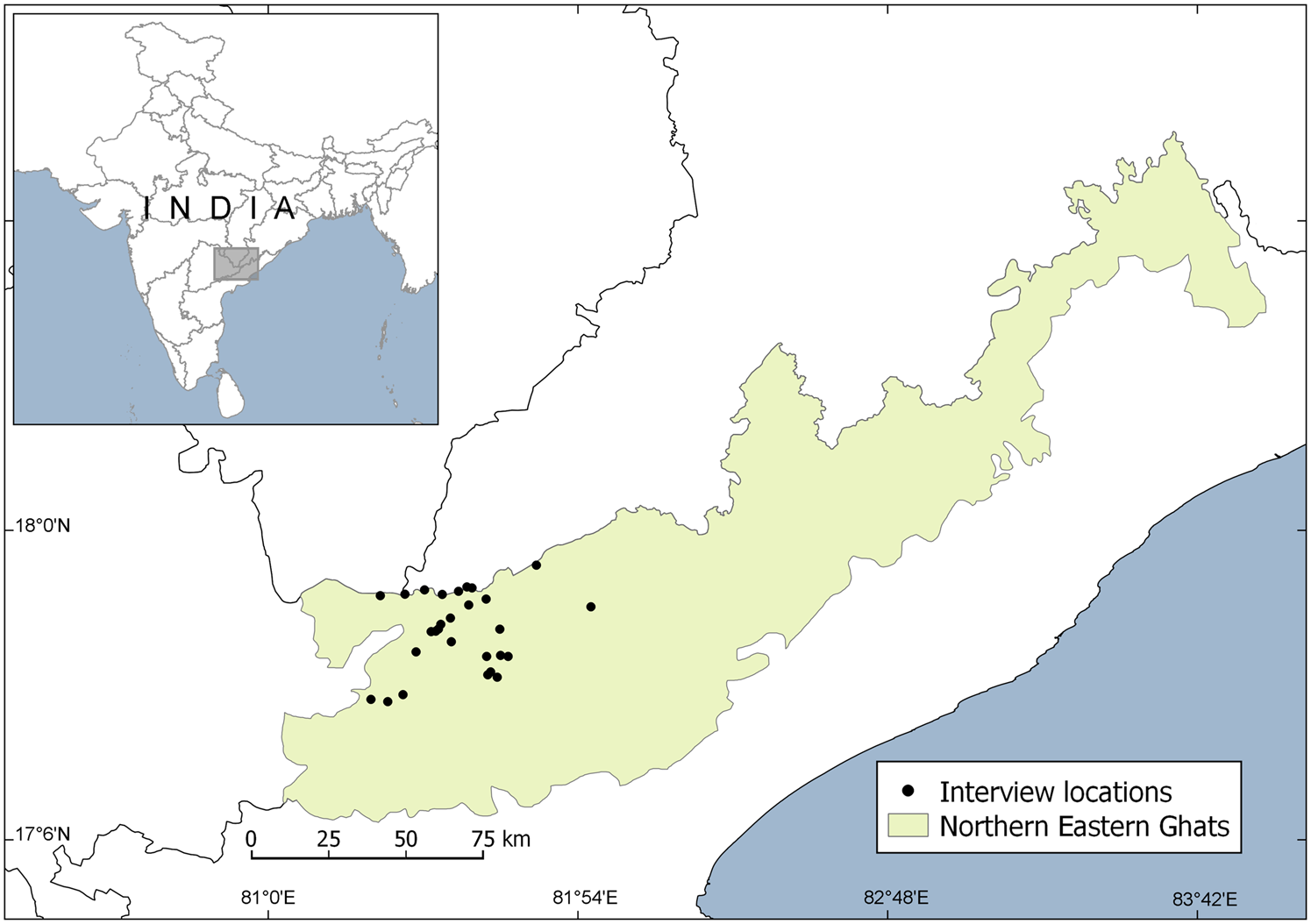
The northern Eastern Ghats is an important forested corridor between the Western Ghats and north-east Indian biodiversity hotspots (Goswami et al., Reference Goswami, Thorat, Aditya and Karimbumkara2018). Various Indigenous communities inhabit the landscape, mainly the plains dwelling Koyas, who are cultivators, and the hill dwelling Konda Reddis, who subsist on non-timber forest produce and shifting cultivation. Other communities include the Parajas, Bagathas and Valmikis, all of whom depend on the forests for their livelihoods. The study area consists of various Reserve Forests around Papikonda National Park in East Godavari and Visakhapatnam districts, encompassing dry deciduous, moist deciduous and semi-evergreen forests, plantations, some agricultural fields and 30 villages (Fig. 1).
Methods
Camera-trap surveys
We procured LANDSAT 8 satellite imagery from Google Earth Engine (Gorelick et al., Reference Gorelick, Hancher, Dixon, Ilyushchenko, Thau and Moore2017). The image was used to generate a classified habitat map based on pre-existing maps (Buckland et al., Reference Buckland, Anderson, Burnham, Laake, Thomas and Borchers2001) and ground-based training points, through supervised classification (Jha et al., Reference Jha, Dutt and Bawa2000; Vaidyanathan et al., Reference Vaidyanathan, Krishnaswamy, Kumar, Dhanwatey, Dhanwatey and Karanth2010), using the classification and regression tree classifier in Google Earth Engine. We divided the study area into 512, 5 × 5 km grid cells and used stratified random sampling to select 30 cells (a total of 750 km2) from dry and moist deciduous forest patches. We also identified villages within the 30 selected grid cells for conducting interviews. The cells are at altitudes of 200–1,000 m. We used a total of 16 motion-activated Trinetra (REAP, Bangalore, India), Bushnell Aggressor (Bushnell, Kansas City, USA) and ScoutGuard Attack (ScoutGuard, Molendinar, Australia) digital camera traps with a passive infrared sensor, with the sensitivity set to high, at a height of c. 0.5 m above ground, during December 2017–April 2018. Camera traps were placed within each cell based on local information regarding areas with a high likelihood of pangolin occurrence, such as pangolin burrows, hill slopes, streams and near salt licks. Camera traps were set for a minimum of 7 days at each location and then moved to another cell. Indirect signs of pangolins, such as scrape marks on termite mounds, were noted but were not considered a definitive indication of presence. The total survey effort was 840 trap-days (20,160 trap-hours).
Interviews
We identified and mapped all villages in the study area using topographical sheets from the Survey of India, and obtained data on the village populations, tribal groups (as identified by the Census of India, 2001) and per cent of the population in each village that is tribal (Census of India, 2001). We conducted a total of 60 interviews in 30 villages, using a semi-structured questionnaire (Supplementary Material 1), during August 2017–April 2018. We used a convenience sampling approach to assess drivers of hunting qualitatively rather than to facilitate generalization of any findings to a wider population (Newing, Reference Newing2010). Interviews were conducted by four people (VA, KP, RS and a member from the local Koya community) in either Telugu or Koya, as required. Older male respondents, usually aged above 50, who were active hunters, were selected for interviews. Interview questions focused on three broad themes: (1) pangolin occurrence in the landscape, (2) pangolin habitat preferences and (3) hunting practices and trade in pangolins. Interviewees were first shown photographs of the pangolin and asked if they could identify it. We used open-ended questions to obtain qualitative data. Verbal consent was obtained from respondents before the interview. We used a smartphone to record interviews. After transcription of the interviews we used thematic coding to identify themes emerging from our data, which we report using per cent response frequencies. The occurrence of pangolins was estimated from where they were reported, as sightings, localities of capture, or from the presence of pangolin body parts such as scales.
Results
Occurrence recorded by camera traps
The camera traps photographed 18 species of mammals, including the gaur Bos gaurus, sloth bear Melursus ursinus, four-horned antelope Tetracerus quadricornis and sambar Rusa unicolor, all of which are categorized as Vulnerable on the IUCN Red List (IUCN, 2019). However, none of the camera traps captured pangolins.
Occurrence reported by interviewees
The majority of the respondents (88%) correctly identified the pangolin when shown photographs of the animal. More than half of the respondents (53%) reported seeing the animal, 30% had never seen it, and the rest were unsure if they had seen it. Nearly all respondents (93%) felt that pangolin numbers had declined drastically over the previous 10 years. Respondents mentioned six habitat types in which they had seen a pangolin (Fig. 2), with most having been seen amongst rock crevices/boulders, next to their burrows or on slopes; 3% of respondents reported having seen pangolins feed on ants and termites.
Per cent of the 60 interviewees who mentioned each of the six locations where pangolins were observed.

Hunting and trade
Interviewees reported that several techniques were employed to hunt pangolins (Fig. 3), with the most common being to locate a burrow and dig the pangolin out, and to hunt with bow and arrow. Most interviewees reported that they primarily targeted the Indian muntjac Muntiacus muntjak and wild pig Sus scrofa rather than pangolins. Hunting in general peaked during the Bhumi panduga festival, a tribal festival celebrated at the onset of the monsoon season (June–July) across central and southern India during which villagers hunt in groups of 30–100 individuals; 80% of the interviewees said they still celebrated Bhumi panduga. A range of reasons were given for hunting pangolins (Fig. 4); obtaining scales for trade and meat for consumption were the most common. A small per cent reported using scales for medicinal purposes (for the cure of piles and kidney stones). There was a strong belief that scales shaped into rings (Plate 1) are a defence against black magic; 83% of the respondents said pangolin scales were the primary animal part traded. None of the interviewees reported trading of meat either locally or otherwise; it was considered a delicacy, eaten after boiling the animal to remove the scales. Rates received for 1 kg of pangolin scales were INR 10,000–20,000 (USD 138–277), depending on the size and condition of the scales. Most scales were traded locally through middlemen and to nearby towns and cities such as Rajahmundry. Although the trade for export abroad from middlemen and exporters was reportedly well organized, interviewees were apparently not familiar with the trade routes.
Per cent of the 60 interviewees who mentioned each of the eight methods employed for hunting pangolins.

Per cent of the 60 interviewees who mentioned each of the five reasons given for hunting pangolins.

(a) Sale of a hunted pangolin, and (b) ring made out of a pangolin scale.

Discussion
We believe this is the first baseline assessment of pangolin occurrence, hunting and trade in the northern Eastern Ghats landscape. Our findings indicate that hunting of pangolins in the region is driven by both commercial (scales for trade) and personal (meat, scales for making rings) reasons. In 20,160 trap-hours we did not, however, detect any pangolins in our 16 camera traps. Camera-trap surveys conducted by us and covering 232 km2 inside Papikonda National Park and its buffer in 2014–2015, with a survey effort of 19,512 trap-hours, also failed to detect pangolins (Aditya & Ganesh, Reference Aditya and Ganesh2019), highlighting the potential difficulty of using camera traps to survey rare and elusive species. Ninety-three per cent of the respondents reported a decline in pangolin numbers over the previous decade. This apparent reduction in the population along with the species' secretive nature could have affected our ability to detect it with camera-trap surveys. An alternative explanation is that the Indian pangolin could now be locally extirpated in the northern Eastern Ghats. Ingram et al. (Reference Ingram, Coad, Abernethy, Maisels, Stokes and Bobo2018) recommended that for fossorial species such as pangolins several techniques, such as identification of active burrows for the setting of camera traps, combined with data from hunters and markets, might be effective in monitoring populations.
Investigating occurrence and habitat preferences is important for designing effective conservation interventions for pangolins, particularly in landscapes such as the northern Eastern Ghats, where mammals face a high risk of extinction (Cardillo et al., Reference Cardillo, Purvis, Sechrest, Gittleman, Bielby and Mace2004, Reference Cardillo, Mace, Gittleman and Purvis2006; Aditya & Ganesh, Reference Aditya and Ganesh2019). Interviewees indicated that pangolins prefer burrowing in areas with rock crevices and/or boulders, and on hill slopes, consistent with the findings of Karawita et al. (Reference Karawita, Perera, Gunawardane and Dayawansa2018), suggesting that people in the local communities have informal knowledge about pangolin ecology that could be incorporated into conservation planning of the species.
Hunting is a significant threat to wildlife globally (Harrison et al., Reference Harrison, Sreekar, Brodie, Brook, Luskin and O'kelly2016). It negatively affects mammal populations even in protected landscapes such as the Western Ghats and the Indian Himalayas (Kumara & Singh, Reference Kumara and Singh2004; Velho et al., Reference Velho, Karanth and Laurance2012; Benítez-López et al., Reference Benítez-López, Alkemade, Schipper, Ingram, Verweij, Eikelboom and Huijbregts2017). One interviewee noted:
‘They were never in abundance; we look for their burrows and dig them out. I have made several attempts to find it so that I can earn some money. The last one we hunted was about a decade ago since then we have not seen one.’
Hunting has significantly reduced the populations of mammals, birds and reptiles in the northern Eastern Ghats (Ganesh et al., Reference Ganesh, Aditya, Malla and Prashanth2015). During the interviews, people reported hunting using a variety of strategies, including setting fires in the dry season to clear the undergrowth to ensure better visibility for hunting.
Interviewees suggested that the pangolin population has decreased and cited hunting as the prime reason. Our findings suggest that pangolin hunting was mostly opportunistic, occurring when an active burrow is encountered, as in Assam (D'Cruze et al., Reference D'Cruze, Singh, Mookerjee, Harrington and Macdonald2018). Hunting techniques, such as digging out burrows and tracking with dogs, as described by respondents, are similar to those described in other studies (Newton et al., Reference Newton, Van Thai, Roberton and Bell2008). Our findings with respect to the use of rings carved from pangolin scales, which is rooted in superstitious beliefs and perceived medicinal properties, are consistent with the findings of Mohapatra et al. (Reference Mohapatra, Panda, Acharjyo, Nair and Challender2015).
The selling price of pangolin scales that we recorded (INR 10,000–20,000; USD 138–277 per kg), was markedly lower than prices reported in neighbouring Nepal (USD 500–625 per kg) and Bangladesh (USD 500 per kg) (Katuwal et al., Reference Katuwal, Neupane, Adhikari, Sharma and Thapa2015; Trageser et al., Reference Trageser, Ghose, Faisal, Mro, Mro and Rahman2017). This is consistent with observations from other studies (Nooren & Claridge, Reference Nooren and Claridge2001; Newton et al., Reference Newton, Van Thai, Roberton and Bell2008). Prices for pangolin scales in India have nevertheless risen. For instance, in the state of Mizoram, 1 kg of scales fetched INR 1,000 in 1996, INR 13,000 in 2013 and INR 17,000 in 2017, in line with inflation in India over this period (D'Cruze et al., Reference D'Cruze, Singh, Mookerjee, Harrington and Macdonald2018).
We recommend that, to ensure the long-term persistence of the Indian pangolin in the northern Eastern Ghats, further research is carried out to identify both the proximate and ultimate drivers of pangolin hunting. We recommend that local authorities shift from a reactive (e.g. seizures of scales) to a proactive enforcement strategy (prevention of pangolin hunting) by engaging with local communities to understand their socio-economic needs and socio-cultural practices, and to understand market conditions that result in the hunting of pangolins (Dixit et al., Reference Dixit, Kadavul, Rajalakshmi and Shekhawat2010; Mohapatra et al., Reference Mohapatra, Panda, Acharjyo, Nair and Challender2015). Targeted awareness programmes in the local languages could be initiated to communicate the urgency of the situation, and the dangers of consumption of wild meat, in the form of emerging zoonotic infections, could be specifically emphasized. The chain of pangolin trade needs to be halted by taking steps to prevent hunting and supply to local middlemen. Setting up rescue, rehabilitation and breeding centres for pangolins rescued from illegal trade (Hua et al., Reference Hua, Gong, Wang, Li, Ge, Li and Hou2015) could contribute to the future recovery of the population in the Eastern Ghats.
Acknowledgements
We thank the Wildlife Conservation Trust, India, for financial and equipment support for this project, and the Conservation Leadership Programme, The Rufford Foundation, Idea Wild and ReAP for the continuing support, particularly for equipment. We thank the Andhra Pradesh Forest Department for granting us the necessary permits and for field assistance, Arvind Thurram for field assistance, Ovee Thorat for her input, and the Editor and two reviewers for their helpful comments.
Author contributions
Study design: all authors; field work: VA, KP, RS; data analysis, writing: all authors.
Conflicts of interest
None.
Ethical standards
This study was conducted with permission from the Andhra Pradesh Forest Department. Respondents' names were recorded only if they wished us to do so (to recontact them if necessary), and names and locations were held confidentially. The research abided by the Oryx guidelines on ethical standards.


 Open access

