


Introduction
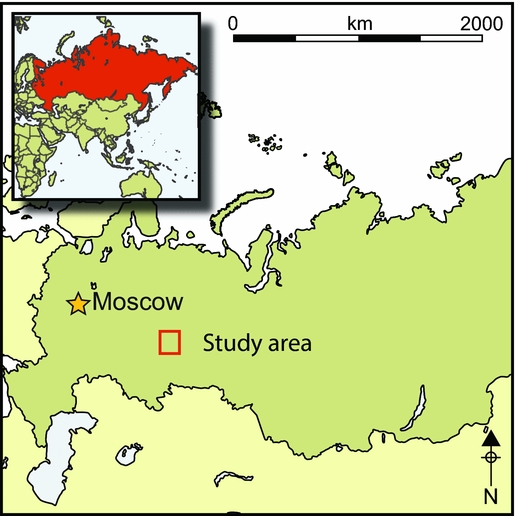
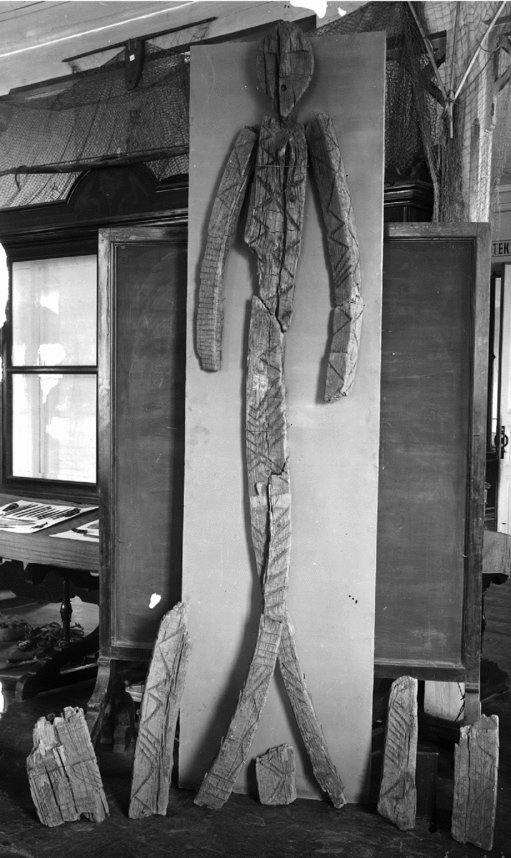
On 24 January 1894, a wooden sculpture was found during gold mining in the Shigir peat bog about 100km north of Yekaterinburg, in the Middle Urals (see Figure S1 in the online supplementary material (OSM)). Today the area is flooded and no longer accessible (Figure S2). Ten wooden fragments were found about 4m below ground level, and were first identified by Dmitri Ivanovich Lobanov as a sculpture approximately 2.8m in height. Later, in 1914, Vladimir Yakovlevich Tolmachev reconstructed a much larger sculpture using all of the recovered fragments (Figures 1–2). Unfortunately, some of those fragments have since been lost, but all the surviving pieces are on display in Sverdlovsk Regional Museum in Yekaterinburg.
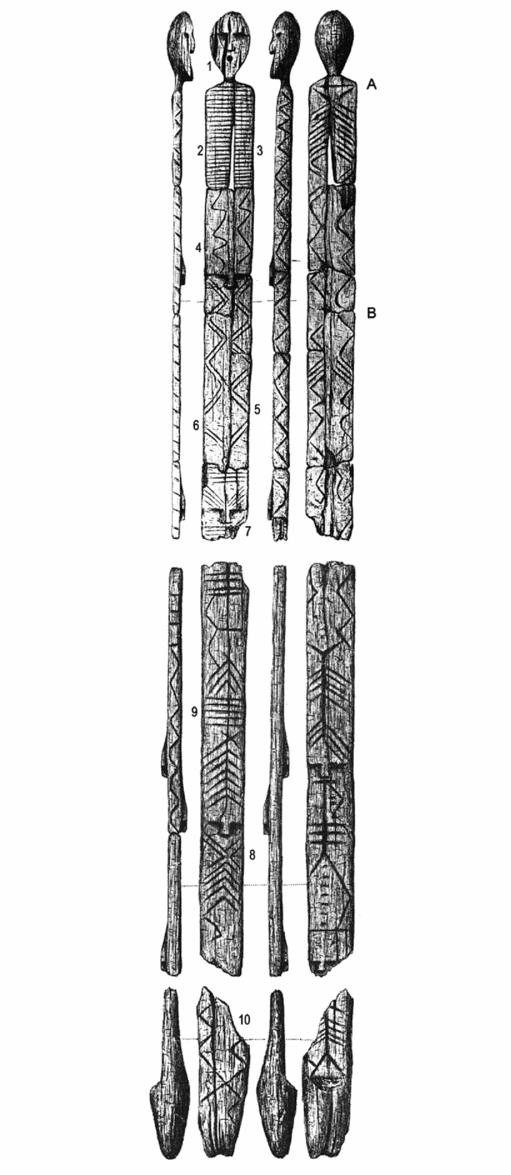
Drawing of the Shigir sculpture by Tolmachev (1914) and fragments 1–10. A) Position of new anthropomorphic face detected in 2014; B) position of new anthropomorphic face detected in 2003.
Photograph of the Shigir sculpture reconstructed by D. Lobanov (1890–1891), on display in this shape until 1914 (after Heikel Reference Heikel1894).
The unusual character of the sculpture made it difficult to assign a date from its typology, and indeed it remained undated for decades. In 1997, two large wooden samples were taken from the middle and the bottom part of the figure for conventional radiocarbon dating. Three measurements assigned it to the Boreal Mesolithic period c. 7900–7600 cal BC, making it the oldest wooden monumental sculpture in the world (Savchenko Reference Savchenko1999; Lillie et al. Reference Lillie, Zhilin, Savchenko and Taylor2005; Chairkina Reference Chairkina2010).
In 2014, a new investigation was undertaken to provide: 1) a new and more detailed documentation of the figure by means of photographs and drawings; 2) to allow a morphological inspection of the wood, including the traces of working; 3) a systematic AMS dating program to deliver a more reliable date for the sculpture; and 4) to re-investigate the tree-ring sequence. Investigations and sampling were performed in Yekaterinburg in June 2014. At the same time, a few decorated bone and antler objects from relevant sites were carefully sampled for AMS dating. Here we present the results of these analyses for the first time.
Description
As mentioned above, the sculpture did not survive in its entirety, and new descriptions have to take earlier reports into consideration. According to Tolmachev's reconstruction (1914), the figure was 5.3m high, had a round sculptured head with a facial depiction, a plank-like body and a rounded, conical base (Figures 3–4, S3). The bottom part lacks any figurative details (Figure S4). Subsequently, a portion from the lower part—about 1.95m long—was lost, but it is illustrated in Tolmachev's drawing (Figure 1). The preserved section of the figure on display in Sverdlovsk regional museum is 3.4m tall (Figure S5).
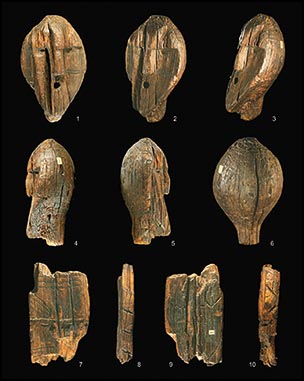
Head of the wooden Shigir sculpture and anthropomorphic face on fragment 7 (see Figure 1) (photograph by E.F. Tamplon).

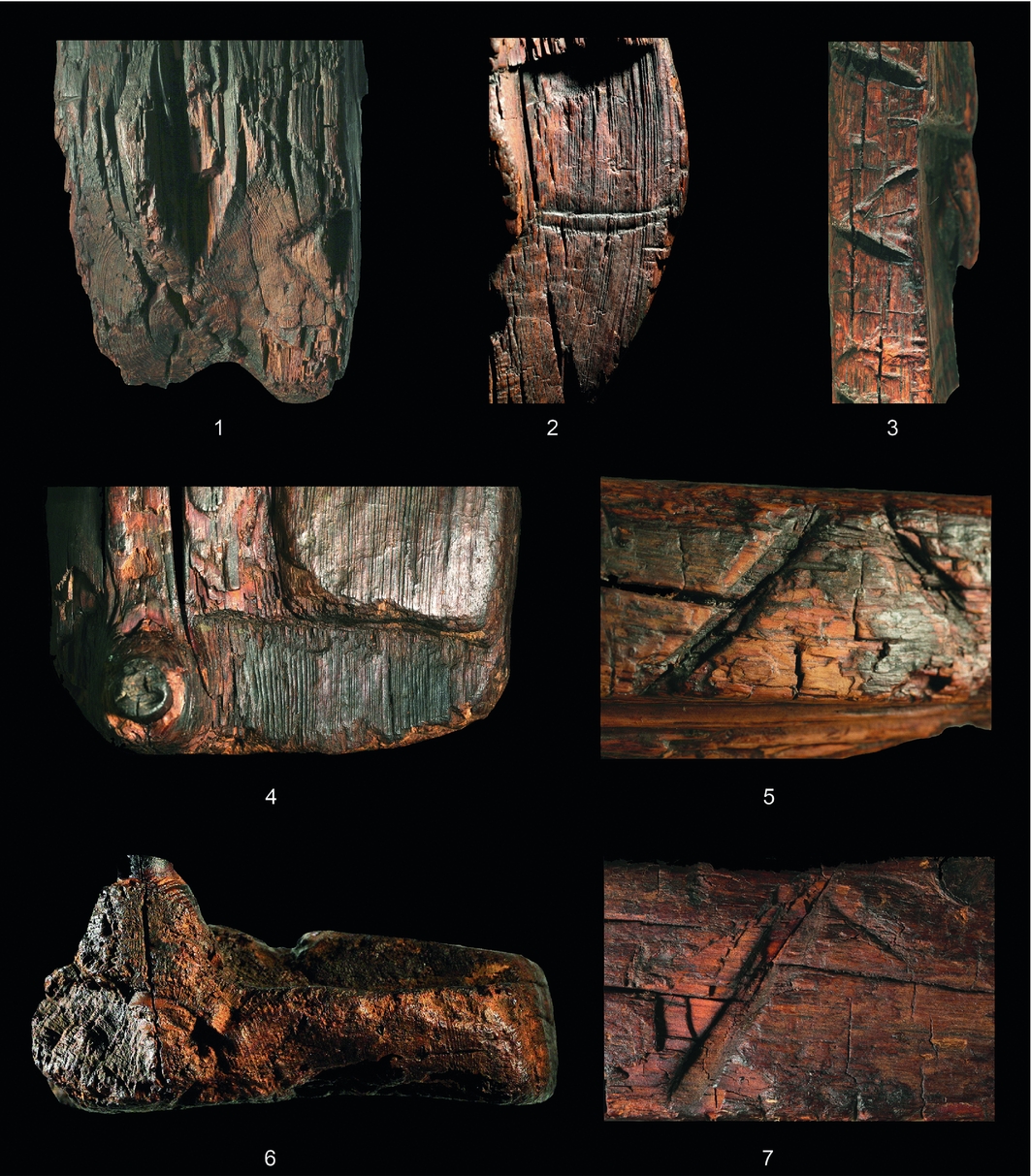
Details of the ‘body’ of the Shigir idol: 1) shows part of fragment 10 of the sculpture with traces of a broad polished adze visible on the bottom and obverse;. 2–7) are all examples of traces made by narrow chisels, showing: 2) the face of the head; 3, 6 & 7) different sides of fragment 7 (see Figure 1); and 4–5) showing the new face discovered in 2004 (photograph by E.F. Tamplon).
The body of the sculpture is covered by a deeply engraved ornamental pattern dominated by zig-zag lines. The flat surfaces also show carved faces, which belong to separate images.There are five such faces on Tolmachev's drawing: three on the front, and two on the back. In 2003, a sixth face was identified by Svetlana Savchenko on the back of the figure, in the middle of the preserved fragment (Figure 1B; Savchenko & Zhilin Reference Savchenko and Zhilin2004). It differs from the other faces, which display rectangular noses; for in this case, a branch protruding from the tree trunk was used for modelling the nose. This makes it more animal-like than the other depictions.
In 2014, during use-wear analysis of the figure, yet another new face was discovered by Svetlana Savchenko and Mikhail Zhilin in the upper part of the back (Figure 1A). In conclusion, eight figural depictions can now be identified, including the faces from the lost fragment attested by Tolmachev's drawing: the topmost figure with a round carved head, three flat faces on the front plus four flat faces on the back of the body. All of the faces appear distinctly individual.
The decorative elements of the Shigir figure may reflect encoded mythologies. The vertical placement of the faces could indicate the presence of an internal hierarchy among the images, or a sequence of events. Available ethnographic data provide only limited help in deciphering these carvings. Above all, however, the Shigir sculpture is unique within the early art of Eurasia and offers the potential for a better understanding of the spiritual world of early hunter-gatherer-fishers of the forest zone of Eurasia.
Morphological and technological inspection of the wood
The sculpture is made from a larch (Larix) tree. The trunk was split into two approximate halves, and a long plank was cut for the production of the anthropomorphic figure. During early growth, the branches of a larch tree are orientated upright, becoming horizontal or lower with age. In the case of the Shigir plank, the branches of the tree grew upright and their positions enable us to identify that the head of the sculpture was located at the upper end of the tree. The main part of the sculpture is relatively flat and is decorated on both sides (see above).
The tip of the base of the figure is crushed flat through pressure. This is probably due to the sculpture having stood upright for some time after manufacture, with its weight pressing upon the tip of its base. This first caused cracks to appear, until later the sculpture collapsed. The well-preserved surface with very slight traces of abrasion suggests that it floated in water for only a limited period (of a maximum of about one year) before it was finally buried in the underlying sediment.
The head
The head is three-dimensional, with narrow tree rings clearly visible on the top (Figure S3). These rings correspond closely with the narrow rings observed at the very bottom of the sculpture, which were selected for sampling. This suggests that all fragments of the sculpture originally belonged to the same tree trunk.
The upper part of the head shows lesions where wood fragments were chipped away. The nose is well sculpted but somewhat compressed, and to the left of it (frontal view) there is a deep, old crack. Double lines were carved below the nose and two incisions above it, with three lines on both sides of the head. The eyebrows gently slope down to the nose, and the eyes are cut into the surface. In both the left and right eyes, the pupil seems to be marked by greater depth, while the left eye is also marked by a knot in the wood where a branch was attached. Together, these features give the head a lifelike appearance. On the right cheek, cut marks, made probably by an adze, are visible, and the chin has clearly been tapered.
The body
The tree rings are visible on different fragments of the body, confirming that all of these belong to the same trunk. The zig-zag decoration on the outer surface was probably executed in the area of the outermost tree rings (Waldkante). Tree rings can be identified on the surface of the figure and in various carved cuts. All cuts upon the body were made with sharp implements, leaving no compressed wooden tissue from the carving process, suggesting that the sculpture was made of green wood.
Pieces 3 and 4 (Figure 1) fit well together, and the visible breakage between them is clearly modern, but the origin and character of the break in the centre of piece 4 is less clear. A carved anthropomorphic face recorded in Tolmachev's drawing of pieces 4 and 6 is no longer visible. This part has been restored using wax. In contrast, the human face on piece 7 is easily identified, showing clear cut marks. The loss of some fragments of the figure means that the ‘body’ cannot be reconstructed in total. A modern cutting made for analytical purposes is clearly visible at the base of the sculpture.
Traces and tools
The surface of the figure shows repeated evidence of working. The characteristic traces were probably caused by a polished stone adze and two or three different types of polished stone chisel. The adze marks are visible on the bottom part of the sculpture in the shape of long broad scars with even flat surfaces, and without the striations and grooves that would be left by an unpolished adze (Figure 4.1). Traces left by the chisels are also flat and sharp, and are visible, for example, on the cheeks of the idol and in some of the decorative lines (Figures 3.1–3, 4.2, 5 & 7). Differences in the size of the cut marks indicate the use of two or three different chisels. Such sharp traces also support the conclusion that the carving was made in green wood.
Polished stone adzes have been recovered from layer IV of the Beregovaya 2 site situated at the western border of the city of Nizhny Tagil (Figure S1), dated to c. 8200–7500 cal BC (c. 9000–8400 BP). In layer V of the same site, dated to the early Preboreal (c. 9300 cal BC/9800 BP; Zhilin et al. Reference Zhilin, Savchenko, Nikulina, Schmölcke, Hartz and Terberger2014, Reference Zhilin, Kosinskaya and Savchenko2017), preforms and flakes from the manufacture of such tools were identified. One of these flakes with a polished dorsal surface probably derives from a polished wood-cutting tool. A decorated and perforated polished artefact of non-siliceous material was discovered in the same layer. There is, in short, clear evidence that wood-working tools of polished stone were in use in the Urals at the time the figure was carved (Zhilin Reference Zhilin, Masojć, Płonka, Ginter and Kozłowski2007, Reference Zhilin, Legrand-Pineau and Sidéra2010; Hartz et al. Reference Hartz, Terberger and Zhilin2010).
Tree-ring sequence
Of 159 tree rings, only 137 could be measured due to the poor preservation of the outermost 22 (Figure S6). The innermost 18 rings are clearly narrower than the outer rings. This is an indication of difficult conditions during the early growth of the tree, probably caused by pressure from neighbouring trees. After about 20 years, the tree had established itself, and a relatively stable growth phase followed for another 60 years. Growth rates became unstable with strong declines over the next 30 years, probably due to repeated phases of poor climate. The average annual growth rate of 2.49mm is much lower than that of today. The RUSS004-chronology (Shiyatov n.d.) from the sub-alpine area of the southern Urals is characterised by an average growth rate of 9.89mm per annum. The modern values also demonstrate a higher variability and standard deviation as well. A more detailed interpretation of the sequence will only be possible with more information on the local conditions and through comparison with sequences from other trees of that time; a single sample can be influenced by highly localised conditions and events.
Dating of the object
Material and methods
The development of AMS dating and new pretreatment methods enabled the new approach taken to dating the Shigir figure in 2014. The larch wood of the sculpture was carefully sampled a few centimetres above the earlier cut; a narrow transect of the tree-ring sequence was then carefully cleaned with a razor blade. The tree rings were marked with chalk after sampling to improve their contrast (Figure 5). They were then recorded using a stereo-microscope.
Position of the samples in the tree-ring sequence relative to chalk markings (photograph/graphic by T. Terberger).
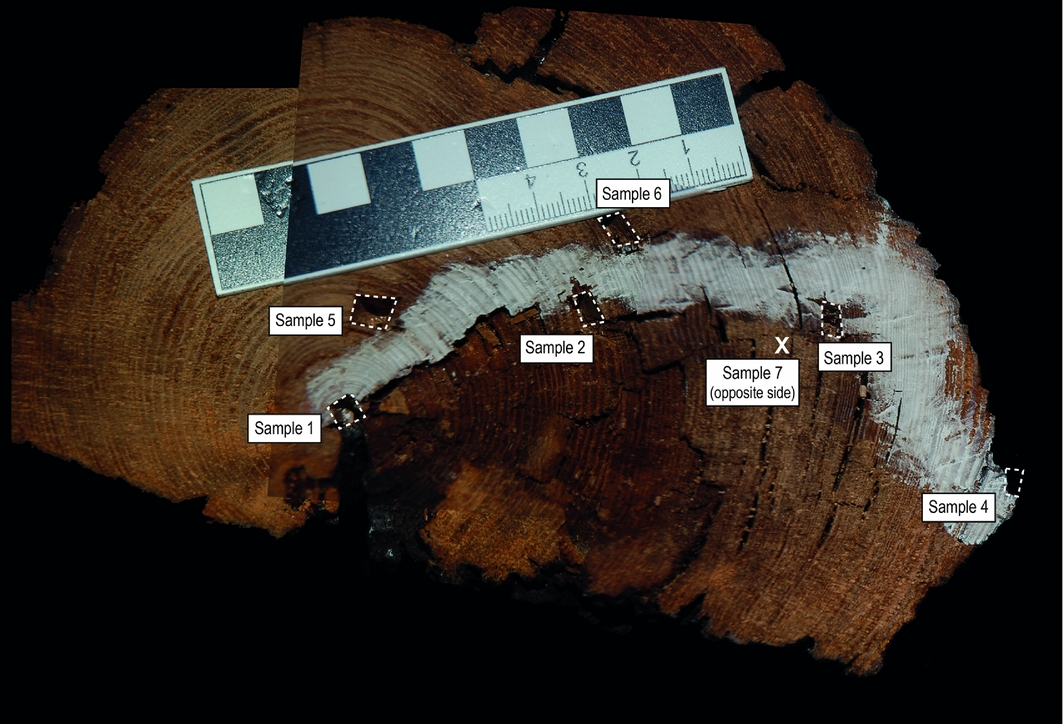
Sampling for AMS dating was done on the basis of the counted sequence. Sample numbers 1–4 were taken off for every 50 tree rings (Figure 5; Table 1). Every sample consisted of four tree rings. As the sculpture was made from a split plank, sample 1 is located at the centre of the former tree (Markbereich), while sample 4 was situated closest to the outermost tree rings. Three further samples (5–7) were taken between samples 1 and 2, 2 and 3, and 3 and 4.
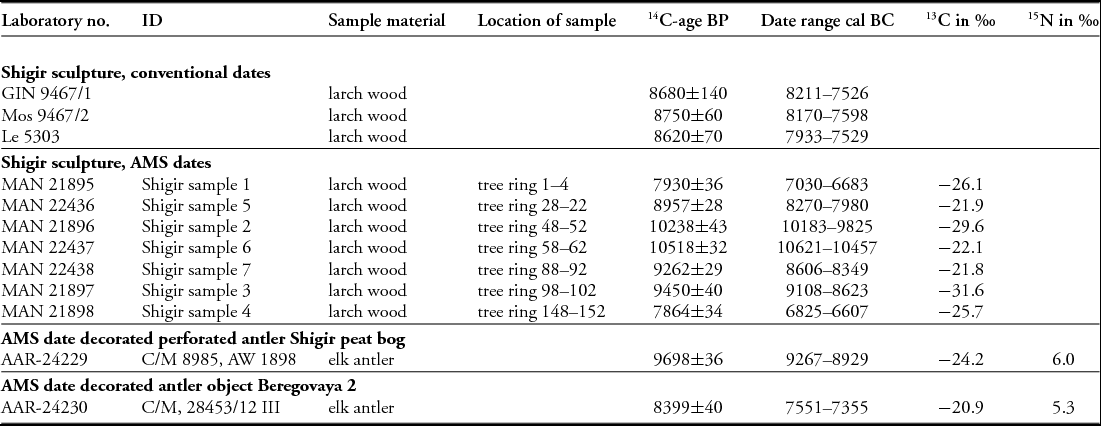
Radiocarbon dates of finds from the Shigir collection and the site of Bergovaya 2. For the position of the samples, see Figure 5. Calibration of radiocarbon dates was performed with OxCal v4.2.3. on the basis of IntCal 13 and dates are given at the 95% confidence level (Bronk Ramsey Reference Bronk Ramsey2009; Reimer et al. Reference Reimer, Bard, Bayliss, Beck, Blackwell, Bronk Ramsey, Buck, Cheng, Edwards, Friedrich, Grootes, Guilderson, Haflidason, Hajdas, Hatté, Heaton, Hoffmann, Hogg, Hughen, Kaiser, Kromer, Manning, Niu, Reimer, Richards, Scott, Southon, Staff, Turney and van der Plicht2013).
As the figure was discovered some 120 years ago, we anticipate that it will have undergone repeated restoration processes with the help of different materials and consolidants. Sampling of the parts affected by these processes was avoided as far as possible. All samples were put in glass tubes and later submitted to the Klaus Tschira-Laboratory at the Curt-Engelhorn-Centre in Mannheim. Processing and pretreatment of the samples was conducted according to modern standards. First the samples were pretreated with acid-wash and chloroform to remove consolidants. Subsequently, the ABA-method (acid/base/acid) using HCl, NaOH and HCl was applied, followed by bleaching with NaClO2 to extract the cellulose. The cellulose was combusted in an element analyser, and CO2 was catalytically reduced to graphite. The measurement of the samples was performed by a MICADAS-Accelerator.
AMS results
All samples were successfully measured, but the results show considerable variation (Table 1). Samples 1 and 4 correspond well with each other and provide the latest dates of the series, between c. 7000 and 6600 cal BC (MAN-21895: 7930±36 BP; MAN-21898: 7864±36 BP). These two results suggest a date in the early Atlantic period.
Results for samples 5 (MAN-21898: 8957±28 BP), 3 (MAN-22438:9262±29 BP) and 7 (MAN-21897: 9450±40 BP) from the inner part of the sculpture are considerably older (c. 9000–8000 cal BC), supporting a Preboreal to early Boreal date. Results for samples 2 and 6 (MAN-21896: 10238±43 BP; MAN-22437: 10518±32 BP) are even older and would assign the piece to a period close to the end of the Late Palaeolithic (c. 10500–10000 cal BC).
The results of these seven new AMS dates confirm the Stone Age attribution, but the difference of up to c. 3000 years requires explanation. The sculpture has been repeatedly restored since it was found. Macroscopic inspection confirmed the use of wax for the conservation, repair and reconstruction of damage incurred during the late nineteenth/early twentieth century. In 1997 the wooden sculpture was treated by conservator Olga Anatolyevna Tuberozova of the Sverdlovsk Regional Museum. Cavities caused by sampling for the initial series of radiocarbon dates were filled with finely ground wood pigment mixed with 10 per cent Butyl acrylate dissolved in acetone and white spirit. The outer surface layer of the figure was stabilised with Butyl acrylate dissolved in acetone and white spirit; the concentration was progressively increased from 3 to 10 per cent. The effects of this treatment would be most marked on the outer surface. Despite careful sample pretreatment, it is possible that the consolidants were not completely removed.
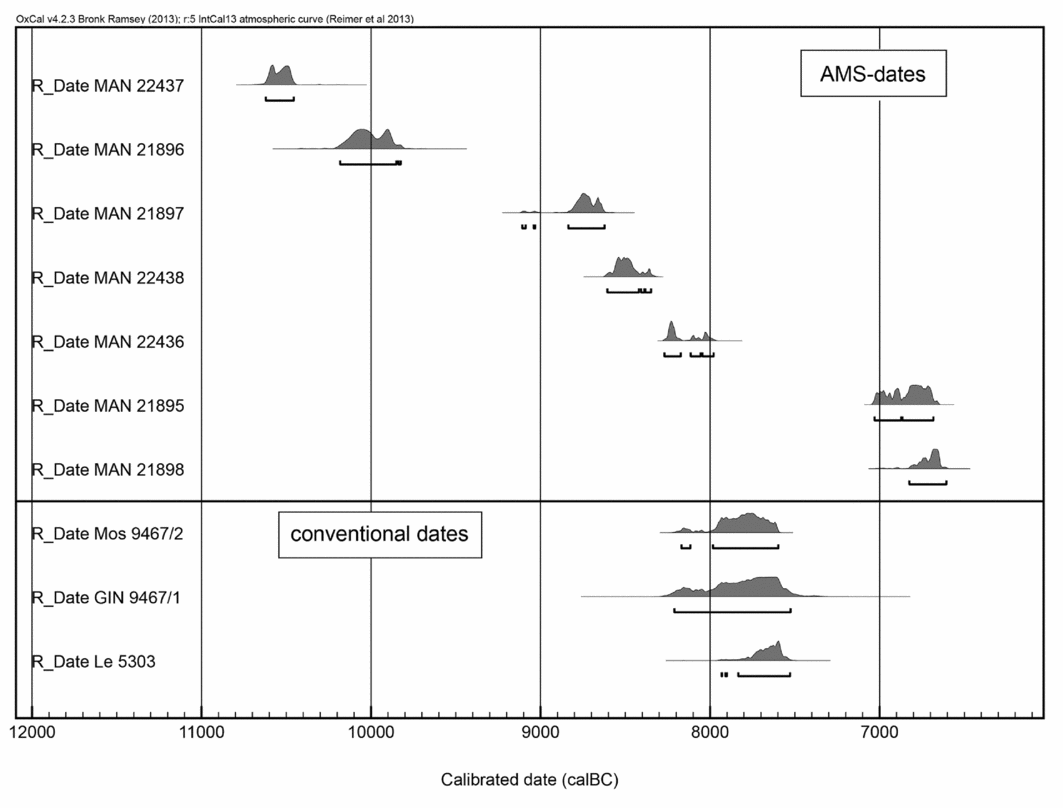
In recognition of this we expect that AMS samples 1 and 4, taken closest to the surface (Figure 5), have a higher probability of being affected by such treatments (see Chairkina et al. Reference Chairkina, Kuzmin and Burr2013). This is corroborated by a strong correlation between the distance of the sample from the surface of the sculpture and the AMS results (Figure S7): AMS dates are increasingly older towards the inner part of the sculpture. Samples 2 and 6 are therefore the most reliable, suggesting that the find should be dated to c. 10200 cal BC (c. 10200 BP; Figure 6 & Table 1).
Calibrated AMS dates of the idol (OxCal v4.2.3 using the IntCal13 calibration curve; Bronk Ramsey Reference Bronk Ramsey2009; Reimer et al. Reference Reimer, Bard, Bayliss, Beck, Blackwell, Bronk Ramsey, Buck, Cheng, Edwards, Friedrich, Grootes, Guilderson, Haflidason, Hajdas, Hatté, Heaton, Hoffmann, Hogg, Hughen, Kaiser, Kromer, Manning, Niu, Reimer, Richards, Scott, Southon, Staff, Turney and van der Plicht2013).
In the late 1990s, an earlier attempt at dating the Shigir figure by the conventional radiocarbon technique was undertaken. Sample material was obtained from cuts to the bottom and middle of the object prior to Butyl acrylate treatment. Three conventional dates were obtained that correspond well with each other (Table 1), dating the sculpture to c. 7900–7600 cal BC (c. 8700 BP; Boreal period). The homogeneous results of the three earlier dates can be explained by the large samples necessary for conventional radiocarbon dating. Wood from the inner and the outer parts of the tree were probably mixed, giving a mean value for the sample material.
The new results are more reliable and date the Shigir sculpture to an earlier period. Samples 2 and 6 come from the innermost part of the tree, representing its early growth. It was felled around 160 years later. The radiocarbon dates suggest a date of c. 10200 BP for the carving of the sculpture, close to the transition from the Younger Dryas to the Preboreal (c. 9600 cal BC). A strong wiggle in the calibration curve at the transition to the Holocene makes attempts at more accurate dating in this time period almost impossible (Figure 6).
Pollen diagrams from the Gorbunovo peat bog (close to the site of Bergevoaya 2; (Figure S1)) and Shigir peat bog demonstrate the presence of larch and pine (Pinus) during the late Younger Dryas, with up to 12 per cent arboreal pollen, increasing during the Preboreal. Sparse larch forests against a background of large open spaces have been reconstructed from the pollen cores of level V (the bottom layer) of the Beregovaya 2 peat bog (Zaretskaya et al. Reference Zaretskaya, Panova, Zhilin, Antipina, Uspenskaya and Savchenko2014). The tree-ring sequence of the Shigir sculpture is consistent with this in showing very limited growing conditions.
According to early reports, the sculpture was found in peat deposits (Tolmachev 1914), and this is confirmed by peat residue in crevices and old cracks of the sculpture. This supports the suggested dating of the sculpture and its deposition to the period when peat formations started to develop. In conclusion, we propose a dating of the sculpture to c. 9600 cal BC.
Decorated Mesolithic antler from the Shigir collection
The Shigir peat bog is famous for numerous organic prehistoric finds collected during many years of gold mining activities. Among them are bone points and slotted bone daggers, which can be assigned to the Stone Age on typological grounds. In 1887 a decorated elk antler (0.24m long and 0.06m wide) with a perforation, figurative carving and highly polished surface was collected as a stray find. The perforated end is engraved, while the antler beam at the opposite end is carved into an animal head (Figures 7 & S8–9). Two small knobs close to the perforation indicate ears or eyes, while the muzzle is engraved with two lines on each side. The muzzle is emphasised by a series of triangular incisions, which perhaps represent teeth. An incised line is present on the top, while below the muzzle, simple lines of decoration are present. The ears and the shape of the long snout are reminiscent of a wolf or dog, while the two shallow nasal impressions are more suggestive of a wild boar. The mixture of elements could therefore represent a fantasy animal or mythical creature (Zhilin Reference Zhilin, Legrand-Pineau and Sidéra2010).
Drawing of decorated antler object from Shigir collection (after Zhilin Reference Zhilin, Legrand-Pineau and Sidéra2010).
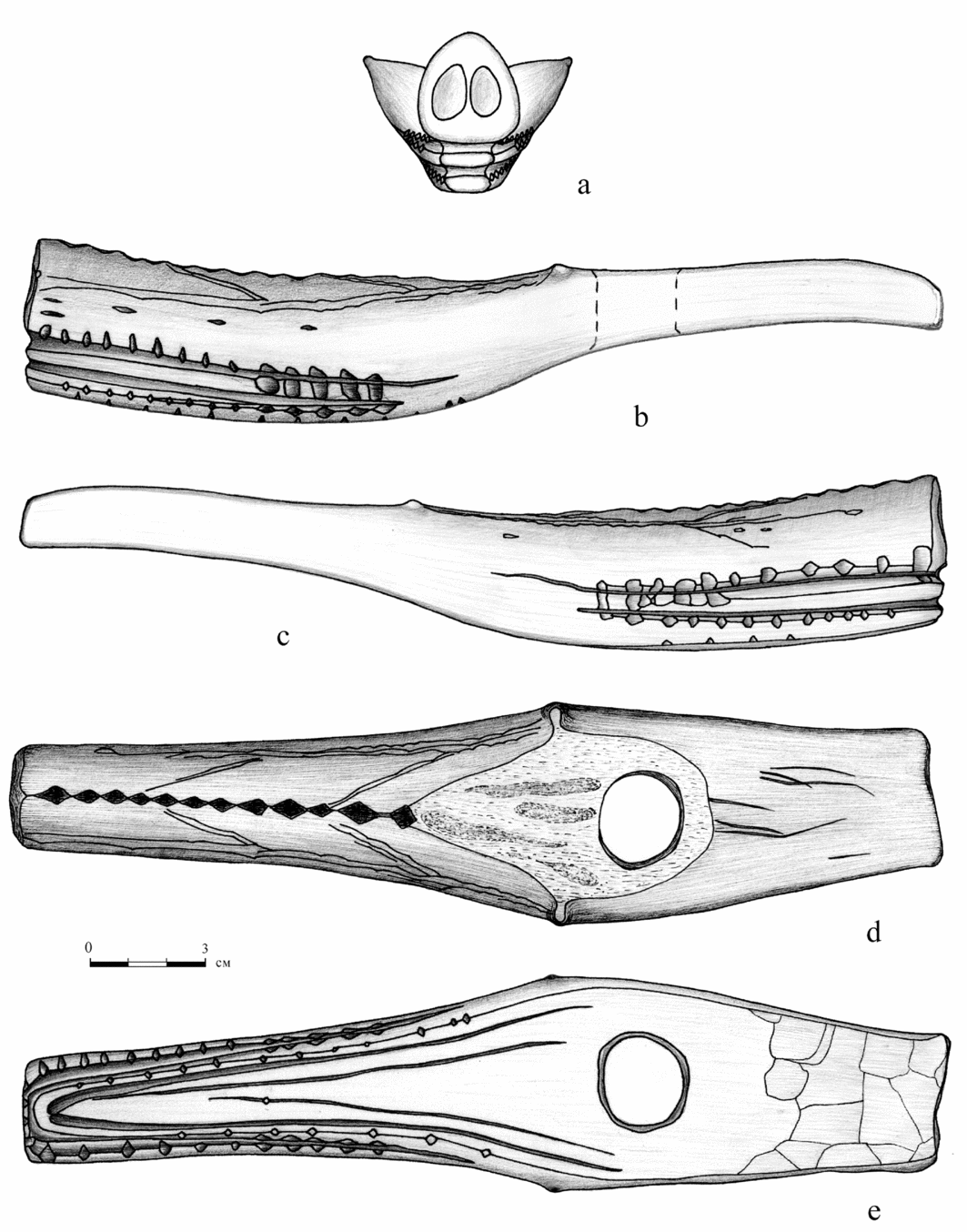
In June 2014, the antler was AMS dated in Aarhus and assigned to c. 9100 cal BC (AAR-24229; Table 1), making it another example of elaborate, figurative early Preboreal art.
Mesolithic art from Beregovaya 2
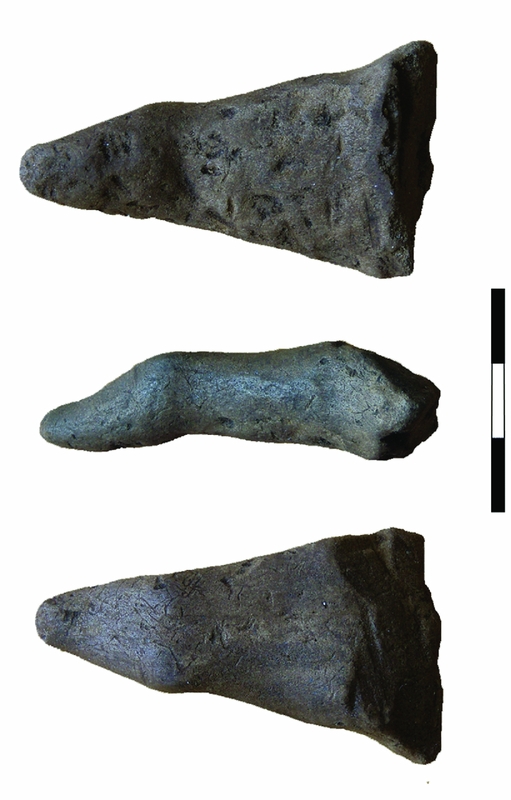
Another piece of Mesolithic art was excavated at the multi-layer peat bog site Beregovaya 2, located about 150km north/north-west of Yekaterinburg (Zhilin & Savchenko Reference Zhilin, Savchenko and Davudov2010). A small animal head (bear(?); Figure 8), probably carved from elk (Alces alces) antler (identified by Pavel Kosintsev), was found in layer III, which is dated to the late Boreal accordingto its context (Zhilin et al. Reference Zhilin, Savchenko, Nikulina, Schmölcke, Hartz and Terberger2014). The face of the head uses the natural surface of the antler, while the bottom of the head displays traces of shaping by a stone burin, smoothed by fine grinding and polishing. The age inferred from the stratigraphy is corroborated by a new AMS date of c. 7500 cal BC (AAR-24230; Table 1).
Animal head made of antler from the site of Beregovaya 2 (photograph by T. Terberger).
Discussion
The sculpture and engraved antler pieces from Shighir and Beregovaya 2 (layer III) play an important role in the discussion of Early Mesolithic art in the Urals. A series of seven AMS dates give a probable early Preboreal date for the famous Shigir sculpture. Morphological observations suggest that it was made from a freshly felled larch tree. The object, which was probably originally 5.3m long, is famous for its monumental character and unusual anthropomorphic depictions, including a large sculpted head on the top, and a series of carved faces on the body as well as complex ornamentation.
A perforated antler with outstanding decoration, probably showing the head of a canine, wild boar or some fantastic beast, belongs to approximately the same period. This animal-headed staff further supports the presence of a surprisingly rich and varied body of Early Mesolithic art in the Transurals, including elaborate figures of humans and animals. A small antler bear head from Beregovaya 2 dates to several hundred years later, and testifies to an enduring tradition of figurative art in this region throughout the Mesolithic.
Knowledge of archaeological sites of the Late Glacial and the Early Holocene is still very limited in the Urals (Serikov Reference Serikov2000; Zhilin et al. Reference Zhilin, Savchenko, Nikulina, Schmölcke, Hartz and Terberger2014: 165). Kapova Cave, located about 500km south-west of Yekaterinburg in the southern Urals, is well known for red-painted parietal art depicting mammoths, woolly rhinos and horses, which probably date to the Late Upper Palaeolithic. In Ignatievskaya Cave, 150km to the north, more than 30 groups of red and black cave paintings have also been assigned to the Late Upper Palaeolithic (Petrin & Širokov Reference Petrin and Širokov1995; Ščelinskij & Širokov Reference Ščelinskij and Širokov1999). Both sites demonstrate a tradition of cave art in the southern Transurals towards the end of the Late Glacial. The paintings show general similarities to contemporaneous cave art from France and Spain, but are generally smaller in size. Within Ignatievskaya Cave, however, there are depictions of an ungulate approximately 2.3m long, painted red and of an abstract female human figure around 1.3m tall. In conclusion, Late Upper Palaeolithic art in the Transurals shows a considerable variability of motifs, sometimes including larger figures.
The discovery of animal paintings in Coliboaia Cave in Romania (Ghemis et al. Reference Ghemiş, Clottes, Gély and Prud'homme2011) confirmed the presence of Upper Palaeolithic cave art in eastern Central Europe, and there is evidence for a rich body of portable art from (Late) Upper Palaeolithic sites in Eastern Europe and also farther east (e.g. Kozłowski Reference Kozłowski1992; Abramova Reference Abramova1995; Hansen Reference Hansen2007).
The limited number of Final Palaeolithic to Early Mesolithic sites in the Urals does not provide material comparable to the two outstanding finds from the Shigir peat bog. In the Upper Volga region, some 1700km to the west, there is evidence of decorated Mesolithic objects of bone and antler from sites such as Zamostje 2 and Ivanovskoje 7, including carved elk figures and an unknown animal head, but these finds are considerably later and date to the Late Mesolithic (Atlantic period, seventh millennium cal BC) (Zhilin Reference Zhilin, Legrand-Pineau and Sidéra2010).
In Central and Western Europe there are a few Late Palaeolithic finds (c. 12000–9600 cal BC), which document the presence of portable art of Late Upper Palaeolithic tradition. Small elk figurines made of amber along with objects with geometric engravings or traces of paint date to the Allerød (Veil & Terberger Reference Veil, Terberger, Planck, Heiligmann and Conard2009). Very few decorated objects, however, including isolated anthropomorphic engravings and objects with geometric decoration, are known from the Younger Dryas. The latest Ice Age cave art mostly comprises engravings, which are known in France, southern Italy and probably also in Britain (e.g. d'Errico Reference d'Errico1994; Bahn & Pettitt Reference Bahn and Pettitt2009; Tusa et al. Reference Tusa, di Maida, Pastoors, Piezonka, Weniger and Terberger2013).
Engravings of small, schematic, anthropomorphic figures and animals on bone and antler objects are a rare feature of the Maglemosian in the western Baltic (e.g. Płonka Reference Płonka2003; Kabacinski et al. Reference Kabacinski, Hartz and Terberger2011). This has nothing in common with the earlier style of anthropomorphic sculptures or facial depictions, and there are no decorated wooden objects or animal representations comparable to those from Shigir.
In the Levant and neighbouring regions, however, a considerable and multifaceted body of art has been documented from Late Palaeolithic (c. 12000–9600 cal BC) and Early Holocene sites. Late Palaeolithic techno-complexes such as the Natufian provide repeated examples of stone figurines including elaborate representations of animals and sometimes humans (Hansen Reference Hansen2007). During the Early Holocene and the Pre-Pottery Neolithic, representations of art and architecture became more complex. In south-eastern Anatolia, stone sculptures depicting various animals including birds and snakes, and anthropomorphic figures, were recovered from Pre Pottery Neolithic A (PPNA) Nevalı Çori (Hansen Reference Hansen2007; Hauptmann & Schmidt Reference Hauptmann, Schmidt and Karlsruhe2007).
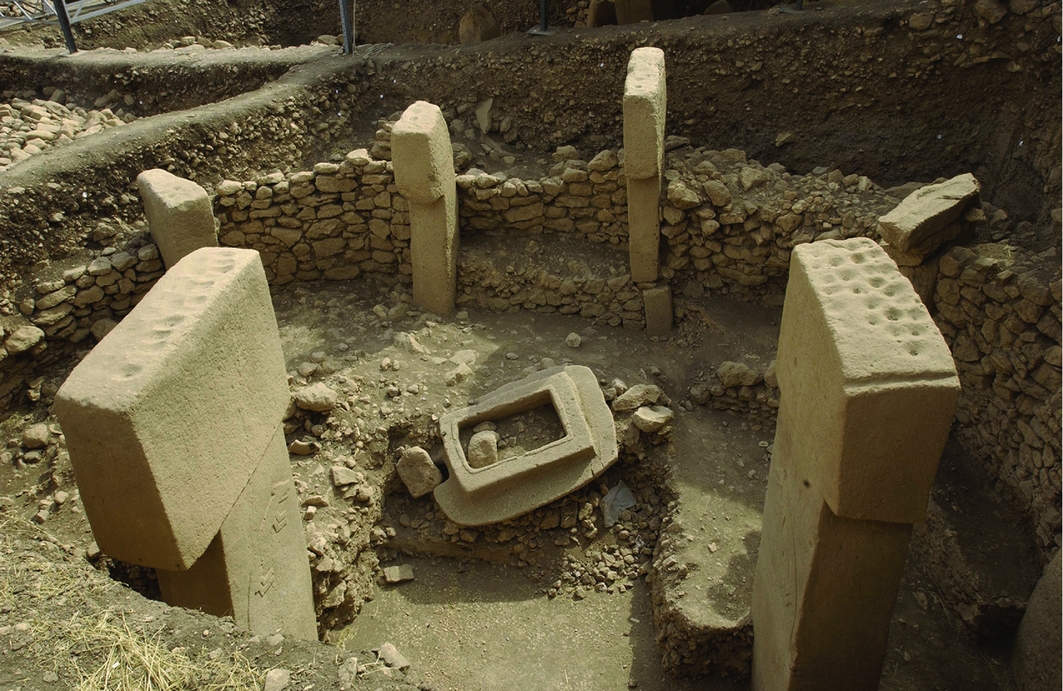
The most prominent examples of PPNA art were excavated at the site of Göbekli Tepe some kilometres farther south-west. The site is famous for its circular stone structures with pillars up to 4m tall (Figures 8–9 & S10). The T-shaped stelae can be identified as anthropomorphic stone sculptures, in some cases with carvings of gazelles, foxes, birds and snakes (Schmidt Reference Schmidt and Karlsruhe2007). The circular structures are interpreted as places for ritual. Göbekli Tepe also provided some examples of portable art dating between the tenth and eighth millennia cal BC (Dietrich et al. Reference Dietrich, Heun, Notroff, Schmidt and Zarnkow2012). There is no doubt that the large stone stelae at Göbekli Tepe were erected during the early phase of its use (c. 9600–8800 cal BC), when some 20 circular enclosures were used for ritual purposes by late hunter-gatherers (Dietrich et al. Reference Dietrich, Heun, Notroff, Schmidt and Zarnkow2012).
Göbekli Tepe, south-eastern Turkey. Anthropomorphic steleae (photograph courtesy of DAI/German Archaeological Institute).
The earliest monumental human figure from this region is represented by the stone sculpture (1.93m tall) found at Urfa. It shows a man wearing a necklace with his hands held to his front at groin height (Hauptmann Reference Hauptmann, Özdoğan, Hauptmann and Başgelen2003; Hauptmann & Schmidt Reference Hauptmann, Schmidt and Karlsruhe2007; Hansen Reference Hansen, Özdoğan, Başgelen and Kuniholm2014). The pillar-like basis of the sculpture leaves no doubt that it was displayed standing upright.
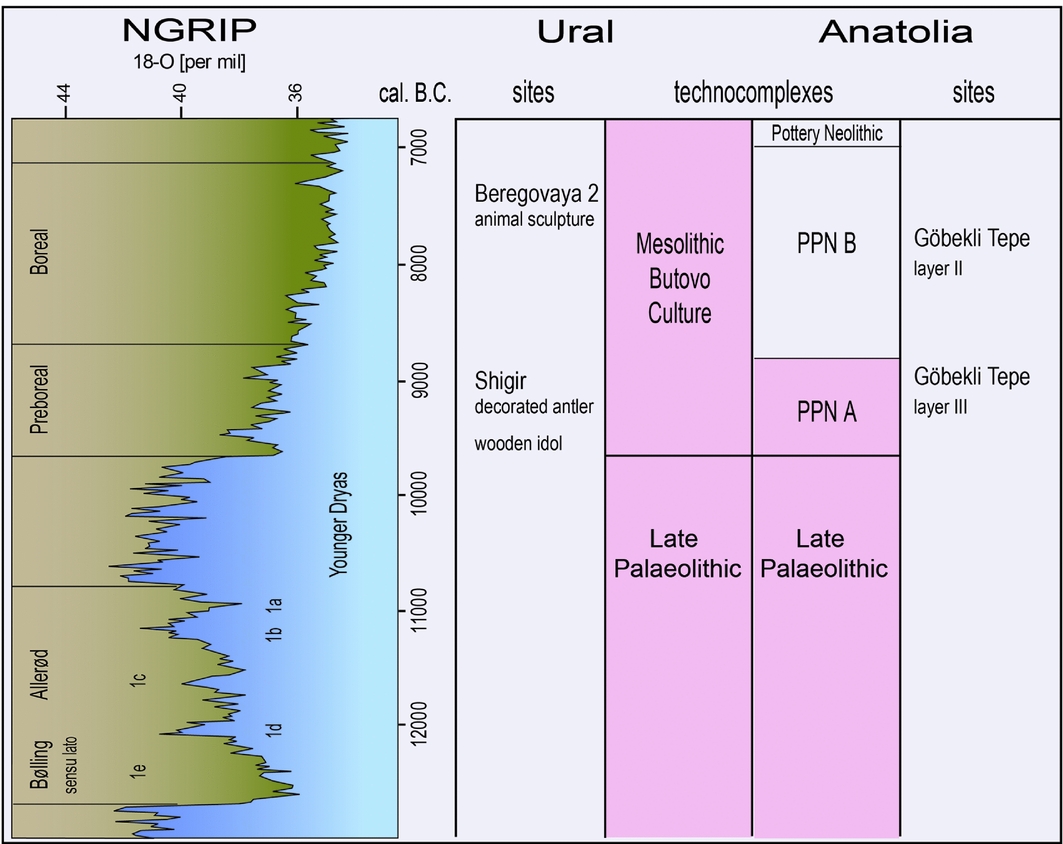
South-east Anatolia, with sites such as Nevalı Çori and Göbekli Tepe, is therefore the only region besides the Urals where we find evidence for monumental anthropomorphic sculptures and animal representations of Early Holocene date (Figure 10). The finds from the Shigir peat bog indicate the existence of an impressive, elaborate tradition of art contemporaneous with that of south-east Anatolia. Early Holocene hunter-gatherers clearly inhabited a symbolic world with richer and more complex forms of artistic expression than was previously believed.
Chrono-stratigraphic context of Early Holocene art.
Supplementary material
To view supplementary material for this article, please visit https://doi.org/10.15184/aqy.2018.48



