




Non-technical Summary
Caniforms, the branch of the carnivore tree more closely related to dogs than to cats and including animals as diverse as bears and weasels, have been important predators for millions of years. Much of what we know about the evolution of this group in the Oligocene Epoch (34–23 million years ago) is based on fossils collected in Oregon’s John Day Formation. However, many of these fossils were collected over a century ago, and we know very little about precisely where they were found, making it hard to study trends through time in caniforms. In this paper, we describe 16 new specimens of caniforms from museum collections around the Pacific Northwest, most of which are associated with detailed locality information. Among these are three common amphicyonids (an extinct family known as bear-dogs for its close relationship to both bears and dogs) and two types of dog not previously known from the John Day Formation: the large, predatory Osbornodon and the fox-like Otarocyon. We also describe two isolated bones that might come from a group of giant bear-dogs that migrated to North America from Eurasia; if so, one of these would be the oldest record of these huge animals on the continent by several million years. Overall, though, caniform evolution seems to have followed a similar pattern in Oregon as it did in the rest of North America, and future research could help us figure out what environmental factors caused these patterns.
Introduction
The John Day Formation of central Oregon preserves a diverse fossil fauna ranging from trace fossils of insects (e.g., Lee et al., Reference Lee, Famoso and Lin2024) and vertebrates (Bennett et al., Reference Bennett, Famoso and Hembree2025) to body fossils of ungulates (e.g., Famoso and Jewell, Reference Famoso and Jewell2024) spanning the Orellan through Hemingfordian North American Land Mammal Ages (NALMA; Oligocene, Rupelian Stage/Age to Miocene, Burdigalian Stage/Age). Among the most diverse and intensively studied John Day taxa are caniform carnivorans. These include Mustelidae (Paterson et al., Reference Paterson, Samuels, Rybczynski, Ryan and Maddin2020) as well as the arctoids Allocyon Merriam, Reference Merriam1930; Nothocyon Wortman and Matthew, Reference Wortman and Matthew1899; and Ursavus Schlosser, Reference Schlosser1899; but the most abundant caniforms from the John Day Formation are members of the Canidae and Amphicyonidae. All three subfamilies of North American canids are represented in the formation, with five genera of Hesperocyoninae (Mesocyon Scott, Reference Scott1890; Philotrox Merriam, Reference Merriam1906; Enhydrocyon Cope, Reference Cope1879a; Paraenhydrocyon Wang, Reference Wang1994; and Osbornodon Wang, Reference Wang1994; Wang, Reference Wang1994; Albright et al., Reference Albright, Woodburne, Fremd, Swisher, MacFadden and Scott2008), six genera of Borophaginae (Archaeocyon Wang, Tedford, and Taylor, Reference Wang, Tedford and Taylor1999; Rhizocyon Wang, Tedford, and Taylor, Reference Wang, Tedford and Taylor1999; Cynarctoides McGrew, Reference McGrew1938; Phlaocyon Matthew, Reference Matthew1899; Cormocyon Wang and Tedford, Reference Wang and Tedford1992; and Desmocyon Wang, Tedford, and Taylor, Reference Wang, Tedford and Taylor1999 (Wang et al., Reference Wang, Tedford and Taylor1999), and Leptocyon Matthew, Reference Matthew1918 from Caninae (Tedford et al., Reference Tedford, Wang and Taylor2009) having been previously described. Similarly, three subfamilies of Amphicyonidae have been reported: three genera of Daphoeninae (Daphoenus Leidy, Reference Leidy1853; Daphoenodon Peterson, Reference Peterson1909; and Paradaphoenus Wortman and Matthew, Reference Wortman and Matthew1899; Hunt, Reference Hunt, Janis, Scott and Jacobs1998, Reference Hunt2001, Reference Hunt2009b), three genera of Temnocyoninae (Temnocyon Cope, Reference Cope1878; Mammacyon Loomis, Reference Loomis1936; and Rudiocyon Hunt, Reference Hunt2011; Hunt, Reference Hunt2011), and Amphicyon Lartet, Reference Lartet1836 (Hunt and Stepleton, Reference Hunt and Stepleton2004; Coombs and Hunt, Reference Coombs and Hunt2015). The type specimens of 14 canid species and five amphicyonid species were recovered from the John Day Formation, underscoring its importance to caniform taxonomy. John Day fossils have figured prominently in phylogenetics as well as in systematics. For example, the phylogenies developed by Wang (Reference Wang1994), Wang et al. (Reference Wang, Tedford and Taylor1999), and Tedford et al. (Reference Tedford, Wang and Taylor2009) for each of the three subfamilies of canids were based heavily on specimens from the formation. The central role played by large carnivores in ecosystems means that both families have been the focus of paleoecological research; notably, Tanis et al. (Reference Tanis, DeSantis and Terry2018) used John Day phlaocyonins as a case study for dental microwear analysis, reconstructing a wide dietary niche for the group. Canids and amphicyonids are both biostratigraphically informative and have been crucial to understanding the zonation of the John Day Formation, as in the analysis of the Turtle Cove and Kimberly members conducted by Albright et al. (Reference Albright, Woodburne, Fremd, Swisher, MacFadden and Scott2008).
For all their evolutionary, ecological, and stratigraphic significance, gaps remain in our understanding of John Day canids and amphicyonids. Many specimens were collected in the 19th or early 20th Century and lack locality and collecting information, as most clearly illustrated by the type specimen of Temnocyon subferox Hunt, Reference Hunt2011 (Hunt, Reference Hunt2011). Despite the importance of this fossil, its locality is recorded only as ‘Middle John Day.’ Its collector and year—indeed, even century—of discovery are likewise unrecorded. Many other specimens collected in the region also lack detailed locality information. The John Day Formation has subsequently been divided into multiple members and subunits (Retallack et al., Reference Retallack, Bestland and Fremd1999; Hunt and Stepleton, Reference Hunt and Stepleton2004; Albright et al., Reference Albright, Woodburne, Fremd, Swisher, MacFadden and Scott2008; Mohr et al., Reference Mohr, Famoso, Samuels, Laid and Schmitz2025) and the volcanically active nature of the Pacific Northwest and the many tephra, ignimbrite, and basalt layers erupted onto the landscape have allowed precise dating of many of these units (Bestland and Retallack, Reference Bestland and Retallack1994; Hunt and Stepleton, Reference Hunt and Stepleton2004; Albright et al., Reference Albright, Woodburne, Fremd, Swisher, MacFadden and Scott2008; Mohr et al., Reference Mohr, Famoso, Samuels, Laid and Schmitz2025). This stratigraphic framework provides opportunities for analyses of biostratigraphy and faunal turnover, but such analyses are difficult for taxa such as John Day caniforms for which detailed locality data is often missing. For instance, Hunt (Reference Hunt, Janis, Scott and Jacobs1998) suggested that the possible presence of Daphoenus in the upper part of the John Day Formation might represent an evolving population that persisted longer in the region than elsewhere in North America while noting that the absence of context for many historic specimens complicates any interpretation of amphicyonid diversity through time in the region. We aim to provide some of this context by identifying previously undescribed caniform material in the collections of the Universities of Oregon and Washington as well as more recently collected fossils housed at John Day Fossil Beds National Monument.
Geologic setting
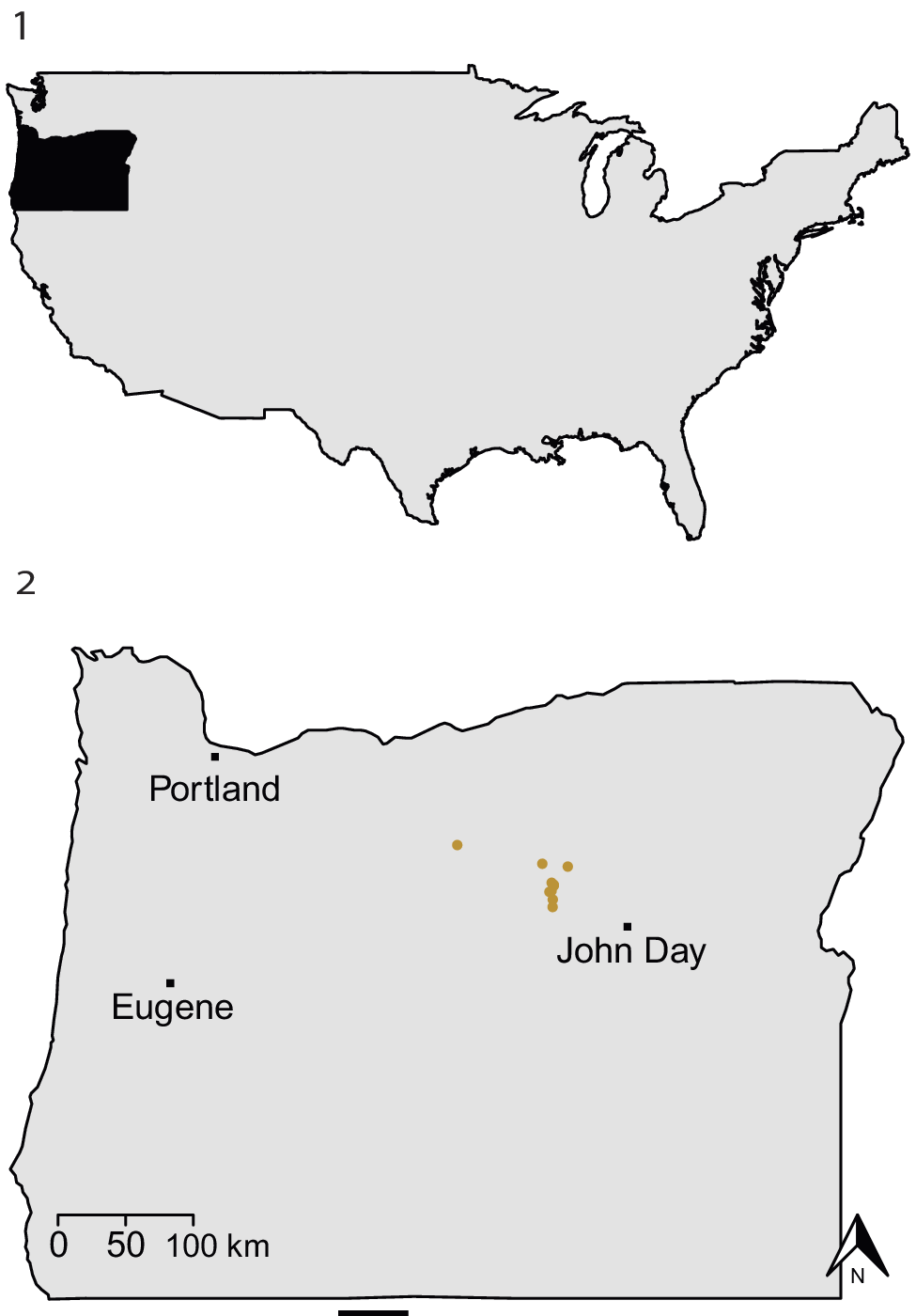
The John Day Formation (specific geodetic coordinates withheld according to U.S. Federal Law concerning vertebrate fossils on public lands) of central Oregon (Fig. 1) is currently subdivided into seven members (Fig. 2): Big Basin (39.673–32.150 Ma), Turtle Cove (32.150–26.579 Ma), Kimberly (26.579–25.486 Ma), Haystack Valley (24.199–23.173 Ma), Balm Creek (23.173–22.466 Ma), Johnson Canyon (22.466–21.687 Ma), and Rose Creek (18.467–17.999 Ma; Retallack et al., Reference Retallack, Bestland and Fremd1999; Hunt and Stepleton, Reference Hunt and Stepleton2004; Albright et al., Reference Albright, Woodburne, Fremd, Swisher, MacFadden and Scott2008; Mohr et al., Reference Mohr, Famoso, Samuels, Laid and Schmitz2025). The Big Basin Member is subdivided into three informal units, the lower (39.673–37.754 Ma; Eocene; Bartonian Stage/Age), middle (33.198–32.992 Ma; Oligocene; Orellan NALMA; Rupelian Stage/Age), and upper (32.992–32.15 Ma; Oligocene; Orellan NALMA; Rupelian Stage/Age; Bestland and Retallack Reference Bestland and Retallack1994; Mohr et al., Reference Mohr, Famoso, Samuels, Laid and Schmitz2025). There is a small portion of the Big Basin Member (referred to as the Lost Creek fauna) in the Crooked River Basin that appears to be Chadronian (Priabonian Stage/Age) in age and fills in the gap between the lower and middle informal units (Samuels et al., Reference Samuels, Mihlbachler, Korth, Holbrook, Bredehoeft, Fremd, Farke, MacKenzie and Miller-Camp2016). The Turtle Cove and Kimberly consist of ~500 m of section that Albright et al. (Reference Albright, Woodburne, Fremd, Swisher, MacFadden and Scott2008) divided into 16 lithostratigraphic subunits (A–M) within the area near the Sheep Rock Unit of John Day Fossil Beds National Monument. These units are not laterally continuous in other areas where the Turtle Cove Member is exposed (e.g., Painted Hills Unit, Crooked River Basin). Included within the Turtle Cove Member are several dated tuffs and the Picture Gorge ignimbrite (PGI)—a supervolcanic event related to the Yellowstone hotspot (Seligman et al., Reference Seligman, Bindeman, McClaughry, Stern and Fisher2014). The PGI subdivides the Turtle Cove Member into the lower (A–F) and upper (G–K2) informal units that we used in this study. The faunas of the Turtle Cove Member are assigned to the Whitneyan and Arikareean NALMAs (Oligocene; Rupelian Stage/Age) whereas the fauna of the Kimberly Member is only assigned to the Arikareean NALMA (Oligocene; Chattian Stage/Age; Albright et al., Reference Albright, Woodburne, Fremd, Swisher, MacFadden and Scott2008). The Haystack Valley (Arikareean NALMA; Oligocene; Chattian Stage/Age), Balm Creek (Arikareean NALMA; Miocene; Aquitanian Stage/Age), Johnson Canyon (Arikareean NALMA; Miocene; Aquitanian Stage/Age), and Rose Creek (Hemingfordian NALMA; Miocene, Burdigalian Stage/Age) members were once all assigned to the Haystack Valley Member, but were split into a revised Haystack Valley Member, as well as the younger Balm Creek, Johnson Canyon, and Rose Creek members (Hunt and Stepleton, Reference Hunt and Stepleton2004).
Location of the John Day Fossil Beds and the localities discussed herein: (1) location of Oregon within the United States; (2) location of localities (brown dots).

Figure 1. Long description
Panel 1 at the top shows a silhouette map of the contiguous United States with the state of Oregon highlighted in solid black in the Northwest.
Panel 2 at the bottom is a detailed map of Oregon. In the Northwest is the city of Portland. In the Southwest is the city of Eugene. In the East-Central region is the city of John Day. A cluster of approximately ten brown dots representing fossil localities is concentrated just West and Northwest of the city of John Day. A scale bar in the bottom left corner indicates 0 to 100 kilometers. A North arrow is located in the bottom right corner.
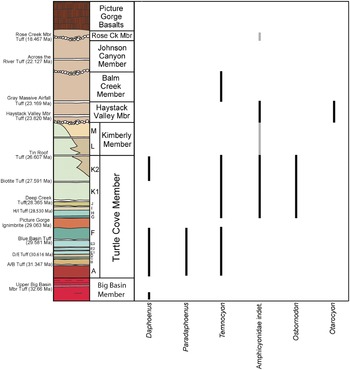
Stratigraphy of the John Day Formation showing the ages of the specimens discussed in this paper. Taxon ranges are shown at the generic and familial levels to allow comparisons with taxa from other regions in North America. Dark lines represent well-supported ranges based on specimens described in this paper and that have been previously published elsewhere. Grey lines indicate uncertainty as to whether UWBM VP 31287 is from the Kimberly or Rose Creek Member of the John Day Formation, both of which outcrop at the Picture Gorge 36 locality.

Figure 2. Long description
The chart is organized with a vertical stratigraphic column on the left and taxon ranges to the right.
Stratigraphic Column from bottom to top:
* Big Basin Member: Includes Upper Big Basin M b r Tuff at 32.66 M a.
* Turtle Cove Member: Divided into subunits A through K 2. Key markers include A forward slash B Tuff at 31.347 M a, D forward slash E Tuff at 30.616 M a, Blue Basin Tuff at 29.581 M a, Picture Gorge Ignimbrite at 29.063 M a, H forward slash I Tuff at 28.530 M a, Deep Creek Tuff at 28.365 M a, and Biotite Tuff at 27.591 M a.
* Kimberly Member: Subunits L and M, including Tin Roof Tuff at 26.607 M a.
* Haystack Valley M b r: Includes Haystack Valley M b r Tuff at 23.820 M a and Gray Massive Airfall Tuff at 23.169 M a.
* Balm Creek Member.
* Johnson Canyon Member: Includes Across the River Tuff at 22.127 M a.
* Rose Creek M b r: Includes Rose Creek Tuff at 18.467 M a.
* Picture Gorge Basalts: The uppermost layer.
Taxon Ranges from left to right:
* Daphoenus: Solid black lines in the Big Basin Member, lower Turtle Cove Member, and K 2 subunit of the Turtle Cove Member.
* Paradaphoenus: Solid black line spanning Turtle Cove subunits A through F.
* Temnocyon: Solid black lines spanning Turtle Cove subunits A through F, K 1 through K 2, and the Balm Creek Member.
* Amphicyonidae indet.: Solid black line from Turtle Cove subunit G through K 1. A grey line continues through the Kimberly Member, with a separate grey segment in the Rose Creek Member.
* Osbornodon: Solid black line spanning Turtle Cove subunits G through K 2.
* Otarocyon: Solid black line restricted to the Haystack Valley M b r.
Materials and methods
Measurements of specimens were made to the nearest 0.1 mm using Mitutoyo Digimatic calipers with an accuracy of ± 0.02 mm. In the text and tables, upper dentition is indicated by upper-case letters, and lower dentition indicated by lower-case letters. JODA 12390 was collected under BLM permit OR-50892 issued to John Day Fossil Beds National Monument. UOMNH F-58640 was collected under BLM permit OR-50923 issued to University of Oregon Museum of Natural and Cultural History.
Repositories and institutional abbreviations
The specimens described below are reposited in the following collections: American Museum of Natural History, New York (AMNH); John Day Fossil Beds National Monument, Kimberly, Oregon (JODA, JDNM for locality numbers); Rice Northwest Museum of Rocks & Minerals, Hillsboro, Oregon (NM); University of Oregon Museum of Natural and Cultural History, Eugene (UOMNH, UO for locality numbers); and University of Washington Burke Museum, Seattle (UWBM).
Systematic paleontology
Order Carnivora Bowdich, Reference Bowdich1821
Family Amphicyonidae Trouessart, Reference Trouessart1885
Amphicyonidae gen. indet. sp. indet.
Postcrania of large amphicyonids: (1) left metacarpal IV in medial (top) and plantar (bottom) views (UOMNH F-58640); (2) left unciform in palmar (left) and plantar (right) views (UWBM VP 31287). Scale bar = 1 cm.

Figure 3. Long description
The photo is divided into two main numbered sections.
Section 1 at the top contains two views of a long, slightly curved bone labeled U O M N H F-58640. The top view shows the medial side of the left metacarpal I V, featuring a textured surface with green mineral staining and a white specimen label on the right end. The bottom view shows the plantar side of the same bone, revealing a more symmetrical shaft and articular surfaces at both ends.
Below section 1 is a solid black horizontal scale bar representing 1 centimeter.
Section 2 at the bottom contains two views of a smaller, wedge-shaped bone labeled U W B M V P 31287. The left view shows the palmar side of the left unciform, characterized by a deep concave articular surface and a porous texture. The right view shows the plantar side of the same bone, which has a more rounded, convex profile. Both bones exhibit a tan and brown coloration with patches of dark green mineral deposits.
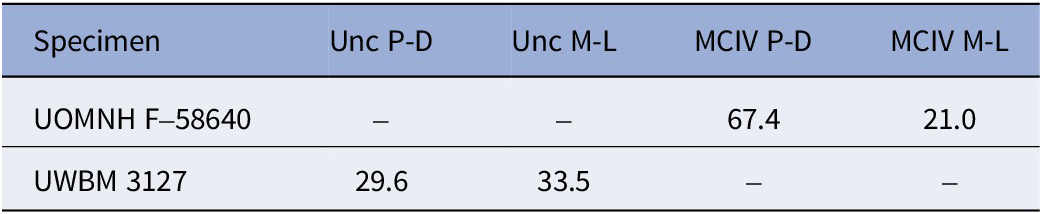
Postcranial measurements of John Day Formation Amphicyonidae gen. indet. sp. indet. Length is measured proximodistally (P-D) and width is measured mediolaterally (M-L) for the unciform (Unc) and metacarpal IV (MCIV). The mediolateral measurement of UOMNH F-58640 was taken at the proximal end. Measurements in mm

Table 1. Long description
The table consists of five columns and two data rows. The columns are labeled Specimen, Unc P dash D, Unc M dash L, M C I V P dash D, and M C I V M dash L.
Row 1: Specimen U O M N H F dash 58640 has no data for Unc P dash D or Unc M dash L. It records 67.4 for M C I V P dash D and 21.0 for M C I V M dash L.
Row 2: Specimen U W B M 3127 records 29.6 for Unc P dash D and 33.5 for Unc M dash L. It has no data for M C I V P dash D or M C I V M dash L.
Referred material
UOMNH F-58640, left metacarpal IV from the Turtle Cove Member of the John Day Formation at UO 4698, Bull Canyon, Wheeler County, Oregon, USA; UWBM VP 31287, left unciform from the Kimberly or Rose Creek member of the John Day Formation at UWBM A5835, Picture Gorge 36, Grant County, Oregon, USA.
Description
An amphicyonid unciform (UWBM VP 31287) is considerably larger than that of the daphoenine and temnocyonine unciforms described by Hunt (Reference Hunt2011). It is comparable in size with an unciform of Amphicyon major De Blaineville, Reference De Blaineville1841 from Sansan, France (Argot, Reference Argot2010), and shares with it a convex lateral surface with a small distal process. Like Ysengrinia Ginsburg, Reference Ginsburg1965, it has a smooth, concave distal surface to receive the proximal head of metacarpal 2 (Hunt, Reference Hunt2002). In the absence of clearly figured and measured amphicyonine unciforms, though, it is not possible to assign this specimen to either genus, or indeed to the Amphicyoninae. An isolated fourth metacarpal (UOMNH F-58640) is consistent in size with the large daphoenine Daphoenodon but lacks the elongation, straightening, and strong distal keels seen in this taxon (Table 1; Hunt, Reference Hunt2009b). Similarly, this lack of elongation and a distal keel suggest that it is not a large temnocyonine (Hunt, Reference Hunt2011). The relatively short, robust metapodial is consistent in both size and morphology with large amphicyonines, including Ysengrinia (see Hunt, Reference Hunt2002) and Amphicyon (see Hunt, Reference Hunt2003; Argot, Reference Argot2010). The metapodials of the large mustelid Megalictis Matthew, Reference Matthew1907 are comparable to those of Amphicyon, but UOMNH F-58640 is somewhat larger and less robust than those from the type specimen of Megalictis (see Matthew, Reference Matthew1907).
Remarks
The presence of a large amphicyonine in the John Day Formation would have important biostratigraphic and biogeographic implications due to the age of these specimens, particularly of UOMNH F-58640, which was uncovered from unit G of the Turtle Cove Member (29.063–28.530 Ma; Fig. 2). This specimen was collected ~1.5 m above the Picture Gorge ignimbrite (29.042 Ma) and ~4 m below the H-I tuff (28.525 Ma) in a portion of Bull Canyon that has no other stratigraphy present above unit I (Mohr et al., Reference Mohr, Famoso, Samuels, Laid and Schmitz2025). Based on the field notes, there are only exposures of the Columbia River Basalt Group above the exposures of units G–I, in this part of Bull Canyon. The specimen was found in float, but there are no other possible parts of the upper Turtle Cove stratigraphy that it could be from. The oldest Amphicyon fossils in North America are considerably younger, dating to the early Hemingfordian (as early as 18.8 Ma; Hunt, Reference Hunt2003). Ysengrinia appears somewhat earlier (to 23 Ma; Hunt, Reference Hunt2002), but in either case the John Day material would represent a significant range extension for amphicyonines in North America. However, the dearth of information about the morphology of amphicyonid hand elements makes it impossible to state with certainty that these specimens are from amphicyonines as opposed to large daphoenines or temnocyonines. An uncatalogued dentary (field number JODA BLMJLC22-03) with a single premolar from Sutton Mountain (Bridge Creek 6, JDNM-160), Haystack Valley Member, in Wheeler County, Oregon is also in the collection at JODA. This jaw is edentulous, but the morphology of the dentary is similar to other amphicyonids but is much smaller than Temnocyon specimens also found in the Haystack Valley Member. We did not describe this specimen here because it is not yet cataloged.
Subfamily Daphoeninae Hough, Reference Hough1948
Genus Daphoenus Leidy, Reference Leidy1853
Type species
Daphoenus vetus (Leidy, Reference Leidy1853) from the Orellan Brule Formation of South Dakota, USA, by original designation.
Daphoenus sp. indet.
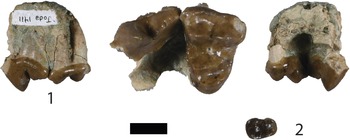
Dentition of Daphoenus sp. indet.: (1) left P4 and M1 in buccal (left), occlusal (middle), and lingual (right) views (JODA 1411); (2) left m2 in occlusal view (JODA 313). Scale bar = 1 cm.

Figure 4. Long description
The top row contains three views of specimen J O D A 1 4 1 1 labeled with a number 1.
* The left view shows the buccal side of the left P 4 and M 1 teeth with a white label reading J O D A 1 4 1 1 attached to the upper bone fragment.
* The middle view shows the occlusal or grinding surface of the same teeth revealing the complex cusp patterns.
* The right view shows the lingual or tongue-side of the teeth.
Below these is a black scale bar representing 1 centimeter. To the right of the scale bar is a single small tooth labeled with a number 2. This is specimen J O D A 3 1 3 which is a left m 2 shown in occlusal view. The fossils are brown and glossy set against light-colored bone and rock matrix.
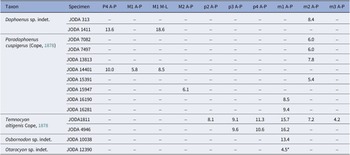
Dental measurements of John Day Formation caniforms. Length is measured anteroposteriorly (A-P) and width is measured mediolaterally (M-L) for upper dentition (upper case) and lower dentition (lower case). Measurements in mm. Asterisk indicates a broken specimen

Table 2. Long description
The table contains twelve columns: Taxon, Specimen, P 4 A-P, M 1 A-P, M 1 M-L, M 2 A-P, p 2 A-P, p 3 A-P, p 4 A-P, m 1 A-P, m 2 A-P, and m 3 A-P.
* Daphoenus species indet.: Specimen J O D A 313 has an m 2 A-P of 8.4. Specimen J O D A 1411 has a P 4 A-P of 13.6 and M 1 M-L of 18.6.
* Paradaphoenus cuspigerus: Eight specimens listed. J O D A 7082, 7497, and 13813 have m 2 A-P values of 6.0, 6.0, and 7.8 respectively. J O D A 14401 has P 4 A-P of 10.0, M 1 A-P of 5.8, and M 1 M-L of 8.5. J O D A 15391 has m 2 A-P of 5.4. J O D A 15947 has M 2 A-P of 6.1. J O D A 16190 and 16281 have m 1 A-P values of 8.5 and 9.4 respectively.
* Temnocyon altigenis: Specimen J O D A 1811 has p 2 A-P of 8.1, p 3 A-P of 9.1, p 4 A-P of 11.3, m 1 A-P of 15.7, m 2 A-P of 7.2, and m 3 A-P of 4.2. Specimen J O D A 4946 has p 3 A-P of 9.6, p 4 A-P of 10.6, and m 1 A-P of 16.2.
* Osbornodon species indet.: Specimen J O D A 10038 has an m 1 A-P of 13.4.
* Otarocyon species indet.: Specimen J O D A 12390 has an m 1 A-P of 4.5 asterisk, indicating a broken specimen.
Referred material
JODA 313, left m2 from JDNM-7, Foree; JODA 1411, left maxilla fragment with P4 and M1 from JDNM-9, Blue Basin; both specimens from the Turtle Cove Member of the John Day Formation in Grant County, Oregon, USA.
Description
The large protoconid and hypoconid, the relatively small size of the metaconid, the even smaller size of the paraconid, an enlarged anterobuccal cingulum, the squared posterior border, the basined talonid, and small entoconid of the m2 (JODA 313) are all characteristic of Daphoenus. The triangular shape of the M1 (JODA 1411), formed by a well-developed protocone, paracone, and metacone and an extended lingual cingulum posterior to the protocone are diagnostic of the basal daphoenines Daphoenus and Brachyrhynchocyon Scott and Jepsen, Reference Scott and Jepsen1936. However, the P4 is much less robust than in Brachyrhynchocyon, indicating that JODA 1411 can be assigned to Daphoenus (Hunt, Reference Hunt, Janis, Scott and Jacobs1998).
Remarks
Hunt (Reference Hunt, Janis, Scott and Jacobs1998) suggested that JODA 1411 represents an unusually large specimen of Daphoenus and that it could occur as low as unit C of the Turtle Cove Member. However, specimen records at JODA, confirmed by aerial photography data, indicate that it was recovered from unit E2 in Blue Basin, much higher up in the section. Likewise, its size is consistent with other specimens of Daphoenus measured by Hough (Reference Hough1948) in her review of the genus.
Genus Paradaphoenus Wortman and Matthew, Reference Wortman and Matthew1899
Type species
Canis cuspigerus Cope, Reference Cope1878, from the Arikareaan John Day Formation of Oregon, USA, by original designation.
Paradaphoenus cuspigerus (Cope, Reference Cope1878)
Dentition of Paradaphoenus cuspigerus (Cope, Reference Cope1878): (1) left M2 in occlusal view (JODA 15947); (2) right M2 in occlusal view (JODA 13813); (3) left m2 in occlusal view (JODA 7082); (4) left m2 in occlusal view (JODA 15391); (5) right P4 and M1 in buccal (left), occlusal (middle), and lingual (right) views (JODA 14401); (6) right m2 in buccal (left), occlusal (middle), and lingual (right) views (JODA 7497); (7) left m1 in buccal (left), occlusal (middle), and lingual (right) views (JODA 16190); (8) left dentary with m1 in buccal (left), occlusal (middle), and lingual (right) views (JODA 16281). Scale bar = 1 cm.

Figure 5. Long description
The photo contains eight numbered panels of fossilized dental remains. A black scale bar representing 1 centimeter is located at the top right.
* Panel 1. A small, dark brown left M 2 tooth in occlusal view.
* Panel 2. A right M 2 tooth in occlusal view.
* Panel 3. A light tan left m 2 tooth in occlusal view.
* Panel 4. Another left m 2 tooth in occlusal view.
* Panel 5. Three views of a right P 4 and M 1 fragment labeled J O D A 1 4 4 0 1. The left view shows the buccal side, the middle shows the occlusal surface with distinct cusps, and the right shows the lingual side.
* Panel 6. Three views of a right m 2 fragment labeled J O D A 7 4 9 7. The left buccal view shows a white label, the middle occlusal view shows the tooth crown, and the right lingual view shows the inner bone surface.
* Panel 7. Three views of a left m 1 fragment labeled J O D A 1 6 1 9 0. The left buccal view shows the sharp cusps, the middle occlusal view shows the grinding surface, and the right lingual view shows the interior side.
* Panel 8. Three views of a large left dentary bone with m 1 labeled J O D A 1 6 2 8 1. The top view is the buccal side showing the full length of the jaw bone. The middle view is the occlusal perspective showing the tooth row and empty sockets. The bottom view is the lingual side of the jaw bone.
Reference Cope1878 Canis cuspigerus Cope, p. 8.
Reference Cope1879b Amphicyon entoptychi Cope, p. 372.
Holotype
Cranium and dentaries (AMNH FM 6852) from the Arikareean John Day Formation of Oregon, USA.
Referred material
JODA 7082, left m2, and JODA 13813, right M2, from JDNM-64, Sorefoot Creek, Wasco County, Oregon, USA; JODA 7497, right dentary fragment with m2, and JODA 15391, left m2, from JDNM-9, Blue Basin, Grant County, Oregon, USA; JODA 14401, right maxilla with P4 and M1, and JODA 16190, left dentary fragment with m1, from JDNM-8, Sheep Rock, Grant County, Oregon, USA; JODA 15947, left M2, and JODA 16281, left dentary with m1, from JDNM-7A, Foree, Grant County, Oregon, USA; all specimens from the Turtle Cove Member of the John Day Formation.
Description
Although only preserving lower premolar roots, JODA 16281 exhibits the laterally compressed premolars typical of Paradaphoenus. This specimen, along with JODA 16190, also has the closed, basined m1 trigonid that distinguishes Paradaphoenus from small canids. In neither specimen is the paraconid blade anteriorly extended, another feature that distinguishes Paradaphoenus from canids. Specimens in which the m2 is preserved (JODA 7082, 7497, and 15391) all show the rectangular shape formed by the anterolingual swelling of the cingulum characteristic of Paradaphoenus and the anterior crowding of the trigonid typical of Paradaphoenus cuspigerus. The M1 of JODA 14401 preserves a prominent paraconule, another feature characteristic of Paradaphoenus. The M2, preserved in JODA 13813 and 15947, displays two more traits typical of Paradaphoenus: a labially-placed metacone and paracone and a lingually-extended cingulum. Tooth size is large for Paradaphoenus (Table 2), consistent with previously described specimens of Paradaphoenus cuspigerus (see Hunt, Reference Hunt2001).
Remarks
Paradaphoenus cuspigerus is well-represented in the John Day Formation, having first been described from there by Cope (Reference Cope1878). Although Albright et al. (Reference Albright, Woodburne, Fremd, Swisher, MacFadden and Scott2008) indicated the presence of Paradaphoenus in units K1 and K2, there are no known voucher specimens to confirm these occurrences, thus the specimens described here are the first individual specimens assigned to specific units of the Turtle Cove Member (Fig. 2). Most specimens of known provenance were recovered from unit E (E1, E2, or E3), although one specimen (JODA 15947) is from unit D and another (JODA 15391) was found in unit F.
Subfamily Temnocyoninae Hunt, Reference Hunt, Janis, Scott and Jacobs1998
Genus Temnocyon Cope, Reference Cope1878
Type species
Temnocyon altigenis Cope, Reference Cope1878, from the Arikareean John Day Formation of Oregon, USA, by original designation.
Temnocyon altigenis Cope, Reference Cope1878
Dentition of Temnocyon altigenis Cope, Reference Cope1878: (1) right dentary with p3-m1 in lingual (top), occlusal (middle), and buccal (bottom) views (JODA 4946); (2) right dentary with c1–m3 on lingual (top), occlusal (middle), and buccal (bottom) views (JODA 1811). Scale bar = 1 cm.

Figure 6. Long description
The top half labeled 1 shows specimen J O D A 4946. The top view is the lingual side showing the inner surface of the jaw with three prominent dark teeth. The middle view is occlusal, looking down at the grinding surfaces of p 3 through m 1. The bottom view is buccal, showing the outer surface of the jaw. A black scale bar representing 1 centimeter is positioned between the two specimens. The bottom half labeled 2 shows specimen J O D A 1811. The top view is the lingual side of a longer jaw section containing c 1 through m 3, with a separate smaller fragment to the right. The middle view is occlusal, showing the full tooth row from above. The bottom view is buccal, showing the outer jaw bone with a white label reading J O D A 1811 on the left fragment. Both specimens exhibit dark brown fossilized bone and black enamel on the teeth.
Holotype
Right dentary (AMNH FM 6855) from the Arikareean John Day Formation of Oregon, USA.
Referred material
JODA 1811, right dentary with c1–m3 from JDNM-925A, Picture Gorge; JODA 4946, right dentary with p3-m1 from JDNM-153, Stubblefield; both specimens from the Turtle Cove Member of the John Day Formation, Grant County, Oregon, USA.
Description
Early John Day Temnocyon can be distinguished from Daphoenus, which shares plesiomorphic lower dentition, by the absence of an entoconid on the m1. Both of the specimens described here (JODA 1811 and 4946) lack an entoconid and can therefore be assigned to Temnocyon. In the two species known from the John Day Formation, Temnocyon altigenis and Temnocyon fingeruti Hunt, Reference Hunt2011, the relatively small size of the teeth (Table 2) is consistent with Temnocyon altigenis (see Hunt, Reference Hunt2011).
Remarks
All specimens of Temnocyon described here are from the upper part of the Turtle Cove Member (Fig. 2). Although JODA 4946 cannot be assigned to a specific unit, JODA 1811 comes from unit H. There is a partially cataloged and prepared specimen, JODA 19500 (field number JXS410-65) collected from JDNM-9, Blue Basin (Turtle Cove unit E1), Grant County, Oregon, that can tentatively be assigned to Temnocyon altigenis. JODA 19500 is a skull with lower jaws attached and basicranium with ectotympanic bulla, but there is a large fracture that diagonally splits the specimen into two sections. Because this specimen was not fully prepared, nor fully cataloged, we did not describe it here, but this specimen warrants description once it is fully prepared.
Family Canidae Fischer De Waldheim, Reference Fischer de Waldheim1817
Subfamily Hesperocyoninae Tedford, Reference Tedford1978
Genus Osbornodon Wang, Reference Wang1994
Type species
Osbornodon fricki Wang, Reference Wang1994, from the Barstovian Tesuque Formation at Skull Ridge, Santa Fe County, New Mexico, USA, by original designation.
Osbornodon sp. indet.
Dentition of canids: (1) right m1 of Osbornodon sp. indet. in buccal (left), occlusal (middle), and lingual (right) views (JODA 10038); (2) right m1 of Otarocyon sp. indet. in buccal (left), occlusal (middle), and lingual (right) views (JODA 12390). Scale bar = 1 cm.

Figure 7. Long description
The photograph is organized into two horizontal rows separated by a black horizontal scale bar representing 1 centimeter.
* Row 1 (Top): Three views of the right m 1 of Osbornodon sp. indet. (J O D A 10038). The tooth is dark brown and robust.
* Left: Buccal view showing the outer side of the tooth with a prominent central cusp.
* Middle: Occlusal view showing the grinding surface from above, revealing two distinct basins.
* Right: Lingual view showing the inner side of the tooth.
* Row 2 (Bottom): Three views of the right m 1 of Otarocyon sp. indet. (J O D A 12390). These specimens are significantly smaller than those in the top row and appear lighter in color with visible root fragments.
* Left: Buccal view showing a sharp, pointed cusp.
* Middle: Occlusal view showing a narrow, elongated grinding surface.
* Right: Lingual view showing the interior profile of the crown and root.
Referred material
JODA 10038, right m1 from the upper Turtle Cove Member of the John Day Formation at JDNM-49, Bone Creek, Grant County, Oregon, USA.
Description
The paraconid blade of JODA 10038 is strongly anteriorly deflected, a trait that distinguishes canids from amphicyonids (Hunt, Reference Hunt2001). Although most hesperocyonine canids have trenchant talonids, the talonid of JODA 10038 has a strong entoconid that defines a basin, a trait unique to Osbornodon. Osbornodon species cannot be distinguished based on m1 morphology, but the size of JODA 10038 is slightly larger than that reported for the Orellan and Whitneyan species Osbornodon renjiei Wang, Reference Wang1994 (Table 2; Wang, Reference Wang1994; Welsh, Reference Welsh2014) and somewhat smaller than that reported for Osbornodon sesnoni Macdonald, Reference Macdonald1967 (Wang, Reference Wang1994).
Remarks
Osbornodon has been reported from across the Great Plains, Florida, New Mexico, and California (Wang, Reference Wang1994). MacKenzie (Reference MacKenzie2013) reported specimens of Osbornodon iamonensis Sellards, Reference Sellards1916 from Arikareean deposits in the Coglan Buttes area in Lake County, Oregon, but the exact stratigraphic placement is unknown. Albright et al. (Reference Albright, Woodburne, Fremd, Swisher, MacFadden and Scott2008) stated that Osbornodon was present in unit E but did not assign any specimens to this genus, making JODA 10038 the first definitive, peer-reviewed record of the genus from the John Day Formation. Although it does not represent a temporal range extension for the genus, it does fill in a notable gap in the Arikareean, from which Osbornodon has previously been nearly absent (Wang, Reference Wang1994).
Subfamily Borophaginae Simpson, Reference Simpson1945
Genus Otarocyon Wang, Tedford, and Taylor, Reference Wang, Tedford and Taylor1999
Type species
Cynodesmus cooki Macdonald, Reference Macdonald1963 from the Arikareean Sharps Formation at Wounded Knee, Oglala Lakota County, South Dakota, USA, by original designation.
Otarocyon sp. indet.
Referred material
JODA 12390, partial right m1 including trigonid and anterior half of talonid from the Arikareean (Ar2) Haystack Valley Member (23.173–24.199 Ma; Mohr et al., Reference Mohr, Famoso, Samuels, Laid and Schmitz2025) of the John Day Formation JDNM-274, Grey Face Bluff, Wheeler County, Oregon, USA.
Description
JODA 12390 is small for a borophagine (Table 2), consistent only with Otarocyon and small species of Cynarctoides (Wang et al., Reference Wang, Tedford and Taylor1999). The specimen lacks the enlarged protostylid diagnostic of Cynarctoides but has a lingually opened talonid basin forming a deep notch between the trigonid and talonid, characteristic of Otarocyon (Wang et al., Reference Wang, Tedford and Taylor1999). Relative length of the talonid is the only reliable feature of the m1 that can be used to distinguish Otarocyon cooki from Otarocyon macdonaldi Wang, Tedford, and Taylor, Reference Wang, Tedford and Taylor1999 (Wang et al., Reference Wang, Tedford and Taylor1999); because the talonid is not completely preserved in JODA 12390, we cannot assign it to either species.
Remarks
Otarocyon has previously been described from the Oligocene of South Dakota, Wyoming, and Montana (Wang et al., Reference Wang, Tedford and Taylor1999) and the Eocene of Nebraska (Korth et al., Reference Korth, Boyd, Person and Anderson2022). JODA 12390 represents the first identified material of this genus west of the Rocky Mountains. There are currently two valid species for this genus, Otarocyon cooki and Otarocyon macdonaldi. The primary difference between Otarocyon cooki and Otarocyon macdonaldi is that the latter is smaller and exhibits less development of the advanced characters (Wang et al., Reference Wang, Tedford and Taylor1999). Specifically, for the m1, the trigonid is less shortened, and lower molar cusps are lower in Otarocyon macdonaldi. In Otarocyon cooki, the trigonid of m1 is shortened and the shearing blade is rather obliquely oriented. The metaconid, hypoconid, and entoconid of the m1 are high-crowned, and there is a deep notch between the high entoconid and metaconid of m1 that sets it apart from other borophagines (Wang et al., Reference Wang, Tedford and Taylor1999). Otarocyon macdonaldi is only known from the Chadronian and the Orellan whereas Otarocyon cooki is only known from the Arikareean (Wang et al., Reference Wang, Tedford and Taylor1999). As such, it is more likely that JODA 12390 represents Otarocyon cooki, but because the talonid is broken and the height of the trigonid cusps can be influenced by wear, we did not assign it to a specific species.
Discussion
The temporal distribution of the amphicyonid and canid specimens described here is generally consistent with the pattern observed elsewhere in North America. On the continental scale, the daphoenine amphicyonids Daphoenus and Paradaphoenus overlap in the Orellan, Whitneyan, and early Arikareean NALMAs (Hunt, Reference Hunt, Janis, Scott and Jacobs1998). The specimens of these genera described here can all be assigned to the lower Turtle Cove Member; that is, below unit G and the Picture Gorge ignimbrite (29.063 Ma), a range that coincides with the latest Whitneyan and early early Arikareean. A possible occurrence of Daphoenus from the Lost Creek fauna of the Big Basin Member could extend the range of that genus in the John Day Formation into the Chadronian (Samuels et al., Reference Samuels, Mihlbachler, Korth, Holbrook, Bredehoeft, Fremd, Farke, MacKenzie and Miller-Camp2016), an age still considerably younger than the first occurrence of Daphoenus in the Duchesnean (Hunt, Reference Hunt, Janis, Scott and Jacobs1998). The youngest occurrence of Daphoenus in the John Day Formation is JODA 3237 from unit K2, described by Hunt (Reference Hunt2009a) as a member of the Daphoenus socialis lineage (Thorpe, Reference Thorpe1922). We found no evidence of Paradaphoenus in units K1 or K2 as asserted by Albright et al. (Reference Albright, Woodburne, Fremd, Swisher, MacFadden and Scott2008). The Temnocyon specimens described here are younger than nearly all specimens of either daphoenine genus (except for JODA 3237 from unit K2), because all of them can be assigned to the upper Turtle Cove Member (units G–K2). Again, a similar trend is seen across North America, in which Temnocyon ranges throughout the Arikareean (Hunt, Reference Hunt, Janis, Scott and Jacobs1998). Two other Temnocyon specimens that can be assigned to a specific stratigraphic unit have been previously published. UCMP 9999 was figured by Merriam (Reference Merriam1906) and is from Logan Butte (lower Turtle Cove Member) and NM 208/61 (now reposited at UOMNH and re-catalogued as UOMNH F-280161) the type specimen of Temnocyon fingeruti from Balm Creek (Hunt, Reference Hunt2011). These specimens were described in detail in their original publication and were therefore omitted from our systematic paleontology section, but they do inform our stratigraphic ranges for the genus (Fig. 2).
As with the amphicyonids discussed above, the occurrence of the borophagine canid Otarocyon in the John Day Formation does not extend the temporal range of the genus. It is, however, a significant geographic range extension for Otarocyon, which had not previously been reported west of Wyoming (Wang et al., Reference Wang, Tedford and Taylor1999). When first described by Wang (Reference Wang1994), the only fossils of the hesperocyonine Osbornodon on the western coast of North America were from California. Albright et al. (Reference Albright, Woodburne, Fremd, Swisher, MacFadden and Scott2008) mentioned the presence of the genus in units E and F of the Turtle Cove Member but did not assign any specimens to the genus. The molar described here is from the upper Turtle Cove (units G–K), but all of these units fall well within the extensive Orellan-Barstovian range of Osbornodon elsewhere in North America (Wang, Reference Wang1994).
The most surprising caniform specimens are the large amphicyonid postcrania, particularly UOMNH F-58640. Although not diagnostic, they are consistent in size and morphology with amphicyonines like Amphicyon and Ysengrinia, both Eurasian migrants. Ysengrinia is the oldest amphicyonine in North America, with specimens from the Great Plains dating as far back as the late Arikareean, ~23 Ma (Hunt, Reference Hunt2002). UOMNH F-58640 comes from no higher than the Tin Roof Tuff at the top of unit K2 (26.607 Ma) meaning that if it could be attributed to Ysengrinia or another large amphicyonine, it would extend the range of this subfamily in North America by at least 3 Myr. UWBM VP 31287, although from a similarly large taxon, comes from either the Kimberly or Rose Creek member, from which Amphicyon has previously been reported (Hunt and Stepleton, Reference Hunt and Stepleton2004). A thorough analysis of podials and metapodials in Eurasian taxa could clarify whether these fossils really do extend the range of amphicyonines in North America or whether they indicate the presence of a large, unidentified daphoenine or temnocyonine.
Assigning stratigraphic ranges to John Day caniforms allows trends through time in amphicyonid and canid diversity in the John Day Formation to be compared to continent-wide trends. The late Oligocene–early Miocene age of the formation overlaps a North American Larger Carnivore Turnover Event (NALCTE) at 23.7 Ma proposed by Hunt (Reference Hunt2004). Among caniforms, this NALCTE is characterized by the disappearance of smaller-bodied daphoenines, radiations among large daphoenines, temnocyonines, and hesperocyonines, and the immigration of amphicyonines. Stratigraphic data from the John Day Formation show a similar trend, with Daphoenus and Paradaphoenus present almost entirely in the Big Basin and lower Turtle Cove members and Temnocyon predominant in the upper Turtle Cove Member (although, consistent with continental patterns, it does overlap with Daphoenus in the lower Turtle Cove), in which Osbornodon and possibly amphicyonines are also present. Although the Oregonian and North American patterns are comparable, the age of the turnover in the John Day Formation could be somewhat older than that proposed by Hunt (Reference Hunt2004). Except for JODA 3237, Daphoenus and Paradaphoenus were absent above the Picture Gorge ignimbrite (29.063 Ma), which also marks the lowest possible occurrence of Osbornodon and the large amphicyonid postcrania. Hunt (Reference Hunt2004) proposed a much younger age (23.7 Ma, roughly the Oligo-Miocene boundary) for this NALCTE but also noted that it coincides with an erosional interval in the Great Plains. Does the exceptionally continuous fossil record of the John Day Formation indicate an earlier onset for this turnover? If so, it would predate the glaciation event that Hunt (Reference Hunt2004) suggested might have, in part, caused it. Ongoing taxonomic and biostratigraphic analysis of John Day fossils will provide a framework for understanding this important interval in carnivoran evolution.
Acknowledgments
We thank the National Park Service and Bureau of Land Management for access to collections from their administered lands. E. Davis at the UOMNH and K. Anderson at the UWBM provided access to collections, without which this work would not have been possible. We thank R. Hunt (University of Nebraska) for earlier discussions and for his thoughtful review of an earlier version of this manuscript. We appreciate the constructive comments provided by two anonymous reviewers as well. The fossils described above were found on the territories of the Confederated Tribes of the Warm Springs, the Confederated Tribes of the Umatilla Indian Reservation, and the Burns Paiute Tribe.
Competing interests
The authors declare none. One of the authors (NAF) is a guest editor for Journal of Paleontology but had no role in the review or editing of this paper.



 Open access

