

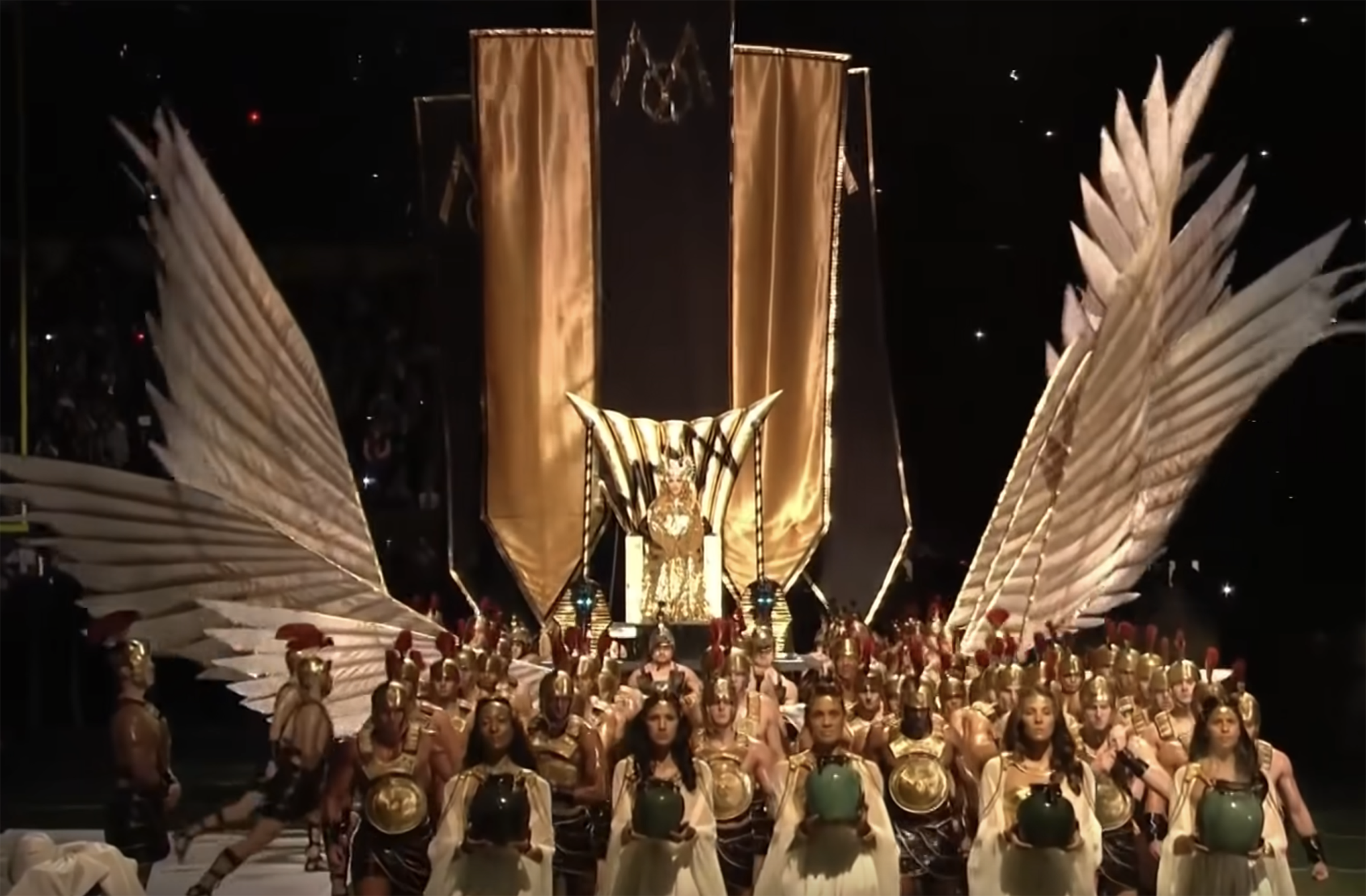
On February 5, 2012, Madonna transformed the Lucas Oil Stadium in Indianapolis into a first-rate pop spectacle for the National Football League’s Super Bowl XLVI Halftime Show. Her halftime performance was the most watched to date, attracting 114 million international viewers during the very first Super Bowl streamed online.Footnote 1 The show’s opening heralded viewers with the familiar wash of shimmering high strings, syncopated percussion, pacing synthesizers, and delicate finger-snapping featured in her hit 1990 song, “Vogue.” The hovering musical arrangement supported a visual spectacle featuring an army of shirtless gladiators and white-robed priestesses accompanying Madonna’s grand entrance perched atop a golden throne (Figure 1Footnote 2). Her layering of visual and musical signifiers allowed four parallel nostalgic narratives to unfold within the show’s first minute as she sang her decades-old hit dressed as Cleopatra, channeled through Elizabeth Taylor’s famous 1963 cinematic performance. Audiences were simultaneously reminded of a mythologized temptress Egyptian pharaoh, a recently deceased Hollywood screen siren and LGBTQIA+ advocate, Madonna’s own tabloid-topping thirty-year career, and—due to the lyrics, dancers, and choreography—the late-twentieth-century underground gay Harlem ball culture that inspired the song. By simultaneously mapping these subversive cultural figures from the past onto a performance designed to confirm her iconicity in the present, Madonna encapsulated what Svetlana Boym has termed “reflective nostalgia,” conveying the desire to “obliterate history and return to private or collective mythology, to revisit time like space, refusing to surrender the irreversibility of time that plagues the human condition.”Footnote 3
Madonna’s Halftime Show Entrance. Screenshot from NFL Super Bowl XLVI on NBC Universal, 2012.

Figure 1 Long description
Panel A: A stage with a large group of performers dressed in ancient Roman-style costumes, including helmets and armor. The performers are arranged in rows, with some holding shields and others holding objects that resemble green orbs. The stage is decorated with giant feathered wings and large banners. Panel B: The same stage and performers, with the focus on the central figure who appears to be a central performer, possibly Madonna, standing on a raised platform with elaborate decorations behind her.
Twenty-first-century discussions about nostalgia insist that it is not just a longing for place, as was its early definition, but for a different time.Footnote 4 Boym writes that:
Nostalgia is not always about the past; it can be retrospective but also prospective. Fantasies of the past determined by the needs of the present have a direct impact on realities of the future. Consideration of our future makes us take responsibility for our nostalgic tales.Footnote 5
In a venue where aging artists typically relived their glory days with medleys of old hits, the then-53-year-old Madonna instead used well-known aural and visual cultural signifiers from the past to extend her legacy into the future: she skillfully interwove “Vogue” and other former hits with performances of new songs and young guest artists during the 2012 halftime show to promote her latest MDNA album, hype her upcoming tour, and demonstrate that she was still the reigning Queen of Pop. Opening the set with “Vogue’s” familiar yet reinterpreted signifiers drew in experienced audiences, while the updated production and addition of newer tracks and cameos later in the show attended to contemporary audiences and expectations.
As “Vogue” reaches its 35th anniversary, this article analyzes Madonna’s performances of the song throughout her career to investigate how she has used it as a site for nostalgic play and as a means to build and perpetuate her legacy. Although it has been commonplace for Madonna to reinvent herself onstage and use signifiers gesturing to the past in her artistic reimagining of popular tracks, “Vogue” continues to be one of her most well-known and most performed songs, making it a frequent site for nostalgic re-creation. The “Vogue” track itself has arguably also been a nostalgic text from its inception due to its conflation of popular culture’s past with the dance-pop sounds of its contemporary moment. Indeed, it was released on a 1990 album (I’m Breathless) inspired by the equally nostalgic film noir-styled movie Dick Tracy, and its black-and-white music video became both iconic and hotly debated for its references to old Hollywood glamour and the underground gay ball culture to which its lyrics alluded. Accordingly, this article examines the original track and video alongside subsequent performances, including Madonna’s renditions at the 1990 MTV Video Music Awards, during her international tours (1990, 1993, 2008, 2016, and 2024), and at the 2012 Super Bowl halftime show.
Foundational scholarship about Madonna’s music videos by Susan McClary, Carla Freccero, and Carol Vernallis, among others, has illuminated how the pop star’s music and performances are loaded—and often overloaded—with complex aural and visual signifiers.Footnote 6 Consequently, within the limited space of this article, I focus only on the “Vogue” texts and signifiers that best reflect the pop star’s nostalgic impulses. My analyses here are framed within two theories of nostalgia. The first is Boym’s concept of “reflective nostalgia,” which I extend to show how Madonna’s various “Vogue” renditions prove “ironic,” “inconclusive,” and “fragmentary” in their various questionings of “truth, human longing, and belonging.”Footnote 7 The second follows Michael D. Dwyer’s more recent theory about how nostalgia can act as a “critical affective response” in the perpetuation of “star legacies.”Footnote 8 His examination of how the cultural memories of iconic figures are extended to include their re-creation in other contexts helps to explain why Madonna uses signifiers of well-known “star texts” to position herself among the “star legacies” of subversive and marginalized cultural icons, and how she uses them to solidify and perpetuate her own.Footnote 9
To support these readings, the pages below combine Boym’s and Dyer’s theories of nostalgia with formative cultural theory on Madonna and her music, as well as close musical and visual analysis, to reveal how and why various “Vogue” renditions are nostalgic in their play with concepts of time—both in terms of teleology (disorienting listeners’ sense of time, place, and space) and in their incorporation of various styles that confuse where the song “belongs” in terms of genre and historical era. Accordingly, this article demonstrates how the track’s seemingly inert qualities support Madonna’s embodiment of various mythologized historical figures to enhance her own “timeless” narrative of being an infinite star: an icon who always was and never ceases to exist. I ultimately argue that Madonna’s reimagining of “Vogue” throughout her career enacts what I call “nostalgic legacy building,” as she struggles against aging and irrelevancy in an industry and larger world that have always marginalized and attempted to contain powerful women. This article contributes to conversations about nostalgia’s roles in popular music performances, revealing how artists can “revisit” musical texts to summon the past in performances aided by present trends and technologies in efforts to seal their infinite futures.
“Vogue’s” Past and Nostalgic Future
Gender, race, and sexuality studies scholars have, since the late 1980s, theorized the many ways Madonna uses marginalized figures in her work to assert her dominance and control and frame her white heteronormativity.Footnote 10 The star has attracted considerable scrutiny for “Vogue” in particular due to her use of marginalized and subaltern figures in the song’s aural referents and music video. Most criticisms reference the documentary Paris is Burning, released in 1991 (shortly after Madonna’s song hit airwaves), which captured the ball house subcultures of voguing performed by drag queens living in New York City during the late 1980s.Footnote 11 Cindy Patton, for example, references the film when writing about the ways that Madonna’s lyrics and video imagery confuse and conflate elements of non-hegemonic gendered, sexual, and racial identities essential to the ball culture from which it was derived.Footnote 12 Patton’s essay is, in fact, one of many in a 1993 collection edited by Cathy Schwitchtenberg that theorize “Vogue” through post-structuralist, feminist, or postmodern lenses. Lisa Henderson critiques Madonna for not crediting the “voguing” practitioners from whom she borrows, while Roseann M. Mandziuk unpacks how the unstable subjectivities of “posturing” Madonna promotes in her video remove authority, politics, and power from social subjects who are never “anchored,” concluding that instead of offering a feminist critique, the star communicates that “a woman’s place is to be sensual, stylish, and self-involved.”Footnote 13 Jack Halberstam and Ira Livingston take these ideas further, extending Judith Butler’s work to explain how Madonna positions herself against the Othered, mainly Black and Latino practitioners of voguing to (re)establish normative performances of “white monied heterosexuality” and “real whiteness.”Footnote 14 They further describe how voguing functions as a subcultural form that, like the other posthuman cultures and bodies discussed in their book, defies rigid structures of historical teleology and “reality,” making it impossible and unproductive to try to define the practice’s “origins” or to locate what is “real.”Footnote 15
Despite these criticisms, Madonna has always considered herself an ally of queer communities, and a considerable portion of her fanbase consists of gay, lesbian, trans, non-binary, and other queer-identifying communities. She, in fact, lost many friends and colleagues whom she met in New York City to the 1980s AIDS epidemic and often references these profound losses in her music, videos, and performances.Footnote 16 In addition to hiring a producer familiar with voguing culture, Shep Pettibone, Madonna also enlisted dancers from prominent ball houses, including two from the House of Xtravaganza (Jose Gutierez and Luis Camacho), to perform in her 1990 “Vogue” video, tour, and VMA performance. Her proximity to queer communities in New York (many of which were white and male) thus likely made her a sincere admirer of voguing culture. However, as critics point out, her appropriation of it raises many concerns, including the fact that she fails to distinguish or acknowledge the social, economic, and political inequities within queer communities themselves as experienced by non-white, non-male, non-gender-conforming, non-youth, and non-binary subcultures.Footnote 17 As such, Jack Halberstam cites work by Marco Becquer and Jose Gatti to illuminate the realities faced by ball house members after voguing gained mainstream visibility: the fortune and fame sought after by gay Puerto Rican and Black practitioners were not bestowed upon them but on Madonna and Livingston while they “faded back into sex work, HIV,” and, for some, an early death.Footnote 18
In the three and a half decades since the song’s release and the thirty years since the above criticisms were penned, Madonna has continued to re-envision the song’s aural and visual signifiers to suit her changing styles and performance agendas. The pages that follow thus redirect these formative discussions through the lens of nostalgia. In particular, I illustrate how her use of the song to define herself through conflation and reinvention, assert her control and authority, and constant efforts to ahistorically reframe it fall neatly within Boym’s definitions of reflective nostalgia. The examples below reveal how Madonna has deployed aural and visual tropes that “explor[e] ways of inhabiting many places at once” in an attempt to define her own versions of “truth, human longing, and belonging.”Footnote 19 Put simply, the following pages examine how Madonna’s nostalgic performances have appropriated and redirected the act of voguing by 1980s drag queens who sought to find fame in, acceptance by, and transcendence from the oppressive structures around them to her own efforts to confirm her enduring place as a female music icon within the fickle and often-ageist and misogynist world of the music industry.
Hearing “Vogue” as a Nostalgic Track
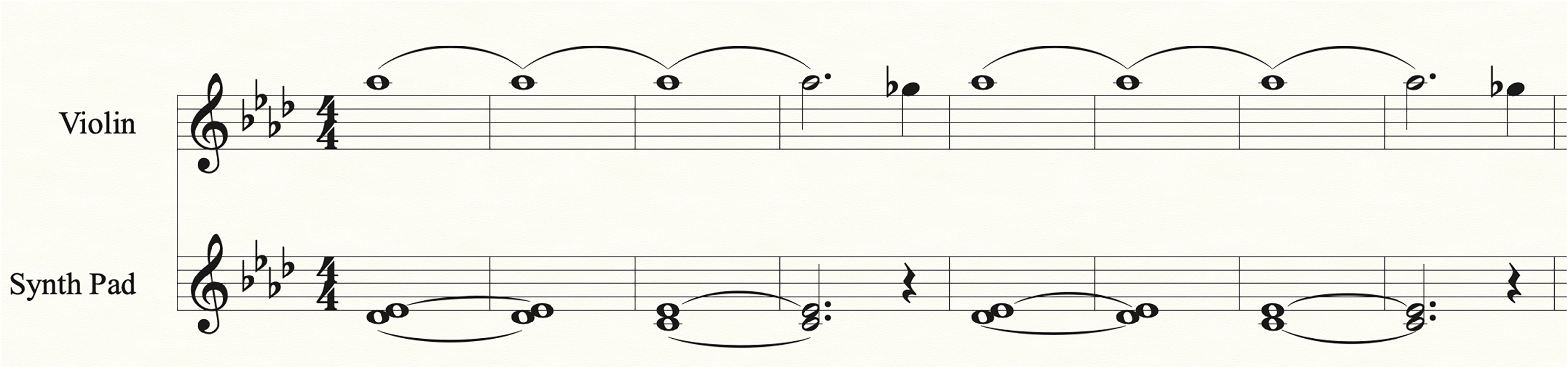
The opening bars to the 1990 track draw listeners in. Sampled violins play a unison high a♭ with subtle vibrato-like oscillations (Example 1).Footnote 20 Other than the brief, anticipatory move down to g♭ on the fourth beat of every fourth measure, the violins establish no sense of tempo and little teleological melodic motion. The static strings instead function outside the bounds of goal-oriented time and hover above it. Below them, barely audible synthesizer chords enter sluggishly in each measure. They only alter by one note, moving the d♭ down a half step to c to occasionally relieve the aural tension and reconfirm the tonic A♭ major chord. The slow oscillation between neighboring pitches in the synthesizer (and in the other electronic sounds that enter later) offers the only real harmonic motion in the track’s entire first minute.
“Vogue” opening measures.

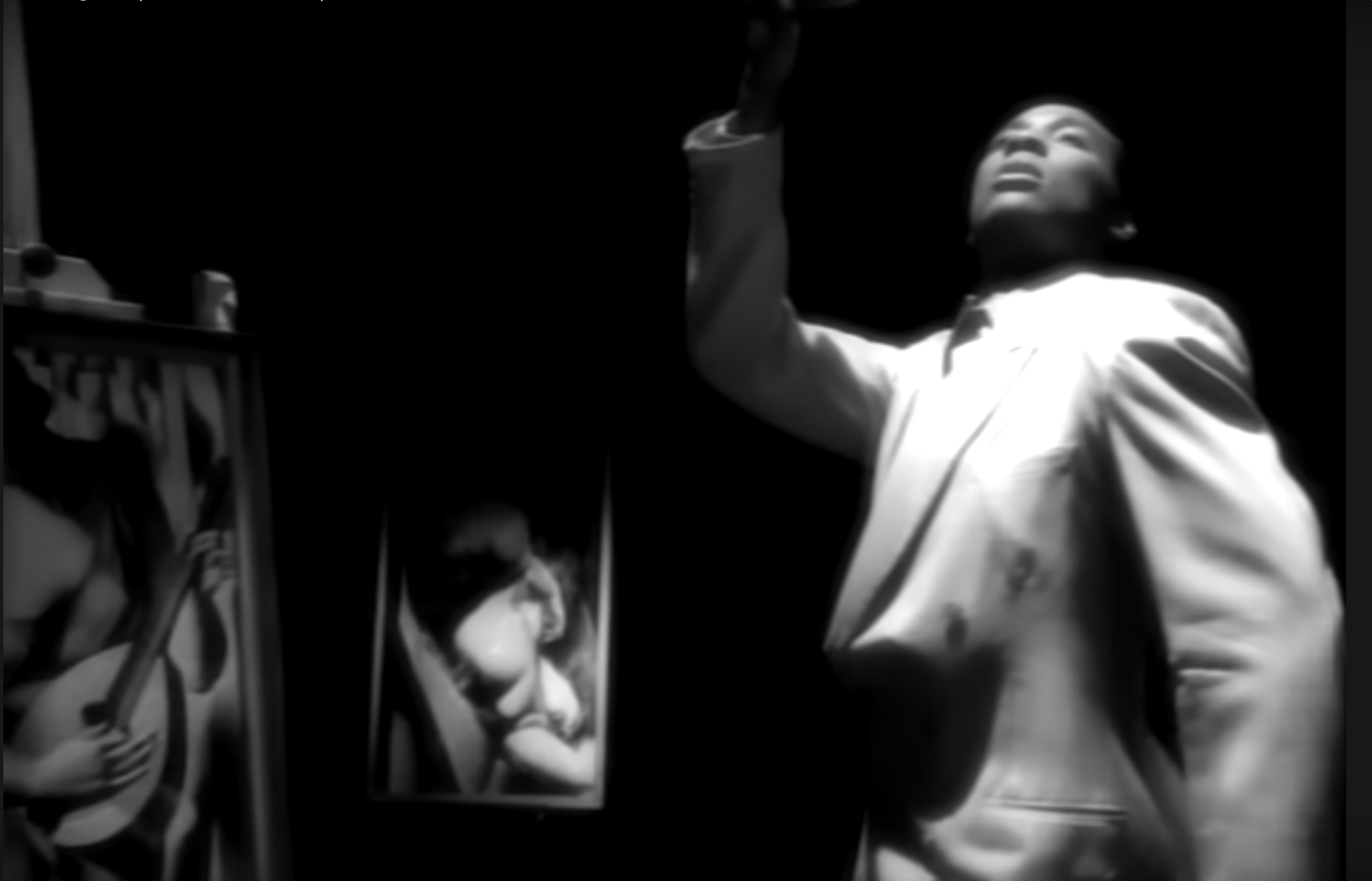
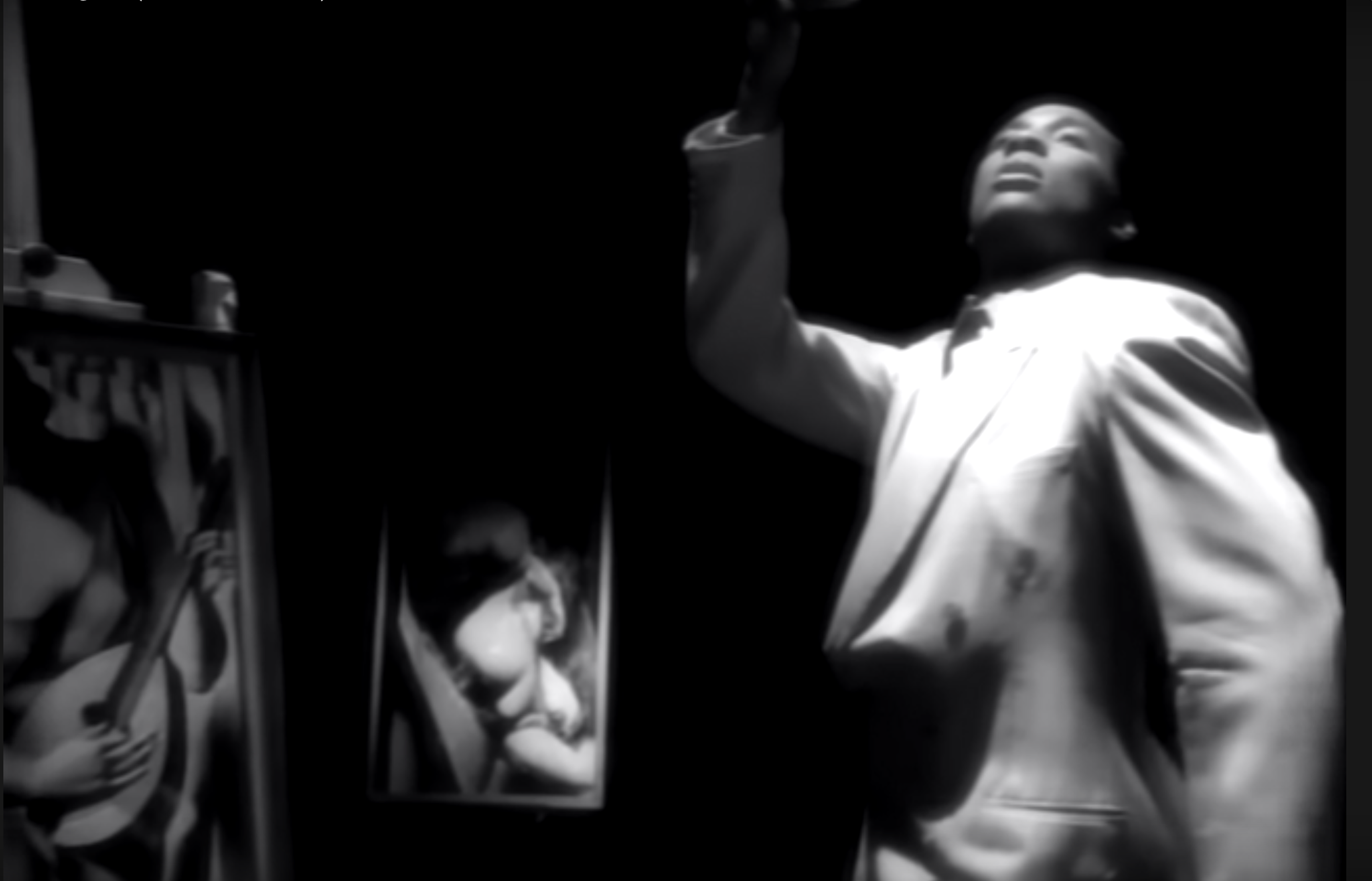
The soft-focus, black-and-white 1990 music video replicates this stillness as the opening shots pan across sharply dressed men and women posed motionless beside marble statues and paintings (Figure 2 Footnote 21). This nostalgic film noir look gestures to 1930s Hollywood sets and backdrops.Footnote 22 These images reinforce “Vogue’s” static musical introduction, visualizing how the track’s first measures can be hypnotic in their ability to focus listeners’ attention and transport them into Madonna’s fantasy. Because the song does not establish any immediately discernable meter, melody, or harmonic motion in the opening passage, it avoids a perceptible sense of time and teleology, aurally preparing listeners for Madonna’s nostalgic reflections.
The music video opens with sharply dressed dancers frozen in poses that emulate high art forms. Screenshot from “Vogue,” 1990.
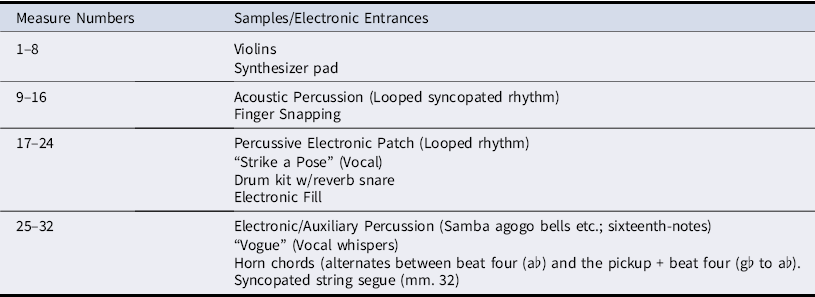
The following bars invite listeners to participate. As Patton and others discuss at length, the body and dancing were central to the original ballroom culture of voguing and to Madonna’s track.Footnote 23 “Vogue’s” primary goal was therefore to inspire listeners to move. Shep Pettibone, the song’s producer, honored Madonna’s request to make the song sound like his own ballroom track—“Ooh I Love It (Love Break)” (1982)—by incrementally introducing rich percussive and electronic timbres and playing with the sonic space.Footnote 24 The increasing textures and movement around the soundbox therefore work to slowly awaken the senses and listener’s bodies from the dreamlike atmosphere established in the opening measures (Table 1). The music video supports this shift with close-ups of the jeweled halter strings dangling between Madonna’s bare shoulder blades as she slowly rolls them in anticipation of striking her first “pose.” At this point, new timbral sounds playing cyclic rhythms are introduced at the front of the soundbox every eight measures and then rotated to the back (Table 1). In the video, the camera cuts here between Madonna, the now-animated movements of the suited men and women in the gallery, and the movements of a young butler and maid tidying up. The main connections between the three opening scenes and characters—the pop icon’s solitary void, the art gallery, and the (presumed) mansion’s passageways—are the black and white costuming, gestures towards class and wealth, and movements of the deadpan-faced occupants within them. Pettibone’s track further entices listeners to move with aural representations of the body (mm. 9–16), which include delicate finger snapping and Madonna’s vocal directive to “Strike a Pose.” When the dance beat finally establishes itself, disorienting whispers of the hook swirl around the soundbox to summon listeners deeper into the track. The song’s gradual increases in texture slowly build a sense of pulse that, after a full minute, finally climax into the A♭ Mixolydian verse. “Vogue’s” introductory measures thus create a space for nostalgic reflection by encouraging listeners to pause; engulfing and disorienting their sense of time, place, and space; seducing them with its rich textures; and inviting their bodies to participate.
“Vogue” opening timbres

The track’s larger design reveals more of its nostalgic tendencies, specifically its fragmentation and conflation of musical tropes that signify the past and the 1990s present. The classical-sounding strings conjure associations with multiple genres, including Western art music, the classical Hollywood film score, and 1970s disco, while the updated production and electronic sounds squarely place “Vogue” in its technological present. According to Pettibone, the song’s title reflected a fad (voguing) that had gone out of style, yet the concept of voguing was brand new to most of the mainstream listeners who heard Madonna’s track for the first time.Footnote 25 Madonna seems to play with the temporality of her own vocality here as well, switching between the lower range, chest voice typically heard in later, more serious tracks like “Live to Tell” (1986) and “Like a Prayer” (1989), and the often-ironic, nasally, and girlish higher-pitched vowels and consonants featured in earlier works, such as “Lucky Star” (1983). The pop star’s non-stylized, monotone “rap” in the song’s bridge also conveys contrasting signifiers by loosely suggesting the growing popularity of the Black hip hop scene with the non-melodic rhyme scheme, while naming 1920s through 1960s white, Golden Age of Hollywood celebrities and athletes (“Greta Garbo and Monroe/Deitrick and DiMaggio”). Despite the fact that the track introduces mainstream audiences to elements of recent underground deep house and hip hop sounds, its naming of past stars, and voguing and disco inspirations are (even by 1990) considered dated practices.Footnote 26 This conflation of styles and eras throughout the track therefore makes “Vogue” a convincing example of reflective nostalgia, as its often perplexing juxtaposition of past and present sonic signifiers proves variously “ironic,” “inconclusive,” and “fragmentary.”Footnote 27 As the pages below illustrate, Madonna continues to extend and revise these signifiers in future performances to further absorb voguing culture and the iconic stars she sings about into her oeuvre.
“Vogue” Iterations and Reflective Nostalgias
By all accounts, “Vogue” was immensely successful, selling 2 million copies in the first two months.Footnote 28 According to Patton, its popularity was aided by the marketing strategy for the video on MTV, which promoted the dance as both new and historical—a concept she notes is expertly mirrored in its postmodern visual iconography.Footnote 29 Despite achieving instant success in its original iteration, Madonna has remixed, extracted, and rearranged “Vogue’s” musical track for almost every subsequent performance. Most added sonic signifiers that simultaneously worked to nostalgically remember “Vogue” as a classic text and update it to fit the pop star’s evolving aesthetics and agendas. In addition to remixing it for compilation albums like the Immaculate Collection (1990), Celebration (2009), Finally Enough Love: 50 Number Ones (2022), etc.—all of which are nostalgic texts in themselves—Madonna has interwoven it within newer songs to create novel arrangements. In other instances, “Vogue” generally sounded like the original but added a gloss of new production to emphasize the innovative visual contexts she created onstage.
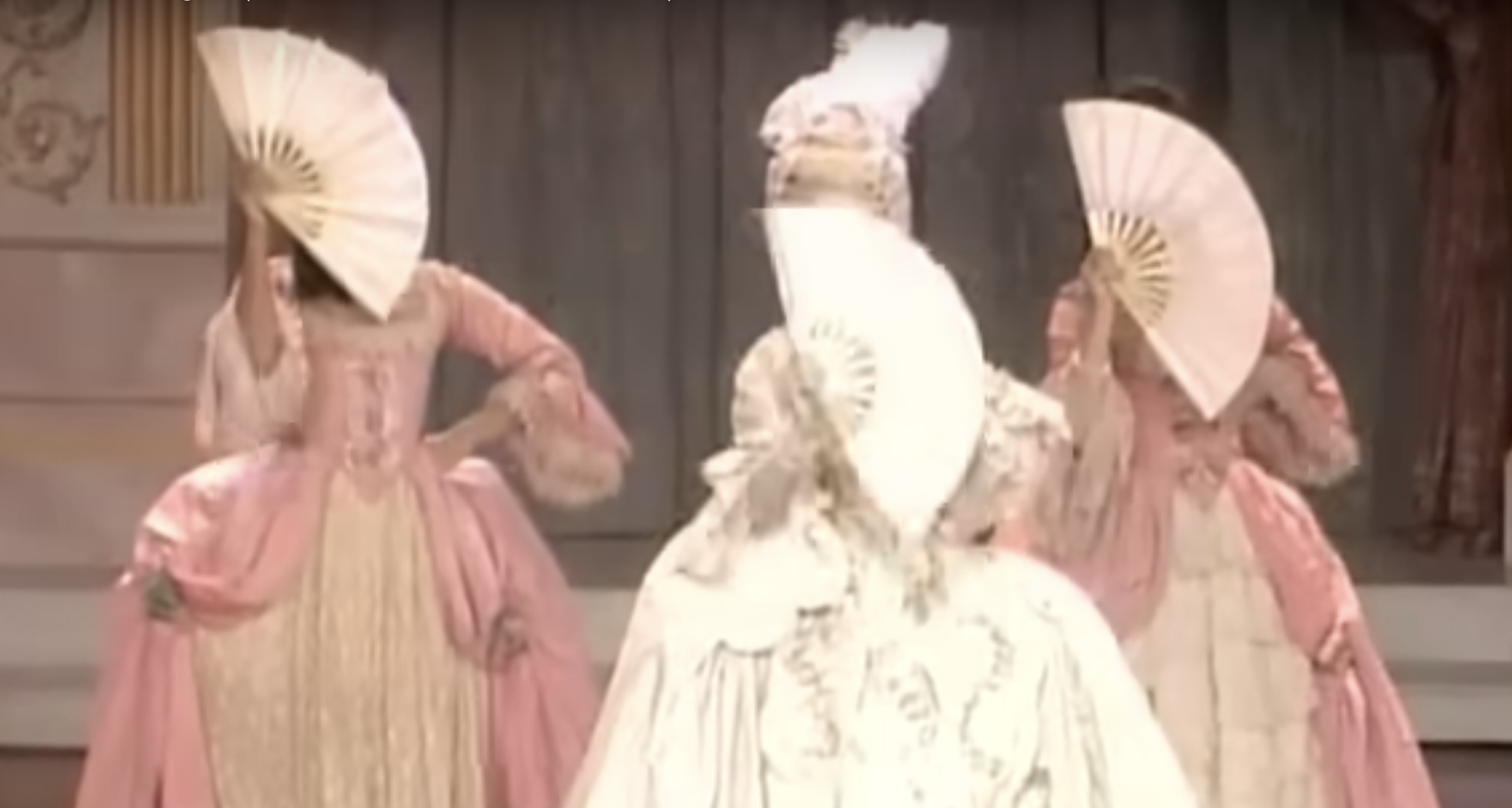
During the 1990 MTV Video Music Awards, Madonna famously set “Vogue” to a re-envisioned version of Queen Marie Antoinette’s late eighteenth-century Parisian court. Sex and sexuality were on display, as evidenced in the male dancers’ short shorts and suggestive choreography throughout. “Vogue’s” musical track remained largely intact except for the addition of sonic emphases on key choreographed moments, especially during the introductory measures (mm. 25–32 in Table 1). This included foley on the downbeats when Madonna and her ladies-in-waiting flicked open their fans (Figure 3 Footnote 30). The a♭ and g♭ electronic horn chords (noted in mm. 25–32 of Table 1) were amplified here as well to highlight specific poses and accentuate the moments of tension and release initially created by the violins’ whole-step oscillations (Example 1). Madonna’s revisionist historical setting and performance here worked to suggest that bodily and sexual freedom had always been in style—that is, “in vogue”—providing a means for her to insert her song and iconicity into the mythology of Antoinette and her infamously rumored self-indulgent lifestyle (a concept discussed further below).Footnote 31
Foley fan sounds were added to emphasize the choreography and setting in Marie Antoinette’s eighteenth-century Parisian court. Screenshot from the 1990 MTV Video Music Awards.

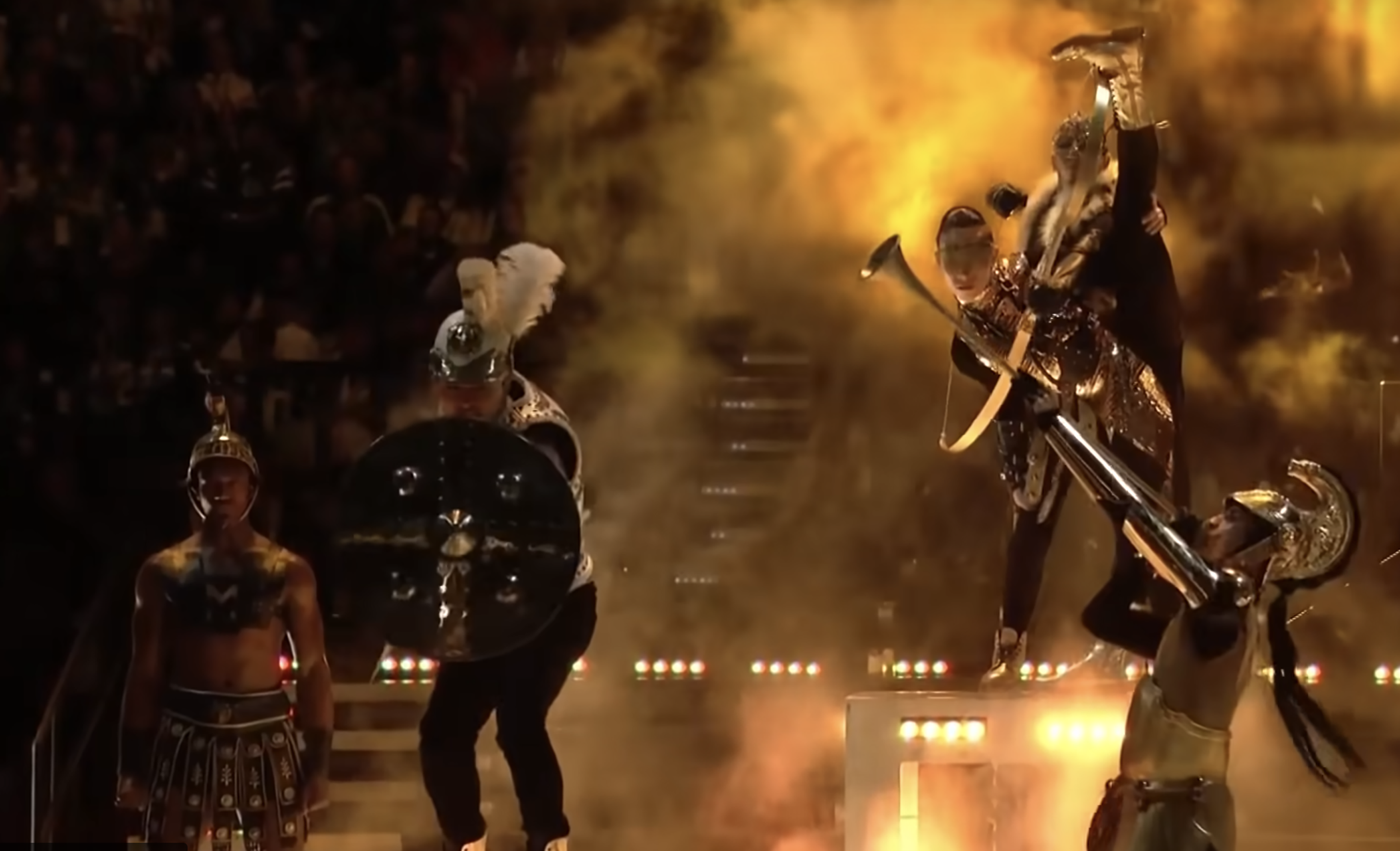
Twenty-two years later, Madonna added similar sonic emphases to “Vogue’s” introductory measures during the opening number for her 2012 Super Bowl halftime show (referenced above). In addition to the back-spinning placed on phrases spliced into the introduction from the rap section (“ladies” and “don’t just stand there”), sword, harp, and other electronic foley and sounds were expertly woven into the harmonic palette to highlight Madonna’s recreation of classic Hollywood’s re-imagining of ancient Egypt.Footnote 32 The sonic emphases created by synthesized trumpets were again amplified here (similar to the VMA track). The crisp horn hits were visualized by the angular poses made by male acrobats dressed in re-stylized Egyptian and Roman garb. The production’s overall campy display combined with the dancers’ distinct choreography to nod obviously to the song’s underground ball culture roots as their “perfect lines” realized the aims of voguing’s early practitioners who desired to emulate “ancient Egyptian hieroglyphics” (Figure 4Footnote 33).Footnote 34
Poses with perfect lines, such as the acrobat in the standing splits, were aurally punctuated by electronic horn chords. Screenshot from the 2012 Super Bowl Halftime Show on NBC Universal.

Figure 4 Long description
Panel A: An acrobat dressed in Egyptian and Roman-inspired garb performs a standing split on stage. The acrobat is positioned with one leg extended upwards and the other downwards, creating a perfect line. The background features smoke and bright lights, enhancing the dramatic effect. Panel B: Another acrobat, also dressed in similar garb, balances on one hand while holding a sword. The acrobat's pose is angular and precise, emphasizing the crisp horn hits and electronic foley sounds. Panel C: A group of acrobats perform synchronized movements on stage. They are dressed in re-stylized Egyptian and Roman costumes, and their poses are angular and precise, highlighting the sonic emphases created by synthesized trumpets and other electronic sounds.
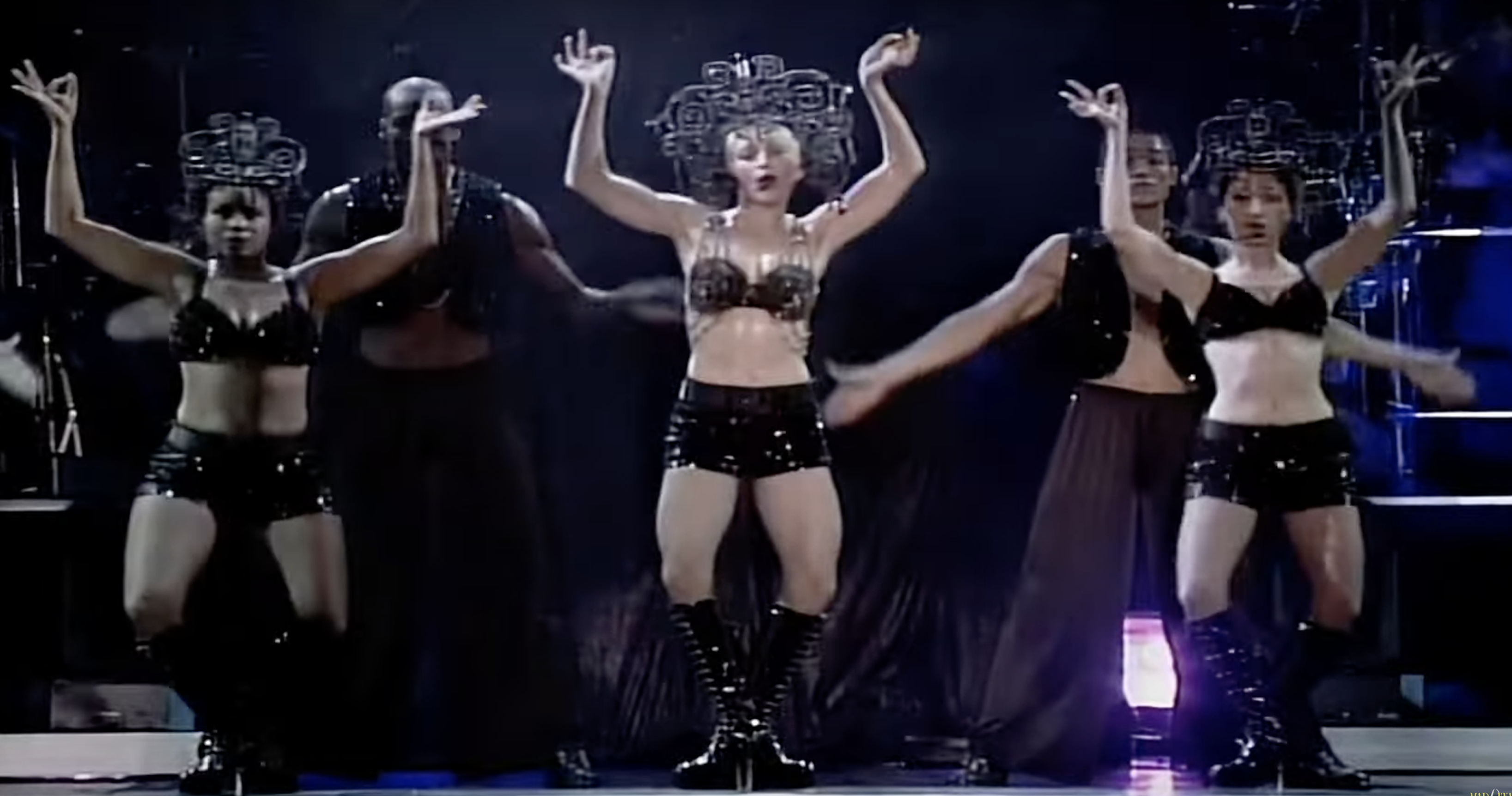
Madonna revised “Vogue’s” musical track more substantially during her international tours. For example, in her 1993 Girlie Show performances, rhythmically cyclical, vaguely Eastern sounding percussion and bells were added to place the song in one of Mata Hari’s legendary “exotic” Parisian shows. For this performance, Madonna and her dancers wore black bikini tops and shorts with elaborate bejeweled headdresses and created poses referencing the Indian and Indonesian dances from which Mata Hari claimed to draw inspiration (Figure 5 Footnote 35).Footnote 36 The new backing track introduced a low, syncopated bass riff that oscillated between the fourth, fifth, and seventh degrees of the a♭ mixolydian tune (d♭, e♭, and g♭) and added rhythmic clapping in groups of seven at the ends of certain phrases. To ensure audiences recognized the tune, the track preserved “Vogue’s” original key, suspended violin line, and sluggish opening chords. In blending the hit track with Eastern influences and making visual references to the Dutch icon, who performed (what she claimed to be) Indian and Indonesian “cultural” dances in Paris and other European cities in the early twentieth century, Madonna once again suggested “Vogue’s” timelessness and relevance throughout history and across the globe.Footnote 37
“Vogue” takes on Eastern influences to emulate Mata Hari’s infamous salon performances. Screenshot from The Girlie Show tour video, 1993.

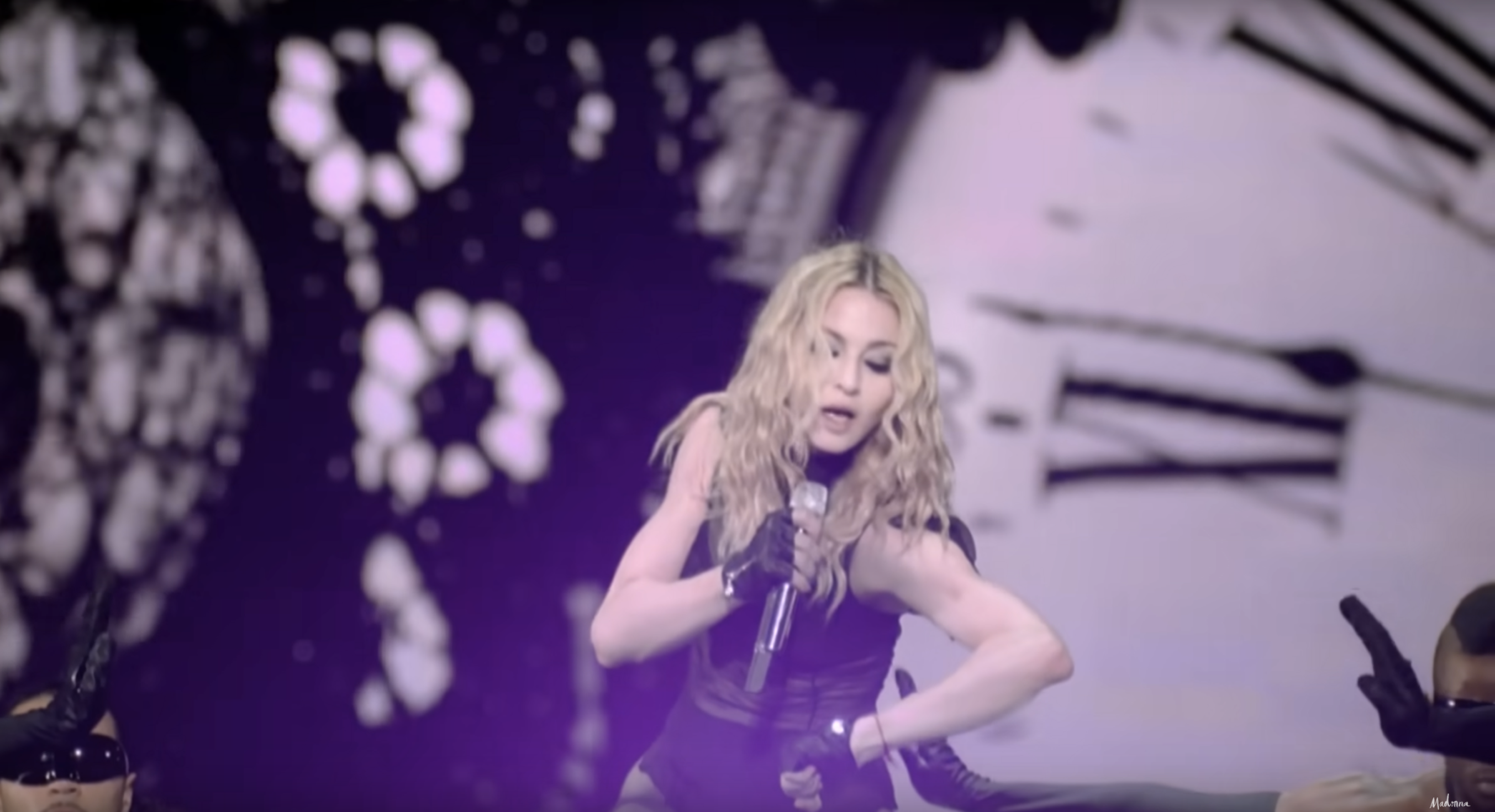
Audiences heard another musical reinterpretation during the 2008 Sticky and Sweet tour, when “Vogue’s” lyrics were overlaid atop the backing track to Madonna’s then-hit single, “4-minutes.” Recorded as a duet with Justin Timberlake, the album version urged people to release their inhibitions and love freely in the face of an apocalyptic countdown. The onstage aural mash-up between “4-minutes” and “Vogue” worked well because, in addition to both being dance tracks, their core messages focused on the body as the vehicle for achieving personal freedom and happiness. The combination of these tracks became an obvious site for nostalgic play with the idea of time itself, as the mashup referenced the apocalyptic vision in Madonna’s current single while also paying homage to an iconic song from her past.
Madonna opened the set singing the “tick tock” refrain from “4-minutes,” repeating it several times while pausing to look at her wrist while giant clocks flashed onscreen behind her (Figure 6 Footnote 38). The entrance of “Vogue’s” introductory bars revealed a new key area for this version—g-minor—adjusting the tune downwards from the A♭ mixolydian original to fit the “4-minutes” backing track. The electronic horn chords amplified for the 1990 VMA performance were also revised here and extended throughout the verses as a two-bar riff that emphasized the frequent poses made by dancers dressed in nude and black bondage costuming (see mm. 25–32 in Table 1). Madonna’s musical past and present were perhaps most obviously conflated during the chorus, when Pettibone’s 1990s production dropped out and Timbaland’s contemporary percussion loop and low, synthesized “4-minutes” riff took over. During a repetition of the chorus, ticking clock sounds interjected after the phrases “Vogue” and “you know you can do it.” These teleological breaks in, and from, “Vogue’s” track were followed with a pre-recording of the star (again) singing the “tick-tock” refrain and Timberlake responding with a rhythmic recitation of her name. Madonna concluded by reciting the “Vogue” rap over the “4-minutes” percussion loop and singing the ensuing chorus over a seamless interweaving of elements from both tracks. As a collision of past and present to suggest a better future—one where people can dance and love freely—this reimagining of “Vogue” perhaps provided the most direct example of how the principles of reflective nostalgia can be realized within a pop music performance, as it dealt directly with the concept of time itself.Footnote 39
Madonna performs a mashup of “Vogue” and “4-minutes,” conflating the fleeting nature of bodily pleasure (posing, dancing, and sexual intimacy) with time itself. Screenshot from the Sticky and Sweet Tour video, 2008–2009.

Madonna revised “Vogue” most significantly during her Rebel Heart tour (2015–2016). In a set that surely would have upset the Vatican even more than her 1989 video for “Like a Prayer,” she added “Vogue’s” lyrics into a pole dancing routine for her recent song “Holy Water,” whose hook is a metaphor for female ejaculation.Footnote 40 Dressed as a provocative reimagining of Mother Superior, Madonna began “Vogue” while standing in high heels on a barely dressed dancer in a habit who spun horizontally on the pole below her. Madonna introduced the track by highlighting the all-female ensemble onstage, segueing from “Holy Water’s” refrain (“Bitch, get off my pole”) to the final verse of the “Vogue” rap (“Ladies with an attitude”). Only a small section of the former hit was adapted into the newer song, and it was transposed to fit into “Holy Water’s” F-Dorian mode. This performance differs most obviously from the others due to its adoption of the newer song’s languishing tempo and deep house, low syncopated bass line—musical alterations that changed the classic text from an energetic four-on-the-floor dance track to a slow and sensual siren song. The song’s imagery was also revised to fit the irreverent religious images onstage, which included mapping Catholic iconography onto revealing costuming, acts of bondage and oral sex, portrayals of sexual and gender fluidity, and prayer hand poses.
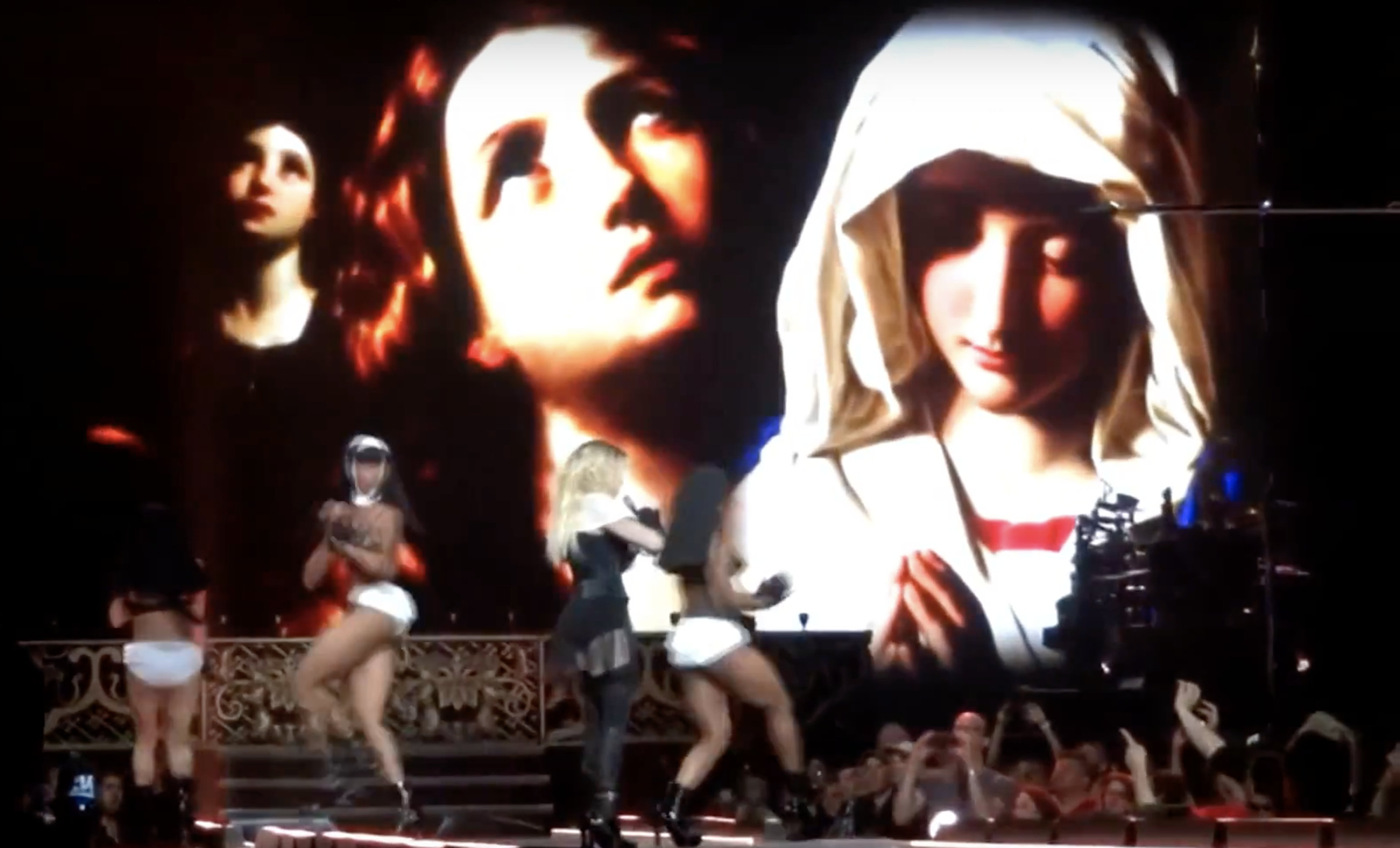
During the naming of the Hollywood icons revered in “Vogue’s” lyrics, famous seventeenth-century paintings of religious figures were projected onscreen. Per usual, Madonna used these images to play with the Catholic origins of her given name and tensions between her professed faith and “boy toy” reputation.Footnote 41 Specifically, she projected images of three biblical Marys—likely alluding to the story of the women present at Christ’s crucifixion—while repeating, “ladies with an attitude” (Figure 7Footnote 42, Footnote 43). Among the layers of symbolism conveyed here, audiences in the know could read that the images of Jesus’s mother Mary and Mary Magdalene represented the virgin/whore dichotomy with which the pop star constantly flirted. The imagery also served as a reminder that it was the women who kept their faith after the crucifixion when Christ’s male disciples had lost it.
Three Marys appear behind Madonna “praying” with her “nuns.” Screenshot from Rebel Heart Tour video, 2015-2016.

This performance equated “Vogue’s” worship of celebrity culture, beauty, and sexual freedom to the complexities of Madonna’s own religious devotion.Footnote 44 In her ahistorical remaking of the track’s music and imagery—1990s lyrics over the production of a 2015 song, against the backdrop of seventeenth-century paintings—she once again made “Vogue” and her own iconicity appear simultaneously out of time and timeless. Madonna further complicated this nostalgic revisiting and remaking of the past in the final minutes of her set with an abrupt transition to a harpsichord and a multi-part, high-register, church-like choral recitation of the hook to “Holy Water” as she and her dancers enacted a sensual re-creation of Leonardo Da Vinci’s painting of The Last Supper (1494–1498).
“Vogue’s” Nostalgic Legacy Building
Before “Vogue” entices listeners to dance, it invites our gaze precisely by questioning it with a hushed, accusatory growl: “What are you looking at?” Madonna’s antagonistic tone here references the definition of voguing described in Paris is Burning as “a safe form of throwing shade,” a way to “dance a fight.”Footnote 45 Of course, the act of voguing and the song itself also allude to the high-fashion magazine of the same name that features models primped and styled to unattainable perfection. The “look” (sartorial style) of vogue practitioners—and the act of looking at them—is therefore as important as the poses themselves in both the ballroom and Madonna’s “Vogue” texts.
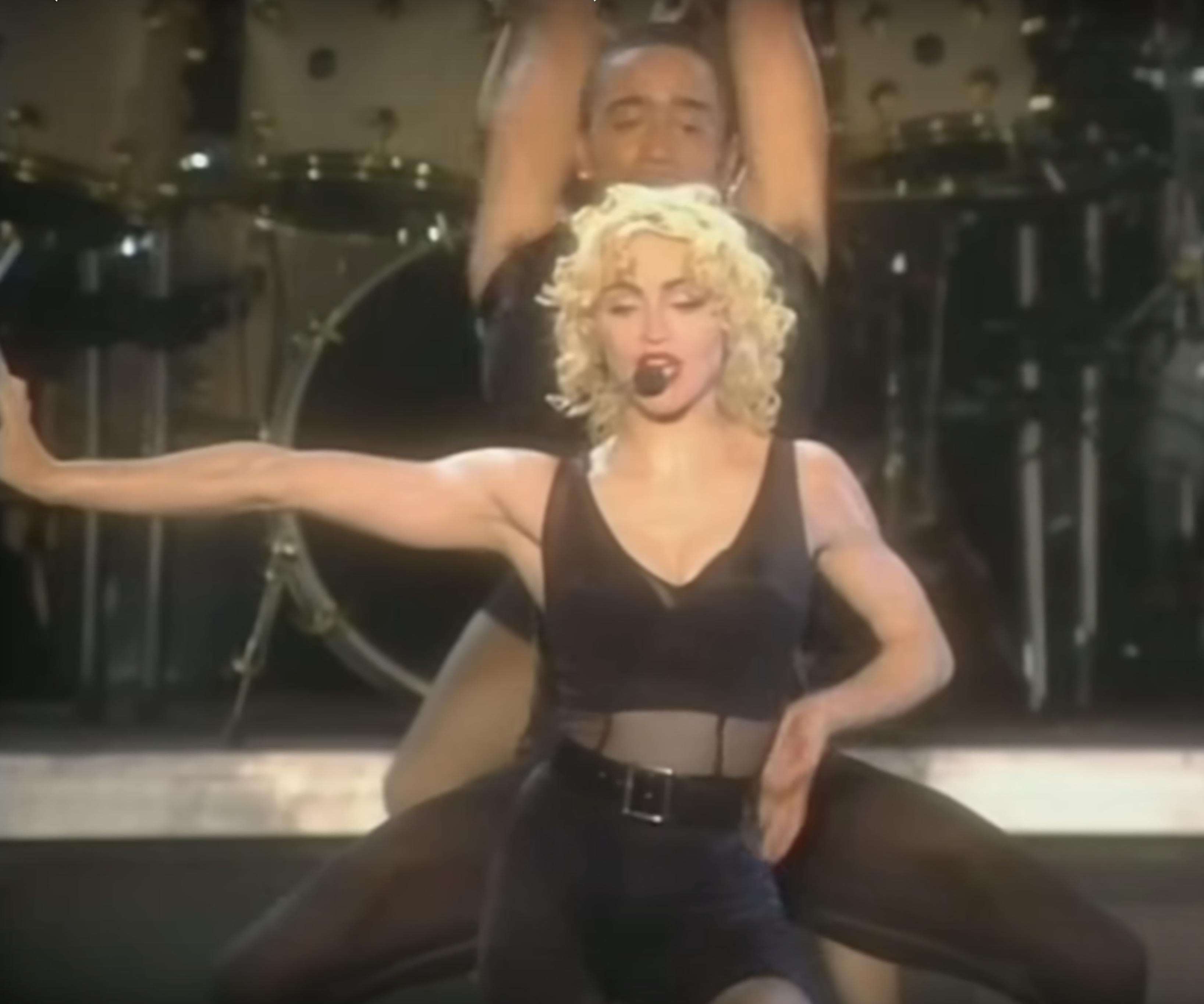
When the song was released, the star was in her early 30s, in peak physical condition, and able to embody the beauty and style venerated by voguing and her lyrics. Accordingly, in her music video and Blonde Ambition tour (1990), she is adorned with eye-catching, fashion-forward, and form-fitting clothing. Her youthful face and trim body are clearly the center of attention (Figure 8 Footnote 46). However, as described in the analyses above, Madonna’s later performances redirected viewers’ attention to the re-envisioned meanings created by new musical or staged settings. In addition to the artistic merits of these changes—expected from the self-proclaimed “Queen of Reinvention”—her embodiment of, and references to, historical figures can be read along the same lines as Michael D. Dwyer’s investigation of nostalgic re-creations of 1950s “star texts” featured in 1970s and ‘80s popular music and films—texts that he identifies as “critical affective responses.” His investigation of how particular “star legacies” were depicted in these texts complements Boym’s concept of reflective nostalgia as he too finds certain nostalgic reimaginings ahistorical in their play with cultural signifiers, chronology, and time. He argues:
Nostalgic longing, in other words, can be used in efforts to remake the present, or at least to imagine corrective alternatives to it. It is important to draw the distinction between retro as a representational mode and nostalgia as a critical affective response because this forces us to confront the contingencies that shape our ever-changing responses to texts: history, culture, politics, intertextual networks, even our subjectivity.Footnote 47
Madonna’s fitness on display during “Vogue.” Screenshot from the Blonde Ambition Tour video.

He further acknowledges this form of nostalgia as “the product of an affective engagement with the present that produces a sense of loss.”Footnote 48 By taking a closer look at the sets, costuming, and characterizations that Madonna and her dancers have assumed, Dwyer’s theory illuminates the possible meanings (intentional or not) of the “critical affective responses” that can be read from the star’s “ever-changing” performances of “Vogue.”
Madonna’s motivations for re-presenting herself and her hit song in the ways discussed above might be best understood through her biography and public discussions about the lack of support and mistreatment she has endured throughout her career. In a 2015 interview with Out Magazine, she admitted to being bothered that her years of challenging the status quo had made little progress, proclaiming that “the last great frontier” for civil rights would be women’s rights.Footnote 49 The following year at the 2016 Women in Music Billboard awards, she focused her acceptance speech for “Woman of the Year” on her difficult path to finding acceptance in the music industry and from the global media—first as a young star, and then as an aging woman thirty-four years into her career. Her speech addressed the “blatant misogyny, sexism, constant bullying, and relentless abuse” she had encountered, including sexual assault, accusations of not being a “good” feminist, and the many times she had been scorned for publicly expressing her sexual desires.Footnote 50 The pop star painfully recounted when she realized “women really did not have the same freedom as men,” just after releasing her Erotica album (1992), and recited the subtextual warnings she had been given for decades: “do not age…to age is a sin.”Footnote 51 Her speech concluded by addressing claims about being too controversial, to which she responded, “The most controversial thing I have ever done is to stick around.”Footnote 52
Indeed, the star’s refusal to concede the pop music spotlight, as well as her efforts to remain an icon of “self-liberation” and “sexual expressiveness,” have become prevalent topics in the mainstream press and academic scholarship.Footnote 53 Madonna’s struggles against ageism and misogyny occupy multiple chapters in a collection about aging women in the music industry. The book explores how women have attempted to preserve their careers, either through “renewal” that requires them to “renegotiate[e] their performance strategies,” or by deploying nostalgia to allow them “to operate in a different discursive space.”Footnote 54 Lucy O’Brien’s chapter theorizes Madonna’s performances through the strategy of renewal and examines her music through three phases she labels as: “maiden, mother, or crone.”Footnote 55 O’Brien unpacks the many ways the star plays into or attempts to subvert the “Californication” ideologies of youth and beauty valorized by the modern pop music industry—ideologies that she, ironically, helped to create during her early-MTV years.Footnote 56 Another chapter about Madonna by Paul Watson and Diane Rialton studies her through the discursive spaces she crafts in her early-2000s music videos, discussing how the star “challenge[s] cultural norms of ageing female sexuality” by positioning herself amongst younger stars and styles, while at the same time using costuming and video editing techniques to obscure any visible signs of aging to her skin or physical stamina.Footnote 57
In light of this scholarship, Madonna’s own words, and decades of damning media headlines that have berated the star for asserting her bodily autonomy and agency—and in recent years for undergoing suspected cosmetic procedures and continuing to perform despite her age—the rationale for the strategies she has used in her “Vogue” re-creations takes shape. She specifically chose to reference Marie Antoinette, Pharaoh Cleopatra, Elizabeth Taylor, Mary Magdalene, and Mata Hari because, much like herself, each of these women was a subversive icon whose body became central to their shared cultural memory: they are remembered for their beauty but scorned for asserting agency over their lifestyles, bodies, and desires. Indeed, despite Cleopatra’s rule as a highly intelligent and successful leader, she is best remembered as a seductress and for her death by poisoning. Mary Magdalene’s reputation as a prostitute often overshadows her faithfulness to, and forgiveness by, Christ. Queen Marie Antoinette is cited primarily for her indulgences—many of which were rumored and exaggerated—that eventually sent her to the guillotine and helped end the French monarchy. Mata Hari’s independent lifestyle as a courtesan for powerful international leaders led to rumors of her working as a double agent and resulted in her death by a firing squad. Elizabeth Taylor’s multiple marriages and divorces made her a source of tabloid ire despite her profound success as an actress and work as an AIDS activist and LGBTQIA+ ally. By placing these women’s “star texts” within her “Vogue” performances (along with the similarly scandalized Hollywood stars she cites in the lyrics), Madonna was thus able to celebrate and valorize their “star legacies,” creating the kind of nostalgic texts that Dwyer would call “critical affective responses” in their “imagin[ing of] corrective alternatives” to the historical mistreatment of these and other powerful women, like herself. These performances might then be understood as nostalgic efforts to remake the perpetual trope of judging and punishing women who exercise personal and bodily agency, or worse, dare to age in the public eye.
The 2012 Super Bowl performance mentioned at the beginning of this article offered perhaps the most compelling example of this as Madonna’s globally-broadcast performance not only crafted a poignant critical affective response, but also followed the practices of reflective nostalgia posited by Boym in its evocation of “the past [to] open up a multitude of potentialities, [and] nonteleological possibilities of historic development.”Footnote 58 In addition to the pressures of asserting her cultural relevance as a woman pop star during an event saturated with aggressive hetero-masculine, nationalist, and militarist messaging, and facing relentless criticisms about her dancing skills, recent injuries, and age, Madonna was remembering the relatively recent loss of her friend and fellow AIDS prevention advocate and gay icon, Elizabeth Taylor.Footnote 59 Madonna’s choice to embody Queen Cleopatra channeled through Taylor’s famous 1963 portrayal of her during “Vogue,” therefore allowed the pop star to draw strength from both women’s legacies by channeling their once-vibrant beauty, iconicity, and power. Her use of the “Vogue” track, chiseled male dancers, and other sonic and visual allusions to ball culture (discussed above) also brought memories of the original voguing drag queens—some of whom died from violence or AIDS—back to life on the Super Bowl field.Footnote 60 Madonna’s re-creation of these various star legacies was therefore mutually beneficial: she did not just become a part of these subversive figures’ cultural memory, but in deploying their signifiers on what has been dubbed “the world’s biggest stage” (the Super Bowl broadcast), they also became a part of hers.Footnote 61
Madonna’s Super Bowl “Vogue”—like the versions that came before and after it—thus became an obvious site for what I call “nostalgic legacy building” due to the fact that her performative evocation of these cultural icons allowed her to position her star status among theirs and assert her right to be regarded as equally impactful, memorable, and timeless. I would further argue that this particular display of nostalgic legacy building proved exemplary of the ways in which Madonna has used the track to re-establish control of her celebrity reputation, not only due to its dense layering of nostalgic signifiers, but also because it reached the largest-ever global viewing audience to date.Footnote 62 The halftime show might then be read as a response to Madonna’s perceived loss of time—in fighting for women’s rights, against aging, for her career, and lost friends—and efforts to reclaim it. Indeed, Madonna “revisit[ed] time like space” here as she portrayed multiple concepts of “queen”—past, present, and future; Pharaoh, screen siren, ball house member, and pop star—asserting her rule over the football field and broadcast.Footnote 63
“Vogue’s” original track and influences from ballroom culture support my nostalgic readings here as Mandziuk reminds us about the postmodern promises offered by the act of voguing and the song’s lyrics, which recommend “the dance floor” as a place to escape from the “heartache” and “pain of life that you know.”Footnote 64 Mandziuk continues her analysis, saying,
…for those who strike a pose, regardless of gender or race, the reward will be elevation to the “superstar” identities of their choice…the enticements of voguing rest in the ability to enter and leave the fantasy of multiple subjectivities at will…In the timeless, shapeless landscape of the dancefloor, all is nondiscriminatory, self-gratifying, and safe.Footnote 65
In allowing dancers to “enter and leave the fantasy of multiple subjectivities at will,” “Vogue” thus allows them to imagine a corrective alternative—or what Dwyer would call a critical affective response—to sadness and oppression within its “timeless, shapeless landscape.” As confirmed in my analyses of the many “Vogue” performances above, the song’s out-of-time opening measures and infinitely reconfigurable backing track have permitted the star to map various subjectivities—including those of Cleopatra and Taylor—onto herself and offer reflective and corrective nostalgic alternatives to the histories of those she has evoked. Like the freedoms sought after by vogueing’s original practitioners, the women who Madonna embodies are similarly released from their previous oppressions on “Vogue’s” dance floor, but at the same time they are refashioned to the pop star’s iconicity as part of her nostalgic legacy-building efforts.Footnote 66
“Vogue” as a Nostalgic Celebration
In fall 2023, Madonna embarked on her Celebration tour to venerate her successful forty-year career. Unfortunately for the star, its planned summer 2023 start was postponed and rescheduled when the then-sixty-four-year-old contracted a near-fatal bacterial infection that landed her in the hospital. Madonna worked hard to recover and get on the road later that fall, crediting much of her resolve to her children, some of whom she featured in the show.Footnote 67
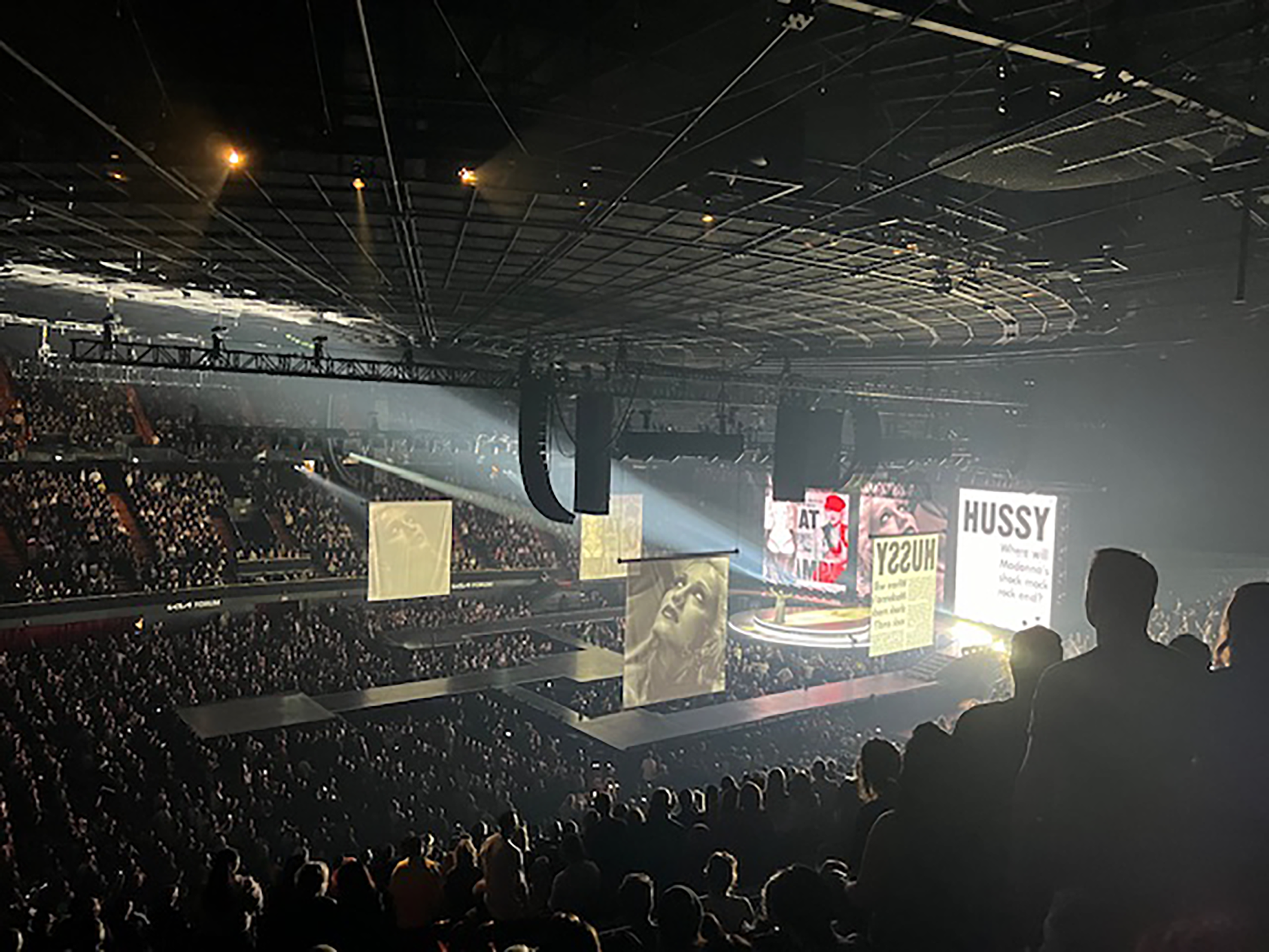
Variety’s Mark Sutherland reviewed the Celebration tour’s early stops, praising its ability to capture the star’s tenacity and musical hits. He highlighted a particular moment in the show when Madonna proudly projected the negative headlines she had endured throughout her career, writing: “[i]t’s a timely reminder that, in an age where anyone with a million streams that gets a new haircut can be hailed as ‘iconic,’ Madonna really has achieved that status, over and over” (Figure 9).Footnote 68 Sutherland’s review also gestured to the tour’s overwhelmingly nostalgic content: As its title signaled, the show revisited the defining moments in Madonna’s career and life as she sang through her catalog. Sutherland further noted how the set list and overall theme were extremely unusual for the Queen of Pop, whose previous performances and messaging always focused on her contemporary relevance and nods to the future.
Madonna projected the derogatory headlines published about her during the Celebration Tour. Photograph taken by the author at the Los Angeles Forum, March 11, 2024.

Throughout the Celebration tour, Madonna dared to look backwards at her own life—once again revisiting time like space—gesturing to past tours, videos, and performances by using the show’s songs, dancing, and imagery to re-create her pop cultural milestones. She also projected old photographs of herself and deceased musicians, friends, and family who inspired her work. She and her onstage entourage even donned her iconic costuming, reminding fans about her most memorable looks. The show, in fact, opened with a nod to her 1990 VMA “Vogue” performance and to the history of voguing writ large, with a spotlight that followed Bob the Drag Queen (Christopher Delmar Caldwell) parading through the floor seats dressed like Madonna’s version of Marie Antoinette. As the show’s master of ceremony, he introduced the night as “a celebration for the Reinvention Queen.” Like glam rocker David Bowie, whose image was projected as one of her inspirations, Madonna’s reputation for reinvention and refusal to be tied to one era, style, genre, idea, or persona allowed her to have a long career and diverse catalog of hits. Of course her reinvention could not be accomplished without acknowledging the past, and this tour’s performance of “Vogue” relied heavily on the song’s ball culture roots for its transformation back into the ballroom. Notably, this version stands out due to the fact that Madonna performed very little of it, instead relying on the poses mastered by her entourage.
The set opened with sequences from the 1990 music video projected onscreen while Madonna’s youngest daughter, Estere, DJed an EDM-like groove below it. The music video imagery soon cut to the live footage of onstage dancers posing along with Estere’s musical segue. Eventually, “Vogue’s” opening violins entered underneath the dense and high-energy, four-on-the-floor track to signal the hit song’s entrance. The performance then rotated between prerecorded sections (including the opening growl, “What are you looking at?), Madonna singing, and Bob the Drag Queen interjecting with commands for the dancers and praises to the “icon.” Midway through, the star and her entourage paraded to the front of the stage amid a backdrop of historical images of gay men posing on street corners and marching for equal rights. Madonna recited the song’s rap after removing her jacket to reveal a cone-shaped, bedazzled corset that paid homage to the Jean Paul Gaultier version she wore on her 1990 Blonde Ambition Tour.Footnote 69 Estere then jumped back into the song’s mix to interweave her opening dance groove with “Vogue’s” chorus while the stage was transformed into a catwalk. Madonna and a guest celebrity (chosen at each stop along the tour) were escorted to chairs and given scorecards to rank each dancer’s costumes and poses.Footnote 70 Notably, Estere performed the final poses and was introduced as Madonna’s daughter, a “queen,” and “the reason why we’re here tonight.”
In transforming her stage into the ball house and putting drag, queer, Black, and subaltern figures center stage, the pop star gestured at returning the practice to its rightful owners. At the same time, the show fell into the same patterns for which Madonna had been critiqued by the scholars cited above: she ultimately put these bodies on display for her own utility, control, success, and pleasure. As such, her act of nostalgic legacy building was unmistakable here as she remade the late-twentieth-century ballroom into her own image. Madonna was no longer a voguing “queen” but the judge of it, inserting herself as the “mother”—on many levels—of her onstage ball house.
Although the nostalgic fantasies conveyed in this particular “Vogue” production are ripe for analysis and critique, the practicalities of Madonna’s sidelined role here are equally important to realize. After her hospitalization, much of the show was reworked to give her time to rest and ensure she could safely make it to the end of each night in the 80-show tour. “Vogue” was thus one of many numbers during the Celebration tour where experienced fans who had witnessed her dance for three hours straight in previous shows could see that her recent illness had taken a serious toll on her body. In literally taking the judge’s seat, Madonna attempted to control her image: using the lens of (ballroom) nostalgia, she redirected probable headlines about her age and physical disabilities to once more perpetuate her legacy through “Vogue”—this time by re-envisioning it for the next generation of voguers and progeny.
“Vogue” and Other Reflections
Scholars who study women’s roles in the music industry often point out that the problem with forging a career and maintaining longevity is not unique to a single artist nor how old she is: relevancy is not just an age issue; instead, success simultaneously rests at the intersections of genre and gender.Footnote 71 Lisa A. Lewis, Lucy O’Brien, Paula Wolf, and many others have documented how young and beautiful women have historically been relegated to the genre of pop music, where they are often patronized and denied autonomy and credibility for their own artistry.Footnote 72 Accordingly, in recent decades women pop stars have increasingly clung to past cultural references to establish legitimacy—each in their own way. As nostalgic references to the pre-social media and smartphone decades of the mid-to-late twentieth century have dominated twenty-first-century media culture, some women stars have built their musical brands on well-known signifiers and star texts from the 1960s through the 1990s. For example, Amy Winehouse’s 1960s bouffant hairstyle, cat-eye makeup, Janis Joplin-like vocal timbre, and compilation of jazz, blues, and doo-wop techniques implied a hard-won veteran status in the industry, despite the realities of her age and shortened career due to her death at 27. Dua Lipa’s four-on-the-floor disco backing tracks and costuming, allusions to 1960s girl-group break-up anthems and clapped patterns, as well as her work with former glam rocker Elton John to remake his 1989 “Cold Heart,” have, like Winehouse before her, allowed the familiarity of her musical signifiers to appeal to multiple generations of audiences. Most recently, Sabrina Carpenter has deployed a dizzying compilation of pre-2000s pop culture referents in her genre-bending music, videos, and performances to suggest that she, perhaps like Madonna, has always had a rightful place in pop culture. As such, Carpenter variously integrates 1960s teen, beach, and horror B-movie tropes, as well as references to well-known country star texts that include a duet with the Queen of Country, Dolly Parton, in “Please, Please, Please” (2024), and themes from the Dixie Chicks’ “Goodbye Earl” (1999), Hollywood westerns, and the cult classic film Thelma and Louise (1991) into her videos. Each of these women’s musical legacies is thus made more credible and palatable by their nostalgic refashioning of established star texts and signifiers that work to “revisit time like space” and offer “corrective alternatives” to pop’s past in order to gain (at least a little) more agency for their futures.
Lady Gaga’s acts of nostalgic legacy building are perhaps closest to Madonna’s for a variety of reasons, including her admitted reverence for the Queen of Pop and focused efforts to engage with previous star texts to boost her own. In addition to garnering multiple high-profile acting roles—such as a 2018 remake of A Star is Born, whose earlier versions starred music icons Judy Garland (1954) and Barbara Streisand (1976)—Lady Gaga has taken measured breaks from her eclectic pop personas to join and extend Tony Bennett’s performances of early-to-mid twentieth-century vocal jazz standards. Gaga worked with him prior to his death in 2023 to record albums, tour, sing in television specials, and perform in multiple Las Vegas residencies. During her “Jazz and Piano” residencies in particular, Gaga sang well-known tunes by Irving Berlin, Cole Porter, and Duke Ellington alongside her own pop hits—“Poker Face” (2008), “Paparazzi” (2009), “Bad Romance” (2009), and “Born this Way” (2011)—transforming them into complex jazz arrangements and suggesting their transcendence beyond common criticisms of pop’s supposedly trite qualities.Footnote 73 These efforts reflect Lady Gaga’s own specific type of nostalgic legacy building, one that is more backward than forward-looking thus far, and that strives to prove the value of her artistry by inserting herself into the lineages of prestigious twentieth-century composers and entertainers iconic to old Hollywood and The Great American Songbook.
It takes a unique kind of celebrity to experiment with multiple personas and musical styles, and few artists are brave enough to try it and actually succeed. Following David Bowie’s lead, Madonna built her career on an expectation of constant reinvention, and by examining the evolution of her “Vogue” performances, we can begin to understand how reinvention might affect a star’s longevity. Indeed, in their reflections on “Vogue’s” 25th anniversary in 2015, staff writers for Slant stated that the song, “like its ball culture roots is about presentation.”Footnote 74 However, the examples in this article argue that the track works well for the Queen of Reinvention because it has offered limitless possibilities for re-presentation and, specifically, for nostalgic legacy building. Returning briefly to the scholarly discussions above by Mandziuk, Halberstam, and Livingston, their points about voguing’s non-teleological, ahistorical roots and its practice of “trying on” standards of beauty and femininity that are unstable and can never be attained in “reality” (or, in Madonna’s case, easily maintained with age and illness) allude to the fact that the practice itself provided the perfect conceptual foundation on which the star could create and continue to reimagine “Vogue” as performative text.Footnote 75 Put simply, the rich aesthetic promises offered by a subcultural practice created by marginalized, abject, and largely dismissed communities provided a useful canvas on which the pop star could map her own nonlinear, nostalgic performances. Madonna’s various “Vogue” renditions thus align with Boym’s concept of reflective nostalgia by “cherishing shattered fragments of” voguing “memory and temporalizing” the ballroom’s “space.”Footnote 76 The liminal, ahistoric space of the ballroom has therefore become the equally liminal space of Madonna’s body and career as she has continued to reimagine corrective alternatives to them, creating reflective nostalgic texts that have helped her to build, maintain, and perpetuate her legacy as an infinite star.
Acknowledgements
This article expands ideas from a roundtable paper presented by this author as part of a panel titled “Margins in the Flesh: Voice, Memory, and Temporality in Madonna’s ‘Vogue’” at the 2016 annual conference for the Society for American Music. I am grateful to my colleagues, Ross Fenimore, Alexandra Apolloni, and Mary Simonson, for their contributions to the panel and input on my research for that conference.
Competing interests
None.
Joanna K. Love is Associate Professor of Music at the University of Richmond. She has published extensively on music in U.S. national brand and political advertising. Her 2019 book, Soda Goes Pop: Pepsi-Cola Advertising and Popular Music, won the inaugural Danijela Kulezic-Wilson award. She recently co-edited an interdisciplinary volume, Sonic Identity at the Margins (2022), and completed an NEH-funded music archiving project. Her current work explores popular music’s roles in NFL Super Bowl broadcasts.

 Open access

