




Introduction
This special issue lies at the intersection of the historical experience of formal political independence from colonial rule and an ongoing project of decolonising our epistemological gaze on the past. These two tracks often intersect – as when previously-colonised African nations in the 1960s sought an “autonomous” view on their own histories – but they are also distinct. Nowhere has that complex relationship, overlapping but distinct, been more apparent than in the current proliferation of calls to decolonise knowledge. For these efforts have achieved an invaluable traction, even as they sometimes risk losing sight of the lessons of the actual past of decolonisation. Particularly in the case of Africa, this risks a new marginalisation, as Olufemi Taiwo has recently warned.Footnote 1
This article examines a case that offers a particularly valuable lens on these questions, that of the University of Dar es Salaam (UDSM) during an early dozen or so years of its life, from 1961-74. These years were ones where Tanzania was distinguished by two significant developments that made the country stand out among many of its newly-independent neighbours: first, a particularly vigorous program of “national culture” that included history-writing within its scope; second, President Nyerere’s drive to make Tanzania the continent’s foremost “frontline state” in the ongoing struggle against colonialism in Africa’s southern third.Footnote 2 These two developments not only formed the broader backdrop against which Tanzania’s new national university was developed. They also significantly shaped the two epistemological debates and strands of historical scholarship that would make the university famous during those years. The first, conditioned by the national cultural project’s drive to “develop a really African history,” as Nyerere put it, was what became known as the “Dar School” of historiography: a body of work centred on the UDSM History Department and often discussed (by critics and proponents alike) with reference to its “nationalism,” its focus on African “initiative,” and its spearheading by Eric Hobsbawm’s sometime co-author, Terence Ranger.Footnote 3 The other was “world-systems-” or “dependency theory,” which would famously attempt to theorize the African continent’s disadvantaged position within global capitalism. (Walter Rodney would pen his seminal How Europe Underdeveloped Africa in Dar es Salaam.Footnote 4) Both were lent oxygen by Dar es Salaam’s status as one of the world’s primary crossroads for some of the most prominent political movements of a “global 1960s.” Networks of pan-Africanism, southern African liberation organisations, global Marxism, African socialism, US civil rights, and global student protest all criss-crossed through the globe-spanning but intimate world that was Dar’s leftwing activist scene.Footnote 5
Although well-known, these two historiographical traditions are rarely placed together in a single frame. When they are, they have been treated primarily as different analyses of nationalism in former colonies: world-systems or dependency theory being seen as more of a critique of nationalist movements’ ability to free Africa from the shackles of an economic “dependency” on the capitalist core, and the Dar School as more interested in nationalist movements as “organic” expressions of dynamics internal to African societies under colonialism.Footnote 6 While not inaccurate, I argue here that such analyses miss what was, and remains, both the most important epistemological commonalities between these two scholarly traditions, and their most crucial differences. Rather than being primarily about “nationalism,” both these schools were attempts at decolonising knowledge of the African past. If that goal united them, though, they went about this task of decolonisation in very different ways that were epistemological inverses of one another: the Dar School seeking what might be called an African epistemological sovereignty; the dependency theorists attempting to make a capitalist periphery central to a Marxist epistemology held to be universal and scientific. At the same time, an equally important decolonisation of knowledge occurring at the UDSM during those years was an outgrowth not of either tradition’s epistemic approach but rather as a subterranean and very gradual shift in the institutional politics around faculty staffing. With both of UDSM’s two historiographical “schools” being composed mainly of expatriates, it was perhaps no coincidence that among them only Walter Rodney – who, alongside his writing had become especially active as an ally to student activists at the University – would see the importance of this material change occurring underneath everyone’s feet.
This article begins by briefly tracing what I suggest was perhaps the most important of the expectations of the kind of change that the end of colonial rule would bring to African universities – that expatriate faculty would be phased out and “Africanised” – and the progress (or lack thereof) toward that goal. Next, it explores each of the UDSM’s signature historiographical traditions traditions in relation to one another, with special emphasis on the ironic similarities between the two and between each and its respective mission. Here, I zoom in on key texts that illustrate the similarities and differences, strengths and weaknesses, of each epistemological approach. Finally, it re-embeds both of these epistemological schools in the material-institutional politics of UDSM at the time, and argues that, for all their sense of mission and scholarly frontiers breached, the two groups of expatriate scholars driving these approaches largely missed one of the most significant decolonisations of knowledge happening under their very noses.
The expatriate question at the UDSM
One of the key axes along which even a casual observer of universities on the African continent at the end of colonial rule would be watching for change had to do with expatriate faculty. What universities existed during the colonial period – and in all of East Africa there was only one, Makerere University in Uganda – were almost entirely staffed by expatriate faculty, the vast majority from the U.K. and France.Footnote 7 They also, in the case of British-ruled territories, had their curricula based on the University of London, which also was the source of staff seconded to African universities on lucrative temporary contracts.Footnote 8 At independence, then, universities had an expectation of decolonisation written into their missions. For national ruling parties just taking the reins of power, having a national university was seen as a signature goal, almost part and parcel of becoming independent.Footnote 9 In Tanzania (or Tanganyika, at the time), this was made manifest by nationalist politicians revolting at the British-proposed timeline that would have the Territory wait until 1965, four years after independence, for its own university. Opened eight weeks before independence, in October 1961, UDSM was Tanganyika’s first university and an outgrowth of demands voiced by both nationalists and visiting UN mandate missions to Tanganyika since the Second World War.Footnote 10
These demands arose out of two contexts. One was the territory’s segregated educational system, which consisted of separate and far from equal schools for Tanganyika's population of Europeans, Asians, and Africans. Another was the colonial administration’s determination to link primary schooling for Africans to a rural and agrarian livelihood.Footnote 11 Driven by African anger at these discriminatory policies, TANU included in its brief to the UN visiting mission in 1954 a demand for a separate university in Tanganyika. (At this point the few Tanganyikan students who entered university generally attended either Makerere in Kampala or other foreign institutions.) The colonial administration finally acted on this demand, joining Kenya, Tanganyika, Uganda, and Zanzibar in 1958 in a commitment to support a federal University of East Africa with constituent colleges in Nairobi, Kampala, and Dar es Salaam. University College, Dar es Salaam, was originally slated to open in 1965, but shortly after taking the reins of “responsible government” in late 1960, TANU shortened the timetable, announcing that it would open in 1961. No separate campus having been built, the University College was opened in what had been the ruling party’s headquarters on Lumumba Street, on the edges of downtown. This location was seen from the beginning as a temporary one, and in 1964 the university moved to its present location, a relatively lavish campus built largely with British, Scandinavian, and American grants on a hill nearly six miles from downtown.Footnote 12
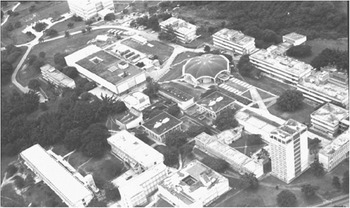
The campus of the University of Dar es Salaam in the 1960s. sourced from the following webpage: https://unitedrepublicoftanzania.com/government-of-tanzania-and-the-society/education-in-tanzania-system/quick-snapshot-of-the-university-of-dar-es-salaam-master-courses-online-application-notable-alumni-address-aris-logo-admission-library-login-fee-structure-form-website-undergraduate-journal-mlimani/.

Image 1 Long description
An aerial photograph showing the University of Dar es Salaam campus in the 1960s. The image captures multiple buildings arranged in a sprawling layout, surrounded by greenery. A distinctive dome-shaped structure is visible near the center, with various rectangular and square buildings scattered around it. Pathways connect the buildings and trees are interspersed throughout the campus, providing a lush backdrop.
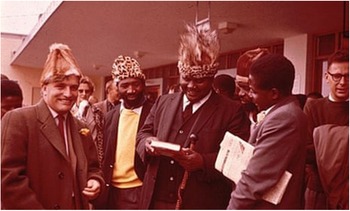
Despite being explicitly bound up with the decolonisation project, it was striking, as the 1960s rolled on, to what degree university faculties across the African continent remained expatriate-dominated. This was certainly true of UDSM, where a large majority of the staff well into the 1970s were white expatriates. Nonetheless, this was also a different kind of expatriate than the servant of empire, one imbued with a new sense of mission (albeit one that, I would argue, bore a lingering shadow of their technocratic 1950s predecessors charged with “preparing” the colonial territories for an eventual independence).Footnote 13 UDSM’s History Department illustrates this well. In 1963, the British historian Terence Ranger was recruited fresh from being deported from white-settler-ruled Rhodesia to found and lead the History department at UDSM. Ranger had initially come to Rhodesia in 1957, aged 28 with an Oxford degree and postgraduate research into seventeenth-century Ireland under Hugh Trevor-Roper’s supervision under his belt. He was interested in “do[ing] good in a multi-racial society,” as his long-time colleague and friend John McCracken put it, but in other respects was a “political innocent.”Footnote 14 This last quality quickly changed in Salisbury, where he and his wife Shelagh (she even more energetically than he) became deeply involved with the African nationalist campaign against the government and its last-bastion-of-empire apartheid policies. They joined the Zimbabwean African People’s Union (ZAPU), organised the Southern Rhodesia Legal Aid and Welfare Fund to raise funds for political prisoners, and Terence co-founded the journal Dissent. All of this made ran them afoul of the Rhodesian government, which deported Terence and Shelagh in 1963.Footnote 15
Terrence Ranger at the Salisbury airport, departing Southern Rhodesia for Dar es Salaam.sourced from the following website where it is credited to David Wiley/African Studies Center, Michigan State University: https://www.thetimes.com/travel/destinations/africa-travel/south-africa/terence-ranger-snnrmfdhv2v#:~:text=Among%20the%20well%2Dwishers%20who%20turned%20up%20at%20Salisbury%20airport%20to&text=Terence%20Ranger%2C%20historian%2C%20was%20born%20on%20November%2029%2C%201929.
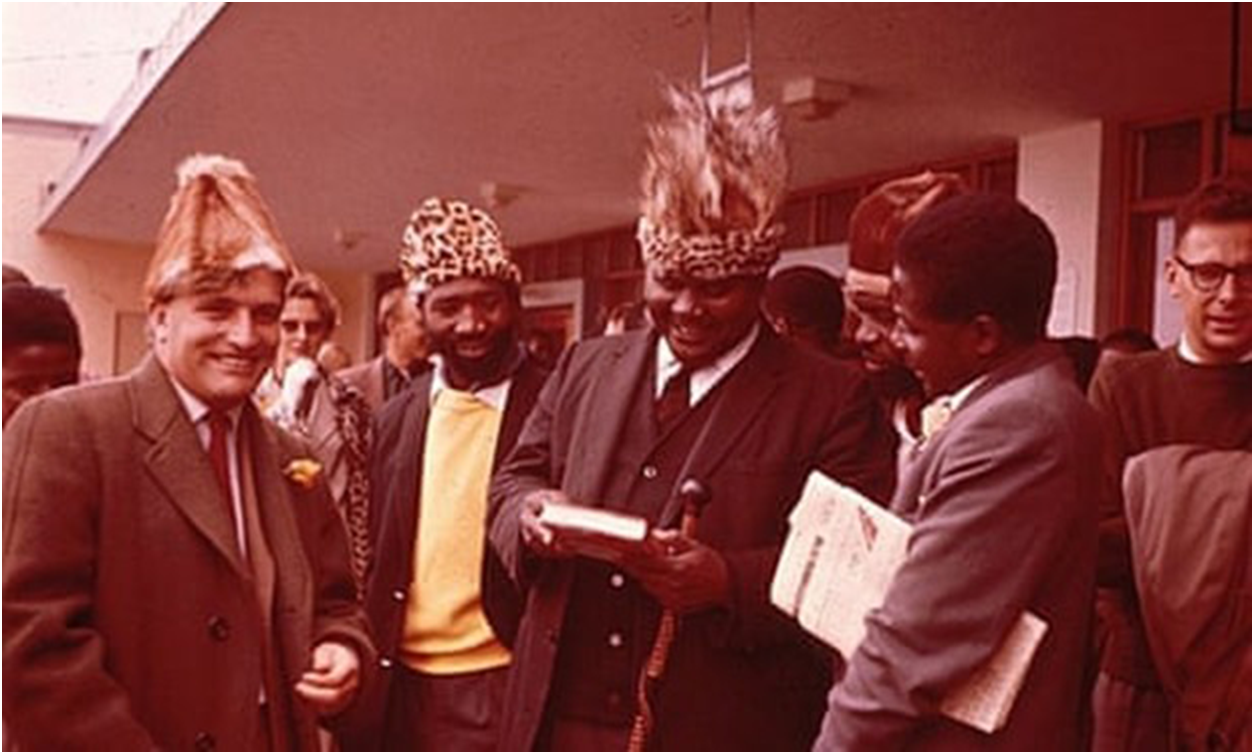
Image 2 Long description
Five men are standing together outside a building. Three of them are wearing traditional hats with distinct patterns. One man is holding a book, while another has a folder under his arm. They are engaged in conversation, with some facing each other. The background shows a building with windows and a covered walkway.
Upon his ouster from the University College of Rhodesia and Nyasaland, Ranger was offered several faculty positions, but UDSM stood out. Not only had Nyerere’s Tanganyika become the continent’s foremost “frontline state” (outstripping even Nkrumah’s Ghana) but UDSM offered the chance to build a history department from scratch. Ranger went about the latter task with aplomb, and it is here that we begin to catch glimpses of his scholarly orientations. His first four appointments (all first-named John!) were all similar to himself – young, white men trained at Oxbridge as liberal empiricists: John Lonsdale, John Iliffe, John McCracken, and John Sutton. One of them would even later comment that the cohort “may have indicated a somewhat insular conservatism [in Ranger].”Footnote 16 As we shall see, Ranger’s philosophy of history would not necessarily be well-described by the label “conservative,” but it was certainly empiricist. And, this empiricism could have quite radical implications given the moment. At the time, Africa was often regarded as a continent without significant internally-driven historical development. Simply empirically examining ordinary Africans as historical agents, who, even amidst colonial occupation, acted to shape changing social and cultural forms – an orientation that was at the centre of Ranger’s and his “colleagues'” [with the possessive] work, as examined below – could have weighty implications.
Not all of UDSM’s new hires were expatriates. For Ranger and his cohort, being at an African university was part of the point, and mentoring African scholars (often, indeed, with the whiff of paternalism implied in that term) who would join faculty ranks became a feature of Dar’s History Department as the 1960s moved along. Isaria Kimambo joined the Department as its first Tanzanian professor of history after a BA and MA on scholarship at Pacific Lutheran University and a 1967 Ph.D. at Northwestern University, and Arnold Temu followed. Nevertheless, the expatriate dominance continued. All of the edited volumes published in the 1960s as snapshots of the Department’s work – one emerging out of a signature conference, another a History of Tanzania volume intended to be a showcase of the Department’s scholarship, and a third a collection designed as a survey for Tanzanian schools of each of the country’s regions – were still dominated by white expatriates.Footnote 17
After 1967, Tanzania began turning to the left with Nyerere’s Arusha Declaration, the beginnings of his peasant-oriented ujamaa rhetoric, and Dar’s growing fame as a hub for itinerant radicals.Footnote 18 With these shifts, yet a new kind of expatriate began appearing on UDSM’s faculty rosters. The bridge between the older and newer cohorts was Walter Rodney, whom Ranger appointed to the History Department in 1966 fresh from his doctoral work at SOAS with a thesis on slavery on the upper Guinea coast. As a black Guyanese Marxist working toward a full accounting of the place of race in structuring the global economy via the Atlantic slave trade, Rodney brought a very different historiography and set of political affiliations to the Department. Indeed, once the number of Marxists at UDSM began rapidly increasing – most in social sciences rather than History – Rodney began joining them for Sunday morning “ideological classes” that brought left-wing faculty and students together and exposed the students to the dependency theory of which some of these Marxist expatriate faculty were ongoing pioneers. Immanuel Wallerstein, Giovanni Arrighi, and Samir Amin soon had joined Rodney at the UDSM. All four were fast becoming household names in global Marxist circles. By the end of the decade, they had made Dar es Salaam an identifiable node on the intellectual geography of Marxist analyses of Third World “underdevelopment” as a constitutive component of global capitalism.
UDSM’s two historiographies in theory and practice: epistemological sovereignty and Marxist universalism
It is worthwhile comparing the ways in which these two schools of historiographical thought positioned Africa in their epistemologies and scholarly praxes. For Ranger and what increasingly began to be referred to as the “Dar School,” centring “African initiative, African choice, and African adaptation” was the starting point. As Ranger put it in his speech at the end of his six years in the Department, if there was a “unifying approach” to the Department’s scholarship during those years, it could be summed up as “the attempt to recover African initiative in Tanzanian history.”Footnote 19 Doing so necessarily meant exploring the diversity within that initiative. As Ranger went on to put it, “Emphasis upon the African voice, upon African initiative in the singular is only meaningful when it is opposed to a doctrine of history which denies any African initiative at all.”Footnote 20
These UDSM historians were not alone in seeking to move beyond accessing African history via European actors. In doing so, they were building on what had already become known as the “Ibadan school” of scholars based at the University of Ibadan in Nigeria, one of West Africa’s premier universities. Even prior to Ranger’s vision, these historians were seeking to do a basic reconstruction of African history through African actors – a practice that was, as Paul Lovejoy put it in a classic re-evaluation, “radical in area of application rather than in its conceptualization of historical discourse.”Footnote 21 What Lovejoy meant by this was that since Africa was “not of general interest to historians” and was a continent that “figured in historical reconstruction only in so much as it was a stage for European imperial actors,” simply reconstructing the “kings and battles” of “Africans themselves” was a radical act -- and a necessary one if even a mainstream of African history was going to be brought into being.Footnote 22 Once this was done, as J.F. Ade Ajayi who was perhaps Ibadan’s most prominent historian famously put it, even “European rule becomes just another episode.”Footnote 23 If Ibadan’s work was geared toward this reconstruction of the more powerful of African actors and thus “preoccup[ied] with political and diplomatic history,” one could regard the “Dar School” as taking this mission of recapturing African agency in history beyond ruling classes and into the realm of social history.
The historians of UDSM did not outright neglect the structural forces (such as colonialism) constraining African agency. But the Dar School would be debated on the question of how much weight such structural forces were to be given as keys to understanding African lifeworlds. One direction such engagements came from was the truly conservative one of traditional imperial historians who thought UDSM’s historians paid too little heed to colonial policymaking and over-elevated African nationalism as a mover of Africa’s twentieth century.Footnote 24 But the much weightier critique came from UDSM’s own Marxists and dependency theorists. For these scholars, operating at a global scale, it was crucial to recognise and analyse Africa’s place as foundational to the construction and maintenance of Western capitalism. In this, Africa joined other Third World or “peripheral” regions in feeding the capitalist industrial core’s need for raw materials. Additionally, as Walter Rodney showed in his seminal text How Europe Underdeveloped Africa, Africa had been uniquely subjected to this due to the Atlantic slave trade. In this he built off of Eric Williams and others to articulate the place of racial difference in the functioning of the global economy. Footnote 25
The other way in which the work of dependency theorists was picked up in Dar came from UDSM’s student left. Work like that of Amin, Arrighi, Wallerstein, and Rodney pulled no punches when it came to analysing the role of governing classes in the new postcolonial states, whom they saw as a “comprador bourgeoisie,” acting as servants of global capital – pliant managers of the extraction of natural resources from the Third World in a process that represented a “neo-colonial” sequel to empire’s subjection of non-Western peoples. UDSM had an energetic homegrown left amongst its student body. They were only a small minority of the University’s students, but were passionate and saw themselves as a vanguard: packing lecture halls to hear guest speakers from C.L.R. James to Stokely Carmichael, attending the ideological classes hosted by Rodney, and starting a journal, Cheche (named the Kiswahili equivalent of Lenin’s journal, Spark), which would go on to publish some of the earliest and most trenchant critiques of Nyerere’s government. Organised into a group named the United Student African Revolutionary Front (USARF), this Tanzanian student left drew on dependency theory and Frantz Fanon to critique Tanzania’s class of party administrators as a “bureaucratic bourgeoisie.”Footnote 26 Even as undergraduates (but especially as they graduated and some of them became influential public intellectuals in Tanzania), this group would produce important work that posed a significant challenge to that of the historians of the Dar School. Predicting that it was from these “Fanon-esque radical pessimists” that his History Department colleagues and students would see the most forceful challenge, especially on the question of how much a difference the moment of independence made in African life, Ranger described the conflict between these two approaches as follows:
The historian who persists in treating national movements as something of genuine importance and formidable energy; who sees the African people winning their independence in the face of colonial reluctance and suppression; who believes their mass participation was at various points crucial; has to argue his case against a wide belief that national independence was an episode in a comedy in which the colonial powers handed over to their selected and groomed bourgeois successors and in which nothing fundamental was changed….The Africanist historian…will increasingly find his main adversaries not in the discredited colonial school but in the radical pessimists.Footnote 27
Epistemologically, the Dar School and world-systems theory were near inversions of one another. Each made intellectual interventions regarding Africa that were important for the continent’s place in postcolonial knowledge, and each had a kind of boldness. The Dar School’s bold move was to position Africa as a continent that deserved to be approached on its own terms, with Africans as agential actors, even under conditions of oppression. It elevated the emic and allowed for studies that explored the details of all manner of African social and cultural life – from religion to dance, agricultural labour to oral traditions of chiefly power. For dependency theorists, Africa’s importance lay more as a region of extraction in a capitalist world system. If this resulted in sometimes one-dimensional approaches to Africans social life – seeing Africans as victims of, or collaborators in, economic oppression more than anything else – it also had a boldness in making the continent a central piece in knowledge that was epistemologically ground-breaking at a global scale, important for explaining other regions of the world (and particularly the Western industrial “core” itself).
Zooming in on these interventions in relation to one another like this brings into view some rarely observed aspects of these strands of knowledge. One is the way that even Ranger’s own characterisations of the Dar School’s work does not quite capture what would prove to be its most important interventions. It had already been hailed for its emphasis on the “organic” nature of nationalism, or on its highlighting of the fact that, as Ranger put it, “the early colonial period did not mean a complete disruption of the old lines of contact and dissemination of ideas.”Footnote 28 But these scholars’ arguably more radical contribution was to eliminate altogether the need for colonialism to serve as a foundational reference point in Africanist historiography. Indeed, if we actually examine the corpus of scholarship that the Dar School produced, perhaps the most immediately striking thing is that so much of it was focused on the pre-colonial African past. This was particularly true for the non-expatriates among the members of the Dar School. In the first two volumes produced by the Dar School, B. Kamian asked as the title to his chapter, “Can we enrich current historiography by drawing on the traditional and Islamic past?”Footnote 29 The young Kenyan historian B.A. Ogot, who would go on to a long and distinguished career, would, in one of his first published works, contribute a longue-durée reflection on “The Role of the Pastoralist and the Agriculturalist in African History.”Footnote 30 Isaria Kimambo, who, as narrated below, would soon become the first Tanzanian appointed as a professor of history at UDSM, made a foray into a period before any Europeans had arrived in non-coastal Tanzania with a chapter entitled, “The Interior Before 1800.”Footnote 31 And even the Nigerian don J.F. Ade Ayaji’s piece, which did touch on the colonial period, deliberately cut against the prevailing wisdom (albeit not Ranger’s) by setting out to prove “The continuity of African institutions under colonialism.”Footnote 32 The fact that Ibadan-based Ajayi was the one non-East African scholar to align with this perspective is another reminder of the Dar School having built on the accomplishments of the Ibadan School’s pioneers.Footnote 33
The focus on the pre-colonial past, including that of the continent’s vast interior, meant moving beyond European or European-mediated sources for African history. Indeed, the question of sources would quickly become a central concern for the Dar School, and this would lead to a methodological creativity for which historians working in this tradition would become well-known (including in some cases far beyond the geographical subfield of African historiography). One of the most prominent and creative of these latter historians was Jan Vansina, whose long career is a useful illustration of the epistemologically radical potential of the tradition birthed by the Dar School.Footnote 34 Vansina, who began working as a researcher and teacher in Congo in 1953, when it was still a Belgian colony, would become intensely interested in how to use non-written source material in (re)constructing African history. This meant turning to oral and archaeological sources, objects and artifacts, linguistic patterns, and even, as Vansina would focus on in his contribution to the Dar School’s first large conference at UDSM, “the use of ethnographic data as sources for history.”Footnote 35 The point in doing so was not simply to find source material for an era prior to the arrival of Europeans or Arabs whose written records survive. (For most of the continent this dated to the nineteenth century for the interior and the fifteenth for areas of the coastline.) As importantly, it was to move beyond a European gaze for any period of African history and instead to generate a knowledge of African ways of seeing, African epistemological sovereignty in all areas of political, economic, and social life. This meant that even present-day ethnographic data was extremely valuable. As Vansina put it, “Cultural data can be used as sources for history despite their chronological weakness. Their great advantage is that they form part of culture, that culture is history and that therefore cultural data cannot be distorted, since any change in a feature is a real change in history.” This meant that “full descriptions are needed of all African cultures and languages” and “imperative that the present cultural situations be recorded everywhere before they do change beyond recognition.”Footnote 36
With this focus, Vansina and other scholars began what developed into both a significant methodological practice that kept the focus on African “words and things,” and also topical work that pursued the Dar School’s aim of (re-)writing African histories on their own terms, needing no European or other external reference point to be valuable.Footnote 37 These techniques could then also be used to rewrite histories of modern Africa – the period affected by colonialism and its aftermath – in a new, decolonised way. As Vansina put it when he opened his book on the Kuba people’s experience of colonisation in Central Congo with a vignette of an “old man on the hill” reflecting on “how the colonial soldiers came to capture the town”:
His vision of colonial history had certainly very little in common with the standard accounts one finds in textbooks about the period. Most of the latter begin with the creation of colonies by European powers…. Such a top-down focus may well be admirably suited to explain the links between colonies and their metropolises and to detail the large place taken by the plans and activities of colonial intruders in the fields of economics, administration, justice, education, religion, and health, but these accounts have no room for histories retold by people such as the old man in his compound on the hill….This book aims to introduce its readers to the colonial period from the side of the colonized, as far as feasible, by keeping its focus on their concrete experiences, by underlining their active rather than passive agency where appropriate in the overall narrative, and by letting them tell their own story as much as possible….I do not know of any introductions to colonial history that emphasize the African experiences and place them at the heart of the tale, where they obviously belong. That is why I wrote this work.Footnote 38
If this epistemological intervention was one kind of decolonising move in the politics of knowledge after independence, so too was that of UDSM’s dependency theorists. Both groups of scholars shared an impulse to refashion knowledge by wresting it away from those who held its reins and had shaped its assumptions regarding Africa. But if the Dar School’s concern was to recentre African history by revaluing Africans’ epistemologies, dependency theory began from a different decolonising impulse. Walter Rodney’s work illustrates this well, not least the book for which he is most famous and which he wrote while teaching at the UDSM. How Europe Underdeveloped Africa begins with a clear statement of Rodney’s intention for writing the book as deriving from a “concern with the contemporary African situation. It delves into the past only because otherwise it would be impossible to understand how the present came into being and what the trends are for the near future.”Footnote 39 As for what he means by the “contemporary African situation,” Rodney makes clear that it is “understanding what is now called ‘underdevelopment’ in Africa,” that urgently requires an investigation – one for which “the limits of inquiry have had to be fixed as far apart as the fifteenth century, on the one hand, and the end of the colonial period, on the other hand.”Footnote 40 He continues,
Ideally an analysis of underdevelopment should come even closer to the present than the end of the colonial period in the 1960s. The phenomenon of neo-colonialism cries out for extensive investigation in order to formulate the strategy and tactics of African emancipation and development. This study does not go that far, but at least certain solutions are implicit in a correct historical evaluation, just as given medical remedies are indicated or contraindicated by a correct diagnosis of a patient’s condition and an accurate case history.Footnote 41
The temporal scope of Rodney’s book gave the clue to the epistemological stance and central argument of his intervention, and that of Dar’s dependency theorists more generally. It was a global capitalist system, which had intruded upon Africa – first via the Atlantic slave trade and then via European colonial rule – that had underdeveloped the continent, leading to a “stagnation and distortion of the African economy.” A universalist and scientific Marxism (the medical analogy underlining its scientific status) constituted the essential epistemological toolkit for analysing the workings of this economic system. However, it also had to be a Marxism that took into account the highly varied ways in which different regions of the world had been incorporated into this system of global capitalism. It was thus that dependency theory – with Rodney’s analysis of the “European slave trade as a basic factor in Africa’s underdevelopment,” and his fellow UDSM colleague Immanuel Wallerstein’s emphasis on a “division of labour” between regions of the world forced into differing roles within a global capitalist system – distinguished itself from other Marxist traditions by stressing how European power (including white supremacy, colonialism, and everything that went along with it) could not be ignored.
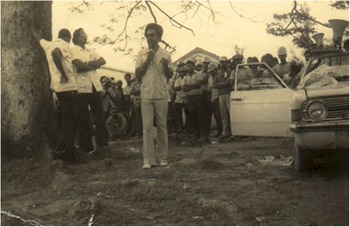
Walter Rodney speaking to a crowd in Dar es Salaam. sourced from the following website: https://www.versobooks.com/en-ca/blogs/news/4300-walter-rodney-pan-afrikanism-marxism-and-the-next-generation?srsltid=AfmBOoo-aWRFCvOk7ZipKyayiqszl8iOuL0G-idQ8hSfmPHLswtG2o4c.
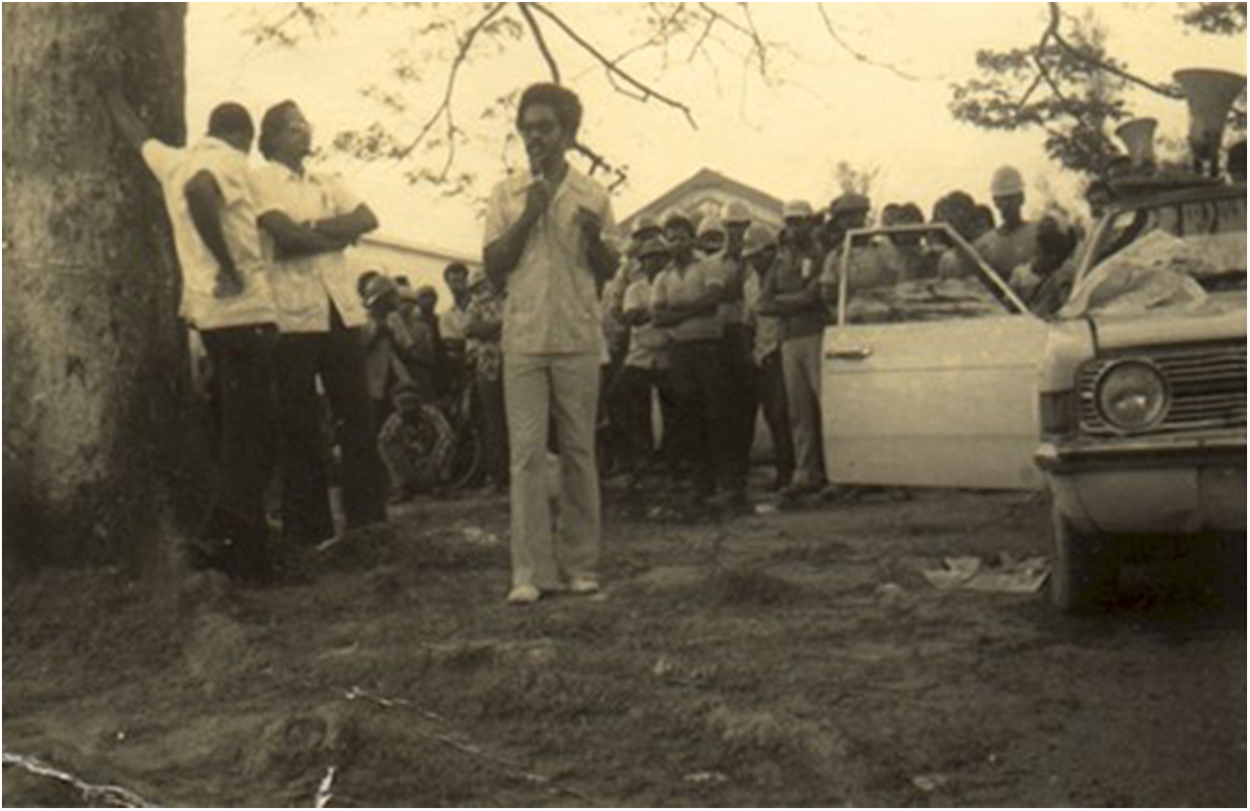
Image 3 Long description
Walter Rodney stands on uneven ground holding a microphone. A large tree trunk is at the left edge. Several people stand behind him and to the left, with some positioned close to the tree. A car is parked on the right side with a door open. Another car front is at the far right edge. A building with a triangular roofline is in the background behind the crowd.
Comparing Rodney’s and Vansina’s respective statements of motivation and intent brings into sharp relief the overlaps and differences between them, and between the Dar School and UDSM’s dependency theorists more generally. In both, past and present were understood as inextricably linked, but the end goal of inquiry, its purpose, was reversed. For Vansina and the Dar School, the simple fact that the past inevitably left traces in the present made the present a valuable clue to the past; and it was an understanding of the latter – the African past, which was unique and needed no justification to be studied – that remained the ultimate decolonising goal. For Rodney and the dependency theorists, studying the past only acquired its purpose in relation to the present and, indeed, an ideally better future. For these Marxists, the tragedy of Africa’s “neo-colonial” independence lay in its economic poverty in relation to the industrialised core, and capitalism had been shown to be the cause of this condition. Understanding how capitalism functioned in its “peripheries” like Africa was therefore critical. Put another way, in the Dar School’s vision of decolonising knowledge, Africa’s future as an independent continent lay in the autonomy of its past. For Rodney and the Marxists, the raison d’etre of understanding Africa’s history lay in its precarious, possibly dependent, future.
The institutional context: a material perspective on the debate over “Education for Self-Reliance”
The epistemological similarities and differences between these two historiographical traditions aside, what would prove to be the even more critical shared element between both these knowledge strands was their institutional platform: the fact that this new knowledge was being produced at an African university and the impact that each of these knowledge strands had on students there. In both cases, the epistemological importance of these efforts at decolonising knowledge was blunted by the dominance of expatriates. Furthermore, if we approach these schools and their effects not just from an epistemological direction but from a vantage point of institutional politics, other material struggles – ones that called into question the expatriate dominance – come into view. This next section zooms in on one such struggle – a debate over UDSM’s response to a Tanzanian government proposal to reform education – and suggests that perhaps the most consequential material contest brewing underneath the epistemological arguments between the Dar school and the dependency theorists was over to what degree Tanzanian faculty themselves would be able to shape UDSM’s future.
In 1967 President Nyerere issued his signal act marking the TANU government’s turn to the left: the Arusha Declaration, which nationalised all large and medium-sized businesses. A few weeks later, it was followed by another major policy document entitled “Education for Self-Reliance” (hereafter ESR). ESR took off from growing public dissatisfaction at signs that the educational system was not serving enough of Tanzania’s population. These criticisms suggested that there were not enough spaces in post-primary education for those who wanted it and were qualified. It thus left far too many primary-school leavers neither trained for careers nor with any educational path forward. And, the lucky few who were able to attend university were seen to hold “elitist” attitudes, as the public reaction to a 1966 demonstration by university students against a plan to make them perform National Service showed.Footnote 42 Aimed at addressing these complaints, ESR proposed on the one hand restructuring primary school as a potentially terminal degree for students going into rural, agricultural labour; and on the other, bringing secondary and higher education more in line with an ethic of self-reliance and service to the nation.Footnote 43
ESR did not include many details on what the plan would mean for the UDSM. But even before it was released, university administrators, together with government and party officials, were planning a major conference to address how UDSM might be reformed. The “Conference on the Role of the University College Dar es Salaam in a Socialist Tanzania” was held in March 1967, just two days after the announcement of ESR. The public speeches at the conference, delivered by high-level government officials and university administrators, presented a united front: accepting the calls for reform but urging measured deliberation. Behind the scenes, though, the conference proceedings were deeply divided in a manner that implicated UDSM’s dependency theorists. A group of Marxist faculty members who came to be known as the Committee of Nine had submitted to the conference a detailed proposal for a radical restructuring of curriculum, faculty appointments, administrative structure, and staff–student relations.Footnote 44 The Committee was composed entirely of expatriates, only one of whom, a Kenyan, was African. Alongside Rodney, Arrighi, and John Saul (another dependency theory-oriented scholar from Canada), the other seven were Catherine Hoskyns, Grant Kamenju, Frances Livingstone, James Mellen, Sol Picciotto, and Herbert Shore. Arrighi, an Italian, had just arrived in Tanzania after being deported, like Ranger, from Rhodesia. Mellen, having come to Tanzania after being fired from his political science teaching post at Drew University in New Jersey in a high-profile case involving his public expression of support for the Viet Cong at a teach-in, would go on after his return to the United States to help found the radical leftist group, the Weathermen. Kamenju was a rising star in Kenyan literary criticism, a colleague of world-famous Kenyan author Ngugi wa Thiong’o in graduate school at Leeds, who had reportedly introduced Ngugi to Fanon. Together, the group was a microcosm of the kind of cosmopolitan Left scene that marked Dar es Salaam at the time.
The Committee of Nine’s proposal professed the same general goals as that of the government and university officials – the transformation of university away from being one based upon hierarchy and privilege. But it proposed changes much more far-reaching and explicitly socialist, and in a way that made many Tanzanian university administrators and government officials highly uncomfortable. The centrepiece was a proposal to reorganise the University’s curriculum around an interdisciplinary “Common Course” in social analysis. Conceived as an assault on the fragmentation of knowledge that the university’s organisation along Western disciplinary lines was seen by the Committee to have produced, the Common Course was aimed at giving students a “comprehensive understanding or questioning of capitalist economy, society, and culture as a system,” equipping them “to confront the theoretical, practical, and strategic problems of Tanzanian socialism…as socialist intellectuals” rather than as elitist technocrats.Footnote 45 The course would stretch over the full three years of a student’s tenure at the University College and occupy at least one third of students’ time each year.Footnote 46
In the wake of the Committee of Nine’s proposal, opinion among University faculty broke down into three main factions. A small number of mostly British faculty members apparently found it difficult to back a proposal for overhauling a university system with which they saw little wrong. Given the overwhelming pressure for university reform, this position was considerably enfeebled. Between the other two factions, however, was a brewing battle. On the one hand was the Committee’s proposal, backed by its authors and a handful of allies, for an overhaul of the university in the directions of socialist instruction and radical interdisciplinarity. On the other, a much larger, if originally less vocal, group – including a wide majority of the African teaching staff – cast themselves as occupying a middle ground, articulating a need for modest reform but wary of the platform put forward by the Committee of Nine. Over the course of heated deliberations at the conference, it was this third group whose position carried the day, aided in no small part to Rodney’s joining the African staff members’ side at the last moment.Footnote 47
The final recommendations that emerged from the conference did include small gestures toward some elements of the Committee of Nine’s proposal, but these were considerably watered down in substance. For instance, while the idea of a common course was endorsed, the recommendation that disciplinary curricula be marginalized was removed, and the matter of the content and length of the course was “left to the College for further consideration.”Footnote 48 And that was in the heat of the moment. As the competing proposals for reform wound their way through the university administration, those wary of the consequences of adopting the Committee of Nine’s platform succeeded in keeping curricular overhaul to a minimum. For the African faculty, who on the surface may have appeared more moderate, the material stakes were high: they faced the potential of losing what had been gained through the slow progress of the Africanisation of the faculty through the 1960s. Indeed, those who stood to lose most from a weakening of individual departments were the Tanzanians either already serving as department chairs or poised to do so – and who, in most cases, were the first non-expatriates to hold their positions.Footnote 49 Support for the Committee of Nine’s proposal remained concentrated among expatriate socialist faculty members. Rodney’s change of sides as the final decision on the Common Course approached proved significant: when he did so, the Committee’s proposal lost out to a much more modest plan for core instruction, placed under the control of existing departments. While this outcome may have been less radical from a curricular perspective, it ended up preserving the Africanisation of the faculty that had been achieved to that point, and provided an institutional basis – the secure status of departments – that extended it into the future.
Conclusion
The debate over Education for Self-Reliance, when viewed against the backdrop of the calls for an epistemological decolonisation of knowledge by the UDSM’s two dominant historiographical approaches, reveals some ironic paradoxes unfolding as African universities moved into a postcolonial moment. One the one hand, Dar es Salaam was turning itself into a centre for Third World radical thought and practice. The epistemological gains proposed by Dar’s two historiographical traditions made were real. Each made significant – and significantly different – decolonising interventions into Africanist historiography and Marxist thought, respectively. On the other hand, viewed in terms of the material politics of the university, a different, much more gradual institutional decolonisation of knowledge was taking shape. The debate over ESR brought the tension between these varied decolonisations of knowledge – one epistemological, the other institutional – into sharp relief. In seizing upon TANU’s ESR initiative and taking it further than even Nyerere’s government envisioned, the mostly-expatriate Committee of Nine called for a bold re-working of the University’s curriculum – one that reoriented it around an analysis of global capitalism influenced by world-systems-theory. For all its epistemological radicalism, however, this posed a material threat to the small but significant gains that Tanzanian staff had finally begun to achieve in staffing faculty ranks. Their positions were in many cases dependent on the very disciplinary divisions that the Committee of Nine sought to transcend. That Walter Rodney changed sides in the debate was both important and no coincidence, given the role Rodney was already beginning to play among his fellow Marxists. Broadly cast, Rodney’s work could be described as oriented toward showing Marxist theorists from the “north” how race and the Third World factored into the development of international capitalism. During the ESR debate, he saw what most other expatriate Marxist faculty did not: that the material politics of the moment trumped the epistemological potential of a curricular restructuring. If the latter simply resulted in extending the dominance of expatriates at the University, its “decolonisation” of knowledge risked being a mirage.

 Open access

