

θνῄσκειν μὴ λέγε τοὺς ἀγαθούς
Callimachus, Anth. Pal. 7.451
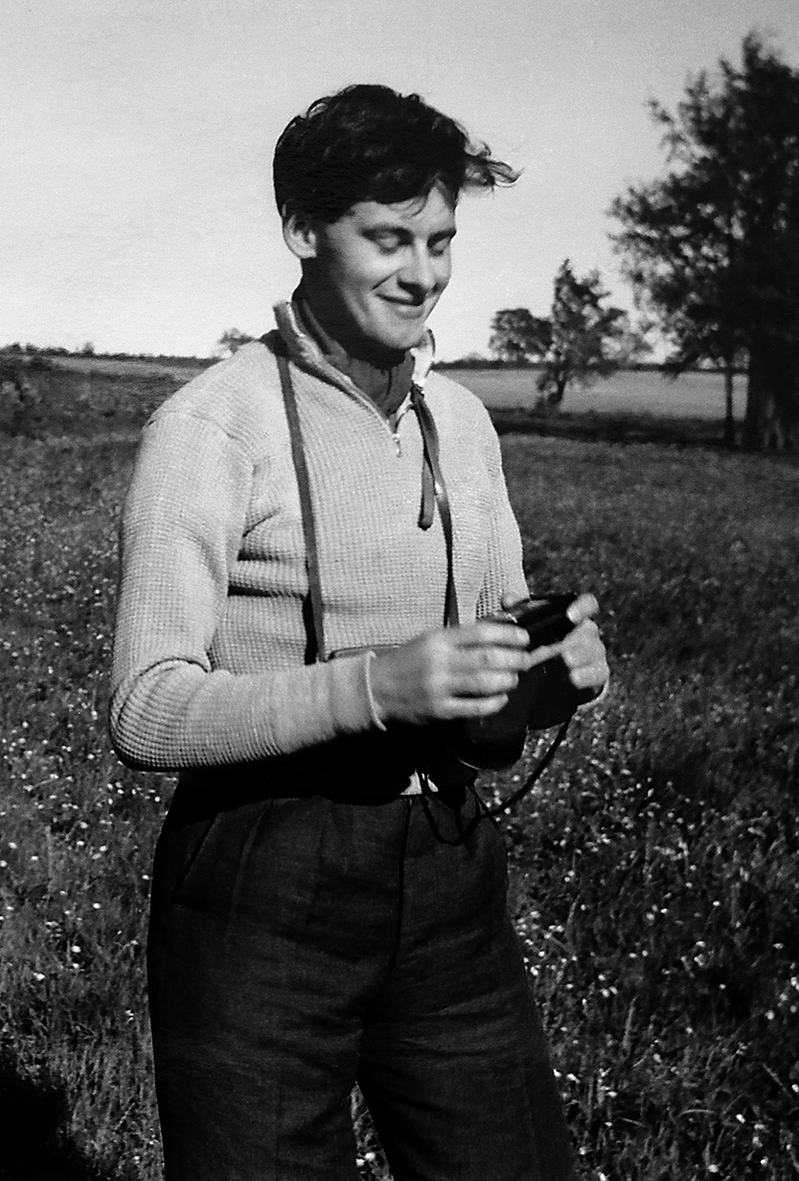
With the departure of John Ellis Jones, the study in North Wales, at university level, of the cultures of the Greeks and Romans and their history, archaeology and literature has come to an end – at least for the present. John was a classical scholar and archaeologist of international renown, and an inspirational communicator of his subject in his home country, ‘a figure of such immense charm’, as a senior ancient historian wrote to one of us. All who met him will remember his powerful, modulated voice; his conversation punctuated frequently by an enthusiastic ‘Oh yes?’; and the sense he gave of enjoying everything he did, which was quite contagious (Fig. 1).
John in the 1950s (by Renée). Courtesy Angharad Ellis Jones.

Born and brought up in Llanrwst, Denbighshire, below the eastern outliers of Eryri/Snowdonia, John – often addressed by his middle name, Ellis – was the second of three sons born to Margaret Ann Jones, a farmer’s daughter, and Evan Jones, deputy headmaster and teacher of botany at Llanrwst Grammar School, who died shortly after retiring when John was just 16. After benefiting from the tuition of the learned classicist H. Parry Jones, the school’s headmaster until 1946, John enrolled the following year at University College of North Wales, Bangor (now Bangor University), some 15 miles from his birthplace as the crow flies. The College’s Principal, Sir Emrys Evans, was the leader of a fine team of classical teachers. Graduating with Firsts in Latin (1950) and Greek (1951), John then gained a teaching qualification in the College’s Department of Education (1952).
The following five years, up to the time when John secured his first university post, were highly formative for him. He was attracted to field archaeology and, under the direction of V.E. Nash-Williams, took part in excavations of Roman military sites in Wales, aided by his exceptional energy and his love of venturing to out-of-the-way places by bicycle or on foot. He continued to work on such sites into the 1960s and returned to this field in his last publications. He even began doctoral research at Cardiff, but found the subject of Roman fortresses and camps in Britain too wide to complete to his satisfaction.
A life-changing opportunity had arisen in 1952, when he won a scholarship to visit Greece. The country was just opening up to outsiders after the tragic Civil War of 1946–9, so that young visitors from the wider world were still a rarity. This visit established his enduring links with the British School at Athens, and it was during this trip that John met his lifelong friend and collaborator Hugh Sackett (1928–2020) (see A. Ellis Jones, C. Ellis Jones and R.C. Ellis Jones Reference Ellis Jones, Ellis Jones, Ellis Jones, Driessen and Knappett2022; R.A. Sackett Reference Sackett, Driessen and Knappett2022). In Hugh’s company, he familiarised himself with the main archaeological sites of the Greek mainland and islands, until he shifted his particular focus to involvement in projects in Attica. An extended visit in 1954–5, funded by a Kimberley Travelling Fellowship, enabled him to visit schools throughout Greece and study contemporary methods of education. He also travelled widely with Hugh to visit archaeological sites with a view to possible joint projects.
The first visit in 1952 had been life-changing in a more important way, too. Travelling out to Greece on the Orient Express, John met two young female teachers who boarded the train in Croatia after being thwarted in their attempts to hitchhike across Yugoslavia by the lack of cars. One was called Helen Dixon. The other had been born in Luxembourg but brought up across the border in Germany, at Iserlohn in Nordrhein-Westfalen. This was Ilse Renée (or Renate) Radau-Eckstein (1927–2016), with whom John maintained a relationship through the mid-1950s while she was teaching at independent schools: first Hatherop Castle School, Gloucestershire, and later Downham School (closed c. 1967), Essex.
At the end of a year’s National Service in the Royal Army Educational Corps (1956–7), during which John was largely based at Kettering in Northamptonshire (and for a time at Catterick in the North Riding of Yorkshire), he gained a temporary position at the newly chartered University of Leicester in 1957. Classics had been a strong subject within the University since its foundation as the University College of Leicester, Leicestershire, & Rutland in 1921 (renamed University College Leicester in 1929). The department was led by its first Professor, Philip Leon (1895–1974), who had taught there since 1923 and been promoted in 1955. At the same time as John, there arrived Duncan Cloud (1930–2020), who had himself done National Service as an educator in the Army and later became the last head of Classics at the University (Shipley and Millett Reference Shipley and Millett2020).
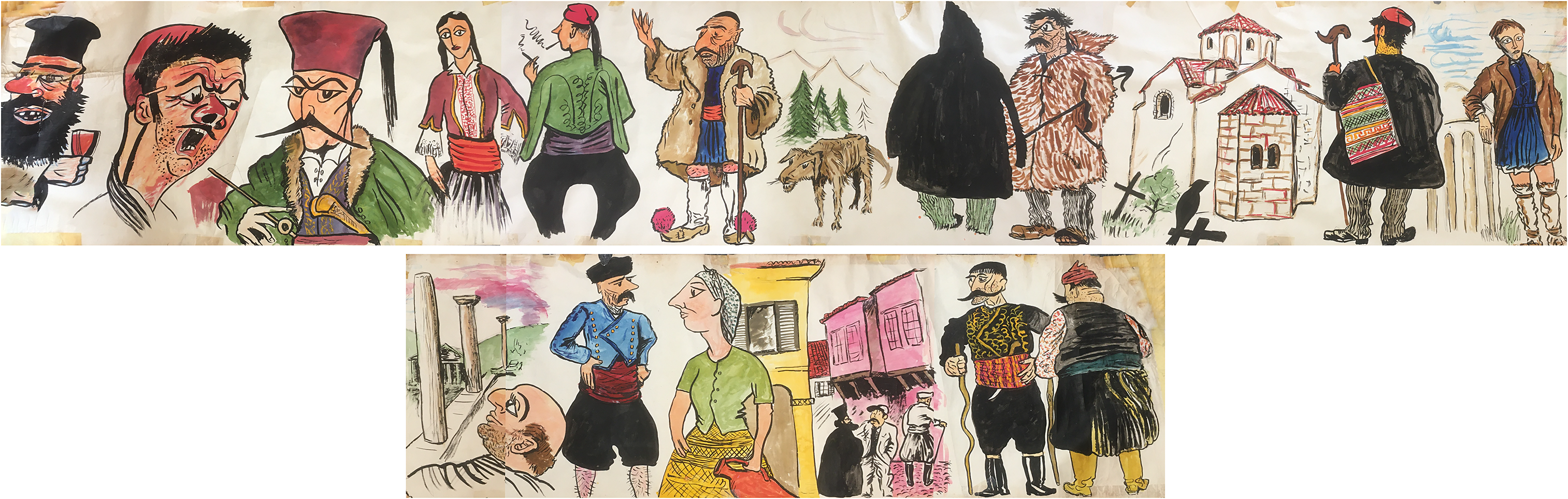
During the academic year 1957–8, John lived in a student residence in Oadby, then as now named Gilbert Murray Hall, where he was a warden. A banner drawn by him on paper for a party belongs to this happy period (Fig. 2), and shows John’s acute observation of the people he was meeting in Greece, in some cases using figures adapted from Osbert Lancaster (cf. Lancaster Reference Lancaster1947). Though he stayed at Leicester only one year, John kept up close ties with the University until well into retirement, and returned several times to give talks to the Classical Association branch and the students, as well as for social visits.
Composite image of the banner drawn by John for a party during his year in Leicester. Original photographs by Elen Simpson (Archives & Special Collections, Bangor University); composite by D. Graham J. Shipley.

At the end of this year, John moved to a permanent post at Bangor, where he spent the rest of his career, rising to be Senior Lecturer (as many academics did, promotion to the rank of professor being much rarer than today). Perhaps now feeling financially secure, John married Renée in July 1958 at the registry office in Great Dunmow, Essex (a state-approved civil service being a German legal requirement for recognising a marriage at the time), and in August in church at her home town of Iserlohn. Their union was blessed with the births of Angharad, Rhodri and Catrin and was characterised by an incomparable verve and happiness. Renée participated in his archaeological expeditions, and they were married for 58 years. The family home in Sling, Tregarth, became a magical fusion of Welsh, German and Greek cultures; their welcome to a host of visitors was proverbial. The writer Angharad Price, who was taught German by Renée, beautifully captures the unique atmosphere of the Joneses’ household at Fronheulog in her volume of essays entitled Ymbapuroli (‘empaperment’; Price Reference Price2020).
John would serve 37 years at Bangor up to his retirement. His career there was not ended by the controversial decision, taken in 1988 in the wake of a government review, to close the Department of Classics (along with those at Aberdeen, Aberystwyth, Birkbeck, Hull, Lancaster, Leicester, Sheffield and Southampton) – purportedly justified by ‘rationalisation’ and the creation of ‘centres of excellence’ elsewhere. (Several of the unfortunate units have since, of course, thrived as centres of classical excellence under other names than ‘Classics’.) Instead, John, now aged 58, chose to remain in post at Bangor while several of his colleagues transferred to Durham. By doing so, he enabled existing Classics students to complete their first degrees, master’s and doctorates, and then taught classical studies, ancient history, Greek archaeology and classical drama in departments such as English and History.
Almost single-handedly, therefore, he ensured the survival of Classics at Bangor, as a knowledgeable and enthusiastic educator. It was painful for John to see Greek (to quote the poet D. Gwenallt Jones) ‘being mortally wounded in the bastions of learning … the classics wasting away’. But becoming bitter was not in John’s character, and he remained an indefatigable organiser of extra- and intramural events, all promoting various aspects of his subject. Until the 1980s, he ran day-schools in Latin for school pupils and their teachers at the University. For a decade or more, he produced annual performances of Greek and Roman dramas with Joan Haldane, and continued to arrange regular meetings of the Bangor branch of the Classical Association (CA), which he ran for half a century with the most active programme of all CA branches. Each speaker who had the pleasure of travelling to Bangor to talk to the students remembers with fondness and pride the posters, hand-drawn by John, that publicised their visits. These works of art, and much other material, now reside within the archives of Bangor University. In addition, John continued for many years to travel to other universities to give CA lectures.
He had also been curator of the local museum at Bangor for 15 years or so, playing a central role in organising an exhibition to celebrate the University’s centenary in 1984, and designing the mace, among other things ( G 5). He was involved in many local history societies and wrote articles on a wide range of historical and other subjects, the last published in 2023.
In early and even middle life, John was quite an athlete, playing soccer and cricket for his school and continuing to play rugby for the University’s 2nd XV until he was 40. He also made amazingly long bike journeys, once riding well over 200 miles from Llanrwst to London to visit a friend. He even took up fencing shortly before retiring in his late sixties, and was soon representing Wales on the veterans’ (over-45s’) team. He continued competing until he was over 80, and went on doing bouts and umpiring until his late eighties. Those who attended his 80th birthday celebration in Bangor will recall the University’s Fencing Club forming a guard of honour for him and Renée.
John published relatively prolifically by the standards of UK Classics at the time. His research interests coincided closely with those of his senior colleague at Bangor, R.E. Wycherley, the Professor of Greek, who worked with the American archaeologists at the Athenian Agora and had already published his influential How the Greeks Built Cities (Wycherley Reference Wycherley1949).Footnote 1 John’s own publications include two short books, The Greeks (1971: A 1) and Ancient Greece (1983: A 5), both of which succeed in making Greek antiquity accessible to a wider readership. The Greeks includes a lengthy and inspiring chapter on the excavations at Vári (of which more below), which brings to life – as no data report can – the experience of digging the same site year on year, as well as the gradual discovery of its character. Ancient Greece offers deeply considered characterisations (with some 60 memorable illustrations by David Salariya and Shirley Willis, and photographs by John and others) on the key sites of Mycenae, Athens, Olympia and Delos.
Despite having started as a linguistic scholar, John expanded his analytical skills to range from inscriptions and pottery to ancient metallurgy and the Greek house. Throughout the Bangor years, he conducted archaeological research in Attica – usually in summer vacations as well as during sabbaticals in 1966, 1973 and 1980 – when he would drive the family across Europe in a VW camper van. From the late 1950s onwards, John became widely known for his co-directorship of important excavations of rural dwellings – notably the Dema House (1958–60, published with admirable promptness in 1962: B 2) and the Vari House (1966, published 1973: A 2; B 3) – and later of silver-processing installations in the remote countryside south-east of Athens, especially at Agrileza near the ancient deme of Thorikos. It is believed he was the first excavator to involve a metallurgist in a Greek excavation from the beginning of the project.
The importance of this fieldwork, and of the publication of these excavations in those decades, cannot be overstated. Despite important work by French scholars on the demes of Attica and the Athenian silver mines in the late nineteenth century, anglophone scholars had traditionally treated Athens as if it was just a town, considering the countryside only in as far as it was the site for battles. Robert Hopper, at Sheffield, had, in the 1950s and 1960s, drawn attention to the importance of the Laurium silver mines and of relations between town and country for the history of archaic Athens in two influential articles in BSA (Hopper Reference Hopper1953; Reference Hopper1968), and had devoted his inaugural lecture as Professor at Sheffield to the Attic demes; but despite the tradition, particularly at the American School of Classical Studies at Athens, of taking students on Saturday expeditions into Attica, archaeological work in the Attic countryside had been practically limited to sanctuary and cemetery sites. The work of John and his colleagues on the Dema and Vari houses, and then at Agrileza, changed all that. It led to a radical rethinking of our understanding of the Attic countryside and the Athenian economy, and played an important part in inspiring the archaeological revolution that was brought in with the intensive surface survey methods pioneered by archaeologists from the British School on Melos and by others from the American School in the southern Argolid.
Perhaps John’s most enduring and oft-consulted publication is the co-authored article – often known simply as ‘Jones, Sackett and Graham’ – that occupies 98 pages of the BSA for 1973 ( B 3) and was shortly afterwards reprinted in hardbound form ( A 2). It details the epoch-making discoveries at Vari, on the southern slopes of Hymettos, that resulted from the excavation of a Classical courtyard farmhouse with multiple rooms and an outer enclosure. Pottery finds, and pioneering chromatographic analyses, proved that beekeeping had been practised on a substantial scale using ceramic beehives.
John’s particular contribution to scholarly understanding of Athenian society and economy was twofold. The first was to bring to the attention of historians and archaeologists alike the importance of the archaeological evidence for housing, both in the countryside and in the town. Crucial here was the paper on ‘Town and country houses of Attica in Classical times’ given at a conference in Ghent in 1973 and published as an extensive 73-page article, well illustrated with line drawings, in 1975 ( D 2). The paper put the archaeological evidence for housing on the map and established the agenda of questions to ask. John’s second contribution was to serious understanding of the process of silver mining. The ancient literary and epigraphic texts, on which Hopper’s and earlier studies had been substantially based, offered no enlightenment as to how the silver was extracted from the ore. John’s work at Agrileza and the successive publications from the late 1970s onwards ( B 5, C 6–22, 24–7, D 4–9, F 6, 14–15, 17–19) were – with the work of the Greek mining engineer turned Professor of Chemical Engineering, Constantine Conophagos, who published in French – pioneering in the understanding of how ‘washeries’ worked.
He was also occupied with projects in Crete and the Peloponnese. His final publication in Greek archaeology, a volume on surface survey data gathered in 1969 from an area within Eleia (north-west Peloponnese) that was about to be flooded as a result of the construction of a dam, appeared as recently as 2016 ( A 10, cf. F 23).
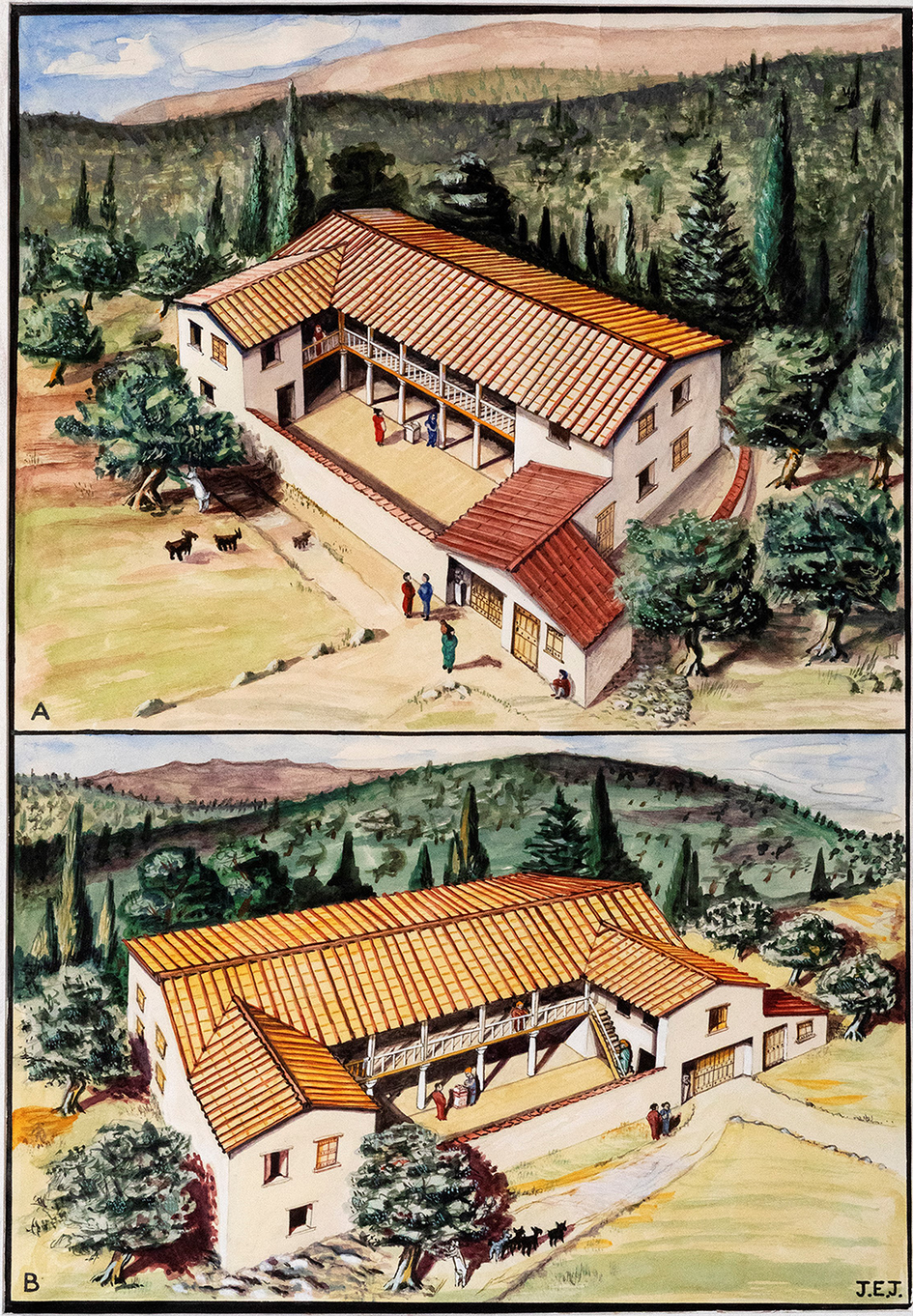
John was a skilled artist and embellished his publications with reconstruction drawings of houses and other structures, often set in a realistic countryside (Fig. 3). His meticulous reports, not to mention his capacity to inspire and mentor young archaeologists, attest to the importance of his contributions.
The Vari House, by John. Courtesy Angharad Ellis Jones. (A) Aerial view from east. (B) Aerial view from south.

John also contributed to what we would now call Outreach not only through his many accessible publications but also through the broadcast media. On one occasion, he was interviewed for radio in Welsh by the cultured, and now highly distinguished, broadcaster Hywel Gwynfryn, MBE, about the Laurion and the Attic silver-processing industry.
Outside the University, John was active in local societies and wrote many papers on local history and archaeology, the majority of them in his native language; the last appeared in 2023 ( G 31). His last public event was in 2019, when he chaired a meeting of the (Welsh-medium) Classical Section of the University of Wales Guild of Graduates, at the National Eisteddfod held – so appropriately! – in John’s birthplace, Llanrwst. There was a large attendance, and John was in fine form. He had been a founder member of the Section in 1951 and its Treasurer from then until 1992, when he became its Chair. Much enjoyment was had during meetings at the National Eisteddfod, at Gregynog (the University of Wales’s cultural, educational and artistic centre), and at one-day schools, held in Welsh, over all those years ( G 18–19). In the name of the Section, he published a great deal in Welsh: principally a detailed introduction and extensive notes to accompany the Welsh translation of Tacitus’ Life of Agricola by A.O. Morris, another former pupil of Llanrwst Grammar School ( D 1).
John’s achievements earned him Fellowship of the Society of Antiquaries of London and election as Vice-President of the Classical Association, a rare honour for one who had not previously held high office in the organisation. It was a richly deserved recognition of his remarkable efforts in maintaining the vitality of the Bangor & North Wales Branch for half a century.
John died after a fall at the age of 93. He is survived by his daughters and son, as well as a grandson, Gruff Morgan. His funeral, in Welsh and English, took place in Capel Seion at his birthplace of Llanrwst on 20 February 2023.
We shall not see his like again. But, to cite a Welsh version (by the poet T. Gwynn Jones) of the words of Callimachus, ‘na ddyweded undyn mai bedd yw diwedd y da’: ‘let no one say the grave is the end of the good’ (Gwynn Jones and Rose Reference Gwynn Jones and Rose1927, 73).
WORKS BY JOHN ELLIS JONES
Abbreviations
Anglesey Transactions = Transactions of the Anglesey Antiquarian Society and Field Club – Trafodion Cymdeithas Hynafiaethwyr a Naturiaethwyr Môn
Caernarvonshire Transactions = Trafodion Cymdeithas Hanes Sir Gaernarfon – Transactions of the Caernarvonshire Historical Society
Denbighshire Transactions = Trafodion Cymdeithas Hanes Sir Ddinbych – Transactions of the Denbighshire Historical Society
Merioneth Journal = Cylchgrawn Cymdeithas Hanes a Chofnodion Sir Feirionnydd – Journal of the Merioneth Historical and Record Society
A. Books and pamphlets
-
(1) 1971. The Greeks (The Young Archaeologist). London and New York: Rupert Hart-Davis Educational Publications/G.P. Putnam’s Sons. Pp. 128.
-
(2) 1974. (1st author with A.J. Graham and L.H. Sackett) An Attic Country House below the Cave of Pan at Vari (BSA Supp. Vol. 11). London: Thames & Hudson. Unaltered reprint of B 3. Pp. 100.
-
(3) 1976. (2nd editor with D.G. Jones) B’le mae Ewrop? [Where is Europe?] (Cwmpas 1). Denbigh: Gwasg Gee. Pp. 138.
-
(4) 1982. (2nd editor with D.G. Jones) Llwyfannau [Stages] (Cwmpas 2). Caernarfon: Gwasg Gwynedd. Pp. 70.
-
(5) 1983. Ancient Greece (History as Evidence). London: Kingfisher Books. Pp. 37. [Paperback edition 1992.]
-
(6) 1985. (2nd editor with D.G. Jones) Bosworth a’r Tuduriaid [Bosworth and the Tudors]. Caernarfon: Gwasg Gwynedd. Pp. 81.
-
(7) 1988. (ed.) Aspects of Ancient Mining and Metallurgy: Acta of a British School at Athens Centenary Conference, Bangor 1986. Bangor: Department of Classics, University College of North Wales. Pp. 154.
-
(8) 1996. ‘Lle pyncid cerddi Homer a Virgil geinber gynt’: trem ar addysg y gorffennol yn Ysgol Rad Llanrwst. Darlith gyhoeddus a draddodwyd yn Eisteddfod Genedlaethol Bro Colwyn Llun Awst 7 1995 [‘Where the Poems of Homer and Vergil Were Once Sung’: A Look at the Education of the Past at Llanrwst Free School. A Public Lecture Delivered at the National Eisteddfod, Bro Colwyn, Monday August 7 1995]. Bangor: Cymdeithasfa Glasurol, Cangen Bangor a Gogledd Cymru [Classical Association, Bangor & North Wales Branch]. Pp. 27.
-
(9) 1997. (ed.) J. Gwyn Griffiths, Cenedlaetholdeb a’r Clasuron [Nationalism and the Classics]: University of Wales Guild of Graduates Centenary Lecture, Gregynog, 1994. Bangor: Classical Section of the University of Wales Guild of Graduates. Pp. 16.
-
(10) 2016. (1st author with O. Kouka) Elis 1969: The Peneios Valley Rescue Excavation Project. British School at Athens Survey 1967 and Rescue Excavations at Kostoureika and Keramidia 1969. Oxford: Archaeopress. Pp. 184.
B. Final reports on Greek archaeological projects
-
(1) 1957. (1st author with L.H. Sackett and C.W.J. Eliot) “Τὸ Δέμα: a survey of the Aigaleos–Parnes wall”, BSA 52, 152–89, pls 30–5.
-
(2) 1962. (1st author with L.H. Sackett and A.J. Graham) ‘The Dema House in Attica’, BSA 57, 75–114, pls 21–31.
-
(3) 1973. (1st author with A.J. Graham and L.H. Sackett) ‘An Attic country house below the cave of Pan at Vari’, BSA 68, 355–452, pls 63–86. Reprinted as A 2.
-
(4) 1992. (2nd author with L.H. Sackett et al.) ‘Excavation and architecture’, in L.H. Sackett, Knossos from Greek City to Roman Colony, vol. 1: Text (Excavations at the Unexplored Mansion 2; BSA Supp. Vol. 21). London: British School at Athens/Thames & Hudson. Pp. 1–58 (ch. 1).
-
(5) 1994. (2nd author with E. Photos-Jones) ‘The building and industrial remains at Agrileza, Laurion (fourth century bc) and their contribution to the workings at the site’, BSA 89, 307–58.
C. Preliminary reports on Greek archaeological projects
Indexed by titular year. The actual year of publication, if different, is in [ ] square brackets.
-
(1) 1960. (1st author with L.H. Sackett, A.J. Graham) ‘Dema House excavations’, ArchDelt 16 (Β') [1962], 42.
-
(2) 1963. ‘A country house in Attica’, Archaeology 16.4, 276–83.
-
(3) 1967. (1st author with A.J. Graham, L.H. Sackett) ‘Brief account of cleaning operations at a Classical house site near Vari in Attica’, ArchDelt 22 (Β').1 [1968], 136–7.
-
(4) 1970. ‘Excavations in the Peneios valley’, ArchDelt 25 (Β').1 [1972], 197.
-
(5) 1975. ‘Another country house in Attica’, Archaeology 28, 6–15.
-
(6) 1977. ‘Industrial sites in the Agrileza valley, Laurion’, ArchDelt 32 (Β').1 [1984], 43–5.
-
(7) 1977–8. ‘Laurion: Agrileza valley’, AR 24, 13–15.
-
(8) 1978. ‘Agrileza valley’, ArchDelt 33 (Β').1 [1985], 60–2.
-
(9) 1978. ‘Vallée d’Agrileza’, BCH 102.2: Chroniques, 650–2.
-
(10) 1978–9. ‘Laurion: Agrileza’, AR 25, 6–7.
-
(11) 1979. ‘Laurion: industrial site in the Agrileza valley’, ArchDelt 34 (Β').1 [1987], 111–14.
-
(12) 1979. ‘Ore-washeries of the Laurium, Attica’, in J.N. Coldstream and M.A.R. Colledge (eds), Greece and Italy in the Classical World: Acta of the XI International Congress of Classical Archaeology. London: The National Organizing Committee. P. 253.
-
(13) 1979. ‘Vallée d’Agrileza’, BCH 103.2: Chroniques, 542–5.
-
(14) 1979–80. ‘Laurion: Agrileza’, AR 26, 17–19.
-
(15) 1980. ‘Vallée d’Agrileza, fouilles de l’École britannique’, BCH 104.2: Chroniques, 583–5.
-
(16) 1981. ‘Laurion: the silver-mine site at Agrileza’, ArchDelt 36 (Β').1 [1988], 73–5.
-
(17) 1981. ‘Vallée d’Agrileza, fouilles de l’École britannique’, BCH 105.2: Chroniques, 534–6.
-
(18) 1981–2. ‘Laureion, Agrileza’, AR 28, 12–13.
-
(19) 1983. ‘An Athenian silver-mine ergasterion in the Laureotike’, in XIIe Congrès international d’archéologie classique: résumés des communications. Athens: Ypourgeio Politismou, Tameio Archaiologikon Poron kai Apallotrioseon. P. 100.
-
(20) 1984. ‘Agrileza, fouilles de l’École britannique’, BCH 108.2: Chroniques, 746–8.
-
(21) 1984–5. ‘Laurion, Agrileza, 1977–83: excavations at a silver-mine site’, AR 31, 106–23.
-
(22) 1988. ‘An Athenian silver-mine ergasterion at Agrileza in the Laureotike’, in Πρακτικὰ τοῦ XII διεθνοῦς συνεδρίου κλασικῆς ἀρχαιολογίας, Ἀθῆναι, 4–10 Σεπτεμβρίου 1983, vol. 4: Ἀρχιτεκτονική. Athens: Ypourgeio Politismou, Tameio Archaiologikon Poron kai Apallotrioseon. Pp. 269–72.
-
(23) 1990. ‘Ancient beehives at Thorikos: combed pots from the Velatouri’, in H.F. Mussche, J. Bingen, J.E. Jones and M. Waelkens, Thorikos IX, 1977–82: rapport préliminaire sur les 13º, 14º, 15º, et 16º campagnes des fouilles. Ghent: Comité des fouilles belges en Grèce. Pp. 63–71.
-
(24) 1995–6. ‘Agrileza’, AR 42, 4–5.
-
(25) 1996. ‘Agrileza’, Annual Report of the British School at Athens, 20–1.
-
(26) 1996–7. (1st author with E. Photos-Jones) ‘Agrileza’, AR 43, 10–11.
-
(27) 1997–8. ‘Agrileza’, AR 44, 12–13.
D. Chapters: Greek and Roman history and archaeology
-
(1) 1975. ‘Introduction’, ‘Notes’ and ‘Bibliography’, in D. Ellis Evans (ed.), Cofiant Agricola [Life of Agricola]. Cardiff: University of Wales Press. Pp. 1–124, 164–224, 225–32.
-
(2) 1975. ‘Town and country houses of Attica in Classical times’, in H.F. Mussche, P. Spitaels and F. Goemaere-De Poerck (eds), Thorikos and the Laurion in Archaic and Classical Times: Acta of a Colloquium at Ghent, Belgium, 26–29 March, 1973 (MIGRA—Miscellanea Graeca 1). Ghent: Belgian Archaeological Mission in Greece. Pp. 63–136 (discussion, 137–40).
-
(3) 1987. ‘Cities of victory: patterns and parallels’, in E. Chrysos (ed.), Nikopolis I: Proceedings of the 1st International Symposium on Nikopolis (23–29 September 1984). Preveza: Dimos Prevezas. Pp. 99–108.
-
(4) 1987. ‘The silver mines of Athens’, in B. Cunliffe (ed.), Origins: The Roots of European Civilisation. London and Chicago, IL: BBC Publications/Dorsey Press. Pp. 108–20 (ch. 8).
-
(5) 1988. ‘The Athenian silver mines of Laurion and the British School at Athens excavations at Agrileza’, in Aspects of Ancient Mining and Metallurgy (A 7 above). Pp. 11–24.
-
(6) 1991. ‘The planning and construction of Attic ergasteria’, in A. Hoffman, E.L. Schwandner, W. Hoepfner and G. Brands (eds), Bautechnik der Antike (Diskussionen zur archäologischen Bauforschung 5). Mainz: Deutsches Archäologisches Institut zu Berlin. Pp. 107–15.
-
(7) 1997. ‘Greek and Roman mines’, in B.M. Fagan (ed.), The Oxford Companion to Archaeology (Oxford Companions). New York: Oxford University Press. Pp. 471–2.
-
(8) 1998. ‘The three washeries at Agrileza in the Laureotike’, in Ἀργυρῖτις γῆ: χαριστήριο στον Κωνστανίνο Η. Κoνοφάγο. Athens: Panepistimiakes Ekdoseis tou Ethnikou Metsoviou Polytechneiou. Pp. 43–53.
-
(9) 2007. ‘ “Living above the shop”: domestic aspects of the ancient industrial workshops of the Laureion area of south-east Attica’, in R. Westgate, N.R.E. Fisher and J. Whitley (eds), Building Communities: House, Settlement and Society in the Aegean and Beyond (BSA Studies 15). London: British School at Athens. Pp. 267–80 (ch. 29).
-
(10) 2009. ‘Yr athronwyr Helenistaidd’ [‘The Hellenistic philosophers’], in J. Daniel and W.L. Gealy (eds), Hanes Athroniaeth y Gorllewin [A History of Western Philosophy]. Cardiff: University of Wales Press. Pp. 69–87. Reprint of 2001 paper; see F 21 below.
E. Chapters: Welsh history and archaeology
-
(1) 1969. ‘Bryn y Gefeiliau (Caern. SH746572)’, in V.E. Nash-Williams (ed.), rev. M.G. Jarrett, The Roman Frontier in Wales. Cardiff: University of Wales Press. Pp. 51–4.
-
(2) 1976. (2nd author with D.G. Jones) ‘Chwilio am Ewrop’ [‘Looking for Europe’], in B’le mae Ewrop? (A 3 above). Pp. 100–17.
-
(3) 1976. ‘Byd yr Orient Express’ [‘The world of the Orient Express’], in B’le mae Ewrop? (A 3 above). Pp. 121–38.
-
(4) 1979. Contributions to H. Thomas (ed.), Geiriadur Lladin–Cymraeg [Latin–Welsh Dictionary]. Cardiff: Gwasg Prifysgol Cymru.
-
(5) 1982. ‘Drama a theatrau’r henfyd a’u dylanwad’ [‘Ancient drama and theatres and their influence’], in Llwyfannau (A 4 above). Pp. 5–18.
-
(6) 1982. ‘Theatrau’r Adferiad a’r ddeunawfed ganrif ym Mhrydain’ [‘Theatres of the Restoration and the eighteenth century in Britain’], in Llwyfannau (A 4 above). Pp. 43–56.
-
(7) 1992. ‘Classics in a cold climate: tradition, change, continuity. Bangor, a case study’, in Proceedings of the 6th International Symposium on the Description and/or Comparison of English and Greek, Thessaloniki 15–17 April 1992. Thessaloniki: Department of Theoretical & Applied Linguistics, School of English, Aristotle University of Thessaloniki. Pp. 27–72.
F. Journal and magazine articles: Greek and Roman history, literature and archaeology
-
(1) 1970. ‘Imperial guards’, Proceedings of the Classical Association 67, 35–6.
-
(2) 1974. ‘Δύο ἀττικαὶ ἀγροτικαὶ οἰκίαι—Two Attic country houses’, Ἀρχαιολογικὰ ἀνάλεκτα ἐξ Ἀθηνῶν – Athens Annals of Archaeology 7, 293–313 (Greek at 293–303, English at 303–13).
-
(3) 1974. ‘Mêl Mynydd Hymettus’ [‘Mount Hymettus honey’], Y Gwyddonydd [The Scientist] 12.3, 110–14.
-
(4) 1975. Illustrations in A.J. Graham, ‘Beehives from ancient Greece’, Bee World 56.2, 64–75.
-
(5) 1976. ‘Hives and honey of Hymettus’, Archaeology 29.2, 80–91.
-
(6) 1976. ‘Laveries (ἐργαστήρια) sur la pente nord de la Haute Agrileza’, AntCl 45.1, 149–72.
-
(7) 1978. ‘Datblygiad cymdeithas drefol’ [‘The development of urban society’], Y Creu [The Creation] = Y Gwyddonydd [The Scientist] 16.2–3, 163–74.
-
(8) 1979. (3rd author with W.W. Phelps and G. Varoufakis) ‘Five copper axes from Greece’, BSA 74, 175–84.
-
(9) 1979. (2nd author with L.H. Sackett) ‘Knossos: a Roman house revisited’, Archaeology 32.2, 18–27.
-
(10) 1979. ‘Peinture d’une maison romaine à Knossos en Crète [résumé]’, Le Courrier du CNRS (31 Jan.), 79.
-
(11) 1981. ‘Archaeoleg diwydiannol yr oes glasurol: mwyngloddiau arian dinas Athen, I. Daeareg a dull y cloddio’ [‘Industrial archaeology of the Classical age: silver mines of the city of Athens, I. Geology and method of excavation’], Y Gwyddonydd [The Scientist] 19.3, 87–92.
-
(12) 1982. ‘Another Eleusinian kernos from Laureion’, BSA 77, 191–9.
-
(13) 1982. (1st author with Rhodri C. Ellis Jones) ‘Archaeoleg diwydiannol yr oes glasurol: mwyngloddiau arian dinas Athen, II. Trin y mwyn crai’ [‘Industrial archaeology of the Classical age: silver mines of the city of Athens, II. The treatment of the raw ore’], Y Gwyddonydd [The Scientist] 20, 63–8 and 77.
-
(14) 1982. ‘The Laurion silver mines: a review of recent researches and results’, GaR 29, 169–83.
-
(15) 1983. ‘Archaeoleg diwydiannol yr oes glasurol: mwyngloddio arian dinas Athen, III. O’r mwyn i’r metel’ [‘Industrial archaeology of the Classical age: silver mining of the city of Athens, III. From the ore to the metal’], Y Gwyddonydd [The Scientist] 21, 61–8.
-
(16) 1983. ‘Berlin conference on “Living in the Classical City”’, LCM 8, 115–18.
-
(17) 1984. ‘Ancient Athenian silver-mines, dressing floors and smelting sites’, Historical Metallurgy 18.2, 65–81.
-
(18) 1987. ‘Eine Erzwaschanlage in Agrileza: britische Ausgrabungen im attischen Silberbergbaugebiet von Laurion’, Der Anschnitt: Zeitschrift für Kunst und Kultur im Bergbau 39.4, 142–52.
-
(19) 1999. (1st author with S. Lambert) ‘Two security horoi from an ore-washery at Agrileza, southern Attica’, ZPE 125, 131–6.
-
(20) 2001. (2nd author with S. Ebbinghaus) ‘New evidence on the von Mercklin class of rhyta: a black-gloss rhyton from Agrileza, Laureion, Attica’, BSA 96, 381–94.
-
(21) 2001. ‘Yr athronwyr Helenistaidd’ [‘The Hellenistic philosophers’], Efrydiau Athronyddol [Philosophical Studies] 64, 68–87. [Reprinted as D 10 above.]
-
(22) 2002. (2nd author with V.R. Anderson-Stojanović) ‘Ancient beehives from Isthmia’, Hesperia 71.4, 345–76.
-
(23) 2016. ‘Before the flood: rescue excavations’, Argo 3, 15–18.
-
(24) 2016. ‘Euripides of Bangor’, Argo 4, 22–3.
-
(25) 2018. ‘An ancient Maginot Line’, Argo 7, 14–17.
G. Journal and magazine articles: Welsh history and archaeology
-
(1) 1977–8. ‘A Roman coin from Dinas near Porth Dafarch, Holyhead’, Anglesey Transactions 159–61.
-
(2) 1983. ‘A Penmaenmawr quern returned’, Caernarvonshire Transactions 44, 167–71.
-
(3) 1983. ‘A Roman coin hoard from Menai Bridge’, Anglesey Transactions 15–29.
-
(4) 1984. ‘Bedd Angharad James o Benamnen, Dolwyddelan’ [‘The grave of Angharad James of Penamnen, Dolwyddelan’], Caernarvonshire Transactions 45, 130–7.
-
(5) 1984. ‘Sketch and note of the new mace’, Y Bangoriad [alumni magazine] 3.12 (Aug.), 5.
-
(6) 1985. ‘The Museum of Welsh Antiquities: a centenary note’, Y Bangoriad 1985 [alumni magazine], 44–7.
-
(7) 1985. ‘The Museum of Welsh Antiquities, Bangor: work on the collections and exhibitions, an archaeological catalogue and recent archaeological accessions’, Archaeology in Wales 25, 5–7.
-
(8) 1985. ‘A stone axe from Llanddoget, Llanrwst’, Caernarvonshire Transactions 46, 133–5.
-
(9) 1985. ‘A Roman milestone re-exhibited: the Severan milestone from Rhiwgoch, Aber, and other milestones on the Roman road between Conovium and Segontium’, Caernarvonshire Transactions 46, 151–60.
-
(10) 1985. ‘A stone axe from Mynydd Bychan, Aberdovey’, Merioneth Journal 10.1, 36–7.
-
(11) 1986. ‘A silver sixpence of Edward VI (1547–1553) found at Bangor’, Caernarvonshire Transactions 47, 121–5.
-
(12) 1987. ‘Two Romano-British bronze oxhead bucket-handle mounts from Dinas, Holyhead’, Anglesey Transactions 19–26.
-
(13) 1990. ‘Roman coins from Cemais on the North Anglesey coast’, Anglesey Transactions 14–21.
-
(14) 1994. ‘Crimean medals: a museum note. A Bangor veteran and the nineteenth-century British army’, Caernarvonshire Transactions 55, 71–107.
-
(15) 2005. ‘A punch bowl in the ceramic collection of the University of Wales, Bangor: vanished dreams of military glory and the reality of eighteenth-century recruitment’, Caernarvonshire Transactions 66, 55–83.
-
(16) 2007. ‘Llanrwst Grammar School: a century of clerical and classical headmasters’, Denbighshire Transactions 55, 96–125.
-
(17) 2008. ‘Traddodiad clasurol Bangor: trem ar adrannau clasurol Coleg Prifysgol Gogledd Cymru, Bangor’ [‘Bangor’s classical tradition: a look at the classical departments of University College of North Wales, Bangor’], Y Traethodydd [The Essayist] 163.685, 92–110.
-
(18) 2009. ‘Classical one-day schools at Bangor: glimpses at a bye-gone age’, Caernarvonshire Transactions 70, 132–43.
-
(19) 2009. ‘Ysgolion undydd clasurol Bangor [‘Bangor’s classical one-day schools’] (1959–1986)’, Y Traethodydd [The Essayist] 164.690, 157–67.
-
(20) 2010. ‘Classical play productions at UCNW, Bangor’, Caernarvonshire Transactions 71, 149–61.
-
(21) 2011. ‘Llanrwst Grammar School: a postscript’, Denbighshire Transactions 59, 155–74.
-
(22) 2012. ‘Arysgrif: nodyn am ddechrau achos crefyddol ym mhentref Tregarth, ger Bangor, a’i ddiwedd’ [‘Inscription: note about the beginning and end of a religious cause in the village of Tregarth, near Bangor’], Caernarvonshire Transactions 73, 28–34.
-
(23) 2012. ‘Two late seventeenth-century Welsh chests, one pair of hands?’, Merioneth Journal 16.3, 230–46, figs 1–2.
-
(24) 2013–14. ‘Dau gastell Dolwyddelan [Two Dolwyddelan castles]: in memoriam fratris, W.G.J. (1927–2000)’, Caernarvonshire Transactions 74–5, 15–35.
-
(25) 2014. (1st author with Angharad Stockwell) ‘Tomen Castell, Dolwyddelan, Gwynedd, North Wales: excavations at an early castle site’, Archaeoleg yng Nghymru – Archaeology in Wales 54, 73–90.
-
(26) 2015. ‘Bangor’s first theatre?’, Caernarvonshire Transactions 76, 19–34.
-
(27) 2015. ‘Hanes diwedd yr achos yn Nhanycelyn M.C., Dyffryn Conwy’ [‘The story of the end of the cause in Tanycelyn M.C., Dyffryn Conwy’], Denbighshire Transactions 63, 99–110. [M.C. = Methodistiaid Calfinaidd, ‘Calvinistic Methodists’.]
-
(28) 2018–19. ‘Pen-y-Gwryd: y gaer Rufeinig wrth odre’r Wyddfa’ [‘Pen-y-Gwryd: the Roman camp at the foot of Snowdon’], Caernarvonshire Transactions 78, 21–30.
-
(29) 2019. ‘Llanrwst Grammar School: headmasters of the seventeenth and eighteenth centuries’, Denbighshire Transactions 67, 33–83.
-
(30) 2020. ‘The Roman “marching camp” at Pen-y-Gwryd at the foot of Snowdon: investigations 1960–1962. In mem. fratris, Hywel Wyn Jones (1944–2019)’, Archaeology in Wales 60, 37–44.
-
(31) 2023. ‘A roll-call of classicists: a shorter history of classical staff at the University College of North Wales, Bangor, 1884–1995’, Caernarvonshire Transactions 79, 121.
H. Encyclopaedia entries
-
(1) 1996. ‘Bee-keeping’, OCD³ 237. (Reprinted in OCD⁴ 227.)
-
(2) 1996. ‘Laurium’, OCD³ 822. (Reprinted in OCD⁴ 800.)
-
(3) 1996. ‘Metallurgy, Greek’, OCD³ 965–6.
-
(4) 1996. ‘Mines and mining, Greek’, OCD³ 984. (Reprinted in OCD⁴ 957–8.)
-
(5) 1996. ‘Thoricus’, OCD³ 1514. (Reprinted in OCD⁴ 1470.)
-
(6) 1998. ‘Mines and mining, Greek’, in S. Hornblower and A.J.S. Spawforth (eds), The Oxford Companion to Classical Civilization. Oxford: Oxford University Press. Pp. 467–8.
I. Reviews
-
(1) 1975. Sinos, Die vorklassischen Hausformen in der Ägäis. In JHS 95, 280.
-
(2) 1976. Ward Perkins, Cities of Ancient Greece and Italy: Planning in Classical Antiquity. In JHS 96, 224.
-
(3) 1980. Spitaels et al., Thorikos VII, 1970–1: rapport préliminaire sur les septième et huitième campagnes des fouilles. In JHS 100, 265.
-
(4) 1983. Papageorgiou-Venetas, Délos: recherches urbaines sur une ville antique. In JHS 103, 217.
-
(5) 1983. Spitaels, Studies in South Attica I. In JHS 103, 218.
-
(6) 1984. Crane, The Archaeology of Beekeeping. In AntJ 64, 428–9.
-
(7) 1989. Osborne, Classical Landscapes with Figures: The Ancient Greek City and its Countryside. In JHS 109, 249–50.
-
(8) 1990. Hoepfner and Schwandner, Haus und Stadt im klassischen Griechenland. In JHS 110, 263–4.
-
(9) 1990. Kolb, Die Stadt im Altertum. In JHS 110, 264–5.
-
(10) 1991. Tomlinson, Greek Architecture. In CR 41, 258–9.
-
(11) 1995. Crouch, Water Management in Ancient Greek Cities. In JHS 115, 220–1.
-
(12) 1996. Tölle-Kastenbein, Das archaische Wasserleitungsnetz für Athen. In JHS 116, 226–7.
-
(13) 1996. Shepherd, Ancient Mining. In JHS 116, 227–8.
J. Obituaries
-
(1) 1985–6. Obituary notice of Professor R.E. Wycherley. Annual Report of the British School at Athens 45–6.
-
(2) 1987–8. Dr R.A. Browne. The Caian 132–3.
-
(3) 1989. Dr C. Bullock-Davies. Y Bangoriad [alumni magazine] 54–5.
-
(4) 2006. A.J. Graham. Annual Report of the British School at Athens 56–7.
Corrigendum to an earlier bibliography
The note in BSA 63 (1968) attributed to JEJ at Sekunda (ed.) 2010, 10, is by J.R. Ellis.
WORKS ABOUT JOHN ELLIS JONES
Festschrift
Sekunda, N.V. (ed.) 2010. Ergasteria: Works Presented to John Ellis Jones on His 80th Birthday (Akanthina 4). Gdańsk: Project/Institute of Archaeology, Gdańsk University.
Memoirs
Davies, Ceri. 2010. ‘Cambrian Euripides: three Welsh-language versions of the Alcestis’, in Sekunda 2010 [above], 178–88, esp. p. 178.
Davies, Ceri. 2023. ‘John Ellis Jones: 1929–2023. Ysgolhaig clasurol ac archeolegydd a gydnabyddid yn gydwladol ac a fu’n lladmerydd egnïol i’w bwnc yng Nghymru’ [‘… Internationally recognised classical scholar and archaeologist who was a vigorous advocate of his subject in Wales’], Barn [Opinion], Mawrth [March], 37.
Ellis Jones, Angharad. 2023. ‘John Ellis Jones obituary’, The Guardian, 23 Apr. (available online <www.theguardian.com/theguardian/2023/apr/23/john-ellis-jones-obituary> accessed July 2024)
Ellis Jones, Angharad, Ellis Jones, Catrin and Ellis Jones, Rhodri C. 2022. ‘Hugh and John Ellis Jones’, in J.M. Driessen and C. Knappett (eds), Megistos Kouros: Studies in Honour of Hugh Sackett (Aegis 23), pp. 36–8.
Ellis Jones, Rhodri C., Price, Angharad and Ros, Manon Steffan (eds). 2024. Cofion [Memories]. Llanrwst: Gwasg Carreg Gwalch. (Printed in Llandysul by Gwasg Gomer.)*
Sackett, L. Hugh. 2010. ‘A tribute to John Ellis Jones’, in Sekunda 2010 [above], 5–9.
Shipley, D. Graham J. 2023. ‘John Ellis Jones’, University of Leicester website (available online <https://le.ac.uk/about/history/obituaries/2023/john-ellis-jones> accessed July 2024).
Shipley, D. Graham J., Davies, Ceri and Ellis Jones, Angharad. forthcoming. ‘Mr John Ellis Jones’, Bulletin of the Council of University Classical Departments.
* This memoir, Cofion, is accompanied by notes in English, Italian and German. Its publication was sponsored by the University of Bangor through the Bangor Fund, the Bangor University Alumni Fund, and the Classical Section, University of Wales Alumni Association. Rhodri writes: ‘The essence of this book is that of a generation paying tribute to the previous one – giving thanks for their childhood and the legacy received. The subject of grief is also approached; Rhodri’s method is to record his emotions using his camera.’ The book was launched at an exhibition entitled Cofio: Photography by Rhodri Jones (7 September–15 November 2024) and held in Storiel, Bangor’s Museum and Art Gallery, previously run by John. The exhibition contained many of his publications and images of his artwork (see www.storiel.cymru/whats-on/cofio-photography-by-rhodri-jones/).
ACKNOWLEDGEMENTS
The assistance of Catrin Ellis Jones and Rhodri Ellis Jones; of Amalia Kakissis (British School at Athens Archive) and Evgenia Villioti (British School at Athens Library); and especially of Elen Simpson (Archives & Special Collections Manager, Bangor University) and Lynne Edwards (friend, and typist for over 25 years, who shared his interests in Classical history) is gratefully acknowledged. Several correspondents’ memories of John have been incorporated anonymously.

 Open access

