




Introduction
Current global food consumption and production patterns are unsustainable and unhealthy. The production of food substantially contributes to the transgression of multiple planetary boundaries (Gordon et al., Reference Gordon, Bignet, Crona, Henriksson, Van Holt, Jonell, Lindahl, Troell, Barthel, Deutsch, Folke, Haider, Rockström and Queiroz2017), and is responsible for 23–42% of human greenhouse gas emissions (IPCC, 2022), with 71% of food-related emissions coming from agriculture and land use (Crippa et al., Reference Crippa, Solazzo, Guizzardi, Monforti-Ferrario, Tubiello and Leip2021; Clark et al., Reference Clark, Springmann, Rayner, Scarborough, Hill, Tilman, Macdiarmid, Fanzo, Bandy and Harrington2022). At the same time, the global rise of obesity contributes to early mortality and debilitating disease, including cardiovascular disease, diabetes, musculoskeletal disorders and some cancers (WHO, 2021). The most recent WHO data show that globally 13.1% of adults and 6.8% of children 5–19 years are obese, which can exist in parallel with underconsumption of key nutrients (WHO, Reference WHO2022). There is broad scientific agreement that current dietary patterns need to shift to improve public and environmental health (Swinburn et al., Reference Swinburn, Kraak, Allender, Atkins, Baker, Bogard, Brinsden, Calvillo, De Schutter, Devarajan, Ezzati, Friel, Goenka, Hammond, Hastings, Hawkes, Herrero, Hovmand, Howden, Jaacks, Kapetanaki, Kasman, Kuhnlein, Kumanyika, Larijani, Lobstein, Long, Matsudo, Mills, Morgan, Morshed, Nece, Pan, Patterson, Sacks, Shekar, Simmons, Smit, Tootee, Vandevijvere, Waterlander, Wolfenden and Dietz2019; Willett et al., Reference Willett, Rockström, Loken, Springmann, Lang, Vermeulen, Garnett, Tilman, DeClerck, Wood, Jonell, Clark, Gordon, Fanzo, Hawkes, Zurayk, Rivera, De Vries, Majele Sibanda and Murray2019; IPCC, 2022). Increasing the share of plants and decreasing the share of animal foods in diets in high- and middle-income settings where consumption of animal foods is high can reduce food system greenhouse gas (GHG) emissions by nearly half (Willett et al., Reference Willett, Rockström, Loken, Springmann, Lang, Vermeulen, Garnett, Tilman, DeClerck, Wood, Jonell, Clark, Gordon, Fanzo, Hawkes, Zurayk, Rivera, De Vries, Majele Sibanda and Murray2019; Clark et al., Reference Clark, Domingo, Colgan, Thakrar, Tilman, Lynch, Azevedo and Hill2020; IPCC, 2022) and lead to improved public health (Swinburn et al., Reference Swinburn, Kraak, Allender, Atkins, Baker, Bogard, Brinsden, Calvillo, De Schutter, Devarajan, Ezzati, Friel, Goenka, Hammond, Hastings, Hawkes, Herrero, Hovmand, Howden, Jaacks, Kapetanaki, Kasman, Kuhnlein, Kumanyika, Larijani, Lobstein, Long, Matsudo, Mills, Morgan, Morshed, Nece, Pan, Patterson, Sacks, Shekar, Simmons, Smit, Tootee, Vandevijvere, Waterlander, Wolfenden and Dietz2019; Willett et al., Reference Willett, Rockström, Loken, Springmann, Lang, Vermeulen, Garnett, Tilman, DeClerck, Wood, Jonell, Clark, Gordon, Fanzo, Hawkes, Zurayk, Rivera, De Vries, Majele Sibanda and Murray2019). Food production and consumption policies play a crucial role in spurring and supporting these changes across scales (Webb et al., Reference Webb, Benton, Beddington, Flynn, Kelly and Thomas2020).
In Europe, the European Commission points to the importance of plant protein in future diets with a particular focus on European production, multi-actor projects, and system-level approaches to legume research (European Commission, 2018, 2020). Cereals currently dominate European production systems with grain legumes cultivated on less than 2% of arable European land (Magrini, Béfort, and Nieddu, Reference Magrini, Béfort and Nieddu2019; Ditzler et al., Reference Ditzler, van Apeldoorn, Pellegrini, Antichi, Bàrberi and Rossing2021). Grain legumes (e.g., dried beans, chickpeas, lentils—also called pulses) are key to improving planetary and public health due to their unique nutritional composition and ability to contribute to cropping system sustainability through atmospheric nitrogen fixation, which can avoid or reduce synthetic fertilizer use in a well-managed rotational cropping system (Watson et al., Reference Watson, Reckling, Preissel, Bachinger, Bergkvist, Kuhlman, Lindström, Nemecek, Topp, Vanhatalo, Zander, Murphy-Bokern and Stoddard2017). As low-fat, fiber-rich sources of protein (Singh et al., Reference Singh, Singh, Shevkani, Singh and Kaur2017; Ferreira et al., Reference Ferreira, Vasconcelos, Gil and Pinto2021) grain legumes are associated with a lower risk of heart disease and lower environmental impacts of GHG emissions and land use than many animal protein sources (Springmann et al., Reference Springmann, Clark, Mason-D'Croz, Wiebe, Bodirsky, Lassaletta, de Vries, Vermeulen, Herrero, Carlson, Jonell, Troell, DeClerck, Gordon, Zurayk, Scarborough, Rayner, Loken, Fanzo, Godfray, Tilman, Rockström and Willett2018). However, grain legume consumption in many European countries remains low (European Commission, 2018), providing approximately 3.6% of daily protein intake in the European Union (EU) (FAO, 2020).
Numerous European projects in the past decade have identified actions to develop legume value chains in Europe with an eye toward replacing imported animal feed as well as providing plant-based protein sources for human consumption (Hamann et al., Reference Hamann, Vasconcelos, Lörich, Odee, Vickers, Blazon, Trstenjak, Toma, Maaß, Kolmans, Tran, Bienkowski and Iannetta2019b; Helming et al., Reference Helming, Kuhlman, Linderhof and Oudendag2014; Smadja and Muel, Reference Smadja and Muel2021; Watson and Murphy-Bokern, Reference Watson and Murphy-Bokern2022). The project scopes have included multiple types of legumes, including fodder (e.g., alfalfa, grass clover—consumed by animals), soy, and pulses. Currently experts estimate 93% of plant proteins in the EU (European Commission, 2018) and 73% of grain legumes in Sweden are used for animal feed (Jordbruksverket, 2022). This suggests that the current grain legume value chains are driven by meat and dairy industry demands. This paper focuses on grain legumes for food. It excludes soy because soy does not grow as well in our case study region (Sweden), and it also dominates existing legume research (Magrini, Salord, and Cabanac, Reference Magrini, Salord and Cabanac2022).
Given the dominant use of grain legumes for animal feed, shifting the system to include increased grain legumes for food would require a transformation (Magrini et al., Reference Magrini, Anton, Chardigny, Duc, Duru, Jeuffroy, Meynard, Micard and Walrand2018; Balázs et al., Reference Balázs, Kelemen, Centofanti, Vasconcelos and Iannetta2021). The leverage points framework (Meadows, Reference Meadows1999, Reference Meadows2008; Abson et al., Reference Abson, Fischer, Leventon, Newig, Schomerus, Vilsmaier, von Wehrden, Abernethy, Ives, Jager and Lang2017) helps identify a wide variety of actions and aspirations, from mechanistic to abstract, that each support system change and larger societal transformation (Leventon, Abson, and Lang, Reference Leventon, Abson and Lang2021). Food system scholars have used the leverage points framework to evaluate how different interventions may shift system behavior, finding less focus on system intent and feedbacks and calling for more research on the interplay between leverage points (Dorninger et al., Reference Dorninger, Abson, Apetrei, Derwort, Ives, Klaniecki, Lam, Langsenlehner, Riechers, Spittler and von Wehrden2020; Slater, Baker, and Lawrence, Reference Slater, Baker and Lawrence2022). Fischer and Riechers (Reference Fischer and Riechers2019) have contributed further to the framework by proposing the ‘chains of leverage’ concept, wherein actions at multiple leverage points interact to support the deepest changes to system intent. A few studies have used participatory processes to identify chains of leverage in specific programs and farming systems (Pérez-Ramírez et al., Reference Pérez-Ramírez, García-Llorente, Saban de la Portilla, Benito and Castro2021; Rosengren et al., Reference Rosengren, Schinko, Sendzimir, Mohammed, Buwah, Vihinen and Raymond2023), but this concept has not been used to consider changes in the grain legume system in Sweden.
Taking Sweden as a case study, this paper asks, ‘what actions have the potential to increase human consumption of grain legumes?’ Here we take the stance that how food system transformation is achieved is context-dependent, and focusing on one place allows for deeper discussion about policy and practice implications (Lam et al., Reference Lam, Martín-López, Wiek, Bennett, Frantzeskaki, Horcea-Milcu and Lang2020). Sweden provides an interesting context given the production of grain legume varieties for feed that can also be used for food (Jordbruksverket, 2022); the low current consumption rates and their public health consequences (Wood et al., Reference Wood, Gordon, Röös, Karlsson, Häyhä, Bignet, Rydenstam, Hård af Segerstad and Bruckner2019), discussed in more detail below; and studies finding that people are interested in eating more grain legumes and Swedish-produced products in particular (Collier et al., Reference Collier, Oberrauter, Normann, Norman, Svensson, Niimi and Bergman2021; Röös, de Groote, and Stephan, Reference Röös, de Groote and Stephan2022). Using the leverage points framework (Meadows, Reference Meadows1999, Reference Meadows2008; Abson et al., Reference Abson, Fischer, Leventon, Newig, Schomerus, Vilsmaier, von Wehrden, Abernethy, Ives, Jager and Lang2017), we examine actions described in peer-reviewed and grey literature for their potential to contribute to an increased share of grain legumes as sources of protein in Swedish diets, and discuss possible consequences for actors in the value chain. We do not only look at individual actions, but also how actions interact as ‘chains of leverage’ which can together reinforce, hinder, or enhance each other to have greater or less potential to transform systems (Fischer and Riechers, Reference Fischer and Riechers2019).
This paper does not focus on individual behavior change but rather on the structural and cultural change that makes individual actions more feasible, enjoyable, and sustainable over time, which is required for climate change mitigation (IPCC 2022), tackling the obesity epidemic (Swinburn et al., Reference Swinburn, Kraak, Allender, Atkins, Baker, Bogard, Brinsden, Calvillo, De Schutter, Devarajan, Ezzati, Friel, Goenka, Hammond, Hastings, Hawkes, Herrero, Hovmand, Howden, Jaacks, Kapetanaki, Kasman, Kuhnlein, Kumanyika, Larijani, Lobstein, Long, Matsudo, Mills, Morgan, Morshed, Nece, Pan, Patterson, Sacks, Shekar, Simmons, Smit, Tootee, Vandevijvere, Waterlander, Wolfenden and Dietz2019), and enabling agency as a crucial component of food security (HLPE, 2020).
Case study background
Grain legumes have substantially lower environmental impact and greater health benefits than animal products. Figure 1 (based on Clark et al. (Reference Clark, Springmann, Rayner, Scarborough, Hill, Tilman, Macdiarmid, Fanzo, Bandy and Harrington2022)) shows the low environmental impact (using an index reflecting greenhouse gas emissions, land use, eutrophication, and water stress) and high nutritional benefit (using an index reflecting calories, salt, saturated fats, sugar, protein, fiber, and fruits/vegetables/nuts/certain oils) of pulses compared with other sources of protein.
The environmental and nutritional impacts of products associated with protein-source foods. Grain legumes (often called pulses, as shown here) score well on both environment and nutrition indices, and better than nuts and animal products. Fresh peas are considered vegetables and displayed separately here, although they also have environmental and health benefits. Figure by Azote adapted from Supplementary Data Figure 16 (Clark et al., Reference Clark, Springmann, Rayner, Scarborough, Hill, Tilman, Macdiarmid, Fanzo, Bandy and Harrington2022) under Creative Commons Attribution License 4.0 (CC BY).

In Sweden, the average current diet includes 8–12 g (dry weight) of grain legumes per day (Amcoff et al., Reference Amcoff and Sverige2012; Wood et al., Reference Wood, Gordon, Röös, Karlsson, Häyhä, Bignet, Rydenstam, Hård af Segerstad and Bruckner2019; Steib et al., Reference Steib, Johansson, Hefni and Witthöft2020), a small portion of the overall median per capita protein intake (Fig. 2). In the absence of specific intake recommendations for grain legumes in Swedish dietary guidelines (Livsmedelsverket, 2021), we use the EAT-Lancet Commission (2019) ‘planetary health diet’ as a reference point to illustrate the scale of dietary change required between current diets and a more healthy diet (Fig. 2). While dairy and cereals are also sources of dietary protein, the planetary health diet classifies them separately due to their other nutritional properties (Willett et al., Reference Willett, Rockström, Loken, Springmann, Lang, Vermeulen, Garnett, Tilman, DeClerck, Wood, Jonell, Clark, Gordon, Fanzo, Hawkes, Zurayk, Rivera, De Vries, Majele Sibanda and Murray2019). Meeting the planetary health diet intake levels would require a 4–6-fold increase from current average diets to around 50 g (dry weight) per day, along with a substantial decrease in red meat consumption. Other major sources of protein would remain at similar levels between current and reference diets (Willett et al., Reference Willett, Rockström, Loken, Springmann, Lang, Vermeulen, Garnett, Tilman, DeClerck, Wood, Jonell, Clark, Gordon, Fanzo, Hawkes, Zurayk, Rivera, De Vries, Majele Sibanda and Murray2019) (see Fig. 2).
Comparison of current Swedish diet and reference diet protein sources. To benefit public and planetary health as illustrated by the EAT-Lancet diet, large changes are needed in legume and red meat consumption at a population level. Figure by Azote.

The market for grain legumes for food is increasing in Europe, and there is an estimated growth in this market segment of 14–16% in recent years (Bjurström and Lindgren, Reference Bjurström and Lindgren2016; European Commission, 2018). This is largely driven by meat and dairy alternatives where the pulse protein is extracted and used as inputs for the final product (European Commission, 2018). The Swedish Board of Agriculture has anticipated that legumes for food will increase to approximately 20–23 g (dry weight) per day by 2030 (Jordbruksverket, 2022).
How we eat grain legumes may also make a difference in terms of what nutrition benefits they confer. While grain legumes contain many macro- and micro-nutrients (Ferreira et al., Reference Ferreira, Vasconcelos, Gil and Pinto2021), by themselves they are usually low in one or more essential amino acids (Livsmedelsverket, Reference Livsmedelsverket2016). A diverse diet can provide complementary amino acids, and product formulation is also used to add complementary amino acids, such as from cereals, to grain legumes in the same product (Shaghaghian et al., Reference Shaghaghian, McClements, Khalesi, Garcia-Vaquero and Mirzapour-Kouhdasht2022). Different processing techniques, ranging from home preparation of soaking and boiling beans to industrial processes using autoclaves or extrusion, can also impact the digestability of the proteins (Drulyte and Orlien, Reference Drulyte and Orlien2019), with many new technologies under development to improve protein availability and digestability. Researchers in Sweden have categorized edible grain legumes as ‘lightly processed’ (LPL; dried for storage and transport, then rehydrated by the customer or commercially boiled and packed) or as ‘legume-based meat substitutes’ (LBMS; animal product analogs or additives to other products based on processed grain legumes such as protein extrusion) (van der Weele et al., Reference van der Weele, Feindt, Jan van der Goot, van Mierlo and van Boekel2019; Röös, de Groote, and Stephan, Reference Röös, de Groote and Stephan2022; Spendrup and Hovmalm, Reference Spendrup and Hovmalm2022). Recent studies show LPL and LBMS may differ in terms of the bioavailability of iron and zinc as well as the amino acid profile integrity (Mayer Labba et al., Reference Mayer Labba, Steinhausen, Almius, Bach Knudsen and Sandberg2022). Consumers perceive the health benefits, convenience, affordability, and acceptability of the two types of products differently (Collier et al., Reference Collier, Oberrauter, Normann, Norman, Svensson, Niimi and Bergman2021; Röös, de Groote, and Stephan, Reference Röös, de Groote and Stephan2022), which may impact consumption habits. Recent Swedish market studies suggest that healthy, fully, or partially prepared foods are most popular with consumers (National Board of Trade, 2020) and many grain legume experts consider LBMS a key step to reducing meat consumption (Murphy-Bokern and Font, Reference Murphy-Bokern and Font2022). Thus, even though there may be tradeoffs between health and convenience, both LPL and LBMS are likely to play a role in increasing grain legume consumption.
Most grain legumes eaten in Sweden are imported, with the highest amounts coming from China, Canada, the United States, Turkey, and Italy (Ekqvist, Röös, and Tidåker, Reference Ekqvist, Röös and Tidåker2019). The most commonly grown Swedish grain legumes are dried yellow peas and faba beans (both of which can be used for food or feed), with very small amounts of other pulses including lentils and brown beans (Jordbruksverket, 2022). Many Swedish LBMS use domestically grown dried yellow peas and/or faba beans to facilitate the marketing of the product as being from Sweden (Jordbruksverket, 2022). Domestic LBMS manufacturers include both large multi-national actors and small regional companies, and their distribution channels vary from supermarkets to in-house web shops. Swedish LPL are also handled by a diversity of actors, including large multi-national companies and smaller organizations supporting the development of additional heirloom and regional pulses.
Several recent and ongoing publicly financed EU and Swedish research projects have focused on actions such as grain legume production techniques (e.g., intercropping, plant breeding), product development, and system-level innovation across actors (European Commission, 2018; Vetenskapsrådet, 2022). These projects mostly emphasize the production and/or processing steps in the value chain rather than distribution channels or consumers. Two large, ongoing Swedish projects include multiple value chain components and span aspects of production and consumption that may help link these knowledge bases in the Swedish context. We draw on the work of such context-specific research projects to identify actions with the potential to increase grain legume consumption in our study.
Methods
Search strategy
We conducted a search of peer-reviewed and grey literature in the EBSCO database and Google scholar in February 2022 using criterion sampling to identify actions with the possibility to increase grain legume consumption. As we were focused on actions linked to consumption, we used the common names for grain legumes rather than species names in our search, which used the following keywords and their Swedish translations: (legum* or pea* or faba* or fava* or chickpea* or lentil*) AND (consum* or food* or eat*) AND (europ* or swed*). We excluded the terms bean* and pulse* from our search because we found they identified the same body of literature as legum* while adding a large amount of irrelevant results. Here we include Europe since many opportunities for policy action in Sweden are linked with EU policies; we excluded other individual countries to focus on the Swedish context. Documents were included if they addressed influencing grain legume consumption through increases to production, directly targeting consumers, or taking a system/value chain perspective, discussed in more detail in the section ‘Classification’. This review identified several published papers that were outcomes of EU Horizon 2020 projects focused on legumes. With the intention of capturing the most recent insights, these project websites were searched for materials that did not appear in the initial search (e.g., conference proceedings, meeting minutes). Drawing on this grey literature acknowledges the expertise and outcomes of recent European legume projects that may not appear in peer-reviewed literature.
Classification
To classify the data, three levels of a priori codes were used to qualitatively assess how the actions influenced grain legume consumption; the type of publication; and the leverage points targeted. Two authors participated in the coding process and documented results in Microsoft Excel. In order to ensure inter-rater reliability for the coding, codes were checked at regular meetings between two authors and discrepancies were flagged and resolved through discussion and reference to the leverage points framework definitions and examples in Meadows (Reference Meadows2008).
First, actions were evaluated based on how they influenced grain legume consumption:
• increase grain legume production to meet a future increase in demand (Röös et al., Reference Röös, Carlsson, Ferawati, Hefni, Stephan, Tidåker and Witthöft2020), ‘production’;
• directly interface with the consumer (Lindahl and Jonell, Reference Lindahl and Jonell2020) or increase health or sustainability of diets (Willett et al., Reference Willett, Rockström, Loken, Springmann, Lang, Vermeulen, Garnett, Tilman, DeClerck, Wood, Jonell, Clark, Gordon, Fanzo, Hawkes, Zurayk, Rivera, De Vries, Majele Sibanda and Murray2019; Lassen, Christensen, and Trolle, Reference Lassen, Christensen and Trolle2020), ‘consumption’; or
• take a system/value chain perspective (Hamann et al., Reference Hamann, Vasconcelos, Lörich, Odee, Vickers, Blazon, Trstenjak, Toma, Maaß, Kolmans, Tran, Bienkowski and Iannetta2019b), ‘both production and consumption’.
Second, actions were coded according to the type of publication in which they were found, which is an indication of the knowledge community the evidence comes from (e.g., researchers, value chain experts). Here we looked at both peer-reviewed and grey literature, and classified them accordingly:
• Peer-reviewed studies
• Project reports (official publications funded by EU or Swedish agency research)
• Expert opinion (other project materials or affiliated research)
In cases where similar actions were identified across multiple types of publications, the peer-reviewed studies were used in the analysis.
Third, we used the definitions from Meadows (Reference Meadows1999, Reference Meadows2008) to place actions along the leverage points framework. We then applied Abson et al.'s (Reference Abson, Fischer, Leventon, Newig, Schomerus, Vilsmaier, von Wehrden, Abernethy, Ives, Jager and Lang2017) adaption of the leverage points framework for sustainability transitions (Table 1) to identify the system targets of each action (i.e., intent, design, feedbacks, parameters). Intent is considered the most transformative leverage point and consequently the most difficult to achieve. The norms and values shape the behavior of the system itself and influence the way that actions at the other leverage points (i.e., design, feedback, parameters) operate (Abson et al., Reference Abson, Fischer, Leventon, Newig, Schomerus, Vilsmaier, von Wehrden, Abernethy, Ives, Jager and Lang2017). Design represents the structural elements of the system, including rules, information flows, and institutions. Feedbacks play a role in system change by delaying or rebalancing system feedback loops or introducing time buffers. Parameters are typically the most easily achievable system changes, but complementary changes at other levels would likely be needed to fundamentally change the behavior of the system.
Description and example of leverage points adapted from Abson et al. (Reference Abson, Fischer, Leventon, Newig, Schomerus, Vilsmaier, von Wehrden, Abernethy, Ives, Jager and Lang2017)

Next, we grouped the actions into action categories along the leverage points framework using open coding, followed by axial coding (Tracy, Reference Tracy2013). One author performed this analysis manually with analyst triangulation by a second author to validate results. Two discrepancies were resolved through discussion and review of the source material. One author kept a running log of decisions made during the classification process.
Lastly, we used the results to illustrate a chain of leverage as an example of actions that may work in concert to impact a deeper leverage point given the policy and practice context of our case study. Research with Swedish consumers has found that they perceive LPL and LBMS as less socially desirable than meat (Collier et al., Reference Collier, Oberrauter, Normann, Norman, Svensson, Niimi and Bergman2021; Röös, de Groote, and Stephan, Reference Röös, de Groote and Stephan2022), so the intent action ‘create social norms for the consumption of healthy foods’ (Brouwer et al., Reference Brouwer, van Liere, de Brauw, Dominguez-Salas, Herforth, Kennedy, Lachat, Omosa, Talsma, Vandevijvere, Fanzo and Ruel2021) was selected for our example. While the intent action is broad, the example chain of leverage focuses on grain legume consumption as one type of healthy food. One author proposed the initial chain of leverage and the other authors confirmed its face validity drawing on their expertise in research and stakeholder engagement.
Results
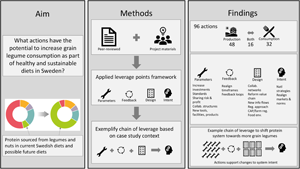
The published and grey literature search yielded 96 actions in a variety of publication types: 41 peer-reviewed sources, 21 project reports, and 34 documents with expert opinions. Fourteen of the actions were identified in multiple sources with different publication types: nine were identified in both peer-reviewed and project reports and are represented in the results under peer-reviewed evidence; five were identified in both project reports and expert opinions and are represented in the results under project reports. All sources are listed in the table in supplementary material (Scheuermann and Wood, Reference Scheuermann and Wood2024).
Of the 96 actions identified, most focus on production (n = 48, 50%), followed by consumption (n = 32, 33%) and the fewest focus on both production and consumption (n = 16, 17%). Nearly half were classified as parameters (n = 45, 47%), followed by design (n = 31, 32%), intent (n = 15, 16%), and feedback (n = 5, 5%). Table 2 shows the results grouped by target, leverage point, and publication type.
Number of actions with the potential to increase grain legume consumption in Europe found in the literature

The actions are presented by target (production, consumption, or both), publication type, and leverage point. Darker shading shows higher concentration of actions, revealing gaps, and clusters in the literature.
At the deepest leverage point, intent, we find the actions are often more general statements not specific to shifting grain legume consumption but pointing to a change in worldviews, norms, or paradigms that themselves would influence grain legume consumption. Examples of the actions are organized by leverage point, action category, and target and are listed in Table 3. Actions identified in peer-reviewed publications are presented in normal typeface and others in italics. The full results are available in supplementary materials (Scheuermann and Wood, Reference Scheuermann and Wood2024).
Examples of actions to increase grain legume consumption by target and leverage point, with action categories in small capital letters. Actions from peer-reviewed publications are in normal typeface, others (project reports, expert opinion) in italics.

The thematic analysis of actions resulted in 15 action categories, shown in small capitals in Table 3. The action categories are useful for understanding patterns in the transformative potential of the actions as they follow the leverage points framework. They also highlight some of the nuances embedded in the definitions of the framework, such as differences between the parameter standards (changes to existing system rules) and system design (new rules for the system), or between the design action category of knowledge/collaborative networks (collaboration with an open purpose) and the parameter collaborative structures (collaboration on a specific project).
Considering the range of actions found and the context of our case study, we illustrate Fischer and Riechers’ (Reference Fischer and Riechers2019) concept of a ‘chain of leverage’ as a set of actions with transformative potential to change a system, which in this case is current Swedish protein sources. The chain of leverage illustrated in Fig. 3 shows 19 actions color-coded by action category at different leverage points which could support changing social norms so that healthy foods are more acceptable. Interactions between the leverage points are described in the section ‘Interactions in the example chain of leverage’.
Example chain of leverage to increase grain legume consumption in Sweden. Adapted based on figure by Azote.

Discussion
This section is organized as follows. First, we review the implications for system change for the three types of classification used in the analysis: how the actions influenced grain legume consumption, the types of publication from which the actions are extracted, and the depth of leverage point these actions target. Next, we discuss how the actions in the chain of leverage would interact to support system change in our case study context. Lastly, we review how these findings can support system change in Sweden and other contexts.
Implications for system change
Many actions identified in the Swedish and European contexts of this review focused on production. One reason for this may be that the renewed political focus on grain legumes in Europe was to increase production to provide an alternative to imported soy for animal feed. This priority on production is still visible in the EU Common Agricultural Policy (CAP) as well as Sweden's Food Strategy (Näringsdepartementet, 2017). Fewer actions in this review were found to target production and consumption at the same time. This may reflect the separate approaches to production and consumption within government (i.e., agriculture and health), academia (i.e., agronomy and nutrition), and among value chain actors, resulting in limited opportunities for integrative approaches to emerge.
Because solving the health and environmental challenges in our food system are so urgent, we considered actions that have not yet appeared in peer-reviewed studies, in order to inform future research and experimentation in practice. The large number of actions found in project reports and associated materials (coded as expert opinion) reveal how much specific expertise may be hidden from the traditional peer-reviewed knowledge base used in food systems research. This is particularly true for the actions that target production and consumption together, where more than half of the actions come from project reports or associated materials. Given this, we suggest that including this knowledge while being transparent about the type of publication in which it appears may benefit scholars and practitioners in the food system.
Like other food system researchers using the leverage points framework, we found more actions targeting parameters and design than intent and feedback (Dorninger et al., Reference Dorninger, Abson, Apetrei, Derwort, Ives, Klaniecki, Lam, Langsenlehner, Riechers, Spittler and von Wehrden2020; Slater, Baker, and Lawrence, Reference Slater, Baker and Lawrence2022). This skew in the distribution of results may reflect that mechanistic actions (parameters) and policies (design) are more often studied, and perhaps more easily analyzed, compared with feedbacks and the more abstract system goals (intent). Feedback leverage points may be best identified through another method of research, such as a causal loop diagram exercise with food system stakeholders. Intent leverage points were often identified as system goals, but these often cut across subjects due to their more abstract nature, such as in our chain of leverage example where we assume healthy foods include but are not limited to grain legumes.
Interactions in the example chain of leverage
In our example chain, changing system intent toward changing social norms for more healthy food consumption (Brouwer et al., Reference Brouwer, van Liere, de Brauw, Dominguez-Salas, Herforth, Kennedy, Lachat, Omosa, Talsma, Vandevijvere, Fanzo and Ruel2021) in the context of increase grain legume consumption is supported by 12 parameters, one feedback, and six design actions across the leverage points. Actions described in the chain of leverage that support this intent action are highlighted in italics for clarity.
Several actions across the parameter and design leverage points target consumers when they are making decisions in their food environment, and could interact to support a shift in norms. Creating new opportunities for exposure to pulse variety (parameter) (Henn et al., Reference Henn, Goddyn, Bøye Olsen and Bredie2021) and making plant-based foods the default choice (design) (Bucher et al., Reference Bucher, Collins, Rollo, McCaffrey, De Vlieger, Van der Bend, Truby and Perez-Cueto2016; Lindahl and Jonell, Reference Lindahl and Jonell2020; Taufik et al., Reference Taufik, Bouwman, Reinders and Dagevos2022) could influence consumers to increase their purchase and consumption of grain legumes. Collier et al. (Reference Collier, Oberrauter, Normann, Norman, Svensson, Niimi and Bergman2021) also found that increasing exposure to LBMS makes consumers more likely to purchase LBMS themselves, showing that this exposure applies to LPL and LBMS alike. Consumers could be even more likely to purchase grain legume products themselves with more convenient and tasty foods (parameter) (Hamann et al., Reference Hamann, Vasconcelos, Lörich, Odee, Vickers, Blazon, Trstenjak, Toma, Maaß, Kolmans, Tran, Bienkowski and Iannetta2019b; Lassen, Christensen, and Trolle, Reference Lassen, Christensen and Trolle2020) to choose from. Design actions to facilitate consumer purchases include implement new fiscal policies to improve access to healthy, sustainable foods (Lassen, Christensen, and Trolle, Reference Lassen, Christensen and Trolle2020; Brouwer et al., Reference Brouwer, van Liere, de Brauw, Dominguez-Salas, Herforth, Kennedy, Lachat, Omosa, Talsma, Vandevijvere, Fanzo and Ruel2021) and reduce or eliminate the value-added tax (VAT) on sustainably marked food (European Commission, 2020; Balkow and Domeij, Reference Balkow and Domeij2022), which would likely include grain legumes due to their low environmental footprint. The EU developed new VAT rules in 2021 to support climate and public health goals (European Commission, 2021), making reduced or zero VAT for grain legumes and other healthy and sustainable foods possible. Implementing this action may be more feasible following the release of the Nordic Nutrition Recommendations, which incorporate health and sustainability into the guidelines and suggest increased intake of grain legumes as a ‘significant part of the regular dietary pattern’ in Nordic diets (Blomhoff et al., Reference Blomhoff, Andersen, Arnesen, Christensen, Eneroth, Erkkola, Gudanavicine, Halldórsson, Pitsi, Schwab, Siksna, Þórsdóttir and Trolle2023), providing a springboard for policy action in Nordic states.
Another group of actions would focus on communication and education at different leverage points in order to support a change in social norms. Communication campaigns, including front of package labelling (parameter) (Brouwer et al., Reference Brouwer, van Liere, de Brauw, Dominguez-Salas, Herforth, Kennedy, Lachat, Omosa, Talsma, Vandevijvere, Fanzo and Ruel2021) could serve as public service announcements about healthy food similar to those that target public health initiatives such as immunizations. Further, using the term ‘alternatives’ instead of ‘substitutes’ for meat analogs (parameter) (Röös, de Groote, and Stephan, Reference Röös, de Groote and Stephan2022) may increase the acceptability of the products because consumers would perceive the products as something new instead of comparing them to meat. Building feedback between processors and retailers to find the right price point that drives an increase in demand (feedback) (Hamann et al., Reference Hamann, Iannetta, Tran, Bienkowski, Vickers, Howard, Blazon, Odee, Maaß, Kolmans, Kelemen, Balázs, Toma, Debeljak, Trajanov and Vasconcelos2019a) and communicating information about consumer preferences to plant breeders (design) (Vaz Patto et al., Reference Vaz Patto, Amarowicz, Aryee, Boye, Chung, Martín-Cabrejas and Domoney2015) would interact across the feedback and design leverage points, respectively, to support a shift in norms. Including multiple value chain actors would build connections across production and consumption, which over time could result in products that consumers prefer at a price point that is acceptable.
Setting specific recommendations or requirements for grain legume consumption would also support a shift in norms through several actions. First, a European recommendation on pulse consumption (parameter) (Magrini, Reference Magrini2018) would likely come from an EU body and could support a shift in norms across cultures and countries, and generate more awareness about health and environmental benefits. A specific requirement for pulses in public meals could be instituted (parameter) (Ferreira et al., Reference Ferreira, Vasconcelos, Gil and Pinto2021) and would provide a way to increase exposure to pulses; this could be particularly effective in schools along with messages to teach children about protein sources that emphasize plants and not only animals (parameter) (Pinto et al., Reference Pinto, Guerra, Carbas, Pathania, Castanho and Brites2019). In Sweden, the local government has the ability to implement such programs and all school children are served free lunch in schools, providing an opportunity to provide nutrition education along with healthy foods, as well as increase the demand for Swedish producers. However, some municipalities have experienced strong opposition to replacing meat with plant proteins even one or two days a week in schools (Eriksson, Reference Eriksson2019), showing the extent to which the social norms are rooted in meat consumption.
Changes in grain legume production and processing would also be needed to meet the increased demand for grain legumes that would be part of changing dietary patterns and social norms. To start, increased investments or subsidies for disease- and pest-resistant legume varieties (parameter) (Watson et al., Reference Watson, Reckling, Preissel, Bachinger, Bergkvist, Kuhlman, Lindström, Nemecek, Topp, Vanhatalo, Zander, Murphy-Bokern and Stoddard2017) and focused legume breeding on characteristics for cool seasons (parameter) (Murphy-Bokern and Font, Reference Murphy-Bokern and Font2022) could result in grain legume varieties suited for the Swedish climate and that reduce the risk of crop loss for producers. Increasing predictability for farmers through stable subsidy amounts (parameter) (Kałużyński, Reference Kałużyński2018) could further increase producer financial security and make grain legumes for food an attractive crop to grow. Several researchers have pointed to the lack of domestic grain legume processing facilities in Sweden which limits development of the value chain (Schwarz et al., Reference Schwarz, Prazan, Landert, Miller, Vanni, Carolus, Weisshaidinger, Bartel-Kratochvil, Mayer, Frick, Hrabalová, Quero, Iragui, Massa, Helin, Huismann, Guisepelli, Fleury, Vincent and Smith2021) and contributes to unnecessary emissions and transportation costs to Southern Europe where they are currently boiled and packed (Tidåker et al., Reference Tidåker, Karlsson Potter, Carlsson and Röös2021). Building additional processing facilities for sorting, cleaning, drying, and other processing (parameter) (Gunnarsson and Chongtham, Reference Gunnarsson and Chongtham2018; Hamann et al., Reference Hamann, Vasconcelos, Lörich, Odee, Vickers, Blazon, Trstenjak, Toma, Maaß, Kolmans, Tran, Bienkowski and Iannetta2019b; Schwarz et al., Reference Schwarz, Prazan, Landert, Miller, Vanni, Carolus, Weisshaidinger, Bartel-Kratochvil, Mayer, Frick, Hrabalová, Quero, Iragui, Massa, Helin, Huismann, Guisepelli, Fleury, Vincent and Smith2021; Tidåker et al., Reference Tidåker, Karlsson Potter, Carlsson and Röös2021) would help develop channels for small- and medium-sized growers to process and sell their harvests, as well as develop Swedish sourcing options for food manufacturers who require pre-processed legumes for their products (Herin, Reference Herin2022; Lindsten, Reference Lindsten2022). In particular, building flexible infrastructure to process pulses according to changing consumer tastes (parameter) (Pinto et al., Reference Pinto, Guerra, Carbas, Pathania, Castanho and Brites2019) could stimulate innovation in the value chain by providing publicly funded infrastructure that allows new, healthy products to be developed and rolled out to market more quickly. This could support social norms by improving the variety of products and lowering the overhead cost for companies, allowing them to make a profit at a lower price point.
While most actions do not specifically mention which actor would be responsible for implementing the action, two design actions in the chain of leverage would likely involve work with public and private actors together. To see if consumer behavior is actually changing, retailers could aggregate scanner data (design) (Wood et al., Reference Wood, Gordon, Röös, Karlsson, Häyhä, Bignet, Rydenstam, Hård af Segerstad and Bruckner2019) to share real-time information on the amounts and types of grain-legumes that are purchased. By doing this, public authorities could monitor changes in dietary patterns and see if social norms are shifting. Creating local food policy councils (design) (Wood et al., Reference Wood, Gordon, Röös, Karlsson, Häyhä, Bignet, Rydenstam, Hård af Segerstad and Bruckner2019) composed of many types of stakeholders from across the value chain could provide a forum for testing this type of public–private initiative. Food policy councils may also be a way to more deeply integrate production and consumption within a local context, and could also be used to develop new requirements at the local level that may be politically sensitive, such as changes to school meals. These actions would support changes to social norms by involving public and private actors together and by institutionalizing actions that support grain legumes as part of healthy diets.
There is precedent for private actors using a suite of actions akin to a chain of leverage to generate consumer demand and change dietary patterns in Sweden. The café latte was introduced in Sweden by the dairy industry with the goal of increasing milk consumption in adults (Pettersson, Reference Pettersson2011). Using media packets, special experts to train baristas around the country, and associated events like an annual barista challenge, the campaign succeeded in increasing the number of people adding milk to coffee by 77% in just six years (Arla Foods, 2009). Consumers report wanting to and intending to eat healthfully and to consider environmental impacts when making their decisions (Lindahl and Jonell, Reference Lindahl and Jonell2020; Röös, de Groote, and Stephan, Reference Röös, de Groote and Stephan2022), although recent rises in food prices may impact purchasing habits and not yet be reflected in the literature (Andrée and Franzén, Reference Andrée and Franzén2023). Value chain actors, then, can help generate demand for food that supports healthy and sustainability of diets, including grain legumes.
Contributions and limitations
By focusing on a particular aspect of the food system in a specific context, this study contributes to research and practice in several ways. First, this study contributes to the literature on transformation with grain legume systems and the emerging body of literature about chains of leverage. The actions identified in this study, particularly the ones from project reports or associated materials, can be further researched or tested to contribute to the more robust peer-reviewed literature. In addition, the action categories identified in this study can be used in communication or work on food strategies to allow space for adaptation of particular actions to local contexts. The contextual example of the chain of leverage shows how these different actions can interact across leverage points to support the actions with the most transformative potential. Conducting this type of exercise with a range of food system actors could identify a suite of actions that policymakers and private actors can take to support different elements of healthy and sustainable diets. The current effort underway in Sweden to align food system sustainability work across departments and agencies (Quetel, Reference Quetel2022) could be a forum for convening this type of research in a practice setting.
This study can also inform the wider context of food policy beyond only grain legumes. Recent crises around the world have led many countries in Europe to emphasize self-sufficiency as a matter of national security, yet at the same time these countries generate more animal products and fewer grain legumes and vegetables than required for healthy and sustainable diets (Wood et al., Reference Wood, Gordon, Röös, Karlsson, Häyhä, Bignet, Rydenstam, Hård af Segerstad and Bruckner2019; Pia, Reference Pia2020; Schwarz et al., Reference Schwarz, Prazan, Landert, Miller, Vanni, Carolus, Weisshaidinger, Bartel-Kratochvil, Mayer, Frick, Hrabalová, Quero, Iragui, Massa, Helin, Huismann, Guisepelli, Fleury, Vincent and Smith2021). This mismatch between the intended consumption and actual production within a country reduces the global resources available for food production that are particularly needed by import-dependent countries in times of crisis (Pörtner et al., Reference Pörtner, Lambrecht, Springmann, Bodirsky, Gaupp, Freund, Lotze-Campen and Gabrysch2022). In this case, considering the global context of food policy impacts within national security policy could improve Swedish diets while supporting food security in other parts of the world.
The leverage points framework is a powerful tool for understanding the potential of different interventions on system behavior, yet its creator acknowledged the inherent uncertainty in complex systems (Meadows, Reference Meadows2008). While actions are presented in neat categories, in this paper, there is no recipe to guarantee system change and actions at different points may have larger or smaller impacts on system behavior than presented here depending on their interactions with the real system, including how humans respond to different actions. This case study used qualitative methods that drew on the experience of the authors involved and as such involved researcher judgment in the classification and development of the chain of leverage. We relied on publicly available information or research available through the academy to inform the identification and classification of actions. Other methods such as expert interviews, value chain actor workshops, or participatory exercises with other stakeholders to identify, develop, and validate the actions and chain of leverage could generate different results and might increase acceptance of the end product (Pelzer et al., Reference Pelzer, Bonifazi, Soulié, Guichard, Quinio, Ballot and Jeuffroy2020). Future research can draw upon these methods to further develop the chain of leverage concept in food systems.
Conclusions and further research
This paper set out to answer the question, ‘what actions have the potential to increase human consumption of grain legumes in Sweden?’ using the leverage points framework and chains of leverage concept. Most actions identified in the literature relate to production with less focus on system changes that integrate production and consumption together. More actions were found to target leverage points with less transformative potential that represent mechanistic changes to the food system (i.e., parameters) compared to more abstract—but potentially more transformational—aspects such as changes in system values (i.e., intent). Considering the policy and practice context of our case study, we exemplify a chain of leverage where a suite of actions interacting across leverage points could work together to shift the protein sources of Swedish diets toward increased grain legume consumption. Our example illustrates how a range of policies at EU and national scales and coordinated actions across the value chain could support dietary shifts and also larger paradigm shifts in how we approach healthy and sustainable diets.
Few of the actions identified in this study specifically indicate which actor or type of actor would perform a given action. Identifying specific actors that are well positioned to take particular actions would facilitate implementing chains of leverage to increase grain legume consumption. Future research should explore how relationships between actors in the grain legume system could facilitate building such chains of leverage for healthy, sustainable diets.
Data availability statement
The evidence table and complete list of references used for data analysis are available through the Zenodo data repository https://zenodo.org/doi/10.5281/zenodo.8325684 (Scheuermann and Wood, Reference Scheuermann and Wood2024). The data used to adapt Figure 1 from Clark et al. (Reference Clark, Springmann, Rayner, Scarborough, Hill, Tilman, Macdiarmid, Fanzo, Bandy and Harrington2022) is available at https://doi.org/10.1073/pnas.212058411.
Acknowledgements
The authors thank two anonymous reviewers for the constructive feedback during the review process. Thank you to Jerker Lokrantz of Azote for producing the figures, and to Lisa Deutsch and Michele-Lee Moore for their review of the manuscript. M. Scheuermann was supported by the Kamprad Family Foundation (grant number 31002095). A. Wood was supported by funding from the Swedish Research Council Formas (grant number 2019-01579). E. Röös was funded by the Swedish Research Council Formas (grant number 2021-01257). L. J. Gordon was supported by grant from Mistra (grant number 31002011). Other authors did not receive any specific grant from funding agencies in the public, commercial or non-for-profit sectors. The funders had no involvement in the design, analysis, or writing of this article. The Stockholm Resilience Centre ethics committee approved this study.
Author contributions
M. S. formulated the research question, and led the design, data collection, analysis, interpretation, and wrote the original draft. A. W. assisted with the design and analysis, and with L. J. G., E. R. , and L. S. contributed to the interpretation, review, and editing. L. S., L. J. G., and A. W. provided supervision throughout the course of the study.
Competing interests
None.


 Open access

