


Obesity in children and adolescents is increasing worldwideReference Lobstein, Baur and Uauy1, Reference Wang and Lobstein2 and Mexico is also markedly affected. Thus, using the internationally relevant cut-off pointsReference Cole, Bellizzi, Flegal and Dietz3 of the International Obesity Task Force, the 2000 Mexican National Health Survey showed that overweight prevalences ranged from 10.8% to 16.1% in boys and from 14.3% to 19.1% in girls aged 10–17 years, with additional obesity prevalences ranging from 9.2% to 14.7% in boys and from 6.8% to 10.6% in girlsReference Del Rio-Navarro, Velazquez-Monroy, Sánchez-Castillo, Lara, Berber and Fanghänel4.
It is well recognised that the basis for the epidemic relates to the consumption of inappropriate foods and drinks as well as a substantial reduction in physical activity5. Often the diet tends to be dominated by palatable snacks and drinks of high energy densityReference Jackson, Romo, Castillo and Castillo-Durán6, which contribute directly to the development of the children’s obesityReference Bellisle and Rolland-Cachera7, Reference St-Onge, Keller and Heymsfield8.
One of the principal foci of proposed preventive measures is the use of educative and other measures in schools, but in Mexico there is little information about the type of food and drinks provided by parents or bought at school. Therefore the present survey was undertaken to assess this. Further objectives of the study were the assessment of the importance of the socio-economic circumstances of the parents and whether the food available within private schools differed from those in public schools. In addition, teachers were questioned about the foods available for children and the shops within schools provided by vendors were also inspected.
Material and methods
Selection of the sample
Adolescent students were selected from primary, secondary and high schools located in the southern delegation of Mexico City, called Tlalpan, during the school years 2004–2005 and 2005–2006. This location was chosen because it had a distribution of socio-economic groups which reflected that of Mexico City overall. As part of the random sampling procedure information was first obtained relating to the basic geostatistical division (AGEB) of Mexico9 based on a census in the year 2000 prepared by the National Institute of Statistics, Geography and Information10. AGEBs are defined as the fundamental units of the National Geostatistical Framework which are smaller than a municipality division. Their limits are easy to identify, delineate substantial population numbers and represent the minimum legal level of census information, compatible with a warranty of confidentiality.
From a total of 2344 AGEBs, 175 were found to be located within the Tlalpan delegation. Twenty of these 175 were randomly selected and 10 of these proved to have 20 registered schools in total. Two schools refused to participate and one school facility was unused. The remaining 17 schools agreed to participate and comprised eight primaries (six state and two private schools) for children aged 6–13 years; six secondary schools (four state and two private) for 13–16-years-olds; and three high schools (two state and one private) for children aged 16–19 years. All students attending the last grade of primary, secondary and high schools in the morning were studied, i.e. ages 11–13, 15–16 and 18–19 years. In many schools there was another batch of teachers and students working in the afternoon, but the numbers involved were fewer than in the morning and were not selected.
A thorough explanation of the research intended was given to the headmaster and the students, with the assurance that data were to be treated confidentially. The protocol was also approved by the Biologics and Health Sciences Coordination of the Autonomous Metropolitan University in Mexico City.
Instrument of data collection: questionnaire
A self-administered questionnaire11 was designed to include 10 questions about the items of food and drink usually brought from home and those bought at school, and four questions aimed at assessing the socio-economic level of the students’ parents. The socio-economic level was defined according to the occupation of the family head and the schooling level of the mother. This was based on the classification by OrtizReference Ortiz12 who clustered these into three categories: (1) the higher level which included business owners, professionals and those who have higher degrees from postgraduate studies; (2) the medium level which included administrative workers and public transport drivers, together with those with less schooling than people in the first category; (3) the lowest level which included day labourers, occasional workers and unemployed people. Those with the poorest education were also included.
The importance of accurate responses to the questionnaire was emphasised. All students in the designated classes were given a questionnaire and any problems in answering the questions were dealt with by the research team. Teachers also answered the students’ questionnaire and another about their own lunches; they were also asked about any food policy at school. During the school break the foods being sold at school were monitored and the food vendors interviewed.
Statistical analyses
The usual foods brought from home, and purchased, were obtained for each category of school. Conducting separate analyses by sex, these values were then correlated with other variables using the SPSS statistical package (SPSS Inc.). To identify statistically significant differences (P < 0.05), either the Pearson χ 2 test or Fisher’s test was used.
Results
Thirty-five students who were older than the age range of 10–19 years needed for the definition of ‘adolescent’13 were excluded and data on 1504 students in all were analysed. Similar numbers of girls and boys were interviewed. There was also a good socio-economic as well as age distribution. The majority of the children attended state schools. Over half of the students were from the middle socio-economic level with about a fifth of students in each of the other two socio-economic categories; 4% of students were unable to be classified. The smaller number in high school reflects the typical pattern of school attendance in Mexico.
Parental provision of school food
About 60% of students always or sometimes brought food from home whereas 41% never did, with girls being more likely to bring food than boys (Table 1). The age of the student influenced this behaviour, with more of the youngest students bringing food from home. One of the questions asked whether the food brought from home was bartered, sold or shared with other pupils. In practice, 97% of the children ate their own food with <1% sharing and only 2% returning home with their lunches.
Foods brought from home for lunch: differences by sex, school grade, type of school and socio-economic level

*Bread, processed = muffins, doughnuts, cup cakes, other sweet breads, etc.
†Crisps = salted processed snacks, fried crisps (made with fried potato), doritos (made with fried tortillas), sabritones (made with fried wheat flour), cheetos (made with fried wheat flour), etc.
‡Quesadilla = maize tortilla, fried, filled usually with high-fat cheese.
§Salad, vegetables = usually made up of lettuce, tomato and cucumber.
The type of foods differed depending on both sex and age. The dominant foods brought from home were sandwiches, fruit, home-made sugared fruit juice and fresh water, with very little salad and little if any confectionery. Girls more frequently brought sandwiches, fruit, yoghurt and fresh rather than sweet cola-style drinks. These foods were also features of the lunches of the younger children (Table 1).
Furthermore, children of high socio-economic level were more likely to bring food from home and again the differences were reflected in the type of food provided: sandwiches, fruit and fresh water were features of the lunch boxes of the wealthier families (Table 1). This emphasis on items of higher nutritional quality was also reflected in the differences between the foods provided for children in private fee-paying compared with public schools.
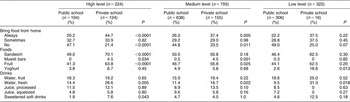
The differences between pupils attending private rather than public schools were not, however, simply a reflection of parental financial background, because as Table 1 reveals those children attending private schools were more likely to bring food from home. Table 2 shows the influence of private schooling on the most common foods brought from home according to students’ socio-economic level.
Influence of private schooling on the most common foods brought from home according to students’ socio-economic level (high, medium or low)
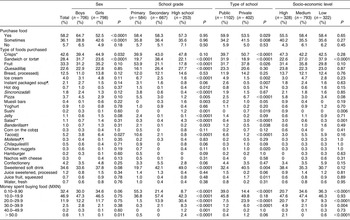
When purchases at school were considered (Table 3) boys made more school purchases (65%) than girls (53%, P < 0.0001) but there were no statistical differences in food purchases by school grade. The most popular foods bought at school were crisps (43%), soft drinks (35%), fresh fruit (33%), sandwich or torta (28%), quesadilla (23%) and processed bread (13%) such as doughnuts and muffins. (Details of these products are given in the tables.) Girls bought more sweetened soft drinks than boys but the latter bought more sandwiches and tortas. When the purchasing was analysed by school grade it was observed that students from high school had the highest preference for crisps, sweetened soft drinks, quesadilla and vegetable salads. Secondary students, on the other hand, bought more sandwiches, tortas and confectionery. Over half the students from primary schools bought fresh fruit but also relatively more pizzas, tacos, ice cream, sincronizada, instant soup and jelly.
Foods purchased at school: differences by sex, school grade, type of school and socio-economic level
MXN – Mexican pesos.
*Crisps = fried crisps (made with fried potato), doritos (made with fried tortillas), cheetos (made with fried wheat flour), etc.
†Torta = type-like sandwich made with Mexican bolillo filled with different ingredients.
‡Quesadilla = maize tortilla, fried, filled usually with high-fat cheese.
§Bread, processed = all packaged bread, i.e. doughnuts, muffins, cup cakes, other sweet breads, etc.
¶Instant packaged soup = white pasta ready-made type soup to which hot water is added. Usually people add to it hot chilli sauce, high in salt.
∥Sincronizadas = white flour tortillas filled with high-fat cheese and ham and heated to melt cheese.
**Salad usually made up of lettuce, tomato and cucumber.
††Banderillas = a sausage deep fried with added industrialised tomato sauce.
‡‡Cooked in boiled water.
§§Tacos = maize tortilla filled with a variety of stews; the tortilla could be either cooked or fried.
¶¶Molletes = a bolillo filled with beans and cheese with tomato, chilli and onion sauce.
∥∥Chilaquiles = Mexican dish prepared with fried maize tortillas, fried tomato and onion sauce, with added cream and white cheese.
Table 4 shows the differences in food purchases in public and private schools and how the socio-economic level of the parents affected children’s purchasing habits. Children in private school and from wealthier background bought more crisps, soft drinks and pizza, and fewer sandwiches and tacos. It is noteworthy, however, that the foods for sale in private schools were different from those in public schools.
Common food purchases of students in public and privates schools according to socio-economic level

MXN – Mexican pesos.
*Crisps = fried crisps (made with fried potatoes), doritos (made with fried tortillas), cheetos (made with fried wheat flour), etc.
†Torta = type-like sandwich made with Mexican bolillo filled with different ingredients.
‡Quesadilla = maize tortilla, fried, filled usually with high-fat cheese.
§Bread, processed = all packaged bread, i.e. doughnuts, muffins, cup cakes, other sweet breads, etc.
¶Sincronizadas = white flour tortillas filled with high-fat cheese and ham and heated to melt cheese.
||Tacos = maize tortilla filled with a variety of stews; the tortilla could be either cooked or fried.
**Molletes = a bolillo filled with beans and cheese with tomato, chilli and onion sauce.
††Chilaquiles = Mexican dish prepared with fried maize tortillas, fried tomato and onion sauce, with added cream and white cheese.
Table 4 also attempts to disentangle the effects of private tuition from socio-economic level for those foods purchased by more than 5% of children. It is evident that whatever the financial background of the children almost all bought some foods or drinks at school, with little evidence that the private-school children are any better informed: they bought more crisps, pizzas and soft drinks as well as more fruit.
Under Mexican law, primary-school children are able to obtain subsidised breakfasts from the government Desarrollo Integral de la Familia (DIF) programme – the breakfast typically comprises 250 ml milk, a sweet biscuit and a piece of fruit, e.g. a banana. A defined group of children of poor parents were eligible for this food costing only 0.5 Mexican pesos (MXN)14. An assessment by the teacher of the relevant class suggested that a substantial proportion (∼90%) of children in the six primary public schools were liable to purchase these foods despite the social stigma attached to them. This stigma was manifest in the communal rejection of the bananas offered, these often being used as suitable material to kick or throw around. Neither students nor teachers mentioned these products even though the cost of these foods was negligible compared with the other foods on offer, and no child of poor parents who failed to bring food from home explained this by indicating their children were expected to manage on the DIF subsidised food. It was estimated by the head teachers of the public primary schools that about 70% of children eligible for these lunches actually purchased them.
Of the 618 students (41% of the total) who did not bring food to school, 24% of them either never or only sometimes purchased items for their lunch break. In addition, of those 456 children who only sometimes brought food from home, nearly half (47%) either never or only sometimes bought food. Thus about 24% of all the children were potentially without food during their school time, which started with them leaving home at 07.00 and not returning until 14.30–15.30 hours. This vulnerability affected more children of the unemployed and poorly educated (29%) than the children of the rich (20%).
Money spent at school on food
The average daily food purchases cost 11 MXN (Table 4), equivalent to about $US 1. The money spent increased with age, with students spending 7.73 (standard deviation (SD) 5.27), 11.62 (SD 6.01) and 16.55 (SD 10.03) MXN per day on average in primary, secondary and high schools, respectively. As expected, the private-school students spent more money on foods and this was also true for those from the higher socio-economic levels. No child specified that they had purchased the DIF government meals at advantageous prices.
Structured interviews with headmasters and other teachers
Twenty-seven teachers and seven headmasters, 14 men and 20 women, agreed to be interviewed and answered the standard questionnaires. All but two of the teachers were concerned about the food consumed at school. Nearly half the teachers considered the food available for purchase was ‘junk food’. Two-thirds of teachers claimed that they gave the students specific advice to avoid junk food and soft drinks and to consume more fruit and vegetables. All of the head teachers were interested in the foods sold and five of them considered that the quality of foods eaten had an effect on the children’s performance.
During lunchtime over half the teachers bought food at school with another third bringing their own lunch; two teachers did not eat at lunchtime. Tacos, squeezed fruit juice, fruit, salad, torta and quesadilla were the foods most frequently purchased, whereas fruit, sandwiches or torta and yoghurt were the most frequent items brought from home. Four headmasters did not eat any food at lunchtime; two bought food at school, e.g. fruit, quesadilla and squeezed orange juice, and one brought fruit and a sandwich from home.
More than half of the teachers reported that there were food policies in their school, the commonest features of which were control of the type of food sold at school and recommendations which they made on eating healthy and not junk food. Individual teachers also noted the provision of DIF breakfasts, educators being sent by the School Cooperation Commission to give talks about nutrition in one school and a policy not to allow students to eat in the classroom.
This assessment was then checked with head teachers. Six of the seven confirmed that they had food policies: in two schools they supervised the foods sold, one gave talks on food and health, and another told parents when discussing the child’s progress that they needed to send their children to school with healthier foods for lunch. Two other head teachers invited experts to their schools to speak about topics on food and health. Two of these six heads also had poster displays on food and health.
Five of the seven heads had determined which vendors would be allowed into the school whereas the other two claimed they were not responsible because the School Cooperation Commission’s mission covered this responsibility. Four head teachers made agreements with vendors at the beginning of the year, two claiming their products were healthy and the other two arguing in favour of extra choice for students. One school had its own shop, another relied totally on the School Cooperation Commission and a third had no facilities as it was in the process of planning the construction of a dining hall for students.
All but one head teacher recommended their students to eat a nutritious diet at lunchtime. One school had a Support Unit Service which arranged regular meetings with parents and teachers so that the head could speak about the children’s health. The teaching curriculum was claimed by four heads to include human biology and some nutrition, two claiming specific nutrition instruction with the availability of Ministry of Health pamphlets on the topic; one referred to the food pyramid.
Vending systems within the schools
Only eight of the 17 schools studied allowed the investigator (M.L.) access to its premises to observe the type of foods that students bought and consumed at lunchtime. These were three primary schools (one private), three secondary (one private) and two high schools (one private), but in the public high school no food is sold and students are allowed to leave the premises to buy food.
The investigator (M.L.) interviewed all food vendors from the eight schools to which access was granted. In total 28 persons, nine men and 19 women (mean age 39 years, range 17–64 years), were interviewed. Twenty vendors prepared their own foods whereas the others relied on wholesale purchases. A third of vendors chose their products in response to children’s preferences whereas another third specified that the school controlled the type of products sold and a fifth simply based their decisions on what they felt able to make themselves.
The majority of the vendors refused to specify their costs and profit margins, but three indicated that their profits were three times their investment and two claimed that profits were double the cost. Only two vendors claimed that they had just marginal profits. All vendors contributed money to the school as part of the access agreement; this money, which could amount to 30000 MXN per year (approx. $US 2700), being used to buy books or equipment with the surplus distributed to the students at the end of the year. No vending machines were found in any school we studied.
Discussion
This survey is one of the few surveys that have been conducted on an independent basis in typical Mexico City schools. The choice of schools allowed an analysis of conditions which might be considered to reflect schools in most urban Mexican environments – rural schools are generally not so well endowed and a higher proportion of students in rural areas come from poor families who therefore have the possibility of receiving the subsidised DIF breakfast in primary school. The DIF system of subsidised food is available to children of poor families who attend public schools of pre-school and primary education located in indigenous, rural and marginal urban areas preferably; they qualify for this support on the basis of their request and a school parental committee’s sanctioning prior to Ministry of Education approval14. The socio-economic spread of families in Mexico City is similar to the distribution in our sample, so it seems reasonable to consider these results applicable to at least Mexico City and probably to most urban communities in Mexico. Clearly it would have been useful to have a nationally representative survey to assess whether the previous regional differences in Mexico in terms of adult chronic diseases and obesityReference Sánchez-Castillo, Velazquez-Monroy, Berber, Lara-Esqueda, Tapia-Conyer and James15 were paralleled by differences in the food habits and school policies.
A substantial proportion (24%) of children in these schools was likely to have no food at all during the whole of their school day, which may therefore handicap their concentration and focus on learning. This applied across the whole spectrum of private and public pupils but particularly affected those from poor families. A greater proportion of students from primary grade brought fruit from home than older students, perhaps reflecting a greater emphasis by parents on well-being when the child is young. However, there was little indication of a regular intake of milk products which are increasingly seen as important in contributing to children’s growth perhaps by some non-calcium growth factorsReference Hoppe, Rovenna, Lauritzen, Mølgaard, Juul and Michaelsen16. Yoghurt products did appear on the list but only 5% brought these from home and 1% purchased them at school. Mexican children are well recognised to have a high prevalence of stunting and to exhibit both iron and zinc deficiencyReference Villalpando, Shamah-Levy, Ramirez-Silva, Mejia-Rodriguez and Rivera17, so these diets are unlikely to remedy these deficiencies. The high prevalence of riboflavin deficiency can also be ascribed to the poor intake of milk products at school.
These children also seemed to have very little vegetable consumption although the sandwiches or tortas were reported to be prepared with one, two or three vegetables, the variety including lettuce, tomato, chilli pepper and avocado. Nevertheless, salad did not feature either in the lunches brought from home or in those foods bought at school.
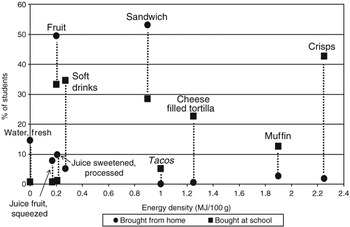
The evidence presented in Tables 3 and 4 confirms that the quality of the foods bought in school was inferior to that which was provided at home. This is further illustrated in Fig. 1 which sets out the proportion of children who buy foods of different energy density, the density being calculated from the Mexican food composition tables. With the exception of sandwiches and torta which are brought more frequently from home rather than being purchased at school, the other foods provided at school are more frequently energy-dense than those brought from home. The single energy density value for all sandwiches/tortas does not reflect the variety of fillings used. The torta is prepared with bolillo, which is salted white roll type of bread. Both sandwiches and torta are filled with a variety of ingredients some of which are very energy-dense, e.g. tuna canned in oil, processed meat such as ham or sausage, avocado, cheese, refried beans, eggs and mayonnaise, as well as vegetables such as lettuce, tomato and peppers. So the energy content may vary widely and it was not possible to assess the likely differences in the sandwich and torta ingredients in the school purchases vs. those brought from home.
The relative dominance of foods from home vs. foods bought at school in relation to their energy density
In Mexico private schools are often considered better than public schools but they do involve longer periods of teaching as well as many additional sports activities after school hours. Thus children may be more active in private school and need higher energy intakes. It is clear from Table 1 that private-school children are more likely to bring food to school and the assessment of the foods available for purchase sometimes revealed a greater variety of healthy foods compared with the public schools. However, processed breads, muesli bars and soft drinks – as well as fruit and salad – are brought from home as well as being bought at school more frequently in private schools. So households paying for private tuition are not necessarily providing their children with higher-quality food. Furthermore, high-school students were also able to buy foods outside the premises where there are illegal informal mobile canteens, usually selling heavily fried foods and soft drinks, operated without water or sanitation facilities, thereby adding another potential risk for the students.
Assessment of the cost of these foods revealed that many of the most nutritionally inappropriate foods such as crisps and soft drinks were cheaper than the ‘healthy’ foods on sale, and therefore had considerable appeal. Prices varied from school to school but in all the schools the majority of healthy foods were more expensive than the unhealthy ones. For example, in one private primary school a slice of pizza cost 5.00 MXN, whereas the cost of a vegetable salad was 10.00 MXN. In a public secondary school a soft drink cost 5.00 MXN whereas a glass of squeezed orange juice cost 7.00 MXN. Basiotis et al.Reference Basiotis, Kramer-LeBlanc and Kennedy18 noted that price is the major consideration in the food selection of children, and poorer students tend to select cheaper food which, in general, has a high sugar and fat contentReference Drewnowski19.
Inspection of the stalls of foods in the schools showed that only one of five stalls offered foods which would be considered nutritionally healthy. Thus despite the clear decision-making by six head teachers about who should sell food and their professed concern about nutrition and health, it would appear that there was no rigorous control over the foods on sale. The claim that ‘choice’ was important not only defies the well-recognised need to train children in their eating habits, but also ignores the fact that at these ages children are particularly vulnerable to marketing and other techniques persuading them to eat inappropriately.
It is evident that children’s diets are worsened by their exposure to foods bought at school. These foods also do not conform with the international and Mexican consensus on appropriate foods for children and vividly demonstrate that Mexico has gone down the same unfortunate route as the USA and many European countries in imagining that some vague nutritional educative moves will counter the immediate availability of heavily marketed, high-energy-density food products. Clearly there needs to be a national policy on the provision of school food as part of the effort to combat the escalating epidemic of diet-related diseases in Mexico.
The head teachers also appear to have a conflict of interest because their schools benefit financially from the vendors’ work and the monetary input is considered useful, amounting to 30 000 MXN per year, with vendors probably making substantial profits. It is clear from the analyses of the Organisation for Economic Co-operation and Development20 that despite a recent substantial increase in funding for education in Mexico, the country still has one of the most limited budgets to assign for any capital or other expenditure apart from teachers’ salaries, which means that head teachers are under great pressure to gain some flexible funds for their school.
Acknowledgements
The authors wish to thank the headmasters, teachers and students of the schools, without whose participation this study could not have been conducted. We are also grateful to Mrs Laura Zavala and Mr Julio Rosas G for their administrative and field assistance. The study was conducted under the auspices of the National Institute of Nutrition Salvador Zubirán. No external funding was used and no conflict of interest exists for any of the authors.



