





Highlights
-
• First eye-tracking reading study of word AoA effects in children versus adults.
-
• Comparisons made between monolinguals and bilinguals (across L1 and L2).
-
• Larger word AoA effects found in children versus adults.
-
• Larger word AoA effects found in L2 versus L1 among bilinguals.
-
• Findings largely support leading lexical entrenchment and word AoA accounts.
1. Introduction
Word learning is a lifelong process for all language users, shaped by ongoing language experience. The age at which a word was learned (i.e., word age of acquisition; AoA) is a strong predictor of the ease and speed with which words are retrieved from semantic memory (Carroll & White, Reference Carroll and White1973). Numerous psycholinguistic studies have found that earlier-learned words (e.g., house) are processed more accurately and rapidly than later-learned words (e.g., abode) across different languages (e.g., Dutch, Chinese, English, French, Turkish), language modalities (e.g., reading, speaking), and experimental paradigms (e.g., standard behavioral tasks, eye-tracking, neuroimaging; reviewed in Elsherif et al., Reference Elsherif, Preece and Catling2023), even when controlling for other related lexical properties, such as word length or word frequency (e.g., Davies et al., Reference Davies, Arnell, Birchenough, Grimmond and Houlson2017; Kuperman et al., Reference Kuperman, Stadthagen-Gonzalez and Brysbaert2012). However, this finding, known as the word AoA effect, has predominantly been studied during native language processing in monolingual young adults using traditional, response-based tasks (e.g., lexical decision, word naming). As a result, relatively little is known about word AoA effects in other age and language groups (across their known languages), especially during more naturalistic language processing. Given that different developmental stages and language backgrounds can shape how words are accessed and represented in the brain, we were particularly interested in how word AoA impacts word processing in children, especially those managing more than one language. Thus, the present study investigated how differences in age (childhood, young adulthood) and language experience (monolingualism, bilingualism) influence both first-language (L1) and second-language (L2) word AoA effects by means of eye movement measures of paragraph reading—a more ecologically valid language processing task. In what follows, we provide theoretical background on word AoA effects, review the extant monolingual and bilingual eye-tracking and behavioral research, and present the current study.
1.1. Theoretical background on word AoA effects
Several theories have been proposed to explain word AoA effects. Among the most prominent are the representation theory (e.g., Brysbaert & Ghyselinck, Reference Brysbaert and Ghyselinck2006; Steyvers & Tenenbaum, Reference Steyvers and Tenenbaum2005), mapping theory or connectionist model (e.g., Ellis & Lambon Ralph, Reference Ellis and Lambon Ralph2000; Xue et al., Reference Xue, Liu, Marmolejo-Ramos and Pei2017), and multiple loci account (e.g., Catling & Johnston, Reference Catling and Johnston2009). According to the representation theory, the age at which a word was learned influences its semantic representation (e.g., richness and depth of semantic connections). Earlier-learned words have stronger and more elaborate semantic networks, leading to more rapid and efficient retrieval. According to the mapping theory, the age at which a word was learned influences the strength of its different representations: orthographic, phonological, and semantic. Earlier-learned words (which are usually acquired during periods of increased neuroplasticity) benefit from stronger, more interconnected mappings between their different representations, leading to more rapid and efficient retrieval. According to the multiple loci account, word AoA effects stem from the interaction of multiple cognitive and linguistic processes during language comprehension and production. Tasks that require the integration of multiple representational processes, such as phonological, syntactic, and semantic information, result in stronger word AoA effects. Although they involve different underlying mechanisms, these word AoA theories are not mutually exclusive. The neuroplasticity emphasized in the mapping theory accounts for the processing advantage of earlier-learned words, while the comprehensive processing proposed by the multiple loci account explains how increased semantic overlap can further affect lexical access. Together, these theories contribute to a more thorough understanding of word AoA effects, suggesting that the age at which a word is learned influences its representation, processing, and retrieval.
1.1.1. Monolingual eye-tracking and behavioral literature on word AoA effects
The use of eye-tracking methods provides a direct and temporally sensitive measure of the cognitive processes involved in reading, without the need for overt behavioral responses (reviewed in Rayner, Reference Rayner1998). Eye movement measures can be categorized into early and late stages based on the aspect of word processing they are thought to capture. Early-stage measures, such as first fixation duration (i.e., length of time spent when initially fixating a word), single fixation duration (i.e., length of time spent fixating a word that received only one fixation during first-pass reading), and gaze duration (i.e., total length of time spent fixating a word during first-pass reading), are believed to reflect initial word recognition and lexical access. Late-stage measures, such as number of regressions (i.e., backward eye movements indicative of re-reading), go-past time (i.e., length of time spent fixating a word during first-pass reading + length of time spent re-fixating earlier-occurring words), and total reading time (i.e., overall length of time spent fixating a word), are believed to reflect post-lexical processing, such as reanalysis and semantic integration.
A range of participant-related and stimuli-related factors have been found to influence eye movement measures during reading (reviewed in Rayner, Reference Rayner1998). For instance, regarding participant-related factors, studies have reported more effortful eye movement reading behavior (e.g., more/longer fixations, shorter saccades, more regressions) among less skilled readers (e.g., child/developing readers, readers with less educational attainment, bilinguals reading in their lesser used/weaker L2), readers experiencing language or neurodevelopmental disorders (e.g., attention deficit hyperactivity disorder, developmental dyslexia), and readers experiencing cognitive/perceptual changes (e.g., aging, neurological conditions, psychiatric conditions). Regarding stimuli-related factors, studies have reported differences in eye movement patterns as a function of the reading task, text length or complexity, and word-level properties. Among the latter, word length, word frequency, and word predictability are the most well-studied lexical features (reviewed in Rayner, Reference Rayner1998), with numerous studies reporting more effortful eye movement reading behavior for longer words (e.g., occupation vs. job), less frequent words (e.g., tome vs. book), and less predictable words (e.g., scotch vs. coffee in the context of “Every morning, Mary drinks a cup of ______.”). Although relatively few in number, studies have also examined the impact of word AoA on eye movement patterns.
Consistent with predictions put forth by word AoA theories (e.g., representation theory, mapping theory, multiple loci account), eye-tracking studies involving English monolingual adults have reported word AoA effects, where earlier-learned words were processed more rapidly (evidenced, for example, by shorter fixations) than later-learned words, across various eye movement measures (reviewed in Elsherif et al., Reference Elsherif, Preece and Catling2023). For instance, in an early sentence-reading study involving 40 English monolingual university students, Juhasz and Rayner (Reference Juhasz and Rayner2003) observed word AoA effects for early-stage measures (first fixation duration, single fixation duration, gaze duration), though the strength of the effects differed when controlling for and using different measures of word frequency. In a subsequent sentence-reading study involving 72 native English-speaking university students, Juhasz and Rayner (Reference Juhasz and Rayner2006) also observed word AoA effects for early-stage measures (first fixation duration, single fixation duration, gaze duration), as well as for a late-stage measure (total reading time), independent of word frequency, which was concurrently examined. Additional work by Juhasz and colleagues (e.g., Juhasz, Reference Juhasz2018; Juhasz et al., Reference Juhasz, Gullick and Shesler2011) has demonstrated that word AoA also influences lexical ambiguity resolution and compound word processing, highlighting the impact of early word acquisition on different aspects of eye movement reading behavior.
More recently, Dirix and Duyck (Reference Dirix and Duyck2017a) extended these findings to novel (story) reading, while controlling for the effects of word length and word frequency. Using data from the Ghent Eye-tracking Corpus (GECO; Cop et al., Reference Cop, Dirix, Drieghe and Duyck2017), the authors found that 14 English monolingual university students exhibited word AoA effects for both early-stage measures (first fixation duration, single fixation duration, gaze duration) and a late-stage measure (total reading time). Furthermore, Juhasz and Sheridan (Reference Juhasz and Sheridan2020) investigated the time course of word AoA effects on eye movements during reading, specifically focusing on how quickly words learned at different life stages are processed. The study included 47 native English-speaking university students who read sentences containing words with early versus late word AoA ratings. Using survival and vincentile analyses (i.e., specialized statistical techniques that focus on the timing and distribution of events), the authors found that word AoA effects were visible as early as 158 ms during initial fixation on a word, and persisted throughout the course of reading (i.e., that word AoA influenced all subsequent reading measures).
Although studies have yet to examine the impact of word AoA on monolingual (or native language) children’s eye movement reading behavior, they have examined its impact on standard behavioral task performance. For instance, an early study by Coltheart et al. (1988, Experiment 1) reported word AoA effects in 47 English monolingual children (aged 8–10 years) across various tasks, including reading aloud, lexical decision, and word recognition, where earlier-learned words were processed more rapidly than later-learned ones (even when matched for related properties, such as word frequency and word imageability). Subsequent work by Nazir and colleagues (2003) found that word AoA influenced lexical decision accuracy (i.e., deciding whether words are real or not) in 75 native French-speaking children (Grades 1–5). The authors found that newly acquired words had higher error rates with increasing grade levels (i.e., fifth-grade students had higher error rates for “Grade 5” words than did first-grade students for “Grade 1” words), but that the proportion of grade-level errors remained constant (i.e., fifth-grade students had similar error rates for “Grade 1” words as did first-grade students). Similarly, Assink and colleagues (2003, Experiment 1) observed word AoA effects in lexical decision reaction times and accuracy levels across different Dutch-speaking age groups: 22 children (aged 10–12 years), 23 early adolescents (aged 13–15 years), and 20 more senior adolescents (aged 16–18 years). However, the magnitude of effects decreased with age; the youngest children exhibited the largest effects, suggesting that early/developing readers are more sensitive to when a word was learned (see also Davies et al., Reference Davies, Arnell, Birchenough, Grimmond and Houlson2017, for similar study design and findings). Furthermore, Hsiao and Nation (Reference Hsiao and Nation2018) investigated the development of lexical quality in different groups of native English-speaking children (aged 6–13 years), and found that early-acquired words were processed more efficiently than late-acquired words (even when controlling for other related lexical properties, such as word frequency and semantic diversity), reflected in faster reaction times and higher accuracy levels for lexical decision and naming tasks (see also Elsherif et al., Reference Elsherif, Preece and Catling2023, Johnston & Barry, Reference Johnston and Barry2006; Juhasz, Reference Juhasz2005 for review papers on similar findings using auditory word perception, picture naming and identification, and word repetition tasks).
1.1.2. Bilingual eye-tracking and behavioral literature on word AoA effects
Although much insight has been gained from monolingual (or native language) reading studies of word AoA effects, the findings may not extend to bilingual populations, given their different language experiences and the interplay of two language systems in the brain. According to lexical entrenchment accounts of bilingual language processing, such as the Bilingual Interactive Activation Plus (BIA+) model (Dijkstra & van Heuven, Reference Dijkstra and van Heuven2002), its more recent extension, Multilink (Dijkstra et al., Reference Dijkstra, Wahl, Buytenhuijs, Halem, Al-jibouri, Korte and Rekke2019), and the weaker links hypothesis (Gollan et al., Reference Gollan, Montoya, Cera and Sandoval2008), bilinguals, by virtue of knowing and using two languages, have divided/reduced experience with each of their languages compared with monolingual users of those languages, especially in their lesser used/weaker L2. As a result of their divided/reduced language experience, bilinguals experience reduced lexical quality and accessibility during reading, driven by lower word baseline/resting activation levels (according to BIA+ and Multilink) and/or reduced connections among orthographic, phonological, and semantic representations (according to Multilink and weaker links hypothesis). Multilink further emphasizes dynamic interactions across multiple linguistic levels (orthography, phonology, and semantics) within an integrated bilingual lexicon. This framework predicts increased cross-language competition/interference during word recognition, which may amplify word AoA effects, especially when reading in the lesser used/weaker L2. While these theories were primarily developed for skilled young adult language processing, they can accommodate developmental differences. For instance, bilingual children (who have had even less language exposure than bilingual adults) may experience greater reductions in lexical quality and accessibility across both languages, potentially resulting in more pronounced word AoA effects.
To date, only one eye-tracking study has examined word AoA effects in bilinguals during reading. Using the GECO corpus, Dirix and Duyck (Reference Dirix and Duyck2017b) investigated the influence of word AoA on L1 (Dutch) and L2 (English) novel (story) reading in 19 unbalanced Dutch-English bilingual young adults. The authors observed significant L1 and L2 word AoA effects for early-stage measures (first fixation duration, single fixation duration, gaze duration) and a late-stage measure (total reading time). Earlier-learned words (in either Dutch or English) were processed more rapidly than later-learned words, reflected in shorter fixation durations and reading times (see also Assink et al., Reference Assink, van Well and Knuijt2003, Experiment 2; Izura & Ellis, Reference Izura and Ellis2002, Reference Izura and Ellis2004; Wang et al., Reference Wang, Liang and Chen2023, Xue et al., Reference Xue, Liu, Marmolejo-Ramos and Pei2017 for similar bilingual word AoA effects using lexical decision and semantic judgment tasks). Moreover, during L2 (English) reading, longer L2 words were processed more rapidly when their L1 (Dutch) translation equivalents were learned earlier in life. Thus, Dirix and Duyck’s (Reference Dirix and Duyck2017b) findings support theories that propose an interdependent mapping of semantic representations across languages by showing that the AoAs of L1 words affect the semantic representations of their L2 translation equivalents. This cross-linguistic influence of L1 word AoA on L2 word processing, particularly for longer, more complex words, emphasizes the shared conceptual bases across languages and indicates that word AoA effects extend beyond simple word recognition to influence extended reading.
As with the monolingual literature on word AoA effects, where studies involving children are still relatively scarce, eye-tracking studies have yet to examine the impact of word AoA on bilingual children’s eye movement reading behavior, with limited research involving standard behavioral tasks. For instance, Łuniewska et al. (Reference Łuniewska, Wójcik, Kołak, Mieszkowska, Wodniecka and Haman2022) used picture naming (production) and picture recognition (comprehension) tasks to assess L1 (Polish) word knowledge and speed of word processing in 45 Polish monolingual and 45 Polish-English bilingual children (aged 4–7 years). The authors found that word AoA influenced response times and accuracy levels across both language tasks (production, comprehension) and language groups (monolingual, bilingual), where later-learned words were more difficult to process. However, for the comprehension task, bilingual children exhibited larger L1 word AoA effects, driven by reduced accuracy levels for later-learned L1 words (in contrast, earlier-learned words were processed similarly in both language groups).
1.2. Current study
Building on previous eye-tracking research on word AoA effects in monolingual (e.g., Dirix & Duyck, Reference Dirix and Duyck2017a; Juhasz et al., Reference Juhasz, Gullick and Shesler2011; Juhasz & Rayner, Reference Juhasz and Rayner2006; Juhasz & Sheridan, Reference Juhasz and Sheridan2020) and bilingual (e.g., Dirix & Duyck, Reference Dirix and Duyck2017b) young adults, we investigated how word AoA influences eye movement reading behavior across different language backgrounds (monolingual, bilingual), languages (L1, L2), and developmental stages (childhood, young adulthood). As mentioned previously, scant research has examined word AoA effects in children (regardless of language background), especially in the context of visual word recognition or reading. We used a previously collected dataset from our group (Whitford & Joanisse, Reference Whitford and Joanisse2018), in which English monolingual and English-French bilingual children and young adults silently read four naturalistic texts (stories) across their known languages for comprehension while their eye movements were monitored. To conduct our analysis of eye movement reading behavior, we collected new word AoA estimates (for the words of the texts) from separate samples of native English and native French speakers, to address the lack of available word AoA norms in French. Crucially, in this analysis, we statistically accounted for highly correlated lexical properties, such as word length, word frequency, and word predictability.
The temporal dynamics of word AoA effects have important implications for adjudicating between competing theoretical accounts. Effects observed during both early-stage (e.g., first fixation duration, gaze duration) and late-stage (e.g., go-past time, total reading time) reading would primarily support the multiple loci account, which posits that word AoA effects arise across multiple processing stages: perceptual, phonological, and semantic. This pattern would also align with an integrated account, where earlier-learned words benefit simultaneously from both richer semantic networks and more efficient mappings. Effects observed predominately during late-stage reading (e.g., go-past time, total reading time) would support the representation theory, which emphasizes that earlier-learned words are more deeply embedded in semantic networks and bias lexical retrieval. Conversely, if word AoA effects are limited to early-stage reading (e.g., first fixation duration, gaze duration), this would support the mapping theory, which attributes AoA advantages to early-formed mappings during periods of heightened neural plasticity (i.e., early in life), particularly emphasizing stronger orthographic–phonological mappings for early-learned words.
Although these theoretical accounts were originally developed for word AoA effects among skilled monolingual adult readers, they can be extended to bilinguals by integrating lexical entrenchment accounts of bilingual language processing (i.e., BIA+, Multilink, weaker links hypothesis). From this perspective, larger word AoA effects would be predicted for: (1) L1 reading in bilinguals versus monolinguals, due to divided/reduced language experience that leads to lower word baseline/resting activation levels, weakens lexical-semantic representations, and potentially increases cross-language competition, particularly for later-learned words; (2) L2 versus L1 reading among bilinguals, where reduced exposure and less entrenched mappings exacerbate processing costs, particularly for later-learned L2 words; and (3) children versus adults, due to ongoing lexical-semantic development and comparatively less robust networks, particularly for later-learned words. For each of these comparisons, earlier-learned words are more likely to retain processing advantages due to their greater entrenchment and accessibility, whereas later-learned words are more susceptible to disruption under conditions of reduced exposure/proficiency, weaker mappings, and/or greater linguistic competition.
2. Methods
2.1. Word AoA rating task
2.1.1. Materials
Stimuli for the word AoA rating task were the same as those included in Whitford and Joanisse (Reference Whitford and Joanisse2018): four paragraphs (~130 words each) with English and French versions. The paragraphs were child-appropriate stories (two fiction, two non-fiction) from the Reading Comprehension subtest of the Wechsler Individual Achievement Test (WIAT-II; English-Canadian and French-Canadian adaptations; Wechsler, Reference Wechsler2005). The English paragraphs contained 105, 87, 103, and 195 words, and the French paragraphs contained 118, 95, 109, and 200 words. The words of each paragraph were coded for key lexical features, including word length, word frequency, word predictability, and word AoA (detailed subsequently). English word frequency values (subtitle word frequencies in parts per million words) were obtained from the Brysbaert and New (2009) corpus within the English Lexicon Project (Balota et al., Reference Balota, Yap, Hutchison, Cortese, Kessler, Loftis and Treiman2007), and French word frequency values (subtitle word frequencies in parts per million words) were obtained from Lexique (New et al., Reference New, Pallier, Ferrand and Matos2001). Word predictability values were obtained through computerized cumulative cloze tasks involving separate samples (n = 30/each) of native English and native French speakers (see Whitford & Joanisse, Reference Whitford and Joanisse2018).
2.1.2. Procedure
Despite available English word AoA databases (e.g., Kuperman et al., Reference Kuperman, Stadthagen-Gonzalez and Brysbaert2012), word AoA ratings in other languages are limited, with only 2,718 monosyllabic and bisyllabic word ratings available in French (Ferrand et al., Reference Ferrand, Bonin, Méot, Augustinova, New, Pallier and Brysbaert2008; Lachaud, Reference Lachaud2007). Moreover, despite having one of the largest English databases (30,000 words from 1,960 participants), Kuperman et al. (Reference Kuperman, Stadthagen-Gonzalez and Brysbaert2012) did not restrict ratings to native English speakers. Thus, we collected our own word AoA norms from 40 native/dominant English speakers and 35 native/dominant French speakers (aged 18–35 years) within Canada (see Table S1 of Appendix in Online Supplementary Materials for participant characteristics). Following previous work that collected word AoA ratings (e.g., Brysbaert et al., Reference Brysbaert, Stevens, De Deyne, Voorspoels and Storms2014; Dirix & Duyck, Reference Dirix and Duyck2017a, Reference Dirix and Duyck2017b; Kuperman et al., Reference Kuperman, Stadthagen-Gonzalez and Brysbaert2012), our participants estimated the age at which they first learned the words of each paragraph, which were presented as lists. The paragraph word lists were counterbalanced across participants using a Latin square design. Average word AoA ratings were then computed for each word. The word AoA rating study was approved by the University of New Brunswick’s Research Ethics Board (2020-006).
2.1.3. Validity of word AoA ratings
To ensure the quality of participant responses, we excluded ratings with correlations < .60 with the average rating for each paragraph (following Dirix & Duyck, Reference Dirix and Duyck2017a, Reference Dirix and Duyck2017b). Based on this criterion, one native French speaker’s ratings were excluded from further analyses, resulting in a total of 34 native French participants (see Table S2 of Appendix in Online Supplementary Materials for average correlation values).
We also compared our word AoA ratings to those of existing databases (English: Kuperman et al., Reference Kuperman, Stadthagen-Gonzalez and Brysbaert2012; French: Ferrand et al., Reference Ferrand, Bonin, Méot, Augustinova, New, Pallier and Brysbaert2008 and Lachaud, Reference Lachaud2007) as a validity check. Moreover, because our study examined children’s eye movement reading behavior, we compared our adult ratings to Smolík and Filip’s (Reference Smolík and Filip2022) estimates of children’s (aged 2–3 years) first word occurrences, derived from the Manchester corpus within the Child Language Data Exchange System (CHILDES; MacWhinney, Reference MacWhinney2014) via custom-written Perl scripts. Our English ratings were strongly correlated with those of Kuperman et al. (Reference Kuperman, Stadthagen-Gonzalez and Brysbaert2012): r = .83, but not with those of Smolík and Filip (Reference Smolík and Filip2022): r = .24, likely due to the limited overlap between words (i.e., very few of our words were available). Our French ratings were strongly correlated with those of Ferrand et al. (Reference Ferrand, Bonin, Méot, Augustinova, New, Pallier and Brysbaert2008): r = .81 and moderately correlated with those of Lachaud (Reference Lachaud2007): r = .61, again, likely due to limited overlap between words (see Table S3 of Appendix in Online Supplementary Materials for correlation values).
Finally, we examined correlations between our word AoA ratings and other related lexical properties: word length, word frequency, and word predictability, as previous research has found that earlier-learned words tend to be shorter, more frequent, and more predictable (reviewed in Rayner, Reference Rayner1998). Expectedly, we found moderate to strong correlations (see Table S4 of Appendix in Online Supplementary Materials for correlation values).
2.2. Eye movement reading task
2.2.1. Participants
Four groups of participants were included: (1) English monolingual children (n = 34; aged 7–12); (2) English-French bilingual children (n = 33; aged 7–12); (3) English monolingual adults (n = 30; aged 18–21); and (4) English-French bilingual adults (n = 30; aged 18–21). Children were recruited from elementary schools in London, Ontario, Canada, that offered instruction in English, French, and French immersion, while adults were recruited from Western University. All participants reported English as their L1 (first acquired/dominant language). Despite some monolingual participants having had some very minimal French instruction through the Ontario educational curriculum (from Grades 4–8), all monolingual participants self-identified as functionally monolingual (verified with a language background questionnaire). All bilingual participants reported French as their L2 (second acquired/weaker language). Of note, the inclusion of French monolinguals and French-dominant bilinguals in our study was not feasible due to limited access to people with these language profiles. Had this research been conducted in Québec, for instance, where Francophones are much more prevalent than Anglophones, inclusion of these groups would have been feasible. All participants were typically developing, with no neurological, psychiatric, language, or learning disorders, normal or corrected vision, and no hearing impairments. Participants were compensated with either a $30 movie gift card or course credit. The study was approved by Western University’s Non-Medical Research Ethics Board (106319/106601).
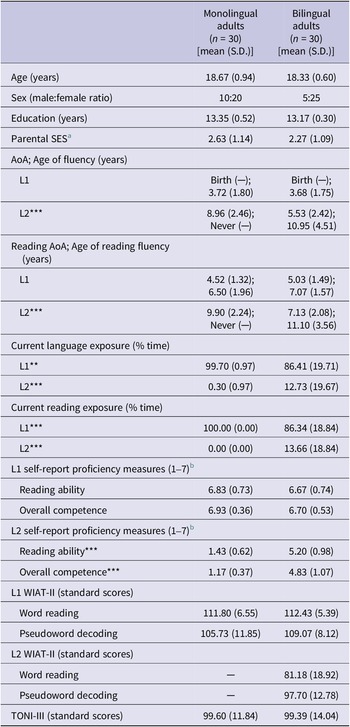
Participants’ demographic and language backgrounds were assessed with adaptations of the Language Experience and Proficiency Questionnaire (LEAP-Q; Marian et al., Reference Marian, Blumenfeld and Kaushanskaya2007); their objective language proficiency/reading skills (across their known languages) were assessed with the Word Reading and Pseudoword Decoding subtests of the WIAT-II (English-Canadian and French-Canadian adaptations; Wechsler, Reference Wechsler2005); and their non-verbal cognitive abilities were assessed with the Test of Non-Verbal Intelligence – Third Edition (TONI-III; Brown et al., Reference Brown, Sherbenou and Johnsen1997). As can be seen in Tables 1 and 2, the monolingual and bilingual age groups were closely matched. However, the adult groups exhibited significantly stronger L1 word reading skills and weaker non-verbal cognitive skills relative to the child groups (across monolinguals and bilinguals).
Child participant characteristics

Abbreviations: SES = socioeconomic status; AoA = age of acquisition; L1 = first-language; L2 = second-language; WIAT-II = Wechsler Individual Achievement Test – 2nd Edition; TONI-III = Test of Nonverbal Intelligence – 3rd Edition.
a Scale from 1 (major professional) to 9 (unemployed) using Hollingshead Four Factor Index of SES (Hollingshead, Reference Hollingshead1975).
b Scale from 1 (beginner) to 7 (native-like).
***p < .001.
Adult participant characteristics

Abbreviations: SES = socioeconomic status; AoA = age of acquisition; L1 = first-language; L2 = second-language; WIAT-II = Wechsler Individual Achievement Test – 2nd Edition; TONI-III = Test of Nonverbal Intelligence – 3rd Edition.
a Scale from 1 (major professional) to 9 (unemployed) using Hollingshead Four Factor Index of SES (Hollingshead, Reference Hollingshead1975).
b Scale from 1 (beginner) to 7 (native-like).
** p < .01; *** p < .001.
2.2.2. Materials
Stimuli consisted of the same four English and four French paragraphs as in the word AoA rating task (detailed earlier). As mentioned previously, words within these paragraphs were coded for multiple lexical features, including word length, word frequency, word predictability, and word AoA using the norms collected in the word AoA rating task (see Table S5 of Appendix in Online Supplementary Materials for lexical properties). A total of 210 language-unique target words were selected for the analyses (across English and French). This number excluded line-initial and line-final words; function, punctuated, and repeated words; and cross-language ambiguous words (i.e., cognates, interlingual homographs), as these properties have been found to influence eye movement patterns (reviewed in Rayner, Reference Rayner1998).
2.2.3. Procedure
After providing verbal and written assent (children) and consent (adults and parents/caregivers), participants completed the eye-tracking reading task. Participants were instructed to silently read the four paragraphs for comprehension. Monolingual participants read all four paragraphs in their L1 (English), whereas bilingual participants read two paragraphs in their L1 (English) and two in their L2 (French). The paragraphs were counterbalanced across participants using a Latin square design (version: 1, 2, 3, 4; language: L1, L2). After reading each paragraph, comprehension was assessed via orally administered, open-ended questions (four per paragraph, designed by the experimenters). Subsequently, participants (or parents/caregivers) completed the LEAP-Q, followed by the WIAT-II Word Reading and Pseudoword Decoding subtests, and, finally, the TONI-III.
2.2.4. Apparatus
A desktop-mounted EyeLink 1000 eye-tracker recorded eye movements at a 1 kHz sample rate (SR-Research, Ontario, Canada). Viewing was binocular; however, tracking was right-eye monocular. The paragraphs were displayed on a 21″ ViewSonic CRT monitor (1024 × 768 pixel-screen resolution), positioned 60 cm in front of participants. The paragraphs were presented on one or two screens (depending on their length) in double-spaced yellow 14-point Courier New font against a black background using Experiment Builder software (SR-Research, Ontario, Canada). Each screen had a maximum of 10 lines of text and 70 characters per line, with two characters subtending 1° of visual angle. Calibration was performed with a nine-point grid, with average fixation errors < 0.5° of visual angle following validation. A padded headrest maintained the head position during reading.
3. Results
3.1. Reading comprehension performance
As mentioned previously, reading comprehension accuracy was assessed via orally administered, open-ended questions (four per paragraph). Responses were scored as 1 (correct), 0.5 (partially correct), or 0 (incorrect). Regarding L1 (English) comprehension accuracy, a one-way analysis of variance (ANOVA) revealed no significant between-group differences [F (3,123) = 0.47, p = .703; monolingual children: M = 84.01% ± 11.74%; bilingual children: M = 82.46% ± 17.54%; monolingual adults: M = 86.25% ± 11.42%; bilingual adults: M = 87.04% ± 13.10%]. Regarding bilingual L1 (English) versus L2 (French) comprehension accuracy, a two-way ANOVA revealed no significant between-group differences [F (1,122) = 0.05, p = .822; bilingual children L1: M = 82.46% ± 17.54%; bilingual children L2: M = 77.83% ± 18.66%; bilingual adults L1: M = 87.04% ± 13.10%; bilingual adults L2: M = 81.47% ± 14.77%]. Thus, reading comprehension accuracy was comparable across the different participant groups and languages.
3.2. Eye movement reading performance
The EyeLink 1000 software separates fixations (pauses) and saccades (eye movements) using a combined acceleration and velocity algorithm; saccades had a minimum velocity of 30°/sec, minimum acceleration of 8,000°/sec2, and minimum change in eye position of 0.15°. A lower cut-off of 80 ms was applied to all fixations (< 5% of all data). No upper cut-off was applied to maximize data inclusion. Fixation duration ranges for each participant group were as follows: monolingual children (min = 80 ms; max = 1,931 ms); bilingual children (min = 80 ms; max = 2,605 ms); monolingual adults (min = 80 ms; max = 1,187 ms); and bilingual adults (min = 80 ms; max = 1,691).
We examined a total of four eye movement measures. Two were early-stage measures, believed to reflect lexical access: first fixation duration (i.e., length of time spent when initially fixating a word) and gaze duration (i.e., total length of time spent fixating a word during first-pass reading). Two were late-stage measures, believed to reflect post-lexical processing: go-past time (i.e., length of time spent fixating a word during first-pass reading + length of time spent re-fixating earlier-occurring words) and total reading time (i.e., overall length of time spent fixating a word).
The data were analyzed using linear mixed-effects regression models (lme4 package) in R version 4.4.3 (Baayen et al., Reference Baayen, Davidson and Bates2008; R Core Team, 2025). Only fixations on the 210 language-specific target words were included in the analysis. To normalize their distribution, fixations were log-transformed. Two core models were applied to each eye movement measure (detailed subsequently), one examining L1 reading across the four participant groups (named “L1 Model”) and one examining L1 vs. L2 reading across the two bilingual participant groups (named “L1 vs. L2 Model”). Across all models, categorical variables were deviation coded (+0.5, −0.5), meaning that each level was compared with the overall grand mean; continuous variables were centered and scaled (i.e., standardized, z-scored) to reduce collinearity; and random factors included random intercepts for participants, random intercepts for paragraph version, and random intercepts for words nested within paragraphs. The latter was only included if model convergence permitted; if convergence issues arose, it was excluded. Of note, the maximal random effects structure could not be implemented due to model convergence issues when random slopes were included. To control the family-wise error rate and reduce the risk of Type I errors, Holm–Bonferroni corrections were applied to main effects and interactions for all eye movement measures (for further discussion, see von der Malsburg & Angele, Reference von der Malsburg and Angele2017).
3.2.1. L1 model
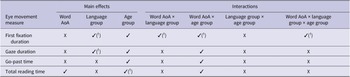
For this model, fixed factors included word AoA (continuous), language group (monolingual vs. bilingual), age group (children vs. adults), and their interactions. Control predictors included word length (continuous), word frequency (continuous, log-transformed), word predictability (continuous), L1 WIAT Word Reading standard score (continuous; included due to significant age group differences), and TONI standard score (continuous; included due to significant age group differences). Sample syntax is provided subsequently, an overview of the results is available in Table 3, and the complete model outputs are available in Tables S6 and S7 of the Appendix in the Online Supplementary Materials.
L1 model overview of significant effects across eye movement measures

Note. ✓(†) = Effect no longer significant after Holm-Bonferroni correction.
L1 Model = lmer(eye movement measure ~ word AoA * language group * age group + word length + word frequency + word predictability + L1 WIAT Word Reading + TONI + (1|participant) + (1|paragraph version/word)
Main Effects. The effect of word AoA was significant for total reading time only (β = 0.05, SE = 0.01, t = 4.85, p < .001, adjusted p < .001), where fixations were longer for later-learned versus earlier-learned words. The effect of language group was initially significant for first fixation duration (β = –0.05, SE = 0.02, t = –2.58, p = .011, adjusted p = .321) and gaze duration (β = –0.07, SE = 0.03, t = –2.19, p = .031, adjusted p = .793), where fixations were longer for bilinguals versus monolinguals; however, it did not survive the Holm-Bonferroni correction. Finally, the effect of age group was significant for first fixation duration (β = 0.12, SE = 0.03, t = 4.29, p < .001, adjusted p < .001), gaze duration (β = 0.19, SE = 0.04, t = 4.93, p < .001, adjusted p < .001), and go-past time (β = 0.18, SE = 0.05, t = 3.51, p = .001, adjusted p = .021), as well as initially significant for total reading time (β = 0.13, SE = 0.06, t = 2.26, p = .026, adjusted p = .694), where fixations were longer for children versus adults.
Interactions. The three-way interaction between word AoA, language group, and age group (i.e., highest-order interaction) was initially significant for first fixation duration only (β = –0.03, SE = 0.02, t = –2.08, p = .037, adjusted p = .894), where L1 word AoA effects were larger for children versus adults, particularly for bilingual children, driven by their differentially slower processing of later-learned L1 words. However, the three-way interaction did not survive the Holm–Bonferroni correction. Additionally, the two-way interaction between word AoA and age group was significant for gaze duration (β = 0.07, SE = 0.01, t = 7.25, p < .001, adjusted p < .001), go-past time (β = 0.10, SE = 0.01, t = 7.67, p < .001, adjusted p < .001), and total reading time (β = 0.11, SE = 0.01, t = 9.98, p < .001, adjusted p < .001), where L1 word AoA effects were larger for children versus adults, driven by their differentially slower processing of later-learned L1 words.
3.2.2. L1 versus L2 model
For this model, fixed factors included word AoA (continuous), paragraph language (L1 vs. L2), age group (bilingual children vs. bilingual adults), and their interactions. Control predictors included word length (continuous), word frequency (continuous, log-transformed), word predictability (continuous), L1 WIAT Word Reading standard score (continuous), L2 WIAT Word Reading standard score (continuous), and TONI standard score (continuous). Sample syntax is provided subsequently, an overview of the results is available in Table 4, and the complete model outputs are available in Tables S8 and S9 of the Appendix in the Online Supplementary Materials.
L1 vs. L2 model overview of significant effects across eye movement measures

Note: ✓(†) = Effect no longer significant after Holm-Bonferroni correction.
L1 vs. L2 Model = lmer(eye movement measure ~ word AoA * paragraph language * age group + word length + word frequency + word predictability + L1 WIAT Word Reading + L2 WIAT Word Reading + TONI + (1|participant) + (1|paragraph version/word)
Main Effects. The effect of word AoA was significant for gaze duration (β = 0.05, SE = 0.01, t = 5.14, p < .001, adjusted p < .001) and total reading time (β = 0.08, SE = 0.01, t = 7.66, p < .001, adjusted p < .001), as well as initially significant for first fixation duration (β = 0.04, SE = 0.01, t = 3.21, p = .002, adjusted p = .050) and go-past time (β = 0.05, SE = 0.02, t = 2.17, p = .031, adjusted p = .793), where, again, fixations were longer for later-learned versus earlier-learned words. The effect of paragraph language was significant for gaze duration (β = 0.12, SE = 0.02, t = 5.45, p < .001, adjusted p < .001), go-past time (β = 0.21, SE = 0.02, t = 9.35, p < .001, adjusted p < .001), and total reading time (β = 0.22, SE = 0.02, t = 11.59, p < .001, adjusted p < .001), as well as initially significant for first fixation duration (β = 0.05, SE = 0.02, t = 3.22, p = .003, adjusted p = .108), where fixations were longer for L2 versus L1 words. The effect of age group was non-significant across all eye movement measures.
Interactions. The three-way interaction between word AoA, paragraph language, and age group (i.e., highest-order interaction) was significant for both late-stage measures (see Figure 1): go-past time (β = −0.14, SE = 0.03, t = −4.34, p < .001, adjusted p = .001) and total reading time (β = −0.14, SE = 0.03, t = −4.93, p < .001, adjusted p < .001). To facilitate interpretation of this interaction, we ran separate follow-up models as a function of paragraph language (L1, L2) and age group (bilingual children, bilingual adults). The L1 follow-up model revealed that L1 word AoA effects were larger for bilingual children versus bilingual adults, driven by their differentially slower processing of later-learned L1 words, across go-past time (β = 0.12, SE = 0.02, t = 5.71, p < .001) and total reading time (β = 0.12, SE = 0.02, t = 6.55, p < .001). In contrast, the L2 follow-up model revealed that L2 word AoA effects were age group invariant across both eye movement measures. The bilingual child follow-up model revealed that L1 versus L2 word AoA effects were comparable across both eye movement measures. In contrast, the bilingual adult follow-up model revealed larger L2 versus L1 word AoA effects, driven by their differentially slower processing of later-learned L2 words, across go-past time (β = 0.08, SE = 0.02, t = 3.82, p < .001) and total reading time (β = 0.10, SE = 0.03, t = 3.22, p < .001).
The effect of word AoA on bilingual children’s and bilingual adults’ go-past times and total reading times during L1 and L2 reading. Actual values are plotted. Shaded areas represent confidence intervals.

Additionally, the two-way interaction between word AoA and paragraph language was significant for gaze duration (β = 0.06, SE = 0.01, t = 4.40, p < .001, adjusted p < .001) and total reading time (subsumed within the previously discussed three-way interaction: β = 0.06, SE = 0.01, t = 3.94, p < .001, adjusted p = .003), where word AoA effects were larger for L2 versus L1 reading. As well, the two-way interaction between word AoA and age group was significant for all eye movement measures: first fixation duration (β = 0.04, SE = 0.01, t = 4.15, p < .001, adjusted p = .001), gaze duration (β = 0.07, SE = 0.01, t = 4.99, p < .001, adjusted p < .001), go-past time (subsumed within the previously discussed three-way interaction: β = 0.06, SE = 0.02, t = 3.95, p < .001, adjusted p = .002), and total reading time (subsumed within the previously discussed three-way interaction: β = 0.06, SE = 0.01, t = 4.28, p < .001, adjusted p = .001), where word AoA effects were larger for bilingual children versus bilingual adults. Across these two-way interactions, effects were driven by differentially slower processing of later-learned words. Finally, the two-way interaction between paragraph language and age group was significant for all eye movement measures: first fixation duration (β = −0.13, SE = 0.02, t = −6.55, p < .001, adjusted p < .001), gaze duration (β = −0.20, SE = 0.03, t = −7.49, p < .001, adjusted p < .001), go-past time (subsumed within the previously discussed three-way interaction: β = −0.20, SE = 0.03, t = −6.44, p < .001, adjusted p < .001), and total reading time (subsumed within the previously discussed three-way interaction: β = −0.25, SE = 0.03, t = −8.76, p < .001, adjusted p < .001), where fixations were longer for bilingual children versus bilingual adults, especially during L1 reading.
4. Discussion
The current study aimed to fill critical gaps in the empirical literature on word AoA by examining how different language backgrounds (monolingual vs. bilingual), languages (L1 vs. L2), and developmental stages (childhood vs. young adulthood) concurrently influence the effects of this important lexical property during naturalistic paragraph reading. Our main findings were threefold: (1) no reliable differences in L1 word AoA effects between monolinguals and bilinguals (regardless of age group); (2) larger L2 versus L1 word AoA effects in bilinguals (across both age groups, but especially in bilingual adults); and (3) larger word AoA effects in children versus adults (across both language groups, limited to L1 reading).
4.1. Word AoA effects in monolinguals vs. bilinguals during L1 reading
Our first main finding was that L1 word AoA effects were comparable in monolinguals and bilinguals during both early-stage and late-stage reading (across both age groups). Although we observed some initial evidence of larger L1 word AoA effects in bilinguals during early-stage reading (first fixation duration), especially in bilingual children, this difference did not withstand correction for multiple comparisons. We also found that children showed greater sensitivity to word AoA than adults, evidenced by their slower processing of later-learned L1 words during both early-stage and late-stage reading (further detailed subsequently). However, the magnitude of this effect did not vary by language group. As such, bilingual experience may not be a significant moderator of word AoA effects when the language being read is the native/dominant one.
From a theoretical standpoint, this pattern aligns poorly with the representation theory, which would predict increased competition or weaker semantic connectivity in bilinguals’ L1 (relative to monolinguals’ L1), due to shared lexical networks. Instead, our results suggest that once L1 representations are well established, lexical access operates efficiently in both monolinguals and bilinguals, and early versus late word learning does not differentially impact processing. Our findings are well-aligned with the mapping theory and the multiple loci account, both of which propose that word AoA effects are context- and task-dependent, emerging more strongly when mappings between orthographic, phonological, and semantic representations are less entrenched and/or when processing demands are high. In the context of L1 reading, particularly among skilled adult readers, these mappings are likely highly robust and well-established, even for bilinguals. We would also like to highlight here that the main effect of word AoA was only significant for late-stage reading (total reading time), suggesting that word AoA does not uniformly influence all stages of reading, as no reliable effects were observed during early-stage reading (first fixation duration, gaze duration). Consistent with the multiple-loci account, this implies that word AoA effects may primarily emerge during post-lexical processing stages, when integration, revision, and other higher-level cognitive operations place greater demands on the language system.
This pattern also fails to provide empirical support for lexical entrenchment accounts of bilingual language processing, such as BIA+, Multilink, and the weaker links hypothesis. These accounts would likely predict larger L1 word AoA effects in bilinguals versus monolinguals (regardless of age group) due to their reduced/divided language experience, resulting in lower word baseline activation levels and/or reduced word-related links, especially for later-learned words. Additionally, Multilink would predict increased L1 processing demands for bilinguals due to L1–L2 co-activation. However, these increased processing demands did not translate into magnified L1 word AoA effects in bilinguals. This suggests that in high-proficiency contexts, the influence of cross-language activation may be minimized, enabling bilinguals to process early- and later-acquired L1 words similarly to monolinguals.
Considering that both monolingual and bilingual children were equally sensitive to word AoA during L1 reading, this suggests that word AoA effects at this age reflect general developmental mechanisms rather than differences in language experience. Moreover, since the adult participants were highly proficient native English readers (i.e., university students with high scores on the WIAT Word Reading subtest; see Table 2), the materials used (short, child-appropriate stories composed mostly of early-acquired and high-frequency words) may not have been demanding enough to elicit between-group differences in L1 word AoA effects. This suggests that language proficiency or current language exposure (not bilingualism per se) may play a more critical role in modulating word AoA effects, particularly during native/dominant language reading. Ultimately, these findings support the view that a core mapping or semantic mechanism operates in a language-neutral manner once proficiency is sufficiently high.
Our findings also contribute to a growing body of research examining the impact of word AoA on online reading behavior. Although we did not observe a significant main effect of word AoA during early-stage reading (first fixation duration, gaze duration), our late-stage effect (total reading time) is consistent with previous studies showing that word AoA influences semantic integration and later cognitive processing (e.g., Dirix & Duyck, Reference Dirix and Duyck2017a; Juhasz & Rayner, Reference Juhasz and Rayner2006). Our findings also closely parallel those of Dirix and Duyck (Reference Dirix and Duyck2017b), who directly compared L1 word AoA effects in monolingual and bilingual readers of similar L1 proficiency, and observed no significant between-group differences across early and late measures. As well, our findings extend previous behavioral studies reporting robust L1 word AoA effects in both children and adults from monolingual (e.g., Assink et al., Reference Assink, van Well and Knuijt2003, Experiment 1; Coltheart et al., Reference Coltheart, Laxon and Keating1988; Hsiao & Nation, Reference Hsiao and Nation2018; Nazir et al., Reference Nazir, Decoppet and Aghababian2003) and bilingual (e.g., Assink et al., Reference Assink, van Well and Knuijt2003, Experiment 2; Łuniewska et al., Reference Łuniewska, Wójcik, Kołak, Mieszkowska, Wodniecka and Haman2022) backgrounds.
4.2. Word AoA effects in bilinguals during L1 versus L2 reading
Our second main finding was that word AoA effects were larger during L2 versus L1 reading in bilinguals, with some nuanced differences depending on reading stage and age group. More specifically, during early-stage reading (gaze duration), both bilingual children and bilingual adults exhibited larger L2 word AoA effects, driven by slower processing of later-learned L2 words. However, during late-stage reading (go-past time, total reading time), this effect was more pronounced in bilingual adults, who exhibited larger-magnitude L2 word AoA effects, whereas for bilingual children, this effect was more attenuated, with reduced L1–L2 differences. The bilingual adult pattern indicates a global hindrance in processing later-learned L2 words that is exacerbated during late-stage reading. Despite being considered “early” bilinguals (L2 AoA = 5.53 years; see Table 2), bilingual adults had low levels of current L2 exposure (12.73%; see Table 2). In contrast, bilingual children, who as a group reported relatively high levels of current L2 exposure (39.70%; see Table 1), were able to offset some of their initial processing difficulties for later-learned L2 words during late-stage reading. Bilingual adults, with their lower levels of current L2 exposure, were unable to do so and, in fact, experienced a heightened degree of difficulty. This occurred despite greater cumulative L2 exposure.
The bilingual adult pattern aligns with the mapping theory, where less stable L2 mappings increase processing costs, as well as with representation-based accounts proposing weaker semantic links for later-learned L2 words. In contrast, bilingual children’s comparable L1 and L2 word AoA effects during late-stage reading may reflect their active dual language use, allowing for more flexible or context-supported integration, even for less entrenched L2 words. However, this pattern aligns poorly with the multiple loci account, according to which, word AoA effects should accumulate across processing stages, leading to larger word AoA effects during late-stage reading for all readers. Thus, relatively high current L2 exposure levels, even among developing readers, may reduce some linguistic or cognitive load when processing later-learned L2 words.
Our bilingual adult findings (but not our bilingual child findings) provide empirical support for lexical entrenchment accounts of bilingual language processing, where more effortful word processing (and larger word AoA effects) are predicted during L2 versus L1 reading. The bilingual adult pattern may reflect weakened L2 connections due to reduced active use, alongside dominance of more deeply entrenched L1 mappings formed through extensive exposure (both past and current). This supports the idea that infrequent L2 use can hinder processing of later-learned L2 words. While models like Multilink additionally predict increased cross-language competition/interference during word recognition, which could contribute to larger L2 versus L1 word AoA effects, we note that our study only included language-unique target words (i.e., cognates and interlingual homographs were excluded from the analyses).
Conversely, bilingual children’s comparable L1 and L2 word AoA effects are at odds with lexical entrenchment accounts of bilingual language processing, where more effortful word processing (and larger word AoA effects) would be predicted in the lesser used/weaker language, especially among developing readers. Rather, the bilingual child pattern suggests that they may have more balanced L1 and L2 word-related links, stemming from their active dual language use. As well, bilingual children’s developing language proficiency may result in more fluid and adaptable mappings between concepts and words across languages.
Although the only previous bilingual eye-tracking study in this area did not directly compare L1 and L2 word AoA effects within bilingual adults (Dirix & Duyck, Reference Dirix and Duyck2017b), our findings demonstrate robust L1 and L2 word AoA effects across early and late eye movement measures, and cohere with prior behavioral research reporting larger L2 versus L1 word AoA effects in lexical decision and semantic judgment (e.g., Izura & Ellis, Reference Izura and Ellis2002, Reference Izura and Ellis2004; Wang et al., Reference Wang, Liang and Chen2023; Xue et al., Reference Xue, Liu, Marmolejo-Ramos and Pei2017). Although our bilingual child findings largely diverge from prior behavioral research, they suggest that current exposure and task demands can modulate how word AoA effects manifest in early development.
4.3. Word AoA effects in children versus adults
Our third main finding was that word AoA effects were larger in children versus adults (across both language groups), albeit during L1 reading only (across both reading stages). This was driven by their slower processing of later-learned L1 words. In contrast, during L2 reading among bilinguals, word AoA effects were age group invariant (across both reading stages). As noted earlier, this finding may stem from bilingual children’s relatively balanced current L1 and L2 exposure levels, resulting in comparable L2 word AoA effects to bilingual adults, who had relatively low current L2 exposure levels.
Our observed developmental differences in L1 word AoA effects support lexical entrenchment accounts of bilingual language processing, according to which, word AoA effects should be larger in children versus adults due to their developing language/reading proficiency and, consequently, lower word baseline/resting activation levels and/or weaker word-related links, particularly for later-learned words. These differences also align with word AoA accounts, as children’s reduced mapping and less established lexical connections reflect their developing proficiency. Compared to skilled adult readers, children are less efficient at accessing orthographic, phonological, and semantic representations (consistent with both the representation and mapping theories). However, as their reading skills develop, they rely less on phonological and perceptual cues for word mapping, leading to more centralized lexical representations (as posited by the representation theory) or more strongly weighted mappings between representations (as posited by the mapping theory). Moreover, as can be seen in Figure 1, there was evidence of heightened age group differences in L1 word AoA effects (across both language groups) during late-stage reading, suggesting that the additional linguistic and cognitive load involved (e.g., revision, semantic integration) increased the magnitude of children’s word AoA effects, providing support for the multiple loci account.
While our study is the first to investigate word AoA effects on eye movement reading behavior in children, our developmental differences in L1 reading are largely consistent with prior behavioral research involving monolingual (e.g., Assink et al., Reference Assink, van Well and Knuijt2003, Experiment 1, which found that the magnitude of word AoA effects decreased with age, with younger participants showing the largest effects; Coltheart et al., Reference Coltheart, Laxon and Keating1988; Davies et al., Reference Davies, Arnell, Birchenough, Grimmond and Houlson2017; Hsiao & Nation, Reference Hsiao and Nation2018; Nazir et al., Reference Nazir, Decoppet and Aghababian2003) and bilingual (Łuniewska et al., Reference Łuniewska, Wójcik, Kołak, Mieszkowska, Wodniecka and Haman2022) children.
4.4. Synthesis of main findings
Word AoA effects are fundamentally driven by when words enter and how deeply they become embedded in readers’ semantic networks. The patterns reported here support accounts in which earlier-acquired words benefit from more robust form–meaning mappings and richer semantic connectivity (as proposed by the representation and mapping theories). They also suggest that divided language exposure in bilinguals leads to weaker lexical accessibility and quality in the L2 compared to the L1 (consistent with bilingual lexical entrenchment accounts), and imply that processing costs accumulate across multiple levels of the reading system. Once readers attain basic proficiency in a language, word AoA effects appear to be driven by core, language-neutral semantic mapping mechanisms, with bilingual and developmental factors modulating only their magnitude and locus.
4.5. Limitations
While our study suggests that naturalistic eye movement reading behavior is sensitive to word AoA effects across languages, language groups, and age groups, several limitations should be considered. One key limitation is our reliance on adult subjective word AoA ratings, which may not accurately reflect children’s actual word acquisition timelines. Although such ratings are generally considered reliable (see Elsherif et al., Reference Elsherif, Preece and Catling2023), studies such as Morrison et al. (Reference Morrison, Chappell and Ellis1997) report only moderate correlations between adult word AoA ratings and the age at which 75% of children can name a given item (r = .76). This suggests that adult ratings may not fully capture children’s actual word AoAs. As noted in the Methods section, we attempted to validate our ratings against more objective child-based word AoA norms from Smolík and Filip (Reference Smolík and Filip2022), which were derived from the CHILDES database (MacWhinney, Reference MacWhinney2014). However, the correlation was relatively weak (r = .24), likely due to the limited overlap between our stimuli and the CHILDES norms, which are based on data from much younger children (ages 2–3). Future research using a broader range of age-appropriate child data and larger word sets will allow for more direct and accurate comparisons between subjective adult and objective child word AoA measures.
Another limitation of our study is that we relied solely on L1 word AoA ratings, without collecting or using L2 word AoA ratings. The existing literature offers conflicting perspectives on the relationship between L1 and L2 word AoA, reflecting the complexity of this topic across different study designs, participant populations, and language pairs. For instance, while some studies suggest that L2 words inherit AoA characteristics from their L1 equivalents (e.g., Izura & Ellis, Reference Izura and Ellis2002; Rodriguez-Cuadrado et al., Reference Rodriguez-Cuadrado, Hinojosa, Guasch, Romero-Rivas, Sabater, Suárez-Coalla and Ferré2022), others propose that L1 and L2 word AoA effects may operate independently (Izura & Ellis, Reference Izura and Ellis2004; Wang et al., Reference Wang, Liang and Chen2023; Xue et al., Reference Xue, Liu, Marmolejo-Ramos and Pei2017). Moreover, studies by Dirix and Duyck (Reference Dirix and Duyck2017b) and Wang and Chen (Reference Wang and Chen2020) have reported varying correlations (r = .52 and r = .32, respectively) between L1 and L2 word AoA ratings in unbalanced bilingual adults, suggesting that the order of word acquisition is roughly similar but not identical across languages. However, such differences may be minimized for early or more balanced bilinguals, like those included in our study.
Despite this second limitation, we believe several aspects of our study may mitigate its impact. First, our bilingual participants were relatively early bilinguals (bilingual children’s L2 AoA = 3.82 years; bilingual adults’ L2 AoA = 5.53 years), which may reduce discrepancies between L1 and L2 word acquisition timelines compared to late or more unbalanced bilinguals (Birdsong, Reference Birdsong2018). Additionally, research by Łuniewska et al. (Reference Łuniewska, Haman, Armon-Lotem, Etenkowski, Southwood, Anđelković, Blom, Boerma, Chiat, De Abreu, Gagarina, Gavarró, Håkansson, Hickey, De López, Marinis, Popović, Thordardottir, Blažienė and Ünal-Logacev2016) reports strong correlations in word AoA across different languages, suggesting that words are acquired at similar ages across languages. Second, previous research has found that L2 word AoA effects often parallel L1 word AoA effects across various standard behavioral tasks (Brysbaert & Ellis, Reference Brysbaert and Ellis2016; Izura & Ellis, Reference Izura and Ellis2002). Finally, studies indicate that L2 words may inherit AoA characteristics from their L1 equivalents (Izura & Ellis, Reference Izura and Ellis2002; Rodriguez-Cuadrado et al., Reference Rodriguez-Cuadrado, Hinojosa, Guasch, Romero-Rivas, Sabater, Suárez-Coalla and Ferré2022), which may lessen the impact of relying solely on L1 AoA ratings.
A final limitation of our study is its relatively small sample size (30–34 participants per group). Larger and more diverse samples are needed to replicate these findings and assess their generalizability across different contexts and bilingual populations. Our study focused on early bilinguals of languages that share the same writing system (English and French, both using the Latin alphabet) and included several participants from relatively privileged socioeconomic backgrounds. As such, it remains an open question whether the observed patterns extend to bilinguals of more typologically distant language pairs (e.g., Arabic–English or Chinese–English, which involve different writing systems), or to individuals from more varied socioeconomic backgrounds.
5. Conclusion
Our study represents the first systematic investigation of word AoA effects on naturalistic eye movement reading behavior across different language groups (monolinguals vs. bilinguals), languages (L1 vs. L2), and age groups (children vs. young adults). We found that later-acquired words impede both lexical access and post-lexical semantic integration, particularly under conditions of reduced lexical entrenchment: during L2 versus L1 reading among bilinguals and in children versus adults (albeit during L1 reading only). These findings provide empirical support for lexical entrenchment accounts of bilingual language processing, as well as leading theoretical models of word AoA. Collectively, these models emphasize the complex relationship between word AoA, language experience, and reading processes, highlighting how established lexical representations and neural plasticity jointly contribute to the processing advantage observed for earlier-acquired words. Continued research with more linguistically and developmentally diverse populations will further clarify the role of lexical properties, such as word AoA, in shaping reading behavior and language processing more generally, with important implications for educational and language instruction practices.
Supplementary material
The supplementary material for this article can be found at http://doi.org/10.1017/S1366728925100278.
Data availability statement
The stimuli for the study were excerpts from the Wechsler Individual Achievement Test – Second Edition (WIAT-II; Wechsler, Reference Wechsler2005), which are protected by copyright laws and are therefore subject to license/restriction. As such, we are unable to publicly share the data due to copyright restrictions. However, the data will be made available upon request by contacting the corresponding author.
Competing interests
The authors have no competing interests to declare.
Disclosure of use of AI tools
The use of AI was not used to (1) generate images; (2) generate text; and (3) analyze or extract insights.



 Open access

