

Tena Quichua (ISO 639-3: quw) belongs to the Quechuan language family, as part of the peripheral variety Quechua IIB (Torero Reference Torero1964, Cerrón-Palomino Reference Cerrón-Palomino1987, Gordon Reference Gordon2005). It is spoken in the Eastern Amazonian region of Ecuador on the Napo River above the mouth of the Rio Coca, primarily on three tributaries: the Misahualli, the Arajuno, and the Ansuc. Tena Quichua is bounded on the North and East by Napo Quichua and on the South by Pastaza Quichua. Previous research on the division of Ecuadorian dialects is summarized by Carpenter (Reference Carpenter1984: 3–4). Although it is beyond the scope of this Illustration, we hope that our description of Tena Quichua will prove useful in future work on the relations between these three Amazonian dialects of Ecuadorian Quichua. Below, a brief summary of Tena dialect identification and formation is given, followed by a description of present-day bilingualism in the region and data collection procedures.
The Tena dialect was first identified when the Wycliffe Bible translators carried out surveys on what was then generically called ‘Jungle Quichua’ or ‘Quichua del Oriente’ to determine the boundaries of comfortable mutual intelligibility for a written text, namely translations of the Bible. As noted in Gordon (Reference Gordon2005), Tena Quichua is considered to be mutually intelligible with Bobonaza (Pastaza) and Napo dialects in speaking but not in written form.Footnote 1 Both the Tena and Bobonaza dialects are classified as Eastern variants of Central Sierra Quichua. This means that they likely entered the Amazonian region through the Pastaza Valley which has its headwaters in the Tungurahua area. By contrast, the Napo dialect spoken below the mouth of the Coca originated in the Northern Ecuadorian Sierra where it entered over the Papallacta pass, moving down the Quijos valley to Coca. From there it was spread down river through trade.
Although the Tena and Bobonaza dialects both stem from the Central Sierra, the Tena dialect exhibits a number of grammatical similarities to one particular Tungurahua dialect community (Salasaca) not shared by Pastaza. Despite grammatical similarities to Salasaca however, Tena speakers perceive their own speech to be much closer to Pastaza than to Salasaca. When Tena or Pastaza speakers encounter Salasacas, they routinely switch to Spanish for greater comfort and intellegiblilty. When encountering each other, they continue in Quichua without perceiving major difficulties. Differences between the two dialects may in part be products of their different histories of missionization. Whitten (Reference Whitten1976) has argued that Pastaza Quichua should more appropriately be called ‘Canelos Quichua’ because their identity emerged around the Catholic mission of Canelos. He has argued persuasively (although on non-linguistic grounds) that the present population of Pastaza Quichua speakers are not the descendants of migrants from the sierra but are rather a mixture of Amazonian Zaparoan and Achuar Jivaroan people who underwent Quichuaization. Extending Whitten's argument, one might say that the Tena dialect could be called ‘Archidona Quichua’ because it crystalized around the Jesuit reduction of Archidona which featured a school to teach Quichua to the infieles or ‘unfaithful’ (Muratorio Reference Muratorio1991: 38). The formation of the Tena dialect as distinct from Pastaza Quichua may well be attributable to the different dynamics of the missions at Archidona and Canelos, although this history falls outside the scope of the present article.Footnote 2
In terms of present-day demographics, data taken from the 2001 national census (see INEC 2008) show that within the Province of Napo, whose population is 79,139, over half of the people reside within the Tena Cantón (46,007 or 58%), while the remainder live in the other four cantones or ‘administrative divisions’ that comprise the Napo Province. The Tena Cantón is further subdivided into parroquias ‘parishes’ and localidades ‘communities’ (see Haboud (Reference Haboud1998: 81–83) for geo-linguistic divisions within Ecuador). Within the Tena Cantón, 63.8% live in rural areas, and there is an almost equal percentage of men and women (50.5% vs. 49.5%). The majority of those aged 10 years or older have received 6.3 years of education, and nearly half of those are employed work in the agriculture, game and forestry sector (48.4%). In answer to the question ¿Cuál es el idioma o lengua que habla? ‘What language do you speak?’, over half of the 44,715 who responded reported speaking either a native language (12.2%) or Spanish and a native language (40.9%). Of those that identified themselves as indigenous (25,563), nearly all spoke either a native language (21%) or Spanish and a native language (69.1%).Footnote 3
To examine the Tena Quichua sound system, a recording was obtained of ‘The North Wind and the Sun’ story, which is commonly used as part of the Illustration of the IPA for different languages in the Journal of the International Phonetic Association. Therefore, the pronunciation described is based on this text rather than a native story. The speaker who participated in the recording of this story was male, 32 years of age at the time of the recording, born in the Napo Province, within the Tena Cantón, specifically in the Venecia Derecha Localidad. He had completed both primary and secondary education and works mainly in the area of agriculture. He is a native speaker of Quichua who learned Spanish after entering the school system and whose parents both speak Quichua.
The recording was obtained as follows: the speaker first read each sentence of the story in Spanish and provided an oral translation in Quichua; next, the Quichua portion was transcribed and written as a separate story just in Quichua; and last, the speaker then read the translated Quichua story aloud. The transcription represents the read production of this translated story in Quichua. The original oral translation was also used to examine any variation in consonant production. Recordings were made with a minidisc recorder using a head-mounted microphone. Additional recordings with this speaker and four other male native Quichua speakers from the same place of origin, the same profession, and age range (30–45 years) were made in order to examine conventions in vowel and consonant production, including recordings of a description of drawings from Mayer (Reference Mayer1967) and Bills, Vallejo & Troike (Reference Bills, Bernardo and Troike1969), and a word list. In addition, the second author of the present article is a member of the Quichua speech community to which the participants in the study belong, so that naturalness in pronunciation could be examined as needed.
Consonants

The consonants listed in the above table represent phonemes in Tena Quichua (TQ). Each sound is illustrated here first in word-initial position, followed by intervocalic, post-nasal, syllable-final, and word-final positions according to their distribution. Variations observed in these different positions are discussed in the ‘Conventions’ section below.Footnote 4

Voiceless stops /p t k/ are realized as plain stops word-initially and in intervocalic positions; /k/ also appears in syllable-final position, as in /ˈsukta/ ‘six’. Note that there are no phonemically contrastive aspirated stops in this dialect, as in other Quichua dialects (Carpenter Reference Carpenter1984: 10; Cerrón-Palomino Reference Cerrón-Palomino1987: 118; Catta Q. Reference Catta1994: 7). Voiced plosives /b d ɡ/ are considered separate phonemes that have developed in part due to the incorporation of these sounds from Spanish.Footnote 5 They appear word-initially in few words (Múgica Reference Múgica1967, Cordero Reference Cordero2006 [1892]), and are found in Spanish loans word-initially. However, voiced plosives appear after nasals and after some other voiced sonorants (e.g. /ataʎˈba-ɾa/ ‘chicken-acc’). Since voiced plosives now appear with a wider distribution, both word-initially and intervocalically, the post-nasal voiced stops are taken as variants of the voiced stop phonemes /b d ɡ/ (e.g. /ˈindi/ ‘sun’). Plosives /t d/ are considered alveolar in Catta Q. (Reference Catta1994) and dental in Moya (Reference Moya1987) and Chango Mazaquiza & Marlett (Reference Chango Masaquiza and Marlett2008). While the affricate /ts/ is much less frequent than other sounds, it is still observed word-initially, between vowels, and after nasals. Cordero (Reference Cordero2006 [1892]) lists the use of this post-alveolar affricate word-initially. However, no instances were observed or elicited in the present data set for TQ. Orr (Reference Orr1991) notes that in questions, the interrogative suffix /-tʃu/ is realized as [-dʒu] when following a nasal. Therefore, [dʒ] is considered an allophonic variant of /tʃ/, although further investigation is needed of TQ, including lower-frequency vocabulary. The distribution of /x/ may also be somewhat more restricted in that [x] in coda position is considered to have evolved as an allophone of /k/ (see Cerrón-Palomino Reference Cerrón-Palomino1987 and ‘Conventions’ section below). Also, in addition to historical reasons, since the post-alveolar fricative /ʃ/ and alveolar fricative /s/ appear before both front /i/ and before non-front vowels /a u/, these two sounds are considered to be separate phonemes in TQ (e.g. /ˈʃimi/ ‘mouth’, /ʃaˈmuna/ ‘to come’, /ˈʃuti/ ‘name’ vs. /ˈsisa/ ‘flower’, /ˈsatʃa/ ‘forest, wild’, /ˈsukta/ ‘six’). While /z/ appears word-initially and intervocalically in few native words and in some early Spanish loans (Cordero Reference Cordero2006 [1892]; see the ‘Fricatives’ section below), it does appear in post-nasal position (e.g. /ˈpunzu/ ‘fluffy, frizzy’, compare voiceless fricative /s/ in /ˈkinsa/ ‘three’). Of the consonants, only /n s k l ɾ/ appear word-finally.
Vowels and diphthongs
Vowels
There are three vowels, /i a u/, used in Tena Quichua and in words adopted from other languages, such as Spanish. All three appear in both stressed and unstressed positions. Example (1) shows each of the vowels in stressed position in combination with each vowel in unstressed position.
-
(1)


Note that the mid vowels /e o/ are not found in words with Quichua origin, but may appear in Spanish words that have not been fully incorporated into the TQ sound system. For example, a loan word into Quichua such as /paˈbo-ɾa/ ‘duck-acc’ maintains the mid back vowel /o/ from Spanish /ˈpabo/ ‘duck’, while a word such as /ˈɡaʎu/ ‘rooster’ shows a more fully incorporated word with a high back vowel /u/ instead of the original /o/ from Spanish /ˈɡaʎo/ ‘rooster’.
In order to examine the quality of the vowels, stressed vowels in open syllables were extracted from recordings of semi-spontaneous speech and measured in Praat (Boersma & Weenink Reference Boersma and Weenink1992–2011). For the five speakers, approximately 10 tokens of each vowel quality were measured. The data points labeled i a u in Figure 1 represent the mean for each speaker (minimum = 5 vowel measurements per data point, average = 9.7 vowels; total = 146 vowels). The measurements, taken in Hertz, were then converted to the Bark scale and normalized using the procedure described in Guion (Reference Guion2003) to account for individual differences in vocal tract length. Figure 2 represents the average vowel quality in Bark for the five speakers combined. Error bars show the average standard deviation for the five speakers. Note that the height (F1) of the back vowel is lower than the high front vowel. Orr (Reference Orr1991) observes that the back vowel is between the /u/ and /o/ sounds. In comparison to the Cardinal Vowels (Delattre et al. Reference Delattre, Liberman, Cooper and Gerstman1952: 200), the high front vowel may be considered to be closer in realization to [y] in terms of backness (F2), although it is also slightly lower, and the high back vowel may be considered closer to between [o] and [ɤ] in terms of backness (F2), although it is also lower than these vowels. Since Quichua vowels are generally transcribed as /i a u/, they will be transcribed in this way here also, even though, as noted in Guion (Reference Guion2003), their actual quality is considered to be closer to lower and more centralized variants [ɪ] and [ʊ]. In the case of the present data, the near-back vowel is even lower, and appears between the Cardinal Vowels [o] and [ɔ] in terms of height. The realization of the low vowel [a] is also more centralized (higher in F1) and is also less back in F2 than the corresponding cardinal vowel.
Data points represent average vowel quality of five Tena Quichua speakers (in Hz).

Vowel quality averaged over five Tena Quichua speakers (converted to Bark scale and normalized).

Diphthongs
The presence of diphthongs is described with respect to the overall syllable structure found in TQ. A coda consonant is possible in TQ, such that the addition of a progressive marker /-u/ forms a falling diphthong with the preceding nucleus, as in (2). Since falling diphthongs are possible, other instances of a glide (or semivowel) following a vowel in (3) are analyzed as diphthongs as well, although a coda consonant is not present in these cases.Footnote 6
-
(2)
-
(3)


In the case of rising diphthongs, the evidence is less clear with respect to syllable structure. That is, complex onsets are found, as in the second syllable in (2). However, there are no instances of a complex onset in combination with a glide. Therefore, in the following examples in (4), a central approximant is considered to be part of the complex onset.
-
(4)

In cases where there are two adjacent identical vowels, they are reduced to one long vowel rather than forming a diphthong, as in (5).Footnote 7
-
(5)

Under this analysis, examples such as (6) represent a falling diphthong preceded by a complex onset (rather than a triphthong).
-
(6)

Prosodic features: Stress and intonation
Stress
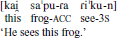
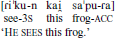
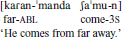
Stress in Tena Quichua generally falls on the penultimate syllable (as shown in the examples in (1) above). However, a subset of suffixes causes stress to fall on the last syllable of the word, including: the locative (loc) suffix when added to polysyllabic words ending in a vowel (see example (5) above), third person singular /-n/ and plural /-nun/ present tense markers (see examples (6) above and (7)), and the suffix /-nɡax/ used to express future obligation (see example (8)).
-
(7)
-
(8)


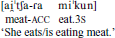
There are also cases in which the addition of a suffix does not cause stress shift to the new penultimate syllable, as in the topic marker (top) /-ɡa/ (Orr Reference Orr1991). In the present data set, this phenomenon was also observed in some cases with the accusative marker (acc) /-ɾa/ (as in (9), from /ˈkwika-ɾa m
iˈku-n/ earthworm-acc eat-3s ‘it eats/is eating (an) earthworm’). However, in other examples, this phenomenon is not as clear (as in (10)), while other cases do show penultimate stress (as in (11), from /a
 ˈtʃa-ɾa m
iˈku-n/ meat-acc eat-3s ‘she eats/is eating meat’) (see Figure 3). Whether or not penultimate stress is observed with /-ɾa/ may be due to several factors, including word order and placement within the discourse, although this matter lies beyond the scope of the present work.
ˈtʃa-ɾa m
iˈku-n/ meat-acc eat-3s ‘she eats/is eating meat’) (see Figure 3). Whether or not penultimate stress is observed with /-ɾa/ may be due to several factors, including word order and placement within the discourse, although this matter lies beyond the scope of the present work.
-
(9)
-
(10)
-
(11)


Word-initial stress in [ˈkwika-ɾa] ‘earthworm-acc’, penultimate stress in [a
ˈtʃa-ɾa] ‘meat-acc’; pitch shown with solid line.

Last, there are some words where secondary stress may be perceived, either on the first or sometimes second syllable, as in (12) and (13). Hintz (Reference Hintz2006: 482–483) provides a summary of stress in varieties of Quechua, including cases in which primary or secondary stress is found on the initial syllable. Cerrón-Palomino (Reference Cerrón-Palomino1987: 128–129) notes that which syllables attract stress may be due in part to syllable structure and the types of suffixes involved in word formation. In order to further characterize stress in TQ, a detailed study of the acoustic correlates of stress, including duration, intensity, and fundamental frequency (f0) is needed as well as a comparison of vowel quality of stressed and unstressed vowels.Footnote 8 Preliminary observation suggests that changes in intensity may participate in signaling tonic and pretonic syllables, as in Figure 4: the greatest degree of intensity appears during the penultimate syllable, whereas the antepenultimate syllable shows the least. In this example, unstressed vowels are not noticeably reduced in quality or duration. Rather, the stressed syllable appears longer than the other atonic syllables (due in part to the presence of a diphthong) and is further highlighted with an f0 peak.
-
(12)
-
(13)


Secondary stress on initial syllable, penultimate primary stress in [ˌrimanuˈna
 ka] ‘they were talking to each other’; pitch shown with solid line, intensity with dashed line.

Intonation
A final note on prosodic features is related to intonation. Since more work on stress (and stress shift) in TQ is needed, the suprasegmental feature of intonation is mentioned here as an area for future research. In terms of Quichua varieties, Cole (Reference Cole1982) provides a description of intonation in Imbabura Quechua, which shows a schematic representation of the peak occurring during the stressed syllable. Words spoken in isolation follow this general description (see Figure 5). However, the representation in Cole (Reference Cole1982) shows only contour movement at the end of the utterance, such that the alignment and scaling of peaks in non-final position within an utterance needs to be determined.
Words produced in isolation with peak during the stressed syllable [ˈʃimi] [ˈɾiŋɾi] ‘mouth’, ‘ear’.

In the declaratives analyzed for TQ, tonic-alignment of peaks is found in both final and non-final positions within an utterance (e.g. Figure 6).Footnote 9 The final pitch accent or tonal movement related to the stressed syllable may be lower than previous pitch accents, as in Figure 6; in other cases, the final pitch accent is not lower, as in Figure 7. The extent to which downstep operates within TQ is another area to be explored further, that is, whether or not pitch is successively lower at certain tonal events along an utterance, as described in Liberman & Pierrehumbert (Reference Liberman, Pierrehumbert, Aronoff and Oehrle1984). Longer utterances with successive peaks are needed to observe this phenomenon (or the lack thereof) in more detail.
Tonic-aligned final and non-final peaks, lower final peak:


Tonic-aligned final and non-final peaks, non-lowered final peak (OV word order):


In the previous examples of declaratives with broad focus (neutral object–verb word order), the utterance ends in a final fall. In Figure 8, the utterance with verb–object word order shows a wider pitch range and slightly lower final pitch accent. Longer utterances demonstrate a similar pattern, with peaks during the stressed syllable and lack of downstep, as in Figure 9 and Figure 10. For the present data, using AM notation for peaks (H) and valleys (L), tonal association (*), and boundary tones (%), the nuclear and prenuclear pitch accents appear to be tonic-aligned or H* (as in Figure 8), in some cases preceded by a low tone L+H* (as in Figure 9); declaratives end in a low boundary tone L% (Figures 6–10). Several other areas to be explored within TQ intonation include examination of other basic utterance types, such as yes–no and wh-questions, exclamatives, and imperatives, as well as the shape of final and non-final contours.
Tonic-aligned final and non-final peaks, lowered final peak, expanded pitch range (VO word order):


Tonic-aligned final and non-final peaks, non-lowered final peak:


Tonic-aligned final and non-final peaks, non-lowered final peak:


Conventions
Stops
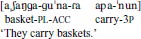
In intervocalic position, voiced stops undergo spirantization, such that fricatives are found, as in /ˈka
-bi/ [ˈka
-βi] ‘this-loc’ (Figure 11) and /aˌʃanɡa-ˈɡuna/ [aˌʃaŋɡa-ˈɣuna] ‘basket-pl’. In addition, voiced stops that originated in loans from Spanish may undergo further spirantization intervocalically, producing approximants, as in /paɡaˈɾatʃu/ [pa
 aˈɾatʃu] ‘Thank you’ < Sp. /paˈɡaɾ/ pagar ‘to pay’ (Figure 12). More investigation is needed to determine if voiced stops undergo spirantization word-initially when following another vowel.
Intervocalic fricative [ˈka
-βi] ‘this-loc’.

Approximant [pa
aˈɾatʃu] ‘thank you’ < Sp. [paˈ
aɾ] ‘to pay’.

Affricates
After nasals a voiced affricate [dʒ] is found. Since the distribution is limited to this context, [dʒ] is considered an allophone of /tʃ/, as in /ˈpuntʃa/ [ˈpundʒa] ‘day’ (Orr Reference Orr1991). However, the affricate /ts/ is not voiced after the nasal (e.g. /ˈtsuntsu/ [ˈtsuntsu] ‘poor’). This lack of voicing after nasals may be due in part to the development of /ts/ from /tʃ’/ (see Cerrón-Palomino (Reference Cerrón-Palomino1987: 188) for a discussion of the evolution of /ts/ from glottalized, aspirated, and simple voiceless affricates). Note that a distinct release of the stop closure appears in the onset of the second syllable in /ˈtsatsa/ [ˈtsatsa] ‘sand’ and /ˈtsuntsu/ [ˈtsuntsu] ‘poor’ (also apparent in a spectrogram of these realizations). This realization may be due to careful pronunciation but should be investigated further according to the evolution of the affricate word-internally.
Nasals
Nasals in coda position share the place of articulation with the following stop (e.g. /ˈtʃimba/ [ˈtʃimba] ‘across’, /ˈtʃinda/ [ˈtʃinda] ‘brush pile’, /ˈtʃunɡa/ [ˈtʃuŋɡa] ‘ten’); note in this last case that [ŋ] is considered to be an allophonic variant of /n/ since its distribution is limited to preceding other velars. Orr (Reference Orr1991) also reports a similar (velar) pronunciation preceding /m/ or word-finally (e.g. /ˈatun/ [ˈatuŋ] ‘large’). However, the extent to which this velarization process occurs in these contexts consistently needs to be investigated further, including formant transitions in the preceding vowel.
Fricatives
After nasals, the alveolar fricative /s/ is not voiced, as in /ˈkinsa/ [ˈkinsa] ‘three’. In Cordero (Reference Cordero2006 [1892]), Caimi ñucanchic shimiyuc-panca (1982), a voiced /z/ is shown after a nasal (e.g. /ˈpunzu/ [ˈpunzu] ‘fluffy, frizzy’); there are also very few tokens of /z/ cited word-initially and intervocalically. The voiced alveolar fricative may appear in early loan words from Spanish (also noted in Cerrón-Palomino (Reference Cerrón-Palomino1987: 186) and references therein). The Quichua word /ˈduzi/ [ˈduzi] ‘zenith’ shows an early Spanish loan from the Old Spanish /ˈdoze/ [ˈdoze] doce, which became a voiced dental in Medieval Andalusian and American Spanish; later developments in the devoicing of sibilants resulted in modern Latin American Spanish [ˈdose] doce (see Penny Reference Penny2002 for a description of the evolution of Spanish sibilants). However, in elicitation of this token for the present data set, only a voiceless alveolar fricative was observed ([ˈdusi] ‘zenith’). A similar result was found for [kuɾˈzana] ‘place in a crossed fashion’ < Old Sp. [kɾuˈzaɾ] ‘to crossʼ; that is, [kuɾˈsana] ‘place in a crossed fashion’ was observed). Since in modern Spanish orthography 〈z〉 represents a voiceless fricative [s] in Latin American Spanish, the production of a voiceless variant for Quichua duzi and kurzana as opposed to the voiced fricative predicted for Quichua may be due to influence from Spanish orthography. More investigation is needed in this area to determine the possible sources of this variation. Also, the fricative /z/ may be realized with an affricate pronunciation word-initially, as in /ˈzas-ʎa/ [ˈdzas-ʎa] ‘quick-lim’, or in some cases after a nasal, as in /ˈaswa a nzi/ [ˈaswa a ndzi] ‘solid residue from corn beer’, compare /ˈpunzu/ [ˈpunzu] ‘fluffy, frizzy’. While the tokens above were observed in the present data set, further investigation is needed to determine how consistently this epenthesis takes place, including examination of other environments such as /z/ in intervocalic position. Variants of another fricative are found in the place of articulation of /x/, which may range from velar to glottal in native Quichua words and in loans (e.g. /ˈpaxu/ [ˈpaxu] ‘illness’, /ˈxutʃa/ [ˈhutʃa] ‘debt, sin’).
Rhotics, laterals, and approximants
The tap /ɾ/ is realized in general as a vibrant with a single occlusion. In the present set of recordings, in addition to a simple tap, a trilled variant [r] was observed word-initially (e.g. /ˈɾuna/ [ˈɾuna], compare [ˈruna] ‘person’). Note that both cases are realized with a prothetic vowel; see Figure 13. The presence of a rhotic trill may be due in part to influence from the multiple trilled variant in Spanish, especially in more careful speech styles, such as in reading. In addition, the rhotic may be naturally strengthened to a trill at the onset of a stressed syllable. There appears to be a degree of variation in this aspect since both the simple tap and trill are found after a pause, such that the trill is not obligatory in this context. Also, a retroflex approximant [ɹ] was found (e.g. [tʃuɹa-ˈɾi-ʃka] ‘put-refl-past.part’; Figure 14). In some cases, although transcribed as a tap, the actual realization was longer than a prototypical tap and/or was between a tap and an approximant.
Word-initial tap [ˈɾuna] and trill [ˈruna] ‘person’.

Approximant and elongated tap in [tʃuɹa-ˈɾːi-ʃka] ‘put-refl-past.part ‘put on, worn’.

According to Catta Q. (Reference Catta1994: 10), in Eastern varieties (including Tena) the palatal lateral approximant /ʎ/ may be realized as [ʎ] word-initially and intervocalically, and as [l] in syllable-final position (e.g. /ˈʎakta/ [ˈʎakta]). In TQ, this depalatalization occurs in particular before the high front vowel /i/ (Carpenter Reference Carpenter1984: 13), as in /ˈali/ [ˈali] ‘good’; since the /l/ phoneme is already posited, the underlying form of [l] is considered to be the alveolar approximant /l/ rather than an allophonic variant of /ʎ/ based on comparison with other Quechuan dialects. A more detailed acoustic analysis is needed of the formants for both /ʎ/ and /l/ in order to determine the extent to which this depalatalization process is complete in syllable-final and intervocalic positions.
Transcription of recorded passage
The passage recorded and transcribed here is a version of ‘The North Wind and the Sun’ story. In the transcription / is equivalent to the end of a phrase and // is equivalent to the end of a complete utterance.
Semi-narrow phonetic transcriptionFootnote 10 , Footnote 11
tʃi w
a
ɾa i
skinamanda i
ndiwa ɾimanuˈnun / ma
kanda tʃi iʃkipuɾamanda m
as ʃindʒi a
ka // tʃi ɾju r
una p
asaka ʃu k
ilpaɾina tʃuɹaɾiʃka // pa
na tʃuɾanuka p
aɾehumanda aʎi ɲawpapunda p
uɾiŋɡawa / ma
kambas tʃi tʃuɾana uɾmakta ɲa ɾikuŋɡawa p
a
ʃindʒi aʃkaɾa // ʃinakpi tʃi iʃkimanda ʃamuk w
a
ɾa p
ukuka p
unkuŋˈɡa k
aʎaɾika w
a
ɾawa // tʃi m
as ʃindʒi w
a
ɾa ʃitaka tʃi ɾju r
una ʃindʒiɾa a
pika p
a
wa k
ilpaɾinaɹa // tʃi iʃkiˈuna ɾimanuʃa w
a
ɾa s
ambajaŋɡama // ʃinakpi tʃi i
ndi ʃindʒi r
a
taka p
a
wa ɾikutʃina p
undʒawa // ʃinakpi d
zasʎa tʃi ɾjux r
una a
paʃitaka p
a
wa tʃuɾanaɾa // ʃinakpi w
a
ɾa i
skinamanda w
a
ɾa ɲa j
atʃaka aʎiɾa tʃi i
ndi aʃka ʃindʒi aʃkaɾa //
English translation
This wind from the (North) corner, with the sun, they talk to each other (about) which of the two was stronger. This traveler passed wearing a cloak. They agreed that of the two (whoever) is first which also makes the clothing fall will be recognized as stronger. So this wind coming from the corner blew, began to blow with wind. The stronger the wind blew, the (more) strongly the traveler held his cloak, the two talking to each other until the wind became tired. Then the sun shone strongly with his visible day(light). Then suddenly this traveler took off his clothing. Then the wind, the (North) corner wind already well knew that the sun had been much stronger.
Spanish text used in recording of Quichua translation
El Viento Norte y el Sol discutían cuál de los dos era el más fuerte, cuando pasó un viajero envuelto en una capa. Se pusieron de acuerdo en que aquel que primero pudiera obligar al viajero a que se le cayera la capa sería considerado el más fuerte. Entonces el Viento Norte comenzó a soplar con mucha furia. Pero, cuanto más soplaba más el viajero agarraba a su capa hasta que el Viento Norte desistió. Entonces el Sol brilló con todo su esplendor e inmediatamente el viajero se quitó la capa. Así que el Viento Norte tuvo que reconocer la superioridad del Sol.
Acknowledgements
This project has received support from the Center for International Studies ‘Hewlett International Grant’ and the Center for Latin American Studies ‘Faculty Research Grant’ at the University of Pittsburgh, and the Research Grants Committee (RGC) at the University of Alabama, all of which has helped to make this research possible. Thanks are due to the Tena Quichua speakers for their participation in this study and the Fundación Amazónica Cotococha for their sponsorship during the research project. Also, special thanks go to Aimee Nichols for initial segmentation of sound files. We are grateful for the comments and questions from an anonymous reviewer and from John Esling. Any errors or shortcomings remain the responsibility of the present authors.