


Introduction
When do traces of combustion first appear at middle-latitude Palaeolithic sites? What do they say about cognitive evolution in early Homo dispersing throughout Eurasia? Inferences that European sites lacked fire before 0.5–0.4 Ma (Roebroeks & Villa Reference Roebroeks and Villa2011) rely on the absence of hearths enabling heat-control. Combustion, however, existed c. 0.8 Ma, without hearths, in the south-eastern Spanish rockshelter of Cueva Negra del Estrecho del Río Quípar (CNERQ). Cognitive versatility perhaps enabled opportunistic exploitation of bush-fires outside such that fire could be tended inside, albeit without heat-control.
Thermally affected fragments of bone, chert artefacts, nodules, fragments and spalls come from closed, deeply lying sediment in unit VI at CNERQ (lat. 38.03679; long. −1.88494; 740m asl; 10km south of Caravaca). Systematic excavation since 1990 of 5m-deep Pleistocene sediments lying on bed-rock uncovered abundant small Palaeolithic artefacts, on chert and other rock types (Walker et al. Reference Walker, López-Martínez, Carrión-García, Rodríguez-Estrella, San-Nicolás-del-Toro, Schwenninger, López-Jiménez, Ortega-Rodrigáñez, Haber-Uriarte, Polo-Camacho, García-Torres, Campillo-Boj, Avilés-Fernández and Zack2013, Reference Walker, Anesin, Angelucci, Avilés-Fernández, Berna, Buitrago-López, Carrión, Eastham, Fernández-Jiménez, García-Torres, Haber-Uriarte, López-Jiménez, López-Martínez, Martín-Lerma, Ortega-Rodrigáñez, Polo-Camacho, Rhodes, Richter, Rodríguez-Estrella, Romero-Sánchez, San-Nicolás-del-Toro, Schwenninger, Skinner, van der Made and Zack2016), showing consistency throughout the stratigraphic sequence, including flakes removed by repetitive centripetal striking of small discoidal cores, fragments and flakes with steeply retouched edges, keeled forms and trihedral pieces with spurred points (cf. Debénath & Dibble Reference Debénath and Dibble1994: 99, figs 7.22–7.27, 108–109, figs 8.29–8.37), and a bifacially flaked (‘Acheulean’) limestone handaxe (Walker et al. Reference Walker, López-Martínez, Carrión-García, Rodríguez-Estrella, San-Nicolás-del-Toro, Schwenninger, López-Jiménez, Ortega-Rodrigáñez, Haber-Uriarte, Polo-Camacho, García-Torres, Campillo-Boj, Avilés-Fernández and Zack2013). Chert is absent in the Upper Miocene (Tortonian) biocalcarenite cave walls; most chert came from an older Tortonian conglomerate outcrop 0.8km east of CNERQ, although comparative trace-element analyses by laser-ablation inductively coupled plasma mass-spectrometry suggests some excavated chert originated around 30km away (Zack et al. Reference Zack, Andronikov, Rodríguez-Estrella, López-Martínez, Haber-Uriarte, Holliday, Lauretta and Walker2013).
Magnetostratigraphy assigns the entire cave sediment to the Matuyama chron, >0.78 Ma (Scott & Gibert Reference Scott and Gibert2009). Preliminary thermoluminescence dating of heated flint by author D.R. (unpublished) agrees with single-grain optically stimulated luminescence analysis by author J.-L.S (unpublished), indicating >0.5 Ma, although small sample size and signal saturation preclude accuracy; hitherto, less accurate multiple-grain OSL methodology suggested 0.3–0.5 Ma (Walker et al. Reference Walker, Rodríguez Estrella, Carrión García, Mancheño Jiménez, Schwenninger, López Martínez, López Jiménez, San Nicolás del Toro, Hills and Walkling2006). Regrettably, 26Al/10Be analysis implausibly indicated Plio-Pleistocene antiquity (R. Braucher pers. comm.).
Biostratigraphy of micro- and macro-mammalian remains assigns the deposits to <1.0–>0.7 Ma (Walker et al. Reference Walker, López-Martínez, Carrión-García, Rodríguez-Estrella, San-Nicolás-del-Toro, Schwenninger, López-Jiménez, Ortega-Rodrigáñez, Haber-Uriarte, Polo-Camacho, García-Torres, Campillo-Boj, Avilés-Fernández and Zack2013, Reference Walker, Anesin, Angelucci, Avilés-Fernández, Berna, Buitrago-López, Carrión, Eastham, Fernández-Jiménez, García-Torres, Haber-Uriarte, López-Jiménez, López-Martínez, Martín-Lerma, Ortega-Rodrigáñez, Polo-Camacho, Rhodes, Richter, Rodríguez-Estrella, Romero-Sánchez, San-Nicolás-del-Toro, Schwenninger, Skinner, van der Made and Zack2016). Extinct Arvicolid rodents (Table 1) of the Iberian late Early Pleistocene occur from top to bottom of the sedimentary sequence (note that upper units II, III and IV have been excavated over a wider area than deeper units V and VI). Once surmised as faunal atavisms c. 0.5 Ma (Walker et al. Reference Walker, Rodríguez Estrella, Carrión García, Mancheño Jiménez, Schwenninger, López Martínez, López Jiménez, San Nicolás del Toro, Hills and Walkling2006), the now extensive Arvicolid sample is comparable to Iberian late Early Pleistocene samples from Atapuerca and the Guadix-Orce Basin (Walker et al. Reference Walker, Anesin, Angelucci, Avilés-Fernández, Berna, Buitrago-López, Carrión, Eastham, Fernández-Jiménez, García-Torres, Haber-Uriarte, López-Jiménez, López-Martínez, Martín-Lerma, Ortega-Rodrigáñez, Polo-Camacho, Rhodes, Richter, Rodríguez-Estrella, Romero-Sánchez, San-Nicolás-del-Toro, Schwenninger, Skinner, van der Made and Zack2016). Macro-mammalian revision by J. van der Made (Walker et al. Reference Walker, Anesin, Angelucci, Avilés-Fernández, Berna, Buitrago-López, Carrión, Eastham, Fernández-Jiménez, García-Torres, Haber-Uriarte, López-Jiménez, López-Martínez, Martín-Lerma, Ortega-Rodrigáñez, Polo-Camacho, Rhodes, Richter, Rodríguez-Estrella, Romero-Sánchez, San-Nicolás-del-Toro, Schwenninger, Skinner, van der Made and Zack2016) shows the presence, even in upper units, of late Early Pleistocene taxa (e.g. Dama vallonnetensis), correcting misguided designations (e.g. Stephanorhinus hemitoechus in Walker et al. (Reference Walker, Gibert, Eastham, Rodríguez-Estrella, Carrión, Yll, Legaz, López, López, Romero and Conard2004), which is either S. etruscus or S. hundsheimensis) unduly influenced by older publications (Martínez Andreu et al. Reference Martínez Andreu, Montes Bernárdez and San Nicolás del Toro1989).
Some extinct small mammal species excavated at Cueva Negra. Numbers are of finds identified for each species.

For Arvicolid rodents (Pliomys; Mimomys; Microtus) numbers refer to mandibular first molars; for other Rodentia (Allocricetus; Apodemus; Eliomys) and for Eulipotyphla (Crocidura; Neomys; Erinaceus), they refer to maxillary and mandibular molars; for Lagomorpha, in Oryctolagus they refer to mandibular third premolars; and in Prolagus they refer to different molars.
The sediments are near-horizontally bedded, laminated or cross-bedded bands or lenses of fine (silt-/sand-sized) particles of litharenite, micritic limestone and quartz, with sparse coarser components. Macroscopic inspection and micromorphology demonstrate several cycles of alluviation (Angelucci et al. Reference Angelucci, Anesin, López Martínez, Haber Uriarte, Rodríguez Estrella and Walker2013) when the cave lay beside a swampy lake that overflowed into it intermittently. Middle/Upper Pleistocene neotectonic activity and riverine incision produced today's vertical 40m separation. Throughout the sequence, there is ample evidence of Palaeolithic activity, doubtless during dry seasons. Apart from a drier episode, reflected in the upper part of the sequence by an incipient palaeosol with traces of bioturbation subsequently truncated by erosion (Angelucci et al. Reference Angelucci, Anesin, López Martínez, Haber Uriarte, Rodríguez Estrella and Walker2013), no significant discontinuity exists (pace Jiménez-Arenas et al. Reference Jiménez-Arenas, Santonja, Botella and Palmqvist2011), and the sediments remained undisturbed (save for small pits dug c. 1940). Pollen from the sediments attests to mild, humid conditions with gallery woodland (Carrión et al. Reference Carrión, Yll, Walker, Legaz, Chain and López2003), and diving-duck bones require a nearby lake (Walker et al. Reference Walker, Gibert, Eastham, Rodríguez-Estrella, Carrión, Yll, Legaz, López, López, Romero and Conard2004). The sediments probably formed in the late Early Pleistocene MIS21 (NB publications before Scott and Gibert (Reference Scott and Gibert2009) regarded them as Middle Pleistocene).
Excavation and macroscopic consideration of thermally affected bone and chert
Findings that fire had affected both bone fragments and Palaeolithic chert came to light in 2011 during excavation in 1m2 of sediment around 0.1m thick at the top of unit VI (Walker et al. Reference Walker, López-Martínez, Carrión-García, Rodríguez-Estrella, San-Nicolás-del-Toro, Schwenninger, López-Jiménez, Ortega-Rodrigáñez, Haber-Uriarte, Polo-Camacho, García-Torres, Campillo-Boj, Avilés-Fernández and Zack2013), 4.5m beneath the surface of the sedimentary sequence, 6–7m behind the cave mouth (Figure 1). Hitherto, thermally altered lithics were unknown among >3000 pieces excavated, and barely a score of burnt bone fragments were scattered among >40000 faunal items recovered. The 2011 excavation uncovered >165 thermally altered chert items, around 0.5–5mm in size, shattered by combustion (and 10 of limestone, 5 of quartzite and, in 2012, a radiolarite edge-retouched ‘scraper’). Among numerous charred bone fragments are several white calcined ones (Figure 2) including conjoinable fragments caused by lengthwise long-bone spalling typical of circumferential shrinkage after thermal volatilisation of organic components at 800–900°C (cf. Uberlaker Reference Uberlaker1999 [2004]: 35–38). Since 2012, more burnt fragments of chert and bone have been excavated from a further 1.5m2 of the 5m2 area where thermally altered sediment is now exposed as a combustion area, apparently continuing inwards and outwards below 4.5m of overburden, perhaps a bonfire site, although neither a circumscribed ‘feature’ nor ‘hearth’. Methodological requirements to wash excavated overlying sediment on 2mm mesh sieves constrain excavation.
The Cueva Negra del Estrecho del Río Quípar excavation. The deep-lying deposit containing burnt remains is indicated by red arrows and is shown in the close-up views on the right.

Thermally altered bone fragments. The left-hand photograph shows longitudinal spalling.

One excavated thermally altered chert nodule (Figure 3, top), split open by heat (‘thermal shock’), had several minute, razor-sharp splinters still in place (implying negligible displacement), its split surface bearing shallow rippled depressions typical of thermally altered chert fracturing (cf. Richter Reference Richter and Wagner2007; cf. Schön Reference Schön and Floss2012: 104, fig. 4). An artificially struck flake (Figure 3, bottom) was excavated with sharp conjoinable fragments in apposition. Effects of combustion on chert are well documented although far from uniform, owing to the variety and complexity of cherts. In some cherts, temperatures around 250–300°C produce changes in colour, lustre or even heat-damage or recrystallisation of quartz. In others, temperatures around 500°C are needed for heat-damage or recrystallisation, depending on the chemical and crystalline properties of the quartz or impurities in the chert, e.g. calcium carbonate or water (Luedtke Reference Luedtke1992; Clemente Conte Reference Clemente Conte, Ramos Millán and Bustillo1997). Combustion temperatures cannot be inferred accurately from visual inspection of burnt chert; supplementary analytical procedures and specific studies are necessary. Chert tends to shatter at around 700–800°C into splinters, spalls and chips far too small for the application of laboratory techniques, so larger burnt fragments on which they were applied had probably not undergone prehistoric heating >700°C, therefore laboratory palaeotemperature determinations probably underestimate temperatures reached by fire. The deep CNERQ sediment has provided many splinters, spalls and chips, often with microscopic stigmata of thermal alteration.
Top left: thermally altered chert nodule. Top right: the rippled surface of a large fragment of the same nodule that covered the fragments on the left, including several small splinters (difference in colour is exaggerated by lighting differences). Bottom: flint flake found in three fragments in situ. Red part of scale = 25mm.

Analytical procedures, specific studies and summary of principal conclusions
Observations made at excavation were supplemented with analytical procedures and specific studies:
a) Thermoluminescence analysis of an excavated burnt chert fragment showed that high temperature of the main TL peak, strong signal increase and presence of a well-developed heating plateau indicate ancient heating >400°C (Figure 4).
Thermoluminescence (TL) analysis of burnt chert. The constant ratio (heating plateau) of natural/(natural+dose) TL signals indicates heating above 400°C.

b) Fourier transform infrared (FTIR) spectroscopy of an excavated bone fragment found characteristic sharpening of phosphate absorptions at 1032–1091 and hydroxyl bands that appear on heating bone mineral >400–450°C (Figure 5), while residual carbonate absorptions indicate incomplete calcination, at <700–800°C.
Fourier transform infrared (FTIR) spectroscopic analysis of burnt bone. Note the characteristic sharpening of the phosphate absorptions at 1032–1091 and hydroxyl bands when bone mineral is heated above 400–450°C, although residual carbonate absorptions indicate an incomplete calcination process, implying a temperature <700–800°C. Sample shown inset.

c) ESR spectra of three excavated bone fragments were compared. Two had undergone Palaeolithic burning; an apparently unburnt fragment was heated as a control. ESR palaeothermometry (Skinner et al. Reference Skinner, Lloyd, Brain and Thackeray2004) involves identifying residual carbon fragments containing ‘soot’ radicals resulting from radiation damage to bone matrix (causing thermal fragmentation of collagen), with oxidation of manganese around 400–500°C. Modern bones contain so much carbon that, on heating, the peak due to pure carbon (basically soot) is so wide that it conceals the other peaks. When fossil bones have lost most, but not all, of their organic carbon, ESR palaeothermometry can estimate temperatures to which bones were heated in antiquity. One burnt CNERQ fragment afforded an organic radical signal additional to that of manganese, indicating ancient heating at approximately 400–450°C (Figure 6, centre). Other CNERQ bones lacked sufficient carbon to show effects of heating, which is unsurprising because bones, being porous, both lose material over time and absorb material from the environment; moreover, organic carbon breaks down during fossilisation, aided by bacteria, and resulting fragments are leached from bone by ground water.
Electron spin resonance (ESR) analyses of bone. Top: fossil bone from Cueva Negra, used as control (1 = unheated, showing ‘dating peak’; 2 = heated to 300°C; 3 = heated to 450°C; 4 = heated to 600°C). Centre: two fragments of a fossil bone from Cueva Negra, apparently heated in antiquity; both showed Mn peaks as well as organic radicals. Best estimate of heating temperature: 400–450°C. Bottom: fragment of fossil bone from Cueva Negra, described as ‘calcined’. Best estimate of heating temperature: <600°C. Additional information is available in online supplementary material.

Fossil bone can show a ‘dating peak’ due to radiation damage to carbonate in the bone matrix. Bone heated in antiquity will show this, superimposed on other spectral features. Bones cannot be dated from this peak because the environmental radiation dose, especially internal to the bone, is incalculable. Radioisotopes, largely uranium, can leach in and out of bone during its burial history. Although this dating signal is extraordinarily stable, it decreases when heated at around 300°C for several hours. Thus, the pattern sought on artificial heating of fossil bone is the disappearance of the ‘dating signal’ and its replacement by a structure attributable to carbon fragments, with a central peak due to carbon (soot) radicals. Peaks at around 400–500°C appear due to oxidation of manganese by heat. By 600°C, almost everything disappears apart from, perhaps, residual carbon radical intensity (Figure 6, top).
d) Thermal discolouration of excavated bone is supported by taphonomic analysis, combined with SEM and EDX, enabling sporadic isolated deposits on bone surfaces of oxides of manganese or iron to be distinguished from discolouration attributable to thermal alteration (Figure 7, following Fernández-Jalvo & Avery Reference Fernández-Jalvo and Avery2015). A statistically significant contrast exists between the proportion of micro-mammalian bone fragments (<5kg live-weight) showing colour change, consistent with exposure to heat, as against those showing less change, when samples from upper unit VI containing burnt chert and bone were compared with samples from unit V above and lower unit VI sediment below. In a taphonomic analysis of around 2300 micro-mammalian bone fragments, identified among around 4400 micro-faunal fragments from those sedimentary units (Rhodes Reference Rhodes2014; Rhodes et al. Reference Rhodes, Walker, López-Martínez, Haber-Uriarte and López-Jiménez2014, forthcoming), 25% showed evidence of thermal alteration as discolouration of bone surface (Figure 8). The deeply lying sediment provided around 95% of all micro-mammalian specimens inspected from CNERQ that corresponded to categories 3–5 in Figure 8; furthermore, in that sediment, bones from different anatomical regions were affected alike, which is compatible with in situ exposure to high temperature. Although excavation of the deep sediment recovered fragments of large mammals (>80, around 20 of which showed signs of thermal alteration) and tortoise, the taphonomic study was devised with the particular methodological purpose of comparing and contrasting remains of micro-mammals from different parts of the site and to consider their source (following Andrews Reference Andrews1990), which is most likely to have been predation by owls, lynxes or foxes, doubtless during periods of absence by humans, who perhaps burnt rubbish on their return and may have roasted foodstuffs.
SEM and EDX spectroscopy; charred rodent femur (left) and heavily oxide-stained rodent metapodia (right). The femur shows minimal Mn and Fe deposits that do not follow the pattern of oxide staining. The metapodial shows, however, a high content of Mn indicating that the colour follows patterns of oxide-stained deposition. Additional information is available in online supplementary material.

Comparative study of approximately 2300 small-mammal bone fragments excavated in 2011 from above, within and below the ‘ash’ layer. The categories of burning span minimum reddish discolouration (Category 1) to complete calcination (Category 5). 97% of all charred and calcined bone identified came from the ‘ash’ layer. A statistically significant difference was found in the proportion of heavily burnt bone (categories 3–5) from within the ‘ash’ layer versus overlying deposits (χ2 = 169.2; p <0.001).

e) Detailed examination of the deeply lying sediment containing burnt chert and bone (Figure 9) reported that “distinct layers were observed of materials resembling ash, sometimes resting on reddened belts” (Angelucci et al. Reference Angelucci, Anesin, López Martínez, Haber Uriarte, Rodríguez Estrella and Walker2013: 198), although incontrovertible high-resolution microscopical evidence of combustion, such as in situ reddening, presence of wood ash or charcoal fragments, was not detected in the thin sections on which sediment micromorphology was undertaken.
Photographs and stratigraphy of deeply lying sedimentary layers with burnt remains in metre-square C2d during excavation in 2012. Adapted from supplementary information in Angelucci et al. (Reference Angelucci, Anesin, López Martínez, Haber Uriarte, Rodríguez Estrella and Walker2013). See online supplementary material for description of unit characteristics and features.

f) Chemical and mineral investigation compared the deep reddened sediment with sediment above and below by thermogravimetric analysis with mass spectrometry, granulometry (of the <2mm fraction) using laser diffraction, and XRF and XRD studies. Hydroxyapatite present in the reddened sediment (2.5%), and in the sediment immediately below it (1%), is compatible with the degradation of bone; it was also found in an excavated burnt chert fragment (0.2%).
Samples: sediment samples were analysed from reddish layer TA-U6 and the underlying layer TA-U7, and compared to one from overlying sediment. A burnt chert fragment was also analysed.
Principal findings: samples from TA-U6 and TA-U7 contained CaCO3 inclusions as microscopic clumps and fine powder. Organic content: 1.45–1.8%. Organic CO2: 20–21.5%. TA-U6 and TA-U7 consist mainly of CaCO3 (c. 90.5%), and hydroxyapatite Ca10(PO4)6(OH)2 (TA-U6 2.5%P; TA-U7 1%P) (c. 2%), which is compatible with the degradation products of bone. Elements present at >1%: O (48%), Ca (20–24%), Si (10–12%), C (6%), Al (4–4.5%), Fe (2–2.5%), P (1–2.5%), K (1.6–1.8%), Mg (1%). Elements present at <1%: Na, S, Cl, Ti, V, Cr, Mn, Ni, Cu, Zn, Br, Rb, Y, Zr, Ba.
Mineral species identified (percentages):
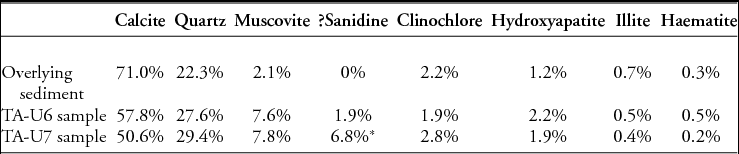
*Further research will attempt to improve the characterisation of this mineral, which appears to be sanidine.
g) Microscopy reveals that grey hues predominate on surfaces of chert excavated in unit VI sediment affected by combustion. Vertical and oblique fractures are frequent (giving rise to tiny spalls), as are conspicuous oval or circular shallow depressions caused by thermal alteration of chert surfaces. Cracks and reticulate crazing are widespread, particularly on surfaces showing rubefaction. White opaque or translucid patination is frequent, as is shiny thermal lustre that can seem slightly ‘greasy’. The macroscopic and microscopic observations at CNERQ are in line with similar observations at other archaeological sites showing evidence of combustion, and also with experimental findings (cf. Luedtke Reference Luedtke1992; Clemente Conte Reference Clemente Conte, Ramos Millán and Bustillo1997). Photomicrographs show thermal alteration and surface patination of thermally altered CNERQ chert specimens (Figure 10).
Microscopy of chert fragments shows thermal alteration (top) and thermal patination (bottom).

Early fire and mid-Quaternary human evolution
The findings imply combustion c. 0.8 Ma at CNERQ. What are the archaeological implications? Claims of early Palaeolithic fire must be treated cautiously. Alleged evidence of fire from ancient cave sites can seem convincing (James Reference James1989) but warning bells are sounded by much-discussed difficulties of interpretation at well-known sites. At CNERQ, previous comments (Walker et al. Reference Walker, Rodríguez Estrella, Carrión García, Mancheño Jiménez, Schwenninger, López Martínez, López Jiménez, San Nicolás del Toro, Hills and Walkling2006) were limited to prudent cursory mention of small bones with ‘signs of burning’ excavated in higher sediments, and, in relation to a 1m2 test-pit dug in 2004, to “loose sediment flecked with carbon (unit V = layer and spits 5a–5g). It passes into unit VI, which is half-a-metre thick, and is distinguished by zones of very dark, loose soil, suggestive of burning (unit VI = layer and spits 6a through 6i)” (Walker et al. Reference Walker, Rodríguez Estrella, Carrión García, Mancheño Jiménez, Schwenninger, López Martínez, López Jiménez, San Nicolás del Toro, Hills and Walkling2006: 8), although post-depositional diagenetic decalcification could be responsible. The small test-pit reached bed-rock in 2004, but its vertical profiles and sediment with neither burnt chert nor burnt bone failed to show the sedimentary sequence of the adjacent 2m2 that have now provided burnt fragments of bone and chert. In these 2m2 the bed-rock slopes slightly downwards towards the test-pit square, determining drainage of nearby sediments. In the test-pit, deeply lying sediment (of units V and VI = layers 5 and 6 = complex 3-2 of Angelucci et al. Reference Angelucci, Anesin, López Martínez, Haber Uriarte, Rodríguez Estrella and Walker2013) contains organic residues, doubtless derived from the adjacent 2m2, albeit lacking both pollen and microscopic traces of charcoal. Our 2006 caution owed to a possibility that ash could have been blown inside from bush-fires sweeping past the cave mouth; it may account for burnt traces in 1.2 Ma sediments at Sima del Elefante (Sierra de Atapuerca, northern Spain): “L'abondance de micro-charbons associés à des composés organo-minéraux exogènes atteste de la récurrence d'incendies naturels dont le déclenchement semble être lié à des évènements exceptionnels d'origine cosmique” [The abundance of micro-carbons associated with exogenous organic-mineral compounds is testimony to recurring natural fires probably caused by exceptional atmospheric phenomena] (Carbonell et al. Reference Carbonell, Vallverdú Poch and Courty2010: 12).
Roebroeks and Villa (Reference Roebroeks and Villa2011: supplementary information p. 1) wrote:
heated flints in a cave site are unlikely to be the result of natural wild fires and may be considered a reliable indicator of anthropogenic fire if (i) there is no evidence of reworking of sediments, slope wash, or debris flow entering the cave; (ii) the excavator noted a localized concentration of heated flint and bones; and (iii) only a small proportion of heated flint occurs at the site. This combination of evidence suggests a good probability of localized fire.
This combination occurs at CNERQ.
‘Anthropogenic fire’ refers to the generation of fire. Although hot sparks given off by a wooden hand-drill, or pyrite being struck with chert, could have ignited carefully prepared tinder at CNERQ, this begs the question of how cognitive appreciation arose of a possibility of making fire by bringing together two different kinds of technical behaviour—namely, selecting and preparing different kinds of wood (e.g. mullein and clematis) or suitable stones for striking sparks, and selecting and preparing suitable tinder for sparks to set alight (NB whereas pyrite occurs in some rock strata near Caravaca, none has been excavated in the cave). Prerequisites could have included advantages gained opportunistically from tending fire, itself a probable consequence of a reduction of instinctive pyrophobia (fear of fire, reinforced by skin-burns). Evidence of fire inside an early Palaeolithic cave carries implications for understanding cognitive evolution. The argument is set out briefly below.
First, it is unlikely that sparks from a bush-fire outside, perhaps caused by lightning, could set alight a chance accumulation of brushwood inside, such as to bring about a roaring blaze within, causing high temperatures. Moreover, the river and its swamp lay in front of the cave, where gallery woodland flourished in a damp environment, not a dry one. The cave roof also probably then extended outwards farther than it does today (as it may well have undergone some erosive reduction); if so, then the signs of fire we have uncovered would have been still farther back inside than the current 5–7m. Perhaps smouldering brands or embers left behind by bush-fires nearby were carried inside so that fire could be tended where rain or wind could not extinguish it. No fire-pit or hearth stones have been found, therefore there is no evidence of ability to control the heat of a tended fire. Nevertheless, from the standpoint of cognitive evolution, it is plausible that the people at the cave had less fear of fire outside than did animals seen fleeing before it. That could have led them to meddle with fire in order to drive animals towards natural death-traps, such as swamps, where they could be dismembered.
A tended fire in a cave serves several purposes: providing warmth, roasting food and deterring approach by animals. Compelling physiological arguments exist for cooking playing a part in human evolution from c. 1.5 Ma. Wrangham (Reference Wrangham2009: 88–90) wrote that archaeological “hints from the Lower Paleolithic tell us only that [. . .] the control of fire was a possibility, not a certainty” and “[T]he inability of the archaeological evidence to tell us when humans first controlled fire directs us to biology [. . .] At some time our ancestors’ anatomy changed to accommodate a cooked diet”. With regard to the evolution of human anatomy, following attainment, c. 1.6 Ma, of more-or-less modern stature, it is a plausible conjecture that subsequently widespread noteworthy increases in cerebral volume in Homo erectus and H. heidelbergensis, and, eventually, H. neanderthalensis and H. sapiens, were enabled by the enhanced digestion and absorption of nutrients that cooking afforded to pregnant women, lactating mothers, infants and children (cf. Fonseca-Azevedo & Herculano-Houzel Reference Fonseca-Azevedo and Herculano-Houzel2012). Outcomes of cognitive evolution are reflected in the extensive material record of Palaeolithic technology (and pyrotechnology) from Middle and Late Pleistocene times, not to mention the late Early Pleistocene at CNERQ. The bifacial flaking of its handaxe is matched in Mediterranean Spain by that of a cleaver excavated in an even earlier deposit at Barranc de la Boella (Vallverdú et al. Reference Vallverdú, Saladié, Rosas, Huguet, Cáceres, Mosquera, Garcia-Tabernero, Estalrrich, Lozano-Fernández, Pineda-Alcalá, Carrancho, Villalaín, Bourlès, Braucher, Lebatard, Vilalta, Esteban-Nadal, Bennàsar, Bastir, López-Polín, Ollé, Vergé, Ros-Montoya, Martínez-Navarro, García, Martinell, Expósito, Burjachs, Agustí and Carbonell2014), and an assemblage of small artefacts at Vallparadís (Martínez et al. Reference Martínez, García, Carbonell, Agustí, Bahain, Blain, Burjachs, Cáceres, Duval, Falguères, Gómez and Huguet2010) shares several features with those from CNERQ.
As CNERQ has provided both an ‘Acheulean’ bifacially flaked handaxe and abundant flakes made by repetitive centripetal flaking of small, sometimes discoidal, cores for producing retouched small tools, it exemplifies the ability of those who frequented it to select and carry out different self-determining or self-constraining Palaeolithic chains of sequential behavioural activities (Walker Reference Walker, de Beaune, Coolidge and Wynn2009; Walker et al. Reference Walker, López-Martínez, Carrión-García, Rodríguez-Estrella, San-Nicolás-del-Toro, Schwenninger, López-Jiménez, Ortega-Rodrigáñez, Haber-Uriarte, Polo-Camacho, García-Torres, Campillo-Boj, Avilés-Fernández and Zack2013, Reference Walker, Anesin, Angelucci, Avilés-Fernández, Berna, Buitrago-López, Carrión, Eastham, Fernández-Jiménez, García-Torres, Haber-Uriarte, López-Jiménez, López-Martínez, Martín-Lerma, Ortega-Rodrigáñez, Polo-Camacho, Rhodes, Richter, Rodríguez-Estrella, Romero-Sánchez, San-Nicolás-del-Toro, Schwenninger, Skinner, van der Made and Zack2016; Zack et al. Reference Zack, Andronikov, Rodríguez-Estrella, López-Martínez, Haber-Uriarte, Holliday, Lauretta and Walker2013). Survival of early humans in middle latitudes laid heavy evolutionary demands on their cognitive versatility and manual dexterity, which are attested by the diversity of the CNERQ artefacts, so it is unsurprising that they may have tended fire. More than one palaeospecies of late Early Pleistocene Homo may have engaged, opportunistically, in behaviour with fire. The skilfulness manifested by ‘Acheulean’ artefacts at sites with traces of fire implies evolution of cognitive versatility sufficient for such behaviour.
Fire characterises the ‘Acheulean’ Gesher Benot Ya'akov site at the onset of the Brunhes chron, c. 078 Ma (Goren-Inbar et al. Reference Goren-Inbar, Alperson, Kislev, Simchoni, Melamed, Ben-Nun and Werker2004; Alperson-Afil & Goren-Inbar Reference Alperson-Afil and Goren-Inbar2010; Richter et al. Reference Richter, Alperson-Afil and Goren-Inbar2011; Alperson-Afil Reference Alperson-Afil2012). Barely 140km south-west of CNERQ, magnetostratigraphy identified the “Matuyama-Brunhes boundary only a few metres below the fossil/tool-bearing levels” (Scott & Gibert Reference Scott and Gibert2009: 82) at the open Solana del Zamborino site, where excavation uncovered five stones surrounding a possible hearth area containing carbonised wood (“madera carbonizada”, Botella López et al. Reference Botella López, Marqués Merelo, de Benito Ontañón, Ruiz Rodríguez, Delgado Ruiz, Botella López, Vera Torres and de Porta Vernet1976: 28) and burnt bone, although burnt remains were also excavated over a wider area; the site provided two bifacially flaked handaxes and small retouched artefacts.
Fire occurred in the South African Wonderwerk Cave with ‘Acheulean’ artefacts during the Jaramillo subchron, c. 1.07–0.99 Ma (Berna et al. Reference Berna, Goldberg, Horwitz, Brink, Holt, Bamford and Chazan2012). Although other late Early Pleistocene sites with evidence of combustion are known in Africa from c. 1.5 Ma onwards (Gowlett et al. Reference Gowlett, Harris, Walton and Wood1981; Rowlett Reference Rowlett2000), most are open sites where bush-fires might have been responsible (Berna et al. Reference Berna, Goldberg, Horwitz, Brink, Holt, Bamford and Chazan2012, who do not exempt Gesher Benot Ya'akov in that regard, contra Richter et al. Reference Richter, Alperson-Afil and Goren-Inbar2011; Alperson-Afil Reference Alperson-Afil2012). At Swartkrans Cave, evidence of combustion (Skinner et al. Reference Skinner, Lloyd, Brain and Thackeray2004) from Member 3, containing ‘Acheulean’ artefacts, is subject to uncertainty about the integrity and age of the member, with dates from 1.4 to 0.6 Ma (Herries et al. Reference Herries, Curnoe and Adams2009; Berna et al. Reference Berna, Goldberg, Horwitz, Brink, Holt, Bamford and Chazan2012), although plausible ones are 0.96±0.09 Ma by 26Al/10Be (Gibbon et al. Reference Gibbon, Pickering, Sutton, Heaton, Kuman, Clarke, Brain and Granger2014) and 0.83±21 Ma by U-Pb (Balter et al. Reference Balter, Blichert-Toft, Braga, Telouk, Thackeray and Albarède2008).
‘Acheulean’ artefacts are unknown at Zhoukoudian Locality 1, where six 26Al/10Be estimates of c. 0.77±0.08 Ma (Shen et al. Reference Shen, Gao, Gao and Granger2009) come from levels 7–10, which also have 17 estimates c. 0.55–0.35 Ma from 230Th/234U, TL, ESR and fission-track methods (Goldberg et al. Reference Goldberg, Weiner, Bar-Yosef, Xu and Liu2001). Layer 8 is correlated with the laterally separate ‘quartz horizon 2’ where ‘ash’ was reported (Pei Reference Pei1932; Teilhard de Chardin & Pei Reference Teilhard de Chardin and Pei1932; Black et al. Reference Black, Teilhard de Chardin, Young and Pei1933). Chemical signs of combustion exist in later levels 4–6 (Zhong et al. Reference Zhong, Shi, Gao, Wu, Chen, Zhang, Zhang and Olsen2013), notwithstanding micromorphological demonstration of post-depositional diagenetic alteration. This also affected deeper layers 7–10, causing mistaken identification of ‘ash’ features; burnt bone from slightly above them is incompatible with in situ combustion (Goldberg et al. Reference Goldberg, Weiner, Bar-Yosef, Xu and Liu2001).
In England, excavation at Beeches Pit, with ‘Acheulean’ artefacts c. 0.42–0.37 Ma, uncovered features hypothesised as putative hearths for “controlled fire-use” (Gowlett et al. Reference Gowlett, Hallos, Hounsell, Brant and Debenham2005: 32), and “occurrence of bones burned to grey or white [. . .] implies more intense combustion than is usual for a natural fire, which often results in only partial and superficial burning (David Reference David, Solomon, Davidson and Watson1990)” (Preece et al. Reference Preece, Gowlett, Parfitt, Bridgland and Lewis2006: 492). At c. 0.3 Ma, hearth features at Qesem Cave in Israel (Karkanas et al. Reference Karkanas, Shahack-Gross, Ayalon, Bar-Matthews, Barkai, Frumkin, Gopher and Stiner2007; Shahack-Gross et al. Reference Shahack-Gross, Berna, Karkanas, Lemorini, Gopher and Barkai2014) imply repeated use of fire in a restricted space enabling heat-control.
From the standpoint of mid-Quaternary human evolution, it is intriguing that in Africa, Israel and now at CNERQ, convincing signs of combustion occur at several sites where Palaeolithic assemblages include bifacially flaked stone artefacts. A tempting surmise is that the conjunction reflects the cognitive versatility and technical ability of early humans, which played a part in facilitating their dispersal into middle latitudes.
Acknowledgements
Alfonso Burgos Risco is thanked for Figures 4, 5, 6, 8 and 9, based on the authors’ colour slides. Régis Braucher is thanked for sampling CNERQ sediments and attempting 26Al/10Be dating at the CEREGE-LN2C National Laboratory for Cosmogenic Nuclides at Aix-Marseilles University. We are grateful for helpful attention from palaeontologists Jan van der Made of the Department of Palaeobiology at Madrid's National Museum of Natural Sciences, Gloria Cuenca Bescós of the Department of Earth Sciences at the University of Saragossa, and Antonio Ruiz Bustos of the Andalusian Institute of Earth Sciences at the University of Granada, and from palaeopalynologist José S. Carrion of the Department of Plant Biology at the University of Murcia. Small mammal analyses were funded by Spanish project CGL2010-19825, a Canadian SSHRC grant awarded to M. Chazan, and SSHRC and University of Toronto financial assistance to S.E. Rhodes.
Supplementary material
To view supplementary material for this article, please visit http://dx.doi.org/10.15184/aqy.2016.91.



