


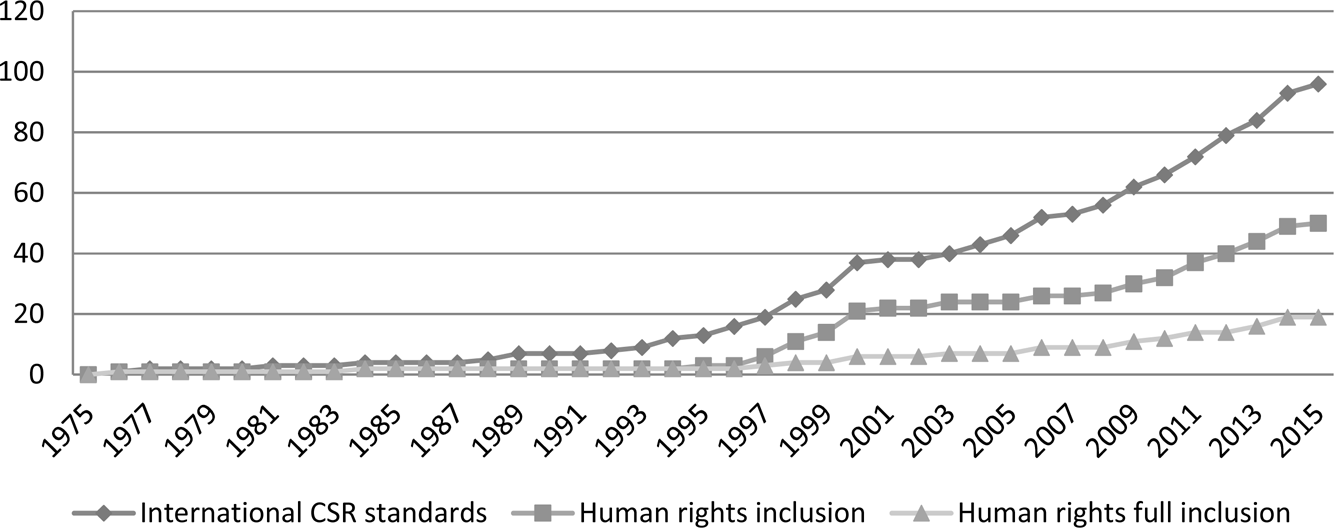
In this essay, we examine empirically whether the revised draft of the business and human rights (BHR) treaty is a normative advance on the existing jungle of global instruments. Since the 1970s, almost one hundred global corporate social responsibility (CSR) standards have been adopted, half of them addressing human rights. See Figure 1 from our global CSR database, below.Footnote 1 What is novel about the current treaty-drafting process within the UN Human Rights Council (HRC) is that it aims to develop a comprehensive standard that would hold states legally accountable for regulating business.Footnote 2 The question is whether this is possible. Drawing on our work on the “commitment curve,” we begin theoretically and point out why one should hold modest expectations about the process and treat strong text with skepticism as much as celebration. Using an empirical methodology, we then compare the HRC's Revised Draft Legally Binding Instrument (Revised Draft LBI) with existing standards, and find that while the draft contains a healthy dose of incremental pragmatism, its significant advances require a degree of circumspection about its strengths and prospects.
Global CSR Standards and Human Rights Content

Why Would States Draft a Strong Treaty?
Let us begin with the standard puzzle in human rights treaty-making: Why would states develop and embrace a stronger set of standards to regulate business activities? Given the domestic politics of regulation, predominant neoliberal norms in the global economy, and a strong state-business nexus in many parts of the world, it is unclear how much governments gain through business and human rights treaty-making.
A common answer from those advocating regulation is that better policy arguments will win the day. Drawing on a logic of appropriateness, states will embrace a new expressive position on business and human rights.Footnote 3 Once the theatre of law production is shifted to a neutral or human rights-friendly environment, such as the United Nations, states will appreciate the need for stronger regulation.Footnote 4 Such spaces provide in particular “affected communities” the “power and voice to engage decision-making processes that affect their lives, as active subjects of the law, not objects.”Footnote 5
Others argue that such expressivism is a long-run game.Footnote 6 For example, John Ruggie, former UN Special Rapporteur on Business and Human Rights, points out that such a shift in international relations requires changes in social norms and that this process is gradual.Footnote 7 New, comprehensive, and ambitious hard law proposals in the field of BHR will often be premature, as their expressive basis is far from being secured. Thus, one should be skeptical of their real strength (legally or in practice), and whether states will be willing to accept them.
An alternative argument for limited optimism is that states are rational actors, concerned with the cost of compliance and spill-over effects in future regulation. They follow a logic of consequence. It is sensible for states to resist soft and hard instruments because of their perception that these instruments impose costs.Footnote 8 Thus, states will seek to maximize the benefits (reputational or material) of joining a global standard while minimizing the costs of commitment for themselves and corporations (e.g., the strength and scope of a standard).Footnote 9 That position may, however, shift if states adopt a long-term rational perspective. Some states may see economic advantage from a level playing field in global regulation or a competitive advantage for their corporations if they calculate that they may adjust more quickly than others.
While the above theories predict different outcomes, the causal explanations for actual change are not mutually exclusive.Footnote 10 Social norms and regulatory calculus can go together. As Beth Simmons has argued, a hybrid rationally expressive theory of state behavior might be appropriate: “Governments are more likely to ratify human rights treaties which they believe in and with which they can comply at a reasonable cost.”Footnote 11
The Commitment Curve
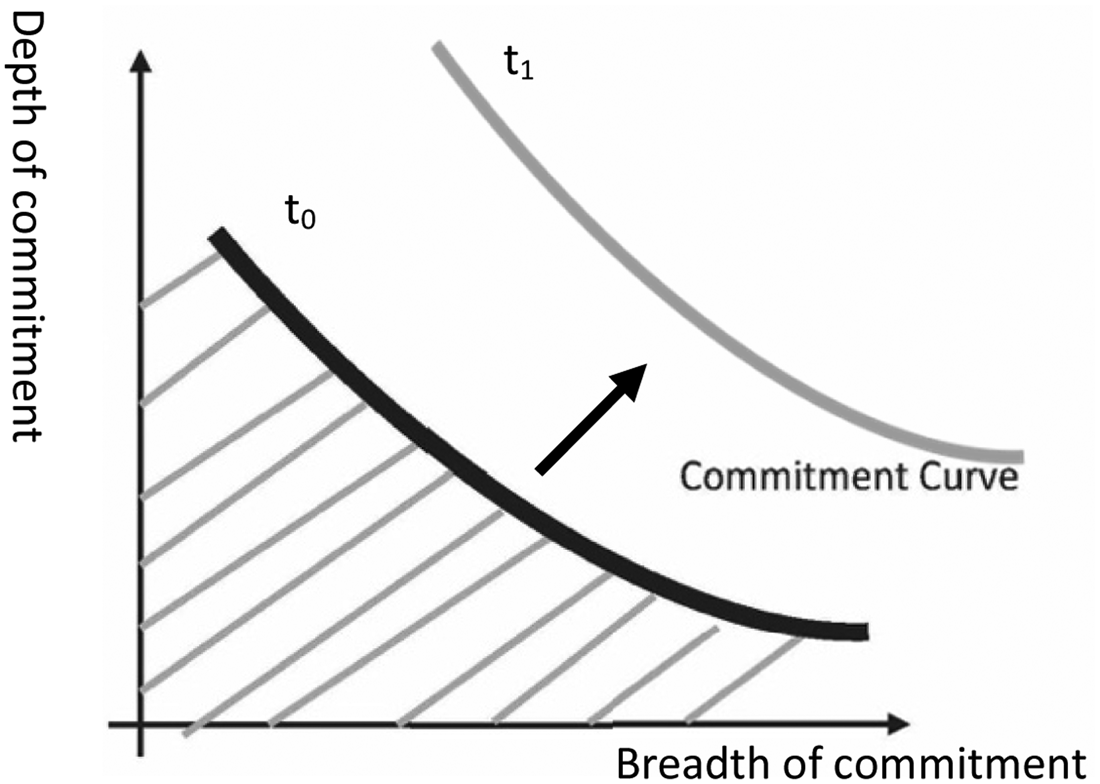
These insights, which apply equally to corporations when they participate in lawmaking, led us to test the existence of a dynamic “commitment curve.” See Figure 2, above. We assume first that states and corporations act rationally: The breadth of new commitments (number of human rights obligations) is traded off against the depth of commitment (e.g., strength of language, accountability mechanisms, and coverage of actors). The result is a regulation frontier or commitment curve. States or corporations can be pushed towards this frontier but a logic of consequence will limit them to its bounds. However, this curve can shift over time: from t0 to t1. Drawing on a logic of appropriateness (changing attitudes) and consequence (awareness of long-term risks), we can expect that curve will move north-east.
The Commitment Curve

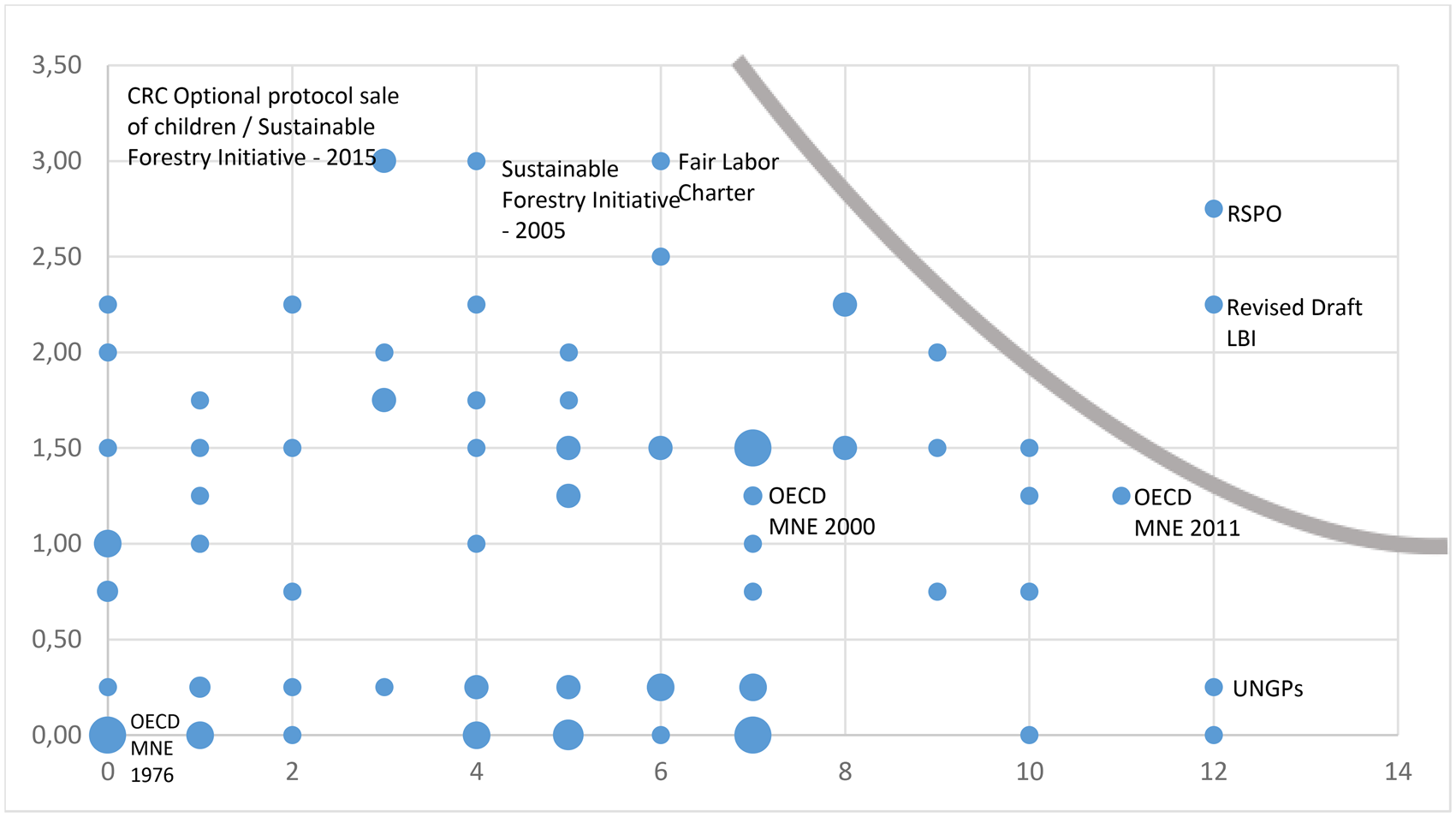
In our analysis of 98 global corporate social responsibility standards (G-CSR), covering fifty-five original standards and their revisions, we found evidence of a trade-off between breadth and depth of commitments, as well as their evolution. See Figure 3, below. Standards were given a human rights score from 0-12, where 12 represents a holistic human rights approach, and an accountability score from 0-4.Footnote 12 The latter was measured by whether the standard is legally binding and whether there are reporting, complaint, or certification procedures (with a weighting for the degree of independence)—whether for states, corporations, or both.
Updated Commitment Curve: Accountability Versus Human Rights Inclusion

The clustering of original standards suggested a clear regulation frontier. For example, at the bottom end of the commitment curve, we find the United Nations Guiding Principles (UNGPs)—which contain many human rights protections but comprise a soft law instrument with no accountability mechanism. At the top end, one finds the Sustainable Forestry Initiative, 2015 revision, with strong accountability through certification and an independent complaints procedure, but less breadth. However, once we considered the forty-three revised versions of existing standards, we observed that the curve shifted outwards. For example, accountability mechanisms in the Organisation for Economic Co-Operation and Development (OECD) Guidelines on Multinational Enterprises were strengthened with revisions in 2000 and 2011.
This juxtaposition of the breadth and depth of commitments permits us to offer critical perspectives on existing standards and new proposals. First, muscular provisions may be overambitious and unable to attract state adoption, ratification, and/or implementation. Second, ostensible strength may hide weakness and compromise elsewhere. For example, standards may be linguistically strong but not matched by any depth in any commitment. We found that many standards drafted solely by corporations fell into this category.Footnote 13 The upshot is that standards close to and to the right of the commitment curve deserve suspicion and scrutiny. For example, there is rather modest evidence of compliance with the one standard that is clearly outside the regulation frontier—the RSPO standard on responsible palm oil.Footnote 14
Analyzing the Revised Draft LBI
The question at hand is whether a business and human rights treaty—which promises both breadth and depth in commitment—can be moved beyond the constraining environment of the commitment curve. The Revised Draft LBI has been described as “ground-breaking” for its progressiveness,Footnote 15 but should it be celebrated or questioned? Clearly, it is broad in its inclusion of different human rights but so are the UNGPs and a number of other standards. To evaluate the Revised Draft LBI, we consider how it compares with other standards in our G-CSR database in relation to three key features of depth: legal language, accountability, and coverage.Footnote 16
-
Language
First, the strength of legal language is often viewed as an indicator of the robustness of legal protections, in particular the choice between “shall” and “should.” The Revised Draft LBI primarily falls on the mandatory side, employing “shall” when articulating the treaty's scope,Footnote 17 state duties, and, indirectly, corporate responsibility. To be sure, this preference is not so unusual. In our database, the standards are evenly divided: 43 percent use “must” or “shall” and another 9 percent use the almost synonymous “requires.”
What is unusual about the Revised Draft LBI is the presence of “shall” in a standard marked by breadth—containing a comprehensive coverage of human rights. This distinguishes the instrument from other leading broadly-worded standards such as the UNGPs and the OECD Guidelines. For example, the UNGPs use only “should” in describing the extraterritorial state obligation to protect.Footnote 18 Thus, the Revised Draft LBI can be placed with other standards that combine reasonably broad coverage with linguistic and institutional strength, such as the Sustainable Forestry Initiative of 2015, and the Fair Labor Charter. Still, critics point to other shortcomings in the legal language,Footnote 19 such as confusion in the use of the human rights terms “impact”Footnote 20 and “lack of gender sensitivity.”Footnote 21
-
Accountability
Second, the degree of accountability for human rights violations is arguably central in efforts to regulate business and is a key part of our commitment curve. Figure 3 shows how ninety-nine standards from our G-CSR database (now including the Revised Draft LBI) score on the accountability index. The Revised Draft LBI constitutes a significant improvement over the status quo. The Revised Draft LBI is intended to be binding and it contains a mandatory and independent reporting procedure. Moreover, it contains novel contributions on accountability by providing for legal liability for corporationsFootnote 22 and requiring states to align domestic legislation to the draft treaty and the UNGPs, possibly increasing accountability for human rights abuse.Footnote 23
Accountability could be enhanced if the draft Optional Protocol (OP) to the Revised Draft LBI is adopted. The OP, which curiously has not been the subject of significant discussion, provides for a National Implementation Mechanism (NIM) to promote compliance and establishes a system of individual complaints against states similar to those under the core UN human rights treaties. The NIM is a particularly interesting innovation. It is based on the National Preventive Mechanism under the second optional protocol to the Convention Against Torture—arguably the most effective accountability mechanism under a human rights treaty.Footnote 24
Nonetheless, skepticism is warranted. While the Revised Draft LBI includes the option for dispute settlement between states at the ICJFootnote 25 and encourages states to assert jurisdiction over companies for extraterritorial conduct, critics point to challenges for victims regarding access to remedy. These are due to gaps in applicable law,Footnote 26 forum non-conveniens,Footnote 27 the inability of victims to file complaints from multiple jurisdictions,Footnote 28 and failure to address civil liability for corporations.Footnote 29
Questions have also been raised about the OP.Footnote 30 Given the experience with low ratifications of the optional protocol to the International Covenant on Economic, Social and Cultural Rights, it is important to ask whether states will sign onto an additional accountability mechanism. For those that do, will they ensure that such a NIM is independent and properly resourced? The OP's chances of success might improve if the mechanism is included in the principal treaty, for example through an opt-out mechanism.
-
Coverage
Finally, we examine coverage, by which we mean the broader issue of who is subject to the treaty. Here, our analysis is more equivocal. The Revised Draft LBI does not recognize responsibilities for corporations like the UNGPs. Incorporation within or transformation of domestic law is required in order to bind business directly. Although, unlike the zero draft, the Revised Draft LBI has expanded the scope from transnational business enterprises to all business enterprises.Footnote 31
Moreover, it is important to analyze which type of corporations are targeted by the treaty. We use corporate structure as a measure of reach and effect. In our earlier sample of ninety-eight standards, which excludes the Revised Draft LBI, only thirty-five standards apply explicitly to the “enterprise,” meaning both a corporation and its subsidiaries.Footnote 32 In forty-seven standards, the coverage only extends to the corporation (i.e., to the “entity”), and not to all subsidiaries in a corporate structure (sixteen standards mentioned neither enterprise nor entity). The Revised Draft LBI applies to all enterprises, including subsidiaries. Thus, it provides an interesting improvement on many existing standards.
However, there are two caveats to be made. First, the Revised Draft LBI allows states to exempt small to mid-size enterprises from provisions in the treaty.Footnote 33 Second, it is not clear how far a state is expected to impose obligations on business entities concerning activities within their supply chains. In particular, the change in language from business relationships to contractual relationships in Article 5(2) may limit corporate responsibility for supply chain management to the first subcontractors, although some maintain the opposite interpretation. In any case, it is unclear how effective the treaty will be in addressing complex and lengthy supply chains. This ambiguity may reflect a compromise between different stakeholders in the drafting process, possibly sacrificing some strength for acceptability.
Ground-Breaking or More of the Same?
There are good reasons, on the surface at least, for labelling the Revised Draft LBI and the OP “groundbreaking.” Compared to the majority of the standards in our G-CSR database, it represents a clear progressive shift in the commitment curve, especially on language, accountability, and corporate structure, as well as addressing issues such as corporate criminal liability. Whereas the UNGPs sought development of national legislation through voluntary commitments, the Revised Draft LBI requires greater domestic legislative efforts and makes states more legally accountable. It also potentially makes states more politically accountable if the legal weight of a treaty strengthens human rights talk. Whether it makes companies more accountable in practice will depend on states parties’ choices about, and level of commitment to, implementing their treaty obligations.
However, the ground-breaking nature of the Revised Draft LBI should also raise questions. The analysis of shortcomings reveals a certain sleight of hand in the text. Various exceptions and qualifications exist and a closer reading shows certain weaknesses. Perhaps more importantly, the strong advances in the text may make it difficult to attract state support—in either ratification or implementation. It is easy to forget the many strong international human rights treaties that have not been ratified.
There are, nonetheless, some faint signs of an incremental expressive change, which shows the potential reflexivity of the process. If the BHR treaty process follows as much as it leads domestic developments, such as by making due diligence mandatory, then the normative advances may be sufficiently grounded to be effective.Footnote 34 Although expressivists have previously argued that the BHR-field is not ready for legally binding regulations,Footnote 35 the rise in standards pushing the field forward may have made it receptive to change. Time will tell.

 Open access

