


Two propositions about the law: (1) Law is an endless flow of paperwork, a relentlessly, overwhelmingly textual practice. From contracts to briefs to opinions to treatises, law lives in its texts. There is no law without text. (2) Law produces authenticity and authority through performances. Witness testimonies, pleadings, and trials all enact law through the bodies of participants. There is no law without performance.
Legal texts; legal performances: These practices exist in a kind of opposition – the fixed finality of text; the fleeting ephemerality of performance – but also produce and reproduce each other. Legal texts record or script legal performances (transcripts, oaths); legal performances inspire or enact legal texts (testimonies, opinions read from the bench).
To understand law as dependent on both text and performance, we must study how law moves between these two domains. This chapter examines law’s textuality and its theatricality in tandem by probing legal performances as they move between texts and acts. By drawing on theater studies and the history of dramatic texts, I offer methods for reading legal texts as scripts that precede or follow legal performances. Examples from Anglo-American law reveal that legal documents’ typographical and formatting conventions encode law’s anxious reliance on performance. Paying close attention to the relationship between the law’s texts and its performances would better serve the law and, most importantly, justice.
To begin locating performance in legal texts, we must first know what we are looking for: What does performance look like in a text? There are many ways to encode performances in writing, but perhaps the best known and most widely disseminated is the set of conventions surrounding dramatic texts (also called playscripts or scripts). The modern playscript consists of five main elements. Figure 5.1, from The Dramatic Publishing Company’s edition of Elizabeth Robins’s Votes for Women, shows us the five elements now common in printed drama.
Elizabeth Robins, Votes for Women (The Dramatic Publishing Company, 1907).
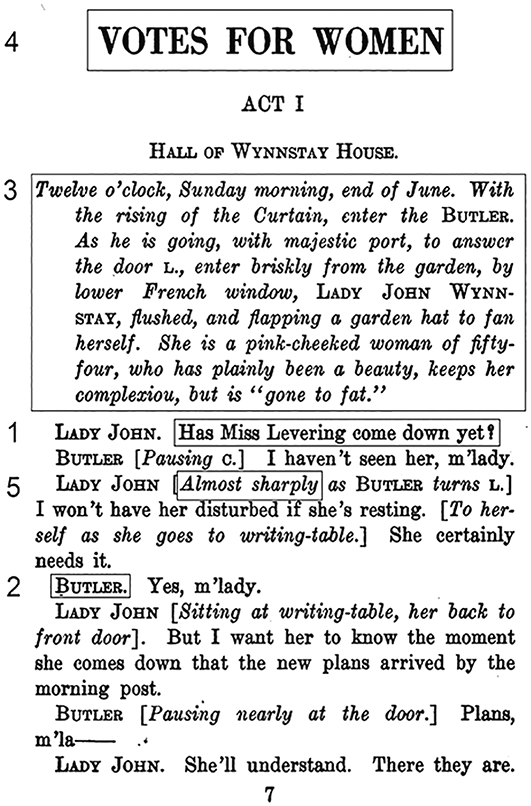
Most plays distinguish these elements through typographical variation: A combination of text size, font, capitalization, indentation, and spacing indicates the different functions of each element.Footnote 1 (Numbers refer to boxed elements in the figure.)
1. Dialogue furnishes the words spoken by performers, printed here in a regular font, fully justified.
2. Speech prefixes indicate who speaks each line of dialogue (and, sometimes, who performs specific actions on stage). These appear in this text indented at the start of each line of dialogue, in small caps and followed by a period.
3. Stage directions both describe the scene and direct the movement of actors. This edition prints them in italic font, with a hanging indent when they occupy a full paragraph.
4. Paratext, such as the play title (in a large, bold type, all capitals, center-aligned) or the page number (a center-aligned regular font at the bottom of the page), control the structure of the play and the text as a material artifact.
5. Didascalia are stage directions that indicate not action (“Pausing nearly at the door.”) but a character’s emotion or manner, such as “Almost sharply.” Didascalia often look like regular stage directions, but they are less concrete than a practical stage direction and sometimes far more discursive, as in the plays of Bernard Shaw.Footnote 2
The history of printed drama traces two developments in the playscript’s form: (1) the elements’ individuation, and (2) the changing print conventions that distinguish them from each other.Footnote 3 Even in any given era (including the present day), one can find huge variety among plays: the presence or absence of any given element, the use of different typographical indicators for the common elements. Each element is a convention with a history. How texts differentiate among them changes depending on shifting methods, tastes, and needs in the theater and in the printing and publishing industries.Footnote 4
An example from this history of theater’s evolution in print, discussed alongside a similar change in some legal print practices, demonstrates the potential of this analytic method. Prior to the consolidation of the conventions for printed drama just enumerated, dialogue-based genres did not reliably distinguish dramatic from narrative forms, instead intermingling them. As Julie Stone Peters explains in her history of printed European drama, “medieval verbal arts foregrounded their use of direct speech and indirect speech in combination, their conjoined use of both characters speaking in their own voices and an author’s or narrator’s voice describing the action.”Footnote 5 The Renaissance consolidation of theater’s artistic identity went hand in hand with a new style in printed drama. The emergent style for dramatic texts minimized “the voice of the poet” and maximized characters’ direct speech, in part by distinguishing typographically between dialogue and other aspects of the script (stage directions, arguments, etc.). Those nondialogic elements retained traces of an authorial, narrative function, but without corrupting the dialogue, the essence of printed drama.Footnote 6 The dramatic action (primarily spoken by characters) and the narrative circumstances (inscribed by stage directions and other textual materials) thus adopted distinct typographical forms.
Compare the history of reporting speeches in Britain’s Parliament. Not until 1909, when Hansard became an official report commissioned by each House of Parliament, were all members’ speeches printed fully in the first person. (Or, at least “substantially” verbatim.)Footnote 7 Previously, printed parliamentary debates appeared as indirect speech, a form of narration that suggests, but is not true dialogue:
Mr. H. Berkeley believed that if this Bill became law it would have the effect of turning every pothouse into a theatre, and every theatre into a pothouse.
Mr. Brady also thought the passing of the Bill would reduce the drama to the lowest pitch it had ever stood at in the country.
Mr. Locke said, he was not disposed to accept mere assertions as an answer to his arguments.Footnote 8
Here we find a combination of direct and indirect speech. We can imagine the named members speaking, but only through an act of implicit translation from this printed form. The use of “believed” and “thought,” as well as “said” without quotation marks, all either interiorize or simply narrativize what was actually a set of speech acts, that is, a dialogue. One could imagine a naive reader thinking that Berkeley did not speak at all, but that the debate’s author omnisciently reports Berkeley’s “beliefs.” Why did parliamentary reports appear this way? In part because, until the 1890s, the reports were produced by cobbling together articles from multiple newspapers. The narrative style disguised the fact that the debates were summaries of summaries.
Modern Hansard transcribes Parliament’s debates more clearly, treating speech like speech. In other words, it looks more like a dramatic text – complete with speech prefixes in bold followed by a colon. Hansard today purports to represent directly what was said by MPs, and thus to increase the transparency of parliamentary actions and to improve citizens’ knowledge of government by making their representatives accountable for their speech. Parliamentary reports’ old narrative–dramatic style, with its indirect discourse, could only gesture at such accountability. It never adopted – as a standard or as a format – the direct connection between speech and the speaking subject upon which dramatic texts insist. Thus we see in the evolution of printed parliamentary debates the belated adoption of a process that theatrical texts underwent in the Renaissance. These changes in legislative reporting, defined in part by adopting drama’s print conventions, improved democratic transparency and accountability.
Changing how parliamentary reports transcribe spoken words and actions changes the legal character of those reports themselves. Such change is only possible after we have recognized the gap between the legal form and its (often disregarded) dramatic cousin. When we see what legal forms elide in their failure to be fully dramatic, we can identify the shortcomings of the former and the possibilities inherent in the latter. In this particular case, once one recognizes that parliamentary debates might be written as dramatic texts, the apparatus of a dramatic text becomes available to bring Parliament to book in a new, newly legible form. Many other legal texts may benefit from a similar analysis – but first we must locate the dramatic potential that their current form suppresses.
Let us explore legal writing by seeking in legal documents – primarily legal transcripts – the elements of printed dramatic texts. By searching for dialogue, speech prefixes, stage directions, paratext, and didascalia, we will find some of law’s essential performances – sometimes concealed, sometimes hiding in plain sight. Because law really is, sometimes, a type of performance, how law does and does not engage with drama’s textual elements may help us learn what legal texts prioritize and exclude from the legal performances they encode or anticipate. Seeking the elements of printed drama, we will discover the slippages between legal texts and legal performances, and identify places where more care for that dynamic may create a better form – literally and figuratively – of law.
Dialogue
Unlike dramatic texts, most legal texts are not scripts for performance. Ex post facto scripts of legal performances – that is, transcripts, such as parliamentary reports – are far more common. A deposition transcript, for instance, is something designed not to be performed by others but to document what was already said. And yet legal material does encode dialogue. For instance, the Constitution of the United States includes a kind of dialogue: the oath to be administered when swearing in the president. Here is how the Constitution introduces the oath:
Before he enter on the Execution of his Office, he shall take the following Oath or Affirmation: – “I do solemnly swear (or affirm) that I will faithfully execute the Office of President of the United States, and will to the best of my Ability, preserve, protect and defend the Constitution of the United States.”
This differs from stage dialogue’s formatting in two important ways. First, there is no speech prefix, but simply an order that the president-elect “shall take” the oath. Second, the oath’s text appears in quotation marks – not, of course, the way dramatic texts indicate speech. Should we, then, regard the oath of office as dialogue at all?
The Constitution’s text suggests we should not. And yet inaugural ceremonies have adopted traditional practices that transform the Constitution’s pseudo-script into a real script for legal performance. In practice, the presidential oath truly is a dialogue. The dialogic nature of the oath begins with the addition of an oath administrator (traditionally, the Chief Justice of the Supreme Court) as the second speaker in the ceremony. Until the 1930s, the oath’s administrator would read the oath as a question, to which the president-elect merely replied in the affirmative. In playscript form, that might look something like this:
Administrator: Do you, George Washington, solemnly swear that you will faithfully execute the Office of President of the United States, and will to the best of your Ability, preserve, protect and defend the Constitution of the United States?
President-Elect: I do.
This form of dialogue gives all the words of the oath to a new, supporting actor, transforming the president-elect’s “line” into a question delivered by the administrator. In this version, the president-elect, surprisingly, never speaks the constitutionally assigned dialogue at all, but instead speaks an entirely different line (“I do.”), inherited from the normal form of oath-taking (e.g., weddings, sworn testimony). In other words, pre-1930s inaugurations relied on the implicit script of oaths and affirmations to transform the Constitution’s unclear dialogue into a recognizable performance of oath-taking.
With Franklin Delano Roosevelt, the inaugural oath transformed into a new performance script. In a letter from February 1933, Roosevelt asked the clerk of the Supreme Court “whether it would be better for me to repeat the oath after the Chief Justice.”Footnote 9 Chief Justice Charles Evans Hughes affirmed this suggestion as “the more dignified and appropriate course” than the “I do” of previous generations.Footnote 10 Thus, since the 1933 inauguration, the oath’s administrator has read each clause of the Constitution’s oath to the president-elect, who replies piecemeal, thereby cumulatively saying all of the oath’s language. Oath takers have also begun appending “so help me God.” The script – and the hands of inaugural participants may well hold a printed script – might look like this:
Administrator: Please raise your right hand and repeat after me: I, Joseph Robinette Biden, Junior, do solemnly swear –
President-Elect: I, Joseph Robinette Biden, Junior, do solemnly swear –
Administrator: – that I will faithfully execute –
President-Elect: – that I will faithfully execute –
Administrator: – the Office of President of the United States,
President-Elect: – the Office of President of the United States [etc.]
However formatted on the page, both the old and the modern forms of the oath differ significantly, in their text, from the Constitution’s script for the oath. Each version transforms the Constitution’s implicit text for performance into a proper script.
This may seem a rather overwrought, quibbling history of presidential oath-taking.Footnote 11 Yet to execute the Constitution’s mandate, we must answer questions that document leaves unresolved: What does it mean to “take” an oath? What is the proper script for oath-taking? What words must be said, by whom, at what time? By understanding presidential oath-taking as a scripted performance, we notice how American law has left the assumption of executive power somewhat mysterious. The plain constitutional text requires rewriting and reformatting to be performed.
Theater scholars are accustomed to plumbing this magical space between print and performance, and to demystifying how the forms of dramatic texts enable particular performances. Less common to theater studies is the examination of scripts derived from performances. Law, however, inverts theater’s literal priority of the written word (i.e., the dramatic text that precedes the performance), depending less on performing implicit scripts than on producing ex post facto transcripts of legal performances. The legal system has not ignored the challenges posed by translating speech to writing; many conventions have developed to control some of the messiness inherent in that act of transformation. The Federal Guide to Judiciary Policies for producing court transcripts, for instance, features sixteen pages of guidelines.Footnote 12 These rules range from the material (paper sizes) to the visual (margins, lines per page, indentations) to the organizational (headings) and more. Such conventions help stabilize legal performances into reliable, purportedly neutral texts. (Intriguingly, the Judicial Conference seems to have established these rules initially only to regularize transcript fees charged by court stenographers.Footnote 13) By standardizing transcripts, the rules predetermine what can and cannot be meaningfully recorded about a legal performance.
One rule stands out as particularly relevant when considering the relationship between legal and dramatic texts, a rule that determines what counts as “verbal content” in a transcript. The rule posits that, while the proceedings “must be transcribed as spoken,” nevertheless,
In the interest of readability, false starts, stutters, uhms and ahs, and other verbal tics are not normally included in transcripts; but such verbalizations must be transcribed whenever their exclusion could change a statement’s meaning.Footnote 14
Transcripts necessarily smooth out the messiness of speech: translate run-on thoughts into neat sentences and paragraphs; remove ambiguities; make what we hear with comprehension into something we read with understanding. But speech is not writing, and some of the information that speech carries is in precisely those things that writing seeks to suppress.Footnote 15 (As any good playwright knows, making meaning from “false starts, stutters, uhms and ahs” is a task at which actors excel.) Forensic linguist Anne Graffam Walker observed this problem in a 1986 essay that surveyed appellate justices about their use of transcripts. Appellate judges, she found, use transcripts “not just to get the facts, but to get at the meaning of the original proceeding which produced the facts by forming impressions of the setting and the participants in an effort to reach intelligent and fair decisions.”Footnote 16 Significantly, judges rely on “contextual features” and “disfluencies” of language to get at that meaning.Footnote 17 In other words: Judges read transcripts like theater artists read scripts, mining them for clues about character and intent. Court proceedings are just as likely to carry meaning in those easily missed, suppressible aspects of speech as any line of Chekhovian dialogue.
A recent play that dealt with the relationship between American law and women presented a magnificent example of unexpected meaning in precisely such verbal clutter from a court proceeding. Heidi Schreck’s What the Constitution Means to Me plays some of the recorded oral argument in Griswold v. Connecticut, the case that established a right to privacy, specifically a right to access birth control. To fully appreciate the effect of this scene, one must listen to the oral argument itself, which, in this written chapter, I cannot offer readers. But Schreck’s script reproduces the necessary portion of it, with her own – rather than the court’s – formatting and details. Her transcript reads:
Justice Potter Stewart: Now that I’ve interrupted you, you’ve told us that in Connecticut the sale of uh … these devices is uh … not molested because they’re sold for the prevention of disease. Is this uh … true about all of these devices that are covered uh … that each of them has the potential dual function of acting in a contraceptive capacity and as a prevention of disease, or only with respect to some of them?
William I. Emerson: It’s probably only true with respect to some, but some get by under the term “feminine hygiene,” and uh … others uh … (Cough) uh … (Cough) uh … I – I – I just don’t know about, but uh (Cough) uh … (Cough) They are, they are all sold in Connecticut drug stores on one theory or another.
Justice Earl Warren: Is there anything in the record to (Cough) to indicate uh … (Cough) the uh, stem of the birth rate in Connecticut vis-à-vis the States that don’t have such laws?Footnote 18
Schreck is wholly uninterested in the substance of this dialogue. She plays the recording so the audience can hear these men’s evident discomfort when talking about birth control. The audio recording and Schreck’s transcription feature persistent, loud throat-clearing first from lawyer Thomas I. Emerson (Schreck mistakenly names him William) and then Chief Justice Earl Warren.
By contrast, here is what that passage looks like in the court’s official transcript:
The Court: Now that I’ve interrupted you – you’ve told us that in Connecticut the sale of these devices is not molested because they’re sold for the prevention of disease. Is this true about all of these devices that are covered, that each of them has the potential dual function of acting in a contraceptive capacity and as a prevention of disease, or only with respect to some of them?
Mr. Emerson: It’s probably only true with respect to some, but some get by under the term “feminine hygiene,” and others I just don’t know about. But they are all sold in Connecticut drugstores on one theory or another.
The Court: Is there anything in the record to indicate the extent of the birth rate in Connecticut vis-a-vis the states that don’t have such laws?Footnote 19
No coughs; no throat clearing; just words. Yet as Schreck and her audience recognized – laughter was plentiful at both performances I attended, and can be heard in the film made of the stage production – the throat-clearing recharacterizes the entire argument, permeating the meaning of the men’s purportedly substantive statements with a stark awareness that their speaking on this issue at all is injust.Footnote 20 The court’s transcript, of course, records only what legal transcribers considered essential dialogue: the words.Footnote 21
Speech Prefixes
Speech prefixes in the law appear in striking forms. Some legal documents include a paratextual relative of speech prefixes, a list of dramatis personae. In case names, the central players in the dramatic conflict called litigation constitute the title itself: plaintiff v. defendant.Footnote 22 The printed US Reports go further, opening each volume with a list of the justices, along with the officers of the court. Opinions name the attorneys arguing and supporting each case, along with the filers of amicus curiae briefs.
Speech prefixes proper appear in transcript of arguments or depositions. The transcript from Griswold, for instance, refers to the lawyers by name, but to the justices – who do not, sad to say, speak simultaneously, like a Greek chorus – simply as “The Court.” At some point since 1965, that practice changed, and modern Supreme Court transcripts do indicate which justice asked which question. The Guide to Judiciary Policy, however, still indicates that transcripts must refer to judges as “THE COURT.” Lawyers maintain their identity – though the policy, in superannuated detail, insists on identifying female lawyers by their marital status (“MRS., MS., OR MISS”). Criminal defendants, after an initial identification by name, lose theirs: a defendant becomes simply THE DEFENDANT, like a character in a medieval morality play.
Yet all of these titles fall by the wayside during witness examinations. Witness examination transcripts record dialogue in a format that almost eliminates speakers as speaking persons. The proper prefixes are simply “Q” and “A” for “question” and “answer” (Figure 5.2).
Deposition of Lawrence Paterson, Ohio Supreme Court, Case No. 2010-2029, 33.
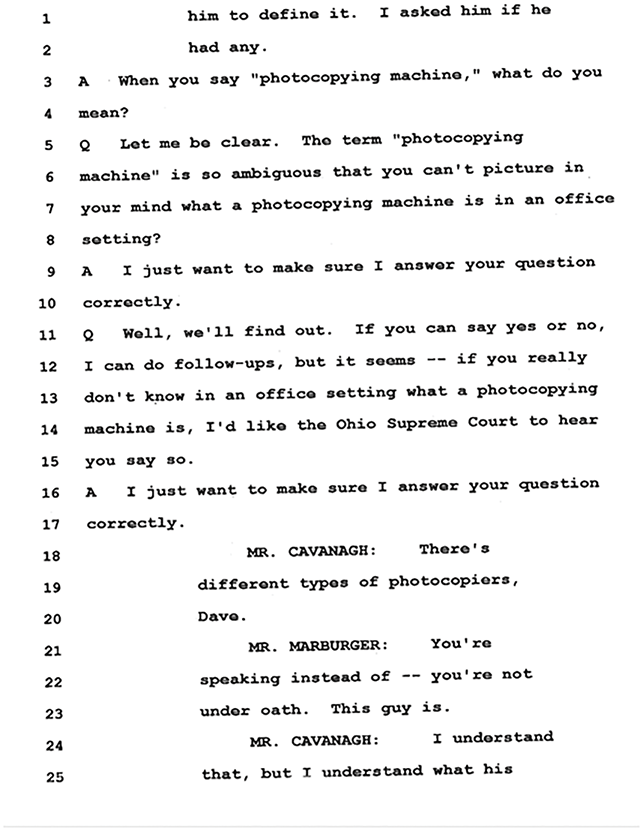
The transcript is a pure dialogue, denuded of persons speaking, recording only the linguistic pursuit of truth.Footnote 23 Most examinations, however, also include some haggling about procedure, a “colloquy.” And colloquies, unlike the questioning proper, revert to named speakers, but with different indentation, with each new speaker identified beginning “on the tenth space from the left margin.” The convention results in an effect like a play within a play.
But which is the metatheatrical frame and which the staged performance? Colloquies control the flow of the question and answer, stepping out of the performance of the Q&A to negotiate the rules of engagement. Law’s procedure, rules about what may be asked, what counts as badgering a witness, etcetera, all direct the play of Q&A. And yet the transcription format suggest that the question and answer is the main event. Q and A’s dialogue is left-justified without indentation, while colloquies begin inside, as it were, the Q&A. And the abstraction of “Q” and “A,” a kind of Beckettian scholasticism, implies large questions of major import, compared to the piddling asides of squabbling, named lawyers. Indeed, even in the formidably absurd deposition in Figure 5.2, Mr. Cavanaugh’s casual, dismissive “There’s different types of photocopiers, Dave” seems petty and insignificant next to A’s profound semantic query – yes, A asks a question! – “When you say ‘photocopying machine,’ what do you mean?”
Stage Directions
Legal scripts thus follow their own, somewhat strange practices for speech prefixes. The rules for stage directions are far less clearly defined. Legal texts do not deal significantly with a legal proceeding’s setting. Legal documents usually provide only vague indications of place-as-jurisdiction: the Southern District of New York, for instance. Dockets, perhaps, add some sense of geographic movement, with their indication of a case’s journey through different jurisdictions. In legal texts, legal scenery is sparse.
This does not mean, however, that legal scenery does not exist or is unimportant. Linda Mulcahy argues that “the environment in which the trial takes place can be seen as a physical expression of our relationship with the ideals of justice.”Footnote 24 Federal courts recognize this in their Design Guide, which combines Levitical detail about the sizes of clerks’ desks with observations such as “Courtroom ceiling heights should reflect the solemnity of court proceedings. The raised judge’s bench and ceiling height contribute to the order and decorum of the proceedings.”Footnote 25 The Design Guide attends to both the practical and the affective registers of architecture, recognizing that courts are environments loaded with symbolic and emotional meaning.
But on the page, law loses attention to space. The Guide to Judiciary Policy does not require transcripts to reveal in which physical venue proceedings took place. Without such information, we cannot grasp how each trial participant’s relationship to the courtroom space may affect their behavior. Many actor training paradigms urge actors to familiarize themselves with the play’s set, so as to make the actor comfortable enough to act truthfully.Footnote 26 Little wonder that the strange courtroom environment creates tension for so many people, or that law enforcement officers and expert witnesses perform so well on the stand: They may be familiar not only with court procedures, but with the very rooms in which they find themselves. (Even a seasoned witness may feel uncomfortable in a new courtroom.) As the Design Guide’s existence demonstrates, legal spaces matter. The absence of information about legal scenery in most legal texts does not imply neutral settings, but merely inattention to the physical environment’s effects on legal performances.
Although scenery is usually absent from legal texts, information about the actions of bodies is not uncommon. The Guide to Judiciary Policy indicates that “It is the responsibility of the attorneys, as well as the judge in some instances, to note for the record any significant nonverbal behavior (i.e., physical gestures, and lengthy pauses on the part of a witness).” A court transcript will also indicate recesses, the commencement and conclusion of a proceeding, and even the jury’s entrances and exits. In tracing the movement of bodies, as well as the discrete “scenes” of legal action, transcripts can look very much like plays. Yet law remains ambivalent about the import of legal actors’ bodies. On the one hand, law often insists on presence in the courtroom. Debates about televising trials still bring up fierce resistance from many in the judiciary.Footnote 27 On the other hand, the appellate process, for instance, turns the human beings in the case into merely dramatis personae.
Does the law script movement, as well as record its having occurred? The blank signature line on a contract is a kind of stage direction: The line instructs you to “sign here,” your printed name beneath it like a speech prefix, interpellating you into your role as a legal person whose speech act–signature entails you to perform your contractual obligations. The signing body is absent in the signature, but also was present.Footnote 28 Or what of court orders, which initiate a whole set of reactions in other courts, other branches of government, and society generally? The hard, flat, ritual locution “It is so ordered,” which punctuates most Supreme Court opinions, may set in motion very specific actions by affected parties. Like a good director, those parties must, as readers of the script, fill in the scenes necessary to enact the drama those words imply.
Paratext
Paratexts, a concept developed by Gérard Genette, are perhaps the least fruitful area in which knowledge of dramatic conventions might shed new light on the forms of legal texts.Footnote 29 This is true for two contradictory reasons: first, because paratexts – page numbers, introductory essays, footnotes, epigraphs – function so precisely in any given form, and, second, because the analytic possibilities of paratexts are generalizable across all types of texts. Legal citations exemplify the former, a legal practice so idiosyncratic that it may learn nothing from drama. Byzantium would blush at the modern prescriptive Uniform System of Citation propagated by The Bluebook, a system the intricacies of which have become, in the words of one critic, “an unhelpfully over-prescriptive approach to citation that has resulted in needless complexity.”Footnote 30 Drama has no comparable standards for citations, and no internal models that might rescue law from its current citational morass. Headnotes exemplify the second type of paratext, familiar across genres, merely the law’s version of introductions. The headnotes produced by Westlaw and Lexis, which summarize legal opinions, are simply a branded form of summary, subject to the same critique as the summarizing introduction for a dramatic (or any other) text.Footnote 31
Might we still have something to learn from drama’s paratextual elements? Act and scene divisions, for instance, are essential paratextual forms in drama, with a history that traces changes in dramatic production practices and the logic of dramatic plots. So-called French scenes, as one example, begin and end with the entrance or exit of a character; each configuration of people on stage creates a new scene.Footnote 32 Trial transcripts follow a slightly different logic, mandated to indicate such moments as “DIRECT EXAMINATION,” “CROSS EXAMINATION,” “PLAINTIFF RESTS,” etcetera.Footnote 33 On the one hand, the transcript records the trial’s formal process, its phases and movements, merely indicating the orderliness of the proceedings. Yet the trial, as lived by its participants, may not be quite so orderly. The transcript’s headings reassert the proper dramatic script of the trial.Footnote 34 Its paratexts insist that the trial was a set of discrete, sequenced events, from opening statements to presentations of evidence and examination of witnesses, to closing statements, and, eventually, to judgment.
Didascalia
Nowhere does the booking of the law’s performance matter more than in the realm of didascalia. Didascalia are the dramatist’s expressive tool for encoding and directing emotion – from which we interpret meaning, motive, character, and so much else that we must understand to reach just outcomes. Without didascalia, with only dialogue, we risk misunderstanding legal performances entirely.
Two examples from comedy’s interaction with law demonstrate the point. One is the famous story from one of Lenny Bruce’s obscenity trials.Footnote 35 As Nat Hentoff reported during the trial,
Lenny had to endure hearing his act performed before a three-judge panel by a nonperformer who had more or less memorized it. Nobody, certainly not the judges – who had refused to let Lenny do his own act – thought any of [the witness]’s surrogate act was funny. How could they? It not only wasn’t funny. It was awful. …
“This guy is bumbling,” Lenny kept saying, “and I’m going to jail. He’s not only got it all wrong, but now he thinks he’s a comic. I’m going to be judged on his bad timing, his ego, his garbled language.”Footnote 36
As any comic will tell you, and as the officers of Bruce’s court refused to acknowledge: it’s all in the delivery.
The second example comes from one of the greatest courtroom films ever made, My Cousin Vinny.Footnote 37 (Once again, the written form of the chapter somewhat stymies the effect of my argument; I recommend a screening.) Early in the film, Ralph Macchio, playing the role of Bill, is interrogated for a crime the audience knows he did not commit. In a classic moment of dramatic misunderstanding, Bill believes he has been arrested for shoplifting a can of tuna. Having confessed his crime, Sheriff Farley (Bruce McGill) – seeking a confession to homicide – asks Bill, “At what point did you shoot the clerk?” Bill replies with what an audience member might describe as incredulity: “I shot the clerk,” he says, looking stunned, and then repeats the statement with increased confusion and alarm.
Later in the film, the sheriff testifies in court about his interrogation of Bill, reading directly from a transcript. In his reperformance of this legal script, the sheriff uses an entirely different intonation, as though Bill had stated twice, plainly and factually, “I shot the clerk.” The sheriff’s testimony turns a suspect’s statement of disbelief into a declaration of guilt, not by transforming any words, but by altering his delivery of those words. Intonation, like coughing, does not get recorded in a transcript. Sheriff Farley reasonably read Bill’s testimony neutrally because, after all, the transcript itself is neutral, recording words, but not tone.
And yet there exists a clear tradition of indicating emotion in a dramatic text. Indeed, this very scene offers an example of that tradition. The screenplay for My Cousin Vinny notes, through its didascalia, Bill’s attitude during the interrogation. The first “I shot the clerk” is to be delivered, “completely confused, rolling the words over.” During the second statement, Bill “gives [a] questioning look to [Sheriff] Farley.”Footnote 38 The screenplay does precisely what the interrogation’s transcript would not: indicates attitude, emotion, tone, delivery.
Why does the law not attempt to put pathos into writing? How many Bills have had their fates sealed by such refusal?Footnote 39 It is a commonplace of modern dramatic texts to make clear – in parenthetical description, by using different fonts, or by other means – how a text ought to be acted. Yet legal transcripts do not take up these conventions from drama, reverting instead to an (illusory) pure textuality.
Though I have reached the end of my discourse, this chapter, I hope, can serve as a beginning. It offers some methods for thinking about legal texts as scripts that either precede or follow legal performances, and suggests how we might employ traditions from dramatic texts for that analysis. My brief examples indicate the deep, unresolved questions about how law textualizes its performances and performs its texts.
In some sense, this study arrives too early. Law does not yet have a proper book history (for instance, of trial transcripts), nor a proper performance history, though both have emerged in recent scholarship.Footnote 40 Perhaps, though, to explore either of those areas properly, law must first recognize that each involves the other. Any book history of law must take seriously the legacy and meaning of performance’s textual conventions. And understanding law as performance remains challenging in no small part because legal writing seems designed to leave performance out.
Yet performance persists in the conventions of legal writing, printing, and publishing; we just have to look for it. If law is performance, legal texts are performance texts, and we should – at least sometimes – read them that way.

 Open access