

Do economic resources in a given territory make states more willing to dispute its ownership? The current literature suggests two answers. On the one hand, states may be more willing to dispute resource-rich territories because gaining resources can help states develop their economies, improve their security, and satisfy domestic demands.Footnote 1 On the other hand, states may not necessarily be more eager to claim resource-rich lands because the benefits from gaining the resources are rarely worth the costs of fighting over them.Footnote 2 The latter argument is supported by recent research showing that many modern territorial disputes take place over lands without clear economic value, and by research showing that natural resource deposits are not always associated with a higher risk of territorial claims.Footnote 3
I propose a third possibility, which is that certain economic resources may make states less eager to claim a territory. Although studies have disagreed on how much states can gain from acquiring resource-rich territories, they have never doubted the assumption that, all else equal, states would rather acquire lands with resources than those without. Here, I question this widespread assumption. I argue that certain economic resources—particularly those such as oil and minerals, which can be relatively easily captured by specific groups—create domestic complications that often make it less appealing for leaders to initiate and sustain claims over the territory.
The presence of such resources triggers two kinds of domestic opposition that are costly for leaders. First, resources can raise questions about how their benefits would be distributed within the nation, drawing opposition from groups that are worried about relative losses. Second, by making salient some domestic groups who may especially gain, resources can invoke suspicion among the general public about the true nature of the territorial conflict. This suspicion can be especially intensified by rival politicians who raise the possibility of parochial interests even when it is not true, undermining beliefs in the sincerity of the leader's motives and the credibility of the territory's other historical, strategic, or ethnic values to the nation.
Lands without such resources are less subject to such complications. Because there are no specific benefits, claiming the land does not trigger distributional discussions or concerns about relative losses. There are also no specific domestic groups that can be easily associated with the benefits of the territorial acquisition. Leaders are therefore less likely to be accused of pursuing parochial interests or to face strong domestic opposition from those who are worried about relative losses. This makes it easier for leaders to claim lands that have only historical, strategic, or some other non-economic value to the nation, since they can maintain support for claiming the territory by emphasizing its broad, non-economic values without having to face the distributional complications from resources.
I provide quantitative and qualitative evidence for my theory. Using newly geocoded data of territorial claims in South America from 1830 to 2001, I first demonstrate that territories with resources whose benefits are easily concentrated in specific groups, such as capital-intensive resources like oil and minerals, are systematically less likely to be claimed by states than territories without such resources. These results are also robust to accounting for other variables that influence the baseline risk of territorial claims, such as a country's past ownership of territory, unclear former jurisdictions, and distance from previous administrative borders—drawn from a century of Spanish colonial administrative records. In other words, even after subsetting on territories that could be claimed for historical and administrative reasons, states were less likely to claim lands bearing oil or minerals. I also confirm that the findings are not driven by certain time periods, anticipated resource discoveries, or strategic selection based on the costs of claims.
I then illustrate the theoretical mechanism through the case of Bolivia. Having lost multiple provinces to its neighbors in war in the early twentieth century, Bolivia provides a good testing ground for examining which of the lost territories leaders have an easier time mobilizing widespread support for and actually end up contesting. Various primary and secondary sources demonstrate that the Chaco region's rich oil potential invoked distributional concerns and discouraged leaders from initiating attempts to reclaim the province, while the Litoral province's lack of specific resources allowed Bolivian leaders to rally broad national support for reclaiming the territory.
This paper makes several contributions. First, I show that the relationship between economic resources and territorial value is much more complicated than previously thought. While conventional wisdom suggests that economic resources make a territory more tempting for leaders and their citizens, I show that certain resources can actually make it less appealing for leaders to claim the territory. Rather than always making the territory more desirable, the presence of certain economic resources can introduce domestic complications that mobilize opposition factions and cast doubt on leader motives. In fact, these domestic complications can be more pronounced for resources traditionally considered more desirable, such as oil.
Second, the paper contributes to the ongoing debate on natural resources and territorial conflict. To begin with, it provides a more precise estimate of their relationship by introducing new data that control for the discovery timing of resources and historical ownership of territory, factors that have not been much accounted for in previous geospatial research.Footnote 4 Also, by showing how the effects of economic resources on territorial claims may depend on their distributive qualities, the paper offers a possible explanation for why previous studies have reached contradictory conclusions on the relationship between natural resources and territorial disputes.
More broadly, the theory highlights the importance of considering domestic opposition to conflict in explaining actual dispute occurrences. Previous research on public opinion and political economy has mainly examined what domestic groups wish to fight over and how their preferences affect interstate conflict.Footnote 5 This study shifts the attention to the other side of the coin, examining which issues present more constraints on conflict escalation. It shows that identifying what domestic groups prefer to escalate over is often not enough to explain the full conflict pattern: even if certain issues receive stronger support from some domestic groups, these may also be precisely the issues that attract stronger opposition, ultimately making conflict escalation harder to observe.
Economic Resources and Territorial Value
Studies of territorial conflict have generally identified three potential sources of value for territory: economic, strategic, and ethnic.Footnote 6 In particular, multiple studies in international relations have proposed that natural resources provide economic or security benefits, making resource-rich territories more tempting to claim. For one, these resources might help states improve their economic and military power or gain some other advantage over their adversaries.Footnote 7 States may also be more inclined to contest areas bearing valuable resources because yielding them to adversaries can strengthen their rivals’ bargaining power, leading to more disadvantageous situations in the future.Footnote 8
There can also be domestic political reasons for wanting resource-rich territory. Governments might be encouraged to fight over such territories to sustain domestic energy consumption,Footnote 9 or because the resources can generate revenue for the leadership and help them maintain domestic support.Footnote 10 Scholars have also pointed to the role of sectoral interests in foreign policymaking: since interest groups put pressure on states to pursue foreign policies that better serve their private goals, states might wish to acquire lands with clear economic value rather than lands without.Footnote 11
Because acquiring resource-rich territory provides many advantages, scholars have generally not questioned the assumption that resources make territories more desirable. Instead, the discussion has mostly focused on how states impute different amounts of value to territorial resources depending on their regime type or economic structure,Footnote 12 or on the extent to which economic resources might make a territory more appealing for leaders when they want the territory for ulterior bargaining or careerist purposes.Footnote 13
Even studies that emphasize how territory can be valued for non-economic reasons—such as reasons related to perceptions of historical control, homeland, or ties to religious spaces and ethnic kin—have not seriously questioned the assumption that economic resources make a territory more desirable.Footnote 14 Rather, the non-economic values have been considered complementary to a territory's potential economic value, with studies examining the extent to which the non-economic benefits can substitute for a territory's lack of economic ones.Footnote 15
While previous scholarship does an excellent job of explaining why not all resource-rich territories become targets of territorial disputes or why even barren territory can be worth fighting for, it does not sufficiently explain why we see so many disputes over barren lands. If states do not contest resource-rich territory because the benefits are not worth the costs, they should be even less willing to contest lands that have little or no economic value. Furthermore, if economic resources simply add value to territory, we should observe states being more willing to fight over lands that have both economic and non-economic value, not over barren lands that only have non-economic benefits. This discrepancy highlights the need to more directly investigate the effect of economic resources on states’ willingness to claim territory, and how economic resources may interact with other non-economic benefits to determine territorial value. In the next section, I elaborate on how having certain economic resources may actually make a territory less desirable for states by triggering domestic costs.
Theory: Distributional Concerns and Domestic Opposition
Studies have shown that concerns for domestic distributional consequences strongly influence states’ foreign policies in various issue areas, from trade policy to alignment choices.Footnote 16 Territorial policies are no different: domestic political concerns for relative ethnic representation have often led to opposition to incorporating territory with minority ethnic groups.Footnote 17 I build on these theories to argue that resources can also trigger domestic distributional concerns and make it harder for leaders to claim resource-rich territories. I argue that resources can generate two types of complications: one arising from contestation between interest groups that are worried about relative losses, and the other coming from the general public's skepticism about leader motives.
Contestation Between Interest Groups
First, although the presence of economic resources may motivate some groups to actively support a territorial claim, that possibility of gains for some can also mobilize opposition from others who fear a relative weakening of their own political or economic position. For example, when several Buenos Aires landowners involved in the wool industry pressured Argentine president Bartolomé Mitre for northward territorial expansion during the wool industry boom, the lobby was fiercely opposed by cattle ranchers who, as the more traditional economic elites, did not want to cede that position to the wool farmers.Footnote 18
Contestation among interest groups can also happen even when there already exists a powerful resource industry or a domestic coalition dependent on resources. While we may expect such a coalition to work collectively toward claiming resource-rich territory,Footnote 19 leaders can still face significant constraints if distributional inequalities are expected to arise within the coalition. In fact, interest groups, even those within the same industry, rarely share the same exact interests and frequently oppose one another in their lobbying attempts.Footnote 20
Chile in 1978 offers a good example of how relative gain concerns within the same industry can constrain leaders. Chile had agreed to acknowledge Bolivia's rights to the nitrate-rich lands above the twenty-fourth parallel in return for Bolivia's promise to not increase taxes on Chilean firms operating in the region. When Bolivia increased taxes on the Chilean Antofagasta Nitrates and Railway Company (ANRC) in violation of the treaty, company officials rushed to request support and protection from the Chilean government. They were initially optimistic about receiving government support, writing: “Fortunately we have several very influential Chileans amongst our share holders … Strong pressure will be brought to bear on them [the government] in Congress and no doubt they would find themselves compelled to act, and act energetically.”Footnote 21 After all, not only was the Chilean government ruled by an oligarchy heavily dependent on mining interests, but ANRC's major stockholders also included prominent members of the ruling party, such as the minister of foreign affairs.Footnote 22
However, ANRC officials soon realized that there were also “some very influential people in Santiago strongly interested in persuading the government to abstain from supporting us energetically, such as Don Melchor Concha y Toro, the president of the Chamber of Deputies, and Jeronimo Urmeneta.”Footnote 23 Jeronimo Urmeneta was one of the founders of a different Chilean mining house, and Melchor Concha y Toro had interests in Fölsch and Martin, a different nitrate mining company operating in the Tarapacá region “which could only benefit from an export tax on Antofagasta [nitrate company's] export production.”Footnote 24
The rival interests used various strategies to undermine ANRC's requests for more aggressive territorial policies against Bolivia. They prevented the Chilean Congress from declaring war on Bolivia by refusing to call the Congress into session,Footnote 25 wrote multiple letters to Chilean president Anibal Pinto defending Bolivian rights to the lands above the twenty-fourth parallel, and even offered Pinto an alleged amount of two million pesos to cede any de facto territorial control Chile had above the twenty-fourth parallel to Bolivia.Footnote 26 These efforts were successful in weakening ANRC's lobbying for stronger actions against Bolivia for over a year. In fact, even after Bolivia confiscated ANRC's holdings, Pinto refused to retaliate or to officially dispute the region.Footnote 27 Overall, even in the presence of a powerful resource-dependent coalition, explicit gains for some can trigger distributional concerns and constrain leaders from straightforwardly claiming resource-rich territories.
General Public Skepticism
A second mechanism through which resources can trigger domestic opposition is by making it easier for domestic rivals to delegitimize the conflict by painting it as a pursuit of private goods. Political rivals can point to the resources’ potential for benefit concentration and say that the conflict would benefit only specific groups, even bringing up suspicions of parochial motives without solid evidence. For example, as we will see later in detail, the Bolivian political opposition attacked the Bolivian president's decision to fight for the Chaco region by accusing him of having gone to war for oil interests, even though they knew it was not true, because they believed their criticisms could easily “intensify populist hostility toward the regime” and thus work to their political advantage.Footnote 28 Such accusations have also been historically persuasive: disputes over lands containing valuable resources, such as the aforementioned Antofagasta or the Gulf War, were widely suspected of involving special interest groups.
In regimes where public opinion matters, this second mechanism can turn out to be a very powerful constraint. These accusations speak closely to people's preference for equality and justice in foreign policy,Footnote 29 as well as their desire to have leaders in office who provide public goods.Footnote 30 The focus on resources also makes it harder for leaders to convincingly emphasize other non-economic values of the territory that may resonate with a broader audience, such as its historical, strategic, or symbolic value to the nation. Consequently, leaders have a harder time justifying such a conflict and risk disapproval from a broad swath of citizens who may not be worried about relative losses per se, but dislike the idea of fighting over something they believe will benefit only specific individuals.
A question worth addressing here is whether leaders can allay these distributional concerns by promising to redistribute the spoils from resources to the entire nation. For example, governments have tried to bolster support for open economies by increasing public welfare spending or by compensating potential losers through subsidies and targeted assistance programs.Footnote 31 However, promises of ex post redistribution are not perfect solutions: such redistribution often faces an inherent commitment problem, where those who benefit from a foreign policy may refuse to follow up after extracting their gains, or worse, use their increased power from the spoils to further ratchet up their position at the expense of others. This commitment problem can lead to the public and losing sectors to oppose fighting for a resource-rich territory ex ante, even when ex post redistribution might be more profitable.Footnote 32 It may also be the case that government redistribution policies are not well recognized by the public even when they exist,Footnote 33 meaning that even leaders who are truly committed to redistribution can still be criticized for insufficient redistribution and risk being penalized for escalating over lands with specific resources.
Meanwhile, territories that have only some historical or strategic value to the nation are freer from such domestic complications. Because there is no obvious resource at stake, leaders are less likely to be accused of pursuing parochial interests or to be challenged by a motivated opposing coalition. This makes it easier for leaders to persuasively point to the territory's historical or strategic qualities that appeal to a wide range of citizens, and ultimately, to garner broader support for the acquisition.Footnote 34
Scope Conditions
I have so far argued that having resources does not simply make a territory more tempting, since those resources may lead to domestic complications from other interest groups and from the public. So under what conditions would we expect these distributional concerns to be more salient and powerful enough to constrain the leader? I outline three key conditions.
First and foremost, there needs to be an autonomous domestic opposition, be it other economic elites, political parties, or the general public, that is capable of imposing political or bureaucratic costs on leaders.Footnote 35 This theory would not be applicable in personalist authoritarian regimes where leaders have almost complete control over domestic and international affairs and do not face a domestic audience that can hold them accountable.Footnote 36
In non-personalist regimes where there is some kind of domestic audience, how strongly and through what mechanism the potential opposition can constrain leaders will depend on the nature, size, and strength of the audience.Footnote 37 Generally speaking, in less democratic regimes, the political position of economic elites and their relative power balance will help determine how successfully leaders can overcome the distributional complications, since the bulk of the opposition will come from contestation between elites. In more democratic regimes, because democratic leaders face additional constraints from the public who may punish them for seemingly pursuing private goods, leaders will on average be constrained more strongly, although the strength of that constraint will depend on the public's political effectiveness and the electoral system.
A second scope condition of the theory is the existence of distrust in the government's willingness or capability to redistribute. As mentioned, a key aspect of the theory is the government's inability to make credible promises of redistribution. If governments can credibly promise to redistribute the spoils of an international conflict to the entire nation, distributional consequences would be less of a concern to other interest groups and to the general public. While credible commitment problems are inherently hard to overcome and thus exist in most societies, the theoretical implications will be more easily noticeable in regimes where the rule of law is weak and commitments are harder to enforce, where the government has a poor track record of redistribution and socioeconomic inequality is severe, or where corruption abounds and people are distrustful of commitments and institutions in general.
Third, the cost of territorial claims should be relatively easy to notice and hard to hide. There will be much more interest in how the territorial gains are distributed when the costs are publicly visible and expected to have personal or far-reaching consequences. If the costs were small or hidden, it would be easier for specific groups to pursue their private interests because others would be unaware of what is happening or, even if aware, not interested enough to oppose the policy.Footnote 38 Having visible, broadly impactful costs would make the issue more salient and subject to more scrutiny about who benefits and why the policy is being pursued.Footnote 39
That said, most territorial claims fit the description: territorial claims increase the risk of militarized violence and war, and even when they do not escalate to violence, disagreements over borders alone can jeopardize relations between countries, dampening trade, investment, and general economic gains.Footnote 40 Claims can also disrupt the development of contested areas and destabilize border security, which usually entail costs that are broadly visible and pertinent to many citizens.Footnote 41
In sum, we would see the theory applying to cases where the domestic audience is aware of the territorial claim, has a reason to be concerned about ex post redistribution, and wields enough power to impose some non-negligible cost on the leader should it wish to do so. I provide some preliminary tests of how the scope conditions can function as theory moderators in Appendix G (in the online supplement) and discuss ways to expand on the moderators in the conclusion. Given the limits of a single paper, the empirical sections focus on testing the following main argument in situations that satisfy the scope conditions:
Hypothesis Leaders will have a harder time claiming territories with resources that are likely to disproportionately benefit specific domestic groups—such as oil and minerals—than territories without such resources.
Quantitative Evidence: Territorial Claims in South America, 1830–2001
I begin with the quantitative evidence, testing my hypothesis using original geospatial data on territorial claims in South America between 1830 and 2001. Geospatial data allow us to observe which specific territories were claimed, and whether certain resources were indeed included in the disputed areas.Footnote 42 Focusing on South America also provides multiple advantages. First, South American states declared independence around the same time that Spanish central authority abruptly collapsed in 1808, making the region an appropriate testing ground for which territories are claimed when new states are given a chance to choose their borders.
Second, South America is a great place to start examining the plausibility of the theory, since the countries largely meet the theory's scope conditions throughout this period. While seven of the thirteen South American countries experienced personalist dictatorships at some point, such periods were mostly brief, rarely longer than ten years.Footnote 43 For the most part, the countries had a somewhat autonomous domestic audience, as well as substantial socioeconomic inequality. Appendix G2 provides a descriptive analysis of how the South American countries generally satisfy the scope conditions from 1830 to 2001.
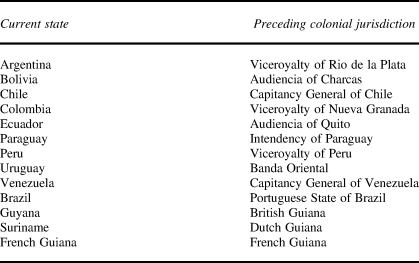
Third, South America provides a convenient opportunity to control for historical and administrative variables that are known to influence the ease of making territorial claims, such as pre-existing borders, overlapping historical occupation of territory, or lack of clear historical control.Footnote 44 All South American countries, including the Guianas and Brazil, declared themselves successor states of a colonial administration (Table 1). These declarations are especially helpful because most territorial claims and “perception of territorial losses” in South America are based on states’ preceding colonial administrations,Footnote 45 allowing us to deduce the potential set of areas that could be claimed for historical or administrative reasons.
South American countries and their proclaimed historical predecessors
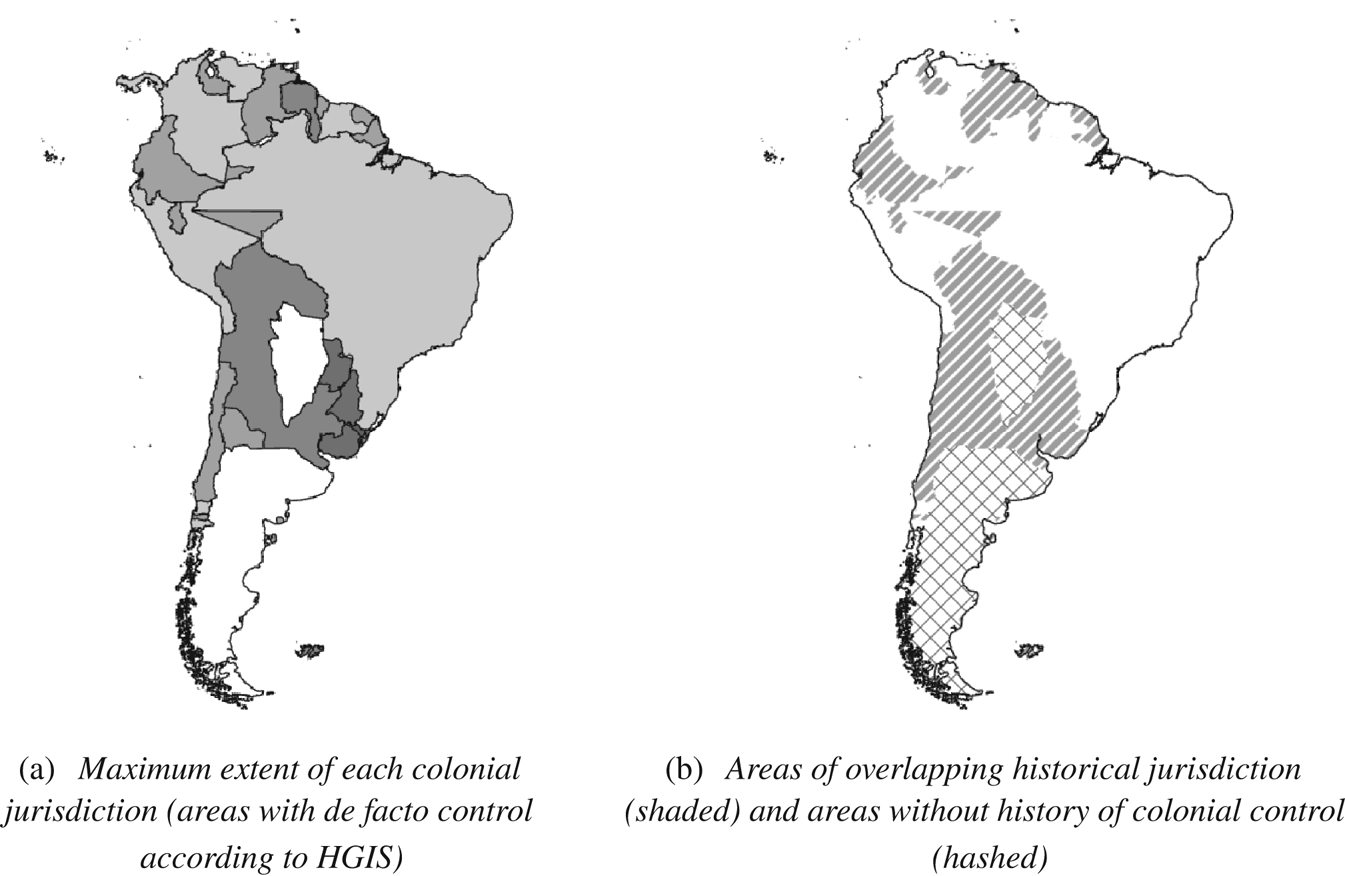
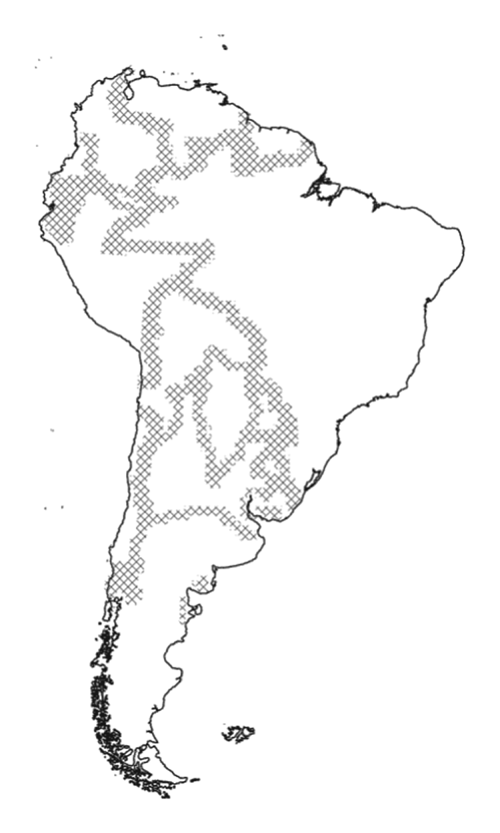
Using geocoded records of colonial administrative borders from 1701 to 1808 compiled by HGIS de las Indias v2,Footnote 46 I trace the maximum territorial extent of each country's preceding colonial administrations and identify areas where the maximum extents overlap, giving multiple states a potential historical title to the territory (historical overlap). I am also able to identify areas where historical ownership is unclear because the area was never de facto governed by the Spanish, such as the Chaco and Patagonia (no jurisdiction). The maximum extent of each preceding jurisdiction in 1701–1808 is shown in Figure 1a, and areas of historical overlap and no jurisdiction are shown in Figure 1b. Finally, because South American states agreed to use the 1810 borders as the standard for the uti possidetis rule on independence,Footnote 47 I am also able to account for areas that serve as pre-existing borders (Figure 2).Footnote 48
Generating the control variables historical overlap and no jurisdiction
Map of areas within 50 km of the 1808 borders
Several other factors make South America appealing. The ecology of states in South America closely resembles that of modern states, where for the most part there was neither a state that tried to completely conquer other countries for imperialist purposes nor a hegemonic state that could be accused of dictating territorial terms.Footnote 49 Finally, ethnic irredentism is comparatively less of a concern in South America, which has been “quite homogeneous in terms of culture, faith, and language” as a result of European colonization.Footnote 50
Variables
Unit of Analysis: 50 km × 50 km Grid–Years from 1830 to 2001
To examine the spatial relationship between territorial claims (outcome variable) and resources invoking distributional concerns (explanatory variable), I divide South America into 50 km × 50 km grid cells.Footnote 51 Because information on disputes and resources change over time, I code a grid cell's attribute for each year. This yields 7,544 grid cells over 172 years, for a total of 1,297,568 grid–years.Footnote 52 Each grid–year contains information on the variables of interest: for example, a grid cell in the Mainas region is coded as unclaimed (0) for the years 1830–1853, and then as claimed (1) for 1854–1945.Footnote 53
I also run my analysis on a subset of “high-risk grid cells,” defined as those located in areas of overlapping historical jurisdictions, with no history of colonial settlement, or within fifty kilometers of previous borders (shaded areas in Figures 1b and 2). Indeed, during the entire duration covered by the data, 90 percent of territorial claims took place within high-risk grid cells, confirming that they are the appropriate grid cells to focus on. A more detailed description of the data and the validity of high-risk grid cells is available in Appendix B2. Next, I elaborate on how I code and georeference my outcome and explanatory variables.
Outcome Variable: Territorial Claims
My outcome variable is territorial claim incidence in South America, which is a binary variable that takes a value of 1 if two or more countries disagree about the ownership of the grid cell in a given year and 0 if there is no disagreement.Footnote 54 A grid cell is considered subject to a territorial claim as long as some states disagree on who owns the territory; it is not necessary for the disagreement to escalate into negotiation attempts or militarized conflict.
I use territorial claims as my outcome variable because they are the clearest observable indicator of which lands states wish to acquire. Once claims are underway, states can use a mix of militarized and peaceful methods to achieve their aims.Footnote 55 Because these strategies are not mutually exclusive, and their timing can be influenced by many factors—such as power asymmetries, prior negotiation outcomes, or the state of the international system—focusing on the strategy selected may lead to biased inferences about states’ ultimate goals.Footnote 56 Meanwhile, territorial claims are less influenced by such outside factors because they are in the most initial stage in the dispute process. I do, however, consider the possibility of selection bias at the claim stage as well, and provide relevant robustness checks in the empirical section.
To generate my outcome variable, I first identify a list of South American territorial claims using the Issue Correlates of War territorial claims data.Footnote 57 I then geocode these territorial claims based on various primary and secondary sources, such as Boundaries, Possessions, and Conflicts in South America by Gordon Ireland,Footnote 58 which provides detailed explanation and maps of each territorial dispute in South America; the David Rumsey Historical Map Collection,Footnote 59 which contains over 100,000 digitized maps from the sixteenth to the twenty-first century; official United Nations documents on South American border conflicts; and scholarly articles from law journals and the British Royal Geographic Society.Footnote 60
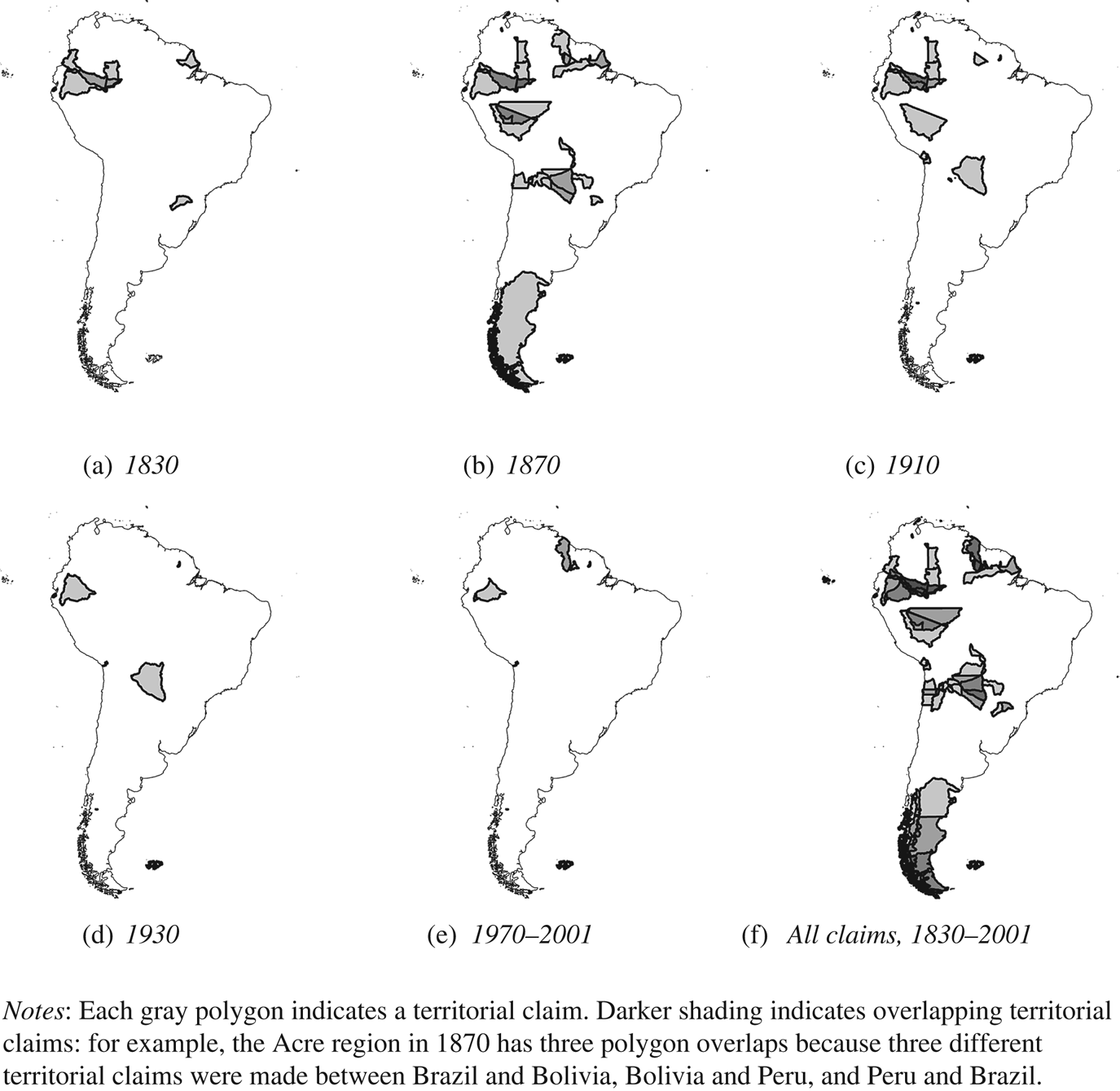
Because the exact location of claimed areas changes over time even within the same dispute, I code a total of sixty-one territorial dispute polygons for thirty-six unique territorial claims. For example, I code five polygons related to the Patagonian claim, each covering the areas contested in 1846–72, 1872–76, 1876–81, 1881–1902, and 1903–98. A full list of the sixty-one polygons with their start date, end date, and spatial overlap with natural resources is provided in Appendix A1. Some selected examples of the claim polygons are shown in Figure 3.
Selected maps of territorial claims, 1830–2001
Explanatory Variable: Potential Benefit Concentration of Territorial Resources
The explanatory variable is the extent to which acquiring the territory can raise concerns about relative losses and parochial motives. I capture this using the capital intensity of the territory's available resources. The logic is that resources with higher barriers to entry, such as those requiring substantial upfront investment for extraction, will be more likely to invoke distributional concerns because they are more likely to be seen as exclusively benefiting a handful of already advantaged groups who are capable of making the investment, even if it may not be true. Indeed, because capital intensity measures the proportion of investment in expensive structural assets needed to join the industry, it has been widely used as an indicator of entry barrier height.Footnote 61
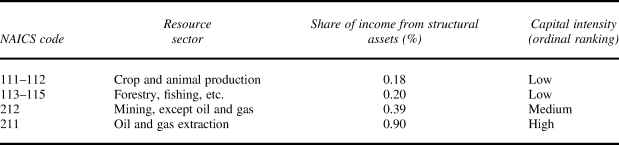
To systematically assess the possible set of territorial resources and their capital intensity, I borrow from the North American Industry Classification System (NAICS) for 1987–2019.Footnote 62 NAICS identifies four main categories of primary industries that are directly associated with gains from the land or the sea: crop and animal production (111–112); forestry, fishing, and hunting (113–115); oil and gas extraction (211); and mining of valuable substances such as coal, iron, silver, copper, nickel, and uranium (212). NAICS also provides data on how much of the resource industry's income comes from structural investments, allowing us to examine how capital-intensive the resource-extraction process is. While directly applying the numbers from NAICS to South America in 1830 to 2001 can be problematic, they do provide a sense of which resources tend to be more capital-intensive than others (Table 2).Footnote 63 This relative ranking of resource capital intensity, while crude, has the advantage of being broadly generalizable across time and space, and tracks well with a general sense of how oligarchic and exclusive the industry is perceived to be.Footnote 64
Resource sectors by capital intensity (potential benefit concentration)
Having established the set of resources and their potential for benefit concentration, I geocode their distribution in South America throughout my period of study (1830–2001) using a combination of data sources. To construct a time-varying variable for oil and gas (211), I use Petrodata v1.2 from Lujala, Ketil Rod, and Thieme, which provides information on 130 onshore and offshore oil fields in South America.Footnote 65 Information on oil is time-varying to avoid a territorial dispute being falsely attributed to oil—for example, a territorial dispute in the 1830s cannot have been due to petroleum, even if oil was later found in the area, because petroleum had not yet become commercially valuable. Fortunately, Petrodata includes the discovery year of most oil fields, allowing me to code a grid cell as containing oil or gas beginning from the year in which it was discovered.
To code the distribution of valuable minerals and metals (212), I use the 2005 US Geological Survey (USGS) report, “Geology and Nonfuel Mineral Deposits of Latin America and Canada.”Footnote 66 This provides geocoded data on fifteen valuable metals, such as gold, copper, iron, and aluminum, and sixteen industrial minerals, such as clay, gemstones, lithium, and phosphate. I also make sure that the minerals data are time-varying, for the same reason that the oil data are time-varying.Footnote 67 Because the mineral data do not cover organic materials such as guano and coal, I code the distribution of coal based on a different geospatial data set of coal compiled by the USGS,Footnote 68 and hand-code the distribution of guano and saltpeter based on nineteenth-century maps from academic sources.Footnote 69 The results are robust to running the analyses on only the original mineral data, excluding hand-coded deposits, and in fact become even more supportive of the hypothesis in terms of their magnitude and significance (Appendix D6).
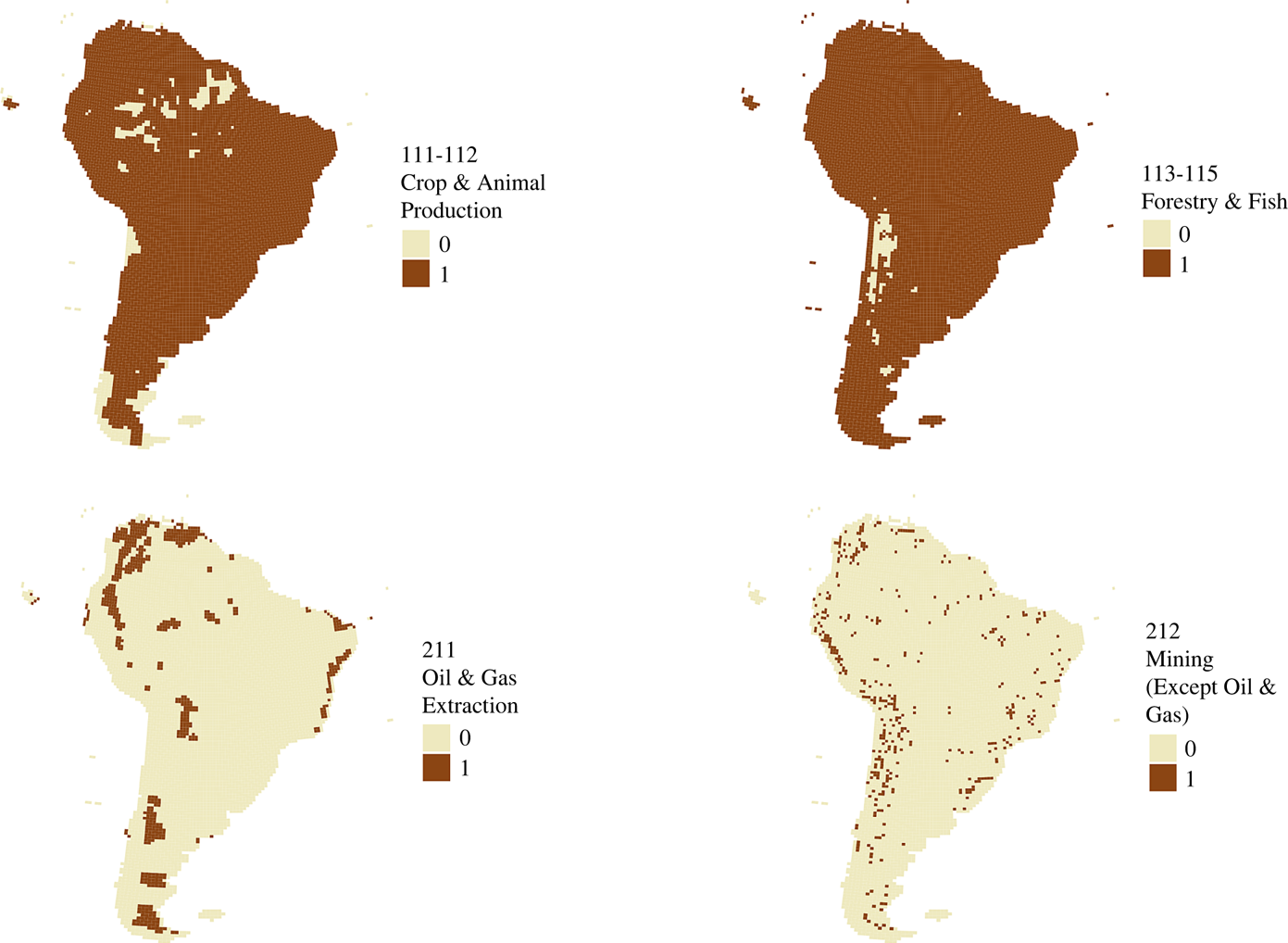
Finally, I code land that can be used for crop and animal production (111–112) using data from the Spatial Production Allocation Model of Yu and coauthors, which records spatial patterns of crop performance for forty-two agricultural and commercial crops such as wheat, rice, bananas, cocoa, coffee, and soybeans.Footnote 70 To locate areas suitable for forestry, hunting, and fishing (113–115), I rely on GlobCover v2.3, which offers a detailed mapping of types of forests and shrublands based on satellite data from the European Space Agency.Footnote 71 Since farming, forestry, fishing, and hunting were all practiced long before 1830, these data are not time-varying like minerals and oil. I instead try to capture all the areas that could have been suitable for such activities throughout my study period, employing a lenient coding standard where a grid cell with any record of crop production is coded as arable, and a grid cell containing any type of forest or shrubland, or bordering the ocean, is coded as suitable for forestry, hunting, and fishing. Figure 4 shows an example of how the primary resources are geographically distributed in 2001. A more detailed explanation of the coding rules and their summary statistics are available in Appendices B1 and C1.
Distribution of primary resources in South America in 2001
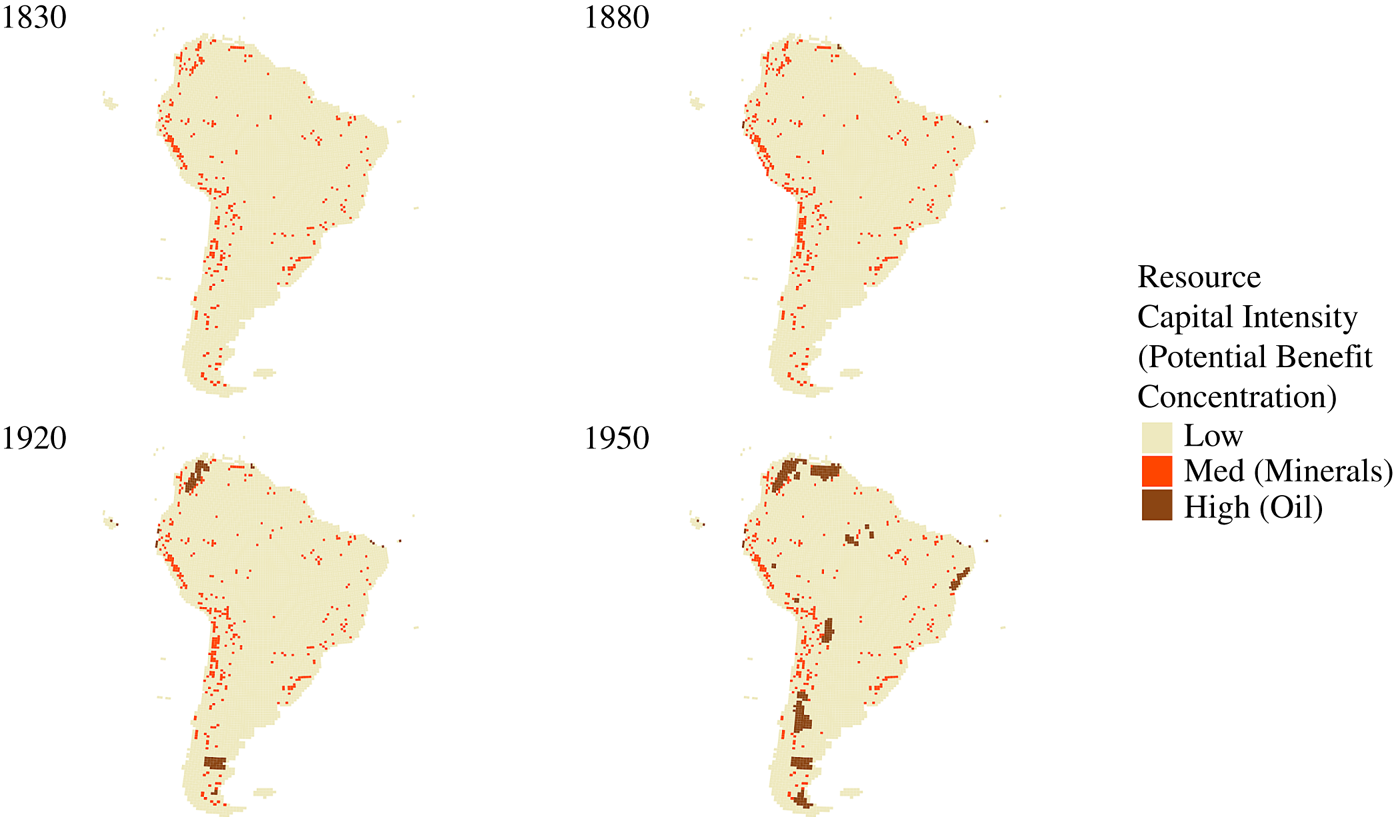
As the last step, I combine the information on the distribution of primary resources to generate my explanatory variable: a time-varying measure of the territory's potential benefit concentration proxied by territorial resource capital intensity in 1830–2001. A grid–year that does not have any resources or is only suitable for crop and agricultural production (111–112) or forestry and fishing (113–115) is coded as having low benefit concentration.Footnote 72 Grid–years with mining or oil deposits are marked as having medium or high benefit concentration, respectively. When there are multiple resources, I code the grid–year according to its most capital-intensive resource, because I wish to capture the maximum extent to which the benefits can be concentrated. For instance, a grid cell that contains both fishing grounds and oil deposits is marked as high. Figure 5 shows some examples of how my explanatory variable is geographically distributed over time.
Selected maps of the explanatory variable: territory's potential to trigger distributional concerns (resource capital intensity)
Results
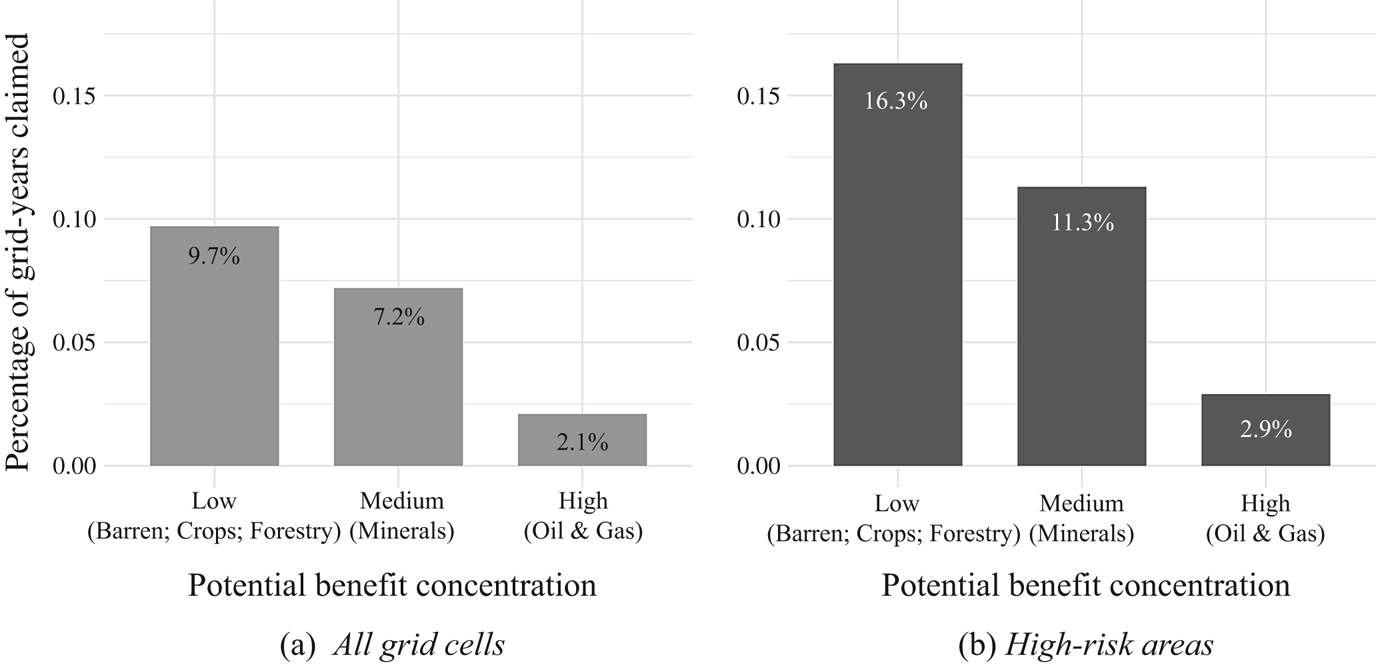
I start with a simple correlation between resources and the probability of territorial claims (Figure 6). Only 2.1 percent of all grid–years with oil were subject to territorial claims; grid–years without minerals or oil were almost five times as likely to be claimed (Figure 6a). This trend also holds when we look at only the high-risk grid cells (Figure 6b), meaning that areas with oil and minerals were claimed at lower rates even when they could have been claimed for historical or administrative reasons.
Potential benefit concentration and probability of claims, 1830–2001
Spatial Lag Results
While grid cells provide a convenient way to perform statistical analyses, they are not independent units of observation. Territorial claims are spatially clustered: a grid cell is more likely to be claimed if a neighboring cell is claimed, and less likely to be claimed if none of its neighboring cells are claimed. To account for this spatial dependence, I estimate my main model using a spatial lag model, which assumes that the outcome variable of a spatial unit is affected by its neighboring values.Footnote 73 Other models, such as regular OLS (with and without Conley standard errors) or hazard models, also provide similar results (see Appendices D3 and D7). I also make sure I am comparing grid cells of the same year to each other by adding year fixed effects to the model. This leads to the specification:
 $${\rm \smallcaps CLAIM}_{rt} = \alpha _t + \rho W{\rm \smallcaps CLAIM}_{rt} + \mathop \sum \limits_{\,j = 1}^m \beta _jX_{\,jrt} + \epsilon _{rt}, \;$$
where r is the individual region (grid cell), t is time (year), ρ is the spatial autoregressive coefficient, W is the King's contiguity row-standardized spatial weights matrix, and α t is the year fixed effect. This model allows us to estimate the average effect of having capital-intensive resources on the probability that a grid cell is claimed for the years 1830–2001, accounting for year-specific characteristics and spatial interdependence between grid cells.
Table 3 presents the spatial lag model results. Model 1 is estimated on all grid cells in South America, while model 2 is estimated on only high-risk grid cells. For both models, the outcome variable is a binary variable indicating whether a grid cell is subject to a territorial claim, and the main explanatory variable is the ordinal level of potential benefit concentration (low, medium, or high) for each year. The negative coefficients show that, consistent with the hypothesis, grid cells with minerals and oil are less likely to be claimed than grid cells without such resources.
Effect of capital-intensive resources on probability of territorial claims
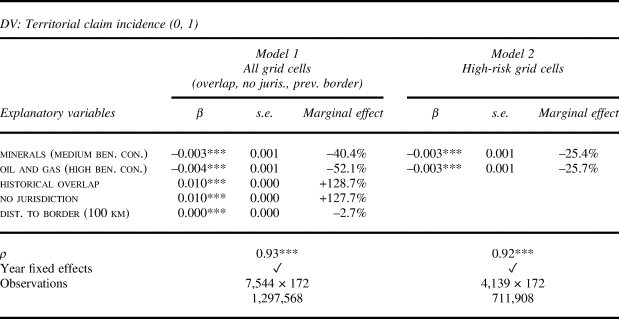
Notes: Spatial lag model. ρ is the spatial autoregressive coefficient. Baseline is grid cells with low potential for benefit concentration (no resources, crop & animal production, or forestry, hunting & fishing). Both models use year fixed effects, meaning that the models are comparing whether grid cells with oil or minerals are more likely to be claimed than those without, holding constant the effect of each year. See Appendix D3 for OLS results, where minerals and oil are each associated with a 38% and 30% decline in the probability of territorial claims. ***p < 0.01.
The marginal effect column indicates how the presence of resources influences the probability of a territorial claim after accounting for the effect of spatial lag. Having minerals or oil is associated with a 40 percent and 52 percent lower probability, respectively, of the territory being claimed (model 1).Footnote 74 The coefficients of the control variables are also in the expected direction and consistent with the findings of earlier research. A history of overlapping jurisdictions or having no clear colonial jurisdiction more than doubles the probability of a territorial claim, while areas closer to previous administrative borders are slightly more likely to be contested.
Robustness Checks and Alternative Explanations
I also perform a series of robustness checks to validate these results. First, I rerun the analysis after controlling for whether the grid cell had been previously claimed and resolved, since such areas are less likely to be contested again.Footnote 75 Results remain the same (Appendix E1). Second, I check whether there are any heterogeneous temporal effects by running the regressions for each decade. Minerals and oil are both negatively related to territorial claims in almost all the time periods, allaying concerns that the results are driven by certain moments in history (Appendix D1). Third, I test my results using claim onset rather than claim incidence as the dependent variable. I have used claim incidence as the dependent variable mostly for technical reasons, but doing so has the downside of overlooking temporal dependence between grid–years.Footnote 76 The results are identical: claim onsets are also strongly negatively correlated with both oil and minerals (Appendix D4). Fourth, I confirm that the results are robust to accounting for the average elevation and ruggedness of the terrain (Appendix D8).
I also consider alternative explanations. First, I check whether the claims could have been driven by anticipated resource discoveries, but find little evidence of this possibility. Running the regression after placing a ten-year lead on the capital intensity of the grid cell yields almost identical results, where discoveries of resources ten years into the future are also negatively correlated with territorial claims. Also, if states were claiming territories because they had reason to believe that they bore valuable resources, we would see resources being discovered at higher rates in places that had been previously claimed. I find no support for this pattern either (Appendix E2).
Second, I check whether the negative relationship could be due to strategic selection, where states claimed resourceless lands simply because they thought such lands would be easier to acquire. If states did want to acquire resource-rich territory but were primarily deterred by their higher cost, we would see two patterns. First, the negative relationship would hold mostly between states that are similar in power, because in cases where one state is significantly stronger than the other and does not need to be very strategic about the cost of claims, they would be able to reveal their true preferences and claim resource-rich territories instead.Footnote 77 Second, by a similar logic, states could try to claim resource-rich lands when they see a window of opportunity, such as when the other state suddenly becomes weaker. However, I find that the relationship between territorial claims and resources is negative even between dyads where one country is significantly stronger than the other (Appendix E3.1). States also did not take advantage of large power shifts to claim resource-rich territories: even among dyads where one state suddenly grew stronger or weaker, territorial claims and resources were robustly negatively correlated (Appendix E3.2). This consistent negative relationship gives us more confidence that even if expressions of territorial claims were subject to some selection mechanism, selection effects are not the primary drivers of the negative relationship.
Finally, I check whether the discovery of capital-intensive resources also decreases the probability of territorial claims by adding both year and grid cell fixed effects to the spatial lag regressions (Appendix D5). The two-way fixed effects allow us to estimate how discovering minerals or oil in a grid cell affects its likelihood of being claimed. I find either negative or null effects, indicating that the discovery of oil or minerals also does not increase the chances of a territorial claim.
In sum, I find strong support for the hypothesis that states are less likely to claim lands bearing valuable capital-intensive resources such as oil or minerals, at least among countries that satisfy the scope conditions. It is also worth emphasizing that we see the same negative trend when we subset on high-risk grid cells. In other words, states were less likely to claim territories bearing minerals or oil, even when the same areas could have been claimed for historical or administrative reasons. These findings are difficult to explain solely within the scope of existing realist, rationalist, or domestic politics theories, which assume that states would prefer to claim resource-rich territories, all else equal.
Illustrating the Theoretical Mechanism: The Case of Bolivia
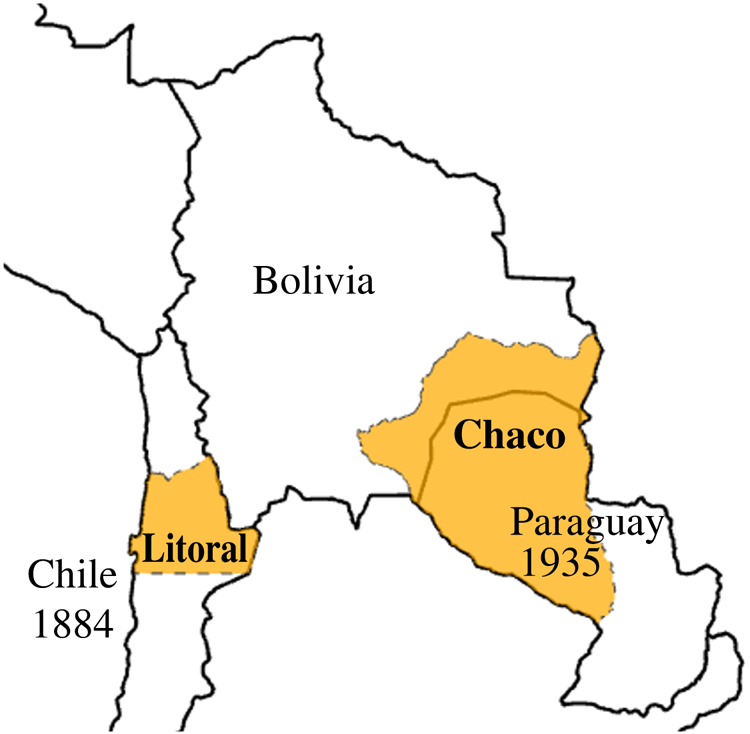
I have so far shown a negative relationship between capital-intensive resources and territorial claims. In this section, I illustrate how the presence of capital-intensive resources can invoke distributional concerns and how those concerns in turn shape a country's territorial claims toward its neighbors. I do so through the case of Bolivia, which lost the contested region of the Litoral to Chile in the War of the Pacific (1879–1884) and the Chaco to Paraguay in the Chaco War (1932–1935) (Figure 7).
Map of the contested Chaco and Litoral regions
Bolivia in this period also meets the scope conditions of the theory: its leaders faced a capable domestic audience and could not make credible promises of redistribution. They faced a strong group of peer elites who could hold them accountable through coups and elections in a multi-party system, as well as a mass public that was starting to become politically relevant with the help of socialist parties.Footnote 78 Bolivia at the time also suffered from severe socioeconomic inequality and was rife with corruption, “inconsistent rule, and unfulfilled promises,”Footnote 79 which made credible commitments to redistribution very difficult.
Bolivia's two territorial losses are comparable, in that they happened in similar periods through defeat in war. Yet Bolivia initiated claims over only one of them: the Litoral. These claims are strongly active to this date: regaining the Litoral is a “common goal shared by all Bolivians,” commemorated annually in national celebrations and referenced in hundreds of street murals and official school textbooks.Footnote 80 Meanwhile, there have not been official claims or even nationalist demands for the reclamation of the Chaco. Far from being a common national goal, the war over the Chaco is widely regarded as a mistake made by corrupt Bolivian leadership.Footnote 81 Former Bolivian president Evo Morales went so far as to say, in a meeting with the Paraguayan president, that if he had been leading Bolivia at the time of the crisis, “there certainly would not have been war” over the Chaco.Footnote 82
Bolivia's choice to renounce its claims to the Chaco while pressing claims over the Litoral is puzzling for several reasons. Conventional theories stressing the historical and intangible values of territory would predict Bolivia to claim both areas. After all, Bolivia had lost both of them unwillingly through defeats in war, and at the time of its independence from Spain, believed that it had a historical title to both lands as the successor state to the Audiencia of Charcas.Footnote 83
Bolivia's lack of interest in the Chaco is even more puzzling from an economic perspective. It is estimated to contain 3.2 billion barrels of shale gas—the second-largest such basin in South America.Footnote 84 Conventional oil exploration in the area is also currently active; it was reinvigorated when the British company President Energy made its first major oil discovery in 2014.Footnote 85 And on top of oil, the Chaco's geography provides opportunities for general national development. It borders the Paraguay River to the east and the Pilcomayo and Bermejo Rivers to the south, all of which flow into the Atlantic Ocean. For this reason, the Chaco was hailed by many Bolivian scientists, entrepreneurs, and politicians in the 1900s as a potential transportation hub for the export of goods from eastern Bolivia, which is surrounded by steep mountain ranges.Footnote 86 The Bolivian historian Ronald Kain, for example, wrote that “the immense store of natural wealth in this vast region will lie dormant” until Bolivia has access to the Chaco and its Atlantic outlets.Footnote 87
The economic benefits of regaining the Litoral, on the other hand, are less clear. The Litoral does not currently have any specific resources that are considered valuable: the nitrate deposits that once made the region economically valuable have been abandoned since the development of synthetic nitrates in the 1930s.Footnote 88 The Charaña corridor, which is the most recent strip of territory discussed in Bolivia–Chile negotiations, is in the northernmost part of Chile, far from any mineral or gas deposits. The Litoral is also the smallest area that had been lost to Bolivia's neighbors, comprising only 9 percent of its lost territories.Footnote 89
Furthermore, while it is true that regaining the Litoral would provide Bolivia with a sovereign access route to the Pacific, scholars and even some Bolivian politicians have privately admitted that its economic benefits are unclear and exaggerated for political purposes.Footnote 90 Bolivia already has “perpetual free commercial transit” to the Pacific ports of Arica and Antofagasta according to the 1904 Bolivia–Chile Treaty of Peace and Friendship, which gives Bolivia the right to assume customs authority, set its own duties, enjoy duty-free warehousing, and be exempt from freight taxes. In fact, the Chilean government has complained on numerous occasions that Bolivians enjoy more perks than the Chileans themselves, who, for example, do not have access to duty-free warehousing.Footnote 91 Even the former Bolivian president Victor Paz Estenssoro, who staged numerous public ceremonies commemorating the loss of the Litoral, admitted in private that the actual benefits of regaining the region were less clear:
For us, the problem of the port [Litoral] is not the foremost problem facing Bolivia. The often-made statement that our backwardness comes mainly from the lack of access to the sea is tendentious if not childish, since it seeks to divert public attention from the true causes of Bolivian stagnation … Paradoxically, for us, it is not convenient if the question of the port has an immediate solution, but better that it be postponed for the future.Footnote 92
To be clear, the point is not to argue that Bolivia would not benefit at all from regaining the Litoral. Rather, it is to emphasize the puzzle of why Bolivians are uninterested in reclaiming the resource-rich Chaco region even when they remain passionate about regaining the Litoral, whose benefits are not ex ante much more obvious. In the next section, I demonstrate how domestic distributional concerns can shed light on this question. The case of the Chaco nicely illustrates the workings of the second theoretical mechanism, in that opposition politicians used the Chaco's oil potential to raise suspicions of parochial involvement. These accusations effectively undermined the credibility of the Chaco's economic and non-economic value to the Bolivian nation and made it politically costly for leaders to make future claims to the region.
The Chaco: Oil Potential, Distributional Concerns, and Domestic Opposition
As mentioned, many Bolivian elites at the time considered the Chaco region an opportunity for national development due to its river passages to the Atlantic. Gaining access to the Atlantic through the Chaco was also what Bolivian president Daniel Salamanca emphasized foremost and continuously when trying to mobilize domestic support for the war over the Chaco in 1931.Footnote 93 For example, in a 1928 letter to the Congress preceding the war, he pleaded for more attention to the Chaco matter, claiming that “our only right and hope remain in our access to the Plata [Atlantic] through the Paraguay River.”Footnote 94 Salamanca also stressed in his speeches that Bolivia had a historical right to the Chaco under the uti possidetis rule of 1810Footnote 95 and referred to the Chaco as a “heritage our elders left us.”Footnote 96
And yet, despite Salamanca's efforts to point to the region's economic and historical importance to all Bolivians, the war for the Chaco faced strong opposition from other political elites and from the Bolivian public, ironically due to the region's perceived rich oil potential. Salamanca's political opponents used the Chaco's oil potential to discredit Salamanca's claims, arguing that the real motivation for the war was to benefit Standard Oil, an American gas company, and the incumbent Bolivian elites sympathetic to the industry.Footnote 97
Tristán Marof, an influential Bolivian politician and rival of Salamanca, argued in his widely cited book on the Chaco War that “a powerful company, possessing more than four and a half million oil fields, was pressing for this purpose [the war]. Inept and traitor to their own country, the miserable bourgeoisie threw themselves into the arms of financial capital.”Footnote 98 Marof even said it was a good thing that Bolivia had lost the war, because if Bolivia had won, Bolivians would have been subject to “a military dictatorship designed specifically to exploit the masses for the gains of the oligarchy,” and that “this is what Salamanca and his clique wanted, reeking of oil and prepared to hand over Bolivia … Salamanca's plan has been partially thwarted by the defeat.”Footnote 99 Carlos Montenegro, another leading opposition politician, also opposed the conflict over Chaco with reference to distributional concerns, saying that only oil companies would gain from acquiring the province, at the expense of regular Bolivians.Footnote 100
Yet there is ample evidence that these accusations were unfounded. First, Standard Oil had refused to cooperate with Bolivia during the entire Chaco War. When the war broke out, instead of honoring its promise to ramp up oil production during wartime, the company capped many of its wells and moved its production equipment to Argentina. Bolivian soldiers did ride on trucks that were marked as Standard Oil's property, but the company said that Bolivia had illegally expropriated the trucks and later sued the government for it.Footnote 101 In fact, Standard Oil's Bolivian drilling rights were canceled shortly after the war on the grounds that the company had been “notoriously hostile” and uncooperative with Bolivian's war efforts.Footnote 102
Most strikingly, despite publicly accusing President Salamanca of serving oil interests, opposition politicians themselves were in private skeptical of such a narrative.Footnote 103 Carlos Montenegro, the same opposition politician who accused Salamanca of pursuing oil interests, privately voiced his doubts about the oil narrative in a personal correspondence, writing that those who supported the oil narrative were “too quick to accept the formula of the socialists which explains all of the world's economic conflicts without taking the trouble to get to the heart of the conflict.”Footnote 104 Lastly, Salamanca himself almost never referred to oil benefits as a reason to justify the importance of the Chaco region. In the rare cases that he did mention oil, the context was always to emphasize how gaining access to the Paraguay River could facilitate the transportation of oil, rather than the possible economic benefits from gaining the oil fields.Footnote 105
Despite there being no evidence of the Chaco region being fought over for oil, the opposition's suggestion of concentrated distributional consequences turned out to be very effective in inciting public opposition to the conflict. The Bolivian public “almost immediately accepted as truth that the Chaco War was the result of a basic conflict of oil lands,”Footnote 106 and Salamanca was soon deposed by a coup amid charges of having waged a costly war for parochial interests.Footnote 107 The conflict over the Chaco became so widely known as a war for special interests that advocating the war became very costly politically; this led to future Bolivian politicians, including recent presidents such as Evo Morales, repeatedly renouncing Bolivia's claims to the Chaco.Footnote 108
The Litoral: Lack of Distributional Concerns and Unified National Support
In contrast, the Litoral did not face such complications, precisely because it did not have specific resources that could trigger distributional concerns. The Litoral currently stands for an unspecified outlet to the Pacific, making it difficult for anyone to deny that some form of access to the Pacific would be beneficial to Bolivia as a whole. It is even more difficult to make a convincing case that a strip of desert territory leading to the Pacific would benefit only special interests, as there are no specific resources or even detailed boundaries involved. This has led to a unified understanding that regaining the Litoral was in the Bolivian national interest, dampening domestic opposition and social debate on the necessity of fighting for the territory.Footnote 109
Consequently, Bolivian politicians, regardless of party affiliation or ideology, have continued to advance territorial claims to the Litoral region.Footnote 110 For example, Carlos Mesa Gisbert, a historian by profession, “abandoned his historian's habit of critical distance” after he became the president of Bolivia in 2003 and pursued more aggressive policies toward the Litoral.Footnote 111 Evo Morales, despite being a political opponent of Mesa Gisbert and rescinding many of Mesa Gisbert's policies on assuming power, did not once question the importance of the Litoral. Instead, he continued to press Bolivian claims over the province, taking the dispute to the International Court of Justice and establishing new government branches with the explicit purpose of regaining the territory.
There is also little evidence that the Litoral is considered inherently more valuable than the Chaco for alternative reasons. First, the Litoral is not especially sacred on religious or historical grounds. Although it had been nominally part of the Intendencia de Potosi (later part of Bolivia) in the late eighteenth century, it had been mostly deserted due to its inhospitable conditions. The territory started being inhabited in only the mid-nineteenth century, but even then mostly by Chileans: census records from 1878 show that 6,554 of its 8,507 residents were of Chilean nationality and that its governing officials also identified themselves as Chileans.Footnote 112 Second, the War of the Pacific over the Litoral was not necessarily more traumatic for the Bolivians than the Chaco War. Historians estimate that the Chaco War cost 100,000 lives at the very least, compared to the War of the Pacific's estimated 25,000, and that the military routs in the Chaco were an even greater shock to Bolivians, who had expected an easy victory over Paraguay.Footnote 113
Overall, Bolivia's attitude toward its two lost provinces is difficult to explain within the scope of conventional theories. These theories would predict that Bolivia would try to claim both the Chaco and the Litoral for historical and intangible reasons, or that if Bolivia had to choose one, it would choose to claim the Chaco, which has the clearer economic benefits. This puzzle becomes easier to understand once we consider the domestic political costs triggered by resources: the war over the Chaco invited widespread suspicion of parochial motives, making conflict costly for leaders and deterring future Bolivian leaders from trying to reclaim the province. In contrast, claims over the poorly defined, resourceless strip of the Litoral did not lead to cleavages based on distributional consequences. Re-emphasizing claims over the Litoral was much less costly—in fact, often appealing—to Bolivian leaders who wished to mobilize unified domestic support. The two contrasting cases demonstrate how the presence of capital-intensive resources, despite their higher value, can lead to distributional complications and ultimately become a liability in mobilizing domestic support for territorial claims.
Conclusion
While many theories of international relations expect states to be more intent on claiming territories that have abundant natural resources, recent empirical evidence on territorial conflicts has not been very supportive of this expectation.Footnote 114 This paper suggests a new reason for why states may not in fact have a higher preference for acquiring resource-rich territories: economic resources with a higher potential for benefit concentration can trigger distributional concerns and prompt stronger domestic opposition to territorial claims from rival interest groups and the public.
An analysis of territorial claims in South America from 1830 to 2001 supports this argument. We see that even among territories that can easily be claimed on historical or administrative grounds, states were less likely to claim areas with capital-intensive resources such as minerals and oil. The Bolivian case also provides support for the theoretical mechanism, showing how a territory's economic resources can ultimately discourage leaders from claiming the territory by triggering distributional concerns. These results not only support the paper's central argument but also directly challenge the commonly held belief that resource-rich lands are more frequently claimed or that disputes over barren lands are only a post-1945 phenomenon.
The findings have several implications for the literature on territorial conflict. First, they challenge the widespread assumption in the literature that a territory's economic, strategic, and intangible values are additive or complementary.Footnote 115 Instead, they suggest that the presence of certain economic benefits can undermine the credibility of a territory's other potential values by opening up the leader to distributional criticisms and casting suspicion regarding the leader's true motives.
Second, while over 90 percent of territorial claims in South America took place in areas that were either previously owned or under unclear colonial authority, more than half of the territories that could have been claimed for historical or administrative reasons went unclaimed. This pattern provides further evidence that past ownership of territory sets the general boundaries of territorial claims.Footnote 116 At the same time, it also cautions against taking states’ assertions of historical claims at face value: the fact that more than half of historical territories went unclaimed indicates that historical ownership by itself is often insufficient to explain the saliency or intractability of territorial conflicts, and further scrutiny would be needed to understand why states choose to escalate over certain historical lands but not others.
Third, the paper highlights the need to be more specific in distinguishing between the various economic values of a territory. Studies have usually defined a territory as economically valuable if it bore any possible economic benefit, from oil and mineral deposits to port outlets or access to fresh water. Yet this study shows that a finer distinction in the coding of economic value is needed, since different economic resources can differently affect the government's ability to mobilize support over the territory. Understanding the heterogeneous effects of territorial economic benefits may also help reconcile the varying empirical findings in the literature on the relationship between natural resources and territorial conflict.
That said, there are various ways future research can build on this study. First, while the theory section outlined some key scope conditions, it did not explore each variable in detail. The extent to which leaders can be constrained by elites or the public would depend on many domestic political variables, such as the political position and relative strength of elite groups, the size and composition of the leader's supporting coalition, and the structure of the state's economy and redistribution system.Footnote 117 Future work could therefore expand on each of these conditions and look at how these various moderators could work independently or interactively to affect the intensity of domestic distributional complications.
Similarly, the paper's empirical section focused on testing the initial argument that there are substantial domestic distributional costs to disputing resource-rich territory under the appropriate scope conditions. While the scope conditions are not particularly restrictive and recent studies have also reported a non-positive relationship between resources and territorial claims outside of South America,Footnote 118 a more rigorous analysis of to what extent the theory is generalizable when the scope conditions are relaxed would help clarify the contributions and limits of this theory.
Finally, scholars could investigate how the theory of distributional consequences applies to non-economic issues as well. This paper focused on economic resources because they tend to be more clearly excludable and perceived as private goods. However, while they are rarer, some non-economic benefits can also be excludable. For instance, when there are multiple ethnic or religious groups in a country, leaders who want to appeal to a broader population often avoid fighting over territories that are meaningful to only some of these groups.Footnote 119 Elaborating on this scholarship and seeing how the theory transfers to other non-economic factors would deepen our insight into how benefit excludability and distributional consequences influence territorial disputes more broadly.
Data Availability Statement
Replication files for this article may be found at <https://doi.org/10.7910/DVN/4L6DQW>.
Supplementary Material
Supplementary material for this article is available at <https://doi.org/10.1017/S0020818324000134>.
Acknowledgments
This paper was previously circulated under the title “When Economic Value Backfires: Domestic Opposition to Resource-Rich Territory.” I am grateful to Ken Schultz, Jim Fearon, and Mike Tomz for their extremely helpful comments and support. I also thank Dan Altman, Kyle Beardsley, David Carter, Alicia Chen, Andrew Coe, Chris Fariss, Stephen Gent, Hein Goemans, Ben Graham, Michaela Mattes, Jonathan Markowitz, Emily Meierding, Sara Mitchell, Katy Robinson, three anonymous reviewers, and workshop participants at Duke University, University of Chicago, ISA 2022, APSA 2022, TISS New Faces 2022, Journeys in World Politics 2023, and Political Economy of International Security 2023 for their insightful comments.


 Open access

