


Introduction
The biological diversity of sub-Saharan Africa (and associated islands) is under pressure from a range of anthropogenic activities, and it is widely accepted that the ongoing loss of species and habitats requires concerted and coordinated action across the region (Stuart & Adams, Reference Stuart and Adams1990; Craigie et al., Reference Craigie, Baillie, Balmford, Carbone, Collen, Green and Hutton2010; Beresford et al., Reference Beresford, Eshiamwata, Donald, Balmford, Bertzky and Brink2013; BirdLife International, 2013; Perrings & Halkos, Reference Perrings and Halkos2015; UNEP-WCMC, 2016). To address changes to sub-Saharan environments and biodiversity, a large number of local, national and international conservation plans have been produced. These often contain detailed goals and time-bound targets (Secretariat of the Convention on Biological Diversity, 2014; Ozor et al., Reference Ozor, Acheampong and Ayodotun2016). However, delivering these plans requires a wide range of diverse skills, knowledge and information to achieve the stated objectives. Collectively, these elements are often called capacity, and the process of acquiring them is called capacity building. However, an agreed definition of the capacity building concept remains elusive for the conservation sector, and there are a large number of terms and definitions used by various individuals and organizations (e.g. capacity development, competency, capability). A discussion of these various terms is beyond the scope of this paper, but comprehensive overviews are provided by Whittle et al. (Reference Whittle, Colgan and Rafferty2012) and Appleton (Reference Appleton2015). Here, a working concept of capacity building is used, which largely follows the UN's approach of focusing on ‘the combination of all the strengths, attributes and resources available within a community, society or organization that can be used to achieve agreed goals’ (UNISDR, 2016).
Beyond attempts to pin down a definition, the key capacity issue for conservation in Africa is that few of the multitude of plans to halt and reverse the loss of biodiversity include a qualitative and quantitative assessment of the capacity required for the successful delivery of stated aims. To discuss the ongoing issue of capacity building for conservation and natural resource management, 185 delegates representing 105 organizations from 24 African nations and eight non-African nations met in Nairobi, Kenya, in 2015. These practitioners, scientists, community groups and government agencies used a framework of four main themes (outlined below) to discuss methods for the acquisition and long-term maintenance of skills, knowledge, information and competencies within the conservation sector. However, any discussion of capacity building also needs to recognize the large number of associated issues that can alter the scope and extent of impact in various contexts, including local/national facilitating environments, levels of available funding, public awareness and attitudes, and the required scale of impact. These issues therefore formed the cross-cutting themes of the meeting and a background perspective for the key recommendations from each thematic workshop. We provide an overview of the broad thematic backgrounds to the four workshops, and report the key discussions and recommendations made during the 4-day meeting.
African contexts for conservation and resource management
Sub-Saharan Africa is one of the most biodiverse regions on Earth, with > 100,000 species of insects, 50,000 plants, 1,100 mammals, 2,355 birds, 3,000 freshwater fishes, 950 amphibians and 1,600 reptiles (Stuart et al., Reference Stuart, Chanson, Cox, Young, Rodrigues, Fischman and Waller2004; UNEP, 2010; Myers et al., Reference Myers, Mittermeier, Mittermeier, da Fonseca and Kent2012; Han et al., Reference Han, Josse, Young, Smyth, Hamilton and Bowles-Newark2016). Five of the world's biodiversity hotspots, 373 Ramsar sites and > 1,250 Important Bird and Biodiversity Areas are in Africa, and many taxonomic groups contain relatively large proportions of endemics (Mittermeier et al., Reference Mittermeier, Turner, Larsen, Brooks, Gascon, Zachos and Habel2011; BirdLife International, 2013). Patterns of species diversity in the region generally follow latitudinal gradients, and the equatorial tropical forests are amongst the most productive natural systems in the world (net primary productivity of > 800 g C m−2 yr−1; Pan et al., Reference Pan, Dangal, Tao, Yang and Tian2015). Africa also has an extensive network of protected areas (> 2 million km2), covering c. 10% of the 119 recognized African ecoregions (WWF, 2016).
Despite this considerable natural capital, when measured across a range of socio-economic metrics, Africa is the world's poorest region. In the 21st century it is predicted to have the largest population growth of any continent, and all of the 10 nations with the highest fertility rates are in sub-Saharan Africa. Forty-three percent of the region's population is < 15 years of age (He et al., Reference He, Goodkind and Kowal2016). The human population is currently 1.1 billion, and this will increase to at least 2.4 billion by 2050 (assuming that family planning initiatives achieve targets for declines in the birth rate of key countries). These population increases are not predicted to be accompanied by economic growth that will lead to a proportional increase in employment or governmental investment in infrastructure and resilience (UNDESAPD, 2015). The predicted outcome of this population increase is further extensive land-use change (agricultural conversion) accompanied by increased direct/indirect impacts on natural resources (e.g. soil erosion and degradation, loss of biodiversity, habitat fragmentation, loss of ecosystem services). Pressures on water resources (and associated wetland biodiversity) are also predicted to increase, with many watersheds suffering from over-abstraction, pollution and degradation (McKee et al., Reference McKee, Sciulli, Fooce and Waite2004). Over the next century these pressures will be exacerbated by the impacts of climate change. The region is particularly vulnerable to climate alteration as a result of agricultural practices that rely on rainwater and that lack drought resilience. Per capita access to land is low in many African countries, and the Food and Agriculture Organization of the United Nations predicts that population growth will result in an additional 36 million Africans being affected by drought-related famine by 2050 (Bruinsma, Reference Bruinsma2009; Turral et al., Reference Turral, Burke and Faurès2011). It is in this context of ongoing social, economic and land use changes that African government agencies, conservation organizations, civil society organizations, and local community groups must develop strategies, policies and actions to ensure a sustainable future for people, wildlife and natural systems.
Responses to environmental issues in Africa
Conservation responses to pressures on African biodiversity and natural capital occur at a number of nested operational and ecological scales. Many conservation organizations and agencies work across these scales (communities to international). However, this can have implications for how they set priorities, their operational costs, and the reach, impact and sustainability of their actions. These scale effects are also present in considerations of capacity building, and there is a considerable need for research to measure the relative cost-effectiveness and impact of conservation actions implemented at various levels and scales (Henson et al., Reference Henson, Williams, Dupain, Gichohi and Muruthi2009; Guerrero et al., Reference Guerrero, McAllister, Corcoran and Wilson2013). At the international level, transboundary issues and actions have always been a feature of African conservation. Most sub-Saharan nations have signed up to the key multilateral environmental agreements, and efforts are being made to integrate these with national legislation and administrative frameworks. This includes harmonizing capacity building efforts across the various conventions (Jones, Reference Jones2003; Steiner et al., Reference Steiner, Kimball and Scanlon2003; Burnside & Dollar, Reference Burnside and Dollar2004; Ambalam, Reference Ambalam2014; Ozor et al., Reference Ozor, Acheampong and Ayodotun2016).
Since the 1990s, in many sub-Saharan countries there has been an increase in the number of tertiary education establishments offering applied courses associated with biodiversity, conservation, sustainable development and community engagement (World Bank, 2009; Vasudev et al., Reference Vasudev, Kumar and Karanth2015), as well as in the provision of environmental e-learning in Africa (Aderinoye et al., Reference Aderinoye, Siaciwena and Wright2009). E-learning has the potential to provide accessible, strategic, low-cost and efficient means to build capacity in some areas of conservation. However, despite the rapid increase in the availability of both face-to-face and e-learning courses, it is clear these need to be driven pro-actively by strategic partnerships between the conservation and education sectors. Research is also needed to measure and evaluate the conservation impacts of various delivery methods.
At the same time as multilateral environmental agreements and tertiary education have been responding to environmental change, there has also been a major grass-roots response (Lewis, Reference Lewis2002). This has been led largely through community-based conservation and the rise of African civil society organizations, which now play an important role in catalysing positive local-level changes that improve natural resource management and the conservation of biodiversity (Armitage, Reference Armitage2005; Maliasili Initiatives & Well Grounded, 2015).
The other major response to environmental change in Africa that spans all operational and spatial scales is research. For much of the past 50 years there has been a considerable effort to describe, understand and predict changes to the components and functioning of natural systems. Sometimes this has been undertaken by external organizations, often in partnership with African bodies. More recently, African institutions have been building their own research capacity through the employment of dedicated research staff. However, as with conservation research elsewhere, there remains a gap between the provision of knowledge and its use in developing conservation actions. The difficulties associated with improving the use of research by African conservation organizations have been known for many years (Lampietti & Subramanian, Reference Lampietti and Subramanian1995) but have yet to be fully resolved (Western, Reference Western2003).
Capacity implications for the African conservation community
The key implication arising from the extent, severity and speed of environmental change in Africa is the need to deliver cost-efficient, strategic, evidence-based, sustainable, equitable and adaptive capacity building across the conservation sector. This is coupled with widely varying facilitating environments across sub-Saharan Africa (and its associated islands). These internal (organizational) and external contexts (environmental, cultural and socio-economic) change the nature and emphasis of capacity building needs, and how provision may be evaluated. Even ignoring contextual effects, the general efficacy of more established capacity building methods (e.g. training, tertiary education, mentoring) has also yet to be fully evaluated (Wilder & Walpole, Reference Wilder and Walpole2008; Washington et al., Reference Washington, Baillie, Waterman and Milner-Gulland2015). In the meantime, the sector is trying to broaden the range of methods used; for example, competence-based techniques developed in the 1980s (Burke, Reference Burke1989) have been applied recently to building capacity for protected area managers. The approach identifies core professional requirements (competencies) for staff at various organizational levels and in various roles (IUCN, 2015; Müller et al., Reference Müller, Appleton, Ricci, Valverde, Reynolds, Worboys, Lockwood, Kothari, Feary and Pulsford2015). Advocates of competence-based approaches suggest that they could help overcome the problems associated more with the established capacity building methods. In particular, identifying competencies with specific professional roles is both pro-active and strategic, rather than merely reacting to capacity needs as they arise. This also facilitates the raising of professional standards, and harmonization across the sector. Nevertheless, despite other sectors (notably public health) having accepted and adopted these approaches, the efficacy of competence-based approaches in conservation has yet to be evaluated (Brightwell & Grant, Reference Brightwell and Grant2013).
It was the need to discuss and generate solutions to the broad spectrum of individual and organizational issues and contexts associated with conservation capacity building that led to the development of the conference in Nairobi in 2015.
Conference development
The 2015 Nairobi conference was developed explicitly to provide a forum for key organizations in sub-Saharan Africa to discuss capacity building issues. The thematic areas for the meeting were developed originally by the conference secretariat and an independent panel of conservation and capacity experts. These four core generic themes built on discussions at the first regional conservation capacity building conference held in Colombia in 2013: (1) capacity for protected area management, (2) community engagement and rights-based governance, (3) effective leadership and strong organizations, and (4) professional e-learning.
An African committee was then established, with representation from 14 organizations. The remit of the committee was to render the core generic themes into focused discussion areas relevant within specifically African contexts, and to select speakers for each sub-thematic area. The need for a definite output from the conference was also discussed at this stage. It was agreed within the committees that there would be a session at the meeting focusing on developing a post-conference community of practice. The sections below provide an overview of the key discussion points and recommendations arising from each workshop in the four thematic areas.
Thematic area 1: capacity building to support protected area management
Protected areas in Africa play a critical role in the conservation and management of some of the most diverse terrestrial and marine sites in the world (Stolton & Dudley, Reference Stolton and Dudley2010; Bertzky et al., Reference Bertzky, Corrigan, Kemsey, Kenney, Ravilious, Besançon and Burgess2012). Their effective management provides an opportunity for close inter-institutional coordination, synergies between local and national initiatives, and increased understanding of the values of protected areas by a range of communities and stakeholder groups (Kothari et al., Reference Kothari, Corrigan, Jonas, Neumann and Shrumm2012; Müller et al., Reference Müller, Appleton, Ricci, Valverde, Reynolds, Worboys, Lockwood, Kothari, Feary and Pulsford2015; Barnes et al., Reference Barnes, Craigie, Harrison, Geldmann, Collen and Whitmee2016). Protected areas can also be designed and managed to alleviate poverty for communities living within and around their boundaries and to enhance community-based decision making (Borrini-Feyerabend et al., Reference Borrini-Feyerabend, Dudley, Jaeger, Lassen, Pathak Broome, Phillips and Sandwith2013). However, according to a global assessment in 2010 only 17% of 644 African protected areas assessed were under ‘sound management’, 31% had ‘basic management’, 31% had ‘basic management but major deficiencies’, and 21% were ‘clearly inadequate’ (Leverington et al., Reference Leverington, Costa, Courrau, Pavese, Nolte and Marr2010a). It is therefore essential that organizations responsible for protected area management in Africa have a clear understanding of the capacity needed to fulfil the increasingly complex goals of these areas, as well as a quantified assessment of gaps in the competencies of their core staff. Since the 1990s there has been a lag between the development of methods for identifying the capacity needs of protected area staff, compared to the number of initiatives focused on metrics to measure protected area management effectiveness (Leverington et al., Reference Leverington, Costa, Pavese, Lisle and Hockings2010b). Assessments of protected area management effectiveness focus on management elements such as planning and adaptive feedback mechanisms but are not always able to measure capacity gaps directly (Coad et al., Reference Coad, Leverington, Knights, Geldmann, Eassom and Kapos2015). The IUCN guidance on protected area management effectiveness stresses that data should be used to identify ‘the extent to which measured outcomes are due to management interventions or to other factors which may be beyond a manager's control’ (Hockings et al., Reference Hockings, Stolton, Leverington, Dudley and Courrau2006). Competency evaluations as part of protected area capacity building initiatives therefore constitute a complementary tool to protected area management effectiveness assessments for achieving conservation goals.
Thematic area 2: community engagement and rights-based governance
The majority of sub-Saharan African countries have large rural societies, with communities making their living through agriculture, pastoralism or the use of forests and wild products. These livelihoods are therefore strongly linked to the sustainable management of water, soils and forest products, as well as the conservation of the species and habitats within associated ecosystems. Although the effective management and conservation of natural systems and the resources they provide are the concern and responsibility of all citizens of a country, the consequences of environmental degradation (and subsequent conservation or management actions) are experienced locally. This motivates action based on local knowledge (ecological, social and cultural), and community-based decisions that have greater relevance and are based on rapid reporting of changes in biodiversity or threats.
Local communities must therefore be fully engaged in conservation actions and resource management. Often, however, communities do not derive socio-economic or livelihood benefits from environmental stewardship, nor do they have an equitable voice in decision making and policy development processes that affect their well-being and livelihoods (Agrawal & Gibson, Reference Agrawal and Gibson1999; Maathai, Reference Maathai2009). African governments, which are all signatories to the African Charter on Human and Peoples' Rights (the African Charter), must respect human rights in all areas relating to natural resource governance, and develop a clear legal framework to deliver these rights. This is as a result of a resolution adopted in 2012 by the African Commission on Human and Peoples' Rights, in the context of the Rio+20 Conference (Rio+20 Portal, 2016). The Commission noted how ‘natural resources governance is often hampered by ill-planned development, misappropriation of land, corruption, bad governance, and prevailing insecurities.’ It also noted how communities in Africa ‘continue to suffer disproportionally from human rights abuses in their struggle to assert their customary rights to access and control various resources, including land, minerals, forestry and fishing.’ The role of women in resource governance and civil society organizations was also recognized by the Commission because women can often be sidelined from the community and regional decision-making processes that affect them (FAO, 2011). Although the core concepts of community engagement and rights-based governance are mainstreamed into African legal frameworks and local governance actions, there is still a long way to go in building the requisite capacity of local communities. A transnational survey of > 70 leading African civil society organizations, international organizations, funders and organizational development experts (Maliasili Initiatives & Well Grounded, 2015) found that African civil society organizations play a central role in catalysing positive changes in natural resource governance and conservation; face significant challenges in their efforts to build the capacity to sustain their impact; need evidence of the impacts of capacity building and organizational strengthening; often have their operational focus skewed by external influences (partners), in the absence of strong leadership; and can have capacity building aims related to compliance with contractual obligations to funders. There is therefore an urgent need for continued efforts and research on effective community engagement and good practice in capacity building for civil society organizations in key areas.
Thematic area 3: effective leadership and strong organizations
Strong, committed and highly skilled leaders are a crucial element in an organization or community's ability to achieve its stated goals. Strong organizations have the ability to assess internal needs, plan and implement organizational development goals, and measure their progress using tangible metrics and indicators. Leaders must therefore be able to develop and maintain the operational efficiency and resilience of their organizations through building appropriate organizational structures, strategies, accountability and finances. Despite the acknowledged role of leadership in conservation, the sector has been relatively slow to adopt evidence-based models of good leadership practices from other sectors (Manolis et al., Reference Manolis, Chan, Finkelstein, Stephens, Nelson, Grant and Dombeck2009). There have been attempts to bring greater clarity and definition to what is actually meant by leadership in various conservation contexts (Bruyere, Reference Bruyere2015).
A key starting perspective for the development of leaders is the characterization of good and bad leadership traits in a range of situations and working environments (Black et al., Reference Black, Groombridge and Jones2011). However, as a result of extensive management research in the 1970s it has been accepted that leadership is defined as much by behaviours and strategies as by the particular traits and interpersonal qualities of individuals (Senge, Reference Senge2006), and leadership development cannot be viewed as a single regular choice. It is therefore vital that conservation organizations and communities think carefully about succession planning and career structures, and identify, support and develop future leaders at all levels of an organization. This approach is key to facilitating creative and effective engagement with challenging issues and limited resources.
Thematic area 4: professional e-learning
E-learning is defined as learning that utilizes the internet and associated electronic technologies to access an educational curriculum outside traditional classroom (face-to-face) learning. Despite problems with internet access in some areas, electrification of rural areas and the wider information and communications technology network are expanding and improving rapidly. A survey identified significant factors constraining information and communications technology-enhanced learning in 41 African countries (Shafika & Hollow, Reference Shafika and Hollow2012). The key constraining factor was found to be limited bandwidth, followed by the lack of financial resources, inadequate human resource capacity and limited electricity. Nonetheless, information and communications technology-enhanced e-learning is being embraced by higher-learning institutions in Africa. Freely available online e-learning has the potential to provide continued professional development for a wide range of individuals and conservation organizations. Online training and knowledge exchange platforms facilitate much-needed scaling up of effort to complement more established delivery methods (e.g. attendance at courses). They also have the ability to reach professional end-users who live in remote areas, have limited financial resources, and need to access training material throughout their professional life (not just during a course).
Discussion
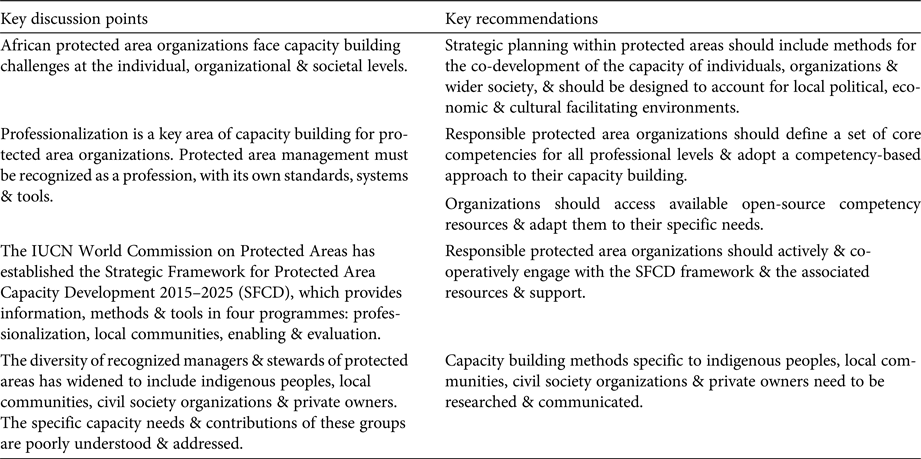
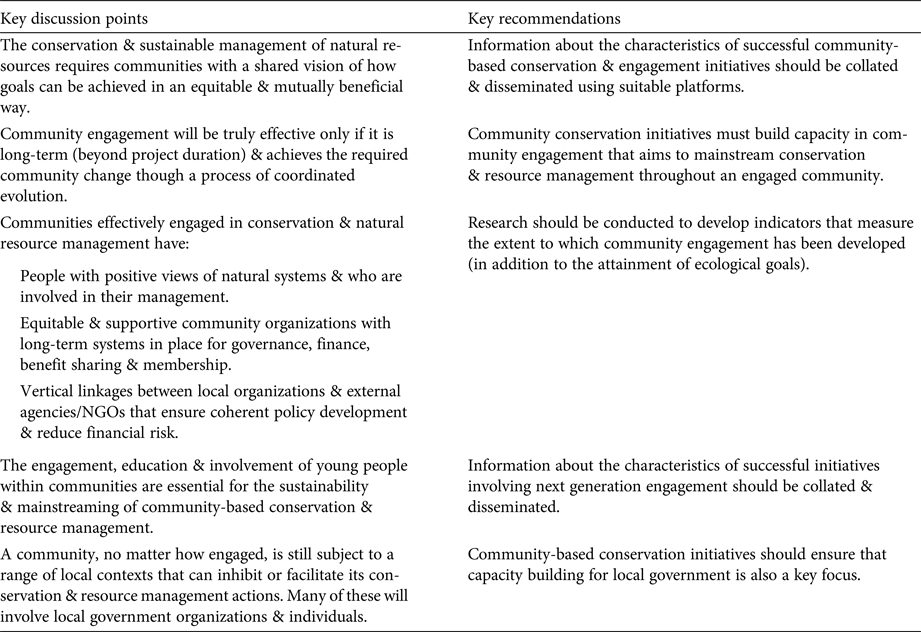
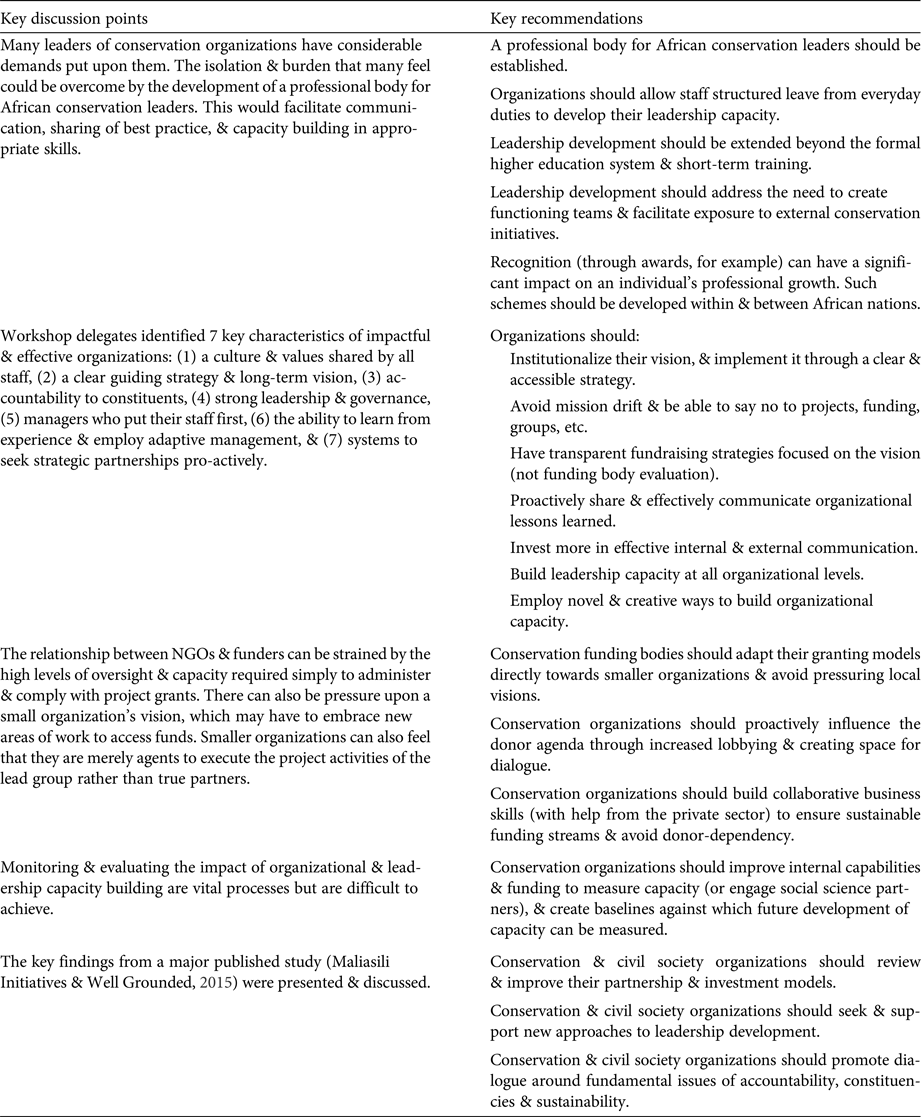
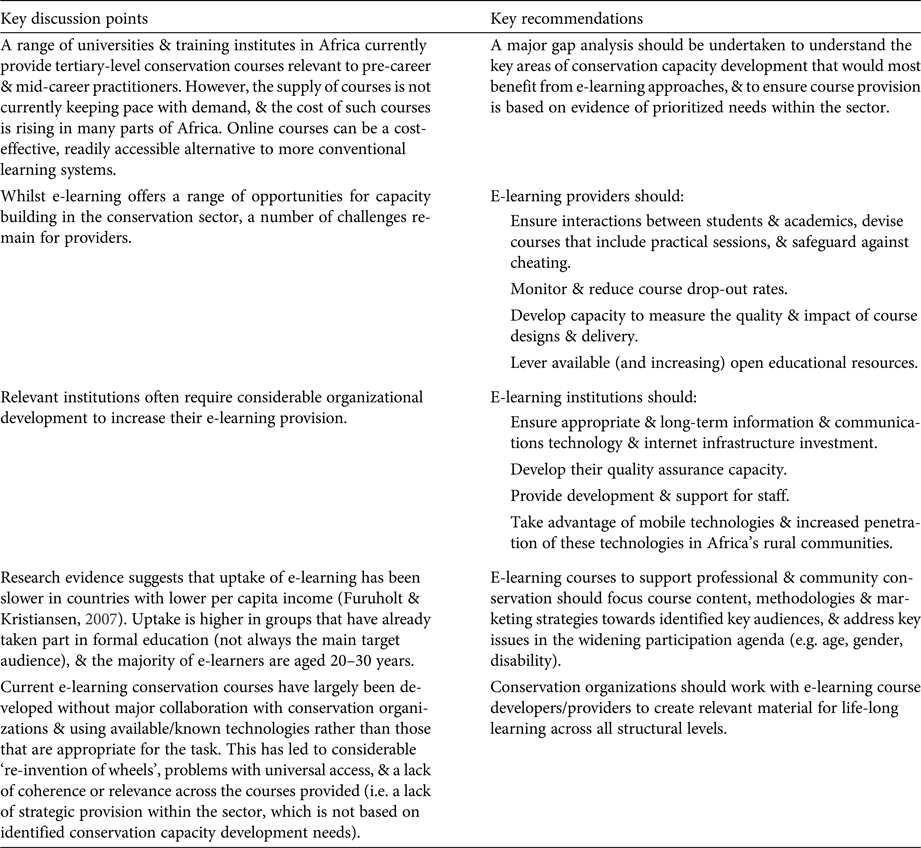
Thirty-nine recommendations were developed at the conference (Tables 1–4), with six broad types of suggested action: (1) the development of new methods, (2) the provision of capacity building resources (e.g. information or data), (3) the communication of ideas or examples of successful initiatives, (4) the implementation of new research or gap analyses, (5) the establishment of new structures within and between organizations, and (6) the development of new partnerships.
Key discussions and recommendations in relation to the building of capacity to support the management of protected areas in sub-Saharan Africa.
Key discussions and recommendations in relation to the building of capacity for community engagement and rights-based governance in sub-Saharan Africa.
Key discussions and recommendations in relation to the building of capacity to develop effective leadership and strong organizations within the conservation sector of sub-Saharan Africa.
Key discussions and recommendations in relation to the building of professional e-learning to support the conservation and resource management sectors of sub-Saharan Africa.
For these recommendations to deliver real impact and change they will need to be communicated, interpreted and assimilated into existing frameworks. In particular, in developing these recommendations, conference delegates recognized the need for follow-up and collaboration in the form of a community of practice. A subset of attendees committed to developing a range of post-conference activities and funding applications to deliver tangible outcomes in the longer term. Given the time taken to establish and evaluate such a community network, an assessment of the success and impact of these activities, and hence the conference, will be published in 2018.
Delegates also noted that a number of dominant issues were common to all the conference workshop discussions. Firstly, in the face of ongoing and rapid socio-environmental change in sub-Saharan Africa there needs to be a greater sense of urgency in the development of capacity building activities by organizations, responsible agencies and donors. In these groups, capacity building should be recognized and prioritized as one of the most urgent conservation issues of the 21st century (Rodríguez et al., Reference Rodríguez, Rodríguez-Clark, Oliveira-Miranda, Good and Grajal2006). Secondly, there is a need to scale-up current capacity building activities significantly in terms of their number, focus and geographical/social footprint. Thirdly, notwithstanding the need to develop novel cost-efficient capacity building methodologies (and associated evaluation metrics), the future of capacity building for conservation will probably be best served by integrating new methods with more established activities (Washington et al., Reference Washington, Baillie, Waterman and Milner-Gulland2015). Fourthly, given the broad suite of social, cultural and economic contexts found across sub-Saharan Africa, there is a need to move away from one-size-fits-all approaches. The issues can be addressed only through increased cross-sectoral collaboration and information exchange. Ultimately, closing the gap between capacity need and capacity provision in the region will be achieved only through multi-partner capacity initiatives and networks.
Acknowledgements
We thank the following organizations for their generous support of the conference: Critical Ecosystem Partnership Fund (financial support for delegates), Organisation Internationale de la Francophonie (simultaneous translation into French), East African Wild Life Society (meeting facilities for the organizing committee), and Fauna & Flora International (staff time and delegate funding). The conference was also supported by conceptual input from Brett Bruyere and Jim Barborak (Colorado State University), Francis Staub (Biodiversité Conseil), Fred Nelson (Maliasili Initiatives), Robyn Dalzen (Conservation International) and Andrea Santy (Russell E. Train Education for Nature Program, WWF).
Author contributions
MJO drafted the article and developed the core concepts. ON and KHF helped develop the core concepts and made extensive comments on early drafts. All other authors made comments on early drafts.
Biographical sketches
The authors comprised a team of African and international conservationists who helped to develop and deliver the 2015 Nairobi capacity building conference. Collectively they represent key conservation organizations, agencies, institutes and civil society organizations for which capacity building and evaluation is a key issue. They are committed to finding sustainable and context-relevant solutions to this difficult and urgent task. Mark O'Connell is a conservation scientist who has led three regional meetings on capacity building. These have been designed to identify key common issues, facilitate discussion of potential solutions, and learn from successful initiatives. Oliver Nasirwa has worked on a wide diversity of conservation projects in Africa, including building regional capacity for environmental monitoring programmes. Marianne Carter leads a team engaged in efforts to develop conservation leadership skills globally.



