




Introduction
In the last decades, there has been a growing interest in the community to evaluate the diversity in scientific fields compared at different levels of the scientific career and to identify measures and strategies to increase diversity in working groups, institutions, research networks, as well as award and fellowship appointments, to name only a few. It has been shown that diversity in work groups, institutions and networks can be beneficial by allowing for multiple viewpoints, ideas, experiences and diverse approaches to solve or mitigate problems, especially in areas with complex tasks that require creativity (e.g., Stahl et al., Reference Stahl, Maznevski, Voigt and Jonsen2010; Wallrich et al., Reference Wallrich, Opara, Wesołowska and Yousefi2024). As diversity and integration initiatives show positive effects on organizational performance (e.g., Okatta et al., Reference Okatta, Ajayi and Olawale2024), scientific institutions have taken measures to ensure a larger diversity of their staff members – for example by establishing diversity and equality officers, by requesting statements on diversity of applicants in group leading positions, or by introducing quota or special funds reserved for hiring from underrepresented groups (w.r.t. gender or nationality for example) (e.g., Aigare et al., Reference Aigare, Koyumdzhieva and Thomas2011). This issue is also addressed by e.g., the European Commission through Horizon Europe, where a Gender Equality Plan (GEP) is a key eligibility criterion. However, multiple studies (e.g., Herman, Reference Herman2024; Matias et al., Reference Matias, Lewis and Hope2022) have concluded that the tendency to have lower representation of underrepresented groups in higher-level position persists, often referred to as “leaky pipeline” (e.g., Pandey-Pommier et al., Reference Pandey-Pommier, Piccialli, Wilkes, Hasan, Vargas Dominguez, Hassanin, Lazzaro, Lagos, Masegosa, Yang, Valls-Gabaud, Leibacher, Norman, Nastula and Bamba2023).
Current state of diversity has been investigated in many scientific disciplines, for example in radiology departments (Malhotra et al., Reference Malhotra, Futela, Payabvash, Wintermark, Jordan, Gandhi and Duszak2025), in STEM (Jones et al., Reference Jones, Williams, Whitaker, Inkelas and Gates2018; Miriti, Reference Miriti2020), in medicine (Gibbs et al., Reference Gibbs, Basson, Xierali and Broniatowski2016), in science and engineering faculty (Nelson, Reference Nelson2017), in geosciences (Holmes et al., Reference Holmes, OConnell and Dutt2015), but also in political science faculty (Claypool and Mershon, Reference Claypool and Mershon2016), environmental disciplines (Taylor, Reference Taylor and Taylor2010) and the social sciences (Casad et al., Reference Casad, Garasky, Jancetic, Brown, Franks and Bach2022). Most often these studies focused on a specific country or region (many of them having been conducted in the US). Naturally, in order to increase diversity, the current state of (lack of) diversity needs to be known in the specific field considered. While many previous studies focused on universities or research institutions in general or on specific faculties, we here focus on two specific European research communities in astrobiology, that is, the European Astrobiology Network Association (EANA) and the Astrobiology Graduates in Europe (AbGradE) network.
EANA (European Astrobiology Network Association, http://www.eana-net.eu/, see logo in Fig. 1) was founded in spring 2001 during the First European Workshop on Astrobiology co-organized with ESA at the ESRIN research facility in Frascati, Italy. The main task of EANA is the organization of the annual Astrobiology Conference, focussing on scientific exchange and networking opportunities between individual astrobiologists as well as European astrobiology societies and puts a special emphasis on promoting the early-career astrobiology community in Europe. A result of networking within the EANA community is the return of ESA support through the recruitment of individuals from diverse disciplines, thereby enhancing the ESA topical teams, strategy communities and working groups, as well as contributing to ESA mission participation and initiatives. EANA therefore serves a different purpose than the European Astrobiology Institute (EAI), which works on a more institutional level, bringing together large research organizations, universities and institutes within Europe to act as one voice in dialogue with different stakeholders and to foster international collaborations, as well as formulate a long-term astrobiology research strategy for the European astrobiology research community (Capova et al., Reference Capova, Persson, Milligan and Dunér2018).
Logos of EANA (left, designed by Katarina Eriksson in 2015) and AbGradE (right, designed by Sean McMahon in 2014).

EANA has been active for over two decades now (Cavalazzi et al., Reference Cavalazzi, Westall, Noack, Taubner, Milojevic and Finster2022) and continuously connects the European astrobiology community in its annual events with typically 150 to 250 participants each year. The consistency in the organization of the annual EANA meeting allows to collect and evaluate statistical data on the conference participation spread over almost 25 years. While the situation at conferences may not exactly reflect institutional statistics, such an evaluation can act as a first-order mirror of the European astrobiology community as a whole.
EANA has currently approximately 170 active members and is organized by the EANA council. To become an EANA member, currently two sponsors are needed, who are already EANA members. Further, there is an annual membership fee of 25€. The EANA council members are elected every three years, where half of the council is composed of national representatives of local astrobiology societies, networks or research groups. The EANA council 2022–2025 includes national representatives from 17 EU countries plus Japan, Russia, Switzerland and the UK. For the next period, Estonia will join the council. By design, they therefore represent their country of affiliation. Depending on the number of countries represented in the council at the time of elections, the same number of additional council positions is available for the election. The election process includes two steps – in the first step, all active EANA members (i.e., those that officially became a member of the EANA network and that paid their membership fees in recent years) are invited to suggest names for the open council positions, limited to twice the number of open positions. If for example 20 countries are represented with national ex-officio members in the council, 40 candidate names can be nominated for the council elections. From all received nominations, an election committee (typically three national ex-officio members) down-selects a list of candidates with the highest number of nominations after contacting them for their willingness to serve on the council. The number of final candidates for the election vote is again twice the number of open positions, i.e. 40 in our example. All active EANA members are then invited to vote on the nominated candidates, from which the final new councillors are identified by the highest number of votes. Currently, no diversity measures are therefore implemented in the election of EANA councillors apart from country-of-residence constraints for ex-officio members.
EANA (as well as its independent early-career network AbGradE) strives not only for gender balance and diverse representation from many different nationalities/countries. In addition, EANA has always emphasized the importance of having a high presentation of scientists at the very beginning of their career, not only in terms of participation aided by granting several travel grants each year, but also in terms of selection for oral presentations, for example by initializing the Space Factor student contest in 2011. This led to the creation of an early-career network in 2013, which formally became the AbGradE network in 2014 (Samuels et al., Reference Samuels, Noack, Verseux and Serrano2015).
The early-career network AbGradE (Astrobiology Graduates in Europe, https://abgrade.eu/, see logo in Fig. 1) was founded from EANA’s early-career professionals at the EANA 2013 in Stettin, Poland, with its first organized event in 2014 in Edinburgh (preceding EANA 2014). In 2024, AbGradE celebrated its 10th anniversary and can also look back at a rich statistical dataset with participants from 57 countries attending the so far 19 AbGradE events.
Unlike EANA, AbGradE does not have a membership; rather, it consists of a general committee and an executive committee, with all committee members participating in the organization of AbGradE activities. Applications to join are voted on by the committee, generally following participation in an AbGradE event. Due to a rise in interest during the recent years, AbGradE has introduced a probation period, with new members officially joining the general committee upon active involvement in the organization of an event. The executive committee is elected every three years, generally coinciding with the EANA council elections, with all AbGradE committee members invited to nominate themselves and/or other members and participating in the final voting. No diversity measures have been implemented so far, though AbGradE has benefited from a very diverse committee since its inception, with members coming from all over Europe (Nauny et al., Reference Nauny, Cassaro, Kopacz, Noack, Palabikyan, Pinna, Price, Stavrakakis and Taubner2022; Noack et al., Reference Noack, Verseux, Serrano, Musilova, Nauny, Samuels, Schwendner, Simoncini and Stevens2015; Taubner et al., Reference Taubner, Nauny, Cassaro, Kopacz, Noack, Palabikyan, Pinna, Price and Stavrakakis2022).
Our aim is to evaluate the presence (or absence) of diversity within this field. We specifically regard gender, career status and nationality/country of residence as diversity characteristics and evaluate diversity with regard to attendance, contributions, travel grants and awards at the conferences.
Methods and data
In order to evaluate diversity in the European astrobiology community, we make use of statistical data raised at scientific conferences and workshops. The data used in this analysis were collected during the registration process for various EANA and AbGradE events. For EANA events, the registration data were not updated with respect to actual participation. As a result, the presented data and figures may exhibit minor discrepancies when compared to a potential final attendee list. For instance, for the EANA 2024 event in Graz, 144 individuals were initially registered, although four did not ultimately attend.
EANA and AbGradE datasets
In 2014, the website http://www.eana-net.eu/ (originally designed for the at-that-time not yet officially founded early-career network, with “net” standing for “Network of Early-career Trainees”) became the new, official EANA website (“net” standing then for “network”), which integrated a previously developed EANA member platform, serving mainly as base for newsletters sent to the community by the EANA council. From 2018 on, the website was then used regularly as conference platform to organize the annual EANA conference, which especially includes collecting the registration data of conference participants. The EANA database and website therefore allows for a fast extraction of statistical data related to nationality/country of residence, gender and career stage for the more recent years, with new functionalities and statistical data added every few years.
For AbGradE, registration for events varied from year to year depending on the host of the individual events. Registration data were in some years limited to participant names and nationality/country of residence but were more extensive in other years including more statistical information. The main datasets available over a large range of years are therefore limited to gender (available in most, but not all years) and nationality/country of residence.
Data on gender
In our evaluation, we compare the participation statistics of EANA and AbGradE with respect to gender. It should be noted that for the early years, the registration forms of the annual meetings often did not include gender information. For these years, the gender was assigned from data taken from later registration forms (where the gender was included in the registration form) or assigned by hand if known from other circumstances (e.g. personal communication or information from websites or social media platforms). It should be noted that this method includes a margin of error since the gender may have changed or may not have been openly communicated or perceived falsely, especially w.r.t. non-binary genders. The numbers can therefore only be considered for a very rough first-order overview of gender statistics. In the figures of the Results section, events for which the gender was assigned by the authors are marked with faint colors to underline that they are partly guessed. In 2018 and in general since 2021, the EANA registration data contain voluntarily stated gender information.
For AbGradE, gender statistics were indicated by participants in 2021 and were then regularly provided during registration from 2023 on.
Data on country of residence or nationality
The country of residence and nationality data have been collected differently from year to year, as AbGradE did originally not differ between the current country of affiliation and nationality of the participants. Specifically for the three AbGradE events in 2024, the nationality was stated instead of the country of residence/affiliation.
For the EANA data, in several years the nationality was requested in addition to the country of affiliation in the registration forms. Here, however, we only use information on the country of residence/affiliation.
Results
Below we evaluate our identified criteria for diversity with regard to gender, career status, nationality/country of residence as well as scientific diversity based on our statistical data on attendance and membership, contributions, travel grants and awards at EANA and AbGradE events.
Attendance
We first compare the attendance numbers at EANA and AbGradE meetings. For the EANA meetings (Fig. 2) no exact data on participation are available in the years 2004 and 2009 in the EANA archives, but based on communication with attendees, participation was relatively similar to the surrounding years (typically between 100 and 150 participants). In recent years, participation increased to on average 200 participants per EANA meeting (with 241 participants in 2018 in Berlin, Germany, 250 at the online 2021 conference and 320 participants at the so-far largest EANA meeting in Graz, Austria, in 2002). The continuous high participation is especially of interest in the context of having currently two large European astrobiology conferences every other year (when the BEACON “Biennial European Astrobiology Conference” of the EAI takes place) without a visible drop in participation at the EANA meetings, showing the continued need for an annual meeting of the EANA network.
EANA conference host distribution (left) and numbers of participation (right; no exact data available for 2004 and 2009).

Figure 2 furthermore shows a map of all hosts of EANA conferences from 2001 (Italy) to 2025 (Portugal). In 2020, a virtual meeting was organized by the entire EANA Executive Board and the year is therefore not assigned to any specific country on the map but instead to the international waters of Europe.
All countries represented in the EANA council are each year invited to propose to host one of the future EANA meetings, where preference is given for countries that did not yet (or not for a long time) host a conference, or where an already planned meeting had to be changed to a virtual meeting, as was the case for Portugal in year 2021, which hosted the 2025 EANA conference in Lisbon, October 21–24, 2025.
AbGradE events have also been organized at different venues all over Europe, where larger meetings were often coupled to the EANA or EAI conference and venue. The participation varied strongly depending on the type of meeting, attended by on average 40 early-career participants per in-person AbGradE event, with the largest meetings organized in 2018 (63 participants), 2023 (60 participants, joined with EPEC, the EuroPlanet Early Career network) and 2024 (88 participants, International Astrobiology School in Florence, Italy, in collaboration with the Arcetri Astrobiology Laboratory).
Country of residence and nationality
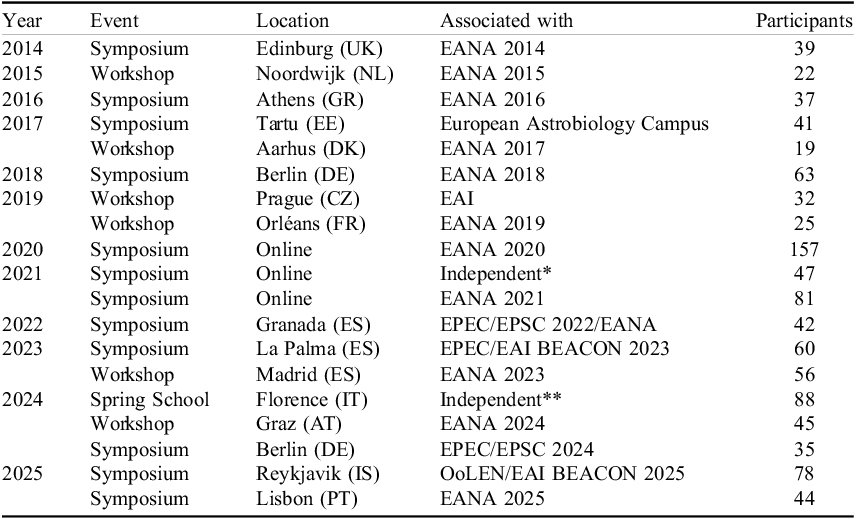
Table 1 lists all AbGradE events until 2025. Figure 3 shows the number of participants during different AbGradE events, separated here by country of residence (nationality since 2024). With the exception of India and the USA, all ten countries that have contributed the highest number of participants to AbGradE events have already hosted an event.
Comparison of AbGradE and EANA participation statistics sorted by country of residence. Since 2024, for AbGradE events instead the nationality is given.

List of all AbGradE events

* topic: Space Law & Governance.
** supported by Arcetri Astrobiology Laboratory and the EAI.
During the online events in 2020 and 2021, participation spread to reach more countries within and beyond Europe. Virtual events were particularly strongly attended from outside Europe (India, Brazil and USA). Also after the pandemic, there has been an increasing diversity of participation, and several countries with lower participation numbers still show a continuous participation spread over several AbGradE events.
A similar trend can be observed for participation by country at EANA meetings – shown in Fig. 4 exemplarily for the meetings in 2015 (the Netherlands), 2021 (online) and 2025 (Portugal). The number of countries represented at the online meeting in 2021 was with 47 nations considerably higher than for the in-person conferences (25 and 26 countries in 2015 and 2025, respectively). Similarly to the AbGradE events, also at EANA meetings Italian participation is increasing, with Italy being one of the most represented countries at EANA 2025, together with Portugal as host country and Germany as always strongly represented country at European meetings.
EANA participation by country of residence for three exemplary annual conferences with different host settings: 2015 The Netherlands, 2021 virtual and 2025 Portugal.

A similar trend can be observed for the distribution of countries represented within the EANA Executive Council; see Fig. 5, where half of the council are ex-officio members spread over different nationalities and the other half is elected every three years by all active EANA members. The additionally elected members come mostly from the countries most strongly represented also at the annual events: Germany, Italy, France and UK, which belong also to the most populous European countries.
Country of residence distribution on the EANA Executive Council highlighting the diversity of its members due to the special configuration of assigning ex officio members in addition to elected council members.

Gender diversity
As explained in the Methods and Data section, gender information is restricted to recent years when participants could voluntarily add gender information during event registration. These information are shown in Fig. 6 in dark colors in the respective bars. Additionally, faint-colored bars have been added for years where no gender information was provided but was assigned by the authors to their best knowledge, as described in the Methods and Data section. These bars should therefore only be taken as a first indicator, as the underlying data may have a small but significant error.
Gender diversity at EANA (top) and AbGradE (bottom) events. Darker colors are based on voluntary data provided by the participants, fainter bars are based on values obtained from other sources and should only be taken as a first-order indication of gender distribution with a small potential error in the shown data. The total number of participants at EANA meetings is given in Fig. 2, and for AbGradE events listed in Table 1.

Another indicator for gender diversity is the distribution of awards. Apart from the earlier-mentioned Space Factor student contest established in 2011, where selected early-career participants give a short oral presentation and the best three (in some years up to 6, depending on the number of EANA participants) oral presentations and/or best online outreach videos are awarded, EANA also hands out poster awards (5–8 per year, depending on number of posters, such that the best $\sim\!\! $
10% of all presented posters are awarded). Figure 7 summarizes the number of awards separated by gender (with the same data constraints as mentioned above and in the Data and Methods section) and year for Space Factor awards, Poster awards and other special awards uniquely established for individual events (2013 CASA* special prize for the best talks of young scientists, 2018 Kate Rubins – Space Microbiology Award for Young Researchers, 2018 Horneck-Brack Award for oral presentations, 2021 EANA 20th Anniversary Presentation Awards and 2024 MEME – Massive Exoplanet MEME Exhibition – Contest). In 2022, EANA was jointly organized with EPSC and poster awards were awarded via the EPSC tools and website, and not separated into EANA participants and other planetary sciences participants. Therefore no data are shown for the year 2022.
$\sim\!\! $
10% of all presented posters are awarded). Figure 7 summarizes the number of awards separated by gender (with the same data constraints as mentioned above and in the Data and Methods section) and year for Space Factor awards, Poster awards and other special awards uniquely established for individual events (2013 CASA* special prize for the best talks of young scientists, 2018 Kate Rubins – Space Microbiology Award for Young Researchers, 2018 Horneck-Brack Award for oral presentations, 2021 EANA 20th Anniversary Presentation Awards and 2024 MEME – Massive Exoplanet MEME Exhibition – Contest). In 2022, EANA was jointly organized with EPSC and poster awards were awarded via the EPSC tools and website, and not separated into EANA participants and other planetary sciences participants. Therefore no data are shown for the year 2022.
Awards handed out per year to female and male participants, separated into Space Factor awards (early-career oral presentation award, circle markers), Poster awards (dashed markers) and other, special awards uniquely presented at single EANA events (dotted markers). Colors (especially light versus dark colors) were applied as described in Fig. 6.

In the first years before 2020, on average 45% of EANA prizes were awarded to female researchers, which shifted to 70% in the years from 2020 on, leading to on average, over all years presented here, to 55% of EANA prizes being awarded for female researchers. Therefore, while seeing an increase in female awardees in recent years, the overall, average success rate is about 50–50%, comparable also to the participant gender statistics for early-career researchers.
It is also interesting to compare the gender diversity within the EANA Executive Board – consisting of the President, two Vice-Presidents, two Secretaries and the Treasurer – as well as within the EANA Executive Council; see Fig. 8. The Executive Board was presided over by female presidents between 2007 and 2022 and was actually, in the times for which gender information is available to the authors of this study, dominated by female scientists (varying between 50% and 83%). The Executive Council members, on the other hand, show a gender diversity more reflective of the astrobiology community, with female members making up 32% (in cycle 2013–2016) up to 49% (in cycle 2022–2025), which is between 40% and 50% at EANA conferences (all career stages) and appr. 50% at AbGradE events (early-career stage). It should be noted that several members of the elected Executive Council are current or previous AbGradE members (see Table 2) with a high female proportion (67%).
Female proportion of EANA Executive Council and Board members, elected always for three years, as well as AbGradE Council members, changing each year. The 2025–2028 Executive Board members are still to be elected. Numbers on top of each bar are the total number of council/board members.

Number of AbGradE members in the EANA council

* EANA Executive Board.
** two of three left the AbGradE committee in 2021.
*** one of six left the AbGradE committee in 2022.
Within the AbGradE committee, the ratio of female members became slightly higher over the years (see Fig. 8). Further, all previous presidents have been female. The AbGradE executive board consists of a president (incl. representative on the EANA council, if not elected EANA councillor), two vice-presidents, a secretary, a treasurer, a representative on the EAI Board of Trustees and two media/correspondence officers. The next election of the AbGradE executive board is scheduled for 2025.
Career status
Early-career scientists make up the majority of participants at EANA meetings. In 2024 and 2025 for example, see Fig. 9, 63% and 65% of the participants were early-career participants (this definition includes postdoctoral researchers until 7 years after their PhD). BSc and MSc students also submitted a considerable fraction of the abstracts at EANA (4% and 9% in 2024 and 2% and 15% in 2025, respectively), but of them only every fifth abstract was selected for an oral presentation by the Scientific Organizing Committee (see Discussion section); the rest was selected as poster presentation (not counting rejected abstracts based on insufficient scientific quality). In contrast, the fraction of submitted abstracts selected for oral talks was highest for senior scientists (59% in 2024 and 49% in 2025) and postdoctoral researchers (56%/38%), followed by PhD candidates (38%/27%) leading to the distribution shown in Fig. 9. These values depend on the total number of abstracts vs. available oral slots and were in general a bit lower in 2025 compared to 2024. While these oral selection rates varied in the two years, the final distribution of career stages for oral and poster presentations in Fig. 9 is remarkably similar.
Distribution of registrations, abstracts, oral requests, as well as scheduled oral and poster contributions over different career stages at EANA 2024 and EANA 2025, showing a very consistent picture of career distribution at EANA over the two years.

These numbers are comparable to earlier years: in 2018, the first year when more statistical data was submitted during the registration and abstract submission process, 56% of the abstracts submitted by senior scientists were selected for an oral presentation, compared to 62% for postdoctoral students and 38% for BSc/MSc students and PhD candidates. In that year, the early-career community made up 58% of the participants.
Career development can also be traced to some extend when comparing the members of the AbGradE and EANA over the years. Table 2 shows the transition from AbGradE committee members to EANA council members. The number of (past) AbGradE members in the EANA council is steadily growing, which indicates the successful inclusion of early career researchers into the EANA community and the willingness of these to take over responsibilities within the community. This shows that early careers benefit from membership in networks such as AbGradE, not only to develop management and communication skills, but also to be introduced into the community in a more sustainable way.
Research topics
While EANA conferences show also a large diversity in terms of research topics being presented at the meetings, the distribution of abstracts varies also from one conference to the next; see Fig. 10. One of the reasons for this is that each host institute typically has a specific local research focus. In addition, at EANA conferences there is typically one special topic highlighted, inviting more abstracts to one specific session.
Distribution of abstract presenters over career stage and gender for six recent EANA conferences sorted into the main disciplines spanning the field of astrobiology. Presenters were separated into pre-doctorate stage (light colors; termed “PhD,” but including also a few BSc and MSc students in this category), postdoctoral stage (intermediate colors; “PD”) and senior career stage (dark color; >7 years past last degree).

Since different sub-communities have different average gender distributions (with astronomy and physics showing the lowest fraction of female scientists within the astrobiology community), a variation of our gender statistics would also be expected from year to year. However, in all years, the life sciences and biosignatures communities are very strong at EANA and therefore lead to equal gender distribution amongst participants at EANA conferences.
To compare the dependence of gender representation over career stage with other studies in different disciplines, we therefore separated the presenting authors over disciplines (Chemistry, Biology, Missions, Planetary Sciences and Other/Unknown) and show their distribution over career stage based on all available data on presenting authors with assigned gender information; see Fig. 10.
A clear under-representation of female participants can be seen in the fields of Chemistry (covering astrochemistry as well as prebiotic chemistry) and Missions (including also instrument development and detection studies), especially for senior scientists, very much in line with previous studies on the “leaky pipeline” (e.g. Pandey-Pommier et al., Reference Pandey-Pommier, Piccialli, Wilkes, Hasan, Vargas Dominguez, Hassanin, Lazzaro, Lagos, Masegosa, Yang, Valls-Gabaud, Leibacher, Norman, Nastula and Bamba2023). In contrast, female participation is high in the field of Biology and distribution over different career stages is in general comparable to male participants with fluctuations from year to year.
Travel support
A large fraction of the available budget is allocated to support early-career participants from diverse nationalities, aimed especially for participants from underrepresented countries. The final distribution of grants, however, depends on the applications, and in case that enough budget is available, travel grants are also provided for early-career scientists from other countries. The actual distribution of travel grants is therefore correlated to the distribution of countries observed above for participation at EANA meetings, with most travel grants in recent years given to participants from Italy, Germany and the UK (see Fig. 11). Regarding career level, the majority of travel grants is allocated to PhD candidates, followed by Master students.
Distribution of EANA travel grants during the last four in-person meetings. The number of travel grants (added in brackets in the legend) varies from year to year.

Discussion
In the following subsections, we discuss our main diversity characteristics (nationality/country of residence, gender and career status) with respect to our goal to achieve diversity, equality and inclusiveness within the European astrobiology community, specifically for the EANA and AbGradE networks and events, and propose additional measures to be taken for future events.
Countries
The unequal representation of countries at EANA and AbGradE meetings, with highest participation numbers from Germany, France, Italy, Spain and the UK, is similar to what has been observed within other European networks and scientific conferences (e.g. EPSC, Tomasik et al., Reference Tomasik, Piccialli, Adeli, Opitz, Cavallazzi, Franchi, Pearson, Bonnefoy, Dósa, Hutchinson, Heward, Noack and Vandaele2023). EANA did develop different strategies to include a more diverse representation of countries of residence, for example by choosing new hosts for each annual meeting preferentially choosing countries where a meeting did not already (or only once) take place, and therefore ensuring a large local participation and advertisement of EANA and AbGradE events. Furthermore, the structure of the EANA council itself favors diversity and inclusion with respect to nationality by selecting half of its representatives via ex-officio positions split over the different nations within Europe with existing astrobiology research groups, networks or even societies. However, the second half of the EANA council is elected and therefore a potential dominance of selected countries is then also reflected in the election of the EANA council members, which in turn may increase the local visibility of EANA in the already over-represented countries, drawing on more participants from already well-represented countries. As additional measure for more inclusivity, travel grants are preferentially awarded to early-career scientists from underrepresented countries. However, the statistical data evaluated in the results section still show a limited impact of the current strategies for equalizing participation with respect to country of residence/nationality. Possible explanations are insufficient height of allocated travel grants (meaning that a too high fraction of the actual costs remain to be covered by local institutions with possibly severe budget constraints) or smaller astrobiology networks in some of the underrepresented countries in contrast to the larger countries where big national Astrobiology societies have been established (which is the case for example for France, Spain, the UK and Germany). In the European astrobiology community, there is an increasing awareness of this issue of uneven representation at meetings not only at European level but also extending towards developing modern ethical standards especially for international research (including field work) in countries with colonial legacies and inclusion of local expertises (Marino et al., Reference Marino, Franchi, Lebogang, Gomez, Azua-Bustos, Cavalazzi, Balcha, Lynch, Bhagwat and Olsson-Francis2023).
From the very beginning, EANA and AbGradE meetings were meant as networking meetings for the astrobiological community. To enable the participation of interested people with low funding opportunities, the LOC is asked to keep the costs low and to offer comparable low registration fees. As an example, for EANA 2024, the highest registration fee was 130EUR for seniors, and 80EUR for students, but lunch and coffee breaks were provided for the whole 3.5 days meeting. This is a very low amount compared to other registration fees in the field and only possible due to gracious support of our sponsors, especially ESA.
For AbGradE events, the registration fees are even lower (ca. 20EUR for a 1-day event) also thanks to financial support of EANA, EAI and other institutions. Furthermore, the EANA membership fee is rather low with 25EUR per year. The difference between registration fees for members and non-members is always kept higher than 25EUR to motivate attendees to become a member. The membership fees are returned to the community, by supporting AbGradE and funding travel grants in addition to those covered by the EANA supporters (especially ESA), i.e. used to support especially the early-career community.
Potential future avenues to increase participation of underrepresented countries at EANA meetings could therefore include higher travel grants for scientists from underrepresented countries (not necessarily limited to early-career scientists), stronger local advertisement of EANA and AbGradE activities especially in underrepresented countries, as well as more frequent selection of event hosts in countries where a higher inclusion in the European-wide astrobiology networks is sought-after.
Another possible strategy might be the continuous inclusion of virtual participation, as during the pandemic years we saw an increased online participation from many different countries usually not (or only weakly) represented at EANA and AbGradE meetings (Figs. 3 and 4). However, for hybrid events, the danger exists of creating a two-class participation with increasing the fraction of in-person participants stemming from high-income countries and with virtual participation (with several well-known disadvantages) being dominated by in general underrepresented groups (including for example country, gender, career stage or caring responsibilities), that were already identified to have been more negatively affected by the pandemic and virtual participation with lack of networking opportunities (Tomasik et al., Reference Tomasik, Piccialli, Adeli, Opitz, Cavallazzi, Franchi, Pearson, Bonnefoy, Dósa, Hutchinson, Heward, Noack and Vandaele2023).
Gender
Gender equality is not yet reached in all scientific fields, and the ratio of female to male participants (not counting participants with unknown gender) varies from discipline to discipline. In the past years, abstract authors in the subfields of biology and plantary sciences were about half female authors (52% and 43%, respectively, averaged over all career stages and all six years in Fig. 10). In contrast, the subfields of chemistry and missions were dominated by male authors (65% and 61%, respectively). Depending on the organizer of the annual EANA meeting and a different focus on a specific subdiscipline each year, the proportion of female participants naturally varies from year to year. However, since the life sciences community is very strong at EANA and AbGradE meetings, participation on average reaches gender equality.
This is also reflected in the EANA council and board composition (see Fig. 8), where the proportion of female members is currently even above 50%. This raises the question, if in Astrobiology a “leaky pipeline” exists, as has been previously suggested in other natural sciences fields, i.e., a continuous drop of female proportions with increasing career level. These studies often focus on (so far) male-dominated fields (Pandey-Pommier et al., Reference Pandey-Pommier, Piccialli, Wilkes, Hasan, Vargas Dominguez, Hassanin, Lazzaro, Lagos, Masegosa, Yang, Valls-Gabaud, Leibacher, Norman, Nastula and Bamba2023), and criticism against these studies typically include the hypothesis that data will change with time (e.g., if at student level equality w.r.t. gender is achieved, the same will be seen in the future at higher levels). In the present study, however, we concentrate on a scientific field that is on average not that strongly affected at least w.r.t. gender equality. However, in Fig. 10 it was shown that there are still large discrepancies w.r.t. gender equality especially for the disciplines related to chemistry and missions. In addition, when looking more closely at EANA participation statistics, we observe a somewhat similar trend, especially for the years with in-person participation, with female proportions dropping for example in 2024 from 58% at PhD level over 50% at post-doc level to 39% at mid-career and senior scientist level (see Fig. 12, evaluated only for participants with known gender. Unknown career status was counted here into the Senior category.). This is opposite to the trend observed in the EANA council and board, that mostly consist of members beyond the early-career stage, but is more comparable to the results of other studies on gender distribution over career stages (e.g. Pandey-Pommier et al., Reference Pandey-Pommier, Piccialli, Wilkes, Hasan, Vargas Dominguez, Hassanin, Lazzaro, Lagos, Masegosa, Yang, Valls-Gabaud, Leibacher, Norman, Nastula and Bamba2023). Interestingly, in the years 2020 and 2021, when the EANA meetings were organized as virtual meetings, female representation was more or less similar over the different career stages, with values between 43% and 50% even at senior researcher level. This observation hints that female researchers may be more involved in caring responsibilities, for whom virtual (or hybrid) meetings allows participation in contrast to in-person-only scientific meetings.
Percentage of female participation over all disciplines in astrobiology but separated into student (BSc/MSc/PhD students), postdoctoral (PD) and senior (>7 years past last degree) career stages. Numbers on top of each bar are the total number of participants per career stage.

One interesting trend in the EANA gender statistics can be observed related to awards presented for poster or oral presentations (e.g., within the Space Factor student contest); see Fig. 7. Prior to 2020, awards were awarded more often to male participants (with the exception of 2013 and 2014), which changed since 2020 to continuously 60% or more (up to 88% in 2020) of the awards being presented to female early-career scientists, which reflects the increased proportion of female PhD candidates at EANA and AbGradE meetings. In addition, since the beginning of the pandemic, at least for the poster prices as well as the Space Factor outreach award, all EANA participants are invited to vote on the best presentation, which may also impact the increased ratio of awards given to female scientists compared to the previous procedure, where a small group of selected senior scientists identified the best posters at the conference.
Career status
While several points regarding career status and gender distribution have been discussed above, one remaining trend in our meeting statistics is the apparent selection bias for oral contributions at EANA meetings. At EANA 2024 and 2025, 63%/65% of all participants were early-career scientists. While more than half of the oral presentations were also assigned to early-career scientists, the oral selection rate was unproportionally higher for senior scientists compared to PhD candidates. It should be noted that the low oral selection rate for MSc and BSc students mentioned above is directly related to the initial preference for poster presentations selected during abstract submission. This is not the case for the higher career stages, where preference for an oral slot was at 60% $ \pm $
7% for all career levels starting at PhD level for both years, with the exception of a higher fraction in 2025 of oral requests by senior scientists, increased to 87%.
$ \pm $
7% for all career levels starting at PhD level for both years, with the exception of a higher fraction in 2025 of oral requests by senior scientists, increased to 87%.
One argument in favor of a lower oral selection rate for early-career scientists could be that a very early PhD project may not yet have mature-enough results summarized in the abstract to be selected for an oral presentation. Similarly, even for high-impact research results, inexperience in writing conference abstracts may lead to a lower selection rate during the evaluation process. However, until 2024 the abstract evaluation (conducted by the EANA council members and local SOC – Scientific Organizing Committee – of the conference) included making the names of the authors known to the evaluation committee, leading to potential biases and unconscious favourism towards abstracts of well-known scientists (for example scientists of high international standing or scientists known to be exceptional speakers, but with an average abstract). This was adapted in 2025, where a double-blind abstract evaluation system was implemented. Even though the final distribution of oral presentation is still comparable to the previous year (46% in 2025 in comparison to 48%in 2024), the fact that many more oral requests were submitted this year by senior scientists suggests that the double-blind system indeed led to a less biased evaluation of abstract and therefore assignment of oral presentations over all career stages. However, the effect is still small and will be re-evaluated over the coming years.
In the future, we will therefore continue to include a partially blind review system (for the abstract evaluations conducted by the EANA council and SOC members) to avoid any potential biases. The final selection, on the other hand, should be conducted taking into account diversity measures including especially the career stage to ensure a balanced selected of oral and poster presenters.
Last but not least, it should be pointed out that our datasets discussed in this study are very limited and only encompass registration data during AbGradE and EANA events. For a more detailed study, including especially long-term career developments within different disciplines, gender groups and for different nationalities, a regularly repeated survey would be needed that should track the long-term career pathway starting at BSc and MSc level, tracking mobility and other demographic information such as family status.
Conclusion
Due to the special structure of the EANA Executive Council, a broad and diverse presentation of many nationalities including underrepresented countries is ensured. In addition, EANA always focused especially on supporting the early-career community with different support structures and activities. This, together with the support of the EAI during the recent years, led to an ever-growing AbGradE network spanning by now far beyond European borders and celebrating its 10-year anniversary in 2024. In addition, the pandemic allowed us to explore additional virtual tools to connect our community and to grow beyond Europe.
In general, we see in both the EANA and AbGradE networks an appropriate diversity of our community with respect to gender and career status of our members and annual meeting participants. However, while EANA includes participants from many different nationalities, it is still dominated by a handful of countries. More measures to increase participation of underrepresented countries is needed to reach the goal of equality and inclusivity within the EANA and AbGradE networks.
Future inclusivity and equality measures could be implemented to allow for a broader participation for example via more virtual components (during the annual conference or throughout the year), increased funding to support (early-career) researchers especially from underrepresented countries, additional advertising measures and a more diversified selection of future meeting venues to attract participants from different corners of Europe and beyond. In addition, abstract evaluation should include in the future a blind review system to avoid any potential biases.
It should be noted, though, that the data that our study relies on are limited due to European data protection laws applying to conference registrations and membership applications. To conduct a more insightful evaluation of the evolving diversity of the community as well as individual career paths (including the “leaky pipeline” observed in several disciplines in other studies), a regular survey within the European astrobiology community is needed including not only information on scientific subdiscipline or demographic information such as gender or nationality/ethnicity but also other potential factors influencing the long-term career, including for example keeping track of family status and employment status and recording the discipline of the university studies to tackle the basic qualifications required for long-term careers in astrobiology.
Although previous literature has clearly documented the persistence of a “leaky pipeline,” our findings suggest that EANA and AbGradE have made significant progress in enhancing diversity within the community. Further steps are planned, especially with regard to increasing diversity with respect to countries, that do have the potential to help to further increase diversity.
Acknowledgements
EANA and AbGradE would like to express their gratitude to the generous sponsors over the past decades, whose support has made these events possible. This includes organizations such as ESA, EAI, various local sponsors and the local organizing committees. We also extend our thanks to the EANA community for their ongoing engagement and for the countless vibrant discussions that have enriched the events, both during and beyond.
Funding statement
L.N. was funded by the European Union (ERC, DIVERSE, 101087755). Views and opinions expressed are however those of the author(s) only and do not necessarily reflect those of the European Union or the European Research Council Executive Agency. Neither the European Union nor the granting authority can be held responsible for them. S.P. and L.N. received funding from the Berlin University Alliance (GC_SC_PC_55) and from the Einstein Foundation Berlin (EZK-2021-650).
Competing interests
The authors declare no conflicts of interest regarding this manuscript.







 Open access

