


Overnutrition, a major public health issue of the developed world, is a growing menace in the developing world already burdened with undernutrition and infectious diseases(Reference Martorell, Khan and Hughes1). Gupta and Kockar(Reference Gupta and Kockar2) indicate obesity to be one of the most neglected public health problems according to WHO. Hajian-Tilaki and Heidari(Reference Hajian-Tilaki and Heidari3) state that obesity is an undesirable outcome of changing lifestyles and behaviours. Overnutrition is an emerging problem in segments of Sub-Saharan African society particularly where lifestyles have become urbanized and Westernized(Reference van der Sande, Caesay and Milligan4). The issue of overnutrition has become very important as a result of its debilitating effect on health. Obesity increases the risk for many serious and morbid conditions, such as diabetes mellitus, hypertension, dyslipidaemia, coronary artery diseases and some cancers(Reference Martorell, Khan and Hughes1, Reference van der Sande, Caesay and Milligan4). Seidell(Reference Seidell5) found obesity to be 1·5–2·0 times higher in women than men from countries with low gross national product. Studies in adolescents have found an association of BMI with gender, ethnicity and food habits. In other studies, obesity has been found to be higher among married women than unmarried(Reference Rguibi and Belahsen6). Socio-economic status has been found to have an inverse relationship with obesity in the developed world; however, the opposite is the case in the developing world(Reference McLaren7). Work by Amoah(Reference Amoah8) in urban and rural Accra, Ghana showed crude prevalences of overweight and obesity of 23·4 % and 14·1 %, respectively, among adults aged 25 years and above. Females recorded higher rates than males. Obesity increased with age and the rate was found to be higher among urban high-class residence compared with low-class residence and in urban compared with rural locations. Individuals with higher educational status recorded higher prevalence than those with lower education. A study in Accra involving Ghanaian civil servants found obesity prevalence of 10 % among males and 36 % among females(Reference Addo, Smeeth and Leon9). However, the subject of obesity in Ghana receives much less attention than it deserves despite the growing menace(Reference Biritwum, Gyapong and Mensah10). The present study aimed to highlight the determinants of overweight in three fishing communities to establish if these were the same as those reported elsewhere in Ghana. The specific objectives were to: (i) examine the participants’ sociodemographic characteristics (such as gender, occupation, marital status and years of education); (ii) assess their BMI and the dietary intake; and (iii) determine the associations between sociodemographic characteristics, dietary intake and BMI.
Methodology
The present study was a cross-sectional one involving 252 adults aged 20 to 50 years from the fishing communities of Ola, Duakor and Idun of the Cape Coast metropolis in Ghana. These communities had a total population of 10708, comprising 7375, 1039 and 2294, respectively(11). Given an adult population size of 10708 in the three communities and an expected frequency of 23·4 % urban adult overweight and obesity prevalence, with worst acceptable frequency of 28·6 % at 95 % confidence interval, a sample size of 249 was needed for the study (Epi Info version 3·5·1; Centers for Disease Control and Prevention, Atlanta, GA, USA). From the total population of the chosen communities, weighting was used to estimate the number of participants required from each community. Based on the weighting, eighty-one, eighty-four and eighty-seven participants were randomly chosen from Ola, Duakor and Idun, respectively. Healthy-looking adults who self-reported absence of any ailment were included in the study while pregnant women and ill persons were excluded. A multistage sampling procedure was used. This involved the random selection of three out of four fishing communities in the urban metropolis. Systematic random sampling was used to select the houses in the communities. If there was more than one household in the same house, simple random sampling was used to select a respondent. Data were collected on sociodemographic factors using a semi-structured questionnaire and on dietary intake using a 24 h recall questionnaire. The 24 h dietary recall was conducted on one weekend and two weekdays for each of the respondents.
Data on anthropometry were collected following a standard protocol by taking two repeated measures(Reference Ismail and Manandhar12). Weight and height measures were taken using a UNISCALE (UNICEF electronic scale 890) and a UNICEF adult microtoise (UNICEF, Copenhagen, Denmark), respectively, which were calibrated to ensure accuracy of the measures. Weight was measured with the participants in light clothing, with the scale on a level stable surface, to the nearest 0·1 kg. Participants were weighed while standing unsupported, bare footed and looking forward, with their hands by their side, and were not holding any metallic or other object that could influence the SECA scale. Weight measurements were read only when the digital reader was stable. Height of the participants in bare feet was measured to the nearest 0·5 cm using a standard microtoise. In measuring height, the head bar of the microtoise was placed securely on the floor and the tape fully drawn. The free end was secured with a nail to a suitable vertical surface above the head bar. The head bar was then raised above the height of the participant, who was instructed to stand upright directly below the point of attachment and positioned such that the Frankfort plane of his/her head was horizontal. The participant was instructed to inspire and to hold his/her breath while the head bar was lowered to the crown of the head, and a direct height reading in centimetres was taken. This was all administered by the interviewer.
Using the WHO reference for BMI, participants were classified into the following categories: BMI<18·5 kg/m2 (thin), BMI = 18·5–24·9 kg/m2 (normal weight), BMI = 25·0–29·9 kg/m2 (overweight) and BMI ≥ 30·0 kg/m2 (obese)(13). In the present paper, ‘overnutrition’ is taken to include overweight and obesity (BMI ≥ 25·0 kg/m2). Occupation of the participants was classified into sedentary and manual. For the study purposes, those who by their occupation spend more than five out of eight working hours in the day moving or doing manual work were considered physically active, while sedentary participants were those who spend more than five out of the eight working hours in a day sitting or not doing manual work.
The data were entered and analysed using the IBM SPSS version 20·0 statistical software package (IBM Corp, Armonk, NY, USA). A nutrition database (ESHA Food Processor® 6·02(Reference Davison and Mandible14)) and the Ghanaian food composition table(Reference Tayie and Lartey15) were used in estimating nutrient intakes. Means, standard deviations and ranges were calculated for continuous variables, while frequencies and proportions were calculated for categorical variables. The associations between demographic factors, dietary intake and BMI were assessed using the χ 2 test and logistic regression technique. Differences in means among males and females were determined using the independent-samples t test.
Results
In all 252 adults participated in the present study, of whom 40·1 % were male and 59·9 % were female (Table 1). Participants’ mean age was 31·7 (sd 1·0) years and they had 13·7 (sd 8·1) mean years of formal education. Mean BMI of 24·8 (sd 6·4) kg/m2 was recorded for both sexes. Females had a significantly higher mean BMI (25·8 kg/m2) than males (23·3 kg/m2).
Descriptive statistics (demographic characteristics, anthropometric measures) of the study population: adults aged 20 to 50 years from three fishing communities in the urban Cape Coast metropolis, Ghana

*Mean values were significantly different from those of males (independent-samples t test): P < 0·05.
The median monthly income of the participants was $US 7·4 (interquartile range (IQR) $US 3·3, 20·0; Table 2). The participants’ median energy intake was 7·3 (IQR 5·3, 9·8) MJ and the median percentage contributions of macronutrients to daily energy intake were 23·0 (IQR 14·3, 36·0) % for fat, 12·0 (IQR 10·0, 14·0) % for protein and 62·0 (IQR 52·0, 72·0) % for carbohydrate (Table 2).
Descriptive statistics (income, dietary intake) of the study population: adults aged 20 to 50 years from three fishing communities in the urban Cape Coast metropolis, Ghana

IQR, interquartile range.
The results indicated an overweight/obesity prevalence of 32 % (Table 3). More females (45·7 %) than males (13·9 %, P < 0·05) were found to be in the overweight/obese category. A significant difference in the proportion of overweight/obesity was found between married persons (20·3 %) and singles (45·0 %, P < 0·05; Table 3).
Demographic characteristics and dietary intake according to overweight/obesity status: adults aged 20 to 50 years from three fishing communities in the urban Cape Coast metropolis, Ghana

*Proportions were significantly different from those in the not overweight/obese group (χ 2 test): P < 0·05.
Females were almost eight times more likely to be overweight/obese than males (adjusted OR = 7·7; 95 % CI 3·6, 16·4; Table 4). People aged ≥40 years were about six times more likely to be overweight/obese than those aged 20–29 years (adjusted OR = 6·1; 95 % CI 2·6, 14·1; Table 4). Married people were almost three times more likely to be overweight/obese than singles (adjusted OR = 2·8; 95 % Cl 1·4, 5·7; Table 4). Compared with 13 years of education or less, participants with more than 13 years of education were 70·0 % less likely to be overweight/obese (adjusted OR = 0·3; 95 % CI 0·1, 0·9; Table 4). Participants with >30 % contribution to daily energy intake from fat were 70·0 % less likely to be overweight/obese (adjusted OR = 0·3; 95 % CI 0·1, 0·6; Table 4) than those with ≤30 % of daily energy intake from fat.
Logistic regression coefficients and 95% confidence intervals for predictor variables of overnutrition (BMI ≥ 25·0 kg/m2): adults aged 20 to 50 years from three fishing communities in the urban Cape Coast metropolis, Ghana
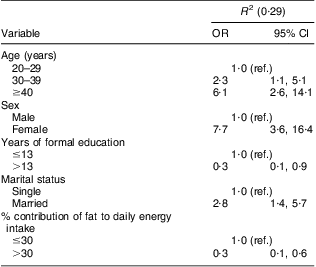
ref., reference category.
The regression coefficient for the entire model; R 2 = 0·21.
Discussion
In Ghana, studies show that overnutrition is gradually becoming an important issue following the increasing prevalence of overweight and obesity in most parts of the country. Information on the situation will be an important element for early management and prevention of overweight and obesity to avert its health-debilitating effects. Work by Amoah(Reference Amoah8) found an overweight prevalence of slightly over 23 % in the urban population. The present study, however, found about 32 % overnutrition prevalence among the study population in the urban fishing community. Factors that were found to be associated with this phenomenon were age, marital status, gender, years of formal education and dietary fat intake.
Age was found to be associated with overnutrition; the present study indicated 2·3 times increased odds of overweight/obesity among people aged 30–39 years compared with those aged 20–29 years and a 6·1 times increased likelihood for persons aged ≥40 years. This confirms van der Sande et al.'s(Reference van der Sande, Caesay and Milligan4) study that recorded higher obesity prevalence among women aged >35 years. Biritwum et al. (Reference Biritwum, Gyapong and Mensah10) and Beltaifa et al. (Reference Beltaifa, Traissac and El Ati16) also found increasing obesity prevalence with increasing age. The present study found an association between marital status and overweight, with married persons being 2·8 times more likely to be overweight/obese compared with unmarried persons. This result affirms studies by Biritwum et al. (Reference Biritwum, Gyapong and Mensah10) and Rguibi and Belahsen(Reference Rguibi and Belahsen6). Females were 7·7 times more likely to be overweight/obese than males in the present study and this confirms findings by van der Sande et al. (Reference van der Sande, Caesay and Milligan4) and Biritwum et al. (Reference Biritwum, Gyapong and Mensah10) who reported similar results. Females have a greater physiological propensity to become obese than males. Coupled with the sedentary occupations of women in the area, they have a greater chance to become overweight/obese than males who engage in energy-demanding activities such as fishing. According to van der Sande et al. (Reference van der Sande, Caesay and Milligan4), nothing can be done about the age and sex susceptibility but lifestyle modifications are possible. Contrary to Amoah's(Reference Amoah8) and Biritwum et al.'s(Reference Biritwum, Gyapong and Mensah10) finding of increasing obesity prevalence among persons with higher education, the present study found reduced odds of overweight/obesity among persons with higher education compared with those having basic or no formal education. This could be attributed to the fact that more highly educated persons are aware of the negative consequences of being overweight such as the development of chronic diseases, and hence take measures to prevent it. In their study of obesity among adults aged 20 to 70 years, Hajian-Tilaki and Heidari(Reference Hajian-Tilaki and Heidari3) also found an inverse relationship between the risk of obesity and high level of education. Beltaifa et al. (Reference Beltaifa, Traissac and El Ati16) indicated a higher prevalence among women with intermediary educational status. Persons whose fat intake contributed >30 % of daily energy intake were found less likely to be overweight/obese in the present study. This could possibly be attributed to the occupation they undertake. Males found to consume more fat probably undertake energy-demanding activities, hence accounting for the observation.
Conclusions
Overweight and obesity was prevalent in fishing communities in the Cape Coast urban metropolis, Ghana. Factors such as age, gender, marital status, education and fat intake were associated with overnutrition in this community. Further prospective research is recommended for assessing the factors accounting for overweight and obesity. Health education on healthy lifestyles is recommended.
Acknowledgements
This research received no specific grant from any funding agency in the public, commercial or not-for-profit sectors. There are no conflicts of interest. The authors’ contributions are as follows: K.K.A.P., Principal Investigator; J.M.T., Co-Principal Investigator; J.S., project staff training, manuscript writing and review; W.B.O., supervisor, statistician; E.K.A., data entry, manuscript writing and review. The authors acknowledge the kind assistance and permission of the Cape Coast Metropolitan Health Directorate and Assembly Members of the three project communities. They also appreciate the participation of the Duakor, Idun and Ola fishing communities.



