




Introduction
Whale beachings worldwide are of great public interest. Some whale species strand more frequently and others relatively rarely (Sergeant, Reference Sergeant1982; Bryden, Reference Bryden1999), and interestingly, some coastlines show higher densities of whale strandings than others. However, despite much speculation, the reasons for some strandings remain unknown. This phenomenon includes sperm whale (Physeter macrocephalus) beachings on North Sea coasts (Smeenk, Reference Smeenk1997; Vanselow and Ricklefs, Reference Vanselow and Ricklefs2005; IJsseldijk et al., Reference IJsseldijk, van Neer, Deaville, Begeman, van de Bildt, van den Brand, Brownlow, Czeck, Dabin, ten Doeschate, Herder, Herr, IJzer, Jauniaux, Jensen, Jepson, Jo, Lakemeyer, Lehnert, Leopold, Osterhaus, Perkins, Piatkowski, Prenger-Berninghoff, Pund, Wohlsein, Gröne and Siebert2018). There has been much discussion of the possible causes of recent sperm whale strandings around the North Sea at the beginning of 2016, when 29 animals beached within 4 weeks (Unger et al., Reference Unger, Rebolledo, Deaville, Gröne, IJsseldijk, Leopold, Siebert, Spitz, Wohlsein and Herr2016; IJsseldijk et al., Reference IJsseldijk, van Neer, Deaville, Begeman, van de Bildt, van den Brand, Brownlow, Czeck, Dabin, ten Doeschate, Herder, Herr, IJzer, Jauniaux, Jensen, Jepson, Jo, Lakemeyer, Lehnert, Leopold, Osterhaus, Perkins, Piatkowski, Prenger-Berninghoff, Pund, Wohlsein, Gröne and Siebert2018; Nielen, Reference Nielen2018; Vanselow et al., Reference Vanselow, Jacobsen, Hall and Garthe2018). However, despite intensive research, experts have struggled to determine the reason for this stranding episode (e.g. weather, waves, current, military exercises, excessive underwater noise, parasites, diseases, poisons, plastic in the stomach, etc.) (Unger et al., Reference Unger, Rebolledo, Deaville, Gröne, IJsseldijk, Leopold, Siebert, Spitz, Wohlsein and Herr2016; IJsseldijk et al., Reference IJsseldijk, van Neer, Deaville, Begeman, van de Bildt, van den Brand, Brownlow, Czeck, Dabin, ten Doeschate, Herder, Herr, IJzer, Jauniaux, Jensen, Jepson, Jo, Lakemeyer, Lehnert, Leopold, Osterhaus, Perkins, Piatkowski, Prenger-Berninghoff, Pund, Wohlsein, Gröne and Siebert2018; Nielen, Reference Nielen2018). IJsseldijk et al. (Reference IJsseldijk, van Neer, Deaville, Begeman, van de Bildt, van den Brand, Brownlow, Czeck, Dabin, ten Doeschate, Herder, Herr, IJzer, Jauniaux, Jensen, Jepson, Jo, Lakemeyer, Lehnert, Leopold, Osterhaus, Perkins, Piatkowski, Prenger-Berninghoff, Pund, Wohlsein, Gröne and Siebert2018) and Nielen (Reference Nielen2018) suggested that geomagnetic misinterpretations triggered by Solar storms could have influenced the animals' migration, either exclusively or in connection with other causes. Vanselow et al. (Reference Vanselow, Jacobsen, Hall and Garthe2018) examined the possible reasons for the effects of such geomagnetic disturbances, leaving Solar storms as a possible causal explanation for the North Sea strandings in early 2016. Interestingly however, the potential of Solar storms as a cause for whale strandings varies globally. The following discussion therefore considers the circumstances under which Solar storms might cause navigation errors leading to whale strandings.
In general, space weather directly or indirectly influences life on Earth, in the past, present and in the future, with the Sun and the magnetic field and atmosphere of the Earth playing an important role. This is a clear example of how changes in the Earth's environment can impact life on Earth, the key to understanding Earth's astrobiology. The Sun constantly ejects ionized particles forming the Solar wind. However, it also hurls large quantities of charged energetic particles mostly via coronal mass ejections into space and sometimes towards Earth. Most charged energetic particles are guided around the Earth by the Earth's magnetic field with some particles entering the magnet field of the Earth. This happens when ionized particles are guided from the Solar magnetic field lines via the Earth's outer magnetic field lines towards the Earth near the poles by different ways (Hargreaves, Reference Hargreaves1992; Borovsky and Valdivia, Reference Borovsky and Valdivia2018). In these polar regions, the charged energetic particles (via the magnetic field induced by them) may then cause temporal magnetic field distortions in the Earth's magnetosphere. As a side effect of the interaction of the energetic particles with the particles of the ionosphere, auroras often are generated. The width of the observation belt (auroral oval) and the intensity of the auroras around the poles vary with the intensity of the particle streams from Solar ejections (Gustafsson, Reference Gustafsson1982; Hargreaves, Reference Hargreaves1992; Borovsky and Valdivia, Reference Borovsky and Valdivia2018).
Astronomical impacts such as Solar storms can trigger storms in the Earth's magnetosphere, resulting in temporal distortions of the Earth's magnetic field. The temporal sequences, as well as the strength of the magnetic field disruptions caused by this phenomenon, can vary at different times and places, and not all storms will therefore lead to geomagnetic misinterpretation by migrating animals. These aspects also need to be linked to the spatial ‘magnetic maps’ used by the animals (Vanselow et al., Reference Vanselow, Jacobsen, Hall and Garthe2018), to determine how they swim through the respective area, in order to identify how the geomagnetic disturbance could have influenced their navigation. However, this presupposes a magnetic sense as assumed by many authors (e.g. Qin et al. (Reference Qin, Yin, Yang, Dou, Liu, Zhang, Yu, Huang, Feng, Hao, Hao, Deng, Yan, Dong, Zhang, Jiang, Wang, Luo and Xie2016); Hall and Johnsen (Reference Hall and Johnsen2019) and references therein). For example, some migrating animals have been shown to use geomagnetic orientation aids in some areas (Kirschvink et al., Reference Kirschvink, Dizon and Westphal1986), such as the ‘geomagnetic mountain range’ north of the North Sea (Vanselow et al., Reference Vanselow, Jacobsen, Hall and Garthe2018), or the much longer and larger ‘East Coast Magnetic Anomaly’ off the American east coast (Walker et al., Reference Walker, Kirschvink, Ahmed and Dizon1992; Behn and Lin, Reference Behn and Lin2000). Furthermore, different species may be affected differentially, depending on their way of life. In this context, whale species migrating over long distances and deep-sea hunting species would be more likely to experience problems in shallow near-coastal waters as a result of magnetic anomalies compared with whale species familiar with these waters. Hence, some shallow waters or coastlines can become traps for these species, as described by Smeenk (Reference Smeenk1997) and Vanselow and Ricklefs (Reference Vanselow and Ricklefs2005) in the North Sea.
The causes of whale strandings have been widely discussed (Sergeant, Reference Sergeant1982; Goold et al., Reference Goold, Whitehead and Reid2002; IJsseldijk et al., Reference IJsseldijk, van Neer, Deaville, Begeman, van de Bildt, van den Brand, Brownlow, Czeck, Dabin, ten Doeschate, Herder, Herr, IJzer, Jauniaux, Jensen, Jepson, Jo, Lakemeyer, Lehnert, Leopold, Osterhaus, Perkins, Piatkowski, Prenger-Berninghoff, Pund, Wohlsein, Gröne and Siebert2018), and Solar storms have been suggested as a possible explanation for such strandings worldwide. In a series of studies covering different timescales, Vanselow and coworkers found a possible relationship between Solar storms and sperm whale strandings in the shallow North Sea (over ~300 years for Solar cycles (Vanselow and Ricklefs, Reference Vanselow and Ricklefs2005); over ~400 years for aa indices (Vanselow et al., Reference Vanselow, Ricklefs and Colijn2009); and for a great stranding event in 2016 (Vanselow et al., Reference Vanselow, Jacobsen, Hall and Garthe2018)). In contrast, Pulkkinen et al. (Reference Pulkkinen, Moore, Zellar, Uritskaya, Karakoylu, Uritsky and Reeb2018) found no connection between mass stranding events and Solar storms in New Zealand from 1990 to 2016, the United Kingdom from 1991 to 2015 and the United States from 1999 to 2014. This discrepancy indicates a potential link between Solar storms and whale standings in some areas but not in others. This review thus considers this association based on the examples of whale strandings worldwide, including in the North Sea, Newfoundland, Cape Cod, Tasmania, New Zealand and South Australia. The southernmost tips of South America and South Africa are also included because Evans et al. (Reference Evans, Thresher, Warneke, Bradshaw, Pook, Thiele and Hindell2005) reported that strandings occurred ‘at high frequencies on the southernmost areas of land masses’ in the southern hemisphere, and because they represent the geographically most southern points of these continents, with the highest probabilities for strandings triggered by geomagnetic storms.
Where are whale strandings caused by Solar storms most likely to occur?
An investigation of the influence of geomagnetic storms needs to take account of the geographic location and the magnetic field in the region in question. Auroras (polar lights) are a secondary effect of Solar storms (associated with space weather), and the area in which auroras are to be expected (auroral oval) was described by Gustafsson (Reference Gustafsson1982) as follows: the auroral oval at night extended from approximately 72 to 67° geomagnetic latitude in 1982. The probability of an aurora at a geomagnetic latitude 10° nearer the equator was only 1/10 and the probability at 30° was only 1/1000 compared with the probability within the auroral oval. Vanselow et al. (Reference Vanselow, Jacobsen, Hall and Garthe2018) also showed that magnetic field disturbances on 20 December 2015 had virtually no influence on the magnetic field at ground level at a geographical latitude of 48°N (near Vienna, Austria, Europe) compared with disturbances at more northern latitudes. The effects of a geomagnetic storm therefore depend on the geographical and geomagnetic latitude; the closer a location is to the equator, the weaker the effect of a Solar storm on the respective magnetic field (Vanselow et al., Reference Vanselow, Jacobsen, Hall and Garthe2018).
Some possible whale stranding locations at higher latitudes around the world are now under consideration in relation to their geographical and geomagnetic coordinates. The known stranding areas in the northern hemisphere are north of 40° geographical latitude. Cape Cod's northern tip is located at 42.1°N and Newfoundland's northern tip at 51.6°N, but based on the geomagnetic latitudes, both locations are at least ~9° further north (Table 1). In Europe, Solund (north of the North Sea; see below and Table 1) is located north of Bergen in Norway, with geographically and geomagnetically similar latitudes of ~61°N. However, the situation differs at higher latitudes in the southern hemisphere . The latitude of the southernmost tip of South America is in 2016 geographically at 55.7°S but geomagnetically 9.8° further north. The southernmost tips of the Australian mainland and Tasmania lie ~7° further south in latitude geomagnetically than geographically (Table 1), while New Zealand's southernmost point has a geomagnetic latitude of 50.4°S, which is 3.8° further south than its geographical latitude (Table 1). The southern locations listed in Table 1 are geomagnetically much closer to the equator than the northern locations. This difference is at least 10° for the northern tip of Newfoundland and for Solund near the southern Norwegian Sea, where 29 sperm whales took a wrong turn into the shallow North Sea at the beginning of 2016 (Vanselow et al., Reference Vanselow, Jacobsen, Hall and Garthe2018).
Geographical and geomagnetic coordinates of possible whale stranding sites in 2016

Geomagnetic values calculated using the World Data Center for Geomagnetism (Kyoto) website at http://wdc.kugi.kyoto-u.ac.jp/igrf/gggm/.
It can be assumed that Solar storm-related stranding phenomena are more likely to occur at higher geographical latitudes in the northern hemisphere (exhibiting much more suitable coastlines) than in the southern hemisphere. First, the magnetic field intensity is currently very weak in South Africa and South America in the southern hemisphere (between ~26 and ~34 μT for the year 2000 (Figure 3b in Mandea et al., Reference Mandea, Korte, Soloviev and Gvishiani2010), making the impacts of geomagnetic storms less likely. Only Australia and New Zealand in the southern hemisphere currently show relatively high magnetic field values (~46 to ~62 μT). Second, apart from Antarctica, only South America's southern tip and southern parts of Tasmania and New Zealand are south of 40°S geographical latitude (Table 1). There is therefore much less land than sea in the southern hemisphere (excluding Antarctica) compared with the northern hemisphere. Against this background, it can be assumed that, even if whales are misdirected by geomagnetic disturbances, they are much more likely to reorient themselves and correct their mistakes before reaching a coast.
In contrast, the southern Norwegian Sea has a magnetic field intensity of ~50 to ~52 μT (year 2000; Figure 3b in Mandea et al., Reference Mandea, Korte, Soloviev and Gvishiani2010) and thus seems to be particularly vulnerable to sperm whale strandings in the North Sea as a result of Sun-induced geomagnetic disturbances, compared with many other areas of the world. This is particularly important given the gradual decrease in depth of the North Sea when approaching from the north, such that sperm whales may not notice their navigation error until they can no longer find their way out (Vanselow and Ricklefs, Reference Vanselow and Ricklefs2005; Vanselow et al., Reference Vanselow, Jacobsen, Hall and Garthe2018). The interplay of these circumstances is relatively rare on coasts at higher latitudes.
In relation to the geomagnetic storm that occurred on 20 and 21 December 2015, which may have triggered the sperm whale strandings in the North Sea at the beginning of 2016, Table 2 (for the same areas listed in Table 1) shows that the effects of this geomagnetic storm were most severe north of the North Sea where 29 whales were stranded between ~10 days and a few weeks after the Solar storm (Vanselow et al., Reference Vanselow, Jacobsen, Hall and Garthe2018). The maximum changes in absolute magnetic field strength were between 780 and 900 nT for Solund, Tromsø (both Norway) and Lerwick (Shetland Islands, Scotland, UK) and the changes in magnetic inclination were between 1.2 and 1.65°, respectively. The other locations listed in Table 2 showed lower magnetic field distortions (100–290 nT) and lower magnetic inclination distortions (0.2–0.62°) on the 2 days.
Maximal distortions of the total magnetic field and magnetic inclination during a geomagnetic storm on 20 and 21 December 2015 at magnetometer stations nearest to the locations shown in Table 1
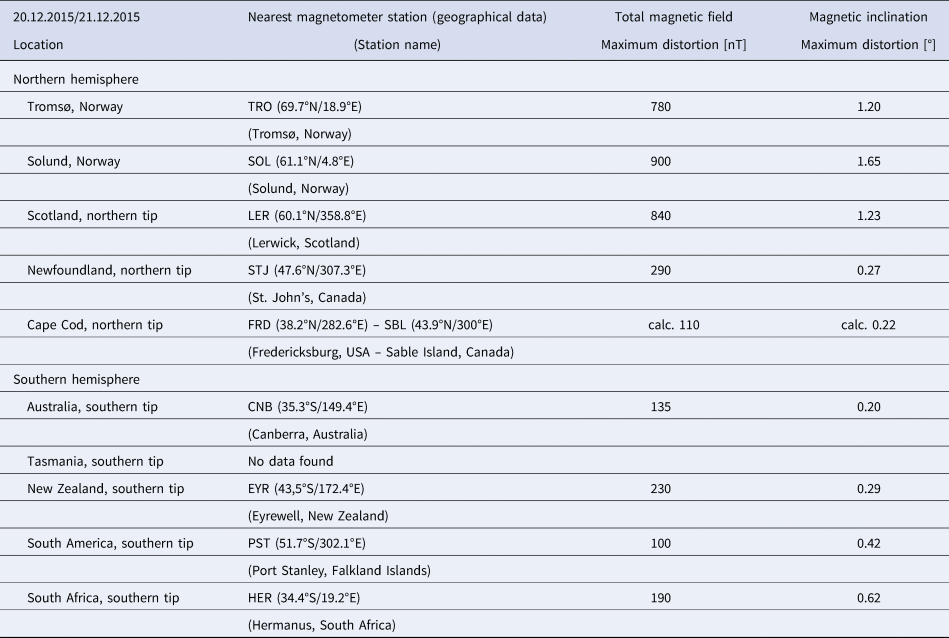
Magnetic values calculated using the International Real-time Magnetic Observatory Network (Intermagnet) website at https://www.intermagnet.org/data-donnee/dataplot-eng.php?type=dif and/or the Tromsø Geophysical Observatory (UiT – The Arctic University of Norway) website at http://flux.phys.uit.no/stackplot/.
Changes in the magnetic field in recent centuries
To include historical whale-stranding data in research on the causal connection between whale beachings and Solar storm-induced magnetic disturbances, it is necessary to examine the magnetic fields in the relevant areas over time.
According to the Magnetic World Map (Walker et al., Reference Walker, Dennis and Kirschvink2002; Mandea et al., Reference Mandea, Korte, Soloviev and Gvishiani2010), the most likely areas for the discussed phenomenon to occur are South Australia, Tasmania and New Zealand in the southern hemisphere, and the American east coast near Cape Cod to Newfoundland and the area north the North Sea in the northern hemisphere. Most of Australia in the southern hemisphere and Norway and North America north of Florida in the northern hemisphere currently have magnetic field strengths >50 μT (Figure 3c in Walker et al., Reference Walker, Dennis and Kirschvink2002; Figure 3b in Mandea et al., Reference Mandea, Korte, Soloviev and Gvishiani2010). However, the tip of South America was previously exposed to a much stronger magnetic field (>66 μT in 1600, Figure 3a in Mandea et al., Reference Mandea, Korte, Soloviev and Gvishiani2010), because of changes in the geographical position of the Earth's magnetic poles over time. Accordingly, the magnetic field intensities and geographical latitudes are only roughly related.
The southern tip of South Africa is currently at similar geographic and geomagnetic latitudes (Table 1). However, the absolute magnetic field has decreased by 10.3 μT from 1700 to 2016, and the geomagnetic inclination has increased by 24.8° (Table 3). Meanwhile, the absolute magnetic field strength at the southern tip of South America has halved by 31.6 μT in the last 316 years and the magnetic inclination angle has flattened by 19.3° (Table 3). The other locations listed in Table 3 have experienced relatively minor changes.
Total magnetic field and inclination data from 2016 and 1700 and changes over 316 years
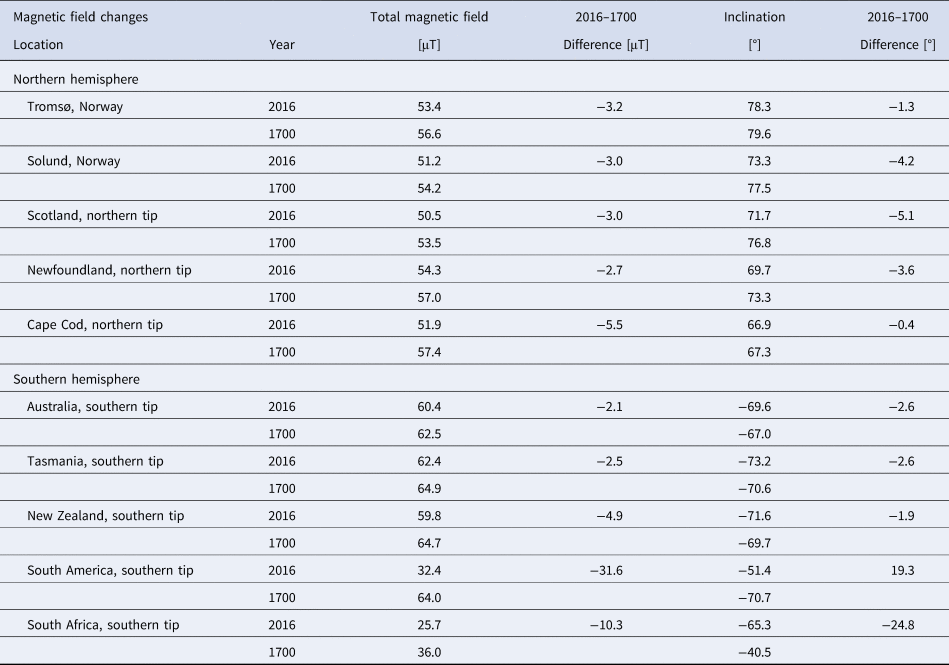
Locations as in Table 1. Values calculated using the National Centers for Environmental Information of the NOAA website at https://www.ngdc.noaa.gov/geomag/calculators/magcalc.shtml#igrfwmm.
These data suggest that Solar storm-induced strandings at the southern tip of South America were more likely 400 years ago than today. The geomagnetic equator between South America and South Africa subsequently shifted further south into the South Atlantic region and the whole magnetic field became weaker. In this context, Solar storm-induced strandings in the North Sea over the past three and four centuries, analysed by Vanselow and Ricklefs (Reference Vanselow and Ricklefs2005) and Vanselow et al. (Reference Vanselow, Ricklefs and Colijn2009), were not affected by large magnetic field shifts in the Norwegian Sea area, and these results therefore remain valid.
Conclusions
An analysis of the relationship between whale-stranding data and astronomical effects such as Solar storms, including over long time periods, needs to take account of the Earth's relevant magnetic field conditions. This includes considering both the strengths of the magnetic field components and the geomagnetic anomalies at the respective locations, as well as changes in the geomagnetic field over the centuries. Whale strandings caused by Solar storms are thus not equally likely throughout the world; geomagnetic storms can only explain some strandings and several additional aspects must also be considered. It is therefore necessary to establish a regional reference for each stranding rather than generalizing the found effects a priori worldwide. For example, different whale species deal with shallow waters differently, leaving some species more vulnerable to Solar storm-induced strandings than others. The combined geographical, geomagnetic and hydrographic environment of the southern Norwegian Sea, together with the conditions of the southbound North Sea, make the effects of geomagnetic storms here particularly dangerous for animals such as sperm whales compared with other regions of the world. Sperm whales pass this sea on migration, and unexpected geomagnetic storms may cause them to be misdirected into the shallow North Sea, often resulting in strandings. Further studies of whale navigation and strandings are needed to address the occurrence of geomagnetic anomalies and disturbances and to link them closely to the animals' migration routes and their magnetic parameters.
Acknowledgements
I thank Katja Heubel and Anne Mareike Vanselow for critical reading of the manuscript and helpful discussions and Susan Furness for providing linguistic support.


 Open access

