

The Lake Titicaca Basin is one of the areas in the world where Indigenous peoples developed complex political, social, and economic institutions over several millennia. The earliest occupations in the region have been documented in the early Holocene. Mobile hunter-foragers dominated the landscape up to the third millennium BC. These Archaic period settlements were concentrated along the lake edge and in the rich riverine environments (Cipolla Reference Cipolla, Charles, Amanda and Mark2005; Klink Reference Klink, Stanish, Cohen and Aldenderfer2005). Beginning around 3400 to 1000 BC, settlements such as Chiripa, Jiskairumoko, Kaillachuro, and Soro Mik’aya Patjxa show shifts to semisedentary and settled villages (Flores-Blanco and Aldenderfer Reference Flores-Blanco and Aldenderfer2025; Haas and Llave Reference Haas and Llave2015; Hastorf Reference Hastorf1999; Rumold and Aldenderfer Reference Rumold and Aldenderfer2016). During this time, we see intensification in the subsistence economy with a focus on the domestication of plants and animals, particularly native tubers, grains, beans, and camelids (Bruno Reference Bruno2024; Bruno and Whitehead Reference Bruno and Whitehead2003; Miller et al. Reference Miller, Kendall, Capriles, Bruno, Evershed and Hastorf2021).
A number of archaeologists have noted the formation of Titicaca Basin–wide shared ideological traditions beginning in at least the Middle Formative (Bruno Reference Bruno2024; Chávez Reference Chávez1988). Most scholars recognize that economic exchange of exotics and nonlocal commodities was a component of these shared traditions. The presence of exotic plants, stones, minerals, pottery, and the like has been documented in a number of sites in the region. Goods include coca, tobacco, lapis, gold, copper, obsidian, marine shell, sodalite, and possibly other forest products. Maize occurs in Formative sites (Bandy Reference Bandy2005:95). Maize grows in restricted regions in the basin and its distribution would have required exchange networks (Aldenderfer et al. Reference Aldenderfer, Craig, Speakman and Popelka-Filcoff2008; Logan et al. Reference Logan, Hastorf and Pearsall2012). Matthew Bandy (Reference Bandy2005:93) sees trade as central to the political organization of these Formative societies, calling it “the primary source of social power, at least in the southern Titicaca Basin” during the Middle and Late Formative periods.
Most archaeologists have emphasized camelid caravans as the primary means to move goods. However, watercraft also serve as a very efficient way to move objects, particularly lightweight preciosities. While rarely addressed in archaeology because of preservation issues, we have rich ethnographic and historical records of people creating very sophisticated reed watercraft for the last 500 years. Balsa rafts in fact are central to the economic life of Indigenous Titicaca-area communities.
One indirect means to determine how old watercraft technology was employed by people is to examine islands that are, obviously, only reachable by boats. Islands such as Amantaní, Soto, and the Islands of the Sun and Moon prove that there were people living there since at least the Late Formative period (Myres and Paredes Reference Myres, Paredes, Stanish, Cohen and Aldenderfer2005). The question is not whether Indigenous peoples had watercraft. Rather, the question is when did this tradition begin?
Our work on the Island of the Sun confirmed that there were Formative period sites on the island. Our survey extended this back to at least the Terminal Archaic. Members of the Proyecto Tiksi Kjarka worked on the Island of the Sun for three seasons from 1994 to 1996 (Figure 1). All results of those seasons’ work have been published (e.g., Bauer and Stanish Reference Bauer and Stanish2001; Dearborn et al. Reference Dearborn, Seddon and Bauer1998; Seddon Reference Seddon1998; Stanish and Bauer, eds. Reference Stanish and Bauer2004; among others).

Figure 1. Titicaca Basin with South America insert. (Color online)
A total of 180 sites were identified on the island using an intensive, full-coverage survey methodology. We discovered only three Archaic sites based upon surface collections (see Stanish and Bauer Reference Stanish, Bauer, Stanish and Bauer2004:Table 2.1). These were located on the eastern side of the island adjacent to and above the lake shore (Figure 2). During this work, we excavated one Archaic site called Ch’uxuqullu (site 093). The site is located on a low hill above the community of Challa in the middle of the northeastern side of the island (Figures 2 and 3). It is above and adjacent to a lush freshwater marsh on the lake edge. Given the topography and nature of the aquifers in this area, it is likely that the Challa Bay would have been a marshy area throughout the Holocene even with lower lake levels. Full details of this site and the excavation methodology can be found in the original report in Stanish and colleagues (Reference Stanish, Burger, Cipolla, Glascock and Quelima2002). As seen in Figure 3, the entire Challa Bay is a shallow area extending out several hundred meters into the lake. In periods of low lake levels, this area would have been a rich marshy area of about 40 ha.

Figure 2. Island of the Sun showing location of Ch’uxuqullu (093), two other Archaic period sites, and the bathymetric contours at 50 and 150 m (contours adapted from Wirrmann Reference Wirrmann, Dejoux and Iltis1992:19). (Color online)

Figure 3. Topographic position of Ch’uxuqullu and site 092 relative to marshlands. (Color online)
Five units were excavated in the original project. One of these, Unit 3, was an undisturbed 2 m deep stratified series of occupational surfaces (Figure 4). There were no apparent breaks in occupation. Archaic period projectile points and obsidian flakes were recovered on the surface and in the unit as described in the 2002 article.

Figure 4. Stratigraphic profile of Ch’uxuqullu, Unit 3.
Radiocarbon Dating
Radiocarbon dating was developed during the mid- to latter half of the last century. Continued methodological advancements since then have led progressively to the measurement of relatively smaller sample sizes with increased precision. A number of carbonized samples were collected during the 1995 excavation season at Ch’uxuqullu. Most were bulk samples of small fragments of charred wood from across a level. Most samples did not yield sufficient carbon content to be dated by the beta-decay method. However, three samples were of sufficient size and yielded dates. In addition, several samples were sent for AMS dating at that time, but only one was successful. None of the samples from the lowest level produced dates. Having only a few samples left, and only one from the lowest level, we archived the remaining ones until methodologies for dating improved.
Results
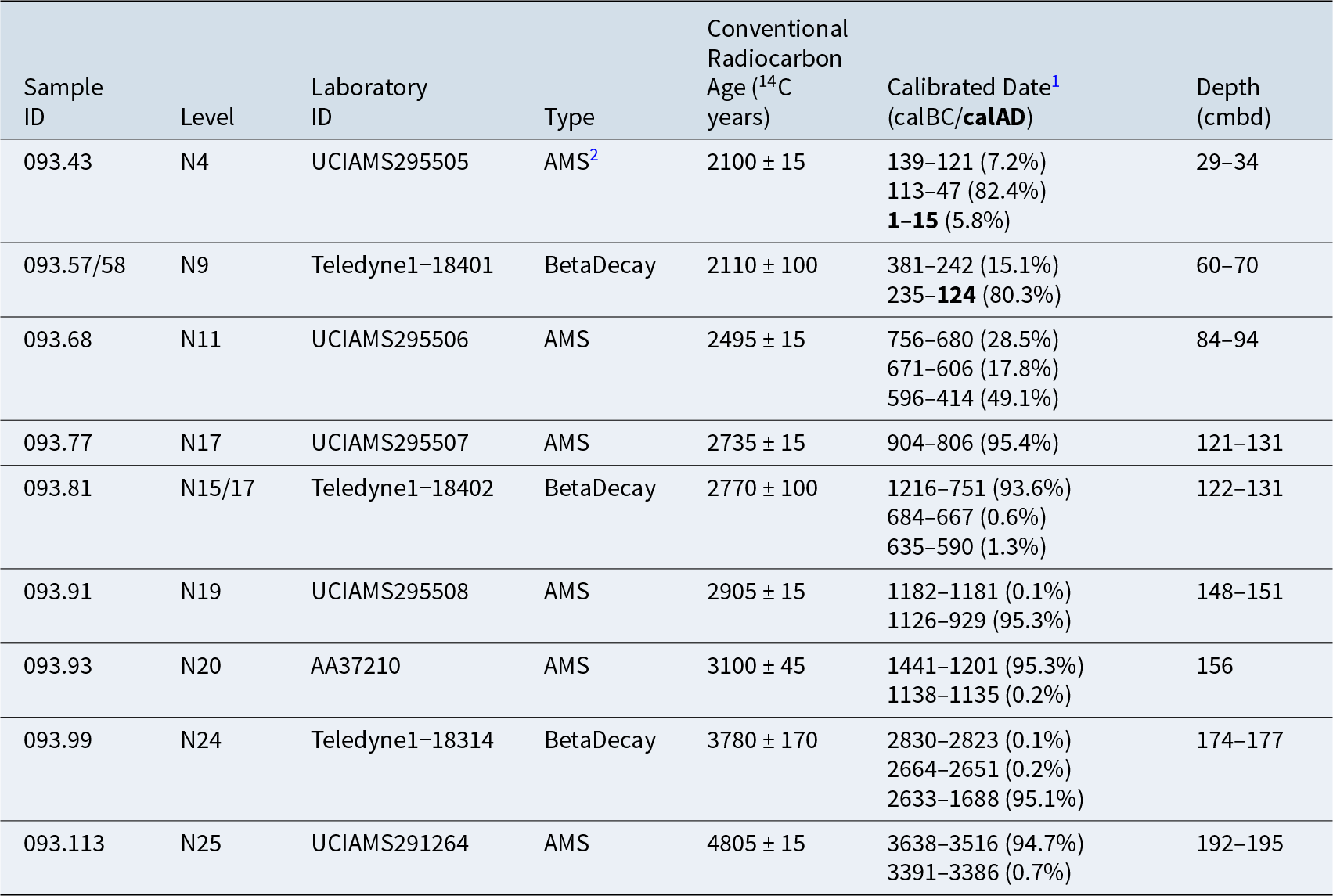
Given the importance of this excavation, five additional samples for radiocarbon dating were sent to the Keck AMS facility at University of California, Irvine. All five produced dates (Figure 3 and Table 1). The earlier dates based on the beta-decay method have radiometric radiocarbon ages with relatively large standard deviations, while the new AMS measurements are much more precise (±15 14C years). Significantly, the newer calibrated dates are consistent with the older ones in terms of overlap and progression with depth.
Table 1. Chronology.

An important result is the date for the earliest occupation of the site. Prior to the new data, the earliest date was from a bulk sample collected between 174 and 177 cmbd (centimeters below datum) from level 24 near the bottom of the unit. This had a radiometric radiocarbon age of 3780 with a high standard deviation of ±170 14C years. The calibrated date range (2-sigma) is 2846–1743 cal BC.
There was one archived bulk sample from the base of the lowest level (25) of the unit just above sterile. This sample (093.113) was collected from a 3 cm thick section in this level that rested above natural clays. It yielded a calibrated date range (2-sigma) of 3635–3381 cal BC (Figure 3 and Table 2). Given the internal consistency of the calibrated dates in relation to this last one, we can state with high confidence that this represents the date of the initial occupation of Ch’uxuqullu.
Table 2. 14C Dates from Unit 3, Ch’uxuqullu, Island of the Sun, Bolivia.
1 Calibrated (calendrical) dates based on OxCal 4.4.4 (Bronk Ramsey Reference Bronk Ramsey2001, Reference Bronk Ramsey2009, Reference Bronk Ramsey2017; Bronk Ramsey and Lee Reference Bronk Ramsey and Lee2013; https://c14.arch.ox.ac.uk/oxcal.html), which incorporates the southern hemispheric atmospheric curve (SHCal20; Hogg et al. Reference Hogg, Heaton, Hua, Palmer, Turney, Southon and Bayliss2020). This date is reported in terms of the 95.4% Highest Probability Density (HPD) range. Note that the selection of the appropriate calibration curve for South America is location dependent, as discussed by Marsh and colleagues (Reference Marsh, Bruno, Fritz, Baker, Capriles and Hastorf2018). A case can be made for using a mixed curve (50% IntCal20, 50% SHCal20) for Lake Titicaca, which would result in calibrated dates up to a few decades more recent than listed abovein this table.
2 AMS dates with precision of ±15 14C years from measurements in 2024 from Keck AMS facility at the University of California Irvine. The AMS date with precision of ±45 14C years from measurement in 2000 from the AMS Laboratory at the University of Arizona.
The new data from Ch’uxuqullu indicate that the site was first occupied in the middle of the fourth millennium BC. Prior to this, the earliest date ranged from the Late Archaic to the end of the Terminal Archaic in the third millennium. These new data establish a Late Archaic occupation on the Island of the Sun at least seven centuries earlier than previously reported.
Discussion
The refined chronology of the site of Ch’uxuqullu allows us to state that (1) the earliest known occupation of the Island of Sun was in the middle of the fourth millennium BC, substantially earlier than previously known; (2) the date of the first use of pottery at the site was between the twelfth and tenth centuries BC; (3) the transition to sedentary lifeways at the site began at least during the Late Archaic; and (4) watercraft technology was sufficiently developed in the fourth millennium to allow regular access to the island. These interpretations are consistent with the criteria developed by Levine and Stanish (Reference Levine and Stanish2014) for significant archaeological contexts in that there are multiple dates from a single excavation that are internally consistent. Furthermore, these dates are reinforced with independent stylistic pottery data from around the region. These new dates mean that the late Archaic period on the Island of the Sun is consistent with lakeshore early sites throughout the region (Capriles and Albarracin-Jordan Reference Capriles and Albarracin-Jordan2013).
Was the Island of the Sun an Island in the Fourth Millennium BC?
There is still some debate as to the levels of Lake Titicaca in the Middle and early Late Holocene. Cross and colleagues (Reference Cross, Baker, Seltzer, Fritz and Dunbar2000:28) suggest that the lake reached modern levels at 2100 14C years BP or about AD 150. Craig (Reference Craig2011:371) summarizes our knowledge of the paleolimnological data during this time: “Between 6050-2050 cal BC the water level in Lake Titicaca was 50-100m lower than today. . . . Sediment cores and seismic-reflection data indicate the Early-Middle Holocene maximum lowstand occurred about ca. 3350 cal BC, and lake levels were between 85-100m lower than present (Baker et al. Reference Baker, Seltzer, Fritz, Dunbar, Grove, Tapia, Cross, Rowe and Broda2001; Cross et al. Reference Cross, Baker, Seltzer, Fritz and Dunbar2000; Cross et al. Reference Cross, Baker, Seltzer, Fritz and Dunbar2001; Rigsby et al. Reference Rigsby, Baker and Aldenderfer2003:166; Seltzer et al. Reference Seltzer, Baker, Cross, Dunbar and Fritz1998).” Abbott and colleagues (Reference Abbott, Binford, Brenner and Kelts1997:17) note some rapid rises at 3,800 years ago. Baker and colleagues (Reference Baker, Seltzer, Fritz, Dunbar, Grove, Tapia, Cross, Rowe and Broda2001:642) slightly revised the estimates of Cross and colleagues and put the maximum drop at 85 m below present levels in the Holocene. Rigsby and colleagues (Reference Rigsby, Baker and Aldenderfer2003:180) note significant periods of “rapidly decreasing” lake levels between 4500 and 2500 BC. Guédron and colleagues (Reference Guédron, Delaere, Fritz, Tolu, Sabatier, Devel, Heredia, Vérin, Alves and Baker2023) concur that studies indicate a possible drop of 85 m in the Middle and early Late Holocene in the main lake (Lago Mayor).
What do these paleolimnological data mean for the Island of the Sun? Wirrmann (Reference Wirrmann, Dejoux and Iltis1992:19, Figure 2; Wirrmann et al. Reference Wirrmann, Ybert, Mourguiart, Dejoux and Iltis1992) reproduced a bathymetric map showing that most of the lake surrounding the island to the west, southwest, north, and southeast was at least 150 m deep (Figure 2). According to this map, the section of the lake between the Copacabana Peninsula and the island was greater than 50 m below present lake levels but less than 150 m.
There are no publications of detailed soundings of this area between the island and the Copacabana Peninsula. Soundings were conducted in 1996 by Michael Moseley and Charles Stanish, with the assistance of local informants. Two experienced fishermen transported the team from the 150 m bathymetric contours on the southeast side of the island to those at 150 m depth in the southwest. A 100 m sounding line was lowered but did not reach the bottom, indicating that the lake was at least 100 m deep in this area. Given that the lowest lake level drop published for the Middle and Late Holocene is 100 m, and the contemporary shores of the Island of the Sun are at least 100 m above the present lake level, we can conclude that it was only sporadically, if ever, connected to the mainland. Certainly, for at least the last 5,000 years, including the bulk of the time that Ch’uxuqullu was occupied, the island was only reachable by watercraft. We conclude that watercraft transport was an integral strategy in Titicaca Basin exchange from at least the Middle Archaic.
Hastorf and colleagues (Reference Hastorf, Moore, Smail, Penfil, Williams, Riebe and Knudson2022:1) aptly note that “from the very beginning of human habitation there is evidence for short-and long-distance movement and trade [in the Titicaca Basin].” They summarize extensive evidence for exchange of nonlocal beads, shells, metals, obsidian, plants, hallucinogenic plants, lowland crops, basalt, and other commodities. They also note (Reference Hastorf, Moore, Smail, Penfil, Williams, Riebe and Knudson2022:2) that both caravans and boat traffic were used to move goods. The new data from Ch’uxuqullu support Hastorf and colleagues’ hypothesis of extensive boat traffic beginning in the Middle Archaic. It is also consistent with Delaere’s (Reference Delaere2017) concept of a “Lacustrine Cultural Landscape,” adapted from Westerdahl (Reference Westerdahl1992), in which the entire network of sailing routes, ports, and other landfalls shift over time.
While bone preservation was very poor at Ch’uxuqullu, we did find a variety of lithic debris, including nonlocal raw materials. We recorded obsidian, red chert (jasper), gray chert, quartzite, orange quartz, rose quartz, green marl, rhyolite, white chalcedony, andesite, and basalt. The range and types of raw materials are consistent with assemblages at Early through Late Archaic sites in the Huancané region to the north (Cipolla Reference Cipolla, Charles, Amanda and Mark2005). The range of materials on the Archaic sites was distinct from almost all other periods. The similarity to the Huancané Archaic indicates that a similar process of importing nonlocal materials also characterized the Archaic on the Island of the Sun.
The continual use of the island by people around the region was confirmed by obsidian analysis indicating the import of pieces from sources as far as Chivay (Burger et al. Reference Burger, Asaro, Salas and Stross1998). Obsidian fragments were found throughout the excavated unit. Because obsidian is not naturally available on the island, the evidence indicates that a regular exchange of these lithics from mainland sources was routine and of millennial-long duration.
Other islands have only been superficially studied. There is no evidence for Archaic occupations on Isla Soto, Isla Esteves, Tikonata, Amantaní, or Taquile. We do know, however, that there are Middle Formative through modern occupations on many of these islands (Chávez and Stanish Reference Chávez, Stanish, Vranich, Klarich and Stanish2012; Korpisaari et al. Reference Korpisaari, Sagárnaga, Villanueva and Patiño2012; Myres and Paredes Reference Myres, Paredes, Stanish, Cohen and Aldenderfer2005; see review in Capriles et al. Reference Capriles, Moore, Domic and Hastorf2014; Ponce Sanginés et al. Reference Ponce Sanginés, Reinhard, Ortiz, Siñanis and Ticlla1992). The data from Ch’uxuqullu open the possibility that other islands had Archaic occupations. These data make it clear that any early model of exchange in the Titicaca Basin must include the use of watercraft as well as camelid caravans. Using historical and ethnographic analogy, the data indicate that there was a vigorous exchange network in the basin carried out by land and lake transport.
Settled Lifeways
A major research theme in the region is the timing and nature of the transition to settled village life. Work by Aldenderfer and colleagues have defined four large periods in the preceramic or archaic periods as seen in Table 1.
Craig (Reference Craig2005) and Aldenderfer and colleagues (Reference Aldenderfer, Craig, Speakman and Popelka-Filcoff2008) find evidence for the earliest transition to settled lifeways at the Late Archaic site of Jiskairumoko in the upper Ilave River valley in the western Titicaca Basin. The new data from Ch’uxuqullu are consistent with these conclusions. Unit 3 at Ch’uxuqullu had a continual occupation from the earliest levels. We did not find structures, but we had a pattern of intensive and long-term use of the hilltop, a first step in the sedentism process. Ch’uxuqullu fits Haas and Llave’s (Reference Haas and Llave2015:1305) empirical pattern of Archaic sedentism at the site of Soro Mik’aya Patjxa in Ilave in that both sites constitute places “where hunter-gatherers resided repeatedly on a long-term, non-permanent basis” during the Archaic. The abundant fish resources in the Challa Bay would have been a source of wild resource concentration encouraging repeated occupation. These data conform to their observation that “residential sedentism and resource intensification” (Reference Haas and Llave2015:1298) can be seen in the Terminal Archaic. It is significant that the three sites with Archaic occupations surround the Challa Bay. This would have been a very rich ecological zone for a number of wild foods particularly fish, birds, and totora reeds. Capriles and colleagues (Reference Capriles and Albarracin-Jordan2013) document the heavy reliance on fishing by 1500 BC at sites on the Taraco Peninsula in the south Titicaca Basin. The intensification of fishing is an additional feature that correlates to increasing sedentism.
Adoption of Pottery Technology
Pottery was discovered 45 cm above the lowest occupation level and continued up to the surface. The sequence of pottery generally matches that seen in the southern Titicaca Basin indicating that the inhabitants of the Island maintained regular contact with other societies in the entire region. Levels 17–20 contain the earliest pottery previously named Pasiri. Only one fragment was found in level 20, and we feel that one sherd is insufficient to draw any conclusions. Three fragments were found in level 19, and there was a substantial quantity of sherds in levels 18–15. The natural level composed of arbitrary levels 16 and 17 is 17 cm thick. It has an associated AMS date of 904–806 cal BC. Below this is a natural 19 cm thick level composed of arbitrary levels 18–20. The new AMS date for arbitrary level 19 is 1182–929 cal BC, which is the best approximation for the earliest pottery in this excavation.
This date, between the twelfth and tenth centuries BC, is consistent with the Early Sillumocco pottery defined by Lee Steadman (in Stanish et al. Reference Stanish and Steadman1994). It corresponds to the Middle Chiripa period (1000–800 BC) in the southern Basin (Hastorf Reference Hastorf1999; Whitehead Reference Whitehead and Hastorf1999:20). Our survey on the island found 10 Early Formative and 48 Middle Formative sites indicating a substantial occupation for these periods. In particular, the fiber-tempered pottery is similar to these mainland areas with a similar transition to sand-tempered, red-slipped wares. The new AMS dates indicate that pottery arrived at Ch’uxuqullu around the same time, or slightly later as it was in use on the southern mainland.
Final Comments
This research effort illustrates the importance of archiving primary archaeological material. If all our collected carbon samples from Ch’uxuqullu were analyzed at the time of the excavation, fewer and less precise dates would have been obtained. The AMS methods have improved since that time and, as a result, the chronology of the site has been substantially refined. Furthermore, additional research in the last few decades allows us to make more informed observations from these data. Future research will certainly fill out this fascinating narrative of the ingenious ways in which the Indigenous peoples produced a thriving economy and cultural life on the highest navigable lake in the world.
Acknowledgments
The authors thank Henry Tantaleán for revising and translating the abstract in Spanish. We thank the communities of Challa, Challapampa, and Yumani for permitting our work.
Funding Statement
Funding for our research on the island was provided by the National Science Foundation, the Wenner-Gren Foundation, the John Heinz III Trust, the Field Museum of Natural History, and UCLA Office of the Dean. Recent carbon dates were funded by the University of South Florida. Permission to work on the Island of the Sun was granted by the Instituto Nacional de Arqueología, La Paz and by the Sindicato Agrario Comunidad Challa–Autorización Comunal, August 11, 1994.
Data Availability Statement
All data from the Island of the Sun have been published or are included in this manuscript.
Competing Interests
The authors declare no conflicts of interest.


 Open access

