




Introduction
This article concerns a notable blind spot in the sociolinguistic study of multilingualism. Among language users, it is a commonplace that multilingual speakers switch between languages to make themselves understood. Code choice and code-mixing, in other words, are understood to be routinely motivated by concerns about intelligibility. Curiously, though, the field of sociolinguistics has had little to say about the role of such considerations. Sociolinguistic studies have explored a wide variety of variables that influence code choices and patterns of code-switching—class, gender, ethnicity, among many others—but intelligibility is rarely among them.
This omission might be chalked up to the patently obvious role that intelligibility plays in shaping multilingual practices: why investigate its significance if its significance is obvious? But as I aim to show here, the neglect of intelligibility as a sociolinguistic variable is more deeply rooted than this. Indeed, it is a foundational feature of the field of sociolinguistics that has proven incredibly productive over the past half century. At the same time though, this neglect of intelligibility has also kept the field from addressing one of the most important motives for one of its paradigmatic objects of study.
In the first part of this article, I look back at the field's early days to show how its leading lights carved out a niche for it by drawing a distinction between the semantic—the cornerstone of mainstream linguistics and philosophy of language—and the social, which was to be the focus of the new field. In this way, sociolinguists constituted a distinctive object of study by excluding semantic factors, like the intelligibility of denotational content, from its purview. Since those early days, this dichotomy has persisted and hardened into a hallmark of the field.
In the later parts of the article, I draw on my research in Papua New Guinea to illustrate how this dichotomy impairs the sociolinguistic study of multilingual practice and how it ultimately proves to be untenable. In the rural villages where I conducted research, intelligibility is a major factor influencing people's code choices and patterns of code-mixing, particularly when it comes to the use of national and global languages. In this context, intelligibility cannot be set aside as merely a semantic issue of no relevance for the study of language in social life. There, as we see below, the social and the semantic are inextricably entangled: the conveyance of denotational content is part and parcel of the performance of roles and identities, the globalization of institutions, and the circulation of ideas and ideologies.
I submit that sociolinguistic situations like this are not rare. Social meaning and semantic meaning are often entangled with one another and cannot be pulled apart in the way that this foundational dichotomy of sociolinguistics suggests they can. To address a variety of prominent issues in the social life of languages, including the spread and endangerment of languages in an era of globalization, greater attention to the communication of semantic meaning is needed. But this does not mean focusing on the semantic instead of the social meanings of sociolinguistic variants. Rather, it means breaking down the dichotomy between the semantic and the social to explore how the communication of semantic content is a socially important activity in its own right.
The semantic and the social: A foundational dichotomy
Efforts in the 1960s and 1970s to carve out a niche for the field of sociolinguistics revolved around a number of contrasts—for example, performance versus competence, quantitative versus qualitative—that served to distinguish the nascent field from traditional linguistic and philosophical approaches to language. Among the most significant of these was the dichotomy of the social and the semantic. Alongside philosophers (e.g. Wittgenstein Reference Wittgenstein and Anscombe1958; Austin Reference Austin1962) and anthropologists (e.g. Hymes Reference Hymes, Gladwin and Sturtevant1962; Silverstein Reference Silverstein, Basso and Selby1976), early sociolinguists called attention to the ‘semantic’ or ‘referential’ bias of mainstream linguistics and philosophy of language. Philosophers of language had focused primarily on the use of language to describe the world (i.e. the referential relationship between words and objects, propositions and states of affairs). And linguists had focused their analyses primarily on forms like morphemes, words, and sentences whose meaning contributes to such descriptive uses of language (i.e. semantic meanings). As sociolinguists and other critics pointed out, everything from the logical analysis of statements and the transformational analysis of sentences to the phonological analysis of sounds was fundamentally tied to this sort of semantico-referential meaning (e.g. in the role that sameness and difference of semantico-referential meaning plays in phonological analyses, in the role semantic meaning plays in grammaticality judgements).
The field of sociolinguistics delimited its object of study in contrast to this semantic-centered vision of language. Rather than focus on features of language grounded in semantic and referential meaning, it would focus on features of language conditioned by and indicative of the social world. As Dell Hymes put it in his delimitation of ‘The scope of sociolinguistics’:
we must recognize that there is more to the relationship between sound and meaning than is dreamt of in normal linguistic theory. In sound there are stylistic as well as referential features and contrasts; in meaning there is social as well as referential import; in between there are relationships not given in ordinary grammar but there for the finding in social life. (Hymes Reference Hymes1973:317, emphasis added)
To operationalize this program, the field of sociolinguistics coalesced in the 1960s and 1970s around the study of a set of phenomena which semantic-centered approaches to language seemed ill-suited for: free variation, diglossia, politeness, honorification, superposed variation, code choice, codeswitching, and the like. In the case of free variation, to take one paradigmatic object of sociolinguistic study, semantic meaning provides no analytic traction because free variants by definition do not alter the semantic meaning of morphemes or lexemes (e.g. dancing pronounced with final [ŋ] vs. final [n]). To explain patterns in the use of these variants, social factors (among other non-semantic factors) must be considered.
In much the same way, polite and honorific variants (e.g. T/V pronouns used for singular addressees, Javanese speech levels) were seen to be semantically equivalent, thus their patterns of occurence needed to be explained with reference to social rather than semantic factors. And, as we see below, the same was said of code choice and codeswitching patterns. What united all of these diverse phenomena was the need for an analytic machinery that was social, not semantic.
I cannot hope to review all of the ins and outs of the early history of sociolinguistics here. But I want to highlight two of the prime areas where the dichotomization of the social and the semantic has had a large and lasting impact on the field. The first is in the formulation of the (socio)linguistic variable as the distinctive object of variationist sociolinguistics in the 1960s. Sociolinguistic variables are, as Weinreich, Labov, & Herzog (Reference Weinreich, Labov, Herzog and Lehmann1968:159) described them, ‘alternative means of saying ‘the same thing’’: different pronunciations of the same words (e.g. [fo(ː)ɹθ flo(ː)ɹ] vs. [foəθ floə]), different words and expressions that are roughly synonymous (e.g. eye doctor vs. oculist), different grammatical constructions with the same meaning (e.g. negative concord). Crucially, such variables presume the semantic equivalence of variants; the sociolinguistic variable is characterized by semantic invariance.Footnote 1 The result is to effectively dissociate the semantic and the social: semantic meaning is rendered immaterial to social meaning, and semantic factors that influence speech production are divorced from social factors.
As a matter of general principle, I suspect that few variationists would endorse such a rigid separation of the semantic and the social. As Eckert & Labov (Reference Eckert and Labov2017:469) note, for instance: ‘We commonly refer to the meaning of variation as “social meaning”. But in an important sense, all meaning is social inasmuch as it is constructed for the purposes of, and in the course of, social exchange’. A few have even explicitly challenged this dissociation of the social and the semantic. Lavandera (Reference Lavandera1978), Romaine (Reference Romaine1984), Slotta (Reference Slotta2016), Beltrama & Casasanto (Reference Beltrama and Casasanto2017), and Acton (Reference Acton2019) all point in different ways to the entanglements of the semantic and social meanings of variants. But as a matter of routine practice, the pervasive use of sociolinguistic variables—particularly sociophonetic variables—has resulted in an immense body of variationist research in which the social is effectively divorced from the semantic.
Whereas the semantic and the social are readily segregated in sociophonetic research, the distinction is not as easily sustained in the study of code choice and codeswitching. There, the need to make semantic content intelligible might appear, on the face of it, to be a prominent factor influencing the language varieties speakers use in different contexts. Yet strikingly, many of the most influential early studies of code choice and codeswitching managed to sidestep the issue by focusing on contexts of what Fishman (Reference Fishman1965) termed ‘within-group multilingualism’. These are multilingual contexts where ‘general knowledge of mother tongue or other tongue may be ruled out as an operative variable since most individuals could communicate with each other quite easily in either of the available languages’ (Fishman Reference Fishman1965:67). In other words, in contexts of within-group multilingualism, semantic factors like the intelligibility of denotational content could be disregarded (see Rampton Reference Rampton1998 for other enduring effects of this early focus on ‘within-group multilingualism’).Footnote 2
As an example, consider John Gumperz's work, which is both characteristic of this approach and has been hugely influential in the field. Like much of the research on multilingualism at the time, his focused on contexts approximating Fishman's ‘within-group multilingualism’, where collective multilingualism and multidialectalism were presumed to be the norm (other influential examples include Rubin Reference Rubin1962; Fishman Reference Fishman1965; Gumperz & Hernandez-Chavez Reference Gumperz and Hernandez-Chavez1971; Sankoff Reference Sankoff, Pride and Holmes1972). In such contexts, as he points out repeatedly, code choice and codeswitching are not motivated by the need to communicate semantic content. In his research in India, for instance, he found that Hindi-Punjabi bilingual college students in Delhi and Kannada-Marathi bilingual men in the village of Kupwar could get semantic content across using either code, making their language choices a social, not a semantic issue (Gumperz Reference Gumperz1971:247).
In the same vein, Blom & Gumperz (Reference Blom, Gumperz, Gumperz and Hymes1972) observe that students in Hemnesberget, Norway can get semantic content across in both Ranamål and Bokmål:
Since the dialect and the standard are almost isomorphic in syntax and phonetics and vary chiefly in morphophonemics, and since most speakers control the entire range of variables, it would be unreasonable to assume, as is frequently done wherever two distinct dialects are spoken, that selection patterns affecting the just-mentioned selection rules are motivated by considerations of intelligibility. The most reasonable assumption is that the linguistic separateness between the dialect and the standard, i.e., the maintenance of distinct alternates for common inflectional morphemes and function, is conditioned by social factors. (Reference Blom, Gumperz, Gumperz and Hymes1972:416–17)
In these contexts of within-group multilingualism and multidialectalism, Gumperz is able to effectively exclude semantic considerations from the study of codeswitching and code choice much as Labov did in his research on varieties of English in New York City.Footnote 3 Elsewhere, Gumperz draws the connection explicitly, identifying the common factor that allows for the study of social meaning in a variety of different linguistic environments—honorification in French, Javanese, and Korean; Labov's phonic variants in New York City English; as well as bilingual codeswitching: ‘Although social meanings may be coded almost anywhere within the linguistic system, they always require the existence of one or more referentially equivalent synonyms’ (Gumperz Reference Gumperz1967/1971:221).
In this way, the dichotomization of the social and the semantic provided the nascent field of sociolinguistics with its own distinctive terrain where social rather than semantic factors were the variables of significance. And since those early days, the dichotomy has persisted. At times, it takes explicit form, as in Myers-Scotton's (Reference Myers-Scotton1988:152) influential markedness theory of codeswitching:
While conveying referential information is often the overt purpose of conversation, all talk also always is a negotiation of rights and obligations between speaker and addressee. Referential content—what the conversation is about—obviously contributes to the social relationships of participants, but with content kept constant, different relational outcomes may result. This is because the particular linguistic variety used in an exchange carries social meaning. This model assumes that all linguistic code choices are indexical of a set of rights and obligations holding between participants in the conversational exchange.
Even where such explicit statements are absent, the dichotomy lives on implicitly in the kind of multilingual contexts that are typically studied by sociolinguists and in the analytics brought to bear on them. As Rampton (Reference Rampton1998:290, 299–301) among others (e.g. Angermeyer Reference Angermeyer2010) has pointed out, research on code choice and codeswitching continues to focus primarily on contexts where collective multilingualism is the norm—the equivalent of Fishman's ‘within-group multilingualism’—allowing analysts to downplay intelligibility as a consideration. Moreover, in these contexts analysts tend to neglect the fact that linguistic competence often varies in ways that impact patterns of codeswitching, as Auer & Eastman (Reference Auer, Eastman, Jaspers, Östman and Verschueren2010:100) note. (Tellingly, Auer himself has thematized the issue of intelligibility in his notion of ‘participant/preference related switching’, but that analytic has received far less attention than his notion of ‘discourse related switching’, in which intelligibility is not an issue; see Auer & Eastman Reference Auer, Eastman, Jaspers, Östman and Verschueren2010:99.)
This neglect is all the more striking because, where attention is given to it, intelligibility often proves to be an important factor influencing multilingual practices. Zentella's (Reference Zentella1997) extensive research on Spanish-English bilingualism in New York City, for instance, shows that considerations of intelligibility and the communication of semantic content play a paramount role in shaping patterns of language use in the community: the linguistic proficiency of addressees is a prime consideration guiding the language choices of the children she worked with; and clarification/translation and crutching are among the most common motives for codeswitching (cf. Eversteijn Reference Eversteijn2011 on Turkish-Dutch bilingualism). Cases like this, where intelligibility figures as a significant sociolinguistic variable, could be multiplied (e.g. Breitborde Reference Breitborde1983; Woolard Reference Woolard and Heller1988; Heller Reference Heller1992; Myers-Scotton Reference Myers-Scotton1993; Rampton Reference Rampton1995). And yet, even as the data in these studies highlights the significance of intelligibility, all too often the analyses of that data downplay or neglect it.
Still, as these studies indicate, contexts where multilingualism is unevenly distributed—where people have different levels of competence and command over different codes and varieties—are hardly uncommon. Situations of ongoing migration like the one described by Zentella (Reference Zentella1997), for instance, typically result in a sociolinguistic situation where people have marked differences in their linguistic repertoires. And there, intelligibility is foregrounded as a concern, shaping codeswitching practices and code choices both within migrant communities and with authority figures and others outside of them (Urciuoli Reference Urciuoli1996; Angermeyer Reference Angermeyer2015; and the growing research on language brokering, e.g. Tse Reference Tse1995; López Reference López2020).
Contexts of this sort may even be multiplying in the current era of globalization and the linguistic superdiversity that has ensued, as Blommaert (Reference Blommaert2010) has argued. European colonialism and its legacies, large-scale migrations and diasporas, the expanded reach of communications technologies and multinational corporations—all have helped to break down what were perhaps historically more stable speech communities (e.g. de Swaan Reference de Swaan2001; Jacquemet Reference Jacquemet2005; Pennycook Reference Pennycook2007; Mufwene Reference Mufwene2010; Heller & Duchêne Reference Heller and Duchêne2012; Shankar & Cavanaugh Reference Shankar and Cavanaugh2012). The result in many cases are multilingual contexts marked by significant differences in people's linguistic repertoires—more akin to what Fishman calls ‘between group multilingualism’ than his ‘within-group multilingualism’. And yet, it is the latter that has served as a model for much of the research on multilingual practices to date.
So, it appears that it is time to revisit some of the foundational premises of sociolinguistic research on multilingualism, and to reconsider the kinds of sociolinguistic factors that figure in multilingual contexts. In foregrounding one context of unevenly distributed multilingualism in the following sections, I hope to show that one of the upshots is that issues of intelligibility and the communication of semantic content become prominent considerations in language users’ code choices and codeswitching practices.Footnote 4
Critically, though, this concern with communicating semantic content does not mean that multilingual practices become a matter of semantic rather than social considerations. Rather, in contexts like the one I detail here, the dichotomization of social meanings and semantic meanings, social factors and semantic factors, itself breaks down. In such a context, semantic and social meanings become inextricably intertwined: making oneself and others intelligible (or unintelligible) is itself a socially significant activity.
In the remainder of this article, I flesh this point out by offering a brief account of some prominent code-mixing practices in the rural villages of Papua New Guinea's Yopno Valley, informed by two years of ethnographic research in the region. There, switching between Yopno (a Papuan language widely spoken in the valley) and languages of wider communication (particularly English and Tok Pisin) serves a variety of functions. As the most widely spoken language in Papua New Guinea, the English-based creole Tok Pisin is closely associated with the institutions and activities that connect people to the rest of the country: churches, government, business, schooling. And as in many parts of the world, English carries with it an aura of modernity, wealth, and power that people lay claim to by dropping English expressions into their speech. Mixing these languages into one's speech clearly serves to index these sorts of identities and activities.
But there is more to the social significance of using English and Tok Pisin than this. As I hope to show, these languages are valued in the Yopno Valley as a way to gain access to sought-after knowledge and information; which is to say, they are regarded as communicative vehicles for conveying valued semantic content. Those who can understand these languages are likewise seen as important links in communicative networks that bring this valued semantic content from outside of the valley to those living there. Here, semantic factors and social factors that shape code choices and code-mixing practices are thoroughly entangled as people participate in the circulation of ideas, ideologies, and institutions in colonial and postcolonial contexts.
Making the world intelligible: English and the semantic side of Yopno leadership
As in many parts of the world, knowledge of English is highly sought after by people in the Yopno Valley. For the vast majority of people there, who continue to grow their own food and build their own housing as their parents and grandparents did, English is seen as a prerequisite for socioeconomic mobility—for obtaining one of the few wage-paying jobs available in the valley or in the nearest towns, a two-day trek away. At the time of my research (2008–2009, 2014, 2016), few in the valley had much facility with the language. Still, parents and community leaders would often speak hopefully of a future in which their children would leave behind the life of subsistence agriculture to live and work in urban areas where they will speak only English.
Schools were seen as the key to bringing about this future. English is the official language of instruction in Papua New Guinean schools, and learning English was the first reason most parents and older students gave when I asked why education was worth the money and effort. Parents spent much of the money they made selling pigs, tobacco, and other produce to pay their children's school fees, and students and parents alike devoted a good deal of time and labor to help maintain schools and to grow food and collect firewood for their teachers.
Yet, despite the widespread interest in learning English, most students were leaving school by the eighth grade with limited ability in the language. Aside from a few words here and there, it was rare to encounter the language outside the school context. Occasionally, someone might throw in a sentence of English while telling a joke or imitating a teacher or government official. Complaints and scoldings were sometimes given a bit of extra oomph with a well-chosen English expression (memorably, the preschool teacher in Nian would threaten to go on ‘strike’ when he felt the community was not supporting him or the school).
But one place where English words and expressions reliably appeared was in the speeches and commentaries of community leaders. During public meetings at the school, heads of the school board would discuss how to ‘top up’ schools (i.e. expand the school by adding higher grades) and access school ‘subsidies’ from the government. During political speeches and community development workshops, local politicians and administrators spoke of ‘export licenses’ and ‘hydroelectric power’. Yopno men who worked for a US-based conservation NGO operating in the valley would discuss ‘nature’ and ‘conservation’ as part of efforts to explain what the NGO was up to. Familiarity with the somewhat technical English terminology associated with their bailiwicks was part of what was involved in being on a school board, having a position in local level government, or working for the conservation NGO.
Familiarity with other languages has long been an important element of leadership in Papua New Guinean communities. In the small-scale polities that were pervasive in pre-colonial New Guinea, where the median indigenous language is spoken by only 1,206 people (Kik et al. Reference Kik, Adamec, Aikhenvald, Bajzekova, Baro, Bowern, Colwell, Drozd, Duda, Ibalim, Jorge, Mogina, Ruli, Sam, Sarvasy, Saulei, Weiblen, Zrzavy and Novotny2021), knowledge of the languages of neighboring societies was often a distinctive trait of political leaders, essential for managing relations with other groups (Sankoff Reference Sankoff1980). During the colonial era, languages of wider communication like Tok Pisin, the trade pidgin Hiri Motu, and church lingua francas like Kâte were often initially monopolized by ambitious men who used knowledge of them to gain status as mediators between colonial society and indigenous communities (Kulick Reference Kulick1992; Romaine Reference Romaine1992; Handman Reference Handman2014). In this context, codeswitching into languages of wider communication could serve as a sign of status. As Gillian Sankoff (Reference Sankoff1980:44) observed among the Buang in the 1970s, switching into Tok Pisin was a way for a community leader to indicate that ‘he is… a valuable link with the modern, outside world, and his authority in this domain, his claim to understand bisnis (how modern economics works), to have outside contacts with urban businessmen… and government officials are all substantiated by his use of Tok Pisin’.
Much the same could be said of Yopno leaders’ use of English at the time of my research. By mixing the technical English vocabulary of government, business, and environmentalism into their speeches, community leaders demonstrate their ability to understand and interact effectively with powerful outside actors and institutions—to deal with the provincial education bureaucracy, the US-based conservation NGO, and coffee exporters. This is a major part of what leaders are expected to do in Yopno villages, and mixing some English into one's speech serves as an indication of one's ability to do it.
In this mixing of English and Yopno, the intelligibility of these somewhat technical English expressions is part and parcel of their social, indexical significance. In the way they are used, speakers put on display their comprehension of these terms’ semantic meaning, often explicitly explaining their meaning to listeners. For many in the audience, by contrast, these terms are unintelligible, a fact emphasized by the efforts speakers’ make to explain their meaning (see Wirtz Reference Wirtz2005 and Donzelli Reference Donzelli2007 for important discussions of the way disparities in intelligibility are used to distinguish specialists from non-specialists). In this code-mixing, it is the distinctive ability to understand the semantic meaning of somewhat technical English terminology that is resonant with social meaning—a mark of leadership ability and status. It is this that indexes a person's ability to understand the workings of government, business, and NGOs, and to make them intelligible to others in the community.
To get a sense of what this looks like in practice, consider the following conversation, which took place after an evening church service in a house in the village of Weskokop. Most of the men and a few of the women who participated in the service remained afterwards to discuss the issues of the day, a conversation that continued for over two hours. Of particular concern was the work of the US-based conservation NGO, which at the time was preparing to celebrate the establishment of a conservation area in the region that was designed to protect an endangered species of tree kangaroo.
As in much of the country, land in the Yopno Valley is held by its customary owners (local clans and lineages), and people were concerned that if they pledged land to the conservation area the NGO or the government would take possession of it. In the discussion leading up to the portion of the conversation below, Nanda, a community leader and one of very few middle-aged men in the Yopno Valley at the time with a high school education, was explaining how the conservation NGO operates. He then turned to the government and its relationship to the land.
The following example is translated from Yopno, except for words in Tok Pisin (underlined) and English (italics). Because new terminology is continually being borrowed from English into Tok Pisin, the boundary between the two languages is sometimes difficult to judge. I use underlined italics for terms in an anglicized Tok Pisin, which are part of more urban and professional varieties of Tok Pisin not commonly used in the Yopno Valley.
(1) Nanda: And here's another thing. The government (gavman) is secretly taking the land. We'll say it's ours and they'll reply: “No, it's my land. You rent (rentim) it!” A large group (grup) has gone underground and put down roots. We are on top. We are just sitting on top. When land disputes arise, I am going to discover that the government (gavman) has taken it. What am I going to do? How will I pay taxes (takis) to the government to keep the land? I think about this but I don't speak out about it. If I speak out about it, you'll be afraid and you won't have the energy to do all the things we need to do. Its roots have come underneath and encircled us. In a little while, you'll see. They will get up and say: “No, this is my land.” And around here it will be divided up.
Esing: They won't kill us, they'll call us ‘bastards’. The native inhabitants will become bastards and others will become the real owners.
Nanda: People with money will become the real owners. People without money will become outcast bastards. In Kiyambaw's time, he had plenty of land. After him, in our time, his children, some portions of land will still be ours. In our children's time, it will be the government's. We put our children into a difficult (trabal) situation. We are afraid.
I have talked to you about the fruits of education. Now, schooling starts (stat) with elementary (elementri), kindergarten (prep) going up to eighth (et) grade, where most students drop out (drop aut). In the future, when land deeds (fom) come, you who understand, you'll fill out the forms (fom filim) and remain. Do you receive these and then after that you go to school for a long time and finish high school (hai skul)? No! First you must have a clear understanding, then the forms (fom) can come. The good and the bad together.
Esing: Those of us who know Tok Pisin will be gone. Your children will speak English, all of them, men and women. This time will come.
Nanda: Now, inside our country (kantri), Papua New Guinea, someone else [the World Bank] along with the government (gavman) says: “Forget what you learned during the Australian era [the colonial era, when Australia was the colonial power]. Forget the way of government (gavman) from before and do it my way.” They gave them twenty-eight (twenti et) laws [the twenty-seven conditions of the World Bank/IMF's 1995 Structural Adjustment Program for PNG].
One of the twenty-eight (twenti et) was: “You sell everything of yours and give me taxes (taks)”, they told them. And so they sold the bank (beng) [the Papua New Guinea Banking Corporation], Air Niugini (Air Niugini) [the national airline], everything belonging to the government (gavman). You see? They gave an order to the government (gavman) to do that. If you want to buy food at the store, you have to pay government taxes (gavman taks) too. They say, you want to buy one carton (katin) of something, you pay twenty-four kina (twenti fo kina). The price (prais) you see is twenty-four kina (twenti fo kina), but you will give them thirty four kina (teti fo kina). ten kina (ten kina) is for the government (gavman).
One law (lo) they gave, it's land change [spoken in Yopno: mɨktɨm kulabek]. In English it's called land reform (land reform) or land mobilization (land mobilization). This has come secretly, so when it becomes clear everyone will fight. They will fight with the government (gavman). Troublemakers will be upset and prepare to fight the government (gavman). Soon you'll hear about this. They'll go get the Prime Minister and bring him to Parliament (parlamen) and torture him. You'll hear about that. I've seen their secret plan (plan). I've sat down with some of them and seen it. I've seen men with guns talk about this. This time has arrived, so we have to fear for our children's future and promote education.
Throughout this portion of the conversation, Nanda reveals information about what the Papua New Guinean government is up to. At the World Bank's behest, the government has privatized the national bank and airline, introduced value added taxes, and taken control of the land as part of a program of ‘land mobilization’ (i.e. making land held by customary owners more readily alienable). He urges his audience to respond to this situation by educating their children so they can retain control of their land by following proper bureaucratic procedure and defending their proprietary rights in court.
Here, Nanda is doing the kind of thing community leaders are expected to do: explaining the ways of powerful but inscrutable forces to others so that they can be resisted, managed, or put to use (see Slotta Reference Slotta2023). In the Yopno Valley, leadership has long been associated with esoteric knowledge of similarly enigmatic forces. Formerly, this knowledge circulated in the men's houses (Yopno: bema yut), which were the prime institutions of educational and ritual activity. There, men would teach boys secret knowledge about powerful spirits, magic, designs, and rituals that was essential for success in all aspects of life: gardening, hunting, marriage, war, and so on.
With the arrival of Christian missionaries in 1928, the men's houses gradually became defunct, replaced by Lutheran churches and schools. But the variety of powerful and enigmatic forces at work in and around the valley only grew. People continued to look to their forest spirits, ancestral relics, and sorcerers as sources of power; but they also turned to the Lutheran Church and the Christian God as new sources of power they hoped to harness. Later, these forces were joined by the Australian colonial administration, the national and provincial governments, overseas development agencies, and NGOs. Like the spirits that inhabit the valley, these national and transnational actors are seen as potential sources of power and wealth. And like the spirits, they have also proved difficult to understand, interact with, and control.
Part of the difficulty lies in understanding how they operate. How can people get school subsidies from the provincial education bureaucracy, college scholarships from the conservation NGO, or money and roads from mining companies? What does one need to do to get into heaven? Each of these actors and institutions have their own particular procedures and requirements that are complex, unfamiliar, and hard to grasp. So, much as with other powerful entities in the valley, esoteric knowledge about the workings of government, business, NGOs, and the Christian God is widely sought after, circulating not in men's houses but in churches and informal discussions like the one quoted above.
On top of the challenge of understanding how these actors and institutions operate, there is the difficulty of understanding the language they use: English, a kind of ‘hidden talk’ (Yopno: gen pasulu Footnote 5) that adds an extra layer to their obscurity. To understand how to interact effectively with these actors and institutions, one needs to know how they operate. And to understand that requires knowledge of the semantic meaning of English expressions associated with their activities: land mobilization, export licenses, subsidies, and so on.
This is the semantic skill that community leaders put on display when they codeswitch into the English terminology of business, government, and environmentalism. We see an example of this in Nanda's discussion in (1) above. As part of his explanation of what the government is secretly doing, Nanda introduces a few key terms in English that caption the government's activities: land reform and land mobilization foremost among them. (He first uses the Yopno expression mɨktɨm kulabek ‘land change’ which is a nonce translation without a well-established meaning; and so, as he explained to me, he switches into English.) He does much the same with the Tok Pisin/English word tax. While the Tok Pisin word is widely known in the Yopno Valley, its use to denote a ‘value added tax’ is not. So, Nanda explains this more anglicized meaning by giving an example of paying this tax while buying things at the store.
In this code-mixing, the intelligibility of powerful outside actors is linked to the intelligibility of key terms in English and a more urban, anglicized Tok Pisin—the languages of these outside powers. To understand what the government is up to, one needs to understand the meaning of land mobilization and tax. And Nanda both demonstrates his understanding of these terms and helps his audience to understand them.
One sees something similar again and again in discussions of government, business, and the conservation NGO. An NGO worker warns people that mining companies will trick them into signing ‘contracts’ that cede their land irrevocably. A local level government counselor describes the process of ‘solar drying’ at a workshop about growing coffee for the export market. A school board member explains the nature of the ‘scholarships’ to teacher-training college that the conservation NGO awards to people in the valley. Explaining the semantics of English terminology is a way of helping others to understand and interact effectively with powerful outsiders—to defend their land, to produce coffee for the export market, to get scholarships to college (see Figure 1).
A sign explaining the YUS (Yopno-Uruwa-Som) Conservation Area. Like the speech of community leaders, the sign mixes multiple languages—English and Tok Pisin—to help explain the meaning of English words like Conservation Area (written in phonemic Tok Pisin-style as Konsevesen Eria), Buffer Area (Buffer Eria), and Village Area (Village Eria). The Konsevesen Eria, for instance, is identified in Tok Pisin as Tambu Eria ‘off-limits area’. The Buffer Eria is eria namel long Konsevesen Eria na haus lain ‘the area between the Conservation Area and the village’ where yu ken painim wel abus, paiawut na samting bilong wokim haus ‘you are allowed to hunt, collect firewood, and get materials to build houses’.
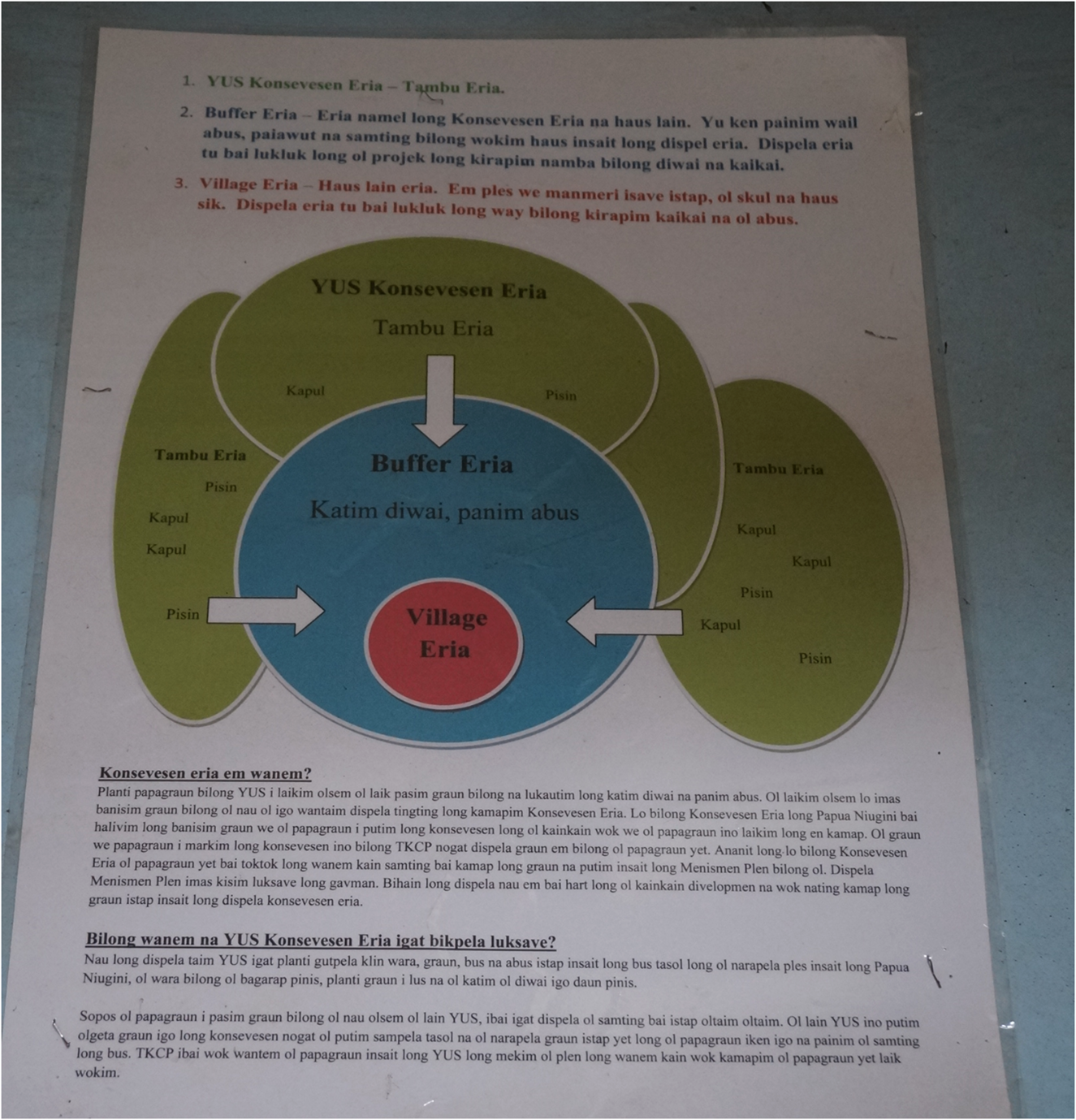
In these moments of code-mixing, comprehension of the semantic meaning of technical English expressions like these indexes a person's ability to understand the workings of powerful outsiders and to explain them to others in the community. Which is to say, the intelligibility of these English expressions is resonant with social significance: it is the mark of a leader. Here, in a context of uneven multilingualism, culture contact, and the propagation of national and global institutions into the Yopno Valley, the semantic and the social are two sides of the same coin.
Multilingualism and the semantic mediation of ideas and institutions: From colonialism and missionization to neoliberal globalization
English is only the latest in a long history of outside languages associated with leadership in the Yopno Valley. From the advent of the first Lutheran missionaries in 1928, leading figures in Yopno communities have served as mediators with colonial and postcolonial authorities, which has necessitated familiarity with the languages of colonial officers, NGO administrators, development workers, government authorities, and especially the Lutheran church.
Until the 1970s, the Lutheran church was the principal vehicle of colonial transformation in the valley. The standard histories people tell emphasize how, after some initial trepidation, their ancestors came to see both the material and spiritual benefits of the new religion and took it up eagerly. As people converted to Christianity in the decades that followed the arrival of the first missionaries, the men's houses were disbanded and the sacred, powerful objects they housed were buried, burned, or tossed into the Yopno River. Families who had lived in scattered fenced homesteads surrounded by their fields gathered into centralized settlements built around mission schools and churches that took the place (often literally) of the men's houses. There, people learned how to read, children attended school, and an entirely new cosmology with a new set of ritual practices became part of their lives. Today, virtually all of the roughly 8,000 people living in the valley identify as Christian.
The spread of Christianity in the valley was enabled by Kâte, a Papuan language adapted by the Lutheran mission for use in missionizing communities that spoke other Papuan languages such as Yopno (see McElhanon Reference McElhanon, Flierl and Strauss1977; Renck Reference Renck and Wurm1977; Paris Reference Paris2012). Kâte was the language of both school and church in the Yopno Valley until the 1970s, when the first English-language school was established by the Australian colonial administration shortly before Papua New Guinea gained independence in 1975. It is hard to know exactly how widely and how well Kâte was understood during this period, but my interviews suggest that knowledge of the language was very unevenly distributed. Some knew Kâte very well, becoming teachers and even missionaries traveling to the Central Highlands to spread Christianity. Even at the time of my research, older church leaders could still run services and give sermons in the language. But many others did not attend Kâte language schools at all, particularly young women. Even some who did left school with only a rudimentary knowledge of the language, as young people rarely spent more than a few years in school. Everyone had some exposure to Kâte, if not in school then in church; but knowledge of the language was quite variable.
Much as community leaders with some knowledge of English explain the workings of postcolonial governance in the neoliberal world order—land mobilization, value added taxes, World Bank-directed privatization, and the like—those who learned Kâte well became the school teachers and church leaders who translated the new ideas and institutions associated with Christianity. And as with leaders’ use of English today, understanding semantic content in Kâte—school lessons on secular and religious topics, the Lutheran liturgy, the New Testament and later Bible—was an indispensable part of their social role as church leaders, teachers, pastors, and missionaries.
Much the same was true of Tok Pisin at the time of my research. By the 1960s, under pressure from the Australian colonial administration, the Lutheran church began phasing out Kâte in favor of the English-based creole Tok Pisin. The transition was slow in the Yopno Valley, where Kâte was intimately associated with Christianity and knowledge of Tok Pisin did not become common until the 2000s. Even then, many children and older women were unfamiliar with the language. And, as pastors and church leaders explained to me, many others had only a limited facility with the language, able to use it when necessary but struggling to follow church services and Bible texts in the language.
And so, just as church leaders once explained Kâte-language Bible texts to their audiences in Yopno, pastors continue to do the same with God's Word in Tok Pisin. In church services, codeswitching between Tok Pisin and Yopno was a regular part of the proceedings. Every church service involves at least one Bible text, which is usually read from the Tok Pisin language Buk Baibel (English language Bibles and the Yopno language New Testament are occasionally used as well). Invariably, whenever a Bible text is read in a language other than Yopno, it is translated spontaneously, usually line-by-line, into Yopno. Here is how the start of one Bible text (1 John 4:10) was presented in an evening service in the village of Weskokop, with Tok Pisin underlined and Yopno in italics.
(2) Ves ten. Pasin bilong laikim ol arapela…
‘Verse ten. The practice of loving others’
Amɨn nutnin galaktaŋ yumneŋ dakon aŋpak
‘The practice of loving our friends’
em i pasin bilong Got
‘is God's way.’
un aŋpak un Anutu dakon.
‘that way is God's.’
And so it continues until the end of the verse, with the service leader reading a phrase from the Tok Pisin Bible and spontaneously translating it into Yopno.
As Angermeyer (Reference Angermeyer2010, Reference Angermeyer2015) points out, translation work of this sort has largely been overlooked in the study of codeswitching, even though on the face of it, it looks like many other codeswitching practices (i.e. with languages alternating in the course of an utterance). Partly, this neglect is the result of the focus on contexts of shared multilingualism (Fishman's ‘in-group multilingualism’) in research on codeswitching. There, translation work of this sort is likely less common because all of the participants are proficient in all of the languages involved.
On top of that, this sort of translational codeswitching is more typically taken up in studies of translation and interpretation, a topic with its own voluminous scholarship. While this scholarly division of labor is understandable—not all acts of translation involve codeswitching and not all acts of codeswitching involve translation—it has the effect of obscuring the translation work that often does take place in moments of codeswitching, especially in contexts of uneven multilingualism (a point I return to in the next section). This division of labor also helps to keep semantic considerations, which are so central to the scholarship on translation and interpretation, separate from the concern with social identities and relationships that is central to the study of codeswitching (for an important exception, see Handman (Reference Handman2010)'s model of ‘events of translation’, which is an inspiration for the analysis here).
In the Yopno Valley, codeswitching in events of translation like the one above is an integral part of what church services are as socioreligious activities. Lutheran services there are fundamentally didactic events. The Christian message is widely regarded by people as being of potentially great use in securing blessings in this life and the next. But it is also regarded as very difficult to understand. So, church services focus on making the esoteric, difficult-to-understand messages found in the Bible accessible to congregants.
Much of this is done in the course of sermons. There, pastors and lay leaders offer detailed exegeses of the meaning of the day's Bible readings, meant to open the eyes, the hearts, and the minds of their audience, as they say. This exegetical work is one of the prime responsibilities of Yopno pastors and church leaders, who draw on their training in seminary and Bible schools to elucidate the esoteric meanings hidden in these texts (see Slotta Reference Slotta2023 for additional discussion and examples).
But before they can get into the niceties of Biblical interpretation, the first step in making God's Word intelligible to their audience is to translate it into a language that their audience understands well. In effect, the kind of translational codeswitching exemplified above is the gateway to understanding the Christian message. So, pastors and church leaders must be familiar not only with the specialist religious knowledge that they learn in Bible schools and seminaries; they must be familiar with the language that Lutheran Christianity now comes packaged in: Tok Pisin. That is the language of training in Bible schools and seminary, and that is the language that must be translated for congregants on a routine basis.
Multilingual practices of translation and codeswitching in this context are at once social and semantic activities. Indeed, there is no accounting for codeswitching practices in Bible readings like the one above without reference to both semantic and social factors. Conveying the semantic content of Biblical texts lies at the heart of what church services are as social activities in the Yopno Valley and what pastors, evangelists, and lay leaders do as part of their social roles: they make the message of God in Tok Pisin intelligible to others in the community.
For centuries, people in the global south have been interacting with outside actors and institutions in contexts of European colonialism, Christian missionization, postcolonial nationalism, and neoliberal globalization—contexts typically marked by unevenly distributed multilingualism. Yet, even as the uneven distribution of multilingualism in these contexts is often noted in the sociolinguistic literature (e.g. Blommaert Reference Blommaert2010; Mufwene Reference Mufwene2010; Heller & Duchêne Reference Heller and Duchêne2012; Reyes Reference Reyes2021), little attention has been given to a common consequence of this: namely, in a speech community—or, perhaps better, a contact zone (Pratt Reference Pratt1991)—where people do not share the same languages, the issue of intelligibility routinely arises. And more than that, in such contexts the issue of intelligibility is not simply a matter of semantics, but is frequently bound up with social identities, statuses, relationships, and activities. In the multilingual practices through which ideas and institutions have circulated around the globe in the colonial and post-colonial eras, the social and the semantic often go hand in hand.
In the last two sections, I have highlighted one way in which the social and the semantic are entangled in the Yopno Valley. There, the status of community leaders has long been linked to their understanding of powerful but obscure forces: forest spirits, ancestral relics, and other autochthonous powers. The colonial era introduced new powerful actors and institutions like the Christian God, the Lutheran Church, development officers, and the colonial administration; the formation of the post-colonial nation-state added national and provincial governments, teachers, and politicians to the mix; and neoliberal globalization now brings NGOs, overseas development agencies, and the World Bank as well. Leadership involves the ability to interact effectively with these different actors and institutions, and to make them intelligible to others in Yopno communities—an ability that fuses semantic understanding and social status, both of which are put on display in the multilingual practices of code-mixing and codeswitching I have discussed.
But wherever ideas and institutions circulate from speakers of one language to speakers of another, one is likely to find multilingual intermediaries whose social identities and statuses are linked to their ability to make those ideas and institutions intelligible to others. To take an example from the other side of the world, consider the linguistic practices of indigenous spokespeople in the Amazon. In a masterful synthesis of her own and others’ research, Laura Graham (2002) lays out the sociolinguistic dilemma that these spokespeople confront when they address national and international audiences. In a political context where indigenous groups seek recognition as distinctively autochthonous peoples, indigenous languages are a valuable resource spokespeople use to make their indigeneity visible to the state and wider publics. Indeed, to use Portuguese or some other national or global language in such contexts can put their indigenous identity at risk in the eyes of publics that see linguistic difference as a crucial index of indigenous authenticity. But, at the same time, the use of indigenous languages renders the semantic content of their political messages unintelligible to government officials and wider publics, leaving indigenous groups potentially voiceless.
As Graham shows, this tension is resolved in different ways in different contexts. In some contexts, where the intelligibility of semantic content is viewed as paramount, spokespeople use Portuguese. As Graham (Reference Graham, Warren and Jackson2002:192) notes, ‘this is the reason why many indigenous groups place tremendous importance on Western education, and some make considerable sacrifices so that their youth may become conversant in the dominant language’. In other contexts, where intelligibility is considered less important, spokespeople may use indigenous languages to convey an authentic identity, if not the semantic content of their messages. And in still other contexts, the communication of both semantic and social meanings is made possible through various translation and code-mixing formats. (Interestingly, one of the code-mixing strategies Graham highlights is the inverse of the Yopno-English code-mixing discussed above: technical terms in Amazonian languages are mixed into speech otherwise in Portuguese, much as technical terms in English are mixed into Yopno leaders’ speech.)
If we set semantic considerations of intelligibility aside, the variety of multilingual practices that Graham discusses prove impossible to account for. But the same is true if we focus solely on semantic factors. Across all of the strategies she discusses, intelligibility is simultaneously a semantic and sociopolitical consideration, one that indigenous spokespeople address creatively using different kinds of code choices and code-mixing practices. To grasp the contours of multilingual practices in the contact zones of European colonialism, postcolonial nationalism, and neoliberal globalization, close attention must be given to the ways the social and the semantic are entangled in different contexts. In these contexts, the semantic factors that drive multilingual practices of translation, code-mixing, language learning, and language choice are themselves often factors of social significance as well.
Conclusion: The social meanings of intelligibility
At one time, the separation of the semantic from the social provided a way for the budding field of sociolinguistics to carve out a niche for itself. Over half a century later, having firmly established itself, it is time for the field to reevaluate whether this dichotomy is sustainable and whether it is worth sustaining. As I have argued here, the semantic and the social often cannot be neatly separated in the way this foundational dichotomy suggests. By excluding considerations of intelligibility, much that is of social significance in multilingual practice is excluded as well. This is especially true in contexts of uneven multilingualism, which have long been treated as the poor stepchild in research on multilingual practices. Yet, as I hope to have indicated here, such contexts are ubiquitous, perhaps especially so in an era of post-colonial globalization.
In a way, there is nothing surprising about the salience of intelligibility as a sociolinguistic variable. The communication of semantic content is one of the prime functions of language in social life. Taking semantic considerations like intelligibility into account, then, does not mean turning away from the social life of language; it means looking more closely at how the semantic matters socially in different contexts.
At present, some of the most concerted attention to the social stakes of intelligibility is found in the work of political theorists and economists on language rights, linguistic justice, and the spread of global languages (e.g. Patten Reference Patten2001; de Swaan Reference de Swaan2001; Kymlicka & Patten Reference Kymlicka and Patten2003; Archibugi Reference Archibugi2005; Van Parijs Reference Van Parijs2011). Where linguists and education researchers have tended to stress the importance of languages as vital sources of identity and community in their discussions of these issues (e.g. Skutnabb-Kangas Reference Skutnabb-Kangas2000; May Reference May2012), political theorists and economists have emphasized the instrumental role that language plays as a tool for communicating semantic content, essential to diverse domains of social life: education, legal services and protections, political participation, health care, employment, and the production and consumption of cultural goods. All of these, as Ruth Rubio-Marín (Reference Rubio-Marín, Kymlicka and Patten2003:65) puts it, depend on ‘the possibility of comprehensible linguistic interactions’.
Linguists and others have criticized work along these lines for neglecting the many other, non-referential ways in which languages matter to their users. As true as that often is, it does not negate the fact that intelligibility too is a matter of significance in all of these areas of social life. If anything, political theorists and economists—with their focus on economic markets and state services—have not gone far enough in exploring the many ways intelligibility is a matter of social significance. In New York City courtrooms, interpreters are tasked with making the proceedings intelligible to participants as a matter of equal justice (Angermeyer Reference Angermeyer2015), a legal and moral consideration that is often talked about by political theorists. But for the Spanish-English bilingual children Zentella (Reference Zentella1997) worked with in New York City, intelligibility is connected to very different social considerations and cultural values: children are enjoined to follow the code choices of their elders because making themselves intelligible is a sign of respect, a highly salient value in this context. Here, the social significance of intelligibility is not the sort that political theorists typically concern themselves with.
Likewise, in the Yopno Valley, facility with English is seen as essential to socioeconomic mobility. As in many postcolonial and globalizing labor markets, it is a ‘communication skill’ required for many jobs, especially those people most aspire to (Heller Reference Heller2003; Cameron Reference Cameron, Erreygers and Jacob2005; Urciuoli & LaDousa Reference Urciuoli and LaDousa2013). Here, intelligibility figures as an economic matter of the sort readily recognized by economists and political theorists. But as I have sought to show, in the Yopno Valley facility with English is also tied to conceptions of leadership, power, and knowledge that fall well beyond the ken of economic and political theory.
As these examples indicate, intelligibility is like other sociolinguistic variables—its social meaning varies across cultural, political, economic, and religious contexts (Agha Reference Agha2007; Eckert Reference Eckert2008; Hall-Lew, Moore, & Podesva Reference Hall-Lew, Moore, Podesva, Hall-Lew, Moore and Podesva2021). Here it is a sign of respect in age-graded neighborhood hierarchies; there it is tied to socioeconomic mobility in post-colonial labor markets; and elsewhere it is part of what it means to be a community leader. Much like the phonic variables that have been at the heart of second and third wave sociolinguistics (Eckert Reference Eckert2012), intelligibility requires close ethnographic attention to its multifarious social meanings: what values, identities, interests, and desires make intelligibility a matter of importance for language users in a particular social setting? Is it necessary to function in a workplace? Is it needed to achieve equal justice? Is it a sign of respect? Barring such close ethnographic attention, the economic rationales and moral imperatives conjectured by political and economic theorists will continue to serve as a poor substitute for the myriad ways that intelligibility actually matters to language users in different settings.
Moreover, without careful attention to the social meanings of intelligibility in different settings, it will prove impossible to account for the varied contours of multilingual practices across these settings. In Nuyorican neighborhoods, where concerns about intelligibility are inflected by considerations of age, hierarchy, and respect, the burden of intelligibility is placed on children, who are enjoined to follow the code choices of their elders. In the courtroom context, where intelligibility is a matter of equality, justice, and legal procedure, the task of ensuring intelligibility is allocated to a professional interpreter, providing at least a veneer of equality, accessibility, and professional competence to the proceedings. In the Yopno Valley, where intelligibility is a concern in dealings with powerful outside actors and institutions, it is community leaders who take the lead in making these actors and institutions intelligible to others in their community. In each of these contexts, who engages in multilingual practices of codeswitching, translation, and language choice, and how they engage in them, differs. To understand how and why multilingual practices differ across these contexts, it is not enough to point to the importance of intelligibility as a sociolinguistic variable. We need to attend to the different social meanings that intelligibility has in each of them.
From micro-interactional code choices and code-mixing patterns like the ones I have focused on here to macro-historical processes of language shift and endangerment—for example, why people in the Amazon and Papua New Guinea are learning national and global languages—considerations of intelligibility shape multilingual practices and multilingual repertoires. In the macro-historical domain, the spread of English is itself a case in point. The legacy, in part, of the British colonial enterprise and the international influence of the United States, English has become, as many have emphasized, an essential medium of communication in a globalizing world. It serves as one of the primary working languages of international business, politics, and science. And it has come to function widely as a lingua franca, enabling communication between people whose first languages differ. At the same time, English is more than merely a tool for communicating semantic content; it has become a vehicle for expressing a range of identities and a variety of attributes in different settings: modernity, cosmopolitanism, education, mobility, luxury, coolness, style (e.g. LaDousa Reference LaDousa2014; Nakassis Reference Nakassis2016; Zentz Reference Zentz, Giri, Sharma and D'Angelo2020; Henry Reference Henry2021; Highet Reference Highet2022).
In the literature on global English, these two perspectives on the language—focusing on English as a medium of communication and an emblem of identity—are often set against one another. For those emphasizing English's role as a lingua franca, the informational function of English often eclipses its identity-marking function: ‘When speakers who belong to different linguacultures enter into these intercultural communication situations, it seems that their focus often shifts to communicative effectiveness and economy instead of markers of prestige and social status’ (Breiteneder Reference Breiteneder2009:263). For others, the informational function is backgrounded in favor of identity signaling:
In my research with ELF [English as a Lingua Franca] users in China I quickly learned that English is often used in spite of, and occasionally because of, problems with intelligibility. According to my observations, occasionally the purpose of English use was to successfully communicate information—as in the case of professionals employing technical vocabulary in English rather than Chinese—but far more commonly the purpose of ELF was indexical (i.e. how particular choices about register, style, accent and lexical usage signaled to other speakers desirable identities, stances, attitudes and forms of belongs). (Henry Reference Henry, Holmes and Dervin2016:186)
In a way, the literature on global English—with its focus divided between English as a medium of communication and an emblem of identity—replays the dichotomy between the social and the semantic that has been a focus of this article. As we have seen, the dichotomy has proven fruitful in opening up the vast territory of non-semantic, non-referential, social meaning for research. In the literature on global English, such a perspective has usefully spotlighted the role that varieties of English play as emblems of identity throughout the world. And yet, as important as English no doubt is as a marker of identity around the world, it also no doubt plays an important role as a vehicle of communication. Indeed, as I have highlighted in my discussion of English in the Yopno Valley, these two factors are often inextricably linked to one another: the communication of semantic content is part and parcel of its social significance. But the dichotomization of social and semantic meaning makes it all too easy to lose sight of such connections.
What is needed at all levels of analysis—from the micro-interactional to the world historical—is a less rigid dichotomy that allows us to chart the ways that conveying semantic content is itself a social activity in which identities, statuses, and stances are all at issue as well.


 Open access

