

In comparison to biological sex differences and mate preferences, differences in sexual orientation and mate preferences have received limited attention in the literature. Sexual orientation can be defined as sexual preference, and is often categorised as either a preference for members of the same sex (homosexuality), a preference for members of the opposite sex (heterosexuality), or a preference for both sexes (bisexuality; Kassin, Fein, & Markus, Reference Kassin, Fein and Markus2011). Bailey, Gaulin, Agyei, and Glaude (Reference Bailey, Gaulin, Agyei and Gladue1994) stated that very few studies have paid specific attention to the mating psychology of individuals with a homosexual orientation. This in itself is perplexing, as research should not just assume that the mate preferences of individuals with a sexual orientation other than heterosexual simply mirror heterosexual mate preferences. As homosexual sexual orientation produces different mating behaviour to heterosexual sexual orientation (Bailey et al., Reference Bailey, Gaulin, Agyei and Gladue1994), it is reasonable to conclude that individuals of a sexual orientation other than heterosexual may express different mate preferences. It could be argued that as sexual orientation is not measured in studies of sex differences in mate preferences, research has actually ignored a critical factor that may be both influencing and moderating these mate preferences. Therefore, the aim of this article was to assess the independent and interactive effects of biological sex and sexual orientation on how much of a necessity heterosexual, homosexual, and bisexual men and women consider physical attractiveness and social level in long-term and short-term relationships.
Sexual Orientation and Mate Preferences
Studying relationships between sexual orientation and mate preferences may shed light and distinguish among different origin theories of sex differences in mate preferences (Lippa, Reference Lippa2007). For example, Kenrick, Keefe, Bryan, Barr, and Brown (Reference Kenrick, Keefe, Bryan, Barr and Brown1995) suggest that a homosexual sexual orientation would potentially challenge reproduction, and this in turn contests evolutionary theory of sex differences in mate preferences. Furthermore, as homosexuality is considered, to some extent, heritable (Kenrick et al., Reference Kenrick, Keefe, Bryan, Barr and Brown1995; Bailey & Pillard, Reference Bailey and Pillard1991), the adaptive nature of homosexuality is further puzzling. Other research has argued there are no biological or genetic functions of homosexuality, and that this sexual orientation is a function of the environment alone (Kenrick et al., Reference Kenrick, Keefe, Bryan, Barr and Brown1995). However, research on the biological and psychological factors of sexual orientation dispels this idea.
Research on biological and psychological factors of sexual orientation
Research has also attempted to incorporate and combine the role of both biological and psychological processes. Bem (Reference Bem1996) theorised that the development of sexual orientation was both an influence of hormones and an individual's environment. Different hormones and temperaments could lead individuals to engage in either ‘masculine’ activities with male playmates, or ‘feminine’ activities with female playmates (Bem, Reference Bem1996). Bem (Reference Bem1996) then referred to children who prefer same-sex playmates as ‘gender conformists’ and to children who prefer opposite-sex playmates as ‘gender nonconformists’, and proposed that ‘gender-conforming’ children come to see members of the opposite sex as ‘exotic’. In contrast, gender-nonconforming children come to see same-sex as exotic, and during puberty develop physical and sexual attraction to the sex they find exotic. Hence, Bem (Reference Bem1996) labelled this theory as ‘exotic becomes erotic’. However, support for this prediction is unclear (Kassin et al., Reference Kassin, Fein and Markus2011).
However, research does continue to find support for gender atypical behaviour in homosexual men and women, particularly during childhood (Rieger, Linsenmeier, Gygax, & Bailey, Reference Rieger, Linsenmeier, Gygax and Bailey2008), and they also tend to be more gender nonconforming as adults (Drummond, Peterson-Badali, & Zucker, Reference Drummond, Bradley, Peterson-Badali and Zucker2008). Homosexual men and some homosexual women do exhibit behaviour more typical of the opposite sex, such as interests and dress (Bailey et al., Reference Bailey, Gaulin, Agyei and Gladue1994; Bailey, Kim, Hills, & Linsenmeier, Reference Bailey, Kim, Hills and Linsenmeier1997; Rieger et al., Reference Rieger, Linsenmeier, Gygax and Bailey2008). However, Bailey and colleagues (Reference Bailey, Gaulin, Agyei and Gladue1994) posit that although behavioural characteristic differences may exist between homosexual and heterosexual men and women, at the same time these individuals may be similar in other areas that affect mate preferences and mating psychology. The above section has considered theories of differing sexual orientations in humans, such as biological and environmental influences. The next part will discuss research examining differing sexual orientations and mate preferences.
Research on mate preferences and sexual orientation
Lippa (Reference Lippa2007) collected data from an online BBC survey from a large number of heterosexual and homosexual men and women in an effort to compare mate preferences between differing sexual orientation. Participants included 102,961 heterosexual men (91% of men), 5,938 gay men (5% of men), 82,819 heterosexual women (90% of women), and 2,548 lesbian women (3% of women). Participants were of differing nationalities, though the highest participating nationalities were from the United Kingdom (45%), the United States (29%), Canada (5%), and Australia (4%). Participants reported their biological sex from one of two responses: ‘male’ or ‘female’. Sexual orientation was assessed by asking ‘What is your sexual orientation?’, and participants were asked to choose one out of the three provided responses: ‘Heterosexual’, ‘Homosexual’, and ‘Bisexual’. Results were that homosexual men showed similar preferences for physical attractiveness as heterosexual men, whereas homosexual women were similar to heterosexual women in ranking attractiveness relatively low. However, differences in sexual orientation and mate preferences were found. Specifically, heterosexual men and women tended to rank religion, parenting ability, and fondness for children more highly than homosexual men and women. Lippa (Reference Lippa2007) argued that sexual orientation differences regarding these characteristics make sociological sense, as homosexual relationships may be less likely to focus on child rearing, and because of the negative views of many organised religions regarding homosexuality.
Deaux and Hanna (Reference Deaux and Hanna1984) examined 800 personal advertisements that were collected from four different publications. These personal advertisements were equally dispersed between homosexual men and women and heterosexual men and women. Results found that men were significantly more likely than women to seek physical attractiveness and to offer financial assets. Meanwhile, women were more likely than men to seek and offer psychological characteristics. Results also found that heterosexuals were significantly more likely to seek attractiveness, and heterosexuals were also more likely to offer information about their financial status and occupation. Finally, heterosexual women were most likely to offer indices of physical attractiveness, followed by homosexual men, whereas homosexual women were least likely to do so. Additionally, heterosexual women were more likely to seek financial security and status and occupational information. Heterosexual men were most likely to offer information about their occupation and to seek physical attractiveness. Again, the authors theorised that perhaps the heterosexual relationship sets up certain expectations for women, and the women who choose a different (homosexual) type of relationship are free to define themselves in different ways, responding to a lessened set of role demands.
Although there are similarities between homosexual and heterosexual men's and women's mate preferences, we cannot assume equality, nor can we just assume a reverse, linear relationship. For example, research examining the physical attraction of heterosexual men and women and homosexual men and women shows that heterosexual men regard physical attractiveness in women differently to how homosexual women perceive physical attractiveness in women (Wood & Brumbaugh, Reference Wood and Brumbaugh2009). Clearly, the research presented so far shows that the relationship between biological sex, sexual orientation and mate preferences is multifaceted and complex. As such, it is not sufficient to assume that individuals of sexual orientations other than heterosexual have mate preferences that simply mirror heterosexuals.
The mate preferences of heterosexual men and women have also been shown to differ depending on the term of relationship they are considering (i.e., long-term vs. short-term). This research will be presented below, and will consequently show that mate preferences of individuals other than a heterosexual sexual orientation should also be considered in different relationship terms. These sex differences in mate preferences will now be discussed in differing terms of relationships (i.e., short-term and long-term).
Relationship Lengths and Mate Preferences
The term of relationship being considered (i.e., long-term or short-term) also has an effect on men's and women's mate preferences (Regan, Levin, Sprecher, Christopher, & Cate, Reference Regan, Levin, Sprecher, Christopher and Cate2000). This may be because different lengths of relationships have different implications for levels of parental investment: if offspring result from a short-term relationship, women are likely to contribute the majority of parental investment (Trivers, Reference Trivers and Campbell1972). As a result, men tend to favour short-term sexual relationships more than women do (Symons, Reference Symons1979). Strategic pluralism theory states that both men and women seek short-term mates who can provide high quality genes that will promote health in their offspring (Kruger & Fisher, Reference Kruger and Fisher2008). For women, although long-term mates may also contribute genetic fitness to offspring, physical attractiveness appears to be more important when seeking short-term mates.
Sexual strategies theory, however, states that the characteristics women prefer in long-term and short-term mates are quite similar, and theorises that women use short-term mating to evaluate mates as potential long-term partners (Buss & Schmitt, Reference Buss and Schmitt1993). However, sexual strategies theory receives limited support in the literature, as research continues to find that women consider the physical attractiveness of a short-term mate more important than the physical attractiveness of a long-term mate (e.g., Li & Kenrick, Reference Li and Kenrick2006; Schulte-Hostedde, Eys, & Johnson, Reference Schulte-Hostedde, Eys and Johnson2008).
Theories of Sex Differences in Mate Preferences
Although physical attractiveness and status and resources are important characteristics to both sexes when considering a potential mate (Schulte-Hostedde et al., Reference Schulte-Hostedde, Eys and Johnson2008), a robust, consistent pattern has emerged: Men place greater importance on the physical attractiveness of a potential long-term mate than women do, whereas women place greater importance on the status and resources of a potential long-term mate than men do (Badahdah & Tiemann, Reference Badahdah and Tiemann2005; Cottrell, Neuberg, & Li, Reference Cottrell, Neuberg and Li2007; Greitemeyer, Reference Greitemeyer2007; March & Bramwell, Reference March and Bramwell2012). These sex differences in mate preferences are considered to be reliable (Perilloux, Fleischman, & Buss, Reference Perilloux, Fleischman and Buss2011) and stable across cultures (Buss et al., Reference Buss, Abbott, Angleitner, Asherian, Biaggio, Blanco-Willasenor and Yang1990; Jonason, Li, & Cason, Reference Jonason, Li and Cason2009). These sex differences in mate preferences are often attributed to evolutionary and/or social-economic origins.
Evolutionary theory of sex differences in mate preferences
Evolutionary theory contends that human mate selection is governed by evolved mechanisms that developed to overcome reproductive obstacles (Stanik & Ellsworth, Reference Stanik and Ellsworth2010). Parental investment theory (Trivers, Reference Trivers and Campbell1972) states that men and women differ in reproductive strategies, based upon the minimum level of parental investment they must make to ensure an offspring's survival. Compared to women, men's level of parental investment is considered low, and therefore men are able to focus on the physical attributes of a mate associated with fertility. Due to the extensive parental investment required of women, women seek mates who are able to contribute the material resources required to ensure an offspring's survival. Thus, a woman's reproductive potential is characterised by physical attributes, whereas a man's reproductive potential is characterised by his status and resources (Geary, Vigil, & Byrd-Craven, Reference Geary, Vigil and Byrd-Craven2004).
Social-economic theory of sex differences in mate preferences
Social-economic theory states that these sex differences in mate preferences are a product of social roles and economic constraints. Social role theory (Wood & Eagly, Reference Wood and Eagly2002) predicts that these differences are related to gender roles, and men and women who endorse a more traditional gender role exhibit stronger traditional sex differences (Eagly, Eastwick, & Johannesen-Schmit, Reference Eagly, Eastwick and Johannesen-Schmidt2009). Social-economic theory also proposes that these sex differences exist due to economic constraints (Moore, Cassidy, Law Smith, & Perrett, Reference Moore, Cassidy, Law Smith and Perrett2006). As women have historically experienced greater economic constraints than men, women seek partners who possess these resources (Buss & Barnes, Reference Buss and Barnes1986; Moore & Cassidy, Reference Moore and Cassidy2007). As men have not been bound by these economic restrictions, men are able to focus on the physical attractiveness of a potential mate (Li, Bailey, Kenrick, & Linsenmeier, Reference Li, Bailey, Kenrick and Linsenmeier2002). It should be noted that although evolutionary and social-economic theories are not considered entirely incompatible, evolutionary theory has paid less attention to within-sex differences (Eagly & Wood, Reference Eagly and Wood1999). In sum, the information presented thus far has suggested sex differences in mate preferences are attributed to both evolutionary and social-economic origins, and tend to change when men and women are considering short-term or long-term relationships. However, it cannot be assumed that individuals of differing sexual orientations will just reflect heterosexual mate preferences. The current study attempts to address this gap in the literature, by considering short-term and long-term mate preferences of individuals other than a heterosexual orientation.
Aim and Hypotheses
The aim of the current experiment was to explore the relationship between biological sex and sexual orientation on the necessity of a long-term and short-term mate's physical attractiveness and social level. A similar mating psychology of heterosexual and homosexual individuals could suggest that powerful biological or socialisation factors, which are common to all men and to all women, underlie mating psychology, despite variations in sexual orientation. Based on previous research that has suggested biological sex may influence sex differences in long-term mate preferences more so than sexual orientation, the current study predicted that:
-
1. Heterosexual and homosexual men will consider the physical attractiveness of a long-term mate significantly more of a necessity than heterosexual and homosexual women.
-
2. Heterosexual and homosexual women will consider the social level of a long-term mate significantly more of a necessity than heterosexual and homosexual men.
As previous research has not yet considered the effects of sexual orientation on short-term mate preferences, the following exploratory question was also generated:
-
3. What is the effect of sexual orientation of the necessity of a short-term mate's physical attractiveness and social level, and if an effect exists, does this effect support sexual strategies theory or sexual selections theory?
Method
Participants
Participants were randomly allocated into long-term and short-term conditions, where participants in the long-term condition considered a long-term mate (e.g., marriage partner) and participants in the short-term condition considered a short-term mate (e.g., casual, one-time sexual mate).
Long-term condition
In the long-term condition, there were 166 participants with a mean age of 22.40 years (SD = 3.33). In the long-term condition, there were 61 men (36.7%) and 105 women (63.3%). Of the participants, 66 (39.8%) identified as heterosexual, 46 (27.7%) identified as homosexual, and 54 identified as bisexual (32.5%).
Short-term condition
For the short-term condition, there were 141 participants with a mean age of 22.15 years (SD = 3.36). In the short-term condition, there were 50 men (35.5%) and 91 women (64.5%). Of the participants, 61 (43.4%) identified as heterosexual, 39 identified as homosexual (27.7%) and 41 (29.1%) identified as bisexual.
Materials
Materials were an online questionnaire that included a demographics section and the mate budget paradigm.
Demographics
Participants were asked to supply the following information through self-report: age in years, biological sex, whether English was their primary language. Participants indicated their sexual orientation through ticking the box they believed best described their sexual-orientation (heterosexual, homosexual, or bisexual), as modelled by Lippa (Reference Lippa2007).
Mate budget paradigm (long-term/short-term)
The mate budget paradigm developed by Li and colleagues (Reference Li, Bailey, Kenrick and Linsenmeier2002) was used in the current study. Participants were randomly assigned to one of two questionnaires. One questionnaire asked participants to consider a long-term relationship and 848 (52.1%) participants completed the long-term relationship questionnaire. The other questionnaire asked participants to consider a short-term relationship, and 781 (47.9%) participants completed the short-term questionnaire.
The mate budget paradigm consists of three different parts. First, an introduction informs participants that they will be asked to indicate characteristics they would desire a long/short-term partner to possess by using percentiles. The introduction then gives a brief example of percentiles using height as an example.
If we could rank all the women by their height, then the tallest woman would be at the 100th percentile of height (she is taller than 100% of all the women). The woman at the 50th percentile is of median or roughly average height (she is taller than 50% of women). The shortest woman is at the 0th percentile of height (she is taller than 0% of women).
Following this is the first budget, which requires participants to design their ideal long-term/short-term mate by indicating a percentile level for five characteristics (physical attractiveness, creativity, kindness, liveliness, social level). The first budget requires that only 10 ‘mate dollars’ are spent, so participants must ensure that the percentiles for each of the characteristics will, at the end, equal 10.
The high budget is presented next. This requires participants to once again design their ideal long/short-term mate by indicating a percentile level for five characteristics, but this time they may spend 30 ‘mate dollars’. This time, participants must ensure that the percentiles for each of the characteristics will, at the end, equal 30.
For the current study, low and high budget presentation was counterbalanced. The counterbalanced condition (high then low presentation) consisted of 776 (47.5%) of the participants, whereas 859 (52.5%) of participants received the low then high presentation.
Procedure
Participants were recruited on and off the Australian Catholic University Brisbane Campus by the student researcher. Participants were contacted during class time and through the means of social media. Participants were informed this study was voluntary and anonymous and would take approximately 20–30 minutes of their time. Participants were given the online address to access the study.
Results
Data Screening
Before inferential analyses were run, data were split by term of relationship and checked for missing values, normality (Levene's test of normality) and univariate outliers. No missing values were found to exceed 5%. Univariate outliers were detected; however, analyses were run with and without inclusion of these outliers and as results did not change, outliers were not deleted. Finally, distributions of physical attractiveness and social level scores were not found to significantly violate normality.
Inferential Statistics
Bivariate correlations
Data were split by term of relationship and bivariate correlations between sex, sexual orientation and necessity of physical attractiveness and social level, and are presented in Table 1 for long-term data and Table 2 for short-term data.
Bivariate Correlations between Sex, Sexual Orientation and Necessity of Physical Attractiveness and Social Level in Long-Term Mates

Note: Sex is coded as 0 = Male, 1 = Female, Sexual orientation is coded as 1 = Heterosexual, 2 = Homosexual, 3 = Bisexual.
*p < .05, **p < .01.
Bivariate Correlations between Sex, Sexual Orientation and Necessity of Physical Attractiveness and Social Level in Short-Term Mates

Note: Sex is coded as 0 = Male, 1 = Female, Sexual orientation is coded as 1 = Heterosexual, 2 = Homosexual, 3 = Bisexual.
*p < .05, **p < .01.
Factorial analysis of variance and long-term data
To test hypotheses 1 and 2, data were split by term of relationship and two 2 × 3 independent-measures ANOVAs were run on the long-term relationship data with sex (2 levels: men and women) and sexual orientation (3 levels: heterosexual, homosexual, and bisexual) as the independent variables (IVs), and physical attractiveness necessity scores and social level necessity scores as the dependent variables (DVs), respectively.
Regarding physical attractiveness necessity scores, there was a main effect of sex, F(1, 160) = 6.01, p = .015, ηp 2 = .04, observed power = .68. There was also a main effect of sexual orientation, F(2, 160) = 4.05, p = .019, ηp 2 = .05, observed power = .71. Finally, there was a significant interaction between sex and sexual orientation, F(2, 160) = 8.30, p = .001, ηp 2 = .09, observed power = .96. (See Table 3 for descriptives and Figure 1 for graphical representation of means.)
Long-Term Relationship Descriptives for Physical Attractiveness Necessity Scores with Variables of Sex and Sexual Orientation

Heterosexual, homosexual and bisexual men and women's mean long-term mate physical attractiveness necessity scores. Error bars represent standard errors.

Post-hoc tests with a Bonferroni correction revealed men considered a long-term mate's physical attractiveness significantly more of a necessity than women considered a long-term mate's physical attractiveness a necessity, p = .015.
Post-hoc tests with a Bonferroni correction revealed individuals of a heterosexual sexual orientation considered the physical attractiveness of a long-term mate significantly more of a necessity than did individuals of a bisexual sexual orientation, p = .024.There was no significant difference between individuals of a heterosexual sexual orientation and a homosexual sexual orientation, p = .153. Finally, there was no significant difference between individuals of a homosexual sexual orientation and a bisexual sexual orientation, p = .999.
Regarding the interaction between sex and sexual orientation, post-hoc analyses with a Bonferroni correction showed that heterosexual men considered a long-term mate's physical attractiveness significantly more of a necessity than heterosexual women considered a long-term mate's physical attractiveness, p = .001.
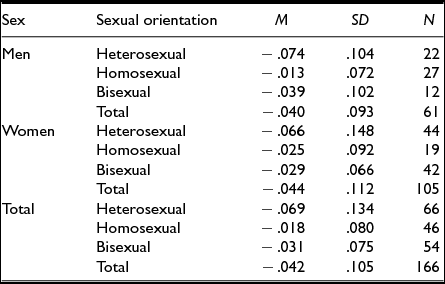
Regarding social level necessity scores, there was no main effect of sex, F(1, 160) = .01, p = .920, ηp 2 = .01, observed power = .05. There was a main effect of sexual orientation, F(2, 160) = 3.25, p = .041, ηp 2 = .04, observed power = .61. Finally, there was no significant interaction between sex and sexual orientation, F(2, 160) = .16, p = .849, η p 2 = .01, observed power = .08. (See Table 4 for descriptives and Figure 2 for graphical representation of means.)
Long-Term Relationship Descriptives for Social Level Necessity Scores with Variables of Sex and Sexual Orientation
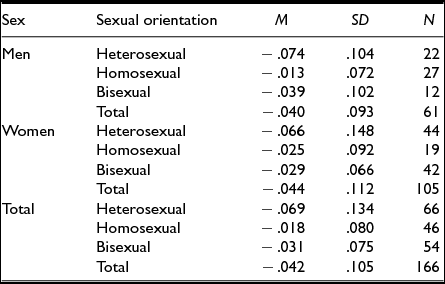
Heterosexual, homosexual and bisexual men and women's mean long-term mate social level necessity scores. Error bars represent standard errors.

Post-hoc comparisons with a Bonferroni correction showed that individuals with a homosexual sexual orientation considered the social level of a long-term mate significantly more of a necessity than individuals with a heterosexual sexual orientation, p = .046. However, individuals with a homosexual sexual orientation did not consider the social level of a long-term mate significantly more of a necessity than individuals of a bisexual sexual orientation, p = .999. Finally, there was no significant difference between social level necessity scores of individuals of a heterosexual sexual orientation and those of a bisexual sexual orientation, p = .301.
Factorial analysis of variance and short-term data
To test hypotheses 3 and 4, data were split by term of relationship and two 2 × 3 independent-measures ANOVAs were run on the short-term relationship data with sex (two levels: men and women) and sexual orientation (three levels: heterosexual, homosexual, and bisexual) as the IVs, and physical attractiveness necessity scores and social level necessity scores as the DVs, respectively.
Regarding physical attractiveness necessity scores, there was no main effect of sex, F(1, 135) = 2.48, p = .118, ηp 2 = .02, observed power = .35. There was a main effect of sexual orientation, F(2, 135) = 12.70, p = .001, ηp 2 = .16, observed power = .99. Finally, there was no significant interaction between sex and sexual orientation, F(2, 135) = 1.08, p = .344, ηp 2 = .02, observed power = .24. (See Table 5 for descriptives and Figure 3 for graphical representation of means.)
Short-Term Relationship Descriptives for Physical Attractiveness Necessity Scores with Variables of Sex and Sexual Orientation

Heterosexual, homosexual and bisexual men and women's mean short-term mate physical attractiveness necessity scores. Error bars represent standard errors.

Post-hoc comparisons with a Bonferroni correction showed individuals of a heterosexual sexual orientation considered the physical attractiveness of a short-term mate significantly more of a necessity than did individuals of a homosexual sexual orientation, p = .001. Furthermore, individuals of a heterosexual orientation considered the physical attractiveness of a short-term mate significantly more of a necessity than did individuals of a bisexual sexual orientation, p = .001. There was no significant difference between individuals of a homosexual sexual orientation and a bisexual sexual orientation, p = .965.
Regarding social level necessity scores, there was no main effect of sex, F(1, 135) = 3.70, p = .057, ηp 2 = .03, observed power = .48. There was no main effect of sexual orientation, F(2, 135) = 1.37, p = .257, ηp 2 = .02, observed power = .29. Finally, there was no significant interaction between sex and sexual orientation, F(2, 135) = .06, p = .938, ηp 2 = .01, observed power = .06. (See Table 6 for descriptives and Figure 4 for graphical representation of means.)
Short-Term Relationship Descriptives for Social Level Necessity Scores with Variables of Sex and Sexual Orientation

Heterosexual, homosexual and bisexual men and women's mean short-term mate social level necessity scores. Error bars represent standard errors.

Discussion
The aim of the current study was to explore the relationship between biological sex and sexual orientation on the necessity of a long-term and short-term mate's physical attractiveness and social level. Based on previous research, the current study predicted that heterosexual and homosexual men would consider the physical attractiveness of a long-term mate significantly more of a necessity than heterosexual and homosexual women. This hypothesis was only partially supported, as although heterosexual men did consider a long-term mate's physical attractiveness significantly more of a necessity than heterosexual women, there was no significant difference between homosexual men and women. These results do not corroborate results of Lippa (Reference Lippa2007), who found that homosexual men showed similar preferences for physical attractiveness as heterosexual men and homosexual women were similar to heterosexual women. However, as the current study assessed necessities instead of allowing individuals to rank importance of traits, this may explain why the current results are in contrast to the work of Lippa (Reference Lippa2007).
The current study also predicted that heterosexual and homosexual women would consider the social level of a long-term mate significantly more of a necessity than heterosexual and homosexual men. Results did not support this hypothesis, as no significant interaction was found between biological sex and sexual orientation.
Finally, the current article explored the effect of sexual orientation on the necessity of a short-term mate's physical attractiveness and social level. Additionally, we sought to explore whether an effect does exist, and if it provides more support for sexual strategies theory or sexual selections theory. Results showed no significant interaction between biological sex and sexual orientation on the necessity of a short-term mate's physical attractiveness and social level. Results also showed no effect of biological sex on necessity of a short-term mate's physical attractiveness. This provides support for sexual selections theory, as men and women did not differ when considering a short-term mate's physical attractiveness a necessity. However, results did show an effect of sexual orientation on the necessity of a short-term mate's physical attractiveness. Specifically, individuals of a heterosexual sexual orientation considered a short-term mate's physical attractiveness significantly more of a necessity than individuals of homosexual and bisexual sexual orientations. Furthermore, there was no difference between homosexuals’ and bisexuals’ necessity scores. We posit that these results suggest further support for sexual selections theory, as heterosexuals may experience greater possibility of offspring resulting from short-term sexual relations compared to homosexuals and bisexuals. Therefore, individuals of a heterosexual sexual orientation may consider the physical reproductive qualities of a short-term mate more of a necessity, in the hope that if offspring do result from short-term sexual relations, the offspring will inherit these physical attributes. The support for sexual selections theory is further corroborated by the lack of effect of biological sex and sexual orientation on the necessity of a short-term mate's social level. Sexual strategies theory predicts that women will consider the social level of a short-term mate more of a necessity compared to men, and results of the current study did not support this prediction.
Additional Considerations
Although not addressed by predictions, additional results of the current study warrant consideration. First, results showed a main effect for both sex and sexual orientation on necessity of a long-term mate's physical attractiveness. Specifically, men considered a long-term mate's physical attractiveness significantly more of a necessity than women did, and individuals of a heterosexual sexual orientation considered a long-term mate's physical attractiveness significantly more of a necessity than individuals of a bisexual sexual orientation. Concerning sexual orientation, there were no other significant differences. In sum, results of long-term mates’ physical attractiveness necessity scores show that men consider physical attractiveness more of a necessity than women do, heterosexuals consider physical attractiveness more of a necessity than bisexuals do, and heterosexual men consider physical attractiveness more of a necessity than heterosexual women. Results of the current study suggest that, contrary to the suggestion of Bailey and colleagues (Reference Bailey, Gaulin, Agyei and Gladue1994), differences do exist between men and women of different sexual orientations. Specifically, perhaps traditional sex differences in mate preferences regarding a long-term mate's physical attractiveness are not only a product of biological sex, and may actually be influenced by an individual's sexual orientation. If this is the case, by not assessing sexual orientation, research regarding sex differences in mate preferences has neglected a potentially moderating characteristic. This suggestion is substantiated by further results of the current study, which showed that there was an effect of sexual orientation on the necessity of a long-term mate's social level. Specifically, individuals of a homosexual sexual orientation considered a long-term mate's social level significantly more of a necessity than individuals of heterosexual sexual orientation. Again, this effect of sexual orientation on mate preferences suggests that the effect of sexual orientation should not be discounted.
Strengths, Limitations and Future Directions
Jonason, Li, and Richardson (Reference Jonason, Li and Richardson2011) posit that research on human relationships has focused extensively on the dichotomy of long-term and short-term relationships, but other relationships exist that may not neatly fall into one of these categories (e.g., casual sex; Wentland & Reissing, Reference Wentland and Reissing2011). Therefore, a potential direction for future research is to consider the mate preferences of individuals of differing sexual orientation in relationships that do not fall into the dichotomised categorised of ‘long-term’ and ‘short-term’. Exploring necessities of individuals of differing sexual orientations in relationships such as ‘booty-calls’ (Jonason et al., Reference Jonason, Li and Cason2009), ‘fuck buddies’ (Wentland & Reissing, Reference Wentland and Reissing2011), and ‘friends with benefits’ (Bisson & Levine, Reference Bisson and Levine2009) will provide further clarification of the necessities of mates in all forms of relationships.
This was the first study to examine how much of a necessity individuals of differing sexual orientations consider the physical attractiveness and social level of both long-term and short-term mates. However, this may also have limited the study: other characteristics not assessed here may be considered a necessity in long-term and short-term mates. For example, perhaps individuals of all sexual orientations do not consider the social level of a short-term mate a necessity.
Future research should consider the possible influence of gender roles on the necessity of these characteristics in different relationship lengths as a function of sex and sexual orientation. Differing gender roles (i.e., masculinity and femininity) may have an effect on characteristics desired in a potential mate (e.g., Eastwick et al., Reference Eastwick, Eagly, Glick, Johannesen-Schmidt, Fiske, Blum and Volpato2006), and as such it may be of interest to consider any interaction between gender roles, sexual orientation and sex.
Future research could also consider interactions between mate preferences, sexual orientation and women's menstrual cycles. For example, women have expressed greatest preference for masculine traits during their most fertile phases of their cycle, such as masculine faces (Gangestad, Simpson, Cousins, Garver-Apgar, & Christensen, Reference Gangestad, Simpson, Cousins, Garver-Apgar and Christensen2004) and masculine voices (Feinberg et al., Reference Feinberg, Jones, Law-Smith, Moore, DeBruine, Cornwell, Hillier and Perrett2006). It would be of interest to see if women of differing sexual orientations share the same fluctuating mate preferences as a result of changes in their menstrual cycle. Results of such a study would provide further insight into evolutionary and biological mechanisms of mate preferences.
Conclusion
The current study has shown that research cannot simply assume equivalence of mate preferences between individuals of differing sexual orientations. For example, homosexuals’ necessity for the physical attractiveness of a potential short-term mate does not simply emulate heterosexuals’ necessity. As such, previous research of sex differences in mate preferences that have not considered and measured individuals’ sexual orientations may be methodologically flawed, as these sexual orientation differences may have impacted mean scores. Results of the current study suggest that as the two are not equivalent, future research should consider not only the effects of biological sex on differences in mate preferences but also sexual orientation.