


Introduction
Understanding human behaviour is one of the fundamental goals of psychological and behavioural science. The discipline has so far made substantial progress towards reaching this goal and built a profound body of knowledge in this respect, including how behaviour is influenced by the environment and shaped by personality and various values, goals, motivations and beliefs (Ajzen, Reference Ajzen1991; Stanovich and West, Reference Stanovich and West2000; Michie et al., Reference Michie, van Stralen and West2011; Hofmann et al., Reference Hofmann, Baumeister, Förster and Vohs2012; Davis et al., Reference Davis, Campbell, Hildon, Hobbs and Michie2015; Duncan et al., Reference Duncan, Jachimowicz, Johnson and Weber2019; West et al., Reference West, Godinho, Bohlen, Carey, Hastings, Lefevre and Michie2019). In this context, many influential theories and models of human behaviour have been developed from the classic ones proposed in the 20th century, such as the social cognitive theory (Bandura, Reference Bandura1977), self-determination theory (Deci and Ryan, Reference Deci and Ryan1985), theory of planned behaviour (Ajzen, Reference Ajzen1991) or prospect theory (Kahneman and Tversky, Reference Kahneman and Tversky1979), to the more recent 21st-century models, including the reflective-impulsive model (Strack and Deutsch, Reference Strack and Deutsch2004), construal level theory (Trope and Liberman, Reference Trope and Liberman2010) or behaviour change wheel (Michie et al., Reference Michie, van Stralen and West2011). This work was pivotal in creating various intervention techniques that have been widely used by policy makers to change numerous real-world behaviours, from tax compliance to smoking cessation (Halpern, Reference Halpern2015; Hallsworth et al., Reference Hallsworth, List, Metcalfe and Vlaev2017; Reisch and Zhao, Reference Reisch and Zhao2017; Sanders et al., Reference Sanders, Snijders and Hallsworth2018; Sunstein, Reference Sunstein2020; Milkman et al., Reference Milkman, Gromet, Ho, Kay, Lee, Pandiloski, Park, Rai, Bazerman, Beshears, Bonacorsi, Camerer, Chang, Chapman, Cialdini, Dai, Eskreis-Winkler, Fishbach, Gross and Duckworth2021; Ruggeri et al., Reference Ruggeri, Stock, Haslam, Capraro, Boggio, Ellemers, Cichocka, Douglas, Rand, van der Linden, Cikara, Finkel, Druckman, Wohl, Petty, Tucker, Shariff, Gelfand, Packer and Willer2024).
Despite the successes of psychological and behavioural science in mastering human behaviour, the discipline’s endeavours to explain transformative behavioural change are still in their infancy. Transformative behavioural change (Table 1) can be described as a significant and radical change in someone’s actions that is highly difficult to achieve and involves a transformation of one’s way of living (Adams, Reference Adams2021; Krpan and Basso, Reference Krpan and Basso2021; Basso and Krpan, Reference Basso and Krpan2022). For example, a person abandoning a lifestyle of abundance and excess to adopt rigorous practices that can save the planet from ecological breakdown (e.g., moving to a smaller dwelling combined with reusing and repairing old items rather than discarding them, renouncing the consumption of any non-essential goods and products, eating only plant-based foods, etc.) can be considered transformative behavioural change (Buch-Hansen and Nesterova, Reference Buch-Hansen and Nesterova2023). This type of change is not restricted to only one domain such as sustainability and can be linked to any area of human activity, from work and physical or mental health to religion and education.
Transformative behavioural change: definition and main considerations

Table 1 Long description
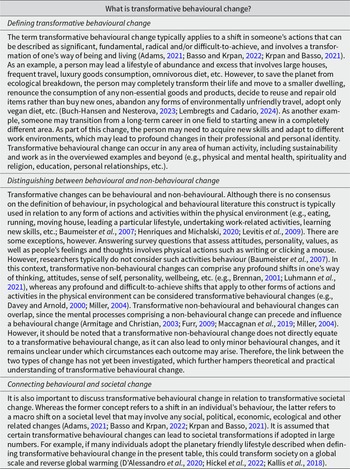
The table defines transformative behavioural change as a significant, fundamental, and difficult-to-achieve shift in a person’s actions and way of living. It illustrates this with examples such as moving from a high-consumption lifestyle to a low-impact one, and changing careers into a completely different field requiring new skills and identity adjustment. It distinguishes behavioural change, described as actions in the physical environment, from non-behavioural change, described as profound shifts in thinking, attitudes, sense of self, personality, or wellbeing. The table notes that non-behavioural and behavioural changes can overlap because mental shifts may precede and influence actions, but a deep psychological change does not necessarily produce a transformative behavioural change and may result in only minor action changes. It also connects individual transformative behavioural change to transformative societal change, defined as large-scale social, political, economic, or ecological shifts. The table suggests that widespread adoption of certain transformative behaviours could contribute to societal transformation, such as broad uptake of a planetary-friendly lifestyle helping address global warming. It cautions that the conditions linking non-behavioural change to transformative behavioural outcomes remain unclear and under-researched.
There are various reasons that might explain why transformative behavioural change has been neglected by psychological and behavioural science. First, this change is typically vaguely defined, by evoking terms such as significant or radical (Adams, Reference Adams2021; Krpan and Basso, Reference Krpan and Basso2021; Basso and Krpan, Reference Basso and Krpan2022), but without specifying which behaviours should be considered transformative and why. Therefore, researchers may not see it as a construct around which they can build a systematic line of research because of the ambiguities associated with measuring it, interpreting the findings and linking them together. Second, since transformative behavioural change involves a transformation of one’s way of being and living, it may not be as frequent as other phenomena that psychological and behavioural scientists research, which makes it more difficult to observe and study scientifically. Another related reason is that effect sizes that concern the influence of experimental manipulations on behaviour or the link between personality and behaviour are usually small to medium (Bosco et al., Reference Bosco, Aguinis, Singh, Field and Pierce2015; Gignac and Szodorai, Reference Gignac and Szodorai2016; Albarracín et al., Reference Albarracín, Wilson, Chan, Durantini and Sanchez2018; Mertens et al., Reference Mertens, Herberz, Hahnel and Brosch2022). It is therefore plausible that transformative behavioural change would be associated with effect sizes that are even more difficult to detect, and studying it would require either larger sample sizes and/or more powerful and diverse methodological approaches.
Nevertheless, these obstacles are worth overcoming because achieving scientific understanding of transformative behavioural change may be one of the most important tasks of our time. Indeed, it is expected that both solving the world’s biggest issues (e.g., climate change) and living through major disruptions (e.g., technological revolution) will require people to transform their behaviour (Wiedmann et al., Reference Wiedmann, Schandl, Lenzen, Moran, Suh, West and Kanemoto2015; Rahman et al., Reference Rahman, Hamid and Chin2017; O’Neill et al., Reference O’Neill, Fanning, Lamb and Steinberger2018; Krpan and Basso, Reference Krpan and Basso2021; Hickel et al., Reference Hickel, Kallis, Jackson, O’Neill, Schor, Steinberger, Victor and Ürge-Vorsatz2022). Therefore, for psychological and behavioural science to remain relevant in the 21st century and continue shaping the world, it will need to reach the stage where it can understand transformation and help people achieve it. This progress is also crucial for advancing the discipline’s quest towards its fundamental goal: mastering human behaviour.
The main objective of this perspective is to propose how transformative behavioural change can become one of the integral topics studied by psychological and behavioural science by developing a seven-step agenda for how to build a systematic line of research around this topic. In the next sections, I will first overview and discuss previous relevant research linked to transformative behavioural change to illustrate the current state of the field and then proceed with outlining the agenda.
Transformative behavioural change in psychological and behavioural science
In psychological and behavioural literature, various constructs can be identified that have some overlap with transformative behavioural change but do not directly focus on it (i.e., they concern phenomena that may involve this change but were not created with the aim to zoom in on it and uncover its main features and mechanisms, in which domains it occurs, etc.). These constructs are summarised in Table 2. Since the aim of this perspective is to propose how to embed transformative behavioural change into psychological and behavioural science by building a systematic line of research around it, the table also reports other information that can be used to evaluate whether a similar endeavour has been previously attempted or achieved.
Summary of constructs from psychological and behavioural science linked to transformative behavioural change
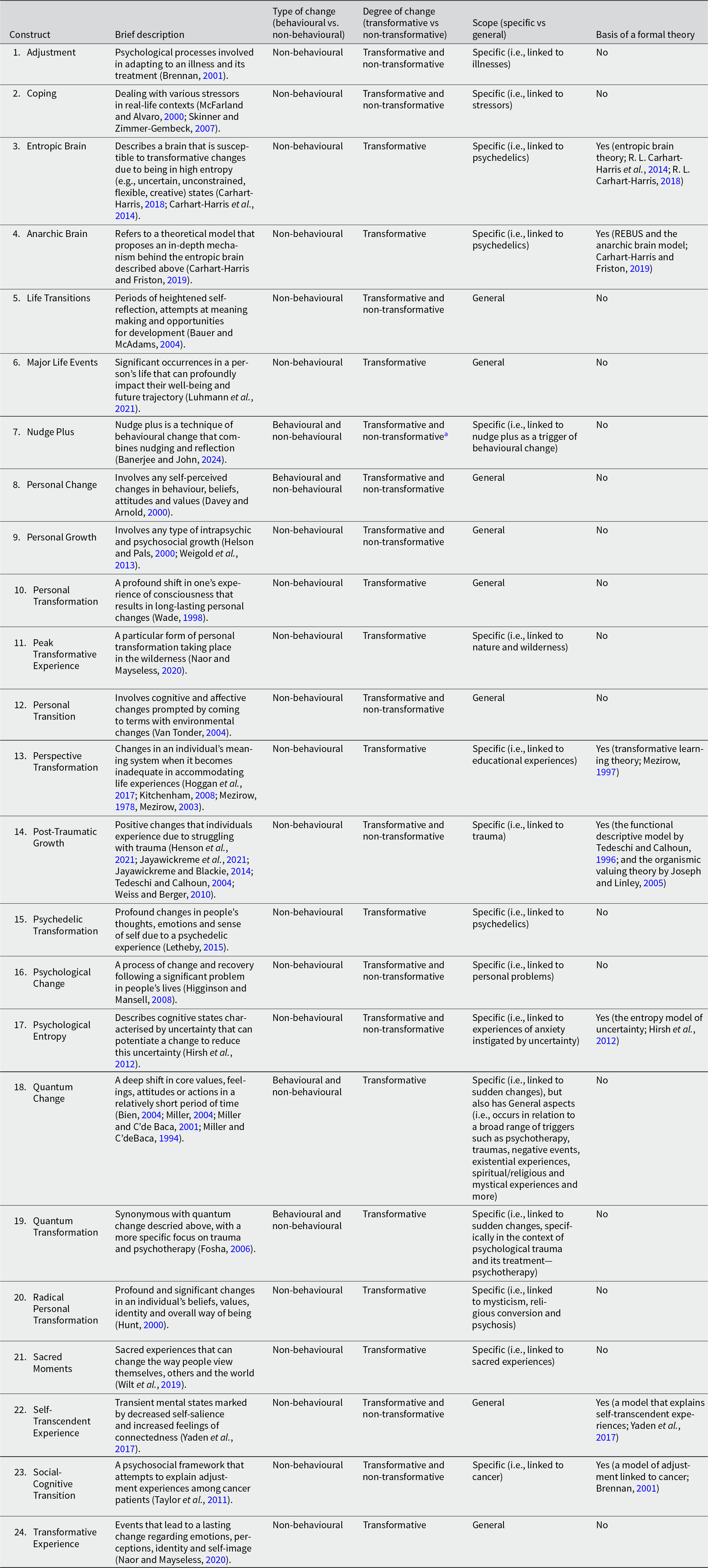
Table 2 Long description
The table lists 24 psychological and behavioural constructs, each with a brief definition and classifications for type of change, degree of change, scope, and whether it is part of a formal theory. Non-behavioural change dominates: most constructs focus on shifts in thoughts, emotions, identity, meaning, or wellbeing rather than actions. Only four constructs explicitly combine behavioural and non-behavioural elements: Nudge Plus, Personal Change, Quantum Change, and Quantum Transformation. Many constructs are linked to transformative change, but several are marked as spanning both transformative and non-transformative change, especially Adjustment, Coping, Life Transitions, Personal Growth, Post-Traumatic Growth, Psychological Change, Psychological Entropy, Self-Transcendent Experience, and Social-Cognitive Transition. Scope varies: some constructs are general across life contexts, while many are specific to triggers or domains such as psychedelics (Entropic Brain, Anarchic Brain, Psychedelic Transformation), trauma (Post-Traumatic Growth), illness or cancer (Adjustment, Social-Cognitive Transition), wilderness (Peak Transformative Experience), education (Perspective Transformation), or sacred experiences (Sacred Moments). Formal theories or models are noted for a minority of constructs, including Entropic Brain, Anarchic Brain, Perspective Transformation, Post-Traumatic Growth, Psychological Entropy, Self-Transcendent Experience, and Social-Cognitive Transition. Classifications reflect each construct’s primary emphasis and may overlap, for example Quantum Change is described as specific due to sudden change yet also applicable across many triggers.
In the columns ‘Construct’ and ‘Brief description’, the table lists each construct and its description, respectively. How the constructs were identified and based on which criteria they were included in the table is comprehensively explained in the section Transformative behavioural change in psychological and behavioural science in the text. The column ‘Type of change’ indicates whether the main focus of a construct is behavioural or non-behavioural change. If a construct is classified as Non-behavioural, it means that it primarily concerns changes in relation to people’s thoughts, emotions, personality, sense of self, wellbeing, meaning and similar psychological processes. In contrast, classifying a construct as Behavioural would mean that it concerns changes in relation to actions and activities in the physical environment that go beyond mere thoughts, wellbeing, attitudes and other similar processes (for an in-depth explanation of the distinction between behavioural and non-behavioural, see Table 1). Whereas many constructs in Table 2 are classified as Non-behavioural, some are classified as Behavioural and non-behavioural, which means that they typically equally emphasise both behavioural and non-behavioural components. Moreover, the column ‘Degree of change’ indicates whether a construct covers transformative or non-transformative change. Since the requirement for a construct to be included in the table was that it needs to be linked to transformative change, as explained in the section Transformative behavioural change in psychological and behavioural science in the text, the constructs generally had to be associated with this change. Nevertheless, the constructs classified as Transformative are the ones that predominantly focus on this type of change, whereas the ones classified as Transformative and non-transformative are linked with both changes. Furthermore, the column ‘Scope’ indicates whether a construct focuses on changes in the realm of specific domains or is more all-encompassing: the constructs classified as Specific are the ones that examine changes that belong to particular areas of human activity (e.g., linked to nature and wilderness) and/or that have particular triggers (e.g., daily stressors) and/or that have a specific characteristic (e.g., sudden change), whereas the ones classified as General tackle changes regardless of the triggers that prompt them, the areas of human activity in which they occur or the specific characteristics they exhibit. Finally, the column ‘Basis of a formal theory’ indicates whether a construct was proposed as a building block of a formal theory that the authors developed to explain it. The constructs that are classified as Yes are the ones to which this applies, whereas those classified as No are the ones to which it does not. For each construct, the key references are listed under the columns ‘Brief description’ and ‘Basis of a formal theory’ (where relevant) − this is not an exhaustive list of references, as many resources were usually published per each construct and would be impractical to reference in the scope of a single article.
Note: a Since nudge plus is discussed by the authors (Banerjee and John, Reference Banerjee and John2024) in relation to transformative change, it is important to clarify why it is classified as Transformative and non-transformative in this table. The authors propose that nudging in combination with reflection can transform one’s perspective, which in turn changes behaviour. Although the authors do not specify whether the behavioural change itself is transformative, based on our understanding and available evidence there is no indication that the type of the interventions the authors cover would be associated with transformative behavioural change as defined in Table 1. Nevertheless, it is important to emphasise that nudge plus typically influences behaviours to a greater degree than nudging or reflection in isolation (Banerjee et al., Reference Banerjee, Galizzi, John and Mourato2023; Banerjee and Picard, Reference Banerjee and Picard2023).
Before examining the information presented in Table 2 in more depth, it is important to clarify what is meant by a ‘construct’, how the constructs were identified and based on what criteria they were selected for the table. In this context, a ‘construct’ broadly refers to any phenomenon that has been operationalised (i.e., defined in such a way that it can be measured or accessed either qualitatively or quantitatively) and investigated in the realm of psychological and behavioural science. The constructs were identified using a literature search that can be classified as narrative rather than systematic (Furley and Goldschmied, Reference Furley and Goldschmied2021). More specifically, this search aimed to uncover a wide range of references linked to transformative change by using words that directly refer to this change as search terms in Google Scholar (e.g., transformative, transformation, radical, significant, profound, disruptive, life-changing); by reviewing the resources that cited or were cited by the references identified via the Google Scholar search; and by reviewing the author’s personal collection of articles that has been accumulated over the past 15 yr and includes various articles linked to transformative change. Using this procedure, the aim was to identify a more exhaustive list of constructs to be included in Table 2 than would have been possible via a merely systematic literature search (Collins and Fauser, Reference Collins and Fauser2005), since constructs associated with transformative change are not always described using terminology directly linked to this change (e.g., words such as transformative, disruptive or radical). Therefore, it is possible that some relevant constructs that belong in Table 2 were not identified, and in fact one of the aims of the agenda proposed in this article is to set the stage for integrating the relevant literature so that any potentially missing constructs can be identified (see Figure 1, Step 4).
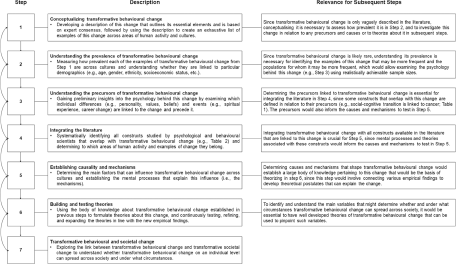
Agenda for establishing psychological and behavioural science of transformative behavioural change.

Figure 1 Long description
The flowchart outlines seven steps for understanding transformative behavioral change. 1. Conceptualizing transformative behavioral change: Developing a description based on expert consensus to create an exhaustive list of examples across cultures. This is necessary to assess prevalence and investigate causes in subsequent steps. 2. Understanding the prevalence: Measuring how prevalent examples from Step 1 are across cultures and demographics. This helps identify frequent examples and relevant populations, aiding in psychological examination. 3. Understanding precursors: Gaining insights into the psychology behind the change by examining individual differences and events linked to the change. This is essential for integrating literature and informing causes and mechanisms. 4. Integrating the literature: Identifying constructs studied by scientists that overlap with transformative change. This is crucial for understanding mental processes and theories. 5. Establishing causality and mechanisms: Determining factors that influence change across cultures and establishing mechanisms that explain the change. 6. Building and testing theories: Using knowledge about the change to develop and test theories, identifying variables that might determine the change. 7. Understanding societal impact: Identifying and understanding variables that might determine whether and under what conditions transformative change can spread across society, aiding in predicting societal needs.
Since the present article focuses on transformative change, the main criterion for including a construct identified through the above-described search in Table 2 was that it addresses transformative change. This means that the literature studying this construct had to clearly indicate that the type of change linked to it is transformative, either using direct terminology (e.g., transformative, radical, significant, profound, disruptive, life-changing, etc.) or by describing in some other way that the change corresponds to transformative (for definition of this change, see Table 1). The ‘Degree of change’ column in Table 2 shows that not all selected constructs are solely focused on transformative change; some involve both transformative and non-transformative changes. However, any construct linked to transformative change was included, while those associated only with non-transformative changes were omitted.
Finally, it is important to emphasise that, whereas all constructs from Table 2 address transformative change, many of them focus predominantly on non-behavioural changes linked to wellbeing, personality, way of thinking, etc. and do not tackle behavioural changes (see the column ‘Type of change’). These constructs were selected because transformative non-behavioural changes can potentially precede transformative behavioural changes (Armitage and Christian, Reference Armitage and Christian2003; Miller, Reference Miller2004; Furr, Reference Furr2009; Maccagnan et al., Reference Maccagnan, Wren-Lewis, Brown and Taylor2019). Therefore, the constructs are at least partially relevant to understanding transformative behavioural changes and are essential for an accurate representation of the literature on this subject. However, it should be noted that transformative non-behavioural changes can lead to either minor or transformative behavioural changes, and it remains unclear under which circumstances each outcome may arise. Overall, by adopting this approach to construct selection, I wanted to ensure that Table 2 contains constructs that are in any way linked to transformative behavioural change to examine the current state of the field and show that this topic has not been systematically investigated in psychological and behavioural science.
After a detailed exploration of how constructs were identified and selected, we now return to the specific content of Table 2. The table does not merely list the constructs; it categorises them based on specific criteria to enable a thorough analysis of the changes they comprise. In particular, Table 2 details the type of change (i.e., behavioural vs non-behavioural) and the degree of change (i.e., transformative vs non-transformative) to establish which constructs deal with transformative behavioural change vs other changes that do not have behaviour at their core. In addition, under ‘Scope’, the table examines whether the constructs focus on changes from a specific domain − i.e., changes that have specific characteristics (e.g., sudden change) and/or are experienced in relation to specific areas of human activity (e.g., work) and/or triggers (e.g., psychotherapy, psychedelics) − or on changes regardless of their domain. This is important because systematically studying transformative behavioural change would necessitate researching how it occurs across various settings to build its overarching theoretical understanding. Finally, in relation to this assertion, Table 2 also reports whether the constructs were proposed as cornerstones of formal theories that were developed to explain them, to understand the current state of theorizing on transformative behavioural change. In this context, theory can be defined as a set of postulates that explain a phenomenon of interest and can be used to infer testable predictions about this phenomenon (Suppes, Reference Suppes and Sklar2000; Locke and Latham, Reference Locke and Latham2002; Locke, Reference Locke2007). For example, concerning transformative behavioural change, a theory would need to offer an empirically testable explanation of when and why this change occurs.
In relation to the type of change, it is important to highlight that the literature regarding the constructs covered in Table 2 usually does not directly specify whether they focus on behavioural or other types of changes. The constructs classified as non-behavioural are the ones for which it can be inferred that the changes in question are experienced in relation to people’s thoughts, way of thinking, wellbeing, personality, sense of self, etc., whereas the remaining constructs (i.e., those that are classified as behavioural and non-behavioural) typically mention both behavioural and non-behavioural components with equal emphasis. In that regard, the constructs do not clearly indicate when the change in question should be behavioural and/or non-behavioural, and whether and how various non-behavioural changes are linked to and can instigate behavioural changes.
In relation to the degree of change, evaluating the constructs in Table 2 is challenging, as the relevant literature does not always elaborate on the focus and magnitude of change. This difficulty is compounded by the lack of a clear definition of transformative change in the literature. Overall, the constructs I classified as transformative are the ones that either directly refer to ‘transformative’ as their main focus, or for which this could be inferred through emphasis on changes that are significant, profound, etc. The remaining constructs are classified as both transformative and non-transformative, as the corresponding references suggest associations with both without specifying when each type of change should occur.
In relation to the scope of change, many of the constructs from Table 2 focus on understanding changes in relation to specific areas of human activity, triggers and characteristics. For example, adjustment, coping, post-traumatic growth and psychological change are conceptualised as reactions to certain negative events (i.e., stressors, illnesses or traumas), whereas psychedelic transformation focuses on transformative changes instigated by psychedelics. Only some of the constructs (e.g., personal transformation, transformative experience; Table 2) were not created to explain changes linked to specific domains but can encompass changes from numerous areas of human activity regardless of their triggers and characteristics.
Finally, most constructs from Table 2 were not developed as building blocks of formal theories. Even for the few constructs for which this is not the case, the associated theories do not attempt to explain specifically transformative behavioural change. Namely, the entropic and anarchic brain are associated with the entropic brain theory (Carhart-Harris et al., Reference Carhart-Harris, Leech, Hellyer, Shanahan, Feilding, Tagliazucchi, Chialvo and Nutt2014; Carhart-Harris, Reference Carhart-Harris2018) and the REBUS and the anarchic brain model (Carhart-Harris and Friston, Reference Carhart-Harris and Friston2019) which explain the relationship between brain entropy (i.e., higher degree of disorder and uncertainty in the brain) and different consciousness states through the lens of psychedelics. Moreover, perspective transformation is part of the transformative learning theory (Mezirow, Reference Mezirow1997) that examines how transformative learning occurs, what characterises it and what predicts it. Post-traumatic growth is linked to the functional descriptive model (Tedeschi and Calhoun, Reference Tedeschi and Calhoun1996) and organismic valuing theory (Joseph and Linley, Reference Joseph and Linley2005) that propose how different affective-cognitive processes can reconstruct the person’s belief system following a trauma to facilitate growth (Ning et al., Reference Ning, Tang, Shi, Yao, Zhao and Li2023). Additionally, psychological entropy is grounded in the entropy model of uncertainty that explains the link between uncertainty and anxiety by drawing on the concept of information entropy (Hirsh et al., Reference Hirsh, Mar and Peterson2012). Furthermore, self-transcendent experience is at the core of a theory that posits which psychological and neurobiological mechanisms account for the impact of this experience on decreased self-salience and increased feelings of connectedness (Yaden et al., Reference Yaden, Haidt, Hood, Vago and Newberg2017). Finally, social cognitive transition belongs to a theory of adjustment that proposes how people’s mental models of the world shape adjustment to cancer and are influenced by it (Brennan, Reference Brennan2001).
Overall, the review of constructs from Table 2 leads to one important conclusion. There is no construct that (a) investigates changes which are specifically behavioural and transformative, (b) comprehensively maps areas of human activity in which any such changes occur and (c) examines their triggers (i.e., causes), characteristics and mechanisms across these areas to form an overarching theoretical explanation of transformative behavioural change and uncover how such a change could be induced in multiple settings. Taken together, the literature review shows that this change has not been systematically investigated as a topic in psychological and behavioural science. Indeed, the constructs presented in Table 2, as a totality or in isolation, cannot answer when and why transformative behavioural change occurs to offer an integrative explanation that applies across an exhaustive set of examples of this change, regardless of their specific characteristics, triggers that cause them and areas of human activity in which they occur. An additional obstacle in this endeavour is that the constructs come from many diverse sub-fields of psychological and behavioural science and have therefore typically not been developed or studied in relation to each other. This makes it challenging to integrate them, understand their overlap and infer any overarching insights about transformative behavioural change.
It could be argued that this type of change has not been systematically tackled in psychological and behavioural science because the change itself is not possible or does not occur. However, this would be inconsistent with the literature since the occurrence of transformative behavioural changes has been documented in numerous settings. For example, the literature on quantum changes and transformations reports many examples of sudden behavioural transformations that have occurred in the context of psychotherapy but also in relation to various life events and experiences, without therapeutic interference or any behavioural interventions (Miller and C’de Baca, Reference Miller and C’de Baca2001; Miller, Reference Miller2004). Therefore, while various instances of transformative behavioural change have been observed, a systematic study of this phenomenon aimed at developing its overarching explanation has been neglected. To address this, I next develop a seven-step agenda on how to create a field of research around this change.
Agenda for psychological and behavioural science of transformative behavioural change
The agenda described in this section is summarised in the roadmap in Figure 1. I want to emphasise that I do not envision this agenda as a solitary pursuit. On the contrary, it would entail long-term collaborative efforts of multiple researchers from various cultural, methodological and theoretical backgrounds, as this kind of diversity is most likely to result in a multilayered and comprehensive understanding of transformative behavioural change (Medin et al., Reference Medin, Ojalehto, Marin and Bang2017; Krpan, Reference Krpan2020; Sulik et al., Reference Sulik, Bahrami and Deroy2022). Therefore, the agenda is indicative rather than prescriptive. In other words, it outlines the steps that could be followed to systematically study transformative behavioural change from the perspective of psychological and behavioural science in a progressive manner. According to this approach, some level of advancement regarding a previous step is necessary before the next step can be addressed. The agenda does not rigidly prescribe which exact research designs need to be employed to achieve progress within each step, although I suggest various possibilities. Instead, the agenda allows for flexibility, enabling researchers to employ various approaches based on their creativity, background and expertise, thereby fostering a range of diverse discoveries.
Another point worth clarifying is that the agenda is not an attempt to propose a new framework for developing and/or implementing behavioural change interventions. I am simply proposing how to establish a systematic line of research around transformative behavioural change with the ultimate goal for the field to advance scientific and practical knowledge about this change (e.g., by determining where and how frequently this change occurs, what causes it, how to study it despite potentially small effect sizes and difficulty of observing it, how it is shaped by various individual differences and events, which psychological processes underpin it and how it is linked to wider societal change and transformation). Each of the seven steps I propose in the agenda can therefore be achieved through various existing methodological approaches and frameworks. For that reason, for each step I provide relevant examples of such methodologies and approaches I find useful. However, these examples are neither exhaustive nor prescriptive, since psychological and behavioural science is a vibrant field characterised by rich methodological, statistical and conceptual diversity, and harnessing this diversity is most likely to yield profound insights about transformative behavioural change (Medin et al., Reference Medin, Ojalehto, Marin and Bang2017; Sulik et al., Reference Sulik, Bahrami and Deroy2022).
Step 1: Conceptualizing transformative behavioural change
Since the absence of a clear conceptualisation of transformative behavioural change might be one of the main obstacles to studying it, the essential step of the proposed agenda entails clarifying what this change is and identifying its examples. I propose that the starting point of this endeavour could involve bringing together experts specialised in related topics (e.g., constructs from Table 2 and beyond) to settle on the main features of this change. One possible way of achieving this would be by conducting a comprehensive survey of experts to understand which features they most frequently evoke (Darko et al., Reference Darko, Chan, Owusu-Manu and Ameyaw2017). From these features, a description of transformative behavioural change that outlines its essential elements could then be constructed (Krpan et al., Reference Krpan, Booth and Damien2023).
Subsequently, it would be vital to develop an exhaustive list of examples of behavioural change that qualify as transformative from all areas of human activity (e.g., sustainability, work, health, education, etc.). Since everyday individuals rather than experts are predominantly the subjects of this change, I posit that they should determine which behavioural changes are transformative based on their perceptions of the expert description. Indeed, various guides, frameworks and other resources from psychological and behavioural science relevant to evidence-based policy emphasise the importance of context in understanding human behaviour and its change (e.g., Cartwright and Hardie, Reference Cartwright and Hardie2012; Meder et al., Reference Meder, Fleischhut and Osman2018; Hallsworth, Reference Hallsworth2023). The integration of the expert description with people’s views and experiences would ensure that the resulting list of examples of transformative behavioural change applies across a wide range of contexts and experiences.
One possible way of developing an exhaustive list of examples of transformative behavioural change by drawing on people’s perceptions of experts’ views could be by conducting qualitative research on individuals from a variety of cultures and asking them to identify, based on the expert description, all examples of behavioural change they consider transformative (Krpan et al., Reference Krpan, Booth and Damien2023). Testing many individuals globally would ensure that even the rarest examples are identified (Mayring, Reference Mayring2004, Reference Mayring2019; Fugard and Potts, Reference Fugard and Potts2015; Faulkner and Trotter, Reference Faulkner and Trotter2017; Rijnsoever, Reference Rijnsoever2017; Guest et al., Reference Guest, Namey and Chen2020; Hennink and Kaiser, Reference Hennink and Kaiser2022). This would be followed by a quantitative study in which representative samples across cultures would rate how transformative each of the identified examples are. Overall, this quantitative phase would result in a definitive list of changes deemed transformative by individuals from various cultures and identify any potential cross-cultural differences.
Step 2: Understanding the prevalence of transformative behavioural change
Based on the list of examples of transformative behavioural change established in Step 1, in Step 2 it would be possible to estimate the prevalence of this change across cultures. This could be achieved by conducting research on representative samples from each culture in which the participants would receive the definitive list of changes deemed transformative from Step 1 and report whether they have experienced these changes. Their demographic characteristics (e.g., age, gender, ethnicity, socioeconomic status, etc.) would also be assessed. This step would be essential for subsequent steps because it would allow identifying which examples of transformative behavioural change (and from which areas) are sufficiently frequent to be studied using correlational and experimental designs. In addition, the demographic variables measured would allow identifying whether there is a subset of the population that is particularly likely to experience this change and could thus be the focus of research endeavours. Overall, Step 2 would determine the examples of transformative behavioural change and the target populations for which the effect sizes associated with this change are sufficiently large to be detected using realistically achievable sample sizes (Cohen, Reference Cohen1988, Reference Cohen1992; Lakens, Reference Lakens2022).
Step 3: Understanding the precursors of transformative behavioural change
The goal of Step 3 would be to uncover the precursors of transformative behavioural change, including any individual differences (e.g., personality, values, beliefs) and events (e.g., spiritual experience, career change) that are linked to it, while taking into account macro-level variables that can shape behaviour (e.g., norms; Rivis and Sheeran, Reference Rivis and Sheeran2003; Howe et al., Reference Howe, Sparkman and Walton2021; Pianta et al., Reference Pianta, Rinscheid and Weber2021). This step could involve several types of research. The first one would comprise basic cross-sectional studies (Spector, Reference Spector2019) that investigate which individual differences are correlated with whether people across cultures have experienced transformative behavioural change. More specifically, this research would test representative samples from various cultures, assess whether the participants have previously experienced transformative behavioural change, and measure a wide range of individual differences. It would allow identifying the most important individual differences linked to this change, but it would not be possible to distinguish whether these differences are merely correlated with the change or also predict a future occurrence of this change.
This limitation could be avoided in the second type of research that would comprise longitudinal studies (Ployhart and Vandenberg, Reference Ployhart and Vandenberg2010) focusing on participants who have not yet experienced transformative behavioural change but are likely to experience it. These participants would be identified based on the insights from Step 2. In the longitudinal studies, in Wave 1 their individual differences would be assessed, and the participants would then be contacted in waves over the course of several years to probe whether they have experienced transformative change. The proposed research would determine individual differences that precede transformative behavioural change and would therefore go beyond basic cross-sectional research.
The third type of research would be qualitative (Willig, Reference Willig2019) and focus on events. More specifically, the studies would zoom in on individuals who have already experienced transformative behavioural change. These individuals would be interviewed to identify and describe any significant events that occurred prior to their experience of the transformative change and that they perceive as a potential trigger of this change. This approach is aligned with a recent trend in psychological and behavioural science that advocates empowering individuals to understand the role of their external environment in creating behavioural change and to restructure this environment to produce desired changes (Reijula and Hertwig, Reference Reijula and Hertwig2022; Hertwig, Reference Hertwig2023).
Overall, Step 3 would not yet provide causal information about factors that influence transformative behavioural change or the psychological mechanisms that explain it. However, it would allow researchers to gain preliminary insights into the psychology behind this change and the events that may be linked to it, which would be crucial for subsequent steps.
Step 4: Integrating the literature
Even if Table 2 overviews constructs that overlap with transformative behavioural change, it is currently not possible to fully integrate this change with potentially related constructs from psychological and behavioural science literature for several reasons. First, because this change is vaguely conceptualised, it is difficult to identify whether and which specific behaviours linked to a construct (Table 2) can be classified as transformative behavioural change, or to conduct a systematic literature review (Siddaway et al., Reference Siddaway, Wood and Hedges2019) to uncover all constructs that comprise this change. Second, some constructs (Table 2) are defined in relation to their precursors. For example, social-cognitive transition is linked to cancer, psychological entropy to anxiety and quantum transformation to psychotherapy. Therefore, a deep understanding of the precursors is necessary to integrate these and many other constructs (Table 2) with the transformative change.
The previous steps of the proposed agenda would identify detailed precursors, as well as the characteristics and examples of transformative behavioural change, thus making the integration possible. The starting point of this endeavour could involve conducting systematic literature reviews (Siddaway et al., Reference Siddaway, Wood and Hedges2019) across cultures to examine whether Table 2 covers all relevant constructs linked to this change or there are additional ones to be discovered. Next, researchers could focus on more clearly mapping the constructs onto transformative behavioural change. This would involve determining whether the behaviours these constructs entail classify as transformative change, and identifying to which specific areas of human activity and examples they correspond. Ultimately, this process would allow discovering whether the literature has covered most transformative behaviours identified in Step 1, or many of them remain unexplored. Step 4 would be necessary because constructs linked to transformative behavioural change (Table 2) are typically associated with various mental processes and in some cases theories, and this knowledge would inform psychological mechanisms to examine in Step 5.
Step 5: Establishing causality and mechanisms
The goal of this step would be to determine the main factors that can influence transformative behavioural change across cultures and establish the mental processes that explain this influence (i.e., the mechanisms). The focus would be on testing which events that were identified as precursors in Step 3 can impact this change, and which mental processes informed by the integrated literature achieved in Step 4 and any relevant theoretical accounts can explain the impact. This implies that any events and mental processes used for this purpose need to lend themselves to causal research methods in an ethical manner. The causal methods used to test the influence of various events on transformative behavioural change could involve randomised experiments, instrumental variable approach or regression discontinuity (Marinescu et al., Reference Marinescu, Lawlor and Kording2018), whereas the methods for probing the mechanism could involve experimental-causal-chain or moderation-of-process design (Spencer et al., Reference Spencer, Zanna and Fong2005). Statistical models such as causal Bayesian networks (Stewart et al., Reference Stewart, Mengersen and Meader2014; Tummers et al., Reference Tummers, Hommersom, Lechner, Bemelmans and Bolman2022) that analyse complex causal relationships between observed variables and test hypotheses about these relationships could also be implemented. Finally, computational approaches such as causal tree and forest could be utilised to examine whether causality and causal mechanisms differ across various subgroups of participants based on their demographic characteristics and individual differences (Veltri, Reference Veltri2023).
Importantly, since transformative behavioural change is not common, studying causality and mechanisms would require that researchers either implement insights from Step 2 by focusing on the most prevalent examples of transformative behavioural change and the population subsets for whom this change is more likely to occur, or utilise big data (Chen and Wojcik, Reference Chen and Wojcik2016). In this context, megastudies − i.e., large-scale experimental designs that test multiple interventions across diverse populations (Milkman et al., Reference Milkman, Gromet, Ho, Kay, Lee, Pandiloski, Park, Rai, Bazerman, Beshears, Bonacorsi, Camerer, Chang, Chapman, Cialdini, Dai, Eskreis-Winkler, Fishbach, Gross and Duckworth2021; Duckworth and Milkman, Reference Duckworth and Milkman2022) − could be utilised as a powerful tool to evaluate causality despite potentially small effect sizes and produce insights that could ultimately be used to develop policy interventions aimed at transformative behavioural change. Indeed, various resources on evidence-based policy emphasise the critical role of understanding causal mechanisms in policymaking and policy intervention development (e.g., Cartwright and Hardie, Reference Cartwright and Hardie2012). Since transformative behavioural change is difficult to achieve, it is likely that the process of intervention development will be laborious and involve various failures. To learn from these failures and create effective interventions, the failures could be systematically investigated using the taxonomy proposed by Osman et al. (Reference Osman, McLachlan, Fenton, Neil, Löfstedt and Meder2020) (see also Osman, Reference Osman2023).
Step 6: Building and testing theories
There are three approaches to theory building in psychological and behavioural sciences: deductive, inductive and abductive (Haig, Reference Haig2005; Borsboom et al., Reference Borsboom, van der Maas, Dalege, Kievit and Haig2021; Janiszewski and van Osselaer, Reference Janiszewski and van Osselaer2022). The deductive approach involves deriving a set of postulates that explain a phenomenon (e.g., transformative behavioural change) from a large body of empirical evidence about this phenomenon, whereas the inductive approach involves starting with a core set of postulates based on few findings and gradually evaluating whether these postulates generalise across a larger body of evidence. The abductive approach is at the midpoint between these two extremes and involves forming a set of postulates that best explain a phenomenon based on empirical evidence that may be incomplete and limited.
Although the inductive approach has been used to develop some of the most influential theories in psychological and behavioural science (e.g., self-determination theory; Locke, Reference Locke2007), it would be difficult to apply this approach in the context of transformative behavioural change because of various challenges associated with forming a set of postulates about a phenomenon that is undefined and largely uninvestigated. Therefore, the present agenda is grounded in the assumption that it is more plausible to first accumulate a body of knowledge about transformative behavioural change in Steps 1–5, and then use it to infer theoretical postulates. Although I expect this body of knowledge will be substantial, which would typically be suitable for the deductive approach, I anticipate that the theory building will be more aligned with the abductive approach. Indeed, the evidence accumulated via previous steps might ultimately be incomplete because of various obstacles to empirically studying some examples of transformative behavioural change (e.g., their low frequency, association with distressing or unethical events). Therefore, the most optimal approach to theory building might involve forming the best explanations based on the body of knowledge that is substantial but incomplete and continuously testing, refining and expanding these explanations in line with the new empirical findings.
Step 7: Transformative behavioural and societal change
The final step of the research agenda would focus on exploring the link between transformative behavioural change and transformative societal change, which refers to fundamental and irreversible shifts in social, economic and ecological systems (Adams, Reference Adams2021; Krpan and Basso, Reference Krpan and Basso2021; Basso and Krpan, Reference Basso and Krpan2022). This step would therefore go beyond individual behaviours and examine how they can reshape society to resolve its biggest challenges. The questions that could be tackled include understanding whether transformative behavioural change on an individual level can spread to society and under what circumstances, identifying barriers to and facilitators of the link between individual and societal transformative change, etc. In addition, it could be examined whether and to what extent individual transformative behavioural change depends on various regulatory measures and wider economic policies, which is an important yet uninvestigated topic in psychological and behavioural science (Loewenstein and Chater, Reference Loewenstein and Chater2017; Osman et al., Reference Osman, Schwartz and Wodak2021).
The main obstacle to answering these questions is that transformative societal change is rare and investigating it empirically in relation to individual transformations is highly challenging. Therefore, it is likely that Step 7 will to a large degree rely on computer simulations such as agent-based modelling (Jackson et al., Reference Jackson, Rand, Lewis, Norton and Gray2017) rather than on empirical investigations. For example, agent-based modelling is a computational method that simulates interactions of autonomous agents (e.g., individual human beings, organisations) to assess their effects on the system (e.g., society) as a whole (Smith and Conrey, Reference Smith and Conrey2007; Jackson et al., Reference Jackson, Rand, Lewis, Norton and Gray2017; Folke and Kennedy, Reference Folke, Kennedy, MacLachlan and McVeigh2021). The researcher determines the characteristics of these agents and the rules based on which they interact to examine how the system comprising the agents changes over time and what kind of trends emerge. In relation to transformative behavioural change, the researchers could determine the difficulty and main characteristics driving this change informed by Steps 1–6 and then investigate to what degree the change could spread across different agents through their interactions over time. Recent research also indicates that large language models such as the generative pretrained transformers (GPTs) can be used to create artificial research participants that have psychological characteristics similar to humans (Demszky et al., Reference Demszky, Yang, Yeager, Bryan, Clapper, Chandhok, Eichstaedt, Hecht, Jamieson, Johnson, Jones, Krettek-Cobb, Lai, JonesMitchell, Ong, Dweck, Gross and Pennebaker2023; Dillion et al., Reference Dillion, Tandon, Gu and Gray2023). While this approach is still in early stages and requires further investigation to fully understand its capabilities and constraints, it could potentially be used to explore the link between transformative individual and societal behavioural change in simulated human populations, offering significant real-world applications.
Although the present step focuses on individual transformative behavioural change and its link to societal change, I am not implying that individuals are responsible for society’s most pressing problems, or that these problems should be addressed by focusing on individuals rather than by modifying the system in which they act (for a discussion of this debate, see Chater and Loewenstein, Reference Chater and Loewenstein2023). The step I propose aims to produce scientific knowledge that would clarify whether a societal shift can realistically be achieved through individual transformations, and what it would take for this to happen. This is an important and profound question to which we do not yet have a definitive answer, making it a worthy and compelling area for further investigation.
Additional considerations
Overall, the proposed agenda deals with a complex endeavour of proposing how to systematically study transformative behavioural change to increase its scientific and practical understanding. In that context, there are several points and broader considerations that were not explicitly addressed in the seven steps proposed but that warrant further reflection.
First, although the article focuses on investigating transformative behavioural change from the perspective of psychological and behavioural science, it is plausible that this research endeavour will eventually involve a broader social science approach. For example, ecological approaches to human behaviour posit that behaviour is a complex system shaped by continuous interaction between the person and various levels of the environment, including the person’s immediate family and social surroundings as well as broader influences such as media, social and economic norms, etc. (Bronfenbrenner, Reference Bronfenbrenner1977; Sallis et al., Reference Sallis, Cervero, Ascher, Henderson, Kraft and Kerr2006; Heft, Reference Heft2013; Rosa and Tudge, Reference Rosa and Tudge2013; Gibson, Reference Gibson2014; Lobo et al., Reference Lobo, Heras-Escribano and Travieso2018). Although the present work focuses on individual behavioural change, it does acknowledge the ecological perspective in various steps and is underpinned by it − for example, Step 3 encourages the measurement of macro-level variables that can shape behaviour (e.g., norms), whereas Step 7 focuses on the interplay between the person and wider societal changes and proposes examining questions such as to what extent individual transformative behavioural change depends on various regulatory measures and wider economic policies. In this regard, I want to explicitly encourage researchers who aim to study transformative behavioural change from the perspective of psychological and behavioural science to consider a broader perspective of social sciences and examine different paradigms such as the ecological approach.
A related point concerns using the ecological approach and similar paradigms to gain deeper insights into the process of transformative behavioural change. For example, complexity science, which is integral to the ecological approach, posits that complex systems such as cognition and behaviour can exist in certain states that are relatively stable, but can transition into different states depending on the interplay between the system and environmental forces (Krpan, Reference Krpan2017; Favela, Reference Favela2020; Riva et al., Reference Riva, Graco-Roza, Daskalova, Hudgins, Lewthwaite, Newman, Ryo and Mammola2023). To draw on an example from Table 1, a person may lead a lifestyle of abundance and excess that involves large houses, frequent travel, luxury goods consumption and omnivorous diet, which corresponds to one stable state. However, as a result of personal reflections and experiences, as well as scientific evidence about potentially devastating effects of climate change on future generations, the person may transform their life and move to a smaller dwelling, renounce the consumption of any non-essential goods and products, etc., which corresponds to another stable state. Therefore, transformative behavioural change could be conceptualised as a transition from one stable state to another, and its scientific investigation could therefore benefit from considering different models that complexity researchers use to understand transitions between states of various complex systems. For example, frameworks such as the state and transition models are used to understand transitions between different stable states of a system as a result of external influences and its internal workings (Phillips, Reference Phillips2011; Bestelmeyer et al., Reference Bestelmeyer, Ash, Brown, Densambuu, Fernández-Giménez, Johanson, Levi, Lopez, Peinetti, Rumpff, Shaver and Briske2017).
This leads to another important question about transformative behavioural change on which to reflect: How do transitions between different states shape perceived transformative value of a behavioural change? For example, based on the constructs from Table 2, some transformative changes can be abrupt and sudden, such as quantum change (Miller, Reference Miller2004), whereas for many others the time frame is not specified, and both more abrupt and slower changes are possible. From the perspectives of ecological approach and complexity science, transitions between different states may be minor, but many such transitions over a longer period could lead to a state that is radically different than the starting state. The question is whether people would perceive such a change as less transformative than a similarly radical behavioural change that occurs over fewer transitions, or as more transformative, since longer duration could also signal more effort invested into the change. In Step 1 of the present agenda, I propose developing an exhaustive list of examples of transformative behavioural change by drawing on people’s perceptions of experts’ views. Whereas this step does not explicitly mention the duration of change, researchers could investigate whether the same change is perceived as more or less transformative depending on its duration. Overall, considering diverse paradigms to complement theories and approaches from psychological and behavioural science in investigating transformative behavioural change could prompt various insights and research directions.
Conclusion
This perspective highlights the critical importance for psychological and behavioural science to focus on transformative behavioural change, and develops a seven-step agenda to accomplish this objective. The agenda allows for diverse methodological and statistical approaches suitable for individuals from various backgrounds, from qualitative to quantitative, including those specialised in simulated models of human populations rather than empirical research. The agenda also incorporates solutions to some of the most significant obstacles to studying transformative behavioural change, such as its potentially rare occurrence. I hope the agenda will encourage psychological and behavioural scientists to embark on investigating transformative behavioural change to uncover the secrets behind this arguably most intricate aspect of human behaviour.
Competing interests
The author declares no financial or non-financial competing interests.

 Open access

