




The Easter 1916 rebellion was the most pivotal episode of the Irish revolution of 1912–23 and the bloodiest.Footnote 1 It effected a profound shift towards separatism and the eventual establishment of an independent Irish state. More immediately, the sudden and unexpected eruption of violence in Dublin on 24 April and the suppression of the insurgency by the British army led to 504 fatalities of which 276 were civilians.Footnote 2 Contemporaries such as William G. Smith, a St John Ambulance volunteer, observed several civilian casualties: ‘an old man shot whilst going out to get a loaf of bread for his daughter … a servant girl shot dead while sitting in her bedroom window; a woman badly injured in the jaw’.Footnote 3 Notably, part of the rationale behind the insurgents’ surrender on 29 April 1916 was ‘to prevent the further slaughter of Dublin citizens’.Footnote 4 While the destruction of the city’s infrastructure by bullet, shell, and fire was immediately visible, the devastation of civilian lives through loss of breadwinners and injury was not.
In recent decades, the previously insular historiography of the 1916 rebellion has been reframed. It is now better understood within the wider context of the First World War, without which a rebellion would have been inconceivable, and has also been examined using a broader comparative transnational lens.Footnote 5 A growing body of research on the experience of First World War casualties, disability pensions, and medicine has focused understandably on military veterans.Footnote 6 By contrast, the experience of civilian casualties on the home front has not received the same level of scholarly attention and has been overshadowed by research on themes such as atrocities, occupation, mobilization, public health, and bereavement, among others.Footnote 7 The state’s treatment of civilian casualties of the 1916 rebellion exemplified its unequal approach to military and civilian death and disability during the First World War. As Julie Powell has observed, whereas disabled war veterans occupied a valorized position in terms of efforts ‘to remake them … bodily and socially whole’, and were the beneficiaries of private and state supports, nothing similar was bestowed on civilians.Footnote 8
In October 1916 the British government established the Rebellion (Victims’) Committee (RVC) to adjudicate on 550 compensation awards for 246 civilian fatalities and 304 cases of injury. All cases, whether perpetrated by the state forces or the rebels, were considered by the committee. Notwithstanding the publication of a detailed compendium of the dead of the Irish revolution, official treatment of wounded civilians remains one of the least researched aspects of the 1916 rebellion.Footnote 9 The preservation of the RVC material in the National Archives of Ireland provides a rare opportunity to undertake a case study of how the British government treated civilian war casualties. This article has five aims. First, it explains the government’s initial opposition to the idea of compensation for civilians and the various factors that eventually overturned this stance. Second, it outlines the establishment of the RVC and the bureaucratic nature of the compensation process. This bore similarities with how the state approached wartime separation allowances and widows’ pensions, not least official surveillance of working-class recipients of such awards. Third, an analysis of the compensation forms is presented because it permits new insights into the nature of civilian casualties during the rebellion in terms of gender, age, and circumstances. Fourth, the article describes how, at the insistence of the Treasury, the awards recommended by the RVC were set according to the rubrics of the Workmen’s Compensation Act (1906). This treated civilian casualties of the rebellion not as victims of war but on a par with injured workers. In this way, state liabilities were limited as much as the consequences of state violence were elided. Lastly, the article concludes with a consideration of why the workmen’s compensation legislation was an inadequate means of treating civilian war casualties. In Italy and in Belgium, for example, legislation governing disabled soldiers and military widows was substantially extended to civilian casualties. However, this was not the case in Britain.Footnote 10 The RVC material powerfully captures how the rebellion adversely affected the lives of ordinary men, women and children, and how the British state endeavoured to limit its obligations to make reparations to them.
I
Initially, the British government refused to countenance compensation for the death or injury of civilians during the 1916 rebellion, the majority of whom were from working- or lower middle-class backgrounds. This was in stark contrast to its acceptance of financial liability, in the form of ex gratia grants, for property damaged by military operations to quell the rebellion.Footnote 11 This unjust and classist approach was criticized by the Irish Trade Union Congress and Labour Party. In an appeal to the prime minister, it maintained that the families of civilians killed or injured
have at least as strong a claim upon the good will of the state for some recompense … as the property owner has for the loss of his property … Life is more than property and we hope it may not be again the experience of the working class of Dublin … that the rich will receive compensation because they have friends at court, while the poor must bear their losses without complaint because, being poor, that is their just reward!Footnote 12
Although H. H. Asquith regretted that the government was unable to pay compensation for loss of life or injury, he, nevertheless, adhered to the advice of Sir Robert Chalmers, joint permanent secretary of the Treasury and interim under-secretary in Dublin, who maintained that such claims should be resisted because it would be impossible to discriminate between the innocent and those who were complicit in the rebellion.Footnote 13 This negative stance differed sharply from the government’s readiness to meet claims for both property and civilian casualties in the wake of the German bombardment of the English seaport towns of Hartlepool, Scarborough, and Whitby – known as the East Coast raid – in December 1914.Footnote 14 Between January and September 1915, the East Coast Raid committee, chaired by Lord Parmoor, assessed over 10,000 claims for property and 697 for personal injury (of which 178 were fatalities).Footnote 15 The deaths of British civilians, particularly women and children, in German naval and air raids during the First World War occasioned outrage; the press portrayed them as the vulnerable victims of a barbarous enemy.Footnote 16 Compensation was paid in the summer and autumn of 1915 and the example of the East Coast raids, though in very different circumstances as it did not involve the crown forces or an insurgency, was raised in parliament by Irish MPs.Footnote 17
Several months elapsed before the British government altered its position. In the interim, the plight of those rendered fatherless, widowed, blind, or lame was raised by several organizations in addition to the Irish Trade Union Congress and Labour Party. A committee of the Dublin Chamber of Commerce, chaired by Charles Jacob, a well-known Quaker biscuit manufacturer, impressed on Asquith that ‘life lost is as deserving of compensation as property destroyed’ and called for a special commission to award compensation for death or injury on the same basis as the Workmen’s Compensation Act.Footnote 18 The press, individual solicitors, employers, Dublin corporation, and Irish MPs also urged that provision be made by the government for dependants of wage-earners killed during the rebellion. At the end of May the Irish Independent warned that many families had been ‘reduced to privation’.Footnote 19 At Westminster, Alfred Byrne, Irish Parliamentary Party (IPP) MP for Dublin Harbour, called for the government to grant compensation; he made the same demand at meetings of Dublin corporation.Footnote 20 Although these appeals received a stony response, they nonetheless kept the question of compensation for civilians alive.
A number of issues coalesced between May and August 1916 which forced the government to perform a volte-face on the question of compensation for civilians. First, there was sustained public outcry over military ill-discipline during the rebellion. Two episodes posed great difficulties for the authorities in Ireland and London. The first involved the actions of Captain J. C. Bowen-Colthurst, who shot dead James Coade on 25 April and on the following morning ordered the death by firing squad of three journalists – Thomas Dickson, Patrick McIntyre, and Francis Sheehy-Skeffington, the latter a well-known pacifist and feminist. The second was the killing by the British army of thirteen civilians in North King Street.Footnote 21 A royal commission on the killing of the journalists damningly concluded that ‘the shooting of unarmed and unresisting civilians without trial constitutes the offence of murder, whether martial law had been proclaimed or not’.Footnote 22 Bowen-Colthurst was found guilty of murder but insane.Footnote 23 Controversially, there was no public inquiry into the North King Street deaths. However, the drip feed of reports about the plight of dependants was sufficiently detrimental that by early August 1916 General Sir John Maxwell, commander-in-chief in Ireland, recommended to Asquith that although ‘a very dangerous precedent’, monetary compensation should be paid to ‘families of persons killed during the rising, about whose participation there is a reasonable doubt and the circumstances of their death is not attributable to their own acts’.Footnote 24 The logic was inescapable and Asquith, who had been personally lobbied by several grieving families, underwent a Pauline conversion to find himself ‘strongly in favour’ of Maxwell’s suggestion.Footnote 25
A second factor was Henry Duke’s appointment as Irish chief secretary.Footnote 26 Before he left for Dublin, he had been instructed by Asquith to consider Maxwell’s proposal for monetary recompense. Duke was more disposed than Chalmers to compensate civilian victims of the rebellion, and in his first memorandum for cabinet saw no objection in principle to compensating claimants who suffered innocently by reason of military action by crown forces.Footnote 27 The secretary of the Mansion House fund, established by the Dublin lord mayor to relieve distress following the rebellion, left the new chief secretary in no doubt that the condition of affected civilians was ‘one of almost absolute helplessness’.Footnote 28 By June 1916 the fund had disbursed 3,600 grants amounting to £3,000; a similar sum was spent on relief employment schemes before it closed in April 1917.Footnote 29 The Society of St Vincent de Paul, the largest Catholic charity in Ireland, also played a critical role in maintaining many desperate families. For example, having been a ‘self-supporting’ citizen before the rebellion, Ellen Dillon had been ‘saved from starvation by relief from the Vincent de Paul’.Footnote 30 These voluntary relief efforts proved vital in the aftermath of the rebellion, but the scale of the crisis necessitated state intervention.
A third factor was the stance of the IPP. For much of June and July 1916 the party’s attention was absorbed by ill-fated negotiations with Lloyd George to settle the Irish question. Despite a ‘dazzling display of verbal conjuring’, his scheme ultimately foundered on the issue of partition and the trenchant opposition of southern unionists.Footnote 31 Subsequently, as Herbert Samuel, the home secretary, observed, a bitterly disappointed IPP became more antagonistic towards the British government so as ‘to impress their followers in Ireland’.Footnote 32 Irish MPs truculently raised anew complaints about the internment of republicans, martial law, the conduct of the military during the rebellion, and compensation for civilians – all of which had soured public opinion in Ireland. None was more vocal in championing the plight of poorer victims of the rebellion and haranguing Dublin Castle than John D. Nugent, MP for College Green (which was acutely affected by the outbreak), a member of Dublin corporation, a poor law guardian for Dublin’s Arran Quay ward, and influential national insurance secretary of the Ancient Order of Hibernians.Footnote 33 In early August he furnished Asquith with the details of fifty-one cases of dependants of non-combatants and fifteen cases of persons wounded and rendered unfit for work.Footnote 34
The final factor was the Law and Procedure (Emergency Provisions) (Ireland) bill, the legal implications of which inadvertently opened the way for compensation of civilians. The measure protected the local authority from claims for compensation for criminal or malicious injuries to persons or property arising out of the rebellion.Footnote 35 When introduced in the Commons in July 1916, Thomas Heath, permanent secretary to the Treasury, observed the possibility that depriving citizens of legal redress against the local authority might ‘have the effect of giving them an equitable claim to compensation from public funds’.Footnote 36 So it proved. During the committee stage of the bill on 17 August, Duke indicated that the cases presented by Nugent were in the course of investigation and that valid claims would be favourably considered.Footnote 37 At the end of August the chief secretary drafted terms of reference for a committee so that, as he put it to the chancellor of the exchequer, ‘some good may be done without extravagance’.Footnote 38 The desire to avoid profligacy profoundly shaped the compensation process.
II
A Rebellion (Victims’) Committee (RVC) was appointed by the lord lieutenant on 11 October 1916.Footnote 39 It sat sixty times between 14 October 1916 and 14 July 1917 and was chaired by Charles St George Orpen, president of the Incorporated Law Society of Ireland, senior partner in Messrs Darley, Orpen and McGillycuddy solicitors, and brother of the architect Richard and the artist William. He was joined by Charles H. O’Conor, a senior local government board inspector who had been involved in relief schemes in the immediate aftermath of the rebellion. John J. Taylor, head of the finance division of the chief secretary’s office and a future assistant under-secretary, completed the triumvirate.Footnote 40 Hugh C. Love, an official in the office of the commissioners of national education, was appointed secretary. The RVC’s office was at 13 St Stephen’s Green, Dublin.Footnote 41
Sitting in camera, the RVC was instructed to inquire and report on claims for two categories of compensation. The first was persons who ‘suffered loss by reason of personal injuries sustained by them, without misconduct or default on their part’, during the rebellion.Footnote 42 In this way, injured rebels and looters were ineligible. The second category was ‘dependants of deceased persons who, without misconduct or default on their part, were killed or injured in the recent rebellion’.Footnote 43 In exceptional cases not within the two categories – where death or wounding occurred in the course of military operations – a compassionate grant could be recommended.Footnote 44 Applications by dependants of soldiers or policemen were not admitted.Footnote 45 Neither were cases involving psychological distress, those unable to demonstrate dependency, or cases where injuries owed to the misguided actions of the applicant. An example of the latter was fifteen-year-old Nicholas Murphy. He picked up a gelignite cartridge on Sackville Street and when at home applied a lighted candle to it. The resultant explosion blew off the fingers of the boy’s right hand. Although raised in parliament by Nugent, the case was dismissed by Duke.Footnote 46
Dependants of deceased breadwinners had to attempt a twenty-one-question application form. A modified eighteen-question version was used for personal injuries which focused on income, the nature of the injury sustained, and its impact on earning capacity. Both versions of the form had to be completed by a signed declaration before a justice of the peace and returned before 16 December 1916.Footnote 47 A handful of particularly deserving cases were admitted after this deadline. For example, in February 1917 Catherine Veitch successfully submitted an application on behalf of her twelve-year-old son Peter because he was wounded while aiding a soldier near Mount Street Bridge.Footnote 48 All applicants had to supply their personal details; details of the deceased, including a certified extract from the registry of deaths (or a hospital certificate showing date of death); relationship to deceased; the circumstances of death or injury; evidence of dependency and its extent; the income and employment record of the deceased or injured party; monies from other sources such as benefits for injury under the National Insurance Act; and the names and addresses of two witnesses. Several applicants sought to strengthen their claim by emphasizing that brothers, sons, or husbands were serving at the front. Six of Joseph Geraghty’s sons were in the British army: two had been killed in France, while Joseph junior had been invalided out of the army in November 1914 and was killed during the rebellion.Footnote 49 Commitment to the war effort was looked on favourably.
The extensive nature of the RVC application forms reflected two overlapping bureaucratic phenomena. The first was the fixation, since the introduction of the poor law system in the nineteenth century, with determining deservingness when it came to welfare recipients.Footnote 50 The second was the expansion of the state and increasing state surveillance in the everyday lives of citizens following the Liberal social reforms of 1906–14. During the First World War, this grew significantly when the Defence of the Realm Act permitted what one historian has described as ‘pragmatic authoritarianism’.Footnote 51 Ann-Marie Foster has noted the state’s bureaucratization of death in this period, Louise Jackson has highlighted the ‘assiduity with which claimants were scrutinised’ when seeking separation allowances or war widows’ pensions, and both Janis Lomas and Fionnuala Walsh have observed the persistence of negative official attitudes towards working-class women and the use of police surveillance as a mechanism of social control.Footnote 52 All of these tendencies were evident in how applications to the RVC were adjudicated. The most obvious mechanisms deployed by the state to control RVC compensation claims were medical surveillance through physical examinations (discussed in section IV below) and police surveillance. Lists of claimants were sent to the police to verify the absence of misconduct or complicity in the rebellion, report on the circumstances of death or injury, and comment on the general character of the deceased or injured. In a typical report, the late John Brennan was considered ‘a quiet respectable man’ who had ‘no connection with any extreme political organisation’.Footnote 53 The model of policing in Ireland was different to the United Kingdom in that it had always acted as a highly centralized information-gathering entity. As Elizabeth Malcolm has argued, ‘no arm of the state was quite so ubiquitous, so intrusive or so rigidly controlled’.Footnote 54 Few if any Irish people, and especially the urban poor, escaped the prying eyes of the police. That approach to policing based on class structure was also the case in Britain.Footnote 55
A striking feature of the compensation process was the degree to which legal representation was engaged. There was a brisk stream of correspondence between Love’s office and various solicitors who requested application forms. John M. McDowell, solicitor of 26 Bachelors Walk, sought almost 100 forms and was peeved at the committee’s reluctance to supply such a large number.Footnote 56 A solicitor was employed in 65 per cent of the 550 applications. There were several reasons for this. First, claims pursued under the Workmen’s Compensation Act normally required legal representation, though this was not strictly the case for applications to the RVC. Second, given the legalistic nature of the compensation process, a majority of applicants calculated that they stood a stronger chance of success with legal representation to negotiate bureaucratic hurdles. This was particularly true of illiterate applicants who typically marked their applications with a crooked X. They dictated their cases to solicitors, and though their voice was constructed it was at least preserved. Lastly, some solicitors touted for business and grasped the opportunity to charge fees. McDowell lodged no fewer than forty-nine claims on behalf of dependants who lost breadwinners and thirty-three claims for personal injuries. Politically and professionally, he was well positioned to gain clients or have them directed towards him. Close to John D. Nugent and other nationalist politicians, McDowell also acted as solicitor to the Ancient Order of Hibernians, the most prominent ‘approved society’ under the National Insurance Act of 1911.Footnote 57 Thomas Heath later suggested that McDowell assailed Dublin Castle with questions about payment because he was ‘not able to bleed these unfortunate people according to the scale he appears to have laid down’.Footnote 58 One of the most poignant cases was that of Catherine Foster whose three-year-old son, John, was shot in his perambulator on Easter Monday 1916. Her husband had been killed in France in 1915 while serving with the Royal Irish Fusiliers. She was in receipt of a War Office pension of 18s. 6d. for herself and her two children, which was reduced to 15s. after the death of her son. When she was awarded £10 funeral expenses by the RVC, McDowell protested the inadequacy of the sum.Footnote 59 Heath observed that ‘the tears shed at his [McDowell’s] instigation over the smallness of the grant did not prevent him from putting £3 into his own pocket’.Footnote 60 John Saturnus Kelly, leader of the short-lived Rail Workers’ Trade Union, wrote on behalf of several applicants who did not engage a solicitor; members of the Society of St Vincent de Paul also assisted some claimants.
III
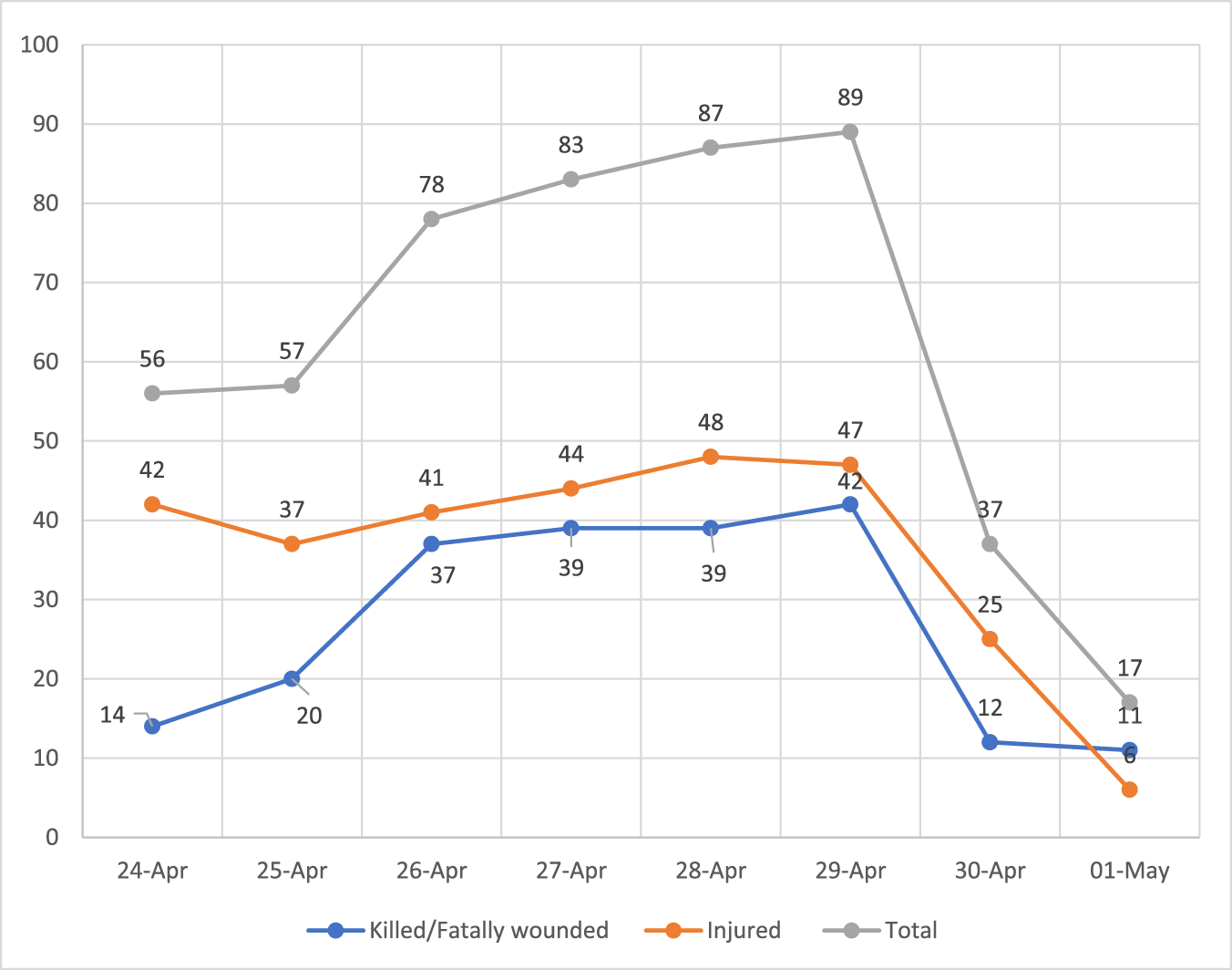
The RVC received 550 applications: 246 pertaining to fatalities and 304 to injury.Footnote 61 They merit some brief analysis given the unique insights they provide on the civilian casualties of the rebellion. Figure 1 illustrates that the total number of civilian casualties (killed and injured) for which compensation was sought increased day on day during the week-long rebellion from fifty-six on Easter Monday, 24 April 1916, to eighty-nine on Saturday 29 April, when an unconditional surrender was agreed.
Civilian casualties for which compensation was sought, 24 April–1 May 1916.

On the first day, the number of wounded civilians was three times the number killed, which suggests that civilians were unintentional targets while holiday-making on the Easter bank holiday. Three factors explain the increasing number of casualties as the rebellion progressed. First, the fighting intensified as the British army moved against insurgent positions, all of which were in built-up urban neighbourhoods, and artillery was deployed to crush the revolt. Second, civilians became increasingly desperate to secure food, to feed animals, to fetch a doctor or a priest, to check on relatives, or to flee from burning buildings. Third, as many insurgents did not wear uniforms, civilians could be mistaken for rebels. After the surrender, the casualty toll continued to rise as sniping and a general sense of chaos persisted for some days. The RVC received forty-six applications (thirty-two fatalities and fourteen cases of injury) for dates on or after 2 May 1916 as some civilians died weeks or even months after being wounded. For example, Elizabeth Kane was shot in the mouth on 30 April but did not die until 13 November 1916.Footnote 62
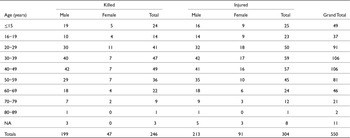
Table 1 provides a profile of the total number of casualties by gender and age. Only a quarter of the 550 claims concerned females (forty-seven deaths and ninety-one injuries). Women were less likely to be shot because of their gender, whereas men, apart from the very young and old, were more likely to be mistaken for insurgents. Males accounted for 199 compensation claims for deaths (81 per cent) and 213 (70 per cent) for injuries.
Civilian casualties by gender and age

All age groups were affected. The youngest victim was two-year-old Christina Caffrey, who was shot in her mother’s arms on Easter Tuesday as she fetched another child who had wandered into the street.Footnote 63 The oldest casualties were in their eighties. Under the rubrics of the compensation scheme, children were categorized as being fifteen years or younger. They accounted for almost 10 per cent of all compensation claims with twenty-four deaths and twenty-five cases of injury. Notably, more male than female children were killed; 63 per cent of those boys were between twelve and fifteen years and were probably mistaken for rebels. For example, fourteen-year-old Patrick Ivers had been sent for milk on 28 April but was prevented by a sentry from accessing his home on Gloucester Street. He was shot dead while climbing a neighbour’s rear wall to get home.Footnote 64 Civilians in their thirties and forties accounted for one-third of compensation claims as they were more likely to be economically active, have dependent children who needed to be fed, or be mistaken for insurgents.
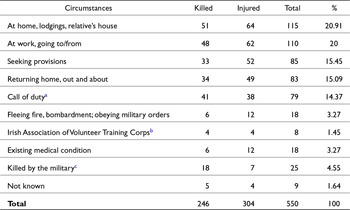
The circumstances in which civilians were killed or injured are presented in Table 2 under ten broad categories based on information gleaned from compensation applications.
Circumstances in which civilians incurred death or injury during the 1916 rebellion

a This category includes aiding the wounded, feeding animals, urgent errands, fetching children, and visiting friends and relatives.
b Composed of part-time reservists who exceeded military age.
c At North King Street, Portobello and the South Dublin Union.
That one-fifth of casualties occurred while civilians were in their own homes, lodgings, or in the house of a relative is particularly striking. It demonstrated the perils of urban warfare, stray bullets, and edgy soldiers who mistook anyone at a window or in the street for a rebel. Some families were doubly unfortunate. On 28 April, a bullet came through the front window of 27 Wellington Quay and struck Kate Doyle in the right thigh before wounding her husband, Stephen, in the stomach, from which he died on 30 April.Footnote 65 Equally notable was that one-fifth of casualties occurred when people were either at work or were going to or from their place of employment. Some employers demanded that their workers report each day in case conditions permitted business to resume. The dislocation of transport services, which did not resume until 5 May, increased the dangers of proceeding to work on foot.Footnote 66 Undoubtedly, some casualties may have been fearful of losing wages at a time of crippling wartime price inflation. Fifteen per cent were killed or injured while trying to buy food for their families. So acute was the shortage of food that the local government board, with the assistance of the Society of St Vincent de Paul, opened emergency food depots. As might be expected, a considerable number of civilians were shot while returning from various holiday pursuits or while venturing out to view the unfolding drama in Dublin city centre. For example, eight-year-old Doreen Carphin had been on a day trip with her family on Easter Monday. She was shot in the thigh that evening at St Stephen’s Green as the family returned to their home in Rathgar.Footnote 67 Just over 14 per cent of causalities were incurred while on a call of duty such as aiding the wounded, feeding animals, or checking on relatives.
IV
The Treasury directed that the scales and conditions of compensation recommended by the RVC be in accordance with the provisions of the Workmen’s Compensation Act (1906). That there was no debate about this suggests that the use of an existing legal framework was administratively convenient given the exigencies of the war and did not create any financially costly precedents. This decision was accepted in Ireland without demur. The then novel principle of no-fault compensation for workers who suffered injury arising from their employment was introduced by the Workmen’s Compensation Act (1897).Footnote 68 The legislation was expanded to agricultural workers in 1900 and further broadened to apply to almost all industries and occupations in 1906. By then it embraced an estimated fifteen million workers.Footnote 69 These provisions remained in operation in Britain until replaced by a state system of insurance under the National Insurance (Industrial Injuries) Act (1946). The scales of payment set down in 1897 remained unaltered under the 1906 act, which pertained to workers earning £250 per annum or less. Only twelve applications to the RVC (eleven fatalities and one injury) exceeded this threshold. In these exceptional cases, compensation was guided by the Superannuation Act (1887), which granted a salary allowance linked to the degree of incapacity or pension.Footnote 70 Philip W. Snell, managing director of the Limerick Clothing Factory, which had several wartime contracts for uniforms, earned £2,600 per annum and was awarded a pension of £300 per annum after the amputation of his left foot following a gunshot wound.Footnote 71 Richard Butler, a forty-four-year-old insurance agent with the Prudential Assurance Company killed in crossfire in the Phoenix Park on 26 April, earned over £400 a year in salary and commission. The RVC recommended that his widow receive a pension of £53 16s. 8d.Footnote 72
Where death was caused by accident or industrial disease and a workman left dependants who were fully dependent on him, the Workmen’s Compensation Act of 1906 laid down that compensation was a sum equal to his earnings with the same employer over the three years prior to the injury or the sum of £150, whichever was larger. Compensation was not to exceed £300. Dependants received a lump sum rather than a pension. For example, before his death on 25 April 1916, Edward Murphy earned £4 a week as a court crier and waiter. The RVC awarded his widow, Margaret, and five children £300.Footnote 73 Analysis of the awards recommended by the RVC in cases of full dependency reveals that almost half were to spouses, 28 per cent to parents, and 21 per cent to adult children or siblings. Widows accounted for the vast majority of cases of total dependency with eighty-six such instances. A total of 167 children who lost their father or mother received compensation from the RVC.Footnote 74
In cases of partial dependency on the deceased, £300 remained the maximum award, but there was no minimum. The case of fourteen-year-old Christopher Andrews revealed the extent to which the rebellion plunged families into crisis at a stroke through the loss of a primary or secondary wage-earner. He earned 12s. a week as a messenger, as did his widowed mother, Maria, a cleaner in the National Library. Before the boy’s death, 24s. per week sustained five people, but afterwards four had to survive on just half this. Writing to the RVC in support of Mrs Andrews, T. W. Lyster, director of the library, suggested that had her son been a rebel she would already have been assisted by the republican relief agency. ‘Is there no state help for this poor woman?’, he asked, given that her son had done ‘an act of mercy to one of the King’s soldiers who was calling for water’.Footnote 75 Mrs Andrews was eventually awarded £150 by the RVC. Lyster’s argument about the state’s slow response was well-made. The police estimated that the Irish National Aid and Volunteer Dependants’ Fund, which came into being in August 1916 to raise monies for dependants of dead, injured or interned Irish Volunteers or members of the Irish Citizen Army, had about £28,000 at its disposal, much of which originated in the United States.Footnote 76 Where a deceased child earned a wage that helped to support the family, a grant of £50 was deemed justifiable and twenty-three such awards were made by the RVC.
In cases of no dependency – where a parent applied for compensation in respect of the death of a child or a husband sought compensation for his wife – the RVC took the view that its terms of instruction permitted the recommendation of a compassionate award. Where a child had no earnings, the RVC suggested grants of £25.Footnote 77 The Treasury scrutinized compassionate grants and reduced recommendations for non-wage-earning children or wives to funeral expenses of £10 only in line with the Workmen’s Compensation Act (1906). For example, the RVC recommended £100 for Robert Condron, who had to care for children aged eight and six after the loss of his wife, Julia, and £150 for Michael Moran, who was left with four children, ranging in age from nine years to thirteen months, following the death of his wife Elizabeth.Footnote 78 In both cases the Treasury overruled the recommendations and permitted only funeral expenses. Neither the RVC’s argument about the loss constituted by the death of a wife, nor the parliamentary protestations of Nugent altered the Treasury’s parsimonious stance.Footnote 79 For the most part, widows and other dependants of deceased wage-earners accepted RVC awards without protest. Moreover, requests to reconsider awards were as a rule dismissed.
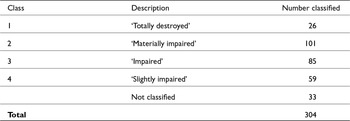
The RVC followed the provisions for personal injuries under the 1906 act. Where accidents resulted in total or partial incapacity for work, the injured party was entitled to half their average weekly earnings calculated over the previous twelve months up to a maximum of £1 per week. This disadvantaged the better-paid worker. Where the incapacity lasted less than two weeks, no compensation was payable for the first week. The Workmen’s Compensation Act excluded emotional and physical pain from any compensation estimate. Instead, it ‘categorized and valued the loss of the body’s parts and its capacities’ and differentiated between temporary and permanent disability.Footnote 80 The extent of incapacity was determined by Sir Thomas Myles, the government medical referee, to whom 241 of the 304 claims for personal injury were referred in the early months of 1917.Footnote 81 He also reported on a small number of fatalities to determine whether death was properly attributable to the rebellion or to a pre-existing medical condition. As Jackie Gulland has argued, the doctor’s medical certificate confirming a claimant’s incapacity for work was the basis for incapacity benefits across the twentieth century.Footnote 82 Table 3 sets out the four classes of incapacity and the numbers of injured civilians so assigned.
Classes of incapacity as a result of injury

Injuries classified as ‘totally destroyed’ were so serious as to prevent the likely resumption of employment. For example, on 24 April 1916 George White, a sixty-five-year-old cabman, was shot in the foot, which was subsequently amputated. Owing to age and disability, Myles judged that White was unlikely ever to work again.Footnote 83 Those who were ‘materially impaired’ suffered lasting injuries. An example was twenty-three-year-old Kathleen Cunniam, who lost her left eye. Almost 42 per cent of injured civilians were placed in classes 1 or 2. Class 3 included less serious injuries with a reasonable expectation of recovery, and class 4 were injuries with no permanent impairment.
From a compensation perspective, each class of incapacity had a linked rate of average weekly earnings: (1) ‘totally destroyed’, one-half; (2) ‘materially impaired’, three-eighths; (3) ‘impaired’, one-quarter; and (4) ‘slightly impaired’, one-eighth. By contrast, war pensions were calculated in tenths of a maximum of 100 per cent and, therefore, a greater fixed monetary value could be ascribed to the life and limbs of veterans. Where incapacity was of a permanent nature, the RVC recommended that weekly payments be commuted to a lump sum sufficient to purchase a post office annuity equal to three-quarters of the annual value of the weekly payments.Footnote 84 Thomas Cook was awarded hurt pay for six months of 12s. 6d. per week (half the 25s. that he earned as a bottler of mineral water). The payment was backdated to 25 April 1916 when he was shot in both legs. As only his right leg was amputated, he was granted a ‘materially impaired’ rate of 9s. 4½d. (three-eighths of 25s.) until 31 March 1917, when the payment was commuted to £235 10s. 6d.Footnote 85 Lump sums could also be awarded for temporary incapacity based on the number of weeks that incapacity was considered likely to last.
Cases of incapacity were subject to periodic review, on which basis an allowance could be ended, reduced or continued. When Bridget Flynn was re-examined in October 1917, Myles reported that she was still an invalid and that her injured leg would require further operations. It was recommended that her allowance of 4s. 6d. be continued for a further twelve months.Footnote 86 Lengthy projected recovery times were a striking feature of the medical referee’s reports. Some of the injured required further rest or medical intervention, but this was often outweighed by a desperation to return to work lest they lose their employment. Several individuals sought costs for medical and nursing care and were generally successful if their expenses could be confirmed. For injured non-wage-earning children, the RVC generally compensated the parent by means of a grant for the benefit of the child for expenses incurred, or, if the injury was of a serious and lasting nature, to provide for the support of the child until their recovery.Footnote 87 Mary O’Callaghan, a twelve-year-old schoolgirl, received a weekly allowance of 10s. for the loss of her left arm. In February 1918, her mother accepted a lump sum payment of £150 in commutation of the allowance.Footnote 88
Bone, nerve, joint, and serious tissue injuries caused great financial and emotional hardship as the injured worried about falling economically idle should they not make a reasonable recovery. Neither should the long-term physical pain associated with serious injury be downplayed. A simple fracture of an arm could take four weeks to heal and a broken leg up to six months.Footnote 89 However, during the rebellion civilians suffered battlefield injuries that were complicated and required much longer recovery times, for which the Workmen’s Compensation Act was ill suited. The overwhelming majority of claimants suffered gunshot wounds and comminuted fractures where bullets shattered bones and caused significant tissue trauma. Infection was also common in cases where wounds were not swiftly debrided. The British army, like those of France and Germany, adopted a pointed bullet – the Mark VII.303 cartridge – in 1911, which increased the damage to human tissue and organs.Footnote 90 Hospitals in Dublin were overwhelmed during Easter 1916 and had to function in trying circumstances. A nurse in the Mater Hospital recalled that the surgeon had to operate by candlelight as there was no gas or electricity and ‘there was no sterilisation of instruments or dressings as there was no boiling water at hand’.Footnote 91 In 1916 fracture and wound management were rudimentary. External fixation of broken bones using pins and plaster, expert supervision, and appropriate aftercare did not become standard practice until the late 1930s after the British Medical Association’s landmark report on fractures.Footnote 92 That report found that 37 per cent of fracture patients were disabled for the remainder of their lives.Footnote 93 Even if skilfully set, compound long bone fractures of the thigh or leg led to shortening of the limb and a limp. In a labour market in which movement and dexterity were crucial for all sorts of occupations, from tailors to charwomen, a disabled hand, shoulder, or leg could prove economically catastrophic.
V
Although the RVC worked diligently to vet and process claims as swiftly as possible, months elapsed before awards were paid out. Three factors contributed to the delay. First, the RVC went to great lengths to verify the earnings of deceased or injured persons by means of direct communication with employers. In sixty-three cases, mostly casual labourers with erratic employment patterns, a personal hearing was required to ascertain average weekly earnings or the degree of dependency.Footnote 94 Establishing the ages of minor dependants was also time-consuming. The requirement to authenticate claims by working-class applicants was an example of what Virginia Crossman observed of the poor law system in early twentieth-century Ireland where the poor ‘were rarely given the benefit of the doubt’ in terms of their perceived honesty by middle-class officialdom.Footnote 95 So great was the pressure of work on Hugh Love that Treasury sanction was obtained for extra clerical assistance in December 1916 and again in January, March and April 1917.Footnote 96
Second, lists of recommended awards had to be approved by the Treasury. This led to considerable bureaucratic delay as each claim was further scrutinized. William Byrne, the Irish under-secretary, was inundated with letters from solicitors protesting at the delay in the disbursement of awards, many for urgently necessitous cases. For example, John Burke complained that Julia O’Connor was ‘almost starving’, while William Triston described Mary Lawlor as ‘absolutely in want’.Footnote 97 Others were anxious to recoup out of pocket expenses such as doctors’ fees to support particular claims. In an interview with The Freeman’s Journal, John D. Nugent described the delay as a scandal given the level of destitution of some claimants and denigrated the ‘absolute incompetency’ of the Irish administration ‘to deal with such a small question as this is to a Government but such a mighty question to the poor people affected’.Footnote 98 The first schedule of ex gratia awards to women and children, whose breadwinners had been killed, was published in the press on 8 and 9 February 1917.Footnote 99 However, the announcement of awards did not mean swift payment and only a handful of claimants received their compensation in February.
The most significant cause of delay was Treasury insistence that in cases of adult and minor dependants – generally widows and children – two trustees be nominated and officially approved, after which the money would be lodged in the county court and the apportionment made by the recorder. Trustees were also proposed for adults without minors.Footnote 100 Clergy, businessmen, local government officials, and members of the Society of St Vincent de Paul were frequently nominated as trustees. The Treasury position exasperated solicitors, and an eleven-strong deputation waited on the under-secretary on 12 February 1917.Footnote 101 The proposed payment mechanism was challenged on the grounds that it would delay receipt of awards (and by implication legal fees) until at least the May 1917 session of the Dublin recorder’s court.Footnote 102 While the deputation agreed that compensation for minors should be lodged in court until the beneficiaries reached their majority, it maintained that compensation for adults and the share of awards allocated to mothers should be paid directly to recipients.Footnote 103 Wrangling over procedural matters continued until April 1917, when the authorities agreed to disburse the shares of adult claimants but to lodge those of minors in court with awards to be divided equally between named children.Footnote 104 For example, Jane Dunne was paid £69 on 24 April 1917 and £110 was lodged in court on 3 December 1917 for her children Mary (six), William (four), Maggie (one).Footnote 105
The behaviour and perceived respectability of working-class women in receipt of RVC awards were subjected to significant official scrutiny. The under-secretary instructed the Dublin Metropolitan Police (DMP) to ascertain if direct payment without the intervention of trustees would lead to the squandering or misapplication of RVC awards.Footnote 106 The views of local clergy or other reliable persons with local knowledge were also elicited by Dublin Castle. Their reports were paternalistic and suffused with middle-class judgements about the deserving or respectable poor. Although Margaret Mooney of 96 Francis Street, who was awarded £300, was deemed a ‘respectable and sober women’, the local Roman Catholic priest suggested it would ‘not be safe to give her the handling of a large sum of money direct’. By contrast, it was believed there was no danger in awarding Bridget Dunne, widow of Moses Dunne, a ‘hardworking woman of sober habits’, her £293 compensation in full as she was unlikely to ‘squander it lavishly’.Footnote 107 This scrutiny of RVC award recipients was part of a wider trend during the First World War. As several historians have demonstrated, the administration of wartime pensions and separation allowances was significantly defined by social class and a system of police surveillance imposed middle-class moral norms over the lives of working-class women; many war widows also had their pensions administered in trust or revoked for transgressing those norms.Footnote 108
Even where trustees had been nominated, most awards were not paid until April and May 1917, a year after the rebellion. This caused considerable hardship for many affected families as short-term means of staying afloat through charity (public, familial, or employer), the pawnbroker, or the proceeds of modest life or funeral policies had been exhausted. This was exacerbated by wartime inflation. A report by the Society of the St Vincent de Paul observed how the sharp increase in the cost of necessities such as coal, bread, meat, milk, and potatoes by the end of 1916 made ‘the struggle for the existence of the poor even harder than it was before the war’.Footnote 109 Two of Susan Turner’s children were injured during the rebellion and she was ‘exhausted trying to hold out’ in the face of ‘the high price of food and extra nourishment being required’.Footnote 110 A bitterly cold winter and early spring 1917 compounded the situation. The delay in RVC payments was the subject of numerous parliamentary questions, flurries of frustrated letters from solicitors, and frantic appeals by claimants such as Mary Murray. In February 1917, she was informed that she and her six children would receive £273 compensation.Footnote 111 When she had still not received payment in mid-May, she wrote despairingly to the under-secretary:
It is really very hard after all the time I have been waiting. I am now left to starve. A friend before Easter advanced me £2 to put me over the Easter and now I am left without a single thing … except something is done immediately neither myself or children will have no place to put our heads. In common Christian charity you might try and do something as after all one doesn’t relish going to the workhouse and it will be the only refuge left if I have not some money within a few days.Footnote 112
Dread of the poor law was expressed frequently. Elizabeth Byrne informed the Irish chief secretary that she and her child were ‘almost starving … I have sold everything in my place to get a bit of food. So, I think the only place for me now is the poor house’.Footnote 113 Such letters by claimants were relatively rare but they capture, in Lindsey Earner-Byrne’s evocative phrase, their ‘humiliation of need’.Footnote 114 Mrs Murray’s solicitor received her portion of the award three days later and Mrs Byrne received £234 in May. The payment of weekly allowances to the injured was just as tardy. Writing to the under-secretary in March 1917, William Cullen claimed ‘it was a gross scandal’ that the government had not compensated his daughter Brigid ‘after making a cripple of her for life’.Footnote 115 In April and May 1917 lump sums were paid to cover the period of incapacity and Brigid Cullen received £100.
For Dublin’s poorest citizens the struggle for survival was perpetual but the loss of a primary (or even secondary) breadwinner, or the full use of a limb, temporarily or permanently, occasioned financial distress of a different magnitude. In this context, government compensation was a godsend. More broadly, Dublin stood apart from similar sized British cities during the First World War in that the limited expansion of wartime industries did not counterbalance the contraction of staples such as building.Footnote 116 Although alleviated by enlistment in the armed forces, working-class unemployment remained endemic in a city where two-thirds of the population were described as working class.Footnote 117 Furthermore, unemployment was exacerbated by the damage inflicted on hundreds of businesses in April 1916 – another unhappy consequence of the rebellion.
VI
The RVC concluded its work by submitting a private report to the lord lieutenant on 30 July 1917. Notably, an overall figure for the compensation awarded was not indicated, but a sum of £45,000 is a reasonable estimate of what was paid out to claimants in 1917, exclusive of a small number of life annuities. While the RVC compensation did at least reduce the rawness of life for many bereaved or disabled civilians, compensation for loss of life and injury was miniscule when compared with compensation for property damaged during the 1916 rebellion. A total of £1.84 million was paid out in compensation for loss of property – a staggering amount given the stringencies of the First World War.Footnote 118 A two-tiered approach which favoured property over people was also adopted following the Irish War of Independence and the Civil War.
The British system of workmen’s compensation had several limitations which adversely affected injured workers, in general, and the civilian casualties of the 1916 rebellion, in particular. First, it was far less generous than in other jurisdictions and imposed hardship on the injured by enshrining the notion that they ‘should shoulder a part of the loss arising from circumstances which, in most cases, were wholly beyond their control’.Footnote 119 This was especially true during the 1916 rebellion when civilians suffered injury due to state-sanctioned violence in an insurgency that the state should have prevented. This was captured in an angry letter by A.D. Sainsbury to the RVC. He protested that he had been ‘most unfairly treated’ when awarded £10 for the death of his nine-year-old son, George Percy, who had been killed by the British army which ‘should have protected him’.Footnote 120 Whereas a British widow received a sum of between £150 and £300, a widow in Germany was compensated with a pension of 20 per cent of her husband’s annual earnings until her death or remarriage, and if she remarried she received a lump sum of two-thirds of her late husband’s yearly earnings.Footnote 121 Likewise, in France a spouse was entitled to a life annuity equal to one-fifth of her husband’s basic wage.Footnote 122 In Britain pensions were awarded to war widows but these terminated if they remarried, although from 1917 a gratuity equivalent to one year’s pension was issued.Footnote 123 Even in terms of funeral costs, the 1906 workmen’s compensation legislation with its limit of £10 lagged behind. In Germany an automatic grant of one-fifteenth of yearly earnings was paid.Footnote 124 The scale of awards for incapacity in Britain was also greatly inferior. In Germany, France, Belgium, and Australia those totally incapacitated were entitled to two-thirds of their basic wage as opposed to just half in Britain, which remained the proportion until as late as 1940.Footnote 125
Soaring wartime inflation exposed the inadequacy of the scales of compensation under the 1906 legislation. Discontent over the increasing cost of living and wage restraint compelled the British government to pass supplementary legislation in 1917 and in 1919 to increase payments to the totally incapacitated from 20s. to 25s. and then to 35s. Both measures were temporary and ceased at the end of 1923.Footnote 126 However, as P. W. J. Bartrip observes, the permanently disabled and dependants of those fatally injured whose settlements pre-dated high inflation were adversely affected.Footnote 127 Casualties of the 1916 rebellion did not benefit from these relieving measures but still had to meet the rising cost of living. For instance, the retail price of food alone almost doubled between April 1916 and April 1917 when the first RVC awards were paid.Footnote 128 The insufficiency of awards under the 1906 legislation was later highlighted by a departmental committee on the operation of workmen’s compensation. Reporting in 1920, it recommended increasing the minimum for widows from £150 to £250, raising burial grants to £15, paying two-thirds of average weekly earnings rather than half for total incapacity, and raising the limit of remuneration within the scope of the legislation from £250 to £350.Footnote 129 Only the latter recommendation and burial money were enshrined in the Workmen’s Compensation Act (1923) legislation.Footnote 130
A second disadvantage of applying the 1906 legislation to civilian casualties of the rebellion was the widespread use of lump sum settlements. Elsewhere, they were prohibited because they were disadvantageous to workmen and especially their dependants. In practice, lump sums were often exhausted while the injured or dependent family still needed such help. The sad case of seventeen-year-old Fanny Geary is instructive. She had secured a job in Jacob’s biscuit factory in May 1915, but a bullet wound to the left thigh on 28 April 1916 turned her world upside down. When the shattered bone united, the limb was shortened by three inches and thus necessitated the wearing of a costly bespoke boot. No longer able to work in Jacob’s, she had to compete in the labour market against non-disabled rivals. Eventually, in April 1918, she secured a regular but meagre wage and her allowance from the RVC was commuted to a lump sum of £150 in June 1918.Footnote 131 One wonders for how long this sum kept her in special boots, if it numbed the physical and psychological pain of her injury in middle and old age, if her injury hindered her marital prospects, and if her loss was assuaged after 1922 by political sovereignty as she limped along in independent Ireland. Other unfortunates had to wear special dentures where they were shot in the mouth, glass eyes in place of real ones, or prosthetic limbs where an arm or leg had to be amputated, but such costs were not supported by the Workmen’s Compensation Act.
The 1906 legislation took little account of family size, the age of children and the length of their dependency when lump sums were awarded.Footnote 132 Much inequity resulted. For example, the RVC recommended an award of £300 to Catherine Hayes, a forty-five-year-old widow with no children. The same amount was awarded to Catherine Kelly and four dependent children (£100 for the widow and £200 for her children).Footnote 133 In Germany, by contrast, dependent children under fifteen received a pension of 20 per cent to an aggregate maximum of 60 per cent. Allowances for dependent children were awarded to war widows in Britain. Under the Workmen’s Compensation Act there were no safeguards on how a lump sum might be spent. Notably, the ministry of pensions only sparingly approved the device of a lump sum. Applications for commuting a war pension were closely examined and fewer than 6 per cent of such applications were accepted between 1921 and 1938.Footnote 134 In the case of RVC awards, lump sum payments were a convenient means for the state to end any obligation on financially advantageous terms for it, as lump sums were typically less than the capitalized value of weekly payments.
After 1917 the payment of allowances to rebellion victims remained an imperial charge but a shrinking one as payees died or had their allowances commuted. In the complex negotiations that preceded the separation of financial responsibilities between Britain and the Irish Free State after the signing of the Anglo-Irish treaty in 1921, the Treasury made a renewed effort to commute the fourteen remaining rebellion victim cases.Footnote 135 In the event, five cases were disposed of in this way by the purchase of post office annuities at a cost of £1,636 10s. 11d.Footnote 136 More assertive claimants resisted Treasury pressure and declined the commutation. For example, Anne Butler suggested £750 or £1,000 was more appropriate than the £350 offered by the Treasury.Footnote 137 In nine cases payments continued and responsibility for them passed to the Irish Free State on 1 April 1923.
A third and glaring shortcoming was the absence in the workmen’s compensation of provision for medical treatment or vocational rehabilitation, as was the case in German and French workmen’s compensation. Anthony Farrell has observed that complaint about the magnitude of disability pensions for war veterans was offset by the free medical care associated with them.Footnote 138 To this end, the ministry of pensions established clinics and hospitals in Britain and Ireland to cater for disabled veterans on which there is a significant body of research.Footnote 139 By contrast, the injured civilian enjoyed no such benefit after the rebellion. There was a clear hierarchy where military veterans were privileged. Several historians have explored how the British government attempted to curtail its obligations to workers. For example, Andrew Perchand and Keith Gildart have shown how illnesses associated with coal mining were reclassified to allow government to avoid payment of compensation to workers forced to leave their industry on occupational grounds.Footnote 140 Likewise, the instrumentality of the Workmen’s Compensation Act was an expedient means of minimizing the state’s obligations and financial liabilities towards civilian casualties of the 1916 rebellion, even though they occupied a different category to the disabled veteran or disabled industrial worker.
Arguably, the deployment of the Workmen’s Compensation Act to address an awkward Irish problem was another manifestation of the British government ‘muddling through’ the challenges of the First World War. The culture of official surveillance of recipients of state welfare in Ireland and Britain bore striking similarities in terms of parsimony and distrust of the working class. More broadly, the example of the RVC points to the need, as David Gerbert has observed, of studying all war victims rather than the tendency to examine war veterans in isolation from civilian war casualties.Footnote 141 There has been a growing interest in civilian war fatalities, both on a global scale as exemplified in the work of Cormac Ó Gráda and on the British home front.Footnote 142 The assessment of official treatment of civilian casualties of the 1916 rebellion presented here fits into this developing historiography with its focus on the ‘hidden victims’. For civilians who grieved for lost spouses, children, and parents, or stoically faced the reduced life prospects concomitant with life changing injury, it was clear, as an early account of the rebellion remarked, that ‘the curse of war had come upon Ireland, and the citizens of Dublin … know only too well what war meant’.Footnote 143
Acknowledgements
This article would not have been possible without the support of the late and greatly missed Gregory O’Connor at the National Archives of Ireland. Over several years, we eventually tracked down all the Rebellion (Victims’) Committee files. Gregory’s death in 2020 robbed us of a generous friend and an unrivalled font of archival knowledge. I am most grateful to the two anonymous reviewers for their encouraging and helpful suggestions. My thanks to Ailís Fagan, Noel Carolan, Gerard Hanley, and James Kelly for their advice and for reading earlier drafts of this article.
Funding Statement
Research in The National Archives in London was supported by a travel grant from the Dublin City University Faculty of Humanities and Social Sciences Research Committee. A module teaching buy-out under the Dublin City University Journal Booster scheme facilitated the completion of this article. I am grateful for this assistance.
Competing interests
The author declares none.

 Open access

