


Introduction
Embolization of middle meningeal artery (EMMA) is a relatively new treatment for either primary or recurrent chronic subdural hematoma (CSDH). Reference Dian, Linton and Shankar1–Reference Fiorella and Arthur3 This is based on a fairly new understanding of inflammatory pathophysiology of CSDH. Reference Edlmann, Giorgi-Coll and Whitfield4 The inflammatory process in the dural covering of the brain is felt to likely result in a cascade of neovascularity followed by hemorrhage and rehemorrhage in the subdural space. EMMA results in devascularization of the neovascularized meninges halting this process, which in turn results in a reduction of rehemorrhage and a natural resorption of the hemorrhagic products. Reference Fiorella, Hirsch and Arthur5 The extent of embolization of the middle meningeal artery (MMA) territory is reported to be associated with the degree of reduction in the volume of CSDH (REF). Reference Catapano, Nguyen and Wakim6,Reference Catapano, Ducruet and Nguyen7
To date, an objective method to assess or describe the extent of EMMA for the treatment of CSDH does not exist. This results in heterogeneity in the reported outcomes of EMMA in patients with CSDH. Moreover, it also limits the reporting of the extent of EMMA. Recently, Shankar et al. proposed the concept of a novel grading scale for EMMA in patients with CSDH. Reference Shankar and Kaderali8 However, this has not been applied to a clinical practice and inter-rater reliability has not yet been studied. The purpose of the present study is to validate this grading scale in a clinical setting and assess the inter-rater reliability.
Method
The study has been approved by our institutional research ethics board. We retrospectively examined our prospectively collected database of consecutive patients who underwent EMMA for CSDH between July 2020 and September 2021.
Patients were included in the study only if the whole head angiogram from common carotid artery (CCA) as well as external carotid artery (ECA) before and after EMMA were available. The angiograms were considered good for evaluation only if they had arterial, capillary, as well as venous phases available before and after EMMA. Two independent readers (one interventional neuroradiologist and an interventional neurosurgeon), each with more than 5 years of experience in independent practice, assessed the angiograms for the grading of EMMA. The angiograms were assessed for contrast filling in the arterial, venous, and capillary filling as well as filling of the MMA territory through adjacent collaterals. For patients who underwent bilateral EMMAs, a separate score was assigned to each side. Disagreements between the readers were recorded, and final grading was done with consensus when possible. The grading scores between the two readers were compared to assess the inter-rater reliability.
EMMA grading. Reference Shankar and Kaderali8
0- Embolization of the MMA could not be achieved; there was no change in the filling of the MMA. The failure of embolization could be due to difficult access issues, iatrogenic spasm, or dissection of the proximal trunk of the MMA by the microcatheter or microguidewire or due to the presence of collaterals such as those to the ophthalmic artery or to the petrosal branch (Fig. 1). In case of inadvertent proximal occlusion of the MMA, due to the rich meningeal collaterals, the continued filling of major branches of the MMA can be seen on the proximal ECA trunk angiogram.
Schematic diagram ( a ) of EMMA grade 0 suggesting no embolization. ( b ) Common carotid artery and ( c ) external carotid artery lateral angiogram before embolization shows no middle meningeal artery originating from the expected location (arrow) from the internal maxillary artery. ( d ) Zoomed view of the common carotid artery lateral angiogram showed middle meningeal artery originating from the ophthalmic artery through recurrent meningeal artery (arrow).

1- Embolization of less than 50% of the MMA territory. It could be either embolization of the anterior branch or posterior branch of the MMA. The other branch of the MMA is either not embolized or could not be embolized for the reasons of failure described in EMMA grade 0. (Fig. 2)
Schematic diagram ( a ) of EMMA grade 1 suggesting embolization of < 50% embolization. ( b ) External carotid artery lateral angiogram before embolization shows normal middle meningeal artery origin from the internal maxillary artery. ( c ) Selective microcatheter lateral angiogram in the middle meningeal artery for embolization. ( d ) Post-embolization external carotid artery control angiogram showed prominent accessary middle meningeal artery that continued to supply more than 50% of the middle meningeal artery territory (arrow).

2- Embolization of most (50%–75%) of the MMA territory through both anterior and posterior branches, but the distal MMA territory can be seen filling through the collateral meningeal supply with meningeal parenchymal blush seen on the control ECA angiogram. This could likely also be due to the proximal occlusion/embolization of the main trunk of the MMA without distal penetration of embolic material. (Figure 3)
Schematic diagram ( a ) of EMMA grade 2 suggesting embolization of 50%–75 % embolization. ( b ) External carotid artery lateral angiogram before embolization shows normal middle meningeal artery origin from the internal maxillary artery. Selective microcatheter lateral angiogram in the ( c ) posterior division and ( d ) anterior division of the middle meningeal artery for embolization. ( e ) Post-embolization external carotid artery control angiogram showed small accessary middle meningeal artery that continued to supply approximately 25% of the middle meningeal artery territory (arrow).

3- Embolization of complete (75%–100%) MMA territory through both anterior and posterior branches of the MMA. This represents the ideal outcome of EMMA with no obvious meningeal parenchymal blush seen on the control ECA angiogram. (Fig. 4)
Schematic diagram ( a ) of EMMA grade 3 suggesting embolization of 50%–75 % embolization. ( b ) Common carotid artery lateral angiogram before embolization shows normal middle meningeal artery origin from the internal maxillary artery. Selective microcatheter lateral angiogram in the ( c ) anterior division and ( d ) posterior division of the middle meningeal artery for embolization. ( e ) Post-embolization external carotid artery control angiogram showed proximal stump of the embolized middle meningeal artery territory (arrow) with no residual filling.

Grades 2 and 3 were proposed to be successful EMMA.
All patients had a clinical follow-up as well as follow-up CT head to assess for resolution or recurrence of CSDH. The grading scores were compared with complete resolution or recurrence. Any increase in the size of CSDH on the follow-up CT head compared to the baseline CT head was considered recurrence.
Statistics – Descriptive statistics including mean, standard deviations, frequencies, proportions, and 95% confidence intervals were calculated. Cohen’s Kappa score was used to assess the inter-rater reliability. All statistical analyses were done using Excel and STATA 13.1. A p < 0.05 was considered significant.
Results
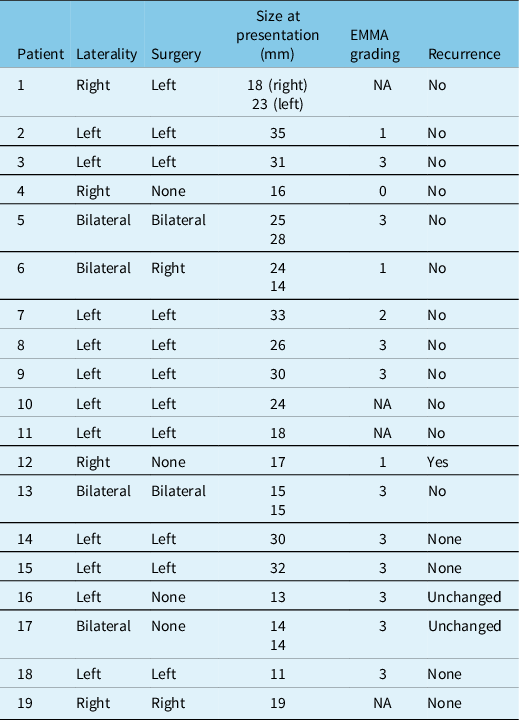
A total of 19 patients (male – 16; mean age – 65.6 years; range 14–85 years) underwent 23 EMMAs. Bilateral EMMA was done in three patients at the same sitting. One patient who received EMMA on one side came back to the hospital with CSDH on the contralateral side which was also treated with EMMA. EMMA was done as an adjunct treatment postsurgical drainage in 15 patients, and 4 patients had EMMA as their primary treatment. Seven patients underwent EMMA using polyvinyl alcohol (PVA) particles and 12 patients underwent EMMA using liquid embolic agents. Liquid embolic agents were used in all four patients who underwent bilateral EMMA. Choice of embolic agent was operator-dependent. Table 1 shows the clinical and angiographic details of EMMA.
Imaging and angiographic details of patients who received EMMA between July 2020 and September 2021

EMMA was done in the MMA branches on all patients, except for two patients where accessary MMA was also embolized. In these two patients, the large MMA territory continued to fill at the end of EMMA through the accessary MMA. EMMA grading could not be done in 4 of 19 patients, as the whole head angiograms running from arterial through capillary phases were not available. These cases were excluded from final analysis. All ungraded study patients had unilateral EMMAs done, and all were treated with PVA particles. The number of cases in each EMMA grading score category are as follows: 0 n = 1; 1 n = 3; 2 n = 1; and 3 n = 10. An average follow-up of 2.8 (1–8) months was available on imaging for these patients. On follow-up, 11 patients had complete resolution of their CSDH, 1 patient had recurrence of CSDH, and 2 patient’s CSDH remained unchanged. All other patients had a marked reduction in the size of their CSDH on follow-up. Of the four patients with bilateral EMMA, three had marked reduction in size of their CSDH and one patient’s CSDH remained unchanged on the 2-month follow-up. One patient’s unilateral CSDH also remained unchanged on 3-month follow-up CT. This patient’s CSDH was thought to be secondary to ventriculo-peritoneal (VP) shunt. The patient with recurrence of CSDH had significant medical comorbidities that precluded surgical drainage and had to be anticoagulated for pulmonary embolism that was diagnosed before EMMA. This patient died 1 month after EMMA from multiple in-hospital complications.
None of the patients with EMMA grade 3 had recurrence. One patient with EMMA grade 3 had their CSDH unchanged on short-term follow-up. The single patient with recurrence of CSDH in our series had an EMMA grade 1 embolization (Fig. 2).
There was substantial inter-rater reliability for the assessment of grading of EMMA (Kappa = 0.74). Only 2 of 19 EMMA cases were discordant between the two readers. In both cases, one reader marked them grade 3 and the other marked them grade 1. The discordance was due to the presence of a posterior branch of superficial temporal artery on the control angiogram that looked like a potential meningeal branch.
No periprocedural technical complications were noted from EMMA. Since only one patient had recurrence of CSDH, we did not calculate the odds ratio for it.
Discussion
Our study illustrates a clinical application of a previously proposed EMMA grading scale with substantial inter-rater agreement (Kappa = 0.74). We currently lack a standardized grading system. Such a grading system is greatly needed to communicate and objectively compare the technical outcome of EMMA in routine clinical practice, as well as in ongoing clinical trials on EMMA for CSDH treatment. The proposed grading scale appears to be intuitive and simple to use, and its high inter-rater agreement is promising for routine clinical use. Although our series is small, having no technical complications from EMMA is very promising for this treatment.
The grading scale appears to have some clinical validity as the single patient with recurrence of CSDH on follow-up had grade 1 EMMA. None of the patients with EMMA grade 2 or 3 had recurrence on the treated side. This is intuitive that the more extensive embolization will decrease the chance of recurrence of CSDH. This was previously proposed by Catapano et al. Reference Catapano, Nguyen and Wakim6,Reference Catapano, Ducruet and Nguyen7 Although the majority of patients included in the study were treated using liquid embolic agents, the grading scheme seems to be valid for those treated either with PVA or liquid embolic agents. This is likely based on the principle of good distal penetration irrespective of the type of embolysate.
It is important to highlight the four patients excluded from the final analysis. This was based on the unavailability of whole head control post-EMMA angiograms. The grading scheme is based on the evaluation of whole head selective CCA and ECA angiograms before and after EMMA. These angiograms should run from arterial to late venous phase. The late venous phase of the angiogram is critical for the evaluation of residual as well as collateral filling of the MMA territory. Similarly, covering whole head on the before and after EMMA angiograms is key for assessment of filling of MMA territory through collaterals. Any future application of this grading scale should highlight this. Including whole head and running the angiograms to late venous phase should become a standard protocol for EMMA evaluation. In our hospital, after the conceptualization of the grading scale, we saw a trend for more complete embolization, and we were able to standardize the image acquisition protocol to include whole head angiogram running from arterial through the venous phase.
Although our series is small, it does illustrate a clinical application of the EMMA grading scheme; it will be important to validate this in larger series. The EMMA grading system is simple to use and follows parallel principles that have been shown in the Thrombolysis in Cerebral Infarction (TICI) grading system Reference Higashida, Furlan and Roberts9 and the aneurysm occlusion grading system. Reference Roy, Milot and Raymond10 With further evaluation of the clinical use of EMMA for the treatment of CSDH, the grading system will likely further evolve. The grading scheme will help report technical extent and outcomes of EMMA to enable comparability and interpretability of study findings.
Conclusion
The novel EMMA grading scheme appears to be promising with substantial inter-rater reliability.
Acknowledgments
The authors thank Susan Alcock and Joshua Dian for their help in organizing this study.
Funding
None.
Competing interests
Jai Shankar is the principal investigator of EMMA-Can study in Canada.
Statement of authorship
Jai Shankar conceptualized, collected the data, and wrote the first draft of the manuscript. Zul Kaderali helped develop the idea, collected the data, and reviewed the manuscript.
Ethical approval
All procedures performed were in accordance with the ethical standards of the institutional and/or national research committee and with the 1964 Helsinki declaration and its later amendments or comparable ethical standards.



 Open access

