





1. Introduction
In principle, the number of novel situations and coordination problems humans can encounter is open-ended. However, human communication systems enable humans to communicate about everything, concrete or abstract, in the moment or temporally and spatially far from the here and now (Hockett, Reference Hockett1960; Pleyer et al., Reference Pleyer, Perlman, Lupyan, de Reus and Raviv2025). From an evolutionary perspective, this raises the question of how this property of human communication systems has come about. One possible solution to the challenge of an open-ended communicative environment would be to coin new signals for each new referent and situation. This strategy is exemplified in Jorge Luis Borges’ (Reference Borges1942/1954) short story ‘Funes the Memorious’ in which a teenage boy, Ireneo Funes, has acquired the ability to remember absolutely everything in perfect detail. In Borges’ short story, Funes proceeds to assign a new, arbitrary word to every number. However, in reality, the increasing number of novelties is open-ended, which places severe real-life restrictions on this potential strategy. From an evolutionary perspective, the storage capacity for form-meaning pairings that humans possess clearly distinguishes human communication systems from the communication systems of other animals, which, in comparison, are severely limited in the items that form part of their communicative repertoires (Hurford, Reference Hurford2012; Pleyer & Hartmann, Reference Pleyer and Hartmann2020). However, the number of form-meaning pairings that can be learned is still limited – even though it is in the tens of thousands (Brysbaert et al., Reference Brysbaert, Stevens, Mandera and Keuleers2016). In addition, learning is also an extremely costly and time-consuming process (Kirby et al., Reference Kirby, Tamariz, Cornish and Smith2015). For these reasons, this adaptive strategy gets humans only so far on the way to creating a communication system that can be used to communicate about potentially everything.
One much more efficient and successful solution to this problem is to introduce systematicity into the system. That is, whereas Funes the Memorious can assign a novel word to each and every number because of his unlimited memory, humans do not need to do this because human number systems exhibit systematicity. We do not need to assign a novel word or rote learn the word expressing 7312 (seven thousand three hundred and twelve) because we can generate it based on the systematic rules for generating numbers. It is the same case in other systems, such as language. In linguistics in general and evolutionary linguistics in particular, most attention has been paid to the formal properties exhibiting such systematicity, such as duality of patterning (that a limited set of meaningless phonemes can be combined to yield meaningful words; Hockett, Reference Hockett1960), as well as morphology and syntax. Such systematicity of human language can be realised by the properties of combinatoriality and compositionality: Existing signals can be combined in meaningful ways in which the meaning of the whole is a function of the rule- and schema-based combination of its parts. For example, in John is taking a train back home after work, John can be substituted by other people; taking a train can be substituted by other means of transportations such as taking a bus; after work can be replaced by other situations such as after meeting his friends in town or after visiting his aunt; another motion event can be expressed by Mary is driving a car to the park. In this way, novel utterances that have never been produced and describe situations that have never happened before can be composed (Pelletier, Reference Pelletier, Hampton and Winters2017; Pleyer et al., Reference Pleyer, Lepic and Hartmann2024b), such as ‘Hold the newsreader’s nose squarely, waiter, or friendly milk will countermand my trousers’ (Stephen Fry, A Bit of Fry and Laurie).
Another adaptive solution is to systematically extend the meanings of existing signals, that is, by adding polysemy to the system. However, this has been paid much less attention to in evolutionary linguistics. In fact, polysemy is widely observed in modern languages. For example, in English, approximately 84% of words are estimated to exhibit polysemy (cf. Floyd & Goldberg, Reference Floyd and Goldberg2021). Vicente and Falkum (Reference Vicente and Falkum2017) even go so far as to suggest that virtually every word in natural language is polysemous to some extent. Body parts are a particularly good example of this widespread polysemy: we speak of a person’s foot, hands, and head, but also the foot of a mountain, the hands of a clock, and the head of a government. From a diachronic perspective, polysemy can be achieved by the semantic extension of pre-existing words. Indeed, the process of semantic extension leading to polysemy has been amply documented in historical linguistics (e.g. Allan & Robinson, Reference Allan and Robinson2012; Traugott & Dasher, Reference Traugott and Dasher2002). One of the key factors identified in historical linguistics that licences such semantic, polysemous extension is that of metaphoric extension (e.g. Anderson, Reference Anderson, Semino and Demjén2017; Sweetser, Reference Sweetser1990). For example, when speaking of someone with a ‘sunny personality’, this sense is based on the meaning ‘bright, cheerful, joyous’ (OED). In the history of English, this sense has emerged from a metaphoric, semantic extension of the older, concrete, core meaning of ‘characterised by or full of sunshine’ (OED). This metaphoric extension is licensed by the conceptual metaphor HAPPINESS IS LIGHT (Anderson, Reference Anderson, Semino and Demjén2017).
Given its central role in language change, we argue that metaphorical extension could also have played a key role in the emergence of polysemy in the evolution of communication. This, in turn, means that it has served as one of the key processes (next to our massive storage capacity for linguistic constructions and combinatoriality and compositionality) explaining one of the key questions about the evolution of language: How the communication systems of hominins became ‘readily expandable’ (Planer & Sterelny, Reference Planer and Sterelny2021) and enabled the unlimited communicative potential of human languages.
However, while a number of studies have stressed the importance of metaphor for language evolution (e.g. Ellison & Reinöhl, Reference Ellison and Reinöhl2024; Gil & Shen, Reference Gil and Shen2021; Knight & Lewis, Reference Knight and Lewis2017; Kuleshova et al., Reference Kuleshova, Zhang, De Weyer, Boëda and Pleyer2026; Pleyer et al., Reference Pleyer, Kuleshova and Placiński2024a; Smith & Höfler, Reference Smith, Höfler and Díaz-Vera2015), relatively few have investigated the role of metaphor and semantic extension from an experimental perspective (Bowerman & Smith, Reference Bowerman and Smith2022; Smith et al., Reference Smith, Bowerman and Smith2025; Verhoef et al., Reference Verhoef, Walker and Marghetis2016, Reference Verhoef, Walker and Marghetis2022, Reference Verhoef, Marghetis, Walker and Coulson2024). Here, we investigate semantic extension based on conceptual metaphors in an artificial language learning experiment. Specifically, we first ask participants to learn pairings of concrete concepts with novel ‘alien words’, and then to apply these newly learned words to communicate new, more abstract meanings, that is, to semantically extend the meanings of the original ‘alien word’ – ‘concrete meaning’ mappings. Importantly, the new meanings they have to communicate can be linked to the concrete meanings of the ‘alien words’ via frequently posited conceptual metaphors. In other words, the signal and meaning space that we create affords the use of conceptual metaphors as semiotic resources for semantic extension.
2. Theoretical background and hypotheses
2.1. Experimental semiotics and artificial language learning
Overall, ‘experimental studies on the cultural evolution of language’ (Tamariz, Reference Tamariz2017) try to observe the change and emergence of linguistic or language-like structures in controlled settings. For this reason, they have been called ‘the linguist’s Drosophila’ (Roberts, Reference Roberts2017), given the paradigm’s wide-ranging applicability for attempting to replicate processes observed in language change and to investigate questions regarding the evolution of language.
This paradigm is also often referred to as experimental semiotics (e.g. Delliponti et al., Reference Delliponti, Raia, Sanguedolce, Gutowski, Pleyer, Sibierska, Placiński, Żywiczyński and Wacewicz2023; Galantucci, Reference Galantucci2005; Reference Galantucci2009, Galantucci et al., Reference Galantucci, Garrod and Roberts2012; Garrod et al., Reference Garrod, Fay, Lee, Oberlander and MacLeod2007; Healey et al., Reference Healey, Swoboda, Umata and King2007; Müller & Raviv, Reference Müller, Raviv, Raviv and Boeckx2025; Nölle & Galantucci, Reference Nölle, Galantucci and Ibáñez2023). In experimental semiotics studies, participants are not allowed to use language, but instead have to create and negotiate their own communication system in order to successfully communicate. These studies have shown that humans develop systematic communication systems in which they first create signs (form/meaning mappings), which become more systematic over time. Experimental semiotics studies have been conducted in a variety of modalities, including visual symbols, drawings, gestures, pantomime, vocalisations or other types of novel communicative media (see Delliponti et al., Reference Delliponti, Raia, Sanguedolce, Gutowski, Pleyer, Sibierska, Placiński, Żywiczyński and Wacewicz2023; Müller & Raviv, Reference Müller, Raviv, Raviv and Boeckx2025; Nölle & Galantucci, Reference Nölle, Galantucci and Ibáñez2023; Pleyer & Hartmann, Reference Pleyer and Hartmann2024 for reviews).
One classic example works much like the traditional pictionary game, in which participants are assigned to be ‘senders’ and ‘receivers’, and one has to guess the signals the other sends (Garrod et al., Reference Garrod, Fay, Lee, Oberlander and MacLeod2007). Both senders and receivers are not allowed to use language. The other type of game that is relevant here is the ‘alien language’ paradigm. In this type of game, participants are asked to learn ‘an alien language’ which is artificially created by experimenters (Cuskley, Reference Cuskley2019). Although studies within the experimental semiotics paradigm have shown insightful results for the evolution of communication (e.g. Kirby et al., Reference Kirby, Cornish and Smith2008; Raviv et al., Reference Raviv, Meyer and Lev-Ari2019), and metaphorical extension is a key factor in language evolution, not many studies have addressed the question of metaphorical extension experimentally.
2.2. Experimental semiotics and metaphor
As far as we know, only two sets of studies so far have focused on metaphorical extension using the experimental semiotics paradigm. Verhoef et al. (Reference Verhoef, Walker and Marghetis2016) investigated metaphorical mappings from temporal and spatial dimensions. The linguistic phenomenon that space and time concepts are closely connected is pervasive across languages, in the way that there is a mapping between the extent of space and the duration of time. For example, many languages express a lot of time vs. little time and a long time vs. a short time, like in English, as well as in Polish dużo czasu vs mało czasu, długi czas vs krótki czas , in German viel Zeit vs wenig Zeit, lange Zeit vs kurze Zeit , and in Chinese 很多时间 (hěnduō shíjiān) vs 很少时间 (hěnshǎo shíjiān), 长时间 (cháng shíjiān) vs 短时间 (duǎn shíjiān). Such a spatial-temporal conceptual mapping is also supported by neurobiological findings. For instance, overlapping brain activation has been detected in both space and time tasks (Winter et al., Reference Winter, Marghetis and Matlock2015). Spatial attention has also been shown to modulate mental time travel (Casadio et al., Reference Casadio, Patané, Ballotta, Candini, Lui, Benuzzi and Frassinetti2024), the ability to reconstruct events from the past and imagine future events. Developmental studies also suggest a conceptual mapping between space and time. Human neonates and preverbal infants spontaneously make an association between spatial extent and time duration (de Hevia et al., Reference de Hevia, Izard, Coubart, Spelke and Streri2014; Srinivasan & Carey, Reference Srinivasan and Carey2010).
Inspired by this linguistic phenomenon, Verhoef et al. (Reference Verhoef, Walker and Marghetis2016) attempted to test whether such mappings would emerge in a communication game. Specifically, a vertical touchbar recording finger movement sequences was used to communicate time concepts. Eighteen temporal concepts were included in the tests, belonging to the domains of duration (‘second’, ‘day’, ‘year’), sequence (e.g. ‘day before’, ‘year after’) and deictic (e.g. now, yesterday, today, tomorrow). The results showed that participants successfully communicated time concepts with the movement of the touchbar quickly and consistently, and that they used spatial length to represent time duration – the more space used on the touchbar, the longer the time indicated. This strongly suggests that a space-time-based metaphor system emerged in the communication. However, the direction of the touchbar movement diverged among participants. About half of the participants moved the touchbar downwards to indicate future time and upwards to indicate past time, whereas in the other half, it was the other way around. These differences suggest that the universal time-space metaphor can emerge in a new communication system for the spatial extent – temporal duration mapping, but that there are differences in terms of directionality (whether the future is in front or behind), just as is found in different languages.
Verhoef et al. (Reference Verhoef, Walker and Marghetis2022) further investigated metaphorical extension with a combination of the experimental semiotics paradigm and the iterated learning paradigm. The iterated learning paradigm is also commonly used by researchers to explore questions in language evolution. It often includes generations of participants, in the way that the output of the first generation serves as the input of the second generation, and the output of the second generation serves as the input of the third generation, and so forth (e.g. Kirby et al., Reference Kirby, Cornish and Smith2008). It is also believed to function as a ‘filter’ for learning biases. Taking the produced touchbar communication systems from previous experiments (Verhoef et al., Reference Verhoef, Walker and Marghetis2016, Reference Verhoef, Walker and Marghetis2022), the authors trained the first-generation participants and then let them interact for four rounds, in which they negotiated a communication system for expressing time concepts. After finishing four rounds of interactions, the resulting communication system was given to the second-generation participants as the input, and they interacted with each other for four rounds as well. Eight generations of interactions were recorded. Interestingly, compositional structures of space-time mappings emerged in some of the transitional chains. For example, the signals for ‘past’, ‘now’ and ‘future’ were combined with ‘day’ and ‘year’ to signify ‘yesterday’, ‘today’ and ‘tomorrow’ and ‘last year’, ‘this year’ and ‘next year’ respectively.
This shows that metaphor-based systems not only can be combined into compositional structures, but also can evolve into a grammatical system via cultural evolution. Moreover, the integration of interaction and transmission rendered much higher communicative accuracy, even up to 100% in some systems. Nevertheless, the inconsistency of the directions of the touchbar mapping with time duration still remained, even in very few cases, in the course of interactions. Overall, the analysis of the results revealed that interactions robustly produced gradually increasing structured communication systems, and transmission gave rise to widespread structure and perfect communication when the structure from interactions was maintained.
The other set of studies by Bowerman and Smith (Reference Bowerman and Smith2022) and Smith et al. (Reference Smith, Bowerman and Smith2025) investigated semantic extension with multiple steps of experiments. Participants joined a referential game, in which they took turns being senders and receivers of signals. Senders had to use a signal space of white geometric shapes (such as a square, a cross or a hexagon) to communicate the target picture that the receiver should pick out of a lineup of different possible options (the meaning space).
In one experiment, participants were then tested in six blocks with changing meaning spaces that increased in difficulty with each block. The first two blocks served as the basis for motivated extensions, using matching white shapes and then coloured shapes as meaning spaces. In Block 3, the meaning space was coloured splats. Participants did indeed make use of this metonymic relationship in the coloured splats block. Participants were then tested on three further blocks with new meaning spaces: coloured shapes, pictured objects with prototypical colour associations (such as a banana, with an expected association with yellow), and emotions (such as sadness, with an expected association with blue). These blocks were designed to test whether participants would make further metonymic and metaphorical extensions based on colour associations. For these three subsequent blocks, participants in both conditions behaved similarly: If the initial colour associations in Block 2 were fixed and reliable, participants initially tended to extend the colour associations of signals in the predicted manner but did so with declining fidelity over subsequent blocks.
They especially struggled with metaphorical extensions to emotions, and instead mostly created new associations from scratch. This suggests that the associations were less salient and were not assumed to be shared to the degree that they could function as common ground for shared referential strategies based on metaphorical extension.
However, when participants did extend associations in the predicted manner, this facilitated communicative success in all blocks. Salient and mutually accessible metonymic associations, therefore, seem to play a central role in enabling initial semantic extension. Moreover, when these initial extensions are more strongly grounded, they give rise to more systematic and resilient extension patterns in subsequent chains.
The authors relate the success participants have with metonymic chaining of semantic extensions to the importance of metonymy in language change (e.g. Traugott & Dasher, Reference Traugott and Dasher2002). However, as noted, participants face a greater challenge with metaphorical extensions, making it an important research question under which conditions metaphorical extensions can more easily emerge.
2.3. Cognitive linguistics and conceptual metaphor theory
In cognitive linguistics, the major theoretical framework that captures metaphors is that of Conceptual Metaphor Theory (CMT; Lakoff & Johnson, Reference Lakoff and Johnson1999; Kövecses, Reference Kövecses2010). In metaphor, one kind of thing is understood and experienced in terms of another. This understanding is achieved via the ‘mapping’ of aspects of a – most often concrete – source domain (such as space) to a – most often more abstract – target domain (such as time). In this way, more abstract domains are understood in terms of a domain that we have more concrete experience with, with this experience often being based on our embodied interactions with our environment. The conceptual metaphor of TIME IS SPACE, which was the subject of the experiments by Verhoef et al. described above, is one such example. On a more general level, CMT sees our conceptual system as being based on and organised by conceptual metaphors. This means that metaphoric expressions are windows into our conceptualisation of these abstract domains. Much of the work in CMT has concentrated on systematising metaphoric expressions for a particular domain to gain insight into the underlying conceptual mappings (Kövecses, Reference Kövecses2010; Lakoff & Johnson, Reference Lakoff and Johnson1980). For example, metaphorical expressions such as ‘We’re at a crossroads in our relationship’ ‘When we were in our twenties our relationship was quite a wild ride’ or ‘We’ve reached the end of our relationship’ can be systematised as being expressions of a conceptual metaphor LOVE IS A JOURNEY. However, more recently, evidence has also come from behavioural and neurological studies, as well as from other modes of human expression such as gesture, art or dance (Littlemore, Reference Littlemore2019).
One crucial argument of CMT is that our conceptual system is metaphorically structured. That is, we understand and organise abstract concepts such as TIME or LOVE through the mappings to more concrete domains grounded in our embodied experiences that structure them, such as SPACE for TIME and JOURNEY for LOVE. Importantly, some conceptual metaphorical mappings are more salient and prominent in organising an abstract conceptual domain than others. For example, SADNESS IS DOWN (as in ‘she’s feeling low today’, ‘he’s feeling down’.) is a more salient, frequent, and prominent conceptual metaphorical mapping than SADNESS IS BEING BLUE (as in ‘I felt blue yesterday’). This also presents a possible explanation why participants in the studies by Smith et al. (Reference Smith, Bowerman and Smith2025) struggled with colour mappings to emotions (such as BLUE for SADNESS), as there are potential mappings that are more salient in structuring these conceptual domains. For example, McMullen and Conway (Reference McMullen, Conway and Fussell2002) found that 90% of metaphorical expressions conceptualising depression made use of the SADNESS IS DOWN mapping.
It has been discussed whether conceptual metaphors are universal across cultures. For example, emotion metaphors have been investigated across different languages with the expectation that they are universal because humans across cultures have the same bodily experience. However, as Kövecses (Reference Kövecses2015) argues, some variations should also be expected. Although embodiment plays a central role in the emergence of metaphor, various contextual factors also play a central role, such as situational, discourse, conceptual-cognitive and cultural influences. HAPPINESS IS UP has been attested in English, Chinese and Hungarian (Kövecses, Reference Kövecses2015), but HAPPINESS IS FLOWERS IN THE HEART is specific to Chinese (Yu, Reference Yu1998). HAPPINESS IS LIGHT is also widely captured in languages like English, Chinese, Japanese, Persian and Wolaita (Faranso et al., Reference Faranso, Jakale and Tsegaye2024; Safarnejad et al., Reference Safarnejad, Ho-Abdullah and Awal2014), and has been called ‘one of the most characteristic metaphors for happiness’ (Kövecses, Reference Kövecses1991: 30; cf. Anderson, Reference Anderson, Anderson, Bramwell and Hough2016: 118). SAD IS DOWN, which is the opposite direction from happiness, has also been observed in English, Chinese, Japanese and Swahili (Kövecses, Reference Kövecses2015). ANGER IS FIRE is also expressed similarly in English, Chinese, Japanese, Hungarian, Zulu and Polish (Kövecses, Reference Kövecses2010, Reference Kövecses2015). LOVE IS A JOURNEY can be found in English, Chinese, Hungarian and Polish, for example (e.g. Brożyna Reczko, Reference Brożyna Reczko2017; Kövecses, Reference Kövecses2015). It seems that emotions display a good example for culture/language universality, which suggests that conceptual metaphors of emotion are probably more salient than other categories.
2.4. Research questions
As mentioned in the introduction, conceptual metaphors have also been invoked as motivations for diachronic semantic change and especially semantic extension via metaphor (e.g. Anderson, Reference Anderson, Semino and Demjén2017; Sweetser, Reference Sweetser1990), although experimental insights into the processes that underlie such extensions are currently limited. One factor that seems to influence whether metaphoric extensions are made is how salient the underlying metaphorical mappings are and to what degree they are assumed to be culturally shared between interactants. For example, the studies by Verhoef et al. (Reference Verhoef, Walker and Marghetis2016, Reference Verhoef, Walker and Marghetis2022, Reference Verhoef, Marghetis, Walker and Coulson2024) suggest that the mapping of space to time can serve as a salient association for the creation of a systematic communication system. In contrast, the studies by Smith et al. (Bowerman & Smith, Reference Bowerman and Smith2022; Smith et al., Reference Smith, Bowerman and Smith2025) suggest that this is less the case for colour-emotion associations, which did not lead to established metaphoric extensions in the majority of participants.
Here, we want to test if participants make use of semantic extensions in an artificial ‘alien’ language based on conceptual mappings from CMT, which have received wide empirical support and are assumed to represent salient and culturally shared associations. Specifically, we investigate if participants will make use of the conceptual mapping proposed by CMT when asked to use symbols with concrete meanings to communicate about novel, more abstract referents.
In addition, as noted in the discussion of the studies by Smith et al. in Section 2.2, it remains an important research question under which conditions metaphorical extensions can emerge more easily in experimental settings. Given that in previous studies participants struggled with metaphorical extension, presumably due to their low saliency, we also want to know if more predicted metaphorical extensions are made use of by participants if they receive explicit instructions that similarity plays a role in the artificial alien language they are learning. We therefore test the potential use of metaphorical extensions in two conditions, a no instruction condition, and an instruction condition, where participants are explicitly made aware that the communication system they are learning makes use of similarity-based semantic extension.
Whether there is a difference between the two conditions will answer the following questions: (1) Are conceptual mappings proposed by CMT saliently available as a semiotic resource to extend the communicative potential of symbols to new referents?, or (2) Do conceptual mappings need additional context and does the process of extension based on similarity need to be made salient in some way for participants to engage in metaphoric extensions?
Importantly, if participants are aware that semantic extensions are made based on conceptual metaphorical associations, it is a crucial question which associations are salient for interactants. This, therefore, relates to the question of which concrete concepts are more likely to be chosen for the expression or understanding of abstract concepts. Of course, this can also be phrased from the opposite perspective, namely, which abstract concepts are more likely to be structured by a particular concrete concept, and which are more likely to be structured by multiple source concepts. In the literature on conceptual metaphor, some conceptual mappings have emerged as particularly salient ways of structuring particular target concepts, such as the aforementioned case of SAD IS DOWN (McMullen & Conway, Reference McMullen, Conway and Fussell2002). Other target concepts have multiple salient conceptual metaphorical mappings that can be used to structure them. For example, as mentioned above, the target concept of HAPPINESS is frequently conceptualised in terms of HAPPINESS IS UP as well as HAPPINESS IS LIGHT. Conversely, the same source concept can also be used to conceptualise different target concepts. For example, UP is not only used to conceptualise the concept of HAPPINESS but is also found in the conceptual metaphor POWER IS UP, which is also widely attested in languages such as English, Chinese, Japanese and Polish (Kövecses, Reference Kövecses2015; Wojtczak et al., Reference Wojtczak, Witczak-Plisiecka and Augustyn2017).
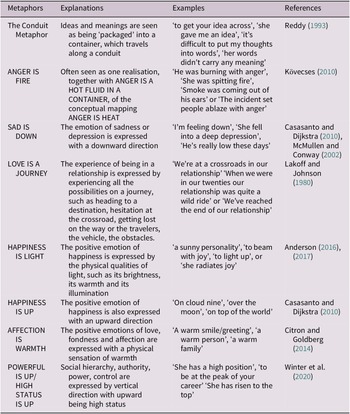
Here, our goal is to find out which metaphors represent salient conceptual associations through the use of a multiple-choice Alien Language Learning Experiment. Importantly, we are interested in this question both for concepts where one particular mapping has been found to be dominantly salient in the literature (such as SAD IS DOWN), as well as for concepts where previous research has found multiple salient associations across cultures (such as HAPPINESS IS LIGHT and HAPPINESS IS UP). This will help answer the question of which mappings are more likely to be used as the basis for semantic extension in an experimental setup. The conceptual metaphors that we use as the basis for the stimulus design of our experiment are listed in Table 1. They are based on frequent metaphorical mappings posited in CMT research that are also found quite frequently across different cultures (e.g. Kövecses, Reference Kövecses2005, Reference Kövecses2010; Lakoff et al., Reference Lakoff, Espenson and Goldberg1991; Lakoff & Johnson, Reference Lakoff and Johnson1980). Specifically, the conceptual metaphors were used to populate the ‘meaning space’ (Delliponti et al., Reference Delliponti, Raia, Sanguedolce, Gutowski, Pleyer, Sibierska, Placiński, Żywiczyński and Wacewicz2023; Nölle et al., Reference Nölle, Staib, Fusaroli and Tylén2018) of the experiment, that is, the meanings that have to be communicated (such as SADNESS, HAPPINESS, ANGER etc), as well as the ‘signal space’ that is the meaningful signals (Such as DOWN, UP, FIRE) that are available as affordances for semantic extension
Overview of conceptual metaphors that serve as the basis for stimulus creation
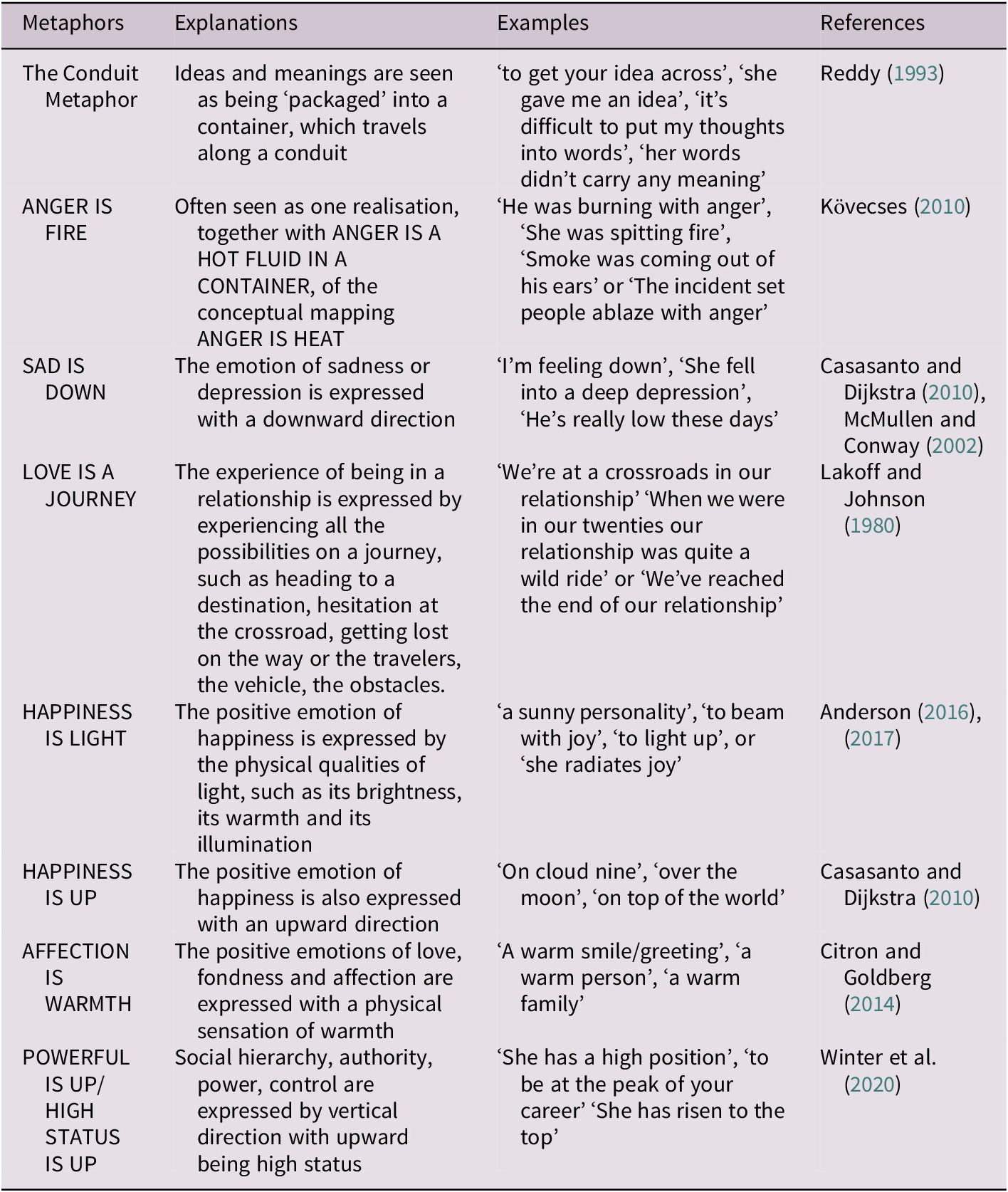
Table 1. Long description
From top to bottom, the table contains eight rows. The first row has column headers: Metaphors, Explanations, Examples, References. The second row lists The Conduit Metaphor, explained as ideas and meanings packaged in a container traveling along a conduit, with examples such as ‘to get your idea across’ and reference Reddy Reference Reddy and Ortony1993. The third row is ANGER IS FIRE, described as a realization of ANGER IS HEAT, with examples like ‘He was burning with anger’ and reference Kövecses Reference Kövecses2010. The fourth row is SAD IS DOWN, explained as sadness expressed with downward direction, examples include ‘I’m feeling down’, referenced by Casasanto and Dijkstra Reference Casasanto and Dijkstra2010, McMullen and Conway Reference McMullen, Conway and Fussell2002. The fifth row is LOVE IS A JOURNEY, explained as relationships expressed as journeys, examples include ‘We’re at a crossroads in our relationship’, referenced by Lakoff and Johnson 1980. The sixth row is HAPPINESS IS LIGHT, explained as happiness expressed by qualities of light, examples include ‘a sunny personality’, referenced by Anderson Reference Anderson, Anderson, Bramwell and Hough2016, Reference Anderson, Semino and Demjén2017. The seventh row is HAPPINESS IS UP, explained as happiness expressed with upward direction, examples include ‘On cloud nine’, referenced by Casasanto and Dijkstra Reference Casasanto and Dijkstra2010. The eighth row is AFFECTION IS WARMTH, explained as affection expressed as warmth, examples include ‘A warm smile’, referenced by Citron and Goldberg Reference Citron and Goldberg2014. The ninth row is POWERFUL IS UP/HIGH STATUS IS UP, explained as power and status expressed by upward direction, examples include ‘She has a high position’, referenced by Winter et al. Reference Winter, Duffy and Littlemore2020. Each row follows the order: metaphor, explanation, examples, reference.
By asking participants to choose which concrete source concept could be used to refer to which more abstract target concept via semantic extension, we can then address the research question of whether there are statistically significant associations of particular source domains to particular target domains, that is, which concept-to-concept mappings are more strongly associated than would be expected (see Stefanowitsch, Reference Stefanowitsch, Stefanowitsch and Gries2006 for discussion). In other words, our research question is the following: (3) Which associations between source concepts and target concepts are most frequent, and therefore most salient, for participants in the meaning space of the experiment?
3. Methods and methodology
The experiment was run in two conditions, a no instruction condition (3.1) and an instruction condition (3.2).
3.1. No instruction condition
3.1.1 Participants
We recruited a total of 59 participants via the online crowd-sourcing platform Prolific, whose primary language was English. Participants were paid £3.50 for their participation (median completion time 12 minutes).
3.1.2. Design and procedure
The experiment was coded in JavaScript using jsPsych 8.0 (de Leeuw, Reference de Leeuw2015) and was run on cognition.run (Full code for the experiment can be accessed at https://osf.io/n6pej/). After an informed consent form, participants received an introduction to the experiment. They were told that they had been selected to be Ari’s tour guide, an Alien from the planet Tsamtrah who is visiting Earth for tourism.Footnote 1 They were told they had to help Ari take pictures of interesting things on Earth to send back to their home planet. However, in order to do so, they had to learn some Tsamtrahian, which is a purely graphical language.
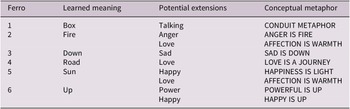
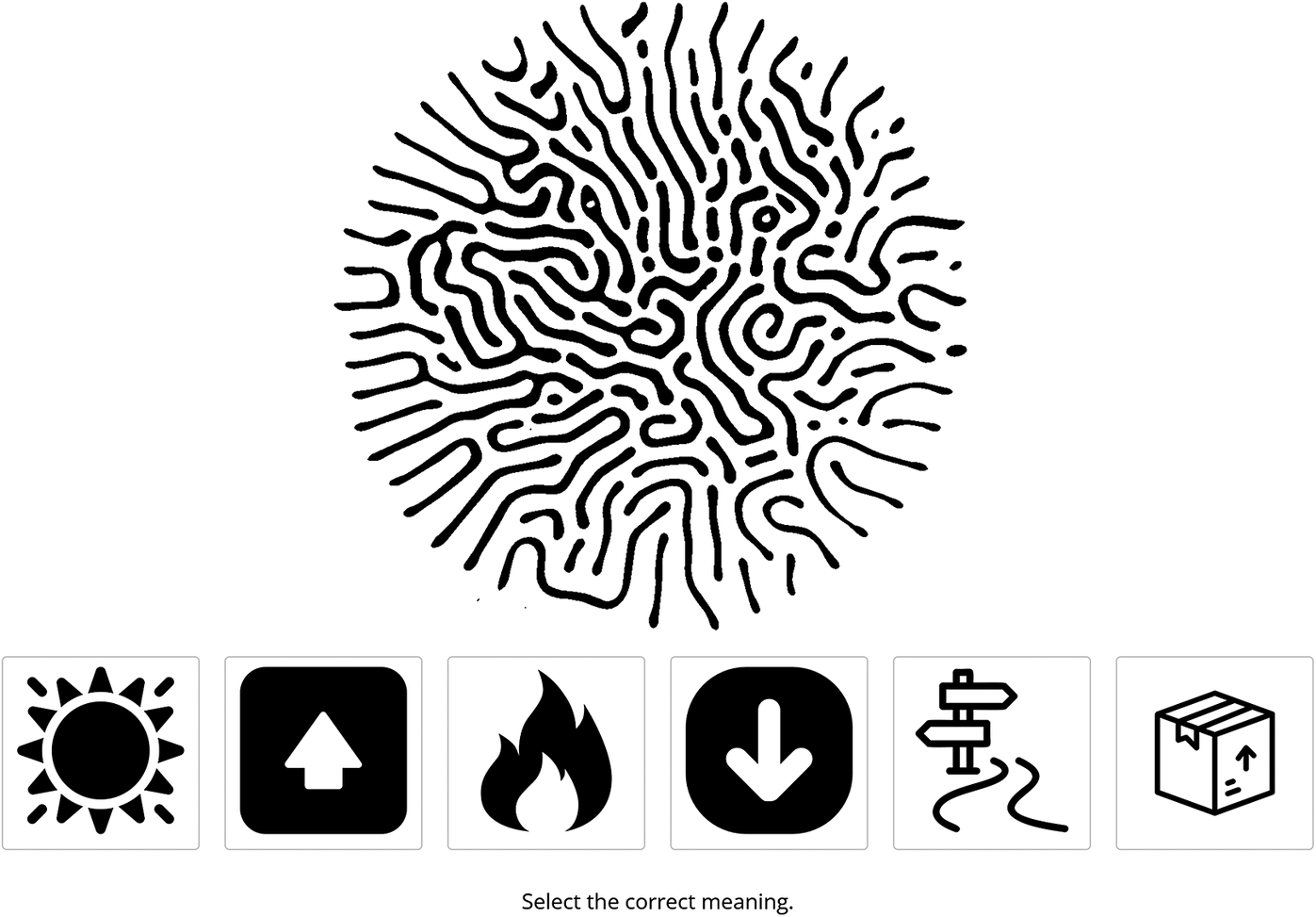
The Tsamtrahian language in the experiment consisted of six graphical alien ‘words’ represented by Ferros, highly complex visual forms that are genuinely alien (Cuskley, Reference Cuskley2019). Using Ferros, which are unlike other graphical forms they may know, such as letters, made sure that participants had not encountered these forms before. Participants then went through a learning phase (Learning Round 1) in which a Ferro was paired with a graphical representation of its meaning, with the Ferro on the left and the image representing its meaning on the right (e.g. Ferro 1 was paired with an image of a box, and Ferro 2 was paired with an image of fireFootnote 2). Overall, there were six Ferros paired with one meaning each for a total of six Ferros being paired with six meanings, each representing a frequent source concept for particular conceptual metaphorical mappings (box, fire, down, road, sun, up; see Table 2). Participants were presented with each Ferro/Meaning combination in randomised order, with the exposure to the six combinations repeated three times. After that, participants went through a testing round (‘OK! Have you learned Tsamtrahian? Let us find out!’) in which they were presented with the six Ferros in randomised order and had to select the correct meaning with all six meanings/images being displayed in randomised order below the Ferro (Testing Round 1; see Figure 1). After each guess, they received feedback on the correct answer (‘The correct answer is: [image of the correct meaning]’) and whether their answer was correct. The testing round was then repeated one more time (Testing Round 2). This testing round was followed by one more learning round (Learning Round 2) (‘OK, let’s look at the symbols one more time! Remember, you can only help Ari if you master all the symbols’), which followed the same principle as Learning Round 1. After that, participants did one final test on the form-meaning pairings they had to learn (Testing Round 3). (‘OK, let’s do one more test!’).
Overview of stimuli and potential extensions
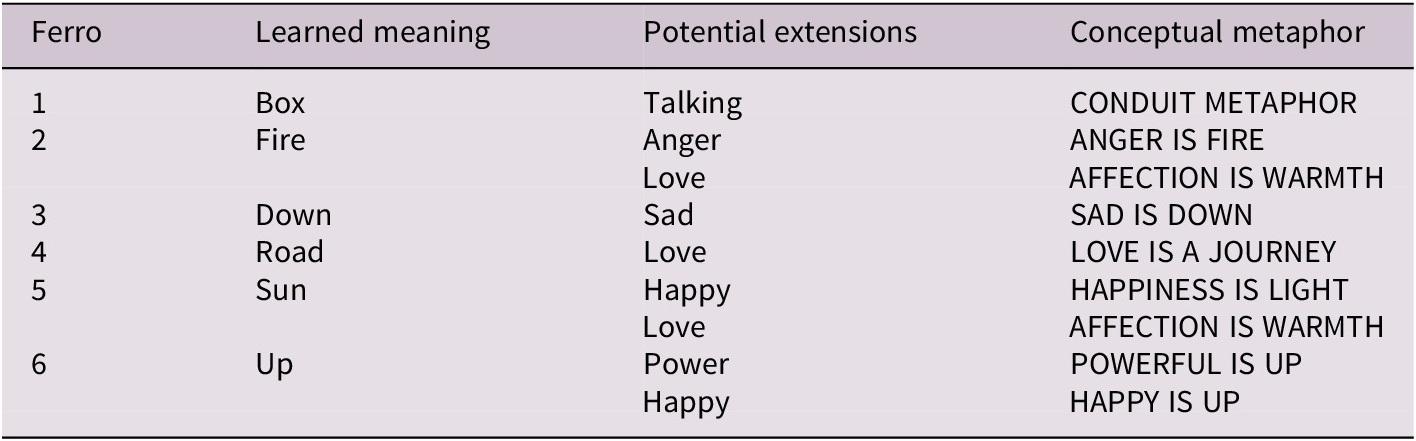
Table 2. Long description
The table has four columns labeled Ferro, Learned meaning, Potential extensions, and Conceptual metaphor. Row one lists 1, Box, Talking, CONDUIT METAPHOR. Row two lists 2, Fire, Anger and Love, ANGER IS FIRE and AFFECTION IS WARMTH. Row three lists 3, Down, Sad, SAD IS DOWN. Row four lists 4, Road, Love, LOVE IS A JOURNEY. Row five lists 5, Sun, Happy and Love, HAPPINESS IS LIGHT and AFFECTION IS WARMTH. Row six lists 6, Up, Power and Happy, POWERFUL IS UP and HAPPY IS UP.
Example of Testing Round 1. A Ferro paired with six possible meanings. Images representing meanings 1,2,4,5,6 designed by Freepik (www.freepik.com), image representing meaning 3 designed by Flaticon.com.

After Testing Round 3, participants were shown a screen telling them that it was now time to help Ari. They were told that Ari would now communicate with them, and they had to select what Ari might want to take a photo of. Participants were informed that Ari might want to take photos of the same thing several times, so that it was possible that they would use the same symbol more than once. By clicking on ‘Start Helping Ari’, participants initiated the Communication Phase in which an image of Ari next to a Ferro was on the top half of the screen, and on the bottom half were six images in randomised orders (Figure 2). Participants were instructed to select what Ari wanted to take a photo of. The six Ferros appeared in randomised order, and this process was repeated three times, for a total of 18 guesses, three for each Ferro. As we wanted to know if participants would spontaneously extend the meaning of the Ferros they had learned to other concepts based on metaphorical mappings analysed in conceptual metaphor theory, we presented them with the following six images as possible choices: a sad person (for the metaphor SAD IS DOWN), two people talking (for the conduit metaphor), a happy person (which can be conceptualised via HAPPINESS IS LIGHT or HAPPINESS IS UP for example), two people in love (which can be conceptualised by LOVE IS A JOURNEY or AFFECTION IS WARMTH), an angry person (for the metaphor ANGER IS FIRE), and a king (for the metaphor POWERFUL IS UP) (See Tables 1 and 2). Participants did not receive feedback on their choices. After they made their final choice, participants were thanked for being Ari’s tour guide and for their participation in the experiment.
The design of the communication phase.
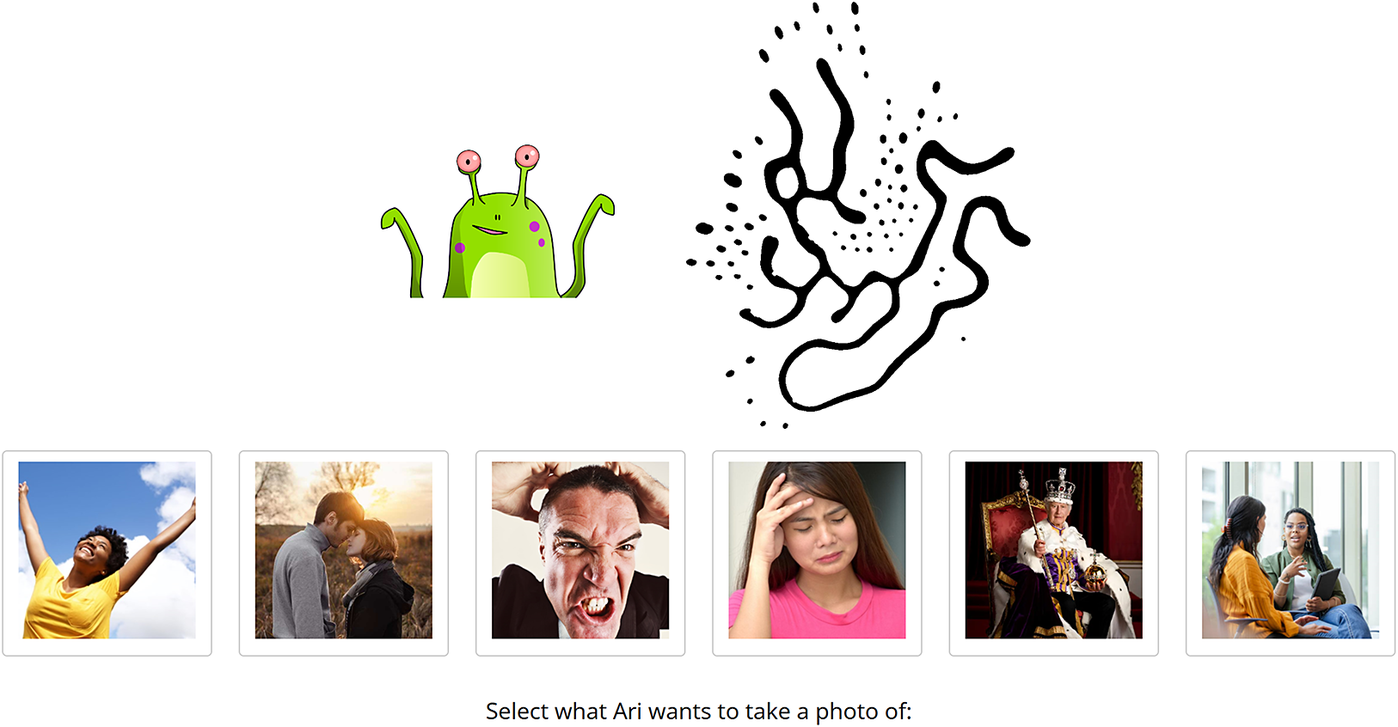
Figure 2. Long description
At the top left is a cartoon alien with green skin, two eye stalks, and a smiling face. To its right is an abstract black line drawing with dots and curved segments. Below, six square photos are arranged left to right: a person in a yellow shirt raising arms outdoors, two people about to kiss at sunset, a person with hands on their head and face blurred, a person in a pink shirt with face blurred and hand on forehead, a person in royal attire seated on a throne, and two people sitting and talking by a window. Below the photos is the prompt ‘Select what Ari wants to take a photo of.’
3.2. Instruction condition
3.2.1. Participants
We recruited a total of 64 participants via the online crowd-sourcing platform Prolific, whose primary language was English. Participants were paid £3.50 for their participation (median completion time 12 minutes).
3.2.2. Design and procedure
The experimental design of the instruction conditions was identical to the no instruction condition, except for the change that participants received more explicit instructions. The instructions highlighted the fact that semantic extension is a feature of the alien language they were asked to learn and communicate with. In order to direct participants’ attention more strongly to the possibility of semantic extension based on metaphor and similarity in the communication phase, we explicitly told them that this was a feature of Tsamtrahian. After the introduction, which was the same as in Experiment 1, another screen appeared telling participants that before they start learning, there was one important thing about Tsamtrahian: ‘Tsamtrahians like Ari often use a word not only for one thing, but also when they see something that is in some way “similar” to that thing’. Participants were then shown an image of Ari and a Ferro that was not part of the experiment and an arrow to an image of two people arguing with each other on the top half of the screen. On the bottom half, the image of Ari next to the same Ferro was followed by an arrow of two medieval knights engaged in battle. This was intended to evoke the conceptual metaphor ARGUMENT IS WAR (Lakoff & Johnson, Reference Lakoff and Johnson1980). Participants were told that for now they would only learn one meaning for each symbol, and Learning Round 1, Testing Round 1 & 2, Learning Round 2 and Testing Round 3 proceeded in the same way as in Experiment 1. Then, before the Communication Phase, the text was the same but also contained a reminder ‘Remember that in Tsamtrahian, symbols can also be used for things that are “similar” in some way!’
4. Results and analysis
All analyses were conducted using the R programming language (R Core Team, 2021) and its various libraries.Footnote 3 First, to confirm that participants followed the instructions in both experiments, we examined their learning accuracy during the initial phase. Accuracy was high in both conditions (approximately 90%), providing confidence in the validity of the subsequent analyses.
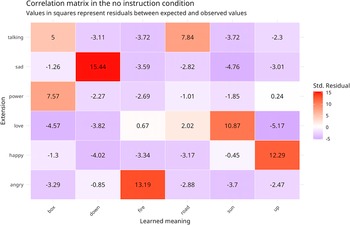
We evaluated whether participants mapped meanings with signals in a systematic manner by running two separate chi-square tests on the subset of the data: one for the no instruction condition and the other for the instruction condition. The chi-square test for the no-instruction condition (χ2(25, N = 1062), p < .01) shows that the distribution of responses differed significantly from what would be expected by chance. In other words, participants’ chosen extensions were systematically related to the meanings they had learned, and participants did not answer at random. Figure 3 visualises the deviation of the observed frequencies from the expected frequencies: positive values indicate responses chosen more often than expected by chance, negative values indicate responses chosen less often, and values near zero indicate responses occurring at the chance level.
Mappings in the no instruction condition. Higher positive values indicate more frequent mappings than chance, and lower negative values indicate less frequent mappings than chance.
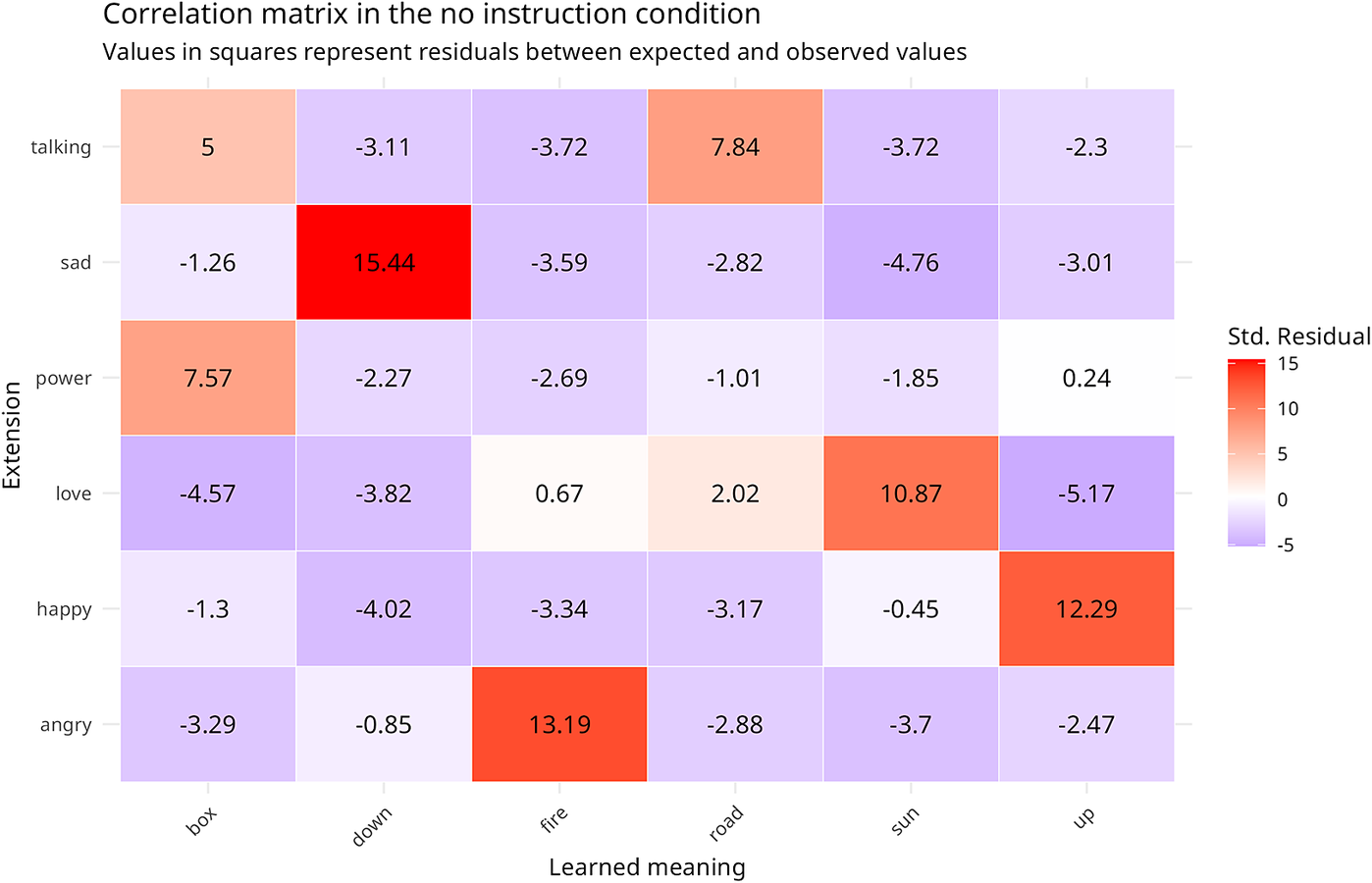
Figure 3. Long description
The heatmap matrix has Extension labels on the y-axis: talking, sad, power, love, happy, angry, and Learned meaning labels on the x-axis: box, down, fire, road, sun, up. Each cell contains a residual value, with positive values in shades of red and negative values in shades of blue, as indicated by the standard residual color bar on the right ranging from -5 to 15. In the talking row, the highest positive residual is 7.84 for road, and the highest negative is -3.72 for fire and sun. In the sad row, the highest positive is 15.44 for down, and the lowest is -4.76 for sun. In the power row, the highest positive is 7.57 for box, and the lowest is -2.69 for fire. In the love row, the highest positive is 10.87 for sun, and the lowest is -5.17 for up. In the happy row, the highest positive is 12.29 for up, and the lowest is -4.02 for down. In the angry row, the highest positive is 13.19 for fire, and the lowest is -3.7 for sun. The most intense red cell is sad-down (15.44), and the most intense blue cell is love-up (-5.17).
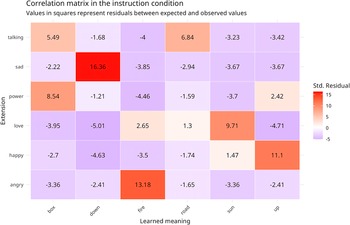
Mappings in the instruction condition. Higher positive values indicate more frequent mappings than chance, and lower negative values indicate less frequent mappings than chance.
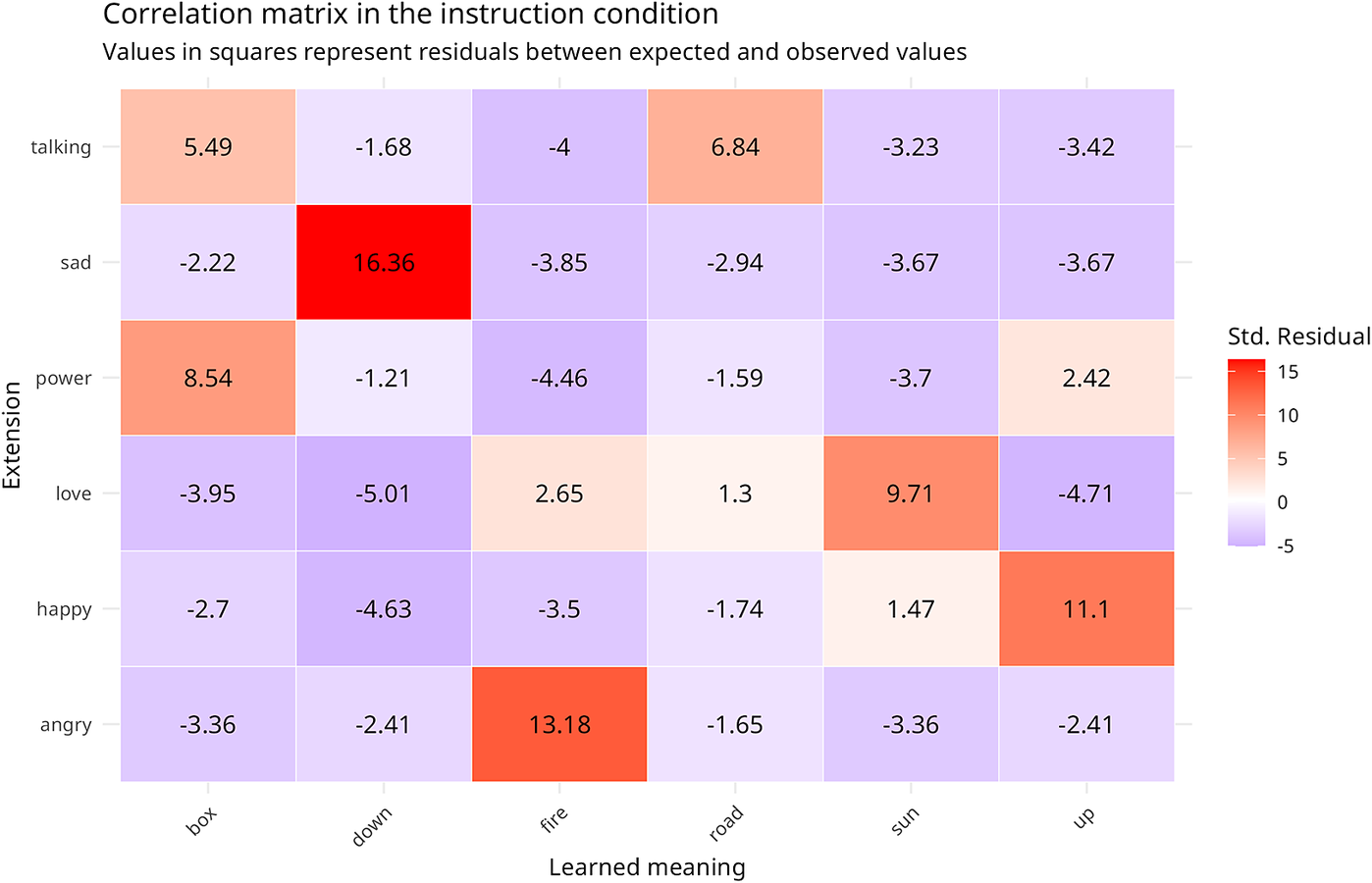
Figure 4. Long description
The heatmap matrix has Extension categories on the y-axis: talking, sad, power, love, happy, angry, from top to bottom. The x-axis lists Learned meaning: box, down, fire, road, sun, up, from left to right. Each cell contains a residual value, color-coded from purple for negative to red for positive, with a standard residual color bar at the right. Notable high positive residuals are sad-down (16.36, bright red), angry-fire (13.18), happy-up (11.1), love-sun (9.71), power-box (8.54), talking-road (6.84), and talking-box (5.49). Negative residuals include love-down (-5.01), happy-down (-4.63), power-fire (-4.46), and others, shown in purple. The matrix visualizes which Extension-Learned meaning pairs occur more or less frequently than chance.
We also observed a significant result for the instruction condition χ2(25, N = 1170, p < 0.01). Again, we plot the difference between the expected and observed frequencies in Figure 4. The interpretation of the residual values on the plot is the same as in the no instruction condition.
Overall, we see similar trends in both conditions, though the raw residual values may differ in specific cases. In both cases, we see that participants associated the Ferros representing road (5 vs 5.49) and box (7.84 vs 6.84) in the first block of the experiment with talking in the second, extension phase, block of the experiment. The ferro for down was later associated with the meaning of sad (15.44 vs 16.36). The ferro for box was extended in both cases to power (7.57 vs 8.54), indicating that the extension of the box was more ambiguous than the others. Another ferro that was associated with power was up, though the strength of the association is much bigger in the instruction condition (2.42) than in the no-instruction condition (0.24). As for love, we can see three different ‘competing’ Ferros that were associated with this meaning: fire, road and sun. Similar to the case of power, although the extensions were the same, their strength was different across conditions (fire 0.67 vs 2.65; road 2.02 vs 1.3; sun 10.87 vs 9.71 in the no instruction and in the instruction condition respectively). The extensions made for happy are the first where we see a difference: while up is the only Ferro associated with happy in the no instruction condition (12.29), sun (1.47) and up (11.1) were associated with it in the instruction condition. Finally, in both conditions, participants used the Ferro for fire as an extension for angry. Our analysis points to the fact that participants make systematic choices in both conditions, although there are small differences in the strength of associations across conditions.
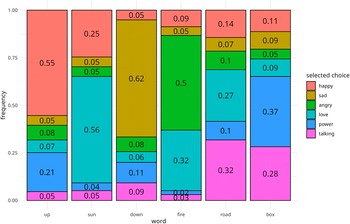
Figures 5 and 6 below represent two plots of participants’ mapping decisions that can make the distributions more transparent for a qualitative analysis of the results. The bars demonstrate a trend of mapping the semantic meaning with extended metaphoric meaning in both conditions. We discuss both conditions (no instruction condition: NIC; instruction condition: IC) together here, as the frequencies differ only slightly from each other and the overall rank of participants’ choices is the same. The frequency of the participants communicating happy with up is 60% (IC: 55%), which shows that the metaphorical mapping of HAPPINESS IS UP is much more frequent than the conceptual metaphor HAPPINESS IS LIGHT. HAPPINESS IS UP is found in metaphorical expressions such as ‘to be upbeat’ or ‘to be in high spirits’. However, POWERFUL IS UP/HIGH STATUS IS UP is the second most frequent mapping used by participants (NIC: 14%, IC: 21%). The higher frequency of POWERFUL IS UP found in the instruction condition might point to a slight effect of the instructions raising participants’ awareness of potential more abstract conceptual associations. Overall, the pronounced difference in frequency between HAPPY IS UP and POWERFUL IS UP, however, shows that the former metaphorical mapping seems to be much more salient. Participants tended to use sun to express love in 66% (IC: 56%) of cases. We can explain the connection between the sun and love via the conceptual metaphor AFFECTION IS WARMTH, which can be found in metaphorical expressions such as ‘My love for her still smolders’, ‘she’s an old flame’ or ‘a warm welcome’ (Kövecses, Reference Kövecses2010). As noted, HAPPINESS IS LIGHT is much less frequent than HAPPINESS IS UP, as it is the second-most frequent mapping for happy with 18% (IC: 25%). The predicted conceptual mapping SAD IS DOWN was indeed the most frequent one chosen by participants for down and sad, with 60% (IC: 62%). For ANGER IS FIRE is being used to communicate angry in 50% of cases (IC: 50%). However, the second most frequent mapping with 28% is that of fire and love (IC: 32%). This choice can also be motivated by existing conceptual mappings LOVE IS FIRE, which can be found in expressions such as ‘She is burning with love’, ‘The fire between them has gone out’, or ‘the flames are gone from their relationship’, and is also related to the conceptual metaphor AFFECTION IS WARMTH (Kövecses, Reference Kövecses2010). For road, love and talking are two competing concepts, with frequencies of 33% and 36% respectively (IC: 27% and 32%). So while LOVE IS A JOURNEY is a salient conceptual association for communicating love via road, it is less transparent where the most frequent association of road with talking comes from. One possibility is that the choice was based on properties of the image used to represent the meaning road as the image (Figure 1) contains two signposts pointing in different directions, which could be associatively related to the concept of talking, as both signposts and talking are forms of linguistic communication. Regarding LOVE IS A JOURNEY, it is possible that this conceptualisation was not as salient as the JOURNEY source concept seems to be associated with long-standing relationships, which was not saliently profiled in the image we use.
Stack bar plot for the no instruction condition.
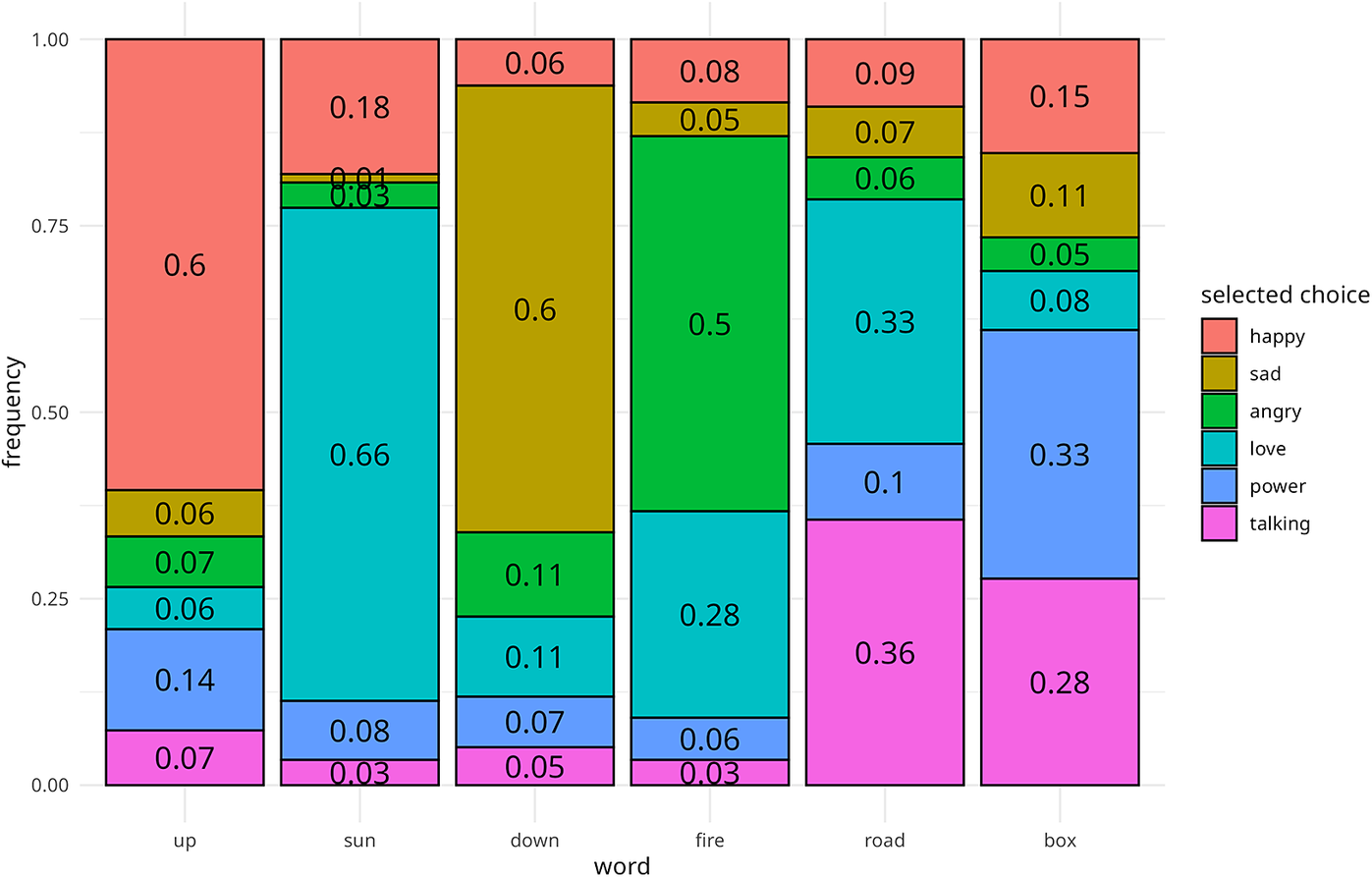
Figure 5. Long description
The chart displays six vertical stacked bars, each labeled at the base with a word: up, sun, down, fire, road, box. The y axis is labeled frequency, ranging from 0.00 to 1.00. Each bar is divided into colored segments representing emotion categories: happy (red), sad (yellow), angry (green), love (cyan), power (blue), talking (magenta). For ‘up’, happy is 0.6, power 0.14, sad 0.06, angry 0.07, love 0.06, talking 0.07. For ‘sun’, love is 0.66, happy 0.18, power 0.08, sad 0.03, angry 0.03, talking 0.03. For ‘down’, angry is 0.6, love 0.11, power 0.11, happy 0.06, talking 0.05, sad 0.07. For ‘fire’, love is 0.5, talking 0.28, power 0.07, happy 0.08, sad 0.05, angry 0.03. For ‘road’, talking is 0.36, love 0.33, power 0.1, happy 0.09, sad 0.07, angry 0.06. For ‘box’, talking is 0.28, love 0.33, power 0.08, happy 0.15, sad 0.11, angry 0.05. The legend at the right matches each color to its emotion category.
Stack bar plot for the instruction condition.

Figure 6. Long description
From left to right, the x-axis labels are up, sun, down, fire, road, box. The y-axis is labeled frequency, ranging from 0 to 1. Each bar is divided into colored segments representing emotions: happy (red), sad (yellow), angry (green), love (cyan), power (blue), talking (pink). For ‘up’, happy is 0.55, love 0.21, power 0.07, angry 0.08, sad 0.05, talking 0.05. For ‘sun’, love is 0.56, happy 0.25, power 0.04, talking 0.05, angry 0.05, sad 0.05. For ‘down’, sad is 0.62, love 0.08, power 0.06, talking 0.09, angry 0.05, happy 0.05. For ‘fire’, angry is 0.5, love 0.32, power 0.11, talking 0.03, sad 0.09, happy 0.05. For ‘road’, love is 0.27, talking 0.32, power 0.1, happy 0.14, sad 0.07, angry 0.1. For ‘box’, power is 0.37, talking 0.28, love 0.09, happy 0.11, sad 0.09, angry 0.05. The legend on the right matches colors to emotion categories.
As for box, power and talking are two competing concepts, with frequencies of 33% and 28% (IC: 37% and 28%). The fact that box is the second most frequent association shows that the CONDUIT METAPHOR represents a conceptually salient mapping to represent communication. However, it is possible that the use of a box/parcel as representing the CONDUIT METAPHOR did not make the aspect of transfer salient enough to participants, which might be why it was less prominent.Footnote 4 The most frequent association of box with power is less transparent. Again, it is possible that associations between image properties play a role, as the box had an up arrow on it, so it might be related to the POWERFUL IS UP metaphor. However, other associations salient to the participants that we have not identified are equally likely here.
Overall, our results show that certain conceptual metaphorical mappings are more saliently available as semiotic resources to participants than others when spontaneously interpreting possible meaning extensions in an alien language artificial language learning game. This can also be related to the findings of the studies by Verhoef et al. (Reference Verhoef, Walker and Marghetis2016, Reference Verhoef, Walker and Marghetis2022, Reference Verhoef, Marghetis, Walker and Coulson2024) and Smith and colleagues (Smith et al., Reference Smith, Bowerman and Smith2025). As noted in Section 2.2, participants in the Verhoef et al. studies frequently made use of the universal and highly salient mapping of spatial extent and temporal duration (with longer durations being communicated by signals that occupy more space, and shorter durations by signals that occupy less space), but when it came to directionality (whether future was upwards, and past downwards, or the other way around), there was much more variation. This mirrored the fact that there is also considerable cross-cultural variability in this domain, with these conceptualisation potentially also being less salient and more reliant on conventionalisation and less on pre-existing biases. In our study, certain mappings were also more frequent than others, which can be related to their universality and to what extent they conform to deeply rooted human conceptual patterns. Culture-specificity and conventionalisation equally played a role in Smith et al. (Reference Smith, Bowerman and Smith2025), where metaphoric colour associations were found not to be particularly salient. This was also the case for some of the mappings in our study, which were not perceived as particularly salient by participants.
5. Discussion
As the results show, participants seem to make systematic use of salient semantic and metaphoric associations and mappings when having to extend the meanings of learned form-meaning pairings from concrete items to more complex and abstract referents. However, overall, not in all cases did participants perform semantic extensions that can be explained in terms of mappings posited by Conceptual Metaphor Theory. In some cases, competing associations could be identified that motivated a particular choice, such as the signposts on the image for road leading to an association of this meaning with talking. However, other systematic choices made by participants are likely based on associations that could not be identified with a high degree of confidence, such as the association of power (represented by an image of a king) with a box.
Overall, the results replicate findings from language change and diachronic semantics in an experimental setting. They show that polysemy can emerge from the semantic extension of concrete meanings based on salient semantic associations. And at least in a number of cases, these semantic extensions are based on conceptual metaphorical mappings identified by CMT. Metaphors, from a diachronic perspective, are instances of motivated metaphoric extension in which a concrete meaning (the source domain) is extended via associative or conceptual links to a more abstract meaning (the target domain), and a number of metaphoric extensions, such as SAD IS DOWN and ANGER IS FIRE, have been shown to be motivating participants’ choices for meaning extension.
Such metaphorical extensions are a crucial first step for the emergence of polysemy and the conventionalisation of new senses of a word. For example, returning to the example of sunny from the introduction, in contemporary English, both the metaphorical and concrete meanings of sunny are documented in dictionaries, signifying that both meanings have undergone conventionalisation. According to the career of metaphor model proposed by Bowdle and Gentner (Reference Bowdle and Gentner2005), novel, ‘online’ metaphoric extensions gradually become conventionalised as distinct word senses. Over time, such meanings are perceived as less metaphorical and more conventional. This conventionalisation, however, occurs incrementally. Supporting this, Gentner and King (Reference Gentner, King, Nölle Raviv, Graham, Hartmann, Jadoul, Josserand, Matzinger, Mudd, Pleyer, Slonimska, Wacewicz and Watson2024) demonstrated that historically newer word senses are generally perceived as more metaphorical than older ones. Thus, two critical processes characterise the development of metaphorical meanings: the initial emergence of metaphorical meanings and their subsequent conventionalisation. However, one crucial question relating to the first step of this process is whether speakers are aware of the metaphoric extension potential of concrete items and whether they spontaneously assume this in a novel communication system. The current results show that they are and that they make systematic, motivated choices in interpreting the meaning of polysemous items.
The results also show that participants spontaneously make motivated choices on potential meaning extensions based on salient associations without necessarily needing specific instructions to do so. This can be seen from the fact that the results from the no instruction condition and the instruction conditions do not differ significantly from each other.
The results also add to a growing research literature showing that metaphoric semantic extension is not limited to the spoken/written modality, but can be found in different modalities. For example, Joosten and Pfau (Reference Joosten and Pfau2024) have shown that metaphorical extensions of GIVE are productive in the Sign Language of the Netherlands. Many languages, such as English, not only use GIVE for concrete prototypical events where a GIVER transfers a concrete THING to a RECIPIENT (e.g. ‘The professor gave the student a book’). In addition, GIVE is also metaphorically extended to the transfer of abstract entities, (e.g. ‘Can you give me an answer?’ or ‘Writing this paper is giving me a headache’). Such metaphorical extensions can also be found in Sign Language of the Netherlands, so that things that can be given include, for example, feelings such as happiness, attention, or punishment. In experimental studies, Verhoef et al. (Reference Verhoef, Walker and Marghetis2016, Reference Verhoef, Walker and Marghetis2022, Reference Verhoef, Marghetis, Walker and Coulson2024) showed the use of the TIME IS SPACE metaphorical mapping using a touchbar, and Smith and colleagues (Bowerman & Smith, Reference Bowerman and Smith2022; Smith et al., Reference Smith, Bowerman and Smith2025) showed that semantic extension can occur in a novel communication system based on geometric shapes.
Here, we have shown that metaphorical extension can also be found in a novel ‘alien language’ communication system based on abstract visual shapes. As such, this work adds to the growing body of work showing that semantic and metaphorical extension can be both found in different modalities and replicated in experimental settings. It therefore offers valuable insights into the role of metaphorical extension in explaining the emergence of polysemous meanings during the evolution and cultural development of language. Research into the emergence and conventionalisation of abstract metaphorical meanings is of particular importance, as it has the potential to support theories that posit metaphorical extension as a key mechanism in the evolutionary and cultural emergence of language (e.g., Ellison & Reinöhl, Reference Ellison and Reinöhl2024; Gil & Shen, Reference Gil and Shen2021; Knight & Lewis, Reference Knight and Lewis2017; Pleyer et al., Reference Pleyer, Kuleshova and Placiński2024a; Smith & Höfler, Reference Smith, Höfler and Díaz-Vera2015).
Metaphor can be understood as a generalising mechanism that licenses and facilitates the creation of new form-meaning pairings and their extension to additional meanings. In this sense, it contributes to the development of a more complex and structured semiotic system. Thus, metaphor may have played a crucial role in the gradual shift from a protolinguistic stage to a fully developed language, serving as a ‘basic means for extending the lexicon’ (Dirven, Reference Dirven, Paprotté and Dirven1985). Smith and Höfler (Reference Smith, Höfler and Díaz-Vera2015) argue that the cognitive mechanisms that underlie metaphor support the emergence of the use of symbols as well as grammatical structure. They argue that all symbols and constructions are derived from conventionalised metaphors, which in turn started out as ad hoc acts of ostension whose meaning was inferred from context. These were then entrenched in the memory of communicators through repeated usage and became conventionalised in communities. For this reason, in their view, metaphor played a pivotal role in the evolution of language. Knight and Lewis (Reference Knight and Lewis2017) also assign a central role to metaphor and the social and cognitive conditions enabling the evolution of language. As they argue, metaphor relies on accepting symbols to not be literally true but still being used ostensively and cooperatively. This relies on a community-wide platform of trust between interlocutors (see also Wacewicz & Żywiczyński, Reference Wacewicz and Żywiczyński2018) and a ‘virtual’ world of meanings that are shared between interlocutors and can be used in interpreting semantic associations.
Metaphor thus represents a cognitive process that connects concrete meanings to more abstract and non-literal meanings, which, as Smith and Höfler (Reference Smith, Höfler and Díaz-Vera2015) point out, in turn is a central process in the evolution of symbols and grammatical structure. Similarly to Smith & Höfler, Ellison and Reinöhl (Reference Ellison and Reinöhl2024) also argue that a special kind of metaphor, functor-type metaphors, led to the emergence of many features that characterise fully fledged languages. In functor-type metaphors, a relational term that would normally take a concrete and semantically fitting argument, such as arrive taking an argument relating to a spatial destination, takes an abstract and semantically clashing argument, such as conclusion. They argue that metaphor emerged during a protolanguage stage of language evolution and then, metaphor, for example, by combining functors with semantically clashing arguments and thereby expanding the expressivity of protolanguage, led to the development of syntax and features of fully fledged languages.
On this view, then, metaphor and the processes underlying it played an important role in the cultural evolution of language, as this study has shown that participants spontaneously make use of it and processes of semantic extension to communicate more abstract meanings. It thus presented evidence that these processes that give rise to polysemy operate in human participants when confronted with a novel communication system, adding further credence to the proposal that they can serve as explanatory mechanisms in the evolution of language.
6. Conclusion
In this study, we addressed the emergence of metaphorical meanings within the non-linguistic medium of abstract visual symbols in an ‘alien language’ game. The results show that participants make choices on how to extend concrete meanings to more abstract meanings based on metaphorical mappings proposed by conceptual metaphor theory, but that they do not do so in all cases. It also offers insights into which conceptual metaphorical associations are particularly salient, especially in cases where CMT posits the availability of multiple source concept-target concept mappings. Some mappings, such as SAD IS DOWN and ANGER IS FIRE, are particularly salient for participants and are chosen relatively frequently, whereas others, such as POWERFUL IS UP, seem to be less salient and instead participants show much more variability in which associative mapping they make use of. In addition, some mappings that were not predicted were still made relatively frequently. Some of these can be explained by post hoc analyses, and others seemingly are based on as yet unidentified associations, such as between box and power. The study also shows that specific instructions that make the metaphoric mapping underlying the alien communication more salient do not affect the results significantly.
Overall, then, participants spontaneously made motivated choices in a forced choice paradigm when having to extend concrete meanings to more abstract meanings. This suggests that the ability and motivation for semantic and metaphoric meaning extension are spontaneously exhibited by participants. Further, this indicates that the spontaneous ability for semantic and metaphoric meaning extension is the foundation of the emergence of polysemy and the conventionalisation of new word senses based on metaphoric mappings and salient associations in the cultural evolution of language. The results add to proposals that assign a central role to the cognitive mechanism of metaphor in the evolution of language.
The study also had a number of limitations that should be addressed in future work. For instance, as the post-hoc analyses revealed, some of the images exhibited features that might have detracted participants from the meaning they were trying to represent. This highlights the difficulties of unambiguously representing even apparently very straightforward meanings, and future studies should take care to control for potential confusing visual features more carefully. For example, future studies could include interviews in a debriefing session to evaluate which meanings participants thought certain images were meant to represent. In addition, as the number of proposed conceptual metaphorical mappings was quite small, with six concrete source concepts and six more abstract meanings as targets for semantic extension, future work should test the saliency of a larger set of conceptual metaphors and pay more attention to potential competing metaphorical mappings. In addition, as the experiment was done with participants whose primary language was English, it would be interesting to obtain results for different languages to investigate if, in other languages, other conceptual metaphorical mappings are more salient. This is of particular importance as differences in the salience of concepts, their detailed internal structure, and conceptual associations may influence the use of conceptual metaphorical expressions (Kövecses, Reference Kövecses2015). While all the affordances for conceptual metaphorical mappings in our meaning space (such as SAD IS DOWN, or ANGER IS FIRE) are frequent across many different languages and cultures, there still are differences in how salient a particular conceptual metaphorical mapping is in a given culture and how exactly the conceptual metaphor is constituted in detail. This presents an important area for future research.
Data availability statement
All data and analyses are available under this OSF repository: https://osf.io/n6pej
Acknowledgements
This research is part of the project No. 2021/43/P/HS2/02729 co-funded by the National Science Centre and the European Union Framework Programme for Research and Innovation Horizon 2020 under the Marie Skłodowska-Curie grant agreement No. 945339. We thank Klaudia Karkowska and Darya Namednikava for their help in creating the experimental stimuli. We also thank two anonymous reviewers for their helpful comments on the manuscript.
Competing interests
The authors declare none.



 Open access

