





Introduction
Child maltreatment poses a severe threat to normative development and psychological health (Cicchetti & Toth, Reference Cicchetti and Toth2016; Vachon et al., Reference Vachon, Krueger, Rogosch and Cicchetti2015; Vallati et al., Reference Vallati, Cunningham, Mazurka, Stewart, Larocque, Milev, Bagby, Kennedy and Harkness2020). However, some maltreated children display profound resilience despite experiencing adversity (Collishaw et al., Reference Collishaw, Pickles, Messer, Rutter, Shearer and Maughan2007; Marriott et al., Reference Marriott, Hamilton-Giachritsis and Harrop2014). Efforts to foster secure relationships with parents during early childhood have been shown to be particularly helpful in promoting resilience (Cicchetti et al., Reference Cicchetti, Rogosch and Toth2006; Toth et al., Reference Toth, Maughan, Manly, Spagnola and Cicchetti2002). However, adolescence is also a critical period of plasticity, during which developmental adjustment may be influenced by a variety of factors (Barone et al., Reference Barone, Carone, Costantino, Genschow, Merelli, Milone, Polidori, Ruglioni and Moretti2021; Bergsund et al., Reference Bergsund, Drozd, Olafsen, Nilsen, Linnerud, Kjøbli and Jacobsen2023; Brown et al., Reference Brown, Witmer and Johnson2024; Kadosh et al., Reference Kadosh, Linden and Lau2013). Despite the importance of the adolescent stage, there is a dearth of literature examining malleability in certain adolescent relationships and its longitudinal association with psychopathology among maltreated populations (Bergsund et al., Reference Bergsund, Drozd, Olafsen, Nilsen, Linnerud, Kjøbli and Jacobsen2023). The current study examines the interaction between two of the most vital adolescent relationships — parents and peers — and their associations with the development of psychopathology among maltreated and non-maltreated adolescents.
Attachment and relationship quality in adolescence
Throughout child and adolescent development, a person’s attachment network includes many prominent figures, among whom are parents and peers (Gillath et al., Reference Gillath, C Karantzas and Lee2019; Trinke & Bartholomew, Reference Trinke and Bartholomew1997). Early parent-child relationships are integral to the formation of internal working models that shape later perceptions of oneself as worthy of love and others as capable of responding to their needs for safety and security (Ainsworth & Bowlby, Reference Ainsworth and Bowlby1991; Bowlby, Reference Bowlby1958). According to this Trait-Specific perspective, responsive parenting in early childhood supports the development of secure models characterized by assurance and trust, whereas dismissive or unpredictable parenting can lead to insecure models marked by uncertainty. As expected from the turbulence involved in childhood maltreatment, maltreated children are more likely to develop insecure or disorganized internal working models later in life (Baer & Martinez, Reference Baer and Martinez2006).
Adolescence presents a period of key developmental shifts in cognition that encourage the ability to subjectively evaluate our relationships (Ebbert et al., Reference Ebbert, Infurna and Luthar2019; Kadosh et al., Reference Kadosh, Linden and Lau2013). Thus, a favored method of conceptualizing the security of adolescent and adult relationships is to examine subjective evaluations of trust, communication, and alienation (Armsden & Greenberg, Reference Armsden and Greenberg1987). Positive self-reported perceptions of relationship quality consistently play a role in increased psychological health, general well-being (Armsden & Greenberg, Reference Armsden and Greenberg1987; Caron et al., Reference Caron, Lafontaine, Bureau, Levesque and Johnson2012), and positive psychological traits like resiliency (He et al., Reference He, Chen, Fan, Cai and Hao2018). On the other hand, poor self-reported relationship quality is associated with increased risk for psychopathology and maladjustment (Armsden & Greenberg, Reference Armsden and Greenberg1987; Armsden et al., Reference Armsden, McCauley, Greenberg, Burke and Mitchell1990; Ebbert et al., Reference Ebbert, Infurna and Luthar2019; Laible et al., Reference Laible, Carlo and Raffaelli2000; McGinley & Evans, Reference McGinley and Evans2020).
These outcomes appear to suggest a bleak outlook for those with poor relationships with their parents. However, the assumption that one internal working model developed in childhood will be applied to all subsequent relationships does not account for variability across relational domains (Bohn et al., Reference Bohn, Holtmann, Luhmann, Koch and Eid2023; Caron et al., Reference Caron, Lafontaine, Bureau, Levesque and Johnson2012; Overall et al., Reference Overall, Fletcher and Friesen2003). Fortunately, Domain-Specific Models of attachment posit that we can form varying evaluations of different types of relationships — such as those with parents, friends, and romantic partners (Bohn et al., Reference Bohn, Holtmann, Luhmann, Koch and Eid2023; Overall et al., Reference Overall, Fletcher and Friesen2003). Empirical evidence indicates that during adolescence, perceptions of relationship quality differ for parent and peer domains (He et al., Reference He, Chen, Fan, Cai and Hao2018; Miljkovitch et al., Reference Miljkovitch, Mallet, Moss, Sirparanta, Pascuzzo and Zdebik2021). Further, adolescents’ and young adults’ evaluations of relationship quality for parents and peers have been shown to differentially contribute to well-being (Caron et al., Reference Caron, Lafontaine, Bureau, Levesque and Johnson2012) and adjustment (Laible et al., Reference Laible, Carlo and Raffaelli2000). In sum, variability within the relational dynamics that adolescents experience with parents and peers invites further inquiry into how differing perceptions of these relationships might serve optimal development.
As mentioned, adolescence presents an important period of developmental shifts (Kadosh et al., Reference Kadosh, Linden and Lau2013; Wagner, Reference Wagner1996), during which relationships can be malleable (Barone et al., Reference Barone, Carone, Costantino, Genschow, Merelli, Milone, Polidori, Ruglioni and Moretti2021; Buist et al., Reference Buist, Deković, Meeus and van Aken2002; Ebbert et al., Reference Ebbert, Infurna and Luthar2019; Miljkovitch et al., Reference Miljkovitch, Mallet, Moss, Sirparanta, Pascuzzo and Zdebik2021). For example, longitudinal studies show linear and nonlinear decreases in parental relationship quality during middle-school and adolescence (Buist et al., Reference Buist, Deković, Meeus and van Aken2002; Ebbert et al., Reference Ebbert, Infurna and Luthar2019). As parent relationships decrease in influence, peer relationships increase in influence (De Goede et al., Reference De Goede, Branje, Delsing and Meeus2009; Laible et al., Reference Laible, Carlo and Raffaelli2000; Steinberg & Silverberg, Reference Steinberg and Silverberg1986). In fact, alienation from parents in adolescence can predict friendship quality in early adulthood (e.g. Miljkovitch et al., Reference Miljkovitch, Mallet, Moss, Sirparanta, Pascuzzo and Zdebik2021). These shifts may create an opportunity for those with poor relationships with one or both parents to form others that are more beneficial to their adjustment, such as close relationships with peers (e.g., Laible et al., Reference Laible, Carlo and Raffaelli2000). Indeed, positive peer relationships serve as a protective factor against psychopathology in general populations (Gorrese, Reference Gorrese2016) and maltreated ones (Brown et al., Reference Brown, Witmer and Johnson2024). Further, adolescents’ relationships with their mothers and fathers exhibit differing levels of involvement and serve distinct aspects of development (Collins & Russell, Reference Collins and Russell1991). Since relationship quality can vary depending on the parent-child dyad (Buist et al., Reference Buist, Deković, Meeus and van Aken2002), adolescents with poor relationships with one parent may adapt by forming close connections with another parent. Thus, maltreated adolescents may even compensate for poor relationships with perpetrating parents by forming stable ones with other caregivers (e.g. Marriott et al., Reference Marriott, Hamilton-Giachritsis and Harrop2014). Given these considerations, it is important to elucidate contexts in which mothers, fathers, and peers may become especially important for maltreated adolescents’ adjustment.
Maltreatment and resilience
According to Developmental Psychopathology, which compares normal to abnormal development (Cicchetti & Toth, Reference Cicchetti and Toth2009; Cicchetti, Reference Cicchetti1984), maltreatment in childhood can lead to increased psychological symptoms, as it deviates sharply from typical developmental experiences. Because maltreated individuals are at high risk for maladjustment and psychopathology (Cicchetti & Toth, Reference Cicchetti and Toth2016; Vachon et al., Reference Vachon, Krueger, Rogosch and Cicchetti2015; Vallati et al., Reference Vallati, Cunningham, Mazurka, Stewart, Larocque, Milev, Bagby, Kennedy and Harkness2020), research has long been conducted to examine potential factors promoting resilience in this population (Brown et al., Reference Brown, Witmer and Johnson2024; Cheung et al., Reference Cheung, Taillieu, Turner, Fortier, Sareen, MacMillan, Boyle and Afifi2017; Cicchetti et al., Reference Cicchetti, Rogosch and Toth2006; Cicchetti & Toth, Reference Cicchetti and Toth2016; Collishaw et al., Reference Collishaw, Pickles, Messer, Rutter, Shearer and Maughan2007; Henry, Reference Henry2002; Marriott et al., Reference Marriott, Hamilton-Giachritsis and Harrop2014; Toth et al., Reference Toth, Maughan, Manly, Spagnola and Cicchetti2002). Previous work has suggested that maltreated children may be more sensitive to the buffering effects of various protective factors than non-maltreated children (Bergsund et al., Reference Bergsund, Drozd, Olafsen, Nilsen, Linnerud, Kjøbli and Jacobsen2023; Brown et al., Reference Brown, Ng, Lisle, Koenig, Sannes, Rogosch and Cicchetti2023).
The role of parents
The role parents play in promoting adjustment is perhaps uniquely influential in circumstances of maltreatment. In the instance of sexual maltreatment, having a good relationship with at least one caregiver is linked to resilience (Marriott et al., Reference Marriott, Hamilton-Giachritsis and Harrop2014). Empirical work also notes that when implemented at early ages, parent-child attachment interventions are effective in mitigating behavioral problems specifically among maltreated children (Cicchetti et al., Reference Cicchetti, Rogosch and Toth2006; Toth et al., Reference Toth, Maughan, Manly, Spagnola and Cicchetti2002). In a recent study, Brown and colleagues (Reference Brown, Ng, Lisle, Koenig, Sannes, Rogosch and Cicchetti2023) demonstrated that certain aspects of mothers’ dialogues with their young children can reduce risk for psychopathology in the context of maltreatment. During adolescence, parenting interventions have been shown to curtail behavioral issues in general populations (e.g. Barone et al., Reference Barone, Carone, Costantino, Genschow, Merelli, Milone, Polidori, Ruglioni and Moretti2021). However, there is still a lack of research examining the longitudinal implications of parent relationships among maltreated groups (Bergsund et al., Reference Bergsund, Drozd, Olafsen, Nilsen, Linnerud, Kjøbli and Jacobsen2023).
The buffering effects of friends
Certain qualities of friendships can also be more salient for maltreated adolescents (Brown et al., Reference Brown, Witmer and Johnson2024; Cheung et al., Reference Cheung, Taillieu, Turner, Fortier, Sareen, MacMillan, Boyle and Afifi2017; Toth & Cicchetti, Reference Toth and Cicchetti1996). For instance, among maltreated youth only, increased opening up to friends is related to improved mental health (Cheung et al., Reference Cheung, Taillieu, Turner, Fortier, Sareen, MacMillan, Boyle and Afifi2017). Conversely, confused patterns of relatedness to best friends can be especially harmful for maltreated adolescents’ depressive symptomatology (Toth & Cicchetti, Reference Toth and Cicchetti1996). More generally, positive friendships buffer mental health problems among those who have experienced child maltreatment (Brown et al., Reference Brown, Witmer and Johnson2024), especially since they often lack family support (e.g. Manna et al., Reference Manna, Falgares, Costanzo, La Sala, Lamis and Musso2022). Ultimately, the interchange between parent and peer relational domains during adolescence provides a pronounced opportunity for readjustment among those with maltreatment histories specifically.
To summarize, an abundance of literature affirms that healthy relationships are an integral part of human flourishing, beginning with the formation of parental attachments and developing further through adolescent relationships. Better relationship quality with both parents and peers is associated with increased psychological well-being (Armsden & Greenberg, Reference Armsden and Greenberg1987; Caron et al., Reference Caron, Lafontaine, Bureau, Levesque and Johnson2012), with peers gaining more influence throughout adolescence (De Goede et al., Reference De Goede, Branje, Delsing and Meeus2009; Laible et al., Reference Laible, Carlo and Raffaelli2000). Altogether, it follows clearly that each domain of parent and peer relationship quality presents either an obstacle to or opportunity for optimal development. Deficits within any domain can increase the risk of psychopathology, and those with low relationship quality with fathers, mothers, and friends may experience a particularly detrimental void of developmental resources. Additionally, since relational protective factors are especially powerful for maltreated children (Bergsund et al., Reference Bergsund, Drozd, Olafsen, Nilsen, Linnerud, Kjøbli and Jacobsen2023; Brown et al., Reference Brown, Ng, Lisle, Koenig, Sannes, Rogosch and Cicchetti2023), the security of parent and peer relationships may play a pronounced role in the psychopathology of maltreated adolescents.
Current study
Despite the breadth of research emphasizing the value of secure attachments, as well as literature demonstrating the importance of relationship quality in normative development, many questions regarding the interchange between parent and peer relationships and its association with long-term outcomes for maltreated adolescents remain (Bergsund et al., Reference Bergsund, Drozd, Olafsen, Nilsen, Linnerud, Kjøbli and Jacobsen2023). Particularly, there is ambiguity in the differential associations between paternal, maternal, and peer relationship quality and psychopathology, despite it being known that developmental trajectories for each relational domain are distinct (Buist et al., Reference Buist, Deković, Meeus and van Aken2002; Collins & Russell, Reference Collins and Russell1991; Laible et al., Reference Laible, Carlo and Raffaelli2000). To clarify these distinctions in fathers’, mothers’, and friends’ roles in adolescents’ mental health, this study investigates interactions between perceived maternal relationship quality and friendship quality, as well as perceived paternal relationship quality and friendship quality, in a sample of maltreated and non-maltreated adolescents. Using secondary data that utilized a two-wave design, this study followed a sample of ethnically diverse participants throughout two timepoints in their adolescent development. Specifically, we assessed maltreated and demographically similar non-maltreated participants in early-mid adolescence (ages 13 – 15 years) and mid-late adolescence (ages 15 – 18 years). The primary predictions for the current study are as follows:
Hypothesis 1: Maternal and paternal relationship quality in early-mid adolescence (Wave 1) will predict psychopathology for both maltreated and non-maltreated youth in mid-late adolescence (Wave 2), with higher parental relationship quality predicting lower levels of internalizing and externalizing symptoms
Hypothesis 2: Perceived friendship quality in early-mid adolescence (Wave 1) will moderate the association between parental relationship quality in early-mid adolescence (Wave 1) and psychopathology in mid-late adolescence (Wave 2) for both maltreated and non-maltreated youth. Adolescents with lower perceived parental relationship quality and lower perceived friendship quality will exhibit the highest levels of externalizing and internalizing symptoms.
Hypothesis 3: This moderation effect will be stronger for maltreated adolescents, such that maltreated participants with lower perceived parental relationship quality and lower perceived friendship quality during early-mid adolescence (Wave 1) will exhibit the highest levels of psychopathology during mid-late adolescence (Wave 2). However, higher perceived friendship quality during Wave 1 will buffer psychopathology more strongly for maltreated adolescents compared to non-maltreated adolescents.
Method
Participants
Participants in this study were 545 adolescents (295 maltreated, 250 non-maltreated) assessed at two time points: Wave 1 (M age = 13.8 years, SD = 1.1 years) and Wave 2 (M age = 16.2 years, SD = 1.3 years). Maltreatment group status was determined during their participation in a prior study during middle childhood (M age = 7.6 years, SD = 1.5 years). Maltreated children were identified with the help of a Department of Human Services (DHS) liaison and DHS records were coded using the Maltreatment Classification System (MCS; Barnett et al., Reference Barnett, Manly, Cicchetti, Cicchetti and Toth1993) to make independent determinations of maltreatment experiences including subtype, severity, and perpetrator. Mothers of maltreated children also completed the Maternal Maltreatment Classification Interview (MCMI; Cicchetti et al., Reference Cicchetti, Toth and Manly2003) to assess for maltreatment that may have not been included in records. However, classification into the maltreated or non-maltreated group was based on the presence or absence of DHS records in the prior study. Within the sample of maltreated youth, experiencing the subtype of neglect was most common (82%) followed by emotional maltreatment (61%), physical abuse (43%), and sexual abuse (15%). Most of the maltreated sample (62%) had been exposed to more than one subtype of abuse (M = 2.0; SD = .96; Range = 1 – 4). Using a rating of 1 – 5 to determine the severity of each individual subtype (1 = Minor, 2 = Moderate, 3 = Serious, 4 = Severe, 5 = Extremely Severe), the average subtype severity for the maltreated sample was moderate (M = 3.10; SD = 0.89). Regarding perpetrators of any type of maltreatment experienced by participants, 96.9% were maltreated by their mothers, 46.1% by fathers, and 34.2% by others. Demographically comparable families without a history of maltreatment were recruited through the Aid to Families with Dependent Children program. Parental consent was provided to review DHS records and the absence of maltreatment experiences was verified through DHS records and completion of the MMCI (Cicchetti et al., Reference Cicchetti, Toth and Manly2003). If maltreatment was reported using the MMCI, these participants were not included in the study despite an absence of DHS records.
The complete sample of 545 maltreated and non-maltreated children consisted of 328 boys (60.2%) and 217 girls (39.8%) who were diverse in race (52.8% Black, 27.5% White, 12.8% Bi-racial, 6.4% Other) and ethnicity (13.4% Latin@). Maltreated and non-maltreated youth did not differ in terms of sex, ethnicity, family marital status (28.8% never married, 35.5% married or living with a partner, 35.8% no longer married), family’s history of receipt of public assistance (92.7% history of ever receiving public assistance), or family annual household income (M = $22,844, SD = $15,108). However, child’s race did differ across groups, in that White children were significantly more likely to belong to the maltreated group, and Black children were significantly more likely to belong to the non-maltreated group than expected by chance, χ2 (3) = 16.40, p < .001.
Procedure
Adolescents who had previously attended a week-long summer day camp program during middle childhood were recruited to participate in a follow up study at two waves during early-mid and mid-late adolescence (Wave 1 and Wave 2) spaced approximately two years apart. Assessments were conducted in a laboratory setting. Adolescents and parents were administered a comprehensive battery of assessments at Waves 1 and 2, which included measures of demographic characteristics, psychopathology, and parent and peer relationship quality. This follow-up study was approved by the University of Rochester Research Subjects Review Board. Informed consent was obtained for all participants and guidelines for the ethical treatment of human participants were followed.
Measures
Psychopathology
Psychopathology was assessed using the Youth Self-Report (YSR; Achenbach, Reference Achenbach1991), which is a widely used and well-validated and reliable self-report measure (Achenbach & Rescorla, Reference Achenbach and Rescorla2001; Achenbach, Reference Achenbach1991) that was administered to youth at Waves 1 and 2 and yields two broadband continuous dimensions of internalizing and externalizing symptoms. Youth responded to 112 items based on how that item describes them now or within the past six months using a 3-point scale (0 = not true, 1= somewhat or sometimes true, 2 = very true or often true). Raw scores are summed for internalizing and externalizing symptoms and transformed into T-scores based on normative data, with higher scores reflecting greater symptoms. Internal consistency for internalizing symptoms was excellent at Wave 1 (Cronbach’s alpha = 0.92) and good at Wave 2 (Cronbach’s alpha = 0.84). Internal consistency for externalizing symptoms was also excellent at Wave 1 (Cronbach’s alpha = 0.94) and good at Wave 2 (Cronbach’s alpha = 0.83).
Perceived parental relationship quality and perceived friendship quality
The Inventory of Parent and Peer Attachment (IPPA; Armsden & Greenberg, Reference Armsden and Greenberg1987) was administered to participants at Wave 1 and assesses perceived parental relationship and friendship quality. The adolescent responded to questions about their mother, father, and close friends that assess their perceptions of cognitive and affective attributes that characterize each of these three relationships. Using 25 questions each, three domains of these relationships are measured: (1) degree of mutual trust; (2) quality of communication; and (3) extent of anger and alienation. Participants are asked to rate each item on a scale from 1 (almost never or never true) to 5 (almost always or always true) based on how true the statement is for them now. Negatively keyed items are reverse coded before summing all item responses to obtain an overall mother, father, and friends relationship quality score. Higher scores are indicative of higher quality relationships. This measure has good reliability and validity (Armsden & Greenberg, Reference Armsden and Greenberg1989). Internal consistency was excellent for the mother (Cronbach’s alpha = 0.93), father (Cronbach’s alpha = 0.95), and friend (Cronbach’s alpha = 0.91) perceived relationship quality scores.
Data analysis
Data were checked for frequencies, minima, and maxima, and Pearson correlation analyses were conducted to determine associations between variables of interest. To investigate study hypotheses, path analyses within a structural equation modeling (SEM) framework were conducted using the lavaan package in R, which was developed for latent variable modeling (Rosseel, Reference Rosseel2012). Figure 1 displays the proposed statistical model for the relations between the primary variables of interest. Of note, we allow Wave 2 internalizing and externalizing symptoms to covary with each other and regress Wave 2 internalizing and externalizing symptoms on their Wave 1 values to control for prior symptoms. Additionally, all Wave 1 variables (perceived parental relationship quality, friendship quality, internalizing symptoms, and externalizing symptoms) are covaried with each other. All variables in the model are regressed on child sex.
Model for the 3-way interaction between maltreatment (Mal) group status, parental relationship quality, and friendship quality predicting psychopathology. W1 = Wave 1; W2 = Wave 2. All variables are regressed on male child sex. W2 internalizing and externalizing symptoms are regressed on W1 internalizing and externalizing symptoms, respectively, which each covary with W1 parental relationship and friendship quality. These paths have been removed for ease of readability.

To test the first hypothesis that lower levels of parental relationship quality would predict higher levels of psychopathology for both the maltreated and non-maltreated group, we run separate path analyses for maternal and paternal relationship quality for the overall sample. In this model, parental relationship quality at Wave 1 acts as a predictor of both internalizing and externalizing symptoms at Wave 2. Further, maltreatment group status is entered as a main effect predictor and a moderator of the association between parental relationship quality to determine if this finding differs based on group.
To test the second hypothesis that Wave 1 friendship quality will moderate the association between Wave 1 parental relationship quality and psychopathology in Wave 2 (mid-late adolescence), we entered maternal/paternal relationship quality and friendship quality, as well as the interaction between parental relationship and friendship quality, into analyses for the overall sample. To test the third hypothesis that moderation effect would be stronger for the maltreated sample, we entered maternal/paternal relationship quality, friendship quality, maltreatment group status, and a three-way interaction term between these three variables as predictors. Of note, predictor variables were centered prior to analyses due to large value of the moderator variable (e.g., 5-digit values when multiplying 3-digit numbers by each other) when using raw values resulting in the model not being identified. Additionally, the residual correlations between parental relationship quality, friendship quality, maltreatment group status, and the cross-product interaction term were estimated. Significant interactions were plotted to interpret findings.
Evaluations of the comparative fit index (CFI), Tucker-Lewis Index (TLI), root mean square error of approximation (RMSEA), and standardized root mean square residual (SRMR) determined model fit for the CFA and the full SEM model. CFI and TLI values ≥ .95, RMSEA and SRMR < .06, and a non-significant χ2 statistic is considered evidence of good model fit (Bentler & Bonett, Reference Bentler and Bonett1980; Brown, Reference Brown2014; Hu & Bentler, Reference Hu and Bentler1999; Kline, Reference Kline2010; Yu & Muthén, Reference Yu and Muthén2002). However, CFI and TLI values > .90 and SRMR values ≤ to .08 are acceptable. Additionally, several researchers have noted the limitations of the χ2 statistic, partly due to its sensitivity to sample size, with larger samples being more likely to have a significant χ2 despite providing an adequate to good fit to the data based on other fit indices.
A total of 385 participants completed a Wave 2 assessment (70.6% retention rate). Participants followed up at Wave 2 did not differ from participants who only completed Wave 1 on child sex, race, or ethnicity. Furthermore, participants followed up at Wave 2 versus those who completed Wave 1 only did not significantly differ on Wave 1 levels of maternal relationship quality, friendship quality, or internalizing or externalizing symptoms. However, participants followed up at Wave 2 reported significantly lower Wave 1 paternal relationship quality scores, t (243.49) = 2.21, p = .028. This was also supported when checking for patterns of missingness. Little’s MCAR test revealed that data were not missing completely at random when all variables were included, χ2 (112) = 145, p = .021. However, when paternal relationship quality was excluded, data were determined to be missing completely at random, χ2 (63) = 74.8, p = .148. For path analyses, we addressed missing data using full information maximum likelihood (Arbuckle, Reference Arbuckle1996) but interpreted models with paternal relationship quality as the predictor with caution.
Results
Descriptive statistics and correlations between study variables
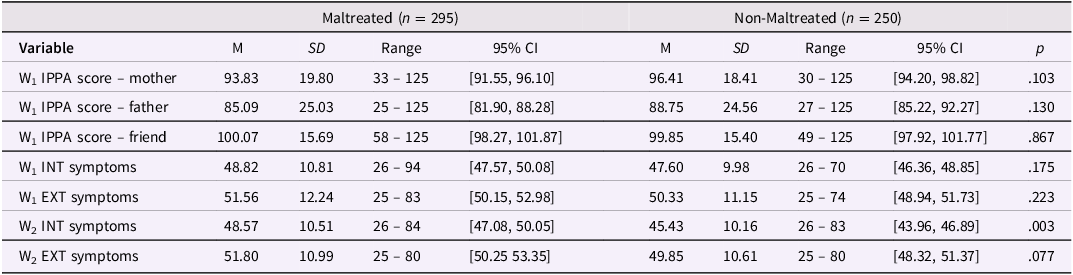
Table 1 displays descriptive information for study variables by maltreatment group status. As can be seen in the table, the maltreated sample reported significantly higher levels of Wave 2 internalizing symptoms than the non-maltreated sample. There were no other statistically significant differences between groups for study variables.
Descriptive statistics for study variables based on maltreatment status

Note. W1 = Wave 1; IPPA = Inventory of Parent and Peer Attachment; INT = internalizing; EXT = externalizing; W2 = Wave 2.
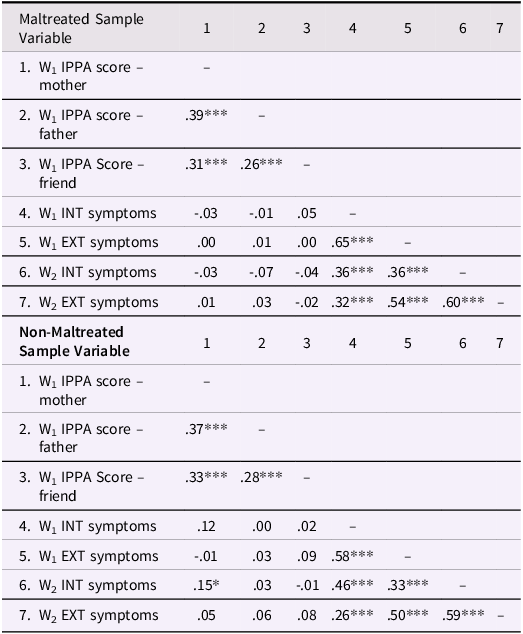
Table 2 displays correlations among study variables by maltreatment group status. As can be seen, higher relationship quality with both parents was significantly correlated with higher friendship quality scores for both the maltreated and the non-maltreated sample. Further, internalizing and externalizing symptoms were all significantly and positively correlated with each other across time points and samples. However, higher maternal relationship quality was significantly correlated with higher Wave 2 internalizing symptoms in the non-maltreated sample only.
Correlations among study variables based on maltreatment status
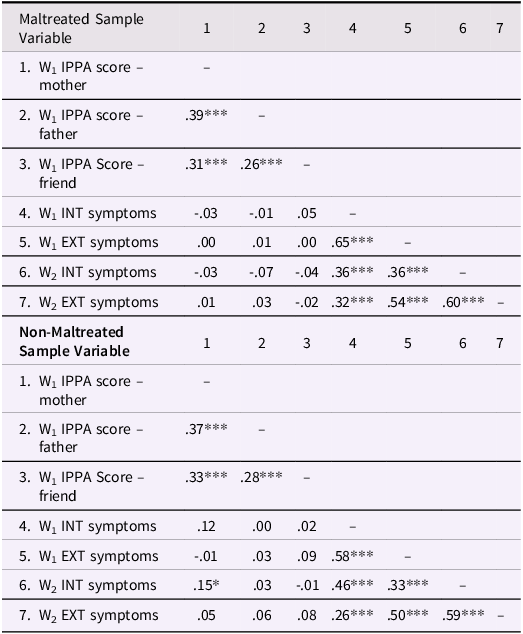
Note. W1 = Wave 1; IPPA = Inventory of Parent and Peer Attachment; INT = internalizing; EXT = externalizing; W2 = Wave 2; *p < .05; ***p < .001.
Hypothesis 1: Is there a main effect of perceived parental relationship quality on psychopathology for both groups?
Maternal relationship quality model
We proceeded with a path analysis using the lavaan package in R version 4.3.1 (R Core Team, 2023) to examine whether Wave 1 parental relationship quality significantly predicted Wave 2 internalizing and externalizing symptoms in both the maltreated and non-maltreated samples. The model for maternal relationship quality provided an excellent fit to the data, χ2(9) = 11.25, p = .259, CFI = 1.00, TLI = 1.00, RMSEA = .02, SRMR = .03 (Brown, Reference Brown2014; Hu & Bentler, Reference Hu and Bentler1999; Hu & Bentler, Reference Hu and Bentler1999; Kline, Reference Kline2010; Yu & Muthén, Reference Yu and Muthén2002). Maternal relationship quality at Wave 1 did not significantly predict either internalizing (β = .13, p = .062) or externalizing (β = .08, p = .206) symptoms. However, there was a significant main effect of maltreatment group status on internalizing symptoms (β = .49, p = .031), but not on externalizing symptoms (β = .23, p = .301). The interaction between maternal relationship quality and maltreatment group status was not significant in predicting either internalizing (β = −.40, p = .089) or externalizing symptoms (β = −.17, p = .453). Thus, maltreatment group status did not moderate the association between maternal relationship quality and psychopathology.
Paternal relationship quality model
The model for paternal relationship quality also provided an excellent fit to the data, χ2(9) = 9.77, p = .370, CFI = 1.00, TLI = 1.00, RMSEA = .01, SRMR = .03. Similar to the model for maternal relationship quality, there was no main effect of paternal relationship quality on internalizing (β = .05, p = .498) or externalizing (β = .04, p = .690) symptoms. Further, there was no main effect of maltreatment group status on internalizing (β = .31, p = .097) or externalizing symptoms (β = .03, p = .864), and maltreatment group status did not significantly moderate the association between paternal relationship quality and internalizing (β = −.22, p = .264) or externalizing symptoms (β = .04, p = .835).
Hypothesis 2: does perceived friendship quality moderate the association between perceived parental relationship quality and psychopathology in the overall sample?
Maternal relationship quality x friendship quality model
Path analyses were conducted to test if Wave 1 friendship quality would moderate the association between Wave 1 parental relationship quality and Wave 2 psychopathology in the overall sample by entering an interaction between friendship quality and parental relationship quality. The model for the interaction between maternal relationship quality and friendship quality provided an excellent fit to the data, χ2(5) = 6.08, p = .299, CFI = 1.00, TLI = 0.99, RMSEA = .02, SRMR = .02. There was not a significant interaction between maternal relationship quality and friendship quality in predicting either internalizing (β = .05, p = .317) or externalizing symptoms (β = .04, p = .364). Furthermore, there was not a significant main effect of maternal relationship quality on internalizing (β = .03, p = .498) or externalizing symptoms (β = .03, p = .506) or of friendship quality on internalizing (β = −.03, p = .477) or externalizing symptoms (β = .01, p = .883).
Paternal relationship quality x friendship quality model
The model for the interaction between paternal relationship quality and friendship quality also provided an excellent fit to the data, χ2(5) = 8.98, p = .110, CFI = 0.99, TLI = 0.97, RMSEA = .04, SRMR = .02. However, there was not a significant interaction between paternal relationship quality and friendship quality in predicting either internalizing (β = −.00, p = .320) or externalizing symptoms (β = −.00, p = .881). Furthermore, there was not a significant main effect of paternal relationship quality on internalizing (β = −.00, p = .998) or externalizing symptoms (β = .02, p = .454) or of friendship quality on internalizing (β = −.02, p = .517) or externalizing symptoms (β = .00, p = .944).
Hypothesis 3: is the moderation effect of perceived friendship quality on the association between perceived parental relationship quality and psychopathology stronger in the maltreated sample?
Maternal relationship quality x friendship quality x maltreatment group status model
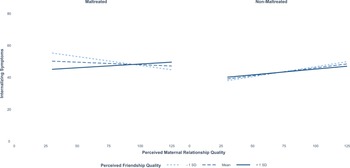
Though we did not find a moderation effect of friendship quality on the association between parental relationship quality and psychopathology, we entered a three-way interaction between friendship quality, parental relationship quality, and maltreatment group status to determine if findings differed by maltreatment group status. The model examining maternal relationship quality provided an excellent fit to the data, χ2(10) = 12.37, p = .261, CFI = 1.00, TLI = 0.99, RMSEA = .02, SRMR = .02. The three-way interaction between these variables was significant in predicting both internalizing (β = .10, p = .037) and externalizing (β = .12, p = .010) symptoms. The three-way interaction is plotted in Figure 2. As can be seen, for the non-maltreated group, the significant positive association between maternal relationship quality and internalizing symptoms was more pronounced with decreasing levels of friendship quality. However, for the maltreated group, higher maternal relationship quality predicted lower internalizing symptoms at the lowest level of friendship quality, but maternal relationship quality predicted more internalizing symptoms when friendship quality was at its highest level. Figure 3 displays the three-way interaction for externalizing symptoms. In the non-maltreated group, higher maternal relationship quality appears to predict decreased externalizing symptoms at greater levels of friendship quality. However, at lower levels of friendship quality, externalizing symptoms are increased at higher levels of maternal relationship quality. Conversely, in the maltreated group, similar to the pattern for internalizing symptoms, higher levels of maternal relationship quality predicted more externalizing symptoms at the highest levels of friendship quality, but higher maternal relationship quality predicted less externalizing symptoms when friendship quality was at its lowest. Of note, there was not a significant main effect of maltreatment group status, maternal relationship quality or friendship quality on internalizing or externalizing symptoms (βs = −0.02 to 0.09, ps = .055 to .639).
Interaction between friendship quality and perceived maternal relationship in predicting internalizing symptoms based on maltreatment group status.

Interaction between friendship quality and perceived maternal relationship in predicting externalizing symptoms based on maltreatment group status.

Paternal relationship quality x friendship quality x maltreatment group status
The model for the three-way interaction between paternal relationship quality, friendship quality, and maltreatment group status also provided an excellent fit to the data, χ2(10) = 12.10, p = .279, CFI = 1.00, TLI = 0.99, RMSEA = .02, SRMR = .02. However, the three-way interaction between these variables was not significant in predicting either internalizing (β = −.06, p = .297) or externalizing (β = −.02, p = .722) symptoms. Regarding main effects, maltreatment significantly predicted elevated internalizing (β = .12, p = .013), but not externalizing (β = .07, p = .125) symptoms. Neither parental relationship quality nor friendship quality had a significant main effect on internalizing or externalizing symptoms (βs = −0.04 to 0.05, ps = .323 to .984).
Discussion
Does higher perceived maternal and paternal relationship quality in early-mid adolescence predict decreased psychopathology in mid-late adolescence for maltreated and non-maltreated youth?
This study’s purpose was to assess the various ways in which parent and peer relationships are associated with the development of psychopathology among maltreated and non-maltreated adolescents. Consistent with previous literature, maltreated adolescents reported higher levels of Wave 2 internalizing symptoms (Cicchetti & Toth, Reference Cicchetti and Toth2016; Collishaw et al., Reference Collishaw, Pickles, Messer, Rutter, Shearer and Maughan2007; Vachon et al., Reference Vachon, Krueger, Rogosch and Cicchetti2015; Vallati et al., Reference Vallati, Cunningham, Mazurka, Stewart, Larocque, Milev, Bagby, Kennedy and Harkness2020); however, they did not report higher levels of Wave 2 externalizing symptoms. We did not find evidence to support the prediction that higher parental relationship quality in early-mid adolescence is associated with lower levels of psychopathology in mid-late adolescence. We also did not find an interaction between maltreatment group status and parental relationship quality on psychopathology, meaning that this lack of association was true for both maltreated and non-maltreated youth. These results are inconsistent with previous work showing that both maltreatment experiences and poor parental relationships are linked to worsened mental health (Armsden & Greenberg, Reference Armsden and Greenberg1987; Armsden et al., Reference Armsden, McCauley, Greenberg, Burke and Mitchell1990; Cicchetti & Toth, Reference Cicchetti and Toth2016; McGinley & Evans, Reference McGinley and Evans2020; Vachon et al., Reference Vachon, Krueger, Rogosch and Cicchetti2015; Vallati et al., Reference Vallati, Cunningham, Mazurka, Stewart, Larocque, Milev, Bagby, Kennedy and Harkness2020). However, our findings may have occurred for several reasons. Firstly, the current study examined adolescents’ relationships with their mothers and fathers at only one point in time. Yet, even when parent-child relationship quality appears to be developmentally stable, it can fluctuate daily depending on contextual factors related to the overall family (Gao & Cummings, Reference Gao and Cummings2019). Thus, one measurement of relationship quality between adolescents and their parents on any given day is not likely to be a robust predictor of developmental outcomes. Further, relational changes are only one of the many important and potentially conflictual developmental processes occurring on the pathway to adulthood (Wagner, Reference Wagner1996). The achievement of autonomous functioning, for example, naturally entails parent-child individuation (Steinberg & Silverberg, Reference Steinberg and Silverberg1986). This disengagement from parents may contribute to decreased parent-child relationship quality, even though it is otherwise beneficial for self-perceived independence (Buist et al., Reference Buist, Deković, Meeus and van Aken2002; Steinberg & Silverberg, Reference Steinberg and Silverberg1986). Considering this, our results might suggest that parents’ roles in their children’s psychological health diminish — or are at least difficult to detect — in the face of other simultaneous and counteracting developmental processes occurring during adolescence.
Does higher perceived friendship quality in early-mid adolescence buffer the association between perceived parental relationship quality and psychopathology in the overall sample?
We did not find any evidence to suggest that higher friendship quality in early-mid adolescence buffers the association between lower parental relationship quality and greater psychopathology in mid-late adolescence in the overall sample. This contradicts previous work suggesting that friendship plays a significant role in the psychological health of both maltreated and non-maltreated individuals with poor filial relationships (Brown et al., Reference Brown, Witmer and Johnson2024; Manna et al., Reference Manna, Falgares, Costanzo, La Sala, Lamis and Musso2022). Considering this, it is important to address the theoretical accuracy of our assessments’ temporal framing. Our two-wave design was scaled using concrete and linear units of time, such as age in years or days on a calendar. However, time may also be just as meaningfully scaled in terms of developmental milestones (Hopwood et al., Reference Hopwood, Bleidorn and Wright2022). For instance, some researchers choose to measure adolescence in terms of pubertal status, as puberty marks the onset of great physiological and relational shifts (Blakemore et al., Reference Blakemore, Burnett and Dahl2010; Collins & Russell, Reference Collins and Russell1991), in addition to more pronounced mental health symptoms (Oldehinkel et al., Reference Oldehinkel, Verhulst and Ormel2011; Pfeifer & Allen, Reference Pfeifer and Allen2021). Given that maltreatment is associated with changes in pubertal timing in girls (e.g. Mendle et al., Reference Mendle, Leve, Van Ryzin, Natsuaki and Ge2011), it is possible that the prominence of quality friendships as a developmental milestone occurs at a different age for maltreated adolescents. Future work assessing maltreatment, parental relationships, and peer relationships should incorporate designs with more frequent assessments, as well as adjust the timing and scaling of assessments accordingly. Such designs would allow researchers to consider stability and change in adolescent friendships, factors which also affect these relationships’ closeness and intimacy (Cairns et al., Reference Cairns, Leung, Buchanan and Cairns1995). Given these considerations, it is likely that by only assessing friendship quality once in early-mid adolescence, we have been unable to detect its potential association with the development of psychopathology. While adolescent friendships may be best captured more comprehensively, we must also acknowledge the budgetary constraints and feasibility of obtaining data so frequently in maltreated populations.
Is the buffering effect of perceived friendship quality in early-mid adolescence on the association between perceived parental relationship quality and psychopathology stronger for maltreated adolescents?
It is important to preface the following interpretations with the acknowledgment that our sample size is underpowered for robust conclusions from higher order associations. Despite this, we found a significant three-way interaction between maternal relationship quality, friendship quality, and maltreatment status on psychopathology (see Figures 2 and 3). These results admittedly lack precision, and replication is necessary in order to draw meaningful conclusions from these findings. Yet, they may provide insight into the previously mentioned lack of findings in the overall sample, as they reflect differences in developmental trajectories for maltreated and non-maltreated adolescents.
Among non-maltreated adolescents, the association between higher maternal relationship quality and greater internalizing symptoms was strongest at low levels — and weakest at high levels — of friendship quality. At all levels of friendship quality, this association remained positive. This was not the case for non-maltreated adolescents’ externalizing psychopathology. Although we witnessed similar patterns between higher maternal relationship quality and greater externalizing symptoms at low and average levels of friendship quality, higher maternal relationship quality was associated with less externalizing symptoms in the presence of high-quality friendships. Those lowest in maternal relationship quality and friendship quality reported the least externalizing and internalizing symptoms. Taken together, these results are conflictual and do not align with previous literature on adolescents’ relationships with their parents and peers (Armsden & Greenberg, Reference Armsden and Greenberg1987; Armsden et al., Reference Armsden, McCauley, Greenberg, Burke and Mitchell1990; Laible et al., Reference Laible, Carlo and Raffaelli2000). However, they appear to suggest that increased friendship quality buffers the association between stronger maternal relationships and greater psychopathology in the case of internalizing symptoms. As mentioned previously, parent-child individuation (Steinberg & Silverberg, Reference Steinberg and Silverberg1986) and increased peer influence (De Goede et al., Reference De Goede, Branje, Delsing and Meeus2009; Laible et al., Reference Laible, Carlo and Raffaelli2000) are integral aspects of adolescent development and the achievement of autonomous functioning. Given that perceived behavioral autonomy is associated with decreased adolescent depressive symptoms (e.g. Eagleton et al., Reference Eagleton, Williams and Merten2016), more robust replication of these results could point to the potential benefit of decreased maternal relationship quality in the pursuit of independence. While the opposite appeared to occur for externalizing symptoms, previous research suggests that socioeconomic status predicts more variance in externalizing behaviors than relational factors (Madigan et al., Reference Madigan, Brumariu, Villani, Atkinson and Lyons-Ruth2016; Rönnlund & Karlsson, Reference Rönnlund and Karlsson2006). Our sample’s low overall socioeconomic status may have confounded our efforts to assess associations between maternal relationship quality, friendships, and externalizing symptoms among non-maltreated youth. This is especially plausible given our results, since adolescents’ internalizing but not externalizing symptoms differed by their maltreatment status. We also did not assess any specific traits of adolescents’ friends — for example peer deviance, which has been shown to exacerbate externalizing behaviors (Dishion & Tipsord, Reference Dishion and Tipsord2011; Gifford-Smith et al., Reference Gifford-Smith, Dodge, Dishion and McCord2005). Due to our sample’s lack of power, it is particularly important for future work to parse these potential confounding variables in larger sample sizes in order to clarify our findings.
Despite these analytical issues, the differences in interaction findings for maltreated youth were notable. Among maltreated adolescents, higher maternal relationship quality predicted decreased internalizing and externalizing symptoms at low and average ratings of friendship quality, such that those with low friendship and maternal relationship quality reported the most symptoms. While it would be necessary to replicate these results in a higher-powered sample to draw meaningful conclusions, previous research has shown that maltreated adolescents are at elevated risk for psychopathology (Cicchetti & Toth, Reference Cicchetti and Toth2016; Vachon et al., Reference Vachon, Krueger, Rogosch and Cicchetti2015; Vallati et al., Reference Vallati, Cunningham, Mazurka, Stewart, Larocque, Milev, Bagby, Kennedy and Harkness2020). Thus, assuming these results could be replicated, they might reflect the “double challenge” of facing both maltreatment-related trauma and deficits in supports that could provide alleviation (Craig et al., Reference Craig, Robillard, Turner and Ames2022 p. 795). Ultimately, it is reasonable to contend that due to this added layer of developmental challenge, maltreated adolescents are especially vulnerable when facing such adversity in addition to poor relationships with their mothers and friends.
At high friendship quality, there was an association between higher maternal relationship quality and increased levels of maltreated adolescents’ externalizing and internalizing symptoms. Unexpectedly, those with high friendship quality but low maternal relationship quality reported the lowest levels of symptoms. Given the Domain-Specific Model of Attachment’s assertion that we can form distinct evaluations for different kinds of relationships (Bohn et al., Reference Bohn, Holtmann, Luhmann, Koch and Eid2023; Overall et al., Reference Overall, Fletcher and Friesen2003), these results have the potential to suggest that maltreated adolescents’ psychological symptoms decrease when they are strengthening friendships and eschewing maternal relationships. Though these results necessitate replication, they do mirror Laible and colleagues’ (Reference Laible, Carlo and Raffaelli2000) study, in which adolescents with high friendship quality but low parental relationship quality were better adjusted than those with the converse. As 96.9% of this study’s maltreated sample reported their mothers to be the perpetrators, these results may suggest that higher relationship quality with maltreating mothers is detrimental, despite the known value of parental relationships in other contexts. By contrast, it is possible that avoiding – or even becoming invisible — to one’s abusive parent predicts resilience. While we do not have the statistical strength to make this claim with confidence, others have acknowledged invisibility to abusers as a resilience technique (e.g. Henry, Reference Henry2002), and there is related literature demonstrating the exacerbating impacts of family support at high levels of maltreatment (Folger & Wright, Reference Folger and Wright2013; Wright & Folger, Reference Wright, Folger and Teti2017). In short, lower parental relationship quality may predict lower levels of psychopathology for maltreated adolescents with strong friendships because they can utilize invisibility to their abusive parent as a resilience tactic while maintaining friendships that contribute to their adjustment.
Our results also indicated that maltreated adolescents with low and average friendship quality still relied on stronger maternal relationships to shield against increased psychopathology. If replicable, this would suggest that to buffer the double challenge accompanying maltreated adolescents’ unique deficits in social resources (Craig et al., Reference Craig, Robillard, Turner and Ames2022), having higher relationship quality in at least one relational domain is preferable. Having high relationship quality with a maltreating parent is perhaps still better than social isolation and loneliness (Leigh-Hunt et al., Reference Leigh-Hunt, Bagguley, Bash, Turner, Turnbull, Valtorta and Caan2017), even if it is not as ideal as having high relationship quality with friends who are unassociated with maltreatment experiences.
Perceived maternal versus paternal relationship quality
There was no significant three-way interaction between paternal relationship quality, friendship quality, and maltreatment status. This lack of finding may partially stem from limitations related to attrition, as paternal data was not missing at random for participants who did not complete Wave 2 assessments. Rather, participants with worse paternal relationship quality were more likely to partake in follow-up assessments, potentially preventing us from examining the association between positive paternal relationships and psychopathology. These findings could also be attributed to asymmetry in data characteristics. As previously mentioned, 96.9% of participants reported that their maltreatment was perpetrated by their mothers, whereas 46.1% reported that their maltreatment was perpetrated by their fathers. Despite these limitations, our results may be considered with previous research which suggests that mother-child dyads are more involved, undergo greater instability during adolescence, and entail more contentious parent-child individuation than father-child dyads (Collins & Russell, Reference Collins and Russell1991). Nonetheless, given that there is generally a need for parenting literature to address the role of fathers in development (Lee, Reference Lee2018), future studies should explore interactions between friendship quality, paternal relationship quality, and father-perpetrated maltreatment more specifically.
Limitations and future directions
There are several limitations worth mentioning in addition to those already discussed. Firstly, all insights were drawn from correlational results, thus no causal claims can be drawn from the current study. Further, as we previously stated, our sample is underpowered for second- and third- order interactions, and our results are associated with small effect sizes. This presents obstacles for interpretation, particularly regarding replicability and reliability. Future work on this topic should emphasize replicating these findings with larger sample sizes.
Second, the low SES nature of our sample not only introduces a potential confounding impact on externalizing symptoms but also precludes generalizability to families from higher SES backgrounds. Generalizability to the overall population of maltreated children may also be limited, considering that the maltreated sample was identified using substantiated CPS records when child abuse and neglect is severely underreported. Waves 1 and 2 measures were based solely on adolescent self-report, while previous research has shown discrepancies between adolescents’ ratings of their own psychological symptoms and others’ accounts of the same problems (Montgomery, Reference Montgomery2008; Ooi et al., Reference Ooi, Glenn, Ang, Vanzetti, Falcone, Gaab and Fung2017). Given these issues, more work is needed to address the suitability of self-report and external accounts of both maltreatment and psychopathology. Additionally, although FIML is the most ideal method to account for missing data, attrition between Waves 1 and 2 does not allow for examination of the proposed model with complete data from all participants. Notably, those with poor paternal relationship quality were more likely to participate in the Wave 2 follow-up. Lastly, the current work operationalized maltreatment as a binary variable, whereas some research shows that psychological symptoms vary by maltreatment subtype (e.g. Vallati et al., Reference Vallati, Cunningham, Mazurka, Stewart, Larocque, Milev, Bagby, Kennedy and Harkness2020). As such, it would be wise for future work to examine whether assessment of specific maltreatment subtypes produces distinct findings. In addition to the directions mentioned, designs involving more frequent and developmentally appropriate assessments may allow future research to explain our unexpected findings.
Strengths
This study also has several strengths. Notably, we assessed maltreatment prior to the Wave 1 assessment. While this design would seemingly present challenges for temporal ordering, empirical work suggests that the association between childhood adversity and internalizing and externalizing problems peaks at around 15 years old (e.g. Lee et al., Reference Lee, Duan, Constantino-Pettit, Yoon, Oxford, Rose and Cederbaum2025). By assessing childhood maltreatment’s lagged role in development, the current work’s temporal design shows strengths in its correspondence with Attachment Theory and Developmental Psychopathology (Ainsworth & Bowlby, Reference Ainsworth and Bowlby1991; Cicchetti & Toth, Reference Cicchetti and Toth2016). Furthermore, research on maltreatment and parental relationships focuses primarily on early development (Cicchetti et al., Reference Cicchetti, Rogosch and Toth2006; Toth et al., Reference Toth, Maughan, Manly, Spagnola and Cicchetti2002), leaving many questions about adolescent resilience unresolved. This study is one of few employing the developmental significance of adolescence to address these important questions. Additionally, previous work has acknowledged the difficulty of conducting research on maltreated populations (Bergsund et al., Reference Bergsund, Drozd, Olafsen, Nilsen, Linnerud, Kjøbli and Jacobsen2023; Socolar et al., Reference Socolar, Runyan and Amaya-Jackson1995). Considering this, the ethnic diversity of this study’s sample and the inclusion of a demographically similar non-maltreated comparison sample allows for greater generalizability and may be considered particularly valuable to the field. Lastly, literature assessing the protective influence of peers during adolescence is largely conflictual. While certain aspects of friendships exacerbate the effects of maltreatment (Dishion & Tipsord, Reference Dishion and Tipsord2011; Gifford-Smith et al., Reference Gifford-Smith, Dodge, Dishion and McCord2005), others have been shown to reduce them (Brown et al., Reference Brown, Witmer and Johnson2024). This study elucidates specific contextual factors that may contribute to the varied capacity of relationships as buffers against the development of psychopathology among non-maltreated and maltreated individuals.
Conclusion
The results of this study reflect potential nuances in the interaction between parent and peer relationship quality during adolescence by showing that the buffering nature of certain adolescent relationships depends on the quality of peripheral relationships. More specifically, it has contributed to efforts to clarify ambiguity in previous research on the success of protective factors (Brown et al., Reference Brown, Witmer and Johnson2024; Dishion & Tipsord, Reference Dishion and Tipsord2011) and resilience tactics (Henry, Reference Henry2002). As we have found that decreased relationship quality with mothers and peers is associated with potential benefits for non-maltreated youth, we have invited important questions about the role of autonomy and adjustment in adolescent development. Further, the suggestion that maltreated adolescents’ mental health outcomes are optimal when they have had stronger friendships and weaker maternal relationships is accompanied by important clinical implications. Clinicians should consider encouraging maltreated adolescents to establish and maintain high quality friendships, while also acknowledging the contexts in which improved maternal relationships may increase in importance. Most significantly, our findings provoke more comprehensive assessments of adolescents’ unique social networks when discerning their developmental risk.
Data availability statement
This study was not pre-registered. Materials and analysis code for this study are not made publicly available due to ethical reasons (e.g., child welfare involved sample).
Acknowledgments
We would like to thank the faculty, staff, and families at Mt. Hope Family Center who made this study possible.
Funding statement
This work was supported by the National Institute on Drug Abuse [R01-DA12903, R01-DA17741], the Spunk Fund, Inc., and the Eunice Kennedy Shriver National Institute of Child Health and Human Development [P50-HD096698]. The preparation of this manuscript was supported by a career development award (R00 HD103958) and a Loan Repayment Program Award (L40 HD103019) to Dr Brown by NICHD.
Competing interests
None.



 Open access

