




Introduction
Traditionally, the distribution of Pleistocene cave art has centred on the Franco–Cantabrian region with a ‘periphery’ including areas of southern Spain and Italy. More than 70 per cent of known Palaeolithic rock art sites are in this region; however, in recent years, there have been discoveries across Europe and Asia (for a compilation, see Ruiz-Redondo, Reference Ruiz-Redondo, Moro-Abadía, Conkey and McDonaldin press). Discoveries outside the Franco–Cantabrian area are always relevant to enhancing knowledge of Palaeolithic symbolism.
Along the eastern Iberian coast, the situation is paradoxical. Although this area hosts the most important Pleistocene mobiliary art site in terms of decorated items (‘Parpalló’: Villaverde Reference Villaverde1994), Palaeolithic cave art sites are sparse: nine are reliably identified as Pleistocene, with up to 21 possible in total (Villaverde Reference Villaverde and López2020: 27). The low occurrence of painted figures is especially striking because there are only three, at most, in the combined territories of Valencian Community and Catalonia.
Preliminary results
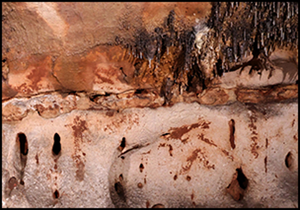
In this context, the discovery of the Cova Dones rock art in the summer of 2021 contributes a great deal to the study of ‘graphic behaviour’ in the Mediterranean area. The site consists of a single-gallery cave, approximately 500m deep, that opens onto a steep canyon in the municipality of Millares (Valencia; UTM coordinates: 30S 692764X 4338785Y, 399m AMSL) (Figure 1). Despite some Iron Age finds (Aparicio Reference Aparicio1976), the existence of Palaeolithic remains was unknown until an informal exploration in 2021 identified four painted motifs, including an aurochs head (Figure 2a). Further work in 2023 allowed us to identify the site as a major Palaeolithic art sanctuary, given the quantity and variety of motifs and the richness and detail of its technical features.
Location of Cova Dones (figure by the authors).

a) painted aurochs head; b) horse head made with clay; c) panel with several motifs painted with clay, including animals and signs (some partly covered by calcite layers) (figure by the authors).

So far, we have identified more than 110 graphic units, including at least 19 zoomorphic representations, located in three different zones of the cave. Despite being deep inside the cave (the main decorated area is approximately 400m from the entrance), all zones, and the panels and figures they contain, are easily accessible without any climbing required. The depicted animals are seven horses, seven hinds (female red deer), two aurochs, a stag, and two indeterminate animals. The rest of the art consists of conventional signs (rectangles, meanders), several panels of ‘macaroni’ (‘flutings’ made with either fingers or tools dragged across a soft surface), isolated lines, and poorly preserved unidentified paintings.
The variability and rarity of the technical features of the artworks are noteworthy because the assemblage includes different types of engravings and paintings. The engravings comprise the classic single-trait outlines of figures (Figure 3a), but also figures shaded by scraping the mondmilch (a type of limestone precipitate) on the surface of the walls (Figure 3b). This technique is rare in Palaeolithic cave art and previously unknown in eastern Iberia. The painting technique is no less surprising; motifs were created through the application of red clay on the walls, instead of the usual diluted ochre or manganese powder (Figure 2b–c). This iron-rich clay is abundant on the floors of the cave. Examples of such technique are known in the Mediterranean area and beyond (e.g. Ardales, Bernifal, Higuerón, La Pasiega, Pileta, Rouffignac), but they are rare in all of these sites (except at La Baume Latrone). In Cova Dones the entire painted corpus (>80 graphic units) is made using this technique.
a) engraved ‘Mediterranean trilinear hind’; b) two horse heads scraped on the wall surface (figure by the authors).

Chronology
The figures painted with fresh clay are rare and their dating is notoriously difficult. In Cova Dones, the antiquity of the paintings is supported by the fact that the applied clay has had time to dry in a wet environment and, especially, by the presence of thick calcite layers which cover different areas of several figures (Figure 4a).
a) detail of a thick calcite layer partly covering a hind's head; b) detail of a bear-claw mark overlapping some finger flutings (figure by the authors).
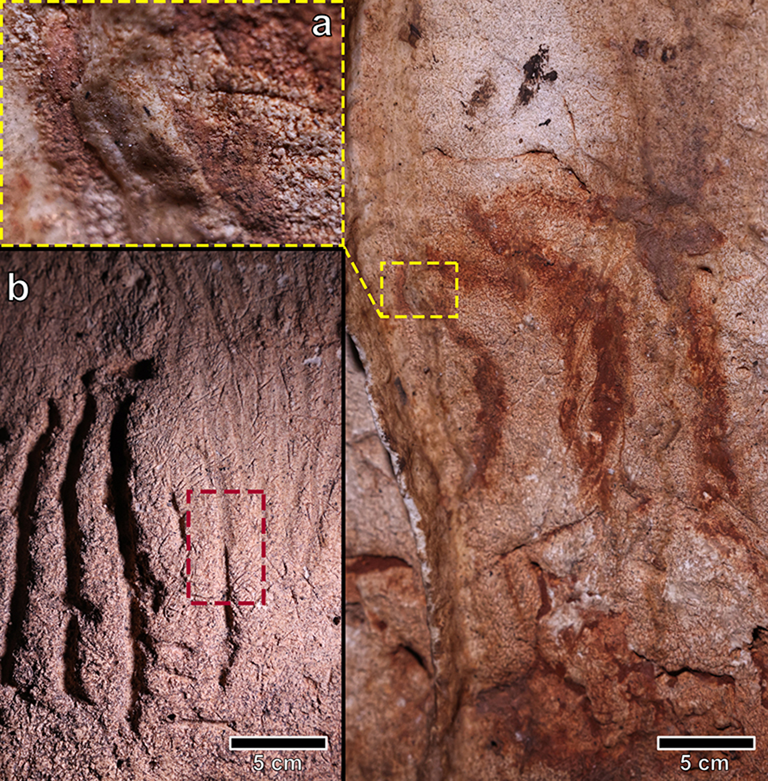
The age of the ‘macaroni’ is also generally difficult to assess. The simplicity of the technique used to create them makes it hard to attribute them to the Palaeolithic with certainty, although longevity can be assumed because of the occurrence of weathering processes (i.e. patinas). In Cova Dones, other evidence indicates the Palaeolithic age of some of these marks. The walls of the cave have some cave-bear claw marks scattered around. One of them partially overlaps some finger flutings (Figure 4b). The suggested extinction date in Europe for this species at c. 24 ka cal BP (Terlato et al. Reference Terlato, Bocherens, Romandini, Nannini, Hobson and Peresani2018) provides a terminus ante quem for this panel.
Even before a more detailed chrono-stylistic analysis takes place, some features can help establish the site's chronology. ‘Mediterranean trilinear hinds’ are well-known motifs in Mediterranean Palaeolithic art (Fortea Reference Fortea1978). In Nerja cave (Málaga, Spain) a radiocarbon date was obtained for a panel that has one of these representations (Sanchidrián et al. Reference Sanchidrián, Márquez, Valladas and Tisnerat2001). The result (GifA-98191: 19 900±210; 24 545–23 680 cal BP (85.2% probability, using IntCal20)) indicates a chronological attribution around the Gravettian–Solutrean transition (c. 26–24 ka cal BP). Rectangular signs are not a ubiquitous motif throughout the Upper Palaeolithic. For the nearby site of Parpalló, it is suggested that these images are dated to 24.5–21.1 ka cal BP based on their stratigraphic position in the sequence (Villaverde & Cantó Reference Villaverde, Cantó, Paillet, Paillet and Robert2020: 299). They show no discrepancies with the other rectangular signs present in Mediterranean Iberian Palaeolithic art (e.g. Comte, Nerja, La Pileta, Las Motillas, Las Estrellas and Ambrosio). Lastly, the style of the aurochs and horses—despite not being entirely diagnostic—can be used to assess the paintings’ age. Stylistic analysis of the figures points to a pre-Magdalenian age (>20 ka cal BP) and, considering the date for the extinction of the cave bear, we estimate that at least part of the rock art must be more than 24 000 years old.
Conclusion and future work
The Cova Dones rock art is a key discovery in Mediterranean Palaeolithic art. While the project is still in its early stages, preliminary results reveal an enormous potential for research at the site and establish this assemblage as arguably the most important for the eastern Iberian coast. Its iconographic and technical features make it one of the few major Pleistocene decorated sites of eastern Iberia; the recently discovered Cova de la Font Major (Morales et al. Reference Morales2022) could also be included in this category if further research confirms its potential. Future work will continue surveying the cave walls and will focus on the apparently unique technical aspects of the rock art as well as its chronology and archaeological context.
Acknowledgements
The authors are very grateful to Dr Marc Vander Linden and the two anonymous reviewers for their comments and suggestions on the manuscript. This project has been authorised by the Directorate-General for Culture and Heritage of the Valencian Government (Exp.2023/0075-V).
Funding statement
This work has been supported by the Universities of Zaragoza and Alicante (Spain).
Data availability
The authors confirm that the data supporting the findings of this study are available within the article. Raw data that support the findings of this study are available from the corresponding author on reasonable request.


 Open access

