

1 Introduction and background
An increasing number of products are designed for global markets, yet research has largely focused on the investigation of design practices by designers from high-income countries, whether designing for their own high-income context (e.g., Ahmed, Wallace & Blessing Reference Ahmed, Wallace and Blessing2003; Atman et al. Reference Atman, Adams, Cardella, Turns, Mosborg and Saleem2007; Yilmaz & Seifert Reference Yilmaz and Seifert2011; Daly, Adams & Bodner Reference Daly, Adams and Bodner2012; Hilton, Linsey & Goodman Reference Hilton, Linsey and Goodman2015) or designing for low- or middle-income (LMIC) contexts (Haloburdo & Thompson Reference Haloburdo and Thompson1998; Downey et al. Reference Downey, Lucena, Moskal, Parkhurst, Bigley, Hays, Jesiek, Kelly, Miller, Ruff, Lehr and Nichols-Belo2006; Byrne & Sahay Reference Byrne and Sahay2007; Nieusma & Riley Reference Nieusma and Riley2010; Mohtar & Dare Reference Mohtar and Dare2012; Jeffers, Beata & Strassmann Reference Jeffers, Beata and Strassmann2015). However, a designer from a low- or middle-income country may employ different approaches than a designer from a high-income country and may interpret the context for which they are designing in different ways, and this may impact their design practices. Prior work supports the notion that design decision making is a culturally situated practice (Bucciarelli Reference Bucciarelli1988; Tse et al. Reference Tse, Lee, Vertinsky and Wehrung1988; Heaton Reference Heaton1998; Clemmensen, Ranjan & Bødker Reference Clemmensen, Ranjan and Bødker2017). For example, in one study, the cultural perceptions and norms of the designers in a multicultural design team influenced how the team represented the problem as well as their development of the solution requirements for an automotive accessory package (Daly et al. Reference Daly, McKilligan, Murphy and Ostrowski2017). Clemmensen and colleagues (Reference Clemmensen, Ranjan and Bødker2017) found that the design thinking processes of participants were influenced by their cultural knowledge that was either shared across the team or specific to one group.
These and other studies (e.g., Hong & Mallorie Reference Hong and Mallorie2004; Kimbell Reference Kimbell2011) have shown that cultural background, designers’ country of origin, and context in which the designer is designing can impact their design processes. However, little research has investigated the extent to which recommended best practices (developed from the research of Western designers) are used by non-Western designers in non-Western contexts. Therefore, it is important to investigate design practices across multiple and diverse contexts in order to broaden and deepen our knowledge about design decision making.
1.1 Prototyping best practices in design
Prototyping is an essential activity in a design process (Yang & Epstein Reference Yang and Epstein2005; Viswanathan et al. 2014) and allows ideas to take on virtual form such as sketches and computer-generated prototypes, or physical form such as tangible models and existing objects (Ullman, Wood & Craig Reference Ullman, Wood and Craig1990; Schrage Reference Schrage1999; Kelley & Littman Reference Kelley and Littman2006; Hamon & Green Reference Hamon and Green2014). Several studies have shown that prototypes can be useful throughout an entire design process to understand the problem, develop requirements and specifications, consider and select ideas, get feedback, test functionality, etc. (Ullman et al. Reference Ullman, Wood and Craig1990; Moe, Jensen & Wood Reference Moe, Jensen and Wood2004; Yang & Epstein Reference Yang and Epstein2005; De Beer et al. Reference De Beer, Campbell, Truscott, Barnard and Booysen2009; Viswanathan & Linsey Reference Linsey2009; Hamon & Green Reference Hamon and Green2014; Ulrich & Eppinger Reference Ulrich and Eppinger2015). Best practices with prototypes include developing quick and simple mock-ups, as well as leveraging them both frequently and iteratively (Clark & Fujimoto Reference Clark and Fujimoto1991; Yock et al. Reference Yock, Zenios, Makower, Brinton, Kumar, Watkins, Denend, Krummel and Kurihara2015) as prototypes can help designers create multiple ideas quickly, compare and select the most promising concepts, and use what has been learned from previous iterations to inform the next generation (Kordon & Luqi Reference Kordon2002; Kelley & Littman Reference Kelley and Littman2006). Schrage (Reference Schrage1999) argues that prototypes should be regarded as disposable objects that help eliminate bad ideas and discover opportunities, and Kelley (Reference Kelley2001) calls prototyping ‘the shorthand of innovation.’ Following best practices allows designers to swiftly select and refine the most promising solutions without investing much ‘sunk cost,’ i.e., time, money or other resources in ideas that would later be eliminated (Houde & Hill Reference Houde and Hill1997). In contrast, when designers focus on using prototypes as tools to verify a function or test features or components of a chosen concept later in the design process, the prototyping methods often include sophisticated fabrication techniques such as machining, leading to high-functioning, but also high-expense prototypes (Dym et al. Reference Dym, Agogino, Eris, Frey and Leifer2005; Dieter & Schmidt Reference Dieter and Schmidt2012).
Instead of concentrating on the entire system, expert designers often use prototypes to break up complex design problems and work at the component level (Gerber Reference Gerber2009; Viswanathan et al. 2014; Hilton et al. Reference Hilton, Linsey and Goodman2015). Many find it easier to succeed at the component level and achieve ‘small wins’ by solving individual and simpler challenges that are part of a larger, more complex problem. Achieving success at a small scale can give designers confidence in their abilities to solve problems and motivate their pursuit of larger, more complex design challenges (Gerber Reference Gerber2009). Gaining confidence is particularly important for novice designers, however, achieving small wins that support bigger wins, or solving a larger, more complex problem, requires foresight, and experienced designers use structured approaches to plan their use of prototypes, including when and how to use them, how much time to spend on prototyping, and the level of complexity of a prototype (Yang & Epstein Reference Yang and Epstein2005; Atman et al. Reference Atman, Adams, Cardella, Turns, Mosborg and Saleem2007; Camburn et al. Reference Camburn, Sng, Perez, Otto, Wood, Jensen and Crawford2015; Häggman et al. Reference Häggman, Tsai, Elsen, Honda and Yang2015).
Prototypes also serve as devices that support communication within the design team as well as between designers and stakeholders. Here, prototypes can help designers develop deep understandings of stakeholders’ needs and wants (Skaggs Reference Skaggs2010) by providing a fundamentally different way of collaborating through a ‘shared space’ that enables conversations between participants and designers (Schrage Reference Schrage1999). Well-planned communication is particularly crucial during the early stages of a design project when both the problem and solution spaces are undefined, and comprehensive information can be difficult to collect (Mohedas, Daly & Sienko Reference Mohedas, Daly and Sienko2014). For example, in a project described by Sarvestani & Sienko (Reference Sarvestani and Sienko2014), the designers initially attempted to establish requirements for an adult male circumcision device from stakeholders in Uganda without the use of prototypes, but were more successful once they introduced prototypes, particularly with respect to eliciting cultural and other contextual factors.
1.2 Novice prototyping behaviors
Prior work comparing novice and expert design approaches has demonstrated that design practices change with experience (Cross Reference Cross2004; Popovic Reference Popovic2004; Atman et al. Reference Atman, Adams, Cardella, Turns, Mosborg and Saleem2007; Björklund Reference Björklund2013; Ozkan & Dogan Reference Ozkan and Dogan2013). Experienced designers often use prototypes to observe stakeholders’ behaviors and use these observations to develop requirements and specifications (Courage & Baxter Reference Courage and Baxter2005; Kelley Reference Kelley2001). Other researchers have shown that prototyping with a purpose, or having a strategy for using prototypes is beneficial to a successful design outcome (Popovic Reference Popovic2004; Christie et al. Reference Christie, Jensen, Buckley, Menefee, Ziegler, Wood and Crawford2012; Hilton et al. Reference Hilton, Linsey and Goodman2015). Factors such as number of prototypes, types of prototypes and time of use, among others, influence how a project progresses, and the effective and intentional use of prototypes can have tremendous impact on project outcomes (Yang & Epstein Reference Yang and Epstein2005; Kelley Reference Kelley2001; Camburn et al. Reference Camburn, Dunlap, Kuhr, Viswanathan, Linsey, Jensen, Crawford, Otto and Wood2013), yet several studies found that novice designers tend to underutilize prototypes (Atman et al. Reference Atman, Adams, Cardella, Turns, Mosborg and Saleem2007; Ozkan & Dogan Reference Ozkan and Dogan2013; Viswanathan et al. 2014).
For example, in a previous study with novice designers from a university in the United States, Deininger et al. (Reference Deininger, Daly, Sienko and Lee2017) examined how novice designers’ prototyping behaviors compared to literature-grounded prototyping best practices. In this study, participants underutilized prototyping best practices and often lacked intentionality in their behaviors, specifically during the front end and to engage with stakeholders. In this study, the student novice designers realized broader benefits of using prototypes throughout a design process when they reflected on their actual use of prototypes. The study also identified a difference between the perception of the usefulness of prototypes and how participants reported using them during their capstone design courses. These findings align with studies that have shown that instead of using prototypes iteratively to refine and develop several ideas in parallel, novice designers often use prototypes primarily to test and evaluate a chosen design (Lande & Leifer Reference Lande and Leifer2009; Yang Reference Yang2009; Zemke Reference Zemke2012; Hamon & Green Reference Hamon and Green2014). Novice designers tend to use prototypes during fewer stages of a design process, spend less time on individual design tasks, and gather less information when scoping a problem (Atman et al. Reference Atman, Adams, Cardella, Turns, Mosborg and Saleem2007). Combined, these behaviors limit the benefits that frequent, iterative, and rigorous use of prototypes can provide.
1.3 Virtual versus physical prototypes
Physical prototypes include existing objects, mock-ups, and tangible models like 3D-printed objects that can be rough and made of scrap pieces or refined and nearly indistinguishable from a final product (Kelley Reference Kelley2001; Hilton et al. Reference Hilton, Linsey and Goodman2015; Yock et al. Reference Yock, Zenios, Makower, Brinton, Kumar, Watkins, Denend, Krummel and Kurihara2015). Virtual prototypes include, for example, sketches, renderings, and digital CAD models and also can be created with varying levels of fidelity, from simple line drawing to photorealistic rendering (Tractinsky, Katz & Ikar Reference Tractinsky, Katz and Ikar2000; Lim et al. Reference Pangam2006; Kudrowitz, Te & Wallace Reference Kudrowitz, Te and Wallace2012). Both virtual and physical prototypes are used during design, and experienced designers leverage prior experiences to choose the most appropriate prototype format that supports a design task (Lawson Reference Lawson1994; Ho Reference Ho2001; Cross Reference Cross2004). Therefore, the type of prototype that designers create often depends on the stage of a project, and the level of prototype refinement typically increases as designers learn more about the solution and refine earlier ideas (Yang & Epstein Reference Yang and Epstein2005; Ulrich & Eppinger Reference Ulrich and Eppinger2015). Lower fidelity prototypes of either virtual or physical nature that can be created quickly are often used during the front end to inspire, communicate, and gather feedback (Houde & Hill Reference Houde and Hill1997; Brandt Reference Brandt2007; Campbell et al. Reference Campbell, De Beer, Barnard, Booysen, Truscott, Cain, Burton, Gyi and Hague2007; Kelley Reference Kelley2007; Gerber Reference Gerber2009), while higher fidelity prototypes that require more investment are frequently used later in the design process to test and verify a chosen concept (Baxter Reference Baxter1995).
The amount of information that is included in different prototype types is not necessarily the same, and therefore, not all prototypes are equally well suited for every task. For example, a sketch might convey an idea and describe the shape of a handheld object to a stakeholder but deprives participants of the opportunity to physically interface with the device or examine how the shape ‘feels.’ When people interact with models, new insights can often be gained that may not have been revealed otherwise (Sauer, Franke & Ruettinger Reference Sauer, Franke and Ruettinger2008; Kelley Reference Kelley2001). Specifically when evaluating human factors, tangible prototypes allow for evaluations that are challenging at best when using virtual prototypes. To support the use of prototypes, design experts recommend the selection of the most suitable prototype type to answer a particular question (Kelley Reference Kelley2001; Dieter & Schmidt Reference Dieter and Schmidt2012; Yock et al. Reference Yock, Zenios, Makower, Brinton, Kumar, Watkins, Denend, Krummel and Kurihara2015).
Prior work evaluated the usefulness of feedback by representative stakeholders for informing design decisions based on the prototype type and the fidelity of the prototype presented (Deininger et al., under review). The study found that stakeholders responded with more useful feedback when presented with physical prototypes as compared to virtual models. Although many researchers agree that physical prototypes produce richer feedback from stakeholders (Wiklund, Thurrott & Dumas Reference Wiklund, Thurrott and Dumas1992; Brandt Reference Brandt2007; De Beer et al. Reference De Beer, Campbell, Truscott, Barnard and Booysen2009; Sauer & Sonderegger Reference Sauer and Sonderegger2009), some studies have found that, under certain circumstances, virtual prototypes can be equally useful as physical models, as long as designers are aware of their limitations (Rudd, Stern & Isensee Reference Rudd, Stern and Isensee1996; Walker, Takayama & Landay Reference Walker, Takayama and Landay2002).
1.4 Prototyping behaviors and context
Prototyping strategies of designers vary depending on the level of expertise and have also been shown to vary by design phase (Christie et al. Reference Christie, Jensen, Buckley, Menefee, Ziegler, Wood and Crawford2012; Crismond & Adams Reference Crismond and Adams2012; Hilton et al. Reference Hilton, Linsey and Goodman2015; Menold, Jablokow & Simpson Reference Menold, Jablokow and Simpson2017). However, other aspects of a designer’s background, including education, culture, and personal preferences, likely influence their prototyping approaches as well. For example, Bar-Eli (Reference Bar-Eli2013) identified three different profiles among participants’ sketching behaviors. The designers leveraged sketches to support realization, learning, and reflection and used them as tools to think and communicate during conceptualization. The different approaches to sketching demonstrate variations in prototyping behaviors not dependent on expertise level, and in the case of this study, likely on personal preference and style instead.
Cultural background may also influence the ways two-dimensional and three-dimensional prototypes are leveraged. For example, a study by Razzaghi and colleagues (Reference Razzaghi, Ramirez and Zehner2009) found that sketching behaviors during a conceptualization exercise varied between Australian and Iranian industrial design students. Additionally, the study identified ten sketching patterns within each group, and interviews revealed that participants’ design preferences were influenced by their own cultural values. Similarly, Lotz & Sharp (Reference Lotz and Sharp2017) found significant differences between interaction designers from the United Kingdom and Botswana. During sketch-based ideation tasks, designers from the UK preferred a more field-independent cognitive style and focused on detailed, dynamic interaction with an object, while designers from Botswana preferred a more field-dependent cognitive style and emphasized relationships and context of an object. The researchers also identified differences in ideation techniques as well as the development of different design details and conclude that complex relationships exist between cultural background, cognitive style, and design setting.
To more broadly investigate prototyping practices in design, particular to an understudied designer context, this study examined how novice designers from a university in Ghana reported using prototypes when developing products as part of project-based engineering design courses. While some behaviors were expected to be explainable due to level of expertise, other behaviors may be explained by contextual factors. The findings present a comparison of Ghanaian novice designers’ reported behaviors to prototyping best practices and are followed by a discussion of how local constraints may have impacted their design prototyping practices.
2 Research methods
Motivated by questions about novice prototyping practices and what prototyping practices may be prominent in particular contexts, the following research questions guided this study:
(1) To what extent do Ghanaian engineering novice designers follow prototyping best practices?
(2) What types of prototypes do Ghanaian novice engineering designers use during their project-based design courses?
2.1 Participants
The participants for this study were upper-level students at a university in Ghana. They were recruited by a teaching assistant in the engineering department at the university. The teaching assistant reached out to recent graduates of third- and fourth-year engineering design courses via phone and email, and scheduled interview times following the courses’ conclusion. These courses included Biomedical Engineering 300 (BME 300), Biomedical Engineering 400 (BME 400) and Food Processing Engineering 400 (FPE 400). Some participants also had participated in extracurricular, academic design activities, had experience as a teaching assistant, or had completed an internship. Participants were presented with an informed consent form, agreed to be audio recorded for later transcription and analysis, and received a small amount of money for their contribution. Personal data collected throughout the study was de-identified for data storage and analysis.
A total of 33 novice designers were recruited from a university in Ghana, which is a large number of study participants for this type of research and more than sufficient to conduct detailed explorations of participants’ experiences and identify transferable trends of the findings (Stempfle & Badke-Schaub Reference Stempfle and Badke-Schaub2002; Cash et al. Reference Cash, Elias, Dekoninck and Culley2012; Björklund Reference Björklund2013; Daly, McGowan & Papalambros Reference Daly, McGowan and Papalambros2013; Crilly Reference Crilly2015).
The courses were designed to introduce students to practical engineering design, decision-making processes, and the rational selection of materials to meet design specifications. Some of the targeted learning objectives of these courses included:
(1) Distinguishing between science and engineering and the products of scientific and engineering endeavor.
(2) Recognizing the steps of a systematic engineering design process.
(3) Identifying and formulating problems for solution using engineering design skills.
(4) Conducting a comprehensive product analysis.
(5) Applying the engineering design process to design a product satisfying a specified need.
(6) Applying systematic decision-making tools to make design decisions.
(7) Using knowledge of materials properties and processing to specify and select appropriate materials for a designed product.
(8) Demonstrating improved teamwork, writing, and presentation skills.
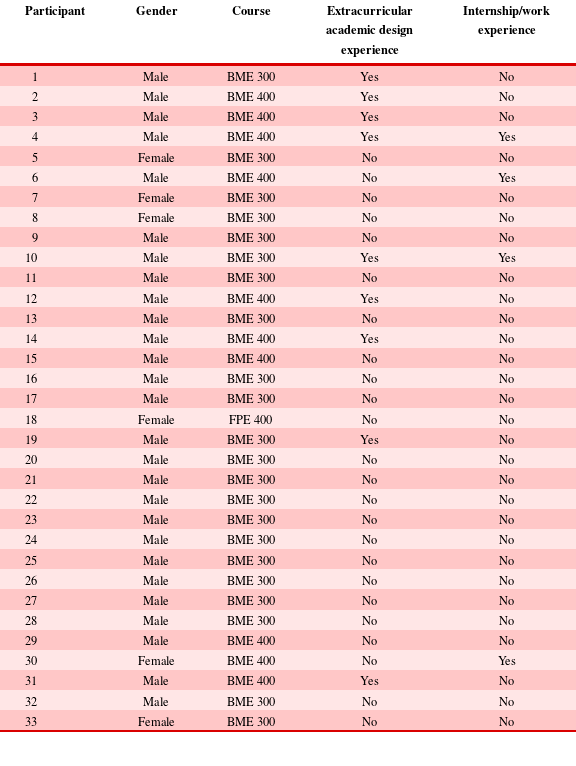
Participants selected a significant design problem of local relevance and had to prepare a final presentation and project report by the end of the course. Some of the projects included a heatless hair dryer that prevents burns, a rehabilitation device to help stroke patients with limb exercises, a temperature-conserving blood bag, a smokeless cooking stove, a device to detect ringworm, a volume-control device for an aspirator, and a device to detect muscle contractions during labor. Even though some participants reported prior design experience, they were considered novice designers due to their limited exposure and experience with team-based design projects that required them to apply their skills to a project challenge that encompassed the entire design process. However, a range of design and prototyping skills was expected based on participants’ previous experiences. The demographics of the study population are shown in Table 1.
Participant demographics
2.2 Data collection
A qualitative research approach was used for this study to develop an understanding of participants’ experiences (Boyatzis Reference Boyatzis1998; Creswell Reference Creswell2013; Patton Reference Patton2014), and to describe how they reported using prototypes during their project-based design courses. This was done through semi-structured interviews that allowed participants to express their individual experiences and thoughts, while still providing some guidance as they reflected on their design projects (Weiss Reference Weiss1995; Creswell Reference Creswell2013; Patton Reference Patton2014).
2.3 Interview protocol
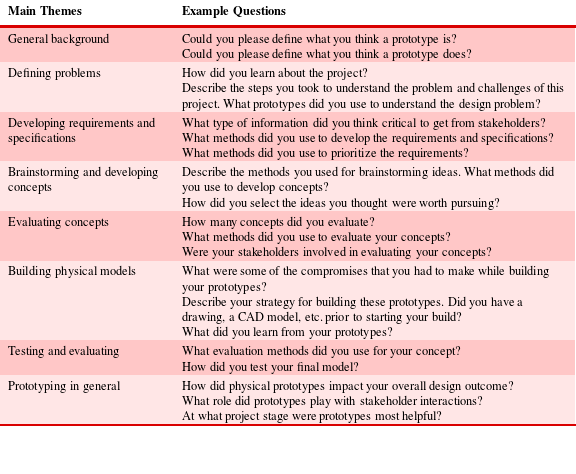
The interview protocol, developed during a previous study (Deininger et al. Reference Deininger, Daly, Sienko and Lee2017), focused on how participants conceptualized and reported using prototypes during their most recent design courses and was approved by the University’s IRB. The questions focused on the roles of prototypes during the individual design phases and encouraged participants to express their experiences while allowing the interviewer to ask followup questions. The main themes and sample questions of the interview protocol are shown in Table 2.
Interview protocol main themes and sample questions
All interviews were conducted by the same person. At the beginning of the interview, the interviewer provided the following broad definition of prototypes to participants: ‘Prototypes are three-dimensional physical models, CAD models, or two-dimensional sketches or representations that communicate an idea or a design concept.’ To ensure that all participants based their answers on the same broad definition when reflecting on how they used prototypes during their design projects, the research team developed this definition based on information sources that included prominent engineering textbooks and academic literature from other design disciplines such as industrial design (Ertas & Jones Reference Ertas and Jones1996; Schrage Reference Schrage1999; Otto & Wood Reference Otto and Wood2000; Cross Reference Cross2004; Kelley & Littman Reference Kelley and Littman2006; Dieter & Schmidt Reference Dieter and Schmidt2012; Ulrich & Eppinger Reference Ulrich and Eppinger2015; Yock et al. Reference Yock, Zenios, Makower, Brinton, Kumar, Watkins, Denend, Krummel and Kurihara2015). Following this presentation of the definition of prototypes, participants were encouraged to describe their projects in chronological order and elaborate on their prototyping activities during the individual phases they completed.
2.4 Data analysis
The research team used a deductive analysis approach (Crabtree & Miller Reference Crabtree and Miller1992) to determine how the reported prototyping behaviors aligned with prototyping best practices. The 15 codes used for this analysis, developed during an earlier study (Deininger et al. Reference Deininger, Daly, Sienko and Lee2017), focused on expert prototyping best practice behaviors and recommendations and were derived from the same prominent engineering design textbooks used to develop the definition of prototypes (Ertas & Jones Reference Ertas and Jones1996; Schrage Reference Schrage1999; Otto & Wood Reference Otto and Wood2000; Cross Reference Cross2004; Kelley & Littman Reference Kelley and Littman2006; Dieter & Schmidt Reference Dieter and Schmidt2012; Ulrich & Eppinger Reference Ulrich and Eppinger2015; Yock et al. Reference Yock, Zenios, Makower, Brinton, Kumar, Watkins, Denend, Krummel and Kurihara2015). These textbooks are frequently referenced in engineering design courses, and while they likely do not capture every best practice in prototype usage, the list of codes generated from these information sources allowed for a comprehensive collection of prototyping best practices. A full list of the prototyping best practices including detailed rating criteria can be found in Table 6 in the Appendix.
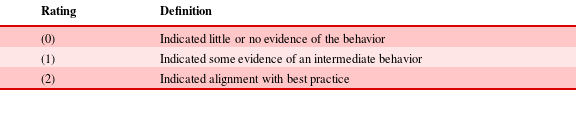
The transcribed interviews were then rated by two team members who determined if, and to what extent, the participants reported following prototyping best practices. Each participant’s reported prototyping behavior was rated on a three-point scale (0-1-2) that considered intentionality, fidelity, structure, and iteration of the activity, and discounted referencing existing objects for benchmarking. The criteria used for this rating are shown in Table 3, and this analysis was organized using QSR’s NVivo 11, qualitative coding software. Cronbach’s Alpha, the degree of reliability or agreement between raters was calculated as 0.94 and values greater than 0.9 are generally considered excellent for internal consistency (George & Mallery Reference George and Mallery2011). Remaining inconsistencies between raters were discussed until agreement was reached.
Criteria for rating prototyping best practice behaviors
The coded sections identifying prototyping activities were then examined to determine what type of prototypes participants reported using during their reported prototyping activities and the rating of the prototyping behavior following the use of each prototype type. The codes for this analysis distinguished between virtual and physical prototypes and a detailed description can be found in Table 4.
Definitions for virtual and tangible prototypes

3 Findings
3.1 To what extent did Ghanaian novice designers’ reported behaviors follow prototyping best practices?
Participants reported using prototypes in some ways that aligned with best practices. There were also instances in which students did not report using prototypes in recommended ways. The number of participants who reported use of prototyping best practices are summarized in Figure 1 and numerical results can be found in Table 7 in the Appendix.
Number of participants who reported use of a specific prototyping best practice.

Communication was the most frequently reported prototyping behavior. Five participants reported activities that aligned with this prototyping best practice, and 23 showed some evidence of an intermediate behavior. Participant 31 provided a summary of what the majority of the participants in this study experienced:
‘Sometimes I am working on a project and…those around me don’t understand it as I understand it. I can talk to you for hours about this, but a picture conveys a better idea than me talking about it. So that’s the main essence for better communication to my audience.’
Participant 1 also discussed this insight with a similar statement:
‘Sometimes you have in mind what you are doing, you would say this is what you want to represent. But when you don’t show it to someone…[they] will be thinking of something else.’
Communication occurred between a variety of people, and Participant 19 found that prototypes helped to make sure that communication within the team was effective and that people had a good understanding of what others were thinking:
‘Sketches were used to communicate, as in we were a group and we were discussing, looking at possible solutions. So if somebody brings an idea, if we don’t sketch it down, other people might not understand what the person is trying to imply so that’s why we were putting the sketches down. So somebody will come out with a sketch and we’ll be like no this part needs to change that part, so we will have an idea where we are moving to and what we are really talking about, so that’s how come we used sketches throughout.’
This point was also communicated by Participant 25:
‘Sketches just made people, or made our colleagues understand what we really wanted to come up with.’
In more detail, Participant 3 described how prototypes were essential as communication tools for the completion of their project:
‘I think it would have been very impossible to complete our project without [a] prototype, because at various stages of the design process, we had to communicate with each other…With sketches and 3D models, we were able to get the idea of members of the team and we were able to build on that to get a better design. In fact it improved the communication with our team.’
Participant 4 explained how prototypes were essential for sharing information outside of his team, here classmates and instructors:
‘Without [prototypes], we don’t think we will be able to show to the class, to prove to our supervisors that we’ve done a great job. We were able to prove ourselves and show that we’ve done something.’
Some participants involved stakeholders outside of the design team and academic advisors, but deliberately shared prototypes only selectively. Participant 29 based this selective behavior on the fact that the design team did not expect all stakeholders to be prepared to provide input on their prototype:
‘I didn’t show it to nurses – Ok I showed it to the technician alone, not the nurses, because they don’t understand technical stuff like that, so it was my supervisors and the technicians who had [a] chance to look at that and then approve before I move on to the next stage.’
Communication is a crucial activity that occurs frequently during the design process and participants found that the use of prototypes improved the exchange of information among team members. However, communication with individuals outside of participants’ own teams was often challenging, and participants sometimes expected stakeholders with no design experience, or stakeholders not familiar with product development, would not be able to respond to prototypes.
Testing a concept was the second most frequently reported prototyping best practice behavior. Nine participants reported behaviors that aligned with this prototyping best practice, and 12 showed some evidence of an intermediate behavior. Participant 1 described in general terms the importance of testing:
‘I have to evaluate my product to see if it suits my customers’ requirement. So I have to make sure I validate that, whether I’m doing, am I’m following in line with what I said from the beginning. Have I been able to achieve my specifications, have I met my target, and have I met my customers’ needs?’
Participant 30 laid out an iterative approach to testing that allowed the team to move through several iterations of her project:
‘So based on the result of the simulations, I noticed it was going to work so I decided to put it in a mock-up and come up with something to show physically, something, not a computer [model]. So I bought the aluminum and I designed it.’
Participant 12 provided more detail and explained how the team tested the insulating properties of his design for a device to transport blood. The team started with virtual models and moved to physical testing to verify their findings:
‘We did simulation with the MATLAB. We had data that we see [in] the graphs, the warming process, this is the heat going in and this is the temperature of the blood bag that was changing. We were taking the temperature of the blood bag at specific time periods as well as the voltage that we were using. So we were able to obtain some data on it and we could see that ok, this is the warming process over 10 minutes. So we see this kind of curve; it peaks and then it plateaus.’
However, testing was not always a straightforward activity for participants, and Participant 6 described a struggle based on compromised material selection:
‘I went on testing if that concept would actually work. I was able to get some readings but then because of the selection that I made for the electrodes…It was supposed to be nickel and copper…but…I had to settle on lead and, so because of that, that actually gave me a very weak signal.’
More than one third of the participants (12) showed little to no evidence of this prototyping best practice behavior. Participant 25 explained that the team did not have enough time to learn the necessary skills for testing, a challenge also experienced by other teams:
‘Because we had to learn the software, procedure and other techniques and do it at the same time, it was a bit stressful. The time too was short so we couldn’t really finish up the work.’
Participant 11 also reported limitations to their testing activities that influenced their decision-making process:
‘We actually were supposed to test…but unfortunately because we couldn’t do that, we just decided…we didn’t actually [have] empirical evidence to prove that here will be better than here or maybe here. I’m sure probably if we had been able to test, we would have made some adjustments.’
This was also discussed by Participant 31 who expanded on how the team was not able to simulate flow with his CAD model, and used an alternative, mathematical method instead:
‘I wanted to use AutoCAD to do the free flow and I don’t have the software, so basically I wish I could have got help from somebody. I interacted with so many people but I didn’t get anybody to help me. So I resorted to using Excel Solver to just run optimizations based on the equation I had.’
Participant 9 explained how his team also had to compromise based on time and skills but was able to proceed with a software simulation. However, the team did not think this approach was as successful as if they had constructed a functional prototype:
‘Because we didn’t really build a final working, let me say prototype, we used SolidWorks to simulate maybe the pumping and then the absorption of water by maybe a silica gel. So we saw how the whole thing will be like and then the SolidWorks generated a Word document that is kind of like a report of the testing. So we would have done some kind of like testing, real hands on testing if we had the prototype, maybe the working prototype, but because we didn’t go that far because of the time for the semester and then other courses that we need to be taking we ended up, we had to opt for the software.’
Participants frequently found testing difficult and reported time constraints and limited access to resources such as materials and tools as well as insufficient training for creating and testing prototypes as reasons for these challenges.
Identify functional blocks was the third most frequently reported prototyping best practice behavior. Functional blocks are key components, elements, or individual functions of a complex system, product or process. Identifying and working on individual functional blocks can support solving complex design problems by enabling designers to work at the often more manageable component level instead of the whole system (Christie et al. Reference Christie, Jensen, Buckley, Menefee, Ziegler, Wood and Crawford2012; Hilton et al. Reference Hilton, Linsey and Goodman2015; Yock et al. Reference Yock, Zenios, Makower, Brinton, Kumar, Watkins, Denend, Krummel and Kurihara2015). Eight participants reported behaviors that aligned with this prototyping best practice, and 10 showed some evidence of an intermediate behavior. Participant 27 explained the functional components of a device to prevent mosquito bites:
‘We had three main ways that the mosquitoes get attracted…The fan that sucks the mosquitoes into the device…And then for the extermination we considered electrocuting the mosquitoes after they’ve been attracted, or using a sticky trap to trap them.’
Participant 11 discussed how asking specific questions helped the team with the design of a cooking stove:
‘What are some of the ways of maybe conducting the heat? Maybe the heat regulation, we decided to put a regulator there and a conducting system. Where our smoke is going to come out? So we decided to incorporate a chimney system into it. And that’s where we decided to place our filtering system.’
Likewise, Participant 2, who worked on a glucose-monitoring device, described in detail how breaking up the device into functional blocks helped the team address several questions:
‘So I had to look at the power of the pump, the weight of the pump because you’re going to wear it on the arm. I had to consider the electrodes, the size of the electrodes, what amount of current will pass through the electrodes. The weight, the mechanisms, how finely it can be tuned, the flow rate, how much power it needs. The insulin chamber, the injection, the size of the needle, because that really affects how much pain the patients goes through, and I’m trying to make it as less painful as possible.’
However, 15 participants did not identify functional blocks and instead considered their project as a complete system. Participant 16 explained:
‘Ok we were analyzing the system as a whole we didn’t divide it into sections.’
Similarly, Participant 26, who worked on a portable massager, did not build any physical prototypes or investigate individual functional blocks. Instead, the team based assumptions on virtual sketches and estimations of the complete solution they designed:
‘Let’s say if I took the weight, because the actual prototype wasn’t built, but it was in sketches, so I didn’t know the actual mass but I intuitively…I think it was less than 500 to 750 grams yeah… $\!\!$
’
$\!\!$
’
Not all teams identified and worked on functional blocks. Instead, some participants addressed the whole product, making it potentially harder to develop a solution, especially when designing a complex product.
Another critical prototyping best practice that is closely related to communication is engage with stakeholders. Only one participant reported using this best practice at an advanced level, and six participants reported evidence consistent with an intermediate behavior. Participant 31, who reported advanced use of the practice, explained how existing products were used to get feedback from stakeholders on the appropriate weight of a device component:
‘I communicated with them like “What do you really define as not too big?” They picked an ultra sound Doppler, so they said this is ok, so I checked the weight of the ultra sound’
Participant 19 described how various prototypes not only helped the team with explaining the work they had completed, but also with gathering feedback from stakeholders:
‘When you communicate with people with just words, people have different conceptions about what you are trying to put across, but when you show them a prototype, sketches or the CAD model, they can actually confide what they are thinking about a specific design. So it helped us put across all the work that we did from material selection, concept generation, idea generation into that model.’
Similarly, Participant 24 described how stakeholders helped the team better understand the problem, and also how they provided feedback on early suggestions:
‘They told me more about the problems…A few gave me ideas, but then I proposed ideas to them: “Do you think that if you had something that was much smaller, would it be fine?” And they will say: “Yeah, maybe this will be so good.” “You think something that is much softer to clean the ear, would it be ok?” They say: “Yeah, I think something which is soft is good for the ear, not something which is too hard.”’
Little to no evidence among the 26 participants was reported for using prototypes to engage with stakeholders. Many stated a lack of time for not engaging with stakeholders and relied on personal experience and literature reviews instead. Participant 10 explained:
‘It was from literature review and it was from personal experience that we got the ideas. We had confidence that we were correct because based on where we got the information [from] we had confidence that it was correct…It would have been helpful for us if we would have gotten more stakeholders to be involved in the work.’
Participant 14 also mentioned referencing literature and the team using themselves as stakeholders:
‘Like we could have involved them [stakeholders] in the selection of the concept, but because it was an academic work, we just decided to select the concept and give it our own and score it based on the literature.’
Participant 10 justified why the team did not engage more with stakeholders and referred to the course structure and a lack of time:
‘I think it all depends on our course that we did. If they could allow us to have some let’s say time slot within the academic schedules where we can go out there to have contact with our stakeholders.’
Time was the most frequently reported limiting factor for engaging stakeholders as Participant 13 explained:
‘Basically, we didn’t go to the stakeholders as I said earlier but we took ourselves as stakeholders and looked at it at that way.’ Similarly, Participant 21 said: ‘So time didn’t permit us, that’s the main reason why we didn’t go to the hospitals and catch doctors and maybe get enough ideas to support the work.’
Similarly, Participant 21 said:
‘So time didn’t permit us, that’s the main reason why we didn’t go to the hospitals and catch doctors and maybe get enough ideas to support the work.’
Participant 12, who tried to engage with medical professionals, found that their stakeholders were too busy, which motivated the design team to make decisions on their behalf:
‘We didn’t really have that [conversations] because they’re always busy so we don’t have that direct contact with them. At some point we needed to make a decision on their behalf. We needed to adapt the Apple rule: Design the thing that people don’t know [they need], but design things that they think people will like.’
Participants often reported a lack of time and challenges when trying to engage with stakeholders as reasons for referring to literature or using their own opinions to motivate design decisions.
3.2 What types of prototypes did Ghanaian novice designers use during their project-based design courses?
Participants reported using virtual prototypes more often, and reported using best prototyping practices more often with virtual prototypes than with tangible prototypes. Frequencies of best practice usage are represented for both virtual and tangible prototype types in Figure 2, numerical results can be found in Table 7 in the Appendix, and the individual behaviors are discussed subsequently.
Frequencies of the reported use of virtual and tangible prototypes for prototyping best practices by Ghanaian novice designers.
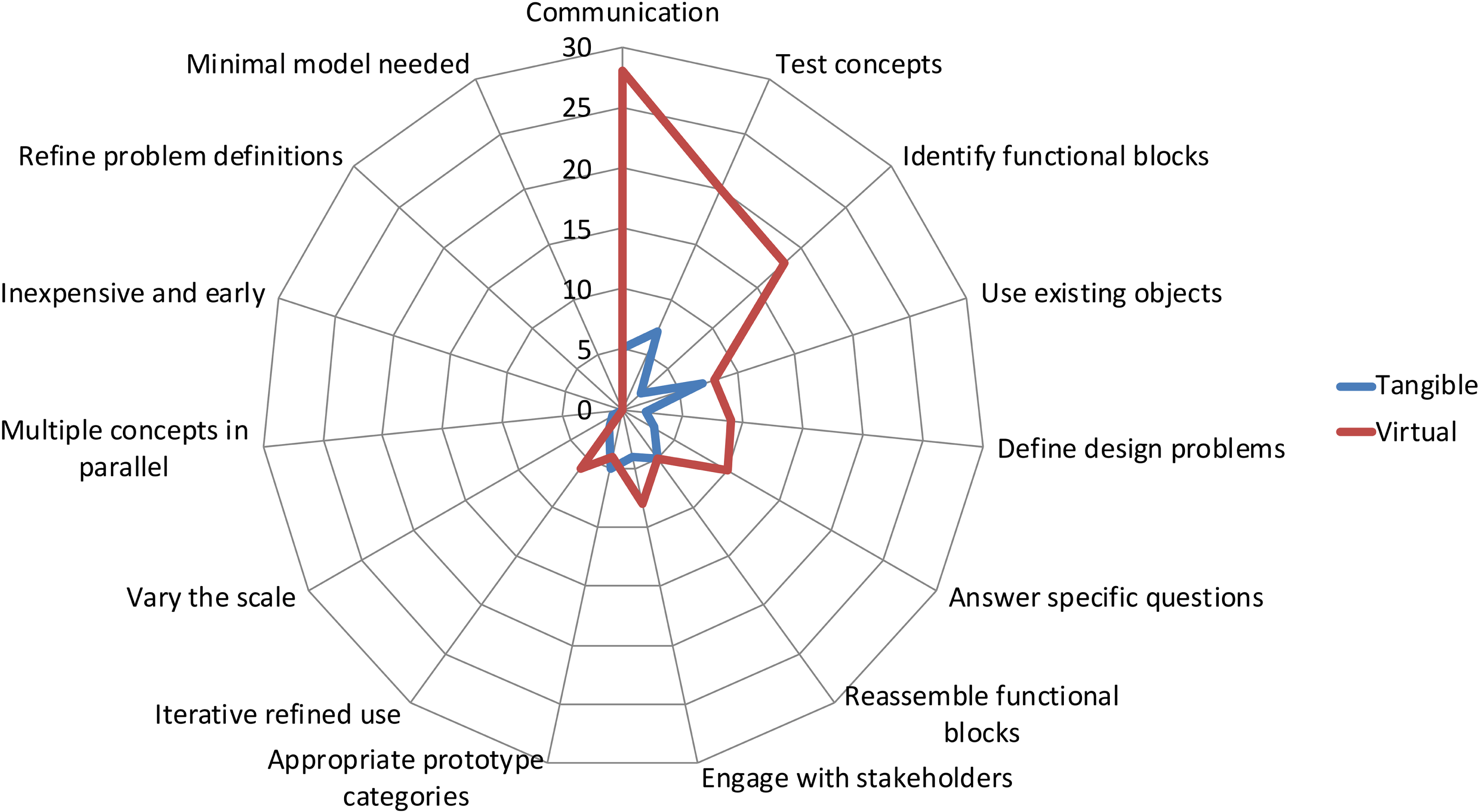
The majority of participants (28) reported using virtual prototypes for communication, and five participants reported using tangible prototypes to communicate. The participants who reported using tangible prototypes for communication emphasized the benefits of this approach. For example, Participant 22 explained how their stakeholders provided feedback on the proposed design once the team introduced physical models:
‘The impact of building the physical models, it really gave the lecturers, our supervisors the idea of what we were really trying to do because when we started it, we had more questions coming to us, like how is it going look like. So the time we presented our model, we had less questions, it wasn’t even a question, it was a comment.’
Most participants described using virtual prototypes for communication. For example, Participant 11 noticed that once the team used prototypes, people became more interested in their project because they added a sense of realism:
‘When we started using the CAD…you know some of those people, they started gaining interest: “Wow, so this is how the whole thing is like’ and they were very happy. So when we started using it and they realized that ‘Oh after all, this thing is feasible.” So it’s like before you use the CAD sometimes you find the thing so difficult to achieve or maybe you don’t see the feasibility of it but it was when we started using the CAD that we started getting something.’
Participant 2 felt similarly:
‘CAD was very helpful because it helped people see what you are trying to do. It helped people understand. The CAD model, it made it like, “Oh ok, this is it. Oh ok, it moves from here to here to here”. ’
Participant 2 added that, for this particular activity, virtual prototypes were easier to create than physical ones:
‘It made it very easy and helpful and it was easier to use than building the physical model component. It was far easier than actually building it.’
Participant 19, who had already acknowledged the benefits of using prototypes, added distinctions between different levels of prototype refinement:
‘If it was just the sketches, it will not be as easy as it was with the video form from CAD design.’
Participant 14 explained how the team used sketches to get feedback and input from stakeholders:
‘So we had to like draw this for them, with the dimensions, this fetal monitor…we showed them the dimension of this or that, which one will you prefer. They gave us like “Oh it should be shorter than this, this part should be shorter, this part should be taller.” They gave us all the dimensions then we approximated them to get the length.’
Participants reported that communication improved when using prototypes, both within the design team as well as with stakeholders. The few participants who reported using physical models felt that using tangible prototypes to gather feedback from stakeholders improved the input they received.
Twenty participants reported the use of virtual, and seven reported the use of tangible prototypes to test concepts. The participants who described the use of physical prototypes to test their device often also reported the use of virtual prototypes. Frequently, the physical models were used to verify the virtual test results. Participant 31 explained how the team moved from earlier, virtual testing to building a physical model to verify their results:
‘The goal for building a physical model was to validate the operation of the device. Just to see how in reality, whether they will perform in a similar manner as [the virtual] model.’
Participant 12 also explained how the team performed physical tests to verify their earlier, virtual test results:
‘We built a physical model and we analyzed. Yeah we had a physical bag, but later on not with the blood; for the blood it was difficult to actually test with the blood so…we were using sachet water. Yeah so based on that we know that if we warm the water it might be close to warm blood. So it was just the simulation that was trying to test to see whether the warming process is [real].’
Several participants realized the benefits that tangible prototypes could afford, even if they were not able to use them in their projects. Participant 17 described how the team found physical models better suited for testing than virtual prototypes:
‘CAD or software or sketches, some might be, some could be used alright but I think the most efficient one to try and use will be the physical model.’
Similarly, Participant 14 started with a virtual simulation and then built a physical prototype to test the concept:
‘So I first did the simulation [in] Proteus with the Arduino, then I came to the physical model to prove my concept that what I have done is feasible. My physical [model] goes to verify [the concept].’
Participant 5 recognized limitations of a virtual model and posited that a computer-generated prototype might not always match the results of testing a physical model:
‘For the computer model, it can work on a computer simulation but when you bring it out of there to the physical model, it might fail you, it might not perform actually what you saw on the computer.’
This uncertainty in the virtual environment was also voiced by Participant 9, who expressed concerns about the validity of the materials that were available in a simulated environment:
‘The material has certain properties that maybe were modeled mathematically into the program so we can’t trust that code 100% that it will do efficient work or what it would have done if you had brought the thing real.’
However, the majority of the participants (20) reported using virtual prototypes for testing. Participant 13 described how they successfully used simulation software to test their concept:
‘We used COMSOL multi physics software to test for the temperature with time. With the PBC, it gave a red signal, and it means it wasn’t able to conserve the temperature for much period of time. But then with ABS, it gave a blue, I mean the total border was blue, that means it had a good temperature-conserving property.’
All participants reported challenges when using simulation software and not everybody was successful using virtual tools for testing. Participant 8 described how they attempted to test their design through software simulation, but did not succeed because they were not able to create a custom material:
‘Solid Works to do the testing and then because we chose we selected polymer blending, then we couldn’t get a blend because if we were to get the blend we were supposed to specify percentages, the percentage of say PVC and percentage of ABS and we put it together to have that design, but we were not able to.’
Similarly, Participant 11 explained how the team used sketches to design a system that allowed for maximum airflow:
‘Yes, we did the hand sketches, we did the flow. We kind of tried to use all those ideas here to see and basically that’s what actually helped us to come up with the passage of the system where we can get a maximum amount of air flowing in.’
Participants found testing a challenging activity and several pointed out that they needed additional skills to test the models they created. Specifically for the virtual prototypes, participants had to learn these skills on their own and not all of them were able to test their prototypes.
Eighteen participants reported using virtual prototypes and two participants reported using tangible prototypes to identify functional blocks. Participant 2 described how working with physical components was helpful in determining how individual functional blocks would fit together:
‘So I broke it down into different pieces – the glucose monitor right, it’s basically made up of two electrodes and these electrodes have some substances that it reacts with glucose and stuff and then it a has a sensor that will monitor or that will give you a reading. So it’s not really a big component right, that’s why it could be made into a watch…Then I had to fit an insulin chamber where it would store insulin and ideally I was trying to get about 300 ml…Then I had to talk about the pump because I needed to cause fluid to flow.’
Similarly, Participant 25 described how the team identified functional blocks to improve temperature retention in his device:
‘We looked at [the] specific heat capacity, we realized that when you heat coffee and you put it in the mug, the temperature of the coffee doesn’t really drop when it is covered because of the difference of the specific heat capacity of the material and the steel.’
A much larger number of participants (18) reported using virtual prototypes, and Participant 14 described how the team identified functional components, and how this activity helped to visualize the internal functions of a device:
‘Let’s just say I’m taking a signal, so how I will acquire the signal? Then my signal processing, do we have [a] notification filter, then I will send a signal. I’m doing SD card, so I’m doing storage, I’m doing this, I’m doing a buzzer. This is my functional structure, like how the internal components work…Now I came to see how the internal working structure was.’
Participant 31 elaborated how the team identified functional blocks, researched existing solutions, and finally selected the most suitable approach:
‘For every function or sub function, I picked a system, I checked out how other people do it. Sometimes I do sketches to show whether this one will work or other ones will work. So let’s say for tying (fastening) of the [item], I considered…a gear system to lock it up where I can translate my rotational motioning to lock it. For every idea, every sub function, I got about 2 to 3 to 4 means of addressing the function and I compared them using a decision matrix in relation to the objectives. So I did the same for all sub functions and eventually combined them to get what the device is supposed to do.’
Participant 3 explained in detail how the team addressed weight and force requirements for their design of a device to help stroke patients with rehabilitation exercises:
‘If you are going to move the leg with a pulley and you have a person with a maximum weight of 300 pounds, and the leg is going to have this proportion of weight, we used anthropometric data to find which proportion of the weight. So what kind of force are you supposed to apply to move this leg? So based on that, we analyzed the movement of the leg so that if we are going to use this system then this amount of force and this amount of weight. Is it sufficient or does it meet our user requirement, does it meet our specification?’
About half of the participants reported identifying and working on functional blocks. Particularly those working on complex design challenges found it helpful to think of individual elements that comprise the overall solution instead of the complete product.
3.3 What challenges did Ghanaian novice designers face when creating prototypes?
Throughout this study, participants identified key challenges that influenced their choices and use of prototypes during their design projects. Commonly mentioned challenges are shown in Table 5.
Challenges for using prototypes
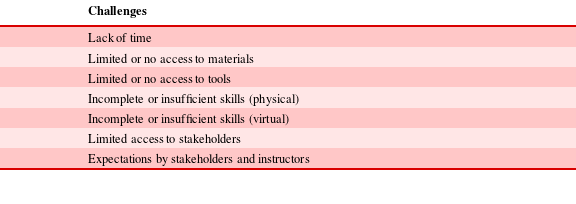
While some of these challenges are common among novice designers, some might be unique to the particular context of this study. Specifically, limited access to physical tools and materials, challenges with specific skills required for testing concepts, and challenging expectations by stakeholders combined with relatively easy access to software might have influenced the prototyping choices of the participants in this study.
4 Discussion
4.1 To what extent did Ghanaian novice designers’ reported behaviors follow prototyping best practices?
The majority of the participants reported using prototypes to communicate. Those who recognized communication as an important function of prototypes described benefits not only within the team, but also with stakeholders. However, only seven participants reported using prototypes to engage with stakeholders at the advanced and intermediate levels (one and six, respectively). Many experts consider engaging with stakeholders essential for collecting input and feedback throughout the design process to ensure that stakeholder needs are met (Kelley Reference Kelley2007; Yock et al. Reference Yock, Zenios, Makower, Brinton, Kumar, Watkins, Denend, Krummel and Kurihara2015), but in this study, participants often reported using their own experiences and judgments to establish design requirements, evaluate their design concepts, and verify that the chosen design satisfied the defined requirements. While it may have been convenient to use themselves as stakeholders at the time, not separating designer from user when evaluating whether a solution solves a problem might lead to biased results. Only after reflecting on their experiences did participants recognize that they should have engaged with real stakeholders more often to get input and feedback on their design project, suggesting that repeated reflective practice would benefit novice designers to intentionally engage in this prototyping best practice behavior.
The second most frequently reported best practice behavior was using prototypes to test design concepts. Testing a concept is one of the most commonly agreed upon purposes for creating prototypes and a way to verify that the selected concept satisfies established requirements (Dieter & Schmidt Reference Dieter and Schmidt2012; Yock et al. Reference Yock, Zenios, Makower, Brinton, Kumar, Watkins, Denend, Krummel and Kurihara2015). Almost all participants realized that they needed to test their prototypes, but more than one third reported they were unable to do so because of the obstacles they faced. A lack of particular skills relevant for virtual testing and access to resources needed to build and test both physical and virtual prototypes were frequently given as reasons for not engaging in this critical behavior. Based on these statements, it appeared that many participants were not prepared to build or test prototypes to an extent that would benefit their design project. The participants who leveraged this critical prototyping best practice behavior either taught themselves, or received help from others to accomplish the testing tasks.
More than half of the participants (18) reported breaking up complex designs and identified functional blocks, which is an effective technique used to solve challenging design problems at the component level (Christie et al. Reference Christie, Jensen, Buckley, Menefee, Ziegler, Wood and Crawford2012; Hilton et al. Reference Hilton, Linsey and Goodman2015; Yock et al. Reference Yock, Zenios, Makower, Brinton, Kumar, Watkins, Denend, Krummel and Kurihara2015). Expert designers often break up complex design problems and develop component-based solutions. Observing the impact of their actions on manageable tasks can help designers reduce their anxiety of failure and instead provide a sense of accomplishment, success and control. These ‘small wins’ at the component level are helpful when facing uncertainty in design, a challenge that many novice designers encounter, especially when tasked with large and complex projects (Gerber Reference Gerber2009). However, only eight of the participants engaged in this best practice behavior at an advanced, intentional level, and only four reported later that they reassembled the individual blocks into a complete model at the end of their project at an advanced level, indicating that they might not have been completely successful at the component level. When looking at related prototyping activities, only nine participants reported the use of prototypes to answer specific questions, and none reported using prototypes to build the minimal model needed at an advanced or intermediate level.
Equally crucial to successful design is the practice of using prototypes to redefine the design problem, however, none of the participants reported engaging in this behavior. Through trial and error, the iterative use of prototypes, and by building on what has been learned from prior prototype generations, expert designers often embrace a problem–solution co-creation process (Dorst & Cross Reference Dorst and Cross2001). What is first perceived as a promising approach might actually not be an ideal solution. The frequently-incomplete understanding of the problem space that designers develop at the beginning of a project can result in an approach that, when implemented, requires a problem statement to be reframed. In other words, when a proposed solution is put into practice, it might illuminate new, different, opposing, or additional issues that need to be addressed. The knowledge that can be gained from earlier prototypes often leads to new approaches and compromises in the final solution (Suwa, Gero & Purcell Reference Suwa, Gero and Purcell2000). Expert designers are aware that problems are not always set, but need to be refined, and this process of revision aims to achieve more appropriate solutions (Rittel & Webber Reference Rittel and Webber1973; Buchanan Reference Buchanan1992). The majority of participants in this study, however, did not use prototypes to redefine a design problem, which represents a missed opportunity for problem definition iteration. Several studies have shown that problem–solution spaces often undergo an evolution as part of a design process (Buchanan Reference Buchanan1992; Dorst & Cross Reference Dorst and Cross2001) and require an abstract approach to problem solving (Popovic Reference Popovic2004), yet the participants in this study, as novices have been reported to do, did not engage in iteration of the problem.
4.2 What types of prototypes did Ghanaian novice designers use during their project-based design courses?
Participants in this study primarily reported the use of virtual tools like sketches, CAD models, and simulation software, and few participants reported use of tangible prototypes. While both tangible and virtual prototypes can be particularly helpful early in the design process to develop and select from a variety of ideas (Houde & Hill Reference Houde and Hill1997; Brandt Reference Brandt2007; Campbell et al. Reference Campbell, De Beer, Barnard, Booysen, Truscott, Cain, Burton, Gyi and Hague2007; Gerber Reference Gerber2009; Moogk Reference Moogk2012), a primary focus on virtual prototypes alone throughout a design project has several limitations. For example, for the most frequently reported prototyping best practice, communication, only five participants reported using tangible models. Virtual prototypes, like sketches, often do not include the same information as tangible prototypes, limiting the amount and kind of information that can be transferred between individuals (Suwa & Tversky Reference Suwa and Tversky1997; Suwa et al. Reference Suwa, Gero and Purcell2000; Tversky et al. Reference Tversky, Suwa, Agrawala, Heiser, Stolte, Hanrahan, Phan, Klingner, Daniel and Lee2003; Goldschmidt Reference Goldschmidt2007). Virtual prototypes often leave more room for interpretation and require more domain knowledge from participants to interpret and provide input on a new concept (Deininger et al. under review; Tversky et al. Reference Tversky, Suwa, Agrawala, Heiser, Stolte, Hanrahan, Phan, Klingner, Daniel and Lee2003). Consequently, virtual prototypes can make effective communication more challenging which is particularly critical when communicating outside of the design team, i.e., to engage with stakeholders.
In this study, participants demonstrated limited use of prototypes for engaging with stakeholders. For example, one participant did not think that a particular stakeholder group would be able to respond to a particular prototype type (here sketches), and as a result, the participant chose not to share prototypes with this stakeholder group. Other studies found that shared mental models are crucial when communicating design intent across stakeholder groups (Goldschmidt Reference Goldschmidt2007; Viswanathan et al. 2014), but many participants in this study did not consider creating a different type of prototype that would have supported communication with stakeholders outside of the design team. When interactions with stakeholders are limited, such as reported by the participants throughout their courses, the use of tangible prototypes for communication becomes even more important since they have been shown to help engaging with, and gaining information from stakeholders (De Beer et al. Reference De Beer, Campbell, Truscott, Barnard and Booysen2009; Macomber & Yang Reference Macomber and Yang2011).
Virtual prototypes were reported almost three times as often as tangible prototypes for testing (20 virtual – seven tangible) by the participants in this study. While virtual testing is common practice in many domains, it is primarily used to inform physical testing, rather than to replace it (Dannbauer et al. Reference Dannbauer, Meise, Gattringer and Steinbatz2006). An iterative design process that includes both physical and virtual testing can be challenging and relies on well-designed models and experienced operators. Many experts agree that while virtual prototypes can inform physical testing, they should not be considered a replacement for physical testing, unless appropriate methods and levels of expertise have been established and proven (Rudd et al. Reference Rudd, Stern and Isensee1996; Walker et al. Reference Walker, Takayama and Landay2002).
Access to, and familiarity with, prototyping methods can positively impact project outcomes (Camburn et al. Reference Camburn, Dunlap, Kuhr, Viswanathan, Linsey, Jensen, Crawford, Otto and Wood2013), yet the participants in this study reported that insufficient training and limited access to tools and resources (e.g., machining, 3-D printing, materials, physical testing equipment) prevented them from building and testing physical prototypes. Even though high-fidelity materials and tools might have been more challenging to access than low-fidelity materials, several participants managed to build physical prototypes of both low- and high fidelity. The participants also reported that it was easier to gain access to CAD and simulation software, and therefore they often chose this option instead. However, participants also stated insufficient instructions and limited access to virtual tools for both building and testing. While some participants had access to and experience with basic CAD software through the university, they had to find ways to gain access to more advanced tools and training (e.g., rendering software, finite element analysis, heat transfer analysis, etc.) on their own, suggesting that participants were not well prepared for the prototyping tasks expected of them by the course (i.e., a prototype and test results from testing said prototype), regardless of prototyping format.
In addition to the actual testing of the device, participants also described the use of tools like matrices and tables (e.g., Pugh Concept Selection Method, Weighted Decision Matrix) to aid in their decision-making process. This is common practice in design (Dieter & Schmidt Reference Dieter and Schmidt2012), but establishing the parameters that populate these forms and charts is often informed by the use of physical models and stakeholder engagement. Especially when human factors and usability issues of a design are to be evaluated, physical models should be considered to establish differences among concepts (Kelley Reference Kelley2001).
For the third most frequently reported prototyping best practice behavior, identify functional blocks, only two participants reported using tangible prototypes, and 18 reported using virtual prototypes. While virtual tools can indeed be helpful to identify individual elements of a product, they can make it challenging for novice designers to actually work on the component level. Virtual models have the potential to deprive designers of many of the benefits that physical models can afford them, such as interaction, testing, human factor evaluation, etc. (Kelley Reference Kelley2001; Dieter & Schmidt Reference Dieter and Schmidt2012; Yock et al. Reference Yock, Zenios, Makower, Brinton, Kumar, Watkins, Denend, Krummel and Kurihara2015.) The limited CAD skills that participants reported likely contributed to their struggles to successfully use the prototyping best practice of identifying functional blocks to advance their designs.
4.3 Prototyping behaviors as a function of context
Several participants mentioned that they thought of CAD models as well as the resulting computer-generated drawings and renderings as desirable course deliverables. The focus on virtual tools might have been encouraged by faculty who, according to participants, preferred high quality, i.e., CAD models, over low fidelity and potentially unfinished physical prototypes, i.e., mock-ups and sketches. Some of the resources that participants reported using to inform their virtual prototyping behaviors, i.e., online tutorials and videos, likely contributed to this focus. Many educators in Ghana acknowledge the effectiveness of online learning and often embrace and promote technology as a teaching tool to increase quality of teaching and to reach a broader audience (Dadson Reference Dadson2011). Online and mobile learning are on the rise in Ghana and educational institutions are seeking to meet increasing demands (Bass-Flimmons & Kinuthia Reference Bass-Flimmons and Kinuthia2015). Google and YouTube are the most popular websites in Ghana (Alexa 2018) and are used by students as resources to supplement their learning. Several participants mentioned that they taught themselves some of the skills they needed to complete their projects and often referred to online resources including tutorials and videos. The exposure to an extensive online library of images and videos might have introduced participants to more sophisticated and refined virtual rather than quick and simple physical prototypes. While some videos like IDEO’s shopping cart project show a trial and error approach (Fran Chuan 2017), other designers likely promote their finished and successful prototypes online rather than failures and mishaps they encountered along the way. Limited exposure that leaves out critical aspects of design practice might influence novice designers’ perceptions of the design process. An incomplete perspective might result in them potentially not considering the full spectrum of prototype use when selecting an appropriate prototyping practice.
The focus of participants on high-quality prototypes might have also been motivated in part by the fact that in Ghana, craftsmanship is highly valued and can be observed in several cultural areas including art, fashion and burial traditions (Clarke Reference Clarke2006; Tranberg Hansen & Hansen Reference Tranberg Hansen and Hansen2013; CNN 2016).
Additionally, from an early age, students in Ghana are required to pass qualifying exams to advance to the next level of schooling (Glewwe & Jacoby Reference Glewwe and Jacoby1994; Glewwe Reference Glewwe1996; U.S. Embassy in Ghana 2018). This focus on memorization likely teaches students to be good test takers by the time they enroll in college, but might compromise on other, more exploratory learning approaches that embrace failure as a way to learn. Students might be taught, and consequently expect, that there is a ‘right’ solution to every problem, and they might not be familiar with an iterative approach to problem solving that builds on what has been learned from failures and prior iterations.
An initial intention to create high-end virtual models from the onset of the course may explain why participants often neglected to create quick and simple prototypes. Such an approach to using prototypes was likely not only not encouraged, but possibly even discouraged by faculty and peers alike and potentially deprived participants of the benefits that a quick and simple approach to using prototypes can afford designers, including the iterative use of prototypes to further the design process, inform design decisions, and engage stakeholders in discussions of new ideas and concepts around a shared object (Clark & Fujimoto Reference Clark and Fujimoto1991; Schrage Reference Schrage1999; Kelley Reference Kelley2001; Yock et al. Reference Yock, Zenios, Makower, Brinton, Kumar, Watkins, Denend, Krummel and Kurihara2015).
Participants in this study only infrequently reported using prototypes to engage with stakeholders to define or redefine the design problem, establish user requirements and gather feedback on proposed design solutions. It is possible that the reported infrequent use of prototypes to engage with stakeholders is partially a function of the type of projects pursued in the study sample. For example, the majority of the participants (19 out of 33) described health technology related projects, and most commonly, medical devices (12 out of 19). Given that the establishment of biomedical engineering programs is relatively recent in sub-Saharan Africa (Ploss et al. Reference Ploss, Douglas, Glucksberg, Kaufmann, Malkin, Mcgrath, Mkandawire, Oden, Osuntoki, Rollins, Sienko, Ssekitoleko and Reichert2017; Ploss & Reichert Reference Ploss and Reichert2017), and few, if any, medical devices are developed or produced in Ghana, some of the participants’ most relevant stakeholders (healthcare practitioners including doctors and nurses) may not have been accessible to them. Many participants reported difficulties in gaining access to stakeholders and not receiving help from their instructors or institution to facilitate meetings with stakeholders. In contrast, it is increasingly common to find engineering students in clinical settings in the United States (Yazdi & Acharya Reference Yazdi and Acharya2013) performing needs assessments to identify unmet clinical needs and conducting observations to inform design decision making. Western healthcare providers may therefore experience more exposure to design and design-related processes than their sub-Saharan counterparts (Kalaichandran Reference Kalaichandran2017).
Limited and often challenging access to stakeholders, combined with preferences by educators, cost (no cost of virtual models versus cost of materials for physical prototypes), convenience (ability to work from home or elsewhere) and perceived sophistication of CAD models or drawings, might explain why participants in this study focused on virtual prototypes and created few, if any, physical models.
5 Implications for education and practice
Novice designers in both this Ghanaian context and the US context studied in prior work (Deininger et al. Reference Deininger, Daly, Sienko and Lee2017) underutilized prototypes during the front-end of design and to engage with stakeholders. To help novice designers leverage prototyping best practices, design educators could incorporate opportunities for students to engage in front-end design experiences, where design problems are found and explored. This would provide opportunities for designers to employ prototypes to understand challenges with existing artifacts and define design problems based on prototype feedback from stakeholders. Additionally, prototypes were not used strategically as tools for iteration in which multiple design ideas were explored and iterated on early in a design process. This mentality, where failure is embraced as an activity to learn from and improve an idea, could be facilitated by giving credit to novice designers for experimenting with easily accessible materials, building many early, rough prototypes, and delaying building a refined prototype until multiple options have been explored. Such an approach to teaching design might call for a change in expectations by educators but could ultimately lead to better design outcomes as well as help to better prepare novice designers for professional practice.
Expert practitioners regularly engage in reflective practice to develop and refine their design approaches (Schön Reference Schön1984; Adams, Turns & Atman Reference Adams, Turns and Atman2003), but the participants in this study did not realize the extent to which prototypes could be leveraged to facilitate their design process and could benefit from repeated and reflective practice with prototypes. Simply repeating a behavior does not make one an expert, and instructors could integrate intentional structured opportunities for students to be explicit in their motivation for using prototypes, and eventually arrive at more deliberate prototyping behaviors.
Specific to the challenges faced by designers in this Ghanaian context, an increased use of physical prototypes might support novice designers to engage more in the prototyping best practices they underutilized. Because simple physical prototypes can be created quickly, they might encourage Ghanaian novice designers to more frequently share their prototypes with stakeholders, gather feedback, and redefine their design problems. Physical models also have the potential to make testing easier, a prototyping best practice behavior that many participants were only partially successful with, particularly when using virtual prototypes.
6 Limitations
One limitation of this study was an unequal distribution between female and male participants. Differences in prototyping behaviors between genders were not studied, but if such an imbalance exists, it might have impacted the outcomes and future studies might include a more equal distribution between female and male participants. Another limitation was that communication was part of the definition provided to the participants and may have biased their responses. Additionally, only participants from one university in one context were included in this study, and the participants were not queried for the types of resources available to them for creating both virtual and physical prototyping. Unique circumstances such as access to resources and stakeholders, curricula, instructors and background of participants might exist and could have influenced the findings. Future work could include background queries and explore prototyping practices in other contexts, both within Ghana and in other cultural contexts.
The presence of a male interviewer might have affected conversations and contributed to potentially limited insight into participants’ actual experiences. The presence of a foreign, white male in a local African community might have introduced a response bias on the part of the participants, leading to students not sharing their true thoughts. Future research might consider a local partner who enters a community as a member rather than an outsider.
Finally, the study was limited in that the authors did not solicit information about specific contextual factors from other stakeholders. For instance, data collection from design instructors, personnel in the department or university as well as users could have added to or contradicted participants’ statements about the ways in which the context impacted their choices.
7 Conclusions
Participants in this study reported engaging in some best practice behaviors like using prototypes to communicate, test, and identify functional blocks well, but underutilized other, critical behaviors like using prototypes to engage with stakeholders and to redefine the design problem, particularly early in the design process. Participants also reported the predominant use of virtual prototypes and little use of physical prototypes during all stages of design. Some of these prototyping choices by the participants were likely motivated by the designers’ own context and background. Since a designer’s own experiences can impact their process no matter whom they design for, further investigation into practices of designers in different contexts is needed, particularly beyond designers in high-income countries.
Acknowledgments
This research was supported by the Fogarty International Center of the U. S. National Institutes of Health under award number 1D43TW009353, by the University of Michigan Investigating Student Learning Grant funded by the Center for Research on Learning and Teaching, the Office of the Vice Provost for Global and Engaged Education, the College of Engineering and by the University of Michigan’s Mechanical Engineering PhD Ghana Internship. The research team thanks Kimberlee Roth for her help with editing the manuscript and Ernest Bediako for his help during data collection.
Appendix
Prototyping best practices
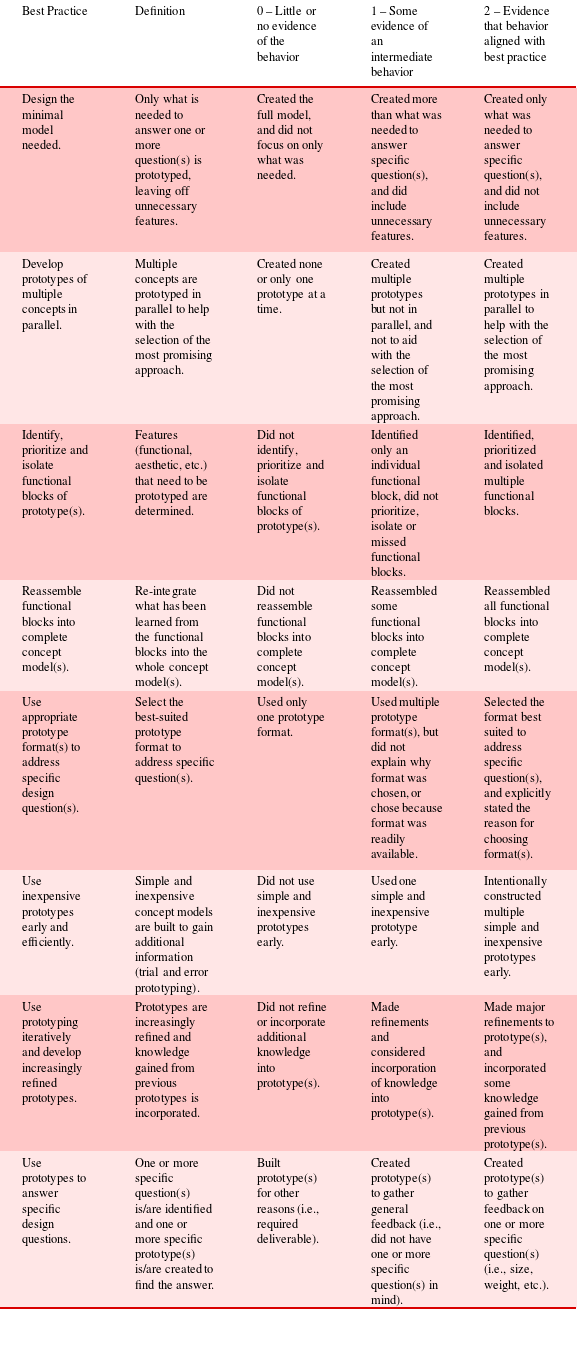
(a) Prototyping best practices, (b) The use of virtual and tangible prototypes by Ghanaian novice designers
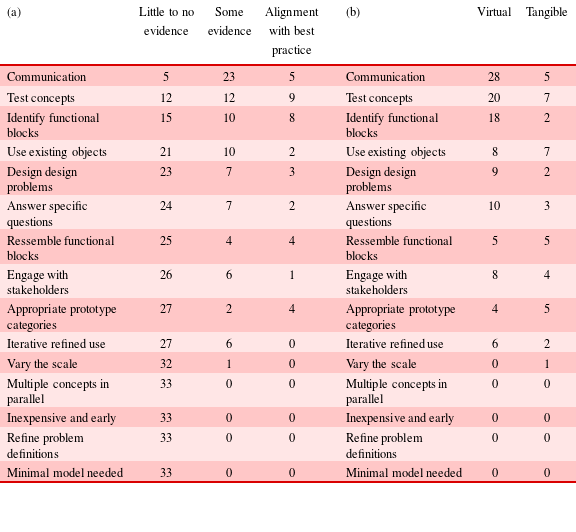


 Open access

