


In the past two decades, there has been a significant increase in the proportion of overweight and obese children in Australia, a trend that has also been reported in a number of other countriesReference Chinn and Rona1, Reference Strauss and Pollack2. The most recent population data for Australia were collected among school students in New South Wales, where it was found that 25% of students in school years 2–10 were overweight or obeseReference Booth, Okely, Denney-Wilson, Hardy, Yang and Dobbins3.
Television viewing has been identified as a factor contributing to the problem of childhood overweight and obesityReference McGinnis, Gootman and Kraak4. Television viewing is a significant component of total sedentary behaviourReference Booth, Okely, Denney-Wilson, Hardy, Yang and Dobbins3 and has been found to be positively correlated with total caloric intakeReference Wiecha, Peterson, Ludwig, Kim, Sobol and Gortmaker5 and the consumption of snack foodsReference Halford, Gillespie, Brown, Pontin and Dovey6.
Exposure to advertising of unhealthy food products is one of the means by which television viewing contributes to overweight and obesity. Television food advertisements have been linked to children's food preferences, at both brand and category levelsReference Hastings, Stead, McDermott, Forsyth and MacKintosh7, Reference Zywicki, Holt and Ohlhausen8, and to both purchasing and consumption habitsReference Lobstein and Dibb9. The recent systematic review by the United States Institute of MedicineReference McGinnis, Gootman and Kraak4 found strong evidence that food and beverage preferences and purchase requests from children aged 2–11 years are influenced by television food advertising. Some researchers report a link not only between viewing of food advertisements, consumption of snack foods and caloric intake, but also between advertisement exposure and increased body weightReference Hastings, Stead, McDermott, Forsyth and MacKintosh7.
There appears to be a disparity between the range of food products advertised on television and the diet that is recommended for health. Hastings et al. Reference Hastings, Stead, McDermott, Forsyth and MacKintosh7 reported that the five most frequently advertised product categories were breakfast cereals, confectionery, savoury snacks, fast-food restaurants and soft drinks. Consequently, children who view a greater number of television advertisements have been found to consume a larger quantity of non-core foods, particularly sweet and high-fat savoury foodsReference Halford, Gillespie, Brown, Pontin and Dovey6. The Australian Guide to Healthy Eating recommends that not more than two servings of non-core foods (i.e. those high in sugar and/or fat) should be consumed each day10. This is the equivalent of approximately 14% of daily energy intake for children aged 5–12 years. Population data for Australia show that, in practice, these foods contribute more than 40% of energy intake for children and adolescentsReference Bell, Kremer, Magarey and Swinburn11.
As a result of such trends, the nature and extent of television advertising has come under increasing scrutiny in a number of countries. In New Zealand, the rates of food advertisements have been found to be increasing, from eight per hour in 1997 to 12 per hour in 2006Reference Wilson, Signal, Nicholls and Thomson12. An international study conducted in 1996 on television food advertising patterns indicated that Australia, the USA and the UK had the highest proportion of overall food advertisements, with 83, 98 and 79% of these food adverts, respectively, for sweet/fatty foodsReference Lobstein and Dibb9.
The question of whether food advertising to children should be more strongly regulated has been raised in several countriesReference Caraher, Landon and Dalmeny13. Children less than 8 years of age, in particular, are thought to lack the cognitive skills required to recognise an advertiser's persuasive intent and purposeReference McGinnis, Gootman and Kraak4, Reference Kunkel, Wilcox, Cantor, Palmer, Linn and Dowrick14, and are therefore more at risk of commercial exploitation. The need to protect children from commercial exploitation has been recognised by a wide range of public health groups; and the International Code of Advertising Practice has stated that advertisements should not manipulate the inexperience of children15.
The Children's Television Standards (CTS) were introduced in Australia in 1990, and have been under the jurisdiction of the Australian Communications and Media Authority (ACMA) since 200516. The current system of co-regulation in Australia is comprised of three regulatory frameworks, including both industry and government regulations, of which the CTS is the overriding standard. The CTS relates to advertising broadcast during children's programming, where children are defined as people younger than 14 years old. These regulations refer to maximum advertising time and the repetition of advertisements, and define children's viewing periods. These children's viewing periods have been adopted by all three regulatory codes. Among other recommendations, this code states that advertisements directed to children should not promote unhealthy eating or drinking habits.
The aim of the current study was to undertake a detailed examination of the extent and type of food advertisements in Sydney, the largest population centre in Australia with a population of 4 254 90017. Patterns of advertising were examined within the weekly time period agreed to be children's viewing hours under the prevailing regulations, and within a more selected band of viewing time for which comparable data were available from 2002. The focus of the research was high-fat/high-sugar foods and the potential exposure of children to advertising for these foods under the current regulatory system.
Methods
Sample week television recording
Data were collected by recording all television, from 06.00 until 23.00 hours on Sydney television stations from Sunday 14 May 2006 to Saturday 20 May 2006, using an established monitoring system at the University of Sydney. Of five free-to-air channels, data were collected from the three commercial channels. All data were screened by three research assistants, with all advertisements identified, logged and classified as either for food or non-food, and the duration of the advertisement recorded. This sample week was selected as it matched the period of data collection in the similar 2002 studyReference Neville, Thomas and Bauman18, which assessed the same television channels during a corresponding sample week in 2002.
Children's viewing hours
The children's television viewing periods were categorised in two ways:
1 Children's television viewing band one (Viewing band 1), as set down in the ACMA CTS (Monday–Friday 07.00–08.00 and 16.00–20.30, Saturday–Sunday 07.00–20.30).
2 Children's television viewing band two (Viewing band 2), which was the same as that used in the 2002 study (Monday–Friday 06.30–07.30, 09.00–09.30 and 15.00–16.30, Saturday–Sunday 07.00–11.30).
Viewing band 1 included 54.5 h per week per channel, and Viewing band 2 comprised 24 h of television per week per channel. The more extensive children's viewing hours, Viewing band 1, was used as the basis for describing the current extent of television advertising to children. The data for Viewing band 2 comprised a subset and were used to compare advertising patterns between 2006 and 2002.
Food advertisements were coded using the food categories from the comparable 2002 study, which consisted of 18 food group categories, divided into the three major groups: core foods, high-fat/high-sugar foods and miscellaneous foods (refer to Table 1 for the list of food types categorised into each group). All food coding was conducted by a research dietitian (B.K.).
The frequency of food categories advertised during children's viewing hours and non-children's viewing hours
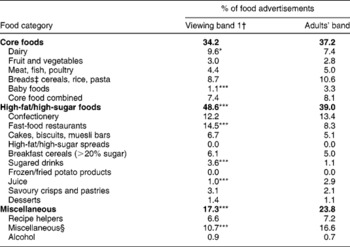
† Viewing band 1 includes Monday–Friday 07.00–08.00, 16.00–20.30; and Saturday–Sunday 07.00–20.30.
‡ Includes breakfast cereals with < 20% sugar.
§ Includes tea, coffee, alcohol, supermarkets, local restaurants/cafes, supplements, vegemite and throat lozenges.
*P < 0.05; P < 0.001.
Television viewing patterns
In order to explore patterns of advertising during high-ratings programmes, data on the 20 highest rating programmes for 5–12-year-olds, 13–17-year-olds and people 18 years and over were obtained from OzTAM Pty Ltd19.
Statistical analyses
Data from recorded television advertising were initially entered into an Excel 2003 database (Microsoft Corporation). The statistical analyses were conducted using SPSS, version 12 (SPSS for Windows). The proportions of foods in various categories were analysed, applying the χ2 test for significance. P-values of < 0.05 were considered statistically significant.
Results
Food advertising during children's viewing hours
During the study period, there were a total of 9991 advertisements on three Sydney commercial television stations, with 2621 food advertisements. During Viewing band 1, food advertisements comprised 28.3% of total advertisements on weekdays and 22.4% on weekends, with an overall proportion of 25.5% and a rate of 7.2 food advertisements per hour. This compared with 27% of food advertisements on weekdays and 25.6% on weekends, and an overall proportion of 26.9% and a rate of 7.4 food advertisements per hour during adults' viewing hours. Within Viewing band 1, there were significantly more food advertisements during afternoon/evening time periods than in the mornings (27.2 vs. 20.4%, χ2 = 21.6, P < 0.001) and more on weekdays than weekend days (28.3 vs. 22.4%, χ2 = 21.2, P < 0.001).
Types of food advertised
While there was little variation in the number of food advertisements between children's and adults' viewing times, the types of foods advertised varied significantly (Table 1). During Viewing band 1, core foods comprised 34% (rate of 2.5 advertisements per hour) and high-fat/high-sugar foods comprised 49% (3.5 advertisements per hour) of total food advertisements. This contrasts with 39% of advertisements being for high-fat/high-sugar foods during adults' viewing hours (χ2 = 23.9, P < 0.001), a rate of 2.9 advertisements per hour.
The most frequently advertised food groups for Viewing band 1 were fast-food restaurants (14.5%), confectionery (12.2%), dairy products (9.6%) and bread, cereals, rice and pasta (8.7%). A miscellaneous group, including tea, coffee, alcohol, supermarkets, local restaurants/cafes, supplements, yeast extracts and throat lozenges, comprised 10.7% of food advertisements, with alcohol contributing to 0.9% of total food advertisements during this time.
The highest concentration of high-fat/high-sugar advertisements was seen in the Viewing band 1 morning period, when these comprised 54.3% of food advertisements. The main contributing food at this time was high-sugar breakfast cereals (36% of high-fat/high-sugar advertisements). Weekend days had a higher frequency of high-fat/high-sugar advertisements than weekdays for both children's and adults' viewing times. The proportion of high-fat/high-sugar advertisements during the Viewing band 1 weekend times was marginally higher than that during adults' viewing hours on weekends (49.9 vs. 44.6%, χ2 = 1.08, P = 0.30).
Food advertising during high-rating programmes
The 20 most popular programmes on Sydney commercial television during the study week accounted for 13.5 h of viewing time per week for 5–12-year-olds and 16 h per week for 13–17-year-olds. The majority of these programmes fell in the afternoon/evening time periods, when food advertising was most concentrated. There was a high rate of food advertisements during these periods, at 14 per hour (41.0%) in the programmes popular with younger children (aged 5–12 years) and 12 per hour (36.5%) during programmes popular with older children (13–17 years). The difference between core and high-fat/high-sugar foods advertised was also greater during high-rating programmes, with high-fat/high-sugar foods the subject of 65.9% of food advertisements (rate of 9 advertisements per hour) during programmes popular with younger children and 66.8% of food advertisements (rate of 8 advertisements per hour) during programmes popular with older children. The proportion of these advertisements declined during the lower-ratings periods for 5–12-year-olds (41.6%, χ2 = 41.6, P ≤ 0.001) and 13–17-year-olds (41.5%, χ2 = 45.5, P < 0.001) (see Table 2, Fig. 1).
The rate and proportion of high-fat/high-sugar advertisements during the most popular programmes, stratified by age group

*** P < 0.001.
The proportion of food advertisements for different food groups advertised during popular programmes. †CVB1 includes Monday–Friday 07.00–08.00, 16.00–20.30; and Saturday–Sunday 07.00–20.30

Comparison with 2002 study data
The data on 2006 food advertising during Viewing band 2 were compared with patterns described for 2002. Overall, the rates of food advertising on commercial Sydney television during Viewing band 2 were reduced significantly from 31 to 25.9% (χ2 = 17.9, P < 0.001). The overall proportion of high-fat/high-sugar food advertisements also decreased, from 47.7% of all Viewing band 2 food advertisements in 2006 compared with 54% in 2002 (χ2 = 6.2, P = 0.01, see Fig. 2). For this viewing period, there was an average of 3.0 advertisements per hour for high-fat/high-sugar foods in 2006, compared with 4.4 in 2002.
The proportion of core foods, high-fat/high-sugar foods and miscellaneous foods advertised during children's viewing hours, comparison of 2002 and 2006 data. †CVB2 includes Monday–Friday 06.30–07.30, 09.00–09.30 and 15.00–16.30, Saturday–Sunday 07.00–11.30

In both 2002 and 2006, the weekday afternoon children's viewing time slot had the largest proportion of food advertisements. Despite the overall differences between 2002 and 2006, the proportion of food advertisements in the Viewing band 2 weekday afternoon time slot in 2006 was 38%, which is similar to the 37% found in 2002. In 2006, during the weekday afternoon viewing time, there was an average of 3.7 min of food advertisements per hour per channel (compared with 5 min in 2002).
In terms of specific foods, the proportion of confectionery advertisements within all food advertisements decreased between 2002 and 2006 (16.6 vs. 13.4%, χ2 = 2.9, P = 0.09) whereas the proportion of food advertisements that were promoting fast-food restaurants declined over this period (13 vs. 9.2%, χ2 = 5.0, P = 0.02).
Discussion
Overall, about a quarter of advertisements on Sydney commercial television were for food. While the proportion of all advertisements that were for food was similar for children's and adults' viewing hours, the foods advertised during children's viewing hours were more likely to be high-fat/high-sugar foods.
These findings indicate that under the current co-regulatory system in Australia, including the government's CTS, children have a high level of exposure to advertising for unhealthy food products. High-fat and high-sugar foods were the subject of about 50% of overall food advertisements, and this was even higher during programmes popular with children, at 65.9% of all food advertisements. Adopting a conservative assumption that half of the average daily television viewing time of children and young people in Sydney, estimated to be 2.1 h, is of commercial stations, then they would be exposed to 50 food advertisements, including 24 high-fat/high-sugar foods per week (assuming 7.2 food advertisements per hour). If we were to assume that children were viewing their quantum of television during popular programmes, the estimate of food advertising exposure would be markedly higher, i.e. children aged 5–12 years would be exposed to 96 food advertisements, including 63 high-fat/high-sugar advertisements per week.
Although direct comparisons with other studies are difficult due to differences in the classification of ‘non-core’ foods, the results from this study were consistent with previous data, which have shown a large disparity between the numbers of ‘core’ and ‘non-core’ foods advertised. A study describing the content of UK television advertising showed that a total of 35% of advertisements were for food, with the most commonly advertised food groups being high-sugar breakfast cereals (26.3% of food advertisements) and confectionery (23.7%)Reference Rodd and Patel20. Similarly, data from the USA have shown that advertising during children's Saturday morning programmes consists of 57% food advertisements, with 44% classified as fats, oils and sweet foodsReference Kotz and Story21. A study of food advertising in New Zealand, using identical food coding to that of the current study, showed food advertising comprising 42% of all advertisements, of which 80% were for high-fat/high-sugar foodsReference Wilson, Signal, Nicholls and Thomson12. A recent study of television food advertisements across four population centres in Australia, using a less conservative system that categorised advertised foods as core or non-core, also showed the predominance of advertisements for non-core foods, at 81% as compared with 19% of advertisements for core foodsReference Chapman, Nicholas and Supramaniam22.
The analysis of advertising during the high-ratings programmes of 5–12-year-olds and 13–17-year-olds allowed both programme ratings and advertising frequency to be considered. Both of these aspects have not been addressed concurrently in previous Australian studies. These analyses clearly showed that the programmes most popular with children and young people have a significantly higher proportion of total food and high-fat/high-sugar food advertisements when compared with other viewing times. These finding indicate, first, that past studies which have only measured the volume of food advertising are likely to have underestimated population-wide exposure of young people to advertisements of unhealthy products. Second, the inflated proportion of high-fat/high-sugar food advertisements during popular programmes confirms that children are the target of these commercial promotions. This is reflected in commercial marketer's ability to identify and dominate advertising during expensive high-ratings periods.
In view of these findings about the nature and extent of food advertising to children, it was surprising to observe that there has been slight decline in the extent of both overall food advertisements and advertisements of high-fat/high-sugar food products since 2002. Our results have shown that there has been an overall reduction in total food advertisements to 26% from 31% over the 4-year period. The advertising of non-core foods, including high-fat/high-sugar foods and its constituent foods, confectionery and fast-food restaurants, has also decreased. The advertising of core food groups, and particularly fruit and vegetables, has increased from 2002 to 2006.
It is important to recognise, however, that the definition of children's viewing time in this comparison was narrower than the band of time which is currently adopted by the commercial television industry. Thus, these findings may indicate either a reduction in advertising to children over this period, or possibly a shift in the concentration of advertising towards viewing times not included in the time band used in 2002, especially to higher-ratings afternoon and evening time slots. It is also possible that these findings may reflect a shift from television advertising towards a wider mix of promotion strategies by food manufacturers. A report by the Institute of MedicineReference McGinnis, Gootman and Kraak4 in the USA outlined that although television advertising still constituted 45% of food and beverage industries' advertising expenditure, increased emphasis has been placed on other advertising mediums, such as radio, print, billboards and the Internet. Other forms of promotion included sponsorship, in-school marketing, point-of-sale and give-aways. A review by Hasting et al. Reference Hastings, Stead, McDermott, Forsyth and MacKintosh7 states that research into the use of these other marketing tactics is lacking.
This study demonstrates that, under the current Australian regulatory systems, children's exposure to food advertising remains disproportionately high compared with the promotion of more healthful foods. Considering past research about the relationship between advertising exposure and patterns of food consumptionReference McGinnis, Gootman and Kraak4, Reference Hastings, Stead, McDermott, Forsyth and MacKintosh7, it is likely that the levels of advertising of high-fat/high-sugar foods, and the targeting of these during high-ratings periods, are contributing to excess energy consumption and overweight and obesity among Australian children.
The question for the public health community and Australian society at large is what steps will be required to reduce the level of promotion of unhealthy food products to children? Current Australian regulations do not conform to the criteria proposed by the International Obesity TaskforceReference Lobstein and Baur23, or those under consideration in the UK, where voluntary self-regulation by broadcasters is under scrutiny24. Similarly, the US Congress is considering mandatory food advertising regulations for both commercial and cable televisionReference Hastings, Stead, McDermott, Forsyth and MacKintosh7. Increasingly it is recognised that voluntary regulations may not be sufficient, and that more transparent, enforceable regulations may be required to reduce the pervasiveness of ‘non-core’ food advertisingReference Hastings, Stead, McDermott, Forsyth and MacKintosh7.
Experience from the field of tobacco control shows that implementation of stricter regulation of products requires both scientific evidence of health risk and societal acceptance of the introduction of government controlsReference Mello, Studdert and Brennan25. The body of empirical evidence linking television food advertisements to food choices is growingReference McGinnis, Gootman and Kraak4, Reference Hastings, Stead, McDermott, Forsyth and MacKintosh7 and is now considered sufficient by a number of bodies, including the Institute of Medicine in the USA and the World Health Organization26, 27, to warrant stronger regulatory action. This, however, remains contested by the food and advertising industries. The Australian Food and Grocery Council has recently stated that the current regulatory codes are adequate and that any considerations of advertisement bans would be simply a reactive political manoeuvre, and would be inappropriate and ineffectual in defeating rising childhood obesity28. Similar arguments, that self-regulation is more effective than government regulation, have been made by the International Advertising AssociationReference Caraher, Landon and Dalmeny13. Public opinion is the other important ingredient, and in Australia there is evidence of a mandate for action on this issue. A recent survey conducted by CHOICE29 indicated that 82% of people support greater government regulation of food advertising to children.
Future advertising regulations should consider Australian nutritional recommendations and seek to limit high-fat/high-sugar advertisements to approximately 14% of food advertisements, since this is the maximum proportion of average daily energy intake that the recommended servings of non-core foods would account for in children up to 12 years oldReference Bell, Kremer, Magarey and Swinburn11. In light of available data on the high prevalence of food advertisements, and particularly advertisements for high-fat/high-sugar foods, information on the effects of advertising on food preferences, purchasing and consumption, and the public support for government regulation, Australia needs to consider further regulatory changes to limit children's exposure.
Acknowledgements
Sources of funding: The study was funded by NSW Health Department.
Conflict of interest declaration: There were no commercial, personal, political, academic or financial conflicts of interest.
Authorship responsibilities: All authors contributed significantly to the research, including obtaining funding, project design, implementation, management and manuscript writing.
Acknowledgements: We would like to acknowledge the invaluable role of Simon Holding in recording the TV data, and Elizabeth Dunford, Bramilla Patkunanathon and Laxmi Iyengar for their work as research assistants.



