

Introduction
After the Covid-19 pandemic exposed Europe’s economic dependence on China and import restrictions against Lithuania demonstrated China’s willingness to weaponise its economic might, the European Union (EU) announced ‘de-risking’ as a new guiding framework for its economic relations with China. In articulating this framework, the EU outlined a more cautious approach to its economic engagement with China, focused on managing risks by reducing vulnerabilities and supply chain dependencies in critical sectors.Footnote 1 Scholarly debates on de-risking have since notably revolved around the implementation of this framework and its associated policies, including the Critical Raw Material Act, the Net Zero Industry Act, or the Chips Act.Footnote 2
Less attention, by contrast, has been given to how de-risking is perceived by China. This lack of attention marks an important oversight insofar as the reception of de-risking is arguably critical to the framework’s ability to guide EU–China relations as intended. Indeed, de-risking intended to position the EU vis-à-vis both China and the United States. Notably, it has been presented as a measured approach aimed at ‘reducing critical dependencies […] where necessary, while recognising the importance and need to maintain open channels of communication’.Footnote 3 As argued by Tunsjø, de-risking therefore fits with an overall EU strategy of hedging that aims to avoid economic dependencies ‘without decoupling or balancing China’.Footnote 4 The success of de-risking in charting such a middle path between full cooperation and ‘decoupling’ (promoted by the US under President Donald J. Trump) naturally hinges on the extent to which this framework is accepted by China.
In the literature, China has generally been viewed as supportive of the EU’s ambition of strengthening its strategic autonomy and independence from the United States.Footnote 5 As recently as December 2022, Chinese President Xi Jinping has indeed highlighted that ‘China supports the strategic autonomy of the EU and supports the unity and prosperity of Europe’.Footnote 6 However, the extent to which China’s support for EU strategic autonomy has led it to accept the EU framework of de-risking, which the EU leaders have notably contrasted with the US-associated policy of decoupling, remains unclear. Against this background, our article asks: Does China accept de-risking as an expression of EU strategic autonomy? Does it recognise de-risking as charting a middle path between decoupling and engagement? And does it support de-risking as an acceptable normative framework for EU–China relations?
To answer these questions, our article develops an analytical framework that integrates insights from role theory and the perceptual approach to EU foreign policy. Drawing on the perceptual approach,Footnote 7 we assess China’s reception of de-risking by analysing the extent to which de-risking has generated a ‘perception gap’ between China’s view of the EU and the EU’s own self-perception and associated altercasting practices. Our article operationalises the perception gap with the help of role theoryFootnote 8 as the gap that emerges between the EU’s own assertion of international roles, involving the articulation of role conceptions and altercasting of China, and the validation of such roles by China. Using this analytical framework, our article examines to what extent the EU’s attempt to assert roles for itself and China – and thus to reorient their relationship – through the articulation of de-risking has been discursively validated by China.
Our empirical analysis suggests that the EU has used de-risking to assert itself 1) as a strategically autonomous actor, 2) a defusing actor in the context of Sino–American competition, and 3) a normative broker/convenor. The assertion of these three role conceptions has been accompanied by attempts to ascribe commensurate roles to China. Specifically, our analysis suggests that the EU has sought to cast China in the role of 1) an equal interlocutor; b) a cooperative economic partner, and c) an aligned normative actor. To assess China’s validation of the EU’s asserted role conceptions and altercasting moves, our paper has developed a systematic and comprehensive analysis of primary data from Chinese governmental, media, and academic sources in Mandarin Chinese.
This analysis suggests that China has widely rejected the EU’s de-risking agenda. China does not view the EU as playing a strategically autonomous role in the context of de-risking, portraying it instead as a loyal follower of the United States, and refuses to accept de-risking as a basis for developing a relationship between equals. China’s reaction has, moreover, invalidated the EU’s conceived role as a defusing actor by framing de-risking as either equally or even more dangerous than decoupling. Finally, China has rejected the EU’s attempts to define de-risking as a ‘normal’ practice of international trade and portrayed de-risking as fundamentally misaligned with China’s conduct and principles by characterising it as an unjustified and illiberal policy. Considering this wholesale invalidation of the EU’s role assertion, the analysis contends that de-risking has generated a wide perception gap between China and the EU, which raises questions about the potential for the EU’s de-risking agenda to succeed as intended and to credibly underwrite a hedging strategy towards China.
Our article proceeds in four steps. In the following section, it will develop an analytical framework for assessing China’s perspectives on de-risking by integrating insights from role theory and the perceptual approach to EU foreign policy. Building on this framework, our article will draw on primary sources to assess how the EU has used de-risking to assert a set of role conceptions and to altercast China. In turn, we systematically assess the extent to which the EU’s role assertion has been validated by China and discuss the overall perception gap. Finally, the concluding section will reflect on the broader significance of the theoretical contribution and empirical findings and outline avenues for further research.
Operationalising the perception gap
This article builds on and contributes to the perceptual approach in EU studies, which has advanced considerably over the past two decadesFootnote 9 by integrating insights from role theory.Footnote 10 By linking the role-theoretical concepts of ‘role conception’ and ‘altercasting’ to the perceptual approach, the article develops an analytical framework that enables the systematic operationalisation of ‘perception gaps’ between the EU’s self-image as an international actor and the images of the EU held by others.
The perceptual approach has long emphasised how perceptions by third-party actors facilitate and limit the EU’s ability to realise its desired roles in international affairs. The approach, for instance, highlights that perceptions shape the EU’s ability to act as a normative power. As argued by Kavalski, ‘an actor’s capacity to define the “normal” depends on the recognition of this agency by target states’, which creates the ‘permissive context for […] normative power’.Footnote 11 Drawing on this insight, the perceptual approach does not take the EU’s ability to play a normative role as a given. Instead, it highlights its contextual dependence on the recognition of others, which can differ across space, time, and policy area.Footnote 12 Other EU roles also hinge on external recognition. According to Bengtsson and Elgström,Footnote 13 the EU’s ability to perform as an international leader, for instance, depends on whether others take up the role of followers and endow the EU’s role with ‘ideational legitimacy’.
Drawing on the observation that perceptions by third-party observers are critical for the realisation of EU roles, the perceptual approach has developed a sophisticated conceptual framework for assessing the EU’s perceptual environment. Central to this framework is the concept of the ‘perception gap’, which denotes the level of divergence between third parties’ views of the EU and the EU’s own self-image.Footnote 14 The perceptual approach has employed this concept as a potent yardstick for assessing the level of dissonance between the EU and other international actors across space and time. In analysing the perception gap between the EU and Ukraine, Chaban and Elgström,Footnote 15 for instance, concluded that, while the EU viewed itself as a ‘benevolent and committed partner who understands the Ukraine clear and well’, Ukraine, at the same time, perceived the EU as an ‘arrogant and self-centred, top-down partner who does not understand Ukraine and is not a very good listener’. As this example illustrates, studies of perception gaps can usefully identify misunderstandings between the EU and others, which may hinder the EU’s ability to realise its aspired role(s) in international affairs.
To further strengthen the analytical value of the ‘perception gap’, our article aims to contribute to its operationalisation. Drawing on role theory, we argue that the perception gap between the EU’s self-image and the perceptions of others can be studied in a more systematic fashion by contrasting the EU’s ‘role assertion’ with the degree of ‘role validation’ by the EU’s observers and interlocutors. Following role theory, international actors like the EU assert themselves on the international stage by advancing a set of (more or less well-aligned) social roles.Footnote 16 This process of role assertion, one the one hand, involves the (more or less direct) articulation of ‘role conceptions’, which denote an actor’s envisioned roles in international affairs. On the other hand, it implies the signalling of commensurate roles for others, a process termed ‘altercasting’, which aims to shape the behaviour of others in line with articulated role conceptions.Footnote 17 As highlighted by Michalski and Parker,Footnote 18 the EU’s assertion of a role set in the Indo-Pacific region, for instance, revolves around the EU’s conception of its role as a ‘normative power’, a ‘market power’, and (increasingly) a ‘security power’, as well as associated altercasting moves, such as attempts to assign Japan, South Korea, and ASEAN the role of ‘key regional partners’.
This role assertion process, however, is not a self-fulfilling prophecy. As stressed by Michalski and Parker, the EU’s ‘role-fulfilment takes place as part of a social process that requires the acknowledgment and acceptance of the roles by other actors’.Footnote 19 To grasp this dimension, we argue that the success of an actor’s role assertion can be understood by assessing the role validation of others. The latter, we suggest, can (in)validate an actor’s asserted role, set by either responding to its articulated role conceptions or reacting to associated altercasting practices. On the one hand, a third party may (in)validate an actor’s role assertion by (selectively) supporting, qualifying, or rejecting its promoted role conceptions. On the other hand, it may (in)validate an actor’s role assertion by going along with or pushing back against altercasting moves.
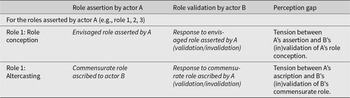
Building on these assumptions, our article argues that the depth of a perception gap can be assessed by contrasting an actor’s role assertion, expressed in the assertion of role conceptions and altercasting moves, with the interlocutor’s role (in)validation. The resulting analytical framework is summarised in Table 1.
Analytical framework.

Table 1 Long description
The table outlines an analytical framework for comparing how actor A asserts roles with how actor B validates or invalidates those roles, and how mismatches create a perception gap. It is organized into three columns: role assertion by actor A, role validation by actor B, and the resulting perception gap. For role conception, actor A states an envisaged role for themself, actor B responds by validating or invalidating that claim, and the gap is described as tension between A’s self-assertion and B’s response. For altercasting, actor A assigns a commensurate role to actor B, actor B responds by validating or invalidating that ascribed role, and the gap is tension between A’s ascription and B’s response. The framework applies across any set of roles actor A asserts, such as multiple role types listed as examples. The table is conceptual rather than numerical, so it defines categories of interaction and where disagreement is expected to appear.
Based on this analytical framework, the perception gap between two actors can be assessed as narrow, partial, or wide (Table 2). If an actor’s asserted role within a social context is fully validated by another actor, through a positive response to articulated role conception and altercasting practices, then the perception gap can be understood as narrow. Likewise, a perception gap can be assessed as wide when the interlocutor invalidates that actor’s asserted role by rejecting both the asserted role conception and associated altercasting attempts. Beyond these two extremes, an analysis of the (in)validation of roles by third parties may also suggest a partial perception gap. Observers or interlocutors, for instance, may selectively invalidate an actor’s role conceptions and altercasting attempts while validating others. An analytical focus on the assertion of roles, we argue against this backdrop, promises to provide a more fine-grained understanding of perception gaps, including their width and manifestation across space and time.
Operationalisation of the perception gap.

Table 2 Long description
The table defines three levels of a perception gap based on how actor B responds to actor A’s role conception and altercasting moves. A narrow gap occurs when actor B validates both actor A’s role conception and actor A’s altercasting. A partial gap occurs when actor B validates or invalidates only some elements, or responds ambiguously to actor A’s role conception or altercasting. A wide gap occurs when actor B invalidates both actor A’s role conceptions and actor A’s altercasting. The categories form a continuum from full validation through mixed or unclear responses to full invalidation.
Previous studies using the perceptual approach to examine EU–China relations indicate that the perception gap between China and the EU has long been shaped by China’s partial validation of EU role conceptions. Following Dai and Zhang, China has, for instance, perceived the EU ‘as a great power […] though not necessarily a leader in global politics’.Footnote 20 Despite a recent overall downturn in Chinese perceptions of the EU,Footnote 21 scholars have, moreover, highlighted a remarkably narrow perception gap for the EU’s assertion of a strategically autonomous international role. Yang, for instance, has highlighted that official Chinese statements, including by Chinese President Xi Jinping, have expressed explicit support for EU strategic autonomy while articulating the hope that such autonomy will create a partnership between the EU and China that ‘will not be targeted, dependent or subject to any third party’.Footnote 22 In the same vein, Su and Liu have shown that Chinese scholars perceive EU strategic autonomy with ‘cautious optimism’,Footnote 23 recognising the potential benefits of a less US-aligned Europe.
While Chinese views of EU strategic autonomy are generally recognised as supportive and reflective of Chinese hopes to separate the EU from the United States, it remains unclear, however, whether such support also extends to the EU’s more recent assertion of a strategically autonomous role in international trade, which, encapsulated by the policy of de-risking, has been associated with the reduction of economic dependencies, above all from China.Footnote 24 Some scholars suggest that Chinese views of EU economic policy have remained remarkably optimistic despite the EU’s increasingly critical stance towards Chinese trade and investment practices. Kuang and Song, for instance, highlighted that ‘the EU’s recent labelling of China as a strategic rival has not undermined the positive representations by Chinese media and intellectual elites of opportunity’.Footnote 25 However, whether and to what extent this rather positive sentiment extends to the EU’s policy of de-risking, and whether de-risking, in turn, challenges the previously narrow perception gap for the EU’s assertion of a strategically autonomous international role, remains so far unclear.
To address these questions, our article will contrast the EU’s role assertion in the context of de-risking with China’s level of role validation. In a first step, the following chapter will identify the role set, which the EU has asserted in articulating its policy of de-risking by identifying associated role conceptions and altercasting moves. Subsequently, our article will systematically analyse the extent to which these have been (in)validated by China. Finally, we will assess to what extent China’s (in)validation of EU role conceptions has generated a perception gap in EU–China relations and discuss implications of this gap for the EU’s self-image and ability to realise its aspired roles, particularly that of a strategically autonomous actor, in international affairs.
Casting without confronting: How the EU asserts its role in the context of de-risking
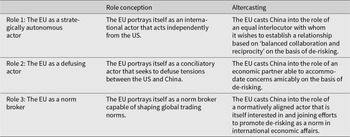
This section examines how the EU, by introducing its policy of de-risking, has engaged in a process of ‘role assertion’ through the projection of role conceptions as well as the altercasting of China. Specifically, we argue that the EU has used the concept of de-risking to assert its role conception as 1) a strategically autonomous actor, 2) a defusing actor in the context of Sino–American competition, and 3) a norm broker. We further suggest that the assertion of such role conceptions has been accompanied by attempts to cast China into the role of 1) an equal interlocutor, 2) a cooperative economic partner, and 3) a normatively aligned actor. In the following, we will outline the asserted role conceptions and ascriptions, which are summarised in Table 3, in more detail.
EU role assertion through the policy of de-risking.

Table 3 Long description
The table links three EU role conceptions to how the EU describes itself and how it assigns a corresponding role to China under a de-risking approach. As a strategically autonomous actor, the EU presents itself as acting independently from the United States and casts China as an equal interlocutor for balanced collaboration and reciprocity. As a defusing actor, the EU depicts itself as conciliatory in easing United States–China tensions and casts China as an economic partner expected to accommodate concerns amicably. As a norm broker, the EU portrays itself as shaping global trading norms and casts China as normatively aligned and interested in promoting de-risking as an international economic norm. Across all roles, the EU self-image shifts from independence to mediation to rule-shaping, while China is consistently positioned as cooperative and compatible with the de-risking agenda. The entries are qualitative role statements rather than measured outcomes, so they reflect framing rather than evidence of behavior.
In outlining its policy of de-risking, the EU has asserted three interrelated role conceptions. First, the EU has portrayed itself as a strategically autonomous actor. Notably, the EU has employed the term ‘de-risking’ to signal its autonomy from the United States, which, especially during the first presidency of Donald J. Trump, had promoted the alternative concept of ‘decoupling’. As clarified by European Commission President Ursula von der Leyen, the EU does ‘not believe strategic decoupling is in our interest […] it would be inefficient and ineffective […] but we will continue to de-risk’.Footnote 26 The concept of de-risking, moreover, signalled the EU’s ambition to strengthen its autonomy and reduce its dependency vis-à-vis China. Such dependencies had become painfully clear during the Covid-19 pandemic, which convinced EU leaders that the EU had ‘to take its destiny in its own hands’Footnote 27 in the face of its over-reliance on external supplies and the progressive weaponisation of global supply chains. De-risking, in this regard, reflects the EU’s adoption of an increasingly all-encompassing conception of strategic autonomy, ‘widened to new subjects of an economic and technological nature’,Footnote 28 to promote ‘its own strategic interests and values’,Footnote 29 in addressing an ‘unbalanced relationship’ with China resulting from ‘continuing and significant distortions in China’s own economy’.Footnote 30 As put by Ursula von der Leyen:
Dialogue with China is…essential…We will continue to de–risk because we have learnt the lesson about the extent to which dependencies are vulnerabilities and how tech, trade, and security are inherently linked. De–risking is simply a matter of European independence.Footnote 31
Following this role conception of a strategically autonomous actor, the EU has sought to cast China as playing the commensurate role of an equal interlocutor with whom it wishes to establish a relationship based on ‘balanced engagement and reciprocity’Footnote 32 on the basis of de-risking. Hence, in line with the EU’s ‘multifaceted’ relationship with China,Footnote 33 the EU has recognised both frictions and ‘islands of opportunity’ and used de-risking as a platform to advocate ‘open and frank exchanges’ with Chinese counterparts.Footnote 34 Mutuality, reciprocity, and responsibility between two ‘fascinating and complex giants’Footnote 35 is thus the discursive framework the EU uses to altercast China.
Second, and relatedly, the EU has used the concept of de-risking to assert its role as a defusing actor that seeks to mitigate tensions between the United States and China. In contrasting de-risking with decoupling, which has been viewed by the EU as a full-scale securitisation of trade with China, von der Leyen, for instance, highlighted that it ‘is neither viable – nor in Europe’s interest – to decouple from China. Our relations are not black or white – and our response cannot be either.’Footnote 36 Von der Leyen, moreover, explicitly highlighted the diplomatic and economic component of de-risking.Footnote 37 The former component would guarantee that the EU leaves ‘space for a discussion on a more ambitious partnership’ with China and ‘to work productively in the global system in the future’, by making ‘competition fairer and more disciplined’. The latter component would contain those areas ‘where trade and investment pose risks to our economic and national security. […] and maintain those areas of trade in goods and services which are largely mutually beneficial and “un-risky”’. Therefore, by employing the concept of de-risking, the EU explicitly sought to defuse the confrontational overtones that characterise the US–China trade relationship. According to EU High Representative Borrell,Footnote 38 de-risking is ‘about avoiding risk’ and ‘excessive dependencies’, not about cutting ‘economic links’. The aim to protect the EU’s own market from malicious attacks, on the one hand, and to advocate for a detente in economic politics, on the other, are thus two inherent sides of the EU’s defusing actor role conception.Footnote 39
Based on this role conception, the EU has sought to cast China in the role of a cooperative economic partner able to accommodate dependency concerns on the basis of de-risking. The EU, in this regard, has sought to reassure China that it continues to value its economic partnership role, and that it does not seek to cut ties or turn inward. As clarified by the European Council:
The European Union and China continue to be important trade and economic partners. The European Union will seek to ensure a level playing field, so that the trade and economic relationship is balanced, reciprocal, and mutually beneficial. In line with the Versailles agenda, the European Union will continue to reduce critical dependencies and vulnerabilities, including in its supply chains, and will de-risk and diversify where necessary and appropriate. The European Union does not intend to decouple or to turn inwards.Footnote 40
Moreover, the EU has sought to reassure China that its de-risking policy is limited in scope and that it does not preclude the strengthening of ties between the EU and China in the future. As von der Leyen has made clear:
There is also room to engage constructively with China – and find solutions in our mutual interest. And I think we can find agreements that could even expand our trade and investment ties. It is a fine line that we need to walk. But it can lead us to a fairer and more balanced relationship with one of the world’s economic giants. And that can make sense for Europe.Footnote 41
To be sure, in the current climate of trade wars, de-risking does not equate to de-securitising. China’s economic assertiveness is still articulated as a threat and a risk. However, the EU’s attempt to circumscribe areas of risk and produce resilience both domestically and externally (through an international culture of open and transparent trade exchanges) has fed into a process of casting China into the role of a partner that is able to responsibly cooperate in the name of shared interests and mutual benefit. Hence, de-risking has served as a platform for the EU to cast China into the role of a cooperative economic partner, ready to work with the EU in a spirit of predictability and reliability’.Footnote 42
Third, the EU has employed the concept of de-risking to portray itself as a norm broker, which offers a less divisive alternative to decoupling as a potential platform to build consensus within the international community. In the words of Macron:
We Europeans are the joint custodians of international multilateralism. … it’s up to us to defend its rules, … and to be neither naïve in the face of unfair competition nor weak in the face of the threat from those who sometimes wrote these rules with us.Footnote 43
The link between de-risking and the EU’s self-conception as a normative actor is widely reflected in the EU leaders’ discussions on de-risking. Political and institutional communication underscored the search for avenues of cooperation and respect for China’s achievements and potential. In the words of the High Representative/Vice-President Borrell:
We do not fear China’s rise. However, we know that the history of tomorrow’s world will also depend on how China uses its power… Our normative influence is strong and often original. … [T]here is indeed a European voice and a European way. In this, what remains vital is that we all respect the core rules and norms of the international system to which we belong.Footnote 44
The EU has therefore seized its challenging relationship with China to promote its own ‘conceptions of what is normal’, on the understanding that ‘everything calls for increasing our collective capacity to protect our own values and interests’.Footnote 45 De-risking provided the EU with an appealing policy framework, allowing it to project an original image in the current geopolitical context. In Washington, Brussels, and various international quarters – including Australia, the UK, Japan, South Korea, the G7, beyond the United States – de-risking appeared more feasible and convenient than decoupling. The catalytic power of de-risking re-echoed in the Biden administration’s rebranding of Trump’s decoupling strategy.Footnote 46 The EU’s de-risking narratives, therefore, widely resonated with like-minded international actors.
Based on the role conception of a norm broker, the EU, moreover, sought to cast China in the role of a normatively aligned actor that is itself interested in and joining efforts to promote de-risking as a norm in international economic affairs. Notably, the EU developed a narrative about de-risking that foregrounds the benefits of fair and transparent economic exchanges with considerations on enhancing resilience against malicious attacks. In doing so, the EU has positioned all involved parties, and especially China, in a potentially win–win resolution of the current economic confrontation, provided that there is a willingness to abide by some rules. As stated by Von der Leyen:
We insist on fair competition within the Single Market. Therefore, we also insist on fair competition from companies that come to our Single Market. And I am glad that we agreed with President Xi that trade should be balanced between the two of us.Footnote 47
That said, the EU has been careful to avoid reserving for China a mere role of follower of its own ‘conceptions of what is normal’.Footnote 48 To the contrary, the EU’s official speeches tend to emphasise China’s contribution in all areas where the two share values and principles (e.g., in environmental policy) and encourage China to be even more ‘ambitious’Footnote 49 in its contribution to the economic international order. Moreover, the EU has presented de-risking as aligned with China’s own economic practices. Von der Leyen, for instance, stressed that there is room for cooperation since:
China…has a long-standing similar approach [to de-risking]. China called it self-reliance and it was partially included in the dual-circulatory approach.Footnote 50
This role assertion by the EU begs the fundamental question: Does China, as a direct referent of the EU’s de-risking policy, validate these role conceptions and associated altercasting practices? The EU’s ability to assert itself as an autonomous, defusing, and normative actor through de-risking hinges on how de-risking is accepted by others. If like-minded actors have widely bought into the EU’s narratives, did China accept this declaration of good intent? Or is it the case, as Hobbes put it plainly, that ‘covenants without the swords are nothing but words?’Footnote 51
China’s role (in)validation
The analysis is based on an original dataset which systematically collected governmental, media, and scholarly texts published in Mandarin between the EU’s announcement of de-risking (April 2023) and November 2024, right before the policy uncertainty generated by the US post-electoral transition. Specifically, we surveyed mentions of ‘de-risking’ (去风险 qu fengxian) and selected sources that specifically contained an assessment of de-risking as opposed to an ‘in passing’ reference to it.
The dataset includes open-access texts collected online, through three main access channels corresponding to the selected discursive arenas. Governmental discourse includes official declarations by Chinese officials, press releases, and posts published by authoritative official sources, collected directly from the Mandarin-language version of the website of the Chinese Ministry of Foreign Affairs. Academic discourse encompasses publications produced by both university-based research institutions and think-tanks, since in the Chinese context, the term ‘think-tank’ can be used to ‘encompass a wide range of research organizations, including university centers, independent institutes, academies, some NGOs, etc’.Footnote 52 This is because, as highlighted in academic debates on the think-tank landscape in China, ‘institutes affiliated to universities, which – while usually understood as being an altogether distinct form of organization – have come to play the same roles [as think-tanks] in China, as a result of direct government requests’.Footnote 53 Among key Chinese foreign policy think-tanks whose journals we surveyed, we note various institutes of the Chinese Academy of Social Science (CASS), the Shanghai Academy of Social Sciences, the Center for Contemporary War Studies, and the China Institute of Contemporary International Relations (CICIR). A full account of the academic journals screened for the purposes of this research, including their sponsoring institutions, is provided in Appendix 3.
Academic sources were retrieved from the Chinese National Knowledge Infrastructure (CNKI) among journals indexed in the Chinese Social Sciences Citation Index (CSSCI). CSSCI publications play an important role in developing, explaining, and arguably justifying China’s foreign policy to the outside world, and may play a direct advisory role to the Chinese leadership on foreign policy matters.Footnote 54 In this regard, the inclusion of Chinese academic publications as empirical data, rather than as secondary literature, follows recent scholarship that identifies the analysis of Chinese international relations scholars and their internal debates as a key avenue for understanding China’s foreign policy.Footnote 55
Media discourse includes media posts, identified through systematic searches on the official websites of key Chinese media outlets (i.e., People’s Daily, Xinhua Agency). Xinhua is the official state news agency of the People’s Republic of China and the largest media organ in China, while People’s Daily is the official newspaper of the Chinese Communist Party Central Committee and the most influential and authoritative newspaper in China closely representing the government line.Footnote 56 In total, we identified fifty-nine sources that met our inclusion criteria: ten posts from the Chinese Ministry of Foreign Affairs and twenty-one posts from Chinese mass-media outlets (see Appendix 1), and twenty-eight scholarly articles (see Appendix 2) retrieved from twelve Chinese academic journals (see Appendix 3).
While analytically distinct, these three strands of discourse function as interconnected vessels in the Chinese context and should be understood as complementary rather than fully separate. Governmental discourse articulates the official policy line. Academic publications – including those produced by university-based research institutions and some foreign policy think-tanks – tend to offer more nuanced and less overtly politicised assessments; in certain cases, think-tanks also play a more outward-facing role by amplifying official messages through Track 1.5 and Track 2 formats and bilateral exchanges with foreign counterparts.Footnote 57 Media narratives, in turn, highlight recurrent points of contention and patterns of issue framing. Combining these sources has the methodological advantage of mitigating the risk of ‘conflating variation in transparency with actual policy change’ – a risk highlighted in recent methodological debates on the use of Chinese sources.Footnote 58
We deliberately rely on textual data rather than interviews, as access to elite or expert interviewees in China is limited, and conducting interviews may entail ethical and practical risks, including potentially placing research participants in harm’s way.Footnote 59 While each of the used sources entails specific strengths and limitations – widely acknowledged in foundational works on Chinese sourcesFootnote 60 – their triangulation allows us to capture publicly articulated perceptions in a systematic and replicable manner. Although this approach cannot access private deliberations, it is not constraining for the purposes of this study, which aims to analyse how de-risking is publicly constructed, debated, and stabilised across authoritative and semi-authoritative discursive platforms in China.
The remainder of this section outlines the findings of our analysis and discusses the extent to which Chinese perceptions on de-risking validate the EU’s role conceptions as an autonomous, defusing, and normative actor and associated altercasting of China. The results of our analysis are presented in the subsections below.
Chinese views on the EU as an autonomous actor
Although the EU advances de-risking to portray itself as a key autonomous actor on the international stage, independent from the United States, and to altercast China in the role of an equal interlocutor, Chinese narratives, with few exceptions, largely reject both the EU’s role conception and its altercasting attempts. Specifically, they reject the notion that the EU acts independently from the United States, portraying it instead as a follower of the US’s China policy and pointing to the EU’s structural weaknesses and asymmetries of economic power to substantiate China’s differentiated treatment of it. This is further evidenced by Chinese discourses across the three strands of literature.
Specifically, Chinese government statements portray EU de-risking as an expression of the EU’s submission to a US narrative aimed at containing, isolating, and depriving China from its legitimate right to developFootnote 61, Footnote 62 through unilateral and protectionist measuresFootnote 63. To be sure, the EU’s own agency and intention to distinguish itself from the United States are occasionally acknowledged. China’s Foreign Minister Wang Yi,Footnote 64 for instance stated that
Europe’s rational understanding of China is increasing, and its willingness to cooperate with China is increasing. Facts have proved and will continue to prove that China is an opportunity rather than a risk to Europe, and a partner rather than an opponent.
However, such acknowledgements do not extend to the attribution of autonomy to the EU in the context of de-risking. Instead, Foreign Ministry Spokesperson Wang Wenbin clearly stressed that the ‘US is behind this de-risking and decoupling’.Footnote 65
Chinese media outlets have further doubled down on rejecting the EU’s agency. In media statements, de-risking has been identified as an initiative of the ‘US and the West’.Footnote 66 It is best understood a ‘rhetorical trap’ to lure the entire West (hua shu xianjing) and to hide the US’s ‘real intention’ to decouple from China.Footnote 67 Media agency Xinhua,Footnote 68 for instance, stated that:
The United States verbally replaced the ‘decoupling theory’ with the so-called ‘de-risking’, but in action it continued to piece together the ‘containment puzzle’ of ‘de-Sinicization’. […] The United States is promoting the so-called ‘de-risking’ concept to mislead the international community to think in the direction it wants and draw conclusions that are beneficial to it.
By contrast to government and media statements, academic discussions offer a more nuanced assessment. A limited strand of scholarly works that acknowledge EU’s agency echo the EU’s argument that it is not seeking to ‘decouple’ from China, but rather to ‘de-risk’.Footnote 69 For instance, in Yan’s account, de-risking reveals that Europe continues to value the Chinese market while seeking to limit excessive dependence on it and ‘balance the benefits and risks of economic and trade relations with China’.Footnote 70 In doing so, the EU ‘pursues strategic autonomy and positions itself as a key third party in shaping the pattern of Sino–US competition’.Footnote 71 Similarly, Sun and Zou argue that the ‘EU’s influence on the United States increases’.Footnote 72 In their interpretation, the EU’s de-risking strategy reflects its quest for a ‘topic-based breakthrough’ within the overall alliance framework traditionally ‘led by the US and followed by the EU’.
However, besides the limited scholarship that acknowledges the EU’s agency, most academic works downplay de-risking as an expression of EU autonomy. By shifting the analytical attention away from the EU and towards the United States, they obscure the EU’s role as the initiator of de-risking.Footnote 73 Specifically, these works tend to frame de-risking primarily in relation to the US’s capacity to disseminate its China positions. Chang and Li, for instance, acknowledge that de-risking was initially advanced by European Commission President von der Leyen but contend that it has become increasingly shaped by US isolationism, as Washington’s ‘influence over the politicisation of economic and trade issues’Footnote 74 has progressively imprinted itself on EU policy, including the 2023 Critical Raw Materials Act.
Taken together, these accounts reveal that Chinese scholarship remains divided but predominantly sceptical towards the EU’s self-role conception as a strategically autonomous actor, with only a limited strand recognising de-risking as evidence of an emerging, though constrained, autonomous positioning vis-à-vis the United States.
Turning to the question of altercasting, Chinese sources suggest that de-risking has not led China to view the EU as an equal interlocutor. Rather than signalling an EU interest in a relationship based on balanced collaboration and reciprocity, de-risking is widely interpreted in Chinese narratives as evidence of the EU’s economic dependence on China and strategic alignment with US priorities, thereby foreclosing the possibility of an equal and balanced relationship.
On the question of economic dependence, Chinese critiques of de-risking repeatedly invoke the EU’s reliance on China to question not only the EU’s standing as an equal partner but also the very plausibility of a balanced and reciprocal relationship.Footnote 75 Similarly, Chinese media contend that ‘[for European companies] the attractiveness of the Chinese market is hard to give up’,Footnote 76 underscoring China’s centrality in global economic affairs and the unbalanced relation with Europe that this entails. Chinese scholarly works have doubled down on these narratives, emphasising that ‘Europe is currently facing the impact of energy crisis and inflation and still has a huge demand for economic cooperation with China’Footnote 77. They further argue that, regardless of political shocks such as the ‘pandemics and the Ukrainian crisis (…) economic and trade cooperation remains the “ballast stone” of EU–China relations, showing strong resilience’.Footnote 78 Such arguments underscore a Chinese understanding of its bilateral relations with the EU as ultimately anchored in enduring economic interdependence, rather than in shared strategic agency.
On the question of strategic alignment with the United States, Chinese scholarly works portray the EU as a follower of the United States in the construction of a ‘new Cold War’ against ChinaFootnote 79 rather than an independent actor. In these accounts, de-risking appears as a strategy proposed by ‘US and the Western countries’Footnote 80 rather than an EU-led initiative. Based on the premise that Europe is primarily a US ally,Footnote 81 these works have been mainly concerned with analysing the passage from decoupling to de-risking as an indicator of friction between the United States and its alliesFootnote 82 rather than the expression of EU role assertion vis-à-vis China.
Taken together, these narratives suggest that, from a Chinese perspective, de-risking does not signal an EU interest in acting as an equal interlocutor but rather its intent to follow and team up with the United States and other like-minded actors to contain and reduce dependencies of China. In this sense, de-risking reinforces, rather than mitigates, China’s refusal of the EU’s altercasting and entrenches a perception gap regarding the EU’s claimed strategic autonomy. Therefore, EU efforts to position itself as an autonomous international actor and to altercast China into a relationship of balanced collaboration and reciprocity are largely rejected in Chinese narratives.
Chinese perceptions of the EU as a defusing actor
Despite the EU’s efforts to portray de-risking as less confrontational than US decoupling and as a means of defusing China–US tensions, Chinese narratives often frame it as either equally or even more dangerous than decoupling. This perceived equivalence is grounded in Chinese narratives that systematically blur the distinction between de-risking and decoupling, portraying them as different terms masking the same underlying intention. In this regard, Chinese media posts have frequently dismissed de-risking as a ‘new vest for decoupling’,Footnote 83 as ‘old wine in new bottle’,Footnote 84 or as ‘a fig leaf to cover up “malicious competition”’.Footnote 85 Academic discussions also echo this equivalence. Chang and Li, for instance, highlighted that ‘no matter how the words are modified, the “de-risking” policy toward China cannot conceal the true intention of the US to win over its allies to suppress and contain China’.Footnote 86 Gu and Xiong further argue that the concept of de-risking is ‘intentionally vague’Footnote 87 and that its
deliberate ambiguity will help the EU and the US find a common narrative logic toward China, reflecting the latest consensus and ‘greatest common denominator’ between Europe and the United States on policy coordination toward China. It not only confirms the general direction of China policy but also leaves room for both sides to interpret it independently.
Relatedly, some scholars underscored that, notwithstanding his endorsement of de-risking, US President Joe Biden substantially maintained a policy of ‘“decoupling” from China’s industrial and supply chain in the name of “de-risking”’,Footnote 88 using de-risking to ‘downplay the policy discourse of “decoupling”’.Footnote 89 Ke further suggested that, despite the more ‘moderate and appropriate’ overtones of de-risking, the ‘US and Europe’s tough stance on China has never changed’.Footnote 90
From this perspective, de-risking is understood as a rebranded, softer strategy directed towards the same underlying goal as decoupling: the containment of China. The image of a Western strategy of ‘de-sinicization’ of the global industrial chain is omnipresent in Chinese governmental and media discourse on de-risking.Footnote 91 Similarly, scholarly works have described the passage from ‘decoupling’ to ‘de-risking’ as a ‘word game used by the United States and Europe to cover up their true intentions and give their actions “legitimacy” […] to achieve “de-Sinicization”’.Footnote 92 Li has also pointed to both de-risking and decoupling as a continuation of the ‘US’ strategic blockade’Footnote 93 of China, while Wang et al. have warned against the US’s attempt to use its alliance system to ‘“de-sinicize” the industrial chain and form two connected but parallel market systems in the world to isolate and exclude China from the industrial chain in the name of “de-risking”’.Footnote 94
In sum, rather than being portrayed as a defusing actor, the EU is presented as contributing to rising tensions in world politics, insofar as de-risking is associated with what Yang et al. describe as a Western zero-sum mentalityFootnote 95 and with the risk of producing a ‘negative-sum game’ that ‘harms others and themselves’.Footnote 96 Hence, paradoxically, de-risking has produced the opposite of its intended effect.
Turning to altercasting, Chinese narratives depict de-risking as a threat to the global economy and to EU–China relations, framing it as not a basis for stable and peaceful economic partnership but rather a securitising move that challenges the EU’s efforts to position China as a cooperative economic partner. Specifically, the Chinese ambassador to Sweden, Cui Anmin, for instance, underscored that EU practices associated with de-risking ‘are not in the common interests of China and Europe’,Footnote 97 while Foreign Ministry Spokesperson Wang WenbinFootnote 98 declared that
Some people unilaterally emphasize the ‘rivalry’ between China and Europe, but deliberately ignore the ‘cooperation’ between China and Europe, advocating ‘de-risking’ and ‘reducing dependence’ on China. This wrong perception of China will not only exacerbate misunderstandings and erode mutual trust, but it also runs against the free trade stance and WTO rules that the EU has always advocated, it interferes with the development of China–Europe relations, and is not in the interests of either party.
Chinese Foreign Minister Wang Yi further described de-risking/decoupling as an ‘historical mistake’Footnote 99 that will slow down the global economy, cut ties, and build blocks while taking everyone to recession and destabilisation. Chinese ambassador to the United States Xie Feng moreover stated that ‘in the name of “de-risking” […] tariff wars, trade wars, industrial wars, and technological wars are provoked, which harm others and do not benefit oneself, and cannot stop China’s development at all’,Footnote 100 explicitly equating de-risking with de-Sinicisation and economic containment. In like manner, media posts argue that ‘the so-called “de-risking” is actually “de-globalization”’Footnote 101 and thus incompatible with cooperative economic governance, which will ‘damage the world economy’,Footnote 102 ‘bring unbearable burden to the world’s long-term development and huge risks to the contemporary world’,Footnote 103 and ‘backfire and cause serious damage to the US economy’.Footnote 104 Scholarly works further substantiated these accounts. In this regard, Gu and Xiong underscore that de-risking will ‘narrow the space for and increase the cost of China–EU cooperation’,Footnote 105 while Sun warns that it ‘will not only shake the foundation of the European single market, but also aggravate the imbalance in economic development among member states’.Footnote 106
Altogether, Chinese narratives largely reject de-risking as a concept capable of defusing tensions and, by extension, undermine the EU’s self-portrait as a stabilising actor able to make ‘competition fairer and more disciplined’.Footnote 107 Instead, alongside decoupling, de-risking is presented as a driver of fragmentation and conflict that threatens global – and Chinese – development, thereby challenging the EU’s attempts to altercast China as a cooperative economic partner in a ‘de-risking’-shaped world. Interestingly, de-risking has provided a platform to deflect accusations of provoking tensions in the international system.
Chinese perceptions of the EU as a normative actor
As partly established in the previous section, Chinese perspectives overwhelmingly reject the idea of de-risking as a ‘normal’ practice of international trade, thereby denying the EU’s authority to set the terms of acceptable economic conduct in this area. Although a limited number of sources observe ‘a new normal of “political coldness and economic warmth”’Footnote 108 in EU–China relations and acknowledge the EU’s intention to ‘manage the intensity of confrontation, friction, decoupling and disconnection with China through agenda setting’,Footnote 109 a large number of them reject de-risking as ‘normal’ and, more fundamentally, deny the EU’s authority to define it as such. Specifically, Chinese sources contest the EU’s claim to normative authority in the context of de-risking, often by citing European political leaders and economic actors, such as firms, opposed to de-risking,Footnote 110 using these dissenting voices to underscore internal divisions that both undermine the EU’s internal cohesion on de-risking and constrain its effective implementation. They further portray the EU’s approach as normatively irresponsible, arguing that unilateral de-risking practices undermine the rules-based foundations of international trade. In this regard, Hu and YangFootnote 111 warn that
[de-risking] will cause considerable damage to the rules-based international trade system. […] The EU hastily takes unilateral actions without consulting its trading partners. Although this approach may bring certain economic benefits to the EU in the short term, such as protecting local industries from external competition, it also undermines the rules-based basis and mutual trust mechanism of international trade.
Taken together, these narratives frame the EU as not only unable to develop and implement de-risking coherently but also failing to behave in a manner consistent with the responsibilities of a legitimate norm broker.
Turning to altercasting, despite the EU’s efforts to frame de-risking as naturally aligned with China’s own economic security objectives, particularly China’s emphasis on self-reliance and the dual-circulation strategy,Footnote 112 Chinese narratives reject such an alignment. Instead, they portray de-risking as fundamentally misaligned with China’s practices and interests, characterising it as an unjustified and illiberal policy. In doing so, Chinese discourses distance China from de-risking and implicitly reject the EU’s attempt to altercast it as an actor aligned with the EU’s approach, as outlined below.
On the question of justification, government and media statements assert that the security risks targeted by de-risking are unwarranted. Both decoupling and de-risking are framed as responses to misdiagnosed or fabricated threats, with Chinese narratives contending that ‘the real risks facing the world are camp confrontation and a new “cold war”’ (Foreign Ministry Spokesperson Mao Ning, as cited in Xinhua).Footnote 113 Following this perspective, the United States has often been depicted as the ‘real risk maker’.Footnote 114 Likewise, scholars have also contested the EU’s and US’s rationale behind de-risking, arguing that ‘non-cooperation is the biggest risk’Footnote 115 (emphasis added). Some scholars have furthermore depicted de-risking as an American strategy of instrumentalising security for geostrategic ends, a framing that questions the legitimacy of the security risks invoked. Gao and Zhu, for instance, argue that the risks that de-risking is supposed to remove are all set by the United States while seeking to convince the Asia–Pacific allies to de-risk and thus engage the whole region into a process of ‘de-hedging’.Footnote 116
As for the charge of illiberalism, Chinese sources further depict de-risking as a unilateral and protectionist policy, thereby disputing the notion that it adheres to ‘the core rules and norms of the international system to which we belong’.Footnote 117 In this framing, de-risking is associated with a Western tendency to ‘systematically return to the “hotbed” of protectionism’ (Foreign Ministry Spokesperson Wang Wenbin, as cited in MOFA 2023c), while being presented as incompatible with the principles of free trade and open markets. Wu and Xu, for instance, have portrayed de-risking as ‘artificially building walls and violating economic laws and market rules’.Footnote 118 Similarly, Shen and Chen characterise de-risking as a new form of economic coercion that interferes with free trade and ‘whitewashes economic sanctions’.Footnote 119
In summary, Chinese narratives widely reject both the EU’s presentation of de-risking as a legitimate practice of international trade and its self-portrayal as a norm broker capable of shaping global trading norms. Instead, in the context of de-risking, the EU is portrayed as structurally unable to act coherently and as normatively irresponsible. At the same time, they invalidate EU attempts to altercast China as an actor whose economic security policies and approaches are aligned with de-risking.
Assessing the perception gap
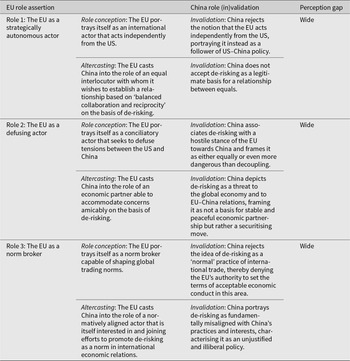
We have argued that de-risking has presented the EU with a platform to promote three self-conceptions and altercast China into three distinct role identities. Following our empirical analysis of Chinese discursive responses to these self-conceptions and altercasting moves, Table 4 summarises our assessment of the perception gap.
Assessing the perception gap.

Table 4 Long description
The table compares how the EU asserts three international roles with how China validates or rejects those roles, and it labels the resulting perception gap. For Role 1, the EU claims strategic autonomy and casts China as an equal partner for balanced, reciprocal ties based on de-risking; China rejects EU independence from the United States and does not accept de-risking as a basis for equality. For Role 2, the EU presents itself as a tension-defusing actor and casts China as an economic partner that can address concerns through de-risking; China frames de-risking as hostile, potentially worse than decoupling, and as a threat to the global economy and EU–China relations. For Role 3, the EU portrays itself as a broker of global trade norms and casts China as normatively aligned with de-risking; China denies de-risking is a normal trade practice and calls it unjustified and illiberal. In all three roles and their associated altercasting, China’s response is invalidation and the perception gap is consistently described as wide. The table summarizes qualitative judgments rather than providing numeric measures of the gap.
First, through de-risking the EU projects itself as a strategically autonomous actor, capable of pursuing an independent economic policy, while simultaneously altercasting China as an equal interlocutor in a more balanced EU–China relationship. This self-conception finds only limited validation in some strands of Chinese scholarship and isolated official narratives. Overall, however, Chinese official, scholarly, and media sources invalidate the EU’s self-role conception, portraying the Union as undermined by internal disagreements and as closely aligned with, or subordinate to, the US foreign economic agenda. In parallel, China invalidates the EU’s altercasting of China as an equal partner. Chinese narratives instead emphasise the EU’s structural weaknesses and its economic dependence on China in order to highlight persistent asymmetries in the bilateral relationship. By stressing imbalance rather than reciprocity, China rejects the notion of an equal and balanced partnership implicit in the EU’s de-risking discourse. As a result, a wide perception gap characterises the EU’s role projection as a strategically autonomous actor and China’s reception of both the EU’s self-conception and its altercasting of China.
Second, de-risking allows the EU to project itself as a defusing actor in US–China tensions, offering a less divisive alternative to decoupling, while altercasting China as a cooperative economic partner. Chinese narratives, however, invalidate the EU’s self-conception as a conciliatory actor, portraying the EU instead as aligned with the US’s offensive strategy and as contributing to economic fragmentation. In parallel, China invalidates the EU’s altercasting of China as a cooperative partner, expressing little interest in cooperating on the basis of de-risking and framing the policy itself as a threat to EU–China economic relations. While cooperation remains rhetorically endorsed in abstract terms, de-risking is rejected as a viable framework for it. As a result, a wide perception gap emerges between the EU’s role projection and China’s perception of both the EU’s intentions and its own role within the relationship.
Third, de-risking allows the EU to reaffirm its self-conception as a normative actor, seeking to lead like-minded partners and to project normative standards onto China, while altercasting China as a normatively aligned actor. Chinese narratives largely invalidate the EU’s normative self-conception, depicting de-risking as protectionist, unilateral, and market-distorting, and as undermining the rules-based foundations of international trade. Simultaneously, China rejects the EU’s altercasting of China as a normatively aligned actor, denying the legitimacy of de-risking as a ‘normal’ or acceptable policy choice. Rather than accepting the EU’s normative framing, Chinese narratives contest the applicability of de-risking as a valid basis for economic relations, thereby refusing the role ascribed to China within the EU’s normative agenda. Consequently, a wide perception gap persists between the EU’s normative role projection and China’s interpretation of both the EU’s role and its own place within the global economic order.
In this regard, de-risking has engendered a battle of narratives on the responsibilities of the current climate of trade wars. Both actors underscore their intention to strengthen their economic relations, and both point at a functioning and disciplined world economic order as a precondition to further develop their relations. But China rejects categorically the role projection of the EU as a broker of a free and disciplined world trade regime and instead deflects the accusations of breaking economic governance to the EU. In parallel, while the EU attempts to altercast a responsible China as a way forward to strengthen their partnership, China portrays the EU as inconsistent, immoral, and aggressive.
Conclusions: When bridge-building looks like bridge-breaking
By bringing together role theory and perceptual approaches, this article argued that the EU’s ability to assert itself as an autonomous, defusing, and normative actor through de-risking depends on how the strategy is perceived by its primary referent, China, and on the extent to which China accepts the EU’s role conceptions and associated altercasting practices. The integration of role theory and perceptual approaches importantly contributes to the operationalisation of the concept of a ‘perception gap’. Following the ways in which role sets are articulated by their sender and subsequently received by their recipient allows perceptual approaches to gain a fine-grained picture of how semantic spaces of agreements and frictions are dynamically constructed through dialogue and confrontation. Thus, the focus on the dialogical, interactive component of international relations promises to enrich our understanding of communication hiccups, drawing directly on the perspectives of the parties involved. In turn, it allows the field of EU studies to emancipate from its alleged Eurocentrism and to systematically embed other parties’ views in their analytical framework.
The perceptual approach proved particularly fruitful in EU–China studies, where it became an increasingly popular lens for studying the relationship.Footnote 120 In this context, de-risking represents an outstanding analytical platform to assess how a bridge-building message was eventually received as a bridge-breaker. By systematically comparing and contrasting the EU’s narratives with China’s counter-narratives on de-risking, a picture emerges of not harmony between two ‘fascinating and complex giants’Footnote 121 but rather a ‘clash of titans’, each striving to steer the narrative. For one thing, the EU urges China to be more ‘ambitious’ and disciplined in upholding commitments and embracing responsibilities. For another, China insists that de-risking reveals the EU’s role as both a follower of the United States and an inflammatory, short-sighted normative actor. Against this backdrop, China rejects the EU’s altercasting by underscoring that it is still belittled and misconstrued by the EU.
The article shows that, despite its long-standing support for European strategic autonomy, China has largely rejected EU efforts to de-risk reciprocal economic relations. Our analysis shows that across governmental, media, and academic debates, China refuses not only the EU’s policy of de-risking but also the EU’s associated self-portrayal as an autonomous, defusing, and normative actor and associated altercasting. To the contrary, the EU’s policy of de-risking has reinforced Chinese perceptions of the EU as a ‘loyal follower’ of the United States, with minimal or no agency. The EU’s promotion of de-risking as a moderate alternative to decoupling, and by extension the EU’s self-image as a defusing actor in Sino–American competition, failed to resonate in China.
The EU’s projected self-image thus collides with China’s perceptions. This perception gap offers key insights into the EU’s capacity to realise its aspired roles amid an intensifying climate of great power competition. Set against an increasingly unbalanced relationship with the United States, the EU’s efforts to chart an autonomous course in its relationship with China meet with an unruly interlocutor, adamant about dictating the terms of engagement. Considering the EU’s emphasis of providing a more viable path to mend the rift with Beijing, these findings are both surprising and alarming. The perception gap between the EU and China on de-risking is indeed likely to increase under the new Trump administration. Heightened US pressure and a more confrontational China policy may further shape Chinese interpretations of EU de-risking through a broader lens of great power competition rather than cooperative and concerted risk management.
Our findings thus point to some clear policy implications for the EU. For one thing, if the EU’s goal is to reach out to its counterpart, political communication should be concerned with a careful analysis of the reception of strategic messages. The combination of role theory and perceptual approach suggests that the reception of a message is still an organic part of any communication strategy. From this point of view, too little is currently being done to embed the way in which China is receiving the EU’s message into its strategic communication. Taking our findings seriously requires an acknowledgement of and reaction to the distortion of key political messages, by systematically embedding the way in which these messages are received into a rearticulation strategy.
This consideration highlights some promising avenues for further theoretical refinement. Zooming in and out on the articulation of political messaging allows us to analyse the way in which agreement and disagreement unfold both within and without the sender’s and recipient’s discursive space. Schmidt’s attention on coordinative discursive practices already offers a solid analytical platform to examine the intra-elite discursive processes through which policy actors generate policy ideas.Footnote 122 Undoubtedly, these processes also affect and are affected by other actors’ discursive practices, as the EU’s internal fragmentation ensuing frictions with the United States or China clearly show. Integrating the interlocutors’ perceptions into the analysis of policy meaning offers a promising way to treat the perceptions of these interlocutors as not exogenous to the policy process but rather forming part of the broader discursive environment in which institutional meanings are constructed, negotiated, and stabilised. Incorporating third parties’ interpretations may potentially extend Schmidt’s framework beyond internal coordination and allows an analysis of how policy discourse travels across institutional and political boundaries and positions both internal and external actors within a semantic space of agreement and disagreement.
The findings of our analysis also suggest multiple paths for further policy research. First, future research may scrutinise Chinese perceptions of specific EU economic policies associated with de-risking, such as the Critical Raw Materials Act or the European Chips Act, to create a more comprehensive understanding of how China receives the EU’s economic agenda. Second, future research may draw on our findings to analyse the extent to which China’s rejection of de-risking has generated a rethink of its support to the wider notion of EU strategic autonomy. Third, extending our ‘perception gap approach’ to areas where the two parties engage in more proficient cooperation (such as climate policy) could offer insight into the preconditions for positive exchanges. And indeed, the perception gap between the EU and China is patchy, with areas of relative agreement, like climate governance, and areas of growing tension, like economic matters and matters of traditional security. Exploring areas where the two parties commit to ‘pursue leadership together’,Footnote 123 such as climate policy, may help researchers pinpoint the preconditions for cooperation. This approach also provides a solid basis for tracing how the perception gap in areas of existing cooperation widens, leading to increasingly divergent role sets and interpretations, as illustrated by EU–China cooperation on African development in 2007–8. Finally, future research may investigate whether our findings about China’s perception of EU de-risking and the Union’s associated self-portrayal remain valid in view of the ongoing trade war between the United States and China during the second Trump presidency, which has seen China launching a charm offensive towards Europe.Footnote 124 Considering the latter, scholars can build on our study as a yardstick to assess whether and to what extent China’s vision of Europe has become more aligned with the EU’s self-image as an autonomous, defusing, and normative actor in Sino–American competition.
Supplementary material
The supplementary material for this article can be found at https://doi.org/10.1017/eis.2026.10070.
Acknowledgements
The authors thank the editors and two anonymous reviewers for their constructive and insightful feedback, which substantially improved the article. The authors are also grateful to Luis Simón, Salih Işık Bora, and Daniel Fiott for comments on earlier versions of the manuscript. Targeted language editing of the manuscript was supported by ChatGPT (GPT-5).
Funding statement
This research is funded with the support of the European Union through a European Research Council grant on Sino–American Competition and European Strategic Autonomy (SINATRA), under grant number 101045227. The financial sponsors played no role in the design, execution, analysis, and interpretation of data, or writing the study.
Competing interests
The authors declare none.
Andreea Budeanu is a senior research associate at the Centre for Security, Diplomacy and Strategy (CSDS) at the Brussels School of Governance, Vrije Universiteit Brussel (VUB). She holds a PhD in Political Science and International Relations together with a BA in Chinese Language and Civilisation from the National Institute of Oriental Languages and Civilisations (INALCO), Paris. Her research interests include EU–China relations, China’s foreign policy and economic development, non-western theories of international relations, and great power competition.
Email and ORCiD: https://orcid.org/0000-0002-8209-9053; andreea.budeanu@vub.be
Caterina Carta is a research professor of international relations at the Centre for Security, Diplomacy and Strategy (CSDS) at the Brussels School of Governance (VUB). Her research interests include foreign policy, cultural and public diplomacy, international organisations, and discourse theory and analysis. Her publications include The European Union’s Diplomatic Service: Ideas, Preferences and Identities (Routledge, 2012); Making Sense of Diversity: EU’s Foreign Policy through the Lenses of Discourse Analysis (ed. with J.-F. Morin, Ashgate, 2014); and Cultural Diplomacy in Europe: Between the Domestic and the International (ed. with R. Higgott, Palgrave, 2020).
Email and ORCiD: https://orcid.org/0000-0002-2034-0972; caterina.carta@vub.be
Stephan Klose is a postdoctoral researcher at the Brussels School of Governance, Vrije Universiteit Brussel (VUB).
Email and ORCiD: https://orcid.org/0000-0003-3073-3937; stephan.klose@vub.be



 Open access

