

Historicizing Grief
When the periodical Bereavement was recently (re)launched, contributors reflected that “‘bereavement studies’ has the potential to be highly interdisciplinary, but [in practice] psychiatry and psychology have been, and continue to be, heavily dominant.”Footnote 1 Scholarship on survivors’ experience and behavior in the aftermath of impactful death has, perhaps not surprisingly, seldom integrated insights from fields like history, much less premodern history.Footnote 2 Nor have historians—generally, a receptive bunch, eager to sponge up “new” theories and methodologies—had much truck with bereavement studies. The present essay, a cultural historian’s probe of gender, affect, and the (micro-)politics of kin and community in the wake of loss, aspires to serve as a platform for each field to make the other’s acquaintance.Footnote 3
My focus is on widowers in medieval Icelandic sagas. Unlike widows—who never cease to fascinate premodernists—widowers have largely flown under historians’ radar.Footnote 4 Several converging reasons explain their obscurity. For starters, the sources themselves rarely seem to care, and Norse texts are no exception: “widows clearly attracted the attention of saga authors,” Jenny Jochens notes, but “the narratives have little to say about widowers.”Footnote 5 Many historians infer that there just is not much worth knowing: “being a widower did not relate [to a] wide range of important social qualifications,” Margaret Pelling observes of early-modern England (and beyond). “The loss of a wife did not affect a man’s ability to hold property, his claim on his children, his civic status, his occupational definition, or his legal status[, nor might he] lose his dwelling.”Footnote 6 Medieval records define men functionally, “by rank not marital status”; “in legal or religious terms,” widowers were “[no] different from other men.”Footnote 7 In fact, premodern European languages lacked words to designate widowers; Old Norse knows ekkja, “widow,” but no precursor to its Modern Icelandic masculine counterpart, ekkill. Footnote 8 Unmarked and unremarkable, widowers appear to warrant historians’ cold shoulder.
Bereavement studies help bring out widowers’ significance as objects of historical investigation. Calling attention to grief and grieving pulls subjective experience into focus: emotional and quotidian realities are no less weighty than legal status and property rights.Footnote 9 Moreover, widower is (as Janet Nelson says of widows) a gender-specific category. This allows for a three-pronged comparison: among bereaved spouses, male or otherwise; among men, bereaved or otherwise; and among men whose spouses had died, across societies.Footnote 10 Because a substantial body of knowledge addresses widows’ (mis)fortunes, contrasting widowers with them can reveal how surviving spouses’ experiences differed between genders, while potentially adjusting our picture of longer-lived wives’ lots. Conversely, “widower” as a subset of “men” highlights continuities and anomalies in how bereaved men perform masculinity. Finally, acknowledged or not, “longer-lived husband” is a universal category that lets us examine men’s responses to spousal mortality, across societies and periods. These three intersecting comparative vectors allow us to discern patterns and exceptions, as well as to frame new heuristics to extend research in new directions.
We are hampered, however, first by the difficulty of identifying widowers in the record, and second by the thinness of the evidence we do have: legislation, charters, even chronicles usually provide few details, especially about inner lives. Precisely for this reason, the Icelandic sagas hold such promise. The sagas are no Nordic equivalent of the famed fifteenth-century Florentine catasto, the benchmark source for medieval demographics.Footnote 11 Richly narrative, they convey complex, circumstantial accounts, not crunchable census data. Picking out bereaved husbands is arduous here, too. But these vibrant, intimate portraits of medieval Norsemen reveal much not readily recoverable elsewhere—including, occasionally, about widowers. Sagas are thus a proving ground for formulating hypotheses about historical experiences of bereavement. What the sagas reveal can blacklight the even fainter, more equivocal traces widowers have left in other documentary corpora.Footnote 12
Below, I formulate two models of dysfunctional bereavement, detectable in the sagas but demonstrable beyond them, which shed light on how loss and emotional dislocation radiate through the social hinterland. Archetypal models never fully correspond to any one historical reality; still, they can bridge gaps between the minutiae of cultural and affective analysis, on the one hand, and the grand gestures of socio-political drama, on the other. Even as the long arc of research bends away from Histories of Great Men, the study of widowers underscores in novel ways the truism that the personal is always political. Individuals, exercising agency in light of idiosyncratic experiences, inflect the grand narratives of society’s march through time, which in turn exert the forces that shape individuals’ affective experiences.
Locating Widowers
The remarriage of widows, Barbara Todd observes, “involves many intangibles which normal historical sources rarely document,” such as “[l]ove and a sense of duty to the dead husband,” but also “loneliness and the need for affection and security.”Footnote 13 Mutatis mutandis, the same holds true for widowers’ experience. Sagas, which portray characters in the round, render such intangibles concrete. But sagas privilege objective, external description over subjective, affective confession. “What you will see and hear is what the characters…see and hear,” William Ian Miller remarks. No omniscient narrator, no soliloquies lay bare experiential interiority: as in real life, “you will have to discern motive…by watching what people say and do and then imputing reason or unreason, whim or calculation, passion or habit, to explain their actions.”Footnote 14 Such radical verisimilitude itself raises concerns over the correspondence between literary realism and historical reality.Footnote 15
Modern scholarship distinguishes many genres of Icelandic sagas, mostly committed to parchment in the 1200s and 1300s. I focus on those overwhelmingly characterized by realism: Sagas of Icelanders and Kings’ Sagas, set in the Viking Age (ca. 800–1150), and the so-called Contemporary Sagas, which deal with high-medieval Iceland (ca. 1050–1300). Many scholars nowadays tend to read the former, written centuries after the events recounted, as pseudo-historical fiction, and the latter, at a remove of mere decades, as historical chronicles.Footnote 16
My approach rejects this methodologically suspect distinction.Footnote 17 Following the so-called anthropological school—of which Miller is indisputably the dean—I read all three realistic genres as “uchronias,” past-tense ethnographies: neither a documentary record of the narrated then, nor an anachronistic superimposition of the narrating now. Footnote 18 Sagas are untrustworthy on events, persons, and dates; but their accounts of social processes, customs, and norms—including masculine and marital ideals—are by-and-large inhospitable to falsehood.Footnote 19 Sagas thus render an exceptionally blurry and broad chronology: their uchronic tableaux depict a synchronous, coherent era, ca. 800–1300. Ninth-century Norwegian vikings and thirteenth-century Icelandic farmers inhabit a recognizable cultural continuum. Even patent fictions, as Miller expertly demonstrates, reveal the real-life parameters within which medieval Norsemen operated, obviating traditional periodizations and exploding easy distinctions between fact and fake.Footnote 20
To a cursory glance, the sagas’ lush literary landscape bears few fruits for a student of husbandly bereavement to pluck, and none that are low-hanging. My laborious picking has yielded approximately sixty-six widowers: a small, but non-negligible sample size—comparable, say, to the fifty widows a comprehensive study has located in Sturlunga saga alone.Footnote 21 Identifying saga widowers involves painstaking sleuthing.Footnote 22 Since there is no native terminology, I define as widower any man who outlives his “female domestic partner.”Footnote 23 This awkward circumlocution, henceforth glossed as “wife” or “spouse” whenever a relationship’s precise tenor is unknown and unimportant, is necessitated by Norsemen’s nonchalance toward monogamy, both before and after Christianization. Men of rank typically did marry, but many “added concubines (frillur) openly to their wives or established informal unions with official mistresses (fylgikonur),” while “ordinary folk [and many clerics] ignored marriage altogether and lived in informal unions.”Footnote 24 Whenever we have either direct mention of a female partner having died, or else strong indirect evidence, such as motherless children or domestic staff hired as a stopgap solution, I call widower: “Hallsteinn…had two sons…. For some years, Hallsteinn arranged it so that he appointed various women to run the farmstead. This grew to be most inconvenient for him…. ‘I now wish to marry.’”Footnote 25 The availability of divorce in medieval Iceland throws a further wrinkle into such inference, however: a spouseless father need not be bereaved.Footnote 26 About one widower identification in six is tentative.
This heuristic is also insensitive to how women perish. Several widowers reportedly lose better halves to accident, disease, the travails of childbirth, excessive grief, or violence.Footnote 27 But usually no cause of death is cited: “Kári spent the winter on Caithness. That winter, his spouse died in Iceland,” runs a typically terse obituary.Footnote 28 Furthermore, my classification of a man as widower is indifferent, in theory, to his subsequent marital fortunes. In practice, widowers who wed anew might be hard to detect, as there would be little incentive to mention an already defunct spouse.Footnote 29 Unfortunately for our purposes, widowers throughout premodernity “tended to remarry more often, and after shorter intervals, than widows.”Footnote 30 Even if spouses of either sex were equally likely to die first—an implausible premise—the high probability that women would remain single (attracting textual attention) while men dive right back into matrimony (deflecting documentary notice from themselves) makes widows appear far more numerous than widowers.Footnote 31 In both Viking Age runestones and fifteenth-century Tuscan censuses, widows outnumber widowers by about five to one.Footnote 32
Widows preoccupied premodern authors because of their abundance, but also because they were regarded as a matter of concern for society at large. In part, at least, this perception hinged on the gendered abnormality of their circumstances, which implicates Norse widows no less than their sisters elsewhere.Footnote 33 A husband’s death “brought a variety of new options and new independence, both economically and emotionally”: to manage property, decide on one’s own and one’s children’s marital options, litigate, patronize religious institutions, and so forth.Footnote 34 Such agency made widows dangerous: stereotypes like Chaucer’s Wife of Bath capture the anxiety they engendered. Conversely, widowhood exacerbated women’s vulnerability.Footnote 35 Kin, affines, lay and ecclesiastical authorities—all were keen to oversee their affairs; theological treatises, sermons, and ribald comedies circulated knowledge about what ought to be done to and about them.Footnote 36 Various mechanisms of social control were implemented to shield widows from poverty, isolation, predation, and conflicting kin-loyalties, but equally to protect society from their newfound reach. In contrast to premodern widows’ rudimentary panopticon, widowers seemingly evaded institutional policing, enjoying much the same opportunities, and laboring under much the same constraints, as bachelors or married men. As I show below, however, widowers, too, were subjected to subtle social scrutiny, attracting anxieties (and sometimes meddling) if they strayed too far from the normative path.
Widowers were perhaps thought to need less supervision precisely because their situation was understood as temporary. Only those who lost wives when already very old might, with some frequency, remain single.Footnote 37 Some relied on grown children, usually sons, to maintain them.Footnote 38 If such dependence proved unpalatable, answering a religious calling offered an alternative.Footnote 39 Both practices are attested among Norse widowers. Thus Þorsteinn the White goes on farming alone after his wife’s death, but then asks his son to take over when his eyesight dims; Egill Skalla-Grímsson transfers his farm to his son and moves in with his stepdaughter.Footnote 40 We also hear of men like Guðmundr Eyjólfsson, who became a monk in the 1180s after his wife died. (We will meet Guðmundr again below.)Footnote 41 Such elderly retirees hint that a few widowers, like most widows, retained their status as bereaved spouses to the end of their lives—which, often, was not far off.
So far, then, I have surveyed what is known of widowers in medieval Europe. They were not differentiated from other men, and thus neither subject to special restrictions nor endowed with unique opportunities; they usually cycled back into wedlock promptly; and only the elderly among them might routinely remain single, supported by grown children or religious houses. These general scripts largely held true of Norse widowers, too. But the sagas also reveal some patterns that have received little notice until now.
Below, I present two testable, extendable hypotheses, suggested by the sagas’ narrative portraits of widowers in action. I dub them the widower on the warpath and the widower on the bridal path. These are both idealized archetypes—anchored in empirical textual evidence, but also analytically abstracted from its specifics. No flesh-and-blood widower may have taken to the warpath or bridal path in quite the manner I describe below, any more than any bereaved wife ever conformed closely to the equally stereotypical images of “chaste widow,” “merry widow,” and “poor widow.”Footnote 42 Still, ideal types are useful tools for organizing our knowledge of how, despite individual variability, many men and women did live their lives; they help us figure out what questions to ask in order to assess the realities of any particular case.
Fire at Will
Let us march down the warpath first. In the feuding society the sagas depict, homicidal violence is everywhere, practically all committed by men.Footnote 43 As so often elsewhere, a capacity for the use of force, and the sporadic exercise of such capacity, seem integral to cultural norms of masculinity. But, even if a propensity for violence formed part of the sagas’ universal malescape, still there was modularity to how men might bring it to bear. Looking closely at widowers exposes a particular feature of this virile socialization. Upon the deaths of their spouses, some men lost control over their violent faculty, firing off in ill-considered and disproportionate ways, for which both they and others had to pay exorbitant prices.
Although Norse men’s ferocity is certainly capable of flaring up, free of any feminine touch, women do frequently get implicated in paving the path to war.Footnote 44 One celebrated archetype is the so-called “whetter”: a wife, mother, or niece whose structural role is to incite lethargic menfolk to vengeance. Whether historical or literary, we may expect the sagas to overrepresent this dramatic archetype, while its opposite—women who took pains to restrain male kin from acting precipitously, whom David Clark simply dubs “anti-inciter[s]”—would be underrepresented.Footnote 45 Those rare occasions when sagas do depict women as tempering men’s imprudent political instincts are therefore doubly noteworthy.
Anthropologists teach us that women can embody bridging nodes between potentially adversarial kin groups. The sagas bear this out: wives try to restrain their husbands from foolish, foolhardy, and fatal missteps, with variable success.Footnote 46 Thus Jórunn Bjarnardóttir (characterized as “a person of outstanding intelligence,” skǫrungr mikill í vitsmunum) dissuades her husband, Hǫskuldr, from attacking his half-brother. Appealing to both sentiment (“That’s a hideous plan, if you mean to kill such a man as your brother is”) and calculation (“Now, he will not have taken that counsel—to go toe to toe with you—before making sure he could expect [support] from greater men”), she successfully walks him back from the precipice (“Hǫskuldr calmed down a good deal at Jórunn’s urging; it seemed to him it had the ring of truth”).Footnote 47 In the early twelfth century, Hafliði Másson’s wife, Rannveig—like Jórunn, “a smart and very capable woman in many respects” (vitr kona ok vel at sér um margt)—tried to dissuade him from facing his nemesis Þorgils Oddason, but was rebuffed and watched Hafliði go off to humiliating defeat.Footnote 48 Over a century later, we hear how an affront from the fifteen-year-old son of an enemy chieftain, living under his roof as a pledge of his father’s political neutrality, whipped Gizurr Þorvaldsson into a lather; Gizurr’s wife, Gróa, defended the boy, going so far as to offer to pay compensation herself for his transgression. Gizurr brushed her off angrily, and the boy kept up his insolence, yet Gróa and other cooler heads were able to avert confrontation.Footnote 49 If violence could not be forestalled, wives might still intercede to mitigate it. Auðr of Mávahlíð, who witnesses her husband cross swords with an enchanted son of a witch (“No weapon [could] touch Oddr Kǫtluson”), “called on the women [of the household] to separate them, and they threw cloths over their weapons.” Auðr’s peacemaking is not confined to stepping into the storm of steel. Later, when her husband finds an amputated hand at the battle site, “he asked where Auðr was. He was told that she was lying in her bed. Then he went to her and asked whether she was wounded. Auðr told him not to worry about it, but still he knew for certain that she had lost her hand.” Rather than whet her husband, Auðr deliberately suppresses information that would goad him to vengeance.Footnote 50
Alive, a wife might act as a peace-weaver; dead, she could release the brake on her husband’s hurtling violence, as exemplified by Gizurr, who tore through Iceland’s political elites in the 1250s and 1260s like an orca through a trip of seals. His rampage sealed the fate of the free commonwealth: over the course of 1262–1264, the last aristocrats standing in his way were eliminated or co-opted, and Icelanders signed over their sovereignty to the Norwegian king (with Gizurr acting as his chief representative, the Earl of Iceland).Footnote 51 Never a gentle man, Gizurr erupted into paroxysms of savagery after Gróa’s premature death. We may be tempted to dismiss his example as anomalous: Gróa perished (alongside three of the couple’s sons) in a fiery inferno when Gizurr’s enemies torched his home on 22 October 1253, so the ratcheting up of his already considerable violence might be attributed more to active desire for vengeance than to the passive absence of a wife’s restraining hand.Footnote 52 Such an explanation does not hold, however, for Snorri Sturluson, another of thirteenth-century Iceland’s arch-connivers and survivors. Snorri met his end on 23 September 1241, shortly after the death of his beloved consort Hallveig Ormsdóttir (on 25 July 1241).Footnote 53 In his final months, the cautious Snorri had let himself be dragged into an ugly property dispute with Hallveig’s sons by a previous marriage, pushing them into alliance with his enemies.Footnote 54 Snorri’s elimination was overdetermined; Gizurr Þorvaldsson spearheaded the effort to destroy him, and the King of Norway himself branded him a traitor. To argue that Hallveig’s death led directly and inexorably to Snorri’s own would be an overstatement. But the contribution that recent bereavement made to ensnaring the normally canny Snorri in a dispute from which he was unable to extricate himself is worth underscoring.Footnote 55 Both Snorri and Gizurr—highly accomplished, sophisticated politicians—had weathered plenty of tempests before. The added strains of widowerhood sent each storming down the warpath, to personal tragedy in Snorri’s case, to the Icelandic commonwealth’s in Gizurr’s.
Once noted, this pattern of heedless widowerhood may bring out less salient examples. Oddr Snorrason’s Óláfs saga Tryggvasonar (ca. 1200) relates the exploits of Norway’s King Óláfr, whose brief Christianizing reign (995–1000) ended in wreckage. In Oddr’s build-up toward his virtuous protagonist’s downfall, a whetting woman’s incendiary rhetoric muffles the battle-cry sounded by the widower on the warpath. Oddr weaves his hero a many-stranded skein of animosities: jilted lovers, treasonous allies, dispossessed subjects, pagans and pagan-sympathizers, all collude to spring a death-trap on the swashbuckling missionary monarch.Footnote 56 One prominent thread in this webwork is the haughty Sigríðr, a divorcée queen from eastern Scandinavia, who harbors enmity toward Óláfr following a badly botched courtship.Footnote 57 When Sigríðr eventually marries the Danish King Sveinn, she assumes the narrative duty of inciting her new husband against his northerly neighbor. She insists Óláfr had disgraced him by marrying his sister without his consent. Sigríðr is an unsparing whetter: she accosts Sveinn in public (“the queen spoke thus when many of their friends were present”), accuses him of putting up with crippling dishonor (“‘Lord,’ says she, ‘how long will you do nothing about the humiliation you’ve received?’”), and threatens to leave if he does not rectify it (“And in truth I tell you, if you will display so little manliness that you don’t dare avenge such a thing, then I shall have us divorced, and I will never remain here”). Sveinn, initially reluctant to take offence at his sister’s union with a husband “more illustrious than all other kings” (“How is this a humiliation for me?…[M]ight I have betrothed my sister to any better king, had I arranged matters myself?”), ultimately gives in and undertakes to lead the coalition against Óláfr.Footnote 58
One detail easily escapes notice. Some chapters prior, Sveinn had been bereaved: “But when King Sveinn hears [of Óláfr’s marriage to his sister], he is greatly displeased that this was done without his leave. And a little later Queen Gunnhildr died, whom King Sveinn had married, and they had had two sons: one was called Haraldr, and the other Knútr. After this King Sveinn wed with Queen Sigríðr the Strong-Willed.”Footnote 59 Contrary to the impression given by the later vignette, where Sveinn happily accepts Óláfr’s matrimonial fait accompli as conferring honor on himself and is only herded into taking up arms against his brother-in-law by the goading of an evil second wife, the earlier passage interlaces news of Sveinn’s first wife’s death with umbrage at Óláfr. However faintly and equivocally, the juxtaposition may hint that Sigríðr has been set up to take the narrative fall for internecine strife: what might otherwise have appeared as a widower’s irascibility can now be blamed on a grudge-holding woman.Footnote 60
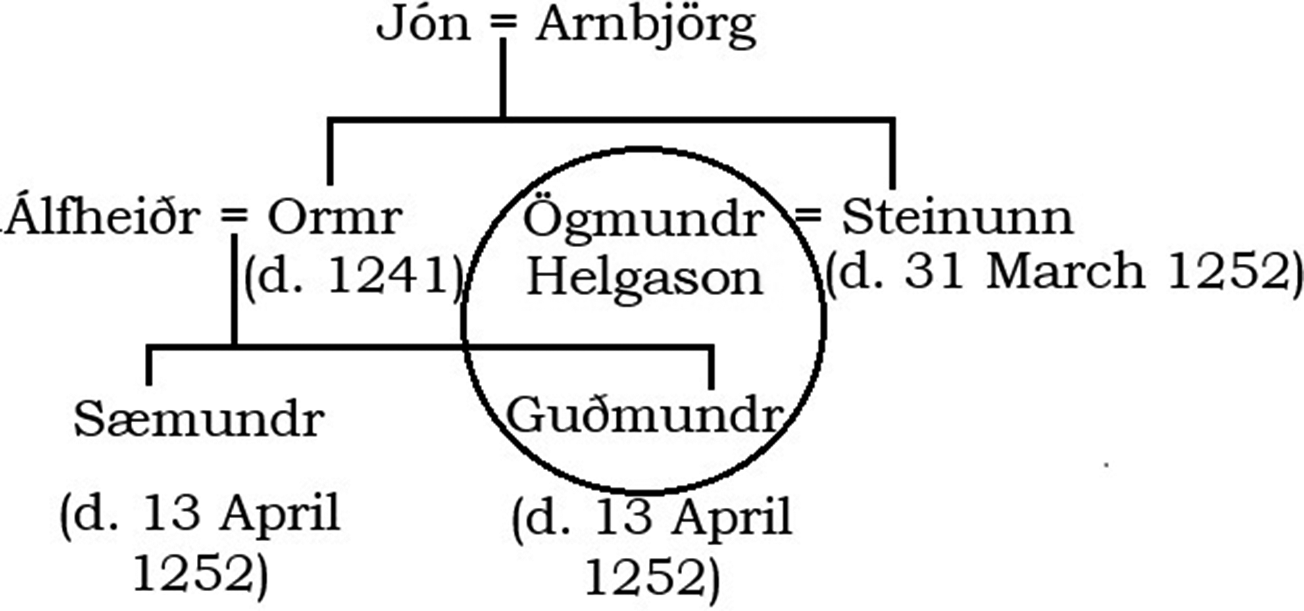
Clinching evidence for the widower on the warpath is provided by an Icelandic magnate, Ögmundr Helgason, whose spouse, Steinunn Jónsdóttir, repeatedly checked his belligerence toward her nephews, Sæmundr and Guðmundr, the sons of her late brother Ormr (see figure 1): “for God’s sake and in your own interest, act in such a way that you don’t add to the troubles with my kinsmen,” she implored Ögmundr. Still, matters continued to spiral; “she then went into church and prayed for them, one and all. She asked this of God, that the troubles among these in-laws might leave off while she lived; and it happened so as she had asked.” An ominous, proleptic death knell tolls in this final clause. Steinunn passed away on “Saturday evening before Easter [31 March 1252]…and it seemed heavy news to everyone, but especially to her husband and sons.”Footnote 61 Ögmundr promptly ambushed Sæmundr and Guðmundr (13 April 1252), seizing them, denying them absolution, then putting both to death. Even the piteous pleading of the teenaged Guðmundr, who had grown up in Ögmundr’s household under his tutelage, could not stay the headsman’s axe. Following this atrocity, Ögmundr was exiled from the district and impoverished. The saga is explicit about the ameliorative effect Steinunn had had on her husband’s temperament while she lived, and consequently about the inevitability of all hell breaking loose once she was gone from his side: “When she died,” Guðbrandr Vigfússon, the saga’s first modern editor, observes, “it was as if his good angel had left Ogmund[;] his fierce and gloomy temper overpowered him.”Footnote 62 Ögmundr’s personality was unquestionably “fierce and gloomy”; the tripwire detonating it was the departure of that “good angel,” his Steinunn.
The family of Ormr Jónsson in mid-thirteenth-century Svínafell (fosterage relationship indicated by a circle). On fosterage, see Footnote n78 below.

The widower on the warpath may thus be identified as a man who, once deprived of companionship and counsel, abandons himself to ebullient aggression, arguably effective at times (as in Gizurr’s and Sveinn’s cases) but more often rash (as in Snorri’s and Ögmundr’s). Additional saga widowers confirm the pattern: the aged Egill Skalla-Grímsson hatches a plan to plunge all of Iceland into chaos after his wife’s death, and—when his beloved stepdaughter thwarts his scheme—takes vengeance on his nearest and dearest by depriving them of their due inheritance, murdering two helpful slaves into the bargain. Like Egill in his dotage, other widowers display unstinting belligerence toward adversaries and associates alike. Thus, the rancorous Þórarinn consistently provokes his son Þorsteinn to fight an antagonist who is, by the father’s own estimation, his superior by far; when at length he believes Þorsteinn has fallen in battle, he rejects the supposed killer’s generous offer of compensation, attempting to shiv him instead.Footnote 63 Social censure of such bellicose widowers—Þórarinn is shooed out of the narrative as “the most wretched old fart”—confirms that despite the absence of a formal protocol for dealing with male bereavement, widows were not alone in enduring oversight of their affairs.Footnote 64 No society can afford to ignore maritally unmoored troublemakers for long.
Widowers on the warpath are caricatures of broken masculinity, reduced to taking the measure of all things by the extent of their blades. Most are past their prime; all but King Sveinn fail to take the normative, socially restorative path of remarriage, which could have dampened their destructive instincts. In the stunted emotional landscape they inhabit, lashing out is the fitting response to the hardships they undergo. Their presence may be unsurprising in the hyperviolent uchronia of the Icelandic sagas; but can the archetype serve its heuristic function in other historical contexts?
Now attuned to its frequencies, we may begin to pick up resonances elsewhere.Footnote 65 A twenty-five-year-old Theodore Roosevelt, for instance, famously experienced the simultaneous loss of his mother and his first wife, Alice Lee, as a shattering blow: “The light has gone out of my life,” he confided on 14 February 1884. Roosevelt, an efficient Republican delegate to the New York State Assembly, was no viking; thrashing about with a battleaxe was not an option. Instead, he plunged into a frenzy of legislative work: within four days of poor Alice’s death, he was back in Albany, producing bill after bill over the coming months, “[l]ike a factory ship in the whaling season.” Then, in the summer of 1884, he withdrew from his frenetic political career to take up buckskins and rifle on the Dakota Badlands, enacting Victorian fantasies of machismo: “Since Alice’s death,” Edmund Morris, his biographer, comments, “his diaries had become a monotonous record of things slain”—170 animals dispatched in a little over a month and a half. It was a solid two years before Roosevelt abandoned his Western adventure (having stood down “marauding…Indians” and hunted down “vicious” boat thieves) and resumed political life back East. Even now, his inner berserker powered a reinvigorated legislative charge, while the courtship of the future second Mrs. Theodore Roosevelt, Edith, civilized his manliness to allow his shift back from the rugged frontier to New York respectability.Footnote 66 His stint on the warpath having run its course, this widower paved his way back into sociability through the traditional expedient of remarriage. Morris fittingly studs Roosevelt’s biography with excerpts from his “favorite poem,” Longfellow’s “The Saga of King Olaf.”Footnote 67 Framed as widower on the warpath, Roosevelt lets us glimpse how a would-be hero of yore sublimated anguish by projecting medieval notions of manliness—what he himself doubtless understood as primitive, apolitical, pre-cultural instincts—onto the conventions of his own age. Roosevelt confirms the archetype, even as he stretches it; the archetype breathes sense into Roosevelt, even as it fetters him in cartoon shackles.
Love is in the Heir
Widowerhood robbed Gizurr, Snorri, Egill, Teddy, and others of an important check on their over-active (but otherwise normative) masculinity.Footnote 68 In flat, unsentimental idiom, the sagas unveil emotional turmoil, letting imperfect coping strategies attest to men’s grief. The sagas also illuminate the responses of others around the rampant widower. Their efforts to contain (or, in Sigríðr’s case, exacerbate) a surviving husband’s violence testify, at the very least, to the social hinterland’s attempts to wrestle this unnamed category, widower, into manageability.
The widower on the bridal path likewise follows protocol for his nameless condition; he, too, does so imperfectly, stirring up trouble for surviving kin. It is less Thanatos that impels him than Eros. As we have seen, there was nothing untoward about widowers who remained socially and sexually active. All but the very old were expected to do so, and even they were granted license to opt out, not barred from seeking another mate. What seems to differentiate the widower on the bridal path from a well-adjusted remarrying widower, however, is his having definitively given up on renewed public virility, then later sought to reclaim it—thereby upsetting the delicate equilibrium among overlapping generations of active males. His scandal hinges on deviation from expected linearity.Footnote 69 The widower on the bridal path was the comeback kid with a comb-over: an impediment to himself and, worse, to his kindred.
Near the beginning of Egils saga, we encounter a full-blown instantiation of this type:
A man in Hålogaland was called Bjǫrgólfr.… He was a baron, powerful and wealthy, and half a hill-giant in strength and size and ancestry. He had a son, who was called Brynjólfr; he resembled his father. Bjǫrgólfr was old by then, and his wife was dead, and he had handed over all his affairs to his son and had sought out for him a wife.… It happened one autumn that there was a well-attended banquet, and Bjǫrgólfr with his son were the most distinguished people at the banquet; then lots were drawn for pairing up couples for the evening, as was the custom. But at this banquet was a man who was called Hǫgni; he had a farm on Leka; he was a very wealthy man [but] of low birth, and had raised himself through his own [industry]. He had a gorgeous daughter, who is named Hildiríðr. She drew the lot of sitting next to Bjǫrgólfr. The two talked a lot during the evening; the maiden appeared to him fair.Footnote 70
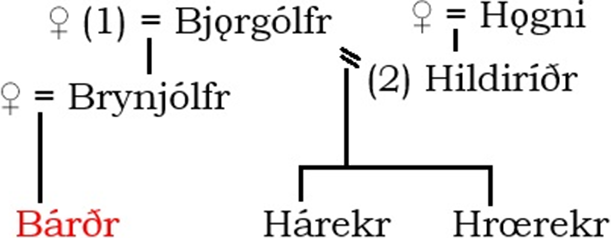
Crusty, single-again Bjǫrgólfr and nubile, upwardly mobile Hildiríðr seem made for each other; every sip from the mead-horn they share inspires thoughts of allying young money with old status. Shortly thereafter, Bjǫrgólfr will unite with Hildiríðr in what he insidiously calls a lausabrullaup, “loose wedding”: when he shows up at the head of an armed entourage, “Hǫgni saw no other option but to let everything happen according to Bjǫrgólfr’s will. Bjǫrgólfr bought her with an ounce of gold, and then they both went into one bed.” Even though his own grown son, “Brynjólfr[,] spoke ill of this arrangement[,] Bjǫrgólfr and Hildiríðr had two sons; one was named Hárekr and the other Hrœrekr. Afterwards Bjǫrgólfr dies; but as soon as he was carried out [for burial], Brynjólfr made Hildiríðr go away with her sons.… Brynjólfr had little esteem for them and did not let them share in their father’s estate.… They were very much equal in age, Brynjólfr’s son Bárðr and the sons of Hildiríðr.”Footnote 71 Quite what Hildiríðr makes of the whole sordid affair, we cannot know.Footnote 72
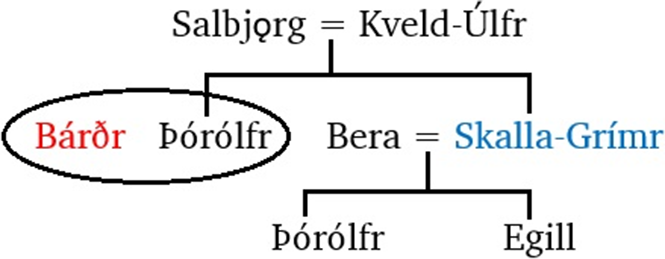
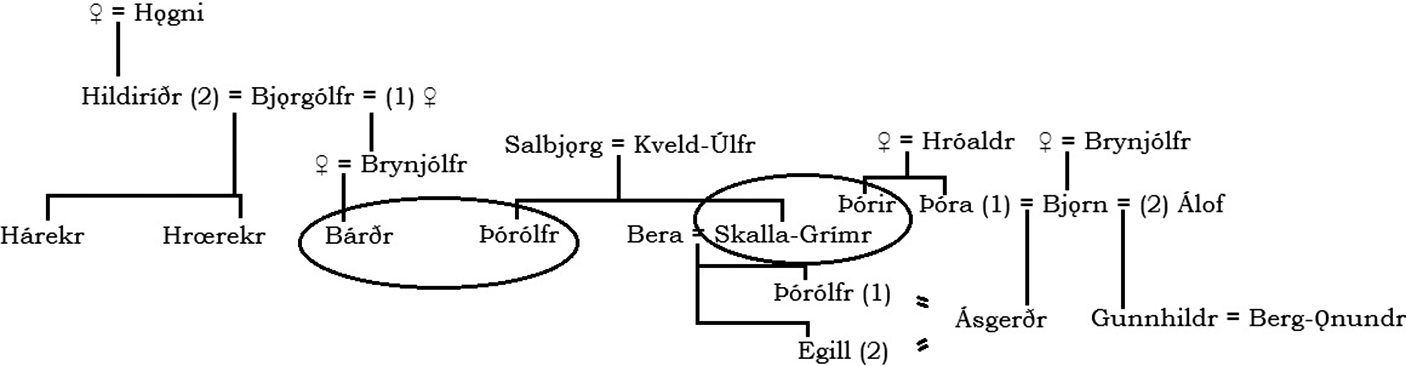
The scene is now set for wrangling among the branches of this little family tree (see figure 2a). Bjǫrgólfr, the old-timer responsible for the mess, is deceased; the son of the first marriage, Brynjólfr, has kicked out his step-mother, Hildiríðr (who must be roughly his coeval); and, in the youngest generation, Bárðr Brynjólfsson and his half-uncles Hárekr and Hrœrekr, the sons of Hildiríðr, stand poised to come to blows. At issue is the question of whether Bjǫrgólfr’s union with Hildiríðr had generated a valid, competing inheritance claim. Bloody dispute ensues. It culminates when the Norwegian king, Haraldr Fairhair, patron of Hildiríðr’s ruthless sons, slays a previously uninvolved third party—Þórólfr Kveld-Úlfsson, Bárðr’s comrade-at-arms. This Þórólfr is the uncle of the saga’s eponymous hero, and himself the protagonist of the saga’s opening act, a wise and fair precursor to the psychotic and ugly Egill: much of Egill’s career looks like a variation, as in a distorting mirror, on uncle Þórólfr’s. What had been a minor fracas on the narrative margin is thus soldered into the saga’s main plot, triggering the migration of Egill’s forebears—his grandfather Kveld-Úlfr and his father Skalla-Grímr—to Iceland (see figure 2b).Footnote 73
Bjǫrgólfr’s family (red continues on Figure 2b).


Notably, what propels this plotline is the sequence set in motion by Bjǫrgólfr’s bereavement. Already old, he initially seeks to install his grown son as householder in his place, acquiring for him a wife and transferring management of his affairs to him. (We may recall the reliance of men like Þorsteinn the White on their offsprings’ householding skills.) To Bjǫrgólfr’s mind, due care for the family interest requires not just an able-bodied man at the head of the household but a hjón, a marital unit.Footnote 74 Clearly, the expectation—the norm Bjǫrgólfr means to uphold—is for the aging patriarch to go into retirement and abandon lusty pursuits appropriate to younger men. Next, however, we witness the kind of complications that might arise if a greybeard begins dating again, especially if he begets new children. Prior transfer of executive authority to an adult, married son and recourse to fuzzy terminology may muddy the legality of the second union but do not entirely dam downstream acrimony.Footnote 75
Everything about Bjǫrgólfr’s conduct at Leka appears calculated to create plausible deniability: his apparent juridical innovation, the lausabrullaup, a nonce-word not otherwise attested in the surviving corpus; the show of force used to coerce Hildiríðr into his bed, which may make their mating more rape than matrimony; his overbearing disregard for her father; and the (presumably) meager bride-price he disdainfully throws down.Footnote 76 Even while he succumbs to the rekindled fire in his loins, undermining the orderly generational transition he had so carefully engineered, Bjǫrgólfr takes extravagant precautions to safeguard his first-born’s claim as sole legitimate heir. Unsavory as he appears from Hildiríðr’s perspective, as beau, there is something touching about his paternal concern for Brynjólfr, his boy. Bjǫrgólfr correctly anticipates the strife his escapade will unleash and makes valiant efforts to head it off; the Norse society refracted in the saga must have been equally wary of such predicament. Just as tales of widowers on the warpath caution against unbridled violence, Bjǫrgólfr’s lausabrullaup crystallizes anxiety over the erotic entanglements of a has-been who indulges virile passions.Footnote 77
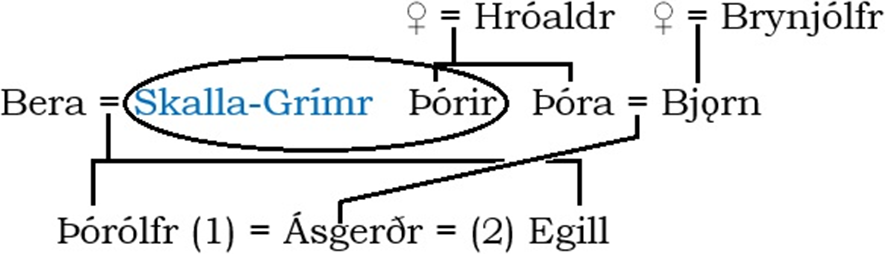
The author of Egils saga was a master of his craft. He loved symmetry, often thrown just a tad off-balance by slightly skewing some component in analogous reiterations, as when Egill is played off against his uncle Þórólfr. In the saga’s middle third, its narrative heart, we find a variation on the motif of the lovelorn widower, recognizably reconstituted from the same modular ingredients. Again, we meet a father-and-son duo, (a different) Brynjólfr and his son Bjǫrn; this time, it is the son who falls for a pretty young thing, Þóra Lace-Sleeve. Over the protests of his father and of the girl’s guardian, her brother Þórir Hróaldsson—a powerful magnate who also happens to be Skalla-Grímr Kveld-Úlfsson’s foster-brother—Bjǫrn carries Þóra off.Footnote 78 They end up in Iceland on Skalla-Grímr’s doorstep and, despite some initial tensions, are reconciled with their host and his foster-brother. Þóra gives birth to Ásgerðr, future object of affections first of Þórólfr Skalla-Grímsson (nephew and namesake of the slain Þórólfr Kveld-Úlfsson) and later of his kid brother Egill (see figure 2c).
Ásgerðr Bjarnardóttir’s family (foster-brotherhood indicated by a circle; blue continues from Figure 2b).

In the interim, however, “Þóra, Bjǫrn’s wife, fell ill and died, and a little later Bjǫrn got himself another wife; she was called Álof, the daughter of Erlingr the Wealthy from Osterø; they had a daughter who was called Gunnhildr.”Footnote 79 Bjǫrn follows the model of countless other Norse widowers, remarrying immediately after his first wife’s demise. The daughter of this second marriage, Gunnhildr, will wed a certain Berg-Ǫnundr, who, on Bjǫrn’s death, will take possession of all his property, leading to a challenge from Egill, Berg-Ǫnundr’s slaying, and Egill’s banishment. Once again, split inheritance claims generated by a deceased widower’s return to the marriage market catalyze an epic dispute between the leading figure among Kveld-Úlfr’s descendents (now his grandson Egill, previously his son Þórólfr) and powerful Norwegian magnates, well-connected to the reigning monarch.Footnote 80 We do not know of any prior abdication on Bjǫrn’s part; perhaps we may hypothesize, by analogy with Bjǫrgólfr, some implied irregularity in Bjǫrn’s remarriage, too. His first marriage, at any rate, is most definitely irregular, and Berg-Ǫnundr roundly denounces it as such (see figure 2d).Footnote 81
Linked lineages of the Bjǫrgólfr, Kveld-Úlfr, and Bjǫrn Brynjólfsson clans (close affinities—foster-brotherhood or similarly close friendship—indicated by a circle).

Were this sequence of events confined to Egils saga, we might marvel at its author’s artistry but decline to accept Bjǫrgólfr and Bjǫrn as the tips of a prosopographic iceberg. But it is not.Footnote 82 Sometime in the 1180s, Guðmundr Eyjólfsson, a man of substance in northern Iceland (whom we met briefly above), lost his spouse. The widower—like Bjǫrgólfr, mindful of the need for a functioning hjón—arranged for the marriage of his son, Teitr, with a capable and well-liked young woman, “and she immediately took over the management of the household, where before there had been various hired cooks since Guðmundr’s wife had died. This was to everyone’s liking.” Like Bjǫrgólfr, Guðmundr was satisfied that his son and daughter-in-law had everything in hand: “But after that Guðmundr transferred his farm and all his possessions, sooner than was to be expected, and they received them. But Guðmundr departed with what he needed for his sustenance, and retired to Þverá and became a monk there.” The responsible father discreetly stepped aside, leaving the family’s worldly affairs to the next generation.
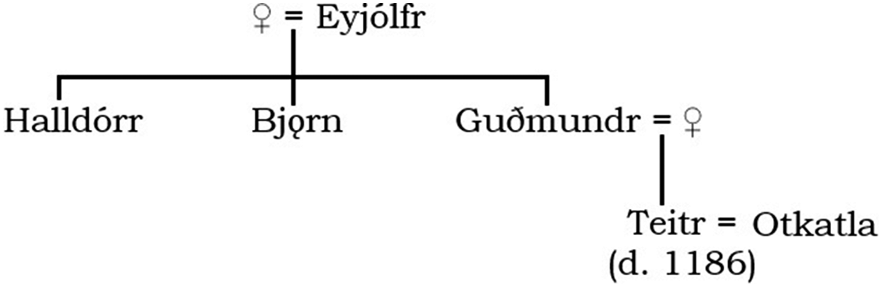
Unfortunately, here, too, the best-laid plans of nice old men came to naught. Young Teitr died prematurely, and an inheritance dispute broke out: “It was many people’s view that [Teitr’s] father should inherit the estate from him; but Guðmundr’s brothers, Björn and Halldórr, said that Guðmundr ought to get and enjoy no possessions since he was a monk.”Footnote 83 A father would normally inherit from a child who predeceased him, but a widower’s remarriage to the Church, these men reasoned, broke the chain of eligibility (see figure 3).Footnote 84 Soon more powerful predators smelled blood; the case passed from the hands of Teitr’s relatives to those of their respective overlords, who ended up dividing the spoils, leaving gristle for the original principals to gnaw on. In exchange for giving up his claim, Guðmundr received “little more than half its value,” while Björn and Halldórr withdrew, empty-handed. The family saw no clod of their patrimonial soil ever again.Footnote 85
Lineage of the monk Guðmundr Eyjólfsson in late-twelfth-century northern Iceland.

But the critical point to note is the specific stimulus for the squabble. It was not remarriage per se that sparked controversy. The anomaly in Guðmundr’s case, as in Bjǫrgólfr’s, was that a widower who had already stepped out of public life, formally renouncing control of family assets, unexpectedly found himself in a position to exercise authority anew. Both Bjǫrgólfr and Guðmundr follow an acceptable script for a bereaved husband, taking a new partner (be she mortal and curvaceous or glorious and everlasting) in lieu of the one they had lost; but both (and perhaps likewise Bjǫrn Brynjólfsson?) fracture the serenity of their family in the process. The debacle in Guðmundr’s case was unforeseeable; Bjǫrgólfr, in contrast, walks into it with eyes open, willfully courting calamity, as evinced by the very precautions he takes. All in vain.
The widower on the bridal path exposes a basic flaw in St Paul’s dictum for the laity (I Cor 7:9): a man might well opt to marry rather than burn; but what is he to do if the bonds of matrimony prove less durable than the fires of lust? Such a man, like the bereaved husband whose violence is no longer checked by his wife’s ameliorative influence, poses a danger to the gossamer cobwebs of social homeostasis. Moreover, whereas the widower on the warpath might usually vent his aggressions outward—even Snorri Sturluson’s fatal clash was with his former stepsons—the widower on the bridal path tends to rend his own (belatedly extended) familial fabric. As a literary type, then, the widower on the bridal path makes for good drama. As a cautionary tale about social realities, he articulates deep and genuine angst over the failure of retirees to sink quietly into oblivion, and their insistence on poaching resources—monetary, immovable, sexual—that the young see as belonging, by rights, to themselves.Footnote 86
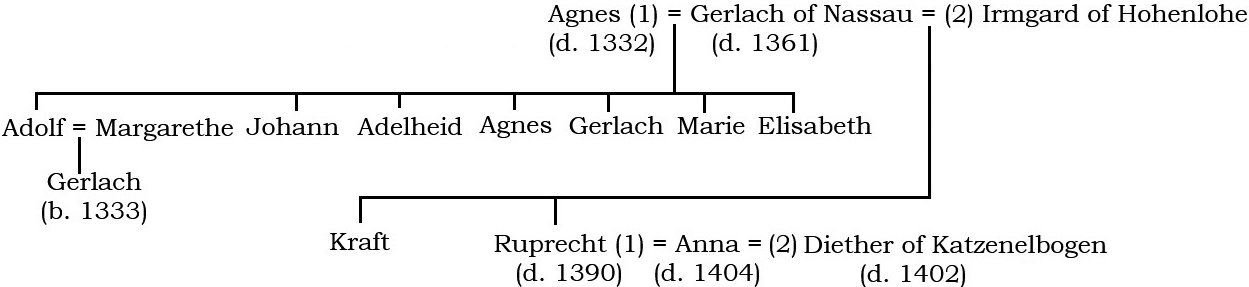
The thinly evidenced Icelandic ideal type can serve as a searchlight, playing its heuristic beam over shadowy historical analogues elsewhere—which, in turn, can bear out the pervasive and sinister reality behind the literary motif. Members of the late-medieval German aristocracy had an unusual lot to lose, and so tended to enforce an uncommonly stringent set of remarriage norms. Here, a man whose wife died was expected to refrain from remarrying if he had living sons, “because generative continuity had already been secured, and additional legitimate children would only put in place further impediments, on account of their claims for inheritance and maintenance.” An exception might be made if there were only one living son, since any individual life was too flimsy to ensure dynastic survival. But even in such cases, some widowers evidently “saw the existence of a single male heir as an opportunity for consolidation of the lordship”: thus, in 1477, a not-quite twenty-eight-year-old Phillip I of Hanau-Münzenberg and, in 1518, a thirty-six-year-old Phillip III of Hanau-Lichtenberg, whose respective sons were each under four at their mothers’ deaths, both remained unwed.Footnote 87 Karl-Heinz Spieß has studied over 300 marriages among this titled nobility; in only three was the imperative to remain single under such circumstances flaunted outright. One remarrying widower, Gottfried III of Eppstein (d. 1293), showed himself as farsighted as Bjǫrgólfr, and the precautions he took proved more effective: by preemptively cloistering the offspring of his second marriage to Setzele Fleming, he neutralized any threat they might pose to their elder half-brothers’ dynastic claims.Footnote 88 Others were less enterprising, less resolute, or less fortunate. Thus, before his wife Agnes died in 1332, Gerlach I of Nassau, born sometime between 1275 and 1283, had fathered three sons and four daughters who would survive to adulthood. By 1337, when Gerlach would have been 54–62 years old, he was already a grandfather (his eldest son Adolf having begot his own first son already in 1333).Footnote 89 These circumstances did not stop Gerlach from marrying Irmgard of Hohenlohe, who gave him two more sons (see figure 4). Gerlach’s advanced age, the five-year hiatus since Agnes’s decease, and the prevailing norm all hint that his second marriage was an unexpected reversal of earlier intentions to remain celibate. Gerlach’s decision to share power with his grown sons in 1344, followed by abdication outright in 1346, has long puzzled specialists.Footnote 90 Mismanaged widowerhood offers a persuasive key. Spieß correctly infers that it was “the tensions that arose in his family on account of his second marriage and the birth of further sons” that led him to take these steps. Gerlach lived to ripe old age, dying in 1361. But, much like the strife fomented by Hildiríðr’s sons, quarrels over the dower he had given Irmgard would long outlive all original principals, lasting for over sixty years and involving several shaky mediated agreements; eventually, the property was nearly alienated when the widow of one of Irmgard’s sons married a rival count.Footnote 91
Lineage of Gerlach I of Nassau in fourteenth-century Germany.

Bjǫrgólfr, Bjǫrn, Guðmundr, and Gerlach confirm that a widower who strolled down the bridal path—ignoring an explicit prior commitment to avoid remarriage (as in Norway and Iceland) or an implicit ban on such practice (as in Germany)—risked trading personal, short-term pleasures for catastrophic dynastic mayhem. The bill for such second weddings would be charged at usurious interest to his heirs’ overdrawn accounts. Precautions like those Gottfried took might avert disaster, albeit at the new beloved bride’s (and her future children’s) expense. Moreover—as Bárðr, Hildiríðr’s sons, and Þórólfr Kveld-Úlfsson painfully learned—safeguards were hardly foolproof. The bridal path might lead, by way of conjugal bliss, to gory internecine calamity.Footnote 92
The Widower’s Forked Paths
Ashes to ashes, dust to dust: a common lot awaits us all. Experientially, death can only be processed as cultural event when it befalls others, some of whom inevitably prove significant for the survivors. There is nothing remarkable, in other words, about Norse widowers’ condition per se. They—like any other segment of population I might have studied—are Everyman. Refracted through the prism of bereavement, their predicament sheds light on their culture’s specific concepts and customs of gendered conduct. Norse masculinity, as expressed by widowers on both war and bridal paths, comes in one flavor only: toxic.
Bereft of a spousal backstop, some Norse men simply lost it. These widowers laid about with incontinent fury, quite unlike the finely calibrated violence that characterized normal feuding behavior. For them, manly grieving amounted to disinhibition. Norse men are generally expected to greet sorrow with a stiff upper lip: “When Bárðr had spent one winter in Hålogaland, his wife Flaumgerðr dies, and it seemed to him the greatest of losses. Afterwards Bárðr courted Herþrúðr, the daughter of Count Hrólfr the Wealthy,” we hear in a characteristically laconic report.Footnote 93 For men like Gizurr Þorvaldsson, however, watching mangled corpses pulled from the smoldering ruins of his home in 1253, intemperance was the watchword. Gizurr identified the carbonized remains with forensic stoicism:
Isleifr Gizurarson was then borne out on a shield, and there was nothing left of him but the trunk, roasted inside [his] byrnie. Gróa’s torso was then found, too, and it was borne out on a shield to Gizurr. Then Gizurr spoke: “Kinsman Páll,” says he, “here you may now see Ísleifr, my son, and Gróa, my wife.” And Páll noticed that he looked away, and what fell from his face was like hailstones (stökk ór andlitinu sem haglkorn væri).
Gizurr proceeded to rain death on those responsible, and did not resheathe his sword until the unique, three-centuries-old polity Icelanders had cultivated lay prostrate at his feet. For the widower on the warpath, decorous masculine mourning calls for blood-curdling battle cries, not soulful sighs.Footnote 94
The sagas thematize this brand of virulent virility, confirming that the culture recognized widowerhood even if the language refused to name it. Censure of widowers on the warpath further attests to social policing efforts; the only thing unusual about the widespread opposition Gizurr’s campaign provoked was his success at quashing it. Others in a similar situation—grasping Snorri Sturluson, done to death in his cellar; Ögmundr Helgason, triumphant over his beheaded rivals but soon driven to penury; old, blind Þórarinn, alone in his smelly bed-closet—all meet push-back from their social circles or, at least, from omnipotent saga narrators. The widower on the warpath might be toxic masculinity incarnate, but his presence activates countervailing mechanisms that suggest Norse norms frowned on his excesses.
In contrast, Teddy Roosevelt, an outspoken proponent of pugnacious masculinity, would have countenanced the archetype (in theory) and was quite ready to inhabit it (in practice). Gizurr, Ögmundr, Snorri, Þórarinn: all expose a historically specific habitus; Teddy glitters in the beam they shine into the distance. Comparative study may, in turn, answer questions that the sagas leave open. How does a man’s age at the time he is widowed condition his response? The future twenty-sixth U.S. President was only twenty-five years old when he lost his wife; the future Earl of Iceland, forty-four. (Usually, we can only guess at Norse widowers’ ages.) And what impact might the manner of a woman’s death have on her husband? Would Gizurr have maintained more composure if Gróa had, like Alice Roosevelt, expired in bed rather than in a hellish blaze? Opacities in Norse materials can, perhaps, be tentatively illuminated by proxies from elsewhere.Footnote 95
Widowers on the bridal path, meanwhile, make genuine efforts to conform to normative expectations. They shoulder responsibilities, anticipate contingencies, and strive to ensure familial and social continuity; stepping graciously aside, they condemn themselves to a kind of social death. Some, like Þorsteinn the White, do so successfully. Almost by definition, however, the measure of success is that they disappear from our view. Those whose stories are deemed sagaworthy generally fail. Moreover, immolation of one’s social self—unlike widows’ suttee to accompany dead husbands—is reversible, and men are, as a rule, so accustomed to exercising agency that permanent sacrifice of their social persona proves more than many can endure.Footnote 96 Thus we see old Bjǫrgólfr and perhaps also Bjǫrn Brynjólfsson—and, oceans and centuries away, Gerlach—do the right thing, initially, only to apply for a do-over so they can screw everything up. (The price women like Hildiríðr or Setzele Fleming have to pay for the widower’s change of heart, it goes without saying, is regarded as inconsequential. Low-born and female, a second wife is viewed as a vehicle for fulfilling men’s designs, not as a subject in her own right. The widower’s debacle is relative to patriarchal propriety, and to his self-interested position within it.)
The tragedy of the widower on the bridal path is that he lives on. Having survived his spouse, he has to contend with her absence. The lens of bereavement studies clarifies what that means in practice.Footnote 97 In Bjǫrgólfr’s tale of retirement and reversal, we find a detailed portrayal of the deprivation that drives such men to undercut not only social norms but also what they recognize as their own and their children’s best interest. Even after he has decided to pursue Hildiríðr, Bjǫrgólfr twists and turns in his efforts to insulate his grown son from the consequences of his transgression: to separate his individual need for sex and companionship from his obligations toward family, and to safeguard their need for clean, clear lines of property and authority transmission. (Had Bjǫrgólfr ever heard of Gottfried III of Eppstein, he would doubtless have regarded him with admiration and envy.)
Bjǫrgólfr also establishes the richness of the widower’s internal, emotional landscape. His abuse of Hildiríðr and of her father, Hǫgni, pawns he callously pushes around, contrasts with his thoughtfulness in crafting a mechanism—ultimately unsuccessful, but nonetheless ingenious—for shielding Brynjólfr and Bárðr from his mercurial infatuation. A demi-giant caricature of masculine entitlement, Bjǫrgólfr may hardly be historically verifiable, but he nonetheless offers a finely drawn profile of a widower’s affective complexity. Inside toxic masculinity, too, a tender heart does beat.
The complexities and contradictions Bjǫrgólfr embodies remind us that archetypes—"toxic masculinity” no less than the widower on either path—are simplified models, not verbatim transcripts of experience. We may put them to probative use, but must resist reifying them. Archetypes draw attention to obscure patterns and help interpret difficult data; they are not skeleton keys. Thus Alfonso IV, king of León from 926, seemingly prefigures Guðmundr Eyjólfsson: when his queen died in 931, he abdicated, peacefully it seems, leaving the throne to his brother Ramiro II and opting for a monastic cell. The following year, however, he led a failed rebellion, which cost him his eyes and his liberty. Confined to a monastery once more, Alfonso died in 933.Footnote 98 The details are murky: we don’t know what had caused Alfonso’s change of heart in 932. Might some prospect of reinvigorated personal fortunes have lured this fickle monk back onto a bridal path?Footnote 99 Or did political intrigue, perhaps his cousins’ in Asturias, set him on the warpath?Footnote 100 That is a call specialists may be able to make—or, perhaps, need not bother with making. Rather than classify Alfonso precisely, the typology I have proposed may demonstrate its greatest utility simply by showcasing the structural volatility of his predicament.
Finally, then, the monk Guðmundr illuminates how toxicity may erupt through no fault of one’s own. This widower sought to please both God and men, fashioning a sustainable solution for himself and his kindred, and “[t]his was to everyone’s liking.” Left to his own devices, Guðmundr would have paid both Peter and Paul—and not even at the expense of some oppressed, suppressed woman. His son’s premature death was an unpredictable stroke of misfortune, which the greed of others—Guðmundr’s brothers and, later, their chieftains—weaponized into a pretext for rending the family’s peace. Icelanders, Miller has noted, had a nose for reopening seemingly settled grievances, reframing them retroactively as matters of contemporary concern and rekindling feuding embers that had long since been doused: “[There was] no way of fixing any particular action as either a wrong or a nonevent. [S]omething dismissed originally as of no account could be recalled [as] an unrequited wrong.… [T]he past was a rich reservoir of inherently ambiguous events rife for being reunderstood.”Footnote 101 The sorrows that befell Teitr’s heirs demonstrate how this nose for mischief could likewise redefine a widower’s spiritual remarriage, turning it from a wholesome settlement for the solace of the soul and the sustenance of the body into a sordid saunter down the thorny bridal path.
Acknowledgments
My deepest gratitude to colleagues who commented on drafts, offered references, and shared copies of unpublished work: Joel Anderson, Mark Bradley, Eiríkur Rögnvaldsson, Alison Finlay, Chiara Formichi, Heather Furnas, Andy Galloway, Wayne Harbert, Drew Hicks, Helgi Þorláksson, Tom Hill, Jóhanna Katrín Friðriksdóttir, Max McComb, Matt McConnell, Kristen Mills, Larry Moore, Mary Beth Norton, Basil Arnould Price, Natasha Raheja, Eric Shuler, Suyoung Son, Abby Sprenkle, Pauline Stafford, Peidong Sun, and Mike Twomey, as well as several anonymous readers.

 Open access

