

Introduction
Many global challenges of today result from the overuse and depletion or destruction of natural resources. Examples are climate change due to the release of greenhouse gasses in the air, widespread grassland degradation due to overgrazing in pastoral areas, and the loss of biodiversity as a result of intensified agricultural production methods. Possible solutions to this tragedy of the commons include government intervention through state control or regulations (as proposed by Hardin, Reference Hardin1968) and community governance (as proposed by Ostrom, Reference Ostrom1990). The implementation of agri-environmental policies in the Netherlands combines both types of solutions.
The relation between agriculture and the environment is complex, with agricultural production being dependent on natural resources but, at the same time, also endangering the environment through activities that cause pollution and biodiversity loss. Agri-environmental schemes (AES) target this complex relationship by offering compensation payments from the EU rural development fund to farmers who implement management practices with environmental benefits. In recent years, AES are increasingly criticised for being ineffective in achieving landscape-level outcomes (Kleijn et al., Reference Kleijn, Baquero, Clough, Diaz, De Esteban, Fernández and Jöhl2006; Pe’er et al., Reference Pe’er, Dicks, Visconti, Arlettaz, Báldi, Benton and Hartig2014). This ineffectiveness can be explained by the traditional target of AES being the farm level, while many ecosystem services (such as for migratory bird conservation) are only achievable at the landscape level (Prager et al., Reference Prager, Reed and Scott2012; Toderi et al., Reference Toderi, Francioni, Seddaiu, Roggero, Trozzo and D’Ottavio2017; Westerink et al., Reference Westerink, Melman and Schrijver2015). To improve AES effectiveness, moving from a fragmented, farm-level approach to a landscape-level approach is necessary. This requires mechanisms that enhance the spatial coordination of conservation efforts across farmland owners.
Several studies have pointed to the importance of institutional configurations for the successful implementation of agri-environmental measures (for instance, Mettepenningen et al. (Reference Mettepenningen, Vandermeulen, Delaet, Van Huylenbroeck and Wailes2013) and Runhaar et al. (Reference Runhaar, Melman, Boonstra, Erisman, Horlings, de Snoo, Termeer, Wassen, Westerink and Arts2017)). Some studies have focused on incentive mechanisms that are designed to boost the spatial coordination of conservation efforts (see Nguyen et al. (Reference Nguyen, Latacz-Lohmann, Hanley, Schilizzi and Iftekhar2022) for a review). Bazzan et al. (Reference Bazzan, Candel, Daugbjerg and Pecurul2022, Reference Bazzan, Candel and Daugbjerg2023) find that farmer participation in the policy design process leads to more successful implementation of ecosystem delivery measures. The potential of collaborative governance mechanisms, where farmers and other stakeholders are included in the planning of the scheme, is also investigated by others (Banerjee et al., Reference Banerjee, Cason, de Vries and Hanley2017; Huber et al., Reference Huber, Zabel, Schleiffer, Vroege, Brändle and Finger2021; Kuhfuss et al., Reference Kuhfuss, Préget, Thoyer and Hanley2016). Huber et al. (Reference Huber, Zabel, Schleiffer, Vroege, Brändle and Finger2021) show that these collaborative schemes are more effective in creating conservation synergies than schemes that do not facilitate collaboration. Besides participation in the policy design process, authors also acknowledge the importance of collaboration in the implementation of policies, especially for achieving spatial coordination of measures at the landscape level. Smits et al. (Reference Smits, Driessen and Glasbergen2008) describe the need for horizontal cooperation between farmers to address externalities of individual farmers’ actions; Westerink et al. (Reference Westerink, Jongeneel, Polman, Prager, Franks, Dupraz and Mettepenningen2017) argue for adaptive, collaborative governance that incorporates learning, monitoring, and evaluation in governance arrangements as key to the effectiveness of agri-environmental management. For this reason, attention is growing in recent years for the collective implementation of AES in the Netherlands.
The Dutch AES are based on fixed, individual payments to compensate farmers for costs and foregone revenues from environmental efforts. As in conventional AES, no incentive payments are available to improve the spatial coordination of environmental management practices across individual farmlands. However, spatial coordination is achieved through agri-environmental collectives that act as spatial coordinators of the environmental efforts in their territory, and farmers who want to participate in AES have to become a member of their local collective (Splinter and Dries, Reference Splinter and Dries2024; Terwan et al., Reference Terwan, Deelen, Mulders and Peeters2016). Since 2016, agri-environmental collectives have become an integral part of the implementation of AES policy in the Netherlands. They form the connection between the national government (macro-level) on the one hand and the collectives’ farmer members (micro-level) on the other. Following Menard (Reference Menard2022, p. 1724), the Dutch agri-environmental collectives therefore provide an example of a meso-institution, defined as ‘devices and mechanisms that implement and adapt the rules and norms that connect the macro- and micro-institutional layers’.
The main hypothesis that is investigated in this paper is that the effectiveness of AES in the Netherlands has improved since the introduction of the collective approach and that the meso-institutional functions performed by the collectives provide the mechanisms to achieve this result. Therefore, the paper has two main objectives. First, we aim to disentangle the functions performed by the collectives through a meso-institutional lens. Several studies have applied the concept of meso-institutions to issues of food quality and safety (Menard et al., Reference Menard, Martino, Magalhães de Oliveira, Royer, Macchione Saes and Bigio Schnaider2022; Oliveira et al., Reference Oliveira, Miranda, Saes and Martino2023; Rouvière and Royer, Reference Rouvière and Royer2017; Soregaroli et al., Reference Soregaroli, Varacca, Ricci, Platoni, Tillie and Stranieri2022). An application in the context of environmental policy is largely missing. Besides contributing to the academic literature on meso-institutions, the first objective of the paper also contributes to an improved understanding of the institutional configurations that bridge the macro- and micro-layers in environmental policy implementation. The second aim of the paper is to assess whether the effectiveness of AES in the Netherlands has improved since the introduction of the collective approach. As such, the paper contributes to the literature linking institutional configurations to AES performance (Bazzan et al., Reference Bazzan, Candel, Daugbjerg and Pecurul2022, Reference Bazzan, Candel and Daugbjerg2023), and it provides insights into the potential mechanisms through which AES success is achieved (adding, among others, to Smits et al. (Reference Smits, Driessen and Glasbergen2008) and Westerink et al. (Reference Westerink, Jongeneel, Polman, Prager, Franks, Dupraz and Mettepenningen2017)). Such mechanisms can be identified in the meso-institutional functions that the collectives perform, and through which they influence farmers’ behaviour both directly, by stimulating farmers’ compliance, and indirectly by providing information and technical advice.
To reach the paper’s objectives, we use a case study of one of the Dutch collectives and a mixed-methods approach that includes a literature review, semi-structured interviews, and a quantitative assessment of changes in farmers’ participation, contracted hectares and applied AES measures in the territory of the case-study collective before and after the introduction of the collective approach. To limit the scope of the study, the paper will assess the effectiveness by focusing on the spatial coordination of AES farm management practices for meadow bird conservation, the main AES in the Netherlands according to Westerink et al. (Reference Westerink, Melman and Schrijver2015). This means that we will not assess actual changes in bird numbers over time. Furthermore, our analysis will not attempt to provide evidence of a causal link between the collective’s meso-institutional functions and the improvement in spatial coordination. These questions remain relevant for follow-up research that should aim to overcome current data limitations and complex issues related to self-selection and endogeneity (Hanley and White, Reference Hanley and White2014).
The next section provides the conceptual background to the study. This includes a brief background to AES and the Dutch collective approach, a discussion of the effectiveness and the link to spatial coordination in the context of meadow bird conservation, and the meso-institutional framework. Section three will describe the methodology. The final sections provide the results and a discussion of the results and conclusions.
Conceptual framework
Background on collective agri-environmental schemes in the Netherlands
At the macro-institutional level, AES are embedded in directives and regulations at the EU and the national level. Specifically for bird conservation, relevant EU rules include the Habitats Directive (Council Directive 92/43/EEC) and the Birds Directive (Directive 2009/147/EC). In contrast to EU regulations, which have binding legal force in every member state, Directives lay down certain results that must be achieved, giving each member state the freedom to decide how to translate directives into national laws. At the national level, in the Netherlands, the requirements of the Birds and Habitats Directives are incorporated in the Nature Conservation Act (Dutch: Wet Natuurbescherming).
The second relevant set of rules at the macro-institutional level is the common agricultural policy (CAP) of the EU, which sets out the conditions and requirements for member state support for rural development, including support for agri-environmental schemes. The legal basis for the common agricultural policy is established in the Treaty on the Functioning of the European Union (2012/C 326/01, consolidated version). Specific regulations that apply to AES (in the period 2014–2020)Footnote 1 are Regulation (EU) 1305/2013 on support for rural development, and Regulation (EU) 1306/2013 on the financing, management, and monitoring of the CAP. AES fall under the rural development (2nd) pillar of the CAP, as opposed to the eco-schemes that were introduced in the new CAP (2023–2027). While eco-schemes build on existing AES measures (Runge et al., Reference Runge, Latacz-Lohmann, Schaller, Todorova, Daugbjerg, Termansen, Liira, Le Gloux, Dupraz, Leppanen, Fogarasi, Vigh, Bradfield, Hennessy, Targetti, Viaggi, Berzina, Schulp, Majewski and Velazquez2022) and both AES and eco-schemes are voluntary for farmers to adopt, eco-schemes are fully funded from the CAP budget while AES require co-financing from national budgets.
Collaborative agri-environmental management has a long history in Dutch grassland areas, with evidence of the first farmer groups integrating agricultural activities and biodiversity conservation in the 1970s (Westerink et al., Reference Westerink, Jongeneel, Polman, Prager, Franks, Dupraz and Mettepenningen2017). The first local (agri-)environmental cooperatives in the Netherlands appeared in the early 1990s (Westerink et al., Reference Westerink, Termeer and Manhoudt2020). Van der Ploeg (Reference Van der Ploeg2021) describes how these initial agri-environmental cooperatives developed as a reaction to a new regulatory scheme (the Ecological Directive) that aimed to protect the natural environment from acidification caused by agricultural practices. Especially farmers in the northern province of Friesland would be affected by the new regulation because natural elements – such as hedgerows and waterways – were abundant in the Friesian agricultural landscape and the imposed restrictions could have severe implications for agricultural practices. A counter-proposal of local farmers to the government led to the establishment of the first agri-environmental cooperatives that acquired a certain degree of self-governance to maintain the landscape and biodiversity and reduce ammonia emissions in the region. Other farmer groups followed the Friesian example and, by 2015, the Netherlands had 160 agri-environmental cooperatives for nature and landscape management (Terwan et al., Reference Terwan, Deelen, Mulders and Peeters2016; Van der Ploeg, Reference Van der Ploeg2021).
Further scaling up of the approach followed with the 2013 EU Rural Development Regulation (Regulation (EU) No 1305/2013, Article 28), which provided the Dutch agri-environmental collectives official policy status, also at the EU level. Since this regulation introduced the option of group applications for agri-environmental measures, the Dutch government decided to exclusively implement AES through joint applications, and as of 2016, individual applications by farmers are no longer allowed. While the EU regulation only refers to the possibility of applications by ‘groups of farmers’, the Dutch government has explicitly required that these groups have to organise themselves in legal entities, which are certified as professional conservation organisations. This condition is not imposed by the EU but is meant to provide adequate proof of establishing a set of ‘internal rules’ by the group applying for agri-environmental support (Terwan et al., Reference Terwan, Deelen, Mulders and Peeters2016).
The Netherlands is currently the only EU member state where agri-environmental measures are being implemented through regional, agri-environmental collectives for the whole country.Footnote 2 Agri-environmental collectives are local, farmer-based associations, and their members comprise farmers and other private persons who own land (Barghusen et al., Reference Barghusen, Sattler, Deijl, Weebers and Matzdorf2021). Each of the 40 certified collectives in the Netherlands is responsible for implementing AES in its own territory. The borders of these territories were laid down at the start of the collective AES approach in 2016 so that each farm has a single collective as a reference point (Terwan et al., Reference Terwan, Deelen, Mulders and Peeters2016). The collectives cover the entire country and many farmers are already familiar with collectives as an integral part of the ‘social structure’ of the Dutch countryside (Terwan et al., Reference Terwan, Deelen, Mulders and Peeters2016).
Effectiveness and spatial coordination of AES measures
Policy effectiveness requires that the policy achieves its goals and, therefore, the specific objectives of a policy strongly determine its success. Meadow birds are the main contribution of Dutch farmland to biodiversity according to Westerink et al. (Reference Westerink, Melman and Schrijver2015). This explains why, compared to earlier AES programmes, the programme for the period 2016–2021 focuses more on the international obligations regarding nature and species protection following the EU Birds and Habitats Directive (Boonstra et al., Reference Boonstra, Nieuwenhuizen, Visser, Mattijssen, van der Zee, Smidt and Polman2021), and farmland birds in particular (Terwan et al., Reference Terwan, Deelen, Mulders and Peeters2016).
While evidence of the impact of specific conservation efforts on farmland birds and biodiversity, in general, is still limited (Kleijn et al., Reference Kleijn, Rundlöf, Scheper, Smith and Tscharntke2011), several authors claim the need for enhancing the heterogeneity of farmlands from within individual fields to whole landscapes (Benton et al., Reference Benton, Vickery and Wilson2003; Schotman et al., Reference Schotman, Melman, Meeuwsen, Kiers and Kuipers2005; Westerink et al., Reference Westerink, Melman and Schrijver2015). Habitat heterogeneity is considered a major factor promoting the abundance and diversity of farmland wildlife (Salek et al., Reference Salek, Hula, Kipson, Daňková, Niedobová and Gamero2018) and a combination of different types of semi-natural habitats is said to deliver the greatest conservation benefits for biodiversity in agricultural landscapes (Salek et al., Reference Salek, Kalinová and Reif2022). In the Netherlands, this is referred to as mosaic management (Beintema et al. Reference Beintema, Moedt and Ellinger1995), requiring the purposeful planning of the spatial distribution of agri-environmental management measures at a landscape level (150–650 ha) rather than an individual farm level (50–60 ha) (Oosterveld et al., Reference Oosterveld, Nijland, Musters and de Snoo2010).
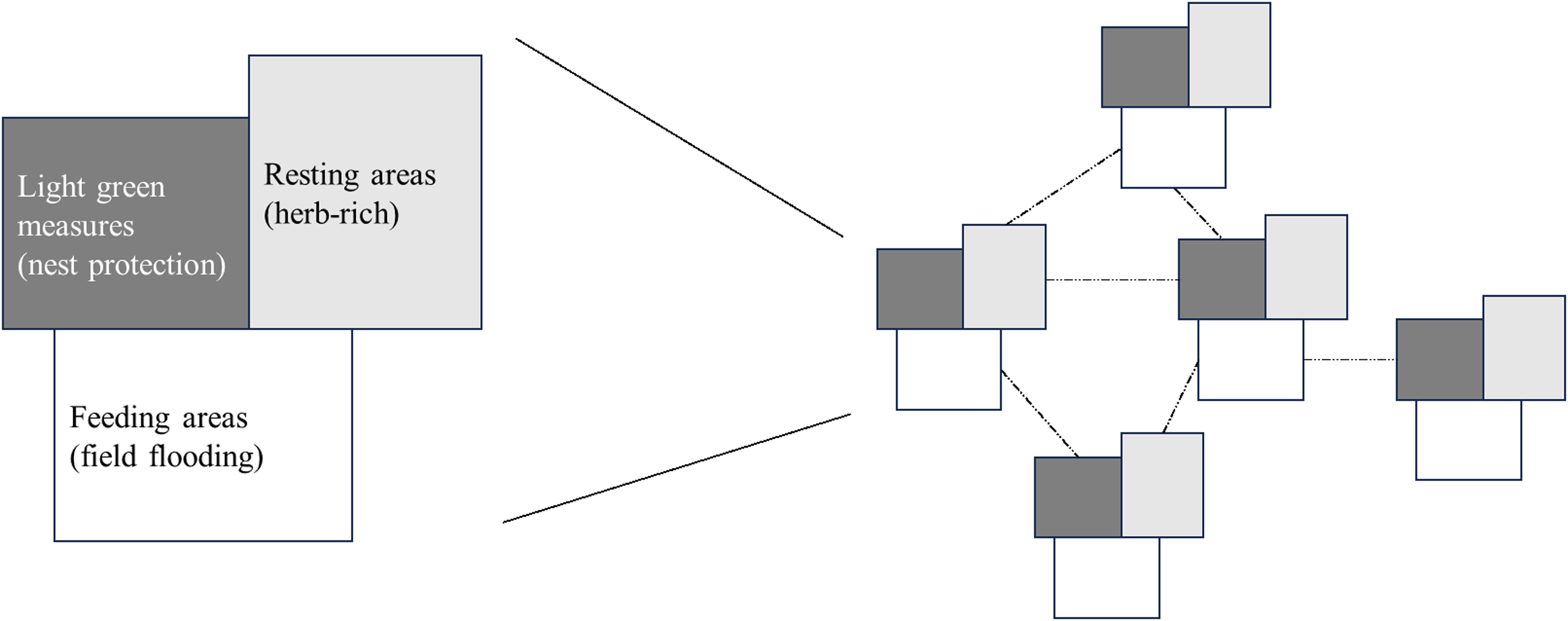
A core task of the agri-environmental collectives is to coordinate the planning and spatial coordination of AES measures in the landscape mosaics (Terwan et al., Reference Terwan, Oosterveld, de Ruiter and Guldemond2003). To this end, collectives first decide (within their territory) which areas are best suited for targeting the specific environmental goal of meadow bird conservation. Once the areas are identified, only farmers in these specific areas are allowed to enter the AES for meadow bird conservation (and only these farmers can receive payments for their environmental efforts). Figure 1 provides a schematic representation of a landscape mosaic for bird conservation (right-hand side of the figure). The three rectangles (left-hand side of the figure) – that are repeated several times within the same mosaic – each represent an area with different landscape elements, and hence different farm management practices, that can be contracted in AES.
Representation of a landscape mosaic for bird conservation – a central tool for spatial coordination by the collectives.
Source: Own representation
Notes: Field flooding, herb-rich grassland, and nest protection are different farmland management practices that can be contracted in AES, each fulfilling a different ecological function for conserving birds (areas where birds can feed on insects, where birds can rest, and where bird nests are protected). The dashed lines between the rectangles indicate that the distance between the different types of AES should be small enough for birds to freely move between the different habitats in a mosaic.
AES are voluntary schemes, which means that the effectiveness of AES also greatly depends on the willingness of farmers to participate. By the end of the 2014–2020 CAP programming period, the area committed to AES in the EU amounted to 22.5% of the utilised agricultural area (Hasler et al., Reference Hasler, Termansen, Nielsen, Daugbjerg, Wunder and Latacz-Lohmann2022). Several studies have investigated the drivers of farmer participation in AES (see, e.g. Buschmann et al. (Reference Buschmann, Narjes and Röder2023) and Hasler et al. (Reference Hasler, Termansen, Nielsen, Daugbjerg, Wunder and Latacz-Lohmann2022) for an overview). Lastra-Bravo et al. (Reference Lastra-Bravo, Hubbard, Garrod and Tolón-Becerra2015) identify economic factors, farm and farmer characteristics, and farmer attitudes towards AES and the environment as important drivers. Zimmerman and Britz (Reference Zimmerman and Britz2016) claim that AES adoption is lower in high-intensity farming systems, even if compensation payments are higher than in low-intensity systems. Others point to the importance of social motivations, and, in particular, social motivations to cooperate (Barghusen et al., Reference Barghusen, Sattler, Deijl, Weebers and Matzdorf2021; Kuhfuss et al., Reference Kuhfuss, Préget, Thoyer and Hanley2016). Other factors are the institutional configuration and design features of AES: flexibility in implementation (Bartkowski et al., Reference Bartkowski, Beckmann, Bednář, Biffi, Domingo-Marimon, Mesaroš, Schüßler, Šarapatka, Tarčak, Václavík, Ziv and Wittstock2023; Bazzan et al., Reference Bazzan, Candel, Daugbjerg and Pecurul2022; Christensen et al., Reference Christensen, Pedersen, Nielsen, Mørkbak, Hasler and Denver2011; Hasler et al., Reference Hasler, Termansen, Nielsen, Daugbjerg, Wunder and Latacz-Lohmann2022; Mettepenningen et al., Reference Mettepenningen, Vandermeulen, Delaet, Van Huylenbroeck and Wailes2013); incentives (Nguyen et al., Reference Nguyen, Latacz-Lohmann, Hanley, Schilizzi and Iftekhar2022); trust-building mechanisms and the potential for social learning (Bazzan et al., Reference Bazzan, Candel and Daugbjerg2023; Westerink et al., Reference Westerink, Jongeneel, Polman, Prager, Franks, Dupraz and Mettepenningen2017). Runhaar et al. (Reference Runhaar, Melman, Boonstra, Erisman, Horlings, de Snoo, Termeer, Wassen, Westerink and Arts2017), however, also point to a potential trade-off that exists between the scope of a scheme (farmers’ willingness to participate) and its ambition or impact. Westerink et al. (Reference Westerink, Melman and Schrijver2015) make a similar point when they observe that AES measures that require simple changes in farm management (e.g. a delayed mowing date) are easily adopted by farmers but have a limited impact on farmland birds; while measures that have a major impact on farming systems (e.g. field flooding) could be more effective but are less likely to be adopted.
The meso-institutional framework
The agri-environmental collectives in the Netherlands are expected to contribute to both the scope (by affecting the drivers of farmers’ participation) and the impact of AES in the Netherlands (by coordinating the landscape mosaics for bird management). To investigate the institutional configuration of the collectives, we use the meso-institutional framework and elaborate on the meso-institutional functions that are performed by the collectives. Meso-institutions involve the transmission mechanisms that link the macro-layer of institutions (where rights are established through rules and norms that can be formal or informal) and the micro-layer of institutions (where transactions are organised and resources are allocated) (Menard, Reference Menard2022). Meso-institutions are the arrangements through which rules and rights are interpreted and implemented and the domain of possible transactions among stakeholders is framed (Menard, Reference Menard2017). They play a crucial role in allocating rights and in determining transaction costs (Menard, Reference Menard2014).
The concept of meso-institutions holds a resemblance to the concepts of multilevel governance (especially type II), developed by Hooghe and Marks (Reference Hooghe and Marks2003), and polycentric governance as described by Ostrom (Reference Ostrom2010). These concepts were developed in different contexts. Hooghe and Marks have looked at vertical and horizontal coordination among different levels of government in the context of the European Union and regional governance. Ostrom’s polycentric governance concept was developed in the context of common pool resources, where she described multiple centres of decision-making whose authorities partly overlap. While similarities can be found between these perspectives, the meso-institutional framework adds value through its concrete focus on and disentanglement of the functions and tasks performed by meso-institutions.
Following Menard et al. (Reference Menard, Martino, Magalhães de Oliveira, Royer, Macchione Saes and Bigio Schnaider2022), Table 1 shows the three fundamental functions and the subsequent tasks of meso-institutions. The first fundamental function is to translate the general rules and norms established at the macro-level to the specifics of a sector, timeframe, and locality. This function may include the adaptation of rules and norms and the provision of information, guidelines, or training to micro-level actors. The second fundamental function is to monitor the implementation of the (translated) rules and norms. This may involve the establishment of protocols or procedures for actors to facilitate the control of their compliance with the rules. The third fundamental function is the enforcement of the rules. This requires the empowerment of meso-institutions to use enforcement tools (such as punishments and rewards) to incentivise actors to conform to the rules and to provide feedback to policymakers about possible misalignments.
Meso-institutions, functions, and tasks
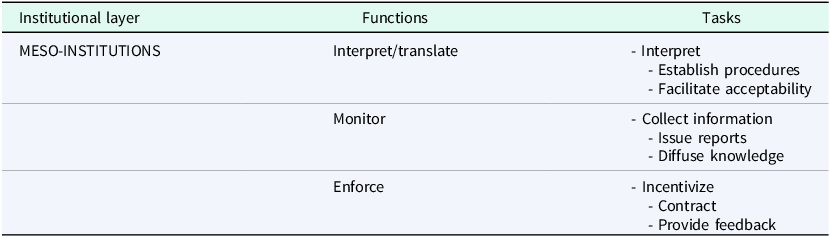
Source: Adapted from Menard et al. (Reference Menard, Martino, Magalhães de Oliveira, Royer, Macchione Saes and Bigio Schnaider2022).
Methodology
Case-study approach
This research is based on a case study of one of the 40 collectives in the Netherlands: Noardlike Fryske Walden (NFW). NFW is located in the province of Friesland in the north of the Netherlands. The majority of the territory of the collective consists of grasslands used for dairy production, which is the main management area for bird conservation. NFW is an example of a bottom-up collective according to Barghusen et al. (Reference Barghusen, Sattler, Berner and Matzdorf2022) that was active already before the initiation of the collective AES approach in 2016. Van der Ploeg (Reference Van der Ploeg2021) even claims that NFW is the predecessor of some of the initial agri-environmental cooperatives that were established in Friesland in the early 1990s. With the start of the collective approach to AES, the collective NFW that exists today was established as a merger of five local agri-environmental associations. While NFW builds on previously existing organisations, Barghusen et al. (Reference Barghusen, Sattler, Berner and Matzdorf2022) also identify top-down collectives in the Netherlands that were newly created with the launch of the collective AES programme. It can be expected that NFW has benefited from its experience prior to 2016, as compared to some of the newly established collectives in terms of transaction costs for organising, contacting, and contracting with farmers in their territory and implementing the collective AES in general. NFW is therefore regarded as a frontrunner collective, which is one of the reasons for its selection as a case study.
We use several sources of information to disentangle the functions of the collective from a meso-institutional perspective. The first source of information is the website of the public executive organisation BIJ12, which supports the provincial government with AES (BIJ12, n.d.). The website lists all the public and private actors involved in AES and their responsibilities. This helps to identify the relevant stakeholders and their roles in AES. The information from BIJ12 was complemented and extended by conducting semi-structured interviews between October 2020 and March 2021, and during a study visit to the collective in April 2023, to establish a complete list of activities carried out by the collective and other stakeholders. In total, 11 interviews were conducted: (i) two representatives of the province of Friesland; (ii) two representatives from the national paying agencyFootnote 3 ; (iii) one current and one former board member and director of the collective NFW; (iv) a theme coordinator for meadow bird management of the collective NFW; (v) three dairy farmers who have a meadow bird AES contract with the collective NFW; (vi) a volunteer connected to NFW, the so-called bird management director. Due to COVID-19, travelling and meeting in person were restricted for the interviews in 2020 and 2021, and most interviews were conducted via telephone or MS Teams (except for in-person interviews with two farmers and the former NFW board member, and the interviews with the current director and the theme coordinator during the study visit in 2023). The interviews were recorded but not transcribed, and we did not perform a comprehensive content analysis.
Spatial analysis
To assess the effectiveness of the collective approach in terms of the spatial coordination of AES measures, GIS data on the registered measures for the meadow bird scheme was obtained from the collective NFW for the period 2016–2021 and from the paying agency and the province for the period 2009–2016. We compare landscape mosaics before and after the introduction of the collective approach (in 2016). First, a qualitative comparison is made for the different mosaics of NFW. Second, we perform a quantitative assessment for the mosaics using Global Moran’s I statistic, to check for a change in the pattern of implemented measures since 2016. Global Moran’s I was first described by Moran (Reference Moran1950) and is widely used to test for spatial autocorrelation (Getis and Ord, Reference Getis and Ord1992).
Global Moran’s I is defined as:
 $$I\; = {{N}\over{W}}\;{{{\mathop \sum \nolimits_{i = 1}^N \mathop \sum \nolimits_{j = 1}^N {w_{ij}}({x_i} - \bar x)\left( {{x_j} - \bar x} \right)}}\over{{\mathop \sum \nolimits_{i = 1}^N {{\left( {{x_i} - \bar x} \right)}^2}\;}}}$$
with $N$
the number of spatial units indexed by
$N$
the number of spatial units indexed by $i$
and
$i$
and $j$
,
$j$
, $x$
the attribute value of interest,
$x$
the attribute value of interest, $\bar x$
the mean of
$\bar x$
the mean of $x$
, and
$x$
, and ${w_{ij}}$
the spatial weights.
${w_{ij}}$
the spatial weights.
The interpretation of Moran’s I statistic is as follows: (i) Moran’s I close to 0 implies a random pattern, (ii) Moran’s I close to 1 implies clustering of similar values, and (iii) Moran’s I close to -1 implies a dispersed pattern, or dissimilar neighbouring values (see Figure 2). Hence, clustering is associated with a positive score and dispersion with a negative score. Applications are found in Kumari et al. (Reference Kumari, Sarma and Sharma2019), who studied the spatial pattern of land surface temperature in relation to land use and cover in the vicinity of a thermal power plant, and Getis and Ord (Reference Getis and Ord1992), who compared the spatial autocorrelation of infant death rates for the counties in North Carolina in the USA.
Detecting autocorrelation patterns with Moran’s I.
Source: Own representation
Notes: The range of the Moran’s I statistic lies between -1 and 1. Displayed are the two extreme patterns that can be detected. The right side of the figure shows a dispersed pattern. In this case, Moran’s I takes on a value close to -1. In the case of clustering of similar values, as shown on the left, Moran’s I takes on a value close to 1.

To apply Moran’s I in our case study, an attribute value $x$
is created that refers to the contracted AES measures. An index from 1 to 7 is defined according to the intensity of the measures, that is, how much a measure restricts regular farm activities (Appendix A1)Footnote
4
. Each contracted measure is assigned a value, with 1 associated with the lightest green measure of nest protection (no restrictions to the grassland) and 7 with the darkest green measure of field flooding (full restriction). In addition, it is of importance how neighbours are defined. The analysis was performed using the geoprocessing tool in ArcGIS Pro with the ‘continuity edges corner’ option. This option considers fields with shared sides or corners as neighbours and assigns them a weight 1, and all other fields receive weight 0 (hence, w_ij is either 0 or 1).
$x$
is created that refers to the contracted AES measures. An index from 1 to 7 is defined according to the intensity of the measures, that is, how much a measure restricts regular farm activities (Appendix A1)Footnote
4
. Each contracted measure is assigned a value, with 1 associated with the lightest green measure of nest protection (no restrictions to the grassland) and 7 with the darkest green measure of field flooding (full restriction). In addition, it is of importance how neighbours are defined. The analysis was performed using the geoprocessing tool in ArcGIS Pro with the ‘continuity edges corner’ option. This option considers fields with shared sides or corners as neighbours and assigns them a weight 1, and all other fields receive weight 0 (hence, w_ij is either 0 or 1).
We expect that the individual approach will show more positive scores (indicating clustering) than the collective approach, which aims to increase the heterogeneity of implemented measures, and therefore should show less clustering of similar measures.
Results
Meso-institutional functions of the collective NFW
Table 2 shows the different meso-institutional functions performed by NFW and the specific tasks connected to each function. The collective has created some very specific rules and procedures in support of the implementation of the AES scheme. An example is the monitoring system that was developed (see Table 2). As a member of the board of the collective stated: ‘We have no problem finding volunteers among our farmers to do this kind of monitoring. Farmers enjoy visiting each other’s fields, to learn and to provide advice’. This shows the willingness of farmer members to be engaged in the implementation of the rules of the collective, and also points to the trust they have in the internal monitoring system.
Meso-institutional functions and tasks of the collectives
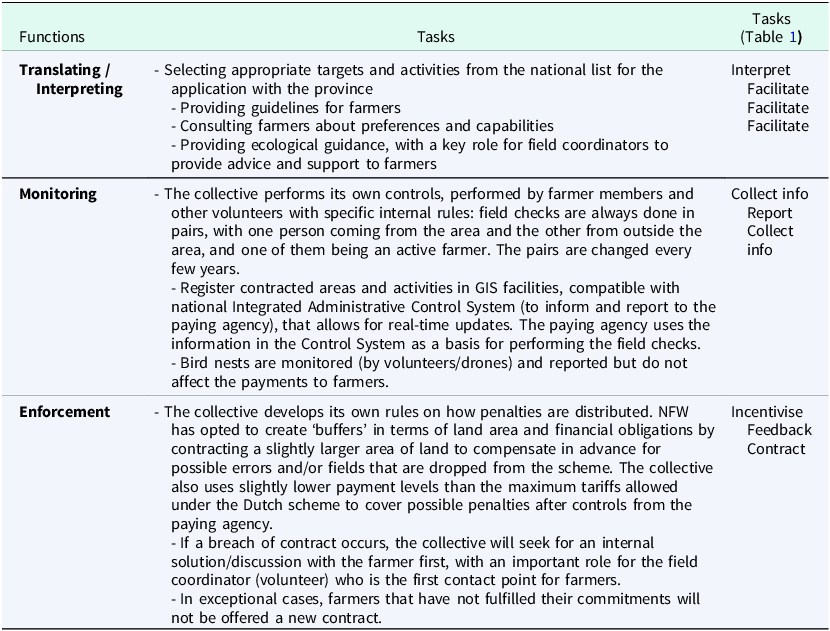
Source: Terwan et al. (Reference Terwan, Deelen, Mulders and Peeters2016), Splinter and Dries (Reference Splinter and Dries2024) and interviews.
There are also unique rules with respect to enforcement in the collective, for instance, procedures for the distribution of penalties among farmer members. The collectives are the direct beneficiaries of the AES payments. This means that the paying agency pays the full amount of the AES subsidy to the collectives, who then redistribute the amount among their contracted farmer members. Likewise, penalties for individual breaches of the contracted commitments of farmers are not imposed directly by the paying agency on the farmer, but on the collective. The collective can then decide how to distribute the penalty between its members. It can impose the penalty 1:1 on the farmer involved, or decide on a different approach (Terwan et al., Reference Terwan, Deelen, Mulders and Peeters2016). NFW has created a financial buffer so that penalties can be absorbed and are not charged to individual farmer members. Rather than penalties, NFW uses informal ways to motivate compliance of its members with AES contracts. Specifically, the collective and the volunteers that have a close relationship with the farmers, talk to farmers about the reasons for possible negative outcomes of the controls, and they try to persuade farmers to uphold the rules. There is also a general agreement that the rules as laid down in the macro-level AES requirements sometimes offer insufficient flexibility leading to a perception of unfair penalties. If official controls lead to penalties that are deemed unfair, then these penalties are paid from the collective’s financial buffers. This offers another example of how the collective uses its meso-institutional functions to engage its farmer members and influence their behaviour.
Spatial coordination – qualitative analysis
As explained in Section 2.2, habitats for meadow birds are formed by creating landscape mosaics or patterns of alternating light green and dark green measures. Light green measures are used to protect nests, while dark green measures include resting and herb-rich areas as well as wet areas for foraging. Dark green measures have a more drastic influence on the productivity of the grasslands and are therefore compensated more through higher AES payments. The farmer collective NFW has created fifteen mosaics that differ in size. Table 3 shows the total area under contract and the number of farmers that implement measures in each of the collective’s mosaics, at the start of the collective approach in 2016 and at the end of the six-year programme cycle in 2021. In 2016, NFW started with 168 farmers participating in the meadow bird scheme. In the same year, the total area that was contracted under the meadow bird scheme added up to 2812 ha.Footnote 5 In December 2021, the number of participants had grown to 206 and the contracted area to 3515 ha. The data further shows that participants either increased the hectares contracted with existing measures or increased the number of measures they contracted. In 2016, 20 different measures were chosen, while by the end of 2021, all 36 available measures were selected by the participants. For illustration, Appendix A2a and A2bFootnote 6 show mosaics 1 and 2 for the period before the collective approach and the period after the start of the collective approach, respectively. Two observations are apparent, namely, the decrease in total hectares contracted and a clear increase in contracts with dark green measures (red areas), that receive higher compensation payments.
Participants and total AES area contracted by NFW, 2016–2021
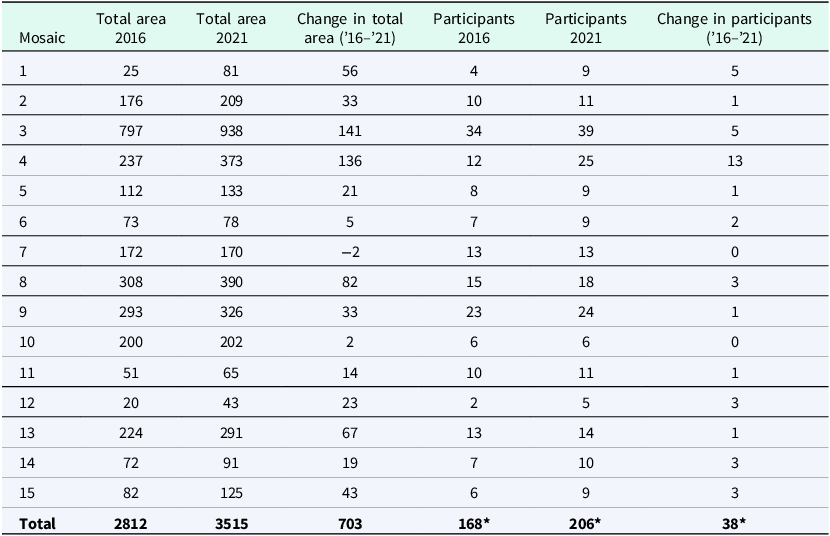
Source: Own calculations based on GIS dataset NFW and verified with the collective.
Note: *This number is lower than the sum of the numbers per mosaic because the same participant can be involved in more than one mosaic.
Spatial autocorrelation analysis
Table 4 summarises the results of Moran’s I estimation. Moran’s I is computed into a z-score and used for statistical testing, the null hypothesis being a random pattern. Significant z-scores can be compared to give an idea of the intensity of spatial autocorrelation. In general, Moran’s I values are negative for the areas under the collective approach, while positive under the individual approach. This confirms the expectation that similar measures were more clustered before the switch to the collective approach. In some instances (mosaics 3, 8, 9, 11), Moran’s I statistic is positive and significant under both the individual and collective approach. The z-scores, however, are much larger under the individual approach and thus show that there was more clustering of similar measures in that period.
Summary spatial autocorrelation testing
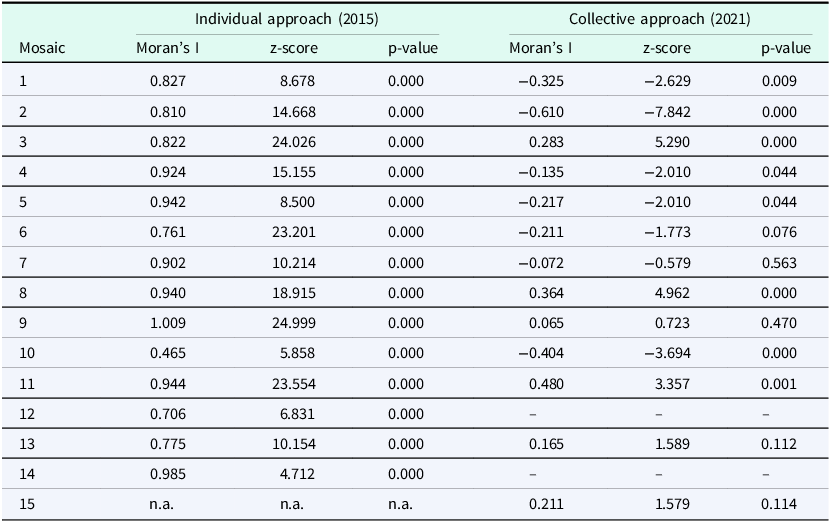
Source: Own calculations using ArcGIS Pro (version 3.1.1).
Notes: The contracted areas and measures for mosaics 12, 13, 14, and 15 are limited because they have been established only recently. Testing was found irrelevant in these cases. Mosaic 15 was established only after 2015 and therefore data is not available for the individual approach.
Discussion and conclusion
Biodiversity loss is one of the main global challenges of this era. Tackling this challenge requires a coordinated approach because the actions of one may affect the results of conservation efforts of others, and because many (mobile) species require diversified habitats that can only be achieved at landscape level and not on the land of individual landowners. This article has used the example of the agri-environmental collectives in the Netherlands to contribute to our understanding of institutional configurations that can achieve such coordination and hence of mechanisms that improve the effectiveness of environmental policies. Moreover, the agri-environmental collectives do not only coordinate horizontally – across land managers – but also vertically across institutional layers. Therefore, the conceptual framework of meso-institutions was used to describe the unique meso-institutional functions and tasks that are performed by the Dutch collectives.
Improving the effectiveness of AES through a collective approach
The effectiveness of the collective approach in achieving spatial coordination was assessed – both qualitatively and quantitatively – through a comparison of farmers’ participation and contracted measures since the introduction of the collective approach. While we find an increase in spatial coordination, Boonstra et al. (Reference Boonstra, Nieuwenhuizen, Visser, Mattijssen, van der Zee, Smidt and Polman2021) point to a decrease in participation at the start of the collective approach. On the one hand, this is explained by an increase in the administrative costs of the collectives that have to be paid out of the total budget available for AES such that less money remains for paying farmers for their conservation actions. Furthermore, Boonstra et al. (Reference Boonstra, Nieuwenhuizen, Visser, Mattijssen, van der Zee, Smidt and Polman2021) argue that collectives focus less on the ‘low-cost’ actions such as nest protection, but increasingly target high-cost measures (such as higher water levels or herb-rich grassland) for which payments are also higher, and hence there are fewer farmers that can be paid for their actions. The latter claim is also confirmed by our results, which show that the collective approach has increased the number of hectares contracted for dark green measures, which are crucial for the creation of diversified birds’ habitats. Furthermore, statistical tests for spatial autocorrelation using Global Moran’s I confirm that, under the collective approach, the contracted agri-environmental measures display a more diverse spatial pattern. Both results point to the success of the collective approach.
It is important to point out that by focusing on the meso-institutional functions and tasks performed by the collectives, other relevant characteristics of the collectives that influence the effectiveness of AES implementation may have been underrepresented. On the one hand, we have identified unique rules for monitoring and enforcement in the collective that influence farmers’ behaviour and stimulate compliance. The importance of collective choice arrangements (rules adapted to specific conditions of the resource and the resource users) and involvement in monitoring systems are also identified in the work of Ostrom (Reference Ostrom1990), Agrawal (Reference Agrawal2001), and Bastakoti and Shivakoti (Reference Bastakoti and Shivakoti2012) as crucial conditions for successful collaborative governance. On the other hand, we did not delve into the role of social norms, peer and network effects, and social capital, which may also be important factors in the success of the collective approach (Ostrom and Ahn, Reference Ostrom, Ahn, Svendsen and Svendsen2009).
Other researchers have studied these aspects in the context of the Dutch agri-environmental collectives. Barghusen et al. (Reference Barghusen, Sattler, Deijl, Weebers and Matzdorf2021) found that farmers’ motivation to participate in the Dutch collective AES was stimulated by positive personal norms concerning environmental measures and that these norms were, among others, influenced by a feeling of collective efficacy. Many of the 40 AES collectives were established through mergers of existing rural collectives and therefore could build on pre-existing networks. Barghusen et al. (Reference Barghusen, Sattler, Berner and Matzdorf2022) note that this can lower barriers to farmers’ engagement with collective AES as farmers are familiar with being reliant on other farmers and with communication about conservation activities between farmers. Furthermore, studies have recognised that Dutch collectives with a long experience can profit from the trust in their network (Vries De et al., Reference Vries De, van der Zee, Beunen, Kat and Feindt2019)), and from their members’ desire for social approval within the collective where ‘commitment to nature’ developed into a norm (Barghusen et al., Reference Barghusen, Sattler, Deijl, Weebers and Matzdorf2021; Westerink et al., Reference Westerink, Pleijte, Schrijver, van Dam, de Krom and de Boer2021). Alblas and van Zeben (Reference Alblas and Van Zeben2023) also note that several respondents in their study felt more compelled to work towards specific environmental objectives when they were asked by someone from the board of the collective, compared to being asked by a governmental body, because the participants trust their ‘colleague-farmers’.
Avenues for further research
This paper interpreted the effectiveness of the collective approach on the basis of the degree of spatial coordination within the territory of the collective. Ecological knowledge about optimal birds’ habitats is at the basis of the mosaic approach that is followed by the collectives. However, the paper does not assess the impact of the collective approach on actual improvements in meadow bird numbers. The relatively recent implementation of the collective AES, the limitations in comprehensive time series data on bird numbers, and the presence of selection bias in the assignment of AES contracts to the most suitable areas only, make the assessment of the impact of the collective approach on target species complex and beyond the scope of the current article. This is a relevant avenue for future research.
Another open question is to what extent the core meso-institutional functions can be separated. Section 4.1 described how the collective has created financial buffers by offering lower payment levels per contracted measure than the maximum tariffs that were agreed upon in the national guidebook. These buffers can be used, among others, to pay penalties in cases where the paying agency has identified errors in reporting or non-compliance with contract terms. The creation of these internal rules for creating the buffers and the instances in which they can be used could be categorised as the meso-institutional function of translating macro-level rules. On the other hand, there is also a clear connection to the function of enforcement, when these buffers are used to prevent penalties on individual farmers.
Furthermore, meso-institutional functions are also performed by institutions other than the collectives that this paper has focused on, and even at different institutional layers. For instance, EU Directives are translated by Member States into national laws. In the Netherlands, the Nature Conservation Act translates the requirements of the Birds and Habitats Directives. Specific translation tasks that are performed by the national government include the identification of target species for protection on the Dutch territory and the development of a catalogue of possible conservation activities (measures) on farmland and the (maximum) payment that is allowed per activity. This shows that the meso-institutional function of translating occurs in phases, with the first phase happening at the national level. It also points to the overlap between the different institutional layers, resulting in a somewhat fluid boundary between the macro- and the meso-institutional layers.
Implications for policy and practice
This paper provides support for the success of the collective approach in terms of spatial coordination of farmers’ efforts. A study by Reichenspurner et al. (Reference Reichenspurner, Barghusen and Matzdorf2023) also shows that farmers prefer the collective over the individual approach because of the (perceived) better ecological results of the area-oriented approach. However, this success may be vulnerable to changes in the macro-institutional environment, such as budgets allocated to AES or a transition to a more result-based payment system.
In line with the findings of Westerink et al. (Reference Westerink, Melman and Schrijver2015) and Boonstra et al. (Reference Boonstra, Nieuwenhuizen, Visser, Mattijssen, van der Zee, Smidt and Polman2021), this paper finds resistance of contracted farmers to the legally obliged controls by the paying agency. This shows the tension that exists between the acceptance of the internal rules of the collective as opposed to externally dictated rules. In line with Ostrom’s assertion of the design principles for successful self-governance, meso-institutions should not be challenged by macro-institutions. In this respect, it is interesting to point to an important current challenge for the Dutch farming sector, and livestock farmers in particular, namely the implementation of the EU’s Nitrogen Directive which is increasingly leading to restrictions on farm investments and expansion. This is likely to lead towards more tensions within the sector that may affect farmers’ willingness to participate in subsidy programmes such as AES, and their involvement in AES collectives.
To conclude, a word of caution to policymakers and practitioners who think of replicating the success of the Dutch collective approach in other contexts. The results in this paper are largely based on a case study of one of the AES collectives in the Netherlands. Given the diversity in collectives (see, e.g. Barghusen et al., Reference Barghusen, Sattler, Berner and Matzdorf2022), these results are unlikely to be representative for all 40 collectives. With our case being a frontrunner among the collectives, average results for the Netherlands will probably be somewhat less pronounced or positive. Furthermore, rural areas in the Netherlands have a long history of collaborative agri-environmental management (Van der Ploeg, Reference Van der Ploeg2021; Westerink et al., Reference Westerink, Jongeneel, Polman, Prager, Franks, Dupraz and Mettepenningen2017, Reference Westerink, Termeer and Manhoudt2020). This makes Dutch farmers familiar with collectives and other rural social structures. Such collaborative networks may be less common in other EU Member States, or there may even be resistance towards collectives due to historical reasons (e.g. in Central and Eastern European Member States). Hasler et al. (Reference Hasler, Czajkowski, Elofsson, Hansen, Konrad, Nielsen, Niskanen, Nõmmann, Pedersen, Peterson, Poltimäe, Svensson and Zagórska2019) found substantial differences in the uptake of AES between farm types and between different EU countries and argued for differentiation in contract obligations and payments. Renting and Van der Ploeg (Reference Renting and Van der Ploeg2001) also emphasise that the success of environmental cooperatives strongly depends on a favourable institutional (macro-)environment. Moreover, Franks (Reference Franks2011) claims that – when providing support for collaborative initiatives – governments should take care to avoid changing the motivation of the actors involved from the intrinsic to the extrinsic (outside rewards). Other contextual factors should therefore also be considered when contemplating the implementation of the collective approach outside of the Netherlands.
Acknowledgements
The authors are grateful for the suggestions provided by the anonymous reviewers and the editors and guest editor of the symposium on meso-institutions. Furthermore, this paper benefited greatly from stimulating discussions about the topic with the so-called ‘Pirates’ as well as advice and comments from colleagues that participated in the EAAE pre-congress workshop in Rennes. We also acknowledge financial support from the European Union’s Horizon 2020 Research and Innovation programme under grant agreement N°817903.


 Open access

