




Introduction: Discourse analysis and the post-digital conditions
Like air and drinking water, being digital will be noticed only in its absence, not by its presence (Negroponte, Reference Negroponte1998).
The mediation of digital technologies is so deeply embedded in everyday lives that, as Negroponte predicted back in the late 1990s, it is now almost invisible. This observation reflects what is referred to as the post-digital condition (Cramer, Reference Cramer2014; Jandrić et al., Reference Jandrić, MacKenzie and Knox2023). In the post-digital era, the long-standing distinction between the online and the offline, among other dichotomies, has increasingly lost its relevance for scholarly research (Lyons & Tagg, Reference Lyons and Tagg2024).
For language and discourse studies, this post-digital condition presents both opportunities and challenges. Works in traditional (digital) discourse analysis, which tend to focus on analyzing texts on a single digital platform or face-to-face interaction in a specific context, must now account for meaning-making practices that travel across technological spaces and how digital communication impacts “offline” social action and vice versa (Barton & Lee, Reference Barton and Lee2026; Blommaert, Reference Blommaert2019; Tagg et al., Reference Tagg, Eriksson and Vásquez2025). Building on emerging arguments and calls for online-offline, cross-media perspectives to communication, this article zooms in on LIHKG, Hong Kong’s most popular local forum, as a site where discourse practices traverse digital and physical spaces in the age of post-digital mediation. Unlike global social media platforms dominated by automated algorithmic mediation, LIHKG, as a traditional online forum, serves as a case of a “manual” algorithmic environment where human agency directly shapes discourse circulation through creative appropriation of platform affordances (Bruns, Reference Bruns2019).
Across Asia, research has shown that platform-mediated misogyny emerges from the intersection of affordances, platform cultures, and user agency. In China, Liao (Reference Liao2024) coins the concept of “platformization of misogyny” to describe how the affordances of Weibo, algorithmic rankings, and state governance actively shape misogynistic discourse against the backdrop of patriarchal ideologies. Similarly, Fuchs and Schäfer (Reference Fuchs and Schäfer2021) show how the ironic and parodic communication style originally developed on the anonymous bulletin board 2channel migrated to Twitter, where misogynistic and abusive language against female politicians is normalized. The present study contributes to this existing literature by demonstrating how misogynistic discourse on LIHKG is enacted not through algorithmic governance but primarily through human appropriation of forum affordances (see also Huang, Reference Huang2023; Wong, Reference Wong2024).
The case study presented here is part of a larger project on the discursive nature of online aggression in Hong Kong Research Grants Council (RGC; Ref No. 14604323). For this paper, I focus on a case study of misogynistic discourse practices sustained across over 200 threads on LIHKG, with a detailed analysis of focal episodes from selected threads and their online-offline trajectories. The overarching research questions guiding this study are: How do users appropriate platform affordances to transform micro-linguistic features into memetic verbal aggression? How do these “affordances-in-practice” shape the discursive trajectory of aggression across the online-offline nexus? To address these questions, the study examines discursive practices of memetic aggression (Sparby, Reference Sparby2017) mediated by affordances and subculture on LIHKG. I then zoom in on an example of LIHKG users’ sustained verbal aggression toward a Hong Kong female influencer to demonstrate how collective deployment of “small things” (Blommaert, Reference Blommaert2019) of interaction can achieve amplification effects through affordances-in-practice (Costa, Reference Costa2018) and online-offline nexus (OON; see section “online-offline nexus”).
This article first situates the present study within traditions of entextualization and discursive trajectories before introducing the specific post-digital conditions, namely affordances-in-practice and the OON, through which discursive trajectories now operate. It then describes the LIHKG context and introduces the critical discourse-centred online-offline nexus ethnography (CD-OONE) analytical framework adopted for the case study. A case study of LIHKG discourse is presented to illustrate how platform affordances amplify misogynistic discourse strategies across a thread series, followed by tracing a 5-year aggression cycle targeting one female influencer. The article concludes by discussing the theoretical and methodological implications for post-digital discourse analysis.
Post-digital conditions and applied linguistics
This section situates the theoretical and analytical approach of this study within a broader disciplinary dialogue. It begins by engaging the existing scholarship on tracing discourse across contexts and timescales, before turning to the specific post-digital conditions for the study of misogynistic discourse. It then introduces the concept of hybrid assemblages that connects platform affordances, user agency, and the circulation of harmful discourse across online and offline contexts.
Post-digital discourse analysis and hybrid assemblages
Foundational work by Bauman and Briggs (Reference Bauman and Briggs1990) on entextualization establishes that any text is extracted from and shaped by its prior contexts of production and reshaped through subsequent acts of recontextualization. Silverstein and Urban (Reference Silverstein and Urban1996) extended this insight and foregrounded the “natural history of discourse” as a trajectory across social settings. Drawing on these traditions, Wortham and Reyes (Reference Wortham and Reyes2015) developed a framework for tracing how social identities and actions are accomplished across linked speech events. Within Critical Discourse Analysis (CDA), concepts of intertextuality and interdiscursivity have captured how texts embed and transform prior texts across social contexts (Fairclough, Reference Fairclough1992).
Concerns about the blurring of the online/offline distinction predate the post-digital label itself (Moore, Reference Moore2019). What has shifted in what Cramer (Reference Cramer2014) describes as the post-digital condition is not the logic of discourse circulation per se, but the specific sociotechnical conditions through which trajectories of discourse now operate at unprecedented scale and speed. The long-standing dichotomy between online and offline has become increasingly difficult to maintain, not simply because digital mediation has become “ordinary,” but because the effects of digitally mediated discourse now routinely extend to shape people’s offline social life.
The term “post-digital” is not, however, a neutral one. While originally coined to capture disenchantment with the ideology of inevitable digital advancement (Cramer, Reference Cramer2014), it has been taken up more critically to foreground how a set of conditions, including platform dominance, algorithmic gatekeeping, and uneven distributions of communicative reach, has real social consequences (see Blommaert, Reference Blommaert2019). In this paper, the post-digital lens serves as an analytical heuristic to examine how platform features actively mediate whose discourses get circulated and to what extent. For (socio)linguistics and discourse analysis, this makes the critical examination of technological affordances newly urgent, alongside the established tools for tracing discourse across space, time, and social context.
Specifically, digital discourse analysis in the post-digital age attends to how meaning emerges through hybrid assemblages where traditional boundaries, like physical and digital, human and machine, are constantly renegotiated (de Souza e Silva et al., Reference de Souza E Silva, Campbell and Ling2025; Lyons, Reference Lyons2019; Tagg et al., Reference Tagg, Eriksson and Vásquez2025). Importantly, users within these hybrid assemblages are not passive recipients of platform design; they bring their own practices and ideologies to negotiate platform affordances and exercise their user agency with high metapragmatic awareness of platform constraints, so as to achieve specific interactional goals (see, e.g., the widespread use of “algospeak” to evade content moderation algorithms (Steen et al., Reference Steen, Yurechko and Klug2023)). This awareness of platform design is central to the analysis of LIHKG’s user practices that follows.
Affordances-in-practice as discourse-mediating resources
The concept of affordances was originally developed to understand the relational potential between an actor and their environment (Gibson, Reference Gibson1979; Hutchby, Reference Hutchby2001). Within social media research, however, it has frequently been applied to describe relatively stable properties in platform infrastructure rather than the outcome of situated practices (boyd, Reference boyd and Papacharissi2010). Costa’s (Reference Costa2018) concept of “affordances-in-practice” reframes affordances as socially and relationally constructed rather than given. Costa’s ethnographic research on social media use in Turkey demonstrates how Facebook’s “public by default” design was reappropriated by users who created multiple accounts, fake and anonymous profiles, and private chats to maintain social norms and boundaries. This shows that affordances are perceived and situated within specific cultural contexts (see also Lee, Reference Lee2007). Affordances therefore “take shape only through specific material and social practices” rather than existing as predetermined potentials (Costa, Reference Costa2018, p. 3649).
Affordances-in-practice have specific implications for the study of verbal aggression, such as the misogynistic discourse discussed in this paper. As the case study in this article illustrates, each affordance acquires its ideological meaning from users’ repeated, collectively ratified deployment of both platform features and discursive resources within a platform-specific subcultural context. Central to the analysis is how users’ metapragmatic knowledge shapes their deployment of media resources (Androutsopoulos, Reference Androutsopoulos2021). Users recognize not only the technical possibilities of platform features but also the subcultural expectations governing their use. This community expectation enables platform features to sustain and amplify harmful discourse over time.
Online-offline nexus
While affordances-in-practice capture how discourse is enacted within the forum, they do not explain why forum-based discourse contributes to consequences far beyond the platform, in mainstream news, in offline reputational damage, and in the target’s own life. Tracing these cross-platform trajectories requires conceptual and methodological tools that can map how discourse transforms from “small things” (Blommaert, Reference Blommaert2019) online into macro-level social phenomena with tangible real-world effects. Blommaert defines small things as “actual moments of interaction taking the shape of meaningful social conduct” that have “powerful ordering effects” in communities where they become “normatively ratified” (p. 486). These seemingly trivial micro moments of interaction, such as emojis, upvoting/downvoting, or coded language, allow users to do identity and social work beyond their literal meanings (see also Darvin, Reference Darvin2022).
This study draws on Androutsopoulos’ (Reference Androutsopoulos, Georgakopoulou and Spiliotiin press) scalar model of the OON to trace how LIHKG misogynistic discourse achieves consequences beyond the forum. OON analysis maps three scales of discursive trajectory across online and offline landscapes. At the micro level, LIHKG users initiate online discussions with reference to real-time offline incidents (simultaneous nexus action). Over time, forum threads and mainstream news reports feed into each other to trigger new rounds of discursive circulation (stepwise interlocking nexus action). At the macro level, discursive practices on the forum become social currency and shape how targets are publicly constructed both online and offline. As will be demonstrated in the case study, misogynistic labels that emerge in LIHKG threads can circulate across platforms, attract mainstream media attention, and ultimately shape offline reputation and social phenomena.
The study context and methodology
This article emerges from a broader research project investigating discourses of online aggression in Hong Kong. Data were collected from LIHKG threads comprising key themes of aggression in Hong Kong, such as doxxing, Hong Kong-mainland tensions, misogyny, and linguicism. The project employed a multimethod approach with LIHKG forum threads and semi-structured interviews with active users as main data sources. A screening survey was initially administered to capture demographic profiles and general patterns of LIHKG use and served as the basis for identifying interview participants. CDA provided the overarching analytical framework for the discourse data, while the interview and sustained observation of forum activities enabled triangulation between screen-based data and user-based ethnographic insights into subcultural norms and affordances-in-practice.
LIHKG: platform affordances and subculture
Launched in 2016, LIHKG is Hong Kong’s most popular local online platform, with over 24.6 million visits monthly as of September 2025 (Similarweb, n.d.). The platform operates as a traditional forum structure where membership is restricted to those with Hong Kong university accounts or local internet service providers, creating a predominantly young and male user base (approximately 64% male, according to Similarweb, n.d.). Unlike global social media platforms dominated by automated algorithmic curation, the visibility of LIHKG posts is largely determined by users’ active interaction with its interface design.
In terms of platform interface and affordances, LIHKG adopts chronological threading (instead of reverse chronological arrangement like most social media feeds), upvote/downvote systems, nested quoting, custom emojis, platform-specific slang, trending (熱門) feeds on the sidebar, and a maximum of 1,000 replies per thread. While these features are not unique to LIHKG, they acquire culturally specific meanings through users’ situated practices. The trending feed, designed for highlighting popular content, becomes a convenient tool for users to collectively mobilize harmful content or attacks. The 1,000-reply thread limit, which is intended as an organizational constraint of the forum, transforms into a powerful resource for sustaining serial discussions on the same topic, as users immediately create successor threads upon reaching the 1,000-reply capacity. In addition, custom emojis originally serving as forum mascots are often reappropriated as culturally coded visual resources that reinforce users’ stance in their verbal message. While comparable affordances exist on platforms like Reddit and 4chan, many global platforms are primarily English-based and attract geographically dispersed user bases. LIHKG, by contrast, is Cantonese-based, largely shaped by its strong localist subculture with specific platform slang. The result is a form of targeted discourse directed at recognizable local actors and events, which requires analysis grounded in the specific sociolinguistic context rather than generalizations from global platforms.
LIHKG embraces “hard plastic” subculture (Zuser, Reference Zuser2022), a trolling subculture marked by nonsensical humor, deliberate absurdity, coded language, and politically incorrect discourse. According to Zuser (Reference Zuser2022, p. 274), this subculture is characterized by a “celebratory use of Cantonese profanity” and a trolling writing style that negotiates between activism and local identity. As one study participant noted in an interview, “[b]eing plastic is just for everyone to have a laugh […] it’s purely because we know it’s meant to be nonsensical.” However, with a predominantly male user base, this normalization of absurdity simultaneously creates an environment where harmful discourse can be easily trivialized and legitimized through collective endorsement via upvoting and serial thread creation. In addition, this hard plastic culture operates through “vernacular masculinity,” a curiosity toward all things bodily and sexual, which “speaks the sexual language of the curious, obscene and vulgar” (Wong, Reference Wong2024, p. 116). As Wong (Reference Wong2024) observes, vernacular masculinity manifests in the casual use of dehumanizing labels for women, sexual objectification, and clickbait threads that presume heterosexual male audiences through sexually explicit language. The convergence of hard plastic subculture and vernacular masculinity creates a unique masculine subcultural environment where misogynistic discourses become simultaneously playful and harmful, creating what Wong (Reference Wong2024) identifies as a space where the “luminous attention to the convergence of misogynistic cultural products eventually obscures its embedded gender hate” (p. 115).
The “calling out crazy women” thread series
Against the backdrop of normalized gendered hostility within LIHKG’s subculture, this article focuses on the ongoing serial thread series titled “召喚痴線西” (Calling Out Crazy Women), which, as of November 2025, comprises 273 threads with over 260,000 posts. These threads aim to call out women, especially female influencers, including models, beauty and fitness vloggers, by reposting stories these women share on their social media accounts and scrutinizing their online and offline behavior, such as driving skills, romantic relationships, or workplace incidents. The series exemplifies how platform affordances enable persistent misogynistic discourse. For example, as each thread reaches the 1,000-reply limit, users immediately initiate a successor thread to maintain continuous visibility. Female influencers become particularly vulnerable targets of call-out and cancel culture, due to societal gendered expectations, lack of industry support, and perceived privilege within the influencer economy, which together encourage public shaming and digilantism (Duffy et al., Reference Duffy, Miltner and Wahlstedt2022). For the broader study, posts were manually downloaded and entered into MAXQDA for systematic coding of recurring discourse strategies and affordance patterns across the full corpus. A subset of posts was then selected for close analysis for this paper based on three criteria: (i) posts featuring a named influencer as an explicit target; (ii) posts containing cross-platform references such as screenshots to the target’s social media, mainstream news, or offline incidents; and (iii) posts demonstrating sustained community engagement reflected in high reply counts. Two threads featuring Kisabbb (threads 126 and 174) form the basis of the detailed case study.
Analytical approach: Critical discourse-centred online-offline nexus ethnography
The overall analytical approach adopts what I refer to as “Critical Discourse-Centred Online-Offline Nexus Ethnography (CD-OONE),” integrating insights from CDA, digital ethnography, and OON. It draws on and extends Androutsopoulos’ (Reference Androutsopoulos2008) discourse-centred online ethnography, which combines systematic observation of digitally mediated interaction with direct engagement with social actors. The term “ethnography” here is used in the tradition of digital ethnographic and technographic practice (Georgakopoulou, Reference Georgakopoulou2024; Hine, Reference Hine2020), encompassing three interconnected components of data collection and analysis:
(i) Platform observation: This involved the research team’s sustained observation of LIHKG’s subcultural norms, interactional conventions, and affordances as both insider users and researchers during the project period. Observed elements include how features such as upvoting, GIFs, and custom emojis are creatively appropriated as discursive resources. Fieldnotes were made throughout to document evolving platform practices and subcultural norms.
(ii) Discourse data collection and analysis: The “Calling Out Crazy Women” series was imported into MAXQDA for thematic and discourse-level coding, focusing on misogynistic discourse strategies, multimodal assemblage, and affordance deployment. Focal episodes for close analysis in this article were selected on the basis of recurrence of discourse strategies across threads and evidence of cross-platform or offline uptake.
(iii) In-depth interviews: Semi-structured interviews were conducted with eight active LIHKG users and/or bystanders of online aggression. Interview data are drawn on selectively in the present paper to illuminate participants’ awareness of platform affordances and subcultural norms, and to triangulate interpretations derived from the discourse data. The interviews were conducted in Cantonese and transcribed verbatim. Selected quotes for this article are translated into English and participants are fully anonymized.
While the broader study collected data across all three components, the analysis presented in this article draws primarily on the discourse data, with selective interview insights used to corroborate and enrich the analysis where relevant.
OON provides the conceptual tools for tracing how discourse moves across scales, from individual platform interactions to mainstream media coverage and offline social consequences, enabling the analysis of both the micro-linguistic features of aggression and their macro-level discourse trajectories. This study adopts a qualitative, case-based tracing of the online-offline trajectory of Kisabbb’s case, following the tradition of hybrid ethnography, which tracks subjects who naturally inhabit social media and constantly move in, out, and between digital and physical spaces (Liu, Reference Liu2022). As an influencer exists primarily across digital platforms, “offline consequences” are defined in this study as embodied effects on the target(s) as well as broader uptake of discursive practices beyond the original digitally mediated interaction that can be triangulated from multiple sources (e.g., forum posts, the influencer’s own social media posts, and mainstream news coverage). This article documents plausible discursive trajectories on the basis of these converging contexts, without assuming a single causal nexus from forum discourse to any given offline outcome.
Analysis: Affordances-in-practice and discursive strategies in post-digital misogyny
The analysis proceeds in two stages that reflect the progressive structure of CD-OONE. First, it examines the recurrent misogynistic discourse strategies across the data, demonstrating how each strategy is shaped not by linguistic form alone but by users’ appropriation of platform affordances. This CDA-informed analysis constitutes the core of the post-digital framework because it is the intersection of the micro-linguistic practices and the affordances-in-practice that makes the subsequent tracing of discursive trajectories possible. Second, it applies CD-OONE to the focal Kisabbb case to demonstrate how these platform-bound discourse practices achieve scalar amplification across the OON and produce real-world reputational damage over a 5-year period.
Nomination strategies and upvoting
Misogynistic discourse on LIHKG manifests through the strategic deployment of culturally coded linguistic resources that reduce women to stereotypical categories. In critical discourse studies, nomination or referential strategies are used to negatively categorize out-groups. Hart (Reference Hart2010, p. 56) defines referentials as the “dichotomous conceptualization of an out-group defined with respect to a coalitional in-group which both text-producer and text-consumer are assumed to belong to.” In the study context, these referential strategies work to delegitimize targeted women by categorizing them as fundamentally “Other” to the predominantly male user base of the forum, constructing what Reisigl and Wodak (Reference Reisigl, Wodak, Wodak and Meyer2015) refer to as “explicit dissimilation,” the process of discriminating social actors by placing them in categories distinct from the in-group.
What distinguishes this from conventional CDA nomination analysis, however, is that the current analysis foregrounds how these naming practices on LIHKG acquire their delegitimizing power through affordances-in-practice. Naming in this context is a discursive practice that emerges through users’ repeated and situated engagement across serial threads, upvoting and downvoting, and increased visibility on trending feeds. Costa (Reference Costa2018, p. 3651) emphasizes that affordances are “never specific to a platform only, but are always specific to the relation between the platform and the situated users.” The analysis reveals that platform features act as a discursive resource for categorizing women into stereotypes, notably through four frequently occurring derogatory labels and naming practices in the forum data.
(1) 雞 (“chicken/prostitute”): A derogatory Cantonese slang term for “prostitute.” The word is often deployed strategically to attribute women’s beauty, fame and financial success to commercialized sexuality.
Example 1
你每場生日上 20 個蛋糕都唔會令到你有貴氣變得有錢另人哋覺得你地唔係做雞 
(157 upvotes, 4 downvotes)
(“Even if you have 20 cakes at every birthday party, it won’t make you look classy or rich and it won’t stop people from thinking that you’re working as a chicken (prostitute)”)
(2) 豬 (“pig”): Dehumanizing label used systematically for body-shaming. Example 2 illustrates this pattern:
Example 2
sy 你真係好撚樣衰呀屌!!!
肥到癲 皮膚又dur 食相又嘔心 藐嘴藐舌
勁似人形豬 
(106 upvotes, 2 downvotes)
(“SY you’re really fucking ugly, damn it!!! So fat it’s insane, your skin is saggy, the way you eat is disgusting, always sneering and sarcastic. You totally look like a humanoid pig”)
(3) MK: stands for “Mong Kok,” a district in Hong Kong. “MK,” as a local slang term, is used to mock individuals perceived as uncultured or having poor taste. Example 3 demonstrates this strategy:
Example 3
佢越嚟越樣衰 個種 MK 港女味重咗好多
(87 upvotes, 1 downvote)
(“She’s looking worse and worse; she really has that MK Hong Kong girl vibe now”)
(4) 大媽 (“big mom”): An age-based label conveying ageist ideologies and discourse strategies to shame women for perceived unfashionability (Ringrow, Reference Ringrow2016). Example 4 illustrates this pattern:
Example 4
個樣好大媽 feel 又腫
(52 upvotes, 1 downvote)
(“She looks very aunty-like and puffy.”)
At the linguistic level, these labels function as naturalizing and depersonalizing metaphors or assign specific negative qualities that frame social actors as deficient (Wodak & Reisigl, Reference Wodak, Reisigl, Tannen, Hamilton and Schiffrin2015). The use of “chicken” in Example 1 not only undermines the target’s social capital by tying her achievements to sexualized labor but also perpetuates the idea that visible signs of wealth or celebration cannot redeem her from the group’s predetermined stigma. The use of 豬 (“pig”) in Example 2 works to dehumanize, reducing a woman’s physicality to something unworthy of empathy. When the label “MK” is deployed in Example 3, it enacts negative social judgment through local class stigma, suggesting that appearance and perceived vibe signal low cultural status. In Example 4, 大媽 (“big mom”) mobilizes ageist ideologies to delegitimize the target based on perceived lack of youth or style. Each example shows how referential expressions serve as social boundary markers to delegitimize and even silence women within LIHKG.
The significance of these examples lies in the high upvote counts (157, 106, 87, and 52, respectively), which represent affordance-mediated collective endorsement of each evaluative stance toward the target women. In Blommaert’s (Reference Blommaert2019) terms, each upvote is a “small thing” that acquires its ordering force through aggregation; that is, when a nomination is endorsed through collective upvoting, the naming practice achieves normatively ratified status within the LIHKG community. Crucially, this endorsement is publicly quantified and visible to every user through the platform’s interface. This visibility extends the reach of each derogatory label beyond the originating post. The upvote system transforms a single user’s derogatory comment into an “acceptable” truth. This is why the analysis should treat the upvote as an integral part of the nomination strategy itself.
Interview data confirm that users recognize misogynistic naming as a platform-level culture. As one female LIHKG member, Brenda, reflected:
仇女一定係連登文化 … 普遍嘅一個 assumption 就係你連登一定仇女㗎喇 … 好多時候我哋會有啲風化案件, 咁就下面一定會有會員話個受害者係性工作者, 或者話係勞資糾紛
(“Misogyny is definitely part of LIHKG culture … the prevalent assumption is that LIHKG is necessarily misogynistic … very often when there is a sexual offense case, members will label the victim as a sex worker, or that it was a labour dispute.”)
(Brenda, interview)
Brenda’s account suggests that these nomination practices are not isolated incidents but part of a platform-level misogynistic culture that users recognize and anticipate. Her observation that sexual offenses are often reframed as “labour disputes” illustrates a recontextualization where violence against women is neutralized and where victims are downplayed as service providers or paid workers. This practice exemplifies the affordances-in-practice argument, as the delegitimizing function of these labels relies on users’ shared subcultural norms within a discursive environment in which vernacular masculinity and linguistic practice are so integrated that misogynistic nomination no longer requires justification.
Discourse amplification through nested quoting
Nested quotation, the practice of “quoting previous body texts” to establish interactional coherence in asynchronous environments (Fu et al., Reference Fu, Abbasi and Chen2008), contributes to reinforcing aggression on LIHKG. This affordance enables users to construct visually complex structures that sustain misogynistic language by making the process of discourse layering explicitly visible. Once quoted and nested in multiple layers, the derogatory referentials discussed in the previous section can be repeatedly recycled and remixed. This practice demonstrates that affordances-in-practice function through accumulation, aligning with research on verbal aggression, which argues that online bullying relies fundamentally on repetition (Law et al., Reference Law, Shapka, Hymel, Olson and Waterhouse2012). Figure 1 illustrates this nested quoting in practice.
Nested quoting reinforcing visibility of negative naming practice 雞 “chicken” (highlighted).

Figure 1 is extracted from a thread discussing a female influencer, Yan, collectively referred to as “chicken Yan” here. The excerpt begins with a user noting the rapid deletion of her Instagram stories, followed by a chain of replies that scrutinize and shame her relationships, financial status, and moral character, using the quoting function to link their replies to specific previous comments. The quoting function creates a visual stack marked by vertical indentation lines, where the derogatory label 雞 (“chicken”) is repeatedly embedded and visibly displayed across multiple turns in the conversation.
While the primary function of such nesting is to maintain interactional coherence (Fu et al., Reference Fu, Abbasi and Chen2008), Eklundh (Reference Eklundh2010, p. 29) notes that quoting also serves to “draw attention to the exact form of the message… often as part of a negative stance.” In this example, the quoting affordance enables users to build visually layered sub-threads where each reply amplifies and remixes the initial insult. This recursive practice effectively turns individual instances of verbal aggression into a communal practice, making it highly visible to all users. As a result, the nested quoting structure not only intensifies the misogynistic label, but also signals to newcomers that such language is accepted and expected, further embedding these patterns into the forum’s everyday discourse.
Custom emojis as ratified aggression
LIHKG provides users with a platform-specific emoji system that serves as an embedded visual affordance. These emojis originated from HKGolden, LIHKG’s predecessor, where users developed custom icons because early web forums lacked standardized emoji support (Yu et al., Reference Yu, Tay, Jin and Yuan2023). Today, LIHKG users continue to use these forum-specific icons over standard Unicode emojis to mark subcultural authenticity and in-group membership, serving as markers of local identity. These distinct cultural meanings are acquired through years of collective use in specific discursive contexts. A famous local example is the LIHKG pig emoji (連豬). As it frequently appeared on protest sites as a mascot during the 2019–2020 Hong Kong protests, the government eventually banned its appearance after the pig was featured in a public festive display, claiming that it would “cause discomfort” to the public (Hong Kong Free Press, 2020).
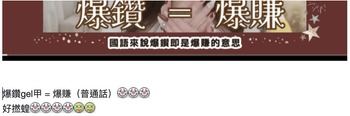
Another notable emoji is the clown emoji, which symbolizes “clownish” absurdity central to the hard plastic (硬膠) subculture as discussed before (Zuser, Reference Zuser2022). In the “crazy women” thread series, the clown is often deployed in a serial manner, together with the “throw-up” emoji to signal ridicule and disgust. This combination is particularly evident in body- and appearance-shaming comments targeting female influencers, as illustrated in Figure 2 below.
LIHKG post combining derogatory nomination and custom emojis to target a female influencer.

In Figure 2, a user, after posting a screenshot of a female influencer’s video footage, shames her for using a pun based on Mandarin pronunciation (“Bao zuan” = “Bao Zhuan”), labeling this linguistic choice as 蝗 (“locust”), a dehumanizing label used by some local Hongkongers to stigmatize mainlanders as resource-consuming pests. This derogatory referential is visually amplified by a string of four clown emojis followed by two throw-up emojis. Here, the clown emoji functions as a specific marker of the hard plastic subculture discussed before. It potentially indicates that the influencer’s adoption of Mandarin slang is incongruous with LIHKG’s grassroots linguistic “policy” of Hong Kong Cantonese. By repeatedly displaying the clown emoji, the user frames the target’s behavior as deserving mockery. The throw-up emojis then escalate this ridicule into disgust. Together, these visual resources perform a dual act of Othering. The clown excludes the target from the local in-group, while the throw-up emoji indexes a rejection of perceived “mainlandized” appearance and fashion sense (glittery gel nails). This demonstrates how LIHKG’s custom emojis serve to reinforce cultural boundaries and deepen the ideological separation between Hong Kong and mainland Chinese women.
Interview participants confirm this pattern of escalation through the use of platform-specific emojis. As Samuel observed, LIHKG emojis generate “有種團體嘅感覺…比香港人有一種歸屬感” (“a sense of community... a sense of belonging for Hong Kongers”), while simultaneously encoding “諷刺…幸災樂禍” (“sarcasm and schadenfreude”) that “大部份嘅網民都係好容易就可以理解到佢嘅背後嘅意思” (“most netizens can easily understand the meaning behind it”) (Samuel, interview). Serena similarly noted that the mocking tone of emojis on LIHKG is “好明顯” (“very obvious”). The participants’ normalization of the negative connotations of LIHKG emojis suggests that the aggressive undertone of these emojis is no longer contained within LIHKG alone, but has spread into a wider Hong Kong digital vernacular. This illustrates the effect of the hybrid assemblage in which platform symbols, subcultural norms, and shared local knowledge converge to make aggressive intent self-evident.
Forum-specific slang as manual algorithmic discourse
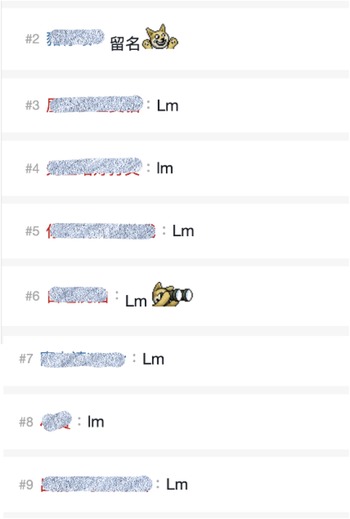
For many years, online forum culture in Hong Kong has developed distinctive linguistic practices where users innovatively adapt language to navigate platform constraints and reinforce forum identity. Notably, the use of “LM” (shorthand for 留名 “leave name”) illustrates a long-standing creative practice originating in HKGolden. On LIHKG, users continue to adopt this practice to engage with LIHKG’s platform affordances. It is one of the interactional “small things” that contribute to the perpetuation of aggressive discourse on the forum. Figure 3 shows the opening messages from the 240th thread of the “Crazy Women” series. It shows a sequence of replies consisting almost entirely of one-word “LM” posts, occasionally accompanied by custom emojis like the LIHKG dog.
Opening posts of the 240th “Calling Out Crazy Women” thread with “LM”.

Visually, this chain of “LM” comments produces a dense block of near-identical turns, each from a different user. This immediately creates an impression of high activity and popularity without contributing any substantive content. It illustrates users strategically exercising their agency in response to specific platform constraints. As noted, the 1,000 replies per thread limit means that to continue discussions on the same topic, users must manually migrate to a new thread. In Figure 3, the series of “LM” posts at the start of the 240th thread thus signals continuity from the previous 239th thread, allowing users to re-establish their presence in the new interactional space. Unlike social media platforms that push notifications algorithmically, LIHKG relies on users’ ongoing activity to keep a thread visible and alive. “LM” therefore serves the dual function of a personal bookmark to leave a digital footprint for future notification updates, while simultaneously “bumping” the thread to the top of the trending board to sustain its popularity. By repeatedly posting “LM,” users manually overcome platform constraints, ensuring that their chosen topic remains active. This metapragmatic awareness is reflected in interviewees’ accounts: several independently described their LIHKG engagement using the Cantonese idiom 食花生 (“eat peanuts,” meaning spectating from the sidelines without intervening, similar to “grab the popcorn” in English). “LM” is the textual equivalent of “eating peanuts” behavior, keeping the thread alive and the audience visible.
The analysis suggests that LIHKG users are not passive subjects of algorithmic mediation but active agents who intervene to determine post visibility and engagement. In the context of the data on misogynistic discourse, this manual reinforcement of aggressive labels contributes to users collectively endorsing and normalizing the hostile language, signals tacit community support, and encourages further participation by other users (Bruns, Reference Bruns2019). The following section examines the case of one Hong Kong female influencer to trace how these routine affordances and micro-practices turn local forum practices into wider, post-digital cross-media memetic aggression, through the lens of OON.
The case of Kisabbb
This section applies CD-OONE to a single case to trace how the affordances-in-practice and discourse strategies analyzed in the previous sections play out in a cross-media discursive cycle involving a Hong Kong female influencer known online as Kisabbb. This case is selected because it clearly demonstrates how a target-specific discourse event unfolds into a sustained long-term aggression cycle through the interplay of naming practice and platform affordances across media spaces. It foregrounds the paper’s central argument that post-digital misogyny operates not through isolated incidents but through ongoing appropriation of platform affordances that produce memetic effects across online and offline communicative contexts.
Posting her first videos on YouTube in 2014, Kisabbb gradually gained popularity through creating comedic and lifestyle content. Her growing visibility across social media drew the attention of LIHKG users from around 2017, whose early threads discussed being attracted to her body shape. Although these posts centered on the body of Kisabbb, they were framed with a largely positive and admiring undertone (e.g., one post has the subject line “Have you noticed that KisaBBB is actually pretty hot?”). In 2020, however, unedited beach photos of Kisabbb were taken without her consent and circulated online, which triggered immediate body-shaming discourse on LIHKG. Some users expressed shock at the perceived discrepancy between her filtered social media photos and the unedited images. One commenter remarked: “點解真係咁嘅樣..我寧願我以前從來無鍾意過你” (“Why do you really look like that… I’d rather I had never liked you before”). It was in this incident that users established the dehumanizing referential 坦克車 (“tank”), a target-specific label whose meaning transforms as it moves across contexts, from a body-shaming referential on LIHKG, to memetic slang, to a news headline, and back to the forum.
Across the LIHKG data, users repeatedly invoke 沙灘坦克 (“beach tank”) as Kisabbb’s primary identifier, with the label appearing in thread titles, comments, and nested quotations that ensure its continuous visibility. The phrase “按F進入坦克” (“press F to enter the tank”), a gaming reference to entering vehicles in first-person shooter games, emerged as a persistent mocking meme applied specifically to Kisabbb’s body. One user wrote: “有勇氣咪按f進入坦克囉” (“If you have the courage, press F to enter the tank”). This shows how a neutral gaming slang expression is transformed into a sexualized insult that frames Kisabbb’s body as an object to be occupied or rejected. This memetic aggression demonstrates affordances-in-practice operating through cumulative small things: every time the “tank” label is employed, alongside upvotes/downvotes and nested quotation, the term is redeployed and amplified collectively, leading to its memetic spread and mutation (Shifman, Reference Shifman2014). Initially exclusive to Kisabbb, the “tank” label has since generalized to describe other women perceived as overweight. The case shows, similar to the “#Karen” label, how a target-specific attack becomes a convenient tool for targeting specific out-groups.
In early 2025, Kisabbb directly addressed the sustained online aggression toward her over the years through an Instagram post. She wrote: “而家2025年仍然有人翻嗰啲沙灘相…我真係夠晒你哋呢班鍾意網絡霸凌嘅人” (“It’s 2025 and people are still digging up those beach photos… I’m so done with you lot who love online bullying”). In naming the experience explicitly as “online bullying,” Kisabbb asserts her own discursive position from being the passive object of entertainment on LIHKG to being the victim of online harm actively scrutinizing misogynistic discourse. In her Instagram post, she characterizes the experience as “俾人偷拍已經慘, 仲要俾人網絡欺凌咁多年” (“It was bad enough being secretly photographed, but having to endure cyberbullying for so many years on top of that is just terrible.”), explicitly naming the sustained nature of the incident. Rather than ending the abuse, her counter-discourse triggered what one interviewee, Adrian, described as “越反越紅” (“the more you oppose, the more popular it gets”) phenomenon on LIHKG, where collective opposition to a public figure tends to sustain rather than diminish their visibility.
On the day following her Instagram post, the Hong Kong mainstream news outlet HK01 covered Kisabbb’s Instagram story with the headline “網紅 Kisabbb 重提當年被偷拍事件稱被欺凌多年” (“Internet celebrity Kisabbb revisits being secretly photographed years ago, says she’s been bullied for years”). While the headline foregrounds Kisabbb’s experience of being bullied, the visual and textual framing in the news text reconstructs her counter-narrative through the very body-shaming lens that motivated her response. Specifically, HK01 published multiple screenshots and photographs of Kisabbb’s bikini photos, presented under the “即時娛樂” (“real-time entertainment”) section. Through strategic placement of multimodal texts, alongside selected quotes from her Instagram narratives, the news article recontextualizes Kisabbb’s voice as entertainment rather than a testimony of abuse. Notably, the article directly references the tank nomination practice on LIHKG, pointing out “有不客氣的網民取笑現實中的 Kisabbb 是『坦克車』” (“some unkind netizens make fun of the real-life Kisabbb as a ‘tank’”). This reframing uses “取笑” (“make fun of”) that repackages this misogynistic labeling as playful ridicule or, at most, a jocular insult (Dynel, Reference Dynel2021). The entertainment and jocular framing together undergo resemiotization (Iedema, Reference Iedema2003) where Kisabbb’s counter-discourse is removed from its original Instagram context and reinserted into the consumer-entertainment context for further online circulation.
This recontextualization by HK01 is not an isolated incident but reflects a broader journalistic practice in Hong Kong’s media ecology. Koo (Reference Koo2024), drawing on interviews with journalists from HK01 and other outlets, documents how click-based journalism has increasingly marginalized political reporting in favor of soft news that can be sensationalized without being politically sensitive. As such, LIHKG content targeting female influencers represents readily available soft content that is affectively charged, already viral, and requiring minimal editorial resources to repackage as “entertainment” news. As of April 2026, a search of HK01’s archive returns over 4,500 articles referencing LIHKG, while LIHKG returns over 48,000 posts citing HK01. Together, these figures suggest a feedback loop where digital discourse becomes news and news becomes digital discourse.
This news article was reposted to LIHKG on the following day. Many users responded by repeatedly recycling the 坦克 (“tank”) label alongside additional delegitimizing discourse. One user responded: “出返原圖仍然係架坦克車” (“Even if you (Kisabbb) post the original photo, you’re still a tank”). Another user’s meta-commentary on the news article captures an OON effect, stating “冇坦克相直頭唔記得呢個『網紅』” (“Without the tank photos, I’d completely forget this ‘influencer’”). This comment reveals how the news photographs and associated derogatory label initiated online have become Kisabbb’s defining public identity. The discursive circulation and trajectory of this case can be illustrated as follows:
offline experience (Kisabbb being photographed) → online misogyny (LIHKG threads and ‘tank’ identity) → counter-narrative (Kisabbb’s Instagram post) → mainstream media recontextualization (HK01 article) → renewed aggression cycle
The trajectory exemplifies two scales of OON identified by Androutsopoulos (Reference Androutsopoulos, Georgakopoulou and Spiliotiin press) as stepwise interlocking nexus action in which each event (non-consensual photographs, forum discussion, counter-discourse, and media coverage) feeds the next; and massive memetic uptake, where the target-specific “tank” label acquires generic meaning as a body-shaming resource applicable to any woman deemed overweight. These scalar effects would not have been possible without the LIHKG platform affordances. It is the combination of serial threading, nested quoting, upvoting, and custom slang and emojis that enables the label to sustain over a 5-year period and beyond across media contexts.
Interview data corroborate the conditions that make misogynistic discourse possible on digital media. Amy noted:
本身你做 KOL 都要拋頭露面, 所以啲人第一時間攻擊你, 都好似係攻擊你啲樣先咁樣, 或者身型先
(“Being a KOL means you have to show your face, so the first thing people attack is your appearance or your body.”) (Amy, interview)
Another interviewee, Samuel, similarly observed:
佢係俾好多人見到, 人哋就自然, 佢可能想像佢個職位究竟要做啲乜嘢…咁佢就會被 attack 囉, 即係他站在嗰個位就會接受到好多唔同嘅意見呀 hatred 等等
(“She is seen by many people; people naturally start imagining what their role or position should entail… and when they don’t do it, they get attacked; standing in that position means receiving a lot of different opinions and hatred.”) (Samuel, interview)
Together, these accounts suggest that visibility, for female influencers, creates the conditions for misogynistic attack, in that it invites normative expectations about femininity, and when these expectations are not met, further collective aggression toward the female targets follows (Duffy et al., Reference Duffy, Miltner and Wahlstedt2022). Kisabbb’s case thus illustrates how sustained online presence as an influencer, rather than any specific act, becomes the trigger for memetic aggression within LIHKG’s vernacular masculinity culture.
Discussion
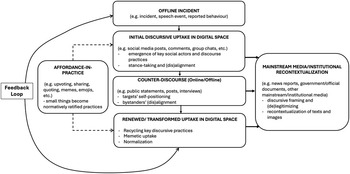
This article has discussed how aggressive discourse practices, specifically misogynistic discourses, become consequential and amplified through digitally mediated interaction in post-digital conditions. The analysis of LIHKG threads targeting “crazy women” reveals that verbal aggression is enacted and sustained through two interconnected processes. At the micro level, members of the LIHKG community collectively appropriate platform affordances as discursive resources, where, for instance, upvoting/downvoting becomes collective endorsement; nested quoting visually amplifies derogatory referentials; custom emojis encode “hard plastic” subcultural norms; and forum slang boosts post visibility. These “small things” are collectively ratified, with verbal aggression becoming a normalized and acceptable practice (Blommaert, Reference Blommaert2019). At the macro level, misogynistic nominations become fluid discursive resources that traverse communicative contexts and temporal scales, while sustaining their general purpose of misogynistic Othering. Taken together, these findings suggest that verbal aggression in the post-digital age operates through a systematic process where micro-level platform affordances enable, normalize, and amplify macro-level consequences online and offline. Beyond LIHKG, in post-digital conditions where digital mediation is fully integrated into everyday “offline” lives, discourse practices can no longer be analytically separated into clear-cut online and offline domains. Rather, verbal aggression unfolds as nexus cycles (Figure 4) that seamlessly travel from one media space to another. What begins as a target-specific incident such as Kisabbb’s case can be extended to generalized negative outgroup construction, and persist over time causing long-term harm to the individual target as well as the social group to which they belong.
The online-offline nexus (OON) cycle of (post)digital verbal aggression.

Figure 4 Long description
The flowchart details a cycle starting with an 'Offline Incident' (e.g., incident, speech event, reported behavior). It leads to 'Initial Discursive Uptake in Digital Space' involving social media posts, comments and the emergence of new discourses. This connects to 'Counter-Discourses (Containing)' with public statements and media responses. 'Mainstream Media/Institutional Recognition/Evaluation' follows, involving media reports and official documents. The cycle continues with 'Renewed/Transformed Uptake in Digital Space,' where discourses are recontextualized. 'Affordances-in-Practice' includes upvoting, sharing and nested quoting, feeding back into the cycle through a 'Feedback Loop.'.
In light of the findings and arguments presented in this article, Figure 4 illustrates how verbal aggression circulates and amplifies across post-digital contexts. An offline incident initiates discursive uptake in digital spaces, where platform affordances enable community ratification and amplification. When targeted individuals contest the narrative or mainstream institutions recontextualize the discourse, new discourses feed back into digital spaces where key discursive resources and practices undergo memetic transformation and generalization. Counter-discourse from targets does not, however, end this cycle: as Jane (Reference Jane2017) notes, women who speak out about online abuse frequently find that doing so generates further attack, resulting in targets’ self-censorship or withdrawal from public discourse, as well as offline real-world impacts such as mental illness, doxxing, and stalking. The recursive feedback loop indicates that such cycles can repeat, rather than resolve aggression. Designed for comparative application across cases and platforms, this framework enables researchers to systematically document how discourse achieves consequence across online and offline communicative contexts.
Theoretically, this OON cycle or feedback loop addresses a gap in traditional digital discourse analysis, which typically examines data from either a single platform or traces only digital media in isolation (Androutsopoulos, Reference Androutsopoulos2021; Lee & Chau, Reference Lee and Chau2021). By tracking how the same incident is discursively constructed across multiple digital and traditional media spaces, the role of mainstream media intervention becomes apparent. This mainstream-digital integration has been recognized as a feature of Hong Kong’s evolving media ecology (Koo, Reference Koo2024). Digital-first news outlets such as HK01 occupy an increasingly ambiguous position, balancing journalistic authority against the pressure to prioritize high-engagement soft news. In response to the highly competitive and fast-paced media market, journalists in Hong Kong, as noted in Zhang and Li’s (Reference Zhang and Li2020) survey, routinely source “ready-made” content from social media and local forums. Through recontextualization processes involving the selective appropriation and transformation of discourse across contexts, media coverage framed as “reporting” and “representation” of online bullying can paradoxically perpetuate the abuse through genre framing (“entertainment”), visual representations (publishing images of victims), and linguistic reappropriation (framing abuse as “joking”). This resonates with Huang’s (Reference Huang2023) analysis of Chinese nationalist digital vigilantism, in which commercial media outlets recontextualize misogynistic shaming as public discourse, thus extending its reach beyond the originating platform. This cycle then feeds back to the forum and other social media with renewed and transformed meanings for subsequent rounds of aggression in the recursive feedback loop. As one participant, Wilson, observed,
連登嘅呢啲有陣時係直接係仇女嘅思想會帶返來社會。就好似我啲 friend, 佢而家真係好好好好崇拜父權嘅。然之後咁又係呢啲父權又上返連登去繼續 spread 呢啲 idea, idea spread 返畀社會, 咁樣就惡性循環
(“LIHKG sometimes directly brings misogynistic thinking back into society. Like my friends, they now really worship patriarchal values. And then that patriarchy goes back onto LIHKG to keep spreading those ideas, and the ideas spread back into society. It becomes a vicious cycle.”) (Wilson, interview)
Wilson’s “vicious cycle” observation aligns with what Bauman and Briggs (Reference Bauman and Briggs1990, p. 77) describe as an extended chain of decontextualization and recontextualization that “may be extended without temporal limit.” As Leppänen et al. (Reference Leppänen, Kytölä, Jousmäki, Peuronen, Westinen, Seargeant and Tagg2014) show in social media contexts, participation in such chains may socialize participants into the ideological histories embedded in the discourse being circulated, and in the case of Kisabbb and also Wilson’s anecdote, such discourse travels into offline relations, until misogynistic discourse becomes vernacular “common knowledge.”
The discursive trajectory of the “tank” label also illustrates what Blommaert (Reference Blommaert2007) calls “scale-jumping”: the label originally served as a micro-level discursive device reacting to the leaked images, but through repeated use, it achieved a macro-level status as a generic community resource within the LIHKG forum and beyond to refer to plus-size women. This upward scaling depends on users’ collective effort, where platform affordances facilitate the memetic spread of the term and mainstream media legitimate its circulation. An offline moment in which a woman is photographed at the beach thus triggers a stepwise interlocking nexus where misogynistic discourse persists in online interactions long after the original incident.
From a discourse-analytic perspective, this study contributes a critical dimension to post-digital discourse analysis by showing how ideologies circulate through OON processes. While the OON model maps discourse circulation across contexts and timescales, it focuses primarily on how interaction circulates in the nexus rather than the ideological consequences of that circulation. This study demonstrates how discourse transformation across scales normalizes and legitimizes particular forms of social exclusion. The integrated CD-OONE approach interrogates what ideological work is accomplished through discursive circulation within an OON, rather than simply documenting circulation patterns. By combining CDA with OON mapping, CD-OONE reveals that misogynistic discourse is never a neutral or random individual act, but a systematic, collective practice across communicative contexts over time.
Conclusions: Implications for post-digital language research
In extending existing scholarship on entextualization and discourse circulation to post-digital conditions, this article demonstrates that single-platform research alone cannot adequately account for contemporary language and communication practices. While the present study is itself grounded primarily in LIHKG as a focal site, the CD-OONE provides a conceptual framing to trace how discourse originating on that platform travels across media contexts and produces effects beyond it. The case study in this article shows that scale-jumping and memetic aggression emerge from the intersection of affordances-in-practice, platform subcultural norms, and community ratification of micro-practices. It shows that digital discourse analysis in post-digital conditions requires attending to how communities enact and ratify linguistic practices, not just documenting their circulation across online and offline spaces.
Crucially, the methodology adopted here reflects a post-digital reality in that offline incidents exist as mediatized events (Androutsopoulos, Reference Androutsopoulos, Blackwood, Tufi and Amos2024). The actual site of meaning-making is not the offline triggering event itself, but its circulation across platforms and media spaces, where language practices are renegotiated, ratified, and upscaled. While a blended, multisite “hybrid ethnography” incorporating direct observation of offline interactions would enrich future research in this area (Liu, Reference Liu2022), the current study’s focus on mediatized representations reflects a post-digital reality where offline happenings increasingly “exist” and acquire social consequences primarily through iterative media presence. The study also has implications for applied linguistics more broadly: Through examining how aggressive discourse is amplified and normalized through affordances-in-practice and community ratification, it becomes evident that discourse functions as a tool for maintaining and reinforcing gender-based ideologies.
This paper calls for a significant shift in how digital discourse analysts approach their research in the post-digital age. Rather than focusing narrowly on algorithmic mediation or treating online spaces as isolated environments, discourse researchers should trace how language practices become socially acceptable through human agency across platforms and communities. First, integrating a critical perspective when tracking discursive trajectories enables researchers to better understand what ideological work language does as it traverses online and offline spaces, with scalar mapping methods that show how that language spreads and gains legitimacy through cumulative human action. Second, it is important to recognize that post-digital discourse exists in hybrid spaces (de Souza e Silva et al., Reference de Souza E Silva, Campbell and Ling2025) where online and offline interactions are inseparable, and to pay close attention to how users actively reappropriate affordances-in-practice as interactions move across spaces and timescapes. Platform-mediated practices such as voting and serial threading are not merely contextual background, and should be treated as primary units of analysis in understanding how harmful discourse becomes ordinary and acceptable. Such an approach points to the value of interdisciplinary dialogue, bridging applied linguistics with media studies and digital culture to explain how verbal aggression evolves in contemporary society.
Acknowledgments
I am grateful to the editors and anonymous reviewers for their insightful comments on an earlier draft of this article. This project was supported by the Hong Kong Research Grants Council General Research Fund (Ref. 14604323).


 Open access

