


Introduction
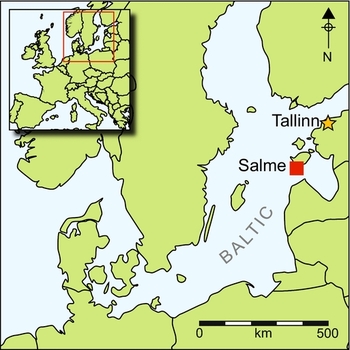
Salme is a small coastal village on the island of Saaremaa in western Estonia, on the eastern side of the Baltic Sea (Figure 1). In the summer of 2008, workmen exposed extraordinary archaeological finds, including human skeletal remains, iron swords and rivets, and bone gaming pieces. The objects were dated to around AD 750, the end of what is known in Estonia as the Pre-Viking Age, and in Sweden as the Vendel Period and the beginning of the Viking Age. None of the artefacts was of local origin, and a number of them exhibited a style associated with archaeological materials from Scandinavia, across the Baltic Sea (Konsa et al. Reference Konsa, Vassiljev, Allmäe, Maldre, Oras and Russow2009; Peets & Maldre Reference Peets, Maldre and Tamla2010; Peets et al. Reference Peets, Allmäe and Maldre2011, Reference Peets, Allmäe, Maldre, Saage, Tomek and Lõugas2013). During subsequent excavations, the remains of two ships were uncovered. The ships had been dragged approximately 100m inland and partly covered with stones and soil. They were then completely buried quite quickly by marine sediments that were washed ashore by storms and perhaps carried by ice.
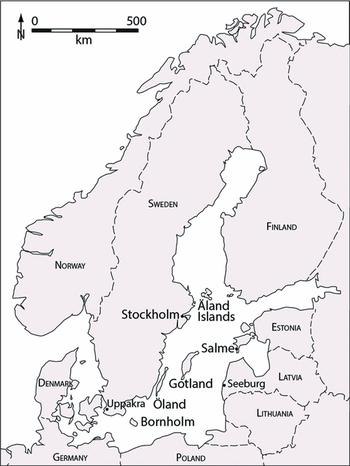
The Baltic Sea and some of the locations mentioned in the text.
Here, we discuss the ship burials, the physical anthropology of the human remains, and isotopic measurements on tooth enamel from some of the burials. Our goal is to consider the place of origin of the individuals who came to Salme, met theirdeath and were buried in these two ships on the coast.
The Salme ship burials
Both ships were clinker built, with rows of iron rivets joining the overlapping horizontal planks of the hull. The Salme I ship was heavily damaged by modern construction activities. It was probably a rowing ship, approximately 11.5m long, with six pairs of oars. Seven human skeletons of tall, young males were found with this ship. At least two, and perhaps all, of these individuals had been placed in a sitting position. Most of the archaeological materials were recorded outside the ship where they had been moved by the construction workers who first encountered the site. The finds included fragments of two swords, spear- and arrowheads, knives, a small, socketed axe and fragments of ornamented combs of deer antler. There were also 75 gamingpieces of whale and cattle bone, belonging to at least two separate sets, together with three dice made of antler. Animal bones (a few pig bones and lots of sheep, goat and cattle bones) at the site may have resulted from a funeral feast or been left as food for the afterlife. There were also the remains of two decapitated hawks (Konsa et al. Reference Konsa, Vassiljev, Allmäe, Maldre, Oras and Russow2009; Peets & Maldre Reference Peets, Maldre and Tamla2010; Allmäe et al. Reference Allmäe, Maldre and Tomek2011). In Sweden, the bones of birds of prey frequently occur in wealthy burials in the sixth–tenth centuries AD. Raptor bones in graves have been found mainly in eastern Sweden, Uppland and Södermanland (Sten & Vretemark Reference Sten and Vretemark1988: 153; Tyrberg Reference Tyrberg2002: 228–30). The most common species is the goshawk, found in 27 of 34 graves containing raptor bones (Tyrberg Reference Tyrberg2002: 228, fig. 11).
The Salme II ship, largely preserved, was found by archaeologists in 2010, approximately 30–50m south-west of Salme I (Figure 2). The first finds included many rivets, sword fragments, two shield bosses and two human skeletons. The humerus of one of the skeletons had been chopped through in three places, and the skull of the second individual had distinct traces of axe or sword cuts. In addition, a dog skeleton was found, cut in half.
The Salme II ship in different stages of excavation. Left: outline of ship rivets and humus stains together with skeletons. Skeleton layers I–III are visible; middle: skeleton layer IV, located transverse to the ship; right: excavated boat contour without skeletons (photographs by Jüri Peets and Reet Maldre).
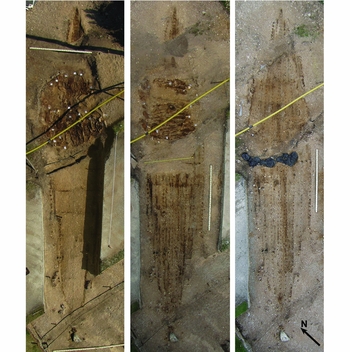
Additional excavations in 2010 and 2011 exposed the entire length of the ship, along with the skeletal remains of 34 individuals. Five or six rows of rivets used in clinker construction were preserved from the ship, which was approximately 17–17.5m long and about 3m wide, with a keel for sailing (Peets et al. Reference Peets, Allmäe, Maldre, Saage, Tomek and Lõugas2013). Such a boat would have held a crew of around 30 (Henrici Chronicon Livoniae VII: 2; Tarvel Reference Tarvel1982).
The 34 skeletons were stacked on the ship like firewood, in four layers within an area of 3 × 4m. The bodies had been buried with 40 swords (both single- and double-edged types, including examples with gilded and jewelled bronze hilts), covered by large, round wooden shields with bosses of iron, and by cloth, probably from the sail. Other grave goods included 15 ornamented antler combs, broken shears, beads, pendants of bear canines, bronze and iron plaques, and small padlocks. Gaming pieces made from whalebone and walrus ivory had been scattered among the bodies. A large number of arrowheads were found, but only a few spears and no axes. Many of the arrowheads were stuck in the wood of the ship and in the shields, and, along with the many injuries observed in the skeletal remains, document the conflict that must have resulted in the deaths of these individuals.
An important question regarding these finds concerns the origin of the individuals on the ships. The archaeological finds were non-local and pointed westwards across the Baltic to Sweden, to places such as the Mälaren region west of Stockholm, the Swedish island of Gotland, Denmark and the island of Bornholm, or south to the Swedish colony of Seeburg (also known as Grobina), near Liepaja in Courland, in present day Latvia (Nerman Reference Nerman1958: 198). Isotopic analysis of the Salme skeletons, looking at isotopic ratios of strontium, carbon and oxygen in dental enamel, was compared with local conditions and with data from Sweden and Denmark, and will be discussed later in this article.
Anthropological analysis of the skeletal remains
The human skeletal remains from the Salme I ship consisted largely of mixed osteological material, but the remains of seven male skeletons were recorded; the cause of their death was not obvious. The probable burial positions of the bodies were estimated from the photographs taken on site; the exact positioning of the corpses is speculative (Allmäe et al. Reference Allmäe, Maldre and Tomek2011).
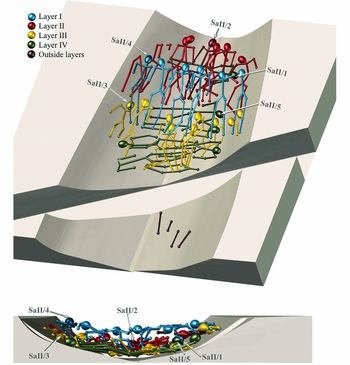
The positions of the human skeletons in the Salme II ship grave were recorded precisely during the excavations, using GPS equipment to facilitate 3D drawings; these demonstrate the burial arrangement and technique used in this mass grave (Figure 3). The bodies were buried in four layers, with the bottom layer perpendicular to the long axis of the ship, and the three other layers parallel to the sides of the ship (Peets et al. Reference Peets, Allmäe and Maldre2011, Reference Peets, Allmäe, Maldre, Saage, Tomek and Lõugas2013). Edged-weapon perimortem injuries were observed on the first skeletons exposed from Salme II. The individuals had been treated with respect during burial, with dismembered body parts placed in anatomically correct positions. In total, 34 complete or partial skeletons were recorded from the grave, along with a solitary skull. Biological age and sex determinations were made according to standard criteria (WEA 1980; Buikstra & Ubelaker Reference Buikstra and Ubelaker1994; White & Folkens Reference White and Folkens2000).
Schematic 3D plan of the position and distribution of burials on Salme II (drawing by Reet Maldre).
For stature calculations, the maximum length of femoral bone was used; if this was absent, the humerus or tibia was used. The long bones of upper and lower extremities were measured according to Martin and Saller (Reference Martin and Saller1957); the right side was used if available. Stature and body weight were calculated according to formulae proposed by Ruff and colleagues (Reference Ruff, Holt, Niskanen, Sladék, Berner, Garofalo, Garvin, Hora, Maijanen, Niinimäki, Salo, Schuplerová and Tompkins2012). The Northern European formula was used for tibia stature estimations, and the formulae of Trotter and Gleser (Reference Trotter and Gleser1952, Reference Trotter and Gleser1958) were used for stature estimations (shown in brackets below). The completeness of the skeletons, any trauma, including blade wounds, and other special features were also recorded.
Salme I ship grave
From Salme I, the best-preserved skeletons in situ were SaI/1, SaI/2 and SaI/3 (Figure 4). The skeletal remains of these three men were found in the stern of the ship and were buried in rather relaxed positions (Allmäe Reference Allmäe2011). The upper skeletons were articulated, but construction works had destroyed the lower parts of the axial skeletons. SaI/1 was lying with the shoulders up and the chin on the chest. This individual was a male, aged 25–35, with an estimated height of 1.812m (1.829m). SaI/2 lay on his right side with his head resting on the left shoulder of SaI/1. SaI/2 was male, aged 18–25, with an approximate height of 1.747m (1.767m). SaI/3 was lying prone, with his head turned to the left and his upper extremities stretched out behind him. SaI/3 was a young male, aged 25–30, with a height of 1.793m (1.813m). One premolar was collected from each individual for isotopic analysis.
Upper portions of skeletons SaI/1–SaI/3, preserved in situ in the Salme I ship (photograph by Külli Rikas).

Salme II ship grave
The burials in the second Salme ship were quite different, distinguished by the regular placement of the corpses in a common, extended, supine position; by the respectful attitude shown towards the buried individuals; and by the presence of injuries from sharp weapons. The analysis of the Salme II human remains is ongoing. To date, ten skeletons present injuries from sharp blades; six have multiple injuries and some exhibit trauma characteristic of decapitation. Investigations so far indicate an average body height of 1.743m (1.776m) and body weight of 76.6kg.
A premolar was removed from five of the Salme II skeletons for isotopic analysis. The position of these skeletons in the mass grave is shown in Figure 3. SaII/4 is male, aged 40–60, with an estimated height of 1.706m (1.746m) and weight of 82kg. The remains were lying on the west side of the ship, the first in the upper burial row, in an extended supine position. The head was turned to the left, although all of the others in the upper row had their heads turned to the right. A broken sword had been placed on the right forearm, which was palm upwards. On top of this was a damaged shield boss. The skeleton exhibited several perimortem injuries: stab wounds (probably from a sword) on the posterior side of the thoracic vertebrae; five blade strokes to the right humerus, which cut through the bone in three places; and a heavy slash with a blade that caused a 100mm-long penetrating injury to the left side of the skull (involving both the frontal bone and the left parietal bone). Evidence of decapitation was observed on the first and second vertebrae.
Skeleton XII (SaII/2) belongs to a male, aged 25–35, height 1.691m (1.732m), weight 73kg. Atlanto-occipital fusion was observed on the vertebra of this individual. This is one of the most common abnormalities of the upper cervical spine (Lang Reference Lang1995: 54), and may cause orthopaedic problems and occasionally induce neurological effects (Skrzat et al. Reference Skrzat, Mroz, Jaworek and Walocha2010). The skeleton exhibited blade wounds on the proximal end of the left ulna and on the medial lower edge of the femoral head. The man was buried in the second layer (Figure 3). A gaming piece with an iron tack was found near his mouth.
SaII/3 was the poorly preserved skeleton of a 25–35-year-old male with an estimated height of 1.704m (1.746m). He was buried as the first in the second row on the west side of the ship. The body had been placed in an extended supine position, head turned to the left, left hand probably under the head. The right arm was stretched away from the body. A sword hilt of gilded bronze with a pommel with precious stones was found under his right upper arm, along with the head of a sacrificed dog.
SaII/5 belonged to a male, aged 25–30. His estimated height was 1.797m (1.822m) and weight 87kg. The man was buried in the transverse bottom layer in extended supine position, head pointed to the east and resting on the left shoulder. A full set of gaming pieces and three dice, made of whalebone and walrus ivory, were placed in his lap (probably originally in a cloth bag); a damaged sword had been placed above his left hip.
SaII/1 is a male aged 30–40, estimated height 1.769m (1.799m) and weight 79kg. A blade injury (probably caused by a single slashing blow) was present on the proximal end of the right ulna and distal lateral end of the left humerus. The man was buried in the transverse bottom layer, separately from the others, in the north-eastern part of the ship. He was placed in an extended supine position, with the head resting on the left shoulder. A single-edged sword had been placed between his body and left arm, parallel to the body.
In summary, the individuals buried with the two ships at Salme were young, tall males, with substantial evidence for trauma and violent death. The Salme II burials were placed carefully in the ship in laid-out positions in a stack of bodies four deep. They were buried with weapons and other grave goods. Less is known about the context of the Salme I burials due to the nature of their discovery. In addition to questions about who buried them and how they died, we would like to know where they came from.
Isotopic analysis
Light and heavy isotope ratios were measured in samples of tooth enamel taken from the three individuals from Salme I (SaI/1–SaI/3) and the five from Salme II (SaII/1–SaII/5). Premolars were chosen, as they are easier to extract and exhibit less diagnostic information than other teeth for various kinds of research. These are permanent teeth, and the enamel forms between 1.5 and 7 years of age (Woelfel & Scheid Reference Woelfel and Scheid2002). In this study, we have measured carbonate as a component of tooth enamel using the reference standard PDB (PeeDeeBee Carbonate).
The isotopic composition of tooth enamel can provide information on diet and place of origin. Isotopic ratios of carbon, oxygen and strontium are deposited in the enamel apatite during formation and remain largely unaltered after death. In archaeology, enamel is used as a signal of place of birth. If an individual moves to a new location in a different geological context, or is buried in a new place, the enamel isotope ratio will differ from the new location, allowing the designation of that individual as non-locally born.
Light isotopes of carbon in enamel provide information on childhood diet, e.g. marine versus terrestrial resources or certain species of plants. The isotopic ratio of carbon was measured in these teeth, but the results are not discussed further. Strontium isotope analysis provides a robust means of examining past mobility. The strontium isotope ratio of 87Sr/86Sr varies among different kinds of rocks, based on their age and composition (Faure & Mensing Reference Faure and Mensing2004). Strontium moves into humans from rocks and sediment through the food chain (Sillen & Kavanagh Reference Sillen and Kavanagh1982; Price Reference Price1985, Reference Price2000) and is deposited in the skeleton. Oxygen isotopes have been widely used as a proxy for temperature in many climate and environmental studies, and vary geographically in surface water and rainfall (Dansgaard Reference Dansgaard1964). The oxygen isotope ratio in the skeleton reflects that of body water, and ultimately of drinking water (Luz et al. Reference Luz, Kolodny and Horowitz1984; Luz & Kolodny Reference Luz and Kolodny1985; Kohn Reference Kohn1996), which in turn predominantly reflects local rainfall. Major factors affecting rainfall δ18O values are primarily geographic: latitude, elevation, amount of precipitation and distance from the evaporation source (e.g. an ocean).
Oxygen, primarily from drinking water, is also incorporated in dental enamel—into both carbonate and phosphate ions—during the early life of an individual, where it remains unchanged through life. Oxygen isotopes are also present in bone apatite, and are exchanged through the life of the individual by bone turnover, reflecting place of residence in later years. Thus, oxygen isotopes have the potential to be used to investigate human mobility and provenance, although there is significant variation in oxygen isotope ratios that makes their application less straightforward. Oxygen, strontium and carbon isotopes are discussed in more detail in the online supplementary material (OSM), together with procedures for sample preparation and measurement. In addition, the determination of isotopic baselines, both in principle and in practice, are described in the OSM.
Estonia, Saaremaa and Salme
Estonia sits at the edge of the Fennoscandian Shield on the north-western East European Shield (Raukas & Teedumäe Reference Raukas and Teedumäe1997). The Proterozoic igneous and metamorphic rocks of this shield form the bedrock of the country and lie at depths greater than 100m, increasing to the south. The sedimentary cover is composed of Cambrian, Ordovician, Silurian and Devonian materials and consists largely of limestone and sandstone. Quaternary deposits, largely of glacial origin, normally cover these sedimentary layers at depths of 5 to >100m across the rather level landscape. Alvar formations are visible in areas where the cover materials are particularly thin or absent. Although there is very little strontium isotope data from mainland Estonia, we have a few samples from the northern part of the country; values range from 0.7106–0.7159 (Oras et al. Reference Oras, Lang, Rannamäe, Varul, Konsa, Limbo-Simovart, Vedru, Laneman, Malve and Price2016). The island of Saaremaa lies on the western edge of the East European Shield. The crystalline rock basement underlying the island is composed primarily of metamorphic rocks (various forms of gneiss) in the east, while acid igneous rocks (mostly types of granite) dominate in the western part of the island (Raukas et al. 2009). The sedimentary platform on top of this basement is metres in thickness and composed entirely of Silurian carbonate rocks, primarily limestones. This limestone is exposed as alvar in areas of thin or absent surface materials.
The surface materials and topography of the island of Saaremaa are the result of the last glaciation and changes in sea level at the close of the Pleistocene. Glacial lobes moved across the island in several directions, depositing sediments from different sources, primarily to the east and west of the island. The weight of glacial ice depressed the earth's surface substantially in the Baltic, and the rise in sea level following the disappearance of this ice flooded this area during the Late Glacial. The island gradually emerged from the sea after 10000 BP, and large parts of the surface are covered with marine sediments from that period. Figure 5 provides information on the location and extent of Quaternary deposits on Saaremaa. The archaeological site at Salme lies at the head of the narrow peninsula of Sõrve Spit, a remnant of a large esker from the late Pleistocene. The immediate area around the site is low-lying and covered with marine sediments: clays, sands and gravels.
Quaternary deposits on the island of Saaremaa (Raukas et al. Reference Raukas, Bauert, Willman, Puurmann and Ratas2009), showing the location of Salme and the sites providing baseline samples from the island.

We obtained a number of modern and archaeological faunal samples from Saaremaa to determine the local bioavailable strontium isotope ratios on the island (see Table 1). There are six samples of snail shells from four sites, and seven samples of small fauna and snails from the site of Asva, dating from the Bronze Age or Pre-Viking Age, located 44km north-east of the ship burial (Figure 5). In addition, there are eight samples of human tooth enamel from Salme, discussed in the next section. The strontium isotope ratios for the snails are provided in Table 1 and Figure 6. The values show a wide range, from 0.7094 to 0.7139. Measurement of fauna and snails from the Asva site exhibits a wide range of values with a bimodal distribution. The two snails and the rodent have 87Sr/86Sr values in line with the other snails from the island. The voles (Arvicola terrestris) have higher ratios approaching 0.720. These values, between 0.709 and 0.720, define the maximum range for baseline values for the island.
Strontium, carbon and oxygen isotope ratios from baseline fauna and human remains from Salme and the island of Saaremaa.

Faunal and human 87Sr/86Sr values from Saaremaa Island and Salme.

Isotopic analysis of the Salme human remains
The results of the isotopic analysis of the Salme human enamel samples are provided in Table 1. The δ13C carbon isotope data from the enamel is a reflection of early childhood diet. It is very homogeneous in the Salme sample, and is not discussed further here. The 87Sr/86Sr for the eight Salme human samples averaged 0.7291±0.0027 (1 SD), with a range of 0.7237–0.7324.
The strontium isotope ratios for the Salme humans, along with faunal samples from the site and from the island of Saaremaa, are shown in Figure 6. It is very clear that the human remains from the Salme ship burials are isotopically distinct from the snails and other fauna from the larger area of the island, as well as from the baseline samples from the Asva site. This is definitive evidence that the buried individuals at Salme are not local to the island. Moreover, it is very probable that these individuals were not from the eastern Baltic region, given the geological homogeneity of this larger region, and 87Sr/86Sr values generally below 0.720.
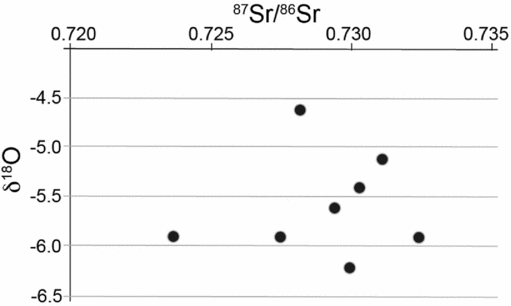
The oxygen isotope data are less informative. Oxygen isotope ratios in the Salme human samples averaged −5.6‰±0.5 (1 SD), ranging between −4.6‰ and −6.2‰. A plot of87Sr/86Sr versus δ18O for the human samples from Salme is shown in Figure 7. The δ18O values are randomly scattered, and no clear pattern can be observed. The range of δ18O values is not inconsistent with values from the Stockholm region in central Sweden (mean = −6.4‰) and is slightly higher than ratios found to the south and on Gotland.
Scatterplot of 87Sr/86Sr versus δ180 for the eight human samples from Salme.
Interpretation and conclusion
It is important to reiterate several points here. Isotopic analysis is useful for identifying non-local individuals in a burial population, but there are often a number of places with similar isotopic ratios that make the distinction of a single place of origin very difficult. In some cases, the combination of isotopic ratios (strontium, oxygen and/or lead) can help to delimit the original home of the buried individuals. Oxygen, however, is not a powerful discriminator in the Baltic region because similar values are found over a very large area. In order to constrain the possible homeland for the Salme skeletons, it is essential to combine isotopic and archaeological evidence to identify their place of origin more accurately.
The artefacts found with the burials are of particular interest. These were generally quite rich and included gaming pieces (326), swords (about 40), arrowheads (91), antler combs (15) and shield bosses (15). Certain artefact types were present in very limited quantities, including ornaments: two brooches, a handful of beads made of different materials, two bear canine tooth pendants, and file and shear fragments. Such limited find material, however, has a positive use. As the finds were located together and were associated with a single, short-lived event, and because they include items with considerably different dates, there is an opportunity to obtain a highly detailed chronology.
The sword hilts of gilded bronze, decorated with Scandinavian designs, and scabbard remnants with ornaments of gilded bronze or gilded bronze wire, preserved on some sword blades, provide useful information. A gilded bronze decoration on the upper edge of a scabbard from Salme (Figure 8) has an exact analogue found with the Ultuna ship burial near Uppsala, Sweden (Nerman Reference Nerman1958: fig. 241; Nørgård Jørgensen Reference Nørgård Jørgensen1999: fig. 49: 2). A repeated, frieze-like ornamental band of gold foil and wire decorating the wooden section of another scabbard bears the same motif (Figure 9). The sword hilts of gilded bronze from the Salme ships have close parallels with the Vendel and Valsgärde ship burials near Uppsala, Sweden, and with richly furnished warrior graves in other parts of Scandinavia and Finland (Nørgård Jørgensen Reference Nørgård Jørgensen1999: fig. 49: 1–3). These ornament types from inland Sweden date from the middle of the Vendel Period, i.e. AD 700–750 (Salmo Reference Salmo1938: pl. XLII; Kivikoski Reference Kivikoski1973: pl. 55: 507–508; Lamm & Rundkvist Reference Lamm and Rundkvist2005: 108).
Fragment of the upper edge of a gilded bronze sword scabbard (photograph by Reet Maldre).

A frieze-like decorative band of gold foil and wire on a wooden part of a scabbard (X-ray photograph by Reet Maldre).

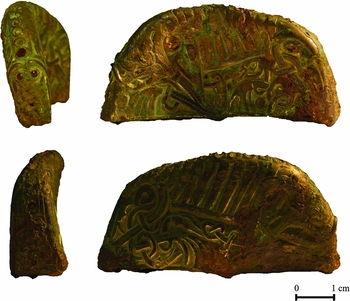
The pommel of gilded bronze decorated with the image of a human-faced beast and 25 almandines (a form of garnet; Figure 10) also has close parallels, for example with the pommeldepicting a beast with almandine eyes from the warrior grave with cremation burial at Ägget in the Mälaren district in Sweden, and with several burials from south-western Finland (e.g. Kivikoski Reference Kivikoski1973). The find from Ägget has been dated to the earlier phase of the Vendel Period, approximately AD 520–600 (Lamm & Rundkvist Reference Lamm and Rundkvist2005: 102–107).
Four views of a sword pommel of gilded bronze, decorated with an image of a human-faced beast and 25 almandines (photograph by Reet Maldre).
During the Vendel Period, there were still relatively few large urban centres for craft production and trade in Scandinavia. Most important among them were Helgö on an island on the Mälar Lake in Uppland, and Uppåkra in south-western Sweden (Hårdh Reference Hårdh and Arrhenius2001). The products of jewellers at these centres were highly esteemed by local and foreign elites. Undoubtedly, weapons decorated with precious metals, garnets and other luxury items were important gifts at negotiations of trade contracts and political alliances among aristocratic families. This practice contributed to the spread of high-status items to places quite distant from the production centres. One possible explanation for the presence of the Salme individuals in Estonia is as members of a diplomatic mission bearing gifts to promote trade and alliance. This interpretation is also supported by the fact that dogs and hawks had been placed with the Salme warriors as grave goods, in addition to luxury weapons and the abundant (326) gaming pieces. These items would not have been particularly suitable for a military campaign, but may be more related to the equipment of an entourage of envoys. Diplomatic deputations from that time always travelled with a well-armed cohort of elite warriors.
The luxurious sword hilts with Scandinavian decoration found at Salme II have features similar to analogous finds from rich noblemen's graves near Uppsala and other places in the Mälar region of Sweden (e.g. graves at Vendel, Valsgärde and Ultuna). The production centre at Helgö was their probable place of origin.
Several other issues are important in understanding the Salme ship burials: political relationships in Scandinavia and the Baltic, trade routes and the introduction of sailingvessels. There were two powerful groups in Sweden, known as the Svears and the Götars. The Svears lived in central Sweden, concentrated around the Uppsala area and in the Mälar region; the Götars (also known as Geats or Goths), another North Germanic tribe, lived south of the Svears, in what is now much of Götaland (‘land of the Geats’) in Sweden. A central Swedish provenance for the warriors killed at Salme is supported by the location of trade routes, probably established in the Bronze Age. It is possible that there was a settlement and cemetery with a Scandinavian population on the Sõrve Peninsula, which was an island separated from Saaremaa by water throughout the Middle Ages. A group of stone graves in the middle of the present Sõrve Peninsula includes two ship-like stone contours and stone cists with finds of Scandinavian design. There were two major trade routes across the Baltic Sea. The northern route was controlled by the Svears tribal elite. The ancient seaway from Mälaren to the eastern part of the Baltic probably ran first across the archipelago of the Åland islands between Sweden and Finland, and either entered the Gulf of Finland heading east to the Great Eastern Way (Austrvegr), or south through the straits at Salme, along the island of Saaremaa to the amber-rich
Courland region of Latvia. The Great Eastern Way was the major route from Scandinavia to Constantinople via the Gulf of Finland, the Neva River and the Dnieper River to the Black Sea, or down the Neva and Volga rivers to the Caspian Sea, and then eastwards.
The southern coast of the Baltic and the estuaries of the great rivers—the southern passage to the Great Eastern Way—were under the control of nobility from the northern part of present-day Poland, northern Germany and Denmark. There was a long-lived enmity between the courts of the Götars and the Svears over control of the Scandinavian peninsula and the Great Eastern Way, which occasionally also led to violent encounters. At times, the Norwegians also interfered in this so-called ‘frozen conflict’.
The shortest route from Courland to the ‘mother country’ in the Mälar district ran through the Salme straits. Noblemen from Denmark and the southern coast of the Baltic, along with the Götars, wanted control of that route. It is entirely possible that the dead at Salme were the victims of an armed conflict between these foreign groups that left the Svear seafarers buried near the shoreline. Local Estonians need not have been involved in any way.
The research reported in this study was driven by a question about the origins of the individuals buried on the two ships at Salme. The combination of isotopic and archaeological evidence clearly points to the Mälaren region in central Sweden as the most probable homeland of those men who travelled to Salme, died violently and were buried hastily in two ships in around AD 750.
Supplementary material
To view supplementary material for this article, please visit http://dx.doi.org/10.15184/aqy.2016.106
Acknowledgements
Several individuals and institutions have contributed to the success of this project. Archaeological fieldwork on the Salme burial complex was supported by a research grant to Jüri Peets from the Estonian Ministry of Education and Science (ETF 7880), and by a target-financed research project of the Estonian Ministry of Education and Science (SF0130012s08) to Lembi Lõugas. The samples for baseline values from Denmark were provided by numerous individuals named in previous publications. Collaboration with Caroline Arcini is responsible for many of the Swedish samples. Samples from Öland were collected by Helene Wilhelmsson. Ken Ritchie and Harry Robson collected the snail samples on Saaremaa; James Burton was responsible for processing the samples through the Laboratory for Archaeological Chemistry in Madison; Paul Fullagar (UNC) and David Dettman (Arizona) respectively measured the strontium and carbon/oxygen isotope ratios. Funding for the isotopic measurements was partly provided by the US National Science Foundation. The collection and analysis of baseline samples on mainland Estonia, conducted by Ester Oras, was supported by an Estonian Ministry of Education and Research institutional research grant (IUT20-7) to Valter Lang, and by the European Union, through the European Regional Development Fund (Centre of Excellence CECT).



