The systematics and status of long-beaked echidnas across New Guinea remains poorly understood because they are highly variable in coat colour, number of clawed digits and relative density of fur and spines, and are only rarely encountered (Flannery, Reference Flannery1995). After the establishment of numerous putative long-beaked echidna species and subspecies between the late 19th and mid 20th centuries, only the single species Zaglossus bruijnii was recognized by Van Deusen & George (Reference Van Deusen and George1969) in their provisional review of the genus. Subsequent systematic revision of Zaglossus by Flannery & Groves (Reference Flannery and Groves1998) identified three allopatric species and several subspecies occurring across the island, and these authors erected the new species Z. attenboroughi (Attenborough's long-beaked echidna) to describe a single echidna specimen (Plate 1) collected in 1961 at 1,600 m near the top of Mount Rara, in the Cyclops Mountains of northern Dutch New Guinea (now the Indonesian province of Papua). Z. attenboroughi is the smallest of the three currently recognized Zaglossus species (70 mm beak length, 107.5 mm dentary length), and the holotype possesses a straight beak, five claws on each foot, and short, dense, fine fur that is raw umber dorsally and fawn ventrally (Flannery & Groves, Reference Flannery and Groves1998). It is the only echidna species known from northern New Guinea.
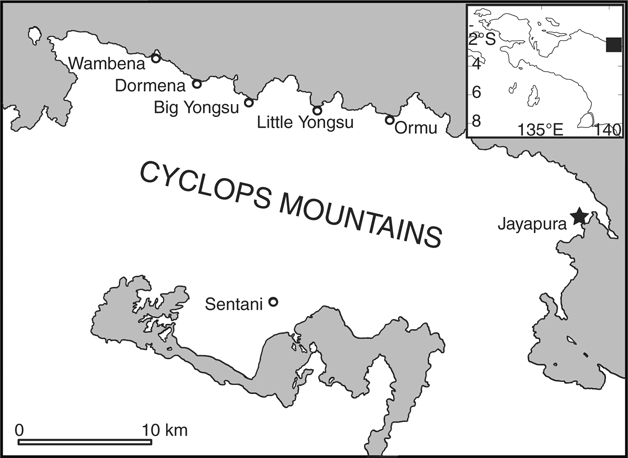
The study area, showing main settlements mentioned in the text (main map), and geographical location of study area in northern Indonesian Papua (shaded rectangle on inset).

Long-beaked echidnas are threatened across their range by subsistence hunting and habitat loss from farming, logging and mining, and all three species are currently categorized as Critically Endangered on the IUCN Red List (2008). The extreme evolutionary antiquity and low taxonomic diversity of monotremes has led to Zaglossus species being recognized as an urgent priority for conservation attention (Isaac et al., Reference Isaac, Turvey, Collen, Waterman and Baillie2007). In particular, although Mount Rara is now protected as part of the Cyclops Mountains Strict Nature Reserve (Petocz, Reference Petocz1989), Z. attenboroughi has not been reported since the collection of the type specimen in 1961. Flannery & Groves (Reference Flannery and Groves1998) considered that the species probably had a total area of habitat of < 50 km2 and may already be extinct, as echidnas are reportedly absent from the neighbouring North Coast Ranges, and a young hunter who lived on the slopes of the Cyclops Mountains told T.F. Flannery in 1990 that he had never seen a long-beaked echidna, although he had heard about them from older hunters. However, although the Cyclops Mountains are close to Jayapura and have been the focus of recent Rapid Biodiversity Assessments for plants, invertebrates, fish, amphibians, reptiles and birds (Richards & Suryadi, Reference Richards and Suryadi2003), intensive mammal survey work has never been conducted in the region and thus the status of Z. attenboroughi has remained unknown.
New fieldwork was carried out in the Cyclops Mountains in May 2007 by the Zoological Society of London (ZSL), in collaboration with the Department Kehutanan and Conservation International, to investigate the continued survival of Z. attenboroughi using community interviews, sign surveys and visual encounter surveys as part of ZSL's EDGE of Existence mammal conservation programme. Fieldwork was conducted on the north side of the mountains (Big Yongsu and Little Yongsu, Dormena and Wambena) on 11–19 May, and on the south side of the mountains (Sentani) on 23–27 May (Fig. 1).
Many villagers in the northern Cyclops Mountains recognized photographs of long-beaked echidnas (reference images of live Z. bartoni and Z. bruijnii individuals courtesy of Pavel German and Auscape International were used instead of the damaged holotype of Z. attenboroughi) and referred to the animal as payangko, which represents a different local name to those listed for long-beaked echidnas from other regions of New Guinea by Flannery (Reference Flannery1995). Our informants also described several key biological characteristics of echidnas, notably that they lack teeth and that they lay eggs, which demonstrated their familiarity with Zaglossus species. Echidnas were even found to play a significant part in community traditions in the Cyclops Mountains; in Dormena, eating an echidna together brings peace between two conflicting people or families, whereas in Wambena wrong-doers can be punished either by paying a fine or by having to find an echidna.
Echidnas had been seen or captured below 300 m elevation in the Yongsu area by four hunters from Little Yongsu and one hunter from Wambena, most recently in 2005 when an animal was snared at 166 m, 1.1 km west of Little Yongsu. Two further possible echidna sightings were reported by a hunter from Dormena, Lodivck Inday, who claimed to have seen two echidnas between this village and Big Yongsu, the first in 1999 and the second animal in 2007; however, he was unable to provide any supporting information about the species to indicate that he was a reliable informant. Although most of the older people in Wambena were also familiar with the local name for the echidna, nobody from this village had ever seen one in the region. No echidnas were observed during visual encounter surveys but diagnostic echidna feeding signs (imprints of nose pokes in soft soil, leaf litter or termite mounds made by echidnas probing the ground with their beaks when foraging for food, and associated excavations; Opiang, Reference Opiang2004) were detected 2.1 km south-west of Little Yongsu in a region where echidnas had previously been seen by local villagers, on the southern slopes of the mountains at 769 m and 1,250 m elevation above Sentani, and possibly also in damp cloud forest at c. 1,700 m elevation (Plate 1).
Top, holotype of Zaglossus attenboroughi (National Museum of Natural History Naturalis, Leiden, RMNH 17301); photograph courtesy of Hein van Grouw. Bottom, two echidna nose pokes in termite nest. Photograph taken 2.1 km south-west of Little Yongsu (Fig. 1) at c. 290 m elevation on 14 May 2007.

These extensive reports and observations confirm that echidnas are still present in the Cyclops Mountains. Descriptions provided by local informants strongly suggest that the reports refer to Z. attenboroughi, as the animals were described as having a relatively shorter beak when shown photographs of Z. bartoni and Z. bruijnii, and were consistently described as being just over 30 cm long (i.e. markedly smaller than other Zaglossus species, especially Z. bartoni diamondi, the geographically closest echidna population to the Cyclops Mountains and the largest long-beaked echidna taxon; Flannery & Groves, Reference Flannery and Groves1998). The only other mammal species with which Z. attenboroughi could conceivably be confused is the endemic New Guinea subspecies of short-beaked echidna Tachyglossus aculeatus lawsoni; however, this has only been recorded from southern and western parts of the island, and informants in the Cyclops Mountains reported that the echidnas in the study region had well-developed spines only around the head and not on the back, consistent with the morphology of Z. attenboroughi but not Tachyglossus. Some of the characteristics reported by local informants differed to some extent from those shown by the holotype of Z. attenboroughi, notably fur colour (described as black rather than brown) and beak shape (described as curved rather than straight) but in the absence of further specimens or any understanding of intraspecific variation in the species, or even a full understanding of the morphology of the damaged holotype (Plate 1), it is difficult to evaluate the significance of these observations.
Long-beaked echidnas have been reported from a wide elevational range in New Guinea (0–4,150 m; Menzies, Reference Menzies1991; Flannery, Reference Flannery1995), but several taxa recognized by Flannery & Groves (Reference Flannery and Groves1998) are restricted to montane environments and Flannery (Reference Flannery1995) noted that Zaglossus was apparently absent from most of northern New Guinea below 1,200 m. However, echidnas apparently have a broader elevational distribution in the Cyclops Mountains than previously thought, occurring from < 200 m to possibly c. 1,700 m. Nevertheless, the species remains threatened by human impacts, and the local Wambena tradition described above suggests that the species is already rare. On the north side of the mountains forests have been widely cleared for cultivation up to 150–200 m, and much of the remaining forest at this elevation is clearly secondary and heavily exploited. Although local economies are based largely on cultivation and exploitation of marine resources, informants reported that night hunting is also widely practised. Several snares were found along paths around Wambena and echidna meat was described by villagers in Little Yongsu as greasy and tasty. Higher elevations above 400 m south of Little and Big Yongsu and Dormena are rarely visited, with many local villagers appearing to think that nobody should climb to these higher areas. In contrast, the south slopes of the Cyclops Mountains are less steep and considerably more exploited, and agriculture and hunting are common at higher elevations in this region. Agricultural activity was documented up to 500 m above Sentani, and a number of old hunting camps were located from 500 m up to 1,300 m along the ridge overlooking Ormu, with c. 40 unused snares left behind at one camp. Although no signs of human disturbance were detected above 1,400 m, large numbers of Dani immigrants from the Central Highlands have settled at lower elevations on the south side of the mountains in recent years, and there are concerns that they may begin hunting even at these higher elevations. Increasing hunting pressure has already driven the declines and local extirpations of other long-beaked echidna taxa across large areas of New Guinea (Flannery, Reference Flannery1995; Flannery & Groves, Reference Flannery and Groves1998), and is undoubtedly a major threat for both Zaglossus attenboroughi and many other species in the southern Cyclops Mountains.
Following the rediscovery of Zaglossus attenboroughi further investigation into the status of this threatened species is urgently required. In particular, comparative genetic analysis of all currently recognized long-beaked echidna taxa needs to be conducted to better understand the evolutionary status and conservation significance of the Cyclops Mountains’ long-beaked echidna population. A research project to investigate echidna genetics and ecology, together with wider-scale mammal diversity in the Cyclops Mountains, is therefore currently being developed in association with a regional community environmental educational programme, to meet these conservation needs. This research will be carried out by ZSL in collaboration with the Jayapura office of Conservation International and will be led by Papuan researchers.
Acknowledgements
Logistical support for fieldwork was provided by the Department Kehutanan and Conservation International. Particular thanks go to Yance de Fretes and Neville Kemp. Funding was provided by public donations to the Zoological Society of London's EDGE of Existence Programme.
Biographical sketches
Jonathan Baillie is Conservation Programmes Director at the Zoological Society of London where he oversees conservation projects in over 50 countries. His current focus is defining the status and trends of species-level biodiversity and drawing attention to highly threatened species and ecosystems receiving little or no conservation attention. Samuel Turvey is a conservation biologist and palaeontologist with an interest in vertebrate extinctions on island systems. Carly Waterman coordinates ZSL's EDGE of Existence programme, which develops conservation field projects targeting threatened species with few or no close relatives to prevent the loss of large amounts of unique evolutionary history.